

Submitted:
01 October 2025
Posted:
02 October 2025
You are already at the latest version
Abstract
Background: The maritime industry is experiencing a dual transformation driven by decarbonization imperatives and Industry 4.0 digitalization. Green Digital Shipping Corridors (GDSCs) is one of the initiatives that integrate zero-emission technologies to achieve shipping decarbonization. GDSCs utilize advanced digital systems and cross-sector collaboration to enable sustainable, efficient, and resilient green maritime transport. While technological architectures for GDSCs are well studied, the operational readiness of human actors—particularly seafarers and shore-based personnel—remains underexplored. Methods: This study adopts a layered, iterative methodology combining a systematic literature review, industry reports, and expert interviews. Strategic analyses were conducted using McKinsey’s 12 Elements of a Dynamic Operating Model and an upgraded Technology Readiness Level–Human Readiness Level (TRL–HRL) matrix. A five-layer Industry 4.0 architecture tailored to GDSCs was developed, alongside a comparative analysis of traditional and Industry 4.0-enabled maritime systems. A competency mapping framework was designed, aligned with STCW standards, and linked to a KPI-based evaluation and phased implementation roadmap. Results: The findings reveal significant gaps between technology maturity and human readiness, particularly in AI explainability, cognitive load compatibility, and multi-agent coordination. The proposed framework bridges traditional maritime skills with AI-enabled operations, emphasizing human–technology synergy, cybersecurity, sustainability competence, and adaptive training. Conclusion: Aligning technological deployment with structured human-factor readiness strategies is essential to realize the full potential of GDSCs. The integration of competency-based training, human-on-the-loop decision protocols, and continuous feedback mechanisms mitigates operational risks, enhances safety, and accelerates sustainable shipping transformation. The proposed model provides a replicable pathway for policymakers, training institutions, and shipping companies to implement AI-augmented GDSCs effectively.
Keywords:
green digital shipping corridors
; industry 4.0
; shipping 4.0
; human readiness level
; technology readiness level
; AI in maritime
; cyber–physical systems
; maritime decarbonization
; seafarer competency
; human–machine interaction
1. Introduction
The maritime industry is navigating a profound structural reform catalyzed by converging the dual imperatives of decarbonization and digitalization. This dual transformation is a respond to the multilateral regulatory frameworks notably the International Maritime Organization’s (IMO) revised greenhouse gas reduction strategy and growing industry commitments to sustainability. It is expected that the energy efficiency measures, zero-emission technologies, and alternative fuels have the potential to cut GHG emissions by 20–30% by 2030 and 70–80% by 2040 (MEPC, 2023).
Central to this transition are Green Digital Shipping Corridors (GDSCs) that represent a solution that unifies efforts in decarbonization, digitalization, and workforce transformation. The GDSCs are designated maritime routes between two or more ports where zero-emission shipping solutions are demonstrated and reported (Bengue et al., 2024). These corridors integrate low- and zero-emission fuels, advanced digital technologies, and coordinated stakeholder actions to achieve scalable, decarbonized, and smart shipping solutions. The GDSCs serve as testbeds for technological, commercial, and regulatory initiatives aimed at reducing maritime emissions (Khabir et al., 2025).
The maritime sector’s adoption of Industry 4.0 principles – conceptualized as “Shipping 4.0” – represents a paradigm shift in ocean transportation systems. The Shipping 4.0 characterized by Industry 4.0 technologies in shipping. The convergence of technologies such as Internet of Things (IoT), Cyber–Physical Systems (CPS), Digital Twins, Edge AI, and advanced communication networks is offering unprecedented opportunities for real-time data exchange, predictive diagnostics, and semi-autonomous navigation (Aiello et al., 2020; Emad et al., 2020a, 2025). While the technical potential is widely recognized, successful implementation requires understanding how human factors, including seafarer competencies, human–machine interaction, and organizational readiness, mediate the effectiveness of these systems (Emad & Shahbakhsh, 2022a; Han et al., 2021).
Current research on GDSCs predominantly emphasizes technological architectures (Diaz et al., 2023; Dolatabadi et al., 2025; M. Editors, 2023; S. Editors, 2023a; Song et al., 2023; Zhang & Feng, 2024) and policy frameworks (S. Editors, 2023b; Slotvik et al., 2022), while comparatively less attention is given to the operational readiness of seafarers and shore-based personnel who must engage with increasingly complex digital ecosystems. Diverging hypotheses exist arguing automation will reduce reliance on human expertise(Emad et al., 2022; Shahbakhsh et al., 2022), while others highlight that human oversight becomes even more critical in autonomous or remote operations(Emad et al., 2020a; Jokioinen, 2016; Luchenko et al., 2023; Rodseth & Burmeister, 2015; Theotokatos et al., 2023a, 2023b). This lack of clarity underscores the need for a structured framework that integrates technological and human dimensions of Industry 4.0 implementation.
The purpose of this study is to address this gap by:
- Proposing a five-layer Industry 4.0 architecture tailored to GDSCs.
- Developing a conceptual-comparative framework contrasting traditional navigation and monitoring systems with Industry 4.0-enabled systems across 14 performance dimensions.
- Introducing a human operational readiness model to support the transition from manual operations to data-driven supervisory roles; and
- Presenting a phased implementation roadmap that aligns technology deployment with workforce adaptation.
By synthesizing these elements, this study argues that technological advancement without parallel investment in human factors may result in three critical failures of cognitive overload, resistance to adoption, and operational inefficiencies. Conversely, incorporating human element in system design can accelerate the realization of safe, efficient, and resilient green maritime corridors.
Methodology
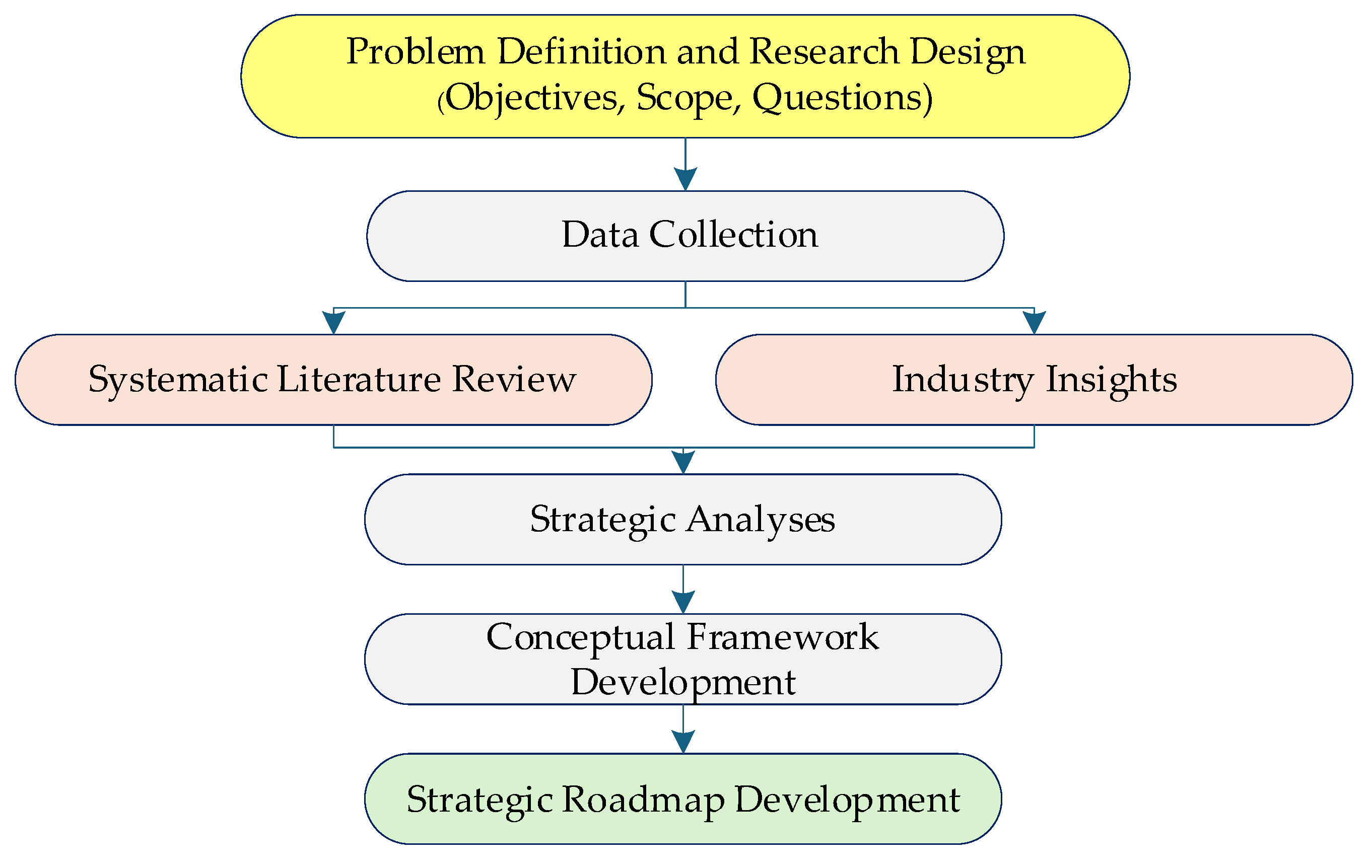
This study employs a layered and iterative research methodology designed to integrate theoretical insights with pragmatic industry perspectives. The process begins with a clear definition of the problem and a research design that establishes the study’s objectives, scope, and guiding questions. Data collection follows a dual approach, combining a systematic literature review with industry insights. The literature review, conducted through comprehensive searches in Scopus, Web of Science, and IEEE Xplore databases, synthesizes relevant concepts, theories, and research gaps. Concurrently, empirical data from technical reports, white papers, and expert interviews enrich the analysis with current and applied knowledge from the field. These combined data sources feed into strategic analyses using tools like McKinsey’s 12 Elements of a Dynamic Operating Model (Krivkovich et al., 2025)and Upgraded TRL-HRL analysis (Browne et al., 2024; Handley et al., 2024; Salazar & Russi-Vigoya, 2021). This allows evaluating internal and external factors influencing the domain, alongside interface mapping to understand the relationships among regulatory, technological, and organizational elements.
Building on these insights, the study develops a conceptual framework through an iterative process involving expert validation. This framework incorporates a multi-layered model to organize interrelated system components and a comparative table that benchmark international practices. Alignment with international standards further enhances the framework’s credibility. Finally, the evaluated framework informs the development of a strategic roadmap, outlining phased implementation steps, critical success factors, and policy recommendations aligned with global objectives such as the Sustainable Development Goals (USDGs) and industry decarbonization targets. This roadmap is tailored to facilitate practical adoption and scalability across diverse stakeholder contexts, thereby bridging academic research with real-world impact. Figure 2 demonstrates these steps.
Figure 1.
Research Methodology.
2. Industry 4.0 Framework for GDSCs
The integration of Industry 4.0 technologies into maritime transport—Shipping 4.0—forms the technological backbone of Green Digital Shipping Corridors (GDSCs). These corridors rely on advanced systems to enable real-time monitoring, predictive maintenance, and semi-autonomous operations, to achive zero-emission shipping. This section outlines a multi-layered Industry 4.0 framework tailored to the unique operational and regulatory demands of GDSCs, highlighting how these technologies reshape maritime logistics, vessel operations, and human-machine interaction.
2.1. Shipping 4.0 Components and Applications
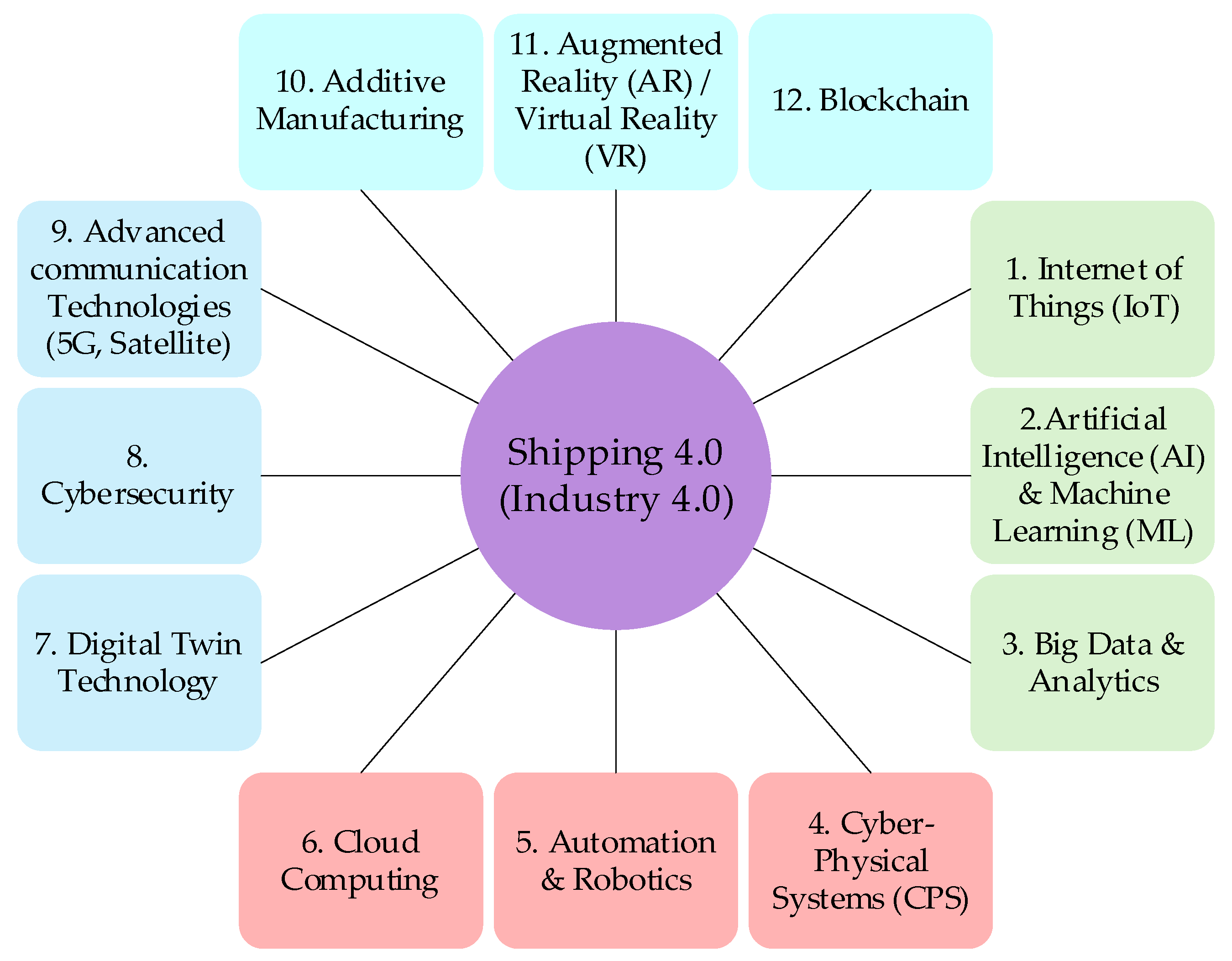
Shipping 4.0 is transforming traditional shipping into a smart, connected, and efficient ecosystem. Central to this transformation is the adoption of technologies such as IoT that enables real-time tracking of vessel conditions, cargo status, and port equipment through embedded sensors, while cloud computing facilitates remote fleet management and operational control. Digital twin technology allows for real-time simulation and diagnostics of ship systems, enhancing maintenance and performance planning. Meanwhile, automation and robotics are revolutionizing both onboard operations and port logistics through autonomous cranes, guided vehicles, and unmanned ships, supported by reliable high-speed communication technologies like 5G and satellite networks. Blockchain further strengthens transparency and trust in global supply chains by securing documentation and transactions such as bills of lading.
Among these technologies, Artificial Intelligence (AI) plays a pivotal role in this digital maritime ecosystem(Ceyhun, 2019; Joshva et al., 2024). In route optimization, AI algorithms analyze weather, currents, and traffic data to propose fuel-efficient paths, reducing both costs and emissions. machine learning models monitor engine performance and predict maintenance by processing historical and real-time operational data to forecast failures and suggest timely interventions. AI is being used to streamline cargo handling, berth scheduling, and customs processing, enhancing overall turnaround time in ports. Emissions monitoring systems powered by AI track the pollutant levels and support compliance with international environmental regulations, while guiding the transition to alternative fuels. Most notably, AI enables Maritime Autonomous Surface Ships (MASS) by integrating navigation, situational awareness, and decision-making systems (Rajapakse & Emad, 2019) pushing the industry toward safer, more sustainable, and unmanned operations (Ceyhun, 2019; Emad et al., 2024; Güner, 2022).
Figure 2.
Shipping 4.0/ Industry 4.0 Components (Aiello et al., 2020; Baum-Talmor & Kitada, 2022; Emad et al., 2020a; Varelas et al., 2023).
Figure 2.
Shipping 4.0/ Industry 4.0 Components (Aiello et al., 2020; Baum-Talmor & Kitada, 2022; Emad et al., 2020a; Varelas et al., 2023).
2.2. Green Digital Shipping Corridors (GDSC)
Green Digital Shipping Corridors (GDSCs) are advanced maritime routes that integrate zero-emission fuels, cutting-edge digital technologies, and collaborative frameworks to accelerate the decarbonization of global shipping(Khabir et al., 2025). At their core, GDSCs rely on sustainable energy sources such as hydrogen, ammonia, methanol, and biofuels, supported by port-based fuel infrastructure and shore-side electrification systems (“Alternative Fuels Data Center: Hydrogen Basics,” n.d.; Editorial Team, 2024; Emad et al., 2020b; Khabir et al., 2020; Khan et al., 2021a, 2021b). These green fuels are complemented by energy-efficient operations and smart logistics systems powered by Industry 4.0 technologies.
Operationally, GDSCs boost fuel efficiency, reduce emissions, and enhance port coordination through smart scheduling, emissions monitoring, and energy optimization tools. These corridors are strategically designed through public-private partnerships that align regulatory, technological, and financial frameworks across borders. Unified efforts among governments, shipping companies, ports, and technology providers enable scalable models, like the Oslo–Rotterdam and Singapore–Los Angeles corridors, that can be replicated globally. GDSCs not only address the shipping sector’s environmental impact but also deliver broader socio-economic benefits, including improved air quality, reduced health risks for port communities, and the stimulation of green economic growth. Their successful implementation depends on deliberate planning, cross-sector collaboration, and strong policy support, making them a transformative approach to sustainable maritime transport. Figure 3 summarizes the core components of green digital shipping corridors (GDSC).
2.3. Comparative Analysis: Traditional vs Industry 4.0 Systems
As maritime transport enters the era of digital transformation, the contrast between traditional navigation and monitoring systems and those aligned with Industry 4.0, especially within the context of Green Digital Shipping Corridors (GDSCs), has become increasingly pronounced. Table 1 provides a structured comparison between these two paradigms, highlighting the key technological, operational, and organizational shifts driving this evolution. By mapping 14 critical dimensions of navigation and monitoring systems, the table outlines how emerging technologies are reshaping maritime operations to enable greater automation, intelligence, and resilience.
Table 1 compares traditional maritime navigation and monitoring systems with those enabled by Industry 4.0 technologies within GDSCs. Traditional systems are typically standalone, hardware-driven, and heavily reliant on manual inputs and crew experience. Their architecture is characterized by fragmented subsystems, limited integration, and static feedback mechanisms. Decision-making and situational awareness depend primarily on human cognition, with low automation and high cognitive load imposed on operators.
Table 1 illustrates that in contrast to the convectional shipping, Industry 4.0 and GDSC systems integrate real-time data processing, predictive analytics, and self-learning capabilities through a unified ecosystem of ship, port, and corridors. Key enhancements include:
- Automation and optimization through AI and CPS,
- Digital supervisory roles for crew members,
- Modular scalability and software-driven adaptability,
- Advanced communication via 5G, satellite, and blockchain,
- Integrated cybersecurity and automated compliance protocols.
Notably, human operators’ role shift from direct control to supervisory and strategic oversight within “human-on-the-loop” decision frameworks, enhancing safety and efficiency (Emad, 2015). The table thus highlights the transformative potential of GDSCs, not only in terms of technology deployment but also in redefining operational paradigms and regulatory approaches in the maritime sector.
2.4. Shipping 4.0 Architecture in GDSC
Shipping 4.0 (Industry 4.0) has precipitated a significant transformation in operations processes, which must be executed through the integration of comprehensive industrial systems (Emad, 2020). Although shipping 4.0 continues to pose considerable challenges for numerous logistics enterprises, reference architectures have seen increased adoption across various domains to assist engineers in defining system interoperability and structural design. Organizations have gained diverse experiences with these reference architectures for shipping 4.0. Nevertheless, the suitability of specific reference architecture varies depending on the distinct use cases it aims to address, potentially affecting its efficacy in supporting organizational transformation(Nakagawa et al., 2021; Narayanan et al., 2023). Furthermore, a complete understanding of existing representative architecture remains elusive. Having a Shipping 4.0 architecture embedded within GDSC is necessary because it provides the digital backbone that connects real-time operational data from ships and ports to high-level decision-making, enabling sustainability, efficiency, and resilience. As illustrated in Figure 4 a pyramid of Shipping 4.0 architecture layered in GDSC ranging from field devices to strategy and enterprise level can be developed. Consequently, each layer is described as follows:
2.4.1. Perception & Control Layer (IoT, CPS)
This foundational layer represents the physical-digital interface of the shipping corridor. It consists of sensors and actuators embedded in ships, cargo systems, and port infrastructure to collect real-time data and initiate automated responses. Internet of Things (IoT) sensors capture critical environmental and operational parameters, such as CO₂, NOₓ, and SOₓ emissions, cargo conditions, hull integrity, and vessel location, while cyber-physical systems (CPS) like smart propulsion, dynamic positioning systems (DPS), and robotic cranes translate digital commands into physical actions. Local control units such as programmable logic controllers (PLCs) and supervisory control and data acquisition (SCADA) systems manage real-time machine behavior, ensuring precision and responsiveness in propulsion, energy use, and port handling operations(Gerrero-Molina et al., 2024; Iqbal et al., 2025). This layer is critical for data acquisition, real-world interaction, and enabling automation at the operational edge.
2.4.2. Communication & Connectivity Layer (IoT, CPS, Edge)
This layer serves as the neural network of the GDSC ecosystem, enabling seamless, secure, and real-time communication between ships, ports, cloud platforms, and edge systems. Advanced maritime communication networks—such as 5G, VDES (VHF Data Exchange System), and satellite routers—ensure constant connectivity even in remote ocean regions(Iqbal et al., 2025; Yang et al., 2022). These technologies support high-bandwidth, low-latency data exchange, which is required for real-time navigation, cargo tracking, and port coordination. In parallel, cybersecurity modules embedded in devices and networks provide robust protection through encryption, intrusion detection, and anomaly diagnostic tools. Blockchain nodes may also be deployed within this layer to secure documentation (e.g., bills of lading), track compliance, and validate transactions across stakeholders, reinforcing trust and transparency throughout the digital corridor(Balador et al., 2018; Nasaruddin & Emad, 2019).
2.4.3. Data Processing & Integration Layer (Edge AI, CPS, Cloud)
This middle layer manages the flow, organization, and contextualization of data captured from the physical environment. It incorporates edge computing systems and localized AI modules to filter, analyze, and act on data close to the source, minimizing latency and reducing dependency on centralized processing. Edge gateways and onboard servers preprocess massive volumes of sensor data, enabling local decision-making in scenarios such as collision avoidance, real-time emissions control, or equipment diagnostics. At the same time, middleware and API gateways ensure seamless interoperability between diverse maritime platforms, ship systems, and port technologies. Digital twin interfaces—virtual representations of physical assets, are also established in this layer to enable synchronized simulation, diagnostics, and forecasting, making it the digital backbone that ensures operational continuity and intelligent integration(Avgeridis et al., 2023; Eom et al., 2023).
2.4.4. Application & Intelligence Layer (Edge AI, Cloud)
This layer transforms processed data into actionable intelligence, driving performance optimization, compliance, and predictive operations. Cloud-based and edge-based applications power advanced analytics tools for route optimization, fuel efficiency, and maintenance forecasting. AI models trained on historical and real-time data enable dynamic voyage planning, cargo sequencing, and emissions reduction strategies. Compliance with international maritime regulations—such as IMO 2020/2050 or MARPOL—can be automated through dedicated tools that log, audit, and report emission levels, waste discharge, and energy consumption(IMO, 2020a, 2020b, 2020c). This layer also supports AI-enhanced decision-making for fleet managers and operators, offering real-time insights into vessel health, environmental impact, and logistical performance. As the brain of the system, it enables adaptive, resilient, and efficient corridor management.
2.4.5. Strategic & Enterprise Layer (Cloud)
This layer, at the top of architecture, encompasses strategic planning, enterprise integration, and sustainability governance. It includes cloud-based Enterprise Resource Planning (ERP) systems(Rub, 2025), Supply Chain Management (SCM) platforms(Lee et al., 2025), and high-level dashboards for tracking emissions, ESG (Environmental, Social, Governance) performance, and compliance metrics(Wang, 2025). Data from all lower layers is aggregated here to support decisions related to long-term fleet planning, investment in green infrastructure, and inter-port collaboration strategies. Digital twin simulations and AI-powered platforms support scenario planning, capacity forecasting, and strategic resource allocation(Carayannis et al., 2025; Spaniol & Rowland, 2023). This layer empowers stakeholders, from logistics executives to sustainability officers, with a comprehensive view of the corridor’s environmental and operational performance, aligning shipping operations with global climate and digital transformation goals.
3. Human Factor’s Operational Readiness
3.1. Necessity and Context
The maritime industry is undergoing a fundamental shift in crew roles as automation, artificial intelligence (AI), and advanced analytics reshaping shipboard operations. Modern seafarers increasingly function as supervisors of AI-driven systems, requiring them to interpret AI-generated insights, validate automated decisions, and intervene in ambiguous or high-stakes scenarios. This evolution demands:
- Digital literacy for navigation of complex systems and robust cybersecurity awareness,
- AI supervision skills to understand machine learning limitations and decision-making boundaries, and
- Cognitive resilience to sustain performance under operational stress.
Without a unified competency framework, training risks becoming reactive and fragmented, unable to meet the integrated demands of human–machine collaboration, predictive operations, and sustainability compliance (Emad & Oxford, 2008).
3.2. Innovative Perspective
This framework addresses four key innovations:
- Bridging Traditional and Future Skills – Each competency maintains a link to its STCW origin while extending into AI-enabled, digitalized workflows.
- Human–Technology Synergy – Competencies are defined to position the human operator as a strategic decision-maker in human-in-the-loop (HITL) systems, ensuring oversight for AI recommendations and ethical considerations.
- Integrated Safety and Cybersecurity Readiness – The framework embeds multi-layered assurance measures, including HITL protocols for safety-critical actions, escalation pathways for low-confidence AI outputs, zero-trust cybersecurity architectures, penetration testing, and explainable AI outputs for transparency.
- Sustainability and Green Competence – Environmental stewardship is integrated into technical and operational competencies, aligning with decarbonization targets and green digital shipping corridor initiatives.
3.3. Human-Machine Interface (HMI) and Operational Design Considerations
Effective application of these competencies requires HMI solutions tailored to maritime environments, where fatigue, noise, and high stress are common. The table supports training for:
- Adaptive HMI designs that adjust to operator skill levels and situational contexts,
- Multimodal feedback systems (visual, auditory, haptic) to enhance situational awareness, and
- Unified decision dashboards integrating AI predictions with real-time sensor inputs, ensuring transparency and rapid escalation options for human intervention.
This focus ensures that automation enhances, rather than replaces, human decision-making authority, particularly in navigation, collision avoidance, and emergency response.
3.4. Continuous Improvement and Adaptation
The competency framework is designed as a living structure, supporting continuous evolution through feedback mechanisms such as:
- Reinforcement Learning from Human Feedback (RLHF) to refine AI performance using operational inputs,
- Combined automated and human evaluation protocols to assess both objective metrics and contextual decision quality, and
- Adaptive regulatory alignment to ensure that safety and performance standards evolve alongside technological capabilities.
3.5. Research Contribution
From an academic standpoint, the competency mapping table contributes by:
- Establishing a taxonomy of Shipping 4.0 competencies that is internationally aligned and operationally actionable.
- Offering a training and assessment blueprint that bridges human factors research with AI, HMI design, and maritime safety science.
- Providing a foundation for Key Performance Indicator (KPI)-linked evaluation models, enabling empirical study of competency impacts on operational efficiency, safety performance, and environmental compliance.
In essence, this framework functions as both a diagnostic tool, identifying competency gaps in AI-augmented operations, and a strategic blueprint for training, policy-making, and ongoing human–machine performance optimization.
The competency mapping in Table 2 provides a structured, multidimensional framework for defining, assessing, and evolving human-factor capabilities in the context of Shipping 4.0. The table organizes competencies into eight key operational domains—Technical & Digital, Cognitive & Situational Awareness, Decision-Making & Problem-Solving, Communication & Collaboration, Leadership & Change, Safety, Sustainability & Green, and Psychological & Human-Centric—and systematically links them to the relevant Standards of Training, Certification and Watchkeeping (STCW) Table/Regulation. Each competency is mapped from its traditional maritime equivalent to its expanded Shipping 4.0 form, concluding with Industry 4.0 implications that highlight operational capabilities such as AI-assisted navigation, predictive maintenance, cyber resilience, and environmental compliance.
4. Strategic Analysis
The successful integration of Industry 4.0 technologies into Green Digital Shipping Corridors (GDSCs) requires a dual focus: transforming organizational structures and ensuring synchronized readiness between advanced systems and their human operators. This section presents two complementary strategic analysis frameworks tailored to the maritime context.
First, the McKinsey 12 Elements of a Dynamic Operating Model is applied to assess how leadership, structure, processes, culture, and talent must be reconfigured to enable safe, efficient, and sustainable human–technology collaboration. Second, an Upgraded Technology Readiness Level–Human Readiness Level (TRL–HRL) Matrix evaluates the maturity of critical Industry 4.0 components alongside the preparedness of seafarers and shore-based personnel to operate, supervise, and adapt to them. Together, these analyses provide an integrated roadmap for aligning organizational transformation with phased technology deployment in GDSCs.
4.1. Dynamic Operating Analysis
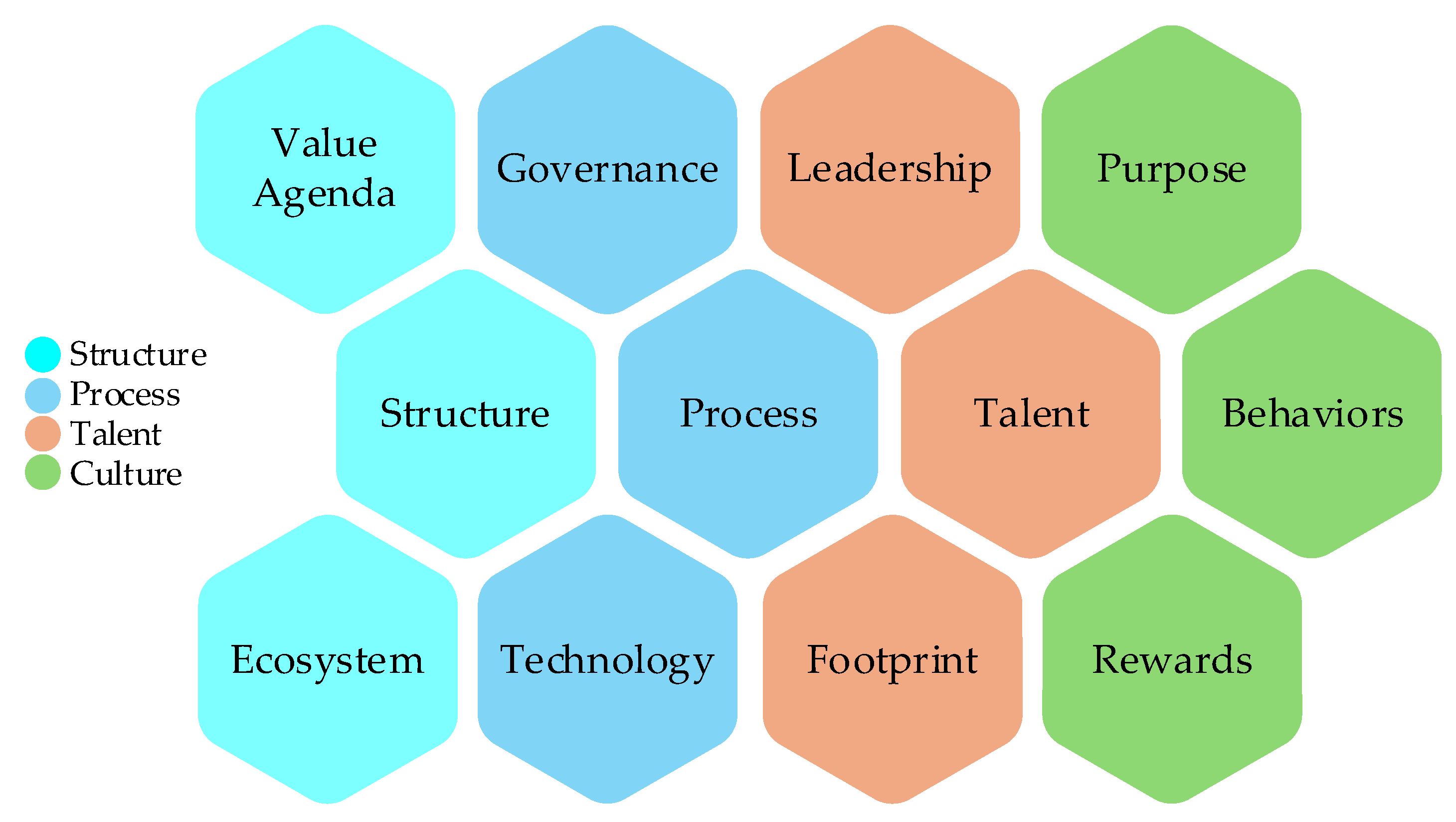
As maritime operations evolve toward cyber-physical and AI-augmented systems within Green Digital Shipping Corridors (GDSCs), a coherent organizational transformation strategy is essential. This section adopts the McKinsey 12 Elements of a Dynamic Operating Model—also known as the “Organize to Value” framework—to assess and guide the integration of human factors in this transition. The framework evaluates how organizations align purpose, processes, technology, and people to create value under conditions of systemic change.
Figure 5.
McKinsey’s 12 elements of the ‘Organize to Value’ system.
1. Purpose
The core purpose of GDSC-enabled shipping organizations must extend beyond logistics efficiency to encompass sustainable, intelligent, and human-centric maritime operations. Clearly articulating this purpose helps crew members and stakeholders understand the “why” behind digital transformation, reducing resistance and anchoring the workforce in a shared mission.
2. Value Agenda
Human-AI collaboration becomes a primary source of value in Shipping 4.0. By shifting human roles from manual execution to digital oversight, companies unlock new efficiencies and safety outcomes. Value is created not just through technology adoption, but through effective training, cognitive resilience, and ethical decision-making.
3. Structure
Organizational design must shift from siloed maritime roles to mission-oriented teams combining AI developers, maritime operators, safety engineers, and trainers. Hybrid roles such as “AI Supervisor” or “Digital Twin Analyst” should be institutionalized within new operational hierarchies.
4. Ecosystem
No single organization can enable GDSCs alone. Port authorities, technology vendors, regulators, and maritime training institutions must collaborate. These partnerships create shared platforms for digital compliance, simulator-based training, and real-time data exchange, generating value beyond individual firm boundaries.
5. Leadership
Leadership must actively champion the human dimensions of AI transformation, not just the technological rollout. Captains, fleet managers, and port executives should model digital adoption, sponsor training initiatives, and serve as agents of cultural change across the organization.
6. Governance
Effective governance involves defining clear decision rights in human–machine interfaces (e.g., human-on-the-loop protocols), managing algorithmic transparency, and allocating resources to both technical and human readiness. Policy and audit frameworks should ensure traceability, override control, and compliance in AI operations.
7. Processes
Maritime workflows must be redesigned for shared control between humans and AI. New processes should include structured feedback loops, cognitive load assessments, ethical escalation paths, and AI validation checkpoints—particularly in autonomous or semi-autonomous contexts.
8. Technology
Technologies like digital twins, IoT sensors, and edge AI are enablers—but only when deployed with intuitive human-machine interfaces (HMIs). Crew members must be trained to interpret system outputs, flag anomalies, and collaborate with AI systems as intelligent partners, not passive users.
9. Behaviors
Culture must shift toward continuous learning, digital trust, and open adaptation. Behavioral norms should encourage seafarers to question AI decisions, provide feedback to developers, and actively engage with data systems—while upholding safety and ethical standards.
10. Rewards
Incentive structures should evolve to recognize non-traditional contributions—such as successful intervention in AI operations, feedback quality, and training progression. Recognition systems must reinforce the value of human judgment in AI-supported environments.
11. Footprint
Crew deployment models must be reevaluated in light of GDSCs. AI-augmented ships may require fewer personnel onboard but more distributed roles, such as remote AI monitors, data analysts, and simulation trainers. Location strategies must align digital capabilities with operational zones.
12. Talent
Organizations must attract, develop, and retain talent with hybrid capabilities: maritime knowledge combined with digital fluency. Training institutions should redesign curricula to cover AI supervision, ethical reasoning in automation, and cybersecurity resilience, ensuring the right capabilities are in place to meet value creation goals.
Conclusion
The McKinsey 12-element operating model provides a comprehensive lens to align technological ambition with human readiness in GDSC implementation. By addressing all facets, from leadership and technology to behaviors and rewards, shipping organizations can establish an integrated, future-proof framework that supports safe, sustainable, and resilient digital transformation at scale.
Building on these insights, the Upgraded Technology Readiness Level–Human Readiness Level (TRL–HRL) Matrix evaluates the maturity of critical Industry 4.0 components alongside the preparedness of seafarers and shore-based personnel to operate, supervise, and adapt to them. Together, these analyses provide an integrated roadmap for aligning organizational transformation with phased technology deployment in GDSCs.
4.2. Upgraded TRL–HRL Analysis
The effective implementation of Industry 4.0 technologies in Green Digital Shipping Corridors (GDSCs) depends not only on the maturity of technological components but equally on the readiness of human operators to engage, supervise, and adapt to these systems. The traditional Technology Readiness Level (TRL) and Human Readiness Level (HRL) frameworks provide a foundation for assessing these dimensions; however, the complexity of AI-augmented maritime operations demands an enhanced version of this matrix. Table 4 proposes an Upgraded TRL–HRL Matrix tailored for GDSCs, incorporating additional dimensions of trust, explainability, cognitive load, and team coordination, which are essential for safe and resilient human–machine integration.
The upgraded matrix introduces five new dimensions beyond standard TRL and HRL assessments (Table 3):
These dimensions directly influence HRL scoring and guide human-centered AI deployment strategies.

Table 4.
Upgraded TRL–HRL Matrix Application in GDSC Context.
| Shipping 4.0 Layer | Technology (TRL) | Human (HRL) | Trust & Explainability | Cognitive Load | Human-AI Integration Readiness |
|---|---|---|---|---|---|
| Perception & Control | TRL 8–9: Mature IoT/CPS | HRL 5–6: Operational proficiency | Moderate (sensor fusion is interpretable) | Medium (multiple alert systems) | Suitable for deployment with monitoring |
| Communication & Connectivity | TRL 7–8: VDES, 5G, blockchain | HRL 3–4: Limited training in protocols | Low to Medium (blockchain is abstract) | Medium | Needs simulation and comms drills |
| Data Processing & Integration | TRL 6–7: Edge AI, middleware | HRL 2–3: Early familiarity | Low (AI decisions are opaque) | High | Not ready; needs transparency tools and training |
| Application & Intelligence | TRL 5–6: Predictive routing, emissions AI | HRL 2–3: Basic dashboard use | Low (black-box AI) | High | High risk; phased rollout with strong oversight |
| Strategic & Enterprise Layer | TRL 4–5: Digital twin planning, ESG dashboards | HRL 1–2: Minimal exposure | Very Low | Variable | Focus on training planners and officers |
Table 5 presents the standardized nine-level scales for Technology Readiness Level (TRL) and Human Readiness Level (HRL), providing a common benchmark for assessing the maturity of Industry 4.0 systems and the corresponding preparedness of their human operators.
5. Implementation Roadmap for GDSCs’ Human Factor
5.1. Implementation Phases
The effective integration of Artificial Intelligence (AI) systems within maritime operations requires a structured, phased approach that addresses both technological reliability and human readiness. A successful roadmap should align system maturity with crew competency, while ensuring regulatory compliance and long-term adaptability.
Phase 1: Controlled Pilot Testing (3–6 months)
Initial deployment should occur in controlled environments such as ship simulators or low-risk operational routes with predictable conditions. This phase focuses on validating the core functionalities of AI systems, identifying potential edge cases, and establishing baseline performance metrics. Concurrently, it provides a safe context for crew members to familiarize themselves with AI-supported operations and interface dynamics.
Phase 2: Workflow Integration (6–12 months)
Upon successful pilot completion, human-AI collaboration protocols must be developed and institutionalized. This includes the formalization of decision-making hierarchies, override protocols, and emergency roles. Specific procedures should be established for communication between bridge teams and AI systems, including standardized response models and user interfaces. The resulting documentation serves as a foundation for subsequent training and certification.
Phase 3: Competency Development (Ongoing)
A multi-tiered training framework is essential to develop the cognitive, technical, and supervisory skills required for effective human-AI interaction. Training should begin with foundational digital literacy and progress toward advanced AI oversight. Simulation-based exercises, grounded in real operational data, should be designed to reflect increasing complexity. Assessment protocols should evaluate not only technical proficiency but also situational judgment and ethical decision-making in AI-assisted contexts.
Phase 4: Regulatory Compliance (Parallel Process)
Engagement with regulatory bodies, including classification societies and flag states, must occur in parallel with system deployment. This includes co-developing certification standards for AI components, establishing algorithmic audit trails, and creating change management protocols for system updates. Compliance must remain adaptive, ensuring AI implementations align with evolving maritime safety and operational regulations.
Phase 5: Operational Refinement (Continuous)
The final phase establishes continuous improvement mechanisms informed by real-world performance data. This includes structured feedback loops with crews, analysis of near-miss and anomalous events, and iterative software updates. Key performance indicators should track both system-level efficiency gains and human-centric metrics, such as reduced cognitive load, improved situational awareness, and enhanced decision accuracy. Organizations must retain the flexibility to revisit earlier phases when scaling to new vessel types or integrating system upgrades.
Across all phases, clearly defined success criteria and transition gates are essential to ensure that technological implementation proceeds in lockstep with crew readiness. A complete fleet-wide rollout typically spans 18–24 months, though continuous adaptation and refinement remain integral throughout the system lifecycle.
5.2. Key Performance Indicators (KPIs)
Table 6 prioritizes and weights critical key performance indicators (KPIs) for human-AI integration in shipping, adding technically essential metrics like model drift and multi-agent coordination. It provides clear benchmarks, scoring scales, and phase alignment to guide decision-making and risk mitigation.
In maturity level, there are some other KPIs to evaluate the competency of the human element, presented in Table 7. The effective operationalization of the proposed competency framework requires a quantitative and qualitative evaluation structure that allows for consistent performance tracking, benchmarking, and continuous improvement. In the context of AI-augmented maritime operations, Key Performance Indicators (KPIs) must address both traditional maritime skill sets and emerging Shipping 4.0 capabilities, capturing dimensions such as technical proficiency, decision-making quality, safety assurance, sustainability compliance, and human–AI collaboration.
This KPI Evaluation Matrix is designed as a dual-purpose tool:
- Framework Function – A structured alignment of competencies to measurable outcomes, enabling comparative analysis across operators, vessels, and organizational units.
- Measurement Package – A standardized scoring and benchmarking system that integrates objective data streams (e.g., system logs, operational performance metrics) and subjective assessments (e.g., peer review, expert evaluation).
KPI Matrix Design Principles
The evaluation system follows five design principles:
- Competency–KPI Alignment – Each KPI directly maps to a defined competency domain in the competency table.
- Mixed-Method Measurement – Integration of quantitative metrics (time-to-decision, system error rate, environmental compliance percentage) with qualitative indicators (leadership adaptability, decision justification quality).
- Benchmark-Driven Scoring – All KPIs are measured against established industry benchmarks (e.g., IMO guidelines, company safety standards, STCW requirements).
- Context-Aware Normalization – KPI results are adjusted for operational context variables such as voyage type, weather severity, and crew experience.
- Continuous Feedback Integration – The evaluation feeds into a reinforcement loop that updates training priorities and AI system design.
Scoring Scale:
- Critical Failure: Does not meet minimum safety or operational standards
- Below Standard: Significant gaps; requires corrective action before phase transition
- Meets Minimum Standard: Acceptable performance; can progress with close monitoring
- Exceeds Standard: Demonstrates strong performance with minor refinements needed
- Best-in-Class: Optimal performance; serves as a benchmark for fleet-wide scaling
6. Conclusions and Future Work
6.1. Key Findings on Technology-Human Alignment
This study has proposed an integrated human–technology readiness framework for implementing Industry 4.0 technologies within Green Digital Shipping Corridors (GDSCs). By combining a five-layer Shipping 4.0 architecture, a comparative analysis of traditional and digitalized maritime systems, and a structured human competency model aligned with STCW standards, the research addresses a critical gap in current GDSC discourse—operational readiness of human actors. Strategic analyses using McKinsey’s 12 Elements of a Dynamic Operating Model and an upgraded TRL–HRL matrix revealed that while technological maturity in areas such as IoT, CPS, and AI is advancing rapidly, human readiness, particularly in trust calibration, AI explainability, cognitive load management, and multi-agent coordination, lags behind.
The proposed competency framework and KPI evaluation matrix provide practical tools for bridging this gap, ensuring that crew members evolve from manual operators to supervisory decision-makers in AI-augmented environments (Emad & Shahbakhsh, 2022b). The phased implementation roadmap emphasizes the need for parallel development of system capability and human proficiency, underpinned by continuous training, regulatory alignment, and performance monitoring.
6.2. Strategic Implications
For Shipping Companies: Adopting AI-augmented operations requires more than system procurement; it demands workforce restructuring, targeted training, and cultural change. Companies should institutionalize “human-on-the-loop” oversight protocols, integrate KPI-based competency monitoring, and phase technology rollouts to match crew proficiency levels. Continuous feedback loops between operators, developers, and management will ensure system adaptability and sustained operational performance.
For Regulators and Policy Makers: Policy frameworks must evolve to certify not only technology but also human readiness. This includes establishing standards for AI transparency, override authority, cyber resilience, and ethical decision-making. Regulators should promote interoperability across corridors and incentivize training programs that integrate sustainability goals with digital competency development.
For Maritime Training Institutions: Curricula should extend beyond conventional STCW competencies to incorporate AI supervision, digital twin interaction, cybersecurity, and alternative fuel handling. Simulation-based, scenario-driven learning environments should reflect real GDSC operational contexts, enabling seafarers to practice both technical execution and ethical judgment in AI-assisted environments.
6.3. Future Research
Future studies should focus on longitudinal validation of the upgraded TRL–HRL framework through real-world GDSC deployments, capturing data on human–machine performance over extended operational periods. Research is also needed on adaptive HMI designs that dynamically adjust to operator expertise and situational demands, as well as on integrating human feedback into AI model retraining pipelines. Comparative analyses of different corridor implementations could yield best practices for global scalability, while socio-economic studies could evaluate the broader impacts of AI-augmented GDSCs on maritime employment patterns and coastal communities.
Author Contributions
Writing—original draft preparation, M.Kh.; Writing—review & editing, G.E. and M.Sh. All authors have read and agreed to the published version of the manuscript.
Funding
Not applicable.
Conflicts of Interest
The authors declare that they have no known competing financial interests or personal relationships that could have appeared to influence the work reported in this paper.
Data Availability Statement
No new data were created or analyzed in this study. Data sharing is not applicable to this article.
References
- Aiello, G.; Giallanza, A.; Mascarella, G. Towards shipping 4.0. A preliminary gap analysis. Procedia Manufacturing 2020, 42. [Google Scholar] [CrossRef]
- Alternative Fuels Data Center: Hydrogen Basics. (n.d.). Www.Afdc.Energy.Gov. Retrieved December 14, 2019, from http://www.afdc.energy.gov/fuels/hydrogen_basics.html.
- Avgeridis, L.; Lentzos, K.; Skoutas, D.; Emiris, I.Z. (2023). Time Series Analysis for Digital Twins in Green Shipping. SNAME 8th International Symposium on Ship Operations, Management and Economics, SOME 2023. [CrossRef]
- Balador, A.; Kouba, A.; Cassioli, D.; Foukalas, F.; Severino, R.; Stepanova, D.; Agosta, G.; Xie, J.; Pomante, L.; Mongelli, M. Wireless communication technologies for safe cooperative cyber physical systems. Sensors 2018, 18, 4075. [Google Scholar] [CrossRef] [PubMed]
- Baum-Talmor, P.; Kitada, M. Industry 4.0 in shipping: Implications to seafarers’ skills and training. Transportation Research Interdisciplinary Perspectives 2022, 13, 100542. [Google Scholar] [CrossRef]
- Bengue, A.A.; Alavi-Borazjani, S.A.; Chkoniya, V.; Cacho, J.L.; Fiore, M. Prioritizing Criteria for Establishing a Green Shipping Corridor Between the Ports of Sines and Luanda Using Fuzzy AHP. Sustainability (Switzerland) 2024, 16. [Google Scholar] [CrossRef]
- Borromeo, G.A. Shaping the Future of Seafaring in an Age of Safer, Smarter, and Greener Shipping. Maritime Digitalization and Decarbonization 2024, 180. [Google Scholar]
- Browne, S.; Pike, T.; Bailey, M.M. A proposed framework for artificial intelligence safety and technology readiness assessments for national security applications. OSF Preprints 2024, 8. [Google Scholar] [CrossRef]
- Carayannis, E.G.; Dumitrescu, R.; Falkowski, T.; Papamichail, G.; Zota, N.-R. Enhancing SME resilience through artificial intelligence and strategic foresight: A framework for sustainable competitiveness. Technology in Society 2025, 81, 102835. [Google Scholar] [CrossRef]
- Ceyhun, G.Ç. Recent developments of artificial intelligence in business logistics: A maritime industry case. Digital Business Strategies in Blockchain Ecosystems: Transformational Design and Future of Global Business 2019, 343–353.
- Diaz, S.; Al Hammadi, N.; Seif El Nasr, A.; Villasuso, F.; Prakash, S.; Baobaid, O.; Gracias, D.; Mills, R. (2023). Green Corridor: A Feasible Option for the UAE Decarbonization Pathway, Opportunities & Challenges. Society of Petroleum Engineers - ADIPEC, ADIP 2023. [CrossRef]
- Dolatabadi, S.H.; Masodzadeh, P.G.; Ishaq, H.; Crawford, C. Green shipping corridors: An overview of Pacific Northwest region and key ports. Ocean & Coastal Management 2025, 269, 107745. [Google Scholar] [CrossRef]
- Durlik, I.; Miller, T.; Cembrowska-Lech, D.; Krzemińska, A.; Złoczowska, E.; Nowak, A. Navigating the sea of data: a comprehensive review on data analysis in maritime IoT applications. Applied Sciences 2023, 13, 9742. [Google Scholar] [CrossRef]
- Editorial Team. (2024, December 23). WMU launches training program on alternative shipping fuels. SAFETY4SEA. https://safety4sea.com/wmu-launches-training-program-on-alternative-shipping-fuels/.
- Editors, M. Feasibility of Green Shipping Corridors. Sustainability 2023, 16, 9563. Available online: https://www.mdpi.com/2071-1050/16/21/9563.
- Editors, S. (2023a). Green Shipping Corridors: Opportunities and Challenges. Springer. https://link.springer.com/chapter/10.1007/978-3-031-39936-7_31.
- Editors, S. (2023b). Supportive Policies for Green Shipping Corridors. Sustainability Science, 16, 300. https://link.springer.com/chapter/10.1007/978-3-031-39936-7_31.
- Emad, G.R. Study of the Effectiveness of Trainings for Port Logistics Workers in Improving the Safety Level of Ports (Case study: Chabahar Port, Iran). Journal of Maritime Research 2015, 12, 105–110. [Google Scholar]
- Emad, G.R. (2020). Shipping 4.0 disruption and its impending impact on maritime education. In Disrupting Business as Usual in Engineering Education, 31st Annual Conference of the Australasian Association for Engineering Education (AAEE 2020): (1st ed., Vol. 1, pp. 202–207). Engineers Australia.
- Emad, G.R.; Enshaei, H.; Ghosh, S. Identifying seafarer training needs for operating future autonomous ships: a systematic literature review. Australian Journal of Maritime & Ocean Affairs 2022, 14, 114–135. [Google Scholar] [CrossRef]
- Emad, G.R.; Khabir, M.; Shahbakhsh, M. (2020a). Shipping 4.0 and training seafarers for the future autonomous and unmanned ships. Proceedings of the 21th Marine Industries Conference (MIC2019), Qeshm Island, Iran, 1–2.
- Emad, G.R.; Khabir, M.; Shahbakhsh, M. (2020b). The Role of Maritime Logistics in Sustaining the Future of Global Energy: The Case of Hydrogen. 21st Marine Industry Conference.
- Emad, G.R.; Oxford, I. Rethinking maritime education and training. Proceedings of the 16th International Maritime Lecturers Association Conference 2008, 91–98.
- Emad, G.R.; Shahbakhsh, M. (2022a). Digitalization Transformation and its Challenges in Shipping Operation: The case of seafarer’s cognitive human factor. Human Factors in Transportation, 60. [CrossRef]
- Emad, G.R.; Shahbakhsh, M. (2022b). Digitalization Transformation and its Challenges in Shipping Operation: The case of seafarer’s cognitive human factor. Human Factors in Transportation, 60. [CrossRef]
- Emad, G.R.; Shahbakhsh, M.; Cahoon, S. (2024). Seafarers’ Challenges in the Transition Period to Autonomous Shipping: Shipping Industry’s Perspective.
- Emad, G.R.; Shahbakhsh, M.; Khabir, M. (2025). Artificial Intelligence and its Transformative Impact in Shaping the Maritime Industry. In D. Rajesh & B. Svilicic (Eds.), International Association of Maritime Universities Conference. International Association of Maritime Universities (IAMU).
- Eom, J.O.; Yoon, J.H.; Yeon, J.H.; Kim, S.W. Port Digital Twin Development for Decarbonization: A Case Study Using the Pusan Newport International Terminal. Journal of Marine Science and Engineering 2023, 11. [Google Scholar] [CrossRef]
- Fakhri, A.B.; Mohammed, S.L.; Khan, I.; Sadiq, A.S.; Alkazemi, B.; Pillai, P.; Choi, B.J. Industry 4.0: Architecture and equipment revolution. Comput. Mater. Continua 2021, 66, 1175–1194. [Google Scholar] [CrossRef]
- Fan, S.; Yang, Z. Analysing seafarer competencies in a dynamic human-machine system. Ocean & Coastal Management 2023, 240, 106662. [Google Scholar] [CrossRef]
- Gerrero-Molina, M.-I.; Vásquez-Suárez, Y.-A.; Valdés-Mosquera, D.-M. Smart, green, and sustainable: unveiling technological trajectories in maritime port operations. IEEE Access 2024, 12, 47713–47723. [Google Scholar] [CrossRef]
- Güner, A. (2022). General AI vs. Narrow AI: 2022 Guide.
- Han, S.; Wang, T.; Chen, J.; Wang, Y.; Zhu, B.; Zhou, Y. Towards the Human–Machine Interaction: Strategies, Design, and Human Reliability Assessment of Crews’ Response to Daily Cargo Ship Navigation Tasks. Sustainability 2021, 13. [Google Scholar] [CrossRef]
- Handley, H.A.H.; See, J.E.; Savage-Knepshield, P.A. Human readiness levels and Human Views as tools for user-centered design. Systems Engineering 2024, 27, 1089–1102. [Google Scholar] [CrossRef]
- Heering, D. (2025). Rethinking Seafarer Training for the Digital Age. In Maritime Cybersecurity (pp. 29–53). Springer.
- Helmann, A.; Deschamps, F.; Loures, E. de F. R. Reference architectures for industry 4.0: Literature review. Transdisciplinary Engineering for Complex Socio-Technical Systems–Real-Life Applications 2020, 171–180.
- IMO. (2020a). Further consideration of concrete proposals to improve the operational energy efficiency of existing ships, with a view to developing draft amendments to chapter 4 of MARPOL annex vi and associated guidelines, as appropriate (ISWG-GHG 7/2/6). https://www.ics-shipping.org/docs/default-source/Submissions/IMO/proposal-for-a-goal-based-operational-measure.pdf?sfvrsn=2.
- IMO. (2020b). GHG Emissions. http://www.imo.org/en/OurWork/Environment/PollutionPrevention/AirPollution/Pages/GHG-Emissions.aspx.
- IMO, S. (2020c). Fourth greenhouse gas study 2020. International Maritime Organization London, UK.
- Iqbal, A.B.; Tariq, F.; Sumra, I.A.; Rasheed, K. The Digital Evolution of the Maritime Industry: Unleashing the Power of IoT and Cloud Computing. Journal of Computing & Biomedical Informatics 2025, 9.
- Jokioinen, E. (2016). Remote and Autonomous Ship-The next steps. https://www.rolls-royce.com/~/media/Files/R/Rolls-Royce/documents/customers/marine/ship-intel/aawa-whitepaper-210616.pdf.
- Joshva, J.; Diaz, S.; Kumar, S.; Suboyin, A.; AlHammadi, N.; Baobaid, O.; Villasuso, F.; Konig, M.; Binamro, A.; Saputelli, L. (2024). Navigating the Future of Maritime Operations: The AI Compass for Ship Management. ADIPEC. [CrossRef]
- Kavallieratos, G.; Diamantopoulou, V.; Katsikas, S.K. Shipping 4.0: Security requirements for the cyber-enabled ship. IEEE Transactions on Industrial Informatics 2020, 16, 6617–6625. [Google Scholar] [CrossRef]
- Kavallieratos, G.; Katsikas, S.; Gkioulos, V. Modelling shipping 4.0: A reference architecture for the cyber-enabled ship. Asian Conference on Intelligent Information and Database Systems 2020, 202–217. [Google Scholar]
- Khabir, M.; Emad, G.R.; Shahbakhsh, M. Toward future green shipping: resilience and sustainability indicators. Proceedings of the 10th Asian Logistics Round Table Conference (ALRT) 2020, 391–417. [Google Scholar]
- Khabir, M.; Emad, G.R.; Shahbakhsh, M.; Dulebenets, M.A. A Strategic Pathway to Green Digital Shipping. Logistics 2025, 9. [Google Scholar] [CrossRef]
- Khan, M.A.; Yasmin, M.; Khan, M.H.H. Alternative Fuels – Prospects for the Shipping Industry. TransNav, the International Journal on Marine Navigation and Safety of Sea Transportation 2021, 15, 137–142. [Google Scholar]
- Khan, M.A.; Yasmin, M.; Khan, M.H.H. Alternative Fuels – Prospects for the Shipping Industry. TransNav, the International Journal on Marine Navigation and Safety of Sea Transportation 2021, 15, 137–142. [Google Scholar]
- Krivkovich, A.; Di Lodovico, A.; Weddle, B.; Maor, D.; Mahadevan, D.; Steele, R. (2025). A new operating model for a new world.
- Lee, J.; Sim, M.; Kim, Y.; Lim, H.; Lee, C. Strategizing Artificial Intelligence Transformation in Smart Ports: Lessons from Busan’s Resilient AI Governance Model. Journal of Marine Science and Engineering 2025, 13, 1276. [Google Scholar] [CrossRef]
- Luchenko, D.; Georgiievskyi, І.; Bielikova, M. (2023). Challenges and Developments in the Public Administration of Autonomous Shipping.
- Malau, A.G.; Purnama, C.; Simanjuntak, M.B. Developing Competency-Based Maritime Education for the Digital Age. Journal of Maritime Research 2025, 22, 100–106. [Google Scholar]
- Martelli, M.; Virdis, A.; Gotta, A.; Cassarà, P.; Di Summa, M. An outlook on the future marine traffic management system for autonomous ships. IEEE Access 2021, 9, 157316–157328. [Google Scholar] [CrossRef]
- MEPC; R (2023). 2023 IMO strategy on reduction of GHG emissions from SHIPS.
- Nakagawa, E.Y.; Antonino, P.O.; Schnicke, F.; Capilla, R.; Kuhn, T.; Liggesmeyer, P. Industry 4.0 reference architectures: State of the art and future trends. Computers & Industrial Engineering 2021, 156, 107241. [Google Scholar] [CrossRef]
- Narayanan, S.C.; Emad, G.R.; Fei, J. Theorizing seafarers’ participation and learning in an evolving maritime workplace: an activity theory perspective. WMU Journal of Maritime Affairs 2023, 22, 165–180. [Google Scholar] [CrossRef]
- Nasaruddin, M.M.; Emad, G.R. (2019). Preparing Maritime Professionals for their Future Roles in a Digitalized Era: Bridging the blockchain skills gap in maritime education and training. 87–97.
- Rajapakse, R.; Emad, G.R. A Review of Technology, Infrastructure and Human Competence of Maritime Stakeholders on the Path Towards Autonomous Short Sea Shipping. 20th International Association of Maritime Universities Annual General Assembly 2019, 313–320. [Google Scholar]
- Rodseth, O.; Burmeister, H.-C. (2015). Report D10. 2: New ship design for autonomous vessels. Maritime Unmanned Navigation through Intelligence in Networks (MUNIN).
- Rub, A. The Role of Artificially Intelligent ERP Systems in Automating Business Processes, Enhancing Decision-Making, and Transparency and Compliance within Organizations: A Case Study for Private Sector Companies. Journal of Business and Management Research 2025, 4, 1102–1125. [Google Scholar] [CrossRef]
- Salazar, G.; Russi-Vigoya, M.N. (2021). Technology Readiness Level (TRL) as the foundation of Human Readiness Level (HRL). Sage Journals: Ergonomics in Design: The Quarterly of Human Factors Applications.
- Shahbakhsh, M.; Emad, G.R.; Cahoon, S. Industrial revolutions and transition of the maritime industry: The case of Seafarer’s role in autonomous shipping. The Asian Journal of Shipping and Logistics 2022, 38, 10–18. [Google Scholar] [CrossRef]
- Slotvik, D.A.; Endresen, Ø.; Eide, M.; Skåre, O.G.; Hustad, H. (2022). Insight on green shipping corridors From policy ambitions to realization. Nordic Roadmap Publication, 3-A/1/2022.
- Song, Z.Y.; Chhetri, P.; Ye, G.; Lee, P.T.W. (2023). Green maritime logistics coalition by green shipping corridors: a new paradigm for the decarbonisation of the maritime industry. International Journal of Logistics Research and Applications. [CrossRef]
- Spaniol, M.J.; Rowland, N.J. AI-assisted scenario generation for strategic planning. Futures & Foresight Science 2023, 5, e148. [Google Scholar]
- Theotokatos, G.; Dantas, J.L.D.; Polychronidi, G.; Rentifi, G.; Colella, M.M. (2023a). Autonomous shipping—an analysis of the maritime stakeholder perspectives. WMU Journal of Maritime Affairs, 22, 5–35.
- Theotokatos, G.; Dantas, J.L.D.; Polychronidi, G.; Rentifi, G.; Colella, M.M. (2023b). Autonomous shipping—an analysis of the maritime stakeholder perspectives. WMU Journal of Maritime Affairs, 22, 5–35.
- Varelas, T.; Kaklis, D.; Varlamis, I.; Flori, A. (2023). Improving Voyage Efficiency in the Shipping 4.0 Decarbonization Era.
- Wang, X. (2025). Research on the Change of Enterprise Strategy Management Mode Empowered by Artificial Intelligence.
- Yang, T.; Cui, Z.; Alshehri, A.H.; Wang, M.; Gao, K.; Yu, K. Distributed maritime transport communication system with reliability and safety based on blockchain and edge computing. IEEE Transactions on Intelligent Transportation Systems 2022, 24, 2296–2306. [Google Scholar] [CrossRef]
- Yu, Y.-U.; Lee, C.-H.; Ahn, Y.-J. Developing a Competency-Based Transition Education Framework for Marine Superintendents: A DACUM-Integrated Approach in the Context of Eco-Digital Maritime Transformation. Sustainability 2025, 17, 6455. [Google Scholar] [CrossRef]
- Zhang, S.; Feng, C. Evolutionary game model for decarbonization of shipping under green shipping corridor. International Journal of Low-Carbon Technologies 2024, 19, 2502–2511. [Google Scholar] [CrossRef]
Figure 3.
Green Digital Shipping Corridors’ (GDSCs) components (Khabir et al., 2025).
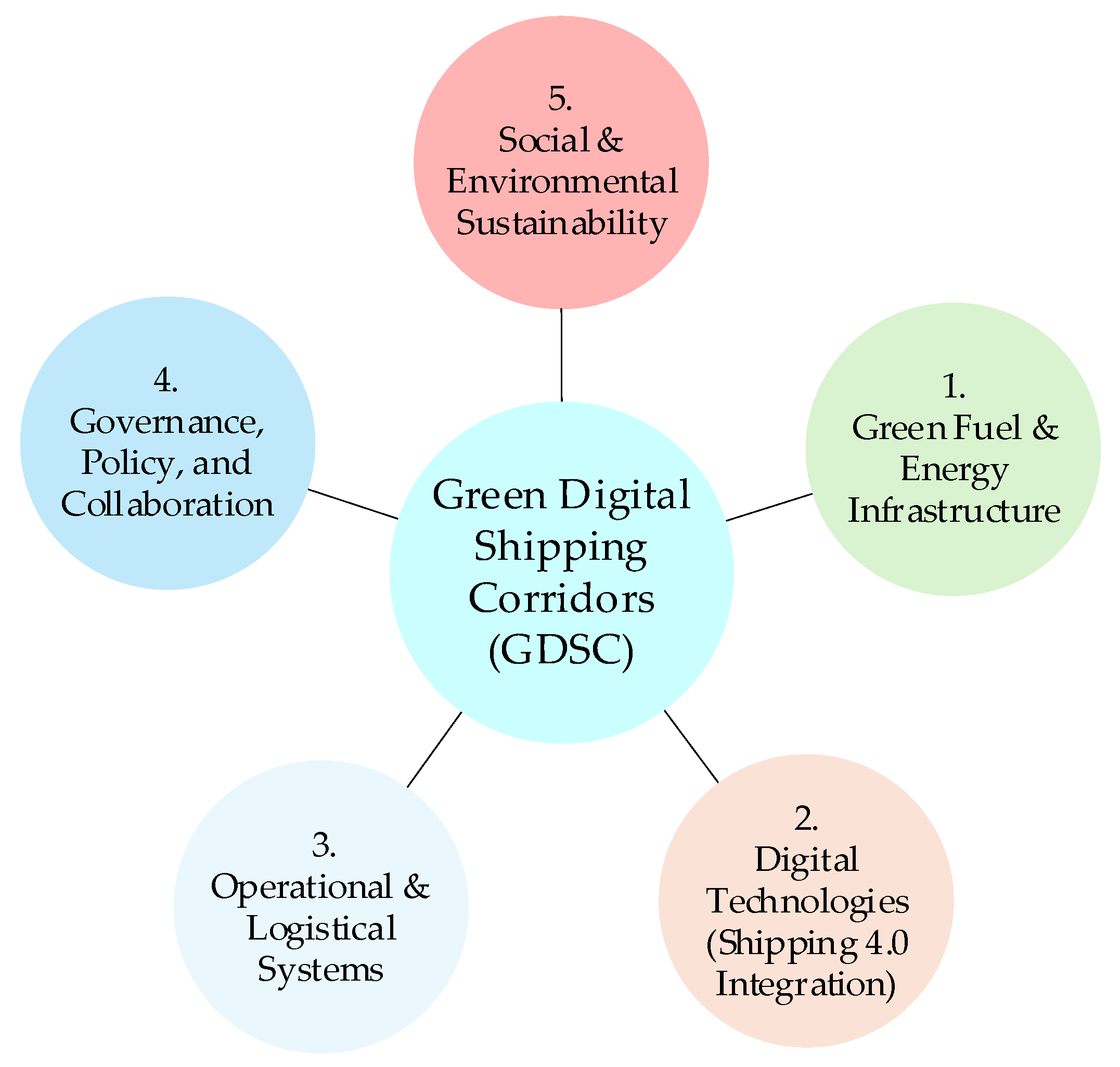
Figure 4.
Pyramid of Shipping 4.0 architecture layered in GDSC: from field devices to strategy (developed by authors based on (Fakhri et al., 2021; Helmann et al., 2020; Kavallieratos, Katsikas, et al., 2020; Nakagawa et al., 2021)).
Figure 4.
Pyramid of Shipping 4.0 architecture layered in GDSC: from field devices to strategy (developed by authors based on (Fakhri et al., 2021; Helmann et al., 2020; Kavallieratos, Katsikas, et al., 2020; Nakagawa et al., 2021)).
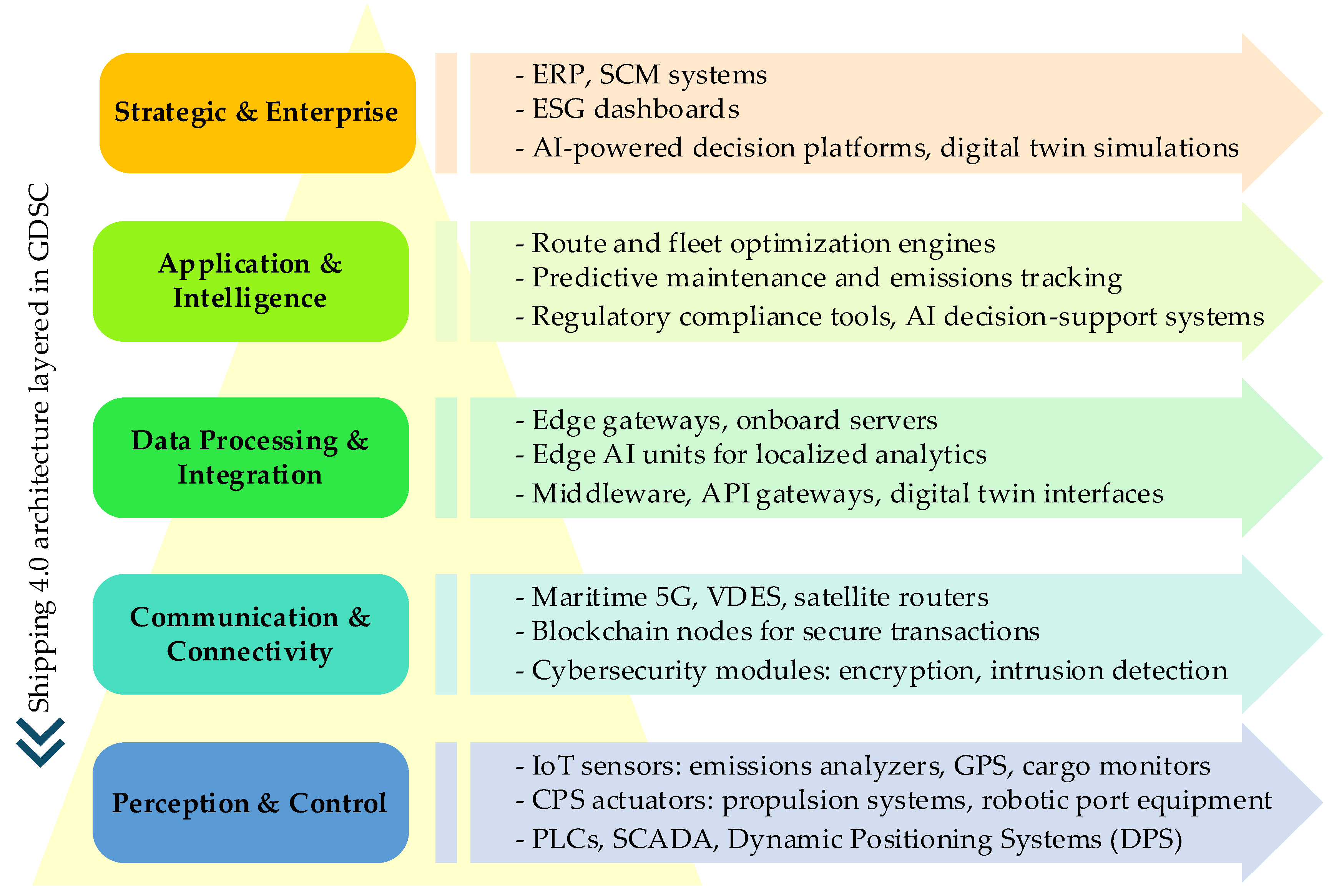
Table 1.
Traditional” vs. “Industry 4.0 + GDSC” in Maritime Navigation & Monitoring Systems (Durlik et al., 2023; Emad et al., 2025; Kavallieratos, Diamantopoulou, et al., 2020; Martelli et al., 2021).
Table 1.
Traditional” vs. “Industry 4.0 + GDSC” in Maritime Navigation & Monitoring Systems (Durlik et al., 2023; Emad et al., 2025; Kavallieratos, Diamantopoulou, et al., 2020; Martelli et al., 2021).
| Category | Navigation & Monitoring Systems | |
|---|---|---|
| Traditional | Shipping 4.0 (Industry 4.0) | |
|
Definition & Architecture |
Standalone shipboard systems (radar, GPS, AIS) for individual vessels, limited integration or intelligence. | Incorporating IoT, CPS, Digital Twins, Edge AI, and Cloud platforms, corridor-wide awareness, optimization. |
|
System Integration |
Fragmented subsystems requiring manual coordination by crew. | Integrated ship, port, and corridor systems visa digital twins; interoperability all systems. |
|
Data Flow & Processing |
Linear and manual data transfer; raw sensor data interpreted by crew. | Real-time, bi-directional data with edge and cloud analytics. |
|
Automation Level |
Low automation, manual navigation, and monitoring dominate. | High automation via AI, CPS, and autonomous decision support; |
|
Decision-Making & Operator Role |
Human-centric decision-making based on experience and limited real-time. | Human-on-the-loop models: AI-assisted decision-making, with operators’ supervisory |
|
System Feedback & Learning |
Static systems; performance relies on manual updates and retrofits. | Self-learning ML systems are improving performance continuously. |
|
Fault Detection & Prediction |
Reactive fault identification; failures detected after occurrence. | Predictive maintenance via IoT and AI anomaly detection. |
|
Situational Awareness |
Crew synthesizes radar, visual, and manual data for awareness. | Multi-sensor fusion and digital twins for holistic awareness. |
|
Crew–System Interface (HMI) |
Disjointed interfaces, high cognitive load | Unified, adaptive HMIs reducing complexity. |
| Role of the Crew | Manual operators of all functions | Digital supervisors focusing on exceptions and strategy. |
|
Scalability & Adaptability |
Hardware-bound, costly upgrades. | Modular, software-driven, corridor-wide scalability. |
|
Communication Infrastructure |
Onboard communication; shore interaction through manual reporting. | Maritime 5G, satellite, and blockchain for secure low-latency exchange. |
| Cybersecurity | Limited exposure but outdated protections. | Integrated real-time cybersecurity with encryption and anomaly response. |
|
Regulatory & Compliance |
Manual reporting, inspection-based compliance. | Automated compliance via IoT, digital twins, and AI forecasting. |
Table 2.
Core Competencies for seafarers in navigation(Borromeo, 2024; Fan & Yang, 2023; Heering, 2025; Malau et al., 2025; Yu et al., 2025).
Table 2.
Core Competencies for seafarers in navigation(Borromeo, 2024; Fan & Yang, 2023; Heering, 2025; Malau et al., 2025; Yu et al., 2025).
| Competency Domain | Shipping 4.0 Human-Factor Competency | Relevant STCW Table / Regulation | Traditional Competency |
Shipping 4.0 Expanded Competency | Industry 4.0 Implication |
|---|---|---|---|---|---|
| Technical & Digital | Automation Systems Operation | A-II/1 (Navigation), A-III/1 (Engineering) | Use of radar, ECDIS, GNSS, and bridge equipment | Automation systems operation; AI-assisted navigation; IoT sensor integration; remote vessel control | Manage autonomous navigation & control systems |
| HMI Proficiency | A-II/1, A-V/2 | Engine monitoring, equipment maintenance | Predictive maintenance via data analytics; integration of smart engine systems; alternative fuel handling | Operate multi-modal displays & integrated systems | |
| AI & Data Analytics | A-II/1 (Use of radar/ECDIS), A-III/1 | Team coordination in emergencies | Human–machine coordination under automation; remote crisis management; AI-driven decision support | Apply predictive analytics for safety & efficiency | |
| IoT & Sensor Integration | A-II/1, A-III/1 | LNG safety procedures | Multi-fuel safety (LNG, ammonia, hydrogen); automation-based fuel monitoring | Monitor & validate sensor data in connected ships | |
| Cybersecurity Awareness | A-II/1, STCW Manila Amendments Sec. B-VIII/2 | Schedule compliance, rest hours | Cybersecurity resilience; digital diagnostics; predictive analytics maintenance scheduling | Protect critical maritime IT/OT systems | |
| Digital Navigation Tools | A-II/1 | Effective communication and task allocation | Cross-disciplinary comms between crew, automation, and shore; multicultural digital teamwork | Operate ECDIS, ARPA, GNSS, radar safely | |
| Remote Operations Control | A-II/1, A-V/2 | Chart-based route planning | Dynamic route optimization using AI, big data, and real-time environmental inputs | Control MASS from shore facilities | |
| Cognitive & Situational Awareness | Situational Awareness (SA) | A-II/1, A-V/2 | Waste & emission control | Energy efficiency management (SEEMP); decarbonization strategies; IoT-based environmental monitoring | Maintain real-time vessel/environment awareness |
| Information Processing | A-II/1 | Manual inspection & fault fixing | Cybersecurity resilience; digital diagnostics; predictive analytics maintenance scheduling | Filter & prioritize key data under automation | |
| Workload Management | A-II/1, A-V/2 | Manual cargo planning | Automated cargo monitoring systems; integration with digital twins for loading plans | Balance mental load in semi- and fully-autonomous ops | |
| Adaptability | A-II/1, A-V/2 | Leading crew operations | Change management for tech adoption; strategic thinking for autonomous operations integration | Adjust to mode changes & automation states | |
| Decision-Making & Problem-Solving | Risk-Based Decision-Making | A-II/1, A-V/2 | Risk identification, drills | Data-driven risk modelling; simulation-based training for MASS and smart port interfaces | Apply risk models in operational choices |
| Problem Diagnosis & Resolution | A-II/1, A-III/1 | Manual inspection & fault fixing | Cybersecurity resilience; digital diagnostics; predictive analytics maintenance scheduling | Identify & fix technical/operational faults | |
| Crisis Management | A-V/2 (Crisis Mgmt) | Team coordination in emergencies | Human–machine coordination under automation; remote crisis management; AI-driven decision support | Act under emergencies with automation factors | |
| Ethical & Legal Judgment | A-II/1, A-V/2 | Risk identification, drills | Data-driven risk modelling; simulation-based training for MASS and smart port interfaces | Apply IMO/flag law in automation contexts | |
| Communication & Collaboration | Cross-Disciplinary Communication | A-II/1 | Effective communication and task allocation | Cross-disciplinary comms between crew, automation, and shore; multicultural digital teamwork | Coordinate with tech, operations, and shore teams |
| Multicultural Communication | A-II/1, B-VIII/2 | Multicultural communication | Integrated comms platforms; human–AI dialogue systems; real-time multi-language translation tools | Overcome cultural & language barriers | |
| Human–Machine Coordination | A-II/1 | Team coordination in emergencies | Human–machine coordination under automation; remote crisis management; AI-driven decision support | Manage control handovers between humans & systems | |
| Teamwork & Leadership | A-V/2, A-II/1 | Leading crew operations | Change management for tech adoption; strategic thinking for autonomous operations integration | Lead mixed human-autonomy crews | |
| Leadership & Change | Strategic Thinking | A-V/2 | Leading crew operations | Change management for tech adoption; strategic thinking for autonomous operations integration | Align tech adoption with operational goals |
| Change Management | A-V/2 | Leading crew operations | Change management for tech adoption; strategic thinking for autonomous operations integration | Guide teams through digital transitions | |
| Continuous Learning Culture | B-VIII/2 (Guidance) | Multicultural communication | Encourage upskilling for evolving tech | Encourage upskilling for evolving tech | |
| Safety, Sustainability & Green | Environmental Awareness | A-II/1, A-V/2 | Waste & emission control | Energy efficiency management (SEEMP); decarbonization strategies; IoT-based environmental monitoring | Apply MARPOL, SEEMP, BWM standards |
| Alternative Fuel Handling | A-III/1, A-V/3 | LNG safety procedures | Multi-fuel safety (LNG, ammonia, hydrogen); automation-based fuel monitoring | Safe handling of LNG, ammonia, hydrogen, etc. | |
| Energy Efficiency Operations | A-II/1, A-III/1 | Energy efficiency management (SEEMP) | Energy efficiency management (SEEMP); decarbonization strategies; IoT-based environmental monitoring | Operate for low emissions & fuel efficiency | |
| Resilience & Safety Culture | A-V/2 | Schedule compliance, rest hours | Promote proactive, just safety culture | Promote proactive, just safety culture | |
| Psychological & Human-Centric | Resilience & Stress Management | A-V/2 | Schedule compliance, rest hours | Maintain performance under high cognitive load | Maintain performance under high cognitive load |
| Emotional Intelligence | A-V/2 | Multicultural communication | Manage relationships in diverse crews | Manage relationships in diverse crews | |
| Ergonomics Awareness | B-VIII/2 | Schedule compliance, rest hours | Use systems to reduce fatigue & errors | Use systems to reduce fatigue & errors |
Table 3.
Framework Enhancements-dimensions (Salazar & Russi-Vigoya, 2021).
| Dimension | Description |
|---|---|
| Trust Calibration | Measures operator confidence in AI decisions and their ability to override them. |
| Explainability Readiness | Assesses whether AI system outputs are transparent and interpretable by humans. |
| Cognitive Load Compatibility | Evaluates the mental effort required to operate or supervise digital systems. |
| Multi-Agent Coordination | Assesses crew’s readiness to coordinate with other humans, AI agents, and systems. |
| Ethical Oversight Capability | Measures user awareness and action in ethically ambiguous automation scenarios. |
Table 5.
Standardized scales for TRL (Technology Readiness Level) and HRL (Human Readiness Level)(Salazar & Russi-Vigoya, 2021).
Table 5.
Standardized scales for TRL (Technology Readiness Level) and HRL (Human Readiness Level)(Salazar & Russi-Vigoya, 2021).
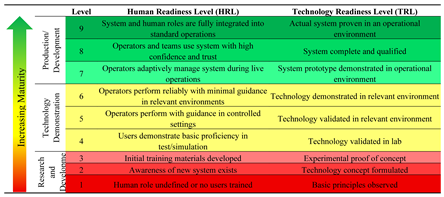
Table 6.
Key Performance Indicators (KPIs) for Human-AI Implementation in GDSCs.
| KPI Category | Indicator | Criteria or Measurement | Benchmark | Scoring Scale | Phase | Criticality |
|---|---|---|---|---|---|---|
| Technological Reliability |
AI core functionality accuracy |
% of successful task executions in controlled environments | ≥ 95% accuracy in pilot tests | 1 = <80%; 2 = 80–89%; 3 = 90–94%; 4 = 95–97%; 5 = ≥98% |
Phase 1 | High |
| Model Drift | Change in model performance over time (precision/recall degradation %) | < 2% drift per quarter | 1 = >10%; 2 = 6–10%; 3 = 3–5%; 4 = 1–2%; 5 = <1% |
Phase 5 (Continuous) |
High | |
| Multi-Agent coordination |
Latency and accuracy of AI-to-AI and AI-to-human communication | Latency < 1 sec; ≥ 90% correct coordination |
1 = <70%; 2 = 70–79%; 3 = 80–89%; 4 = 90–94%; 5 = ≥95% |
Phase 2 & 5 | High | |
| Human Readiness |
Crew familiarity with AI interfaces | % of crew demonstrating baseline proficiency in simulator assessments | ≥ 85% crew proficiency | 1 = <60%; 2 = 60–74%; 3 = 75–84%; 4 = 85–94%; 5 = ≥95% |
Phase 1 | High |
| Cognitive load reduction | NASA-TLX or equivalent workload index | ≥ 20% reduction from baseline | 1 = <5%; 2 = 5–9%; 3 = 10–14%; 4 = 15–19%; 5 = ≥20% |
Phase 5 (Continuous) |
Medium | |
| Situational awareness | Performance in scenario-based assessments (e.g., recognition of anomalies) | ≥ 90% correct anomaly identification | 1 = <70%; 2 = 70–79%; 3 = 80–89%; 4 = 90–94%;5 = ≥95% |
Phase 3 | High | |
| Workflow Integration |
Decision-making Hierarchy adherence |
% of operations following defined human-AI decision protocols | ≥ 95% adherence | 1 = <70%; 2 = 70–79%; 3 = 80–89%; 4 = 90–94%; 5 = ≥95% |
Phase 2 | High |
| Override protocol effectiveness | Response time and accuracy during emergency override drills | < 10 sec response; ≥ 95% correct overrides |
1 = >30 sec/<70%;2 = 20–30 sec/70–79%; 3 = 15–19 sec/80–89%; 4 = 10–14 sec/90–94%; 5 = <10 sec/≥95% | Phase 2 | High | |
| Competency Development |
Training progression rate | % of crew achieving advanced AI oversight certification within timeframe | ≥ 80% certified within 12 months | 1 = <50%; 2 = 50–64%; 3 = 65–79%; 4 = 80–89%; 5 = ≥90% |
Phase 3 | High |
| Ethical decision-making | Score on validated ethical decision-making tests in AI-supported scenarios | ≥ 90% compliance with ethical guidelines |
1 = <60%; 2 = 60–74%; 3 = 75–84%; 4 = 85–89%; 5 = ≥90% |
Phase 3 | Medium | |
| Regulatory Compliance |
Certification attainment | % of AI components meeting classification society standards | 100% certification | 1 = <70%; 2 = 70–84%; 3 = 85–94%; 4 = 95–99%; 5 = 100% |
Phase 4 (Parallel) |
High |
| Audit trail completeness | % of AI decision logs traceable and verifiable | ≥ 95% completeness | 1 = <70%; 2 = 70–79%; 3 = 80–89%; 4 = 90–94%; 5 = ≥95% |
Phase 4 & 5 | High | |
| Operational Refinement |
Near-miss reporting rate | % of near-miss events reported and analyzed | ≥ 90% reporting rate | 1 = <50%; 2 = 50–69%; 3 = 70–79%; 4 = 80–89%; 5 = ≥90% |
Phase 5 (Continuous) |
Medium |
| Decision accuracy | % of correct human-AI decisions in real-world operations | ≥ 98% decision accuracy | 1 = <80%; 2 = 80–89%; 3 = 90–94%; 4 = 95–97%; 5 = ≥98% |
Phase 5 (Continuous) |
High | |
| Efficiency gains | % improvement in fuel use, routing, or other operational KPIs | ≥ 10% improvement from baseline | 1 = <3%; 2 = 3–5%; 3 = 6–7%; 4 = 8–9%; 5 = ≥10% |
Phase 5 (Continuous) |
Medium |
Table 7.
Key Performance Indicators (KPIs) in Maturity level of for Human Element Competency level in Shipping 4.0.
Table 7.
Key Performance Indicators (KPIs) in Maturity level of for Human Element Competency level in Shipping 4.0.
| KPI Category | Indicator | Criteria / Measurement | Benchmark | Scoring Scale |
|---|---|---|---|---|
| Technical & Digital | Automation Systems Operation | Evaluate the ability to configure, monitor, and operate autonomous navigation and propulsion systems, including initiating safe overrides during system faults. | ≥98% correct operations, ≤1% error rate | 1=<80%, 2=80–89%, 3=90–94%, 4=95–97%, 5=≥98% |
| HMI Proficiency | Measure operator’s response time and accuracy when interpreting system alerts, adjusting parameters, and acknowledging alarms on bridge consoles. | ≤5s response, ≥95% accuracy | 1=>10s/<80%, 2=8–10s/80–89%, 3=6–7s/90–94%, 4=5s/95–97%, 5=≤4s/≥98% | |
| AI & Data Analytics | Assess ability to interpret AI-generated predictive maintenance reports, identify anomalies, and recommend corrective actions with supporting data. | ≥95% correct diagnostics | Same 1–5 scale as above | |
| IoT & Sensor Integration | Evaluate skill in validating sensor readings, cross-checking data sources, and ensuring real-time integration with ship control systems. | ≥97% accuracy | Same scale | |
| Cybersecurity Awareness | Measure speed and accuracy in detecting, reporting, and responding to simulated cyber threats, phishing attempts, or malware alerts. | 100% detection in simulation | 1=<70%, 2=70–79%, 3=80–89%, 4=90–94%, 5=≥95% | |
| Digital Navigation Tools | Assess competence in operating ECDIS, GNSS, ARPA, and radar safely under various voyage conditions, including in degraded mode scenarios. | 100% compliance with SOP | Same scale | |
| Remote Operations Control | Measure ability to remotely control propulsion and steering functions with minimal latency, ensuring operational continuity during automation transitions. | ≤2s latency, ≥98% success | Same scale | |
| Cognitive & Situational Awareness | Situational Awareness | Assess capability to detect, interpret, and predict changes in environmental and vessel conditions while multitasking under pressure. | ≥95% detection in drills | Same scale |
| Information Processing | Evaluate ability to filter, prioritize, and integrate high volumes of data from multiple systems into actionable decisions within strict time limits. | ≥95% correct outputs in 1 min | Same scale | |
| Workload Management | Measure effectiveness in prioritizing operational tasks, allocating crew resources, and meeting voyage deadlines without overloading personnel. | ≥95% tasks on time | Same scale | |
| Adaptability | Assess speed and accuracy in shifting from manual to autonomous operations and vice versa while maintaining safety standards. | ≤30 sec transition | 1=>90s, 2=60–89s, 3=45–59s, 4=31–44s, 5=≤30s | |
| Decision-Making & Problem-Solving | Risk-Based Decision-Making | Evaluate ability to identify hazards, assess risk levels, and select optimal mitigation strategies under realistic operational scenarios. | ≤2 min, ≥95% accuracy | Same scale |
| Problem Diagnosis & Resolution | Measure diagnostic accuracy and time taken to isolate faults in shipboard systems and implement corrective measures. | ≤10 min | 1=>30 min, 2=21–30 min, 3=15–20 min, 4=11–14 min, 5=≤10 min | |
| Crisis Management | Assess ability to execute crisis protocols, coordinate emergency teams, and maintain situational control during high-pressure simulations. | 100% adherence | Same scale | |
| Ethical & Legal Judgment | Evaluate awareness and application of IMO, SOLAS, and flag state legal frameworks in operational decision-making. | 100% compliance | Same scale | |
| Communication & Collaboration | Cross-Disciplinary Communication | Assess clarity, conciseness, and timeliness in communicating with engineering, navigation, shore control, and automation teams. | 0 incidents/month | 1=≥4 incidents, 2=3, 3=2, 4=1, 5=0 |
| Multicultural Communication | Measure ability to adapt communication style to diverse cultural and linguistic backgrounds while ensuring operational clarity. | 0 incidents/month | Same scale | |
| Human–Machine Coordination | Evaluate effectiveness in handovers between human and automated control systems, ensuring no operational gaps or conflicts. | ≤3s delay, no error | Same scale | |
| Teamwork & Leadership | Measure ability to foster collaboration, resolve conflicts, and align team performance with voyage objectives. | ≥95% target met | Same scale | |
| Leadership & Change | Strategic Thinking | Evaluate ability to formulate, articulate, and defend long-term strategies for technology adoption and operational improvement. | ≥95% KPI success in trials | Same scale |
| Change Management | Assess ability to gain stakeholder buy-in, train personnel, and maintain productivity during technology or process transitions. | ≥90% adoption in 3 months | Same scale | |
| Continuous Learning Culture | Measure the extent to which individuals promote training participation, knowledge sharing, and skill renewal among the crew. | ≥95% completion | Same scale | |
| Safety, Sustainability & Green | Environmental Awareness | Evaluate ability to identify, monitor, and reduce environmental risks in line with SEEMP, BWM, and MARPOL guidelines. | 100% audit compliance | Same scale |
| Alternative Fuel Handling | Assess skill in safe storage, transfer, and use of alternative fuels such as LNG, ammonia, and hydrogen. | 100% safe execution | Same scale | |
| Energy Efficiency Operations | Measure ability to apply operational adjustments to optimize fuel usage and reduce emissions without compromising safety. | ≥10% improvement | 1=<4%, 2=4–6%, 3=7–8%, 4=9%, 5=≥10% | |
| Psychological & Human-Centric | Resilience & Stress Management | Evaluate consistency of decision-making, concentration, and accuracy under sustained mental or physical stress conditions. | ≥95% normal performance | Same scale |
| Emotional Intelligence | Measure ability to perceive, interpret, and respond constructively to the emotions of team members in high-pressure situations. | ≥4.5/5 score | 1=<3, 2=3–3.4, 3=3.5–3.9, 4=4–4.4, 5=≥4.5 | |
| Ergonomics Awareness | Assess compliance with ergonomic best practices to reduce fatigue and prevent injury during routine and emergency tasks. | ≥95% compliance | Same scale |
Disclaimer/Publisher’s Note: The statements, opinions and data contained in all publications are solely those of the individual author(s) and contributor(s) and not of MDPI and/or the editor(s). MDPI and/or the editor(s) disclaim responsibility for any injury to people or property resulting from any ideas, methods, instructions or products referred to in the content. |
© 2025 by the authors. Licensee MDPI, Basel, Switzerland. This article is an open access article distributed under the terms and conditions of the Creative Commons Attribution (CC BY) license (http://creativecommons.org/licenses/by/4.0/).
Copyright: This open access article is published under a Creative Commons CC BY 4.0 license, which permit the free download, distribution, and reuse, provided that the author and preprint are cited in any reuse.