

Submitted:
01 October 2025
Posted:
01 October 2025
You are already at the latest version
Abstract
Let R bea2-torsion free and n!-torsion free commutative ring with unity, and let
X bealocally finite pre-ordered set. Using the method of Ghahramani and Heidari
Zadeh [22], we endow the incidence algebra I(X,R) with a superalgebra structure
via a nontrivial idempotent, decomposing I(X,R) into even and odd parts A0⊕A1.
If any two directed edges in each connected component of the complete Hasse
diagram (X,D) are contained in one cycle, then every supercommuting map on the
incidence algebra I(X,R) is proper. A supercommuting map θ : I(X,R) → I(X,R)
satisfies [θ(x),x]s = 0 for all x ∈ I(X,R), where [a,b]s = ab − (−1)|a||b|ba is the
supercommutator for homogeneous elements, extended linearly [40, 41, 27]. We
prove that such maps are of the form θ(x) = λx+µ(x), where λ ∈ Zs(I(X,R)) (the
supercenter) and µ : I(X,R) → Zs(I(X,R)) is an R-linear map, under the given
cycle condition, generalizing results on commuting maps [24, 44, 14].
Keywords:
supercommuting maps
; incidence algebras
; superalgebras
1. Introduction
The study of commuting maps, defined via the usual commutator , originated with results on automorphisms and derivations. Divinsky proved non-identity commuting automorphisms on rings imply commutativity [1]. Posner showed centralizing derivations on prime rings are zero [2]. Brešar characterized commuting maps on prime rings as , with in the extended centroid and mapping to the center [3,4,5]. These extended to semiprime rings and von Neumann algebras [6]. Further work covered triangular algebras [7], generalized matrix algebras [8], and incidence algebras [9].
Engel-type conditions, like n-commuting maps where , were studied in prime and semiprime rings [10,11]. Beidar et al. explored functional identities tied to commuting maps [12,13,14].
In superalgebras, supercommuting maps link to Lie superderivations, super biderivations, and Jordan superhomomorphisms [15,16,17,18,19]. Recent studies connect to alternative rings and Toeplitz operators [20,21]. Ghahramani and Zadeh examined Lie superderivations on unital algebras with idempotents [22]. Luo and Chen studied supercommuting maps in similar contexts [23].
Generalizing to superalgebras is important because they model graded structures in physics (e.g., supersymmetry) and quantum mechanics, extending classical algebras to include fermionic and bosonic parts. This allows unified treatment of even and odd elements, relevant in Lie theory and representation theory [24].
A unital algebra A with nontrivial idempotent e () has Peirce decomposition , forming a generalized matrix algebra. The superstructure sets and , yielding superderivation results [22]. For superalgebra basics, see Kac [24].
Incidence algebras over locally finite preordered sets consist of functions with if , under convolution . Introduced by Ward for arithmetic functions [25], developed by Rota and Stanley for combinatorics [26]. Maps on , like automorphisms and derivations, are well-studied [27,28,29,30,31,32]. For fundamentals, see Spiegel and O’Donnell [33].
This paper extends commuting map theory to supercommuting maps on incidence superalgebras. Compared to Brešar [4] (prime rings), Xiao and Wei [8] (generalized matrix algebras), and Jia and Xiao [9] (incidence algebras), our novelty lies in incorporating superstructures, proving all supercommuting maps are proper under a cycle condition on the Hasse diagram. This aligns with superalgebra studies [22,23] and generalizes Jia’s results [9].
2. Preliminaries
Throughout this paper, let R denote a commutative ring with unity that is 2-torsion free and -torsion free. An associative algebra A over R is said to be a superalgebra if it admits a direct sum decomposition into R-submodules such that for . The submodule is called the even part, and is the odd part. Elements in are homogeneous, and the degree of a homogeneous element is denoted by , where if .
For homogeneous elements , the supercommutator is defined as
This extends linearly to all elements in A. Note that if either a or b is even, then , the usual commutator. If both are odd, then , the anticommutator.
The supercenter of A, denoted , is the set
It decomposes as , where . The usual center satisfies .
A linear map is called supercommuting if
Such a map is proper if it can be expressed as
where with , and is R-linear. If for all x, then is supercentral. For a unital A with nontrivial idempotent e, set . The Peirce decomposition is
with multiplication rules: , , etc., and zero otherwise for incompatible products [8]. The superstructure is , [22].
Condition (1.1) from [34] ensures nontriviality: for , if then ; similarly for elements in . Examples include triangular algebras, matrix algebras, and prime algebras with idempotents [34].
Supercommuting maps satisfy . Proper forms are with constraints as above [17,19]. Improper maps exist in certain cases, but our main result shows properness under graph-theoretic conditions.
We now introduce standard notations for the incidence algebra . The unity element of is given by for , where is the Kronecker delta. For with , let be defined by if , and otherwise. Then by the definition of convolution. [33]. The center and diagonal subalgebra play key roles [33].
The Hasse diagram has edges for covering relations (i.e., with no z such that ). Connected components decompose as a product [33].
Our contribution extends commuting map theory to supercommuting maps on incidence superalgebras. Assuming every two directed edges in each connected component of the Hasse diagram lie in a cycle, we prove all supercommuting maps on are proper. This generalizes results on commuting maps of incidence algebras [9] and aligns with structural studies in associative superalgebras [22,23].

Table 1.
Summary of Notations
| Notation | Description |
|---|---|
| R | Commutative ring with unity, 2-torsion free, -torsion free |
| X | Locally finite pre-ordered set |
| Incidence algebra over X and R | |
| Even and odd parts of superalgebra | |
| Supercommutator: | |
| Supercenter of A | |
| Supercommuting map: | |
| Basis element of | |
| Unity element of | |
| Complete Hasse diagram | |
| ≈ | Equivalence on directed edges |
3. The Connected Case
R is a 2-torsion free commutative ring with unity, and X is a locally finite pre-ordered set, with the complete Hasse diagram such that any two directed edges in each connected component are contained in one cycle. The incidence algebra is endowed with a superalgebra structure via a nontrivial idempotent e, where is the even part (degree 0) and is the odd part (degree 1) [22]. In this section, we study supercommuting maps on when X is connected. A map is supercommuting if for all , where for homogeneous , extended linearly [18].
Lemma 1.
Let A be an R-algebra with a superalgebra structure , and let θ be a supercommuting map on A. Let satisfy for some integer , where b is an idempotent. Then .
Proof. Case 1. First assume a is homogeneous, with parity . Since is supercommuting, we have
so
Multiplying (1) on the right by another a and applying the same identity repeatedly, we obtain by induction
Now compute
But by ,
Since (mod 2), the exponent in the supercommutator
Hence by simplification, we conclude
By assumption, is idempotent. The above calculation shows
Case 2. If a is not homogeneous, write with . Expand as a sum of monomials in . Each monomial is homogeneous, and the calculation above shows that supercommutes with each such homogeneous monomial. By linearity, the same holds for their sum. Thus
for general a, i.e. . □
Corollary 1.
Let A be an R-algebra with a superalgebra structure, and let θ be a supercommuting map on A. If is an idempotent, then .
Proof.
Since e is idempotent (), apply Lemma 1 with , , and . Thus, . □
The set forms an R-linear basis of when X is finite. For and , we write or for short. Let be a supercommuting map. We denote
with the convention if .
Lemma 2.
The supercommuting map θ satisfies
Proof.
Assume . Since is idempotent and even (), by Corollary 1, . Which yields
Thus, implies for . Left-multiplying by
This gives if or . For , consider the idempotent . By Corollary 1, , so
Multiplying by on the left and on the right
Combining, .
For , verify that is idempotent
since , , . By Corollary 1, , so
Since (as or ), which gives
For , is idempotent, giving
Multiplying appropriately, we get if , if , and if . Thus
□
Lemma 3.
Let X be a connected, locally finite pre-ordered set, and let be a supercommuting map on the incidence algebra , where R is a 2-torsion free commutative ring with unity, and is endowed with a superalgebra structure [22]. Then the coefficients in the expansion are subject to the following relations:
- (R1)
- , if ;
- (R2)
- , if ;
- (R3)
- , if and ;
- (R4)
- , for all ;
- (R5)
- , if .
Proof.
From Lemma 2, we have
Consider the supercommutator relation for and any , derived from the idempotent (as in Lemma 2). It follows that
Since (), and may have even and odd components, we write , where and . Thus
Now,
Similarly, for , since :
Equating, we get
This implies
- For : , so .
- For : , so .
- For : .
Thus, for , set in the first case: , proving (R1). For , set , in the second case: , proving (R2). For , , the third case gives , proving (R3).
For (R5), if , from (R2): , and from (R1): . By (R3), , so .
For (R4), consider and with , . The element is idempotent for . By Lemma 1, , so
We find , giving . Similarly, for , we get for . For , consider , which satisfies . This yields . For , gives . From , we get . Combining, for all . Since X is connected, for any , there exists a sequence where covers or is covered by . Applying recursively yields , proving (R4). □
Definition 1.
For any two directed edges , define if and only if there is a cycle containing both and . The relation ≈ is an equivalence relation on D.
Example 1.
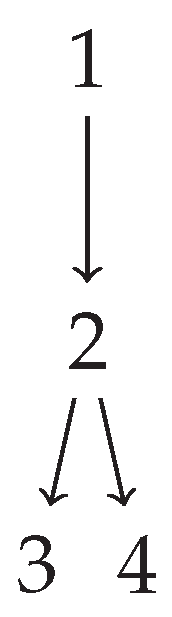
Let with partial order relations (or arrows) , , and . The corresponding Hasse diagram is the Dynkin diagram of type , and the associated complete Hasse diagram is depicted in Figure 1.
Thus, , since the directed edges and are contained in the cycle , with , , , .
Proposition 1.
Let R be a 2-torsion free commutative ring with unity, and let X be a finite, connected pre-ordered set. Let be endowed with a superalgebra structure via a nontrivial idempotent e [22]. Then every supercommuting map , satisfying for all , is proper if and only if any two directed edges in the complete Hasse diagram are contained in one cycle.
Proof.
Assume any two directed edges in are contained in one cycle, i.e., the equivalence relation ≈ has a single equivalence class. By Lemma 2, for a supercommuting map , we have:
From Lemma 3, the coefficients satisfy:
- (R1)
- , if ;
- (R2)
- , if ;
- (R3)
- , if , ;
- (R4)
- , for all ;
- (R5)
- , if .
By (R4), for all , so:
Since (the unity element, with ), we have , as for all f. By (R5), for all , since all edges are in the same equivalence class under ≈. For , set . By (R1) and (R2), for any or , we adjust coefficients to align with the supercenter.
Define , where if . Then
where , and since for fixed . Thus, is proper.
Conversely, if some edges and are not in the same cycle, the equivalence classes under ≈ split D. By [9], a commuting map may be improper in such cases, and similarly, a supercommuting map may fail to be proper due to inconsistent across equivalence classes, violating (R5) uniformity.
Example 2.
Let with relations , , , and . The Hasse diagram of X is a 4-cycle (a square):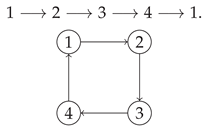
In this case, any two directed edges are contained in a cycle. For instance, via the cycle , and via the same cycle. Thus, the condition of Proposition 1 is satisfied.
4. Supercommuting Maps on Incidence Algebras
Since R be a commutative ring with unity that is 2-torsion free and -torsion free for some positive integer n, and be a locally finite pre-ordered set, possibly infinite, with the incidence algebra endowed with a superalgebra structure via a nontrivial idempotent e, where is the even part (degree 0) and is the odd part (degree 1). The supercommutator is defined as for homogeneous elements , extended linearly. A map is supercommuting if for all .
Definition 2.
Let and . The restriction of f to is defined by
Let be the R-subspace of generated by the elements with . Thus, consists of functions that are nonzero only at a finite number of pairs . The map , defined by , is an algebra homomorphism for any .
Definition 3.
content...For a multilinear map , we define its trace (or diagonal evaluation) by
Lemma 4.
Let be a supercommuting map on the incidence algebra , where R is -torsion free for some positive integer n. For any and , we have
Proof.
Define the map by
where the polynomial in noncommutative variables is defined inductively by
for . Since is supercommuting, we have . Consider the n-fold supercommutator
where the supercommutator is applied n times. The trace of satisfies
Linearizing , we obtain
where is the symmetric group on . Set and , where is the basis element with and zero elsewhere, and (since ). Substituting into (4), we get
Now replace f with , where . Since is an algebra homomorphism, we apply the same substitution
The second terms in (5) and (6) are identical, as they depend only on and . Subtracting (6) from (5), we obtain
Since R is -torsion free, we have
Evaluate at . For any , compute the supercommutator with
Since , unless , so . Iteratively, for
and higher iterates yield zero at . Similarly, for the restricted function
However, we need the value of . Recompute
Instead, use Lemma 2.9 adapted to the superalgebra context. For any ,
Consider . For , we need
Apply to both sides of (7)
Since is an algebra homomorphism and , we evaluate at
because higher supercommutators vanish due to ’s idempotence and degree 0. Similarly
From (7), since R is -torsion free
This completes the proof. □
Theorem 1.
Let be a supercommuting map on the incidence algebra , where R is 2-torsion free and -torsion free, and any two directed edges in the complete Hasse diagram are contained in one cycle. Then θ is proper.
Proof.
Assume without loss of generality, as the case corresponds to the supercommuting condition . Restrict to , the subalgebra of functions nonzero at finitely many pairs , and denote the restriction by . Since is supercommuting, for all , we have .
By the superalgebra analogue of [9], adapted to , if satisfies (with n supercommutators), then , which is already satisfied since is supercommuting. By the superalgebra version of [9] [Theorem 2.5], since inherits the superalgebra structure and the cycle condition holds, is proper. Thus, there exists and an R-linear map such that
Since X is connected and the Hasse diagram satisfies the cycle condition, the supercenter consists of diagonal functions constant on connected components, and for a connected X, (analogous to [33]). Thus, we may take .
Define by
We need to show that is central-valued, i.e., for all . For , we have
since . For any and , by Lemma 4, we have
Thus,
since , and elements in the supercenter are diagonal (i.e., zero off the diagonal). Hence, for all , so is diagonal
Next, we prove that for all , ensuring . Since X is connected, it suffices to show for . Consider the map
where , , and . Since is supercommuting, . Linearizing , we get
Replace with , since and supercommutes with f. Set , , and . Then
since terms with involve , which is diagonal. This simplifies to
as appears once with permutations. Since R is -torsion free, we have
We find
Since is diagonal and even (), and , we get
Higher supercommutators with (even), yield
Thus,
Since X is connected, for some , so
Hence, , and is proper. The cycle condition ensures consistency of coefficients, as in [9]. □
Example 3.
Let , which is -torsion free for all , and let with the natural order . The incidence algebra has -basis
where denotes the characteristic function of .
Choose the idempotent . Then the induced -grading is
Define by
That is, is obtained by doubling f and then adding a diagonal function whose entries are all equal to the trace .
Claim. θ is a supercommuting map and hence proper.
Proof. For write
where . Since is diagonal with constant diagonal entries, we have . As clearly supercommutes with f, and central elements also supercommute, it follows that
Thus θ is supercommuting. By Theorem 1, θ is proper, with and μ central-valued. □
5. The General Case
In this section, we study supercommuting maps on the incidence algebra in the general case, i.e., without assuming connectedness of X. Let R be a commutative ring with unity that is -torsion free, and let be endowed with a superalgebra structure via a nontrivial idempotent e, with even part and odd part . The supercommutator is defined as for homogeneous elements , extended linearly. For a positive integer n, we define the super-n-center of an R-algebra A as follows:
where , and for . Clearly, , the supercenter of A.
Lemma 5.
Let be the family of connected components of a locally finite pre-ordered set X, and let be the incidence algebra over a commutative ring R that is -torsion free, endowed with a superalgebra structure. Let θ be a supercommuting map on , i.e., for all . Then, for each , there exists a unique supercommuting map on and a unique map such that the restriction of θ on satisfies:
Proof.
Since X is a locally finite pre-ordered set, its connected components partition X, and the incidence algebra decomposes as , where each is a subalgebra with the induced superalgebra structure. For each , let be the canonical projection onto , and let be the canonical projection onto the complementary subalgebra. Define
Clearly, , and this decomposition is unique since and project onto complementary subspaces.
For any , since is supercommuting, we have
Write , where and . Since , we have for any with , as only if . Thus
since . Hence
This shows that is a supercommuting map on .
Next, we show that . Define the map by
where , , and for . Since is supercommuting, . For n-fold supercommuting, we assume . Linearizing this condition gives
Let and for some . Then
Since , , and , we have . We find
because , so . The second term involves , but we focus on the first term
Since R is -torsion free, we get
Thus, , as has support only in . This completes the proof. □
Proposition 2.
Let be a family of -torsion free R-algebras, each endowed with a superalgebra structure. If for all , then every n-supercommuting map on , satisfying for all , is proper if and only if every n-supercommuting map on is proper for all .
Proof.
Let be an n-supercommuting map on , i.e., for all . By the superalgebra analogue of Lemma 5, for each , the restriction , where is an n-supercommuting map, and is an R-linear map.
Sufficiency: Assume every n-supercommuting map on is proper for all . Then, for each , there exist and an R-linear map such that for all . Define the R-linear map by
where with . Define
for all . We need to show that . Since is n-supercommuting, we have the linearized condition
where and . Set and for some . This gives
Compute ,
Since , we have
For , evaluate
Since and , for , we have because has no component in . Thus
Now,
Since , we have because . Thus,
Hence,
Since R is -torsion free and for all , we have
Thus, . However, since and , we must have . Therefore
This implies
Since and , we can define , where . Thus:
where and is R-linear. Hence, is proper.
Necessity: Suppose there exists some such that not every n-supercommuting map on is proper. Then there exists an n-supercommuting map that is improper. Construct a map by
where for the given i, and for , is a proper n-supercommuting map, say for some . For , compute
since for . Since each is n-supercommuting, , so is n-supercommuting. However, is improper, so cannot be proper, as its restriction to is . This completes the proof. □
Theorem 2.
Let R be a commutative ring with unity that is 2-torsion free and -torsion free for some positive integer n. Let X be a locally finite pre-ordered set with connected components , and let be the incidence algebra endowed with a superalgebra structure via a nontrivial idempotent e. If any two directed edges in each connected component of the complete Hasse diagram are contained in one cycle, then every supercommuting map is proper.
Proof.
Since X is a locally finite pre-ordered set, its incidence algebra decomposes as , where each is a subalgebra with the induced superalgebra structure via e. By Lemma 5, for a supercommuting map on , the restriction to is , where is supercommuting, and .
Since each satisfies the cycle condition (any two directed edges are in one cycle), by Theorem 1, every supercommuting map on is proper. Thus, there exist and an R-linear map such that
Since R is -torsion free, Lemma 5 implies . For incidence algebras, the super-n-center coincides with supercenter , as elements in must supercommute with all basis elements up to the n-th supercommutator, which forces them to be diagonal and constant on connected components, as shown in [33].
From the proof of Proposition 2, since , we have for all , because . Thus
For any , define
Since for , we have
Since , we have , and is R-linear. Thus, is proper, completing the proof. □
Example 4.
Let and equip X with the pre-order generated by the directed m-cycle
The transitive closure of these relations gives for every pair , so every pair of vertices is comparable (in both directions). Hence
is the full matrix algebra (identify f with the matrix ).
Choose the nontrivial idempotent (the matrix unit). The induced superalgebra grading is
The (super-)center of is the scalar matrices,
Now apply Theorem 2. The cycle condition (any two directed edges lie in one cycle) is obviously satisfied here (the single cycle contains all edges). Therefore every supercommuting map is proper: there exist and an R-linear map such that
Remark. conversely, not every map of the form is automatically supercommuting (extra graded constraints may further restrict ). The theorem asserts: if θ does supercommute, then it must be of the above form.
Example 5.
Let where forms a directed 3-cycle and forms a directed 4-cycle. As in Example 4, taking the transitive closure on each makes every pair inside comparable. Hence,
Denote
The superalgebra structure is induced by the same fixed nontrivial idempotent e, which splits each block according to the matrix decomposition.
Let be a supercommuting map. By Lemma 5, we may write, for ,
where is supercommuting and
takes values in the super-n-center of the other component. In our matrix-algebra components, we have (scalar matrices for each block). Hence, each is a scalar matrix in the other block.
We now show that . Fix i and take and arbitrary. Linearizing the n-fold supercommuting identity (as in the proof of Proposition 2) yields a relation whose first summand equals
Because R is -torsion free, this implies
However, is a scalar matrix sitting in the other summand (), so it has zero support on . Therefore, the only possibility consistent with the identity and with disjoint supports is that is the zero scalar. Hence, for both .
Consequently,
(no cross terms), and by Theorem 1, each is proper on its block. Putting this together, we obtain
where and are R-linear. Equivalently, for any ,
Thus, θ is proper on . This verifies Theorem 2 in this concrete two-component situation.
6. Conclusions and Future Work
In this paper, we have advanced the theory of commuting maps on incidence algebras [9] by introducing and characterizing supercommuting maps in the context of superalgebra structures, as developed by Ghahramani and Heidari Zadeh [22]. Our primary result demonstrates that, under the graph-theoretic condition that any two directed edges in each connected component of the complete Hasse diagram lie within a single cycle, every supercommuting map on the incidence algebra , where R is a 2-torsion free and -torsion free commutative ring with unity is proper. This extends classical results on commuting maps in prime rings, triangular algebras, and generalized matrix algebras [4,7,8] to the superalgebra setting, utilizing the Peirce decomposition induced by a nontrivial idempotent to separate even and odd components.
The proofs hinge on foundational lemmas that delineate the form of supercommuting maps on basis elements (Lemmas 2 and 3) and their behavior under restrictions to connected components (Lemma 5). The culminating theorems (Theorems 1 and 2) offer a precise description: such maps take the form , with in the supercenter and an R-linear map into .
Looking ahead, several avenues merit exploration. One could investigate supercommuting maps on broader classes of algebraic structures, including generalized matrix algebras or triangular algebras equipped with supergradings, or delve into functional identities and multilinear maps within superalgebras [6]. Furthermore, weakening the cycle condition, examining cases where improper supercommuting maps arise, or extending the framework to infinite pre-ordered sets without local finiteness could uncover novel phenomena and classifications.
To guide new researchers, we propose the following specific open problems:
- Characterize improper supercommuting maps on incidence algebras when the cycle condition is violated. For instance, construct explicit examples of improper maps on posets where the Hasse diagram has multiple equivalence classes under the relation ≈ from Definition 1.
- Extend the results to incidence algebras over non-commutative rings R or rings that are not -torsion free. What adjustments are needed to the proper form in such cases?
- Investigate higher-order supercommuting maps, where the condition is for . Can analogs of Theorems 1 and 2 be established, and what role does the super-k-center play?
- Explore applications of supercommuting maps to combinatorial structures, such as poset cohomology or Möbius inversion in superalgebras. For example, how do supercommuting automorphisms affect the Möbius function in incidence algebras with supergrading?
- Study supercommuting maps on variants of incidence algebras, such as reduced incidence algebras or those arising from categories. Does the cycle condition generalize to categorical Hasse diagrams?
References
- Divinsky, N. On commuting automorphisms of rings. Trans. Roy. Soc. Canada. Sect. 1955, 3, 49. [Google Scholar]
- Posner, E.C. Derivations in prime rings. Proc. Am. Math. Soc. 1957, 8, 1093–1100. [Google Scholar] [CrossRef]
- Brešar, M. Centralizing mappings on von Neumann algebras. Proc. Am. Math. Soc. 1991, 111, 501–510. [Google Scholar] [CrossRef]
- Brešar, M. Centralizing mappings and derivations in prime rings. J. Algebra 1993, 156, 385–394. [Google Scholar] [CrossRef]
- Brešar, M. Commuting traces of biadditive mappings, commutativity-preserving mappings and Lie mappings. Trans. Am. Math. Soc. 1993, 335, 525–546. [Google Scholar] [CrossRef]
- Brešar, M. Commuting maps: a survey. Taiwanese J. Math. 2004, 8, 361–397. [Google Scholar]
- Cheung, W.S. Commuting maps of triangular algebras. J. Lond. Math. Soc. 2001, 63, 117–127. [Google Scholar] [CrossRef]
- Xiao, Z.; Wei, F. Commuting mappings of generalized matrix algebras. Linear Algebra Appl. 2010, 433(11–12), 2178–2197. [Google Scholar] [CrossRef]
- Jia, H.; Xiao, Z. Commuting maps on certain incidence algebras. Bull. Iran. Math. Soc. 2020, 46, 755–765. [Google Scholar] [CrossRef]
- Vukman, J. Commuting and centralizing mappings in prime rings. Proc. Am. Math. Soc. 1990, 109, 47–52. [Google Scholar] [CrossRef]
- Brešar, M. On generalized biderivations and related maps. J. Algebra 1995, 172, 764–786. [Google Scholar] [CrossRef]
- Beidar, K.I.; Brešar, M. Extended Jacobson density theorem for rings with derivations and automorphisms. Isr. J. Math. 2001, 122, 317–346. [Google Scholar] [CrossRef]
- Beidar, K.I.; Brešar, M.; Chebotar, M.A. Jordan superhomomorphisms. Commun. Algebra 2003, 31, 633–644. [Google Scholar] [CrossRef]
- Beidar, K.I.; Chen, T.S.; Fong, Y.; Ke, W.F. On graded polynomial identities with an antiautomorphism. J. Algebra 2002, 256, 542–555. [Google Scholar] [CrossRef]
- Fan, G.; Dai, X. Super-biderivations of Lie superalgebras. Linear Multilinear Algebra 2017, 65, 58–66. [Google Scholar] [CrossRef]
- Cheng, X.; Sun, J. Super-biderivations and linear super-commuting maps on the super-BMS3 algebra. São Paulo J. Math. Sci. 2019, 13, 615–627. [Google Scholar] [CrossRef]
- Lee, P.H.; Wang, Y. Supercentralizing maps in prime superalgebras. Commun. Algebra 2009, 37, 840–854. [Google Scholar] [CrossRef]
- Wang, Y. On skew-supercommuting maps in superalgebras. Bull. Aust. Math. Soc. 2008, 78, 397–409. [Google Scholar] [CrossRef]
- Wang, Y. Supercentralizing automorphisms on prime superalgebras. Taiwanese J. Math. 2009, 13, 1441–1449. [Google Scholar] [CrossRef]
- Ferreira, B.L.M.; Kaygorodov, I. Commuting maps on alternative rings. Ricerche Mat. 2022, 71, 67–78. [Google Scholar] [CrossRef]
- Ding, Q. Commuting Toeplitz operators and H-Toeplitz operators on Bergman space. AIMS Math. 2024, 9, 2530–2548. [Google Scholar] [CrossRef]
- Ghahramani, H.; Heidari Zadeh, L. Lie superderivations on unital algebras with idempotents. Commun. Algebra 2024, 52, 4853–4870. [Google Scholar] [CrossRef]
- Luo, Y.; Wang, Y. Supercommuting maps on unital algebras with idempotents. AIMS Math. 2024, 9, 24636–24653. [Google Scholar] [CrossRef]
- Kac, V.G. Lie superalgebras. Adv. Math. 1977, 26, 8–96. [Google Scholar] [CrossRef]
- Ward, M. Arithmetic functions on rings. Ann. Math. 1937, 38, 725–732. [Google Scholar] [CrossRef]
- Stanley, R.P. Enumerative Combinatorics, Volume 1, 2nd ed.; Cambridge Studies in Advanced Mathematics; Cambridge University Press: Cambridge, UK, 2011. [Google Scholar]
- Baclawski, K. Automorphisms and derivations of incidence algebras. Proc. Am. Math. Soc. 1972, 36, 351–356. [Google Scholar] [CrossRef]
- Spiegel, E. Automorphisms of incidence algebras. Commun. Algebra 1993, 21, 2973–2981. [Google Scholar] [CrossRef]
- Koppinen, M. Automorphisms and higher derivations of incidence algebras. J. Algebra 1995, 174, 698–723. [Google Scholar] [CrossRef]
- Siddeeque, M.A.; Alam, M.S.; Bhat, R.A. (ζ1, ζ2)-derivations of incidence algebras. Asian-Eur. J. Math. 2025, 18, 2550079. [Google Scholar] [CrossRef]
- Siddeeque, M.A.; Bhat, R.A.; Alam, M.S. Characterization of mixed triple derivations on incidence algebras. Filomat 2025, 39, 437–450. [Google Scholar] [CrossRef]
- Zhang, X.; Khrypchenko, M. Lie derivations of incidence algebras. Linear Algebra Appl. 2017, 513, 69–83. [Google Scholar] [CrossRef]
- Spiegel, E.; O’Donnell, C.J. Incidence Algebras; Routledge: London, UK, 2022. [Google Scholar]
- Benkovič, D. Lie triple derivations of unital algebras with idempotents. Linear Multilinear Algebra 2015, 63, 141–165. [Google Scholar] [CrossRef]
Figure 1.
Hasse diagram of the poset with relations , , .
Disclaimer/Publisher’s Note: The statements, opinions and data contained in all publications are solely those of the individual author(s) and contributor(s) and not of MDPI and/or the editor(s). MDPI and/or the editor(s) disclaim responsibility for any injury to people or property resulting from any ideas, methods, instructions or products referred to in the content. |
© 2025 by the authors. Licensee MDPI, Basel, Switzerland. This article is an open access article distributed under the terms and conditions of the Creative Commons Attribution (CC BY) license (http://creativecommons.org/licenses/by/4.0/).
Copyright: This open access article is published under a Creative Commons CC BY 4.0 license, which permit the free download, distribution, and reuse, provided that the author and preprint are cited in any reuse.


