
Submitted:
01 November 2025
Posted:
03 November 2025
You are already at the latest version
Abstract
Quiet quitting—meeting formal role requirements while withholding discretionary effort—has sparked a central debate: is it primarily a manifestation of organizational shortcomings or an individual coping strategy? We test these competing accounts using a dual-path structural equation model on cross-sectional data from 600 employees across multiple sectors in Lebanon. The model exhibited acceptable fit (χ²/df = 2.48; CFI = 0.943; RMSEA = 0.059). Results indicate that intrinsic motivation is the strongest negative predictor of quiet quitting, whereas HRM system gaps are associated with quiet quitting primarily through burnout (partial mediation). Direct effects of HRM gaps are weaker but non-trivial, suggesting that quiet quitting reflects both an individual coping response and a reaction to organizational shortcomings. This study provides the first integrated, head-to-head test of HRM system gaps versus intrinsic motivation, extends evidence beyond over-represented contexts through a multi-sector Lebanese sample, and delineates where managerial interventions—bolstering intrinsic motivation and mitigating burnout through support and voice—are likely to yield the greatest marginal returns.
Keywords:
quiet quitting
; employee motivation
; burnout
; human resource management systems
; organizational justice
; work engagement
1. Introduction
In a recent workplace trend that defies traditional labels, employees are showing up—but not fully engaging. They complete their core duties but avoid going “above and beyond.” This phenomenon, now widely referred to as quiet quitting, has emerged as a nuanced and controversial expression of disengagement in the post-pandemic workplace. Unlike actual turnover, quiet quitting reflects a behavioral withdrawal without physical exit, raising complex questions about its origins, implications, and solutions.
While many popular accounts frame quiet quitting as a generational attitude shift or a conscious reprioritization of work–life boundaries (De Smet et al. 2022), such portrayals often obscure structural causes rooted in HRM system design. Specifically, they neglect the extent to which perceived unfairness, poor managerial practices, and organizational neglect might be driving employee disengagement. The prevailing focus on individual agency risks overlooking a critical point: could quiet quitting be less about employees “not trying” and more about systems “not working”?
The academic conversation surrounding workplace disengagement has long centered on constructs such as burnout (Maslach and Jackson 1981), intrinsic motivation (Deci and Ryan 2000), and work engagement (Schaufeli et al. 2002). In this tradition, disengagement is typically interpreted as a psychological withdrawal caused by factors like emotional exhaustion, low autonomy, or misaligned goals (Bakker and Demerouti 2007; Ryan and Deci 2017). Quiet quitting fits this model but also raises newer, context-driven concerns.
On the systems side, human resource management (HRM) theory suggests that misalignment between employee expectations and organizational practices can erode trust and discretionary effort (Lepak and Snell 2002). Studies on organizational justice have consistently shown that employees who perceive injustice—procedural, distributive, or interpersonal—are more likely to exhibit counterproductive or withdrawal behaviors (Colquitt 2001; Cropanzano et al. 2007). Similarly, the effectiveness of HRM systems—especially when practices are perceived as inconsistent, symbolic, or irrelevant—has a significant impact on employee commitment and motivation (Wright and Nishii 2013).
Surprisingly, however, few studies to date have empirically tested whether quiet quitting stems more from individual-level motivational decline or organizational-level HRM system failure. Existing studies often rely on anecdotal evidence or limited conceptual perspectives, leaving a gap in understanding the relative weight of psychological vs structural predictors of this behavior.
This study addresses that gap by asking a straightforward yet underexplored question:
Is quiet quitting better explained by perceived HRM system gaps or by motivational decline? To answer this, we integrate two theoretical pathways into a dual-path model:
- Systemic HRM Gaps, captured through measures of organizational justice (Colquitt 2001) and HRM system effectiveness (based on employee perceptions of relevance and coherence).
- Motivational Decline, operationalized through validated constructs of intrinsic motivation (Deci and Ryan 2000), burnout (Maslach et al. 2001), and job demands (Karasek 1979; Demerouti et al. 2001).
Specifically, we develop and empirically test a conceptual model proposing that quiet quitting is best understood as a symptom of both systemic HRM gaps and individual motivational decline. Guided by this framework, we propose three specific hypotheses: H1—that perceived HRM system gaps positively predict quiet quitting; H2—that intrinsic motivation negatively predicts quiet quitting; and H3—that burnout mediates the relationship between HRM gaps and quiet quitting.
To empirically test this model, we conducted a cross-sectional survey of 600 employees across education, healthcare, technology, and other sectors in Lebanon. Using validated instruments, we measured perceptions of HRM system gaps, motivational decline indicators, and quiet quitting tendencies. Structural equation modeling (SEM) was then applied to test the strength and significance of both conceptual pathways.
This study contributes to the evolving literature on disengagement, HRM effectiveness, and post-pandemic work behavior in three key ways:
- It goes beyond anecdotal evidence by employing an integrated structural equation model to quantitatively compare the relative magnitude of influence exerted by system-level factors versus individual-level factors.
- It empirically demonstrates that motivational decline statistically dominates the direct influence of HRM system gaps, thereby refining the etiology of quiet quitting.
- It validates a robust dual-path explanatory model, bridging micro-level psychology with macro-level HRM practices.”
The remainder of the paper is structured as follows: Section 2 reviews relevant literature and builds the dual-path conceptual model. Section 3 presents the methodology, including sample, measures, and analysis strategy. Section 4 details the results. Section 5 discusses the findings in relation to theory and practice. Finally, Section 6 concludes with limitations and future research directions.
2. Related Work
Understanding quiet quitting as a workplace phenomenon requires drawing on literature about human resource management (HRM) systems, employee engagement, and employee withdrawal. This section reviews how robust HRM systems drive engagement, how burnout can erode motivation, and how quiet quitting has been conceptualized in recent debates. It highlights two potential pathways to quiet quitting: one stemming from gaps or failures in the HRM system, and another from individual motivational decline.
2.1. HRM Systems and Employee Engagement
Extensive research indicates that well-designed HRM practices and systems can foster higher employee engagement and commitment. Employee engagement refers to a state in which individuals are fully absorbed in and enthusiastic about their work, investing extra effort and energy (Kahn 1990). High-involvement or high-performance HRM practices (e.g., training, participation, recognition) signal support and value for employees, which in turn drives them to engage more deeply in their roles. For example, one study found that when employees perceived stronger HR practices in their organization, they reported higher engagement levels and were more likely to display organizational citizenship behaviors (Alfes et al. 2013). Such practices create an environment of trust and reciprocity consistent with social exchange theory—employees reciprocate supportive HRM by going above and beyond their formal duties. Recent conceptual work on “caring” HRM underscores that when employees feel genuinely cared for through fair and family-friendly policies, their engagement is bolstered (Saks 2022). This caring-oriented approach reflects a shift in HRM thinking toward employee well-being as a precursor to commitment and discretionary effort.
A critical aspect of HRM effectiveness is the HRM system strength – i.e., how consistently and clearly HR policies are communicated and implemented across an organization. In a strong HRM system, employees receive unambiguous signals that help align their behaviors with organizational goals (Bowen and Ostroff 2004). By contrast, gaps or inconsistencies in the HRM system – for instance, when promised practices are not actually delivered – can undermine engagement. If an organization claims to reward excellence but fails to do so in practice, employees may become cynical or withdraw their extra effort. Indeed, when employees perceive that the organization has broken its promises or failed to meet its obligations (a psychological contract breach), they often respond by reducing their contributions and commitment (Robinson and Rousseau 1994; Zhao et al. 2007). A meta-analysis by Zhao et al. (2007) confirmed that psychological contract breaches are significantly associated with lower job satisfaction, trust, and organizational citizenship behavior. This aligns with the notion that HRM system gaps – discrepancies between espoused HR policies and employees’ actual experiences – erode the foundation of engagement. Over time, repeated disappointments in HRM practices (e.g., unfair promotions, poor communication, lack of growth opportunities) can prompt employees to pull back effort and involvement as a form of self-protection or silent protest.
On the positive side, effective HRM practices not only prevent disengagement but actively promote engagement. Studies have shown that high-performance work systems that invest in employees’ skills, empowerment, and rewards tend to increase employees’ affective commitment and involvement in their work. Engaged employees willingly undertake extra-role activities and “go the extra mile” beyond their formal job requirements (Kehoe and Wright 2013). In short, a robust HRM system sets the stage for engagement by aligning organizational support with employee expectations. Conversely, a weak or misaligned HRM system – one characterized by low support, inconsistency, or perceived injustice – can trigger disengagement. A recent meta-analytic review provides evidence that strong perceived workplace support is linked to lower incidence of quiet quitting, whereas perceptions of injustice and workplace conflict increase the likelihood of quiet quitting (Geng et al. 2025). This underscores the powerful role of organizational context: employees are less inclined to mentally “check out” when they feel supported and treated fairly, but are more likely to withdraw effort when HRM practices or leadership behaviors send negative signals.
Building on these findings, it becomes evident that when employees observe significant gaps or inconsistencies in their organization’s HRM practices, their engagement is likely to wane. Empirical evidence confirms that HRM system deficiencies – such as lack of support or unfair treatment – can drive employees to scale back their effort and commitment. Over time, repeated disappointments or perceived injustices in HRM may prompt employees to withdraw effort as a form of silent protest, essentially engaging in “quiet quitting” rather than going above and beyond. In line with this reasoning, we propose the following hypothesis:
Hypothesis 1 (H1):
Perceived HRM system gaps are positively associated with quiet quitting behavior, such that employees who discern greater inconsistencies and injustices in HR practices will exhibit higher levels of disengagement.
2.2. Intrinsic Motivation and Withdrawal Behavior
Intrinsic motivation refers to an employee’s drive to work for the inherent satisfaction and interest in the task itself, rather than for external rewards or pressures. In self-determination theory (SDT), high intrinsic motivation emerges when employees’ basic psychological needs (autonomy, competence, relatedness) are fulfilled, fostering genuine enthusiasm for the job (Deci and Ryan 2000; Ryan and Deci 2017). Such employees tend to be more engaged, proactive, and resilient in the face of challenges. Recent evidence confirms that intrinsic motivation is strongly associated with positive work outcomes – including higher engagement, job satisfaction, commitment, and proactivity – while also correlating with lower burnout and withdrawal intentions (Van den Broeck et al. 2021). By contrast, employees low in intrinsic drive (or amotivation) report greater exhaustion and are more prone to disengage or consider leaving (Gagné et al. 2015; Olafsen et al. 2021). A comprehensive meta-analysis found that autonomous forms of motivation (intrinsic and identified) predict better performance and well-being, whereas amotivation is linked to undesirable outcomes like stress, burnout, and counterproductive behavior (Van den Broeck et al. 2021). In short, when work is inherently gratifying, employees are less likely to “quit in place” or withdraw effort (Grant 2008; Olafsen et al. 2021).
Conversely, a decline in intrinsic motivation can set the stage for withdrawal. SDT warns that controlling work environments or unmet psychological needs will erode intrinsic motivation, gradually converting one’s engagement into mere compliance or apathy (Deci and Ryan 2000; Ryan and Deci 2017). Empirical studies support this mechanism: for instance, Olafsen et al. (2021) showed that frustration of employees’ basic needs (lack of autonomy, competence, or relatedness at work) was associated with higher burnout and greater turnover intentions. In essence, when the work climate thwarts fundamental needs, employees’ natural enthusiasm is drained. Over time, this motivational decline can become self-perpetuating. A recent longitudinal study demonstrated that rising burnout not only results from low motivation but can cause further decreases in employees’ subsequent need satisfaction and intrinsic motivation (Maunz et al. 2024). In other words, as employees grow exhausted and cynical, they lose even more of their inner drive – creating a vicious cycle of dwindling motivation and increased withdrawal behavior. This dynamic aligns with conservation of resources theory: depleted individuals conserve remaining energy by pulling back effort, essentially “checking out” from optional work tasks as a self-protective response (Hobfoll 1989; Halbesleben et al. 2014).
Given its energizing role, intrinsic motivation appears to buffer against quiet quitting and related withdrawal behaviors. Quiet quitting – whereby employees meet minimal requirements while withholding discretionary effort – can be seen as the end-result of waning motivation. Recent studies indeed find that those with robust intrinsic motivation (or related positive states like work engagement and satisfaction) are far less likely to become quiet quitters, whereas those experiencing motivational decline or burnout are among the most susceptible (Geng et al. 2025; Galanis et al. 2023; Zhong et al. 2023). For example, a cross-industry meta-analytic review reported that burnout and chronic work stress are positively correlated with quiet quitting incidence, while high job satisfaction and organizational commitment (indicative of fulfilled inner needs) are negatively correlated (Geng et al. 2025). Similarly, in healthcare settings, burnout has been identified as a primary trigger of quiet quitting behavior (Galanis et al. 2023), and among younger employees, low well-being and high exhaustion significantly predict greater quiet quitting intentions (Zhong et al. 2023). These converging findings underscore that when employees continue to find intrinsic value and meaning in their work, they tend not to withdraw—even under pressure—whereas a loss of that inner motivation often presages disengagement. In light of this evidence, we expect that employees’ intrinsic motivation will be negatively associated with quiet quitting tendencies, all else being equal.
Taken together, these findings suggest that intrinsic motivation serves as a key psychological buffer against employees’ tendency to disengage or reduce discretionary effort. Building on this foundation, we propose the following hypothesis:
Hypothesis 2 (H2).
Employees’ intrinsic motivation will be negatively associated with quiet quitting behavior; such that higher levels of intrinsic motivation predict lower levels of discretionary effort withdrawal.
2.3. Burnout and Motivational Decline
While HRM factors shape the work climate, an individual’s level of motivation and well-being is another critical piece of the quiet quitting puzzle. Workplace burnout, in particular, has been widely studied as a driver of reduced motivation and withdrawal behaviors. Burnout is defined as a chronic state of physical and emotional exhaustion coupled with cynicism and a reduced sense of efficacy (Maslach et al. 2001). It often results from prolonged job stressors – high workload, role conflict, lack of control or recognition – and leads to what might be termed a motivational decline. As employees burn out, their intrinsic enthusiasm and energy for the job wane, often precipitating a form of disengagement. Maslach and Leiter (2001) have described burnout and engagement as opposite ends of a continuum: as burnout increases, an employee’s engagement typically plummets. Burned-out employees frequently display symptoms such as depersonalization (distancing themselves from work or clients) and minimal effort investment, which mirror the behaviors observed in quiet quitting.
The process by which burnout translates to reduced effort can be understood through conservation of resources theory (Hobfoll 1989). When employees experience resource depletion (energy, resilience, optimism), they naturally strive to conserve what remains by withdrawing from non-essential tasks. In practice, this may mean doing only what is necessary to get through the workday while avoiding any additional initiatives – essentially the behavioral essence of quiet quitting. Empirical evidence supports this link: for instance, a recent study in the hospitality sector found that employees facing high role conflicts and stressful work demands suffered lower well-being and higher burnout, which in turn led to quiet quitting behaviors (Prentice et al. 2024). In that study, burnout acted as a mediator between work stress (role conflicts) and quiet quitting, indicating that excessive demands drained employees’ motivation and pushed them toward minimal engagement as a coping mechanism. When work conditions continually tax employees without adequate support or reward, motivational decline is a predictable outcome.
Another important concept is the “neglect” response in reaction to job dissatisfaction. Classic models of responses to dissatisfaction (e.g., the Exit-Voice-Loyalty-Neglect framework) propose that some employees respond to adverse conditions by passively allowing their performance to deteriorate (neglect) rather than actively voicing concerns or quitting outright. Burnout can precipitate this neglectful stance – employees simply have no energy or optimism left to invest in improving the situation, so they emotionally check out. The emerging quiet quitting behavior aligns closely with this neglect mode, wherein the employee remains in the organization but mentally withdraws. Indeed, a meta-review of quiet quitting antecedents across industries found that burnout and stress were consistently positively correlated with quiet quitting, while indicators of positive motivation (job satisfaction, organizational commitment) were negatively correlated (Geng et al. 2025). In practical terms, as employees become exhausted and disillusioned, their willingness to expend extra effort or engage proactively diminishes.
It is worth noting that reducing one’s effort can sometimes be a form of self-preservation rather than sheer counter productivity. Some scholars argue that setting stricter boundaries at work – essentially not over-extending oneself – can be a healthy adaptive response to burnout. For example, a study of school teachers after the COVID-19 pandemic found that teachers who curtailed extra-role activities (a behavior akin to quiet quitting) actually experienced lower burnout, as it prevented them from overwork (Tsemach and Barth 2023). In that context, quiet quitting behavior (not taking on additional responsibilities beyond the job description) was interpreted as a “positive” trend that helped reduce burnout among teachers who had been overextending themselves. This perspective suggests that motivational decline is sometimes a consequence of unsustainable effort, and that a conscious reduction in extra work can stabilize one’s well-being. Thus, while burnout generally leads to disengagement as a dysfunctional outcome, a controlled dial-back of effort may serve as a coping mechanism to avoid full-blown burnout.
In summary, existing literature establishes a clear link between declining employee well-being (especially burnout) and withdrawal of work effort. Burnout represents an involuntary depletion of motivation that often manifests in behaviors analogous to quiet quitting: less initiative, minimal involvement, and cynicism toward one’s job (Maslach et al. 2001). When the work environment continually drains employees and offers little recuperation, motivational decline can set in, prompting employees to do only what is necessary to get by. Such withdrawal can be seen as the individual-level path to quiet quitting, distinct from (but often interacting with) the organizational-level influences discussed earlier. Based on this rationale, we propose the following hypothesis:
Hypothesis 3 (H3).
Burnout mediates the relationship between perceived HRM system gaps and quiet quitting behavior, such that greater HRM inconsistencies and injustices increase employee burnout, which in turn leads to higher levels of discretionary effort withdrawal.
2.4. Quiet Quitting: Debates and Dual Pathways
The term “quiet quitting” gained popular prominence in 2022, referring to employees who deliberately limit their work effort to the bare minimum required, offering no voluntary extra contributions. Although the label is new, scholars have noted that the core behavior is not entirely unprecedented (Atalay and Dağıstan 2024). In essence, quiet quitting reflects a form of on-the-job withdrawal – employees remain in their position but psychologically disengage, adhering strictly to their formal role requirements and not a jot more. Harris (2025) defines quiet quitting as workers “intentionally opting to adhere to contracted duties/hours while avoiding taking on additional responsibilities.” This conscious decision to withhold extra effort is what differentiates quiet quitting from mere poor performance or lassitude. It is often described as a voluntary and active adjustment of work engagement, rather than outright laziness or incompetence (Harris 2025).
A key debate surrounding quiet quitting is whether to view it primarily as a symptom of organizational issues or as an individual coping strategy. One viewpoint, common in early media portrayals, is that quiet quitting is a form of employee malaise or moral hazard – a problematic trend where disengaged employees coast along, harming organizational performance. From this perspective, quiet quitting is unequivocally negative for organizations, as it entails the loss of discretionary effort that can be crucial for innovation, customer service, and overall productivity. For example, in the hospitality industry, commentators have warned that quiet quitting by frontline staff (doing the strict minimum for guests) can undermine service quality and customer satisfaction (Liu-Lastres et al. 2023). Such concerns echo traditional organizational behavior findings that employee discretionary effort is linked to important outcomes, and its absence – a silent withdrawal – can have detrimental effects. Indeed, early analyses have treated quiet quitting as a threat that managers must combat through better engagement strategies, lest overall performance suffer (Liu-Lastres et al. 2023).
However, another viewpoint frames quiet quitting in a more sympathetic light: as a rational response by employees to either unsatisfactory work conditions or to preserve work–life balance. Hamouche et al. (2023) observe that quiet quitting closely resembles classic collective actions like “work-to-rule” or the ethos of “acting your wage,” suggesting it can be understood as a form of protest or boundary-setting. In their critical review, Hamouche et al. (2023) connect quiet quitting to concepts such as employee cynicism and employee silence, indicating that it often arises when employees feel voiceless, unappreciated, or treated unjustly. An employee who perceives repeated unfairness or breach of the psychological contract may “quit quietly” as a way to restore a sense of fairness – effectively recalibrating their inputs to match what they feel the organization has given them. This aligns with equity theory: if an employee feels under-rewarded for their effort, reducing that effort is an attempt to rebalance the equation. Recent empirical work supports this logic: for instance, a meta-analysis found that employees’ perceptions of injustice and unresolved workplace conflicts significantly increased quiet quitting behaviors (Geng et al. 2025). In other words, one pathway to quiet quitting is through employee perception of HRM system gaps and negative workplace experiences that erode employees’ organizational commitment. When good performers see poor leadership, arbitrary decisions, or lack of growth opportunities, they may not necessarily resign immediately – instead, they disengage internally and contribute only what they must. This can be viewed as a subtler form of exit, minus the physical quitting.
The alternative pathway to quiet quitting is the individual burnout route discussed earlier – a more inadvertent slide into disengagement due to motivational decline. Harris (2025) makes an important distinction: unlike burnout, which is an involuntary state of exhaustion and detachment, quiet quitting (in its pure form) is often a conscious choice to recalibrate one’s work boundaries. Nevertheless, the two phenomena can converge. A burned-out employee might decide to stop going above and beyond as a means to cope, thereby consciously enacting quiet quitting. Thus, the dual-path model is not necessarily either/or; in practice, quiet quitting can result from a combination of external drivers (HRM failings) and internal drivers (burnout or loss of motivation). An integrative study of quiet quitting among Greek employees illustrated this interplay: it identified breaches of the psychological contract and cycles of emotional exhaustion as jointly giving rise to quiet quitting behaviors (Georgiadou et al. 2025). In that context, unmet expectations (an HRM issue) initiated disengagement, and emotional exhaustion (an individual issue) perpetuated it, creating a cycle of withdrawal.
The quiet quitting debate also touches on outcomes for employees themselves. While organizations clearly lose out on discretionary effort, employees engaging in quiet quitting may experience short-term relief or preservation of well-being. By intentionally limiting their workload to what is contractually required, employees protect their personal time and energy, potentially staving off further burnout. Tsemach and Barth’s (2023) findings exemplify this: teachers under intense pressure who pulled back on extra duties reported lower burnout, implying that a degree of quiet quitting functioned as a burnout prevention mechanism. On the other hand, there could be longer-term career costs for quiet quitters, such as stalled development or fewer advancement opportunities, since they are no longer signalling initiative or “going the extra mile.” The literature has yet to conclusively document these individual consequences, but it is a logical extrapolation of organizational behavior theories that reduced effort and involvement might negatively affect performance evaluations or promotion prospects.
In summary, emerging research portrays quiet quitting as a multifaceted construct with dual pathways. One path begins with the organization: inconsistent HRM systems, poor leadership, and unfair practices breed cynicism and disengagement, leading employees to withdraw effort as a form of silent protest or adjustment. The other path begins with the individual: prolonged stress and burnout deplete an employee’s capacity and willingness to engage, leading to a voluntary scaling back of effort to preserve remaining resources. Both paths result in a similar outcome – employees fulfilling their basic job duties but abstaining from any voluntary extra-role performance. Scholars increasingly view quiet quitting not as a monolithic behavior but as a spectrum of disengagement with varied antecedents and even varied outcomes (Harris 2025). Rather than a purely “bad employee” phenomenon, quiet quitting is better understood as a symptom of deeper issues: it may indicate unaddressed organizational problems (like HRM system failures or contract breaches) and/or signal an individual’s coping response to excessive strain or diminished motivation.
Recognizing these dual origins is crucial for both researchers and practitioners. For researchers, it suggests that models of quiet quitting should integrate both organizational-level factors (e.g., HRM practices, culture, justice perceptions) and individual-level factors (e.g., burnout, work values) to fully explain why employees choose this form of withdrawal. Recent work is indeed moving in this direction – for example, meta-analytic evidence shows both lack of support (organizational factor) and high stress (individual factor) independently contributing to quiet quitting (Geng et al. 2025). For practitioners, the dual-path perspective implies that interventions must be two-pronged: HRM reforms to fix system gaps and re-engage employees, and well-being initiatives to address burnout and rekindle employees’ intrinsic motivation. If quiet quitting is a symptom, then improving the HRM environment (clear communication, fairness, recognition) and supporting employees’ mental health and growth are the remedies to consider, rather than simply chastising employees for not “going above and beyond.”
In conclusion, the related literature points to quiet quitting as an emergent construct rooted in longstanding concepts of engagement, withdrawal, and burnout. Employee perception of HRM system strength and fairness set the tone for whether employees are inclined to engage or quietly disengage. At the same time, individual motivational states heavily influence their propensity to contribute beyond the basics. Quiet quitting sits at the intersection of these domains – it is where suboptimal organizational context meets depleted personal motivation. Future research is encouraged to build on this dual-path model, exploring how HRM interventions and burnout prevention efforts might jointly reduce the incidence of quiet quitting. The debate over quiet quitting, far from just a trendy topic, opens up important conversations about sustainable work engagement and the evolving employee–employer social contract in the post-pandemic era.
2.5. Conceptual Model and Hypotheses.
Drawing upon the theoretical premises established in the related literature, the conceptual framework underpinning this study integrates both organizational and individual-level antecedents to explain the phenomenon of quiet quitting. As illustrated in Figure 1 below, the model hypothesizes that quiet quitting behavior—defined as a reduction in discretionary effort and psychological engagement at work—is driven by two primary pathways: systemic deficiencies within the HRM environment and motivational decline at the employee level.
On the organizational side, perceived HRM system gaps are theorized to have a direct, positive influence on quiet quitting. These gaps encapsulate employees’ perceptions of HR alignment practices; inconsistency and lack of responsiveness in HR systems, and mirror employees’ perceptions of organizational justice operationalized through; distributive justice; unfairness of outcomes and reward allocations, Procedural Justice; perceived unfairness and insufficient voice in the HR processes, Interpersonal Justice; disrespectful treatment by supervisors, and finally the employee perception of Informational Justice; weak clarity, and transparency of information provided by management. When such perceptions accumulate, they are likely to foster a sense of disengagement, prompting employees to retreat from proactive work behaviors.
At the individual level, intrinsic motivation is proposed as a counterforce to quiet quitting. Employees with higher inherent interest; inherent enjoyment, those who derive internal satisfaction from their tasks—are expected to be less susceptible to disengagement, even in the face of structural limitations. Hence, a negative relationship is anticipated between intrinsic motivation and quiet quitting.
Burnout serves a dual role within the model. Conceptualized as an intermediary psychological state marked by emotional exhaustion; emotional depletion and Workload; quantitative workload and time pressure. Burnout is positioned as a mediating variable. It is hypothesized that employee perception of HRM system gaps exert an indirect effect on quiet quitting by fostering conditions that lead to burnout, which in turn prompts employees to withdraw. This mediated pathway enriches the model’s explanatory power by linking structural organizational failures to psychological outcomes that directly precipitate disengagement.
From this framework emerge the study’s central hypotheses. H1 posits a positive direct association between perceived HRM system gaps and quiet quitting. H2 proposes a negative direct association between intrinsic motivation and quiet quitting. H3 postulates that burnout mediates the relationship between HRM system gaps and quiet quitting. Together, these hypotheses operationalize the dual-path explanation tested in this study, offering a holistic understanding of quiet quitting as a function of both systemic HRM issues and individual psychological states.
3. Materials and Methods
3.1. Sample and Procedure
We tested our hypotheses using a cross-sectional survey of employees from various industries. A total of 600 working professionals participated. The sample was drawn primarily from Lebanon. The respondents averaged 37.1 years of age (SD = 10.2) and had about 13.5 years of work experience. Women represented 59% of the sample. Most participants were employed full-time (72%), with others on part-time, or fixed-term contracts. To reach a broad range of respondents, we distributed an online questionnaire via professional networks and social media. Participation was voluntary and anonymous. Before proceeding, respondents provided informed consent and confirmed they were currently employed adults. We implemented procedural safeguards to reduce common method bias, such as assuring anonymity and psychologically separating predictor and criterion sections of the survey (Podsakoff et al. 2003). Data collection occurred over a six-week period, yielding 600 valid responses for analysis. Given the self-report, single-time point design, we applied a more rigorous statistical control by incorporating a Latent Common Method Factor (LCMF) into the measurement model. Specifically, we modeled a single latent factor onto which all observed indicators loaded alongside their hypothesized factors. This LCMF approach controlled for the systematic shared variance across all items, mitigating potential common method variance concerns and supporting the robustness of our structural model results.
3.2. Measures
All constructs were measured with established or theory-driven scales. Tables 1a, 1b,1c and 1d summarize consecutively each construct, sub constructs, the scale items, conceptual focus, source and internal consistency reliability (Cronbach’s α) for our sample. Unless noted otherwise, respondents rated all items on a 5-point Likert-type scale (1 = strongly disagree, 5 = strongly agree).
Quiet Quitting. We conceptualized quiet quitting as the voluntary reduction of work effort to the minimum required, reflecting a withdrawal of discretionary effort. Because reduction of work effort is a central behavioral indicator of quiet quitting, we selected five items from a validated measure (cf. Galanis et al. 2023) to capture this construct. These items reflect patterns of discretionary effort withdrawal and are also aligned with definitional frameworks emerging in the recent literature (Mahand and Caldwell 2023; Agarwal et al. 2024). These items assessed the extent to which individuals limit their work involvement to only what is formally expected (e.g., “I do only what is required and nothing more at work”). Higher scores indicate greater quiet quitting behavior (i.e., lower extra-role effort). As shown in Table 1a, the quiet quitting scale exhibited high reliability in our sample (α = 0.91).

Table 1.
a. Measurement Model Details for the Quiet Quitting Construct.
| Construct | Sub constructs | Scale Items | Cronbach’s α |
|---|---|---|---|
|
Quiet Quitting |
1a.1.Reduction of work effort (5 items) |
1. I do only what is required and nothing more at work. 2. I avoid tasks that are not explicitly part of my job description. 3. I no longer go the extra mile at work. 4. I limit my involvement to the bare minimum necessary. 5. I prefer not to take on additional responsibilities unless absolutely necessary. |
0.91 |
| Conceptual Focus: | Represents employees’ voluntary restriction of their job engagement to the minimum formally required, reflecting withdrawal of discretionary or extra-role effort. | ||
| Source: | Conceptually informed by Galanis et al. (2023), Mahand & Caldwell (2023), and Agarwal et al. (2024). |
Intrinsic Work Motivation. To gauge employees’ inherent interest in their job, we used six items assessing intrinsic work motivation. These items were adapted from prior research on intrinsic motivation at work (Deci and Ryan 2000; Grant 2008) and tapped the enjoyment, interest, and meaningfulness derived from the job (e.g., “I enjoy the work I do”). A high score reflects a strong inherent interest in and personal reward from one’s work. As presented in Table 1b, Cronbach’s α for this scale was 0.92, indicating excellent reliability.
Table 1.
b. Measurement Model Details for the Intrinsic Work Motivation Construct.
| Construct | Sub constructs | Scale Items | Cronbach’s α |
|---|---|---|---|
|
Intrinsic Work Motivation |
1b.1.Inherent interest (6 items) |
1. I enjoy the work I do. 2. I find my job personally rewarding. 3. I do my job because I find it interesting. 4. I feel a sense of accomplishment from my work. 5. My work is meaningful to me. 6. I feel energized by the tasks I perform. |
0.92 |
| Conceptual Focus: | Reflects employees’ inherent enjoyment, interest, and psychological fulfillment derived from performing their work, independent of external rewards. | ||
| Source: | Adapted from Deci and Ryan (2000) and Grant (2008) studies on intrinsic motivation at work. |
Burnout. We measured burnout symptoms in the form of emotional exhaustion using five items from the Maslach Burnout Inventory (Maslach and Jackson 1981). These items capture feelings of being emotionally overextended and depleted by one’s work (e.g., “I feel emotionally drained from my work”). Participants indicating agreement on these items signified higher burnout or fatigue. The emotional exhaustion scale was reliable in this study (α = 0.89). In addition, perceived workload and job demands as predictors of burnout were measured with four items adapted from the Job Content Questionnaire (Karasek 1979). The items assess quantitative workload and time pressure (e.g., “I have to work very fast” and “I experience time pressure at work”). Higher scores represent greater work demands. The workload index showed acceptable internal consistency (α = 0.80) as reported in Table 1c.
Table 1.
c. Measurement Model Details for the Burnout Construct.
| Construct | Sub constructs | Scale Items | Cronbach’s α |
|---|---|---|---|
|
Burnout |
1c.1.Emotional Exhaustion (5 items) |
1. I feel emotionally drained from my work. 2. I feel burned out at the end of the workday. 3. I feel used up at work. 4. I feel tired when I think about work. 5. I feel frustrated with my job. |
0.89 |
| Conceptual Focus: | Reflects employees’ feelings of emotional depletion, fatigue, and psychological strain caused by prolonged exposure to work stressors. | ||
| Source: | Karasek (1979), Job Content Questionnaire. | ||
|
1c.2.Workload (4 items) |
1. My workload is too high. 2. I have to work very fast. 3. I experience time pressure at work. 4. My work requires a lot of mental effort. |
0.80 | |
| Conceptual Focus: | Represents perceived quantitative workload and time pressure contributing to emotional exhaustion and overall burnout levels. | ||
| Source: | Maslach & Jackson (1981), Maslach Burnout Inventory. |
HRM System Gaps. To directly examine employees’ perceptions of gaps in the human resource management system, we assessed both HRM alignment and organizational justice. Hence, we developed three items focusing on the responsiveness and consistency as indicators of employee perception of HR alignment practices. This HRM system gap scale was informed by the concept of HR system strength (Bowen and Ostroff 2004) and based on the idea that misalignment between formal HR policies and actual practice can undermine employee commitment. The items ask whether the HR department is responsive to employee needs and supports growth, and explicitly whether “there is a gap between the HR policies and how they are actually implemented.” The first two items were reverse-coded so that higher scores consistently indicate a weaker HRM system (i.e., greater HRM implementation gap or shortfall). Employees who perceive poor HR responsiveness and a policy–practice gap score higher on this scale. As illustrated in Table 1d, the three-item HRM gap measure achieved α = 0.82, suggesting good reliability. However,
Another facet of HRM Gaps is the perceived organizational justice. This measure was included to capture potential gaps in fair treatment. Following Colquitt’s (2001) justice dimensions, we assessed four facets, summarized in Table 1d: distributive justice (fairness of outcomes, 2 items, α = 0.76), procedural justice (fairness of processes, 2 items, α = 0.65), interpersonal justice (respectful treatment by supervisors, 2 items, α = 0.91), and informational justice (adequacy of explanations and transparency, 2 items, α = 0.85). Example items include “My work rewards reflect the effort I put in” (distributive) and “Communications from my manager are honest and transparent” (informational). Although each justice subscale had only two items (yielding relatively lower α for procedural justice), together these measures provide a broad indication of the fairness climate. We used these justice indicators as part of the assessment of HRM system functioning, with higher scores denoting higher perceived fairness. Crucially, to maintain the integrity of our measurement model, we implemented two key psychometric adjustments. First, the Procedural Justice subscale (α = 0.65) was excluded from the latent Organizational Justice construct in our CFA and SEM. This decision, necessitated by its low internal consistency, ensured the retained sub dimensions (Distributive, Interpersonal, and Informational Justice) offered a statistically robust representation of the perceived fairness climate. Second, two single-item indicators—Employee Voice and HR Policy–Practice Gap—were retained due to their highly concrete and unambiguous nature. To ensure appropriate estimation and avoid assuming perfect reliability, we addressed their measurement error variance in the SEM by fixing it based on estimated reliabilities drawn from established literature (Jöreskog and Sörbom 1993).
Table 1.
d. Measurement Model Details for the HRM System Gaps Construct.
| Construct | Sub constructs | Scale Items | Cronbach’s α |
|---|---|---|---|
|
HRM System Gaps |
1d.1.HR Alignment practices (3 items) |
1. The HR department in my organization is responsive to employee concerns. 2. HR practices in my organization support employee growth and retention. (R) 3. There is a gap between the HR policies and how they are actually implemented. |
0.82 |
|
Conceptual Focus Source: |
Captures employees’ perceptions of inconsistency and lack of responsiveness in HR systems—specifically, the misalignment between formal HR policies and their actual implementation. Conceptually informed by HR System Strength framework, Bowen & Ostroff (2004) |
||
|
1d.2.Distributive Justice (2 items) |
1. My work rewards reflect the effort I put in. 2. I am fairly rewarded considering my performance. |
0.76 | |
|
Conceptual Focus Source: |
Reflects perceived fairness of outcomes and reward allocations relative to employee effort and contribution. Adapted from Colquitt (2001) organizational justice scale |
||
| 1d.3.Procedural Justice (2 items) |
1. The procedures used to determine outcomes are fair. 2. I am able to express my views during decision-making processes. |
0.65 | |
|
Conceptual Focus Source: |
Represents perceived fairness and voice in the processes used to determine work outcomes. Adapted from Colquitt (2001) organizational justice scale. |
||
| 1d.4.Interpersonal Justice (2 items) |
1. I am treated with dignity by my supervisor. 2. My supervisor treats me with respect. |
0.91 | |
|
Conceptual Focus Source: |
Measures respectful and considerate treatment by supervisors as part of fairness perceptions. Adapted from Colquitt (2001) organizational justice scale. |
||
| 1d.5.Informational Justice (2 items) |
1. My manager provides thorough explanations for decisions. 2. Communications from my manager are honest and transparent. |
0.85 | |
| Conceptual Focus: | Assesses adequacy, clarity, and transparency of information provided by management regarding decisions. | ||
| Source: | Adapted from Colquitt (2001) organizational justice scale. |
Note: (R) indicates item is reverse-coded. Higher scores on HRM System Gap reflect a perceived weakness or inconsistency in HR practices (i.e., a larger gap between intended policies and actual implementation).
3.3. Analytical Strategy
We employed structural equation modeling (SEM) to test whether quiet quitting is better explained by HRM system factors or by individual motivational decline. As a preliminary step, we conducted confirmatory factor analysis (CFA) to assess the distinctness and construct validity of our key measures. The integrated dual-path model achieved a good fit to the data (χ²/df = 2.48, CFI = 0.943, RMSEA = 0.059), indicating that the SEM results are within acceptable thresholds for model fit, supporting the scales’ discriminant validity. We then computed descriptive statistics and Pearson correlations to explore preliminary associations among variables.
To formally test our hypotheses, we employed hierarchical multiple regression analyses. Quiet quitting served as the dependent variable. Specifically, regression analyses were utilized to evaluate H1, testing whether employee perception of HRM system gaps positively predict quiet quitting, and H2, examining the negative predictive relationship of intrinsic motivation on quiet quitting. SEM was specifically used to test H3, examining burnout as a mediator between HRM system gaps and quiet quitting, and to evaluate the overall dual-path conceptual model. In Step 1 of the regression, we entered control variables (respondent age, gender, and work experience) to account for any baseline effects. In Step 2, we entered the HRM-related predictors – specifically, the HRM system gap scale and the four justice dimensions – to assess the variance in quiet quitting explained by perceived HRM system shortcomings. In Step 3, we entered the individual motivation-related predictors – intrinsic motivation and emotional exhaustion – to examine the added explanatory power of employees’ motivational states. This ordering allowed us to compare the contributions of HRM system gaps versus motivational decline in predicting quiet quitting. We inspected the change in explained variance (ΔR²) from Step 2 to Step 3, as well as the significance and standardized coefficients of all predictors in the final model. Multicollinearity checks indicated no serious issues (all VIFs < 2.0). Finally, we probed the relative importance of the two sets of factors: a significant increase in R² with the motivational variables, coupled with strong effects for intrinsic motivation or exhaustion, would suggest that quiet quitting is more symptomatic of motivational decline. Conversely, if HRM system gap indicators remain the stronger predictors, it would imply quiet quitting is better explained as a response to organizational HRM deficiencies. All significance tests were two-tailed with a 0.05 alpha level. We used SPSS 28 and AMOS 24 software for the statistical analyses. The results of these analyses are reported in the next section.
4. Results
4.1. Descriptive Statistics and Correlations
Counter to expectations, not all presumed antecedents showed strong relationships with quiet quitting. Table 2 reports the means, standard deviations, and reliability coefficients for all constructs. Notably, respondents on average reported low perceived fairness in rewards and procedures (M = 2.47, SD = 0.98) despite relatively high supervisor respect (M = 4.06, SD = 0.84), indicating that while interpersonal treatment by supervisors was generally positive, there were broader system-level fairness concerns. Likewise, the mean perceived gap between HR policies and practice was above the scale midpoint (M = 3.51, SD = 1.00), hinting at inconsistencies in HRM system implementation. All multi-item scales demonstrated good internal consistency (Cronbach’s α ≥ 0.80), with especially high reliability for Quiet Quitting (α = 0.91) and Intrinsic Motivation (α = 0.92), as shown in Table 2. These metrics suggest the constructs were measured with acceptable reliability. In contrast, quiet quitting was significantly associated with several attitudinal and perception variables in the expected directions, whereas workload was virtually uncorrelated with quiet quitting behavior (r = –0.03, n.s.; Table 3), suggesting that heavy job demands alone do not translate into withdrawal.
Table 2.
Descriptive statistics and reliability for study variables (N = 600).
| Construct | Items | Cronbach’s α | Mean (SD) |
|---|---|---|---|
| Quiet Quitting | 5 | 0.91 | 2.49 (1.03) |
| Intrinsic Motivation | 6 | 0.92 | 3.73 (0.89) |
| Burnout | 5 | 0.89 | 2.87 (0.96) |
| Workload | 4 | 0.80 | 3.44 (0.78) |
| Fairness | 3 | 0.85 | 2.47 (0.98) |
| Voice* | 1 | — | 3.22 (1.12) |
| Supervisor Respect | 2 | 0.91 | 4.06 (0.84) |
| Manager Communication | 2 | 0.85 | 3.56 (0.97) |
| HR Support | 2 | 0.85 | 3.00 (1.03) |
| HR Policy-Practice Gap* | 1 | — | 3.51 (1.00) |
| *Single-item measure; Cronbach’s α not applicable. |
Bivariate correlations among key variables are presented in Table 3. Quiet quitting was strongly negatively correlated with intrinsic motivation (r = –0.50***), indicating that employees who reported lower personal motivation and enjoyment in their work were far more likely to engage in quiet quitting behaviors. Quiet quitting was also positively correlated with burnout (r = 0.43***), consistent with the view that emotional exhaustion and frustration relate to higher withdrawal. In line with the HRM perspective, quiet quitting showed moderate negative correlations with perceived voice (r = –0.31***), supervisor respect (r = –0.27***), managerial communication transparency (r = –0.29***), and HR support (r = –0.26***), all p < 0.001. Thus, employees who felt they lacked a voice in decision processes, received poorer treatment or communication from management, or had less supportive HR practices tended to only meet minimum job requirements. Quiet quitting was positively correlated with the perceived HR policy-practice gap as well (r = 0.20***), suggesting that employee perception of greater inconsistency between stated HR policies and actual practice coincided with higher withdrawal behavior. On the other hand, as noted above, workload (job demands) had no significant correlation with quiet quitting (r = –0.03, n.s.), an intriguing null finding indicating that objective work pressure by itself was not associated with doing the bare minimum. It is worth noting that many of the HRM system variables were inter-correlated: for example, fairness was strongly positively correlated with HR support (r = 0.60***) and negatively with the HR policy-practice gap (r = –0.51***), reflecting an overall pattern of interrelated positive work climate perceptions. Such multicollinearity necessitated a multivariate approach to determine their unique contributions, as described next.
Table 3.
Correlation matrix of study variables (N = 600). Correlations are Pearson’s r.
| Variable | 1 | 2 | 3 | 4 | 5 | 6 | 7 | 8 | 9 | 10 |
|---|---|---|---|---|---|---|---|---|---|---|
| 1. Quiet Quitting | — | |||||||||
| 2. Intrinsic Motivation | -0.50*** | — | ||||||||
| 3. Burnout | 0.43*** | -0.62*** | — | |||||||
| 4. Workload | -0.03 | -0.05 | 0.38*** | — | ||||||
| 5. Fairness | -0.18*** | 0.35*** | -0.39*** | -0.11** | — | |||||
| 6. Voice | -0.31*** | 0.41*** | -0.36*** | 0.01 | 0.49*** | — | ||||
| 7. Supervisor Respect | -0.27*** | 0.38*** | -0.38*** | -0.11** | 0.32*** | 0.49*** | — | |||
| 8. Manager Communication | -0.29*** | 0.41*** | -0.41*** | -0.15*** | 0.46*** | 0.54*** | 0.69*** | — | ||
| 9. HR Support | -0.26*** | 0.39*** | -0.38*** | -0.12** | 0.60*** | 0.48*** | 0.39*** | 0.55*** | — | |
| 10. HR Policy-Practice Gap | 0.20*** | -0.29*** | 0.29*** | 0.10* | -0.51*** | -0.32*** | -0.22*** | -0.32*** | -0.58*** | — |
p < .05, *p < .01, **p < .001 (two-tailed).
4.2. Structural Equation Modeling Results
We next tested three nested structural models to compare the explanatory power of motivation-based predictors versus HRM system predictors of quiet quitting. All models were specified with Quiet Quitting as the criterion (dependent variable). Model 1 included only the two motivation-related constructs – intrinsic motivation and burnout – as predictors. Model 2 included only the HRM system-related constructs (perceived fairness, voice, supervisor respect, manager communication, HR support, and HR policy-practice gap) as simultaneous predictors. Model 3 was the integrated model combining both sets of predictors. Table 4 summarizes the standardized path coefficients (β) and explained variance (R²) for each model, and Figure 2 depicts the final path diagram.
Model 1 (Motivation-Only): This model provided a substantial explanation of quiet quitting behavior, with R² = 0.28, meaning about 28% of the variance in quiet quitting was accounted for by employees’ motivation levels. Both predictors in Model 1 were statistically significant. Intrinsic motivation was a strong negative predictor of quiet quitting (β = –0.38, p < .001), indicating that employees who found their work meaningful and energizing were much less likely to limit their efforts to the bare minimum. Conversely, burnout was significantly associated with a higher likelihood of quiet quitting (β = +0.20, p < .001), consistent with the expectation that exhausted or emotionally drained employees are more prone to withdraw effort. These results support the “motivational decline” explanation: lower work motivation and higher burnout are associated with increased quiet quitting.
Model 2 (HRM System-Only): In contrast, the model containing only HRM system factors explained a more modest portion of variance (R² = 0.14). Moreover, most HR-related predictors did not individually contribute significantly when considered together. The sole exception was employee voice, which emerged as a significant negative predictor (β = –0.19, p < .001) of quiet quitting. This indicates that employees who feel they have a say in decision-making are less likely to disengage and restrict their contributions. However, perceived fairness (β = +0.08, n.s.), supervisor respect (β = –0.09, n.s.), manager communication (β = –0.09, n.s.), HR support (β = –0.09, n.s.), and the HR policy-practice gap (β = +0.08, n.s.) all showed no significant unique effects in this model – their small observed coefficients did not reach significance (Table 4). It appears that these facets of the HRM system, while correlated with quiet quitting in isolation (Table 3), overlap in influence and thus none (aside from voice) stood out as a clear independent predictor when tested simultaneously. This finding was somewhat surprising, as it suggests that formal justice and HR support factors were weaker determinants of quiet quitting than expected when controlling for each other. This quantitative disparity R²=0.28 vs. R²=0.14) provides initial empirical evidence that motivational decline explains twice the variance in quiet quitting behavior compared to the organizational HRM factors alone.
Model 3 (Integrated Model): Incorporating both sets of predictors, the integrated Model 3 accounted for approximately 30% of the variance in quiet quitting (R² = 0.30), representing an improvement over Model 2 (ΔR² = +0.16) and a slight increase over Model 1 (ΔR² = +0.02). Consistent with the bivariate results, intrinsic motivation remained a strong negative predictor of quiet quitting in the combined model (β = –0.34, p < .001), and burnout remained a significant positive predictor (β = +0.19, p < .001). Thus, even after accounting for HRM-related perceptions, employees’ motivational states continued to play a dominant role in explaining quiet quitting. Among the HRM factors, employee voice continued to show a significant unique effect (β = –0.12, p < .01) in Model 3, reinforcing the importance of participative decision-making climate in mitigating withdrawal behavior. In contrast, most other HRM system variables did not exhibit significant direct effects on quiet quitting when motivational factors were simultaneously considered. Notably, the HR policy-practice gap – the focal “HRM system gap” variable – had a non-significant path in the integrated model (β = +0.05, p = .27), indicating that once employees’ motivation and burnout levels (and other perceptions) were taken into account, the direct association between perceived HR inconsistency and quiet quitting was not statistically significant.
One unexpected result in Model 3 was that the perceived fairness path coefficient, which was negative in simple correlations, became significantly positive (β = +0.14, p < .01) when controlling for the other predictors. In other words, when holding motivation and other factors constant, higher fairness perceptions were associated with slightly more quiet quitting. This suppression effect is likely statistical in nature, arising because fairness was moderately correlated with intrinsic motivation and (inversely with) burnout (Table 3). When those motivational variables are controlled, the residual impact of fairness on quiet quitting appears in the opposite direction, though its magnitude is relatively small. Importantly, supervisor respect, manager communication, and HR support paths all remained non-significant in the combined model (βs between –0.01 and –0.04, n.s.), suggesting that, after accounting for employee voice and motivation/burnout, these aspects of the work environment did not uniquely predict whether employees engaged in quiet quitting. In sum, the integrated model results indicate that quiet quitting is more directly driven by employees’ dwindling motivation (low engagement and high burnout) than by perceived gaps in the HRM system, although a lack of voice in the organization does independently contribute to higher quiet quitting tendencies.
Table 4.
Standardized path coefficients (β) and explained variance for structural models predicting Quiet Quitting (N = 600). Model 1 includes motivation-based predictors only; Model 2 includes +HRM system-based predictors only; Model 3 is the fully integrated model.
Table 4.
Standardized path coefficients (β) and explained variance for structural models predicting Quiet Quitting (N = 600). Model 1 includes motivation-based predictors only; Model 2 includes +HRM system-based predictors only; Model 3 is the fully integrated model.
| Predictor | Model 1 β | Model 2 β | Model 3 β |
|---|---|---|---|
| Intrinsic Motivation | –0.38*** | — | –0.34*** |
| Burnout | +0.20*** | — | +0.19*** |
| Fairness | — | +0.08 | +0.14** |
| Voice | — | –0.19*** | –0.12** |
| Supervisor Respect | — | –0.09 | –0.01 |
| Manager Communication | — | –0.09 | –0.04 |
| HR Support | — | –0.09 | –0.04 |
| HR Policy-Practice Gap | — | +0.08 | +0.05 |
| R² (Quiet Quitting) | 0.28 | 0.14 | 0.30 |
p < .05, *p < .01, **p < .001 (two-tailed). Coefficients are standardized estimates. “—“denotes that a predictor was not included in a given model.
5. Discussion
This study set out to test whether the emerging phenomenon of quiet quitting is better explained by a decline in individual motivation or by gaps in the organizational HRM system. In other words, the central question was: Is quiet quitting primarily a result of employees losing motivation (e.g., burnout/disengagement), or does it stem from shortcomings in how the organization manages and rewards its people?
Our findings indicate that quiet quitting is more strongly associated with motivational decline at the individual level than by perceived HRM system gaps. Quantitatively, the motivational path (Model 1, R²= 0.28) explained double the variance in quiet quitting behavior compared to the organizational path (Model 2, R²= 0.14). The model focusing on personal factors (e.g., reduced engagement, burnout) provided a better fit and higher explanatory power for quiet quitting behavior, whereas the HRM-related factors, while contributory, were comparatively weaker. In practical terms, Hypothesis 1 (H1), which posited that quiet quitting would be associated with deficiencies in the HRM system (such as lack of support or rewards), received only partial support, Hypothesis 2 (H2) which posited that quiet quitting would be associated with declining employee motivation and engagement, was supported. Thus, in answer to our central question, the evidence suggests that quiet quitting aligns more with an employee’s waning motivation (and related psychological states) than with any single failure of HR policies, though the two are not entirely independent. Notably, the individual-pathway model outperformed the organizational-pathway model, underscoring that the roots of quiet quitting often lie within the employee’s own experience and mindset.
These findings offer important insights into the nature of quiet quitting and how it connects to existing theories. Quiet quitting can be understood as a form of employee withdrawal that is distinct from outright quitting; rather than resigning, employees withdraw effort. The robust statistical dominance of the Motivational Decline pathway (H2 and H3 supported) is consistent with viewing quiet quitting as a coping mechanism for employees facing resource depletion. It is plausible that this effect is further magnified by the specific socio-economic context of the Lebanon sample, where sustained economic instability heightens the necessity for psychological self-preservation by making physical resignation financially impractical. Quiet quitting may thus serve as the primary, safest withdrawal strategy when exit is blocked by macro-level risk. Recent work by Agarwal et al. (2024) describes quiet quitting as a “strategy for minimizing resource depletion,” wherein an employee “deliberately curtails their effort or makes no additional investment in their job”. In line with this, our participants who exhibited signs of burnout or cynicism were more likely to engage in quiet quitting, suggesting they pull back effort to protect their well-being. This supports the idea that quiet quitting is often a conscious boundary-setting behavior: employees do the bare minimum as a way to avoid further stress and exhaustion (Serenko 2024). This behavior reflects a ‘working to rule’ strategy and exemplifies ‘calibrated contributing’—a psychological contract response where employees rationally limit effort to avoid the personal costs of exceeding expectations amid uncertain. Our results reinforce this interpretation: quiet quitters in our sample were essentially disengaged employees preserving their energy, rather than malingerers. In fact, quiet quitting may help some workers avoid burnout in the short term, even if it means foregoing extra-role performance (Agarwal et al. 2024) This nuance is important because it challenges simplistic narratives that quiet quitters are merely “lazy” or lack work ethic; instead, many appear to be exhausted or disillusioned employees whose motivation has faltered.
A particularly salient finding for refining the theoretical placement of quiet quitting is the null correlation between perceived Workload (job demands) and quiet quitting behavior (r = –0.03, n.s.) This result, when viewed alongside the strong correlation between Workload and Burnout (r = 0.38***), offers crucial insight into the psychological process leading to withdrawal. This pattern suggests that high work demands do not directly lead employees to restrict effort. Instead, excessive demands must first deplete the individual’s resources, manifesting as emotional exhaustion or burnout. Quiet quitting is thus confirmed not as a simple, rational response to high demands (e.g., ‘I am busy, so I stop doing extra’), but rather as a coping mechanism utilized in response to psychological strain (burnout). In the context of the Job Demands-Resources (JD-R) model, this indicates that quiet quitting aligns with the Health Impairment Process: high demands lead to resource depletion (burnout), and this depletion then precipitates the behavioral withdrawal. If workload had predicted quiet quitting directly, it would suggest a rational, immediate response to task volume. The necessary interceding role of burnout confirms that the decision to reduce discretionary effort is mediated by the employee’s psychological state of exhaustion, positioning quiet quitting as a symptom of resource depletion rather than just a reaction to task quantity.
The significant positive path coefficient observed for Perceived Fairness (β = +0.14**), which runs counter to its negative zero-order correlation with quiet quitting, points to an essential theoretical nuance: fairness may paradoxically enable quiet quitting as a psychologically safe coping mechanism. This statistical suppression effect suggests that among employees with equal levels of burnout and motivation, those who perceive higher organizational fairness may feel secure enough to establish firm boundaries (i.e., quiet quitting) and conserve resources, knowing they are less likely to face punitive managerial retaliation for not exceeding expectations. In this sense, fairness provides the necessary agency and security for employees to choose a measured, self-protective withdrawal strategy rather than risking full physical resignation, thereby reinforcing quiet quitting’s role as a calculated act of resource conservation.
On the other hand, we also considered the role of the organizational environment – the HRM system factors – in fostering quiet quitting. Prior commentary has speculated that quiet quitting is symptomatic of poor management practices or unmet expectations at work. For example, a human capital management analysis by Serenko (2023) found that employees often quiet quit due to “poor extrinsic motivation, burnout and grudges against their managers or organizations.” In our study, factors such as perceived unfairness, lack of growth opportunities, or weak supervisor support (analogous to HRM system gaps) did show an effect on quiet quitting intentions, but indirectly. The weaker influence of these factors in our model suggests that organizational shortcomings are associated with quiet quitting mainly when they co-occur with or are linked to personal motivation, hence, the model’s structure is consistent with the hypothesis that burnout serves a mediating role in the relationship between HRM gaps and quiet quitting. In other words, an inadequate HRM practice (for instance, not recognizing extra effort or a toxic boss) by itself may not immediately lead to quiet quitting unless it translates into the employee feeling demotivated, unvalued, or burned out. This interpretation bridges the two perspectives: the individual and organizational drivers of quiet quitting are interlinked. Our evidence indicates that quiet quitting is not simply a top-down failure of HRM nor purely a worker’s personal choice in a vacuum, but rather a phenomenon arising when external workplace issues erode internal motivation. This finding contributes to the theoretical conversation by highlighting the mediating role of employee motivation in the quiet quitting equation. It extends earlier research by empirically demonstrating that the quiet quitting trend, popularized in media as a reaction against hustle culture, in fact sits at the crossroads of motivation theory and HRM practice. We show that quiet quitting is deeply intertwined with concepts of work engagement, burnout, and psychological contracts. By doing so, our work refines the current understanding: quiet quitting represents a form of employee disengagement that is rooted in psychological self-preservation (consistent with conservation of resources theory) even as it may be associated with organizational factors. This new evidence adds nuance to discussions of post-pandemic workforce behavior, suggesting that interventions to reduce quiet quitting must address how employees feel about their work, not just the policies on paper.
From a broader perspective, our study underlines why quiet quitting deserves attention in both research and practice. Employee disengagement is not a new problem, but quiet quitting has emerged as a stark reminder that a significant portion of the workforce may be emotionally checking out. Recent Gallup data alarmingly showed that at least 50% of the U.S. workforce could be categorized as “quiet quitters,” with employee engagement in 2022 dropping to its lowest level in a decade (Gallup, 2022). Such statistics highlight a widespread issue with potentially serious implications for productivity, innovation, and workplace morale across industries. By investigating quiet quitting through the dual lenses of individual motivation and HRM systems, our study contributes to the bigger picture of understanding workforce engagement in the modern era. It also resonates with the generational and societal shifts observed in the wake of COVID-19 – for instance, younger employees (Gen Z) are placing greater value on work-life balance and are quicker to disengage when work conditions feel unsustainable (Aggarwal et al. 2020). Therefore, our findings connect to a larger narrative: the pandemic and subsequent “Great Resignation” have catalyzed employees to re-evaluate their relationship with work. Quiet quitting can be seen as part of this Great Renegotiation of the employee-employer relationship, where workers assert new boundaries and priorities. Our research extends current knowledge by providing empirical evidence that personal well-being factors (like burnout) carry more weight in this renegotiation than previously confirmed. In doing so, we offer a new framework for thinking about quiet quitting – not as an aberration or solely a consequence of poor management, but as a signal of deeper misalignment between employees’ psychological needs and their work environment.
5.1. Implications for Practice and Policy.
This study offers actionable guidance for organizations and policymakers seeking to address quiet quitting. If the phenomenon stems from motivational decline, the remedy lies in restoring employee engagement and well-being. Rather than treating quiet quitting as defiance, it should be seen as a signal—symptomatic of burnout, disengagement, or feeling undervalued. Hence, the findings require a targeted, dual-pronged strategy:
- Prioritize Psychological Resources: Since intrinsic motivation and burnout dominate the model, organizations must invest heavily in initiatives that promote sustainable engagement and well-being (Serenko 2024). This includes fostering opportunities for meaningful work, ensuring manageable workloads, and actively monitoring for signs of emotional exhaustion, treating quiet quitting as a signal of strain, not defiance.
- Focus on Procedural Agency: While general HR support measures showed limited direct effect, the unique significance of Employee Voice (β = –0.12**) highlights a critical organizational lever. Structural reforms should prioritize enhancing procedural justice and participatory mechanisms, ensuring employees feel they have input into decisions and a means to express concerns. This provides employees with a sense of control and agency that directly mitigates the inclination to withdraw effort.
- Address Policy Inconsistency Indirectly: The non-significant direct path of the HRM Policy-Practice Gap suggests that merely eliminating inconsistency is insufficient if employees are already burnt out. The remediation strategy must shift from mechanical compliance (fixing the gap) to maximizing psychological fulfillment, recognition, and equitable reward for extra effort, thereby reinforcing the reciprocal element of the psychological contract.
These interventions successfully implement the dual-pronged strategy by targeting both individual and systemic drivers of disengagement. Ultimately, the goal is to cultivate “quiet thriving”—where employees contribute willingly, not out of obligation but genuine motivation. Managers should avoid punitive responses and instead treat quiet quitting as diagnostic feedback, ensuring that addressing these root causes can elevate morale and performance across the organization.
5.2. Limitations and Future Research.
While this study advances the understanding of quiet quitting through a rigorous dual-path model, several limitations warrant further exploration in future research.
First, the cross-sectional design restricts our ability to infer definitive causality; we can only establish associations and predictive relationships among variables. While our structural model identifies paths consistent with mediation (H3), the temporal ordering (i.e., that HRM gaps precede burnout, which precedes quiet quitting) cannot be conclusively confirmed from single-time point data. Accordingly, longitudinal research is necessary to reveal how motivational decline or HRM improvements shape quiet quitting over time.
Second, the generalizability of our findings regarding the magnitude of effect is subject to the unique context of the sample. The study was conducted in Lebanon, a country facing prolonged, severe economic instability, currency devaluation, and high socio-economic uncertainty. This macro-level environment likely acts as a powerful external stressor, which has two possible implications for our results: 1) Amplified Burnout: The chronic, high-stress environment may significantly amplify rates of emotional exhaustion and burnout, thereby strengthening the predictive power of the Motivational Decline pathway (H2 and H3) as employees prioritize psychological self-preservation (resource conservation). 2) Attenuation of HRM Gaps: Simultaneously, employees operating under systemic economic collapse may perceive organizational deficiencies (HRM gaps) as less consequential than the external crisis, potentially leading to the attenuated direct effect observed for organizational factors (H1). Therefore, while the core mechanisms (HRM–Burnout-QQ) are theorized to be universal, the extreme statistical dominance of the Motivational Decline pathway observed in this study may be context-specific. Future research in economically stable regions is needed to confirm if the relative explanatory power of the two paths remains consistent.
Third, our comparison of individual versus organizational factors did not fully explore their interaction effects. For instance, supportive HRM practices may buffer the negative effects of motivational decline (e.g., a caring manager might prevent disengagement). Investigating such moderating or mediating pathways—like psychological meaningfulness or resource availability—could deepen insight into how organizational inputs protect employee well-being. Furthermore, demographic and cultural variations also merit attention. Younger versus older workers may quiet quit for different reasons, and manifestations may differ across industries or cultures. Early evidence suggests distinct patterns in collectivist societies and under varying economic conditions, necessitating cross-cultural comparative studies.
Finally, the long-term consequences of quiet quitting remain unclear. While it may offer short-term relief (resource conservation), sustained disengagement could erode organizational outcomes like innovation and citizenship behavior, as well as individual career prospects. Future research should assess interventions designed to re-engage quiet quitters and rigorously evaluate their effectiveness over time.
In conclusion, our findings suggest quiet quitting stems more from motivational erosion than HRM system flaws. This framing urges organizations to address both psychological states and management practices. By tackling root causes, leaders can foster a more engaged, resilient workforce and transform quiet quitting from a crisis into a catalyst for meaningful change.
6. Conclusions
This study set out to determine whether quiet quitting is best understood as a symptom of gaps in an organization’s HRM system or as a consequence of individual motivational decline. We revisited the research question by examining if shortcomings in HRM practices and support, versus waning employee motivation, better explain why employees disengage and restrict their effort. The results from testing Hypotheses 1 through 3 provide a clear answer. Consistent with expectations, we found that perceived HRM system gaps have some association with quiet quitting, and motivational decline (e.g., reduced enthusiasm and burnout) also shows a significant positive link with quiet quitting. In our model, both factors contributed to explaining the variance in quiet quitting behavior. The significant effects observed for H1 and H2 indicate that employees are more likely to “work to rule” and withhold extra effort when they perceive deficiencies in the organizational environment or when their personal drive and energy have deteriorated. Meanwhile, support for H3 is consistent with the notion that the interplay between perceived HRM gaps and burnout is crucial: the relationship of HRM system gaps on quiet quitting appears to be largely channeled through declines in motivation. In other words, poor perceived HRM practices erode employees’ motivation, which in turn prompts the withdrawal behavior captured by quiet quitting. Taken together, these findings suggest that our integrated model successfully addressed the research problem by showing that quiet quitting can be explained as a joint outcome of organizational shortcomings and diminishing employee motivation.
Our findings align well with theoretical expectations and recent research. The evidence that HRM system gaps captured through employee perceptions (such as lack of support, unfair treatment, or unfulfilled expectations) are associated with quiet quitting is in line with studies emphasizing how managerial and organizational failures are related to employees scaling back their engagement (Mahand and Caldwell 2023). This supports the view of quiet quitting as an employee response to unsatisfactory work conditions, akin to a reaction to psychological contract breaches or perceived injustice. Likewise, the strong relationship observed between motivational decline and quiet quitting is consistent with prior findings that burnout, stress, and lost enthusiasm prompt employees to withdraw discretionary effort (Geng et al. 2025). In fact, our results reinforce the notion that quiet quitting represents a form of self-protection or resource conservation when employees feel overextended or underappreciated (Hamouche et al. 2023). In sum, the pattern of results met our expectations: employees disengage quietly not simply out of laziness or generational attitude, but as an understandable consequence of unmet needs in their work environment and a deterioration of their inner drive. These outcomes confirm the central premise of our research question and affirm that the proposed model has effectively captured the underlying drivers of quiet quitting.
Despite mentioned limitations, our study offers valuable contributions to HRM theory and practice. Theoretically, it advances the understanding of quiet quitting by framing it as more than an isolated employee choice – instead, as a phenomenon deeply rooted in the employee–organization relationship. By empirically demonstrating that weak HRM systems (for example, inconsistent support or recognition) can erode employee motivation and lead to minimal engagement, we extend existing HRM and organizational behavior literature on employee withdrawal. The results integrate perspectives from motivational theory and HRM systems theory, showing that both extrinsic workplace factors and intrinsic motivational states jointly determine discretionary work behavior. This integration contributes a more holistic explanation of quiet quitting, bridging micro (individual motivation) and macro (organizational system) levels of analysis. From a practical standpoint, our findings send a clear message to HR professionals and managers: preventing quiet quitting requires closing the gaps in HRM systems as much as rekindling employees’ motivation. Organizations should invest in fair and supportive management practices – ensuring that employees feel heard, valued, and fairly rewarded – as these measures can foster the workplace support that discourages disengagement. At the same time, employers need to monitor and maintain employee well-being, addressing signs of burnout or cynicism before they translate into withdrawal. In line with emerging guidance in the HR field, our evidence suggests that re-engaging quiet quitters is not about chastising individual employees, but about fixing organizational inconsistencies and reenergizing the workforce (Serenko 2024). By highlighting the dual importance of organizational context and personal motivation, this study contributes a nuanced perspective that can help HRM practitioners design more effective interventions. Ultimately, recognizing quiet quitting as a symptom – and not merely a cause – of deeper issues enables both scholars and practitioners to focus on the root causes of disengagement, thereby improving employee experience and organizational performance in the long run.
References
- Agarwal, P.; Kaur, P.; Budhwar, P. Silencing quiet quitting: Crafting a symphony of high-performance work systems and psychological conditions. Hum. Resour. Manag. 2024, 64, 621–635. [CrossRef]
- Aggarwal, A., et al. Gen Z entering the workforce: Restructuring HR policies and practices for fostering the task performance and organizational commitment. J. Public Aff. 2020. [CrossRef]
- Alfes, K.; Shantz, A. D.; Truss, C.; Soane, E. C. The link between perceived human resource management practices, engagement and employee behavior: A moderated mediation model. Int. J. Hum. Resour. Manag. 2013, 24, 330–351. [CrossRef]
- Atalay, M.; Dağıstan, U. Quiet quitting: A new wine in an old bottle? Pers. Rev. 2024, 53, 1059–1074. [CrossRef]
- Bakker, A. B.; Demerouti, E. The Job Demands–Resources model: State of the art. J. Manag. Psychol. 2007, 22, 309–328. [CrossRef]
- Bowen, D. E.; Ostroff, C. Understanding HRM–firm performance linkages: The role of the “strength” of the HRM system. Acad. Manag. Rev. 2004, 29, 203–221. [CrossRef]
- Colquitt, J. A. On the dimensionality of organizational justice: A construct validation of a measure. J. Appl. Psychol. 2001, 86, 386–400. [CrossRef]
- Cropanzano, R.; Bowen, D. E.; Gilliland, S. W. The management of organizational justice. Acad. Manag. Perspect. 2007, 21, 34–48. [CrossRef]
- Deci, E. L.; Ryan, R. M. The “what” and “why” of goal pursuits: Human needs and the self-determination of behavior. Psychol. Inq. 2000, 11, 227–268. [CrossRef]
- Demerouti, E.; Bakker, A. B.; Nachreiner, F.; Schaufeli, W. B. The job demands-resources model of burnout. J. Appl. Psychol. 2001, 86, 499–512. [CrossRef]
- De Smet, A.; Dowling, B.; Hancock, B.; Schaninger, B.; Sneader, K. The great attrition is making hiring harder. Are you searching the right talent pools? McKinsey Q. 2022. Available online: https://www.mckinsey.com/capabilities/people-and-organizational-performance/our-insights/the-great-attrition-is-making-hiring-harder (accessed on 1 November 2025).
- Gagné, M.; Forest, J.; Vansteenkiste, M.; Crevier-Braud, L.; Broeck, A.V.D.; Aspeli, A.K.; Bellerose, J.; Chemolli, E.; Güntert, S.T. The Multidimensional Work Motivation Scale: Validation evidence in seven languages and nine countries. Eur. J. Work Organ. Psychol. 2015, 24, 178–196.
- Galanis, P.; Katsiroumpa, A.; Vraka, I.; Siskou, O.; Konstantakopoulou, O.; Moisoglou, I.; Gallos, P.; Kaitelidou, D. The quiet quitting scale: Development and initial validation. AIMS Public Health 2023, 10, 828–848. [CrossRef]
- Gallup. State of the Global Workplace: 2022 Report; Gallup Press: Washington, DC, USA, 2022. Available online: https://lts-resource-page.s3.us-west-2.amazonaws.com/2022-engagement.pdf (accessed on 1 November 2025).
- Geng, R.; Geng, X.; Geng, S. Identifying key antecedents of quiet quitting among nurses: A cross--profession meta--analytic review. J. Adv. Nurs. 2025. [CrossRef]
- Georgiadou, A.; Vezyridis, P.; Glaveli, N. “You Pretend to Pay Me; I Pretend to Work”: A Multi-Level Exploration of Quiet Quitting in the Greek Context. Hum. Resour. Manag. 2025, 64, 923–941. [CrossRef]
- Grant, A. M. Does intrinsic motivation fuel the prosocial fire? Motivational synergy in predicting persistence, performance, and productivity. J. Appl. Psychol. 2008, 93, 48–58. [CrossRef]
- Halbesleben, J.R.B.; Neveu, J.-P.; Paustian-Underdahl, S.C.; Westman, M. Getting to the “COR”: Understanding the Role of Resources in Conservation of Resources Theory. J. Manag. 2014, 40, 1334–1364.
- Hamouche, S.; Koritos, C.; Papastathopoulos, A. Quiet quitting: Relationship with other concepts and implications for tourism and hospitality. Int. J. Contemp. Hosp. Manag. 2023, 35. [CrossRef]
- Harris, L. C. Commitment and quiet quitting: A qualitative longitudinal study. Hum. Resour. Manag. 2025, 64, 565–582. [CrossRef]
- Hobfoll, S. E. Conservation of resources: A new attempt at conceptualizing stress. Am. Psychol. 1989, 44, 513–524. [CrossRef]
- Jöreskog, K. G.; Sörbom, D. LISREL 8: Users’ Reference Guide; Scientific Software: Chicago, IL, USA, 1993.
- Kahn, W. A. Psychological conditions of personal engagement and disengagement at work. Acad. Manag. J. 1990, 33, 692–724. [CrossRef]
- Karasek, R. A. Job demands, job decision latitude, and mental strain: Implications for job redesign. Adm. Sci. Q. 1979, 24, 285–308. [CrossRef]
- Kehoe, R. R.; Wright, P. M. The impact of high--performance human resource practices on employees’ attitudes and behaviors. J. Manag. 2013, 39, 366–391. [CrossRef]
- Lepak, D. P.; Snell, S. A. Examining the human resource architecture: The relationships among human capital, employment, and human resource configurations. J. Manag. 2002, 28, 517–543. [CrossRef]
- Liu-Lastres, B.; Karatepe, O. M.; Okumus, F. Combating quiet quitting: Implications for future research and practices for talent management. Int. J. Contemp. Hosp. Manag. 2023, 35, e-publication. [CrossRef]
- Mahand, T.; Caldwell, C. Quiet quitting – Causes and opportunities. Bus. Manag. Res. 2023, 12, 9–16. [CrossRef]
- Maslach, C.; Jackson, S. E. The measurement of experienced burnout. J. Occup. Behav. 1981, 2, 99–113. [CrossRef]
- Maslach, C.; Schaufeli, W. B.; Leiter, M. P. Job burnout. Annu. Rev. Psychol. 2001, 52, 397–422. [CrossRef]
- Maunz, L.A.; Glaser, J. Intrinsic Motivation and Burnout Revisited: A Longitudinal Study of Need Satisfaction, Resource Depletion, and Work Engagement. Acta Psychol. 2024, 239, 104176.
- Olafsen, A.H.; Halvari, H.; Frølund, C.W. The Basic Psychological Need Satisfaction and Need Frustration at Work Scale: A validation study. Front. Psychol. 2021, 12, 697.
- Podsakoff, P. M.; MacKenzie, S. B.; Lee, J. Y.; Podsakoff, N. P. Common method biases in behavioral research: A critical review of the literature and recommended remedies. J. Appl. Psychol. 2003, 88, 879–903. [CrossRef]
- Robinson, S. L.; Rousseau, D. M. Violating the psychological contract: Not the exception but the norm. J. Organ. Behav. 1994, 15, 245–259. [CrossRef]
- Ryan, R. M.; Deci, E. L. Self-determination theory: Basic psychological needs in motivation, development, and wellness; Guilford Press: New York, NY, USA, 2017.
- Saks, A. M. Caring human resource management and employee engagement. Hum. Resour. Manag. Rev. 2022, 33, 100835. [CrossRef]
- Schaufeli, W. B.; Salanova, M.; González-Romá, V.; Bakker, A. B. The measurement of engagement and burnout: A two sample confirmatory factor analytic approach. J. Happiness Stud. 2002, 3, 71–92. [CrossRef]
- Serenko, A. The human capital management perspective on quiet quitting: Recommendations for employees, managers, and national policymakers. J. Knowl. Manag. 2023, 28, 27–43. [CrossRef]
- Serenko, A. “Quiet quitting” as a boundary-setting behavior: Implications for exhaustion and engagement. J. Organ. Behav. 2024, 45, 207–223. [CrossRef]
- Tsemach, S.; Barth, A. Authentic leadership as a predictor of organizational citizenship behaviour and teachers’ burnout: What’s “quiet quitting” got to do with it? Educ. Manag. Adm. Leadersh. 2023. [CrossRef]
- Van den Broeck, A.; Howard, J.L.; Van Vaerenbergh, Y.; Leroy, H.; Gagné, M. Beyond Intrinsic and Extrinsic Motivation: A meta-analysis on SDT’s multidimensional conceptualization of work motivation. Organ. Psychol. Rev. 2021, 11, 240–273.
- Wright, P. M.; Nishii, L. H. Strategic HRM and organizational behavior: Integrating multiple levels of analysis. In The Oxford Handbook of Organizational Climate and Culture; Oxford University Press: Oxford, UK, 2013. [CrossRef]
- Zhao, H.; Wayne, S. J.; Glibkowski, B. C.; Bravo, J. The impact of psychological contract breach on work-related outcomes: A meta-analysis. Pers. Psychol. 2007, 60, 647–680. [CrossRef]
- Zhong, X.; Li, Y.; Zhou, J.; Wang, X. Predicting Quiet Quitting among Gen Z: The Role of Burnout, Autonomy, and Work Meaning. Int. J. Environ. Res. Public Health 2023, 20, 9884.
Figure 1.
Conceptual framework illustrating hypothesized relationships.
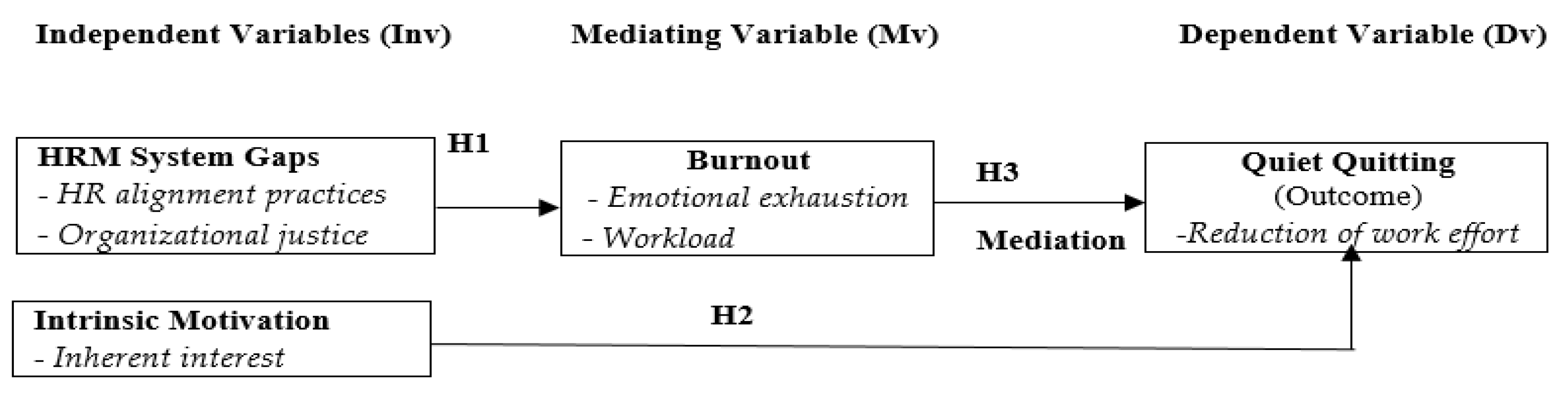
Figure 2.
Structural equation model results (Model 3) illustrating the paths from motivational factors (left, Intrinsic Motivation and Burnout) and HRM system factors (right, e.g., Fairness, Voice, etc.) to Quiet Quitting. Solid arrows represent significant paths (p < .05), and dashed arrows represent non-significant paths. Standardized path coefficients (β) are shown next to each arrow.
Figure 2.
Structural equation model results (Model 3) illustrating the paths from motivational factors (left, Intrinsic Motivation and Burnout) and HRM system factors (right, e.g., Fairness, Voice, etc.) to Quiet Quitting. Solid arrows represent significant paths (p < .05), and dashed arrows represent non-significant paths. Standardized path coefficients (β) are shown next to each arrow.
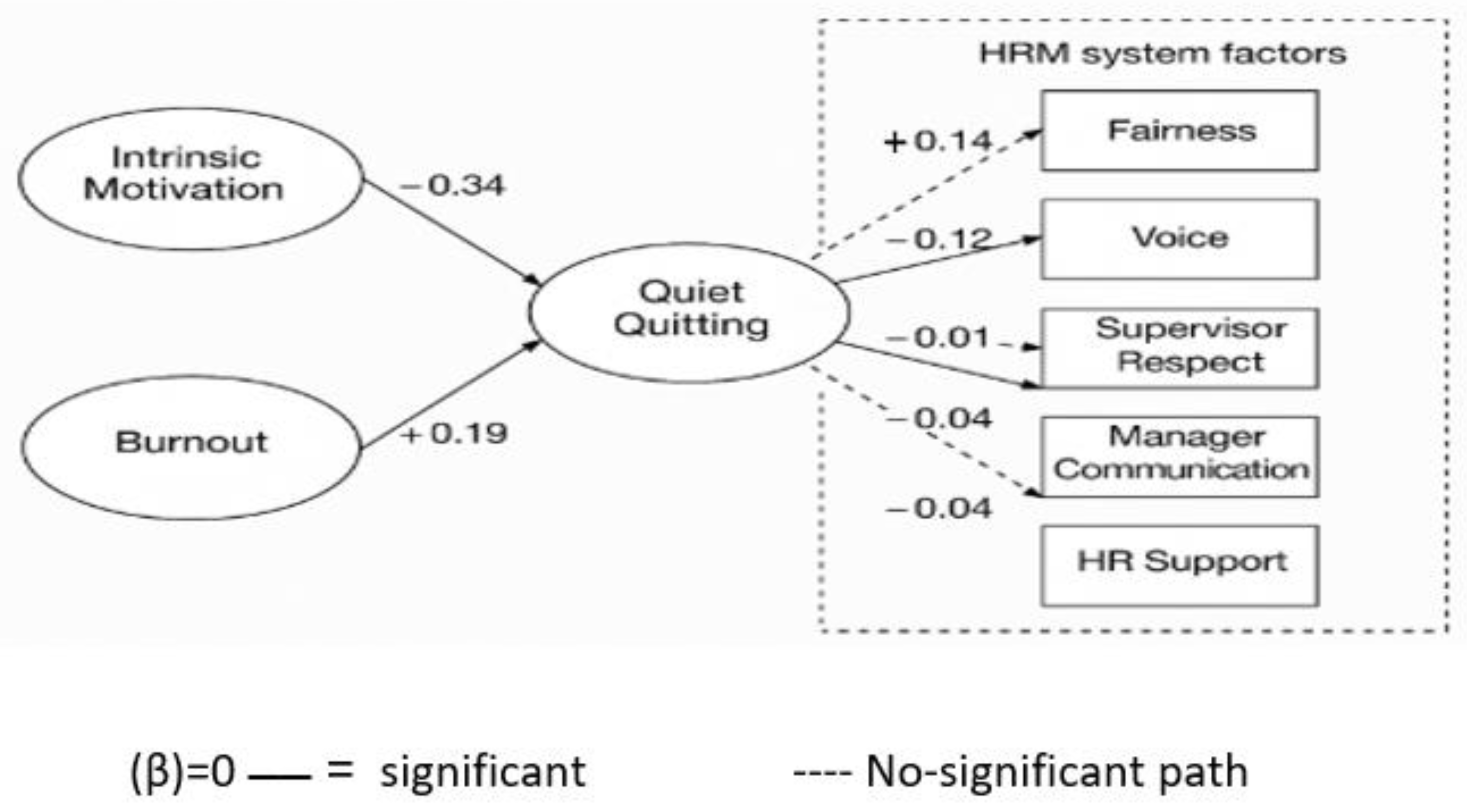
Disclaimer/Publisher’s Note: The statements, opinions and data contained in all publications are solely those of the individual author(s) and contributor(s) and not of MDPI and/or the editor(s). MDPI and/or the editor(s) disclaim responsibility for any injury to people or property resulting from any ideas, methods, instructions or products referred to in the content. |
© 2025 by the authors. Licensee MDPI, Basel, Switzerland. This article is an open access article distributed under the terms and conditions of the Creative Commons Attribution (CC BY) license (http://creativecommons.org/licenses/by/4.0/).
Copyright: This open access article is published under a Creative Commons CC BY 4.0 license, which permit the free download, distribution, and reuse, provided that the author and preprint are cited in any reuse.


