
Submitted:
27 September 2025
Posted:
30 September 2025
You are already at the latest version
Abstract
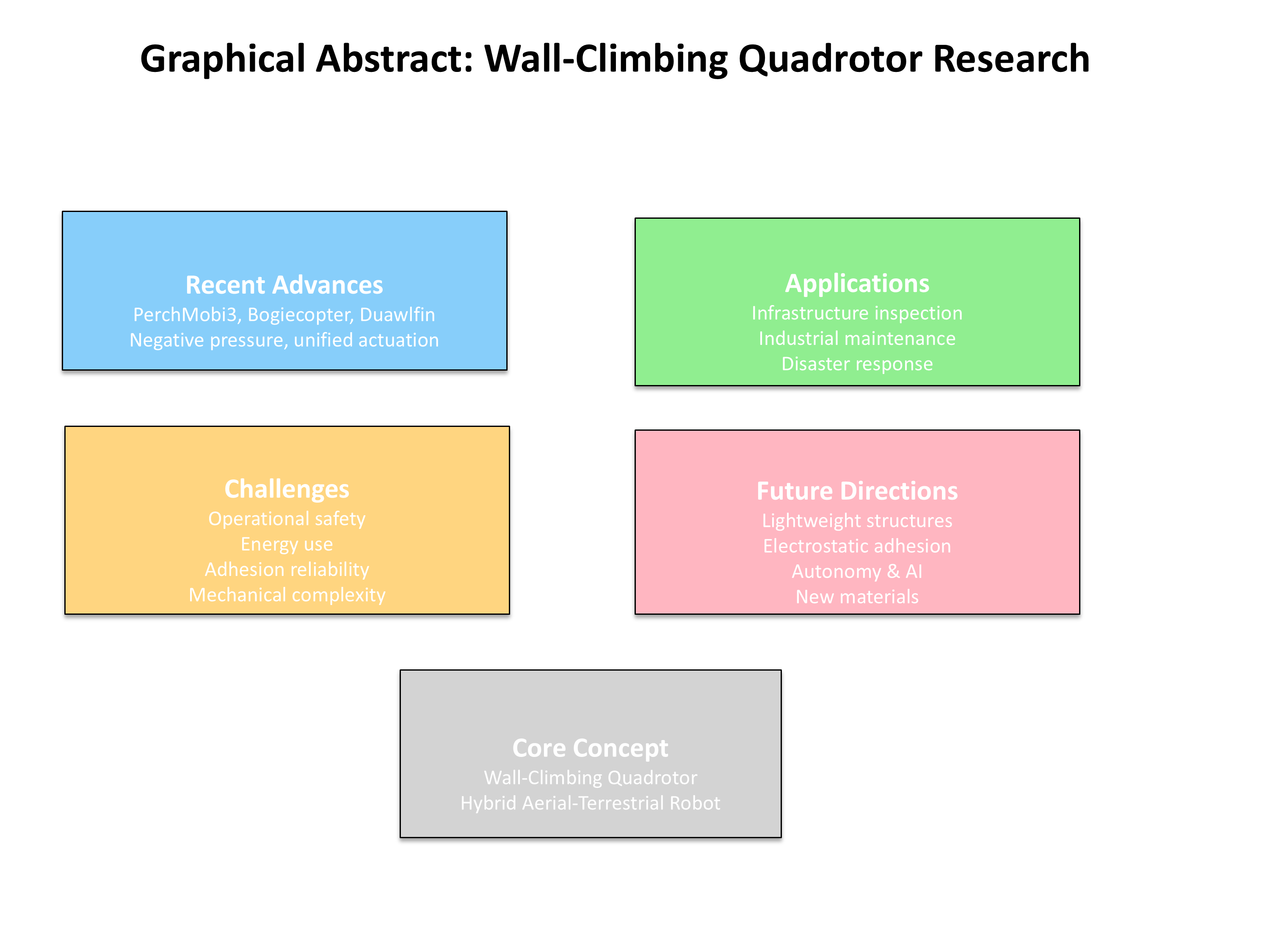
Wall-climbing quadrotors represent a promising class of hybrid aerial-terrestrial robots capable of operating on vertical surfaces, confined spaces, and hard-to-reach environments. Recent prototypes such as PerchMobi3, Bogiecopter, and Duawlfin have introduced novel mechanisms including negative-pressure adhesion, unified actuation, and power-reuse strategies, enabling seamless transitions between flying, ground locomotion, and wall climbing. These designs address critical application areas such as infrastructure inspection, industrial maintenance, and disaster response, while also demonstrating improved energy efficiency and adaptability. Despite these advancements, challenges persist in terms of operational safety, energy consumption, adhesion reliability, and mechanical complexity. Current research is increasingly directed toward enhancing autonomy, developing lightweight structures, and exploring alternative adhesion techniques such as electrostatic and passive adhesives. This review synthesizes recent developments, identifies persisting limitations, and highlights future directions that can expand the adoption of wall-climbing quadrotors in real-world industrial and emergency scenarios.
Keywords:
Wall-climbing quadrotor
; Hybrid aerial-terrestrial robots
; Multi-modal locomotion
; Negative-pressure adhesion
; Unified actuation
; Structural health monitoring
; Infrastructure inspection
; Energy efficiency
; Adhesion mechanisms
; Disaster response.
1. Introduction
Wall-climbing quadrotors represent a cutting-edge fusion of aerial and terrestrial robotics, designed to enhance the capabilities of unmanned aerial vehicles (UAVs) for various demanding applications, including inspection, maintenance, and search-and-rescue operations in complex environments such as vertical surfaces and confined spaces [1,2].
The notable advancements in this field are driven by the need for robots that can effectively navigate and operate in challenging conditions, showcasing the increasing relevance of hybrid locomotion systems in modern robotics. Recent prototypes of wall-climbing quadrotors, such as the PerchMobi3, Bogiecopter, and Duawlfin, have demonstrated significant innovations in design and functionality. These models incorporate multi-modal locomotion capabilities that enable seamless transitions between flying, climbing, and ground movement [3,4,5].
Noteworthy features include the use of negative pressure adsorption for wall attachment and unified actuation mechanisms that enhance operational efficiency and safety. Such advancements underline the potential for these robots to perform critical tasks across various sectors, including infrastructure monitoring and emergency response [6,7,8].
Despite their promise, wall-climbing quadrotors face several challenges, including operational safety concerns due to the risk of accidental falls and the complexity of mechanical systems [9,10,11].
These limitations highlight the ongoing need for research focused on improving the reliability, energy efficiency, and maneuverability of these robots. Addressing these issues is vital for their broader adoption in industries such as aerospace manufacturing and marine engineering, where they can significantly improve maintenance practices and operational capabilities [6,12,13].
The rapid evolution of wall-climbing quadrotors positions them at the forefront of robotics innovation, yet continuous exploration and refinement are essential to overcome current limitations and fully realize their potential in various applications [5,10].
As researchers push the boundaries of design and functionality, these robots are expected to play an increasingly integral role in transforming approaches to inspection and maintenance in difficult-to-access environments.
1.1. Related Work
Wall-climbing quadrotors represent an innovative intersection of aerial and terrestrial robotics, designed to enhance the versatility and functionality of unmanned aerial vehicles (UAVs) in various applications. The development of these systems has gained momentum as researchers aim to improve inspection, maintenance, and search-and-rescue operations in environments that present significant challenges, such as vertical surfaces and confined spaces [1,2].
The efficacy of wall-climbing quadrotors largely depends on their ability to transition smoothly between flying and climbing modes. Recent advancements have introduced mechanisms and control algorithms that enable perching on vertical surfaces through low-speed pose changes, which mitigates the risks associated with detaching from walls during climbing operation [14,15]. These systems utilize fan-assisted transitions that facilitate the robot's movement across ground, wall, and aerial domains, effectively combining multiple locomotion methods [3]. In one notable prototype, a quadrotor equipped with wheels can drive straight up walls. This innovative design employs asymmetric torque generated by ducted fans to achieve a flipping motion that enables the quadrotor to land and adhere to vertical surfaces [16,17]. The robot's ability to stabilize its position even after unexpected disturbances enhances its operational safety, a crucial feature given the potential for falls due to climbing system failures [6,18].
2. Recent Prototype Models
Recent advancements in wall-climbing quadrotor prototypes have demonstrated innovative designs and versatile functionalities. One such notable prototype is the PerchMobi3, which integrates a multi-modal locomotion system enabling it to transition seamlessly between ground movement, wall climbing, and aerial flight. This robot features a lightweight yet rigid carbon-fiber frame, ducted fans, and a unique sealing mechanism for effective wall attachment through negative pressure adsorption [3,5,19]. The PerchMobi3 operates through a two-stage ground-to-wall transition process, where it first flips and then reinforces its wall adhesion, showcasing its adaptability in various environments [5,19]. Another significant contribution is the Bogiecopter, which has been recognized as a pioneering quad-fan prototype that demonstrates functional power reuse across different locomotion modes. This design allows for efficient operation in both aerial and ground contexts, optimizing energy usage and enhancing operational flexibility during inspection tasks [4,18]. Additionally, the Duawlfin exemplifies a design that incorporates unified actuation for both wheeled locomotion and flight operations. It employs a mode-switched control framework that enables the same motors to power either the propellers for flight or the ground wheels for driving, effectively minimizing mechanical complexity while ensuring robust performance [3,11]. Moreover, various other models, such as the Rollocopter and Skywalker, have been developed to further explore capabilities in ground and aerial locomotion, with designs that focus on energy efficiency and adaptability in challenging terrains [4,11]. These recent prototypes illustrate a significant leap in robotics, particularly in the field of hybrid locomotion, enhancing their application potential in diverse environments and tasks.
Recent advancements in wall-climbing quadrotor prototypes highlight a variety of innovative approaches aimed at enhancing mobility, efficiency, and application versatility. These prototypes typically integrate multi-modal capabilities, allowing for ground, aerial, and wall-climbing locomotion.
2.1. Prototype Mechanisms and Adhesion Techniques
One prominent prototype is the PerchMobi3, which employs a power-reuse strategy by utilizing four ducted fans for both flight thrust and negative-pressure adhesion during wall-climbing operations. This design simplifies the system by avoiding the need for dedicated suction motors, thus ensuring stable wall adhesion while maintaining the ability for controllable flight [5,20]
Similarly, the Duawlfin prototype leverages a dual-actuation mechanism that enhances operational safety by decoupling the power sources for ground and aerial modes. This design also focuses on efficiency, as it significantly reduces power requirements for ground maneuvers compared to aerial flight [11].
Conversely, traditional wall-climbing robots often rely on active adhesion mechanisms, such as electric suction cups or motor-driven pumps, which provide strong adhesion forces but introduce complexity and increased costs [5,21].
Recent prototypes have begun exploring alternative adhesion methods, including electrostatic adhesion, to enhance versatility across various surfaces [20].
2.2. Performance Validation and Use Cases
The feasibility of these prototypes has been validated through extensive real-world experiments. For example, the effectiveness of the PerchMobi3 and Duawlfin prototypes has been demonstrated in various scenarios, confirming their robustness and outstanding performance in real-world applications such as industrial maintenance and infrastructure inspection [3,12,22].
These experiments have highlighted the importance of integrating multiple locomotion capabilities, which not only improves the operational range of the robots but also allows for comprehensive asset health monitoring. Furthermore, the design of these prototypes is also influenced by their intended use cases, as illustrated by Gecko Robotics' wall-climbing robots, which aim to transform infrastructure maintenance through enhanced data collection and analysis capabilities [6].
The integration of AI and robotics is paving the way for smarter, safer, and more efficient maintenance practices in various sectors, including marine engineering and aerospace manufacturing [12].
2.3. Applications and Research Focus
The application scope for wall-climbing quadrotors extends beyond traditional inspection tasks. These robots are increasingly being employed in structural health monitoring, allowing for non-destructive evaluations of critical infrastructure, such as oil storage tanks and pressure vessels [6,7]. The combination of climbing capabilities with aerial flight also opens avenues for disaster response, as demonstrated by recent prototypes developed for rapid deployment in emergency situations [8]. This dual functionality emphasizes the importance of ensuring reliability and maneuverability in the design of these systems. Research in this area continues to focus on overcoming existing challenges related to payload capacity and stability, aiming to achieve insect-like maneuverability akin to biological models. The ultimate goal is to create robust wall-climbing robots that can efficiently navigate complex environments while ensuring safety and performance [4,8]. As these technologies advance, their integration into practical applications is expected to grow, marking a significant step forward in robotics.
3. Challenges and Limitations
Despite the advancements in wall-climbing quadrotors, several challenges and limitations persist in their design and functionality.
3.1. Flight Configurations and Motion Patterns
One significant challenge arises from the limited flight configurations and motion patterns of existing wall-climbing robots (WCRs), which can lead to drawbacks such as high noise emissions and larger physical footprints [23]. These factors may restrict their operational effectiveness in urban environments where discretion and space management are critical.
3.2. Risk of Accidental Falls
The risk of accidental falls is a notable concern that hampers the practical use of wall-climbing robots. Operational failures, often caused by harsh environmental conditions or equipment malfunctions, can lead to catastrophic accidents. This has raised safety concerns among potential users, which in turn has limited widespread adoption [9].
3.3. Energy Efficiency and Friction Coefficient Estimation
Energy efficiency remains a hurdle due to the difficulty in estimating the friction coefficient at the contact point between the robot and the surface. Misestimating this coefficient can result in excessive energy use or failures in climbing operations, thereby reducing the overall efficacy of the robots [10].
3.4. Mechanical Complexity and Maintenance
The designs of many hybrid platforms often rely on a combination of propeller-driven movement and terrestrial actuators for ground mobility, which increases mechanical complexity, total mass, and subsequently, maintenance requirements. This complexity can lead to higher costs and may deter potential users from adopting these technologies [11].
3.5. Operational Safety
Another challenge is ensuring operational safety during transitions between aerial and ground movements. The engagement of propellers during ground mobility raises safety concerns, making it crucial to decouple the power sources for ground and aerial locomotion to enhance operational safety without compromising functionality [11].
Addressing these challenges is essential for the development of more efficient and reliable wall-climbing quadrotors, paving the way for their broader application in various sectors such as industrial maintenance, marine engineering, and aerospace manufacturing [6].
4. Future Directions
Research into wall-climbing quadrotors is advancing rapidly, with promising avenues for future exploration. One key area involves enhancing the autonomy of these systems through the integration of onboard perception and planning capabilities, allowing for fully untethered operations in complex environments [5]. This includes adapting to diverse wall surfaces and navigating intricate transitions while responding to external disturbances, thereby expanding the operational scope of these robots. Another focus is improving energy efficiency by refining coordination between the fan and wheel systems, along with optimizing control strategies [5,15]. Achieving better synergy between these components can significantly enhance the overall performance and endurance of wall-climbing quadrotors during extended missions. Additionally, ongoing efforts are directed toward systematic quantitative evaluations and comparative studies against existing wall-climbing and multi-modal robotic systems. This will provide a clearer understanding of the strengths and weaknesses of current designs, guiding the development of more efficient and effective prototypes [5]. Moreover, researchers are investigating the potential for utilizing novel adhesion mechanisms, such as electrostatic and passive adhesive technologies, which may simplify design complexities and reduce weight without compromising performance [10,11]. Such advancements would not only streamline the construction and maintenance of these robots but also improve their adaptability to various operational scenarios. Finally, future prototypes may incorporate advanced materials and manufacturing techniques, such as 3D printing, to enhance structural integrity while maintaining a lightweight design [6]. This would be crucial for ensuring that wall-climbing quadrotors can perform reliably in diverse industrial applications, including maintenance and inspection tasks in high-rise environments [13,24].
5. Conclusion
The rapid evolution of wall-climbing quadrotor prototypes underscores their transformative potential in robotics, particularly for inspection, maintenance, and search-and-rescue tasks in challenging environments. Innovations in multi-modal locomotion, adhesion mechanisms, and control strategies have significantly expanded their versatility, enabling seamless mobility across aerial, ground, and vertical domains. However, critical barriers remain, including the risks of accidental falls, high energy demands, and the mechanical complexity of hybrid designs. Addressing these challenges through improved adhesion technologies, optimized control frameworks, and lightweight materials will be essential for advancing both safety and efficiency. Looking ahead, the integration of onboard perception, planning, and autonomy promises to further enhance the functionality of wall-climbing quadrotors, paving the way for their widespread use in structural health monitoring, aerospace and marine engineering, and disaster response. With continued research and refinement, these robots are poised to become indispensable tools for operating in environments that are otherwise inaccessible or hazardous to humans.
References
- I. Aizelman, D. Magazinnik, D. Feldman, and I. Klein, “Quadrotor with wheels: design and experimental evaluation,” Scientific Reports, vol. 14, no. 1, p. 15603, 2024. [Online]. Available: https://www.nature.com/articles/s41598-024-66396-0.
- C. F. Yaşar, “Climbing with Robots: A Second Order Controller Design for Accurate Wheel Motion Positioning,” Çukurova Üniversitesi Mühendislik Fakültesi Dergisi, vol. 39, no. 1, pp. 175–187, 2024. [Online]. Available: https://dergipark.org.tr/en/pub/cukurovaumfd/issue/83862/1459428.
- Development of a Wall-Climbing Drone Capable of Vertical Soft Landing Using a Tilt-Rotor Mechanism, ResearchGate preprint, 2018. [Online]. Available: https://www.researchgate.net/publication/329913685_Development_of_a_Wall-Climbing_Drone_Capable_of_Vertical_Soft_Landing_Using_a_Tilt-Rotor_Mechanism.
- Development of a Wall-Climbing Drone Capable of Vertical Soft Landing Using a Tilt-Rotor Mechanism (PDF), SciSpace, 2018. [Online]. Available: https://scispace.com/pdf/development-of-a-wall-climbing-drone-capable-of-vertical-1t7iz2a86g.pdf.
- A Multi-Modal Robot with Power-Reuse Quad-Fan Mechanism for …, arXiv preprint, 2025. [Online]. Available: https://arxiv.org/pdf/2509.12620.
- Quadrotor With Wheels Can Drive Straight Up Walls, IEEE Spectrum, 2024. [Online]. Available: https://spectrum.ieee.org/quadrotor-with-wheels-can-drive-straight-up-walls.
- I. Aizelman, D. Magazinnik, D. Feldman, and I. Klein, “Quadrotor with wheels: design and experimental evaluation,” PMC, 2024. [Online]. Available: https://pmc.ncbi.nlm.nih.gov/articles/PMC11227541/.
- Current Status and Trends of Wall-Climbing Robots Research, Machines, vol. 13, no. 6, p. 521, MDPI, 2023. [Online]. Available: https://www.mdpi.com/2075-1702/13/6/521.
- An Aerial–Wall Robotic Insect That Can Land, Climb, and Take Off, Research, Science Partner Journal, 2023. [Online]. Available: https://spj.science.org/doi/10.34133/research.0144.
- A Survey on Pneumatic Wall-Climbing Robots for Inspection, DiVA Portal report, 2016. [Online]. Available: https://www.diva-portal.org/smash/get/diva2:1672183/FULLTEXT01.pdf.
- Wall-Climbing Drone Enhances Structural Integrity Inspections, Innovations Report, 2022. [Online]. Available: https://www.innovations-report.com/engineering/power-and-electrical-engineering/development-of-a-wall-climbing-drone/.
- An Aerial–Wall Robotic Insect That Can Land, Climb, and Take Off, PMC, 2023. [Online]. Available: https://pmc.ncbi.nlm.nih.gov/articles/PMC10204747/.
- Production of a Wall-Climbing-Type Quadrotor and Its Experiment for Verifying Basic Operations, ResearchGate preprint, 2018. [Online]. Available: https://www.researchgate.net/publication/328182565_Production_of_a_Wall-climbing-type_Quadrotor_and_Its_Experiment_for_Verifying_Basic_Operations.
- PerchMobi 3: A Multi-Modal Robot with Power-Reuse Quad-Fan …, arXiv preprint (HTML), 2025. [Online]. Available: https://arxiv.org/html/2509.12620v1.
- J. Tang, R. Zhang, K. Beyduz, Y. Jiang, C. Wiebe, H. Zhang, O. Asoro, and M. W. Mueller, “Duawlfin: A Drone with Unified Actuation for Wheeled Locomotion …,” arXiv preprint, 2025. [Online]. Available: https://arxiv.org/html/2505.13836v1.
- Exploration of Using a Wall-Climbing Robot System for Indoor Applications, Nature Scientific Reports, 2024. [Online]. Available: https://www.nature.com/articles/s41598-024-64642-z.
- ALPINE: A Climbing Robot for Operations in Mountain Environments, Robotics and Autonomous Systems, Elsevier, 2025. [Online]. Available: https://www.sciencedirect.com/science/article/pii/S0921889025000855.
- TIE: An Autonomous and Adaptive Terrestrial-Aerial Quadrotor, arXiv preprint, 2021. [Online]. Available: https://arxiv.org/pdf/2109.04706.
- J. Yarbrough, How Robotics and Drones Are Transforming Infrastructure Maintenance, LinkedIn article, 2024. [Online]. Available: https://www.linkedin.com/posts/jeffyarbroughmba_maintenance-reliability-ai-activity-7359279984491843586-hvkx.
- Current Status, Challenges, and Prospects for New Types of Aerial Robots, Engineering, Elsevier, 2024. [Online]. Available: https://www.sciencedirect.com/science/article/pii/S2095809924002777.
- Drone-Type Wall-Climbing Robot Platform for Structural Health Monitoring, University of Illinois Technical Report, 2015. [Online]. Available: http://sstl.cee.illinois.edu/papers/aeseancrisst15/213_Myeong_Drone-Type.pdf.
- Propeller-Type Wall-Climbing Robots: A Review, IOP Conference Series: Materials Science and Engineering, vol. 1094, no. 1, 012106, 2021. [Online]. Available: https://iopscience.iop.org/article/10.1088/1757-899X/1094/1/012106/pdf.
- Design and Analysis of 4SRRR Legged Wall-Climbing Robot, JAMST, SciOpen, 2023. [Online]. Available: https://www.sciopen.com/article/10.51393/j.jamst.2023005.
- Multispecies Hybrid Bioinspired Climbing Robot for Wall Tile Inspection, Automation in Construction, Elsevier, 2024. [Online]. Available: https://www.sciencedirect.com/science/article/abs/pii/S0926580524001821.
Disclaimer/Publisher’s Note: The statements, opinions and data contained in all publications are solely those of the individual author(s) and contributor(s) and not of MDPI and/or the editor(s). MDPI and/or the editor(s) disclaim responsibility for any injury to people or property resulting from any ideas, methods, instructions or products referred to in the content. |
© 2025 by the authors. Licensee MDPI, Basel, Switzerland. This article is an open access article distributed under the terms and conditions of the Creative Commons Attribution (CC BY) license (http://creativecommons.org/licenses/by/4.0/).
Copyright: This open access article is published under a Creative Commons CC BY 4.0 license, which permit the free download, distribution, and reuse, provided that the author and preprint are cited in any reuse.