
Submitted:
29 September 2025
Posted:
30 September 2025
You are already at the latest version
Abstract
In the context of sustainability, open innovation has increasingly been embraced as a viable innovation paradigm by numerous enterprises. In the academic field, how enterprise openness affects innovation performance has also become a hotspot in the research area of open innovation. However, existing studies have not sufficiently delved into the mechanism underlying the impact of openness on open innovation performance. This study attempts to introduce knowledge management capability and organizational learning as dual mediating variables, and further decompose their dimensions to construct a mechanism model of how enterprise openness influences open innovation performance. Multiple research methods such as structural equation modeling analysis and Bootstrap test are employed to verify the relevant hypotheses. The results show that both external knowledge management capability and internal knowledge management capability play a mediating role between openness and open innovation performance; similarly, both explorative learning and exploitative learning also exert a mediating effect in the relationship between openness and open innovation performance. Moreover, enterprise openness can enhance open innovation performance through the dual chain mediating effects of "external knowledge management capability - explorative learning" and "internal knowledge management capability - exploitative learning". This study not only achieves an organic integration of knowledge management theory and organizational learning theory by constructing a chain mediation mechanism of "ability-learning-performance", but also provides a more systematic and comprehensive theoretical framework for understanding the influencing mechanisms of open innovation performance, thereby advancing theoretical development in this field.
Keywords:
openness
; knowledge management capability
; organizational learning
; innovation performance
; open innovation
0. Introduction
In the context of sustainable development, an increasing number of enterprises are breaking down boundaries and collaborating with external organizations to engage in innovation activities, and innovation has transformed into a multifaceted and ever-evolving activity [1]. Traditional closed innovation struggles to adapt to today’s volatile market environment and the paradigm of sustainable development. As a result, a proliferating number of enterprises are adopting open innovation to drive knowledge sharing and resource integration, thereby enhancing their innovation capabilities [2]. In the sustainability context, open innovation enables diverse stakeholders—including academia, industry, governments, and civil society—to co-create solutions that address complex global challenges such as climate change, resource depletion, and social inequality. By leveraging external expertise, pooling resources, and fostering transparency, open innovation accelerates the development and adoption of sustainable technologies, business models, and policies [3]. For example, by implementing strategies such as open-sourcing patents and promoting technical standards, Tesla, a renowned technology corporation, has established a "shared and rapidly developing open-source technology platform". This initiative enables free and efficient collaboration between Tesla and small-to-medium enterprises, establishes a robust foundation for innovation, and has proven to be a critical driver of Tesla's remarkable commercial success [4].
Openness, a metric that measures an enterprise's level of open innovation, was first introduced by Laursen and Salter [5]. They defined it as 'the number of distinct external knowledge sources utilized by a firm in its innovation processes. By enhancing their openness, enterprises can more effectively acquire novel knowledge and complementary resources, better identify customer preferences and needs, and mitigate investment risks—thereby facilitating smoother innovation processes [6,7]. In the ensuing years, numerous studies have analyzed the effects of openness on corporate innovation performance. Laursen and Salter [5] found an inverted U-shaped relationship between firm openness and innovation performance in their study of 2,707 UK manufacturers. Through an analysis of 96 Italian firms, Capone et al. [8] demonstrated an inverted U-shaped relationship between openness breadth and enterprise innovation performance. Nevertheless, numerous scholars maintain that openness positively correlates with innovation performance [9]. Wang et al. [10] conducted a questionnaire survey on 283 Chinese enterprises and concluded that both the breadth and depth of open innovation have a significant positive impact on the innovation performance. Through an analysis of 1,046 SMEs in South Korea, Son and Zo [11] found empirical evidence that organizational openness positively influences firm innovation performance. Scholarly work to date has approached the openness-innovation performance linkage from diverse methodological and theoretical standpoints, yielding mixed results that warrant further investigation. Furthermore, despite growing evidence linking openness to innovation performance, theoretical understanding of the pathways through which openness operates remains limited.
Knowledge management capability denotes an organization's systematic capacity to create, disseminate, and utilize knowledge assets for developing core competencies and sustaining competitive advantage [12,13,14]. Knowledge management capability plays an important role in open innovation [15]. Harsono et al. [16] conducted a questionnaire survey involving 280 senior managers from 11 Indonesian companies and found that knowledge management enhances enterprise innovation performance. Feng et al. [17] analyzed 253 Chinese enterprises and found that each dimension of knowledge management capability positively influences innovation performance. Through an analysis of 311 Chinese enterprises, Yu et al. [18] demonstrated that both external and internal knowledge management capabilities serve as mediating mechanisms between enterprise social network and innovation performance.
Organizational learning denotes an enterprise’s ability to acquire, generate, disseminate, and synthesize knowledge while dynamically adjusting its conduct to strengthen competitive advantage. Organizational learning also serves a critical function in facilitating open innovation [19]. Enterprises can optimize knowledge resource utilization through two distinct learning approaches - explorative and exploitative learning - thereby enhancing innovation performance [20]. Mai et al. [21] established that organizational learning positively influences firm performance through an empirical study of Vietnamese tourism and hospitality enterprises. Cui et al. [22] empirically demonstrated that organizational learning positively contributes to enhanced enterprise innovation performance drawing on data from 417 Chinese consumers. Through an empirical investigation of 388 Ghanaian SMEs, Tian et al. [23] demonstrated that both explorative and exploitative learning mediate the relationship between organizational openness and enterprise innovation performance.
In summary, while existing studies have independently examined the direct effects of openness, knowledge management capability, and organizational learning on enterprise innovation performance, the underlying mechanisms and mediating pathways through which these factors operate remain underexplored in current literature. Additionally, existing studies predominantly treat knowledge management capability and organizational learning as unitary constructs, failing to deconstruct their constituent dimensions to systematically examine the specific pathways through which they influence enterprise innovation performance.
Therefore, within the open innovation paradigm, this study introduces knowledge management capability and organizational learning - two openness-related factors - as dual mediating variables, constructing a conceptual model to elucidate the mechanism through which enterprise openness influences innovation performance. Building on this framework, we operationalize knowledge management capability through its internal and external dimensions, and organizational learning through its dual modes of exploitative and explorative learning. By systematically integrating these constructs, we elucidate the interconnected nature of knowledge management and organizational learning processes. This approach clarifies the sequential mediating pathway through which enterprise openness enhances open innovation performance - first through knowledge management capabilities, then via organizational learning mechanisms.
The theoretical contributions of this study are threefold: First, grounded in open innovation theory, this study investigates the mediating role of knowledge management capability and organizational learning in the relationship between enterprise openness and innovation performance. By elucidating these mechanisms, our work offers a novel analytical framework for understanding openness-innovation dynamics, and an extension of core propositions in open innovation theory. Second, this study extends the knowledge-based view by differentiating between external and internal knowledge management capabilities and examining their distinct mediating roles in translating openness into open innovation performance. This dimensional approach provides a more nuanced understanding that extends beyond the unitary treatment of knowledge management in existing literature. Third, this study distinguishes between explorative and exploitative learning, analyzing their differential roles in mediating how openness enhances open innovation performance, which bridges organizational learning theory with open innovation theory and offers a more integrated theoretical perspective.
1. Theoretical Framework and Hypothesis Development
1.1. Openness and Open Innovation Performance
Laursen and Salter [5] introduced the concept of openness, and defined it as the number of external knowledge sources that firms draw upon in their innovation processes. By increasing openness, enterprises can foster stronger collaborative ties with diverse external partners—such as customers, suppliers, competitors, universities, and NGOs—to enhance innovation outcomes [24]. Openness serves as a robust measure of external collaboration, capturing both the breadth (diversity of external knowledge sources) and depth (degree of engagement intensity) in organizational knowledge acquisition [5]. Consequently, openness could enhance innovation performance through two distinct dimensions: (1) breadth and depth [8]. Breadth of openness is defined as the scope of external knowledge sources accessed during innovation activities, representing the diversity of an organization’s collaborative network [25].
The impact of breadth of openness on innovation performance stems from its ability to enrich external knowledge inflows. By expanding their scope of external engagement, firms gain access to more diverse knowledge domains, which both broadens their knowledge base and increases opportunities for novel knowledge recombination—ultimately strengthening innovation capabilities [26,27]. Depth of openness represents the intensity of an organization's external collaborative engagements, which critically influences both the quality and stability of assimilated knowledge [28]. Firms exhibiting greater depth of openness could establish sustained, resource-intensive partnerships with knowledge collaborators, mitigating opportunism in knowledge exchange while enabling more effective tacit knowledge transfer and strategic deployment of core knowledge assets—collectively fostering enhanced innovation performance [29,30].
Rauter et al. [24] demonstrated that open collaboration with universities, NGOs, and intermediaries significantly strengthens sustainable innovation performance. Consistent with this, Ahn et al. [31] established that increasing openness develops dynamic capabilities, which in turn enable organizations to assimilate new knowledge and achieve sustained performance gains. Thus, we propose:
H1: Openness has a significant positive effect on open innovation performance.
1.2. The Mediating Effect of Knowledge Management Capability
Knowledge management capability refers to an organization's capacity to acquire, generate, transfer, integrate, share, and deploy knowledge-based resources across functional domains, thereby facilitating the creation of new knowledge [32]. In the context of open innovation, enterprises facilitate knowledge sharing and flows through R&D collaborations and co-creation alliances with external organizations, as well as through internal innovation activities among team members and across departments. Consequently, knowledge management capability plays a critical role in enhancing firms’ innovation performance [33,34]. Knowledge management capability is typically categorized into two dimensions: external and internal knowledge management capabilities [35]. This study examines the mediating role of knowledge management capability—from both perspectives—in the relationship between openness and firm innovation performance.
(1) The mediating effect of external knowledge management capability. External knowledge management capability encompasses three key components: knowledge absorption, knowledge connection, and knowledge desorption. Its mediating role between openness and firm innovation performance operates through these three mechanisms [36].
Firstly, knowledge absorption capability denotes an organization's capacity to acquire, assimilate, and deploy externally sourced knowledge [37,38]. Enhanced innovation openness enables firms to absorb substantial external knowledge, which stimulates employee creativity and facilitates novel idea generation. This absorbed knowledge can then be effectively applied to new product development processes, thereby strengthening innovation performance [10,18]. Secondly, knowledge connection capability reflects an organization's capacity to systematically integrate external knowledge resources with its internal knowledge base [39]. Greater openness facilitates (a) the acquisition of novel external knowledge, (b) the redeployment of existing knowledge assets, and (c) the identification of synergistic opportunities for knowledge recombination. This process ultimately strengthens interorganizational knowledge linkages [40]. Finally, knowledge desorption capability represents an organization's capacity to externally commercialize internal knowledge assets for value creation [41]. While firms acquire substantial external knowledge through open innovation, they can leverage their knowledge desorption capability to strategically transfer non-core knowledge resources to external collaborators (e.g., suppliers, customers, research institutions, and even competitors), thereby generating innovation revenues and facilitating market expansion [42].
Kashosi et al. [43] conducted a survey of small and medium-sized enterprises (SMEs) in developing countries, and demonstrated that both the breadth and depth of openness positively influence firm innovation performance by enhancing knowledge absorption capabilities. Through a multi-country follow-up study of manufacturing, service and retail firms across 11 Sub-Saharan African nations, Medase and Abdul-Basit [44] established that effective utilization of diverse external knowledge sources constitutes a critical determinant of enhanced innovation capabilities in open innovation processes. Therefore, we propose:
H2a: External knowledge management capability mediates the relationship between openness and open innovation performance.
(2) The mediating effect of internal knowledge management capability. Internal knowledge management capability comprises three core dimensions: knowledge creation, knowledge transformation, and knowledge innovation [36]. Internal knowledge management capability could mediate the relationship between openness and firm innovation performance through these three distinct mechanisms.
Firstly, knowledge creation capability reflects an organization's capacity to identify, assimilate, and synthesize both internal and external knowledge [30]. When internal knowledge stocks are limited and lack diversity, firms struggle to generate novel insights solely from existing resources [45]. Higher openness levels thus become critical, enabling organizations to cultivate external linkages that fuel knowledge creation and enhance innovation performance [30,46].
Secondly, knowledge transformation capability denotes an organization's capacity to internally generate knowledge or leverage employees' accumulated expertise [47]. Enhanced openness facilitates access to domain-specific prior knowledge, enabling more efficient knowledge retention and reactivation. This process enriches the organizational knowledge base, thereby strengthening the foundation for innovation performance [18].
Finally, knowledge innovation capability represents an organization's capacity to acquire, assimilate, and integrate knowledge for creative recombination, ultimately transforming novel insights into new products, processes, and services. This capability enhances strategic agility, enabling firms to rapidly adapt their technological innovation trajectories in response to market dynamics, thereby improving innovation performance [48].
Wu and Gao [49] empirically demonstrated that internal knowledge integration significantly enhances open innovation performance in firms drawing on dynamic capability theory. Khraishi et al. [50] established that strengthening internal knowledge creation capabilities enables firms to effectively acquire and assimilate supplier knowledge, thereby generating innovation benefits. Therefore, we propose:
H2b: Internal knowledge management capability mediates the relationship between openness and open innovation performance.
1.3. The Mediating Effect of Organizational Learning
Within open innovation ecosystems, organizational learning enables firms to dynamically leverage both external and internal capabilities in response to evolving business environments. This adaptive process enhances innovation performance through effective knowledge absorption and utilization [51,52,53]. March [54] theorized organizational learning as a dual-dimensional construct comprising explorative learning and exploitative learning. Openness could influence firm innovation performance through these dual organizational learning mechanisms.
(1) The mediating effect of explorative learning. Enhanced openness creates opportunities for firms to cultivate explorative learning, which centers on novel knowledge acquisition and embodies an experimental orientation. This learning mode enables organizations to overcome path dependence and achieve innovation by providing essential knowledge assets and fostering an entrepreneurial mindset [55]. Explorative learning enhances the ability to reconfigure existing knowledge while lowering the cost of integrating diverse knowledge for organizational innovation. Through continuous knowledge absorption and systemic integration, enterprises can develop and maintain a dynamic knowledge base. By strategically applying this knowledge to optimize management practices, they ultimately enhance their innovation performance [56,57].
Kim et al. [58] demonstrated that explorative learning mediates the relationship between environmental dynamism and firm innovation performance drawing on a study of 254 South Korean small and medium-sized manufacturing enterprises. Zhang et al. [59] found that open innovation enhances sustainable competitive advantage by strengthening explorative learning capabilities. Therefore, we propose:
H3a: Explorative learning mediates the relationship between openness and open innovation performance.
(2) The mediating effect of exploitative learning. Exploitative learning, characterized by its cost-efficiency, enables enterprises to deepen their existing knowledge base while systematically integrating newly acquired external knowledge. This dual process of knowledge refinement and application reduces operational errors, accelerates development cycles, and enhances product development efficiency [23]. Particularly in open innovation contexts, where market awareness is crucial, exploitative learning plays a pivotal role in aligning technical capabilities with market demands. By effectively identifying and deploying valuable knowledge assets across production practices, it serves as a critical mechanism for driving innovation while optimizing resource utilization [55,60].
Tian et al. [23] found that exploitative learning mediates the positive relationship between openness and innovation performance in small and medium-sized enterprises, based on their empirical study of 388 Ghanaian firms. Mirza et al. [61] demonstrated that exploitative learning mediates the positive effect of open innovation on enterprise strategic innovation through their analysis of 330 Pakistani pharmaceutical companies. Therefore, we propose:
H3b: Exploitative learning mediates the relationship between openness and open innovation performance.
1.4. The Serial Mediation of Knowledge Management Capability and Organizational Learning
Effective knowledge management constitutes a fundamental prerequisite for enterprises to efficiently utilize knowledge resources. In this process, organizational learning significantly enhances innovation efficacy through dynamic processes including systematic knowledge acquisition, sharing, development, and transformation [59,62]. Within the open innovation paradigm, external knowledge management capability and explorative learning jointly serve as critical mediating mechanisms through which openness influences enterprise innovation performance. Specifically, when enterprises acquire substantial heterogeneous knowledge from external environments by increasing openness, their external knowledge management capability plays a pivotal role in coordination and integration. This capability enables enterprises to effectively screen, categorize, and store external knowledge resources. Concurrently, explorative learning facilitates the absorption and transformation of new knowledge, internalizing external knowledge into organization-specific innovative resources and capabilities.
Together, external knowledge management capability and explorative learning drive enterprises to engage in proactive R&D activities and technological exploration, thereby significantly improving innovation performance [63]. Therefore, we propose:
H4a: External knowledge management capability and explorative learning sequentially mediate the relationship between openness and open innovation performance.
Under the open innovation paradigm, internal knowledge management capability and exploitative learning collectively constitute another critical pathway through which openness influences open innovation performance. By enhancing their openness levels, enterprises establish in-depth interactions with external entities such as suppliers, customers, and industry competitors, thereby gaining precise insights into market dynamics and industrial demands. This heightened market sensitivity drives enterprises to develop demand-oriented internal knowledge management mechanisms, encompassing the systematic creation, transformation, and application of knowledge.
In this process, exploitative learning plays a pivotal role in knowledge reconstitution. Through in-depth mining and reorganization of existing knowledge systems, enterprises can effectively integrate new knowledge generated by internal knowledge management with their current technological foundations [64]. This knowledge integration process enables enterprises to dynamically adapt to changes in market and technological environments, ultimately transforming knowledge advantages into market-competitive new products and technologies, thereby significantly enhancing innovation performance [55]. Therefore, we propose:
H4b: Internal knowledge management capability and exploitative learning sequentially mediate the relationship between openness and open innovation performance.
In summary, the theoretical model of this study is shown in Figure 1.
2. Methods
2.1. Data Collection and Sample
Prior to the formal survey, a pilot study was conducted with 10 enterprises to pretest the questionnaire. Based on the pretest results, certain questions were refined to enhance clarity, precision, and cultural adaptation to the Chinese context. The formal questionnaire was administered through two primary methods. First, face-to-face distribution was conducted, during which respondents received a brief introduction to the survey’s purpose and key concepts before participation. A total of 600 questionnaires were distributed through this method, with 486 returned. After excluding responses with missing data or evident response bias, 429 valid questionnaires were retained for analysis. Second, the questionnaire was distributed via online channels. The electronic survey was disseminated through social networks, including friends, relatives, and colleagues, with key concepts clearly explained within the questionnaire itself. Through this method, 352 questionnaires were collected. After excluding responses with completion times under 120 seconds, 315 valid questionnaires were retained. Combined with the face-to-face survey results, this yielded a final dataset of 744 valid responses.
To assess potential differences between the datasets collected through the two distinct channels, we conducted an analysis of variance (ANOVA). The results indicated no statistically significant intergroup differences between the two data sources. Furthermore, we performed Harman's single-factor test to assess common method bias [65]. The exploratory factor analysis revealed that scale variables loaded on multiple distinct factors, with the unrotated first principal component explaining only 26.37% of the variance (below the 50% threshold). These results indicate that common method bias was not a substantial concern in our data.
The distribution of sample is shown in Table 1.
2.2. Measurement
Our measurement scales were adapted from well-established instruments in prior literature, with minor modifications to suit the research context. All items employed a seven-point Likert scale (1 = strongly disagree to 7 = strongly agree). Complete scale details are provided in the Appendix.
The measurement of openness was drawn on the study of Ahn et al. [66]. The measurement of external knowledge management capability was drawn on the study of Forés and Camisón [67], Mudambi and Tallman [68]. The measurement of internal knowledge management capability was drawn on the study of Forés and Camisón [67], Huang, Lai, and Huang [69]. The measurement of explorative learning, as well as exploitative learning was drawn on the study of Zhao et al. [70]. The measurement of open innovation performance was drawn on the study of Huang, Chen, and Liang [71].
Additionally, this study controlled for several potential confounding variables that may influence open innovation performance, including enterprise ownership type, sales revenue, workforce size, and R&D intensity.
3. Empirical Analysis and Results
3.1. Correlation Analysis
As presented in Table 2, the significant correlation coefficients among key variables provided preliminary support for our hypotheses. Furthermore, all inter-variable correlations were below the threshold of 0.7, suggesting no substantial multicollinearity concerns that would compromise subsequent analyses.
3.2. Reliability and Validity Test
The reliability of the scale was assessed using Cronbach’s α. As presented in Table 3, all variables demonstrated Cronbach’s α values exceeding 0.8, indicating high internal consistency [72]. Furthermore, the standardized factor loadings for all items were above 0.7, while the composite reliability (CR) values exceeded 0.9, and the average variance extracted (AVE) values were greater than 0.7. In accordance with Hair et al. [73], these results confirm strong convergent validity of the measurement scale.
The measurement scale employed in this study has been extensively used and validated in prior research, ensuring strong content validity. As displayed in Table 2, all inter-construct correlation coefficients were lower than the square root of the average variance extracted (AVE). In line with the criteria established by Hair et al. [73], these results confirm adequate discriminant validity for the scale.
3.3. Hypothesis Test
3.3.1. Structural Equation Modeling Analysis
Structural equation modeling was employed, in accordance with the methodological guidelines of Kline and Little [74], to examine the hypothesized relationships. The analysis was conducted using Mplus 7.0. The model fit indices were as follows: χ²(339) = 591.94, χ²/df = 1.746, RMSEA = 0.052, CFI = 0.903, TLI = 0.912, and SRMR = 0.065. All fit indices met established thresholds, indicating an acceptable model fit. The structural equation modeling results are presented in Figure 2.
The structural equation modeling results revealed several significant relationships. First, openness demonstrated a significant positive association with open innovation performance (β = 0.124, p < 0.1), thus supporting H1. Furthermore, openness showed strong positive effects on both dimensions of knowledge management capability: external knowledge management (β = 0.802, p < 0.01) and internal knowledge management (β = 0.407, p < 0.01). Regarding organizational learning, openness was positively related to both explorative learning (β = 0.213, p < 0.01) and exploitative learning (β = 0.438, p < 0.01).
The analysis revealed significant positive effects on open innovation performance from multiple antecedents. External knowledge management capability demonstrated the strongest influence (β = 0.656, p < 0.01), followed by internal knowledge management capability which showed a marginally significant positive effect (β = 0.129, p < 0.1). Regarding organizational learning mechanisms, both explorative learning (β = 0.153, p < 0.1) and exploitative learning (β = 0.199, p < 0.01) contributed positively to open innovation performance, with exploitative learning showing greater statistical significance.
The structural equation modeling results further revealed significant cross-dimensional relationships. External knowledge management capability showed a strong positive association with explorative learning (β = 0.546, p < 0.01), while internal knowledge management capability demonstrated a significant, though weaker, relationship with exploitative learning (β = 0.082, p < 0.05). These path coefficients provide preliminary evidence supporting the proposed mediation effects in our conceptual model.
3.3.2. Mediating Effect Test
Building on the structural equation modeling results, we conducted bootstrap analyses (N = 5,000 samples) to further examine the mediating effects. The bootstrapping results, presented in Table 4, confirm statistically significant mediation effects for the hypothesized pathways.
The bootstrapping analysis revealed a significant indirect effect of openness on open innovation performance through external knowledge management capability (β = 0.526, 95% CI [0.443, 0.609]). This result confirms that external knowledge management capability serves as a significant mediator in this relationship, thereby supporting H2a.
The bootstrap analysis indicated a significant indirect effect of openness on open innovation performance through internal knowledge management capability (β = 0.053, 95% CI [0.026, 0.061]). This finding demonstrates that internal knowledge management capability serves as a statistically significant mediator in this relationship, thus supporting H2b.
The bootstrap analysis also revealed two significant mediation pathways: (1) Explorative learning significantly mediated the relationship between openness and open innovation performance (β = 0.033, 95% CI [0.012, 0.067]); (2) Exploitative learning similarly demonstrated a significant mediating effect (β = 0.087, 95% CI [0.047, 0.127]). Both findings support our hypothesized mediation effects, confirming H3a and H3b.
Moreover, the bootstrap analysis revealed a significant sequential mediation pathway through external knowledge management capability and explorative learning (β = 0.067, 95% CI [0.005, 0.096]). This demonstrates that openness enhances open innovation performance first by developing external knowledge management capability, which in turn facilitates explorative learning. These results provide support for H4a regarding the continuous mediating effect of this dual-path mechanism.
The bootstrap analysis identified a significant but relatively small sequential mediation effect (β = 0.007, 95% CI [0.001, 0.012]), where openness influenced open innovation performance through internal knowledge management capability, which subsequently enhanced exploitative learning. While modest in magnitude, this chained mediation pathway was statistically significant, providing support for H4b.
3.4. Robustness Test
To validate the robustness of our structural equation modeling (SEM) and bootstrapping results, we conducted complementary hierarchical regression analyses. The regression models specified open innovation performance as the dependent variable, with external knowledge management capability, internal knowledge management capability, explorative learning, and exploitative learning as core independent variables. We controlled for several organizational characteristics: enterprise ownership type, sales revenue, workforce size, and R&D intensity.
4. Discussion and Conclusions
This study examines the mechanism through which enterprise openness enhances open innovation performance, focusing on the dual mediating roles of knowledge management capability (external and internal) and organizational learning (explorative and exploitative). Our analysis reveals three key findings:
First, both external and internal knowledge management capabilities significantly mediate the relationship between enterprise openness and open innovation performance. Prior research has established the positive relationship between knowledge management capability and enterprise innovation performance [17]. Yu et al. [18] further differentiated knowledge management capability into internal and external dimensions, demonstrating their distinct impacts on innovation outcomes. This study advances the literature in two key ways: First, by conceptualizing knowledge management capability as a dual-dimensional mediator (internal and external) between openness and open innovation performance, we address a critical gap in existing research that has predominantly examined direct effects. Second, our findings theoretically enrich both knowledge management and open innovation literature by elucidating the underlying mechanisms through which openness translates into innovation performance.
Second, both explorative learning and exploitative learning significantly mediate the relationship between openness and open innovation performance. Chan et al. [75] demonstrated that organizational learning exerts a direct influence on organizational performance. Chuks [76] examined the effect of organizational learning on enterprise innovation performance through the dual lenses of explorative and exploitative learning. This study extends prior research by incorporating the open innovation context into the organizational learning framework. Specifically, it investigates the mediating role of organizational learning—encompassing both explorative and exploitative learning—in the relationship between openness and open innovation performance. By doing so, this paper not only deepens but also expands existing organizational learning theories and their applications in innovation research.
Third, openness enhances open innovation performance through two distinct chain mediation pathways: (1) external knowledge management capability and explorative learning, and (2) internal knowledge management capability and exploitative learning.
Drawing on the strategic capability-competitive advantage framework and the knowledge-based view, Zhang et al. [1] developed a research model in which ambidextrous organizational learning mediates the relationship between open innovation and sustainable competitive advantage, with knowledge management capability serving as a moderating variable. This study systematically integrates knowledge management capability with organizational learning, establishing their interconnected relationship. Through rigorous examination, it investigates the mechanisms by which openness enhances enterprise innovation performance via knowledge management capability and organizational learning pathways. By translating macro-level strategic concepts into actionable internal processes, this research makes significant theoretical and empirical contributions to understanding how openness influences open innovation performance.
5. Research Implications and Limitations
5.1. Research Implications
This study not only contributes significant theoretical value, but also provides the following managerial implications for enterprises implementing open innovation practices.
First, enterprises should systematically enhance their organizational openness. At the strategic level, firms need to embrace open innovation as a core philosophy, viewing open collaboration as a fundamental driver of innovation development. Specific implementation strategies include: (1) Establishing multi-tiered external interaction networks by actively participating in university-industry research alliances, industrial technology forums, and other innovation ecosystems to optimize the allocation of technological, talent, and market resources; (2) Developing standardized information-sharing mechanisms through regular publication of innovation white papers and hosting open technology seminars to improve organizational transparency and strengthen stakeholder trust and collaboration willingness; (3) Fostering an open and inclusive organizational culture by implementing innovation incentive systems and cross-boundary learning programs to encourage employees to absorb external knowledge and propose innovative ideas, thereby continuously enhancing the organization's dynamic innovation capabilities.
Second, enterprises need to systematically develop and strengthen both internal and external knowledge management capabilities by establishing a comprehensive knowledge management system. For external knowledge management: (1) Diversify knowledge acquisition channels through participation in industry-university-research alliances, technology acquisitions, and market intelligence monitoring mechanisms to effectively capture cutting-edge industry knowledge and technological trends; (2) Develop knowledge evaluation and filtering mechanisms to ensure the quality and applicability of acquired external knowledge.
For internal knowledge management: (1) Implement structured knowledge codification and storage systems, such as corporate knowledge repositories and expert directories, to institutionalize knowledge management infrastructure [29]; (2) Enhance knowledge transfer and sharing mechanisms by designing knowledge contribution metrics integrated into performance evaluations; (3) Cultivate an open-sharing culture through incentive programs (e.g., rewards for knowledge sharing) and cross-departmental learning communities to motivate employee participation in knowledge creation and diffusion.
Third, enterprises need to establish an ambidextrous learning mechanism to systematically balance explorative and exploitative learning activities [63,77]. (1) Firms should encourage explorative learning by implementing institutionalized innovation incentives. This includes creating dedicated organizational structures such as innovation labs and technology incubators to secure resources for breakthrough innovations. Additionally, cultivating an experimental culture—through mechanisms like tolerance for failure and innovation funds—can motivate employees to explore new technologies and business models; (2) Enterprises must emphasize exploitative learning by deeply leveraging existing knowledge. Internal training programs, knowledge-sharing sessions, and best practice documentation can help refine operational processes, enhance existing technologies, and improve efficiency and market competitiveness; (3) Firms must dynamically balance both learning approaches, adapting their strategies based on market conditions and organizational growth stages to achieve dual improvements in innovation and operational efficiency.
Ultimately, investigating the intersection of openness, knowledge management capability, organizational learning and open innovation performance is essential for advancing both the academic understanding of collaborative innovation and the real-world capacity to tackle pressing sustainability challenges at scale.
5.2. Research Limitations and Prospects
This study systematically investigates the underlying mechanisms through which openness affects open innovation performance, yielding important theoretical insights while acknowledging several limitations that warrant further exploration.
First, regarding variable selection, this research primarily focuses on core constructs—openness, knowledge management capability, and organizational learning—while overlooking potential boundary conditions. For instance, internal governance mechanisms (e.g., internal control efficiency) and external competitive environments (e.g., market dynamism, industry rivalry) may serve as critical moderators in these relationships. Future studies could incorporate such contextual factors to provide a more comprehensive understanding of open innovation performance.
Second, methodologically, this study employs cross-sectional survey data, which cannot capture the dynamic evolution among openness, knowledge management capability, organizational learning, and open innovation performance. Longitudinal designs with multi-wave data collection would better reveal temporal interactions. Additionally, more rigorous econometric approaches (e.g., instrumental variables, fixed-effects models) could address endogeneity concerns and enhance the robustness of findings.
Author Contributions
Conceptualization, Z.Y. and H.Y.; methodology, K.Z.; software, H.Y.; validation, Z.Y. and H.Y.; formal analysis, H.Y.; investigation, K.Z.; resources, K.Z.; data curation, Z.Y.; writing—original draft preparation, H.Y. and K.Z; writing—review and editing, Z.Y.; visualization, K.Z.; supervision, H.Y.; project administration, Z.Y.; funding acquisition, Z.Y. All authors have read and agreed to the published version of the manuscript.
Funding
This research was funded by National Natural Science Foundation of China (grant number: 72372051), Jilin Province Postdoctoral Researcher Retention Support Project (grant number: 25JBQ009L012), and Changchun University Research Start-up Project (grant number: 25JBE009W030).
Acknowledgments
We would like to express our gratitude to the Editor and the Referees. They offered valuable suggestions or improvements. This work was supported by the National Natural Science Foundation of China (72372051), Jilin Province Postdoctoral Researcher Retention Support Project (25JBQ009L012), and Changchun University Research Start-up Project (25JBE009W030).
Conflicts of Interest
The funders had no role in the design of the study; in the collection, analyses, or interpretation of data; in the writing of the manuscript; or in the decision to publish the results.
Appendix A
| Items (strongly disagree/1-strongly agree/7) |
| Openness |
| The firm has a culture encouraging collaborations with external organisations. |
| The firm has a willingness to share experiences through collaboration. |
| The top managers in the firm are proactive for collaboration with external organisations. |
| In general, the firm trusts external partners. |
| External knowledge management capability |
| We have the ability to identify and use relevant knowledge from external network. |
| We often analyze external knowledge. |
| We are able to integrate internal knowledge with external knowledge. |
| We are able to apply new knowledge to a specific application quickly. |
| The number of affiliates in our partnership network is considerable. |
| We have a close relationship with the affiliates in our partnership network. |
| We are able to identify knowledge that is transferred from us to external network. |
| The process of knowledge transfer from our company to external network is well organized. |
| We provide adequate support for the process of knowledge transfer to external network. |
| Internal knowledge management capability |
| Among all knowledge sources, our internal knowledge makes a major contribution. |
| Our internal team provides major knowledge. |
| Our new employees provide major knowledge. |
| We have the ability to retain the knowledge obtained from external sources. |
| We are able to integrate existing knowledge with new knowledge. |
| We have the ability to maintain the technology acquired from external sources. |
| We have the ability to expand our product range. |
| The percentage of our new product sales revenue is growing fast. |
| We have valuable knowledge in innovative manufacturing and technology processes. |
| Explorative learning |
| Team members were systematically searching for new possibilities during the project. |
| Team members offered new ideas and solutions to complicated problems (were inventive). |
| Team members experimented with new and creative ways for accomplishing work. |
| Team members evaluated diverse options regarding the course of the project. |
| The members of our team developed many new skills during the project. |
| Exploitative learning |
| The members of our team recombined existing knowledge for accomplishing work. |
| In our team, we primarily performed routine activities. |
| During the project, our team implemented standardized methodologies and regular work practices. |
| Team members improved and refined their existing knowledge and expertise during the project. |
| Team members mainly used their current knowledge and skills for performing their tasks. |
| Open innovation performance |
| Compared to major competitors, we develop more new products in the last three years. |
| Compared to major competitors, we develop new products faster in the last three years. |
| Compared to major competitors, we have a higher success rate of innovation projects in the last three years. |
| Compared to major competitors, we apply for more patents in the last three years. |
| Compared to major competitors, we have a higher proportion of new product sales revenue in the last three years. |
References
- Zhang, X.; Chu, Z.; Ren, L.; Xing, J. Open Innovation and Sustainable Competitive Advantage: The Role of Organizational Learning. Technol Forecast Soc Change 2023, 186, 122114. [Google Scholar] [CrossRef]
- Bigliardi, B.; Ferraro, G.; Filippelli, S.; Galati, F. The Past, Present and Future of Open Innovation. Eur J Innov Manag 2021, 24, 1130–1161. [Google Scholar] [CrossRef]
- Madrid-Guijarro, A.; Martin, D.P.; García-Pérez-De-Lema, D. Capacity of Open Innovation Activities in Fostering Product and Process Innovation in Manufacturing Smes. Rev Managerial Sci 2021, 15, 2137–2164. [Google Scholar] [CrossRef]
- Wang, S.; Zhao, S.; Fan, X.; Zhang, B.; Shao, D. The Impact of Open Innovation on Innovation Performance: The Chain Mediating Effect of Knowledge Field Activity and Knowledge Transfer. Inf Technol Manag 2025, 26, 10. [Google Scholar] [CrossRef]
- Laursen, K.; Salter, A. Open for Innovation: The Role of Openness in Explaining Innovation Performance among Uk Manufacturing Firms. Strateg Manag J 2006, 27, 131–150. [Google Scholar] [CrossRef]
- Liao, C.T.; Bagherzadeh, M.; Markovic, S.; Damnjanovic, V. Open Innovation Where It Really Matters: The U-Shaped Relationship between Relative Open Innovation and Innovation Performance in Developing Countries. IEEE Trans Eng Manag 2024, 71, 15540–15554. [Google Scholar] [CrossRef]
- Zhang, H.; Ma, Z.; Liang, X.; Garrett, T.C. Antecedents and Outcomes of Open Innovation over the Past 20 Years: A Framework and Meta-Analysis. J Prod Innov Manag 2024, 41, 793–815. [Google Scholar] [CrossRef]
- Capone, F.; Innocenti, N.; Baldetti, F.; Zampi, V. Firm's Openness and Innovation in Industry 4.0. Competitiveness Rev 2023, 34, 25–43. [Google Scholar] [CrossRef]
- Rumanti, A.A.; Rizana, A.F.; Ramadhan, F.; Reynaldo, R. The Impact of Open Innovation Preparation on Or-ganizational Performance: A Systematic Literature Review. IEEE Access 2021, 9, 126952–126966. [Google Scholar] [CrossRef]
- Wang, Y.W.; Zhou, Y. Innovation Network, Knowledge Absorption Ability, and Technology Innovation Performance—an Empirical Analysis of China's Intelligent Manufacturing Industry. PLoS One 2023, 18, 0293429. [Google Scholar] [CrossRef]
- Son, S.C.; Zo, H. Do R&D Resources Affect Open Innovation Strategies in Smes: The Mediating Effect of R&D Openness on the Relationship between R&D Resources and Firm Performance in South Korea's Innovation Clusters. Technol Anal Strateg Manag 2023, 35, 1385–1397. [Google Scholar]
- Tikas, G. Toward Measuring R&D Knowledge Management Capability: Scale Development and Empirical Validation. Vine J Inf Knowl Manag Syst, ahead-of-print. 2024. [Google Scholar]
- Iqbal, S.; Rasheed, M.; Khan, H.; Siddiqi, A. Human Resource Practices and Organizational Innovation Capability: Role of Knowledge Management. Vine J Inf Knowl Manag Syst 2021, 51, 732–748. [Google Scholar] [CrossRef]
- Le, P.B.; Le, H.M. Stimulating Exploitative and Exploratory Innovation through Transformational Leadership and Knowledge Management Capability: The Moderating Role of Competitive Intensity. Leadership Organ Devel J 2023, 44, 1037–1056. [Google Scholar] [CrossRef]
- Abdelaty, H.; Weiss, D. Coping with the Heterogeneity of External Knowledge Sources: Corresponding Openness Strategies and Innovation Performance. J Innov Knowl 2023, 8, 100423. [Google Scholar] [CrossRef]
- Harsono, T.W.; Hidayat, K.; Iqbal, M.; Abdillah, Y. Exploring the Effect of Transformational Leadership and Knowledge Management in Enhancing Innovative Performance: A Mediating Role of Innovation Capability. J Manuf Technol Manag 2025, 36, 227–250. [Google Scholar] [CrossRef]
- Feng, L.; Zhao, Z.; Wang, J.; Zhang, K. The Impact of Knowledge Management Capabilities on Innovation Performance from Dynamic Capabilities Perspective: Moderating the Role of Environmental Dynamism. Sustainability 2022, 14, 4577. [Google Scholar] [CrossRef]
- Yu, Z.; Yu, H.; Zhang, L.; Wu, Z.; Ju, X. How Does Enterprise Social Network Affects Open Innovation Performance? From the Dual Perspective of Inter- and Intra-Organisation. Technol Anal Strateg Manag 2023, 35, 1191–1206. [Google Scholar] [CrossRef]
- Migdadi, M.M. Organizational Learning Capability, Innovation and Organizational Performance. Eur J Innov Manag 2021, 24, 151–172. [Google Scholar] [CrossRef]
- Mao, Y.F.; Li, P.S.; Li, Y. The Relationship between Slack Resources and Organizational Resilience: The Moderating Role of Dual Learning. Heliyon 2023, 9, e14044. [Google Scholar] [CrossRef]
- Mai, N.K.; Do, T.T.; Ho Nguyen, D.T. The Impact of Leadership Competences, Organizational Learning and Organizational Innovation on Business Performance. Bus Process Manag J 2022, 28, 1391–1411. [Google Scholar] [CrossRef]
- Cui, F.; Lim, H.; Song, J. The Influence of Leadership Style in China SMES on Enterprise Innovation Performance: The Mediating Roles of Organizational Learning. Sustainability 2022, 14, 3249. [Google Scholar] [CrossRef]
- Tian, H.; Dogbe, C.S.K.; Pomegbe, W.W.K.; Sarsah, S.A.; Otoo, C.O.A. Organizational Learning Ambidexterity and Openness, as Determinants of Smes' Innovation Performance. Eur J Innov Manag 2021, 24, 414–438. [Google Scholar] [CrossRef]
- Rauter, R.; Globocnik, D.; Perl-Vorbach, E.; Baumgartner, R.J. Open Innovation and Its Effects on Economic and Sustainability Innovation Performance. J Innov Knowl 2019, 4, 226–233. [Google Scholar] [CrossRef]
- Song, H.; Chen, R.; Yang, X.; Hou, J. How Does the Innovation Openness of China's Sci-Tech Innovation Enterprises Support Innovation Quality: The Mediation Role of Structural Embeddedness. Mathematics 2024, 12, 3034. [Google Scholar] [CrossRef]
- Wu, H.; Han, Z.a.; Zhou, Y. Optimal Degree of Openness in Open Innovation: A Perspective from Knowledge Acquisition & Knowledge Leakage. Technol Soc 2021, 67, 101756. [Google Scholar]
- Wang, C.H.; Chin, T.; Lin, J.H. Openness and Firm Innovation Performance: The Moderating Effect of Ambi-dextrous Knowledge Search Strategy. J Knowl Manag 2020, 24, 301–323. [Google Scholar] [CrossRef]
- Lu, C.; Yu, B.; Zhang, J.; Xu, D. Effects of Open Innovation Strategies on Innovation Performance of Smes: Evidence from China. Chinese Manag Stud 2021, 15, 24–43. [Google Scholar] [CrossRef]
- Tippakoon, P.; Sang-Arun, N.; Vishuphong, P. External Knowledge Sourcing, Knowledge Management Capacity and Firms' Innovation Performance: Evidence from Manufacturing Firms in Thailand. J Asia Bus Stud 2021, 17, 149–169. [Google Scholar] [CrossRef]
- Wang, X.; Li, J.; Qi, Y. Fostering Knowledge Creation through Network Capability Ambidexterity with the Moderation of an Innovation Climate. J Knowl Manag 2023, 27, 613–631. [Google Scholar] [CrossRef]
- Ahn, J.M.; Mortara, L.; Minshall, T. Dynamic Capabilities and Economic Crises: Has Openness Enhanced a Firm's Performance in an Economic Downturn? Ind Corp Chang 2018, 27, 49–63. [Google Scholar] [CrossRef]
- Yang, J. Unleashing the Dynamics of Triple-a Capabilities: A Dynamic Ambidexterity View. Ind Manag Data Syst 2021, 121, 2595–2613. [Google Scholar] [CrossRef]
- Dong, H.; Guo, J.e.; Chen, T.; Murong, R. Configuration Research on Innovation Performance of Digital Enterprises: Based on an Open Innovation and Knowledge Perspective. Front Environ Sci 2023, 10, 953902. [Google Scholar] [CrossRef]
- Wongmahesak, K.; Wongsuwan, N.; Akkaya, B.; Palazzo, M. Impact of Knowledge Management Process on Organizational Performance: The Mediating Role of Technological Innovation. Knowl Process Manag 2025, 32, 54–64. [Google Scholar] [CrossRef]
- Chen, S.T.; Yu, D.K. Exploring the Impact of Knowledge Management Capability on Firm Performance: The Mediating Role of Business Model Innovation. Kybernetes 2024, 53, 3591–3620. [Google Scholar] [CrossRef]
- Lichtenthaler, U.; Lichtenthaler, E. A Capability-Based Framework for Open Innovation: Complementing Absorptive Capacity. J Manag Stud 2009, 46, 1315–1338. [Google Scholar] [CrossRef]
- Zhou, X. Moderating Effect of Structural Holes on Absorptive Capacity and Knowledge-Innovation Performance: Empirical Evidence from Chinese Firms. Sustainability 2022, 14, 5821. [Google Scholar] [CrossRef]
- Harris, R.; Krenz, A.; Moffat, J. The Effects of Absorptive Capacity on Innovation Performance: A Cross-Country Perspective*. Jcms-Journal of Common Market Studies 2021, 59, 589–607. [Google Scholar] [CrossRef]
- Lyu, T.; Geng, Q.; Zhao, Q. Understanding the Efforts of Cross-Border Search and Knowledge Co-Creation on Manufacturing Enterprises' Service Innovation Performance. Systems 2023, 11, 4. [Google Scholar] [CrossRef]
- Wu, Y.-C.; Lin, B.-W.; Chen, C.-J. How Do Internal Openness and External Openness Affect Innovation Capabilities and Firm Performance? IEEE Trans Eng Manag 2013, 60, 704–716. [Google Scholar] [CrossRef]
- Joseph, N. Knowledge Management Capability and Outbound Open Innovation: Unpacking the Role of Desorptive Capacity. Knowl Process Manag 2023, 30, 317–329. [Google Scholar] [CrossRef]
- Braojos, J.; Benitez, J.; Llorens, J.; Ruiz, L. Impact of It Integration on the Firm's Knowledge Absorption and Desorption. Inf Manag 2020, 57, 103290. [Google Scholar] [CrossRef]
- Kashosi, G.D.; Wu, Y.; Getele, G.K.; Bianca, E.M.; Irakoze, E. The Role of Absorptive Capacity and Firm Openness Strategies on Innovation Performance. Inf Resour Manag J 2020, 33, 1–16. [Google Scholar] [CrossRef]
- Medase, S.K.; Abdul-Basit, S. External Knowledge Modes and Firm-Level Innovation Performance: Empirical Evidence from Sub-Saharan Africa. J Innov Knowl 2020, 5, 81–95. [Google Scholar] [CrossRef]
- McGahan, A.M.; Bogers, M.L.A.M.; Chesbrough, H.; Holgersson, M. Tackling Societal Challenges with Open Innovation. California Manag Rev 2021, 63, 49–61. [Google Scholar] [CrossRef]
- Zhao, J. Knowledge Management Capability and Technology Uncertainty: Driving Factors of Dual Innovation. Technol Anal Strateg Manag 2021, 33, 783–796. [Google Scholar] [CrossRef]
- Hu, Z.; Sarfraz, M.; Khawaja, K.F.; Shaheen, H.; Mariam, S. The Influence of Knowledge Management Capacities on Pharmaceutical Firms Competitive Advantage: The Mediating Role of Supply Chain Agility and Moderating Role of Inter Functional Integration. Front Public Health 2022, 10, 953478. [Google Scholar]
- Shin, K.; Kim, E.; Jeong, E. Structural Relationship and Influence between Open Innovation Capacities and Performances. Sustainability 2018, 10, 2787. [Google Scholar] [CrossRef]
- Wu, S.; Gao, H. How Internal It Capability Affects Open Innovation Performance: From Dynamic Capability Perspective. Sage Open 2022, 12, 21582440211069389. [Google Scholar] [CrossRef]
- Khraishi, A.; Paulraj, A.; Huq, F.; Seepana, C. Knowledge Management in Offshoring Innovation by Smes: Role of Internal Knowledge Creation Capability, Absorptive Capacity and Formal Knowledge-Sharing Routines. Supply Chain Manag-an Int J 2023, 28, 405–422. [Google Scholar] [CrossRef]
- Al Nuaimi, F.M.S.; Singh, S.K.; Ahmad, S.Z. Open Innovation in Smes: A Dynamic Capabilities Perspective. J Knowl Manag 2024, 28, 484–504. [Google Scholar] [CrossRef]
- Patwary, A.K.; Alwi, M.K.; Rchman, S.U.; Rabiul, M.K.; Babatunde, A.Y.; Alam, M.M.D. Knowledge Management Practices on Innovation Performance in the Hotel Industry: Mediated by Organizational Learning and Organizational Crea-tivity. Global Knowl Memory Commun 2024, 73, 662–681. [Google Scholar] [CrossRef]
- Ceptureanu, S.I.; Ceptureanu, E.G. Learning Ambidexterity and Innovation in Creative Industries. The Role of Enabling Formalisation. Technol Anal Strateg Manag 2024, 36, 3385–3399. [Google Scholar]
- March, J.G. Exploration and Exploitation in Organizational Learning. Organ Sci 1991, 2, 71–87. [Google Scholar] [CrossRef]
- Li, X.Q.; Qiang, Q.; Huang, L.; Huang, C.Q. How Knowledge Sharing Affects Business Model Innovation: An Empirical Study from the Perspective of Ambidextrous Organizational Learning. Sustainability 2022, 14, 6157. [Google Scholar] [CrossRef]
- Zhao, Z.Y.; Shen, Y.L. Learning Ambidexterity and Technology Innovation: The Moderating Effect of Knowledge Network Modularity. J Eng Technol Manag 2024, 72, 101812. [Google Scholar]
- Öberg, C.; Alexander, A.T. The Openness of Open Innovation in Ecosystems - Integrating Innovation and Management Literature on Knowledge Linkages. J Innov Knowl 2019, 4, 211–218. [Google Scholar] [CrossRef]
- Kim, K.; Seo, E.-H.; Kim, C.Y. The Relationships between Environmental Dynamism, Absorptive Capacity, Organizational Ambidexterity, and Innovation Performance from the Dynamic Capabilities Perspective. Sustainability 2025, 17, 449. [Google Scholar] [CrossRef]
- Zhang, H.; Xiong, H.; Wang, Q.; Gu, Y. The Impact of Enterprise Niche on Dual Innovation Performance: Moderating Role of Innovation Openness. Eur J Innov Manag 2023, 26, 1547–1569. [Google Scholar] [CrossRef]
- Wang, X.; Xu, M. Examining the Linkage among Open Innovation, Customer Knowledge Management and Radical Innovation: The Multiple Mediating Effects of Organizational Learning Ability. Baltic J Manag 2018, 29, 417–434. [Google Scholar] [CrossRef]
- Mirza, S.; Mahmood, A.; Waqar, H. The Interplay of Open Innovation and Strategic Innovation: Unpacking the Role of Organizational Learning Ability and Absorptive Capacity. Int J Eng Bus Manag 2022, 14, 18479790211069745. [Google Scholar] [CrossRef]
- Ginja Antunes, H.d.J.; Pinheiro, P.G. Linking Knowledge Management, Organizational Learning and Memory. J Innov Knowl 2020, 5, 140–149. [Google Scholar] [CrossRef]
- Sancho-Zamora, R.; Hernandez-Perlines, F.; Pena-Garcia, I.; Gutierrez-Broncano, S. The Impact of Absorptive Capacity on Innovation: The Mediating Role of Organizational Learning. Int J Environ Res Public Health 2022, 19, 842. [Google Scholar] [CrossRef]
- Imran, M.K.; Fatima, T.; Sarwar, A.; Amin, S. Knowledge Management Capabilities and Organizational Outcomes: Contemporary Literature and Future Directions. Kybernetes 2022, 51, 2814–2832. [Google Scholar] [CrossRef]
- Podsakoff, P.M.; Mackenzie, S.B.; Lee, J.Y.; Podsakoff, N.P. Common Method Biases in Behavioral Research: A Critical Review of the Literature and Recommended Remedies. J Appl Psychol 2003, 88, 879–903. [Google Scholar] [CrossRef]
- Ahn, J.M.; Ju, Y.; Moon, T.H.; Minshall, T.; Probert, D.; Sohn, S.Y.; Mortara, L. Beyond Absorptive Capacity in Open Innovation Process: The Relationships between Openness, Capacities and Firm Performance. Technol Anal Strateg Manag 2016, 28, 1009–1028. [Google Scholar] [CrossRef]
- Forés, B.; Camisón, C. Does Incremental and Radical Innovation Performance Depend on Different Types of Knowledge Accumulation Capabilities and Organizational Size? J Bus Res 2016, 69, 831–848. [Google Scholar] [CrossRef]
- Mudambi, S.M.; Tallman, S. Make, Buy or Ally? Theoretical Perspectives on Knowledge Process Outsourcing through Alliances. J Manag Stud 2010, 47, 1434–1456. [Google Scholar] [CrossRef]
- Huang, H.-C.; Lai, M.-C.; Huang, W.-W. Resource Complementarity, Transformative Capacity, and Inbound Open Innovation. J Bus Ind Mark 2015, 30, 842–854. [Google Scholar] [CrossRef]
- Zhao, K.; Zong, B.; Zhang, L. Explorative and Exploitative Learning in Teams: Unpacking the Antecedents and Consequences. Front Psychol 2020, 11, 2041. [Google Scholar] [CrossRef]
- Huang, S.; Chen, J.; Liang, L. How Open Innovation Performance Responds to Partner Heterogeneity in China. Management Decision 2018, 56, 26–46. [Google Scholar] [CrossRef]
- Golafshani, N. Understanding Reliability and Validity in Qualitative Research. Qual Rep 2003, 8, 597–607. [Google Scholar] [CrossRef]
- Hair, J.F.; Black, W.C.; Babin, B.J.; Anderson, R.E. Multivariate Data Analysis. A Global Perspective, 7th ed.; Pearson Prentice Hall: Upper Saddle River, NJ.
- Kline, R.B.; Little, T.D. Principles and Practice of Structural Equation Modeling; Guilford Press: New York, 2011. [Google Scholar]
- Chan, D.W.M.; Sarvari, H.; Golestanizadeh, M.; Saka, A. Evaluating the Impact of Organizational Learning on Organizational Performance through Organizational Innovation as a Mediating Variable: Evidence from Iranian Construction Companies. Int J Constr Manag 2024, 24, 921–934. [Google Scholar] [CrossRef]
- Chuks, O. It Capability, Organisational Learning and Innovation Performance of Firms in Kenya. J Knowl Econ 2023, 14, 3489–3517. [Google Scholar]
- Rawashdeh, A.M.; Almasarweh, M.S.; Alhyasat, E.B.; Rawashdeh, O.M. The Relationsip between the Quality Knowledge Management and Organizational Performance Via the Mediating Role of Organizational Learning. Int J Qual Res 2021, 15, 373–386. [Google Scholar] [CrossRef]
Figure 1.
Theoretical model.
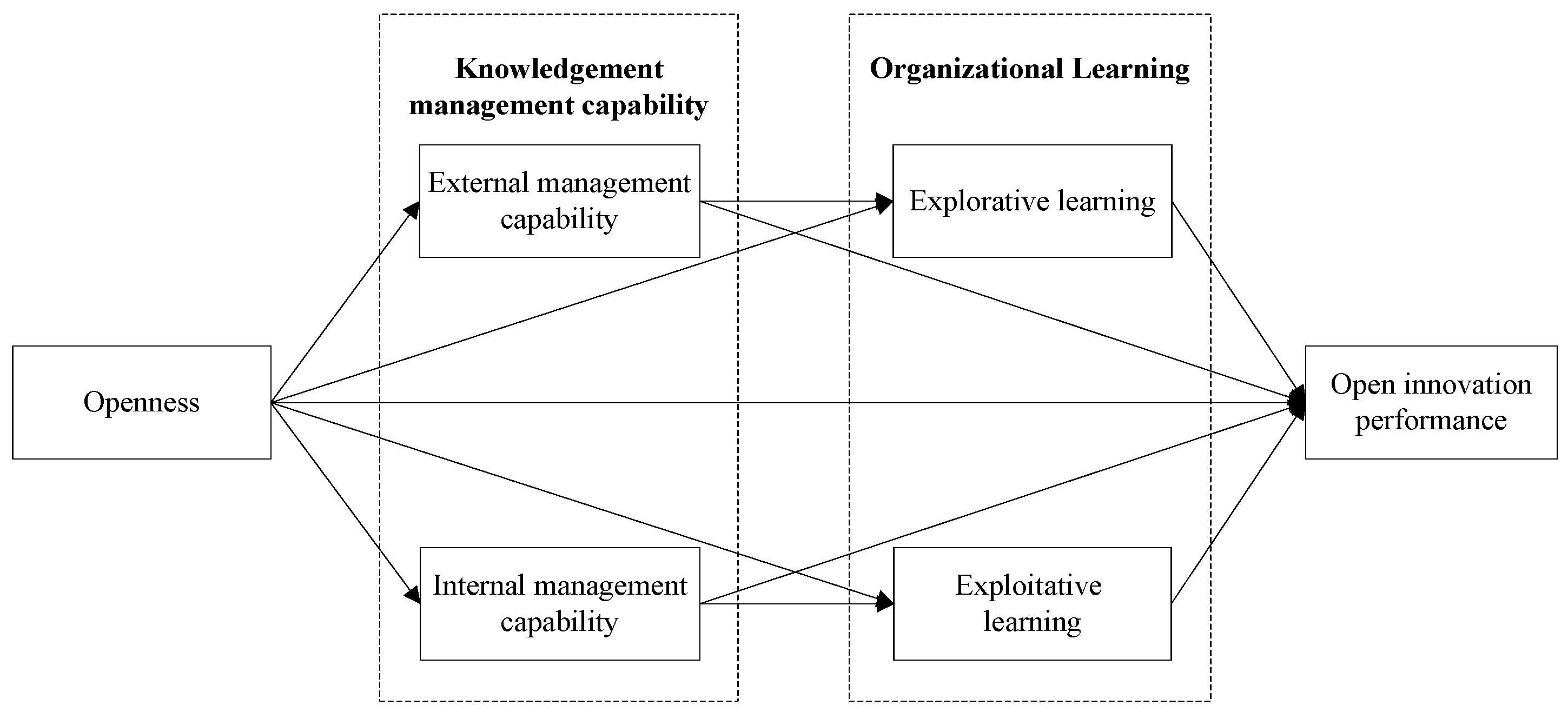
Figure 2.
Result of structural equation modeling analysis. Note: ***p<0.01, **p<0.05, *p<0.1.
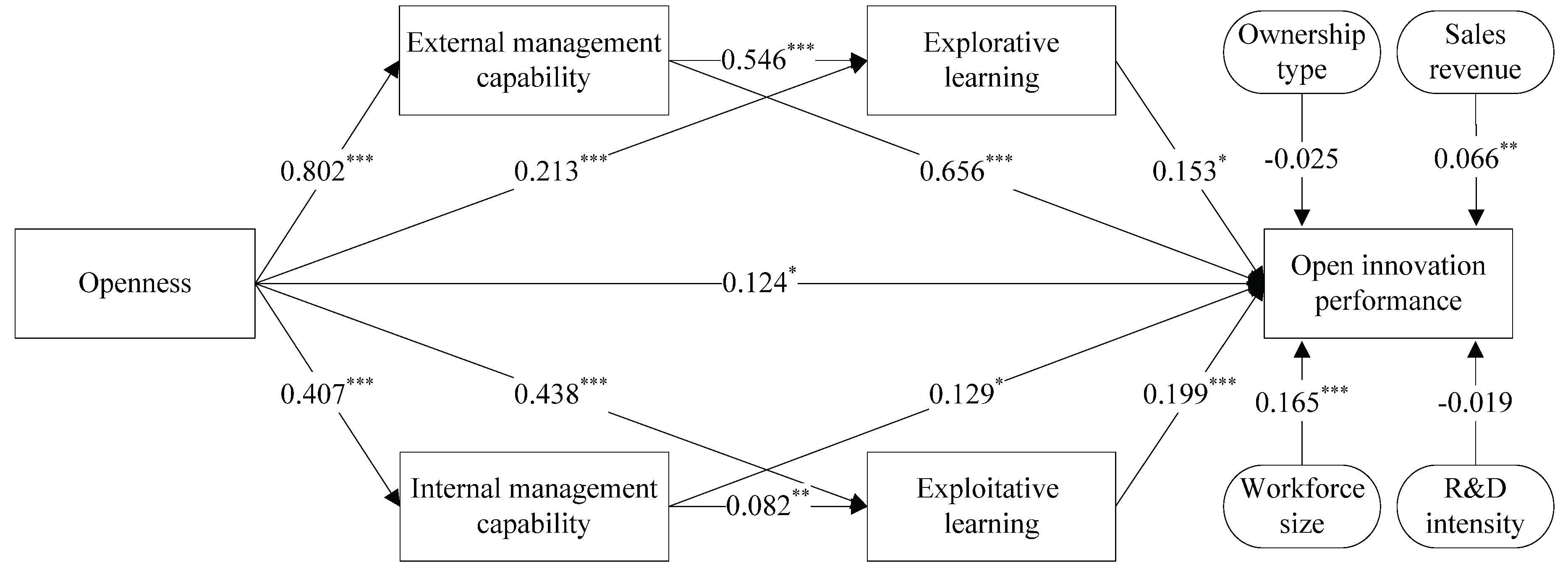

Table 1.
Distribution of sample.
| Characteristic | Number | Percent(%) | |
|---|---|---|---|
| Enterprise ownership type | State-owned enterprise | 316 | 42.5 |
| Private enterprise | 247 | 33.2 | |
| Joint Ventures | 128 | 17.2 | |
| Foreign-owned enterprise | 53 | 7.1 | |
| Sales revenue | <5 million CNY | 48 | 6.5 |
| 5 million-50 million CNY | 229 | 30.8 | |
| 50 million -300 million CNY | 373 | 50.1 | |
| >300 million CNY | 94 | 12.6 | |
| Workforce size | < 50 | 78 | 10.5 |
| 50-300(including) | 192 | 25.8 | |
| 300-1000(including) | 318 | 42.7 | |
| >1000 | 156 | 21.0 | |
| R&D intensity | <1% | 139 | 18.7 |
| 1%-2%(including) | 217 | 29.2 | |
| 2-5%(including) | 296 | 39.8 | |
| >5% | 92 | 12.4 |
Table 2.
Results of correlation analysis and descriptive statistics.
| Variable | 1 | 2 | 3 | 4 | 5 | 6 |
|---|---|---|---|---|---|---|
| 1.Openness | 0.854 | |||||
| 2.External knowledge management capability | 0.602*** | 0.849 | ||||
| 3.Internal knowledge management capability | 0.340** | 0.370** | 0.805 | |||
| 4.Explorative learning | 0.576** | 0.557** | 0.282* | 0.865 | ||
| 5.Exploitative learning | 0.466** | 0.531** | 0.206* | 0.546** | 0.884 | |
| 6.Open innovation performance | 0.590*** | 0.615*** | 0.334** | 0.571** | 0.507** | 0.867 |
| Mean | 4.550 | 4.694 | 5.158 | 4.762 | 4.152 | 4.997 |
| Standard deviation | 1.300 | 1.592 | 1.312 | 1.469 | 1.609 | 1.630 |
Note: ***p<0.01, **p<0.05, *p<0.1; The bold numbers on the diagonal are the square root of the average variance extracted of variables.
Table 3.
Results of reliability and validity test.
| Variable | Items | Factor loading | CR | AVE | Cronbach’s α |
|---|---|---|---|---|---|
| Openness (OPN) |
OPN1 | 0.761 | 0.915 | 0.730 | 0.880 |
| OPN2 | 0.827 | ||||
| OPN3 | 0.911 | ||||
| OPN4 | 0.910 | ||||
| External knowledge management capability(EKM) | EKM1 | 0.852 | 0.958 | 0.720 | 0.913 |
| EKM2 | 0.826 | ||||
| EKM3 | 0.899 | ||||
| EKM4 | 0.784 | ||||
| EKM5 | 0.899 | ||||
| EKM6 | 0.761 | ||||
| EKM7 | 0.913 | ||||
| EKM8 | 0.835 | ||||
| EKM9 | 0.852 | ||||
| Internal knowledge management capability(IKM) | IKM1 | 0.793 | 0.943 | 0.648 | 0.830 |
| IKM2 | 0.724 | ||||
| IKM3 | 0.770 | ||||
| IKM4 | 0.829 | ||||
| IKM5 | 0.834 | ||||
| IKM6 | 0.862 | ||||
| IKM7 | 0.837 | ||||
| IKM8 | 0.781 | ||||
| IKM9 | 0.806 | ||||
| Explorative learning (ERL) |
ERL1 | 0.865 | 0.937 | 0.749 | 0.896 |
| ERL2 | 0.879 | ||||
| ERL3 | 0.909 | ||||
| ERL4 | 0.845 | ||||
| ERL5 | 0.827 | ||||
| Exploitative learning(EIL) | EIL1 | 0.875 | 0.947 | 0.781 | 0.879 |
| EIL2 | 0.886 | ||||
| EIL3 | 0.912 | ||||
| EIL4 | 0.905 | ||||
| EIL5 | 0.839 | ||||
| Open innovation performance (OIP) |
OIP1 | 0.866 | 0.938 | 0.751 | 0.939 |
| OIP2 | 0.908 | ||||
| OIP3 | 0.862 | ||||
| OIP4 | 0.824 | ||||
| OIP5 | 0.870 |
Note: CR, construct reliability; AVE, average variance extracted.
Table 4.
Bootstrap test of mediating effect.
| Path | Estimate | p-value | 95% CI | ||
|---|---|---|---|---|---|
| Lower | Upper | ||||
| Direct effect | Openness→Open innovation performance | 0.124 | 0.058 | 0.049 | 0.162 |
| Indirect effect | Openness→External knowledge management capability→Open innovation performance | 0.526 | 0.000 | 0.443 | 0.609 |
| Openness→Internal knowledge management capability→Open innovation performance | 0.053 | 0.079 | 0.026 | 0.061 | |
| Openness→Explorative learning→Open innovation performance | 0.033 | 0.086 | 0.012 | 0.067 | |
| Openness→Exploitative learning→Open innovation performance | 0.087 | 0.000 | 0.047 | 0.127 | |
| Openness→External knowledge management capability→Explorative learning→Open innovation performance | 0.067 | 0.077 | 0.005 | 0.096 | |
| Openness→Internal knowledge management capability→Exploitative learning→Open innovation performance | 0.007 | 0.028 | 0.001 | 0.012 | |
| Total indirect effect | - | 0.773 | 0.000 | 0.65 | 0.794 |
| Total effect | - | 0.897 | 0.000 | 0.738 | 0.915 |
Note: CI, confidence interval.
Table 5.
The results of regression analysis on direct effects
| Variables | Model 1 | Model 2 | Model 3 | Model 4 | Model 5 | Model 6 |
|---|---|---|---|---|---|---|
| Enterprise ownership type | -0.195*** | -0.059*** | -0.073*** | -0.158*** | -0.060** | -0.071*** |
| Sales revenue | 0.035 | 0.103 | 0.065*** | 0.014 | 0.022 | 0.024 |
| Workforce size | 0.265*** | 0.191 | 0.171*** | 0.231*** | 0.142*** | 0.217*** |
| R&D intensity | 0.127*** | 0.033 | 0.015 | 0.082*** | 0.013 | 0.036 |
| Openness | 0.663*** | |||||
| External knowledge management capability | 0.762*** | |||||
| Internal knowledge management capability | 0.290*** | |||||
| Explorative learning | 0.637*** | |||||
| Exploitative learning | 0.578*** | |||||
| R2 | 0.104 | 0.503 | 0.649 | 0.184 | 0.469 | 0.413 |
| F | 30.024*** | 209.973*** | 382.378*** | 46.725*** | 182.691*** | 145.994*** |
Table 6.
The results of regression analysis on indirect effects.
| Variables | Model 7 | Model 8 | Model 9 | Model 10 | Model 11 | Model 12 |
|---|---|---|---|---|---|---|
| Enterprise ownership type | -0.058*** | -0.053** | -0.022 | -0.013 | -0.037* | -0.008 |
| Sales revenue | 0.077*** | 0.093*** | 0.073*** | 0.080*** | 0.064*** | 0.071*** |
| Workforce size | 0.168*** | 0.184*** | 0.142*** | 0.179*** | 0.142*** | 0.172*** |
| R&D intensity | 0.010 | 0.022 | -0.005 | -0.002 | -0.009 | -0.011 |
| Openness | 0.168*** | 0.632*** | 0.447*** | 0.505*** | 0.121*** | 0.479*** |
| External knowledge management capability | 0.635*** | 0.532*** | ||||
| Internal knowledge management capability | 0.097*** | 0.087*** | ||||
| Explorative learning | 0.381*** | 0.225*** | ||||
| Exploitative learning | 0.363*** | 0.360*** | ||||
| R2 | 0.659 | 0.511 | 0.591 | 0.603 | 0.686 | 0.609 |
| F | 333.610*** | 180.612*** | 249.581*** | 261.593*** | 322.299*** | 230.153*** |
Disclaimer/Publisher’s Note: The statements, opinions and data contained in all publications are solely those of the individual author(s) and contributor(s) and not of MDPI and/or the editor(s). MDPI and/or the editor(s) disclaim responsibility for any injury to people or property resulting from any ideas, methods, instructions or products referred to in the content. |
© 2025 by the authors. Licensee MDPI, Basel, Switzerland. This article is an open access article distributed under the terms and conditions of the Creative Commons Attribution (CC BY) license (http://creativecommons.org/licenses/by/4.0/).
Copyright: This open access article is published under a Creative Commons CC BY 4.0 license, which permit the free download, distribution, and reuse, provided that the author and preprint are cited in any reuse.


