

Submitted:
23 September 2025
Posted:
30 September 2025
You are already at the latest version
Abstract
Objective: Shift work systems among healthcare professionals can potentially lead to physical and psychological disorders. Changes in eating habits, irregular nutrition, inadequate food intake may result in anemia. We aimed to examine the rate of anemia and related disorders among healthcare shift workers through a retrospective analysis.
Methods: We included 132 volunteer healthy personnel working at the university. The survey questions consisting of descriptive information form and literature-based questions related to anemia prepared by using 'Google Forms were sent to the employees' phones. ROC analyses were conducted to evaluate the sensitivity and specificity of continuous variables related to shift work durations in indicating the presence of anemia.
Results: Among the 132 participants, the number of individuals engaged in shift work exceeded that of the non-shift work group (80 versus 52). The rate of participants with anemia was 33.8% in shift workers and 42.3% in non-shift workers (p= 0.32). The incidence of anemia in females (53.3%) was significantly higher than in males (2.4%). In the ROC analysis for the presence of anemia, a cut-off value of 157 hours was determined for total shift work duration, with sensitivity and specificity rates of 43.8% and 41%, respectively (AUC: 0.380, CI: 0.277-0.482). It was observed that those with thyroid disease had a higher rate of anemia compared to those without (p=0.004).
Conclusion: As males constituted the majority of shift workers, the ROC analysis suggested that the risk of anemia didn’t increase despite prolonged shift work duration.
Keywords:
Shift work
; healthcare shift workers
; anemia
; nutritional disorder
; iron deficiency
Introduction
The shift work system is applied for continuity of service, especially in hospitals and other health institutions, as well as in many basic areas such as security and industry. The implementation of shift work systems is increasing globally and is most frequently used in the health sector [1,2]. In shift work system, working hours during the day, especially in the night shift, negatively affects the health of employees in physiological, psychological, and social terms. Among healthcare workers, night shifts cause circadian rhythm disorders along with the change in nutrition and sleep patterns [3]. In addition to the disruption of the circadian rhythm, healthcare workers working in night shifts frequently experience gastrointestinal system disorders such as constipation, digestive problems, and various mood disorders [4]. Furthermore, shift work may increase the risk of cancer, diabetes and cardiovascular diseases. Night shift work might be associated with breast cancer in women, prostate cancer and chronic lymphocytic leukaemia [5]. A study conducted among nurses identified shift work as a potential risk factor affecting sleep patterns, work performance, and quality of life [6]. Insufficient sleep in shift workers may lead to immune system suppression, metabolic disorders, and nutritional imbalances, and all of these may indirectly contribute to the development of anemia [7]. Anemia, defined by the World Health Organization (WHO) as hemoglobin values or other erythrocyte indices below a specified threshold, is a common condition worldwide. The most prevalent form of anemia is iron deficiency anemia, affecting approximately 30% of the global population [8,9]. Psychological disorders and circadian rhythm disturbances observed in healthcare personnel working in shift work may increase the risk of anemia by influencing dietary habits and affecting iron metabolism [10].
Studies have shown that night shifts can negatively impact workers’ dietary habits, potentially leading to deficiencies in iron and other essential vitamins [11,12]. Night shift work disrupts the circadian rhythm, altering the production of hormones such as melatonin and cortisol; it leads to decreased melatonin levels and elevated cortisol levels. Melatonin also supports the immune system and may facilitate iron absorption. The imbalance of these hormones, particularly the reduction in melatonin secretion can decrease sleep quality, resulting in fatigue, stress, nutritional deficiencies, and anemia [13]. The hormonal imbalances observed during night shifts may affect erythropoiesis, potentially reducing red blood cell production and leading to development of anemia [14].
Thyroid dysfunctions, particularly hypothyroidism and hyperthyroidism, can lead to anemia. In hypothyroidism, decreased erythropoietin production and impaired iron metabolism, as well as in hyperthyroidism, shortened erythrocyte lifespan, can contribute to the development of anemia. Furthermore, thyroiditis may increase the risk of anemia [15].
This study was approved by the Ethics Committee of Afyon Health Science University, based on the decision dated November 3, 2023, and numbered 2023/484.
Material and Method
Study design and data collection: The aim was to recruit a total of 256 healthcare workers to facilitate adequate data evaluation, as determined by power analysis (Calculated using G*Power 3.1.9.7 Software; at least 128 participants were required to be included in each group with a mean effect size (d=0.50), alfa= 0.05 significance level, and 80% power.). The sample group consisted of all hospital employees, and only healthcare workers who worked in the shift system or had no shifts and who voluntarily completed the survey questions were included in the study as participants. The study design, participant selection, and data collection process excluded patients or members of the public. The survey questions, prepared by using ‘Google Forms’ were sent to the employees’ phones by the hospital administration. The survey questions included descriptive information form and literature-based questions related to anemia. Approval for the study was obtained from the hospital administration and the ethics committee; no further consent was required from the healthcare professionals. The descriptive information form consisted of questions about the employee, including age, gender, marital status, socio-economic status, disease diagnosis, health status, anemia assessment, and shift work-related inquiries. The questions about anemia were prepared based on the literature.
Statistical Analysis: Data analysis was conducted using SPSS-26 (Statistical Package for the Social Sciences, USA) software. Histograms, probability plots, and the Kolmogorov-Smirnov method were employed to determine whether the variables were normally distributed. Frequency tables were used to interpret categorical variables. Chi-square tests were performed. Chi-square and Fisher’s exact tests were used to analyze statistical differences between categorical variables. Continuous variables were presented as means with standard deviations or medians with interquartile ranges (25-75%), depending on the normality of their distributions. To assess differences between groups in terms of numerical variables, independent samples t-test and the Mann-Whitney U test were used. ROC (Receiver Operating Characteristic) analyses were conducted to evaluate the sensitivity and specificity of continuous variables related to shift work durations in indicating the presence of anemia. P-value <0.05 was considered statistically significant.
Results
Of the total 132 volunteer participants, 60.6% were shift workers, and the rate of participants with anemia among shift workers was 33.8% (Table 1). The incidence of anemia in females (53.3%) was significantly higher than in males (2.4%) (p < 0.001). While 37.1% of participants were diagnosed with iron deficiency, 38.6% were diagnosed with vitamin deficiency (including B12, folic acid, and other vitamins). When comparing occupational groups in terms of the presence of anemia, the relatively high rate of anemia among nurses was found to be statistically significant (p: 0,0002).
Anemia was present in 57.9% and 33.6% of participants with and without thyroid disease, respectively (p = 0.004). The rate of anemia was higher in individuals who drank tea with meals compared to those who drank tea immediately after meals or 1-2 hours after meals (p = 0.006, Table 1). The frequency of anemia was significantly higher in individuals with a family history of iron deficiency anemia compared to those without (p < 0.001). The mean and median values of the number of both meals and portions of red meat consumed per week were significantly lower in the group with anemia than in the group without anemia (respectively p: 0,007, p:0,012, Table 2).
The median total shift work time per month was 80.0 (IQR: 0.0-170.0) hours in those with anemia and 160.0 (IQR: 48.0-196.0) hours in those without anemia (p=0.12, Table 2).
In the ROC analysis for total working hours with shifts, day and night working hours, and the presence of anemia, 43.1% sensitivity, and 41% specificity rates were determined at a cut-off value of 157 hours for total working hours with shifts (AUC: 0.380 CI: 0.277-0.482, p=0.022). A value above 16.5 hours was associated with the absence of anemia. ROC analysis was also performed to assess the presence of anemia in women and continuous variables related to shift work, including the total duration of shift work, number of day and night shifts, and presence of anemia (p = 0.10, p = 0.85, p = 0.47, respectively; Figure 1, Table 3).
The mean (143.55 ± 82.44 versus 111.93 ± 95.59 hours, p=0.02) and median (176.0 IQR: 0.50-182.0 versus 130.0 IQR: 65.0-196.0, p=0.01) values of total shift work time per month were higher in men (Table 3).
Discussion-Conclusions
In the study, the majority of participants were women (68.1%). Most participants were shift workers (60.6%), with the majority being male. Additionally, men had a longer total shift working time. The lower rate of anemia among shift workers compared to non-shift workers was attributed to the predominance of male participants among shift workers. While anemia is more prevalent among females, the limited total number of participants and the shorter total shift work duration for women precluded the identification of a significant cut-off value for anemia in the ROC analysis conducted for total shift work duration, daytime work hours, and nighttime work hours among female participants. Shift work is quite common among healthcare workers. Unbalanced eating patterns, limited access to healthy foods, night shifts, and psychological problems increase the risk of coronary heart disease, metabolic syndrome, and even cancer, and the absorption of vitamins and minerals may be adversely affected. It was reported that women shift workers have a greater risk of poor sleep quality, coronary heart disease, metabolic disorders, and breast cancer [16].
Shift work may increase the risk of anemia due to association with metabolic diseases. Additionally, chronic inflammation in metabolic diseases can suppress iron absorption by altering hepcidin regulation, leading to the development of anemia in chronic disease. In a recent study, among individuals of European ancestry, hypothyroidism was associated with a higher risk of anemia independent of inflammation and lifestyle [17]. In our participants, it was observed that those with thyroid disease had a higher rate of anemia compared to those without. Consistent with the literature, it has been observed that thyroid pathologies, among metabolic diseases, contribute to the risk of anemia.
In healthcare personnel working in shifts, psychological disorders like depression and anxiety may increase the risk of anemia by affecting dietary habits [18]. Although awareness of anemia among healthcare workers is high, shift work systems can lead to irregular food intake and disrupted sleep patterns. In our study, 37.1% of participants reported being diagnosed with iron deficiency, while 38.6% reported being deficient in vitamins. The median values of weekly red meat consumption in terms of meals and portions were significantly lower in the anemic group.
Studies have indicated that black tea, which contains high levels of tannins, may reduce the absorption of non-heme iron. Regular consumption of large quantities of tea with meals may lead to iron deficiency anemia [19]. In our study, the rate of anemia among individuals who consumed tea with meals was significantly higher than among those who drank tea 1-2 hours after meals or immediately after meals, confirming the adverse effects of consuming tea with meals.
Conclusions
To contribute to the literatüre in terms of the rate of anemia in shift workers, however, we were unable to reach a sufficient number of participants and the target population consisted of individuals from all occupational groups, regardless of gender; the relatively high rate of anemia among nurses was found to be statistically significant. The fact that most of the night shift workers were male and anemia was less common in men, it was found that the incidence of anemia did not increase despite the long shift hours. In addition, low weekly consumption of red meat meals and portions was found to be associated with an increased risk of anemia. More meaningful results may be obtained through randomized studies involving a larger number of participants with homogeneous groups.
Author Statements
Nermin Keni Begendi: Planning, data collection, design, statistical analysis, literature review, writing, critical analysis, comprehensive view, discussion, preparation of figures and tables. Mustafa Duran. Literature review, discussion, critical analysis, preparation of figures and tables. Yaşar Culha: Statistical analysis, comprehensive view, discussion, preparation of figures and tables. Formun Üstü.
Funding Information
There was no funding support at any stage of the study.
Ethics Statement
This study was approved by the Ethics Committee of Afyon Health Science University, based on the decision dated November 3, 2023, and numbered 2023/484. Afyon Health Science University and all study protocols complied with the Declaration of Helsinki. Additionally, the human Ethics and consent-to-participate statements were not enforceable.
Data availability statement
All data generated or analyzed during this study are included in this article.
Conflict of Interest Statement
The authors have no conflict of interest.
References
- Sooriyaarachchi P, Jayawardena R, Pavey T, King NA. Shift work and the risk for metabolic syndrome among healthcare workers: A systematic review and meta-analysis. Obes Rev. 2022;23:e13489. [CrossRef]
- Eurofound. Working conditions in global perspective. Luxembourg: Publications Office of the European Union; 2019 May 6.
- Varlı SN, Mortaş H. The effect of 24 h shift work on the nutritional status of healthcare workers: An observational follow-up study from Turkiye. Nutrients. 2024; 16:2088.
- Moreno CRC, Marqueze EC, Sargent C, Wright KP, Ferguson SA, Tucker P. Working time society consensus statements: Evidence-based effects of shift work on physical and mental health. Ind Health. 2019;57(2):139–57.
- Czyż-Szypenbejl K, Mędrzycka-Dąbrowska W. The impact of night work on the sleep and health of medical staff—A review of the latest scientific reports. J Clin Med. 2024; 13:4505. [CrossRef]
- Selvi Y, Aydın A, Çilli AS, et al. General mental symptoms caused by shift work system in healthcare workers and its effect on quality of life. Thinking Man J Psychiatry Neurol Sci. 2010;23(4):238–43.
- Sun M, Feng W, Wang F, Li P, Li Z, Li M, et al. Meta-analysis on shift work and risks of certain types of obesity. Obes Rev. 2018;19(1):28–40. [CrossRef]
- World Health Organization. WHO portal health topics: Anemia [Internet]. Available from: https://www.who.int/health-topics/anaemia#tab=tab 1 [Accessed 2024 Oct 31].
- Warner MJ, Kamran MT. Iron deficiency anemia. In: StatPearls [Internet]. Treasure Island (FL): StatPearls Publishing; 2024 [cited 2024 Jun 4]. Available from: https://www.ncbi.nlm.nih.gov/books/NBK448065/.
- Yang X, Li J, Zhao S. Effects of shift work on iron metabolism and related biomarkers. Int J Environ Res Public Health. 2017;14(11):1379. [CrossRef]
- Khan N, Anwar R, Kamran M, et al. Shift work and vitamin B12 deficiency: Role of circadian rhythm. Anemia. 2019;2019:6076732.
- Yazici T, Yılmaz H, Cakmakci N. Folate and its role in the prevention of anemia: A review of the literature. Clin Nutr. 2022;41(1):91–9. [CrossRef]
- Katsumata K, Takahashi M, Endo H, et al. Hormonal influences on erythropoiesis in humans. Front Physiol. 2019; 10:635. [CrossRef]
- Pereira H, Feher G, Tibold A, Monteiro S, Costa V, Esgalhado G. The impact of shift work on occupational health indicators among professionally active adults: A comparative study. Int J Environ Res Public Health. 2021;18(21):11290. [CrossRef]
- Gül N. Frequency of anemia in patients with subacute thyroiditis and its relationship with disease. Thyroid Dis. 2018;81(2):46–50.
- Chung SA, Wolf TK, Shapiro CM. Sleep and health consequences of shift work in women. J Womens Health (Larchmt). 2007;16(5):761–6. [CrossRef]
- van Vliet NA, Kamphuis AEP, den Elzen WPJ, Blauw GJ, Gussekloo J, Noordam R, van Heemst D. Thyroid function and risk of anemia: A multivariable-adjusted and Mendelian randomization analysis in the UK Biobank. J Clin Endocrinol Metab. 2022;107(2): e643–52. [CrossRef]
- Geniş B, Can Ö, Demirci Z. Factors affecting mental status in health workers and the effects of shift work system. J Psychiatr Nurs. 2020;11(4):275–83. [CrossRef]
- Elmas C, Gezer C. Composition and health effects of tea plant (Camellia sinensis). Akademik Gida. 2019;17(3):417–28. [CrossRef]
Figure 1.
ROC Analysis of for total working hours with shifts, day and night working hours for the presence of anemia.
Figure 1.
ROC Analysis of for total working hours with shifts, day and night working hours for the presence of anemia.
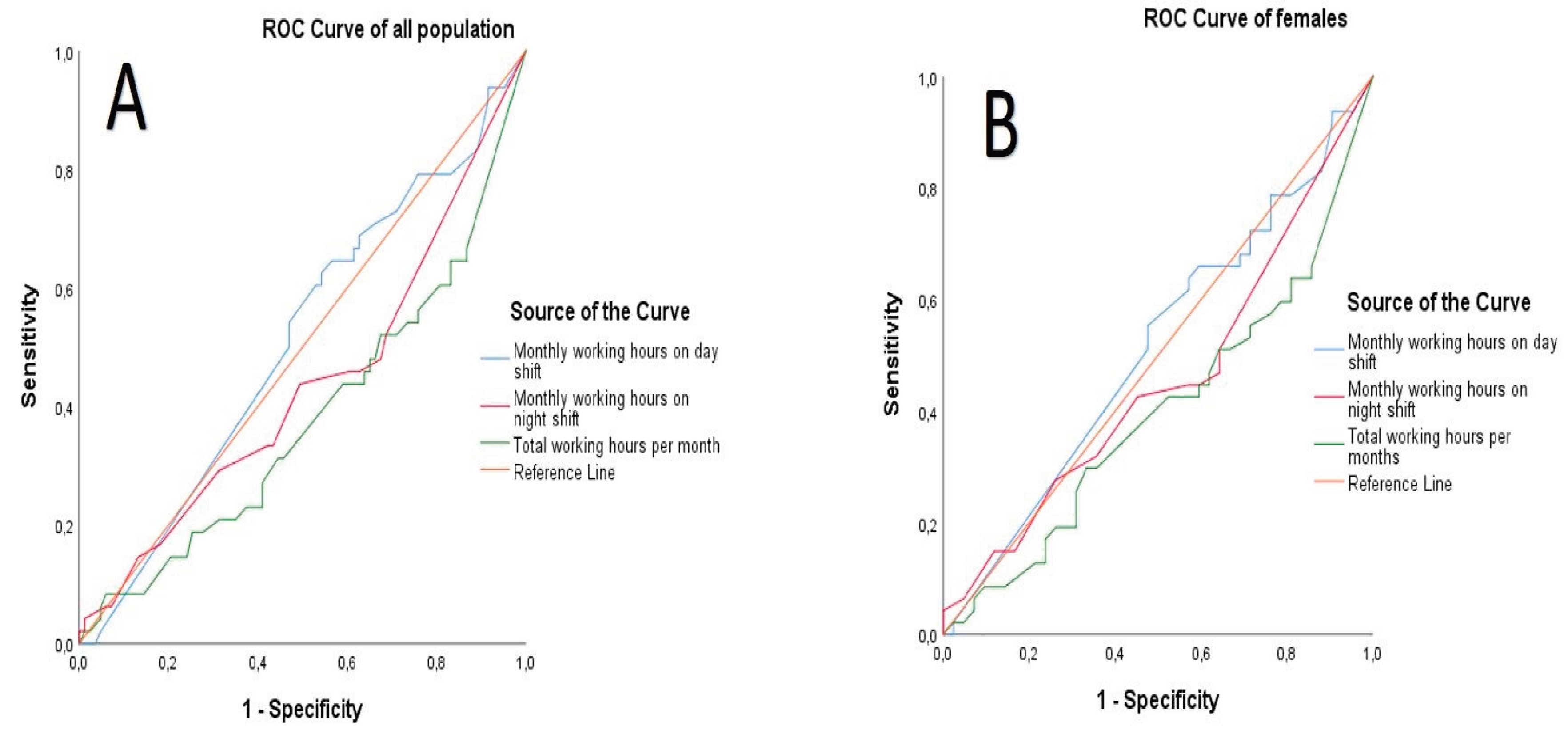

Table 1.
The survey form consisting of descriptive information and literature-based questions about anemia.
Table 1.
The survey form consisting of descriptive information and literature-based questions about anemia.
| Variables | Anemia | Total, n (%) | p Value | |
|---|---|---|---|---|
| No, n (%) | Yes , n (%) | |||
| Shift status | ||||
| Working shifts | 53 (66,3) | 27 (33,8) | 80 (100,0) | 0,320 |
| Not working shifts | 30 (57,7) | 22 (42,3) | 52 (100,0) | |
| Gender | ||||
| Male | 41 (97,6) | 1 (2,4) | 42 (100,0) | <0,001 |
| Female | 42 (46,7) | 48 (53,3) | 90 (100,0) | |
| Marital status | ||||
| Single | 25 (56,8) | 19 (43,2) | 44 (100,0) | 0,308 |
| Married | 58 (65,9) | 30 (34,1) | 88 (100,0) | |
| Family Type | 0,024 | |||
| Nuclear | 75 (63,6) | 43 (36,4) | 118 (100,0) | 0,3Ɨ |
| Extended | 8 (80,0) | 2 (20,0) | 10 (100,0) | 0,11Ɨ |
| Other* | 0 (0,0) | 4 (100,0) | 4 (100,0) | 0,004Ɨ |
| Income level | ||||
| Less than expenses | 24 (55,8) | 19 (44,2) | 43 (100,0) | 0,112 |
| More than expenses | 18 (81,8) | 4 (18,2) | 22 (100,0) | |
| Equal to expenses | 41 (61,2) | 26 (38,8) | 67 (100,0) | |
| Smoking | ||||
| Yes | 24 (60,0) | 16 (40,0) | 40 (100,0) | 0,652 |
| No | 59 (64,1) | 33 (35,9) | 92 (100,0) | |
| Do you have thyroid disease? | ||||
| Yes | 8 (42,1) | 11 (57,9) | 19 (100,0) | 0,043 |
| No | 75 (66,4) | 38 (33,6) | 113 (100,0) | |
| Do you have a history of intestinal parasites? | ||||
| Yes | 2 (28,6) | 5 (71,4) | 7 (100,0) | 0,054 |
| No | 81 (64,8) | 44 (35,2) | 125 (100,0) | |
| Do you drink tea? | ||||
| Yes | 81 (64,8) | 44 (35,2) | 125 (100,0) | 0,101 |
| No | 2 (28,6) | 5 (71,4) | 7 (100,0) | |
| How do you prefer tea? | 0,041 | |||
| Light | 15 (45,5) | 18 (54,5) | 33 (100,0) | 0,008¶ |
| Strong | 24 (75,0) | 8 (25,0) | 32 (100,0) | 0,054¶ |
| Normal | 44 (65,7) | 23 (34,3) | 67 (100,0) | 0,24¶ |
| Timing of tea consumption | 0,027 | |||
| With meals | 6 (35,3) | 11 (64,7) | 17 (100,0) | 0,006§ |
| 1-2 hours after meals | 27 (73,0) | 10 (27,0) | 37 (100,0) | 0,066§ |
| Immediately after meals | 50 (64,1) | 28 (35,9) | 78 (100,0) | 0,38§ |
| Vegetarian? | ||||
| Yes | 0 (0,0) | 2 (100,0) | 2 (100,0) | 0,136 |
| No | 83 (63,8) | 47 (36,2) | 130 (100,0) | |
| Have you been on a diet to lose weight? | ||||
| Yes | 26 (65,0) | 14 (35,0) | 40 (100,0) | 0,739 |
| No | 57 (62,0) | 35 (38,0) | 92 (100,0) | |
| Do you have sleep disorder? | ||||
| Yes | 33 (55,9) | 26 (44,1) | 59 (100,0) | 0,138 |
| No | 50 (68,5) | 23 (31,5) | 73 (100,0) | |
| Do you have a family history of iron deficiency? | ||||
| Yes | 23 (39,7) | 35 (60,3) | 58 (100,0) | <0,001 |
| No | 60 (81,1) | 14 (18,9) | 74 (100,0) | |
| Have you been diagnosed with vitamin (B12, folic acid, other) deficiency? | ||||
| Yes | 22 (43,1) | 29 (56,9) | 51 (100,0) | <0,001 |
| No | 61 (75,3) | 20 (24,7) | 81 (100,0) | |
| Do you have any history of gastrointestinal diseases related to nutrient absorption problems? | ||||
| Yes | 9 (47,4) | 10 (52,6) | 19 (100,0) | 0,130 |
| No | 74 (65,5) | 39 (34,5) | 113 (100,0) | |
| Have you received any dietary program against anemia? | ||||
| Yes | 3 (20,0) | 12 (80,0) | 15 (100,0) | <0,001 |
| No | 80 (68,4) | 37 (31,6) | 117 (100,0) | |
| Occupation? | <0,001 | |||
| Doctor | 26 (83,9) | 5 (16,1) | 31 (100,0) | 0,002 |
| Nurse | 30 (47,6) | 33 (52,4) | 63 (100,0) | 0,0002 |
| Laborant, Technician | 9 (75,0) | 3 (25,0) | 12 (100,0) | 0,18 |
| Secretary | 4 (40,0) | 6 (60,0) | 10 (100,0) | 0,01 |
| Support staff (cleaning, security, driver) | 14 (87,5) | 2 (12,5) | 16 (100,0) | 0,05 |
Statistically significant p values are written in bold. In the *other group, there were 4 participants who selected ‘living alone’. Ɨ,¶,§ The new p value calculated to determine from which subgroup the significance arises in the related groups is 0.008. ǂ the new p value calculated to determine from which subgroup the significance arises in the related group is 0.0054.
Table 2.
Comparison of median values of continuous variables according to anemia status.
| Anemia | N | Median (IQR)* | p | |
|---|---|---|---|---|
| How many hours do you work shifts in total per month? | No | 83 | 160,0 (48,0-196,0) | 0,12 |
| Yes | 49 | 80,0 (0,0-170,0) | ||
| How many day do you work shifts per month? | No | 83 | 20,0 (8,0-22,0) | 0,62 |
| Yes | 49 | 21,0 (8,0-22,0) | ||
| How many night shifts do you work per month | No | 83 | 4,0 (0,0-8,0) | 0,65 |
| Yes | 49 | 1,0 (0,0-8,0) | ||
| Frequency of meat consumption per week (meals)? | No | 83 | 3,0 (2,0-4,0) | 0,007 |
| Yes | 49 | 2,0 (1,0-3,0) | ||
| Portion size of meat consumption per week | No | 83 | 3,0 (2,0-4,0) | 0,012 |
| Yes | 49 | 2,0 (1,0-3,0) | ||
| Body Mass Index (BMI), kg/m² | No | 83 | 23,7 (22,6-27,8) | 0,47 |
| Yes | 49 | 25,0 (22,3-26,8) |
*IQR: Interquartile range is given as 25-75%.
Table 3.
Comparison of Mean and Median Values of Continuous Variables Related to Shift Work by Gender.
Table 3.
Comparison of Mean and Median Values of Continuous Variables Related to Shift Work by Gender.
| Continuous variable | Whole group | Women | Men | ||||||
|---|---|---|---|---|---|---|---|---|---|
| AUC (CI)* | Cut-off | p-value | Sensitivity (%) | Specificity (%) | AUC (CI) | p-value | AUC (CI) | p-value | |
| Number of day shift work per month | 0,511 (0,408-0,613) | - | 0,84 | - | - | 0,512 (0,391-0,633) | 0,85 | 0,366 (0,216-0,516) | 0,65 |
| Number of night shift work per month | 0,435 (0,330-0,540) | - | 0,21 | - | - | 0,455 (0,335-0,576) | 0,47 | 0,829 (0,711-0,948) | 0,26 |
| Total working time per month in shifts (in hours) | 0,380 (0,277-0,482) | 16,5 | 0,022 | 64,6 | 83,1 | 0,399 (0,281-0,517) | 0,10 | 0,829 (0,711-0,948) | 0,26 |
*AUC; Area under the curve, CI; Confidence Interval.
Disclaimer/Publisher’s Note: The statements, opinions and data contained in all publications are solely those of the individual author(s) and contributor(s) and not of MDPI and/or the editor(s). MDPI and/or the editor(s) disclaim responsibility for any injury to people or property resulting from any ideas, methods, instructions or products referred to in the content. |
© 2025 by the authors. Licensee MDPI, Basel, Switzerland. This article is an open access article distributed under the terms and conditions of the Creative Commons Attribution (CC BY) license (http://creativecommons.org/licenses/by/4.0/).
Copyright: This open access article is published under a Creative Commons CC BY 4.0 license, which permit the free download, distribution, and reuse, provided that the author and preprint are cited in any reuse.