

Submitted:
24 December 2024
Posted:
26 December 2024
You are already at the latest version
Abstract
Background: In today's fast-paced work environment, work engagement is crucial for both organizational success and individual well-being. Objective: To analyse the asso-ciated factors of work engagement, work overload, work satisfaction and emotional ex-haustion and describe their effect on nurses and physicians in the Central Catalonia Health Region during 2023. Methods: A multicentre cross-sectional study was conducted using an online questionnaire at the Territorial Management of Central Catalonia (Spain). The questionnaire was accessible from 28th November 2022 to 12nd March 2023. The analysis was performed using SPSS software. CHERRIES guidelines were followed for communicating research results. Results: A total of 321 professionals answered the questionnaire, 60.7% of whom were nursing professionals and 39.3% medical profes-sionals. Work overload, work satisfaction and emotional exhaustion were associated with work engagement. Physicians, permanent contracts, irregular work shifts, overtime and salary were related to work overload and emotional exhaustion. Women, salary, aca-demic level and irregular work shifts were related to work satisfaction. There was a gender inequality in work engagement among nursing professionals, to the detriment of men. In terms of class inequality, there was a difference between occupational groups with respect to work overload and emotional exhaustion among women. Conclusions: Organizational practices need to be improved to promote greater engagement and work satisfaction, as well as reducing emotional overload and exhaustion. This may include regulating unpaid overtime and promoting more stable working hours.
Keywords:
Work engagement
; Work overload
; Work satisfaction
; Emotional exhaustion
; Healthcare workers
1. Introduction
In the current work environment, characterized by rapidly evolving professional demands and ever-changing organizational dynamics, work engagement has emerged as a fundamental pillar for organizational health and individual well-being. This is especially relevant for healthcare professionals, who play a crucial role in caring for the population. However, work engagement in the healthcare sector is often affected by work overload. High work demands, long hours, and constant pressure can lead professionals to feel overwhelmed, triggering mental and physical health problems. Likewise, healthcare professionals, due to the critical nature of their work, are exposed to significant work challenges that, sustained over time, can negatively influence their engagement [1,2].
Work engagement is considered a construct made up of vigour, dedication and absorption. Vigor is characterized by enthusiasm and persistence in performing work tasks. Dedication refers to the involvement and sense of importance that the employee attributes to his or her job. Absorption corresponds to the degree to which a person immerses himself or herself in his or her work [3]. In this sense, work satisfaction is a crucial factor that can enhance or undermine work engagement. Healthcare professionals who enjoy a positive work environment tend to show higher levels of engagement. In this way, work satisfaction could act as a buffer against the negative effects of work overload, also keeping employees away from emotional exhaustion [4,5]. However, it should be noted that emotional exhaustion, or psychological burnout, is especially prevalent in the healthcare sector due to the demanding and often stressful nature of the work. When professionals experience emotional exhaustion, their ability to engage with their work decreases, which can lead to lower quality of care [6,7]. Therefore, it is important to emphasize that work engagement plays a significant protective role, since it has been related to lower perceived stress at work and greater resilience and empathy [3].
Understanding how work engagement, work overload, work satisfaction and emotional exhaustion are related can help develop strategies that promote work engagement and, therefore, improve the quality of patient care and the well-being of health professionals. For this reason, it is necessary to analyse the associated factors of work engagement, work overload, job satisfaction and emotional exhaustion and describe their effect on nurses and doctors in the Central Catalonia Health Region during 2023.
2. Materials and Methods
2.1. Design and Sample
A multicentre cross-sectional study was carried out through an online survey using the Microsoft Forms platform, a secure web application that meets international standards. The study was carried out in the Central Catalonia Territorial Management of the Catalan Institute of Health – a public company of Catalonia, Spain – which has 39 primary care centres and 872 structural positions, 438 of which are in medicine and 434 in nursing [8]. A minimum necessary sample of 242 nursing and medicine professionals was calculated, with a confidence level of 95% and a precision of ± 0.3 units, a population mean with values that are expected to have a standard deviation of around 2.5 units, and an additional 20% of replacements. A convenience sample was carried out, sending a message with an invitation to participate in the study to the corporate email account. The message was sent through the people in charge of the mailing lists of the Communication Department of the Central Catalonia Territorial Management. The questionnaire was accessible from 28 November 2022 to 12 March 2023. CHERRIES guidelines were followed for the communication of research results through online questionnaires [9].
2.2. Instruments and Variables
A self-administered questionnaire of 45 closed questions on a single page was used, divided into 5 parts: sociodemographic data (5 questions), occupational and work activity data (7 questions), work engagement (9 questions), work overload (5 questions), work satisfaction (10 questions) and emotional exhaustion (9 questions). The survey combined ad-hoc questions as well as others belonging to the following questionnaires.
Work Engagement: The Utrecht Work Engagement Scale (UWES-9) has 9 Likert-type response items. The score can range from 0 – 45 points, with 0 = never and 5 = always, with no cut-off points established, so the higher the score, the greater the commitment. The questionnaire was translated and validated into Spanish by Domínguez-Salas et al. 2022 with an α-Chronback of 0.93 for the entire scale [10].
Work Overload: Of the total number of questions in the Karasek work stress questionnaire, 5 were chosen, those related to the job demands category. The score range is between 5 – 20 points, corresponding to 1 = totally disagree and 4 = totally agree. The questionnaire was translated and validated into Spanish by Escribà-Agüir et al. 2001 with an α-Chronback of 0.74 – 0.88 [11].
Work Satisfaction: The Generic Job Satisfaction scale of MacIntyre & MacDonald is made up of 10 Likert-type questions (1 = never and 5 = always), with scores ranging between 10 – 50 points. The questionnaire was translated and validated into Spanish by Salessi et al. 2016 with an α-Chronback of 0.81 [12].
Emotional Exhaustion: Of the total number of questions in the Maslach Burnout Inventory (MBI) questionnaire, 9 were chosen, those belonging to the emotional exhaustion category. The score range varies between 0 – 54 points, where 0 = never and 6 = every day. The cut-off points are set at: 0 – 18 = low, 19 – 26 = medium and 27 – 54 = high. The questionnaire was translated and validated into Spanish by Forné et al. 2022 with an α-Chronback of 0.91 for the emotional exhaustion subscale [13].
2.3. Analysis
A bivariate descriptive analysis was performed, estimating absolute and relative frequencies for qualitative variables, and mean and standard deviation for quantitative variables. The Kolmogorov-Smirnov test with Lilliefors correction was applied to all quantitative variables. Therefore, the Student T test for independent samples was used for significance tests, together with the chi-square test, according to the nature of the variables. A multiple regression model was performed to determine the factors influencing work commitment, work overload, job satisfaction and emotional exhaustion. The analysis was performed using SPSS version 26 for Windows (SPSS Inc., Chicago, IL, USA).
2.4. Ethical Considerations
The study was approved by the IDIAP Jordi Gol clinical research ethics committee with registration code 22/205-P. All participants gave their consent to answer the questionnaire, where they were informed about the objective, the research team, data management and storage, as well as the estimated response time. The data was anonymous and was recorded on the servers of the Territorial Management of Central Catalonia.
3. Results
A total of 321 nursing and medical professionals responded to the questionnaire, 60.7% of whom were nursing professionals and 39.3% were medical professionals. Although the health sector is highly feminized, their distribution was asymmetrical, with female nurses accounting for 93.3% of the sample, while female physicians accounted for 76.2% (p=0.000). Almost all physicians (94.5%) stated that their salary covered basic needs, while nurses did not reach three quarters (68.7%) (p=0.000). In terms of contractual typology, 66.7% of physicians reported having a permanent contract, while the opposite is true for nurses, with 62.1% reporting having a temporary contract (p=0.000). 84.9% of physicians reported spending unpaid overtime at work with an average of 5 hours per week, this frequency being higher than that indicated by nurses (66.2% with an average of 3 hours per week) (p=0.000) (Table 1).
3.1. Factors Associated with Work Engagement
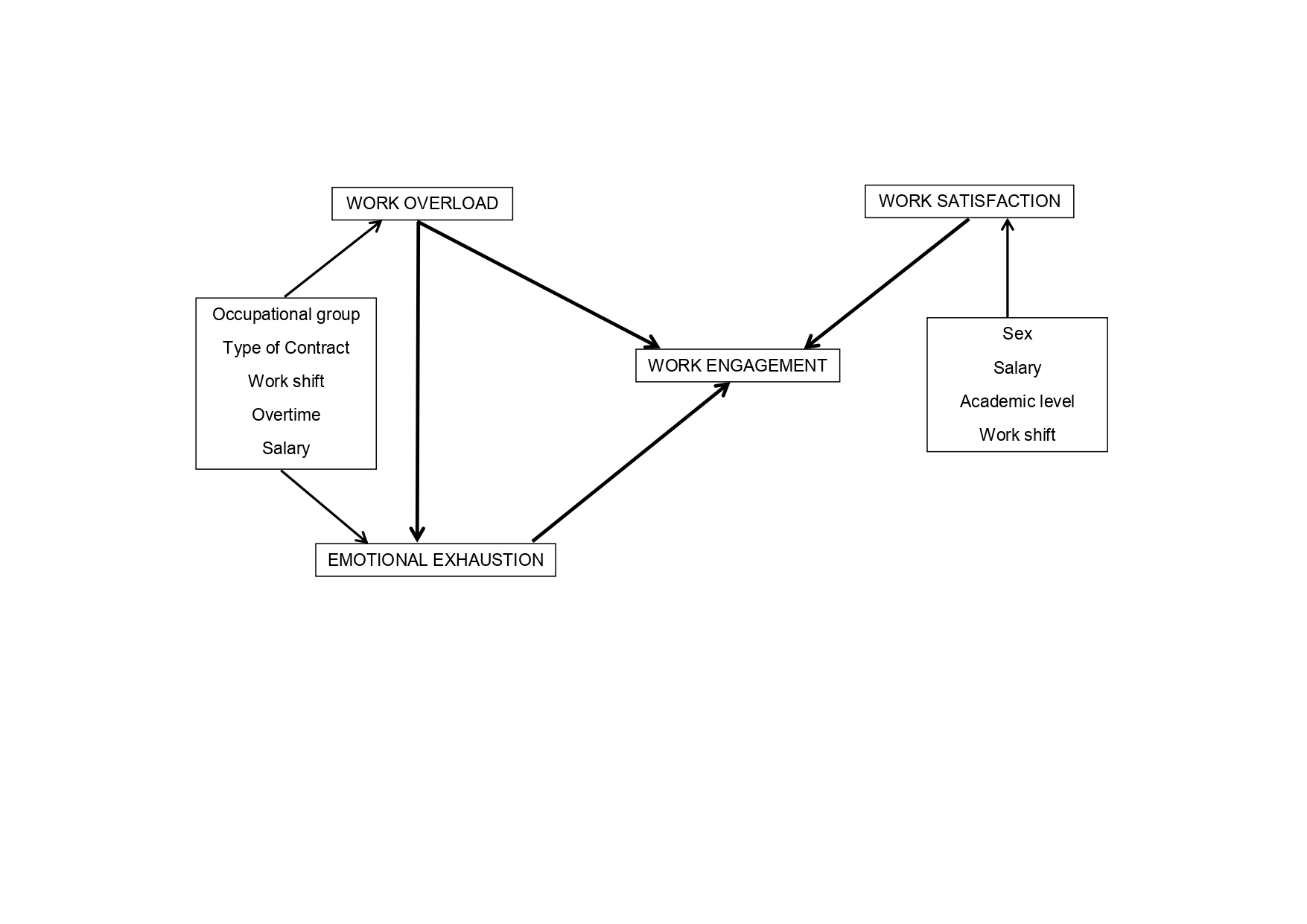
A multiple regression model was performed to predict the possible factors associated with work engagement. The model showed a good level of prediction (R=0.738), with the independent variables explaining 54.4% of the variability of the work engagement variable, which was statistically significant with an F-test value of 0.000. The results showed a positive association between work overload and work engagement, with an increase of 0.501 units in work engagement for each one-unit increase in work overload (p<0.001). This same relationship was observed with work satisfaction, where it was associated, on average, with an increase of 0.735 units in work engagement (p<0.001). However, for the emotional exhaustion variable a negative association was obtained, so that, with a one-unit increase in emotional exhaustion, work engagement decreased by 0.246 units (p<0.001). Regarding the sociodemographic variables, no statistically significant results were obtained (Table 2).
3.2. Factors Associated with Work Overload
Multiple regression analysis revealed a number of factors significantly associated with work overload. The model showed that medical professionals had more work overload than nursing professionals (B=1.428, p<0.001). Likewise, professionals with a permanent contract, rather than a temporary one, had 0.826 points more work overload (p<0.05). However, those whose work shifts were irregular showed greater work overload, compared to workers with fixed work shifts (B=0.554, p<0.05). In addition, healthcare professionals who worked unpaid overtime had 1.467 points more work overload than their counterparts who did not (p<0.001). On the other hand, those whose salaries covered their basic needs tended to experience less work overload (B= -0.342, p<0.05). The model presented a prediction level (R=0.467, R2=0.218), being statistically significant F-test=0.000 (Table 2).
3.3. Factors Associated with Work Satisfaction
With regard to the variables predicting work satisfaction (R=0.382, R2=0.146, F-test 0.000), the findings of the multiple regression analysis revealed gender as an influential factor. The results showed that women had more work satisfaction than men (B=1.726, p<0.05). With respect to the academic level, professionals with higher education had less work satisfaction (B= -0.919, p<0.05). Likewise, health workers whose work shifts were irregular showed 1,835 points less work satisfaction, compared to their colleagues with fixed work shifts (p<0.01). On the other hand, those whose salaries covered their basic needs tended to experience 1,541 points more work satisfaction (p<0.001) (Table 2).
3.4. Factors Associated with Emotional Exhaustion
Regarding the factors influencing emotional exhaustion (R=0.372, R2=0.139, F-test 0.000), it was observed that medical professionals had 3,169 more points of emotional exhaustion than their nursing colleagues (p<0.05). With respect to the type of contract, the findings showed that workers with a permanent contract reported greater emotional exhaustion, compared to those with a temporary employment contract (B=4.783, p<0.01). Likewise, healthcare workers with irregular work shifts reported 3,374 more points of emotional exhaustion than those with a fixed shift (p<0.01). In this sense, those who worked unpaid overtime had greater emotional exhaustion (B=3.269, p<0.05). On the other hand, health workers whose salaries covered their basic needs tended to experience 2,666 fewer points of emotional exhaustion (p<0.001) (Table 2).
3.5. Effect of Work Engagement, Work Overload, Work Satisfaction and Emotional Exhaustion on Healthcare Professionals
In Table 3, firstly, healthcare professionals were stratified according to occupational class, showing the results for the different variables based on sex, thus eliminating the class effect. In this case, it was highlighted that work engagement was distributed in a statistically unequal manner. The gender inequality occurs among nursing professionals and to the detriment of men (p=0.039). Thus, female nurses have more work engagement than their male counterparts. Secondly, healthcare professionals were also stratified according to sex, thus showing the results for the different variables based on occupational class. In this case, a pattern of class inequality was observed, with a difference between occupational groups in work overload and emotional exhaustion among women, but not among men (p=0.000 and p=0.006, respectively).
4. Discussion
The aim of this research was to analyse the associated factors of work engagement, work overload, work satisfaction and emotional exhaustion and to describe their effect on nurses and doctors in the Central Catalonia Health Region during 2023. As to the composition of the sample, an asymmetric distribution was observed in terms of sex in the different occupational groups (p = 0.000). This fact coincides with other studies, where the well-known vertical segmentation continues to be present in the health sector, despite it being a highly feminized sector [14,15,16].
With regard to the factors associated with work engagement, the findings indicated that health workers who have more work overload are also those who are more committed to their work. Work satisfaction also had a positive relationship with work engagement, while the association with emotional exhaustion was negative. This relationship has also been observed in studies by other authors, where work overload, work satisfaction and emotional exhaustion were significantly related to work engagement [1,2]. This association could be explained by the job demands-resources (JD-R) theory of Arnold Bakker et al. According to this model, job demands can have a positive effect on work engagement, as workers can feel motivated and stimulated by these demands, leading to greater involvement and dedication in their work. On the other hand, demands can also lead to burnout, which in turn is negatively related to work engagement. In this way, burnout decreases work engagement because exhausted employees lack the energy needed to engage in their tasks. Workers with high levels of burnout may feel that they do not have the emotional resources to fully dedicate themselves to their work, displaying, for example, decreased dedication, a negative attitude towards tasks, and emotional disengagement from work. In this same line, job satisfaction is positively associated with work engagement, because when employees are satisfied with their work, they are more likely to feel motivated. For this reason, satisfaction provides a positive environment that fosters vigour, dedication and absorption, helping workers to get involved with the organization's goals [17].
As for the factors associated with work overload and emotional exhaustion, the same statistically significant variables were obtained, so the point is discussed together. The results showed that doctors were the ones who had the greatest overload and exhaustion. This coincides with the findings of other studies, where medical professionals are the ones who have the most unfavourable exposures to high quantitative demands, which can lead to greater exhaustion [14,15]. A relationship was also observed with the type of contract, work shifts and overtime. The latest European survey on working conditions showed that more than half of employees with permanent contracts worked at high speed (51.8%). In addition, they had to work under very tight deadlines, a difference of around 9% compared to workers with temporary contracts [18]. This could be because permanent contracts, while providing stability and job security, also entail higher expectations in terms of productivity and commitment, and workers may feel pressured to take on more tasks and responsibilities. This can lead to a backlog of work and greater burnout, as these types of employees have more defined long-term roles. In this sense, irregular shifts make it difficult to plan personal and family time, which can increase stress and the feeling of being emotionally overloaded and exhausted. In addition, irregular shifts lead to an imbalance between work and personal life, making workers feel that they must always be available for work [19]. Likewise, several authors have linked rotating shifts with presenteeism and exhaustion, as well as long working hours (overtime) [20,21]. On the other hand, salary was negatively associated with work overload and emotional exhaustion, such that those whose salary was insufficient to cover their needs tended to have greater work overload and exhaustion. This scenario was also corroborated by the study by Salas-Nicas et al. where workers with lower salaries are more exposed to high strain (high demands and low control to cope with them) with a difference of around 14%, compared to those with a salary sufficient to cover their needs [22].
In relation to the factors associated with job satisfaction, the results indicated that people whose salary allowed them to cover their needs and women were positively related to satisfaction. However, a high level of education and irregular shifts were negatively associated to it. These results coincided with those published by Elsahoryi et al. where workers with higher monthly salaries were 1.53 times more likely to have higher job satisfaction, compared to those with lower monthly salaries [23]. This is also confirmed by Singh et al., where job satisfaction was higher for those who received higher amounts of remuneration, although a wage gap was found to the detriment of women (p<0.001) [24]. Despite the obvious wage gap, women are more likely than men to respond positively in job satisfaction [23,25,26]. This could be due to different expectations between men and women due to cultural and social factors. While one of the most important factors for men when considering a new job is monetary compensation, women tend to value work-life balance or flexibility, as well as a good work environment among other aspects. In addition, if women's initial expectations about their remuneration are lower, they may feel greater satisfaction when these expectations are met or exceeded, even though they objectively earn less [26]. In relation to the educational level, the research by Li et al. showed that professionals with a higher educational level had less job satisfaction. A possible explanation would be that people with a higher educational level tend to have higher expectations regarding their jobs, both in terms of salary, development opportunities, and personal satisfaction. In addition, another reason could be due to the phenomenon known as “underemployment.” This situation occurs when the employee is overqualified for the job he or she performs, which generates a mismatch of skills that creates dissatisfaction due to the feeling of not fully utilizing his or her skills and knowledge [4]. However, it must be taken into account that work satisfaction is a multidimensional construct that can be influenced by several factors. Ran et al. did not find statistical significance between academic level and job satisfaction, but did relate it to the intention to leave the job [27]. Along the same lines, with respect to work shifts, evidence points to irregular shifts as predictors of greater job dissatisfaction, compared to regular shifts [28], as well as the duration of the shift, where longer shifts lead to lower job satisfaction [29]. Irregular schedules can disrupt sleep and general health [30,31], as well as lead to physical and mental health problems such as fatigue and stress [28].
The axes of segregation in the labour market did not go unnoticed in this study. On the one hand, a pattern of inequality in occupational class was obtained, finding class differences only in women for work overload and emotional exhaustion, with these results being more unfavourable among medical professionals than among nursing professionals. On the other hand, the effect of work engagement on sex -eliminating the effect of occupational class- highlighted a statistically significant unequal distribution to the detriment of male nurses, with female nurses being more committed to their work. These results are inconsistent with those found in the literature. On the one hand, Rivera et al. did not find statistically significant differences between sex and work engagement [32]. However, Wang et al. showed that work engagement was higher among men compared to women (p<0.001) [33]. The relationship between work engagement and gender is complex, as it depends on the cultural, social and economic context. For this reason, it cannot be conclusively stated that one gender has less work engagement than another. However, it should be noted that there are some factors that influence how work engagement is perceived according to gender. For example, women have traditionally taken on a greater share of the responsibilities for caring for the home and children. This may lead some women to have to combine these responsibilities with their work, which is sometimes wrongly interpreted as a lack of work engagement. However, many women work as hard as their male counterparts, but have to divide their time between work and home. This conflict often results in the so-called glass ceiling, where women may face barriers that affect their professional development and incorrectly interpret this as a lack of commitment when, in reality, it is a reaction to a work environment that does not support their growth. The perceived differences are often the result of external and systemic factors rather than an intrinsic lack of commitment. For this reason, it is important to consider the various moderating factors that may be influential when analysing work engagement from a gender perspective [34].
4.1. Limitations
It should be noted that this study has some limitations. Given the geographical extent of the study, an online questionnaire was chosen, which is the best option available for this case, also used by international organisations (Eurofound). As it was an anonymous questionnaire, it was not possible to ensure that each person responded only once. Furthermore, the response rate could not be estimated, since the number of workers who opened the email inviting them to participate and the number of professionals who received the link to the snowball questionnaire are unknown. Even so, the number of participants exceeded the sample size initially calculated. A reminder message inviting them to participate was also sent, as a method of increasing the response rate [35]. Likewise, to improve the representativeness of the sample, all doctors and nurses with any type of employment contract were included, although it is possible that not all professionals with temporary contracts frequently checked their institutional email.
5. Conclusions
The results of this study point to several factors that need to be addressed. Organizational practices need to be improved to promote greater commitment and work satisfaction, as well as to reduce work overload and emotional exhaustion. Therefore, the implementation of policies that manage the balance between workload and available resources should be considered. This may include regulating unpaid overtime and promoting more stable work schedules. In addition, it is essential to foster a work environment that increases job satisfaction, which can increase work engagement. These strategies would not only improve the well-being of health professionals, but could also translate into better patient care by promoting a more committed and less emotionally exhausted staff.
Author Contributions
conceptualization: MMM, ISM; data curation: MMM; formal analysis: MMM; investigation: MMM; methodology: MMM, ISM; resources: MMM; visualization: MMM; writing – original draft: MMM; writing – review & editing: ISM. All authors have read and agreed to the published version of the manuscript.
Funding
This research received no external funding.
Institutional Review Board Statement
The study was conducted in accordance with the Declaration of Helsinki and approved by the IDIAP Jordi Gol clinical research ethics committee with registration code 22/205-P.
Informed Consent Statement
Informed consent was obtained from all subjects involved in the study.
Data Availability Statement
The data is stored on the servers of the Territorial Management of Central Catalonia and is not publicly available for ethical reasons. The informed consent did not include the transfer of data to third parties or international data transfer.
Acknowledgments
We thank all physicians and nurses that generously participated in this study.
Conflicts of Interest
The authors declare no conflicts of interest.
Abbreviations
The following abbreviations are used in this manuscript:
| UWES-9 | The Utrecht Work Engagement Scale |
| MBI | Maslach Burnout Inventory |
References
- Ni, Y. xia; Xu, Y.; He, L.; Wen, Y.; You, G. ying Relationship between Job Demands, Work Engagement, Emotional Workload and Job Performance among Nurses: A Moderated Mediation Model. Int Nurs Rev 2024. [CrossRef]
- Debets, M.; Scheepers, R.; Silkens, M.; Lombarts, K. Structural Equation Modelling Analysis on Relationships of Job Demands and Resources with Work Engagement, Burnout and Work Ability: An Observational Study among Physicians in Dutch Hospitals. BMJ Open 2022, 12. [Google Scholar] [CrossRef] [PubMed]
- Sohrabizadeh, S.; Sayfouri, N. Antecedents and Consequences of Work Engagement Among Nurses. Iran Red Crescent Med J 2014, 16. [Google Scholar] [CrossRef] [PubMed]
- Li, L.; Gan, Y.; Jiang, H.; Yang, Y.; Zhou, X.; Zheng, Y.; Yu, F.; Liu, J.; Zhong, Y.; Chen, Y.; et al. Job Satisfaction and Its Associated Factors Among General Practitioners in China. J Am Board Fam Med 2020, 33, 456–459. [Google Scholar] [CrossRef] [PubMed]
- Yildiz, B.; Yildiz, T. A Systematic Review and Meta-Analytical Synthesis of the Relationship between Work Engagement and Job Satisfaction in Nurses. Perspect Psychiatr Care 2022. [CrossRef] [PubMed]
- Van Bogaert, P.; Van Heusden, D.; Timmermans, O.; Franck, E. Nurse Work Engagement Impacts Job Outcome and Nurse-Assessed Quality of Care: Model Testing with Nurse Practice Environment and Nurse Work Characteristics as Predictors. Front Psychol 2014, 5. [Google Scholar] [CrossRef] [PubMed]
- Rollins, A.L.; Eliacin, J.; Russ-Jara, A.L.; Monroe-Devita, M.; Wasmuth, S.; Flanagan, M.E.; Morse, G.A.; Leiter, M.; Salyers, M.P. Organizational Conditions That Influence Work Engagement and Burnout: A Qualitative Study of Mental Health Workers. Psychiatr Rehabil J 2021, 44, 229–237. [Google Scholar] [CrossRef] [PubMed]
- Institut Català de la Salut Gerència Territorial Catalunya Central Memòria 2018; Barcelona, 2018;
- López-Rodríguez, J.A. Declaración de La Iniciativa CHERRIES: Adaptación al Castellano de Directrices Para La Comunicación de Resultados de Cuestionarios y Encuestas Online. Aten Primaria 2019, 51, 586–589. [Google Scholar] [CrossRef]
- Domínguez-Salas, S.; Rodríguez-Domínguez, C.; Arcos-Romero, A.I.; Allande-Cussó, R.; García-Iglesias, J.J.; Gómez-Salgado, J. Psychometric Properties of the Utrecht Work Engagement Scale (UWES-9) in a Sample of Active Health Care Professionals in Spain. Psychol Res Behav Manag 2022, 15, 3461. [Google Scholar] [CrossRef]
- Escribà-Agüir, V.; Más Pons, R.; Flores Reus, E. Validación Del Job Content Questionnaire En Personal de Enfermería Hospitalario. Gac Sanit 2001, 15, 142–149. [Google Scholar] [CrossRef] [PubMed]
- Salessi, S.; Omar, A. Satisfacción Laboral Genérica. Propiedades Psicométricas de Una Escala Para Medirla. Alternativas en psicología 2016, 93–108.
- Forné, C.; Yuguero, O. Factor Structure of the Maslach Burnout Inventory Human Services Survey in Spanish Urgency Healthcare Personnel: A Cross-Sectional Study. BMC Med Educ 2022, 22, 1–10. [Google Scholar] [CrossRef]
- Moreno Martínez, M.; Fernández-Cano, M.I.; Feijoo-Cid, M.; Llorens Serrano, C.; Navarro, A. Health Outcomes and Psychosocial Risk Exposures among Healthcare Workers during the First Wave of the COVID-19 Outbreak. Saf Sci 2022, 145, 105499. [Google Scholar] [CrossRef] [PubMed]
- Moreno Martinez, M.; Feijoo-Cid, M.; Fernandez-Cano, M.I.; Llorens-Serrano, C.; Navarro-Gine, A. Psychosocial Risk in Healthcare Workers after One Year of COVID-19. Occup Med (Chic Ill) 2024, 74, 37–44. [Google Scholar] [CrossRef]
- López-Atanes, M.; Pijoán-Zubizarreta, J.I.; González-Briceño, J.P.; Leonés-Gil, E.M.; Recio-Barbero, M.; González-Pinto, A.; Segarra, R.; Sáenz-Herrero, M. Gender-Based Analysis of the Psychological Impact of the COVID-19 Pandemic on Healthcare Workers in Spain. Front Psychiatry 2021, 12, 692215. [Google Scholar] [CrossRef] [PubMed]
- Bakker, A.B.; Demerouti, E.; Sanz-Vergel, A.; Rodríguez-Muñoz, A. La Teoría de Las Demandas y Recursos Laborales: Nuevos Desarrollos En La Última Década. Journal of Work and Organizational Psychology 2023, 39, 157–167. [Google Scholar] [CrossRef]
- Instituto Nacional de seguridad y Salud en el trabajo (INSST); O.A.; M.P Encuesta Europea de Condiciones de Trabajo 2021. Datos de España; Madrid, 2023.
- Dall’Ora, C.; Ball, J.; Recio-Saucedo, A.; Griffiths, P. Characteristics of Shift Work and Their Impact on Employee Performance and Wellbeing: A Literature Review. Int J Nurs Stud 2016, 57, 12–27. [Google Scholar] [CrossRef]
- Pranjić, N.; Mosorović, N.; Bećirović, S.; Sarajlić-Spahić, S. Association between Shift Work and Extended Working Hours with Burnout and Presenteeism among Health Care Workers from Family Medicine Centres. Med Glas 2023, 20, 288–295. [Google Scholar] [CrossRef] [PubMed]
- Dall’ora, C.; Ejebu, O.Z.; Ball, J.; Griffiths, P. Shift Work Characteristics and Burnout among Nurses: Cross-Sectional Survey. Occup Med (Lond) 2023, 73, 199. [Google Scholar] [CrossRef] [PubMed]
- Salas-Nicás, S.; Moncada, S.; Llorens, C.; Navarro, A. Working Conditions and Health in Spain during the COVID-19 Pandemic: Minding the Gap. Saf Sci 2021, 134, 105064. [Google Scholar] [CrossRef]
- Elsahoryi, N.A.; Alathamneh, A.; Mahmoud, I.; Hammad, F. Association of Salary and Intention to Stay with the Job Satisfaction of the Dietitians in Jordan: A Cross-Sectional Study. Health Policy Open 2021, 3, 100058. [Google Scholar] [CrossRef] [PubMed]
- Singh, N.; Doshi, M.D.; Schold, J.D.; Preczewski, L.; Klein, C.; Akalin, E.; Leca, N.; Nicoll, K.; Pesavento, T.; Dadhania, D.M.; et al. Survey of Salary and Job Satisfaction of Transplant Nephrologists in the United States. Clin J Am Soc Nephrol 2022, 17, 1372–1381. [Google Scholar] [CrossRef]
- Ministerio de Trabajo e Inmigración Encuesta de Calidad de Vida En El Trabajo; Madrid, 2010;
- Snow Andrade, M.; Westover, J.H.; Peterson, J. Job Satisfaction and Gender. Journal of Business Diversity 2019, 19, 22–40. [Google Scholar]
- Ran, L.; Chen, X.; Peng, S.; Zheng, F.; Tan, X.; Duan, R. Job Burnout and Turnover Intention among Chinese Primary Healthcare Staff: The Mediating Effect of Satisfaction. BMJ Open 2020, 10, e036702. [Google Scholar] [CrossRef]
- Jaradat, Y.M.; Nielsen, M.B.; Kristensen, P.; Bast-Pettersen, R. Shift Work, Mental Distress and Job Satisfaction among Palestinian Nurses. Occup Med (Lond) 2017, 67, 71–74. [Google Scholar] [CrossRef] [PubMed]
- Ball, J.; Day, T.; Murrells, T.; Dall’Ora, C.; Rafferty, A.M.; Griffiths, P.; Maben, J. Cross-Sectional Examination of the Association between Shift Length and Hospital Nurses Job Satisfaction and Nurse Reported Quality Measures. BMC Nurs 2017, 16, 1–7. [Google Scholar] [CrossRef]
- Castillo-Guerra, B.; Guiance-Gómez, L.M.; Méndez-Pérez, C.; Pérez-Aguilera, A.F. Impacto de Los Turnos de Trabajo En La Calidad Del Sueño Del Personal de Enfermería En Dos Hospitales de Tercer Nivel de Canarias. Med Segur Trab (Madr) 2022, 68, 105–117. [Google Scholar] [CrossRef]
- Chang, W.P.; Chang, Y.P. Relationship between Job Satisfaction and Sleep Quality of Female Shift-Working Nurses: Using Shift Type as Moderator Variable. Ind Health 2019, 57, 732. [Google Scholar] [CrossRef] [PubMed]
- Rivera, R.R.; Fitzpatrick, J.J.; Boyle, S.M. Closing the RN Engagement Gap: Which Drivers of Engagement Matter? J Nurs Adm 2011, 41, 265–272. [Google Scholar] [CrossRef]
- Wang, Y.; Tang, L.; Li, L. Work Engagement and Associated Factors among Healthcare Professionals in the Post-Pandemic Era: A Cross-Sectional Study. Front Public Health 2023, 11, 1173117. [Google Scholar] [CrossRef] [PubMed]
- Cheng, Y.; Li, Y.J.; Cheng, W.J. Gender- and Age-Specific Associations between Psychosocial Work Conditions and Perceived Work Sustainability in the General Working Population in Taiwan. PLoS One 2023, 18, e0293282. [Google Scholar] [CrossRef] [PubMed]
- Sánchez Fernández, J.; Muñoz Leiva, F.; Montoro Ríos, F.J. ¿Cómo Mejorar La Tasa de Respuesta En Encuestas on Line? Revista de Estudios Empresariales. Segunda Época 2009, 45–62.

Table 1.
Percentages of occupations in relation to socio-demographic and occupational variables.
|
Medical professionals (n=126) |
Nursing professionals (n=195) |
p-value | |
| Sex | |||
| Male | 30 (23.8) | 13 (6.7) | .000 |
| Female | 96 (76.2) | 182 (93.3) | |
| Age (x̄±SD) | 46±11 | 45±10 | .294 |
| Dependents in their charge | 57 (45.2) | 105 (53.8) | .132 |
| Academic level | |||
| Degree | 35 (27.8) | 72 (36.9) | .000 |
| University Master’s | 24 (19) | 114 (58.5) | |
| Specialist | 66 (52.4) | 8 (4.1) | |
| Doctorate | 1 (0.8) | 1 (0.5) | |
| Salary covering basic needs | 119 (94.5) | 134 (68.7) | .000 |
| Type of contract | |||
| Permanent | 84 (66.7) | 74 (37.9) | .000 |
| Temporary | 42 (33.3) | 121 (62.1) | |
| Rotating or irregular work shift | 55 (43.7) | 89 (45.6) | .726 |
| Position held in the company | |||
| Assistance | 113 (89.7) | 174 (89.2) | .898 |
| Direction, management | 13 (10.3) | 21 (10.8) | |
| Unpaid overtime work | 107 (84.9) | 129 (66.2) | .000 |
| Average weekly hours of unpaid overtime work (x̄±SD) | 5±6 | 3±5 | .000 |
| Years of service in the company (x̄±SD) | 16±11 | 13±10 | .072 |
Table 2.
Factors associated with work engagement, work overload, work satisfaction and emotional exhaustion.
Table 2.
Factors associated with work engagement, work overload, work satisfaction and emotional exhaustion.
| Work Engagement | Work Overload | Work Satisfaction | Emotional Exhaustion | |
| Unstandardized coefficient B (95% CI) | ||||
| Work Overload | .501 (.232, .770)*** | |||
| Work Satisfaction | .735 (.600, .869)*** | |||
| Emotional Exhaustion | -.246 (-.310, -.183)*** | |||
| Sex | -.367 (-2.140, 1.406) | .169 (-.656, .994) | 1.726 (.002, 3.450)* | -1.113 (-5.029, 2.803) |
| Age | .028 (-.063, .119) | -.020 (-.062, .023) | .035 (-.053, .124) | -.149 (-.351, .053) |
| Dependents in their charge | .319 (-.862, 1.499) | .211 (-.340, .761) | -.372 (-1.522, .778,) | 2.528 (-.085, 5.140) |
| Academic level | .546 (-.304, 1.397) | .159 (-.237, .554) | -.919 (-1.746, -.092)* | .616 (-1.262, 2.494) |
| Salary covering basic needs | -.576 (-1.246, .095) | -.342 (-.645, -.040)* | 1.541 (.909, 2.173)*** | -2.666 (-4.103, -1.230)*** |
| Occupational group | -.969 (-2.437, .498) | 1.428 (.765, 2.091)*** | .573 (-.813, 1.959) | 3.169 (.021, 6.318)* |
| Type of contract | -.583 (-2.194, 1.027) | .826 (.082, 1.570)* | -.500 (-2.055, 1.055) | 4.783 (1.251, 8.316)** |
| Rotating or irregular work shift | .698 (-.478, 1.873) | .554 (.013, 1.095,)* | -1.835 (-2.965, -.705)** | 3.374 (.806, 5.941)** |
| Position held in the company | .485 (-1.650, 2.621) | .630 (-.364, 1.625) | 1.158 (-.920, 3.237) | -1.270 (-5.992, 3.452) |
| Unpaid overtime work | .843 (-.656, 2.342) | 1.467 (.783, 2.150)*** | -.936 (-2.364, .493) | 3.269 (0.24, 6.514)* |
| Average weekly hours of unpaid overtime work | .061 (-.074, .196) | .007 (-.056, .071) | .015 (-.117, .147) | .078 (-.222, .379) |
| Years of service in the company | -.021 (-.118, .077) | -.036 (-.081, .010) | -.023 (-.118, .072) | .000 (-.216, .215) |
*p<0.05; **p<0.01; ***p<0.001.
Table 3.
± SD of work engagement, work overload, work satisfaction and emotional exhaustion by sex for each occupational group, and by occupational group for each sex.
Table 3.
± SD of work engagement, work overload, work satisfaction and emotional exhaustion by sex for each occupational group, and by occupational group for each sex.
| Medical professionals | p-value | Nursing professionals | p-value | |||
| Male | Female | Male | Female | |||
| Work engagement | 26.57 ± 9.35 | 26.16 ± 6.6 | .586 | 22.23 ± 9.58 | 27.32 ±7.40 | .039 |
| Work overload | 17.50 ± 2.84 | 18.2 ± 2.25 | .317 | 16.85 ± 1.57 | 16.31 ±2.74 | .566 |
| Work Satisfaction | 32.83 ± 6.72 | 34.23 ± 5.02 | .420 | 30.77 ± 7.00 | 33.75 ± 5.19 | .131 |
| Emotional exhaustion | 35.90 ± 14.5 | 36.53 ± 11.37 | .911 | 37.15 ± 10.89 | 32.12 ± 12.09 | .111 |
| Male | p-value | Female | p-value | |||
| Medical professionals | Nursing professionals | Medical professionals | Nursing professionals | |||
| Work engagement | 26.57 ± 9.35 | 22.23 ± 9.58 | .159 | 26.16 ± 6.6 | 27.32 ±7.40 | .166 |
| Work overload | 17.50 ± 2.84 | 16.85 ± 1.57 | .222 | 18.2 ± 2.25 | 16.31 ±2.74 | .000 |
| Work Satisfaction | 32.83 ± 6.72 | 30.77 ± 7.00 | .440 | 34.23 ± 5.02 | 33.75 ± 5.19 | .725 |
| Emotional exhaustion | 35.90 ± 14.5 | 37.15 ± 10.89 | .969 | 36.53 ± 11.37 | 32.12 ± 12.09 | .006 |
Disclaimer/Publisher’s Note: The statements, opinions and data contained in all publications are solely those of the individual author(s) and contributor(s) and not of MDPI and/or the editor(s). MDPI and/or the editor(s) disclaim responsibility for any injury to people or property resulting from any ideas, methods, instructions or products referred to in the content. |
© 2024 by the authors. Licensee MDPI, Basel, Switzerland. This article is an open access article distributed under the terms and conditions of the Creative Commons Attribution (CC BY) license (http://creativecommons.org/licenses/by/4.0/).
Copyright: This open access article is published under a Creative Commons CC BY 4.0 license, which permit the free download, distribution, and reuse, provided that the author and preprint are cited in any reuse.


