

Submitted:
09 September 2025
Posted:
29 September 2025
You are already at the latest version
Abstract
There remains often a number of barriers for the transgender community to join the mainstream of the society in Bangladesh though this minor community has been overcome the obstacles of legal consideration for their existence as the third gender in 10 November, 2013. This paper describes the barriers of joining the mainstream of the society for the transgender community doing the thematic analysis of the interview data shows three major aspects namely i) problems in joining the mainstream of the society (what aspect), ii) underlying issues of those problems (why aspect), and iii) the influence of those problems and underlying issues on their lives (how aspect) to create barriers on the way of their inclusion in the society based on the Just city philosophy. To collect the empirical data, 15 face-to-face in-depth interviews were conducted with transgender people selected by the purposive sampling among the thirteen cluster of transgender people in Khulna city. Surprisingly, due to the power of domination within the transgender community, two groups namely a) ‘Guruma’ who does not want to change their traditional lifestyle and culture of remaining isolated from the society in order to hold their power to dominate the junior members of the transgender community, and b) the junior members of the transgender community who want to change their traditional lifestyle and culture of remaining socially isolated in order to join the mainstream of the society to promote their quality of life like other citizen. In conclusion, this paper establishes that the philosophy of just city, mentioned above, have a great prospect to promote the preservation of diversity in the society of the minor groups like the transgender community.
Keywords:
traditional livelihood
; autocratic leader
; inequality
; quality of life
; hidden barriers
1. Introduction
The issue of the transgender community has become sensitive around the world. Transgender people’s rights have become a global concern. However, there is often a social barrier for ensuring the participation in the mainstream of the society for the transgender community though this minor community has been overcome the obstacles of legal consideration for their existence in many countries of the world (The Daily Star, 2015). Hines said that citizenship rights are seen as key to broader human rights in the context of the practice of European countries (Hines, 2009). But the real scenario is different in the question of transgender human rights in the society as it is found that the transgender community remains physically, verbally and sexually abused in our society in the journal named “living on the extreme margin: social exclusion of the transgender population (Hijra) in Bangladesh” (Khan et al., 2009). It is found that the status of their legal rights is varying from the country to country. This research has been grounded on Khulna city of Bangladesh. As the socio-cultural condition of Khulna city is similar to Bangladesh and most of the South Asian countries, it can be hope that this research will be able to represent the issue of social integration for transgender community in the scale of South Asian continent.
It is assumed from the people’s assumption in our society that the transgender community has remained socially excluded because of their different sexual orientation from the male and female. So, it is important to clarify the concepts of sex and gender of the transgender people. The Johnson’s and Repta’s (2002) concept of sex and gender beyond the binaries was clarifies the concept of sex and gender towards the transgender community to identify their cultural and behavioural difference varies from gender to gender. It is found that gender roles differ between cultures and communities and over time (Johnson & Repta, 2012). It can be said that the genetic, cultural, behavioural distinction of transgender community from the men and women in our society may play a very important role as the obstacle of social inclusion. Transgender people feel that they have been born into a body in which their gender identity and their physical sex are not coherent. ‘Transgender’ is used as an umbrella term that includes transgender, transsexual, bigendered and intersex people; transvestites, crossdressers, and drag kings and queens (Hines, 2007). For this study those people will be considered as transgender people who have chosen their gender identity which is not coherent with their physical sex and who had surgical intervention to change their physical characteristics to match their gender identity.
Democracy, diversity and material equality are the three hallmarks of just city philosophy, used as the three sub themes, dealing with the quality of life to indicate the status of social justice for all the citizen including the minor groups like transgender community (Fainstein, 2010). Cities are the major centres of the struggle for social development – their concentration of large and diverse populations on the basis of age, sex, ethnicity, race, cast, language (Fainstein, 2010). Just city philosophy offers the city as a living place including the services facilities equally to every people beyond the consideration of the diversity (Fainstein, 2010). So, it can be said that just city supports an equal opportunity of the urban services to the diverse groups. The research objectives to be addressed fall into two main categories. The first objective is to explore the problems and underlying issues faced by the transgender community in Khulna City respectively under the 1st (“What” theme) and 2nd (“Why” theme) themes which are discussed in 3A and 3B sections with sub themes of 3.A.a; 3.B.b; 3.B.c. The problems and underlying issues faced by this group would be tried to explore into four different categories namely a) social, b) economic, c) political and d) cultural life. The second concerns the influence process of these problems and underlying issues to create barriers on the way of joining the mainstream of the society for the transgender community which has been discussed on the 3rd theme,” how”, in the section of 4 with the sub themes of 4.A, 4B and 4C. In this sector, the influential problems and underlying issues on establishing the democracy and the material equality and preserving their existence in the society to ensure the diversity would be discussed how these issues create barriers on their way of life to ensure their quality of life like other citizens in the society. Based on the literature review, the indicators (1.01) have been selected as the focus questions for the in-depth interview to the representatives under the four aspects of the human life according to the urban development planning to conduct the research. These indicators will help to define the constructs to assess the problems faced by the transgender community in our society. And the prompt and probing have been done based on their answers following these focus issues, mentioned as indicators, to understand the underlying issues of their highlighted problems and to explore the link between the highlighted problems with the underlying issues and the influential process to create obstacles for the transgender people to join the mainstream of the society.

Table 1.01.
Indicator of focus questions for in-depth interviews.
| Aspect | Indicator for focus questions | Three hallmarks of Just City philosophy as the sub themes of 3B, 4A. 4B, 4C thematic analysis to explore the underlying issue and to develop the analytical codes to explain the process of creating the barriers for transgender people to join the mainstream | Authors | ||
| Democracy | Diversity | Material Equality | |||
|
Health service | Freedom of live | Status of social capital | Access to basic needs, status of social safety | Divan, et al. (2016) |
| Learning opportunity | Dickinson, & Balleine, (2002). | ||||
| Social capital | Woolcock, & Narayan, (2000) | ||||
| Social Prestige and life | Woolcock, & Narayan, (2000) | ||||
|
Employment opportunity | Freedom of livelihood | Status of resilience | Status of working environment | Broadus, (2006). |
|
Participation in decision making | Freedom of speech | Status of representative | Government’s Concern | Khan, et al. (2013) |
| Developing leadership | Khan, et al. (2013) | ||||
|
Access to prayer center | Freedom of choice | Status of cultural construction for welcoming transgender’s presence | Access to public places (services and opportunities) |
Dowshen, et al. (2011) |
| Access to national festivals | Khan, et al. (2013) | ||||
| Access to public services | Whittle, et al. (1998) | ||||
| Access to housing | Atkinson, (2003) | ||||
Figure 1.01: Authors generated based on literature review, 2018.
So, this research is going to explore the underlying issues of hidden problems and the influencing process of those underling issues which create barriers for the Transgender community to join the mainstream of the society like other citizens in the country to ensure a Just city. Because, the opportunity to ensure the existence of every marginal groups like transgender community in the mainstream of the society is very necessary to preserve the diversity and inclusiveness of a society.
2. Methods
Selection participant or sampling is the decisions about whom to conduct for my research (what is traditionally called sampling) which was done by following the problem sampling, an approach of purposive sampling method for the collection of the primary data, based on the perception. However, purposive sampling is a non-probability form of sampling. Bryman believe that the goal of purposive sampling is to sample cases/participants in a strategic way, so that those sampled are relevant to the research questions that are being posed (Bryman , 2012). Fifteen transgender people were taken from the six clusters among the thirteen clusters of transgender people living in Khulna city of Bangladesh for in-depth interview following the focus, probing, prompt questions under every main question in order to let them feel free to talk. Consent was obtained from each respondent as part of the questionnaire for the ethical consideration.
As an outsider, it was not easy to get the access to the transgender community for interviewing. For getting familiar with the field and access to their community I have contacted with the executive director named Md. Abul Hossain of a community welfare organization, organization for detached human welfare, based on the reference of my honorable supervisor of this research. I went to this office for a several number only for being familiar and developing friendship with the transgenders, working there. For ice breaking, I have talked with them over phone for a number of time and wishing them on Eid day (Major religious festival on Bangladesh). I also invited them on my places to build their trust as they can talk to me about their every issue without any hesitation.
For the thematic analysis of my interview data, at first, I have translated them into Microsoft Word Office according to my main interview questions. Then I have imported them into NVivo software (Figure 2.01).
Figure 2.01.
Data Importing process in NVivo, 2018.
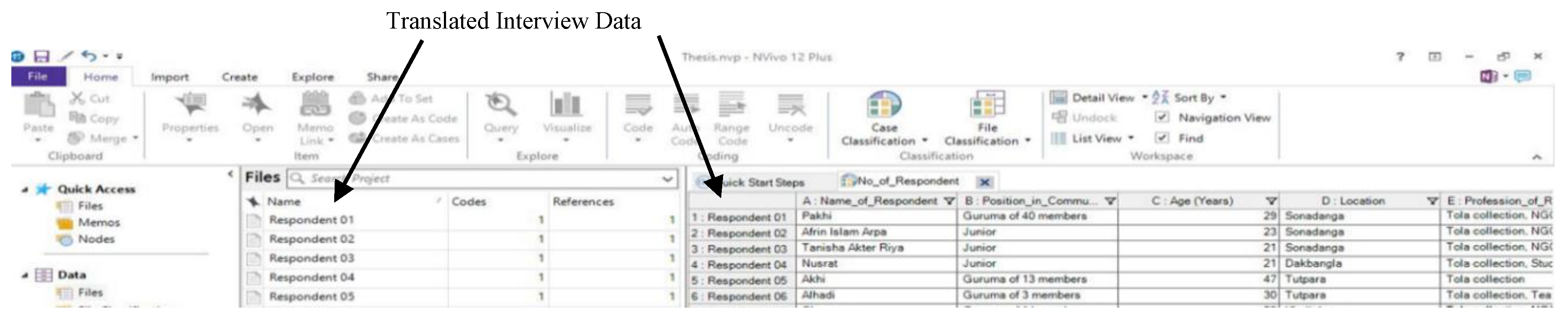
Then I opened all of my interviews one by one and exploring them through scanning and highlighted the important issue using different colors in order to categorize them based on the theme of a) problems in social, economic, political and cultural aspects, they have to face in their everyday life and b) underlying issues of those problems to explore the barriers of establishing their democracy. Coding stipes In NVivo (Figure 2.02) has been used for the easy visualization of different categorized data.
Figure 2.02.
Data Scanning and categorization process in NVivo, 2018.

After that, I have created the descriptive codes (Figure 2.03) under these two themes of a) problems in social, economic, political and cultural aspects, they have to face in their everyday life and b) underlying issues of those problems to explore the barriers of establishing their democracy.
Figure 2.03.
Data Exploration and Coding process in NVivo, 2018.

Next, I have developed analytical codes from aggregating the descriptive codes through generating hierarchical graph (Figure 2.04) to indicate the multidimensional meaning from exploring the influence level of the problems and underlying issues on the transgender’s democracy. Then I used text search query to get the direction from the exploration of the data. And for the visualization I have used word cloud by using NVivo.
Figure 2.04.
Authors generated in NVivo, 2018.
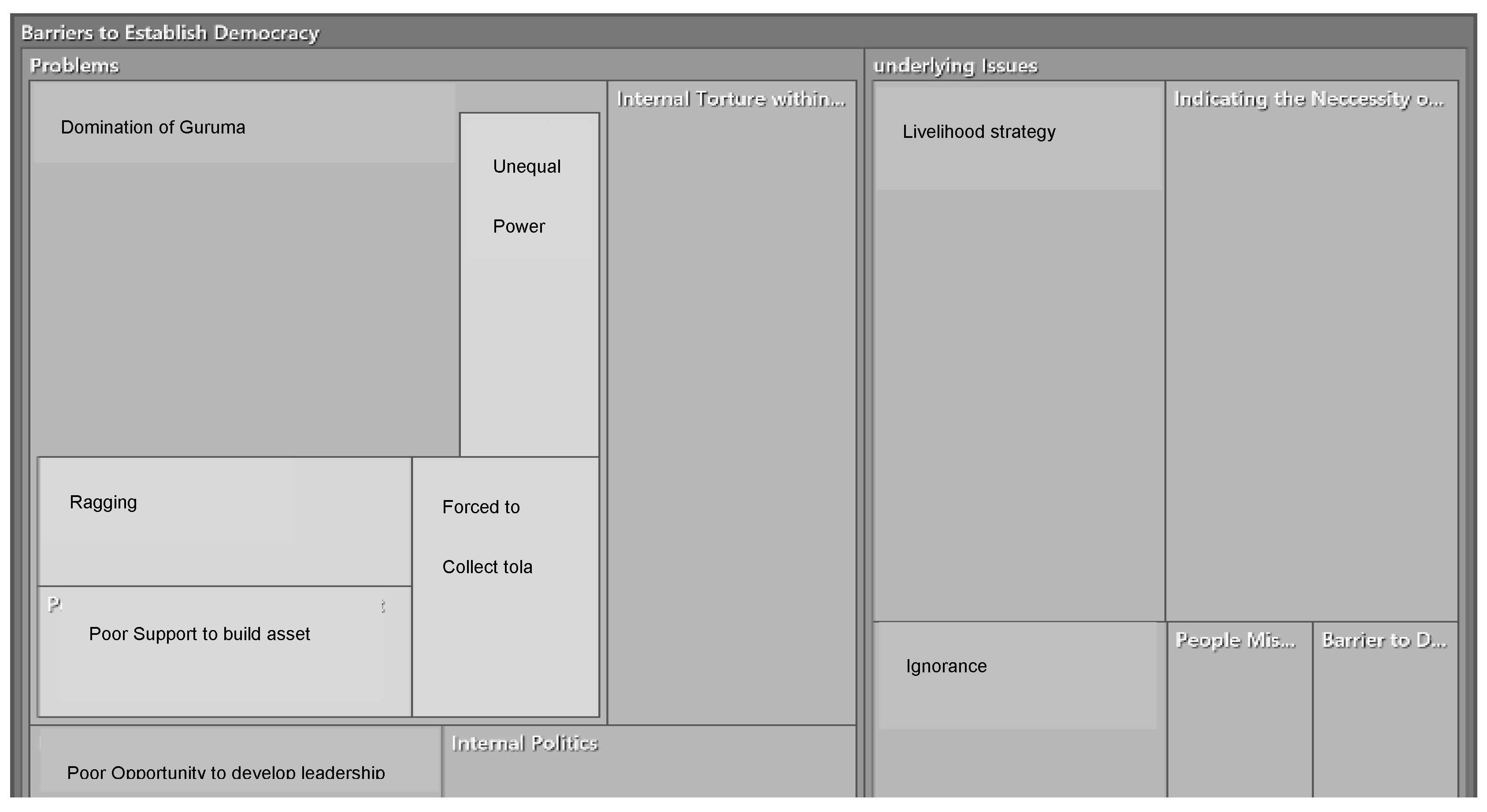
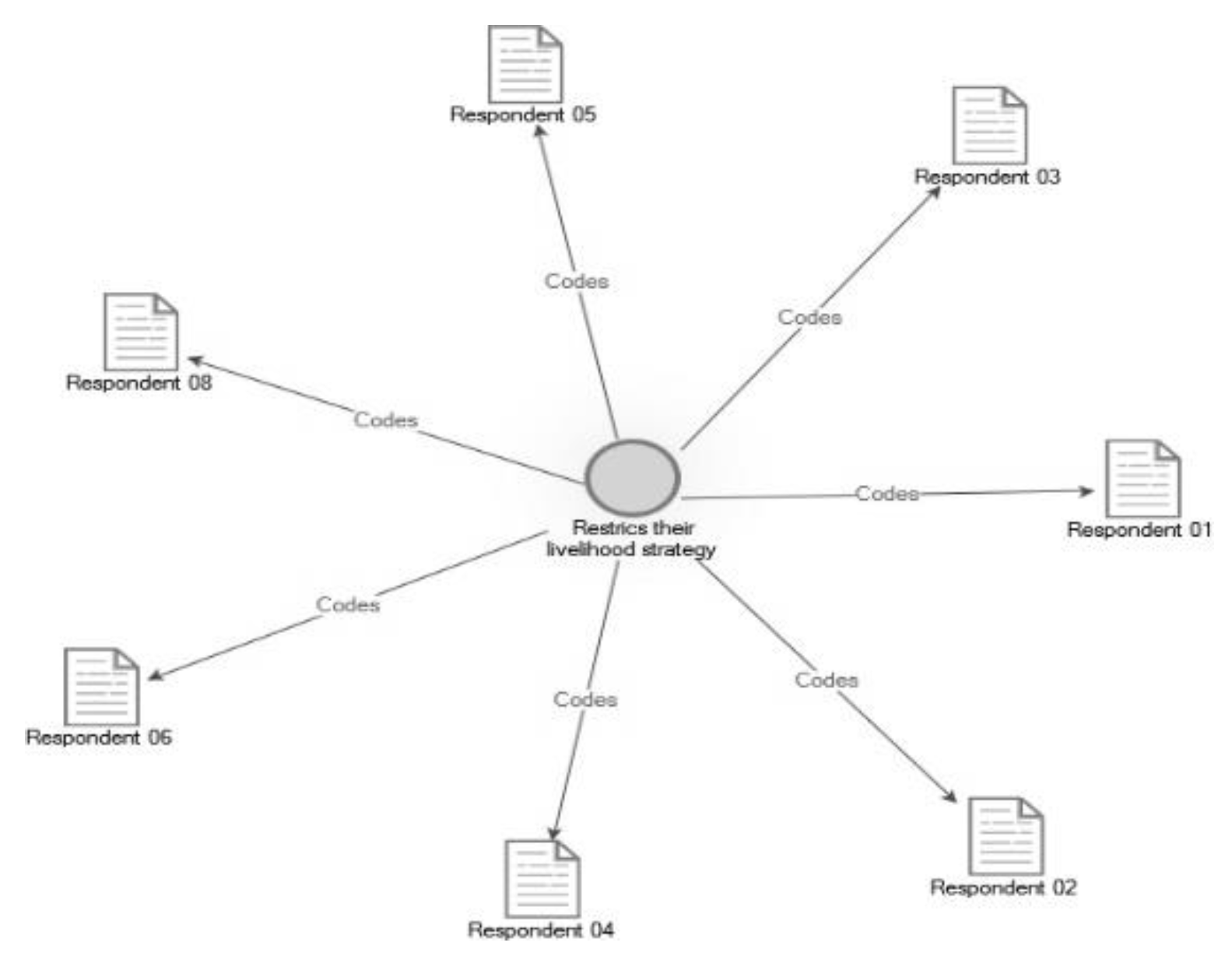
Learning from the voices of the transgender, we could establish that Our empirical evidence shows that there remains a difference in their practice of democracy within transgender group based on their position. As you can see the domination of Guruma(leader of each group) takes the largest portion in this chart, the Guruma (leader of each group) tend to practice domination over the junior members of the transgender community for which the other group members cannot have their freedom in lifestyle and freedom of livelihood because they do not have shelter elsewhere. During the data collection, I did not find any junior member of transgender who does not have any complain about their traditional cultural practice within community which indicates direct or indirect torture of Guruma which restricts their democracy (see Figure 2.05).
Figure 2.05.
Rechecking the references for each node in NVivo for understanding the importance of respective node, 2018.
Figure 2.05.
Rechecking the references for each node in NVivo for understanding the importance of respective node, 2018.
A clear overview on the developed themes for thematic analysis of the interviewed data has been provided below (Table 2.01) with names of the respective sections.
Table 2.01.
Name of the developed themes and sub themes for thematic analysis.
| Name of section | Name of theme | Name of sub theme |
|---|---|---|
| 1st theme “3.A” |
Significant problems faced by the transgender people having a normal life like other citizens (“What” aspect) | |
| 2nd theme “3.B” |
Underlying issue of the emerged problems faced by the transgender people having a normal life like other citizens (“Why” aspect) | |
| “3.B.a” | — | Responsible underlying issues to create barriers for transgender people to achieve their Democracy |
| “3.B.b” | — | Responsible underlying issues to create barriers to protect the existence of transgender people to preserve the Diversity of the society |
| “3.B.c” | — | Responsible underlying issues to create barriers for transgender people to establish their Material Equality |
| 3rd theme “4” |
Influential process of creating barriers by the mentioned underlying issues of their faced problems for the transgender people to join the mainstream of the society like other citizen such as man and woman (“How” aspect) | |
| “4.A” | — | Influential process of creating barriers by the mentioned underlying issues for the transgender people to achieve their Democracy |
| “4.B” | — | Influential process of creating barriers by the mentioned underlying issues for preserving transgender people’s existence as a Diverse group in the society |
| “4.C” | — | Influential process of creating barriers by the mentioned underlying issues for the transgender people to establish their Material Equality |
Figure 2.05: Authors generated in NVivo, 2018.
3. Findings
Two major themes, ‘What’ and ‘Why’ have been developed from the themes of their A. Problems, B. Underlying Issues of those Problems are going to highlight in this section to have understand about their problems and influential underlying issues of those problems. All names of the respondents are being replaced by pseudonyms.
3. A. What are the Significant Problems Faced by the Transgender People Having a Normal Life in the Society like Other Citizens?
All of the significant problems faced by the transgender people are being categorized into four categories based on the aspects such as a. social, b. economic, c. political and d. cultural life. These problems are going to categorized through using these four aspects of life rather than using the issue of creating barriers on achieving democracy of the Transgender people, establishing their material equality and ensuring their existence as the concept of preserving a diverse group of our society because many of the problems, faced by the transgender people, are internally linked with more than one issue, mentioned first part in this sentence,. Considering the flexibility nature of open-ended interview data, the following ‘codes,’ based on the selected indicators which are short phrase that symbolically indicate the problems of the transgender people on the way of establishing their citizen rights like other citizens. And the cluster analysis in NVivo has been conducted based on the ‘word similarity’ of the source data.
Table 3.01.
Generated codes from interview data for thematic (3A) analysis.
| Aspects of Life | Name of the descriptive codes indicating the problems | Sources |
|---|---|---|
|
Forced to Join Transgender Community | 11 |
| Forced to Leave Education | 9 | |
| Poor Access to Public Health Service | 10 | |
| Unsecured Social Prestige and life | 12 | |
|
Poor Opportunity to Choose Livelihood Strategy | 12 |
| Poor Opportunity to Build Assets and Social | 13 | |
| Poor Working Skill | 12 | |
| Few Programs for Rehabilitating Them form Livelihood Strategy | 2 | |
| No Quota in Government Job Except Traffic Police | 1 | |
| Unfriend Working Environment | 6 | |
|
Internal Torture within Community | 14 |
| Poor Opportunity to Raise Voice | 12 | |
|
Ragging Within the Community | 14 |
| Poor Access to Public Services | 13 |
Figure 3.01: Authors 2018 (generated in NVivo).
In order to avoid the repetition of the similar problem in different issues, the problems are going to highlight with simple explanation according to the categorized four aspects.
a. i. Forced to Join Transgender Community
There exists a tradition in Bangladesh for transgender people that they have to leave their family either because of the pressure from their family and relatives or because of the pressure of transgender community to join them. Two of my respondents said that in their family, their family don’t have any problem to live with them but their family was forced by the Guruma (leader of each transgender group) of respective area to live in their community. Representative quotations from interviewees are below:
My Guruma took me to her group by forcing. My mother filed a case against her to return me home but my mother failed with the financial power of Guruma. - Akhi, (47years) (thematic code related to Freedom of live)
My sisters do not misbehave with me usually. But my brothers are Imam (Islamic Religious Leader). They always misbehave with me. And they forbade me to go to home. I do not have any communication with my family members and relatives. My siblings did not let me to see my father’s dead body. They evicted me from home when my sister’s proposals were broken for my sexual orientation. -Bilkis (25years) (thematic code related to Freedom of live)
a. ii. Forced to Leave Education
The transgender people claimed that whoever wants to be educated among them, many of them are not been continuing their education in mainstream respective:
The Guruma of my area (Daulatpur) did not let me study. I flee from my area and start my study in Gopalganj (another area) after her threat to join their community and their profession. - Nusrat (21years) (thematic code related to Freedom of live)
Again, Afrin Islam Arpa (21years),
I had to face bullying from neighbors, teachers, and students for her different attitude from the male students though I used to hide my real sexual identity from others till my 12 class. I failed into two subject and did not continue my study because of the bullying of other transgender friends at my community as I have been living with them though I want to start her study again and want to be a graduate. (thematic code related to Freedom of live)
a. iii. Poor Access to Public Health Service
They have to face problem to receive other general types of medical treatment except sexual disease. The management body of medical care does not believe themselves as they will pay doctor’s fee. The management body of hospital usually assume that Transgender people must create an unstable situation for giving doctor’s fee.
I have to face the embarrassing situation for a several number of times. I have to face bullying from the doctors also instead the medical services. Once I took my mother to a doctor in a reputed medical center named Surgical. The doctor humiliated severely in front of my mother for my gender identity and I could not control after the doctor’s insult. I kept my mother out of the chamber then I beat the doctor for his sexual harassment. Usually I had to wait until other patients finish their meeting with the doctor though I took serial earlier when I go to take medical service to a clinic. - Pakhi (2years)
These issues of the abduction of their basic rights such as shelter, education, health helps me to develop analytical code of their freedom of live for further analysis in the ‘How’ aspect.
a. iv. Unsecured Social Prestige and life
The issue of their insecurity for social prestige and insecurity of life have come into the point in their interview for a several number of times. They claimed that the transgender people do not get the minimum safety or co-operation form the police for getting their minimum prestige as human being respectively:
people assume and treat us as we are free to be abused. If anyone pull my clothes it would not any major issue for my respect. No one will come forward to protest for me. But if the same case will happen to a man or women, it would become a severe issue in our society. Many of general people come forward to protest their dignity. Police do not do anything for our vulnerable situation. They do not want to take any action for protesting our legal rights. – Chumki (18 years) (thematic code related to Insecurity of life).
Again, I used to wear pant- shirt always. That time, people did not let me lead a normal life. When I started to wear share, they blamed me and said, “You are not a transgender. You just act like this because of earning money. We do not believe you and let you live here. If you want to live here then, you have to show your private parts to us at first. If we can find you real transgender then we would not say anything to you. Otherwise we will kill you by beating severely.” I have to be humiliated at public place in front of a lots of people and my clothes were dragging for a several number of times in my life. For being a transgender, I could not protest from being sexually harassed at a public place. And police also were not interest to take any case from us. People of my village used to hit me in front of thousands of people. And, now I do not feel any modesty to show my private parts to others because of being forced to open my clothes for several time. - Akhi, (47years) (thematic code related to Insecurity of life)
Again, I had to face bullying from neighbors, teachers, and students for her different attitude from the male students though I used to hide my real sexual identity from others till my 12 class. - Afrin Islam Arpa (21years) (thematic code related to Insecurity of life)
These issues of the abduction of their human rights of modesty helps me to develop analytical code of their Insecurity of life for further analysis in the ‘How’ aspect.
a. i. Poor Opportunity to Choose Livelihood Strategy
The members of transgender community have to be remained in the boundary of their traditional ‘tola collection’ (extortion of money). If any of them wants to choose another profession, most of the cases do not allowed by their Guruma (leader of the team). And, if anyone of the transgender community disobedience their team leader, she has been punished directly or indirectly respective:
Our leaders do not let us to join any job provided by the government. Guruma (leader of our team) forced to collect tola that means extorting money from public. I want to open her own business because I do not like to extort money from people. But, my Guruma does not allow me. - Afrin Islam Arpa, (21years), (thematic code related to freedom of choice)
a. ii. Poor Opportunity to Build Assets and Social
Some of members complained that their Guruma (Team leaders) do not allow them to build any asset as the Guruma grab the major part of the income from each and every members of the transgender community respective:
Every group of them have to pay more than half of their income to their leaders at every day. She said that each leader’s earning is from 50 thousand to 2 lakhs (BDT) for per month where the earning of each general member of their group is less than 20,000 BDT. But they have to reach at minimum 50 years old to be a Guruma (leader). - Afrin Islam Arpa, (21years), (thematic code related to freedom of livelihood)
Again, Panna Hijra (Senior leader) Grab all the assets and capital that was saved by my Guruma (Junior leader) for ourselves. -Akhi (47years) (thematic code related to freedom of livelihood)
These issues of the abduction of their right to employment opportunity helps me to develop analytical code of their freedom of livelihood for further analysis in the ‘How’ aspect.
The members of transgender community have to lead a financially unsecured life respective:
I don’t have enough saving to cope with any sudden natural disaster or any other vulnerability. - Pakhi (29years) (thematic code related to Poor resilience)
I do not have any capital to face any emergency occurrence. -Tania (17years) (thematic code related to Poor resilience)
Almost all the respondents claimed that they have to live on hand to mouth which directs their lives to have poor Financial capital.
b. iii. Poor Working Skill
The transgender people descriptive codes namely forced to leave education generated under the subsection of a.2 shows that the poor access to receive formal education provide a poor opportunity to improve their working skill.
b. iv. Few Programs for Rehabilitating Them form Livelihood Strategy
The amount of government allowance is very poor in quality as it does not have any ability to fill any demand of a human being such as the monthly government scholarship for the primary and the under graduation program are respectably 4.6 and 12 US dollar for each transgender student according to the Ministry of Bangladesh Social Welfare. One of my respondents mention an opportunity, she had known which has the ability to offer a new dimension for shifting their livelihood strategy respective:
I know about a program of Dinajpur. I can say that government can help them by their simple initiative to change our condition. The mayor of Dinajpur provided vacant land to the transgender for their housing and provide the opportunity of taking part in the project of One House One Farm to shift their livelihood strategy form extorting money at Nobo Palli. - Arpa (21) (thematic code related to Ignorance of Government)
c.v. No Quota in Government Job Except Traffic Police
Every deprived and marginal groups are brought under providing the opportunity of quota in government jobs in Bangladesh for their improvement and ensuring the gender equality. But transgender do not have any quota as they have got the legal recognition as the third gender in Bangladesh respective:
We do not have any quota as the deprived group in the field of government job. If there remain any quota like women and deprived group for the transgender group, many of us would be encouraged to be educated. I want to be police officer through joining the Bangladesh Civil Service. -Tanisha Akter Riya (thematic code related to Ignorance of Government)
b. vi. Unfriend Working Environment
The claimed why them do not go for the government special job circulation in traffic police for them respective:
There is no healthy environment for ourselves to do our job. People harassment. And people do not let us normal as they think us thief and cheater. Most of us are illiterate for the poverty and social obstacle. The amount of scholarship is very poor to support one for carrying her study. So, we cannot be skilled to be ready for any work. We do not have enough money to build a capital for starting any business as our family leave us with nothing but a sea of sorrows. If I have 1000 BDT on my pocket, would I ever go to beg u for 2 BDT sister? -Priyanka (thematic code related to unfriend working environment)
Though I have qualification but I do not get any government job for my gender. The people of the job center humiliated me when I went for the primary teaching job. How can I go anywhere for working where people humiliated and insulted me at my first meeting? -Nusrat (thematic code related to unfriend working environment)
c. i. Internal Torture within Community
Junior members of transgender community have to face torture without any word within their community and have to obey the decision of their Guruma (Team leader). If they try to raise voice against the oppression of their Guruma, they have to face more torture respective:
I was burned with fire by Roji hijra under my neck for visiting their area with some school friends. I went to our main Guruma, Panna Hijra, who ruled on the total Khulna region. But she was bribed 50 thousand BDT and did not give any justice. - Nusrat (21years) (thematic code related to freedom of speech)
If they go to police for the help to get rid of this torture, they are refused from the police also respective:
I went to police. But they did not get any case. They said that it is your internal issues. And we do not do anything for you. - Nusrat (21years) (thematic code related to freedom of speech)
Additionally, sometimes the Guruma murders the junior member if she cannot be controlled by threatening from raising her voice against the autonomy of Guruma respective:
One of my friends was murdered secretly by supari of Guruma for raising her voice against the autonomy of Guruma and no police case was filled. - Arpa (thematic code related to freedom of speech)
d. ii. Poor Opportunity to Raise Voice
Again, Nusrat (21years) claimed that she did not continue politics in a major political party for her gender identity.
I joined at Bangladesh Student league at my college. Many Student leaders of my political group encouraged me at first because of my qualification and skill of leading. But I did not get the promotion of my previous status (President of my Union Student league) in the political party. They only tried to use me as a worker only for my skill and power. But they did not give me the respect and promotion. They did not let me go to front on any activities and blamed me always for my gender.
Upazilla chairman of my area insult me and said that, they could not let me show myself to any VIP named Sheikh Helal, the Member of Parliament of Bagerhat, on the meeting. He said, “how I present you in front of them as the president of the union student league.” So, I leave the place of politics as they used me and my friends as field worker only. (thematic code related to freedom of speech)
These issues of the abduction of being forced to be speechless victim of torture and remain isolated from the mainstream of the society which help to develop analytical code of their ‘freedom of speech’ for further analysis in the ‘How’ aspect.
e. i. Ragging Within the Community
There is a severe trend of ragging on the junior member within the community respective:
If any of us try to raise her voice against Guruma, we have to pay Don (Fixed amount of money by Guruma for each activity) to her and to be beaten. Sometimes, our hair is cut and we do not allow to makeover for beautify ourselves without the permission of Guruma. -Riya (thematic code related to Freedom of choice)
d. ii. Poor Access to Public Services
There are ususlaly refused when they go for burring their dead bodies respective:
I had to face a severe crisis when my Guruma was died. No one wants to read the prayer of Janaja and let us burying her dead body at the public Graveyard. Then I went a new place and told lie to the people of there. I said that she was a man and I bathed her dead body before with my people secretly. Then I burying her dead body there. -Bilkis (thematic code related to Access to public places)
Again, I have to bear a lot of humiliation and insult from my batch mates and other students of the college. When I enter in the classroom, I have to hear the same comment of my classmates, “oh! The Transgender is coming, please grab all the space to seat. And don’t let her sit beside us.” Some teachers also insult me in the front of my classmates, “why you have come for the study? You are wasting the full environment of study alone: -Nusrat (thematic code related to Access to public places)
Additionally, almost all the respondents claim this same problem of their housing. Respective:
I live in with 13 persons of my group in a single room. People do not let me rent their house. They think, we will disturb them by singing and dancing. Their living environment will destroy and status will diminish if they let me live beside them. I have to pay more money than other renters for the room of same quality. - Chumki (thematic code related to Access to public places)
Once I went to Guha restaurant with my six transgender friends for taking lunch but the restaurant manager did not allow us to enter the restaurant. – Pakhi (thematic code related to Access to public places)
The bus manager and helper also try to abuse us. Sometimes they say, “Oh baby! Give me less money for the ticket. Please meet me privately.” Why I will give him less money and why I have to meet him privately? – Nusrat (thematic code related to Access to public places)
A comparison can be done between the previous scenario, before taking the identity of a transgender, and present scenario, after taking the identity of a transgender through the Arpa’s words in case of getting the access to the public service.
People make bullying me when I went to Madina Mosque to complete my Tarabi prayer at Ramadan. So, I used to pray at home to avoid the humiliation though my mother insists me to go to the mosque for praying. But I went to Mosque regularly till I hided my real identity towards my society. - Arpa (thematic code related to Access to public places)
These issues of the abduction of their right from the both sources, within the community and outside the community to take part in any activity and right to live like they want without the fear of being ragged helps to develop analytical code of their freedom of choice for further analysis in the ‘How’ aspect.
3. B. Why are These Significant Problems Emerged in the Transgender People Having a Normal Life in the Society like Other Citizens?
The respondents of those Transgender people were being asked the probing questions to have the understanding about their thoughts on why they have to face those problems in their lives for creating barriers on the way of joining the mainstream of the society like another citizen. After getting the highlights of the significant problems for the Transgender people, the underlying issues of those problems are going to discuss according to the subsections of a. achieving democracy of the Transgender people; b. ensuring their existence as the concept of preserving a diverse group of our society and c. establishing their material equality. A overview on the correlations of the emerged underlying issues from the problems, mentioned in 3.A , are going to present through a table before the detail discussion.
Table 3.02.
Generated codes from interview data for thematic (3B) analysis.
| Aspects of Life | Descriptive codes indicating problems (based on Focus questions and Probes) | Sources | Analytical codes indicating underlying issues of these problems (based on Probes and Prompts) |
Source | Respective hallmarks (sub themes) of Just City for further detail explanation to assess the transgender people’s obstacles and to develop the analytical codes |
|---|---|---|---|---|---|
| Social | Forced to Join Transgender Community | 11 | Negative social construction generates ignorance | 6 |
|
| Traditional practice | 10 | Democracy | |||
| Stereotype negative behavior | 8 | Diversity | |||
| Unwelcomed identity | 10 | Diversity | |||
| Forced to Leave Education | 9 | Domination of Guruma | 9 | Democracy |
|
| Traditional practice | 8 | Democracy | |||
| Unwelcomed identity | 9 | Democracy | |||
| Poor Access to Public Health Service | 10 | Unwelcomed identity | 2 | ||
| Unspecified access to public services | 2 | Material equality | |||
| Unsecured Social Prestige and life | 12 | Unwelcomed identity | 6 | Diversity | |
| Communication gap generates misconception towards transgender people | 2 | Diversity | |||
| Economic | Poor Opportunity to Choose Livelihood Strategy | 12 | Domination of Guruma | 10 | Democracy |
| Poor access to formal and informal education | 8 | Material equality | |||
| Traditional practice | 12 | Democracy | |||
| Poor Opportunity to Build Assets and Social Capital | 13 | Domination of Guruma | 12 | Democracy | |
| Poor access to formal and informal education | Diversity | ||||
| Communication gap generates misconception towards transgender people | 2 | Diversity | |||
| Poor Working Skill | 12 | Traditional occupation of extortion | 12 | Diversity | |
| Poor access to formal and informal education | 8 | Diversity | |||
| Few Programs for Rehabilitating Them form Livelihood Strategy | 2 | Ignorance towards transgender people | 1 | Material equality | |
| Silent Corruption | 2 | Material equality | |||
| No Quota in Government Job Except Traffic Police | 1 | Ignorance towards transgender people | 1 | Material equality | |
| Unfriend Working Environment | 6 | Traditional practice | 6 | Democracy | |
| Traditional occupation of extortion | 5 | Diversity | |||
| Stereotype negative behavior | 4 | Diversity | |||
| Unwelcomed identity | 6 |
|
|||
| Political | Internal Torture within Community | 14 | Domination of Guruma | 12 | Democracy |
| Traditional practice | 12 | Democracy | |||
| Poor Opportunity to Raise Voice | 12 | Domination of Guruma | 12 | Democracy | |
| Communication gap | 10 | Diversity | |||
| Unspecified access to public services | 2 | Material equality | |||
| Unwelcomed identity | 8 | Democracy | |||
| Cultural | Ragging Within the Community | 14 | Domination of Guruma | 14 | Democracy |
| Traditional practice | 14 | Democracy | |||
| Poor Access to Public Services | 13 | Unwelcomed identity | 13 |
|
|
| Communication gap generates misconception towards transgender people | 10 | Diversity | |||
| Ignorance towards transgender people | 12 | Material equality | |||
| Unspecified access to public services | 2 | Material equality | |||
| Stereotype negative behavior | 8 | Diversity |
Figure 3.02: Authors generated in 2018.
Now the detail explanation of the underlying issues respectively under the subsections of the 3B theme is going to start following these analytical codes to observe why the transgender people are facing those problems, explained in 3A, to on the way of joining the mainstream of the society like other citizen.
a. Why are the Transgender People Failed to Achieve Their Democracy in the Society?
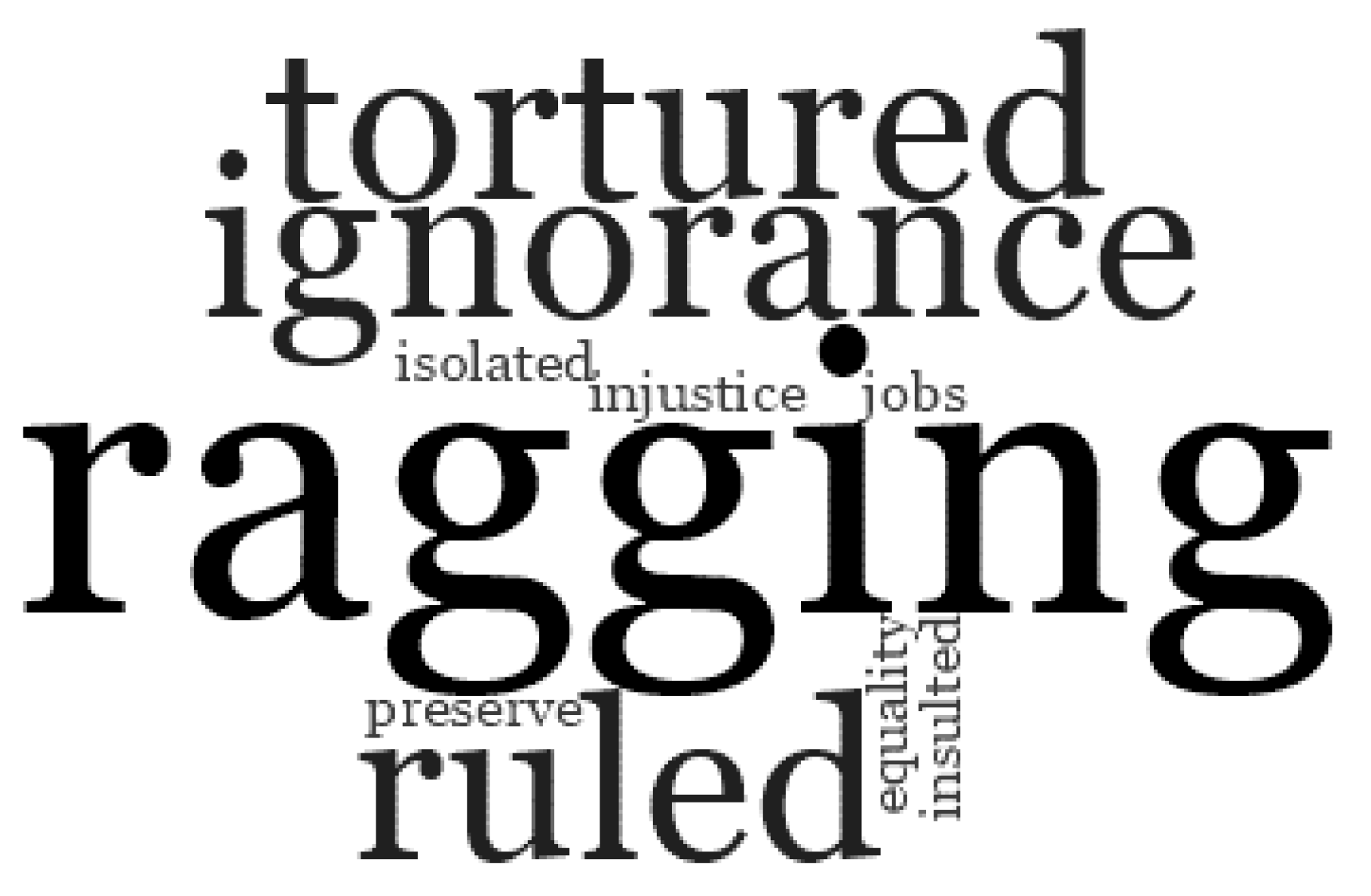
To explore the underlying issues creating barriers on the way of democracy, we have started our analysis from producing the ‘Word Cloud’ through critically analyzing the voices of the transgenders. ‘Word Cloud’ is a common tool to explore and visualize textual data (McNaught and Lam, 2010; Filatova, 2016). The more frequently the words appear within the written transcripts, the larger and bolder it appears it in the Word Cloud. In this research, I have used this tool in NVivo to get a quick visual response of the source data, the interviews with the transgenders.
Word Cloud of underlying issues creating barriers on the way of democracy depicts that the ragging is linked with treat of Guruma, in particular, 14 times appearance within the aggregated codes of problems to democracy (see Table 3.03). The data from Table 3.03 also shows that their livelihood strategy that has being further confined by the Guruma’s willingness who offer either accepting the traditional practice of tola collection or being the victim of ragging.
Table 3.03.
Nine most frequent words of the aggregated codes of ‘Problems to Achieve Democracy’.
| Word | Length | Count | Weighted Percentage (%) | Similar Words |
|---|---|---|---|---|
| ragging | 14 | 23 | 16.54 | ragging, guruma |
| equality | 8 | 6 | 7.54 | equality |
| livelihood | 6 | 5 | 6.69 | assets, livelihood |
| ruled | 5 | 12 | 9.69 | ruled, rules |
| skill | 5 | 8 | 7.69 | skill |
| injustice | 9 | 4 | 3.85 | injustice |
| preserve | 8 | 4 | 3.85 | preserve |
| ignorance | 9 | 12 | 9.85 | ignorance |
| tortured | 8 | 12 | 9.85 | tortured |
Figure 3.03: Authors generated in NVivo, 2018.
A complete illustration of words of the aggregated codes of ‘Zone of Influence’ is shown in Figure 3.03 where words like ‘ragging,’ ‘ruled,’ ‘livelihood,’ ‘ignorance,’ ‘tortured’ are coming forward more frequently.
Figure 3.04.
Authors generated in NVivo for the similar word frequency (Figure 3.03) for better visualizing, 2018.
Figure 3.04.
Authors generated in NVivo for the similar word frequency (Figure 3.03) for better visualizing, 2018.
However, this words further suggest us to explore the interview data by reviewing again and coding the underlying issues, mentioned below, by extracting the information from the interviews.
a. i. Only Ruled or Also Domination of Guruma?
The transgender people have to bear the dictatorship of their Guruma in their life because they have very poor support from their relatives and the society to live their life with their gender identity. Most of them are deprived of their shelters from family persons after expressing their gender identity due to pressure and bullying of society respective.
we do not get any family support. You will get a new dress at least from your family sister. But no one has any headache how we will celebrate my Eid day. -Priyanka (thematic code related to underlying issues to create barriers on the way of democracy)
Due to the ignorance of the family persons they do not have any place to take shelter except the Guruma. And using this chance the Guruma forced the other transgenders who do not have any problem to live in their family from her relatives respective the thematic codes of the freedom of live, livelihood, speech, choice have been abstracted which creates the barrier on the way of establishing their democracy.
a. ii. Traditional practice
From these discussion two groups are found based on the interest of establishing freedom within the transgender community. They are, group-1. ‘Guruma’ who does not want to change their traditional lifestyle and culture instead of knowing about the violence of their social justice for holding their power to dominate the junior members of the transgender community respective:
You cannot not give me any example where does not exist any unemployment problem. Transgender people are in good status. Let them do whatever they are doing. No need to try for bringing any change for themselves. - Chayna (thematic code related to underlying issues to create barriers on the way of democracy)
Again, she added, People’s perception will never change towards the transgender people because they are different from men and women. People are frightened about them and being frightened for the society towards transgender is good for us. (thematic code related to underlying issues to create barriers on the way of democracy)
And group-2. the junior members of the transgender community who want to change their traditional lifestyle and culture in order to join the mainstream of the society to promote their quality of life like others with social dignity are found respective:
I want government to ban our livelihood strategies of collecting money (extorting money) from the public as our leaders would not to force us to extort and stop our own business-like common people of our society. If it would be banned from the government and the people of our society may not misbehave with us if we can stop torturing them by extorting money. And I believe that, it would help us to link us as human with the other people of society and also helps to achieve our social dignity. - Arpa (thematic code related to underlying issues to create barriers on the way of democracy)
Almost all the junior members among the respondents of my research have expressed their willingness to ban their practice of tola collection as they can get rid of the dictatorship domination of Guruma on their livelihood because many of us cannot take any other profession as their livelihood for their Guruma respective:
Our leaders do not let us to join any job provided by the government. Guruma forced to collect tola that means extorting money from public. I want to open my own business because I do not like to extort money from people as it seems so humiliating to me. But (leaders) Gurumas forced us to do this. -Tania (thematic code related to underlying issues to create barriers on the way of democracy)
a. iii. Social construction Generates Ignorance
People in the society remain in the fear about the transgender because of the livelihood strategy of extorting money from the public. As a difference status of social capital has been found from the interview of Alhadi who has tea stall and she used not to go for tola collection respective:
I used to earn average 150 BDT (1.75 US dollar) per day. I live with my mother and bear the cost of my mother’s medical treatment and the cost of whole family. I do not have to face any problem to get any services in the society. I have many friends who helps me for any problem and many people come here to take tea every day. I do not feel I am alone in this society for the reaction of my friends in both within my transgnder community and outside of this community. - Alhadi (thematic code related to underlying issues to create barriers on the way of democracy)
Where another respondent Priyanka claimed that
People think that they earn money by their hard work and we grab their money for nothing. That why they do not like us and they assume us as the burden of their society. - Priyanka (thematic code related to underlying issues to create barriers on the way of democracy)
Again, their profession is blamed worse than the prostitution and enough to make bad perception among the people in the society respective:
The strategy of extorting money seems to me one type of torturing common people. I must blame her profession for being humiliated and insulted by the common people of society. People do not humiliate, deprive and insult a prostitute girl because she does not torture someone else for her livelihood. But we torture people for our livelihood though I have strength, capability to work like others. – Arpa (thematic code related to underlying issues to create barriers on the way of democracy)
This social construction leads to unwelcome transgender’s gender identity in the society like other people.
a. iv. Unwelcomed identity
It can be said that their traditional practice and the social construction do not welcome their identity in our society like other gender men and women.
Figure 3.05.
Cycle of underling issues to create problems to violate the democracy of Transgender people in the society (Authors generated, 2018).
Figure 3.05.
Cycle of underling issues to create problems to violate the democracy of Transgender people in the society (Authors generated, 2018).
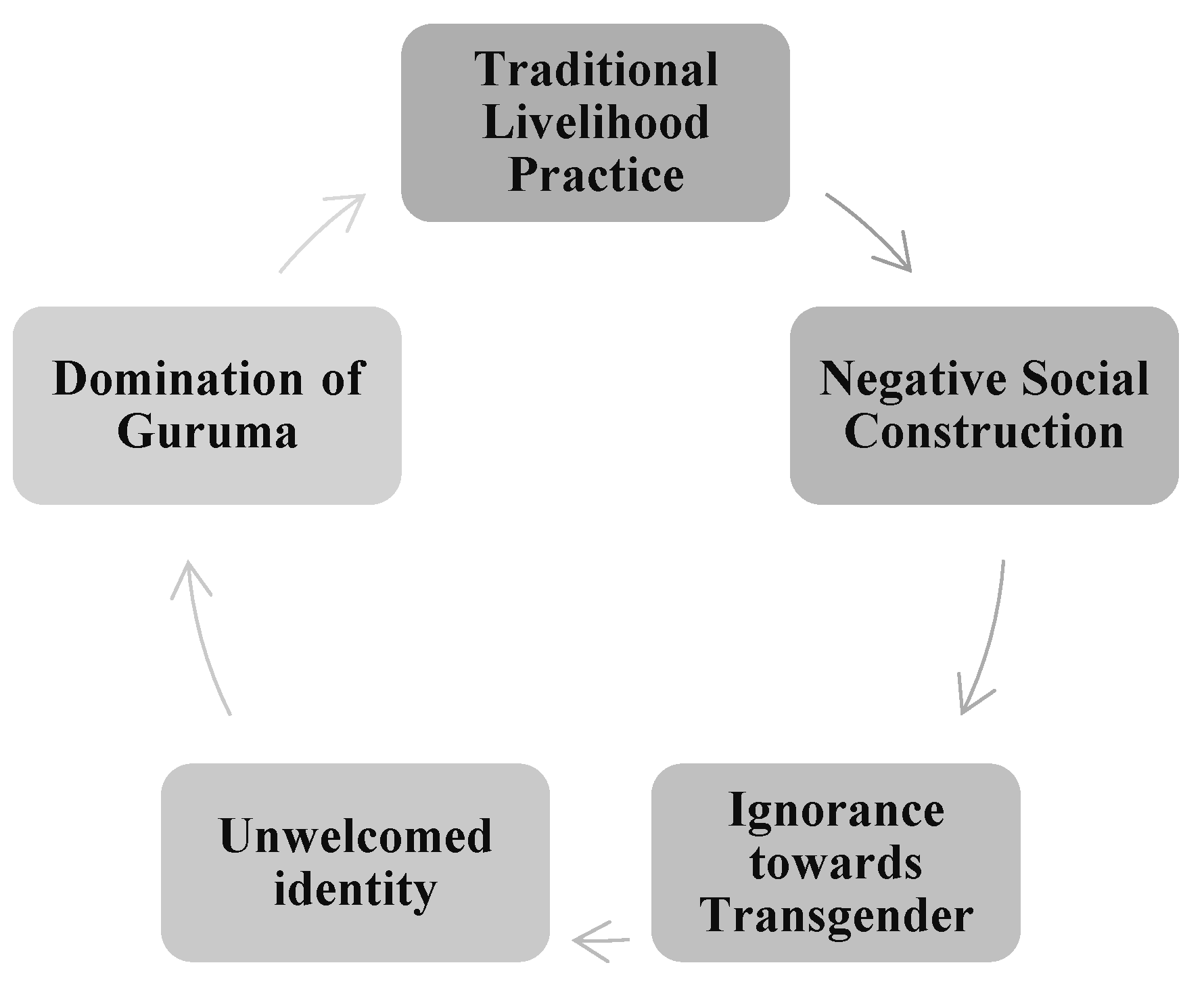
And as a result, the transgender people are being socially bullied and isolated. Their family and relatives are forced by the society to leave her alone because of the continuous humiliation from the people of this society. Then, the transgender people are forced to start their life following their traditional way under the shelter of the Guruma. And they have to no place to flee for living like human being breaking the autonomy of their Guruma.
So, these underlying issues are cycling (Figure 3.05) in this society to create barriers on the way of establishing their democracy for a welcoming environment in the society to promote a Just city.
b. Why are the Transgender People Failed to Protect Their Existence like other citizen to Preserve the Diversity of our society?
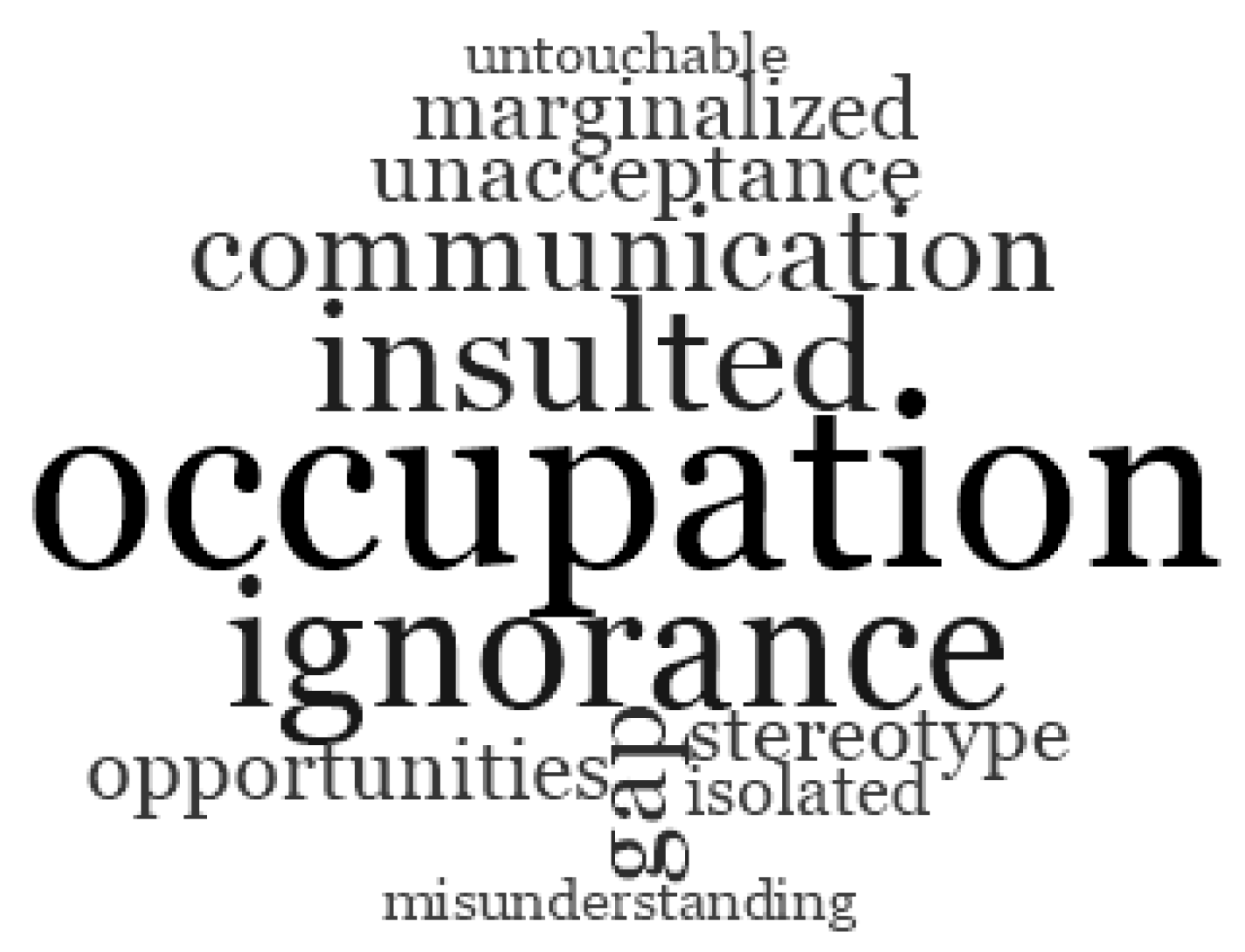
To explore the underlying issues creating barriers on the way to preserve their existence in the society, I have started our analysis from producing the ‘Word Cloud’ through using the tool NVivo to get a quick visual response of the source data, the interviews with the transgenders following the previous subsection 3.B.a. The Word Cloud of underlying issues creating barriers on the way to preserve their existence in the society is linked with ‘occupation’, in particular, 19 times appearance within the aggregated codes of problems on the way to preserve their existence in the society (see Table 3.04).
Table 3.04.
Twelve most frequent words of the aggregated codes of ‘Problems on the way to preserve their existence in the society’.
Table 3.04.
Twelve most frequent words of the aggregated codes of ‘Problems on the way to preserve their existence in the society’.
| Word | Length | Count | Weighted Percentage (%) | Similar Words |
|---|---|---|---|---|
| occupation | 19 | 47 | 4.35 | jobs, occupation |
| ignorance | 9 | 31 | 2.87 | ignorance, ignored, uneducated |
| insulted | 8 | 26 | 2.41 | insulted |
| communication | 13 | 18 | 1.67 | communicate, communication, nation |
| gap | 3 | 16 | 1.48 | gap |
| unacceptance | 12 | 10 | 0.93 | unacceptance |
| marginalized | 12 | 9 | 0.83 | marginal, marginalized |
| opportunities | 13 | 9 | 0.83 | opportunities |
| stereotype | 10 | 8 | 0.74 | stereotype |
| isolated | 8 | 5 | 0.46 | isolated |
| misunderstanding | 16 | 2 | 0.19 | misunderstanding |
| untouchable | 11 | 2 | 0.19 | untouchable |
Figure 3.06: Authors generated in NVivo, 2018.
A complete illustration of words of the aggregated codes of ‘Zone of Influence’ is shown in Figure 3.06 where words like ‘ignorance,’ ‘communication,’ ‘unacceptance,’ ‘stereotype,’ ‘Misunderstanding’ are coming forward more frequently.
However, this words further suggest us to explore the interview data by reviewing again and coding the underlying issues, mentioned below, by extracting the information from the interviews.
Figure 3.07.
Authors generated in NVivo, 2018.
b. i. Poor Opportunity for Employment
The underlying issue of the analytical code, poor education and domination of Guruma
(according to the subsection 3.B.b) forces to be confined them into their traditional occupation, tola collection. The transgender people are remined in deprivation of both the formal education and the informal education. Because they do not get easy access like other to the educational institution because of bullying of their peers and teachers. And they do not get any natural education in informal way from their family which every person gets from their childhood to build their personality and to learn how to communicate with others in the society because they have to leave their family. As a result, they are very poor in building social capital. In their transgender community, usually they are not taught how to well behave with people b their Guruma rather than they are taught how to force people in order to get something from them. They cannot be able to improve their working skill or even do not get any opportunity to utilize their working skill because of people’s ignorance to get any service from them respective:
I know very fluent Arabic language. I can teach Arabic language to the people. But no one is interested to learn from me as I am a transgender. -Bilkis (thematic code related to Ignorance)
Because of their occupation and internal culture of their community, they remain on the ignorance of the people. People usually do not like them to communicate. And there exists very poor initiatives for their rehabilitation in the society of a developing country like Bangladesh respective:
People do not try to do something good for us really. ………………………… off shit! Drop the issue of transgender. Third class issue. Let’s pay concentrate on other projects. These would be more meaningful than that shit. Don’t misunderstand me sister. You will not successful to reach our problems and feeling to your all teacher also. – Nusrat (thematic code related to Ignorance)
In fact, she does not believe anyone to receive any help for her. Because of the ignorance of everyone in the society on their issue effects negatively on their capability of resilience through weakening their capability of financial and social capital. And people do not ready to accept any leadership form them and they are also far from having the capability to lead people. As a result, their voice and their demands remain unheard unthought.
b. ii. Communication Gap Leads Misunderstandings Among General People
There exists a large communication gap between the people, living in the mainstream of the society, and the transgender people. People do not have any idea about themselves rather than people have misconception about transgender people which leads them to have fear about transgender. According to Nusrat, male persons always try to abuse them sexually or verbally and female persons do not feel safe from them.
Male person used to tease me through touching us, using vulgar word and asking about our private issues. On the other hand, female seems us unsafe for their privacy. They react on us and think that they might be abused by us like male. -Tania (thematic code related to Communication gap)
They think that, they should mix with the people to remove the fear about themselves respective:
If people of our society can mix with us, they would understand that we are normal like them. There is no good without mixing bad on the earth. There also exists good man and woman with bad man and woman. Like that, all of us are not bad person. We should mix with people. And people also should co-operate with us to remove this cultural construction about us. – Priyanka (thematic code related to Communication gap)
And this misunderstand between the Transgender people and other people of our society leads to generate unfriendly stereotype behavior of people towards the transgender community.
b. iii. Removing of Misunderstanding from the General People Can Helps to Remove Unfriendly Stereotype Behavior from People
The communication gap leads to develop misunderstanding about themselves which generates the stereotype practice among the people of the society. Three of my respondents brought the issue of the media as they do not play any positive role to remove the prejudices from the general people. Media has a potential role to remove this fear from the general people about the transgender people to accept them in the mainstream of the society respective:
The role of media to change the perception of people towards the people is also important, I believe. I believed that media can play a huge role to bring revolution for changing our situation. Like the example of world cup 2018 that people set projectors at every neighborhood to enjoy the play which is placed at farthest from our country. From this reaction the it can be exemplified the depth of emotional attachment of people with the media. I love Ritu Parna Gosh, the famous film director of India. Our cultural practice and believes can be changed by the intervention of the media. - Arpa
These analytical codes are going to explore and use to develop the influence on their existence in the society.
c. Why are the Transgender People Failed to Establish Their Material Equality in the Society?
To explore the underlying issues creating barriers on the way to ensure their material equality in the society, the next exploration of the interview data has been done again following the similar process of 3.B.a. and 3.B.b. subsections.
c. i. Unspecified Access to Public Services
As the third gender in this country, they do not have being provided the equal specification in the access to public services. That’s why, the stereotype practice of the general people in this society can violate their legal rights to get the access to public services respective:
once I went to a male toilet at my college, because the female students are frightened of transgender people forced me to go to male toilet. One male student pulled my hand and take me at a corner behind the toilet and request me to show him my private parts. So how can I use public toilet where no option is kept for me? I felt myself not existed on the earth though I have recognition as third gender in this country. I have legally the right to use the service but my unspecific rights are getting lost by the specific rights for male and female. -Priyanka
People appointed to maintain the public toilet does not allow to use them and bulling them. I can tell you a story sister that once I had to pay 10 BDT where other people pay 2 BDT for using the public toilet at Hadis Park. Additionally, the appointed man blackmailed me to let him sexually abuse me. I have to provide the access of sexual harassment to that appointed man at that time because of my emergency of using toilet. -Tanisha Akter Riya
when I sit on a seat in the bus (like our university bus), the people leave their place and hate to sit beside me. Once I travelled in the bus, and a boy did not sit beside me. He stood during full travel. Male person used to tease me through touching us, using vulgar word and asking about our private issues. On the other hand, female seems us unsafe for their privacy. They react on us and think that they might be abused by us like male. - Nusrat (thematic code related to Unspecified services)
c. ii. Ignorance and Silent Corruption
The practice of corruption among the government and NGO’s employers limit their access to legal rights respective,
I went to the local social welfare institute to get the stipend as the transgender, but the govt. employee said that there is no govt. allowance for their stipend where Bangladesh government allocate for the primary and the under graduation program respectably 4.6 and 12 US dollar for each transgender student person as stipend per month. -Akhi (thematic code related to Silent Corruption)
I have been working in the last 20 years with a number of social welfare organizations. Most of the money coming for our welfare and development projects are being grabbed by the organizers. And we got a very little amount which was incapable to bring an opportunity to start any business for us. -Chayna (thematic code related to Silent Corruption)
Again, respective Afrin Islam Arpa,
The organizers use us as their earning source to gaining sympathy from various aids programs. The transgenders are not actually benefited through these programs. I can exemplify that organizers steals about 50-70% of total budget for any program brother Abul did not establish any restaurant and parlor for them though he received 5.50 lakhs BDT for a single program from Bandhu (Friend) welfare society to provide a working place to some transgender. (thematic code related to Silent Corruption)
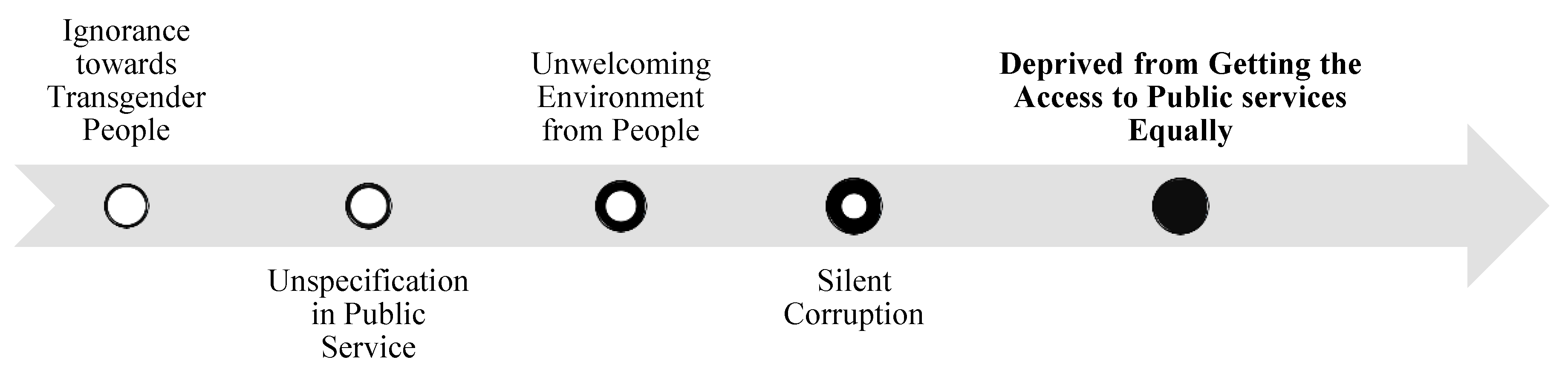
Figure 3.09 has been developed with the understanding of the influential constructs from the previous discussion belongs to mentioned in the previous subsections along with the influential issues, discussed in this subsection, to show why the transgender people remaining out of the equal access to most of the material services in our society from other general citizens.
Figure 3.09.
Process of underling issues to create barrier on establishing their Material Equality in the society (Author generated, 2018).
Figure 3.09.
Process of underling issues to create barrier on establishing their Material Equality in the society (Author generated, 2018).
4. Discussion
The thematic codes, generated by author based on the descriptive analysis of the respondent’s narrations, from the exploration of the mentioned problems and underlying influential issues to create obstacles for the transgender people to join the mainstream of the society are going to utilize on the this discussion section to develop the linkage among the codes and show ‘how’ they develop barriers for the transgender people to live a normal life like other citizen in the society following the three based on the hallmarks of Just city as three major themes.
4. A. How the Underlying Issues of the Mentioned Problems Influence to Create Barriers for the Transgender People to Achieve Their Democracy
From the descriptive codes generated in the subsections of 3rd chapter, 3. A. and 3. B. a. The ‘What’ and ‘Why’ aspects four analytical codes have been developed to evaluate the current status of democracy in transgender community. These problems, faced by the transgender community in their daily life in their social, economic, political and cultural aspects of life (context of these four analytical codes, i) Freedom of Live, ii) Freedom of livelihood Strategy, iii) Freedom of Speech, and iv) Freedom of choice) have been explored on the 3rd chapter to show how the democracy of the Transgender people has been degrade in the society of Bangladesh.
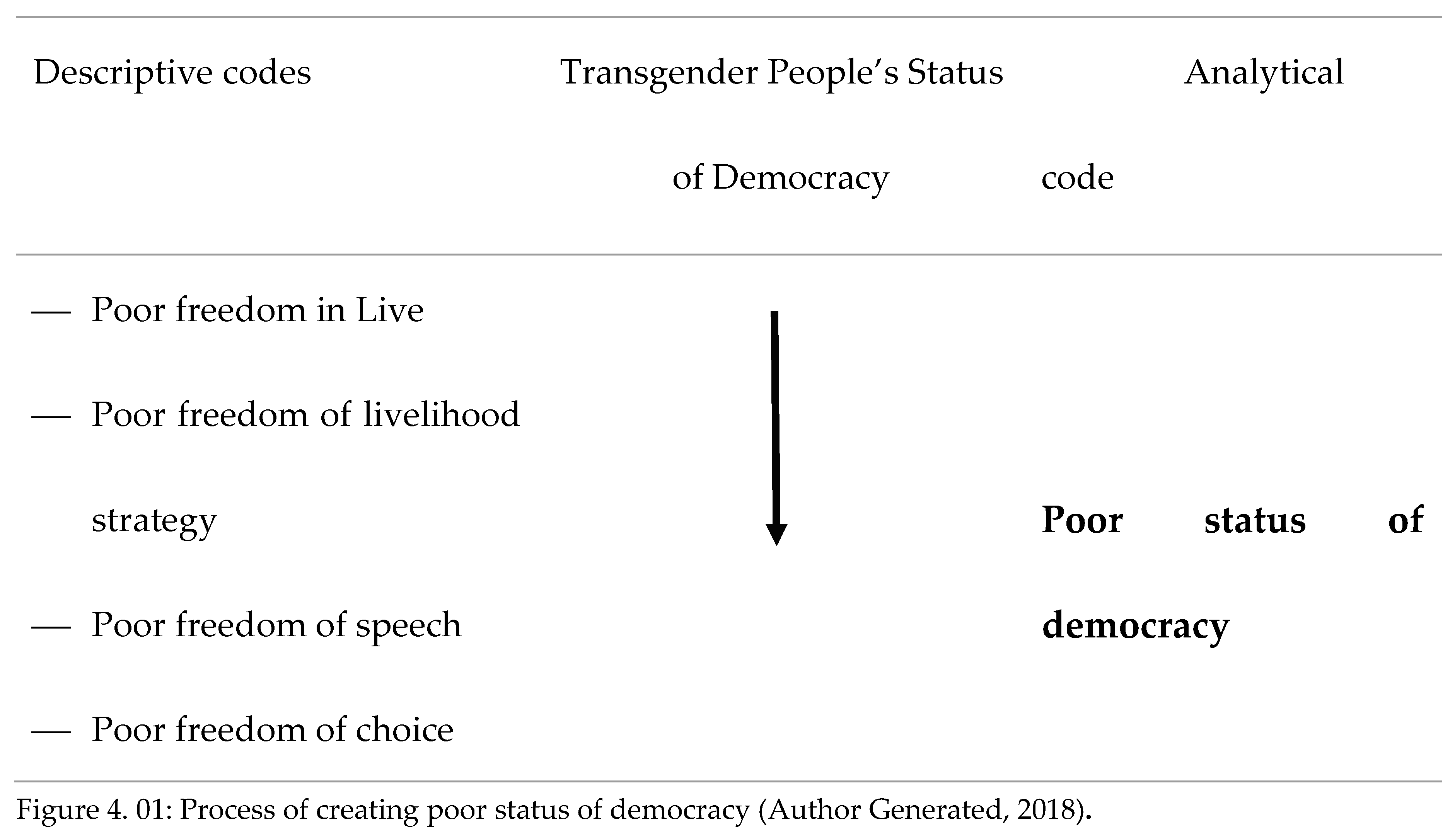
Figure 4.01.
Grid analysis of the power exercise for decision making within the transgender community and outside of the transgender community.
Figure 4.01.
Grid analysis of the power exercise for decision making within the transgender community and outside of the transgender community.
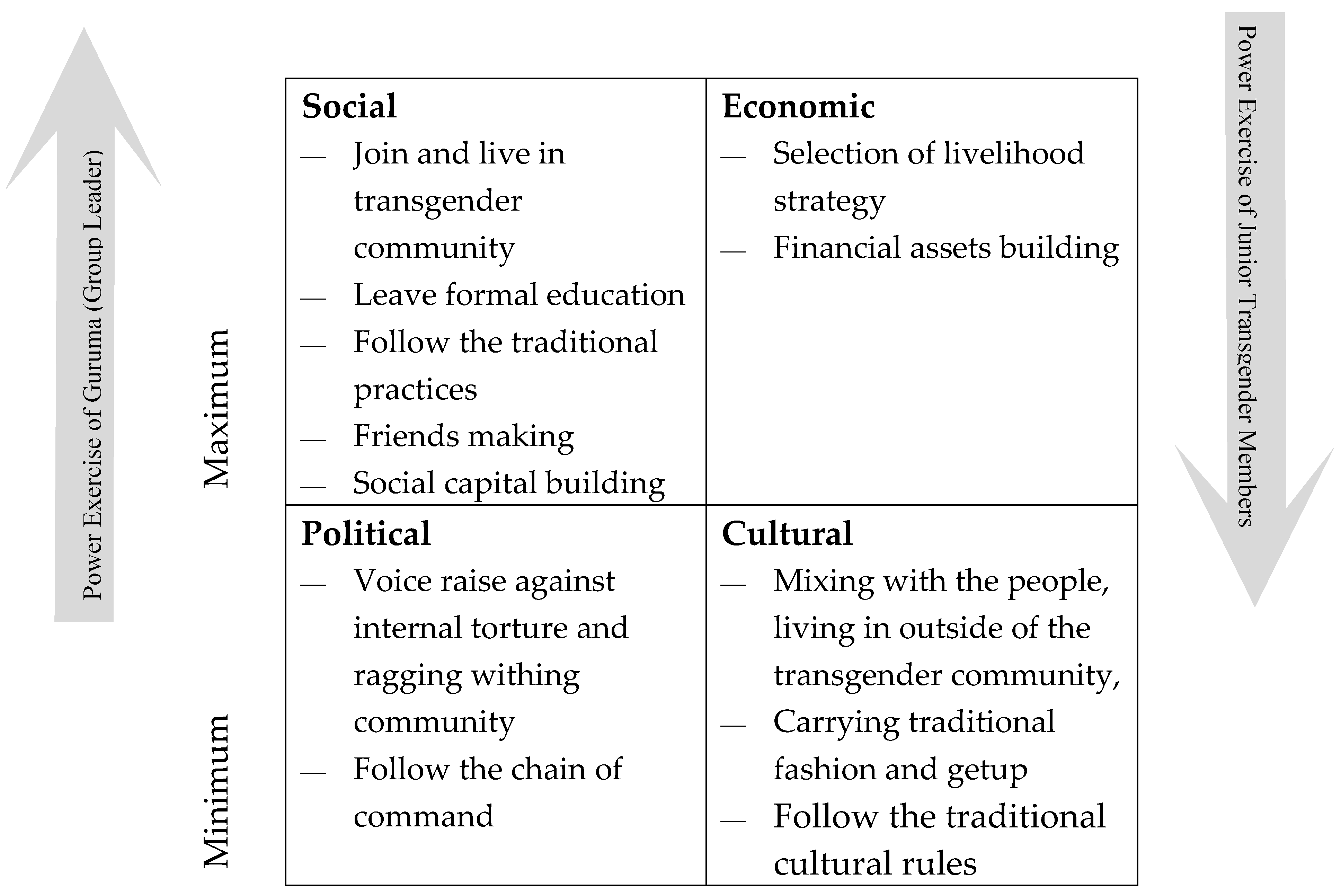
Through exploring these four analytical issues it can be said that, their poor freedom in live, livelihood strategy, speech, choice which can be considered as the determination of a poor practice of democracy (Figure 4.01) in the lives the transgender people due to the underlying issues, explored on the 4th chapter where democracy is the principle of social equality and respect for the individual within a community (Hilla University, 2004). It is a political system which works as the way of ensuring the protection of the human rights. In Just city concept, the term, democracy, indicated the participation of every group of people in eliminating every type of discrimination.
4. B. How the Underlying Issues of the Mentioned Problems Influence to Create Barriers on Preserving Their Existence as a Diverse Group in the Society
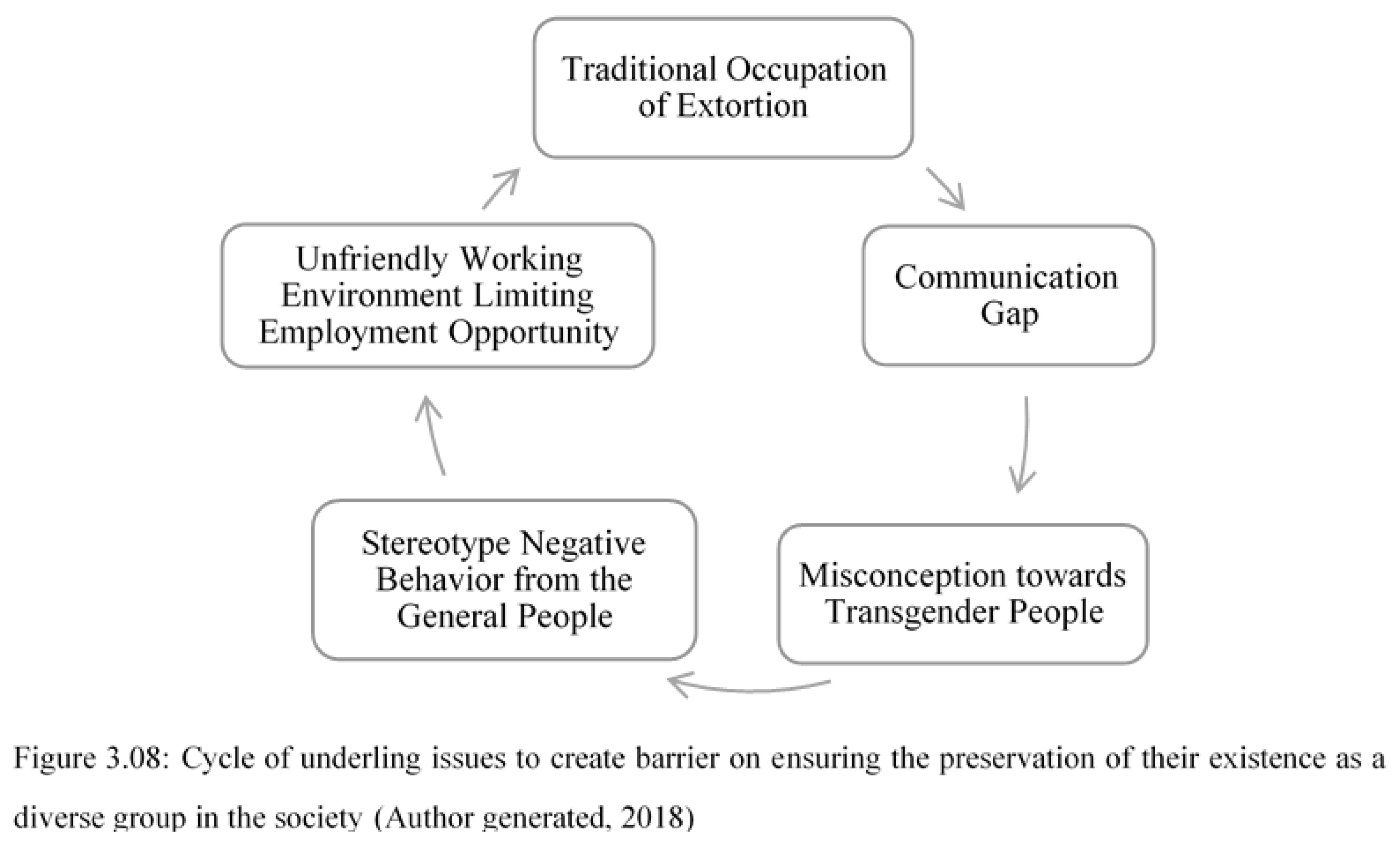
The analytical codes, generated in the subsections of 3rd chapter, 3. A. and 3. B. b of the problems and underlying issues on the way of the existence of the transgender people are using here to develop a framework to show how the transgender people remain untouchable in the society form the mainstream. It is a cyclic process which is continuing from a very beginning in this society. Lack of opportunity of receiving formal and inform education from their family and educational institution proved a poor educational qualification which leads to have a poor working skill. That’s why they are unable to build and financial capital and bound to live under the domination of their Guruma for want of a shelter. And they are forced to continue their traditional livelihood, tola collection form the society, which is the reason to remain ignorant from the general people of the society. And they cannot be able to build social capital outside their community.
Figure 4.02.
Process of remaining untouchable the existence of the transgender people (Author generated, 2018).
Figure 4.02.
Process of remaining untouchable the existence of the transgender people (Author generated, 2018).
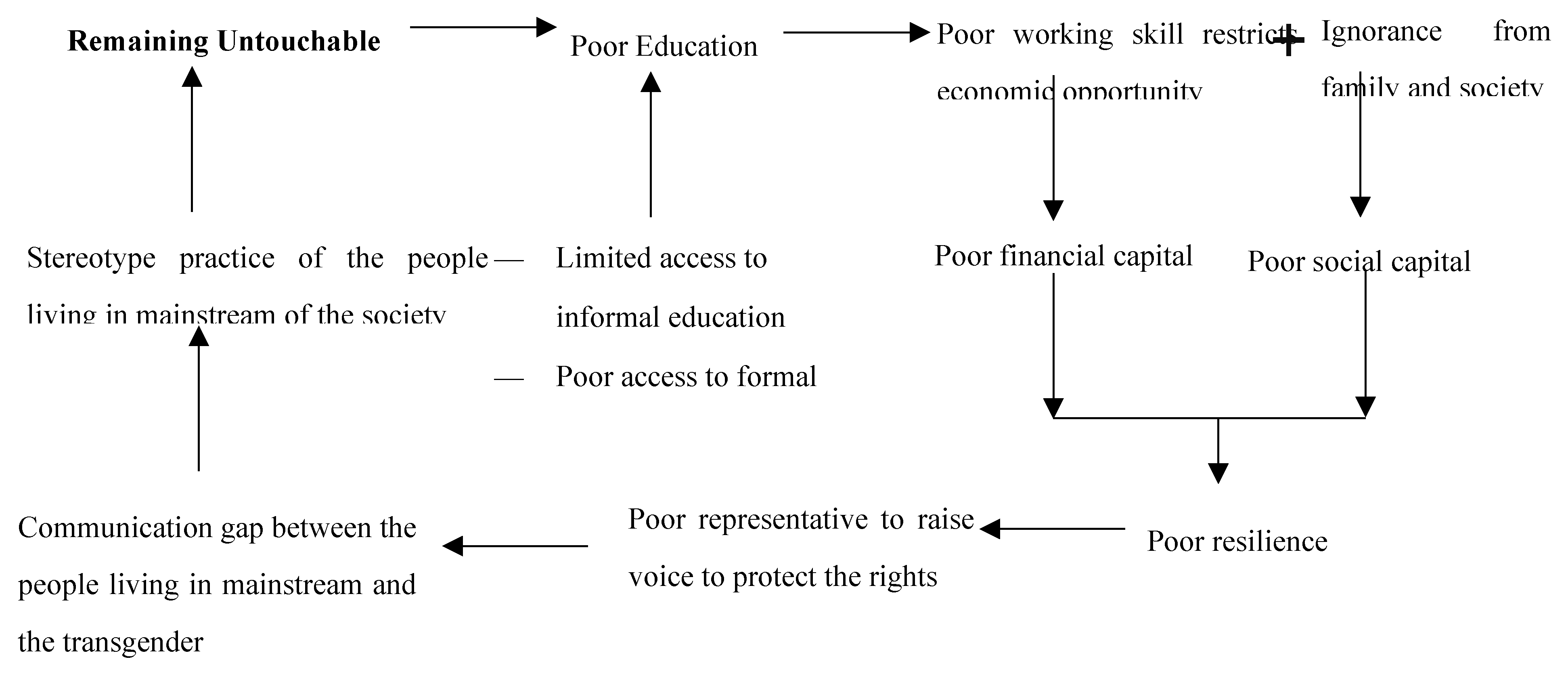
It creates their poor resilience status which generates the obstacle to develop leadership for raising their voice towards the society about their legal and human rights. Ignorance on their issue and absence of their representative leads to create a communication gap which helps to generate stereotype practice of unacceptance and unwelcoming them in the mainstream of the society. And they remain untouchable.
The misconception and fear of people about themselves are not ready to accept them on the regular social life of people. And their family and relatives are also failing to break this ‘untouchable’ conception as they cannot keep their transgender family members with themselves. Remaining detached from the family persons and the society make them frustrated towards people to grab their needs form the general people. This system is working in a cycling process.
4. C. How the Underlying Issues of the Mentioned Problems Influence to Create Barriers on Establishing Their Material Equality in the Society
While these exploratory interviews give a window such as the, generated in the subsections of 3rd chapter, 3. A. and 3. B. c of the problems and underlying issues on the way of the ensuring the material equality of the transgender people are using here to develop a framework to show how the transgender people are deprived of their legal rights to get the public services and opportunities.
In the context of Just city philosophy, material equality indicates the distribution of material benefits derived from public policy that favors all of the citizen equally including those who are already in vulnerable condition of the beginning.
Figure 4.03.
Process of deprivation of their material equality (Author generated, 2018).
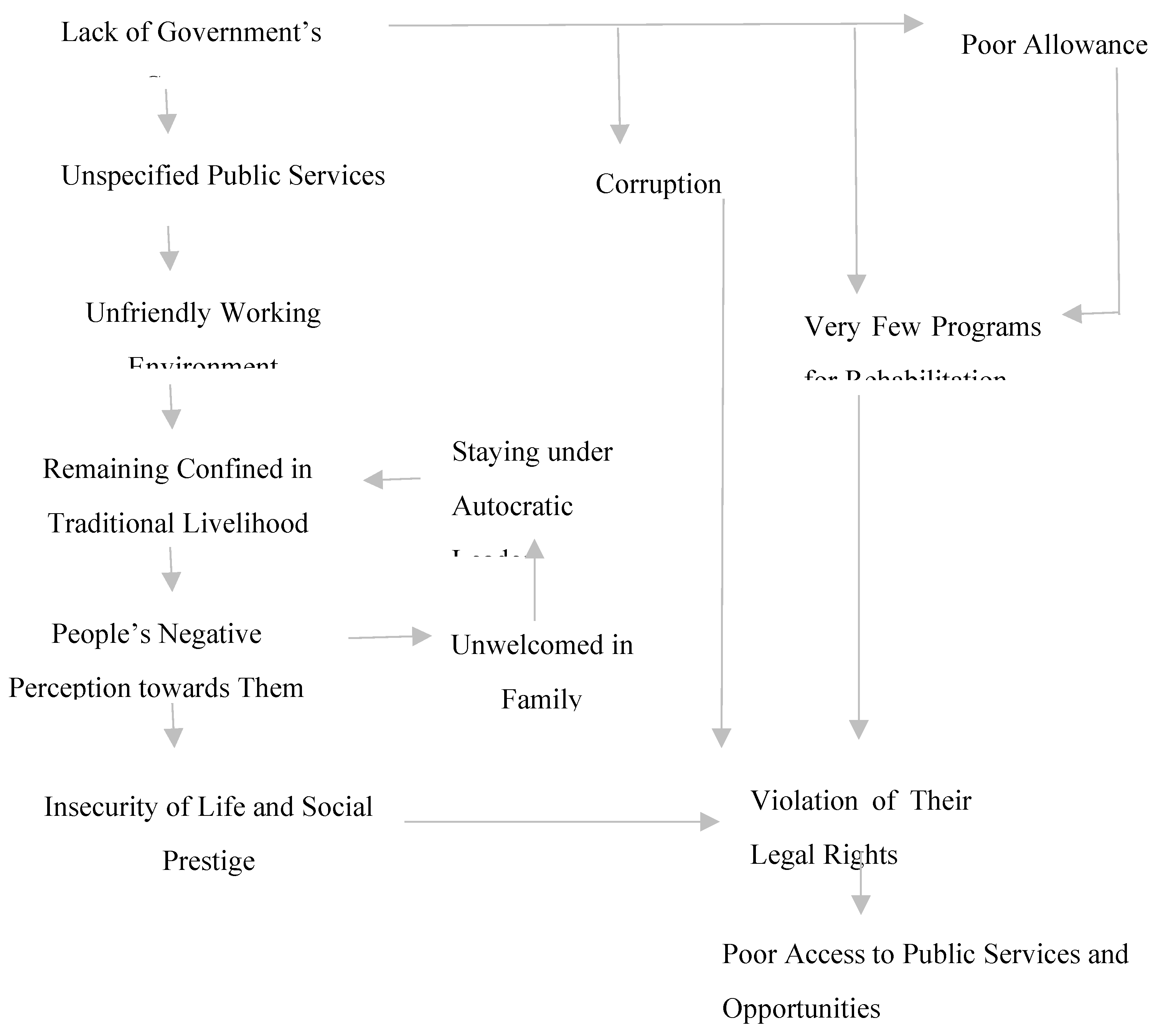
The thematic codes are internally linked and influence each another to generate the significant problems for the Transgender community in order to deprive themselves from getting the equal opportunity and access to the public services and places to harm their rights of achieving material equality like other people, living in the mainstream of the society.
5. Conclusions
The study suggests that the transgender people in Bangladesh cannot practice their democratic rights at both places (within the Transgender community and outside the community). Though they have overcome their obstacle of legal consideration in Bangladesh, their existence is neglected on the issue of joining the mainstream of the society in order to maintain the diversity in our society. Transgender people are depriving of the access to their basic services and opportunity for being isolated from the mainstream of the society though they have the legal rights to get it equally. From evaluating the status of these three hallmarks, it can be discussed what are the main obstacles for the Transgender people with the reason of emerging those problems and the influential process of creating the barriers to join the mainstream in order to have a similar quality of life like others, men and women in the society, as the successful establishment of these three hallmarks (Democracy, Diversity, Material Equality) indicate the establishment of a Just city including every citizen.
Table 4.01.
Overview on how many times the issue of dictatorship of their Guruma (Group leaders) in traditional transgender community should be stopped first for shifting their livelihood strategy from traditional extortion to achieve dignity like other citizen has been mentioned across all interviews.
Table 4.01.
Overview on how many times the issue of dictatorship of their Guruma (Group leaders) in traditional transgender community should be stopped first for shifting their livelihood strategy from traditional extortion to achieve dignity like other citizen has been mentioned across all interviews.
| Name of section | Name of theme | Name of sub theme | How many times it was mentioned | How many participants mentioned it |
|---|---|---|---|---|
|
1st theme “3.A” |
Significant problems faced by the transgender people having a normal life like other citizens (“What” aspect) | 66 | 14 | |
|
2nd theme “3.B” |
Underlying issue of the emerged problems faced by the transgender people having a normal life like other citizens (“Why” aspect) | |||
| “3.B.a” | — | Responsible underlying issues to create barriers for transgender people to achieve their Democracy | 51 | 13 |
| “3.B.b” | — | Responsible underlying issues to create barriers to protect the existence of transgender people to preserve the Diversity of the society | 47 | 12 |
| “3.B.c” | — | Responsible underlying issues to create barriers for transgender people to establish their Material Equality | 13 | 11 |
|
3rd theme “4” |
Influential process of creating barriers by the mentioned underlying issues of their faced problems for the transgender people to join the mainstream of the society like other citizen such as man and woman (“How” aspect) | |||
| “4.A” | — | Influential process of creating barriers by the mentioned underlying issues for the transgender people to achieve their Democracy | In this theme the influential process of transgender people’s suffering has been explored by the author based on the descriptive and analytical codes, developed in previous themes. | |
| “4.B” | — | Influential process of creating barriers by the mentioned underlying issues for preserving transgender people’s existence as a Diverse group in the society |
||
| “4.C” | — | Influential process of creating barriers by the mentioned underlying issues for the transgender people to establish their Material Equality | ||
Figure 4.02: Author Generated, 2018.
If we want to provide an equal opportunity to the Transgender people to have a healthy quality of life like other citizen through establishing a Just city for all citizens of the society, the dictatorship of their Guruma (Group leaders) should be stopped first specially from the viewpoints of establishing the acceptance of the transgender people’s identity with respect and dignity like other citizen in the society through giving them the opportunity of shifting their livelihood strategy from traditional extortion, which works as the main hidden barrier, to employment with dignity according to almost all the junior members among the respondents except the viewpoint of the oldest Guruma.
Acknowledgement
This study was initially submitted for Bachelor in Urban and Rural Planning (BURP); my thanks to my honorable research supervisor, Assistant Professor Mostafizur Rahman, Urban and Rural Planning Discipline, Khulna University, Khulna-9208, Bangladesh because of his perceptive, thoughtful, and kind feedback. This research did not receive any specific grant from funding agencies in the public, commercial, or not-for-profit sectors.
Informed Consent Statement
Informed consent was obtained from all subjects involved in the study.
Notes on Terminology
| Chela | Transgender person who are under Guru Ma |
| Guru Ma | Head of each Transgender group which consists of some transgender people |
| Don | Fine imposed by Guru Ma for misconduct of any Transgender member of her group |
| Jaiger | Divided areas for collecting money ‘tola’. Transgender people consider it as one type of property |
| Tola | Collecting money or foods from market, some kind of extortion or begging. It considered old and traditional profession of Transgender people in Bangladesh |
| Source: Survey and Secondary Data | |
References
- Allmendinger, P. Towards a Post-positivist Typology of Planning Theory; University of Aberdeen, 2002; vol.1, pp. 77–99. [Google Scholar]
- Andrews, T. What is social constructionism? Grounded theory review 2012, 11(1), 39–46. [Google Scholar]
- Atkinson, A. B. Multidimensional deprivation: contrasting social welfare and counting approaches. The Journal of Economic Inequality 2003, 1(1), 51–65. [Google Scholar] [CrossRef]
- Broadus, K. W. The evolution of employment discrimination protections for transgender people; Transgender rights, 2006; pp. 93–101. [Google Scholar]
- Brown, K. 20th Century transgender history and experience. 1999. Available online: http://jenelrose.com (accessed on 10 October 2006).
- Bryman, A. Social Research Methods, 4thed.; Oxford University Press; NY, 2012. [Google Scholar]
- Chowdhury, A. A. Advancement of Transgender Community’s Rights; the Daily Star, 08 March 2015. [Google Scholar]
- Coleman, J. S. Social capital in the creation of human capital. In Knowledge and social capital; 2000; pp. 17–41. [Google Scholar]
- Dickinson, A.; Balleine, B. The role of learning in the operation of motivational systems; Stevens’ handbook of experimental psychology, 2002. [Google Scholar]
- Divan, V.; Cortez, C.; Smelyanskaya, M.; Keatley, J. Transgender social inclusion and equality: a pivotal path to development. Journal of the International AIDS Society 2016, 19((3) Suppl 2, 20803. [Google Scholar] [CrossRef] [PubMed]
- Dowshen, N.; Forke, C. M.; Johnson, A. K.; Kuhns, L. M.; Rubin, D.; Garofalo, R. Religiosity as a protective factor against HIV risk among young transgender women. Journal of Adolescent Health 2011, 48(4), 410–414. [Google Scholar] [CrossRef] [PubMed]
- Fainstein, S. S. New Directions in Planning Theory; Urban Affairs review, 2000; vol. 35. [Google Scholar]
- Fainstein, S. S. The just city; Cornell University Press, 2010. [Google Scholar]
- Gilbert, M. Transgender People. Encyclopedia of Social Work. 11 06 2013. Retrieved 7 Apr. 2018.
- Habitat, U. N. Gender Issue Guide: Urban Planning and Design; 2012. [Google Scholar]
- Harvey, D. Social justice and the city; University of Georgia Press, 2010; Vol. 1. [Google Scholar]
- Harvey, David. Social justice, postmodernism, and the city; 2002; pp. 386–402. [Google Scholar]
- Johnson, J. L.; Repta, R. Sex and gender; Designing and conducting gender, sex, and health research, 2012; pp. 17–37. [Google Scholar]
- Khan, S. I.; Hussain, M. I.; Parveen, S.; Bhuiyan, M. I.; Gourab, G.; Sarker, G. F.; Sikder, J. Living on the Extreme Margin: Social Exclusion of the Transgender Population (Hijra) in Bangladesh. Journal of Health, Population, and Nutrition 2009, 27(4), 441–451. [Google Scholar] [CrossRef] [PubMed]
- Khan, S.; Swapan, M. S. H. From blueprint master plans to democratic planning in South Asian cities: Pursuing good governance agenda against prevalent patron-client networks; Habitat International, 2013; vol. 38, pp. 183–191. [Google Scholar]
- Kollman, K.; Waites, M. The global politics of lesbian, gay, bisexual and transgender human rights: an introduction. Contemporary politics 2009, 15(1), 1–17. [Google Scholar] [CrossRef]
- Mott, L. Epidemic of hate: Violations of The human rights of gay men, lesbians, and transvestites in Brazil; International Gay and Lesbian Human Rights Commission, 1996. [Google Scholar]
- MSc Urban Development Planning, UCL. Available online: https://www.ucl.ac.uk/bartlett/development/programmes/postgraduate/msc-urban-development-planning.
- Powell, J.; Menendian, S. The Problem of Othering: Towards Inclusiveness and Belonging. 2016. Available online: http://www.otheringandbelonging.org/the-problem-of-othering.
- RAJUK. The Draft Plan of Dhaka Structural Plan 2016-2035; Ministry of Housing and Public Work, Government of the People’s Republic Bangladesh; pp. 1–316.
- Rawls, J. A theory of justice: Revised edition; Harvard university press, 2009. [Google Scholar]
- Safier, M. The inter-dimensional analysis of urban development; DPU, UCL, 2014. [Google Scholar]
- Seventh Five Year Plan F2016-2020, Final Draft (2015). General economic Division (GED), Planning Commission, Government of the People’s Republic Bangladesh.
- Simmonds, M. Feminist gender theory summary; 2012; Volume (Vice 1998), pp. 1–10. [Google Scholar]
- Fainstein, Susan S.; Campbell, Scott (Eds.) Readings in Urban Theory, 2nd edit; Oxford; Blackwell.
- The Constitution of the People’s Republic of Bangladesh Government; 1972; Volume 11, pp. 1–80.
- The Human Right Act, Universal Declaration of Human rights, United Nation, General Assembly in Paris on 10 December 1948. General Assembly resolution 217 A; pp. Article 1–30.
- Van Cuilenburg, J.; Verhoest, P. Free and equal access: In search of policy models for converging communication systems. Telecommunications Policy 1998, 22(3), 171–181. [Google Scholar] [CrossRef]
- Waites, M. Critique of ‘sexual orientation’and ‘gender identity’in human rights discourse: global queer politics beyond the Yogyakarta Principles. Contemporary Politics 2009, 15(1), 137–156. [Google Scholar] [CrossRef]
- Whittle, S. Respect and equality: Transsexual and transgender rights; Routledge Cavendish, 2012. [Google Scholar]
- Woolcock, M.; Narayan, D. Social capital: Implications for development theory, research, and policy. The world bank research observer 2000, 15(2), 225–249. [Google Scholar] [CrossRef]
Disclaimer/Publisher’s Note: The statements, opinions and data contained in all publications are solely those of the individual author(s) and contributor(s) and not of MDPI and/or the editor(s). MDPI and/or the editor(s) disclaim responsibility for any injury to people or property resulting from any ideas, methods, instructions or products referred to in the content. |
© 2025 by the authors. Licensee MDPI, Basel, Switzerland. This article is an open access article distributed under the terms and conditions of the Creative Commons Attribution (CC BY) license (http://creativecommons.org/licenses/by/4.0/).
Copyright: This open access article is published under a Creative Commons CC BY 4.0 license, which permit the free download, distribution, and reuse, provided that the author and preprint are cited in any reuse.


