

Submitted:
28 September 2025
Posted:
30 September 2025
You are already at the latest version
Abstract
Precognition in dreams preceded notable scientific, and historical events, but the phenomenol- ogy is not generally accepted. Spacetime theories, however, attribute precognition to relativistic motion, and to strong gravity fields. Study was done to determine the existence and physical basis for precognition in dreams. Precognition narratives were analyzed using computational linguistics, large language model queries, vector embedding, knowledge graph, and theme analy- sis. Causality was established if precognition was re-experienced in wake-space. There were 253 subjects, 141 males and 112 females, with 24 years median age (50 % interquartile range 21– 25). Of 280 precognition narratives, 69 (25 %) were re-experienced in wake-space (p < 0.0001). Wished events were not causally related to re-experienced precognition (p > 0.05). Re-experience lagged precognition by few hours to over a decade. Re-experienced precognition had attributes of determinism, information entropy, and cryptography. Semantics of precognition narratives were strongly connected in knowledge graph. There is bidirectional flow of information be- tween dream-space, and wake-space. Encrypted precognition are metaphors for phenomenal experiences. Relativistic motion of Consciousness, and strong gravity are the physical bases for precognition in dream-space. Thus, dream spacetime permits motions of Consciousness to the past, and to the future.
Keywords:
consciousness
; precognition
; cryptography
; relativity
; gravity
; dreams
; sleep
; Freudian
Introduction
Precognition dreams are interpreted as prophetic, or foretelling in diverse cultures (Kugel 1995; Laughlin 2013; Parra 2013). They have been described as deja vu phenomena (Eranimos & Funkhouser 2023; Kumar 2023), which implies that dreams are re-experienced in wake-space. Notable scientific discoveries, which include acetylcholine by Otto Loewi (McCoy & Tan 2014), benzene ring structure by August Kekule (Rothenberg 1995), and the periodic table by Dmitri Mendelev (Shiltsev & Shiltseva 2020) are attributed to precognition dreams. High occurrence of precognition dreams, which is up to 60 % of subjects (Eranimos & Funkhouser 2023; Schredl 2009), implies that the phenomenology is not rare. Precognition is, therefore, interpretable as encodings of the future (Kugel 1995; Laughlin 2013), although this is not generally accepted (Laughlin 2013; Lindsay et al. 2024),
General relativity theory models events in the universe as positions in spacetime coordinates. Unlike events in Euclidean space or geometry that have 3D spatial coordinates, and distinct 1D time coordinate, events in general relativity mechanics occur in 4D spacetime coordinates. Dreams events have attributes of 4D spacetime coordinates that permit Consciousness to revisit past events (Oluwole 2020, 2022), which implies moving back in time coordinate. Further, it permits Consciousness to observe mixing of past, present, and future events (Oluwole 2020, 2022). Consciousness in dream spacetime may transit vastly separated regions instantaneously, or very short distances may be interminable to transit (Oluwole 2020, 2022, 2024). Dream spacetime is, therefore, dynamic unlike static geometry of wake-space. In general relativity formulation, events in the universe are not perceived simultaneously by all observers. Observers moving close to the speed of light perceive events before stationary observers (Bambi 2018; Luminet 1998; Wald 2010). Similarly, observers in strong gravity fields perceive events before those in weak gravity fields (Bambi 2018; Luminet 1998; Wald 2010). There is, therefore, time dilation in special and general relativity theories. Events in dreams typically last less than five minutes, but equivalent events may take decades to execute in wake-space (Oluwole 2020, 2022). Time dilation between events in dream-space, and phenomenal experiences of wake-space, implies that Consciousness is in relativistic motion in dream-space (Oluwole 2020, 2022). Very strong gravity in dreams also implies that general relativity theory is applicable to dreams (Oluwole 2020, 2022, 2024). 4D spacetime attributes in dreams, therefore, suggest the physical basis for precognition. Study was done to determine the existence and physical basis for precognition in dreams.
Methods
Phenomenal experiences of Consciousness during sleep were modeled to occur in dream-space, which has distinct geometrical attributes. Causality is established if events in precognition dreams transform to phenomenal experiences in wake-space. Subjects provided precognition narratives that were experienced at any time in the past. Details included dates of precognition, and of re-experience in wake-space, geographical settings, and entities encountered like human, animal, and inanimates. Human entities included colleagues, family members, and others were provided. Events in precognition included sports, sex, examination, politics, violence, and climate. Subjects also stated if precognition was wished. Minimum desired sample size of subjects to generate enough narratives was 250. It was assumed that one in 100 precognition dreams would transform at random to phenomenal experiences in wake-space. Statistics of proportions were performed. Chi-square test was performed on contingency table of transformed wished, and of unwished precognition.
Prepossessing of Narratives, Word Cloud, and Entity Extraction
Precognition was entered verbatim into text database without editing. To generate keywords, prepossessing included changing words to lower case, removal of typographical errors, double words, extra spaces, punctuation, numbers, dates, and stopwords. All words were lemmatized. Prepossessing for summary, and query using large language model query narratives, and for word embedding was limited to lower case, and removal of contractions, and typographical errors. Modules of Python Programming, version 3.11, 2025, modules included Textacy, NLTK, and regular expression. Keywords were generated for transformed, and untransformed precognition. Word clouds were generated using Matplotlib module of Python Programming.
Rule based entity search algorithm was used to extract themes, geographical locations, time, entities, and events from corpora of precognition narratives using Spacy module of Python Programming. Spatial entities included organizations like hospitals, universities, schools, Churches, and Mosques, while human entities included friends, colleagues, lecturers, policemen, and family. Themes included vocation, sports, socials, religion, sex, climate, and violence.
Computational Linguistics, and Knowledge Graph
Jaccard index was used to compare lexical similarity of transformed, and untransformed precognition. Jaccard index was defined as . Jaccard index was zero when no words were common to both documents, but one when all words were common to both sets of narratives. Bootstrap statistic was performed to determine 95 % CI for Jaccard similarity.
Large language model was used to query dream narratives to determine if precognition encoded knowledge of the future. The algorithm was implemented in Llama index module of Python Programming and Environment. Each narrative was mapped to 1D vector embedding using Llama 3.1 large language model. 1D vectors were arranged to rows of narrative matrix. Cosine distance matrix was generated from narrative matrix, to map narratives to spherical space, where distances are geodesic. Cosine distance matrix was thresholded to adjacency matrix. Networkx module of Python programming was used to generate knowledge or semantic network graph from the adjacency matrix. The knowledge graph was compared with Erdos-Renyi random graph using Wasserstein distance to determine if it was generated by a random process. Statistical significance was tested using Bootstrap statistic. Metrics were calculated for the knowledge graph to determine connectivity, and modularity.
Ethics
Manuscript conforms to ethical guidelines of WMA Declaration of Helsinki–Ethical Principles for Medical Research Involving Human Participants. Ethical clearance, and informed consent were obtained locally. Subjects had complete disclosure of study objectives, assured of confidentiality of personal information, and received no incentives, or inducement. No grants, or financial assistance were received for the study. Generative artificial intelligence was not used for any section of the study.
Results
There were 253 subjects, 141 males and 112 females, with median age 24 years (50 % interquartile range 21–25). Of 280 precognition narratives, 69 (25 %) were transformed to phenomenal experiences in wake-space. Assuming random occurrence of one in 100 precognition dreams, statistical test showed significant transformations at . Proportions (%) of spatial entities like buildings, streets, and administrative regions were 29 (22–36) for transformed precognition, but 33 (28–37) for untransformed precognition. Comparisons of proportions (%) number of human entities like family members, friends, colleagues, lecturers, and policemen were 27 ( 19–33) for transformed precognition, but 22 (18–26) for untransformed precognition. Proportions (%) of occurrences of minutes, hours, or dates were 37 (29–44) for transformed precognition, but 31 (27–35) for untransformed precognition. Events (%) like social gatherings, worship in Churches, and violence had occurrence of 8 (4–13) for transformed precognition, but 15 (12–18) for untransformed precognition.
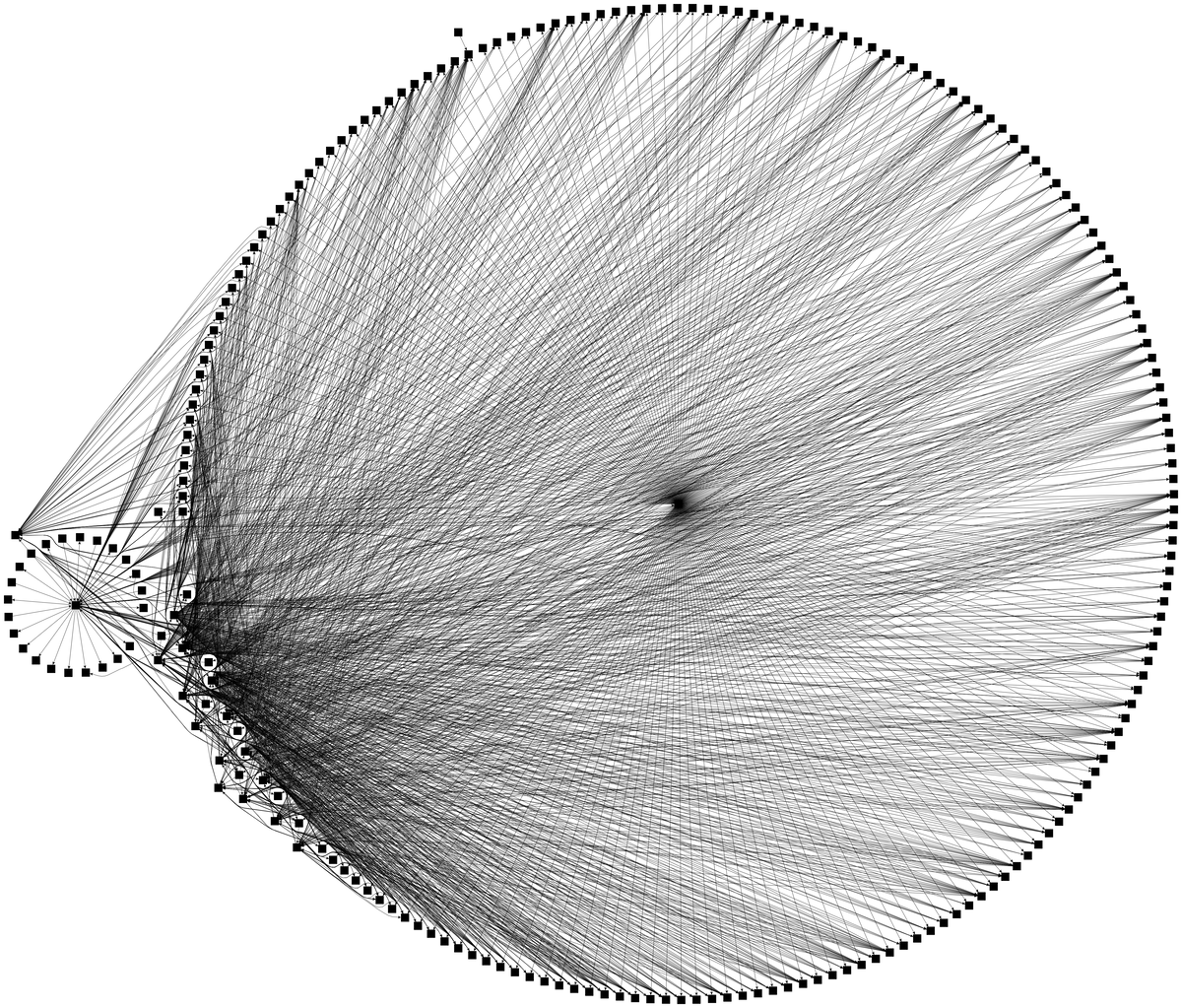
Commonest keyphrases in the corpus of precognition narratives that have been re-experienced were house, room, examination, secondary school, 2019, the next day (Figure 1A); but were house, room, secondary school, see, the day, church for precognition narratives that have not been re-experienced (Figure 1B). Jaccard similarity index (95 % CI) between re-experienced and not re-experienced narratives was 0.14 (0.05–0.22) ().
Large language response to the query what is this document about? was This document appears to be a personal account of vivid dreams or visions experienced by the author. The text describes various scenarios, events, and emotions that unfolded during these dreams, often with a sense of anxiety, fear, or unease. Response to the query was the future perceived in this document? was yes.
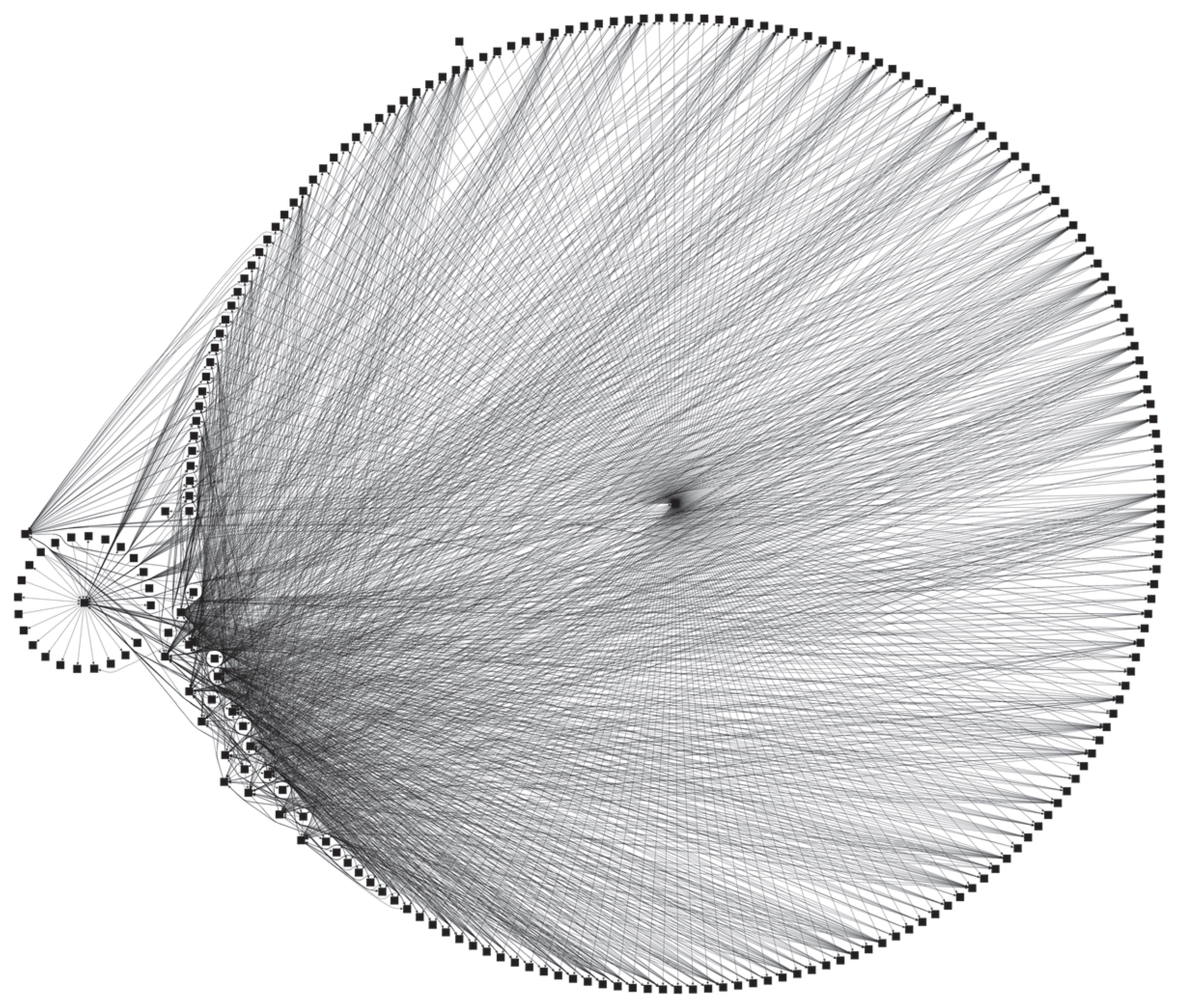
Precognition knowledge graph is shown in Figure 2. The graph is undirected, and its metrics are; 280 for the order or number of nodes, 39,058 for the size or number of edges, 0.99 for density, 0.99 for average degree centrality, and 0.99 for global clustering coefficient. Knowledge graph was not partitioned to clusters. Precognition knowledge graph was statistically significantly different from Erdos and Babarasi random graph using Wasserman distance ()
Illustrative Precognition Narratives
Illustrative narratives of transformed, and untransformed precognition:
Transformations lagged precognition by a few hours to decades. Of 76 precognition dreams that were wished, 22 transformed, but of 204 unwished, 47 were transformed (Chisquare test for proportions ).
- (1)
- "I was preparing for MB with a classmate of mine then she said she did not understand a topic and I explained it to her. We got to the exam hall and saw exactly same topic. This dream was fulfilled within hours".
- (2)
- " I dreamt my sister-in-law who was pregnant then,she gave birth to a baby girl who resembles me and the following day I was called that she had delivered a baby girl who looked like me and I saw for myself". This dream was fulfilled a day later.
- (3)
- "It was a dream I had in the night and I was able to recall it later when I woke up. I had a dream that Chemistry 156 result was out and, in the dream, I score 67 and I was wishing I had an extra 3 marks to make it 70. The same day the result came out and I actually got 67 in the exam it was so surprising to me". This dream was fulfilled within 24 hours.
- (4)
- "I dreamt that the car deal between my brother and his close friend was unsuccessful. In the dream the friend gave an excuse of a faulty part in the car he needs to repair and unwillingness to return my brother’s money. My brother was hurt ". This dream was fulfilled two days later.
- (5)
- "I was called and confirmed Covid positive for a test. This dream was fulfilled two days later.
- (6)
- "I embarked on a long journey with a friend on road and we crossed many states. At first the purpose of the journey was unknown at the start but we arrived at a school which was very big and were received by some people who gave us papers to fill concerning our university admission process. After some time, they came out and gave us envelope. On opening it, it was our letter of admission into the university of which the name could not be clearly recalled on waking. The dream played out two weeks later when I was admitted in University of Ibadan and we travelled on raod to Ibadan across many states". This dream was fulfilled two weeks later.
- (7)
- "I dreamt that a family friend had an accident. Her bones started to dry out. Partial fulfillment two weeks later"
- (8)
- "Sometime in 2019 I had a dream where I went to price a car with my friend. Honestly in that dream I was so rich so I went for the best ride, I finally bought the car and was driving round the town, got to a place and parked my car oh, finally I woke up to found myself on the bed, I was so angry with myself for waking up. But 3 months later, I bought a brand new Toyota Corolla as an under graduate. Then I was able to relate that dream with reality". This dream was fulfilled three months later.
- (9)
- "I saw myself in the streets of Agbowo, eventually I was marveled by when I came to UI and saw exact same buildings on Agbowo street". This dream was fulfilled a few months later.
- (10)
- "I received a prize for coming 2nd in mathematics (SS2). I was celebrated by everyone especially since I have nit been performing well in mathematics". This dream was fulfilled at next prize giving day of the academic year.
- (11)
- "I had a dream of intimacy with a female friend of mine, whom I was never close to at the time of the dream. Five years later, we both dated and we had moments of intimacy".
- (12)
- "I dreamt about whatsapp innovation, told my brother about it but he didnt believe it. It was about introdcution of video status which seemed impossible at the time". This dream was fulfilled eight years later.
- (13)
-
I was in senior secondary school. It was a night dream. At that time, I was in Abeokuta,Ogun State. In the dream. I was the main character. I saw myself carrying out surgical operation on someone’s left thigh. There were few unknown faces around basically health personnel. I did not wake up immediately in the dream.I recalled the dream on awakening in the morning. After the dream, I realized that some people began to call me doctor in real life. The dream metamorphosed into a wish and ambition to pursue a medical career in the university which became fulfilled 13 years after I had the dream(2010) It may seem as a partial fulfillment relatively in the sense that I am not in a surgical specialty as occurred in dream, but I could also view it as fully fulfilled because at the same time I had the dream, my understanding was that I am going to be a doctor which was attained""
- (14)
- I had a dream about my first biochemistry test scores. The scores were 50 and 62 and the third score was unknown. The 62 was for me in the dream while the 50 was for my second friend, they had the unknown score. In the morning of the dream, I told my friend about it. When the result finally came out, it was the reverse, I had a score of 50, while my friend had 62. My second friend failed the test with less than 50 marks, which was the unknown score in the dream"
- (15)
- "During my first MB, I had dreams about myself writing each exam - biochemistry, anatomy physiology. In each dream, i saw myself answering some questions in the paper. The clothes i wore were not so accurate, and some of the questions eventually did come out and some did not."
- (16)
- There was a plane on a hill on my street, conveying everyone to London. People were packing and rushing towards and into the plane. However, I found it difficult to finish packing. It felt like I always had something to pack and that delayed me. My family kept calling out to me as well as neighbors and other people but unfortunately, I didn’t make it into the plane"
- (17)
- "One of my siblings being recruited into football academy based in Dubai.Dream was kind of vivid and intense though, not a full-time footballer"
- (18)
- "I was in the USA where I had just had my residency interview at Massachusetts general hospital Boston. It was an amazing process as I looked forward to getting marched into a residency program, a process started long ago. I was asked tons of questions about my background, why I chose medicine and many more. From their countenances, my interviewers were impressed and that made me more relaxed and confident"
- (19)
- "I had a dream and saw my self as a consultant physician who owns a massive hospital complex. The hospital was designed to help the needy and less privileged, and it had a lot of influx of patients needing help"
- (20)
- ’I dreamt of being settled down career-wise and marriage wise. My kids and hubby were living in the USA though the identity of my husband was not known in the dream. I thought I knew his identity in the dream but I couldn’t recall his face after I woke up’
Discussion
Highly significant re-experience of precognition dreams indicates connectivity between dream-space and wake-space. Information, therefore, transfers from dream-space to wake-space, which indicates that precognition dreams are not random events. Hermenutic phenomenology of Freudian dream theory implies that phenomenal experiences of wake-space transform to dreams. Information transfer is, therefore, bidirectional between dream-space and wake-space. Space, time, and events in memory dreams are derived from the cultural settings of subjects (Oluwole 2019, 2020). Similarly, space, time, entities, and events in precognition are derived from the cultural settings of subjects. These settings include University environment, previous schools, Halls of residence, roads, and geographic entities. Further, precognition themes include social, faith, vocation, sports, climate, and finances. Thus, dream-space and wake-space are coupled information processing system.
The language of Consciousness in dream-space is typically the same language spoken in wake-space (Oluwole 2022). Vocabulary of memory dreams is comparable to diverse genre of human documents (Oluwole 2020). House, room, examination, secondary school, 2019, the next day are the commonest keyphrases in the vocabulary of precognition narratives that are re-experienced (Figure 1A); but house, room, secondary school, see, the day, church for precognition narratives that have not been re-experienced (Figure 1B). Jaccard similarity indicates statistical difference in keyphrases. Dream narratives have been shown to be coherent, even when sequence of events are not feasible (Oluwole 2020, 2022). The corpus of narratives is summarized as dream journal of an individual by large language model. It also identifies precognition in the corpus. These findings indicate coherence of diverse precognition experiences of subjects. Although phenomenal experience of any observer is qualia (Hobson 2009; Kazanina & Poeppel 2023; Smythies 2003; Whorf 1952), objective reality is established if multiple observers share similar phenomenal experiences (Moran 2024; White 1947). Thus, similar phenomenal experiences of subjects in precognition dreams indicate objective reality, but not qualia.
Phenomenal experiences generate knowledge (Husserl 2012), which is usually expressed using language (Husserl 2012). Knowledge graphs are mathematical objects which provide visualization and metrics to assess interactions between entities of systems. Precognition knowledge graph indicates coherent semantics of narratives (Figure 2). Metrics indicate that precognitive narratives are not descriptions of random phenomenal experiences (Figure 2). Figure 2 shows that all pairs of nodes are connected. Connectivity metrics indicates that no precognitive narrative contains information that is isolated from all other narratives. Density of 1.0 indicates maximum connectivity of semantic graph, while average degree centrality of 1.0 indicates that each narrative shares information with at least one other narrative. Global clustering coefficient of 1.0 indicates strong clustering of nodes. Thus, subjects have shared phenomenal experiences of precognition in dream-space.
Precognition Narratives
Dreams 1–5 illustrate re-experience of precognition in wake-space after lag of few hours to 48 hrs. Precognition of examination questions in Dream 1 is re-experienced within hours, but within 24 hours for the delivery of a baby girl that resembles the subject in Dream 2. Precognition of score 67 in chemistry examination in Dream 3 was re-experienced within 24 hours. An unsuccessful Car deal in Dream 4, and positive COVID-19 result in Dream 5 are re-experienced within 48 hours. Thus, precognition do transform to phenomenal experiences of wake-space without changes to order or sequence of events after very short lag.
Dreams 6–13 illustrate re-experience of precognition after lags of up to a decade. These dreams also transform to phenomenal experiences without changes to the order, or sequence of events. Precognition of traveling through many states to a University following admission in Dream 6 is re-experienced within two weeks. A friend who had motor traffic accident in Dream 7, purchase of new Toyota Corolla in Dream 8, perception of University community in Dream 9, and prize in mathematics in Dream 10 are re-experienced within few months. Sex in Dream 11 is re-experienced five years later, while in Dream 12 precognition of WhatsApp video feature is re-experienced 8 years later. Graduation as doctor in Dream 13 is re-experienced after a decade. Thus, long delay before re-experience do not change the sequence of precognition events.
Dreams 14-15 illustrate changes to the sequence of precognition events when re-experienced in wake-space. Precognition scores in Biochemistry examination, which were 62 for the subject, but 50 for a colleague in Dream 14, reversed when re-experienced. Dresses worn in Dream 15 changed when re-experienced. Information entropy measures phenomenology of configuration changes to sequence of events, signals, or messages from source to destination. Thus, information entropy occurs when precognition transforms to phenomenal experiences of wake-space.
Dreams 16–20 illustrate precognition dreams that have not been re-experienced. In Dream 16, precognition was an Aircraft parked on a street, but took off before subject finished packing the luggage. This dream, however, is unlikely to be re-experienced without changes since commercial aircrafts do not park or taxi on neighborhood roads. Sibling is recruited to football Club in Dream 17, while in Dream 18 potential entry to Residency training in Massachusetts General Hospital, Boston is perceived. Consciousness is Consultant Physician in a big Hospital in Dream 19, but is living with family in the USA in Dream 20. Precognition events in Dreams 16–20, therefore, contain symbols, representations, or metaphors of real events. Metaphors in dreams are interpretable only in the context of subjects (Hartmann 1996, 2010). Metaphorical precognition is, therefore, interpretable as encrypted or ciphertext that can be interpreted only by persons with encryption keys. Metaphorical precognition, therefore, explains statistical difference between vocabulary of transformed, and untransformed precognition. Thus, cryptography is observable in precognition dreams.
Causality of Precognition, and Spacetime Theories
Causal events precede their effects in special and general relativity mechanics (Chatterjee 2013). Precognition is causal event in dream-space, where Consciousness is in relativistic motion, and gravity is very strong, while re-experience of precognition is the effect in wake-space, where motion is very slow, and gravity is very weak. The cause, and the effect are, therefore, in distinct spacetimes as modeled in special, and general relativity mechanics. Causal events in the reference frame of observers moving very close to the speed of light away from stationary observers are perceived immediately, but after a lag by stationary observers. Further, the intervals between events, or frequency of signal increases as the fast observer moves away. Changes in the frequency of signals termed redshift is also described as time dilation, such that stationary observers need more time to experience the same event. Time dilation, which is central concept in special relativity theory (Carroll 2014; Einstein 1920), is similar to Doppler effect, which is observable at low speeds in wake-space. Doppler effect increases the frequency of signals when the source moves towards stationary observer, but decreases it when the source moves away. Time dilation also occurs in general relativity mechanics between observers in strong gravity fields and those in weak gravity fields (Bambi 2018; Luminet 1998; Wald 2010). Thus, relativistic motion of Consciousness in dream-space, where gravity is very strong, provides physical model for precognition dreams.
Spacetime concepts in philosophy include presentism, eternalism (Savitt 2006), and Block universe (Bouton 2017; Margoni 2024). Presentism asserts that only now, or present exists, while eternalism asserts that past, present, and future exist (Savitt 2006). Block universe, however, asserts that past, present, and future coexist (Bouton 2017; Margoni 2024), but not ordered. Although Block universe appears counter-intuitive, it is observable in dreams where past, present, and future coexist in the same event. Thus, philosophical concept of Block universe models perception of past, present, and future in dreams.
Conclusions
Precognition transforms to phenomenal experiences of wake-space. Transformation to wake-space is deterministic if the sequence of precognition events is unchanged. Changes, alterations, and reordering of precognition events indicate information entropy. Precognition, however, can be encrypted such that symbols or representations of entities and events are presented. Transformation, therefore, has to be decrypted. There are, therefore, types of precognition which generate knowledge, and serve purposes that transcend mere forecasts of future events. Thus, there is causal relation between precognition events, and phenomenal experiences of wake-space.
Dream-space has attributes of 4D spacetime, while wake-space has attributes of 3D spatial coordinates, and distinct 1D time coordinate. Special and general relativity mechanics, Block universe, and quantum mechanics are models of events in dream-space. Dream spacetime permits Consciousness to perceive the past, present, and future. It also permits motion themes that are not feasible in wake-space. Relativistic motion of Consciousness in dream-space, and time dilation are the physical bases for precognition. Thus, dream spacetime permits Consciousness to move in time dimension to the past, and to the future.
References
- Bambi, C. 2018. Introduction to General Relativity: A Course for Undergraduate Students of Physics. Springer. [Google Scholar]
- Bouton, C. 2017. Is the Future already Present? The Special Theory of Relativity and the Block Universe View. In Time of Nature and the Nature of Time. Edited by C. Bouton and P. Huneman. Springer International Publishing: Vol. 326, pp. 89–121. [Google Scholar] [CrossRef]
- Carroll, S. 2014. Spacetime and geometry: An introduction to general relativity. [Google Scholar]
- Chatterjee, A. 2013. Causality: Physics and Philosophy. European Journal of Physics Education 4, 2: 1–5. [Google Scholar]
- Einstein, A. 1920. Relativity: The special and general theory. vol. 184. [Google Scholar]
- Eranimos, B., and A. Funkhouser. 2023. An exploratory study of the Eastern understanding of déjà rêvé (already dreamed) experiences in Kerala-Indian culture. Dreaming 33, 2: 153. [Google Scholar] [CrossRef]
- Hartmann, E. 1996. Outline for a theory on the nature and functions of dreaming. Dreaming 6, 2: 147. [Google Scholar] [CrossRef]
- Hartmann, E. 2010. Meteorite or gemstone? Dreaming as one end of a continuum of functioning: Implications for research and for the use of dreams in therapy and self-knowledge. Dreaming 20, 3: 149. [Google Scholar] [CrossRef]
- Hobson, J. A. 2009. REM sleep and dreaming: Towards a theory of protoconsciousness. In Nature Reviews Neuroscience. Nature Publishing Group UK London: vol. 10, 11, pp. 803–813. [Google Scholar]
- Husserl, E. 2012. Introduction to the Logical Investigations: A Draft of a Preface to the Logical Investigations (1913). Springer Science & Business Media, December 6. [Google Scholar]
- Kazanina, N., and D. Poeppel. 2023. The neural ingredients for a language of thought are available Publisher. In Trends in Cognitive Sciences. Elsevier. [Google Scholar]
- Kugel, J. 1995. The ladder of Jacob. Harvard Theological Review 88, 2: 209–227. [Google Scholar] [CrossRef]
- Kumar, N. 2023. Déjà vu—Moments relived. International Journal of Indian Psychology 11, 3: 153. [Google Scholar]
- Laughlin, C. D. 2013. Dreaming and reality: A neuroanthropological account. International Journal of Transpersonal Studies 32, 1: 8. [Google Scholar] [CrossRef]
- Lindsay, N., N. Tassell-Matamua, L. O’Sullivan, and R. Gibson. 2024. Trauma or transcendence? The relationship between near-death experiences and dreaming. In Dreaming. [Google Scholar]
- Luminet, J.-P. 1998. Black holes: A general introduction. In Black Holes: Theory and Observation. Springer: pp. 3–34. [Google Scholar]
- Margoni, E. 2024. Adynamism in physics: The block universe vs Barbour’s relational strategy. In Journal for General Philosophy of Science. [Google Scholar] [CrossRef]
- McCoy, A. N., and Y. S. Tan. 2014. Otto Loewi (1873–1961): Dreamer and Nobel laureate. Singapore Medical Journal 55, 1: 3. [Google Scholar] [CrossRef] [PubMed]
- Moran, D. 2024. The phenomenology of joint agency: The implicit structures of the shared life-world. Phenomenology and the Cognitive Sciences 23, 3: 497–524. [Google Scholar] [CrossRef]
- Oluwole, O. 2019. Recurrent dreams of Nigerian undergraduates. In Dreaming. Educational Publishing Foundation: vol. 29, 4, p. 339. [Google Scholar]
- Oluwole, O. 2020. Quantum field structure of dream spacetime. International Journal of Dream Research, 234–243. [Google Scholar]
- Oluwole, O. 2022. Dynamics of consciousness in dreams. In Dreaming. [Google Scholar]
- Oluwole, O. 2024. Gravity and laws of motion in dreams. [Google Scholar]
- Parra, A. 2013. A phenomenological examination of premonition experiences in dreams and waking states: A survey study. Australian Journal of Parapsychology 13, 2: 187–212. [Google Scholar]
- Rothenberg, A. L. B. E. R. T. 1995. Creative cognitive processes in Kekule’s discovery of the structure of the benzene molecule. The American Journal of Psychology 108, 3: 419–438. [Google Scholar] [CrossRef]
- Savitt, S. F. 2006. Presentism and eternalism in perspective. Philosophy and Foundations of Physics 1: 111–127. [Google Scholar]
- Schredl, M. 2009. Frequency of precognitive dreams: Association with dream recall and personality variables. Journal of the Society for Psychical Research 73, 895. [Google Scholar]
- Shiltsev, V., and E. V. Shiltseva. 2020. Dmitrii Ivanovich Mendeleev (1834-1907): The periodic table and beyond. Batavia, IL (United States): Fermi National Accelerator Lab. (FNAL). [Google Scholar]
- Smythies, J. 2003. Space, time and consciousness. Journal of Consciousness Studies 10, 3: 47–56. [Google Scholar]
- Wald, R. M. 2010. General Relativity. University of Chicago Press. [Google Scholar]
- White, L. A. 1947. The locus of mathematical reality: An anthropological footnote. Philosophy of Science 14, 4: 289–303. [Google Scholar] [CrossRef]
- Whorf, B. L. 1952. Language, mind, and reality [Publisher: JSTOR]. ETC: A Review of General Semantics, 167–188. [Google Scholar]
Figure 1.
Figure 1A is the Word Cloud of Re-experienced precognition, while Figure 1B is the Word Cloud of precognition that had not been re-experienced. There is statistically significant difference between the two Word Clouds
Figure 1.
Figure 1A is the Word Cloud of Re-experienced precognition, while Figure 1B is the Word Cloud of precognition that had not been re-experienced. There is statistically significant difference between the two Word Clouds
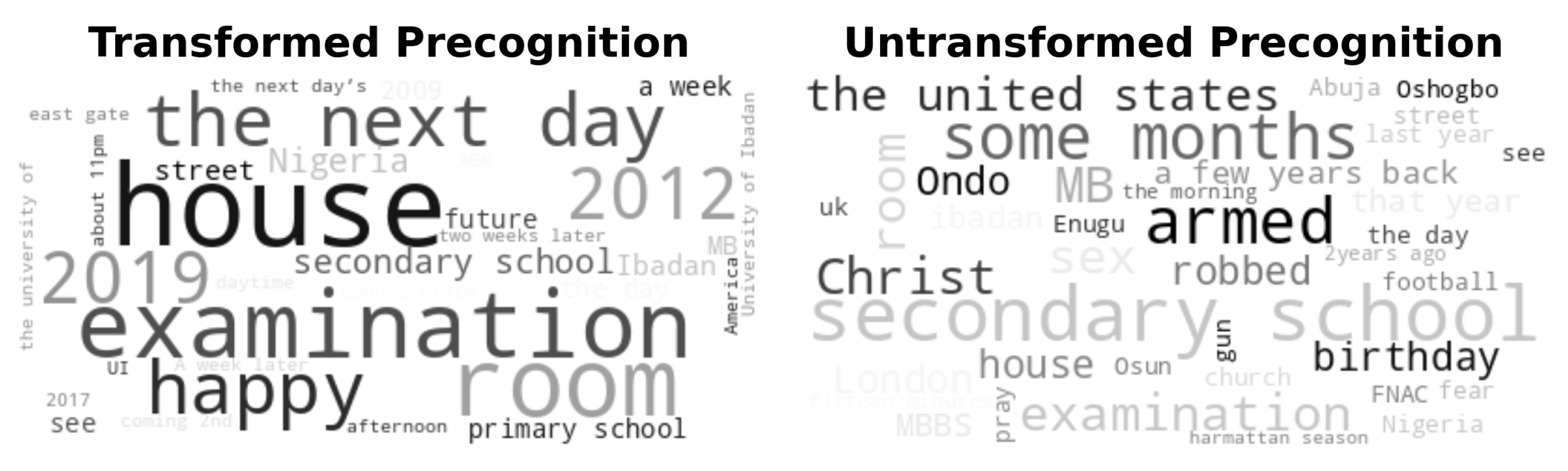
Figure 2.
Knowledge Graph of Narratives. The nodes of the Graph are precognition narratives. Connectivity of the nodes indicate semantic similarity. Phenomenal experiences of the subjects are, therefore, not isolated
Figure 2.
Knowledge Graph of Narratives. The nodes of the Graph are precognition narratives. Connectivity of the nodes indicate semantic similarity. Phenomenal experiences of the subjects are, therefore, not isolated
Disclaimer/Publisher’s Note: The statements, opinions and data contained in all publications are solely those of the individual author(s) and contributor(s) and not of MDPI and/or the editor(s). MDPI and/or the editor(s) disclaim responsibility for any injury to people or property resulting from any ideas, methods, instructions or products referred to in the content. |
© 2025 by the authors. Licensee MDPI, Basel, Switzerland. This article is an open access article distributed under the terms and conditions of the Creative Commons Attribution (CC BY) license (http://creativecommons.org/licenses/by/4.0/).
Copyright: This open access article is published under a Creative Commons CC BY 4.0 license, which permit the free download, distribution, and reuse, provided that the author and preprint are cited in any reuse.


