

Submitted:
26 September 2025
Posted:
29 September 2025
You are already at the latest version
Abstract
Volatile organic compounds (VOCs) released from water-based surface coatings significantly influence indoor air quality and may contribute to Sick Building Syndrome (SBS). This study compared emissions from polyurethane (PUR) and acrylate–polyurethane (ACR-PUR) coatings, identifying a broad spectrum of VOC groups. Results indicate that ACR-PUR emits higher concentrations of symptom-relevant compounds, while PUR shows a more stable emission profile. Several compounds decline rapidly within weeks, whereas others persist longer and may present chronic risks. Although total VOC levels were generally within guideline thresholds, the toxicological profile suggests that symptom-oriented assessment provides more relevant information than total VOC indices. These findings highlight the importance of evaluating both acute and persistent emissions in indoor environments. In addition to characterizing the overall VOC burden, this preprint also emphasizes the differences between short-term and long-term exposure scenarios. While highly volatile compounds dominate the initial period after application, lower-volatility compounds such as certain esters, phthalates, and alkanes persist longer and may influence chronic health outcomes.
Keywords:
volatile organic compounds
; indoor air quality
; polyurethane coatings
; acrylate–polyurethane coatings
; Sick Building Syndrome
1. Introduction
People spend more than 90% of their time indoors, in homes, offices, and commercial spaces (Wu et al., 2007). Since the 1970s, research has increasingly focused on the link between indoor environments and health, particularly as the use of synthetic building materials has expanded. Prolonged exposure to indoor air and the growing presence of synthetic products have made indoor air quality a key determinant of public health. Indoor air is a complex mixture of chemical and biological contaminants, including gases, volatile and semi-volatile organic compounds (VOCs and SVOCs), particulate matter, and microorganisms such as mites, moulds, bacteria, and viruses. These pollutants can significantly reduce environmental quality and adversely affect human health. Their sources include everyday activities such as heating, cooling, humidification, cooking, cleaning, and smoking.
Among indoor pollutants, VOCs in both gaseous and particulate forms are particularly significant. They are frequently associated with Sick Building Syndrome (SBS) (Orkomi, 2024) and Sick House Syndrome (Kishi et al., 2020), conditions characterised by a spectrum of health complaints linked to inadequate ventilation and elevated indoor temperatures. The release profile of VOCs depends strongly on their chemical composition, volatility, and stability under environmental factors such as temperature, UV radiation, and relative humidity (Uhde and Salthammer, 2007). For instance, floor coatings mainly emit alcohols and esters (Knudsen et al., 1999), while wood lacquers release a broader spectrum of VOCs, including aromatic hydrocarbons (toluene, xylenes, ethylbenzene, styrene), aldehydes (formaldehyde, hexanal), alcohols (n-butanol, ethylene glycol), terpenes, and higher molecular-weight hydrocarbons (Guo and Liang, 2024).
Modern water-based coatings, particularly acrylic-polyurethane, polyurethane, and polyester-polyurethane systems, are widely used for finishing wood, furniture, toys, and decorative surfaces. Their appeal lies in their mechanical resistance, adhesion, UV durability, and more favourable ecological properties compared to solvent-based coatings. These systems rely on polymer dispersions in water and are assumed to reduce VOC emissions. Nevertheless, water-based coatings can still emit harmful VOCs and SVOCs. Their release dynamics and stability under environmental conditions such as temperature, humidity, and UV exposure remain insufficiently studied, especially regarding their contribution to indoor air quality. Wang et al. (Wang et al., 2019), for example, demonstrated that VOC concentrations and odour intensity increased with temperature, while higher humidity and ventilation reduced them. The ratio of air exchange to surface load was also shown to significantly influence VOC emissions, underscoring the importance of proper storage and application conditions.
Within the European Union, VOC content in coatings is regulated under Directive 2004/42/EC (European Parliament and Council, 2004), which sets maximum concentrations for products in their ready-to-use form. However, this regulation only addresses product formulation and does not account for emission behaviour over time. The duration and magnitude of VOC release from surface treatments remain unregulated. Post-application emission behaviour is typically evaluated only within voluntary certification schemes and ecolabels such as the EU Ecolabel or Blue Angel, which require VOC measurements, generally after 28 days, and set limits for total emissions, release rates, or the presence of specific hazardous compounds.
This regulatory gap highlights the need for systematic investigation of how water-based polyurethane (PUR) and acrylic-polyurethane (ACR-PUR) coatings behave once applied indoors, not only in terms of total VOC levels but also in the toxicological relevance and persistence of individual compounds. Addressing this gap, the present study integrates chemical composition data, emission profiles, and time-resolved indoor air measurements to quantify the transfer efficiency of toxicologically classified substances and to identify those with the highest potential for acute symptoms and chronic exposure.
A novel framework for VOC risk assessment is introduced by calculating the percentage transfer of individual compounds into indoor air at two post-application intervals (14–21 days and 60 days). Unlike conventional approaches based solely on emission factors or total VOC (TVOC) thresholds, this method enables the identification of compounds with high acute relevance (such as phenol, methyl butyl ketone, and vinyl acetate) as well as long-term persistence (such as 1,3-dioxolane and isopropylbenzene). The findings support the design of time-resolved screening panels that account for both toxicological classification and emission dynamics, contributing to more targeted indoor air quality management strategies.
2. Materials and Methods
2.1. Materials
Volatile and semi-volatile organic compound (VOC, SVOC) emissions were investigated from two commercially available waterborne coatings manufactured in the Czech Republic, representing polyurethane (PUR) and acrylic–polyurethane (ACR-PUR) dispersion varnishes. Both coatings are intended for interior wooden substrates such as flooring, parquet, furniture, and other indoor surfaces.
The PUR coating is a one-component, water-based varnish formulated for professional use on indoor wooden surfaces. The declared composition includes isothiazolinone-based preservatives and benzotriazole derivatives (poly(oxy-1,2-ethanediyl), α-[3-[3-(2H-benzotriazol-2-yl)-5-(1,1-dimethylethyl)-4-hydroxyphenyl]-1-oxopropyl]-ω-hydroxy-). According to the manufacturer, the product has a VOC content of 0.075 kg/kg, a maximum volatile content of ≤ 80 g/L, and a density of 1.05 g/cm³. The ACR-PUR coating is a waterborne acrylic–polyurethane varnish designed for long-term durability in indoor applications and marketed as safe and environmentally friendly. It complies with EN 71-9 (European Committee for Standardization (CEN), 2005), confirming suitability for surfaces in contact with children’s toys. Hazardous constituents listed include 5-chloro-2-methylisothiazol-3(2H)-one and 2-methylisothiazol-3(2H)-one (3:1). The declared VOC content is 0.065 kg/kg, with a maximum volatile content of ≤ 70 g/L, and a density of 1.05 g/cm³. Although the manufacturer declared isothiazolinone-based preservatives and benzotriazole derivatives as hazardous constituents, these compounds were not detected in the VOC emission profiles due to their low volatility. Instead, the emission spectrum was dominated by solvents, co-solvents, plasticisers, and degradation products. Comparative properties of the coatings are summarised in Table 1.
Waterborne PUR varnishes are typically designed for high mechanical resistance and durability. Their VOC emission profile is relatively stable, releasing fewer compounds under standard conditions, although latent reactive residues such as unreacted isocyanates may be mobilised under accelerated environmental stress. In contrast, ACR-PUR coatings often exhibit higher initial volatility, attributable to acrylate-derived esters and aldehydes that volatilise more readily. This difference explains the elevated levels of symptomatically relevant VOCs reported for acrylate-containing systems (Gavande et al., 2024).
2.2. Sampling Procedure
Emissions of VOCs and SVOCs were collected both directly above the opened varnish cans and from indoor air after application. For sampling above the liquid surface, sorption tubes (Markes, United Kingdom) connected to an Acti-VOC pump were used, with a collection time of 5 minutes. As no standard specifies the sampling distance for headspace collection directly from product containers, the tube inlet was placed approximately 1–2 cm above the surface of the liquid. This arrangement allowed the capture of primary emissions released immediately after opening. Each varnish sample was analysed in duplicate.
Indoor air sampling was conducted in a test room with a total volume of 75 m³, in accordance with ISO 16017-2 (International Organization for Standardization, 2023). The coated surface area, which included wall cladding, beams, and flooring, was 80 m². Indoor samples were first collected 14 days after coating application, corresponding to the manufacturer’s recommendation for achieving the declared performance properties. Sampling then continued daily during the following eight days, that is, from day 14 to day 21. Three additional control samples were taken after 60 days to evaluate long-term emissions. Sampling was carried out at a room temperature of 20 ± 2 °C, while outdoor daily temperatures ranged between 5 and 7 °C. Air samples were collected with the Acti-VOC pump onto sorption tubes containing a multi-bed packing of Tenax TA, Carbograph 1TD, and Carboxen 1003, ensuring a broad spectrum of VOCs and SVOCs retention. Each indoor sampling event lasted 1 hour. Ventilation of the test room relied exclusively on natural air exchange through the window opening. Nonmechanical ventilation was used. The frequency of air exchange was standardised to five times per day for 20 minutes.
2.3. Analytical Methods
Collected sorbent tubes were analysed by thermal desorption–gas chromatography/mass spectrometry (TD-GC/MS; Gerstel, Mülheim an der Ruhr, Germany). An internal standard (1,3,5-tri-tert-butylbenzene) was added to each tube before desorption. The desorption program consisted of heating from 50 °C (1 min) to 300 °C (5 min) at the rate of 60 °C/min. The analytes were cryofocused in a cooled injection system (CIS) at 10 °C, then rapidly heated at 10 °C/s to 250 °C and transferred to a non-polar HP5 ms column (60 m × 250 µm × 0.25 µm). The GC temperature program started at 40 °C (10 min), increased at 15 °C/min to 300 °C, and was held for 10 min.
Identification and quantification of VOCs and SVOCs were performed using authentic reference standards. Indoor temperature and relative humidity were continuously monitored with a Govee WiFi H5179 sensor, which has an accuracy of ± 0.3 °C for temperature and ±3% RH for relative humidity. These data provided additional context for evaluating emission dynamics under variable microclimatic conditions.
2.4. Statistical Evaluation
The dataset comprised time-resolved concentrations of volatile organic compounds (VOCs) emitted from polyurethane (PUR) and acrylate–polyurethane (ACR-PUR) lacquers. Each compound was quantified at ten time points: eight measurements between day 14 and day 21 after application, and two additional measurements on day 60. Basic descriptive statistics (arithmetic mean and standard deviation) were computed in OriginPro (OriginLab Corporation, USA).
2.5. Potential Risk Assessment of Chemical Substances in Relation to Sick Building Syndrome (SBS)
To evaluate the health relevance of emissions from the tested varnishes in relation to Sick Building Syndrome (SBS), all identified substances were classified according to internationally recognised schemes and authorities, including the European Chemicals Agency (ECHA), Regulation (EC) No. 1272/2008 (CLP), the Globally Harmonized System (GHS), the International Agency for Research on Cancer (IARC), the US Environmental Protection Agency (U.S. EPA), and Organisation for Economic Co-operation and Development (OECD) guidance documents.
The assessment focused on toxicological endpoints most relevant to SBS symptoms: carcinogenicity, reproductive toxicity, mutagenicity, neurotoxicity, acute toxicity, skin and eye irritation, and specific target organ toxicity (STOT). Harmonised classifications were taken from CLP Annex VI and the ECHA database. Where harmonised data were not available, Safety Data Sheets (SDS) provided by manufacturers or suppliers were used for verification.
Acute toxicity, irritation, and STOT were prioritised as they correspond to immediate and non-specific symptoms often reported indoors, including eye and skin discomfort, mucosal irritation, headaches, fatigue, and respiratory complaints. The evaluation combined toxicological potency with the measured indoor air concentrations, enabling classification of each compound into three SBS relevance categories: high, medium, or low. This framework allowed the identification of substances with the greatest potential to trigger or exacerbate SBS (Table 2).
3. Results and Discussion
3.1. Characterisation of Organic Compounds in Indoor Air and Water-Based Varnishes
In the analysed samples of indoor air and water-based varnishes (polyurethane and acrylic-polyurethane), sixteen groups of organic compounds were identified. These included additives, degradation products, precursors, resin monomers (polyester, polyurethane, acrylic), contaminants, and secondary compounds formed through interactions between varnishes and wood. Additives represented a substantial fraction, fulfilling technological functions such as photoinitiators, antioxidants, UV stabilisers, plasticisers, drying agents, adhesion promoters, gloss enhancers, and antimicrobial agents. They were detected in indoor air either in their original form or as degradation and reaction products. Their presence and concentrations depended on the type of varnish, resin composition, and interactions with the underlying wood.
In the air inside the test chamber, three main groups of organic compounds dominated: aromatic hydrocarbons (37.40 ± 12.90%) > alcohols (23.64 ± 8.74%) > carboxylic acids, esters, and acetates (10.5 ± 2.90%). Water-based varnishes were a significant source of alcohols and esters, which are widely used as solvents and resin components (Wang et al., 2022). The wooden substrate also contributed to the overall burden of aromatic hydrocarbons (9–11%), with elevated emissions of toluene and 1,3-xylene from untreated wood reported by Wang et al. (2022).
Alcohols represented the second most abundant group. Their concentrations in emissions from PUR and ACR-PUR varnishes were comparable, reflecting their role as solvents in both systems. Carboxylic acids, esters, and acetates accounted for about 10% of the total. According to Alapieti et al. (Alapieti et al., 2021), coatings significantly alter the emission profile compared to bare wood, with esters and acetates becoming dominant during early drying stages. Their release is influenced by substrate moisture. These compounds typically occur at 11–20% in coating formulations as part of polyester and acrylic resins modified with polyurethane and serve as plasticisers and lubricants.
Cyclic alkenes, mainly terpenes and isoprenoids, were released naturally from raw wood. They are constituents of resins and essential oils, especially in coniferous species. However, when coatings such as polyurethane varnishes were applied, processes occurred that altered the volatility of these compounds (Liu et al., 2020). The varnish could dissolve wood constituents, enhancing their release, or promote chemical interactions between terpenes (e.g., α-pinene, limonene) and varnish components, which modified the final emission profile. Depending on the type of varnish, some VOCs were trapped in the coating layer, while others were more intensively emitted into indoor air.
Aldehydes and ketones originated from surface treatments, construction materials, and furniture, acting as secondary pollutants. Major sources included MDF, particle boards, laminates, and adhesives. Liu et al. (Liu et al., 2020) reported mean concentrations of aldehydes and ketones in 30 monitored indoor environments at 0.432 mg/m³, with the highest values for flooring (0.648 mg/m³), furniture (0.590 mg/m³), and coatings (0.341 mg/m³).
The total VOC concentration in the test chamber was 389.33 ± 30.96 µg/m³ during days 14–21 after coating application. For the evaluation of varnish impact on indoor air quality, only compounds of anthropogenic origin and with proven health risks were considered, while terpenes and isoprenoids were excluded. In total, 96 organic compounds with potentially toxic properties were identified, several of which have been associated with Sick Building Syndrome symptoms.
3.1.1. Reproductive Toxicants
Many substances with established reproductive toxicity were detected in indoor air following the application of PUR and ACR-PUR varnishes. These included phthalates such as bis(2-ethylhexyl)phthalate (DEHP), dibutyl phthalate (DBP), and diethyl phthalate (DEP), glycol ethers such as 2-ethoxyethanol (EGEE), solvents such as methyl butyl ketone (MBK/2-hexanone) and N,N-dimethylformamide (DMF), as well as styrene, toluene, and 1-ethyl-2-methylbenzene.
Among these, DEHP was detected at 7.46 ± 5.01 µg/m³ in chamber air during days 14–21, while concentrations in the polyurethane varnish reached 62.66 ± 11.33 µg/m³. After 60 days, indoor levels dropped below the detection limit. DEHP is classified as a presumed human reproductive toxicant (Repr. 1B) and as a probable human carcinogen by the U.S. EPA (U.S. Environmental Protection Agency, 1988). Its toxicological profile includes disruption of thyroid hormone balance, reproductive organs, the liver, and the nervous system (Rowdhwal and Chen, 2018). Although DEHP itself is not considered a direct SBS-inducing compound, its degradation product 2-ethyl-1-hexanol has been repeatedly associated with SBS symptoms in buildings with PVC flooring (Wakayama et al., 2019).
DBP was present at 6.37 ± 2.09 µg/m³ in PUR and 1.94 ± 0.10 µg/m³ in ACR-PUR varnish. In indoor air, its concentration averaged 0.16 ± 0.14 µg/m³ during days 14–21 but decreased markedly to 0.03 ± 0.002 µg/m³ after 60 days. This rapid decline is consistent with its higher volatility and lower molecular weight compared to DEHP, which facilitates faster evaporation and weaker binding to the polymer matrix. Despite its faster loss, DBP is a recognised endocrine disruptor and has been shown to exacerbate allergen-induced lung function decline and alter airway immunology (Maestre-Batlle et al., 2020).
DEP, a less potent phthalate, was detected at 6.37 ± 2.09 µg/m³ in PUR and 1.94 ± 0.1 µg/m³ in ACR-PUR varnish. Chamber concentrations averaged 0.44 ± 0.15 µg/m³ during days 14–21 and declined to 3.1 ± 0.1 ng/m³ after 60 days (Wang et al., 2023). Despite lower toxicity, its presence illustrates that even regulated or phased-out plasticisers can contribute to indoor VOC burdens.
Solvents with reproductive toxicity were also present. MBK (2-hexanone) was measured at 9.59 ± 1.42 µg/m³ in PUR and 4.97 ± 0.14 µg/m³ in ACR-PUR varnish. Chamber concentrations were stable at 0.61 ± 0.14 µg/m³ during days 14–21 and 0.60 ± 0.15 µg/m³ after 60 days, demonstrating persistence due to intermediate volatility and reversible sorption–desorption processes. DMF, used as a solvent to improve diisocyanate solubility in PUR systems, was present at 31.16 ± 11.21 µg/m³ in ACR-PUR varnish and detected in chamber air at 0.22 ± 0.07 µg/m³ during days 14–21, but declined below the detection limit after 60 days. Its rapid loss reflects its high vapour pressure and susceptibility to hydrolysis and photodegradation.
Styrene and toluene, both common VOCs in varnishes and wooden composites, were also detected. Styrene reached 26.49 ± 1.20 µg/m³ in PUR and 188.65 ± 87.25 µg/m³ in ACR-PUR varnishes, while chamber air concentrations were 3.39 ± 1.22 µg/m³ during days 14–21 and 1.13 ± 0.017 µg/m³ after 60 days. Toluene exhibited extreme variability between formulations, with 2.45 ± 3.21 µg/m³ in PUR but as high as 816.65 ± 215.1 µg/m³ in ACR-PUR varnish. In chamber air, its concentrations averaged 30.19 ± 11.45 µg/m³ in days 14–21 but fell below detection by day 60, consistent with its high volatility and photochemical reactivity.
Finally, 1-ethyl-2-methylbenzene, a by-product of varnish manufacture and a respiratory irritant, was detected at 38.28 ± 4.67 µg/m³ (PUR) and 25.27 ± 3.92 µg/m³ (ACR-PUR) in varnishes, with indoor concentrations of 0.33 ± 0.16 µg/m³ during days 14–21 and non-detectable after 60 days. Similarly, EGEE (2-ethoxyethanol), a glycol ether solvent, was measured at 1.21 ± 0.14 µg/m³ (PUR) and 6.45 ± 0.97 µg/m³ (ACR-PUR), while indoor levels declined from 0.090 ± 0.026 µg/m³ (days 14–21) to 0.044 ± 0.020 µg/m³ (day 60).
Overall, reproductive toxicants displayed different emission behaviours: some (e.g., toluene, DMF) declined rapidly, while others (e.g., MBK, phthalates) persisted for weeks. This mixture of transient and long-lasting compounds underlines the complexity of indoor exposure scenarios and their relevance to both acute and chronic SBS symptoms.
3.1.2. Mutagens in Indoor Air from Polyurethane and Acryl-Polyurethane Lacquers
Polyurethane and acryl-polyurethane lacquers can release mutagenic compounds into indoor environments, particularly benzene, glyoxal, and phenol. Benzene, a well-known mutagen and human carcinogen, originates both from natural components of wood, such as lignin and extractives, and from varnish composition. Studies have reported emissions of up to 12.82 µg/m³ from untreated solid wood (Wang et al., 2022), while concentrations in our test materials were substantially higher: 37.56 ± 11.89 µg/m³ in PUR varnish and 32.73 ± 6.83 µg/m³ in ACR-PUR varnish. In chamber air, benzene levels reached 28.42 ± 14.98 µg/m³ during days 14–21, exceeding average background values in European households 8.42 ± 14.98 µg/m³ (Fromme et al., 2025). By day 60, however, concentrations had dropped below detection, consistent with observations by Kumar et al., (2023) that VOCs from coatings rapidly decline due to volatilisation, photochemical degradation, and dilution.
Phenol is another mutagenic compound frequently found indoors, originating from coatings, adhesives, carpets, plastics, and wooden furniture. Reported background levels range from 0.2 to 21.5 µg/m³ (Campagnolo et al., 2017). In our measurements, phenol emissions from PUR varnish reached 46.04 ± 29.23 µg/m³, while ACR-PUR varnish produced 37.64 ± 11.90 µg/m³. Indoor chamber concentrations were much lower but still notable at 4.53 ± 1.97 µg/m³ (days 14–21), followed by a sharp decline to 0.06 ± 0.004 µg/m³ after 60 days. This reduction is in accordance with systematic reviews indicating that VOC emissions from coatings and building materials can diminish by 90–99% within two months of application (Kumar et al., 2023).
Glyoxal, used as a cross-linking agent in polymers and also applied as a biocide, was identified at 10.63 ± 0.97 µg/m³ in ACR-PUR varnish. Chamber concentrations averaged 0.35 ± 0.09 µg/m³ during days 14–21, comparable to residential indoor levels of 0.42 µg/m³ reported by Duncan et al. (2018). In more oxidative indoor environments, however, glyoxal has been detected at ~2 µg/m³ (Huang et al., 2019). Its absence by day 60 reflects its high reactivity and instability: as a small α-dicarbonyl compound, glyoxal undergoes rapid heterogeneous reactions with nucleophilic functional groups, sorption to surfaces, and transformation into secondary products such as imines, acetals, or oligomers. This behaviour explains its relatively short persistence in indoor air without continued emission sources.
3.1.3. Carcinogens and Potential Carcinogens in Indoor Air from Polyurethane and Acryl-polyurethane Lacquers
Several carcinogenic or potentially carcinogenic compounds were detected in association with PUR and ACR-PUR varnishes, including 1,4-dioxane, acetamide, vinyl acetate, isopropylbenzene, p-aminotoluene, tetrachloroethylene, benzophenone, and residual polymeric methylene-diphenyl diisocyanate (RMDI). As discussed in Section 3.2.3, benzene is included as one of the most relevant agents.
1,4-Dioxane, a possible human carcinogen, may occur as a residual solvent or degradation product of polyether components in varnishes. It was detected in PUR varnish at 1.69 ± 0.26 µg/m³ and at identical levels in chamber air during days 14–21. By day 60, concentrations had declined to 0.053 ± 0.002 µg/m³, approaching background values reported for households in Japan (0.02 µg/m³) (Tanaka-Kagawa et al., 2005). Importantly, the EU-US risk screening level for long-term cancer risk is 0.2 µg/m³ (U.S. Environmental Protection Agency, 2024), meaning concentrations during the early phase exceeded health-based thresholds, though they dropped to safe levels after two months.
Acetamide, a possible by-product of synthesis or an additive, was present at ~4–5 µg/m³ in both varnish types. Chamber concentrations were modest (0.073 ± 0.052 µg/m³ during days 14–21) but increased slightly to 0.123 ± 0.003 µg/m³ after 60 days. Such delayed release is atypical but consistent with diffusion-limited behaviour in highly cross-linked polymer matrices and with potential secondary indoor sources, such as MDF panels and linoleum (Adamová et al., 2020).
Vinyl acetate, used in hybrid polymer binders, was measured at 1.80 ± 0.21 µg/m³ in PUR and 13.17 ± 8.27 µg/m³ in ACR-PUR varnishes. Indoor chamber concentrations rose from 0.621 ± 0.48 µg/m³ (days 14–21) to 1.534 ± 1.09 µg/m³ after 60 days. This trend mirrors findings by Huang et al. (2019) and reflects the slow release of polymer-bound volatiles under realistic indoor conditions.
Isopropylbenzene (cumene), a precursor for methyl methacrylate, was present at 7.67 ± 0.19 µg/m³ in PUR and 1.63 ± 0.70 µg/m³ in ACR-PUR varnishes. In chamber air, concentrations stabilised around 0.44 ± 0.18 µg/m³ (days 14–21) and 0.40 ± 0.01 µg/m³ (day 60), reflecting its relatively low volatility, high boiling point, and chemical stability.
p-Aminotoluene, an aromatic amine and known carcinogenic intermediate in pigment and polyurethane production, was found at 0.61 ± 0.05 µg/m³ in PUR varnish and 0.062 ± 0.026 µg/m³ in chamber air during days 14–21. By day 60, concentrations fell below detection, consistent with literature values for indoor environments (Palmiotto et al., 2001).
Tetrachloroethylene, widely used as a solvent in coatings, was present at ~25 µg/m³ in both PUR and ACR-PUR varnishes. Chamber air levels were much lower, averaging 0.062 ± 0.046 µg/m³ during days 14–21 and 0.040 ± 0.010 µg/m³ after 60 days. Despite rapid initial volatilisation, its persistence suggests slow desorption from indoor surfaces such as textiles and wall materials, aligning with results reported by Fromme et al. (2025).
Benzophenone, a photoinitiator and possible human carcinogen, was detected at ~20–25 µg/m³ in both varnish types. In chamber air, concentrations were 0.043 ± 0.013 µg/m³ during days 14–21 but dropped below detection by day 60. This pattern is consistent with previous studies showing its partitioning onto dust particles and resuspension in indoor air (Wan et al., 2015).
Finally, polymeric methylene-diphenyl diisocyanate (RMDI), classified by ECHA as a suspected human carcinogen (Category 2), was detected as multiple stereoisomers in indoor air. Between days 14–21, total concentrations reached 0.108 ± 0.028 µg/m³, dominated by the cis,trans isomer at 0.042 ± 0.007 µg/m³. Emissions were substantially higher in ACR-PUR varnishes (403.88 ± 42.76 µg/m³) than in PUR varnishes (64.05 ± 13.76 µg/m³), reflecting differences in prepolymerisation degree and residual monomer content (Cao et al., 2025). By day 60, however, all isomers were below detection, suggesting progressive degradation, sorption, and diffusion processes typical of reactive isocyanates.
In summary, these findings confirm that both mutagens and carcinogens are relevant components of varnish emissions. Although many compounds decline rapidly within two months, several exceed health-based guidance levels during the early post-application period, highlighting the importance of ventilation and material selection in indoor environments.
3.2. Toxicological Profile of PUR and ACR-PUR Coatings
The comparative analysis of PUR and ACR-PUR coatings demonstrates apparent differences in composition and toxicological relevance of emitted compounds. These variations are critical for assessing health risks associated with indoor exposure (Table 3).
ACR-PUR coatings exhibited a higher neurotoxic potential, primarily due to elevated levels of 1,3-dioxolane (42.72 ± 31.05 µg/m³), compared to PUR (73.36 ± 10.75 µg/m³). This compound is associated with central nervous system effects and sensory irritation, indicating a strong neurobehavioral relevance of ACR-PUR emissions.
Reproductive toxicants also showed contrasting profiles. ACR-PUR contained markedly higher concentrations of styrene (188.65 ± 87.25 µg/m³) and toluene (816.65 ± 215.10 µg/m³), both linked to endocrine disruption and developmental toxicity. PUR, on the other hand, was characterised by higher levels of phthalates, particularly bis(2-ethylhexyl) phthalate (62.66 ± 11.33 µg/m³), known to impair fertility and foetal development. These divergent pathways indicate that both coatings present reproductive risks, though via different mechanisms.
Mutagenic compounds were detected in both formulations. Benzene was dominant in PUR (37.56 ± 11.89 µg/m³), while glyoxal was more prominent in ACR-PUR (10.63 ± 0.97 µg/m³). Phenol was common to both, further contributing to the mutagenic burden under prolonged exposure conditions.
Carcinogenic and potentially carcinogenic substances displayed the strongest contrast. ACR-PUR contained significantly higher levels of reactive methylene diphenyl diisocyanate (RMDI) isomers, such as cis,trans- (213.17 µg/m³) and cis,cis- (153.10 µg/m³), which are associated with tumorigenic outcomes. Tetrachloroethylene (24.09 ± 7.65 µg/m³) and benzophenone (24.56 ± 1.28 µg/m³) were also more abundant in ACR-PUR, reinforcing its elevated carcinogenic potential.
These results indicate that ACR-PUR coatings pose a substantially greater toxicological burden across all evaluated categories. While PUR coatings are comparatively less hazardous, the presence of persistent compounds such as phthalates and benzene requires attention in long-term exposure scenarios.
3.3. Toxicological Assessment of Indoor Air Following Coating Application
While coating-specific profiles highlight intrinsic differences in toxicological potential, the actual exposure risk is determined by the temporal evolution of compounds in indoor air (Table 4).
The neurotoxicant 1,3-dioxolane exhibited remarkable stability, with concentrations of 2.46 ± 0.90 µg/m³ between day 14 and day 21 and 2.47 ± 0.16 µg/m³ by day 60. This persistence underlines its significance for chronic exposure scenarios, especially in poorly ventilated environments.
Reproductive toxicants showed the highest absolute load immediately after application, with toluene at 33.94 ± 11.45 µg/m³ and styrene at 3.39 ± 1.22 µg/m³. By day 60, toluene fell below the detection limit, whereas styrene remained detectable at 1.13 ± 0.02 µg/m³. Phthalates such as bis(2-ethylhexyl) phthalate (7.46 ± 5.01 µg/m³) were confined to the early phase.
Mutagenic substances such as benzene (28.42 ± 14.98 µg/m³) and phenol (4.53 ± 1.97 µg/m³) almost completely disappeared by day 60, with total concentrations falling to 0.06 ± 0.004 µg/m³. This rapid reduction indicates their volatile nature and acute rather than chronic relevance.
Carcinogenic and potentially carcinogenic compounds decreased only modestly, from 1.43 ± 0.21 µg/m³ at day 14 to 21 to 1.27 ± 0.11 µg/m³ at day 60. Some, such as ethenyl acetate, even increased slightly, from 0.62 ± 0.48 µg/m³ to 1.53 ± 1.09 µg/m³, probably due to desorption or secondary formation processes. Acetamide (0.073 ± 0.052 → 0.123 ± 0.003 µg/m³) and isopropylbenzene (0.44 ± 0.18 → 0.40 ± 0.01 µg/m³) persisted at comparable levels, while RMDI isomers were confined to the early phase.
3.4. Integrated Evaluation of Emission Behaviour and Exposure Relevance
Neurotoxicants such as 1,3-dioxolane maintained a stable transfer efficiency of 3.37% between day 14 and day 21 (2.46 ± 0.90 µg/m³ from 73.36 ± 10.75 µg/m³) and 3.39% at day 60 (2.47 ± 0.16 µg/m³ from 72.72 ± 11.40 µg/m³). This persistence confirms their potential for long-term neurobehavioral effects.
Reproductive toxicants showed the highest absolute emission load (1460 ± 121 µg/m³), but their transfer efficiency was relatively low: 3.25% between day 14 and day 21, falling to 0.30% by day 60. MBK remained comparatively stable (0.61 ± 0.14 µg/m³ versus 0.60 ± 0.15 µg/m³), whereas phthalates, toluene, and styrene declined sharply. These findings highlight the dominance of acute risks in the early phase and a limited set of persistent contributors to long-term exposure.
Mutagenic compounds displayed high early transfer rates (37.16%), particularly phenol (63.51%), but by day 60 their concentrations nearly disappeared (0.06 ± 0.004 µg/m³). It confirms their acute relevance and limited persistence in indoor air.
Carcinogens initially had low transfer rates, about 0.24% of total emissions, but several persisted over time. Ethenyl acetate increased slightly from 0.62 ± 0.48 µg/m³ to 1.53 ± 1.09 µg/m³, while acetamide and isopropylbenzene remained nearly constant. RMDI isomers and most aromatic carcinogens were present only in the early phase.
Quantitatively, aromatic hydrocarbons and alcohols accounted for more than 60% of the total VOC reduction between days 14–21 and day 60, confirming their key role in the early emission phase and their high volatility shortly after application. Esters and phthalates contributed significantly to the overall decline, although their decrease was more gradual, likely due to sorption on surfaces or within the coating matrix. Groups with marginal contributions, such as amines, amides, and ethers, showed either low initial concentrations or limited volatility, thereby reducing their overall influence on the emission balance. From the quantified compounds, 83.2% of the total VOC reduction was captured, while the remaining 16.8% represented residual concentrations that were either not degraded or had fallen below the detection limit. These substances are often characterised by low reactivity or long-term persistence and are critical for assessing chronic exposure and designing targeted filtration measures, particularly in spaces with insufficient ventilation.
Acute risks are primarily associated with highly volatile substances released shortly after coating application, while chronic exposure is shaped by low-volatility compounds with persistent emission profiles. This dual pattern underscores the importance of time-resolved assessment for effective indoor air quality management.
3.5. Sick Building Syndrome
Sick Building Syndrome (SBS) refers to a set of health problems reported by occupants of specific buildings without the identification of a distinct illness or single causative factor. As described by Norback et al. (Norback et al., 1990), SBS has a multifactorial origin, reflecting a complex interaction of chemical, physical, and psychosocial conditions. Rather than being attributable to a single pollutant, SBS arises from a combined exposure to volatile organic compounds (VOCs), inadequate indoor climate parameters (such as temperature and humidity), poor lighting, noise, occupational stress, and individual sensitivity. The heterogeneity of human response is significant, since compounds that may be tolerated by one individual can cause irritation or systemic effects in another.
3.5.1. Comparison of Coatings
The chemical compositions of emissions from polyurethane (PUR) and acryl–polyurethane (ACR-PUR) coatings show pronounced differences that can be directly linked to their SBS potential (Table 5).
Polyurethane lacquer (PUR) is characterised by a relatively high content of alcohols (994.3 ± 135.6 µg/m³), consistent with a traditional solvent system of lower reactivity. Its emission profile also reveals lower levels of aromatic hydrocarbons (112.8 ± 34.2 µg/m³), which are typically associated with neurotoxicity and sensory irritation, and only limited concentrations of isocyanates (64.0 ± 18.3 µg/m³). Such a profile suggests either a less reactive formulation or an efficient curing process with minimal residual monomers. From the perspective of SBS, this corresponds to a coating with reduced potential to trigger acute sensory symptoms, although alcohols and diols (254.8 ± 42.7 µg/m³) still contribute substantially to overall VOC load and odour perception.
In contrast, ACR-PUR lacquer exhibits a more complex and aggressive emission spectrum. Elevated concentrations of aromatic hydrocarbons (946.2 ± 175.4 µg/m³), esters (280.8 ± 51.2 µg/m³), diols (412.7 ± 63.5 µg/m³), ethers (198.3 ± 40.1 µg/m³), and isocyanates (403.9 ± 72.6 µg/m³) are observed, reflecting a multi-component system modified with acrylates. These modifications, while improving the mechanical and optical properties of the coating, also enhance the volatility and reactivity of the formulation, which significantly increases its emission potential and toxicological burden. As a result, ACR-PUR coatings can be expected to pose a greater risk for SBS symptom onset, especially in enclosed spaces with limited ventilation.
While alcohols dominate in PUR (994.3 ± 135.6 µg/m³), ACR-PUR is strongly characterised by aromatic hydrocarbons (946.2 ± 175.4 µg/m³) and isocyanates (403.9 ± 72.6 µg/m³). This contrast is further emphasised in the bar chart, where compounds are distributed according to their SBS-related potential. Here, PUR is dominated by compounds of moderate relevance, whereas ACR-PUR belongs to strong and medium-strong categories, highlighting its elevated symptomatic potential.
PUR coatings, despite lower overall aggressiveness, still contain compounds capable of provoking irritation during prolonged exposure, whereas ACR-PUR coatings present a higher SBS risk due to elevated levels of strongly symptomatic chemical groups.
3.5.2. Indoor Air Quality After Coating Application
A total of 94 compounds were identified and classified into 16 chemical groups based on their structural characteristics and known associations with Sick Building Syndrome (SBS) symptoms. The distribution of these compounds by chemical class and their relative SBS relevance is shown in Figure 1. The test chamber contained no additional materials or furnishings, which allowed a clear attribution of the measured concentrations to the coatings applied.
Most detected compounds were alcohols, aromatic hydrocarbons, and carboxylic esters, reflecting their role as primary components of waterborne coatings. These groups are strongly or moderately associated with SBS-related symptoms, including mucosal irritation, neurotoxicity, and sensory discomfort. Aldehydes, diols, ethers, and amines were also present at relevant levels, indicating secondary emissions from degradation or polymerisation processes during film curing. In contrast, groups such as isocyanates, isocyanides, nitroalkanes, alkanes, and heterocyclic hydrocarbons were represented only by individual compounds. Despite their low numbers, their toxicological significance and reactivity justify their inclusion in acute SBS screening, particularly in poorly ventilated environments.
Figure 1 illustrates the total number of chemical compounds with SBS relevance in indoor air 14–21 days after coating application, and their persistence after 60 days. At the earlier interval, compounds with strong or moderate-to-high SBS associations were dominant, confirming their role in acute symptom onset. Overall, 94 compounds were identified, of which 17 showed strong or moderate-to-strong association with SBS symptoms. Since all detected substances originated from a single emission source, it was possible to evaluate their emission behaviour and symptomatic relevance with higher accuracy and without interference from other materials. By day 60, most of these substances had declined substantially, but compounds with moderate association remained at detectable levels, representing a long-term exposure concern.
At the earlier interval, compounds with strong or moderate-to-high SBS associations were dominant, confirming their role in acute symptom onset. By day 60, most of these substances had declined substantially, but compounds with moderate association remained at detectable levels, representing a long-term exposure concern.
Quantitative analysis confirms this temporal pattern. Compounds with strong SBS association decreased from 37.03 ± 2.94 µg/m³ at 14–21 days to 2.94 ± 0.41 µg/m³ at 60 days, corresponding to a 92% reduction. Substances with moderate-to-high SBS association showed an even steeper decline of 99%, from 49.51 ± 0.33 µg/m³ to 0.33 ± 0.07 µg/m³. In contrast, compounds classified as moderate exhibited only a 67% reduction (48.16 ± 1.60 µg/m³ to 16.04 ± 0.98 µg/m³), confirming their persistence and chronic relevance. Compounds with low SBS association decreased by 89% (45.91 ± 0.50 µg/m³ to 4.95 ± 0.22 µg/m³).
The greatest relative reductions were observed for phthalate esters (99.1%), phenols (98.8%), diols (98.4%), aromatic hydrocarbons (97.7%), and carboxylic esters (89.8%), consistent with their high volatility and acute emission profiles. In contrast, aldehydes and ketones showed the lowest reduction (32%), reflecting their stability and persistent contribution to indoor air quality. This persistence aligns with long-term field studies, which emphasise the role of aldehydes as chronic drivers of SBS symptoms.
The results confirm a dual emission behaviour: acute SBS symptoms are driven by highly volatile compounds released during the first weeks after coating application, whereas chronic effects are sustained by persistent compounds such as aldehydes, ketones, and low-volatility esters. These findings underscore the need for time-resolved SBS risk classification that accounts not only for chemical type but also for emission dynamics.
In addition, groups such as isocyanates, isocyanides, nitroalkanes, and alkanes were monitored. These compounds showed very low initial concentrations and declined below the detection limit of the analytical method after 60 days. Although their absolute values were minimal, their toxicity, reactivity, and ability to trigger sensitisation justify their inclusion in the acute screening panel, particularly in environments with limited ventilation or in the presence of cumulative VOC emissions.
Aromatic hydrocarbons and alcohols accounted for more than 60% of the total VOC reduction between days 14–21 and day 60, confirming their key role in the early emission phase and their high volatility shortly after application. The relative decrease in concentrations of individual chemical groups between days 20 and 60 and their contribution to the overall reduction of VOC burden. Esters and phthalates contributed significantly to the decline, although their decrease was more gradual, likely due to sorption on surfaces or within the coating matrix. Groups with marginal contributions, such as amines, amides, and ethers, showed either low initial concentrations or limited volatility, thereby reducing their overall influence on the emission balance. From the quantified compounds, 83.2% of the total VOC reduction was captured, while the remaining 16.8% represented residual concentrations that were either not degraded or had fallen below the detection limit. These substances – often characterised by low reactivity or long-term persistence – are critical for the assessment of chronic exposure and for the design of targeted filtration measures, particularly in spaces with insufficient ventilation.
Compared with international indoor air standards, the total VOC (TVOC) values measured 14–21 days after coating application reached 180.61 ± 60.6 µg/m³. According to the German UBA guideline values (Umweltbundesamt, 2007), this corresponds to excellent air quality (< 200 µg/m³). The result is also in accordance with the WHO (Adamkiewicz and World Health Organization, 2010) recommendations, which consider TVOC levels below 300 µg/m³ as indicative of good indoor air quality. However, despite compliance with these guideline values, the presence of specific neurotoxic, reprotoxic, and irritant compounds at measurable concentrations suggests that the indoor environment may still trigger SBS-related symptoms in sensitive individuals. This finding supports the view expressed by Wolkoff, (2013), who emphasised that TVOC alone is not a reliable predictor of health outcomes, since SBS symptoms are more closely linked to the toxicological profiles of individual compounds than to their total concentration.
4. Conclusions
The findings demonstrate that acrylate–polyurethane (ACR-PUR) coatings represent a markedly stronger source of toxicologically significant VOCs compared with conventional PUR formulations. The emission pattern was characterised by an early dominance of highly volatile aromatics such as toluene, styrene, and benzene, which are closely associated with acute sensory and neurological effects. In contrast, compounds of lower volatility, including 1,3-dioxolane, methyl butyl ketone, vinyl acetate, and phthalates, exhibited delayed release and persistence, thereby contributing to long-term exposure risks. This dual behaviour highlights the importance of evaluating both immediate and sustained emissions when assessing the potential of surface coatings to contribute to Sick Building Syndrome and related indoor air quality issues.
Funding
This article is supported by the ESF in “Waste as an alternative source of energy” project, reg. nr. CZ.02.01.01/00/23_021/0008590 within the Programme Johannes Amos Comenius.
References
- Adamkiewicz, G., World Health Organization (Eds.), 2010. WHO guidelines for indoor air quality: selected pollutants. World Health Organization, Regional Office for Europe, Copenhagen, Denmark.
- Adamová, T., Hradecký, J., Pánek, M., 2020. Volatile organic compounds (VOCs) from wood and wood-based panels: Methods for evaluation, potential health risks, and mitigation. Polymers 12, 2289. [CrossRef]
- Alapieti, T., Castagnoli, E., Salo, L., Mikkola, R., Pasanen, P., Salonen, H., 2021. The effects of paints and moisture content on the indoor air emissions from pinewood ( Pinus sylvestris ) boards. Indoor Air 31, 1563–1576. [CrossRef]
- Campagnolo, D., Saraga, D.E., Cattaneo, A., Spinazzè, A., Mandin, C., Mabilia, R., Perreca, E., Sakellaris, I., Canha, N., Mihucz, V.G., Szigeti, T., Ventura, G., Madureira, J., De Oliveira Fernandes, E., De Kluizenaar, Y., Cornelissen, E., Hänninen, O., Carrer, P., Wolkoff, P., Cavallo, D.M., Bartzis, J.G., 2017. VOCs and aldehydes source identification in European office buildings - The OFFICAIR study. Building and Environment 115, 18–24. [CrossRef]
- Cao, W., Yang, X., Song, Z., Geng, J., Liu, C., Zhang, N., Qi, X., 2025. Research on the tribological behavior of polyurethane acrylate coatings with different matrix constituents as well as graphite and PTFE. Polymers 17, 1121. [CrossRef]
- Duncan, S.M., Sexton, K.G., Turpin, B.J., 2018. Oxygenated VOCs, aqueous chemistry, and potential impacts on residential indoor air composition. Indoor Air 28, 198–212. [CrossRef]
- European Committee for Standardization (CEN), 2005. EN 71-9 Safety of Toys – Part 9: Organic Chemical Compounds – Requirements.
- European Parliament and Council, 2004. Directive 2004/42/EC of the European Parliament and of the Council of 21 April 2004 on the Limitation of Emissions of Volatile Organic Compounds Due to the Use of Organic Solvents in Certain Paints and Varnishes and Vehicle Refinishing Products and Amending Directive 1999/13/EC. Official Journal L 143, 0087–0096.
- Fromme, H., Sysoltseva, M., Schieweck, A., Röhl, C., Gerull, F., Burghardt, R., Gessner, A., Papavlassopoulos, H., Völkel, W., Schober, W., 2025. Very volatile and volatile organic compounds (VVOCs/VOCs) and endotoxins in the indoor air of German schools and apartments (LUPE10). Atmospheric Environment 351, 121178. [CrossRef]
- Gavande, V., Mahalingam, S., Kim, J., Lee, W.-K., 2024. Optimization of UV-curable polyurethane acrylate coatings with hexagonal boron nitride (hBN) for improved mechanical and adhesive properties. Polymers 16, 2544. [CrossRef]
- Guo, S., Liang, W., 2024. Volatile organic compounds and odor emissions characteristics of building materials and comparisons with the on-site measurements during interior construction stages. Building and Environment 252, 111257. [CrossRef]
- Huang, Y., Su, T., Wang, L., Wang, N., Xue, Y., Dai, W., Lee, S.C., Cao, J., Ho, S.S.H., 2019. Evaluation and characterization of volatile air toxics indoors in a heavy polluted city of northwestern China in wintertime. Science of The Total Environment 662, 470–480. [CrossRef]
- International Organization for Standardization, 2023. ISO 16017-2:2003 Indoor, ambient and workplace air - Sampling and analysis of volatile organic compounds by sorbent tube/thermal desorption/capillary gas chromatography Part 2: Diffusive sampling.
- Kishi, R., Norbäck, D., Araki, A. (Eds.), 2020. Indoor environmental quality and health risk toward healthier environment for all, Current Topics in Environmental Health and Preventive Medicine. Springer Singapore, Singapore. [CrossRef]
- Knudsen, H.N., Kjaer, U.D., Nielsen, P.A., Wolkoff, P., 1999. Sensory and chemical characterization of VOC emissions from building products: impact of concentration and air velocity. Atmospheric Environment 33, 1217–1230. [CrossRef]
- Kumar, R., Verma, V., Thakur, M., Singh, G., Bhargava, B., 2023. A systematic review on mitigation of common indoor air pollutants using plant-based methods: a phytoremediation approach. Air Qual Atmos Health 16, 1501–1527. [CrossRef]
- Liu, Y., Zhu, X., Qin, X., Wang, W., Hu, Y., Yuan, D., 2020. Identification and characterization of odorous volatile organic compounds emitted from wood-based panels. Environ Monit Assess 192, 348. [CrossRef]
- Maestre-Batlle, D., Huff, R.D., Schwartz, C., Alexis, N.E., Tebbutt, S.J., Turvey, S., Bølling, A.K., Carlsten, C., 2020. Dibutyl phthalate augments allergen-induced lung function decline and alters human airway immunology: A randomized crossover study. Am J Respir Crit Care Med 202, 672–680. [CrossRef]
- Norback, D., Torgen, M., Edling, C., 1990. Volatile organic compounds, respirable dust, and personal factors related to prevalence and incidence of sick building syndrome in primary schools. Occupational and Environmental Medicine 47, 733–741. [CrossRef]
- Orkomi, A.A., 2024. Impacts of environmental parameters on sick building syndrome prevalence among residents: a walk-through survey in Rasht, Iran. Arch Public Health 82, 247. [CrossRef]
- Palmiotto, G., Pieraccini, G., Moneti, G., Dolara, P., 2001. Determination of the levels of aromatic amines in indoor and outdoor air in Italy. Chemosphere 43, 355–361. [CrossRef]
- Rowdhwal, S.S.S., Chen, J., 2018. Toxic Effects of Di-2-ethylhexyl Phthalate: An Overview. BioMed Research International 2018, 1–10. [CrossRef]
- Tanaka-Kagawa, T., Uchiyama, S., Matsushima, E., Sasaki, A., Kobayashi, H., Kobayashi, H., Yagi, M., Tsuno, M., Arao, M., Ikemoto, K., Yamasaki, M., Nakashima, A., Shimizu, Y., Otsubo, Y., Ando, M., Jinno, H., Tokunaga, H., 2005. Survey of volatile organic compounds found in indoor and outdoor air samples from Japan. Kokuritsu Iyakuhin Shokuhin Eisei Kenkyusho Hokoku 123, 27–31.
- Uhde, E., Salthammer, T., 2007. Impact of reaction products from building materials and furnishings on indoor air quality-A review of recent advances in indoor chemistry. Atmospheric Environment 41, 3111–3128. [CrossRef]
- Umweltbundesamt, 2007. Assessment of indoor air contamination using reference and guideline values: Guidance from the ad hoc working group of the Indoor Air Hygiene Commission of the Federal Environment Agency and the Supreme State Health Authorities (in German). Bundesgesundheitsbl. 50, 990–1005. [CrossRef]
- U.S. Environmental Protection Agency, 2024. Supplement to the Risk Evaluation for 1,4-Dioxane CASRN 123-91-1.
- U.S. Environmental Protection Agency, 1988. Di(2-ethylhexyl)phthalate (DEHP); CASRN 117-81-7.
- Wakayama, T., Ito, Y., Sakai, K., Miyake, M., Shibata, E., Ohno, H., Kamijima, M., 2019. Comprehensive review of 2-ethyl-1-hexanol as an indoor air pollutant. Journal of Occupational Health 61, 19–35. [CrossRef]
- Wan, Y., Xue, J., Kannan, K., 2015. Occurrence of benzophenone-3 in indoor air from Albany, New York, USA, and its implications for inhalation exposure. Science of The Total Environment 537, 304–308. [CrossRef]
- Wang, J., Yuan, F., Ye, H., Bu, Z., 2023. Measurement of phthalates in settled dust in University Dormitories and its implications for exposure assessment. Atmosphere 14, 612. [CrossRef]
- Wang, Q., Shen, J., Shao, Y., Dong, H., Li, Z., Shen, X., 2019. Volatile organic compounds and odor emissions from veneered particleboards coated with water-based lacquer detected by gas chromatography-mass spectrometry/olfactometry. Eur. J. Wood Prod. 77, 771–781. [CrossRef]
- Wang, W., Shen, X., Zhang, S., Lv, R., Liu, M., Xu, W., Chen, Y., Wang, H., 2022. Research on very volatile organic compounds and odors from veneered medium density fiberboard coated with water-based lacquers. Molecules 27, 3626. [CrossRef]
- Wolkoff, P., 2013. Indoor air pollutants in office environments: Assessment of comfort, health, and performance. International Journal of Hygiene and Environmental Health 216, 371–394. [CrossRef]
- Wu, F., Jacobs, D., Mitchell, C., Miller, D., Karol, M.H., 2007. Improving indoor environmental quality for public health: Impediments and policy recommendations. Environ Health Perspect 115, 953–957. [CrossRef]
Figure 1.
Number of chemical compounds associated with SBS by organic group.
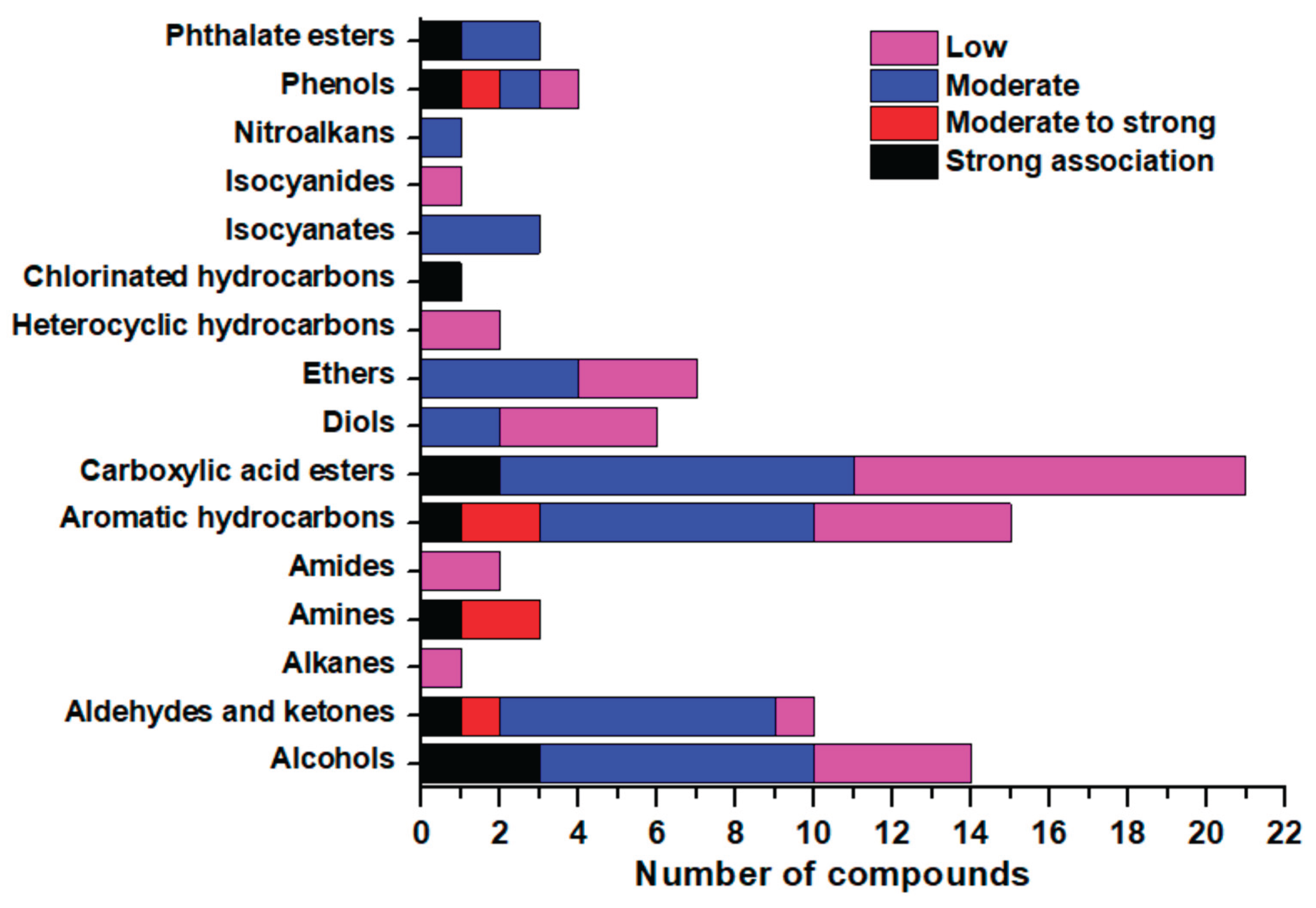

Table 1.
Comparative properties of the tested water-based coatings.
| Property | Water-based PUR coating | Water-based ACR-PUR coating |
| Binder | Polyurethane dispersion | Blend of acrylates and polyurethane |
| VOC profile | Lower; may contain reactive residues (e.g., isocyanates) | Higher initial volatility due to acrylate esters and aldehydes |
| Emission dynamics | More stable, slower VOC release | Faster and more intense VOC release |
| UV resistance | Lower | Higher (due to acrylate component) |
| Application properties | Longer drying time; requires precise application | Faster drying, better adhesion |
Table 2.
A toxicological classification framework applied for risk assessment of SBS-related substances.
Table 2.
A toxicological classification framework applied for risk assessment of SBS-related substances.
| Toxicological category |
Classification source / authority | Criteria and scope | Examples of classification codes / endpoints | Relevance to SBS symptoms |
|---|---|---|---|---|
| Carcinogenicity | CLP, IARC-U.S. EPA | Substances classified as Carcinogenity 1A, 1B, 2 based on human or animal data | Carc. 1A (proven), Carc. 2 (suspected) | Chronic risk from prolonged exposure |
| Reproductive toxicity |
CLP/GHS, Annex I Section 3.7 | Effects on fertility, development, and lactation | Repr. 1A, 1B, 2 | Fertility, developmental, and endocrine effects |
| Mutagenicity (germ cell) | CLP/GHS, Annex I Section 3.5 | Induction of heritable mutations in germ cells | Muta. 1A, 1B, 2 | Genetic stability, chronic SBS effects |
| Neurotoxicity | ECHA guidance, OECD TG 426, TG 443 | Developmental and adult neurotoxicity, DNT cohorts | Based on DNT data, not codified in CLP | Headache, dizziness, cognitive impairment |
| Acute toxicity | CLP Annex VI, ECHA, SDS | Systemic effects after single exposure via oral, dermal, and inhalation | AT1–AT4, NC; H301, H302, H312, H330, H331, H332 | Nausea, dizziness, and respiratory distress |
| Skin/eye irritation | CLP/GHS, SDS | Local effects, reversible or irreversible | Skin 1/1A/1B, Skin 2, Eye 1, Eye 2/2A/2B | Burning eyes, mucosal irritation, and skin discomfort |
| Specific Target Organ Toxicity (STOT) |
CLP/GHS Annex I Section 3.8 | Organ effects after single (SE) or repeated (RE) exposure | STOT SE 1–3, STOT RE 1–2 | Burning eyes, mucosal irritation, and skin discomfort |
Table 3.
Key toxicological groups and dominant VOCs by coating type.
| Group | Key compounds | Coating with a higher concentration |
|---|---|---|
| Neurotoxins | 1,3-Dioxolane | ACR-PUR |
| Reproductive toxicants | Toluene, styrene, phthalates | ACR-PUR (toluene, styrene), PUR (phthalates) |
| Mutagens | Benzene, glyoxal | PUR (benzene), ACR-PUR (glyoxal) |
| Carcinogens | RMDI isomers, tetrachloroethylene | ACR-PUR |
Table 4.
Temporal behaviour of toxicologically relevant compounds in indoor air post-coating application.
Table 4.
Temporal behaviour of toxicologically relevant compounds in indoor air post-coating application.
| Group | Key compounds | Temporal behaviour |
|---|---|---|
| Neurotoxins | 1,3-Dioxolane | Stable, persistent |
| Reproductive toxicants | Toluene, styrene, phthalates | Sharp decline; styrene – partly persistent |
| Mutagens | Benzene, phenol | Near-complete reduction |
| Carcinogens | Ethenyl acetate, acetamide, RMDI isomers | Modest decline; some persistent |
Table 5.
Major chemical groups associated with SBS risks in PUR and ACR-PUR coatings.
| Chemical group | SBS-Related risk | Dominant in |
| Amines | Sensitisation, odour | ACR-PUR |
| Aromatic hydrocarbons | Neurotoxicity, irritation | ACR-PUR |
| Isocyanates | Respiratory sensitisation | ACR-PUR |
| Esters | Mucosal irritation | ACR-PUR |
| Alcohols | High volatility, odour | PUR |
| Phenols | Mucosal irritation | ACR-PUR |
Disclaimer/Publisher’s Note: The statements, opinions and data contained in all publications are solely those of the individual author(s) and contributor(s) and not of MDPI and/or the editor(s). MDPI and/or the editor(s) disclaim responsibility for any injury to people or property resulting from any ideas, methods, instructions or products referred to in the content. |
© 2025 by the authors. Licensee MDPI, Basel, Switzerland. This article is an open access article distributed under the terms and conditions of the Creative Commons Attribution (CC BY) license (http://creativecommons.org/licenses/by/4.0/).
Copyright: This open access article is published under a Creative Commons CC BY 4.0 license, which permit the free download, distribution, and reuse, provided that the author and preprint are cited in any reuse.


