

Submitted:
25 September 2025
Posted:
26 September 2025
You are already at the latest version
Abstract
This paper presents a research-driven framework to make conservation narratives visible in museums through AI-assisted content generation accessible to the public using. Technical conservation documentation is adapted for a general audience through ChatGPT, with all scripts and multimedia outputs reviewed and approved by a human expert. Synthesia (AI avatar video) and Clipchamp (AI voiceovers video) are evaluated for content creation, while QR codes and digital resources enable cost-effective visitor access. The framework is illustrated through the Archaeological Museum of Eleusis re-exhibition, demonstrating how AI tools, under full human supervision, can transform traditionally behind-the-scenes conservation work into engaging, educational, and participatory museum experiences.
Keywords:
Cultural Heritage
; Conservation Visibility
; AI-Assisted Content
; Museum Exhibitions
; Visitor Engagement
; Digital Storytelling
1. Introduction
Cultural heritage serves as a cornerstone of collective identity, with museums functioning as pivotal institutions for preservation, interpretation, and public engagement [1,2]. Contemporary exhibitions increasingly integrate conservation practices, museological theory, and digital technologies to enhance both educational impact and aesthetic experience [3,4]. Despite growing digitization efforts across the cultural sector, conservation work largely remains “behind the scenes,” limiting visitor awareness of the scientific and cultural significance of preservation activities [5,6].
This paper presents a pre-pilot, research-driven framework designed to make conservation narratives accessible to museum visitors through AI-assisted content generation. Technical documentation is systematically adapted for general audiences using ChatGPT, with all generated scripts and multimedia outputs undergoing rigorous review and approval by human conservation experts. Synthesia (AI avatar video) and Clipchamp (AI voiceover video) are evaluated as content delivery platforms, while QR codes and digital resources facilitate visitor access.
The Archaeological Museum of Eleusis re-exhibition serves as the contextual framework for this pre-pilot implementation, demonstrating how AI tools, under comprehensive human supervision, can transform traditional behind-the-scenes conservation work into engaging, educational, and participatory museum experiences while simultaneously addressing contemporary concerns regarding sustainability in cultural institutions.
2. Literature Review
2.1. Museums, Museology, and Museum Objects
Museums serve as central institutions for the preservation and interpretation of cultural heritage, reflecting evolving societal values and historical contexts [4,7]. Over time, they have transformed from static repositories into participatory spaces that engage visitors in processes of meaning-making, collective memory construction, and cultural diversity exploration [8].
Museology, both as a theoretical and applied discipline, investigates museum operations, interpretation strategies, and public engagement methodologies [9]. Pioneering scholars such as Georges Henri Rivière emphasized the museum as a socially embedded institution, intrinsically connected to communities and educational missions.
The museum object transcends its physical form, acquiring profound symbolic and educational significance within carefully constructed exhibition narratives [9]. Effective display strategies, including narrative framing, spatial arrangement, and interpretive materials, transform objects into active carriers of knowledge and emotion, facilitating meaningful connections between visitors and cultural heritage.
This dynamic interplay between museums, museology, and objects underscores the critical role of conservation and exhibition design in shaping meaningful visitor experiences. Increasingly, museums adopt participatory approaches that integrate preservation, interpretation, and public engagement within coherent cultural strategies.
2.2. Digital Transformation in the Museum
Digital transformation in museums represents a strategic and holistic process that extends beyond the mere adoption of technological tools to fundamentally redefine museums as dynamic centers of education, social interaction, and creative experience [10,11]. International case studies, including initiatives by Tate and the J. Paul Getty Museum as well as comprehensive digitization projects at the National Archaeological Museum and the Acropolis Museum [12,13,15,16], demonstrate the significant potential of digital technologies to enhance visitor engagement while maintaining rigorous scholarly integrity.
However, substantial gaps persist, particularly for institutions where limited financial, technical, and human resources constrain the adoption of scalable, cost-effective digital solutions [19,20]. Notably, few studies systematically explore comprehensive frameworks that effectively translate complex conservation documentation into accessible, engaging content for diverse audiences while maintaining full human oversight and professional standards.
2.3. Conservation and Digital Integration
Conservation has evolved into a rigorously scientific and ethically guided discipline, with conservators applying established principles such as minimal intervention, reversibility, material compatibility, and comprehensive documentation to preserve both the physical and semantic integrity of cultural objects [18,19].
Core conservation practices encompass preventive, interventive, and restorative approaches [18,19]. Documentation protocols include scientific analyses, detailed photographic records, and systematic condition reports [5]. Support and presentation systems require carefully engineered mounts [6], while packaging and transport protocols adhere to internationally recognized standards [20,21]. Traditionally, this extensive documentation remains within professional circles, creating a significant opportunity to make these critical processes more visible and accessible to museum visitors [5,6].
The integration of digital technologies has fundamentally transformed contemporary conservation practice. Advanced methods such as 3D scanning, comprehensive digital repositories, and metadata-driven documentation systems significantly improve accuracy in recording, preserving, and restoring museum collections [22,23]. Digital tours, interactive applications, and multimedia resources, including high-resolution photographs, instructional videos, and detailed simulations, expand visitor access to conservation processes, technical interventions, and material studies, effectively framing conservation as a transparent and scientifically rigorous practice [24,25,26].
Augmented and Virtual Reality (AR/VR) technologies facilitate sophisticated visualization of conservation stages and enable virtual reconstructions, substantially enhancing learning opportunities and cultural understanding [27,28]. Platforms such as exhiSTORY successfully merge digital documentation with interactive narratives [29], while artificial intelligence and social media analytics provide additional support for continuous evaluation and data-driven strategies in heritage preservation and public dissemination [30].
Conservation practice is central to museum re-exhibition projects, ensuring long-term preservation, interpretive accessibility, and narrative coherence [34]. Conservators collaborate closely with archaeologists, museologists, and technical specialists to both safeguard objects and integrate them meaningfully into coherent exhibition narratives [30,32,34]. Comprehensive procedural frameworks, including detailed condition assessments, continuous environmental monitoring, specialized restoration treatments, and the design of custom mounting and packaging systems, are essential components of successful re-exhibition projects. The Archaeological Museum of Eleusis exemplifies this integrated approach through the application of extensive documentation protocols implemented both before and after object transfers. Such rigorous measures not only protect the physical integrity of objects but also provide a robust framework for scientific accountability and strategic exhibition planning.
3. Research Objectives and Methodology
3.1. Research Objectives
Building upon the gaps identified in the literature review, this study pursues two focused objectives designed to advance digital heritage practice through the strategic integration of conservation narratives with accessible technology solutions:
- 1)
- 2)
- 3)
3.2. Research Methodology
This study employs a qualitative case study approach [38], utilizing the Archaeological Museum of Eleusis re-exhibition as the primary research site. The methodology combines systematic document analysis with comparative technology evaluation to provide comprehensive insights into AI-assisted content generation for museum applications [30].
Research Design:
- Case Study Selection: The Eleusis re-exhibition was selected based on its recent completion, extensive conservation documentation, and institutional openness to digital innovation initiatives.
- Artifact Selection: Two culturally significant objects were chosen, the Inscription “Hierophant” and the statue of Antinous. These were selected for their documentation completeness, historical significance, and the diversity of conservation challenges they represent.
Data Collection Methods:
Technology Implementation:
- Platform Comparison: Systematic evaluation of Synthesia (AI avatar video) versus Clipchamp (AI voiceover video) for museum content creation applications.
- Content Delivery System: Implementation of QR code-based access system for seamless visitor engagement.
- Evaluation Criteria: Assessment based on production efficiency, content quality standards, visitor accessibility requirements, and long-term institutional sustainability considerations.
Study Limitations:
This framework represents a pre-pilot implementation that has not yet undergone comprehensive visitor testing or long-term evaluation. The methodology is specifically tailored to the contextual requirements of the Archaeological Museum of Eleusis. and the selected conservation case studies, the findings should be generalizable to other institutional contexts where similar documentation standards in conservation practices are maintained.
4. Case Study Archaeological Museum Of Eleusis
The Archaeological Museum of Eleusis preserves artifacts from one of ancient Greece’s most significant religious centers [40]. The 2023 re-exhibition integrated modern conservation practices and selective digital technologies to enhance visitor engagement. This study presents a pre-pilot implementation of AI-assisted content generation to make conservation narratives visible to museum visitors, emphasizing full human supervision in content creation and review.
4.1. Research Context and Implementation Framework
The digital content generation pilot was specifically designed to address a gap identified during the re-exhibition process, the systematic invisibility of conservation work to museum visitors. Despite the extensive conservation documentation and specialized treatments performed throughout the re-exhibition project, this scientifically valuable and culturally significant information remained inaccessible to the general public. The pilot initiative aimed to systematically transform selected conservation documentation into visitor-accessible multimedia content using cost-effective, scalable technologies that could be implemented within existing institutional resource constraints.
Selection Criteria for Pilot Objects:
- Comprehensive conservation documentation availability, ensuring sufficient technical data for content development Historical and cultural significance warranting enhanced visitor engagement and interpretive investment
- Diversity of conservation challenges to effectively test various content generation approaches and methodologies
- Strategic exhibition placement suitable for seamless QR code integration and visitor accessibility
Material Preparation:
- 1)
- Source material: Comprehensive conservation reports, technical documentation, and detailed mounting specifications from the re-exhibition process
- 2)
- Visual assets: High-resolution photographs documenting both conservation treatment stages and final installation phases, captured during the re-exhibition project, supplemented with contextual museum environment shots and detailed artifact imagery
- 3)
- Language adaptation: Technical conservation terminology systematically simplified for general audiences through AI-assisted processing via ChatGPT, with two different prompt strategies
- a)
- Case 1: “HIEROPHANT” Inscription (Synthesia) with prompts specifically designed to accommodate both adult and child visitors
- b)
- Case 2: Antinous Statue (Clipchamp) with prompts specifically designed for adult visitor comprehension levels
- 1)
- Content review: All generated materials supervised and formally approved by qualified museum conservation personnel
- 2)
- Platforms: All AI-assisted processing and QR code generation were carried out using the free versions of Synthesia, Clipchamp and QR Code Monkey code to ensure cost-effectiveness and accessibility.
4.2. Case 1: “HIEROPHANT” Inscription (Synthesia)
Content Development Process:
Phase 1: Synthesia Implementation
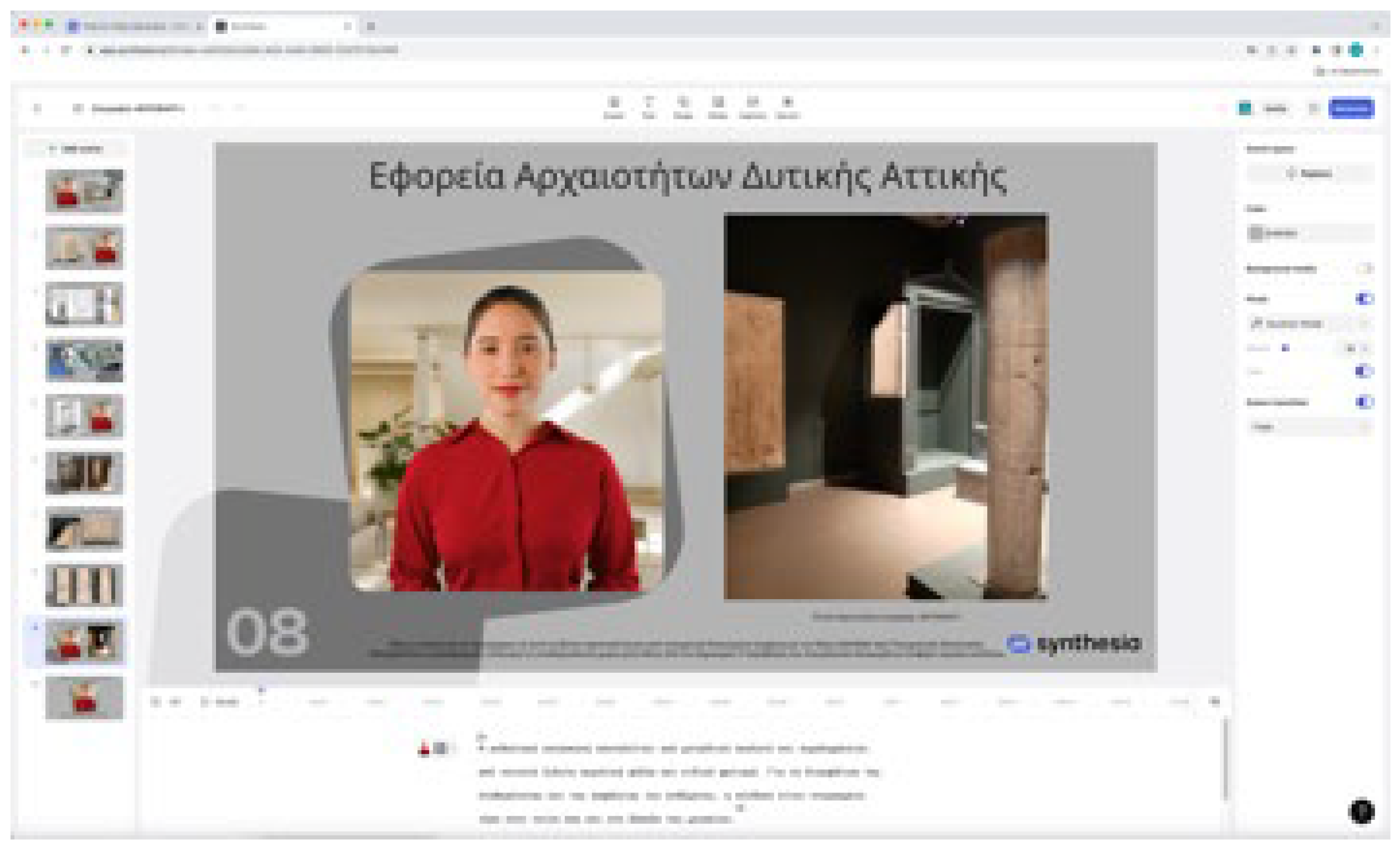
- Platform: Synthesia (AI avatar-based video generation system)
- Template configuration: Graphic Knowledge Base template selected for educational content presentation
- Avatar selection: “Alex” (red shirt configuration), friendly female presenter with neutral, approachable appearance designed for diverse audience engagement
- Voice generation: AI-powered voice synthesis configured for Greek language
- Visual integration: Strategic combination of high-quality conservation photographs with supplementary contextual information
- Technical features utilized: Advanced script-to-video conversion capabilities with professional avatar presentation
- Content specifications: Script length of approximately 233 words, targeting 1:38 minute duration for optimal visitor attention spans
Figure 1.
Digital interpretation interface at the “HIEROPHANT” inscription using Synthesia.
Phase 2: Distribution Strategy (Proposed Implementation)
- Primary access method: QR codes generated via QR Code Monkey platform for reliable, cost-effective visitor access
- Physical integration approach: QR codes designed for printing and mounting in close proximity to exhibit displays (proposed implementation)
- Secondary access provision: Direct URL availability through the museum’s existing digital resource infrastructure (proposed enhancement)
4.3. Case 2: Antinous Statue (Clipchamp)
The second pilot project focused on the statue of Antinous, (favored companion of Emperor Hadrian) [40], selected for its compelling narrative potential and complex conservation history. This case employed a different technological approach to enable comparative assessment of content generation strategies.
Content Development Process:
Phase 1: Clipchamp Implementation
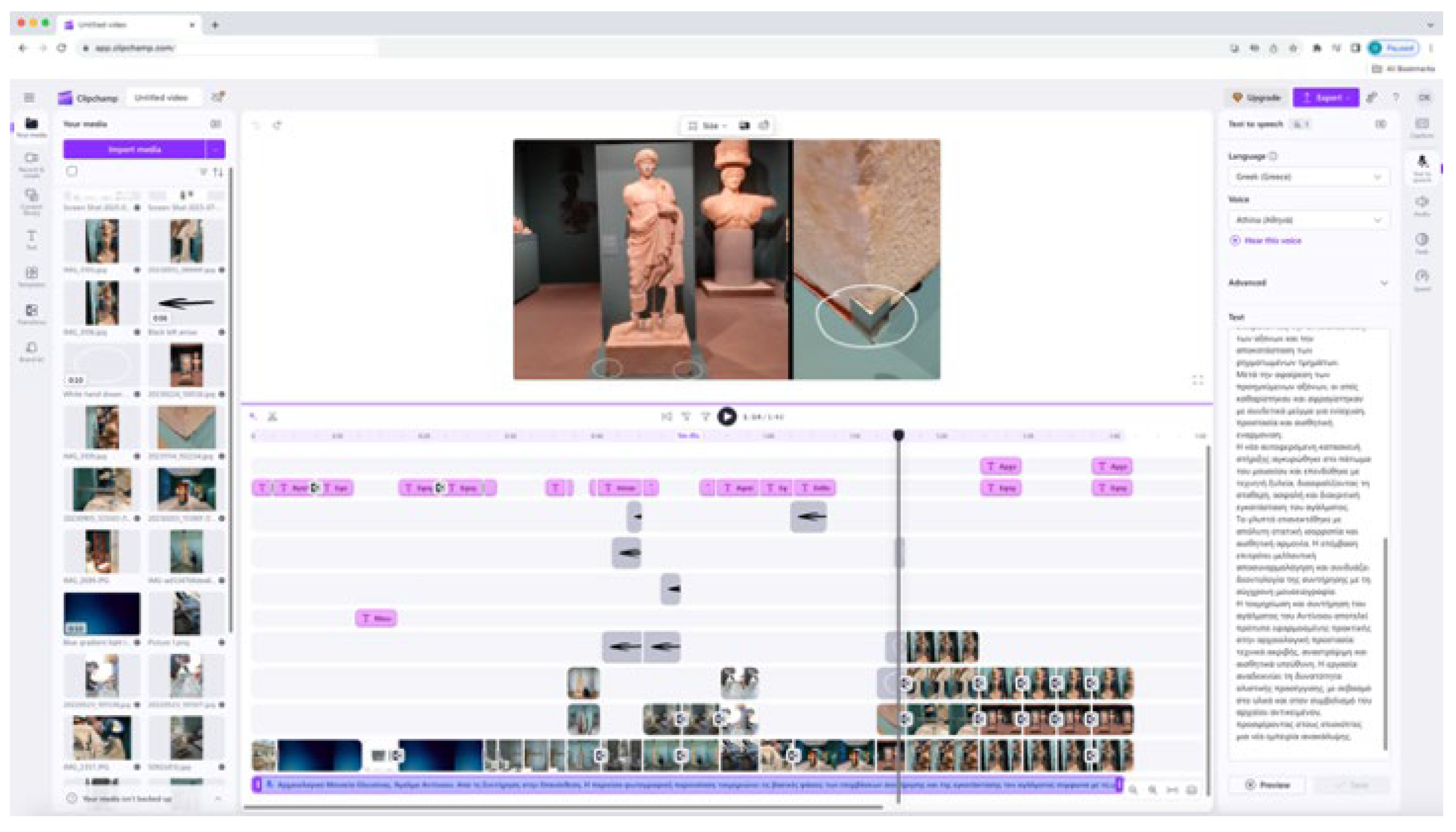
- Platform: Clipchamp (AI-assisted video editing and production system)
- Voice generation: AI-powered voice synthesis configured for Greek language delivery
- Voice selection: “Athina” voice profile selected for natural, engaging presentation suitable for museum contexts
- Visual integration: Strategic combination of conservation treatment photographs with comprehensive contextual information and interpretive elements
- Technical features utilized: Dynamic captioning system, sophisticated pitch and speed adjustment capabilities for natural, accessible delivery
- Content specifications: Script length of approximately 180 words, targeting 1:43 minute duration for optimal visitor engagement
Figure 2.
Digital interpretation interface for the Antinous statue using Clipchamp.
Phase 2: Distribution Strategy (Proposed)
- Primary hosting platform: YouTube (unlisted configuration for institutional content control and privacy management)
- Access method: QR codes generated via QR Code Monkey platform for reliable visitor access
- Physical integration approach: QR codes designed for printing and mounting in close proximity to exhibit displays (proposed implementation)
- Secondary access provision: Direct URL availability through the museum’s existing digital resource infrastructure (proposed enhancement)
5. Comparative Analysis
5.1. Production Analysis
Technical Workflow Assessment:
- Content preparation phase: Systematic script development and comprehensive visual asset compilation specifically designed for conservation documentation presentation
- Video production capabilities: Demonstrated highly efficient content generation capabilities suitable for resource-constrained institutional environments
- Quality assurance protocols: Multiple iterative review cycles necessary to ensure adherence to scholarly standards and institutional quality requirements
- Platform cost analysis: Free tier functionality proved sufficient for current project scope and institutional requirements
- Professional supervision framework: Continuous conservator oversight during all production stages ensured scientific accuracy, cultural sensitivity, and maintenance of high-quality visual standards
Quality Control Framework: Across both technological approaches, all generated scripts and multimedia outputs underwent continuous professional conservator supervision to guarantee scientific accuracy, cultural sensitivity, and adherence to established museum quality standards.
5.2. Platform Comparison
This analysis compares the AI content generation platforms used in the pilot projects, emphasizing differences in usability, creative control, supervision requirements, and cost-effectiveness. The findings offer actionable guidance for implementing these tools in resource-constrained cultural institutions, summarized in the following comparative matrix.
| Platform | Platform Comparison Matrix | |
| Advantages | Disadvantages | |
| Synthesia | Rapid content production enabling quick deployment | Subscription model required for advanced institutional features |
| Accessible interface suitable for non-technical museum staff | Single-platform dependency creating sustainability concerns | |
| Streamlined presentation format with easy content modifications | Limited avatar expressiveness and emotional range | |
| Dynamic captioning system and multilingual support | Avatar presentation may be perceived as impersonal or distracting by some visitors | |
| Professional avatar appearance | AI voice quality in Greek requires improvement for natural delivery | |
| Avatar presentation may be more appealing to younger audiences | Reduced flexibility in visual presentation options | |
| Initial familiarization period necessary for optimal utilization | ||
| Requires comprehensive preparation of visual assets and materials | ||
| Clipchamp | Complete creative control over visual presentation and narrative flow | Advanced technical skills necessary for optimal implementation |
| Platform independence reducing vendor lock-in risks | Extended editing time demanding greater staff investment | |
| Natural-sounding AI voice narration specifically optimized for Greek language | Moderate technical learning curve for museum personnel | |
| Seamless integration of high-quality conservation photographs | Requires comprehensive preparation of visual assets and materials | |
| Dynamic captioning system and multilingual support | Dependence on external hosting platforms for content distribution | |
| Avatar-free format | Absence of avatar may be less engaging for younger visitors | |
| Avatar-free format, may be more appealing to adult audiences. | ||
Strategic Implementation Insights:
- The comparative analysis reveals that institutional priorities and resources should guide platform selection. Museums with limited technical expertise and tight timelines may benefit from
Synthesia’s streamlined approach, despite higher costs and platform dependency risks. Conversely, institutions prioritizing content quality and long-term sustainability should consider Clipchamp, accepting the trade-off of increased technical demands and production time.
Critical decision factors include, staff technical capabilities, budget constraints, target audience demographics (children vs. adults), and institutional tolerance for external platform dependencies. Both platforms successfully transform conservation documentation into accessible content, but require continuous professional oversight to maintain scholarly standards.
Framework Validation:
These pilot implementations demonstrate that AI-assisted content generation, under professional human supervision, can transform traditionally behind-the-scenes conservation work into engaging, educational, and participatory museum experiences. The framework provides scalable, sustainable solutions for resource-constrained institutions while ensuring scientific accuracy and cultural sensitivity.
6. Discussion And Future Work
This pre-pilot study demonstrates that AI-assisted content generation can successfully make conservation narratives accessible to museum visitors. Both platforms maintained scientific accuracy under human supervision and exhibited no content generation errors when adapting well-documented conservation materials.
Key insights:
Free-tier tools proved cost-effective for resource-constrained institutions. A minor limitation was that Synthesia requires users to access videos via its application when scanning QR codes, whereas Clipchamp content hosted on YouTube plays directly, providing a smoother visitor experience. Future implementations should explore multilingual content delivery through a single, aesthetically integrated QR code per exhibit, minimizing visual clutter while ensuring broad accessibility. Platform dependency and hosting limitations remain potential sustainability risks; local hosting alternatives should also be considered.
Future work:
Visitor pilot testing, feedback collection, and assessment of engagement outcomes, as well as exploration of multilingual capabilities, digital resource integration, and scalability for institutions with limited technical expertise.
Framework Validation:
These pilot implementations demonstrate that AI-assisted content generation, under comprehensive professional supervision, can transform traditionally behind-the-scenes conservation work into engaging, educational, and participatory museum experiences. The framework offers scalable, sustainable solutions for resource-constrained institutions while maintaining rigorous standards for scientific accuracy and cultural sensitivity.
Acknowledgments
The author gratefully acknowledges Prof. Dr. Wallace Manolis for his support and the colleagues at the Archaeological Museum of Eleusis for their essential collaboration. Thanks are also due to the reviewers for their constructive feedback, which improved the quality of this paper.
References
- “On cultural heritage and collective memory,” Archaeology Newsroom, Archaeology & Arts, 2012.
- M. Andreadaki-Vlazaki, “Foreword,” in Management and Promotion of Sites and Monuments, S. Vlizos and N. Pantzou, Eds. Athens, Greece: Diadrasis, 2021.
- H. Mendoza and A. Santana Talavera, “Governance strategies for the management of museums and heritage institutions,” Heritage, vol. 8, no. 4, p. 127, 2025. [Online]. Available. [CrossRef]
- E. Hooper-Greenhill, Museums and the Shaping of Knowledge. London, UK: Routledge, 1992.
- K. Drotner, V. K. Drotner, V. Dziekan, R. Parry, and K. C. Schrøder, The Routledge Handbook of Museums, Media and Communication. London, UK: Routledge, 2019.
- International Council of Museums (ICOM), “Code of ethics for museums,” Paris, France: International Council of Museums, 2009.
- International Council of Museums (ICOM), “Museum definition,” 2022.
- France Archives, “Georges Henri Rivière (1897–1985),” 2014.
- Colin, Basic concepts of museology. Paris, France: International Council of Museums (ICOM), 2010.
- Digital Transformation Strategy Initiative in Cultural Heritage: The Case of Tate Museum, 2021. [Online]. Available: ResearchGate.
- M. Shah, “Digital experience service in modern museums,” ViitorCloud Blog, 2024. [Online]. Available: https://viitorcloud.
- The Tate’s Digital Transformation, Harvard Case Solution & Analysis, 2020. [Online]. Available: https://www.thecasesolutions.com/the-tates-digital-transformation-2-69781.
- Getty Blog, “Beyond digitization: New possibilities in digital art history,” 2015. [Online]. Available: https://blogs.getty.edu/iris/beyond-digitization-new-possibilities-in-digital-art-history/.
- Digitaltransform.gr., “Digitization and publication of selected collections of the National Archaeological Museum and the former Royal Estate of Tatoi,” 2025. [Online]. Available: https://www.digitaltransform.gr/psifiopoiisi-kai-dimosiopoiisi-epilegmenon-syllogon-tou-ethnikou-archaiologikou-mouseiou-kai-tou-proin-vasilikou-ktimatos-tatoiou/.
- Acropolis Museum, “Acropolis Museum digital guide,” 2018. [Online]. Available: https://www.theacropolismuseum.gr/psifiakos-odigos-moyseioy-akropolis.
- National Gallery of Art, “Free images and open access,” 2025. [Online]. Available: https://www.nga.gov/artworks/free-images-and-open-access.
- The Metropolitan Museum of Art, “Terms and conditions of use,” 2025. [Online]. Available: https://www.metmuseum.org/policies/terms-and-conditions.
- S. Pansoni, S. S. Pansoni, S. Tiribelli, M. Paolanti, F. Di Stefano, E. Frontoni, E. S. Malinverni, and B. Giovanola, “Artificial intelligence and cultural heritage: Design and assessment of an ethical framework,” The International Archives of the Photogrammetry, Remote Sensing and Spatial Information Sciences, vol. XLVIII-M-2-2023, 2023. [Online]. Available: https://isprs-archives.copernicus.org/articles/XLVIII-M-2-2023/1149/2023/isprs-archives-XLVIII-M-2-2023-1149-2023.pdf.
- Mimeta, “The future of AI-driven cultural heritage?” 2025. [Online]. Available: https://www.mimeta.org/mimeta-news-on-censorship-in-art/2025/3/12/is-now-the-future-of-ai-driven-cultural-heritage. 2025.
- Linkfactory, “Digital strategies for museums 2021–2022,” 2021. [Online]. Available: https://www.linkfactory.dk/sites/default/files/2021-10/Digital%20strategies%20for%20museums%202021%3A2022%20%20LinkFactory.pdf.
- M. Charr, “The role of digital engagement in museums,” MuseumNext, 2024. [Online]. Available: https://www.museumnext.com/article/the-role-of-digital-engagement-in-museums/.
- Europeana, “Europeana collections.” [Online]. Available: https://www.europeana.eu/. Accessed: Aug. 29, 2025.
- Google Arts & Culture, “Online museum collections and virtual exhibitions.” [Online]. Available: https://artsandculture.google.com/. Accessed: Aug. 29, 2025.
- P. F. Marty, “Museum websites and museum visitors: Before and after the museum visit. Museum Management and Curatorship 2007, 22, 337–360. [CrossRef]
- P. F. Marty, “Museum websites and museum visitors: Digital museum resources and their use. Museum Management and Curatorship 2008, 23, 81–99. [CrossRef]
- N. Proctor, “Digital: Museum as platform, curator as champion, in the age of social media,” , vol. 53, no. 1, pp. 35–43, 2010. [Online]. Curator: The Museum Journal 2010, 53, 35–43. [CrossRef]
- A.P. O. S. Vermeeren, et al., “Future museum experience design: Crowds, ecosystems and novel technologies,” in Museum Experience Design, A. Vermeeren, Ed. Cham, Switzerland: Springer, 2018, pp. 1–16. [Online]. [CrossRef]
- D. Schmalstieg and T. Hollerer, Augmented Reality: Principles and Practice. Boston, MA, USA: Addison-Wesley, 2016.
- Vassilakis, et al., “exhiSTORY: Smart exhibits that tell their own stories,” Future Generation Computer Systems, vol. 81, pp. 542–556, 2018. [Online]. [CrossRef]
- V. Poulopoulos and M. Wallace, “Digital technologies and the role of data in cultural heritage: The past, the present and the future,” Big Data and Cognitive Computing, vol. 6, no. 3, pp. 73, 2023. [Online]. Available. [CrossRef]
- J. Cronyn, The Elements of Archaeological Conservation. London, UK: Routledge, 1990.
- UNESCO Digital Library, “Staff training, the conservator-restore,” Museum, vol. XXXIX, no. 4, pp. 231–233, 1987.
- M. Hatzidaki, “The necessity of documentation of conservation work: The documentation of conservation and the conservation of documentation,” in Proceedings of the conference on the topic: Conservation and Exhibition of Preserved Works. Technical Problems—Aesthetic Problems, Series: Small Museological Issues 1, 2005, pp. 23–28.
- Caple, Conservation Skills: Judgement, Method and Decision Making. London, UK: Routledge, 2000.
- N. Stolow, Procedures and Conservation-Standards for Museum Collections in Transit and on Exhibition. Paris, France: UNESCO, 1981.
- UNESCO and ICCROM, “Endangered heritage: Emergency evacuation of heritage collections,” 2016.
- European Commission, “Europe’s digital decade: Digital targets for 2030,” 2025. [Online]. Available: https://digital-strategy.ec.europa.eu/en/policies/digital-decade-targets.
- R. Yin, Case Study Research and Applications: Design and Methods. Thousand Oaks, CA, USA: Sage, 2018.
- S. Sylaiou, F. S. Sylaiou, F. Liarokapis, K. Kotsakis, and P. Patias, “Virtual museums: A survey and some issues for consideration. Journal of Cultural Heritage 2009, 10, 520–528. [Google Scholar]
- My Eleusis, “Eleusinian mysteries,” 2025. [Online]. Available: https://myeleusis.com/. Accessed: Sep. 10, 2025.
- UNESCO, “Recommendation concerning the protection and promotion of museums and collections, their diversity and their role in society,” Paris, France: UNESCO, 2015.
Disclaimer/Publisher’s Note: The statements, opinions and data contained in all publications are solely those of the individual author(s) and contributor(s) and not of MDPI and/or the editor(s). MDPI and/or the editor(s) disclaim responsibility for any injury to people or property resulting from any ideas, methods, instructions or products referred to in the content. |
© 2025 by the authors. Licensee MDPI, Basel, Switzerland. This article is an open access article distributed under the terms and conditions of the Creative Commons Attribution (CC BY) license (http://creativecommons.org/licenses/by/4.0/).
Copyright: This open access article is published under a Creative Commons CC BY 4.0 license, which permit the free download, distribution, and reuse, provided that the author and preprint are cited in any reuse.


