

Submitted:
26 September 2025
Posted:
30 September 2025
You are already at the latest version
Abstract
The objective of this study was to evaluate the effect of nitric oxide (NO) treatment in controlled atmosphere (CA) storage on the quality of ‘Fuji Mishima’ apples. Apples were stored for 8 months at 1 kPa O2+< 0.5 kPa CO2, 1.0±0.2 °C, and 94±22% RH. Treat-ments included a control (without NO) and NO applied as follows: 5 µL L–1 at the be-ginning of storage; at the beginning and end; every 30 days; 10 µL L–1, at the beginning; and at the beginning and end. All NO treatments delayed ethylene production and reduced its levels after 4 days under ambient conditions compared to the control. However, NO had no effect on flesh firmness, soluble solids, titratable acidity, peel color, or flesh browning. Applications of 5 and 10 µL L–1 at the beginning and end, or 5 µL L–1 every 30 days, caused greater peel yellowing. Treatment with 5 µL L–1 applied every 30 days increased decay incidence. Phenolic compounds in the flesh were unaf-fected, while in the peel decreased with 10 µL L–1. Overall, NO application in CA stor-age of ‘Fuji Mishima’ apples did not maintain fruit quality and, in some cases, in-creased peel yellowing and decay.
Keywords:
Malus domestica Borkh.
; ethylene
; decay
; flesh browning
1. Introduction
The Brazilian apple harvest occurs over a short period, mainly from February to April, resulting in a large portion of the yield needing to be stored in order to regulate the supply of the fruit throughout the year. In this context, controlled atmosphere (CA) is the main technology used for apple storage, allowing the extension of the marketing period, maintaining fruit quality, and reducing the incidence of physiological disorders both during and after storage [1].
Despite the advantages of CA, apples from the ‘Fuji’ group are susceptible to damage caused by high CO2 partial pressure (> 0.5 kPa) during CA storage. Therefore, it is recommended to adopt < 0.5 kPa CO2 during CA storage to avoid browning damage [2]. Additionally, the incidence of decay, especially in prolonged storage, can account for up to 80% of postharvest losses of ‘Fuji’ apples [3]. In this sense, the use of technologies complementary to CA becomes necessary to maintain ‘Fuji’ apples quality during storage.
Nitric oxide (NO) is a gaseous molecule naturally produced by plants, which participates in various physiological processes, including fruit ripening, with positive effects on postharvest quality regarding flavor preservation, reduction of disease development, and physiological disorders [4]. In the postharvest period, NO has an antagonistic effect on ethylene production by interfering with the production of its precursor, 1-aminocyclopropane-1-carboxylic acid (ACC), which results in lower activity of the enzymes ACC synthase and ACC oxidase, and consequently inhibits the activity of enzymes responsible for fruit softening [5]. NO also increases the ability to metabolize reactive oxygen species (ROS) through the induction of antioxidant metabolism enzymes, such as superoxide dismutase (SOD), catalase (CAT), peroxidase (POD), and polyphenol oxidase (PPO), resulting in the maintenance of overall antioxidant capacity [4].
The postharvest application of NO, associated with CA storage, has already shown positive results in various fruits, including ‘Baigent’ [6] and ‘Cripps Pink’ apples [7,8,9]. NO application has also proven effective in reducing surface browning of minimally processed ‘Granny Smith’ apples [10], ‘Royal Gala’, ‘Golden Delicious’, ‘Sundowner’, ‘Fuji’, and ‘Red Delicious’ apples [11]. However, for the ‘Galaxy’ cultivar [12], the use of NO was not effective in maintaining postharvest quality.
The metabolism involving the use of NO in postharvest is still not fully understood. It is known that the effectiveness of using NO may change depending on factors such as cultivar, epigenetic modifications, storage conditions, and others, such as concentration, time, and moments of application, influencing its action [13,14,15]. Additionally, NO also has the ability to interact with other molecules, resulting in the alteration of fruit responses [13]. Currently, there is no information on the use of NO in CA storage of apples from the ‘Fuji’ group. In this context, the objective of this study was to evaluate the effect of two doses of NO, applied at different moments during CA storage, on maintaining the quality of ‘Fuji Mishima’ apples.
2. Materials and Methods
Plant material and experimental conduct
The experiment was conducted with ‘Fuji Mishima’ apples harvested during the 2022/2023 season from a commercial orchard located in the municipality of São Joaquim, Santa Catarina, Brazil (28°16’01.7”S; 49°54’17.7”W; 1,400 m altitude, Cfb climate according to the Köppen classification). After harvesting, the apples were transported to the laboratory, homogenized, and those with mechanical damage, or damage caused by pathogens and insects, were discarded.
The fruit initially presented the following ripening attributes: background peel color with lightness (L*), chromaticity (C*), and hue angle of 70.5, 42.1, and 100.8°, respectively; flesh firmness of 74.2 N, soluble solids content of 15.8 °Brix, and titratable acidity of 0.38% malic acid, with an average iodine-starch index of 4.5 (scale 1-5).
For NO treatment, the fruit were placed in experimental micro-chambers (80 L) under CA conditions of 1 kPa O2 + < 0.5 kPa CO2, at a temperature of 1.0 ± 0.2 °C and relative humidity of 94 ± 2%, for 8 months. The evaluated treatments were: control (without NO); 5 µL L–1 NO applied at the beginning of storage; 5 µL L–1 NO applied at the beginning and end of storage; 5 µL L–1 NO applied at the beginning and every 30 days during storage; 10 µL L–1 NO applied at the beginning of storage; and 10 µL L–1 NO applied at the beginning and end of storage.
The application of NO in the micro-chambers was performed using a mixture of NO + N2 gas (standard mixture containing 1000 μL L–1 of NO + N2 in balance, White Martins®, Brazil) from high-pressure cylinders. The initial application was carried out when the partial pressure of O2 reached 1 kPa (4 days after storage), every 30 days from the first application, or at the end of storage, depending on the treatment. The last application of NO, for treatments with reapplication every 30 days and at the end of storage, occurred 5 days before the completion of the storage period.
The partial pressures of O2 and CO2 were monitored daily using an automated system for monitoring and controlling CA (Multiplex Isosoft, Isolcell, Italy). When necessary, due to the fruit respiratory activity, the partial pressures of O2 were corrected by injecting O2 from high-pressure cylinders. For CO2 absorption, hydrated lime was placed inside the micro-chamber in the proportion of 1 kg of hydrated lime per 20 kg of fruit. The storage temperature was monitored daily using mercury thermometers (5100, Incoterm®, Brazil).
Evaluation of fruit quality attributes
The fruits were evaluated upon opening the chambers for ethylene production rate, background peel color, and incidence of decay. After 7 days under ambient conditions (20 ± 1 °C; RH of 65 ± 5%) to simulate the marketing period, flesh firmness, soluble solids (SS), titratable acidity (TA), incidence of flesh browning, and decay were also performed. The ethylene production rate was evaluated every 2 days during the simulation of the marketing period, from the exit of storage (D0), until 6 days under ambient conditions (D2, D4, and D6, respectively).
After the simulated marketing period (day 7), samples of flesh and peel were separated to determine phenolic compounds and antioxidant activity using the ABTS (2,2’-azinobis-(3-ethylbenzthiazoline-6-sulfonic acid) and DPPH (2,2-diphenyl-1-picrylhydrazyl) radical scavenging methods. The samples were frozen in liquid nitrogen immediately after fruit cutting. The skin samples were processed and kept fresh in an ultrafreezer (Thermo Fischer Scientific, 910, USA) at –50 °C until analysis, while the flesh samples were freeze-dried in a freeze dryer (LH, Terroni®, Brazil). The freeze-dried samples were processed in a vibratory ball mill (BM 500, Anton Paar®, Austria) and stored in a desiccator until analysis.
To determine ethylene production (ηmol C2H4 kg-1 s-1), approximately 1 kg of fruit per replicate were placed in hermetically sealed glass jars (6.1 L), for 120 minutes. Then, air samples were withdrawn from the headspace of the jars, using plastic syringes of 1 mL, and injected into a gas chromatograph with flame ionization detection (GC-FID) (Clarus 580, PerkinElmer®, USA), equipped with a 3 m Porapak N column (mesh 80 – 100). The temperatures of the column, detector, and injector were 70, 250, and 130 °C, respectively. The gas flow rates were 70, 30, and 300 mL min–1 for nitrogen, hydrogen, and synthetic air, respectively. Nitrogen gas was used as the mobile phase.
The background peel color was measured on the greenest side of the fruit epidermis using a CR-400 colorimeter (Konica, Minolta®, Japan), on the L* (lightness), C* (chromaticity), and h° (hue) scale.
Flesh firmness was determined on the equatorial region of each fruit after removing a small portion of the epidermis, at two opposite points on each fruit, using an electronic penetrometer (Güss Manufacturing Ltd., South Africa), equipped with an 11 mm diameter probe, and the results were expressed in Newtons (N).
For the SS and TA content, samples of flesh and skin were taken from transverse slices cut from the equatorial region of the fruits, which were then crushed in an electric centrifuge (PG 710/G5, Champion Juicer®, USA). The SSC was evaluated using a digital precision refractometer with automatic temperature measurement and compensation to 20 °C (PR201α, Atago®, Japan) using 0.5 mL of juice, with the results expressed in °Brix. The TA was determined using an automatic titrator (TitroLine Easy, Schott Instruments®, Germany) using a 5 mL juice sample diluted in 45 mL of distilled water, which was titrated with a 0.1 N NaOH solution until pH 8.1, with the results expressed as % malic acid.
To evaluate flesh browning (results expressed as %), the fruits were cut in a transverse section at the equatorial region and observed for the presence of browning (i.e., visually presented any type of browning). The incidence of decay was evaluated by counting the number of apples exhibiting fungal infection symptoms with lesions larger than 5 mm.
To obtain the extracts for the analysis of total phenolic compounds and antioxidant activity, 0.5 g of freeze-dried flesh and 1 g of fresh skin were added to 10 mL of 80% methanol, followed by homogenization in an Ultra-Turrax (SilentCruscher M, Heidolph, Germany), and left to rest protected from light for 60 minutes at room temperature. The extracts were then centrifuged at 15,000 rpm for 15 minutes at 4 °C in a centrifuge (CR22N, Hitachi, Japan), subsequently filtered, and the supernatant collected.
The determination of phenolic compound content was performed using the Folin-Ciocalteau reagent adapted from Roesler et al. [16]. The standard curve was obtained with gallic acid. For analysis, 0.25 µL of extract, 200 µL of distilled water, and 25 µL of 2 N Folin-Ciocalteau reagent were added to microplates. The mixture was allowed to stand for 5 minutes, and then 25 µL of 10% sodium carbonate was added. Readings were taken after 60 minutes using a microplate reader (EnSpire, PerkinElmer®, USA) at 725 nm. The results were expressed in milligrams of gallic acid equivalent per gram of fresh (FM) or dry mass (DM) (mg GAE g–1 FM for peel or mg GAE g–1 DM for flesh).
The determination of antioxidant capacity by the ABTS free radical scavenging method was performed according to Rufino et al. [17], with modifications. In microplates, 10 μL of extract and 290 μL of ABTS radical were added and kept in the dark for 6 minutes, and then the absorbance was read at 734 nm using a microplate reader (EnSpire, PerkinElmer®, USA). The calibration curve was constructed with standard Trolox solutions, and the results were expressed in mg TEAC g−1 FM for skin or mg TEAC g−1 DM for flesh.
The determination of antioxidant capacity by the DPPH free radical scavenging method was conducted according to the method described by Rufino et al. [18], with modifications. In microplates, 40 µL of extract from the samples were added, followed by 260 µL of DPPH solution, and allowed to react for 30 minutes in the dark. Reading were then taken at a wavelength of 525 nm using a microplate reader (EnSpire, PerkinElmer®, USA). The results were expressed as a percentage of DPPH radical scavenging (% DPPH inhibition).
Experimental design and statistical analysis
The experimental design was completely randomized, with four replicates, each consisting of 30 fruits. The data were analyzed using RStudio 3.5.0 software (Posit, Boston, MA, USA). Shapiro-Wilk normality tests of residuals (p < 0.05) and Bartlett’s homogeneity of variance tests (p < 0.05) were first employed. Normal data were then subjected to analysis of variance (ANOVA), and the means were compared using the Scott-Knott test (p < 0.05). Data expressed as percentages were previously transformed into arcsin√(x+0.1)/100.
3. Results and Discussion
After 8 months of storage, the ethylene production rate of ‘Fuji Mishima’ apples showed no differences between treatments upon chamber opening, as well as at 2 and 6 days of exposure to ambient conditions (Figure 1). After 4 days under ambient conditions, when the fruit from the control treatment reached the peak of ethylene production, a rate about 1.5 times higher was observed compared to those treated with different NO doses and frequencies. However, this effect of reduced ethylene production with NO application did not persist until 6 days under ambient conditions.
Similar results were observed for ‘Galaxy’ and ‘Cripps Pink’ apples, where the application of NO at the beginning of CA storage was effective in reducing ethylene production at 4 days of shelf life [12,19]. However, at 6 and 7 days of shelf life, respectively, for ‘Galaxy’ and ‘Cripps Pink’, there was no effect from NO. In ‘Galaxy’ apples, the effect of NO on ethylene production was, at least in part, due to the lower activity of the ACC oxidase enzyme, a key enzyme in ethylene synthesis. NO acts by inhibiting ethylene synthesis through the formation of the ACC-oxidase-NO-ACC complex. Additionally, NO induces the reduction of ACC to 1-(malonylamino)cyclopropane-1-carboxylic acid (MACC), decreases the activity of ACC synthase and ACC oxidase enzymes, and negatively regulates the expression of genes involved in the ethylene signaling pathway [13,20].
The results of this study demonstrate that NO application delayed the peak of ethylene production, corroborating the results obtained by Coser et al. [6] in ‘Baigent’ apples.
For the background peel color, differences between treatments were observed for the hue angle attribute upon exiting the chamber, and for L* after 7 days of exposure to ambient conditions (Table 1). Higher hue angle were observed in fruits not treated with NO, and in those treated with 5 and 10 µL L–1 NO at the beginning of storage, indicating a greener background peel color and, therefore, less mature fruits. However, this result did not persist after 7 days under ambient conditions, where the treatments did not differ from each other. After 7 days shelf-life, the treatments with 5 and 10 µL L–1 NO at the beginning of storage and 10 µL L–1 NO applied at the beginning and end of storage, showed fruit with higher L* values than the others. The application of NO did not show benefits in maintaining the background color of ‘Fuji Mishima’ apples.
Contrary to the present study, ‘Baigent’ apples, regardless of the dose and application time, after 7 days on the shelf, showed higher hue angle for fruit treated with NO compared to the control, while no difference was observed in terms of L* [6]. A similar result was observed for ‘Cripps Pink’ apples, where the weekly application of a NO dose between 5.3 and 5.9 μL L–1 kept the fruits greener after 7 days on the shelf [8]. However, in another study with ‘Cripps Pink’ apples, pre-storage treatments with NO, regardless of the dose, resulted in fruits that did not differ from the control (1-MCP) [9]. The results obtained in the present study and in the literature indicate that the effect of NO on maintaining background peel color can be variable among cultivars, as well as between different harvests.
Nitric oxide (NO) acts as an anti-senescence agent, correlating negatively with the process in different plant species, as endogenous NO deficiency accelerates chlorophyll degradation [21]. The application of NO can delay chlorophyll breakdown by regulating the activity of chlorophyllase and Mg-dechelatase enzymes, reducing carotenoid accumulation, which is responsible for the yellow background color of apples, and by promoting the antioxidant system during ripening [20,22]. However, based on the background peel color data observed in this study, it is possible that the higher frequencies of NO application (at the beginning and end, and at the beginning and every 30 days of storage) were detrimental or even cumulative, accelerating chlorophyll loss in the fruits, since the greener fruit were those treated only at the beginning of storage or not treated with NO. This points to a negative effect of NO when applied in excess.
Zhu et al. [23], when treating ‘Feicheng’ peaches with 5, 10, and 15 µL L–1 of NO gas, observed toxicity from the highest dose of NO in the fruit, while 5 and 10 µL L–1 were beneficial. This contrary effect of NO, when in high doses, may be related to the formation of reactive nitrogen species (RNS) and reactive oxygen species (ROS), which can be harmful to metabolism [23,24]. In this case, NO, instead of inducing antioxidant activity, acts as a facilitator of cellular disorder [25]. ‘Bartlett’ pears treated with 50 and 10 µL L–1 of NO for 12 hours showed accelerated ripening, unlike those treated with 10 µL L–1 of NO for 2 hours, which showed a delay in this process [26], indicating that in addition to high doses, longer exposure periods can also have a negative effect. However, the mode of action of NO on chlorophyll degradation and/or carotenoid biosynthesis and accumulation in fruit still needs to be further investigated [22].
After 8 months in CA storage followed by 7 days on the shelf, no differences were observed for flesh firmness, SSC, and TA (Table 2). Similarly, no differences in flesh firmness were found with NO application for ‘Galaxy’, ‘Cripps Pink’, and ‘Baigent’ apples during storage [6,9,12]. However, ‘Cripps Pink’ apples stored in ultra-low oxygen (ULO-CA) for 8 months showed higher flesh firmness when treated weekly with NO at doses of 5.9 and 6.7 μL L–1 for less and more mature fruits, respectively [8]. The loss of flesh firmness is one of the main changes that occur during ripening, making fruits more susceptible to physical damage and fungal infections during handling. During ripening, several cell wall-modifying enzymes can cause structural modifications to pectin polymers, reducing cohesion between cells and leading to fruit softening [27]. Despite no significant difference in flesh firmness between control and NO-treated apples, all maintained their average values between 66 and 69 N, which is suitable for the commercialization of ‘Fuji Mishima’ apples [28]. This stability may indicate a positive effect of CA on firmness maintenance that overlapped the NO applications. The lower O2 partial pressure during CA storage, may itself reduce various oxidative reactions such as respiration and ethylene biosynthesis, lowering the activity of cell wall breakdown enzymes responsible for softening [27].
The SSC in all treatments was above 14.8 °Brix, which is also suitable for the fresh consumption of ‘Fuji Mishima’ apples [28] and was not influenced by the doses and frequencies of NO application. The same result was verified for ‘Cripps Pink’ apples, where SSC values were not affected by NO application, regardless of the maturity stage and duration of ULO-CA storage [8]. In ‘Galaxy’ apples, there was also no effect of NO application on SSC [12]. For ‘Baigent’ apples, the highest SSC values were observed for the treatment of 2 μL L–1 applied at the beginning, every 30 days, and at the end of the storage period, but not differing from control [6]. Under refrigerated storage, ‘Cripps Pink’ apples only showed differences in SSC between the control and the treatment with 20 μL L–1 NO applied for 2 hours [9].
No differences were also observed regarding TA, with values remaining between 0.21 and 0.23% malic acid. In ‘Cripps Pink’ apples, the acid content was not affected by post-harvest NO application [9,19]. On the other hand, in ‘Baigent’ apples, there was a decrease in TA with the use of higher NO doses, 10 μL L–1 at the beginning, and higher application frequencies, 5 μL L–1 every 30 days or at the beginning and end of the storage period [6]. For ‘Cripps Pink’ apples stored in ULO-CA, there was a linear increasing response, where 10 μL L–1 NO provided higher TA values for less mature apples, while for more mature apples, there was no difference between treatments [8]. This result highlights the importance of the effect of the maturity stage at harvest on the effect of NO on TA. The ‘Fuji Mishima’ apples used in this study were already mature at harvest, according to the quality parameters described by Fioravanço et al. [28] for the cultivar, which may have led to the lack of response to NO.
The treatments with NO also did not show an effect on flesh browning (Table 2). Temperature is the main environmental factor influencing the conservation of fruit post-harvest. In general, apples are non-chilling sensitive fruits and can be stored at temperatures above the freezing point [22], yet they are susceptible to cold damage such as flesh browning. The postharvest application of NO can reduce cold injuries in fruit by decreasing membrane permeability, malondialdehyde content, lipid peroxidation, and ion leakage, effects associated with a reduction in ROS generation, ROS detoxification, and an increase in antioxidant enzyme activity or expression [29,30,31]. Flesh browning is attributed to the oxidation of phenolic compounds, while NO may inhibit the activity of enzymes such as phenylalanine ammonia-lyase (PAL), polyphenol oxidase (PPO), and peroxidase (POD), thereby maintaining fruit quality [13]. In ‘Galaxy’ apples, no effect of NO on flesh browning was observed with the use of NO at the beginning of storage [12]. However, for ‘Baigent’ apples, treatment with 5 μL L–1 NO at the beginning and end of storage in CA reduced the incidence of flesh browning [6].
The incidence of decay in ‘Fuji Mishima’ apples after 7 days under ambient conditions was highest in the treatment with application of 5 µL L–1 NO every 30 days of storage, while all other strategies of NO treatment did not differ from control (Table 2). In ‘Galaxy’ apples, the incidence of decay after 7 days under ambient conditions was higher with a higher dose of NO (40 μL L–1) compared to a lower dose (20 μL L–1), which did not differ from the control [12]. For ‘Baigent’ apples, the application of NO, regardless of dose and application period, showed favorable results in reducing the incidence of decay [6]. NO has the potential to improve post-harvest quality by acting in pest and disease control by inducing defense responses at the genetic and molecular level, depending on the dose and exposure time [5]. It also acts in the activation of enzymes related to defense metabolism, such as cinnamate 4-hydroxylase (C4H), 4-coumarate:CoA ligase (4CL), chalcone synthase (CHS), and chalcone isomerase, in addition to the accumulation of antifungal compounds, phenolic compounds, and antioxidant activity [13,22].
The application of NO did not alter the phenolic compound content in the flesh or the antioxidant capacity quantified by the DPPH method (Table 3). The control and all frequencies of NO application at a dose of 5 μL L–1 showed fruits with higher phenolic compound content in the skin compared to treatments with 10 μL L–1 NO, indicating a possible negative effect of higher NO doses. On the other hand, the antioxidant capacity of the flesh, as measured by the ABTS method, was lower in fruits not treated with NO, while in the skin it was lower in untreated fruits, as well as in those treated with 5 μL L–1 NO only at the beginning and beginning + end of the storage period, and 10 μL L–1 NO applied at the beginning and end of CA storage. NO may end up inducing oxidative stress instead of suppressing it. In ‘Micro-Tom’ tomatoes, NO repressed the activity of H2O2 scavenging enzymes, contributing to increased ROS and RNS production [32].
Gupta et al. [33] emphasize that NO has an ambiguous effect, acting as an antioxidant at low concentrations and as a pro-oxidant at high doses. In this context, the application of 5 μL L–1 NO, regardless of frequency, seems to have been more effective in increasing the phenolic compound content and antioxidant capacity in the skin and flesh of ‘Fuji Mishima’ apples. However, when 5 μL L–1 NO was applied every 30 days, it may have led to negative effects on fruit decay due to frequent exposure to the gas, again pointing to the negative effect of NO when applied in higher doses or frequencies. In parallel, these fruits showed both higher phenolic compound content and antioxidant capacity, mainly in the skin, the primary barrier against pathogens. Frequent NO application may have caused structural damage to the fruit and compromised the barriers, leading to oxidative stress [22]. This contradictory effect, between higher decay incidence and the antioxidant system, may have been caused as a response to stress induced by frequent NO treatment, which led to an increase in decay occurrence. The metabolic response of the fruit to stress may have led to an increase in the synthesis of antioxidant metabolism compounds as a defense mechanism [33,34].
It is well established in the literature that the effect of NO is dependent on the applied dose, exposure time, frequency of application during storage, and the fruit species used [6,9,22]. Although in the present study NO reduced ethylene production and suppressed the climacteric peak during the evaluation period, this did not result into delayed ripening and quality maintenance after storage. Other studies conducted with different cultivars, such as ‘Baigent’ and ‘Cripps Pink’, observed positive results of NO on ethylene production and fruit quality maintenance after storage [6,8]. This differentiated response among different cultivars raises the hypothesis that the effect of NO may not only be species-dependent but also cultivar-dependent. However, different clones of the ‘Gala’ cultivar also showed a differentiated effect to NO application during storage. As mentioned earlier, ‘Baigent’ apples showed positive results with NO application (5 µL L–1) at the beginning and end of storage in CA (1.2 kPa O2 + 2.0 kPa CO2). In contrast, ‘Galaxy’ apples treated with NO (40 µL L–1) at the beginning of storage in CA (1.2 kPa O2 + 2.0 kPa CO2) showed reduced ethylene production and respiration rates but had no positive effect on maintaining fruit quality after storage [12].
In ‘Maxi Gala’ apples, the application of NO (10 µL L–1) at the beginning and end of storage did not suppress ethylene production in CA (1.2 kPa O2 + 2.0 kPa CO2) and increased phytohormone synthesis in a CA with extremely low O2 partial pressure (pO2 varying between 0.1 and 0.7 kPa) and under dynamic controlled atmosphere conditions (minimum pO2 of 0.08 kPa; maximum of 0.5 kPa; average of 0.18 kPa) [35]. Furthermore, the authors did not observe a positive effect of NO, regardless of storage conditions, on maintaining fruit quality. These results contrast with each other even when conducted with clones of apples from the same cultivar. Therefore, in addition to raising the hypothesis of a differential effect based on cultivar, it is possible that the effect of NO is dependent on storage conditions, maturity stage, and even the year of production. Future studies considering these aspects need to be conducted for a better understanding of the effects of NO during apple storage.
4. Conclusions
The application of NO, in the evaluated doses and frequencies, under CA at 1 kPa O2 + < 0.5 kPa CO2, 1.0 ± 0.2 °C, and 94 ± 2% RH, did not show a positive effect on maintaining the quality of ‘Fuji Mishima’ apples. The dose of 5 µL L–1 NO applied every 30 days during storage, despite reducing ethylene synthesis, resulted in more mature fruit and increased the incidence of decay in ‘Fuji Mishima’ apples.
Author Contributions
Conceptualization, Catherine Amorim, Aquélis A. Emer, Natalia M. Souza and Cristiano A. Steffens; methodology, Catherine Amorim, Aquélis A. Emer, Janaiana C. Silva, Juliana A. V. Alves, Bernardino D. Mango, Natalia M. Souza and Cristiano A. Steffens; validation, Catherine Amorim, Natalia M. Souza and Cristiano A. Steffens; formal analysis, Catherine Amorim, Aquélis A. Emer and Natalia M. Souza; investigation, Catherine Amorim, Aquélis A. Emer, Janaiana C. Silva, Juliana A. V. Alves, Samara M. Zanella, Bernardino D. Mango, Rogerio O. Anese, Vanderlei Both, Natalia M. Souza and Cristiano A. Steffens; resources, Catherine Amorim, Aquélis A. Emer, Janaiana C. Silva, Juliana A. V. Alves, Samara M. Zanella and Natalia M. Souza; data curation, Catherine Amorim, Aquélis A. Emer and Janaiana C. Silva; writing—original draft preparation, Catherine Amorim, Aquélis A. Emer and Janaiana C. Silva; writing—review and editing, Natalia M. Souza and Cristiano A. Steffens; visualization, Natalia M. Souza and Cristiano A. Steffens; supervision, Marcelo A. Moreira and Cristiano A. Steffens; project administration, Marcelo A. Moreira and Cristiano A. Steffens; funding acquisition, Marcelo A. Moreira and Cristiano A. Steffens. All authors have read and agreed to the published version of the manuscript.
Funding
This research was funded by the National Council for Scientific and Technological Development (CNPq) [407773/2021-5], Foundation for Research and Innovation Support of the State of Santa Catarina (FAPESC), grant number [1960/2024, 3079/2024 and 2024TR002220] and the State Fund for the Maintenance and Development of Higher Education (FUMDES) [16630].
Data Availability Statement
The raw data supporting the conclusions of this article will be made available by the authors on request.
Acknowledgments
The authors thank the Santa Catarina Research and Innovation Support Foundation (FAPESC) and National Council for Scientific and Technological Development (CNPq) for funding the research project.
Conflicts of Interest
The authors declare no conflicts of interest.
References
- Mir, S.A.; Shah, M.A.; Mir, M.M. Postharvest Biology and Technology of Temperate Fruits. Postharvest Biology and Technology of Temperate Fruits 2018, 1–415. [Google Scholar] [CrossRef]
- Brackmann, A.; Bortoluz, L.; Bortoluzzi, G. Frigoconservação de Maçã “Fuji” Em Duas Temperaturas e Em Atmosfera Controlada. Revista Brasileira de Agrociência 1998, 4, 26–30. [Google Scholar]
- Argenta, L.C.; de Freitas, S.T.; Mattheis, J.P.; Vieira, M.J.; Ogoshi, C. Characterization and Quantification of Postharvest Losses of Apple Fruit Stored under Commercial Conditions. HortScience 2021, 56, 608–616. [Google Scholar] [CrossRef]
- Li, C.; Yu, W.; Liao, W. Role of Nitric Oxide in Postharvest Senescence of Fruits. Int J Mol Sci 2022, 23, 10046. [Google Scholar] [CrossRef]
- Pols, S.; Van de Poel, B.; Hertog, M.L.A.T.M.; Nicolaï, B.M. The Regulatory Role of Nitric Oxide and Its Significance for Future Postharvest Applications. Postharvest Biol Technol 2022, 188, 111869. [Google Scholar] [CrossRef]
- Coser, W.; Steffens, C.A.; Lugaresi, A.; Buss, M.; Gularte, P.S.; Fenili, C.L.; Miqueloto, T.; Talamini do Amarante, C.V. Treatment of ‘Baigent’ Apple Fruit with Nitric Oxide in Controlled Atmosphere Storage Reduces Decay and Physiological Disorders. Postharvest Biol Technol 2023, 196, 112159. [Google Scholar] [CrossRef]
- Gularte, P.S.; Büchele, F.; Silva, J.C.; Zanella, S.M.; Wood, R.M.; Amarante, C.V.T.; Neuwald, D.A.; Steffens, C.A. Use of Nitric Oxide as a Strategy for Postharvest Controlling Blue Mold in “Cripps Pink” Apples. Acta Hortic 2023, 1363, 159–164. [Google Scholar] [CrossRef]
- Gularte, P.S.; Zanella, S.M.; Steffens, C.A.; Buss, M.; da Silva, J.C.; Coser, W.; Miqueloto, A.; Talamini do Amarante, C.V. Treatment of “cripps Pink” Apples with Nitric Oxide in a Controlled Atmosphere Ultra-Low Oxygen: Impacts on Overall Fruit Quality and Anaerobic Compounds. Postharvest Biol Technol 2024, 208, 112635. [Google Scholar] [CrossRef]
- Steffens, C.A.; Soardi, K.; Heinzen, A.S.; Amaral Vignali Alves, J.; da Silva, J.C.; Talamini do Amarante, C.V.; Brackmann, A. Quality of “Cripps Pink” Apples Following the Application of 1--MCP, Ethanol Vapor and Nitric Oxide as Pretreatments for Controlled Atmosphere Storage. J Food Process Preserv 2021, 46. [Google Scholar] [CrossRef]
- Huque, R.; Wills, R.B.H.; Pristijono, P.; Golding, J.B. Effect of Nitric Oxide (NO) and Associated Control Treatments on the Metabolism of Fresh-Cut Apple Slices in Relation to Development of Surface Browning. Postharvest Biol Technol 2013, 78, 16–23. [Google Scholar] [CrossRef]
- Pristijono, P.; Wills, R.B.H.; Golding, J.B. Inhibition of Browning on the Surface of Apple Slices by Short Term Exposure to Nitric Oxide (NO) Gas. Postharvest Biol Technol 2006, 42, 256–259. [Google Scholar] [CrossRef]
- Brackmann, A.; Ludwig, V.; Thewes, F.R.; Anese, R.O.; Schultz, E.E.; Bergetti, M.R.P. Ethanol and Nitric Oxid in Quality Maintenance of “Galaxy” Apples Stored under Controlled Atmosphere. Rev Bras Frutic 2017, 39, e–322. [Google Scholar] [CrossRef]
- Liu, J.; Zhang, W.; Hu, M.; Pan, Y.; Jiang, Y.; Zhang, Z.; Jiang, G. Nitric Oxide Is Involved in Melatonin-Induced Cold Tolerance in Postharvest Litchi Fruit. Postharvest Biol Technol 2023, 196, 112157. [Google Scholar] [CrossRef]
- Zhao, Y.; Tang, J.; Song, C.; Qi, S.; Lin, Q.; Cui, Y.; Ling, J.; Duan, Y. Nitric Oxide Alleviates Chilling Injury by Regulating the Metabolism of Lipid and Cell Wall in Cold-Storage Peach Fruit. Plant Physiology and Biochemistry 2021, 169, 63–69. [Google Scholar] [CrossRef] [PubMed]
- Zhu, Y.; Du, M.; Zhao, J.; Dong, X. The Role of Nitric Oxide in Defending against Chilling Stress in Postharvest Crops. Food Biosci 2023, 56, 103351. [Google Scholar] [CrossRef]
- Roesler, R.; Malta, L.G.; Carrasco, L.C.; Holanda, R.B.; Sousa, C.A.S.; Pastore, G.M. Atividade Antioxidante de Frutas Do Cerrado. Food Science and Technology 2007, 27, 53–60. [Google Scholar] [CrossRef]
- Rufino, M.d.S.M.; Alves, R.E.; Brito, E.S. de; Sampaio, C. de G.; Pérez-Jiménez, J. Saura-Calixto, F.D. Metodologia Científica: Determinação Da Atividade Antioxidante Total Em Frutas Pela Captura Do Radical Livre ABTS+. Comunicado Técnico online 128, Embrapa 2007.
- Rufino, M.d.S.M.; Alves, R.E.; Brito, E.S. de; Morais, S.M. de; Sampaio, C. de G.; Pérez-Jiménez, J. Saura-Calixto, F.D. Metodologia Científica: Determinaçãoda Atividade Antioxidante Total Em Frutas Pela Captura Do Radical Livre DPPH. Comunicado Técnico online 127, Embrapa 2007.
- Steffens, C.A.; Miqueloto, T.; Fernandes, R.C.; Demari, C.K.P.; Anami, J.M.; Lugaresi, A.; Do Amarante, C.V.T. Treatment with Nitric Oxide Preserves the Quality of Cold Stored ‘Cripps Pink’ Apples. Bragantia 2021, 80, e5021. [Google Scholar] [CrossRef]
- Manjunatha, G.; Gupta, K.J.; Lokesh, V.; Mur, L.A.; Neelwarne, B. Nitric Oxide Counters Ethylene Effects on Ripening Fruits. Plant Signal Behav 2012, 7, 476–483. [Google Scholar] [CrossRef]
- Liu, F.; Guo, F.Q. Nitric Oxide Deficiency Accelerates Chlorophyll Breakdown and Stability Loss of Thylakoid Membranes during Dark-Induced Leaf Senescence in Arabidopsis. PLoS One 2013, 8, e56345. [Google Scholar] [CrossRef]
- Buet, A.; Steelheart, C.; Perini, M.A.; Galatro, A.; Simontacchi, M.; Gergoff Grozeff, G.E. Nitric Oxide as a Key Gasotransmitter in Fruit Postharvest: An Overview. J Plant Growth Regul 2021, 40, 2286–2302. [Google Scholar] [CrossRef]
- Zhu, S.; Liu, M.; Zhou, J. Inhibition by Nitric Oxide of Ethylene Biosynthesis and Lipoxygenase Activity in Peach Fruit during Storage. Postharvest Biol Technol 2006, 42, 41–48. [Google Scholar] [CrossRef]
- Wink, D.A.; Mitchell, J.B. Chemical Biology of Nitric Oxide: Insights into Regulatory, Cytotoxic, and Cytoprotective Mechanisms of Nitric Oxide. Free Radic Biol Med 1998, 25, 434–456. [Google Scholar] [CrossRef]
- Durzan, D.J.; Pedroso, M.C. Nitric Oxide and Reactive Nitrogen Oxide Species in Plants. Biotechnol Genet Eng Rev 2002, 19, 293–338. [Google Scholar] [CrossRef]
- Sozzi, G.O.; Trinchero, G.D.; Fraschina, A.A. Delayed Ripening of ‘Bartlett’ Pears Treated with Nitric Oxide. J Hortic Sci Biotechnol 2003, 78, 899–903. [Google Scholar] [CrossRef]
- Gwanpua, S.G.; Van Buggenhout, S.; Verlinden, B.E.; Christiaens, S.; Shpigelman, A.; Vicent, V.; Kermani, Z.J.; Nicolai, B.M.; Hendrickx, M.; Geeraerd, A. Pectin Modifications and the Role of Pectin-Degrading Enzymes during Postharvest Softening of Jonagold Apples. Food Chem 2014, 158, 283–291. [Google Scholar] [CrossRef]
- Fioravanço, J.C.; Girardi, C.L.; Czermainski, A.B.C.; Silva, G.A. da; Nachtigall, G.R.; Oliveira, P.R.D. de Cultura Da Macieira No Rio Grande Do Sul: Análise Situacional e Descrição Varietal; 1st ed.; Embrapa Uva e Vinho: Bento Gonçalves, 2010; Vol. Documentos 71. [Google Scholar]
- González-Gordo, S.; Rodríguez-Ruiz, M.; Palma, J.M.; Corpas, F.J. Superoxide Radical Metabolism in Sweet Pepper (Capsicum Annuum L.) Fruits Is Regulated by Ripening and by a NO-Enriched Environment. Front Plant Sci 2020, 11, 527670. [Google Scholar] [CrossRef]
- Sharma, S.; Sharma, R.R. Nitric Oxide Inhibits Activities of PAL and PME Enzymes and Reduces Chilling Injury in ‘Santa Rosa’ Japanese Plum (Prunus Salicina Lindell). J Plant Biochem Biotechnol 2015, 24, 292–297. [Google Scholar] [CrossRef]
- Wu, B.; Guo, Q.; Li, Q.; Ha, Y.; Li, X.; Chen, W. Impact of Postharvest Nitric Oxide Treatment on Antioxidant Enzymes and Related Genes in Banana Fruit in Response to Chilling Tolerance. Postharvest Biol Technol 2014, 92, 157–163. [Google Scholar] [CrossRef]
- Zuccarelli, R.; Rodríguez-Ruiz, M.; Lopes-Oliveira, P.J.; Pascoal, G.B.; Andrade, S.C.S.; Furlan, C.M.; Purgatto, E.; Palma, J.M.; Corpas, F.J.; Rossi, M.; et al. Multifaceted Roles of Nitric Oxide in Tomato Fruit Ripening: NO-Induced Metabolic Rewiring and Consequences for Fruit Quality Traits. J Exp Bot 2021, 72, 941–958. [Google Scholar] [CrossRef] [PubMed]
- Gupta, K.J.; Fernie, A.R.; Kaiser, W.M.; van Dongen, J.T. On the Origins of Nitric Oxide. Trends Plant Sci 2011, 16, 160–168. [Google Scholar] [CrossRef] [PubMed]
- Mittler, R. ROS Are Good. Trends Plant Sci 2017, 22, 11–19. [Google Scholar] [CrossRef] [PubMed]
- Soldateli, F.J.; Batista, C.B.; Pinto, B.R.C.; Wendt, L.M.; Deon, B.C.; Ludwig, V.; Thewes, F.R.; Steffens, C.A.; Brackmann, A.; Both, V. Interaction of Nitric Oxide and Extremely Low Oxygen Storage on Volatile Organic Compounds and Overall Quality of ‘Maxi Gala’ Apples. Postharvest Biol Technol 2025, 222, 113374. [Google Scholar] [CrossRef]
Figure 1.
Ethylene production rate in ‘Fuji Mishima’ apples after 8 months of storage in controlled atmosphere (1.0 kPa O2 + < 0.5 kPa CO2; 1.0 ± 0.2 °C; 94 ± 2% RH), upon chamber opening (Day 0), and after the subsequent 6 days of exposure to ambient conditions (20 ± 1 °C; 65 ± 5% RH), as a function of nitric oxide (NO) application in two doses (5 or 10 µL L–1) and at different times during storage. *Treatments followed by the same letter in the same evaluated day do not differ by the Scott-Knott test (p < 0.05). ns: not significant by ANOVA.
Figure 1.
Ethylene production rate in ‘Fuji Mishima’ apples after 8 months of storage in controlled atmosphere (1.0 kPa O2 + < 0.5 kPa CO2; 1.0 ± 0.2 °C; 94 ± 2% RH), upon chamber opening (Day 0), and after the subsequent 6 days of exposure to ambient conditions (20 ± 1 °C; 65 ± 5% RH), as a function of nitric oxide (NO) application in two doses (5 or 10 µL L–1) and at different times during storage. *Treatments followed by the same letter in the same evaluated day do not differ by the Scott-Knott test (p < 0.05). ns: not significant by ANOVA.
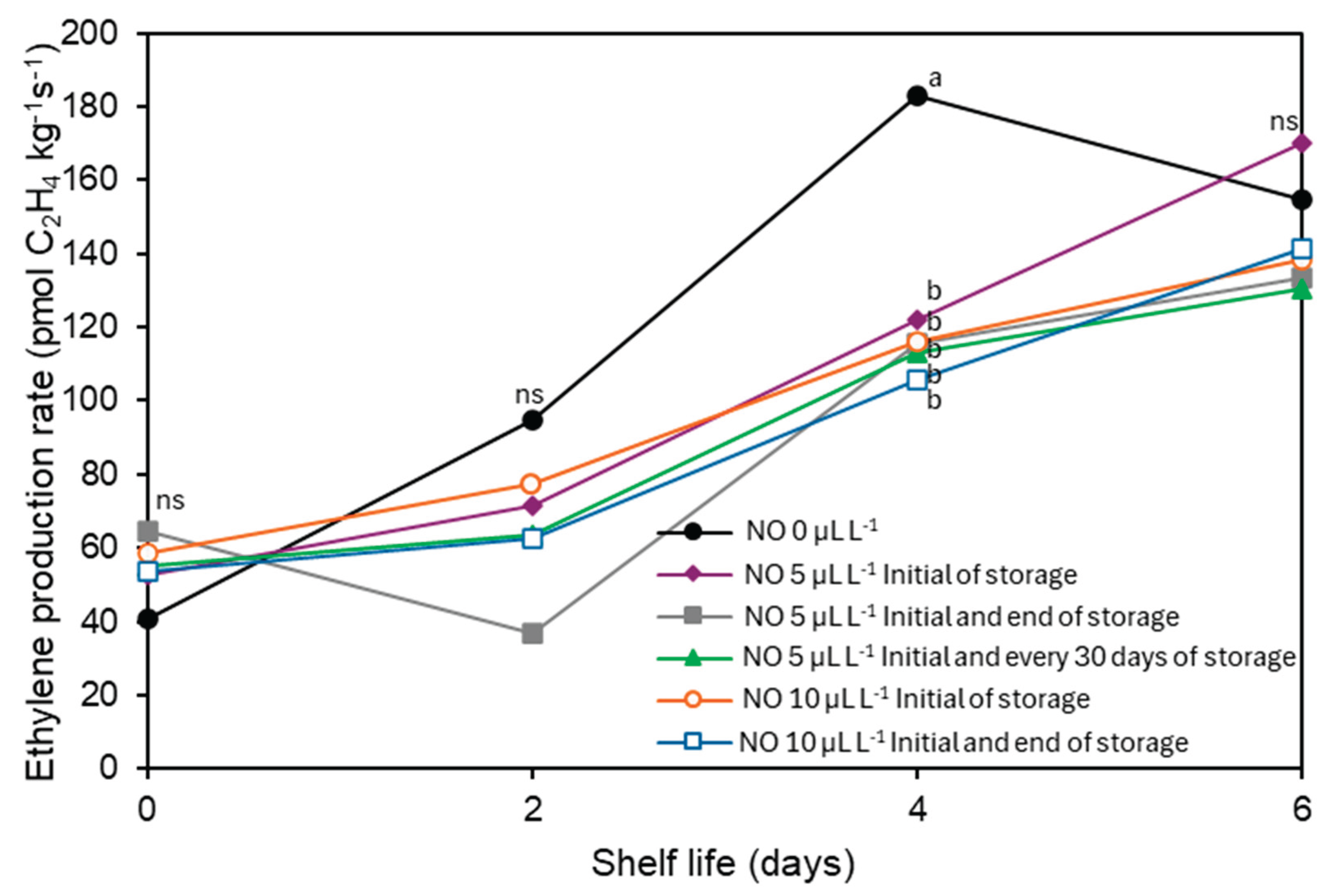

Table 1.
Background skin color attributes of ‘Fuji Mishima’ apples after 8 months of storage in a controlled atmosphere (1.0 kPa O2 + < 0.5 kPa CO2; 1.0 ± 0.2 °C; RH of 94 ± 2%), upon chamber opening and after 7 days of exposure to ambient conditions (20 ± 1 °C; RH of 65 ± 5%), as a function of nitric oxide (NO) application in two doses and at different times during storage. NO: nitric oxide.
Table 1.
Background skin color attributes of ‘Fuji Mishima’ apples after 8 months of storage in a controlled atmosphere (1.0 kPa O2 + < 0.5 kPa CO2; 1.0 ± 0.2 °C; RH of 94 ± 2%), upon chamber opening and after 7 days of exposure to ambient conditions (20 ± 1 °C; RH of 65 ± 5%), as a function of nitric oxide (NO) application in two doses and at different times during storage. NO: nitric oxide.
| Treatments | Background skin color | ||||
|---|---|---|---|---|---|
| NO doses | Application during storage | L* | C* | h° | |
| Exit of the chamber | |||||
| 0 µL L–1 | No application | 67.9 ns | 37.0 ns | 98.8 a | |
| 5 µL L–1 | Beginning | 69.1 | 35.3 | 98.2 a | |
| 5 µL L–1 | Beginning and end | 68.4 | 36.6 | 96.3 b | |
| 5 µL L–1 | Beginning + every 30 days | 69.4 | 38.2 | 97.0 b | |
| 10 µL L–1 | Beginning | 69.9 | 37.8 | 99.4 a | |
| 10 µL L–1 | Beginning and end | 69.3 | 37.0 | 96.6 b | |
| CV (%) | 2.1 | 3.9 | 1.5 | ||
| After more 7 days | |||||
| 0 µL L–1 | No application | 69.0 b | 42.1 ns | 97.0 ns | |
| 5 µL L–1 | Beginning | 70.8 a | 39.8 | 96.0 | |
| 5 µL L–1 | Beginning and end | 67.7 b | 40.2 | 95.0 | |
| 5 µL L–1 | Beginning + every 30 days | 69.7 b | 41.9 | 96.5 | |
| 10 µL L–1 | Beginning | 71.7 a | 39.8 | 98.4 | |
| 10 µL L–1 | Beginning and end | 71.9 a | 40.8 | 95.3 | |
| CV (%) | 2.2 | 3.2 | 2.4 | ||
* Means followed by the same letter in the column do not differ by the Scott-Knott test (p < 0.05). ns: not significant by ANOVA.
Table 2.
Flesh firmness, soluble solids (SSC), titratable acidity (TA), flesh browning and decay in ‘Fuji Mishima’ apples after 8 months of storage in controlled atmosphere (1.0 kPa O2 + < 0.5 kPa CO2; 1.0 ± 0.2 °C; RH of 94 ± 2%) and 7 days of exposure to ambient conditions (20 ± 1 °C; RH of 65 ± 5%), as a function of nitric oxide (NO) application in two doses and at different times during storage. NO: nitric oxide.
Table 2.
Flesh firmness, soluble solids (SSC), titratable acidity (TA), flesh browning and decay in ‘Fuji Mishima’ apples after 8 months of storage in controlled atmosphere (1.0 kPa O2 + < 0.5 kPa CO2; 1.0 ± 0.2 °C; RH of 94 ± 2%) and 7 days of exposure to ambient conditions (20 ± 1 °C; RH of 65 ± 5%), as a function of nitric oxide (NO) application in two doses and at different times during storage. NO: nitric oxide.
| Treatments | Flesh Firmness (N) |
SSC (°Brix) |
TA (% of malic acid) | Flesh browning (%) |
Decay (%) |
|||||||
|---|---|---|---|---|---|---|---|---|---|---|---|---|
| NO doses | Application during storage | |||||||||||
| 0 µL L–1 | No application | 68.4 ns | 15.6 ns | 14.0 ns | 14.0 ns | 23.8 b | ||||||
| 5 µL L–1 | Beginning | 65.7 | 15.1 | 17.6 | 17.6 | 27.3 b | ||||||
| 5 µL L–1 | Beginning and end | 66.2 | 15.2 | 15.9 | 15.9 | 26.4 b | ||||||
| 5 µL L–1 | Beginning + every 30 days | 65.0 | 15.2 | 16.3 | 16.3 | 44.5 a | ||||||
| 10 µL L–1 | Beginning | 65.8 | 14.8 | 16.7 | 16.7 | 33.8 b | ||||||
| 10 µL L–1 | Beginning and end | 66.3 | 14.9 | 15.0 | 15.0 | 26.4 b | ||||||
| CV (%) | 2.8 | 2.5 | 5.6 | 14.9 | 14.9 | |||||||
*ns: not significant by ANOVA.
Table 3.
Total phenolic compound content and total antioxidant activity by ABTS and DPPH methods in the flesh and skin of ‘Fuji Mishima’ apples after 8 months of storage in controlled atmosphere (1.0 kPa O2 + < 0.5 kPa CO2; 1.0 ± 0.2 °C; RH of 94 ± 2%), after 7 days of exposure to ambient conditions (20 ± 1 °C; RH of 65 ± 5%), as a function of nitric oxide (NO) application in two doses and at different times during storage. TPC: total phenolic compounds; GAE: gallic acid equivalent; TEAC: Trolox equivalent; DM: dry mass; FM: fresh mass; NO: nitric oxide.
Table 3.
Total phenolic compound content and total antioxidant activity by ABTS and DPPH methods in the flesh and skin of ‘Fuji Mishima’ apples after 8 months of storage in controlled atmosphere (1.0 kPa O2 + < 0.5 kPa CO2; 1.0 ± 0.2 °C; RH of 94 ± 2%), after 7 days of exposure to ambient conditions (20 ± 1 °C; RH of 65 ± 5%), as a function of nitric oxide (NO) application in two doses and at different times during storage. TPC: total phenolic compounds; GAE: gallic acid equivalent; TEAC: Trolox equivalent; DM: dry mass; FM: fresh mass; NO: nitric oxide.
| Treatments | TPC flesh | TPC peel | ABTS flesh | ABTS peel | DPPH flesh | DPPH peel | |
|---|---|---|---|---|---|---|---|
| NO dose | Application during storage | (mg GAE g–1 DM) | (mg GAE g–1 FM) | (mg TEAC g–1 DM) | (mg TEAC g–1 FM) | (% DPPH Inhibition) |
(% DPPH Inhibition) |
| 0 µL L–1 | No application | 2.14 ns | 3.30 a | 2.56 b | 4.67 b | 90.1ns | 84.3ns |
| 5 µL L–1 | Beginning | 2.25 | 3.61 a | 4.57 a | 4.80 b | 89.3 | 84.1 |
| 5 µL L–1 | Beginning and end | 2.16 | 3.31 a | 5.34 a | 4.95 b | 89.6 | 84.8 |
| 5 µL L–1 | Beginning + every 30 days | 2.49 | 2.90 a | 5.83 a | 6.16 a | 82.9 | 83.2 |
| 10 µL L–1 | Beginning | 2.33 | 2.36 b | 5.21 a | 5.56 a | 89.8 | 83.5 |
| 10 µL L–1 | Beginning and end | 2.50 | 2.09 b | 5.68 a | 4.90 b | 89.1 | 85.0 |
| CV (%) | 11.0 | 12.9 | 12.2 | 9.8 | 5.6 | 1.9 | |
* Means followed by the same letter in the column do not differ by the Scott-Knott test (p < 0.05). ns: not significant by ANOVA.
Disclaimer/Publisher’s Note: The statements, opinions and data contained in all publications are solely those of the individual author(s) and contributor(s) and not of MDPI and/or the editor(s). MDPI and/or the editor(s) disclaim responsibility for any injury to people or property resulting from any ideas, methods, instructions or products referred to in the content. |
© 2025 by the authors. Licensee MDPI, Basel, Switzerland. This article is an open access article distributed under the terms and conditions of the Creative Commons Attribution (CC BY) license (https://creativecommons.org/licenses/by/4.0/).
Copyright: This open access article is published under a Creative Commons CC BY 4.0 license, which permit the free download, distribution, and reuse, provided that the author and preprint are cited in any reuse.


