

Submitted:
25 September 2025
Posted:
26 September 2025
You are already at the latest version
Abstract
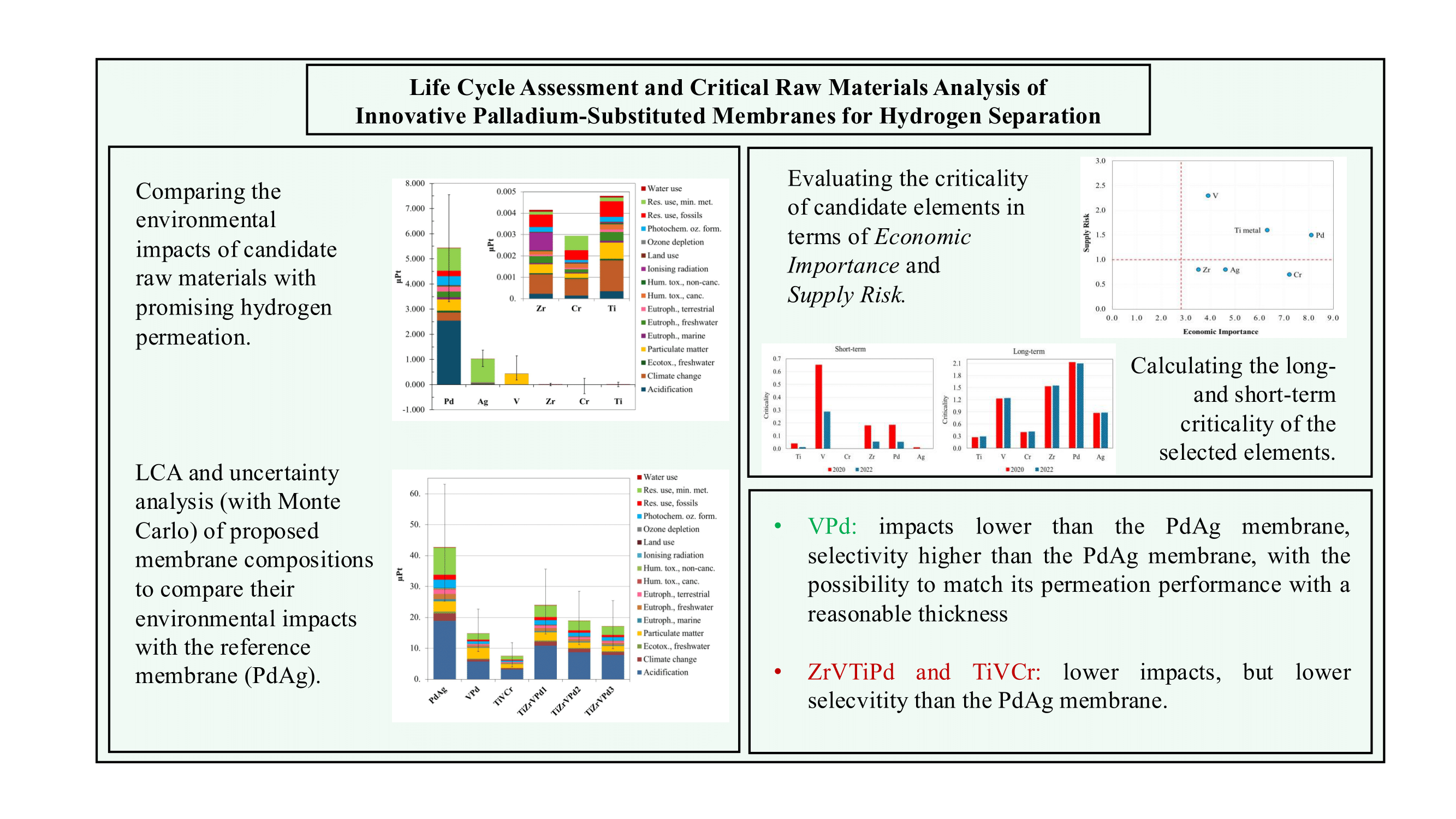
Palladium-based membranes for hydrogen separation offer the most promising gas permeation and selectivity, but their large-scale application has been limited due to the high environmental burdens and criticality of palladium. Herein, the possibility of substituting Pd with candidate elements in the composition of metallic membranes deposited via High Power Impulse Magnetron Sputtering (HiPIMS) was investigated. This study proposed an innovative framework for a more comprehensive investigation of the sustainability challenges related to this lab-scale technology by integrating LCA and criticality analyses, thereby supporting materials selection efforts. First, the criticality status of several elements used in hydrogen separation membranes was screened with two different approaches. Furthermore, the environmental impacts of novel membrane compositions were compared with a high Pd-content reference membrane (Pd77Ag23) through cradle-to-gate Life Cycle Assessment (LCA). For robust LCA modeling, uncertainty analysis was performed via Monte Carlo simulation exploiting errors estimated for primary data. A direct relationship was identified between the Pd content in membranes and the associated environmental impacts. VPd membranes proved to be the most promising candidate by exhibiting 65% lower total impacts than the PdAg membrane while maintaining a high hydrogen permeability performance.
Keywords:
Life Cycle Assessment
; Uncertainty Analysis
; Critical Raw Materials
; Hydrogen Separation
; Membranes
1. Introduction
Fossil fuels currently supply over 80% of global energy consumption, and their combustion accounts for two-thirds of the greenhouse gas emissions [1]. The increasing depletion of these non-renewable resources prompts an urgent need to explore more sustainable alternatives [2]. In this context, hydrogen has been an attractive energy vector offering a pathway to decarbonize industrial processes [3,4].
Hydrogen production involves steam reforming from fossil or biomass fuels, followed by further purification to remove undesired by-products (CO, CO2, H2S, and NH3) [5]. Pure hydrogen is essential for efficient fuel cell-based energy systems, highlighting the importance of developing separation technologies [2]. Over the past decades, H2 separation membranes have gained growing interest owing to their various advantages [6]. These membranes consist of materials with high hydrogen affinity to facilitate hydrogen transport across the matrix. The process is activated by pressure difference at sides of membrane and includes adsorption, dissociation, diffusion, and recombination of hydrogen molecules [7].
Transition metals such as palladium, vanadium, zirconium, and titanium are usually used in hydrogen-selective membranes to enhance permeability or prevent embrittlement [8]. Pd-based alloys are the preferred membranes (e.g., PdAg), as they demonstrate excellent permeation and selectivity due to palladium catalytic characteristics [2]. However, their large-scale application is hindered by high fabrication costs, sensitivity to embrittlement and surface poisoning, high environmental impacts, and raw material criticality [9]. Research is being conducted to replace Pd, even partially, to make hydrogen separation technology more sustainable, even at the expense of functional efficiency [10].
Raw material criticality can be assessed through several methods [11]. For instance, the European Commission has suggested guidelines to improve the sustainability of Critical Raw Materials (CRMs) supply chain [12]. According to the European Commission, CRMs are those that bear high economic importance and supply risk [11].
The European Commission has also proposed an assessment framework for Safe and Sustainable by Design (SSbD) materials [13], aimed at improving the sustainability of innovative processes. In this regard, Life Cycle Assessment (LCA) is an internationally standardized methodology [14], considered as the core element of environmental sustainability assessments [15]. It quantifies the potential impacts of products and processes on the environment and human health, considering the consumption of resources. Even though applying LCA to emerging technologies at low Technology Readiness Levels [16] challenging, when certain conditions are fulfilled, it can effectively support the optimization of lab-scale activities before industrial upscaling [17].
The main challenges concerning the operationalization of SSbD are the integration of circularity into environmental sustainability, data scale-up, and data availability, quality, and uncertainty, which have been rarely addressed in literature [18]. Therefore, to address this gap and for a more reliable sustainability assessment, a supporting uncertainty study using statistical tools can define a degree of confidence in data gathering, modeling assumptions, and LCA conclusions [19]. Also, to have a more comprehensive view of the issues related to the use of raw materials in innovative processes, a decision-making system should combine studying materials criticality and environmental sustainability, complementary to each other [20]. This integrated approach offers additional dimensions to materials selection and helps prioritize the alternatives by suggesting trade-offs, as discussed in previous works [21,22].
Despite the growing interest in hydrogen separation membranes, reports studying the implications of their commercialization are limited. Martinez et al. [23] performed a systematic LCA analysis on the electroless fabrication of composite Pd membranes to find the environmental hotspots of their lab-scale production. Moreover, Sutar [24]proved insightful in highlighting the role of element substitution in the composition of Pd-based membranes on their environmental burdens. This was carried out by comparing the impacts of choosing alternative materials for all three components of electroless-plated membranes.
Recent studies have demonstrated how it is possible, through Physical Vapor Deposition (PVD) techniques, to obtain efficient membranes with reduced palladium content [10,25]. Therefore, metallic layers were deposited on porous alumina substrates, with thin layers of Pd acting as catalytic and protective coatings. Previous works have explored the main drivers of impact at lab-scale preparation of membrane substrates [26] and thin film deposition through PVD magnetron sputtering [27]. Consequently, this study avoids the membrane production processes and focuses its attention only on the choice of raw materials. The aim is to provide insights into the sustainability of materials employed in this field of technology and support future research by proposing a materials selection framework. In this regard, first, the criticality of candidate raw materials used in the composition of layer-based membranes was assessed. Then, the environmental impacts of proposed membrane compositions were compared to those of the reference membrane through LCA analysis, followed by an uncertainty assessment, implementing an updated Ecoinvent database.
2. Materials and Methods
2.1. System Description
Metallic alloys of different compositions were deposited on porous alumina substrates and tested as hydrogen separation membranes. Candidate compositions were selected based on adequate hydrogen permeation and functional stability [10]. An alloy (Pd77Ag23) with high Pd content, optimal permeation performance, and resistance to hydrogen embrittlement was considered as the reference membrane [25,28].
Detailed descriptions of substrate preparation and membrane deposition via HiPIMS are reported in previous works [10,26,29]. Pd coatings (~350 nm) were deposited onto both the surface of the substrate and the dense metallic alloy layer (as seen in Figure 1) to protect the alloys from oxidation, act as catalytic layers for hydrogen splitting and recombination, and prevent the interdiffusion phenomena [30]. The Pd thickness was set to neglect its contribution to the permeation of the membranes.
The composition and characteristics of the membranes are listed in Table 1. Due to the high content of Pd, the reference membrane did not require any additional Pd coatings. The selectivity is considered as the ratio between hydrogen and nitrogen permeances, measured at 350-400°C.
The microstructure of the crystalline phases of the membranes was studied using X-ray diffraction. Moreover, the surface and cross-section of the samples were observed using Field Emission Scanning Electron Microscopy, while their compositions were determined by Energy Dispersive X-ray Spectroscopy. The permeability of the membranes was measured above 300°C using a custom-built stainless-steel station [29] and high-purity N2 and H2 (99.999%), by varying the pressure at the feed side from atmospheric to 400 kPa and maintaining atmospheric pressure on the permeate side. Physicochemical characterization results of the membranes were discussed in previous works [10,25,29].
2.2. Critical Raw Materials
The European Commission suggests using Economic Importance (EI) and Supply Risk (SR) criteria to quantify the criticality of raw materials [11]. EI represents vulnerability as a consequence of supply disruption, given the importance of a material in the European Union economy in terms of final applications and added value. SR is the probability that the supply of the material is disrupted, which increases when sourcing is dependent on a dominant provider or a small number of providers (monopolistic supply structure), as opposed to a diversified supplier base.
Another approach to perform an economic-wide criticality assessment is the evaluation of long- and short-term criticality indexes (Crit.LT and Crit.ST) of the raw materials. These criticality indexes were calculated using the data available in the “Resources Scanner” database [31] and through the following equations reported by Bastein & Rietveld [32]:
where HHI is the Herfindahl-Hirschmann Index, P/R is the ratio between production sites and reserves, Companionality is the degree to which material is a by-product, WGI is the World Governance Indicator, EoLRIR is the End-of-Life Recycling input rate, and OCED indicates the risk of raw materials being affected by export restrictions during past five years.
2.3. Life Cycle Assessment
2.3.1. Goal and Scope
This study investigated how the partial substitution of Pd in the composition of hydrogen separation membranes can affect their environmental footprint. This was performed by comparing the results related to the different alloy compositions with diverse Pd contents.
2.3.2. Functional Unit
A preliminary LCA was conducted using a Functional Unit (FU) of 1 kg of each element present in membrane compositions in their refined metal form, according to the European Commission’s suggestion [33].
The second LCA analysis compared the environmental impacts of studied membrane compositions with those of the reference PdAg membrane. The FU was the mass of the metallic component of each membrane deposited onto an alumina substrate of 2.56 cm2 in surface area, assuming a membrane thickness equal to the reference membrane (3.16 µm).
2.3.3. System Boundaries and Modeling Assumptions
In this work, the mass of each element present in the metallic layers of the investigated membranes was considered. The actual film production processes and the consumption of resources during the membrane production and characterization steps were neglected. LCA results were discussed as a function of the permeability and gas selectivity of the membranes [26], whilst performance and mechanical stability over time were not considered.
2.3.4. Life Cycle Inventory and Data Sources
Primary data were collected as reported in Section 2.1, and secondary data were obtained from the Econinvent v3.10 database, with adequate temporal representativeness (data from 2011 to 2023), or by adaptations according to similar processes reported in the literature. Specifically, the unit processes for vanadium and zirconium were derived through an adaptation of the titanium unit process (Titanium, triple-melt {GLO}| market for titanium, triple-melt | Cut-off, U), which is available in the Econinvent v3.10 database. This is possible because these three elements are assumed to be produced with the same process, the Kroll method [35,36]. As the pure form of zirconium (sponge) was already present in the Ecoinvent v3.10 database, Zr modelling was limited to the subsequent steps (triple-melt refining and transportation). However, since neither vanadium nor its pure form is included in the database, the entire V life cycle was modelled, including all relevant upstream processes prior to pure element production. A complete inventory of the unit processes used to model the V and Zr flows is provided in Tables S1-S11 of the Supplementary Information (SI).
2.3.5. Uncertainty Analysis
All data used in LCA modeling involves some extent of uncertainty that can affect the reliability of the outcome. This is particularly important in the case of comparative LCAs where options are selected based on their impact assessment results. Furthermore, experimental data can contain intrinsic uncertainty, and thus, reporting the uncertainty is essential for transparent communication of results, and to ensure that any future calculations implementing the life cycle inventory will accurately reflect the uncertainty in data [36].
The uncertainties can be distinguished into distinct types, including the correctness of data, variation in data, reliability of measurement means, completeness of the model, and representativeness of the model (considering temporal, geographical, and technological correlations). Addressing uncertain data requires familiarity with data gathering and interpretation of uncertainty specific to the system under study [19].
The Ecoinvent database presents uncertain data with a “best guess” value, together with a range of possible values [37]. This best guess is usually achieved by sampling several measurements and taking the mean of the distribution. A lognormal distribution occurs when values with a normal distribution are multiplied. As this is the case in LCA process chains, lognormal distribution is assumed as the default in the Ecoinvent database [38], and the uncertainty range is represented by the square of the Geometric Standard Deviation (GSD) of a set of measured values [37].
Regarding secondary data, “Pedigree” matrices available in the database were exploited to assess the uncertainty and estimate the GSD of data. The pedigree matrix of each data point consists of score values related to different data quality indicators [37]. In the case of modelled unit processes, the corresponding pedigree matrices were assessed according to uncertainty factors reported in the guidelines [39].
For primary data, key sources of error in data gathering were identified and used to quantify the uncertainty. These include measuring the surface area of the alumina substrates, estimating membrane compositions, and determining film thicknesses.
The assumptions regarding the uncertainty modeling are summarized below:
- The mass of each membrane (deposited onto 2.56 cm2 alumina substrates) was calculated by considering the mean values of surface area (s), thickness (t), atomic mass (m), and unit cell volume (v). Measuring their respective uncertainty (GSDs, GSDt, GSDm, GSDv) allowed obtaining the uncertainty of membrane mass [41,42]. The equations regarding the GSD of a set of n values (xi) and error propagation considering the multiplication of parameters are reported below:
- 2.
- The surface area of several alumina substrates was measured, and the mean and standard deviation were obtained. The contribution of thin film roughness was neglected being lower than the error on thickness estimation, measured using the FE-SEM cross-section images. To assess the coating thickness uniformity, the measurement was repeated in several regions to obtain a distribution of values and their GSD.
- 3.
- The composition evaluation of each membrane was carried out by EDS measurements, as reported in a previous work [42], and the corresponding mass GSDs were obtained.
- 4.
- The cell parameters of the crystalline phase of the membranes and their errors were acquired by Rietveld refinement of XRD patterns. Assuming an orthorhombic crystalline structure, the unit cell volume and its error were estimated for each membrane.
Finally, the Monte Carlo method was implemented to handle the uncertainty of LCA analysis [43].
3. Results and Discussions
3.1. CRM Analysis
The criticality indexes of the investigated elements (Pd, V, Ti, Zr, Ag, and Cr) were obtained using the calculations proposed by the European Commission [11]. The results, indicated in Figure 2, show an EI index above the criticality threshold for all the elements: Pd, V and Ti exceeded even the SR index threshold and were, therefore, considered critical.
Compared to the previous European CRM study (2020) [12], the palladium EI index increased substantially due to the change in its estimated added value of the economic sectors. The supply of Platinum Group Metals (PGMs) is strongly dependent on Russia (~1/3 in 2021). Despite the Ukraine-Russia conflict, neither the European Union nor Russia have imposed restrictions on the import or availability of these raw materials. Nevertheless, attempts have been made to increase imports from alternative countries. Progressive risk mitigation is expected due to the drop in demand for Pd in the automotive sector and the development of recovery and recycling processes for PGMs [44].
Regarding vanadium, Europe has been mostly dependent on Russia for its supply (in refined form). Despite major vanadium reserves being in this country, the extraction and refinement activities are carried out mostly in China [11,45]. This anomalous geographical concentration increased the SR index of vanadium in the 2023 CRM update.
In the 2023 European CRM study, titanium metal is considered critical due to its use in high-tech and strategic sectors [46], and the high geographical concentration of suppliers [11].
Studying the long- and short-term criticality of the elements can also be insightful in managing the risk associated with the raw materials supply chain. In this regard, these criticality indexes were calculated as described in Section 2.2 [32]. The value of each criticality parameter according to the updated database (2022) is reported in Table 3.
It should be noted that high P/R indicates high risks from proven reserves which can lead to an increase in the long-term criticality of materials. For Pd, the geographical location of reserves and the high degree of specialization required steered the mining and refining activities to be concentrated in a few countries, namely Russia, South Africa, and Canada. Moreover, it can be concluded that materials with a high recycling rate have low short-term criticality (e.g., Cr with null criticality), while the ones with inadequate recycling, and a high concentration in countries with poor qualities of governance (high WGI) or restrictive export policies (high OCED) tend to have greater short-term criticality (e.g., V).
A comparison between the 2020 and the 2022 criticality indexes of each element is illustrated in Figure 3.
As can be observed from the graphs, except for the particular case of Cr, the data published in 2022 showed a decrease in the WGI index for all elements, and a marked decrease for V, Zr, and Pd, leading to a decreasing of the Crit.ST index. In the other hand, Crit.LT index did not show any significant variations.
3.2. LCA Results
A first assessment was performed considering 1 kg of each element present in the membrane compositions, in their refined metal form, as FU. Also, an uncertainty analysis was carried out by incorporating the corresponding pedigree matrices associated with the production of each element, as provided in the Ecoinvent 3.10 database. Figure 4 illustrates a comparison of the characterized results of the investigated elements in each environmental impact category (listed in Table S12 of SI).
The results indicated that palladium had a significant contribution across almost all impact categories, except in “Resource use, minerals and metals” where silver had the highest impact. In addition, vanadium showed a notable impact in the “Particulate Matter” category.
By normalizing and weighing the characterization results, it is possible to add the contribution of different impact categories, forming a “single score” index, and obtaining an overall view of various environmental burdens related to each element within their uncertainty range (100 Monte Carlo simulations and 95% confidence interval), as shown in Figure 5.
Figure 5 highlights the distinct contribution of each element to various impact categories. It is evident that Pd, Ag, and V exhibit relatively high environmental burdens, with Pd single score being 5.3 and 12.8 times larger than Ag and V, respectively. The most impacted categories were “Acidification” and “Resource use, minerals and metals”. This simplified analysis highlights how Pd has a significant potential environmental impact, and the objective of its replacement in membrane compositions is of utmost importance to make hydrogen separation technology more sustainable.
After identifying the environmental burdens of each element, LCA and uncertainty analysis were performed on investigated membrane compositions. To have a representative comparison, the environmental impacts of these membranes were determined by imposing the same value of thickness on all the membranes, equal to the reference (3.16 µm) and using a consistent surface area for the alumina substrates (2.56 cm2). With these parameters fixed, and knowing the density of the crystalline phase of each membrane (obtained from the XRD analyses), the corresponding mass value and its uncertainty (see Section 2.3.5) were calculated for each membrane, as reported in Table S13 of SI.
The LCIA characterization results of the studied membranes are shown in Figure 6, while Table S14 of the SI lists characterization results and their associated uncertainties. As expected, the PdAg membrane exhibited the highest characterized results across all impact categories, except for “Particulate Matter” where the VPd membrane showed the highest contribution. Analyzing the uncertainty of impact values across different categories for all the membranes, “Water use” and “Human toxicity, non-cancer" showed the largest coefficient of variability, indicating the highest uncertainty.
After normalizing and weighing the characterization results, the single score outcomes of the membranes were obtained, as shown in Figure 7, together with their respective uncertainty range, considering 95% confidence interval.
Compared to the reference membrane, which showed the highest overall impact, the least impacting membrane was the TiVCr (82.5% lower), followed by the VPd (65.3% lower). Furthermore, it is evident that reducing the Pd content in TiZrVPd membranes effectively lowered the weighted environmental impacts, and on average, their overall impact is 53.1% lower than the PdAg membrane. The impact categories with the highest contribution to the overall impacts were found to be “Acidification”, “Resource use, minerals and metals”, and “Particulate matter” for all the investigated membranes.
To address the uncertainty in LCA results, the number of Monte Carlo iterations can be limited by manually setting a maximum number of runs or defining a fixed Standard Error of Mean. To study the effect of the number of calculations, the simulations were repeated for 100, 1000, and 10000 runs. However, little to no change was observed in the resulting single score values and their corresponding standard deviations, indicating a statistically stable model that is convergent even at a small number of simulations (100). The results of this investigation are reported in Table S15 and Figure S1 of SI.
To account for membrane performance when comparing the environmental burdens, the membranes were evaluated by considering their hydrogen permeability and gas selectivity at 350°C. Permeability is a material property while permeance is an absolute indicator depending on the thickness. Also, selectivity is considered as the ratio between H2 and N2 permeance [10]. It is important to note that TiVCr and TiZrVPd membranes possessed low selectivity values (11, 50, 100, and 75, respectively) compared to the PdAg membranes (222). Despite exhibiting permeability values close to the reference (6.41×10⁻¹² mol m−1 s−1 Pa−1) [10], low selectivity ultimately makes these membranes practically unsuitable for the application of hydrogen separation. On the contrary, VPd with a high selectivity (80% higher than the reference), a permeability of 5.40×10⁻¹² mol m−1 s−1 Pa−1, and lower total impacts than the PdAg reference membrane, can be considered as a suitable candidate composition for such membranes. Moreover, its permeance can match that of the reference membrane if a virtual thickness of 3.1 μm is fixed for its metallic layer, which is in a reasonable range for a successful implementation in a lab-scale prototype [47].
Discernability is an approach to analyze the uncertainty in comparative LCAs, supporting a more detailed comparison of the options [48]. To further compare the environmental impacts of the VPd and PdAg compositions, an uncertainty analysis was performed considering the mass of membrane with the same membrane thickness (3.16 µm) and substrate surface area (2.56 cm2) as the FU. Figure 8 indicates the frequency of Monte Carlo outcomes where one membrane has a higher impact score than the other, per impact category. In case of significant differences (100% positive or negative), options can be compared with less uncertainty, and high data quality can be assumed. Otherwise, uncertainty is considered high.
Figure 8 illustrates that in comparison, the PdAg membrane has consistently higher values across all impact categories except for five, underlining its relatively greater environmental burdens. As an example, it is evident that PdAg showed a higher impact in the “Human toxicity, cancer” category in 86% of runs; meaning that in this category, PdAg has a higher value than VPd with 86% certainty.
Currently, LCA can solely evaluate resource use under the “Resource depletion” category, focusing on the effect of raw materials extraction. This method has limited comprehensiveness in representing resources as few CRMs are modeled in its databases. Also, the security of the supply of resources and the socio-economic factors that affect raw material access are not explicitly considered in current impact assessment methods. The development of LCA methodology can offer strategies for not only assessing the environmental implications of materials but also establishing proper indicators for CRM identification [49].
4. Conclusions
This study provides a methodological approach to support materials selection for sustainable hydrogen separation membranes. Several raw materials with promising hydrogen permeation and low criticality were investigated, and novel membrane compositions with reduced Pd content were compared based on their permeability and environmental impacts. The CRM analysis highlighted the current criticality status of each element. A metal criticality assessment is regarded as a dynamic study that should be periodically updated to account for the alterations in the supply chain. It was shown that the inconvenient geographical concentration of Pd reserves has resulted in its long-term criticality, highlighting the need for alternatives. The LCA of producing the raw materials used in membrane compositions showed that Pd, Ag, and V exhibit relatively high environmental burdens, with Pd single score 5.3 and 12.8 times larger than Ag and V, respectively. Comparative LCA of the membranes indicated that the ZrVTiPd membranes display 53.1% lower total impacts than those of the PdAg reference membrane on average, and the partial substitution of Pd in their composition substantially reduced the overall impacts.
Moreover, the VPd membrane can be considered a suitable candidate, having lower environmental impacts than the reference membrane (63.5%), and showing a superior gas selectivity characteristic with comparable permeability. While literature tends to overlook the practical challenges associated with managing the life cycle inventories, this work tried to address this gap by studying the uncertainty in data gathering and the way it affects the accuracy of the outcome. Monte Carlo analysis proved useful in indicating the distribution of impact values, highlighting the extent of uncertainty in results, and pairwise comparison of membranes at different impact categories, without altering the principal conclusions of the LCIAs. It can be concluded that a broad sustainability analysis implementing LCA thinking would be beneficial for a comprehensive assessment of risks associated with various aspects of a product lifecycle and supply chain.
Supplementary Materials
The following supporting information can be downloaded at the website of this paper posted on Preprints.org.
Author Contributions
Conceptualization, S.B. (Simone Battiston); methodology, A.M. and S.B. (Simone Battiston) and S.F. (Stefania Fiameni) and F.V.; investigation, A.M. and S.B. (Simone Battiston); data curation, A.M. and S.B. (Simone Battiston) and S.F. (Stefano Fasolin); writing—original draft preparation, A.M. and S.B. (Simone Battiston); writing—review and editing, S.B. (Simone Battiston) and S.F. (Stefania Fiameni) and S.F. (Stefano Fasolin) and F.V. and S.B. (Simona Barison); visualization, A.M.; supervision, S.B. (Simona Barison). All authors have read and agreed to the published version of the manuscript.
Funding
This research is funded by the European Union – NextGeneration EU from the Italian Ministry of Environment and Energy Security POR H2 AdP MMES/ENEA with involvement of CNR and RSE, PNRR – Mission 2, Component 2, Investment 3.5 "Ricerca e sviluppo sull’idrogeno", CUP: B93C22000630006.
Institutional Review Board Statement
Not applicable.
Informed Consent Statement
Not applicable.
Data Availability Statement
The raw data supporting the conclusions of this article will be made available by the authors on request.
Conflicts of Interest
The authors declare that they have no known competing financial interests or personal relationships that could have appeared to influence the work reported in this paper.
Abbreviations
The following abbreviations are used in this manuscript:
| CRM | Critical raw materials |
| SSbD | Safe and Sustainable by Design |
| LCA | Life Cycle Assessment |
| LCIA | Life Cycle Impact Assessment |
| XRD | X-ray Diffraction |
| EDS | Energy Dispersive X-ray Spectroscopy |
| FE-SEM | Field Emission Scanning Electron Microscopy |
| EI | Economic Importance |
| SR | Supply Risk |
| EF | Environmental Footprint |
| GLO | Global |
| GSD | Geometric Standard Deviation |
| HiPIMS | High-Power Impulse Magnetron Sputtering |
| PGM | Platinum Group Metals |
References
- Abas, N.; Kalair, A.; Khan, N. Review of Fossil Fuels and Future Energy Technologies. Futures 2015, 69, 31–49. [Google Scholar] [CrossRef]
- Saini, N.; Awasthi, K. Insights into the Progress of Polymeric Nano-Composite Membranes for Hydrogen Separation and Purification in the Direction of Sustainable Energy Resources. Sep Purif Technol 2022, 282, 120029. [Google Scholar] [CrossRef]
- Chuah, C. Y.; Jiang, X.; Goh, K.; Wang, R. Recent Progress in Mixed-Matrix Membranes for Hydrogen Separation. Membranes (Basel) 2021, 11. [Google Scholar] [CrossRef] [PubMed]
- Liu, C.; Zhang, X.; Zhai, J.; Li, X.; Guo, X.; He, G. Research Progress and Prospects on Hydrogen Separation Membranes. Clean Energy 2023, 7, 217–241. [Google Scholar] [CrossRef]
- Dincer, I.; Acar, C. Review and Evaluation of Hydrogen Production Methods for Better Sustainability. Int J Hydrogen Energy 2015, 40, 11094–11111. [Google Scholar] [CrossRef]
- Al-Mufachi, N. A.; Rees, N. V; Steinberger-Wilkens, R. Hydrogen Selective Membranes: A Review of Palladium-Based Dense Metal Membranes. Renewable and Sustainable Energy Reviews 2015, 47, 540–551. [Google Scholar] [CrossRef]
- Amandusson, H.; Ekedahl, L.-G.; Dannetun, H. Hydrogen Permeation through Surface Modified Pd and PdAg Membranes. J Memb Sci 2001, 193, 35–47. [Google Scholar] [CrossRef]
- Dolan, M. D. Non-Pd BCC Alloy Membranes for Industrial Hydrogen Separation. J Memb Sci 2010, 362, 12–28. [Google Scholar] [CrossRef]
- Abdul Samat, N. A. S.; Goh, P. S.; Lau, W. J.; Guo, Q.; Ismail, A. F.; Wong, K. C. Green Hydrogen Revolution: Sustainable Hydrogen Separation Using Hydrogen-Selective Nanocomposite Membrane Technology. Int J Hydrogen Energy 2025, 99, 458–484. [Google Scholar] [CrossRef]
- Fasolin, S.; Barison, S.; Agresti, F.; Battiston, S.; Fiameni, S.; Isopi, J.; Armelao, L. New Sustainable Multilayered Membranes Based on ZrVTi for Hydrogen Purification. 2022. [CrossRef]
- Grohol, M.; Veeh, C.; GROW, D. Study on the Critical Raw Materials for the EU 2023: Final Report; Brussels, 2023. [CrossRef]
- Commissione europea: Direzione generale del Mercato interno dell’imprenditoria e delle PMI, dell’industria; Blengini, G. A.; El Latunussa, C.; Eynard, U.; Torres De Matos, C.; Wittmer, D.; Georgitzikis, K.; Pavel, C.; Carrara, S.; Mancini, L.; et al. Study on the EU’s List of Critical Raw Materials (2020) : Final Report, Ufficio delle pubblicazioni dell’Unione europea. 2020. [CrossRef]
- Centre, E. C. J. R.; Caldeira, C.; Farcal, L.; Garmendia Aguirre, I.; Mancini, L.; Tosches, D.; Amelio, A.; Rasmussen, K.; Rauscher, H.; Riego Sintes, J.; et al. Safe and Sustainable by Design Chemicals and Materials – Framework for the Definition of Criteria and Evaluation Procedure for Chemicals and Materials; Publications Office of the European Union, 2022. [CrossRef]
- Finkbeiner, M.; Inaba, A.; Tan, R.; Christiansen, K.; Klüppel, H.-J. The New International Standards for Life Cycle Assessment: ISO 14040 and ISO 14044. Int J Life Cycle Assess 2006, 11, 80–85. [Google Scholar] [CrossRef]
- Abbate, E.; Ragas, A. M. J.; Caldeira, C.; Posthuma, L.; Garmendia Aguirre, I.; Devic, A. C.; Soeteman-Hernández, L. G.; Huijbregts, M. A. J.; Sala, S. Operationalization of the Safe and Sustainable by Design Framework for Chemicals and Materials: Challenges and Proposed Actions. Integr Environ Assess Manag 2025, vjae031. [Google Scholar] [CrossRef]
- Mankins, J. Technology Readiness Level – A White Paper. 1995.
- Waiyaki, P.; Thekkethil, R.; Ananthakumar, M.; Seshadri, S. How Green Is Green Hydrogen?─A Life-Cycle and Critical Raw Material Analysis of Green Hydrogen Production via PEMW Electrolysers in India. Energy & Fuels 2025, 39, 5534–5549. [Google Scholar] [CrossRef]
- Centre, E. C. J. R.; Caldeira, C.; Farcal, R.; Moretti, C.; Mancini, L.; Rauscher, H.; Riego Sintes, J.; Sala, S.; Rasmussen, K. Safe and Sustainable by Design Chemicals and Materials – Review of Safety and Sustainability Dimensions, Aspects, Methods, Indicators, and Tools; Publications Office of the European Union, 2022. [CrossRef]
- Cespi, D. Procedural Life Cycle Inventory of Chemical Products at Laboratory and Pilot Scale: A Compendium. Green Chemistry 2024, 26, 9554–9568. [Google Scholar] [CrossRef]
- Graedel, T. E.; Harper, E. M.; Nassar, N. T.; Nuss, P.; Reck, B. K. Criticality of Metals and Metalloids. Proceedings of the National Academy of Sciences 2015, 112, 4257–4262. [Google Scholar] [CrossRef]
- Zin, V.; Fiameni, S.; Mohtashamifar, A.; Battiston, S.; Montagner, F.; Deambrosis, S. M.; Losurdo, M. Environmental Sustainability of High-Power Impulse Magnetron Sputtering Nitriding Treatment of CoCrMo Alloys for Orthopedic Application: A Life Cycle Assessment Coupled with Critical Raw Material Analysis. Sustainability 2025, 17. [Google Scholar] [CrossRef]
- Schropp, E.; Campos-Carriedo, F.; Iribarren, D.; Naumann, G.; Bernäcker, C.; Gaderer, M.; Dufour, J. Environmental and Material Criticality Assessment of Hydrogen Production via Anion Exchange Membrane Electrolysis. Appl Energy 2024, 356, 122247. [Google Scholar] [CrossRef]
- Martinez-Diaz, D.; Leo, P.; Sanz, R.; Carrero, A.; Calles, J. A.; Alique, D. Life Cycle Assessment of H2-Selective Pd Membranes Fabricated by Electroless Pore-Plating. J Clean Prod 2021, 316, 128229. [Google Scholar] [CrossRef]
- Sutar, P. R.; Yadav, G. D. Exploring the Environmental Performance of Electroless Plated Palladium Alloy Membranes for H2 Separation: A Cradle-to-Gate Life Cycle Study. Int J Hydrogen Energy 2024, 79, 1464–1471. [Google Scholar] [CrossRef]
- Barison, S.; Fasolin, S.; Boldrini, S.; Ferrario, A.; Romano, M.; Montagner, F.; Deambrosis, S. M.; Fabrizio, M.; Armelao, L. PdAg/Alumina Membranes Prepared by High Power Impulse Magnetron Sputtering for Hydrogen Separation. Int J Hydrogen Energy 2018, 43, 7982–7989. [Google Scholar] [CrossRef]
- Battiston, S.; Fiameni, S.; Fasolin, S.; Barison, S.; Armelao, L. Life Cycle Environmental Impact Assessment of Lab-Scale Preparation of Porous Alumina Pellets as Substrate for Hydrogen Separation Metal Layer-Based Membranes. Int J Life Cycle Assess 2023, 28, 1117–1131. [Google Scholar] [CrossRef]
- Fiameni, S.; Battiston, S.; Castellani, V.; Barison, S.; Armelao, L. Implementing Sustainability in Laboratory Activities: A Case Study on Aluminum Titanium Nitride Based Thin Film Magnetron Sputtering Deposition onto Commercial Laminated Steel. J Clean Prod 2021, 285, 124869. [Google Scholar] [CrossRef]
- Karakaya, I.; Thompson, W. The Ag−Pd (Silver-Palladium) System. Bulletin of Alloy Phase Diagrams 1988, 9, 237–243. [Google Scholar] [CrossRef]
- Fasolin, S.; Barison, S.; Boldrini, S.; Ferrario, A.; Romano, M.; Montagner, F.; Miorin, E.; Fabrizio, M.; Armelao, L. Hydrogen Separation by Thin Vanadium-Based Multi-Layered Membranes. Int J Hydrogen Energy, 2018. [Google Scholar] [CrossRef]
- LI, A.; Boyd, T.; Lim, J. C.; Grace, J. R. Development of Palladium-Alloy Membranes for Hydrogen Separation and Purification. Journal of Membrane Science and Research 2020, 6, 99–106. [Google Scholar] [CrossRef]
- Grondstoffenscanner www.grondstoffenscanner.nl (accessed Jun 19, 2025).
- Bastein, T.; Rietveld, E.; Zyl, S. Van. Materials in the Dutch Economy – a Vulnerability Assessment -, 2015. [Google Scholar]
- Official Journal of the European Union. Regulation (EU) 2024/1252 of the European Parliament and of the Council of 11 April 2024 Establishing a Framework for Ensuring a Secure and Sustainable Supply of Critical Raw Materials and Amending Regulations (EU) No 168/2013, (EU) 2018/858, (EU) 2018/1724 and (EU) 2019/1020 (Text with EEA Relevance), 2024.
- Kroll, W. The Production of Ductile Titanium. Transactions of The Electrochemical Society 1940, 78, 35. [Google Scholar] [CrossRef]
- da Silva Lima, L.; Quartier, M.; Buchmayr, A.; Sanjuan-Delmás, D.; Laget, H.; Corbisier, D.; Mertens, J.; Dewulf, J. Life Cycle Assessment of Lithium-Ion Batteries and Vanadium Redox Flow Batteries-Based Renewable Energy Storage Systems. Sustainable Energy Technologies and Assessments 2021, 46, 101286. [Google Scholar] [CrossRef]
- Finnveden, G.; Hauschild, M.; Ekvall, T.; Guinée, J.; Heijungs, R.; Hellweg, S.; Koehler, A.; Pennington, D.; Suh, S. Recent Developments in Life Cycle Assessment. J Environ Manage 2009, 91, 1–21. [Google Scholar] [CrossRef]
- Goedkoop, M.; Oele, M.; Leijting, J.; Ponsioen, T.; Meijer, E. Introduction to LCA with SimaPro; 2016.
- Qin, Y.; Suh, S. What Distribution Function Do Life Cycle Inventories Follow? Int J Life Cycle Assess 2017, 22, 1138–1145. [Google Scholar] [CrossRef]
- Ciroth, A.; Muller, S.; Weidema, B.; Lesage, P. Empirically Based Uncertainty Factors for the Pedigree Matrix in Ecoinvent. Int J Life Cycle Assess 2016, 21, 1338–1348. [Google Scholar] [CrossRef]
- Endo, Y. Estimate of Confidence Intervals for Geometric Mean Diameter and Geometric Standard Deviation of Lognormal Size Distribution. Powder Technol 2009, 193, 154–161. [Google Scholar] [CrossRef]
- General Chemistry Laboratories. Uncertainties in Quantities and Error Propagation. 2019; https://chem.libretexts.org/@go/page/175486.
- Battiston, S.; Fanciulli, C.; Fiameni, S.; Famengo, A.; Fasolin, S.; Fabrizio, M. One Step Synthesis and Sintering of Ni and Zn Substituted Tetrahedrite as Thermoelectric Material. J Alloys Compd 2017, 702, 75–83. [Google Scholar] [CrossRef]
- Sun, S.; Ertz, M. Life Cycle Assessment and Monte Carlo Simulation to Evaluate the Environmental Impact of Promoting LNG Vehicles. MethodsX 2020, 7, 101046. [Google Scholar] [CrossRef] [PubMed]
- K, G.; U, E.; S, B.; F, P. C.; D, I.; E, D.; E, G. Palladium: Impact Assessment for Supply Security; European Commission, 2023.
- Ciotola, A.; Fuss, M.; Colombo, S.; Poganietz, W.-R. The Potential Supply Risk of Vanadium for the Renewable Energy Transition in Germany. J Energy Storage 2021, 33, 102094. [Google Scholar] [CrossRef]
- S, C.; S, B.; D, B.; P, A. D.; A, C.; K, G.; M, G.; A, I.; T, K.; C, L.; et al. Supply Chain Analysis and Material Demand Forecast in Strategic Technologies and Sectors in the EU – A Foresight Study; Publications Office of the European Union: Luxembourg (Luxembourg), 2023; 10.2760/386650 (online),10.2760/334074 (print). [Google Scholar]
- Alique, D.; Leo, P.; Martinez-Diaz, D.; Calles, J. A.; Sanz, R. Environmental and Cost Assessments Criteria for Selection of Promising Palladium Membranes Fabrication Strategies. Int J Hydrogen Energy 2024, 51, 302–319. [Google Scholar] [CrossRef]
- Heijungs, R.; Kleijn, R. Numerical Approaches towards Life Cycle Interpretation Five Examples. Int J Life Cycle Assess 2001, 6, 141–148. [Google Scholar] [CrossRef]
- Mancini, L.; Sala, S.; Recchioni, M.; Benini, L.; Goralczyk, M.; Pennington, D. Potential of Life Cycle Assessment for Supporting the Management of Critical Raw Materials. Int J Life Cycle Assess 2015, 20, 100–116. [Google Scholar] [CrossRef]
Figure 1.
Cross-sectional view of a representative membrane captured under the backscattered electron SEM.
Figure 1.
Cross-sectional view of a representative membrane captured under the backscattered electron SEM.
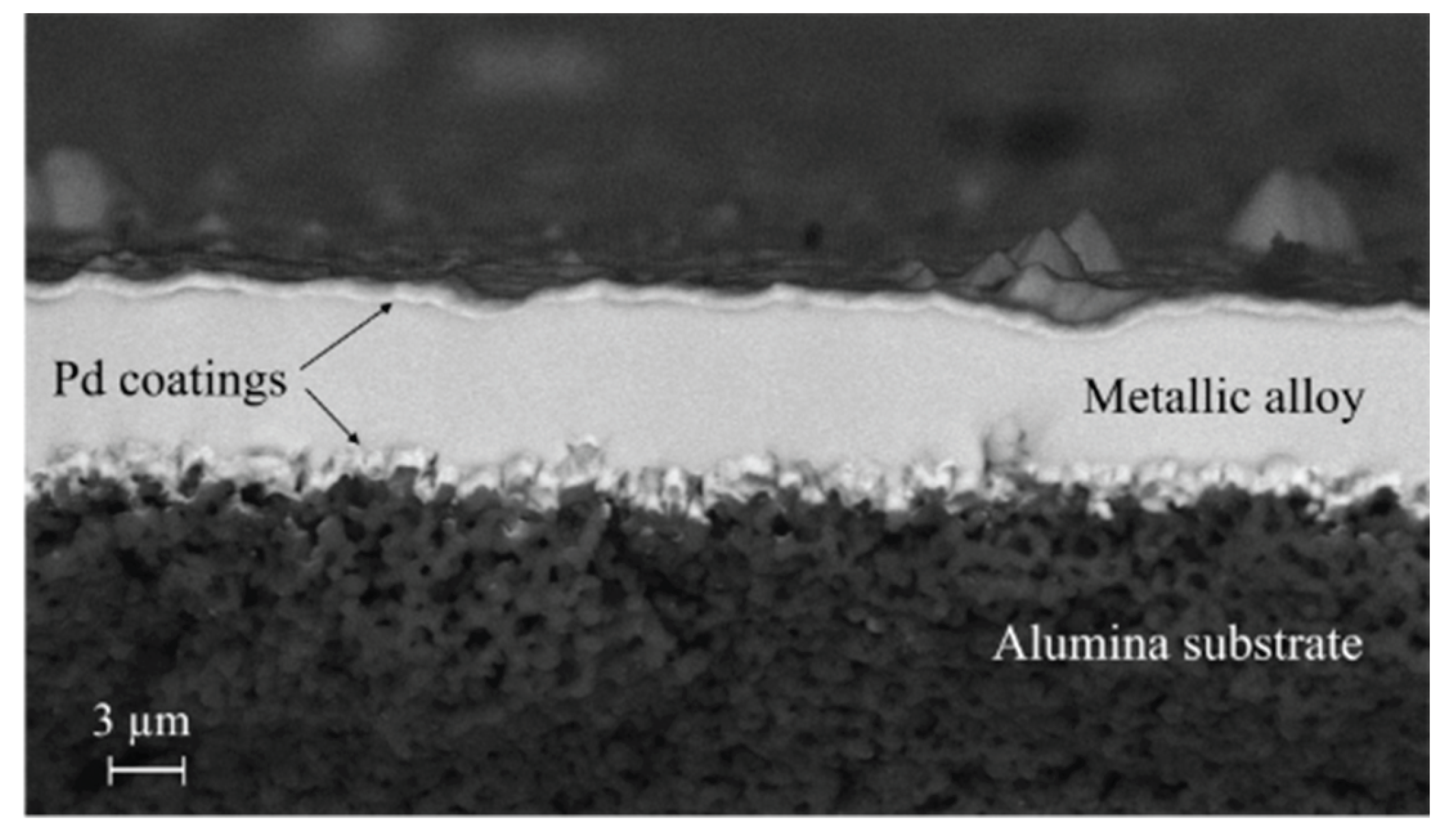
Figure 2.
SR and EI indexes for Pd and its potential substitutes. The red dotted lines indicate the criticality threshold values as defined in the 2023 European CRM study (1 for SR and 2.8 for EI) [11].
Figure 2.
SR and EI indexes for Pd and its potential substitutes. The red dotted lines indicate the criticality threshold values as defined in the 2023 European CRM study (1 for SR and 2.8 for EI) [11].
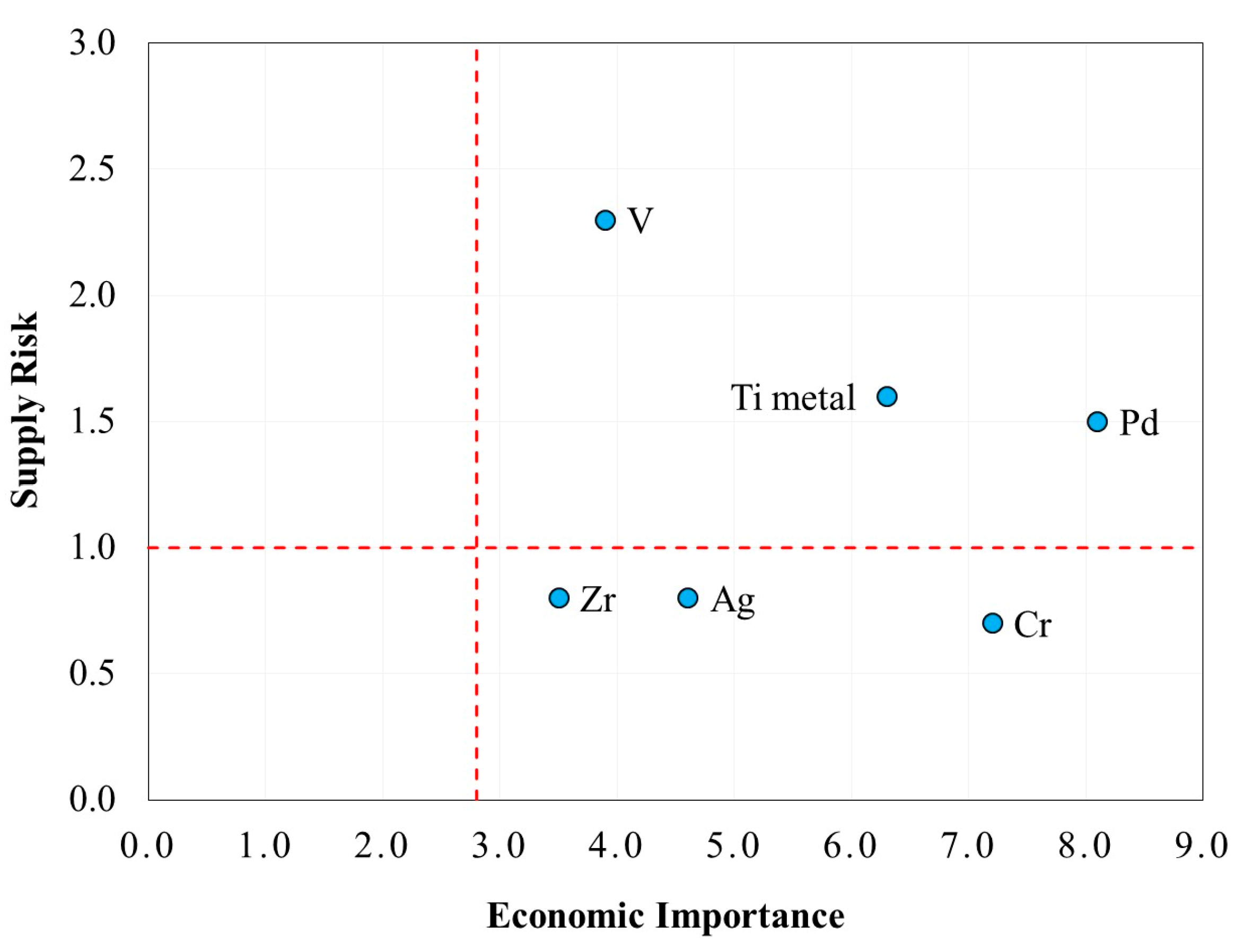
Figure 3.
Comparison of a) short-term and b) long-term criticality values, according to indexes of 2020 and 2022.
Figure 3.
Comparison of a) short-term and b) long-term criticality values, according to indexes of 2020 and 2022.
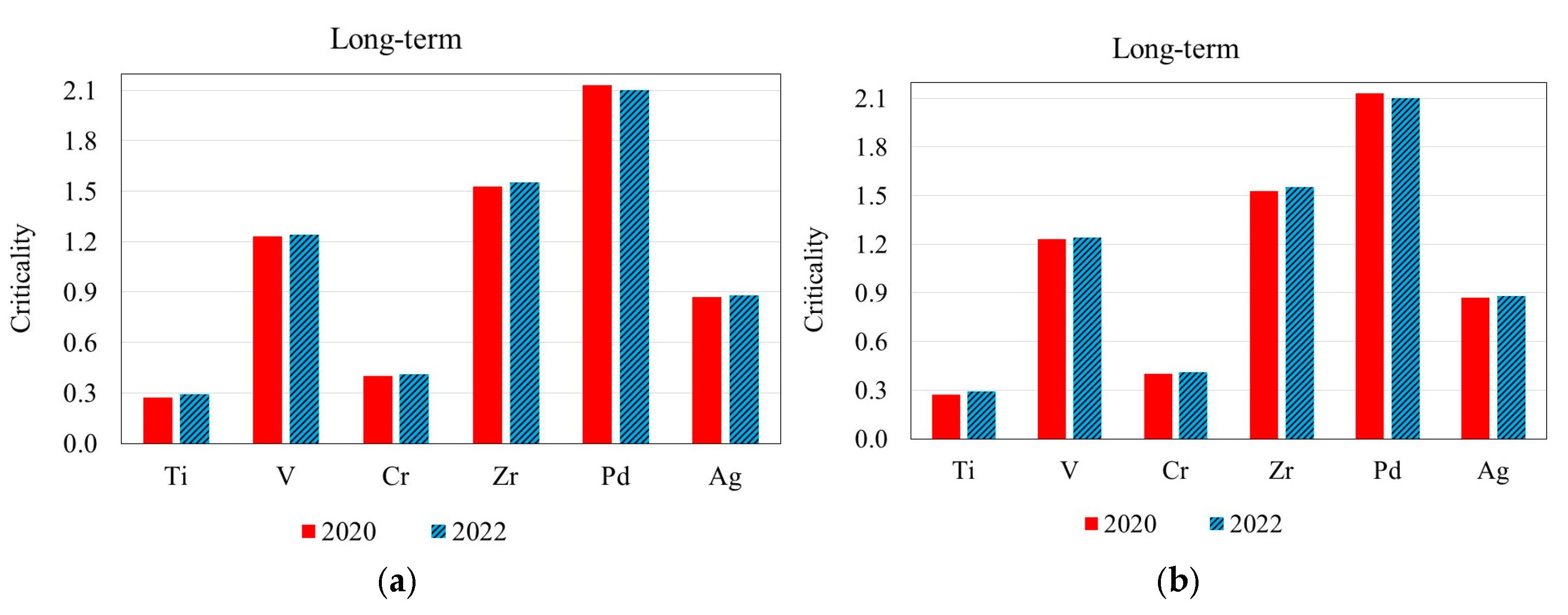
Figure 4.
Characterized results of the investigated elements to each environmental impact category (FU: 1 kg of each refined metal present in the membrane compositions).
Figure 4.
Characterized results of the investigated elements to each environmental impact category (FU: 1 kg of each refined metal present in the membrane compositions).
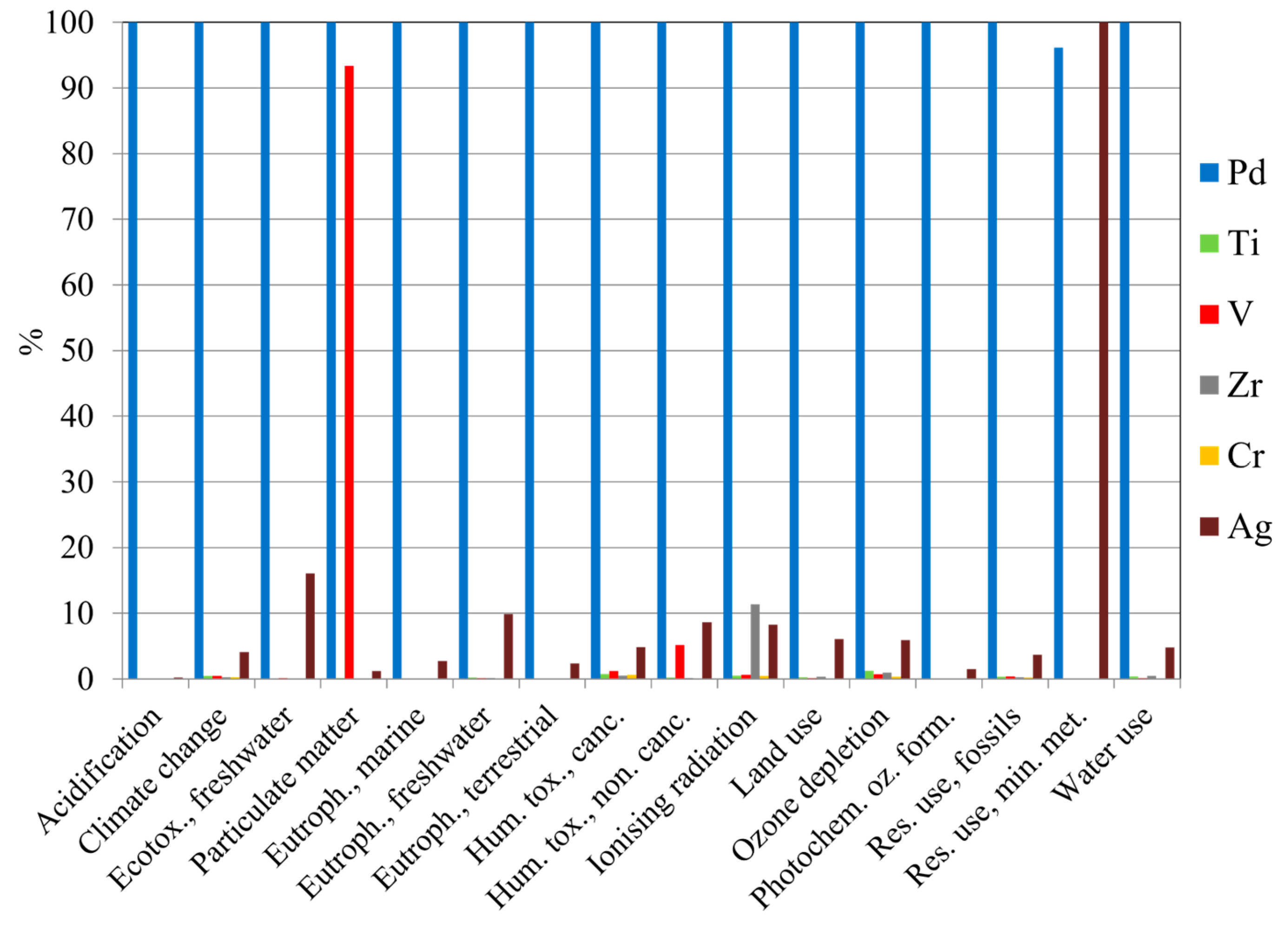
Figure 5.
Single score results of the elements studied. The dimensionless unit µPt stands for micropoints (FU: 1 kg of each refined metal present in the membrane compositions).
Figure 5.
Single score results of the elements studied. The dimensionless unit µPt stands for micropoints (FU: 1 kg of each refined metal present in the membrane compositions).
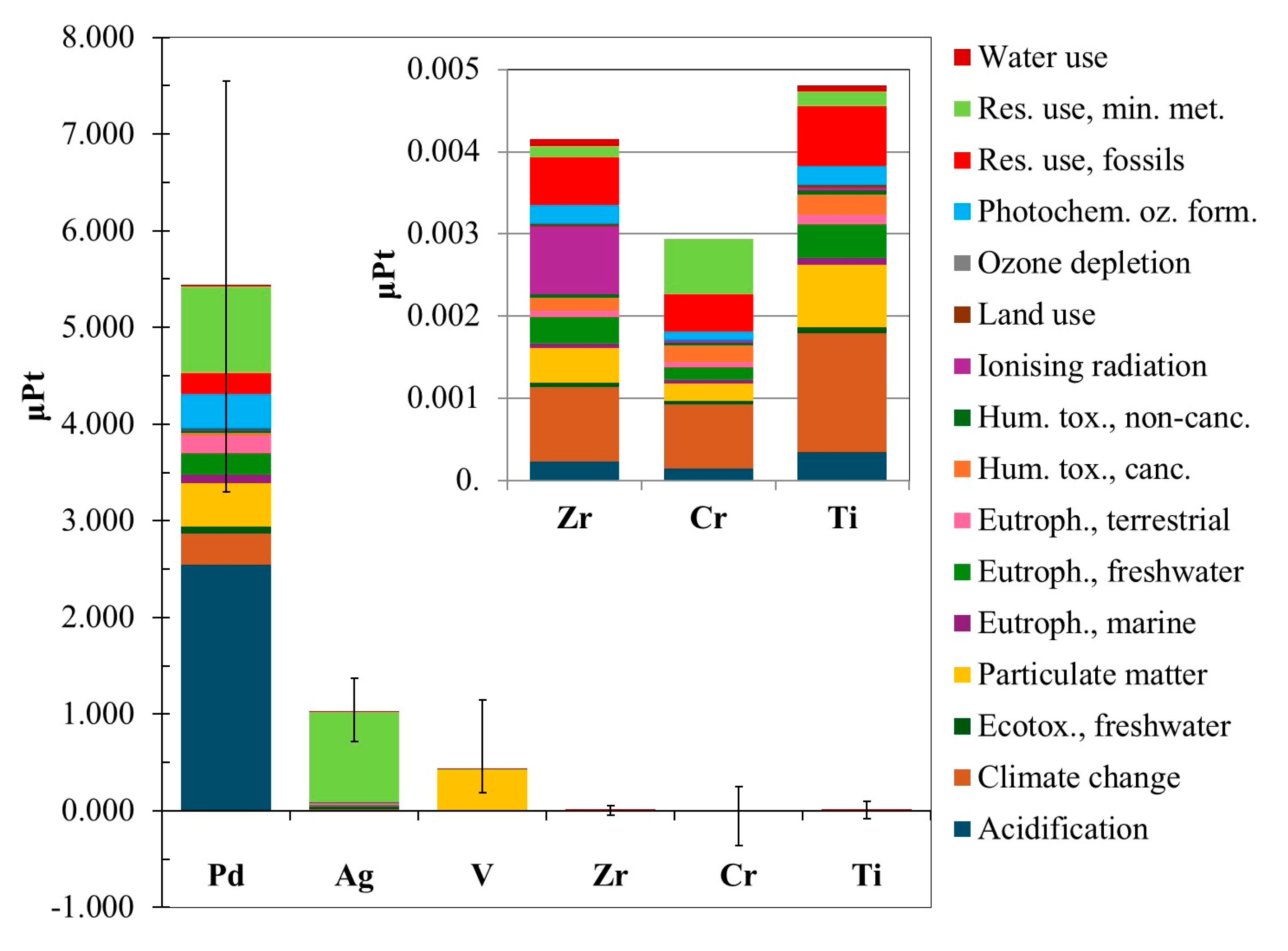
Figure 6.
Characterized results of the studied membranes (FU: the mass of membrane with 3.16 µm thickness, equal to the reference, deposited on 2.56 cm2 alumina substrate).
Figure 6.
Characterized results of the studied membranes (FU: the mass of membrane with 3.16 µm thickness, equal to the reference, deposited on 2.56 cm2 alumina substrate).
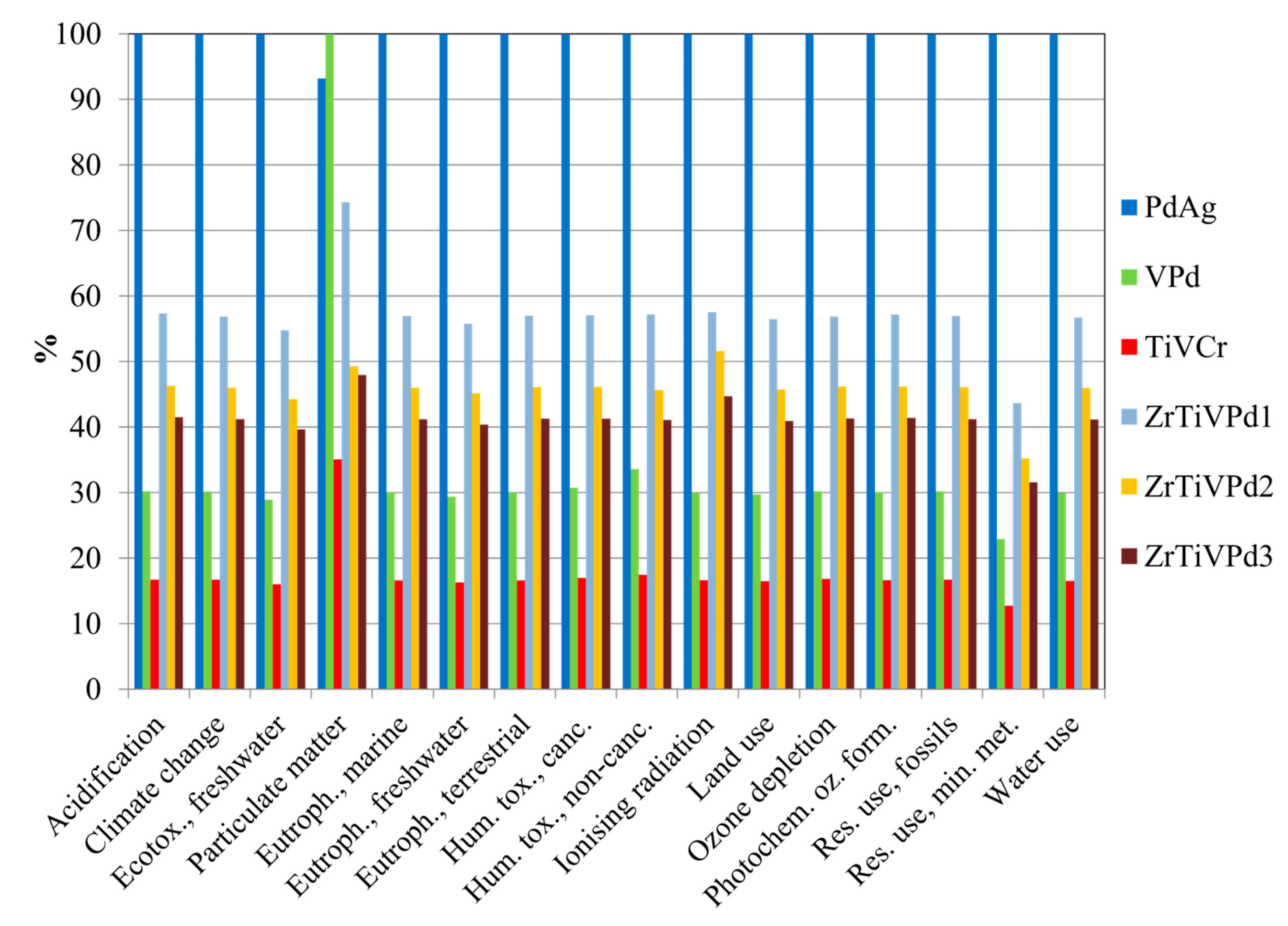
Figure 7.
Single score results of the studied membranes (FU: the mass of membrane with 3.16 µm thickness, equal to the reference, deposited on 2.56 cm2 alumina substrate).
Figure 7.
Single score results of the studied membranes (FU: the mass of membrane with 3.16 µm thickness, equal to the reference, deposited on 2.56 cm2 alumina substrate).
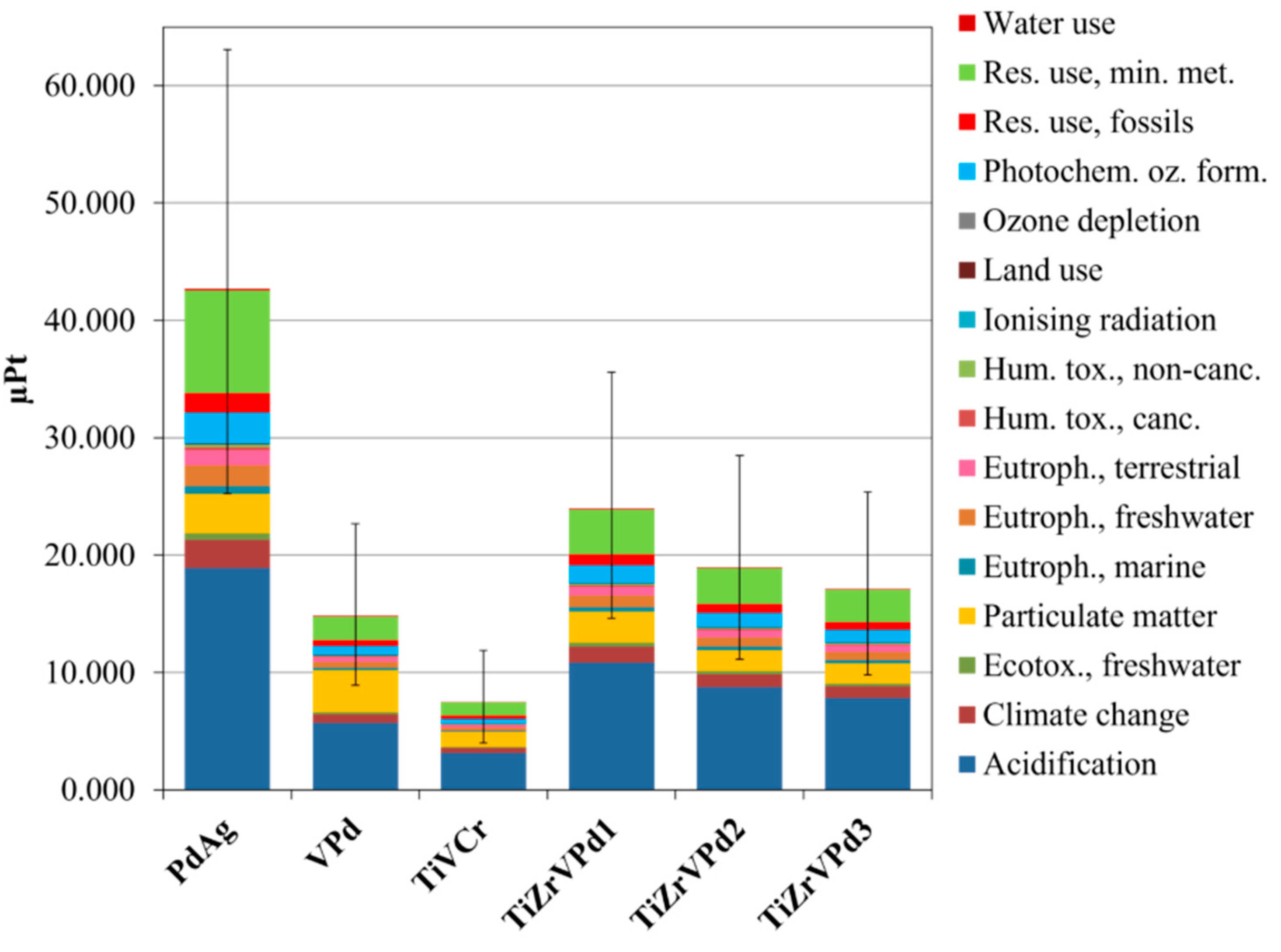
Figure 8.
Comparison of the characterized impact results between VPd and PdAg membranes for each impact category, derived from 100 Monte Carlo simulations (FU: the mass of membrane with 3.16 µm thickness, deposited on 2.56 cm2 alumina substrate).
Figure 8.
Comparison of the characterized impact results between VPd and PdAg membranes for each impact category, derived from 100 Monte Carlo simulations (FU: the mass of membrane with 3.16 µm thickness, deposited on 2.56 cm2 alumina substrate).
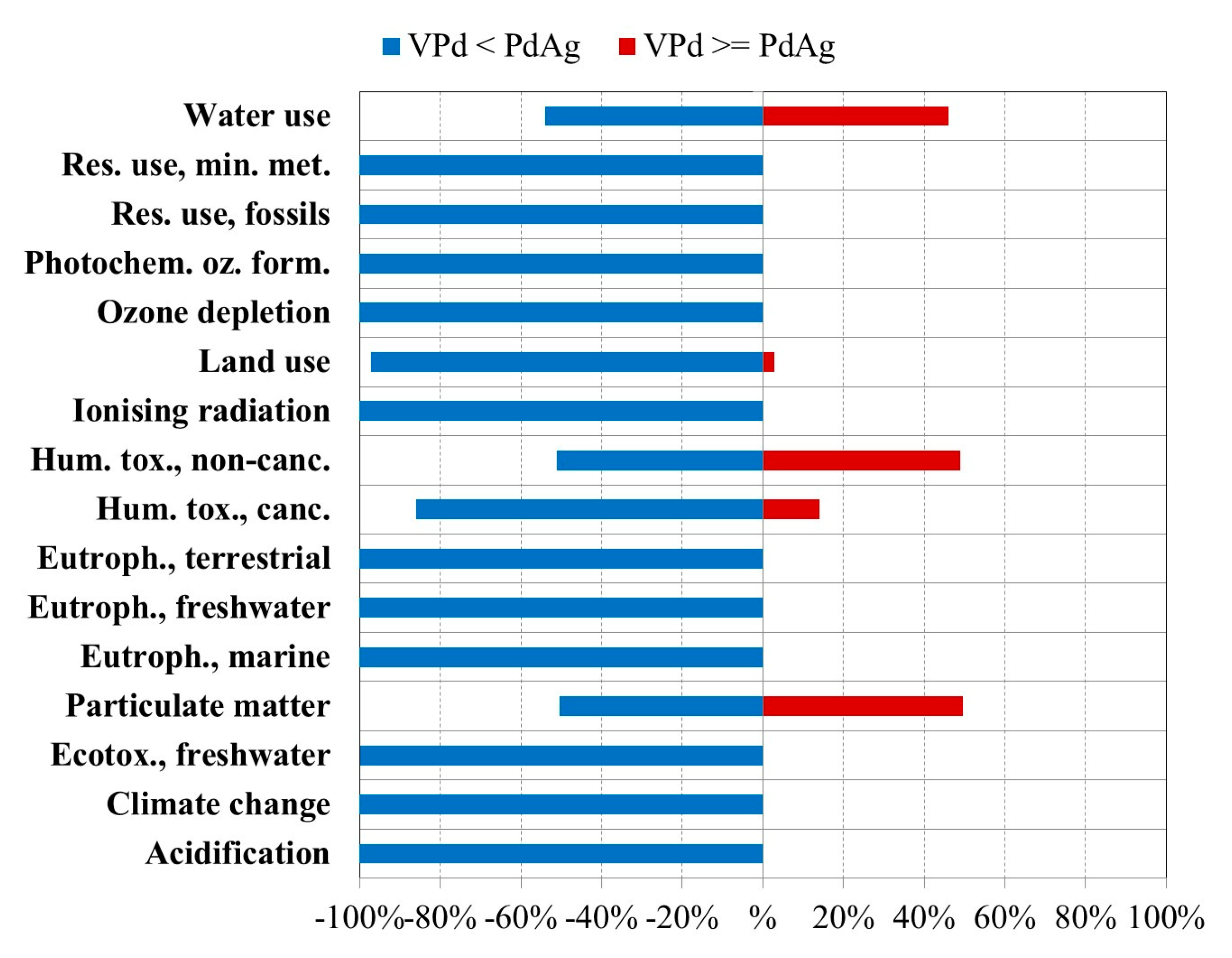

Table 1.
Composition of the metallic layer of the studied membranes and their features.
| Membrane | Composition | Thickness (μm) | Alloy Pd Content (wt%) | Selectivity |
| TiVCr | Ti20V33Cr47 | 2.0 ± 0.2 | - | 11 |
| VPd [29] | V93Pd7 | 3.5 ± 0.2 | 14% | 400 |
| PdAg [25] | Pd77Ag23 | 3.2 ± 0.2 | 65% | 222 |
| ZrVTiPd1 [10] | Zr9V34Ti30Pd27 | 4.7 ± 0.2 | 37% | 50 |
| ZrVTiPd2 [10] | Zr52V12Ti13Pd23 | 6.1 ± 0.2 | 36% | 100 |
| ZrVTiPd3 [10] | Zr39V20Ti19Pd22 | 6.4 ± 0.2 | 33% | 75 |
Table 2.
Unit processes and corresponding quantities (in kg) of the elements used in the studied membranes.
Table 2.
Unit processes and corresponding quantities (in kg) of the elements used in the studied membranes.
|
Element/ Ecoinvent process |
Pd77Ag23 | V93Pd7 | Ti20V33Cr47 | ZrVTiPd1 | ZrVTiPd2 | ZrVTiPd3 | |
| Pd | Palladium {GLO}| market for palladium | Cut-off, U | 0.768 | 0.136 | - | 0.419 | 0.291 | 0.299 |
| Ag | Silver {GLO}| market for silver | Cut-off, U | 0.232 | - | - | - | - | - |
| Cr | Chromium {GLO}| market for chromium | Cut-off, U | - | - | 0.481 | - | - | - |
| Zr | Zirconium triple-melt (modelled) | - | - | - | 0.120 | 0.563 | 0.455 |
| Ti | Titanium, triple-melt {GLO}| market for titanium, triple-melt | Cut-off, U | - | - | 0.188 | 0.209 | 0.073 | 0.116 |
| V | Vanadium triple-melt (modelled) | - | 0.864 | 0.331 | 0.252 | 0.073 | 0.130 |
Table 3.
Parameters and calculation of the short-term and long-term criticality for Pd and its potential substitutes according to the 2022 indexes [31] (accessed on 19.6.2025).
Table 3.
Parameters and calculation of the short-term and long-term criticality for Pd and its potential substitutes according to the 2022 indexes [31] (accessed on 19.6.2025).
| Element | P/R | Comp. | HHIres | Crit.LT | HHIprod | WGI | OECD | EOLRIR | Crit.ST |
| Pd | 0.16 | 0.97 | 0.97 | 2.100 | 0.34 | 0.2 | 0.00 | 0.22 | 0.053 |
| Ag | 0.02 | 0.72 | 0.14 | 0.880 | 0.1 | 0.08 | 0.00 | 0.75 | 0.002 |
| Cr | 0.15 | 0.02 | 0.24 | 0.410 | 0.22 | 0.18 | 0.02 | 1.00 | 0.000 |
| Zr | 0.03 | 1.00 | 0.52 | 1.550 | 0.21 | 0.28 | 0.00 | 0.06 | 0.055 |
| Ti | 0.10 | 0.00 | 0.19 | 0.290 | 0.11 | 0.16 | 0.00 | 0.33 | 0.012 |
| V | 0.18 | 0.74 | 0.32 | 1.240 | 0.36 | 0.28 | 0.53 | 0.01 | 0.289 |
Disclaimer/Publisher’s Note: The statements, opinions and data contained in all publications are solely those of the individual author(s) and contributor(s) and not of MDPI and/or the editor(s). MDPI and/or the editor(s) disclaim responsibility for any injury to people or property resulting from any ideas, methods, instructions or products referred to in the content. |
© 2025 by the authors. Licensee MDPI, Basel, Switzerland. This article is an open access article distributed under the terms and conditions of the Creative Commons Attribution (CC BY) license (http://creativecommons.org/licenses/by/4.0/).
Copyright: This open access article is published under a Creative Commons CC BY 4.0 license, which permit the free download, distribution, and reuse, provided that the author and preprint are cited in any reuse.