

Submitted:
24 September 2025
Posted:
25 September 2025
You are already at the latest version
Abstract
The study examines the travel behaviour and motivations of tourists visiting heritage attractions in the Sekhukhune District Municipality (SDM) in South Africa, as part of the sustainable development of rural heritage tourism. A quantitative approach through a means of a questionnaire was used to collect data from a sample size of 208 respondents at major heritage attractions in the study area. The results indicate that the respondents are primarily motivated by cultural performances, historical stories and sites associated with mining and agricultural heritage. The study identified that tourists are more concerned about the level of crime and environmental degradation as inhibiting factors to their attitudes and behaviours of participation. The study also demonstrates the socio-economic and environmental barriers rural municipalities deal with. The study provides practical recommendations for enhancing cultural engage-ment, addressing safety concerns, and promoting local economic development, thereby fostering a more sustainable and inclusive approach to heritage tourism in the SDM.
Keywords:
travel behavior
; travel motivation
; heritage tourism
; rural tourism
; cultural tourism
1. Introduction
Tourism in rural areas, particularly that which focuses on sustainable heritage tourism, plays a crucial role in economic growth and cultural preservation (United Nations World Tourism Organisation, 2024). Understanding tourists' travel behaviour and motivations in such contexts is essential for effective tourism planning and development (Chen, Wang, Zou & Li, 2022). Rural municipalities often face unique challenges and opportunities in balancing tourism growth with environmental and cultural sustainability (Dias, Viana & Pereira, 2024). Heritage tourism stands at the crossroads of opportunity and growth, particularly in the context of Africa's development, with Saarinen and Rogerson (2015) highlighting its significance as a powerful driver of economic progress on the continent. This form of tourism transcends the conventional boundaries of cultural exploration and instead looks into rich, tangible and intangible heritage. Van der Merwe (2016) underscores the broad spectrum that heritage tourism encompasses, covering natural, cultural and industrial heritage, all of which are found at specific locations across the globe, often in forgotten rural areas. To look deeper into these classifications, it is essential to understand the diverse elements that comprise heritage tourism as outlined by the United Nations Educational, Scientific and Cultural Organisation [UNESCO] (2024). Despite global research on heritage tourism, limited evidence exists on rural South African municipalities, which this study addresses.
Natural heritage, which forms a foundational pillar, encompasses ecological elements. It unveils the perfect beauty of the environment and highlights the ecological marvels that motivate tourists to visit destinations worldwide (UNESCO, 2023). In contrast, Phori (2023) highlights that cultural heritage focuses on the anthropological and historical facets of societies, revealing the customs, traditions and historical narratives that define a community. Andrieux (2022) also indicates that industrial heritage explores the relics of bygone industrial eras, shedding light on activities such as mining and manufacturing that have left their imprints on the landscape. Heritage tourism is a type of travel which incorporates both supply and demand side elements, where heritage is considered the main product (supply) and also the primary motivator for visitors (demand).
Motivation can be described as an integral component of human experience (Morris, Grehl, Rutter, Mehta, & Westwater, 2022). Mengich (2013) defines motivation as a state of necessity, a circumstance that drives an individual toward specific forms of behaviour perceived as capable of yielding gratification. Despite these definitions, there is still controversy regarding who exactly could be considered a heritage tourist. Nguyen and Cheung (2013) suggest that heritage tourists can be identified and classified based on their travel motivations, as it influences their behaviour at a destination. Meanwhile, Subadra, Sutapa, Artana, Yuni and Sudiarta (2019) argue that tourists' behaviour at a destination is closely related to their motivations for travelling to that destination. Tourists can be grouped based on their expressed behaviour predictors, such as their choice of destination and their experiences during their visit. Having knowledge about the motivation of tourists enables tourism practitioners to intervene more effectively at various stages of the visitors' decision-making process (Negrușa & Yolal, 2012:549). According to Kruger, Saayman and Hermann (2014), the successful management of visitor services can only be achieved by first comprehending the reasons behind visitors' travel choices. By understanding the motivations and activities of tourists, tourism service providers can enhance their offerings and gain insight into their customers' preferences and origins (Muzeza, Hermann & Khunou, 2018). This understanding is crucial for improving products and services and tailoring them to meet the specific needs and desires of visitors.
This study places a specific focus on the Sekhukhune District Municipality (SDM), which is located in the Limpopo Province, South Africa's northernmost province (Chen, Wang, Zou & Li, 2022). The district, as shown in Figure 1, comprises four local municipalities, namely: Elias Motsoaledi, Ephraim Mogale, Fetakgomo-Tubatse and Makhuduthamaga (Phori, Hermann & Grobbelaar, 2024; Department of Cooperative Governance and Traditional Affairs, 2024). The municipality is known for its rich cultural heritage and historical significance, which play an essential role in its local tourism and development strategies (SDM, 2024).
The study addresses an underexplored gap by focusing on tourist behaviour and motivations in Sekhukhune District Municipality to understand how these influence sustainable rural heritage tourism planning. A deep understanding of these behaviours and motivations is essential for developing rural tourism products, improving marketing strategies, enhancing service delivery and creating competitive advantage (Phori et al., 2024). The findings will also guide the formulation of policies that align with tourists’ expectations while addressing their concerns, fostering responsible and sustainable rural heritage tourism development (Alvarez-Sousa, 2018). Yet, the challenge in SDM extends beyond understanding tourists; it lies in achieving a balance between the growth of rural heritage tourism and the preservation of the district’s natural and cultural treasures (Sieras, 2024). Striking this balance is vital to prevent overexploitation and safeguard rural heritage resources for future generations.
2. Literature Analysis
Heritage tourism is a mixed field that encompasses both tangible and intangible aspects of cultural and historical significance (UNESCO, 2023). As a tourism product, heritage sites, artefacts, and traditions may hold immense potential for attracting tourists seeking authentic experiences and a deeper understanding of a destination's identity. In this case, the tourist’s essential motivation to travel is to learn, discover, experience and consume the tangible and intangible cultural attractions/products in a tourism destination (Sonuç, 2022). To support this study, the literature review examines the role of heritage as a tourism product. Additionally, it examines the complex dynamics of heritage tourism, exploring the interplay between tangible heritage, such as historic monuments and museums, and intangible elements like traditions, folklore, and local customs, as well as indicators for sustainable tourism within the context of heritage destinations. By investigating these dimensions of heritage tourism, this review provides valuable insights into travel behaviour and tourists’ motivations for heritage tourism.
2.1. Characteristics of Heritage Tourism Products
The relationship between tourism and heritage has been extensively discussed in academic literature, leading to the development of the concept of 'heritage tourism' (Fernández et al., 2016). Shifflet and Associates (1999) categorise heritage tourists based on the importance of heritage tourism in their choices of visits, namely 1) core heritage travellers, 2) moderate heritage travellers and 3) low heritage travellers. Even though heritage tourism is considered a novel concept in academic literature, it is one of the oldest forms of leisure travel (Phori, 2023). Heritage tourism generally involves, amongst other purposes, visiting special and unique objects and places associated with royalty or the elite, which increases its appeal (Navarrete, 2019). It has gained significant importance in the tourism industry due to its significant value in cultural, historical and environmental dimensions (Ballantyne, Hughes, Ding & Liu, 2014). Heritage attractions and activities include a wide range of cultural and historical elements. These include historic sites, cultural landscapes, ruins and archaeological sites associated with mining, industrial, and agricultural heritage, along with places of important events, which are also significant (Angelidou, Karachaliou, Angelidou & Stylianidis, 2017). Collections, including museums, trails and festivals, promote objects of heritage value, while created landscapes and built structures further showcase heritage (UNESCO, 2023). According to UNESCO (2020), cultural performances, languages, rituals, and social practices are integral to cultural heritage. Traditional dance, music, human activities, multi-cultural interactions, stories and histories, as well as traditional cuisine, are key elements that shape the identity and essence of communities (Forgeard, 2023).
Heritage tourism may bring about positive and negative effects to local communities. On the positive side, heritage tourism can play a critical role in promoting tourism-led local economic development, especially in economically weak or marginalised areas of the country (Rogerson, 2014; Rogerson, 2015; Rogerson & Nel, 2016; Rogerson & Van der Merwe, 2016). This is particularly relevant in South Africa, where heritage tourism has been identified as a key driver of regional development and economic upliftment (Magutshwa, 2020). Recent research underscores the importance of heritage tourism in sustaining local craft markets and empowering local artisans through tourist demand (Nkwanyana & Ndlovu, 2021). Additionally, it has been shown to improve infrastructure and enhance the visibility of previously overlooked heritage sites (Tlabela & Munzhedzi, 2022). In addition to preserving and promoting traditions, customs and knowledge, heritage tourism boosts the local economy and increases employment opportunities (Weng, Liu & Zhang, 2019). The strategic use of heritage assets as tourism products can stimulate growth in related sectors such as hospitality, retail and transportation, contributing to a diversified local economy (Marschall, 2019). Therefore, heritage assets should be viewed not just as cultural treasures but as valuable products for tourism consumption.
On the negative side, many heritage tourism attractions were not originally intended for tourism, and developing and managing these assets as tourism products requires a sensitive and balanced approach (Navarrete, 2019). Negative impacts can include the physical deterioration of heritage sites due to overuse, as well as disruptions to local communities through increased foot traffic, commercialisation and the commodification of cultural traditions (Yang & Wall, 2020; Su, 2021). In South Africa, over-commercialisation has been noted as a growing concern, where the focus on economic benefits can undermine the authenticity of cultural experiences and alienate local communities (Ndhlovu, 2022). Studies also highlight issues of unequal access to heritage tourism benefits, with larger operators profiting more than local communities, leading to socio-economic disparities (Briedenhann & Wickens, 2020). This can lead to the erosion of the heritage’s intrinsic value and a disconnection between heritage custodians and their cultural assets.
2.2. Heritage Tourism: Tangible and Intangible
According to Bonet (2013), heritage tourism refers to the intentional and voluntary engagement of tourists with heritage by visiting or consuming heritage products and services outside of their usual place of residence. The Heritage Tourism Initiative Core Team (2020) defines heritage tourism as a concept which encompasses aspects of the living culture, history, and natural history of a place which is highly valued and preserved by communities for the future. In South Africa, tourism has become an increasingly important sector of the economy, providing both revenue and potential solutions to poverty reduction (Habanabakize & Dickason-Koekemoer, 2021). The growth of the tourism industry has also led to the development of niche or special interest tourism (Henama, 2017), such as heritage tourism.
George (2013) highlights the significance of niche tourism in achieving the objectives of the South African National Department of Tourism, such as increasing the duration of the tourist’s visit and expenditure, broadening geographical distribution, boosting volume, reducing seasonality and promoting transformation in the industry – all contributing to the economy. Apart from boosting the economy, Viljoen and Henama (2017) suggest that heritage tourism is a crucial element in promoting the identity of a region or country and may be used to express both national and regional unity, touching on the intangible value of heritage tourism. Khumalo et al. (2014) show that heritage tourism encompasses both tangible and intangible aspects of culture and heritage, as well as the contemporary use of the past. These explanations are comprehensive as they account for the historical significance of cultural and historical events and values, which are both tangible and intangible, and their influence on modern civilisation. Smith and Richards (2013) assert that heritage tourism is an extensive category of specialised travel which involves a yearning for the past and a wish to encounter diverse cultural forms, both tangible and intangible. Tangible heritage tourism denotes tourism activities which engage with physical artefacts which are produced, preserved and passed down between generations within a society. Lorton Consulting (2024) provides examples of tangible heritage tourism, which include artistic creations, built heritage, such as buildings and monuments, and other material or physical products of human creativity which are endowed with cultural significance in a community. The existence of intangible heritage tourism involves showcasing cultural practices, expressions, knowledge, skills and associated artefacts recognised as part of a community or group's cultural heritage (UNESCO, 2020). Examples of intangible heritage tourism include oral traditions, local languages, social practices, rituals, beliefs and performing arts, among others. Lötter (2016) support the notion of tangible and intangible heritage tourism by showing that the latter is a niche form of tourism which includes travel to cultural festivals and events, visits to sites and monuments, travel to study nature, folklore, art or pilgrimages. According to Isa, Ismail and Fuza (2020), heritage tourism, both tangible and intangible, is experiencing growth despite economic challenges, due to higher levels of education, increased income, greater global awareness, the effects of technology and media, and the emergence of new types of heritage attractions, to name a few contributing factors.
To determine whether tourism development at a destination is sustainable, a set of indicators measuring progress toward sustainable development must be used (Dimoska & Petrevska, 2012). These indicators help identify current issues, potential risks and necessary actions while also evaluating the outcomes of implemented measures (Griffin, 2011). Dimoska and Petrevska (2012) emphasise that these indicators must meet criteria such as relevance, availability, meaning and reliability to be effective. When applied to heritage tourism, these indicators also help assess the motivations driving visitation, including cultural preservation, education, and spiritual enrichment. Heritage tourism motivations often involve intangible cultural elements, making the interconnection of tourism impacts even more significant (Khunou, 2016). Sustainable tourism indicators are vital for destination managers to mitigate risks and promote sustainable development at all levels (UNWTO, 2004; Griffin, 2011). Indicators related to the socio-cultural, economic and environmental dimensions of sustainability (Ceron, 2003; Gebhard, Meyer & Roth, 2007) are highly relevant in heritage tourism, where preserving cultural integrity and ensuring economic benefits for local communities are key concerns. Indicators related to local satisfaction, such as perceptions of tourism’s contribution to infrastructure and services, or the balance between tourist influx and local needs, must be customised to reflect the unique motivations behind heritage tourism (Dimoska & Petrevska, 2012). Understanding tourist satisfaction within heritage contexts includes assessing factors such as cultural authenticity, educational value and return visitation (Bam & Kunwar, 2020). Sustainable heritage tourism also involves managing environmental impacts by considering resource conservation, such as energy and water use and preserving the integrity of heritage sites through responsible waste management and conservation efforts (European Space Agency, 2024).
2.3. Tourist Motivations and the Theory of Planned Behaviour
Heritage tourism motivations are an important element to consider when applying sustainable tourism indicators, as they influence both the socio-cultural and economic dimensions of sustainability. Tourists are often driven by a desire to connect with history, culture, and identity, which underscores the importance of preserving and promoting heritage sites in a sustainable manner (McKercher & du Cros, 2018). These motivations also relate to indicators like local satisfaction, as communities benefit from the preservation and interpretation of their heritage, fostering a sense of pride and identity (Su & Wall, 2019). Additionally, heritage tourism can drive economic sustainability by attracting tourists who contribute to the local economy through spending on accommodation, transport, and other services. Consequently, incorporating heritage tourism motivations into sustainable development frameworks is crucial to ensure that the cultural significance of destinations is maintained while achieving socio-economic benefits (Timothy, 2017). These indicators have the ability to measure factors such as tourist motivations in heritage destinations, including the desire for historical knowledge, identity formation or connection to ancestral roots.
To deepen this understanding, the Theory of Planned Behaviour (TPB) provides a structured framework for linking tourist motivations with behavioural intentions. Developed by Ajzen (1991), TPB explains how attitudes, subjective norms and perceived behavioural control shape behavioural intentions. This framework is particularly relevant for rural municipalities such as the SDM, where heritage tourism relies on both cultural preservation and sustainable practices. By aligning motivations with TPB constructs, this study examines not only why tourists visit heritage sites but also how their intentions translate into behaviours that support sustainability. For instance, a study by Han et al. (2020) demonstrated that tourists' environmental motivations significantly influence their intentions to engage in sustainable tourism. This is crucial for rural municipalities that rely on natural and cultural heritage as primary attractions. Motivations towards sustainable tourism, such as environmental conservation and cultural preservation, are important in determining whether tourists will engage in behaviours that support these goals (Vos, 2020). Subjective norms, or the perceived social pressure to perform or not perform a behaviour, also play a vital role in relation to the TPB (Ajzen & Kruglanski, 2019). In the context of tourism, subjective norms may include the influence of friends, family and societal expectations on tourists' decisions to engage in sustainable practices (Guggenheim et al., 2020; Han & Hyun, 2017; Kim & Hwang, 2020). Lee and Jan (2019) found that tourists are more likely to participate in eco-friendly activities when they believe that significant others expect them to do so. This finding is particularly relevant for SDM, where promoting community-led tourism initiatives can create a normative environment that encourages sustainable practices.
Perceived behavioural control, the third component of TPB, refers to the perceived ease or difficulty of performing the behaviour and is closely linked to self-efficacy (Kim & Hwang, 2020). In sustainable tourism, this could involve tourists' perceptions of their ability to minimise their environmental impact or support local heritage conservation efforts. Lam and Hsu (2021) highlight that tourists are more inclined to engage in sustainable behaviours if they feel capable and equipped with the necessary knowledge and resources. For SDM, enhancing tourists' perceived control could involve providing clear information about sustainable practices and ensuring that facilities and services support these behaviours (Huang et al., 2020). The TPB may provide a comprehensive framework for understanding and influencing tourists' perceived behaviours regarding heritage tourism in rural municipalities. By addressing attitudes, subjective norms and perceived behavioural control, SDM may develop targeted strategies to promote sustainable tourism practices that preserve its rich natural and cultural heritage.
Heritage tourism continues to grow despite global economic challenges (Isa, Ismail & Fuza, 2020:6). This growth is attributed to factors such as higher levels of education, increased income, enhanced global awareness, the influence of technology and media and the emergence of new types of heritage attractions. Consequently, understanding tourists' motivations for visiting heritage sites is of paramount importance (Negrușa & Yolal, 2012). Several theorists, including Maslow (1943), Dann (1977), Crompton (1979) and Iso-Ahola (1982), have developed theories on motivation that help explain tourist behaviour. Maslow's (1943) hierarchy of human needs arranges these needs from the most fundamental to the most advanced: physiological needs, safety needs, social needs, esteem needs, and self-actualisation needs (Whitaker, 2019; Ștefan, Popa & Albu, 2020:126). The theory suggests that once a particular need is satisfied, it ceases to be a motivator, prompting the individual to pursue the next level of need.
Dann (1977) and Crompton (1979) introduced the concepts of push and pull factors to elucidate tourism behaviour. Pull factors are external elements that attract individuals to a destination, accommodation, or event, whereas push factors are internal psychological forces that generate a desire to travel. Pull factors are associated with external, situational, or cognitive aspects of motivation and can stimulate push factors. Crompton (1979) identifies two pull factors - novelty and education, and seven push factors: (1) the need to escape from a mundane environment; (2) the desire for self-exploration and evaluation; (3) the need for relaxation; (4) the pursuit of prestige; (5) the desire to regress to a previous state; (6) the enhancement of kinship relationships; and (7) the facilitation of social interaction (Yoon & Uysal, 2005; Crompton, 1979). A study by Mangwane, Hermann and Lenhard (2019) emphasises the importance of attraction attributes as pull factors motivating individuals to visit heritage sites. Additionally, various factors contribute to pushing individuals towards specific actions that are anticipated to bring satisfaction.
Iso-Ahola’s (1982) model posits that two primary motivational forces influence tourism behaviour: escapism and the search for novelty. Expanding on this, Fodness (1994) categorises tourists' motivations for visiting destinations into five motives: (1) cultural or knowledge-seeking; (2) educational; (3) pleasure and sensation-seeking; (4) self-esteem and social prestige-seeking; and (5) escape, stimulus-avoidance or punishment minimisation. These travel motives corroborate the findings of previous studies by Kruger and Saayman (2013), Viviers, Botha and Perl (2013), Hermann and Du Plessis (2014), Hermann, Van der Merwe, Coetzee and Saayman (2016), Muzeza, Hermann and Khunou (2018), and Grobbelaar, Bouwer and Hermann (2019), which indicate that tourists possess varied travel motives specific to different tourism offerings. Mbaiwa and Siphambe (2023) show how rural heritage tourism shapes community livelihoods in Botswana and other African settings. Their findings link directly to the challenges faced by SDM in balancing cultural preservation and economic gains.
3. Materials and Methods
This study made use of a descriptive quantitative methodology utilising a survey research design. A quantitative research method was chosen to quantify tourists’ behaviour and motivations, with a focus on analysing data using statistical methods. The participants had a clear understanding of the study's objective and their consent was obtained prior to data collection. The researcher ensured that each participant provided written consent. Data were collected from tourists at various attractions in the SDM from visiting tourists. A five-point Likert-type questionnaire was used to gather information on tourists’ perceptions on heritage tourism development. A non-random convenience sampling method was used to select the 208 (N) respondents from various SDM respondents. The sample size was deemed appropriate as the researcher conducted a Cronbach alpha test on the results to check for reliability.
The survey was adapted from previously validated instruments developed by Hermann and Bouwer (2023) and Ngondo, Hermann and Venter (2024). Sections A, B, and C of the questionnaire covered demographics, travel behaviour and motivations, respectively. Before collecting actual data, it was necessary to validate the research instrument. The research instrument which in this case, tourists’ questionnaire, underwent a pre-data collection test to determine its effectiveness in measuring the intended variables, among other reasons. This preliminary test is commonly referred to as a pretesting and is widely accepted as an essential part of quantitative research (Jennings, 2001). The pretesting of the survey involved a small number of tourists at the Tswaing Meteorite Crater, north of Pretoria, in the City of Tshwane Municipality. The feedback received indicated that the instrument was effective, as respondents understood the questions and found the provided response options to be adequate.
Responses were rated on Likert scales and analysed using statistical analysis software, employing descriptive, inferential and regression statistical methods to understand tourists' perspectives on sustainable rural heritage tourism. The study used a descriptive statistical method and regression analysis to provide an overview of the significant perceptions of SDM tourists. To ensure the internal consistency of the survey, the researcher performed the Cronbach's alpha reliability test, revealing scores of 0.7 or higher, indicating suitability for descriptive research (Zhang & Li, 2023). Consequently, the items demonstrating such reliability were retained, affirming convergent consistency within the construct.
4. Results
The primary objective of the survey was to gain insights into respondents' behaviour and motivations for engaging in heritage tourism within the SDM region. Specifically, it examined the frequency of visits for heritage-related purposes, the enjoyment and engagement with various attractions and activities and analysed regression coefficients to understand factors influencing these behaviours. Findings are compared with international studies to highlight theoretical contribution, extending motivation theory in a rural African context.
4.1. Frequency of Travelling for Heritage Tourism Purposes
This section examined the number of times the respondents had previously travelled for heritage tourism purposes in a year. The results obtained are presented in Table 1.
Most of the respondents (59%) travelled for heritage tourism purposes at least twice a year, followed by 31% who travelled for heritage tourism once a year. Only a small number of respondents (10%) indicated that they frequently travelled for heritage tourism more than twice a year. The first two groups represent a great potential for understanding the behaviours of tourists regarding rural heritage tourism at SDM.
4.2. Attractions/Activities, Enjoyment and Participation
In this section, respondents were requested to indicate the attractions they enjoy visiting and activities they enjoy participating in when travelling for heritage tourism purposes. The responses are summarised in Table 2. Respondents had to indicate their top three types of heritage attractions and activities of choice.
The top three types of heritage attractions and activities respondents enjoyed visiting, as indicated in Table 2, were: cultural performances at 50%, stories and histories which shape the character and essence of the host community at 36%, and visiting sites associated with mining, industrial and agricultural heritage at 34%. Two other attraction types and activities, which were rated high by the respondents, included traditional dance, drama and music at 33%, visiting ruins and archaeological sites, and visiting sites of important events and commemorations at 25%. It is evident from these results that SDM possesses various types of tangible (UNESCO, 2020) and intangible (Manetsi, 2017) tourist heritage attractions and activities, which have been recognised by the SDM in its STR project, which has never been implemented.
4.3. Regression Coefficients Results
The study further explored how various travel motivators influence tourists' perceptions and attitudes toward heritage tourism (Table 3). By analysing the relationship between these motivators and respondents' awareness, respect for local culture, crime perception and participation in cultural activities, the study aims to provide insights into how different factors can enhance or impede travel motivations towards heritage tourism. The regression results offer a detailed examination of these relationships, highlighting significant predictors and their impact on tourists' overall experiences and satisfaction with heritage tourism.
The regression analysis underscores several motivations shaping tourists' perceptions and experiences in SDM’s heritage tourism landscape. The overall R-squared value of 0.0446 indicates that a small yet significant portion of the variance in travel motivations is influenced by respondents' perceptions and attitudes. Key motivation results reflect the complexity of heritage tourism experiences, where positive engagements with local culture and nature are often tempered by concerns over social and environmental factors.
One prominent motivator, the opportunity to learn about other cultures, positively correlates with tourists' experiences in cultural activities (Beta = 0.3316, p = 0.0114), which aligns with Khumalo et al. (2014), who emphasise that the quest for cultural enrichment drives heritage tourism. This aligns with Iso-Ahola's (1982) concept of "novelty-seeking" as a fundamental motivator in heritage tourism.
Additionally, those who wish to participate in cultural performances, traditional dance and cuisine report an increased appreciation for learning about other cultures (Beta = 0.4028, p = 0.0020). This reinforces the role of cultural authenticity, as highlighted by Su & Wall (2019), in strengthening tourist engagement with heritage tourism through immersive experiences.
Similarly, the motivation to visit museums and galleries is associated with income generation for community members, though this relationship is negatively impacted by perceptions of crime (Beta = -0.1892, p = 0.0342). This reflects how crime can diminish tourists' engagement in specific heritage attractions, as observed by Rogerson and Van der Merwe (2016). Another insight is that the desire to appreciate nature links to concerns over pollution (Beta = 0.2194, p = 0.0493), echoing findings by Dimoska and Petrevska (2012), who argue that sustainable tourism indicators should address environmental quality to enhance visitors' experiences in heritage sites.
Interestingly, motivations to participate in recreational activities are impacted by the perception of crime (Beta = -0.2459, p = 0.0210) and concerns about littering (Beta = -0.2448, p = 0.0334), suggesting that tourists’ willingness to engage in outdoor heritage activities is sensitive to the quality of the local environment. This observation is supported by George (2013), who notes that environmental degradation can directly affect tourist satisfaction and their propensity to visit heritage attractions.
The motivation to "do something out of the ordinary" is positively associated with enhanced participation in cultural activities (Beta = 0.2662, p = 0.0309), further supporting the notion that experiential and unique activities can elevate tourists' cultural engagement (Mangwane, Hermann & Lenhard, 2019). Additionally, tourists who seek experiences in art and craft consumption report concerns over disease prevalence in the community (Beta = 0.3010, p = 0.0107). This highlights the importance of health-related infrastructure in rural heritage tourism, as poor health perceptions can deter potential tourists (Gupta & Dada, 2014).
The desire to experience architecture is positively associated with poverty alleviation perceptions (Beta 5 = 0.1850, p = 0.0265), which reflects the broader economic aspirations often tied to heritage tourism (Magutshwa, 2020). This motivation points to a sense of socio-economic responsibility and a desire to contribute to community upliftment through tourism, reinforcing findings from Rogerson (2015) that heritage tourism holds potential for driving local economic development.
Lastly, the motivation to share a familiar or unfamiliar place with others is tempered by the perception of rising property values and littering issues, with tourists indicating concern over the environmental and social consequences of tourism expansion (Beta = -0.2345, p = 0.0153; Beta = -0.2448, p = 0.0334). This aligns with Su and Wall's (2019) findings that sustainable tourism strategies should aim to balance economic benefits with environmental integrity to maintain heritage sites’ long-term attractiveness.
5. Conclusion and Recommendations
This study explored the travel behaviours and motivations of tourists visiting rural heritage attractions in the SDM, and findings align with the broader comparative evidence. Mbaiwa and Siphambe (2023) note that, in Botswana, rural heritage tourism also faces the competing demands of livelihoods and heritage preservation. In turn, Chen et al. (2023) establish a strong link between perceived heritage value and satisfaction, which is consistent with the regression analysis of the present study. Giliberto et al. (2023) established that crime perception and degradation of the natural environment impact post-COVID-19 tourist behaviour in Africa. Wijayanti et al. (2023) demonstrate the importance of community-based tourism management, noting that all of them reinforce the need for fair engagement from communities. Brooks et al. (2023) point out that without equitable benefit sharing and engagement, local communities remain at risk. Together, these studies provide further justification for the recommendations made for the SDM. Theoretically, this research extends the Theory of Planned Behaviour (TPB) to rural African heritage settings. Future research may expand the inquiry of motivations beyond other rural contexts to increase comparative implications.
The findings highlight the significance of understanding tourist motivations to support sustainable rural heritage tourism development. Among the key results, a significant positive relationship emerged between tourists' desire to explore new destinations and their heightened awareness and respect for local culture. This indicates that tourists, especially first-time or novice visitors, are strongly influenced by opportunities to engage with and learn about the cultural heritage of a destination. This relationship highlights the importance of cultural education and awareness as primarily appeals for new visitors. SDM can enhance its attractions to novice visitors by showcasing unique cultural offerings such as festivals, cultural events and local community tours. These activities not only draw tourists but also foster a deeper appreciation of the area’s cultural heritage, aligning with Kruger et al. (2014), who argue that cultural participation enhances the tourism experience. To promote heritage sites effectively, SDM should develop promotional strategies that emphasise its cultural experiences, specifically those showcasing local customs, traditions and histories. For example, promotional efforts could highlight annual cultural festivals, historical re-enactments and tours led by local guides to appeal to first-time visitors seeking immersive cultural experiences. Partnerships with local artisans and cultural practitioners could further enhance these efforts by offering workshops or exhibitions, providing tourists with hands-on experiences in traditional crafts and customs.
The study also found that perceptions of crime negatively impact tourists’ motivation to visit museums and galleries. This finding is significant as it suggests that enhancing safety around these sites is crucial for attracting and retaining visitors. Consequently, SDM should prioritise security improvements, potentially through community-based policing initiatives and increased law enforcement visibility around key heritage sites, as recommended by Su & Wall (2019). Another key finding is that tourists motivated by a desire to appreciate nature showed concerns about pollution levels. Addressing environmental quality by implementing strict conservation measures and waste management programs would not only enhance visitor satisfaction but also contribute to the long-term sustainability of SDM's natural heritage sites. Promoting eco-friendly practices, such as guided nature walks accompanied by environmental education, would reinforce SDM’s commitment to sustainable rural tourism. The study also revealed that motivations for cultural participation are associated with positive perceptions of poverty alleviation. SDM can leverage this by developing initiatives that connect cultural tourism with community economic benefits, such as creating local craft markets and supporting cultural performances that directly benefit local artisans and performers. Expanding programs that provide direct economic opportunities for community members aligns with recommendations by Nkwanyana & Ndlovu (2021) to promote an equitable distribution of tourism revenue.
To address the varied motivations among tourists (from exploring new destinations to appreciating local history and nature), SDM should tailor its marketing to these distinct interests. Segment-specific campaigns could emphasise different aspects of SDM’s heritage, catering to tourists seeking novelty, relaxation or cultural immersion, as suggested by Nguyen & Cheung (2013). For instance, digital campaigns targeting international visitors might focus on historical sites and cultural festivals, while those aimed at domestic tourists could highlight recreational and educational opportunities tied to natural and cultural heritage. In conclusion, the findings confirm that heritage tourism in SDM holds considerable potential for socio-economic development and cultural preservation. However, to fully realise these benefits, SDM must address key factors such as safety, environmental sustainability and community involvement. By implementing targeted, culturally engaging tourism strategies, SDM can enhance tourist satisfaction and promote sustainable growth, ensuring that both visitors and local communities benefit from the heritage tourism experience.
Author Contributions
All authors contributed to the study's conception, design and implementation. Dr. Madiseng Phori was responsible for material preparation, data collection, formal analysis and interpretation. Prof. Uwe Hermann and Dr. Leane Grobbelaar provided key supervision and contributed to the literature review. The study’s background and objectives were developed by Dr. Madiseng Phori, Prof. Uwe Hermann, and Dr. Leane Grobbelaar. The initial manuscript draft was co-authored by all the authors. All authors reviewed, approved and agreed on the final submission, committing to accept revisions, approve the final version for publication and implement any substantial changes at the proofing stage. Furthermore, all authors collectively take responsibility for the accuracy and integrity of the published work.
Funding
Please add: No funding was received by the authors for the study.
Institutional Review Board Statement
The study was conducted in accordance with the Declaration of Helsinki, and approved by The Tshwane University of Technology Human Research Ethics Committee (FCRE2021/FR/08/001-MS (2) and approved on 08 September 2021).
Informed Consent Statement
Informed consent was obtained from all subjects involved in the study.
Data Availability Statement
The data that support the findings of this study are available from the corresponding author upon reasonable request.
Conflicts of Interest
The authors declare no conflicts of interest.
References
- Ajzen, I.; Kruglanski, A.W. Reasoned action in the service of goal pursuit. Psychol. Rev. 2019, 126, 774–786. [Google Scholar] [CrossRef]
- Alvarez-Sousa, A. The Problems of Tourist Sustainability in Cultural Cities: Socio-Political Perceptions and Interests Management. Sustainability 2018, 10, 503. [Google Scholar] [CrossRef]
- Andrieux, J. (2022). Industrial heritage: A new cultural issue. Encyclopédie d'histoire numérique de l'Europe. https://ehne. (accessed on 22 June 2022).
- Angelidou, M.; Karachaliou, E.; Angelidou, T.; Stylianidis, E. CULTURAL HERITAGE IN SMART CITY ENVIRONMENTS. ISPRS - Int. Arch. Photogramm. Remote. Sens. Spat. Inf. Sci. W5. [CrossRef]
- Arumugam, A.; Nakkeeran, S.; Subramaniam, R. Exploring the Factors Influencing Heritage Tourism Development: A Model Development. Sustainability 2023, 15, 11986. [Google Scholar] [CrossRef]
- Ballantyne, R.; Hughes, K.; Ding, P.; Liu, D. Chinese and international visitor perceptions of interpretation at Beijing built heritage sites. J. Sustain. Tour. 2013, 22, 705–725. [Google Scholar] [CrossRef]
- Bam, N.; Kunwar, A. Tourist Satisfaction: Relationship Analysis among its Antecedents and Revisit Intention. Adv. Hosp. Tour. Res. (AHTR) 2020, 8, 30–47. [Google Scholar] [CrossRef]
- Bonet, L. (2013). Heritage tourism. In I. Rizzo & A. Mignosa (Eds.), Handbook on the economics of cultural heritage (pp. 345–360).
- Botanical Garden in South Africa. (2023). Journal of Environmental Management and Tourism, 14(2), 563–574. Brooks, C., Ilovan, O. R., Fekete, A., & David, L. (2023). Exploring relationships between heritage tourism and community development: A systematic review. Tourism Management Perspectives, 46, 101073.
- Cai, Z.; Fang, C.; Zhang, Q.; Chen, F. Joint development of cultural heritage protection and tourism: the case of Mount Lushan cultural landscape heritage site. Heritage Sci. 2021, 9, 1–16. [Google Scholar] [CrossRef] [PubMed]
- Ceron, J.-P.; Dubois, G. Tourism and Sustainable Development Indicators: The Gap between Theoretical Demands and Practical Achievements. Curr. Issues Tour. 2003, 6, 54–75. [Google Scholar] [CrossRef]
- Chen, D. , Yang, Z., & Huang, X. (2023). How visitors perceive heritage value: A quantitative study. Sustainability, 15(7), 6224.
- Chen, H.; Wang, Y.; Zou, M.; Li, J. Antecedents of Rural Tourism Experience Memory: Tourists’ Perceptions of Tourism Supply and Positive Emotions. Behav. Sci. 2022, 12, 475. [Google Scholar] [CrossRef] [PubMed]
- Chianese, A. , Piccialli, F., & Valente, I. (2015). Smart environments and cultural heritage: A novel approach to create intelligent cultural spaces. Journal of Location-Based Services, 9(3), 209–234.
- Crompton, J.L. Motivations for pleasure vacation. Ann. Tour. Res. 1979, 6, 408–424. [Google Scholar] [CrossRef]
- Dann, G.M. Anomie, ego-enhancement and tourism. Ann. Tour. Res. 1977, 4, 184–194. [Google Scholar] [CrossRef]
- Dann, G. (1981). Tourism motivations: Appraisals. Annals of Tourism Research, 8(2), 89–219.
- Department of Tourism. (2012). National strategy on heritage and cultural tourism. https://www.tourism.gov.za/CurrentProjects/CulturalTourism/Documents/National%20Heritage%20and%20Cultural%20Tourism%20Strategy. (accessed on 22 June 2022).
- Fernández, G.A.M.; Pérez-Gálvez, J.C.; López-Guzmán, T. Tourist motivations in a heritage destination in Spain. Eur. J. Tour. Hosp. Recreat. 2016, 7, 226–235. [Google Scholar] [CrossRef]
- Fodness, D. Measuring tourist motivation. Ann. Tour. Res. 1994, 21, 555–581. [Google Scholar] [CrossRef]
- Forgeard, V. (2023, August 6). 15 ways traveling abroad can transform your life. Brilliantio. https://brilliantio. (accessed on 14 September 2023).
- Gebhard, K. , Meyer, M., & Roth, S. (2007). Criteria for sustainable tourism for the three biosphere reserves Aggtelek, Babia Gora and Sumava. Ecological Tourism in Europe (ETE) & UNESCO.
- George, R. (2013). Marketing tourism in South Africa (4th ed.). Oxford University Press.
- Giliberto, F. , Nocifora, E., & Rinaldi, C. (2023). Re-imagining heritage tourism in post-COVID Sub-Saharan Africa. Sustainability, 15(4), 3122.
- Google Maps. (2024). Map of Sekhukhune District Municipality. https://www.google. (accessed on 22 June 2022).
- Griffin, K. (2011). The trials and tribulations of implementing indicator models for sustainable tourism management: Lessons from Ireland. In R. Phillips & C. L. Bruni (Eds.), Quality-of-life community indicators for parks, recreation and tourism management (pp. 115–133). Springer.
- Grobbelaar, L.; Bouwer, S.; Hermann, U.P. AN EXPLORATORY INVESTIGATION OF VISITOR MOTIVATIONS TO THE BARBERTON - MAKHONJWA GEOTRAIL, SOUTH AFRICA. Geoj. Tour. Geosites 2019, 25, 283–292. [Google Scholar] [CrossRef]
- Guggenheim, N.; Ben-Ari, O.T. –.; Ben-Artzi, E. The contribution of driving with friends to young drivers’ intention to take risks: An expansion of the theory of planned behavior. Accid. Anal. Prev. 2020, 139, 105489. [Google Scholar] [CrossRef] [PubMed]
- Gupta, D. R. , & Dada, Z. A. (2014). Mutations and transformations: The contested discourses in contemporary cultural tourism. International Journal of Hospitality & Tourism Systems, 7(1), 59–68.
- Habanabakize, T. , & Dickason-Koekemoer, Z. ( 58, 275–284.
- Han, H.; Hyun, S.S. Drivers of customer decision to visit an environmentally responsible museum: merging the theory of planned behavior and norm activation theory. J. Travel Tour. Mark. 2017, 34, 1155–1168. [Google Scholar] [CrossRef]
- Henama, U. S. (2017). Tourism politics in South Africa. African Journal of Hospitality, Tourism and Leisure, 6(3), 1–15.
- Heritage Tourism Initiative Core Team. (2024). What is heritage tourism? https://heritagetourisminitiative.
- Hermann, U. P. , & Du Plessis, L. (2014). ( 20(3), 1162–1172.
- Huang, A.; Makridis, C.; Baker, M.; Medeiros, M.; Guo, Z. Understanding the impact of COVID-19 intervention policies on the hospitality labor market. Int. J. Hosp. Manag. 2020, 91, 102660–102660. [Google Scholar] [CrossRef] [PubMed]
- Isa, S.M.; Ismail, H.N.; Fuza, Z.I.M. Elderly and heritage tourism: A review.CONFERENCE NAME, LOCATION OF CONFERENCE, COUNTRYDATE OF CONFERENCE;
- Iso-Ahola, S.E. Toward a social psychological theory of tourism motivation: A rejoinder. Ann. Tour. Res. 1982, 9, 256–262. [Google Scholar] [CrossRef]
- Ivanović, M. , & Saayman, M. ( 2, 138–154.
- Jennings, G. (2001). Tourism research.
- Khumalo, T. , Sebatlelo, P., & Van Der Merwe, C. D. (2014). Who is a heritage tourist? A comparative study of Constitution Hill and the Hector Pieterson Memorial and Museum, Johannesburg, South Africa.
- Khunou, P. S. (2016). Development of a sustainable community-based tourism model: With special reference to Phokeng (Doctoral thesis). University of North West, Potchefstroom.
- Kim, J.J.; Hwang, J. Merging the norm activation model and the theory of planned behavior in the context of drone food delivery services: Does the level of product knowledge really matter? J. Hosp. Tour. Manag. 2020, 42, 1–11. [Google Scholar] [CrossRef]
- Kruger, M.; Saayman, M. Assessing the Viability of First-Time and Repeat Visitors to an International Jazz Festival in South Africa. Event Manag. 2013, 17, 179–194. [Google Scholar] [CrossRef]
- Kruger, M.; Saayman, M.; Hermann, U.P. First-time versus repeat visitors at the Kruger National Park. Acta Commer. 2014, 14, 9. [Google Scholar] [CrossRef]
- Lam, T. , & Hsu, C. H. C. ( 37, 27–34.
- Lee, T. H. , & Jan, F. H. (2019). Ecotourism behavior of nature-based tourists: An integrated perspective. Journal of Travel Research, 58(7), 913–933.
- Lorton Consulting. (2024). What is heritage tourism? https://lortonconsulting. (accessed on 19 July 2024).
- Lötter, M. J. (2016). A conceptual framework for segmenting niche tourism markets (D-Tech thesis). Tshwane University of Technology, Pretoria.
- Magutshwa, L. (2020). Heritage tourism as a tool for regional economic development in South Africa: Opportunities and challenges. Journal of Cultural Heritage Management and Sustainable Development, 10(3), 187–204.
- Manetsi, T. (2017). State-prioritised heritage: Governmentality, heritage management and the prioritisation of liberation heritage in post-colonial South Africa (Doctoral thesis). University of Cape Town, Cape Town.
- Mangwane, J.; Hermann, U.P.; Lenhard, A.I. Who visits the apartheid museum and why? An exploratory study of the motivations to visit a dark tourism site in South Africa. Int. J. Cult. Tour. Hosp. Res. 2019, 13, 273–287. [Google Scholar] [CrossRef]
- Marschall, S. (2019). Cultural heritage and tourism development in South Africa: Problems and prospects. African Journal of Hospitality, Tourism and Leisure, 8(5), 1–14.
- Maslow, A.H. A theory of human motivation. Psychol. Rev. 1943, 50, 370–396. [Google Scholar] [CrossRef]
- Mbaiwa, J. E. , & Siphambe, G. (2023). Rural heritage and tourism in Africa. In C. Rogerson & J. Saarinen (Eds.), Routledge handbook of tourism in Africa (pp. 211–225).
- McCombes, S. (2023). Descriptive research: Definition, types, methods & examples. Scribbr. https://www.scribbr. (accessed on 19 October 2023).
- McKercher, B. , & du Cros, H. (2018). Cultural tourism: The partnership between tourism and cultural heritage management. The Haworth Hospitality Press.
- Mengich, O. (2013). Township tourism: Understanding tourist motivation (PhD thesis). Gordon Institute of Business Science, University of Pretoria.
- Morris, L. S. , Grehl, M. M., Rutter, S. B., Mehta, M., & Westwater, M. L. (2022). On what motivates us: A detailed review of intrinsic versus extrinsic motivation. Psychological Medicine, 1–16. https://www.cambridge.
- Muzeza, D.; Hermann, U.P.; Khunou, P.S. An exploratory investigation towards a visitor motivational profile at a provincial nature reserve in Gauteng. South Afr. J. Bus. Manag. 2018, 49, 8. [Google Scholar] [CrossRef]
- Navarrete, T. Digital heritage tourism: innovations in museums. World Leis. J. 2019, 61, 200–214. [Google Scholar] [CrossRef]
- Ndhlovu, T. (2022). The commercialization of heritage tourism in South Africa: Implications for authenticity and community participation. South African Journal of Cultural History, 14(2), 45–60.
- Negrușa, A. , & Yolal, M. (2012). Cultural tourism motivation – The case of Romanian youths. Annals of Faculty of Economics, University of Oradea, 1(1), 548–553.
- Ngondo, E.; Hermann, U.P.; Venter, D.H. PUSH AND PULL FACTORS AFFECTING DOMESTIC TOURISM IN THE ERONGO REGION, NAMIBIA. Geoj. Tour. Geosites 2024, 53, 575–583. [Google Scholar] [CrossRef]
- Nguyen, T.H.H.; Cheung, C. The classification of heritage tourists: a case of Hue City, Vietnam. J. Heritage Tour. 2013, 9, 35–50. [Google Scholar] [CrossRef]
- Nkwanyana, N. , & Ndlovu, Z. (2021). Craft markets and local artisans in heritage tourism: A case study of KwaZulu-Natal. South African Journal of Economic and Management Sciences, 24(1), 1–12.
- Phori, M. (2023). A sustainable heritage tourism development framework for the Sekhukhune District Municipality, Limpopo (Doctoral thesis). Tshwane University of Technology, Pretoria.
- Phori, M.M.; Hermann, U.P.; Grobbelaar, L. Residents’ perceptions of sustainable heritage tourism development in a rural municipality. Dev. South. Afr. 2024, 41, 551–569. [Google Scholar] [CrossRef]
- Rebeca, G.-P. , Ana, M. H. C., & José-Manuel, S.-M. (2022). Heritage education as a basis for sustainable development: The case of Trujillo, Monfragüe National Park and Villuercas-Ibores-Jara Geopark (Extremadura, Spain). Land, 11(7), 1–20.
- Rogerson, C.M. Reframing place-based economic development in South Africa: the example of local economic development. Bull. Geogr. Socio-economic Ser. 2014, 24, 203–218. [Google Scholar] [CrossRef]
- Rogerson, C.M. Tourism and regional development: The case of South Africa's distressed areas. Dev. South. Afr. 2015, 32, 277–291. [Google Scholar] [CrossRef]
- Rogerson, C. M. (2016). Outside the cities: Tourism pathways in South Africa’s small towns and rural areas. African Journal of Hospitality, Tourism and Leisure, 5(3), 1–16.
- Rogerson, C. M. , & Nel, E. (2016). Planning for local economic development in spaces of despair: Key trends in South Africa’s distressed areas. Local Economy, 31, 124–141.
- Rogerson, C. M. , & Van Der Merwe, C. (2016). Heritage tourism in the global south: Development impacts of the Cradle of Humankind World Heritage Site, South Africa. Local Economy, 31(1–2), 234–248.
- Rogerson, C. M. (2020). Apartheid hotels: The rise and fall of the ‘non-white’ hotel in South Africa. In J. Rogerson & G. Visser (Eds.), New directions in South African tourism geographies (pp. 37–54). Springer.
- Saarinen, J. , & Rogerson, C. M. (2015). Setting cultural tourism in Southern Africa. Nordic Journal of African Studies, 24(3 & 4), 207–220.
- Sekaran, U. (2003). Research methods for business: A skill-building approach (4th ed.). Wiley.
- Sekhukhune District Municipality (SDM). (2024). Integrated Development Plan 2024–2025. Groblersdal: SDM. https://sekhukhune.gov. 14 November 2024.
- Sekhukhune District Municipality. (2025). Sekhukhune Development Agency Annual Report 2017/2018. https://sekhukhune.gov. 14 April 2017.
- Shifflet, D. K. , & Associates. (1999). Pennsylvania heritage tourism study. http://www.china-up.com:8080/memberbook/information/6/Pennsylvania%20Heritage%20TourismStudyfinalreport. 21 April.
- Sieras, S.G. Impact and Identities as Revealed in Tourists' Perceptions of the Linguistic Landscape in Tourist Destinations. Int. J. Lang. Lit. Stud. 2024, 6, 375–392. [Google Scholar] [CrossRef]
- Smith, M. , & Richards, G. (2013). Routledge handbook of cultural tourism. Routledge.
- Spenceley, A. , Rylance, A., Nanabhay, S., & Van Der Watt, H. (2016). Operational guidelines for community-based tourism in South Africa. Department of Tourism: Republic of South Africa.
- tefan, S. C. , Popa, S. C., & Albu, S. F. (2020). Implications of Maslow’s hierarchy of needs theory on healthcare employees’ performance. Transylvanian Review of Administrative Sciences, 59, 124–143.
- Su, M. M. (2021). The challenges of managing cultural heritage sites in China: A review. Journal of Cultural Heritage Management and Sustainable Development, 11(2), 112–126.
- Su, M.M.; Wall, G. Community Participation in Tourism at a World Heritage Site: Mutianyu Great Wall, Beijing, China. Int. J. Tour. Res. 2012, 16, 146–156. [Google Scholar] [CrossRef]
- Subadra, I. N. , Sutapa, I. ( 8(7), 253–269.
- Szymańska, D. , & Biegańska, J. (Eds.). (2014). Bulletin of Geography. Socio-economic Series, 34, 117–130.
- Timothy, D. J. (2017). Cultural heritage and tourism: An introduction. Channel View Publications.
- Tlabela, K. , & Munzhedzi, P. (2022). The development of heritage tourism infrastructure in rural South Africa: A Limpopo case study. Journal of Tourism and Cultural Change, 20(4), 367–382.
- UNESCO. (2020). World heritage and sustainable tourism programme. United Nations Educational, Scientific and Cultural Organization. https://whc.unesco. 12 April.
- UNESCO. (2023). Tourism and culture synergies: Annual report. United Nations Educational, Scientific and Cultural Organization. https://unesdoc.unesco. 19 October 4822.
- United Nations Educational, Scientific and Cultural Organisation. (2023). Cultural landscapes. https://whc.unesco. 14 September.
- United Nations Educational, Scientific and Cultural Organisation. (2024). What is meant by “cultural heritage”? https://en.unesco. 12 December.
- United Nations Educational, Scientific and Cultural Organisation. (2020). Intangible cultural heritage lists. https://ich.unesco.
- United Nations World Tourism Organisation. (2004). Indicators of sustainable development for tourism destinations: A guidebook. Madrid: Spain. https://www.e-unwto.org/doi/book/10. 20 June 1811.
- United Nations World Tourism Organisation. (2024). Measuring seasonality. t: https://observatories/tools-tourism-seasonality#:~, 20 June.
- Van Der Merwe, C. D. , & Rogerson, C. M. (2013). Industrial heritage tourism at the ‘Big Hole’, Kimberley.
- Van Der Merwe, C. D. (2016). Tourist guides’ perceptions of cultural heritage tourism in South Africa.
- Viviers, P. , Botha, K. ( 35(2), 211–229.
- De Vos, J. The effect of COVID-19 and subsequent social distancing on travel behavior. Transp. Res. Interdiscip. Perspect. 2020, 5, 100121–100121. [Google Scholar] [CrossRef] [PubMed]
- Weng, L.; He, B.-J.; Liu, L.; Li, C.; Zhang, X. Sustainability Assessment of Cultural Heritage Tourism: Case Study of Pingyao Ancient City in China. Sustainability 2019, 11, 1392. [Google Scholar] [CrossRef]
- Whitaker, S. (2019). Maslow’s hierarchy of needs and its application for learners/students. Applied Teaching Seminar.
- Wijayanti, A. , Putri, E. D. H., Indriyanti, I., Rahayu, E., & Asshofi, I. U. A. (2023). Community-based heritage tourism management model: Evidence from empirical validation. African Journal of Hospitality, Tourism and Leisure, 12(1), 45–61.
- Yang, L. , & Wall, G. (2020). Planning for heritage conservation and tourism: Stakeholders’ perspectives on the Great Wall of China. Tourism Management, 77, 47–62.
- Yoon, Y.; Uysal, M. An examination of the effects of motivation and satisfaction on destination loyalty: a structural model. Tour. Manag. 2005, 26, 45–56. [Google Scholar] [CrossRef]
- Zhang, S.; Li, Z. Geographically Weighted Cronbach's Alpha (GWalpha): An Exploratory Local Measure of Reliability for Scale Construction. Geogr. Anal. 2025. [Google Scholar] [CrossRef]
Figure 1.
Map of Sekhukhune District Municipality. Source: Google Maps, 2024.
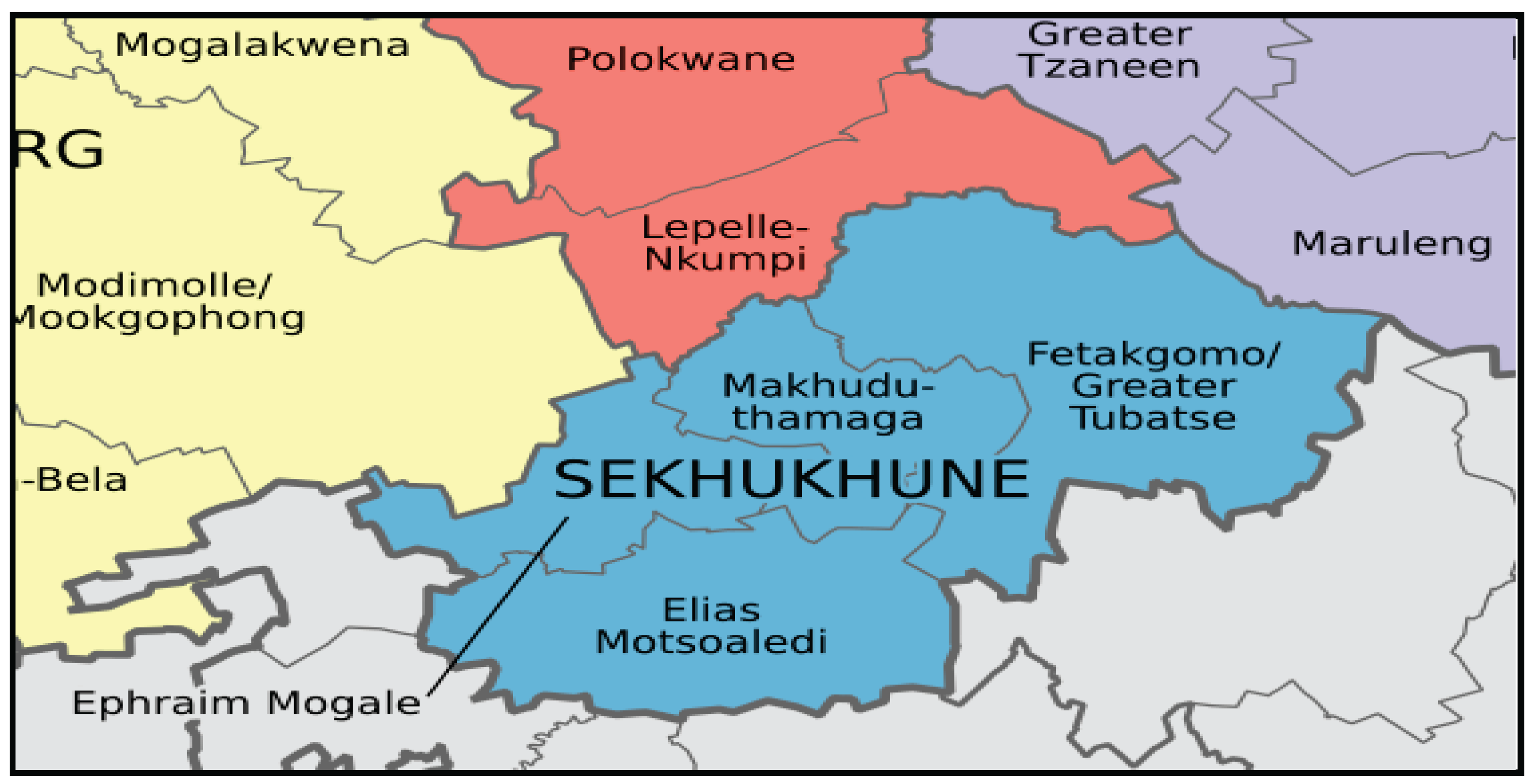

Table 1.
Frequency for travelling for heritage tourism purposes.
| Frequency of heritage tourism travel | Frequency (N) | Percentage |
|---|---|---|
| Once a year | 64 | 31% |
| Twice a year | 123 | 59% |
| More than twice a year | 21 | 10% |
| TOTAL | 208 | 100% |
Table 2.
Heritage attractions/activities tourists enjoy visiting.
| Heritage attractions/activities | Frequency (N) | Percentage |
|---|---|---|
| Historic sites (i.e. Robben Island) | 14 | 7% |
| Cultural landscapes (i.e. Mapungubwe Cultural Landscape) | 12 | 6% |
| Ruins and archaeological sites (i.e. Cradle of Humankind) | 60 | 29% |
| Sites associated with mining, industrial and agricultural heritage | 70 | 34% |
| Sites of important events and commemorations (i.e. Tjate Heritage Site) | 52 | 25% |
| Collections which collectively promote objects of heritage significance (i.e. museums, trails, tours and festivals) | 16 | 8% |
| Created landscapes (i.e. botanic and public gardens) | 6 | 3% |
| Built structures and surroundings (i.e. Voortrekker Monument) | 9 | 4% |
| Cultural performances (i.e. Menyanya) | 103 | 50% |
| Cultural Languages | 16 | 8% |
| Rituals and beliefs (i.e. Go phasa badimo) | 37 | 18% |
| Social practices (i.e. Koma, lebollo) | 28 | 14% |
| Traditional dance, drama and music (i.e. Kiba, dinaka, dipepetlwane, diketo) | 68 | 33% |
| Human activities (traditional modes of transport, gardening, household chores) | 6 | 3% |
| Multi-cultural interactions | 20 | 10% |
| Stories and histories which shape the character and essence of the host community (i.e. the history of Bapedi) | 75 | 36% |
| Traditional cuisine/food (i.e. Malamogodu) | 28 | 14% |
Table 3.
Regression coefficient.
| Dependent variables | Predictors | Unstandardized Coefficients | Standardized Coefficients | t | Sig. | 95.0% Confidence Interval for B | ||||
|---|---|---|---|---|---|---|---|---|---|---|
| Travel motivators | Perceptions and Attitudes | R | R-square | B | Std. Error | Beta | Lower Bound | Upper Bound | ||
| Overall | Overall | .211a | 0,0446 | 0,2191 | 0,0706 | 0,2112 | 3,1014 | 0,0022 | 0,0798 | 0,3583 |
| To explore a new destination | Increased awareness and respect for local culture | .387a | 0,1499 | 0,2390 | 0,1044 | 0,3021 | 2,2898 | 0,0232 | 0,0330 | 0,4450 |
| To experience different lifestyles | Sexual promiscuity and prostitution | .358a | 0,1285 | 0,3041 | 0,0945 | 0,3517 | 3,2170 | 0,0015 | 0,1175 | 0,4906 |
| To learn about history | Increased incidents of crime | .356a | 0,1266 | -0,2170 | 0,0633 | -0,3700 | -3,4279 | 0,0008 | -0,3420 | -0,0921 |
| To escape from a busy environment | Increased incidents of crime | .356a | 0,1269 | -0,1404 | 0,0666 | -0,2274 | -2,1071 | 0,0365 | -0,2718 | -0,0089 |
| To do something out of the ordinary | Enhanced participation in cultural activities | .355a | 0,1261 | 0,2697 | 0,1239 | 0,2662 | 2,1760 | 0,0309 | 0,0251 | 0,5143 |
| An opportunity to learn about other cultures | -0,3126 | 0,1571 | -0,2636 | -1,9896 | 0,0482 | -0,6226 | -0,0026 | |||
| To visit museums and galleries | More income for community members | .412a | 0,1700 | -0,1577 | 0,0739 | -0,1892 | -2,1337 | 0,0342 | -0,3036 | -0,0119 |
| Increased incidents of crime | -0,1392 | 0,0680 | -0,2152 | -2,0456 | 0,0423 | -0,2734 | -0,0049 | |||
| Enhanced participation in cultural activities | 0,3100 | 0,1250 | 0,2957 | 2,4806 | 0,0140 | 0,0634 | 0,5566 | |||
| To appreciate nature | An increase in pollution in the community | .350a | 0,1225 | 0,1511 | 0,0763 | 0,2194 | 1,9790 | 0,0493 | 0,0004 | 0,3017 |
| More diseases in the community | 0,2988 | 0,1204 | 0,3013 | 2,4821 | 0,0140 | 0,0613 | 0,5364 | |||
| To appreciate architecture | Less poverty in the community | .384a | 0,1471 | 0,1643 | 0,0735 | 0,1850 | 2,2372 | 0,0265 | 0,0194 | 0,3093 |
| To visit cultural attractions | More income for community members | .393a | 0,1545 | -0,1986 | 0,0730 | -0,2435 | -2,7208 | 0,0072 | -0,3426 | -0,0546 |
| Enhanced participation in cultural activities | 0,4007 | 0,1234 | 0,3908 | 3,2479 | 0,0014 | 0,1572 | 0,6441 | |||
| To participate in entertainment | Enhanced participation in cultural activities | .370a | 0,1372 | 0,4333 | 0,1292 | 0,4075 | 3,3532 | 0,0010 | 0,1783 | 0,6882 |
| To share a familiar or unfamiliar place with someone | An increase in the value of land and property | .391a | 0,1529 | -0,1910 | 0,0780 | -0,2345 | -2,4485 | 0,0153 | -0,3449 | -0,0371 |
| An increase in littering | -0,2047 | 0,0955 | -0,2448 | -2,1437 | 0,0334 | -0,3930 | -0,0163 | |||
| To participate in recreational activities | Increased incidents of crime | .404a | 0,1630 | -0,1555 | 0,0668 | -0,2459 | -2,3277 | 0,0210 | -0,2873 | -0,0237 |
| More investment in the community | -0,2786 | 0,1405 | -0,2547 | -1,9828 | 0,0489 | -0,5558 | -0,0013 | |||
| An opportunity to learn about other cultures | 0,3978 | 0,1555 | 0,3316 | 2,5572 | 0,0114 | 0,0908 | 0,7047 | |||
| To view and buy art and craft | More diseases in the community | .434a | 0,1885 | 0,2921 | 0,1133 | 0,3010 | 2,5784 | 0,0107 | 0,0685 | 0,5156 |
| An opportunity to learn about other cultures | 0,4100 | 0,1543 | 0,3392 | 2,6563 | 0,0086 | 0,1054 | 0,7146 | |||
| To experience traditional dance, drama and music | An opportunity to learn about other cultures | .399a | 0,1591 | 0,4216 | 0,1602 | 0,3420 | 2,6311 | 0,0093 | 0,1054 | 0,7378 |
| To enjoy traditional cuisine and drink | An opportunity to learn about other cultures | .423a | 0,1791 | 0,4817 | 0,1536 | 0,4028 | 3,1366 | 0,0020 | 0,1787 | 0,7848 |
Disclaimer/Publisher’s Note: The statements, opinions and data contained in all publications are solely those of the individual author(s) and contributor(s) and not of MDPI and/or the editor(s). MDPI and/or the editor(s) disclaim responsibility for any injury to people or property resulting from any ideas, methods, instructions or products referred to in the content. |
© 2025 by the authors. Licensee MDPI, Basel, Switzerland. This article is an open access article distributed under the terms and conditions of the Creative Commons Attribution (CC BY) license (http://creativecommons.org/licenses/by/4.0/).
Copyright: This open access article is published under a Creative Commons CC BY 4.0 license, which permit the free download, distribution, and reuse, provided that the author and preprint are cited in any reuse.


