

Submitted:
22 September 2025
Posted:
23 September 2025
You are already at the latest version
Abstract
This paper explores the concept of abstract biology as a possible framework for understanding life through relations, structures, and organizational principles rather than material substrates. Inspired by the traditions of relational biology [1] (Rashevsky, Rosen) and theoretical biology, the idea is that abstract models may help to identify general laws of living systems, independent of biochemical details. In this perspective, abstract biology can be viewed as an interdisciplinary field linking biology, mathematics, philosophy, and systems theory, with the potential to offer transferable models for both natural and artificial domains.
Keywords:
abstract biology
; relational biology
; theoretical biology
; organizational principles
; symmetry and proportionality
; golden ratio
; entropy
; open systems
; phenotype
; systems theory
1. Introduction
Biology has long been rooted in the study of matter: cells, molecules, and genes as tangible components of life [2]. Yet alongside this empirical tradition, there exists another lineage that emphasizes form, organization, and relation [3]. Nicolas Rashevsky [4] and Robert Rosen [5] developed relational biology in the mid-twentieth century, showing that the essence of living systems can be captured by abstract structures such as graphs, categories, and (M,R)-systems [6].
In this spirit, we propose abstract biology as a broader framework: a science of life that privileges organization over substance. Abstract biology seeks to describe living systems through conceptual schemata, transferable across levels of complexity, from molecular interactions to ecosystems and applicable to both natural organisms and artificial agents.
2. Background and Related Work
Relational biology, founded by Nicolas Rashevsky and further developed by Robert Rosen, seeks to capture the essence of life not in its material composition but in its organizational patterns. Rosen’s concept of metabolism–repair (M,R) systems stands as a milestone in this tradition. In (M,R) systems, metabolism represents the functional transformation of inputs into outputs, while repair (or replication) ensures the persistence of the system’s organizational closure. These models demonstrate that the logic of life can be described using graph theory, category theory, and relational structures, without recourse to biochemical detail. Importantly, Rosen argued that such abstract representations explain properties of living systems, such as autonomy and self-maintenance, which are difficult to formalize in mechanistic, reductionist frameworks.
Parallel to relational biology, the broader fields of theoretical and mathematical biology have demonstrated the value of abstraction in more empirical contexts. Classical models of population dynamics (e.g., Lotka-Volterra equations) [7], pattern formation (e.g., Turing’s morphogenesis) [8], and epidemiology provide examples of how biological complexity can be reduced to systems of equations that still capture essential behaviors. Although these models are often tied to specific quantitative formulations, they show that abstraction provides predictive power and conceptual clarity. Importantly, theoretical biology has expanded beyond equations to include systems thinking, network analysis, and computational simulations tools that align naturally with the goals of abstract biology.
Philosophical inquiry into biology highlights questions that empirical science alone cannot fully address: What defines an organism?; How do emergent properties arise from lower-level interactions?; What constitutes autonomy in living systems? Debates over reductionism versus holism, or mechanism versus organization, show that conceptual frameworks are necessary for interpreting biological data. Abstract biology resonates strongly with these debates, offering a middle ground between empirical description and philosophical generalization by providing formal schemata that can operationalize such concepts as emergence, function, and teleology.
Finally, abstraction is not only theoretical but also practical. Petra Schwille (2017) [9] described abstraction as an art of biology, where scientists deliberately remove details to reveal generalizable principles. In synthetic biology, for example, modular design of genetic circuits reflects abstraction: complex biochemical processes [10] are represented as functional blocks that can be recombined in novel ways [11]. Similarly, in systems biology, abstraction allows the integration of heterogeneous data into coherent network models [12]. These practices show that abstraction is already embedded in biological research, though often implicitly; abstract biology seeks to make it explicit and systematic.
3. Relational Core (Code of Relations)
At the highest level of abstraction, life can be represented as a network of relations rather than as a collection of material parts. Functions such as metabolism, repair, and reproduction are not defined by the molecules that carry them out but by their relational roles in sustaining the system. This “code of relations” provides the organizational grammar of living systems. It suggests that the persistence of life depends less on substance than on the pattern of entailments that link processes together.
Beneath the relational core lie abstract modules: functional units analogous to genes, proteins, or pathways, but defined in purely organizational terms. These modules are not fixed structures but logical blocks whose behavior depends on the relations in which they are embedded. For example, an enzymatic pathway can be seen not as a sequence of molecules but as a structured transformation a module that connects inputs to outputs within the relational web. Abstract modules highlight the portability of biological logic across levels of complexity and between natural and artificial systems.
Relations and modules do not operate in isolation. They are conditioned by the environment, which acts not as a passive background but as an active context shaping the activation, suppression, or modulation of relations. In abstract biology, context is constitutive: the same relational schema may lead to very different outcomes under different environmental constraints. This echoes insights from systems theory, where boundaries between system and environment are permeable and co-defining.
Observable traits whether molecular patterns, cellular morphologies, or organismal behaviors are viewed as manifestations of underlying relational dynamics. Rather than being direct expressions of material entities, phenotypes emerge from the interplay of modules and contexts. In this perspective, the phenotype is not a static outcome but a dynamic realization of organizational schemata. This reorientation allows us to treat phenotype as a window into relational structures, rather than as a mere aggregate of physical components.
Finally, inheritance and reproduction are conceived as the transmission of organizational schemata rather than of material alone. What persists across generations is not merely matter, but the relational blueprints capable of regenerating functional organization in new material substrates. This idea connects abstract biology to broader discussions of information, autonomy, and resilience: life reproduces itself by reproducing the organization that sustains it.
These five dimensions can be represented schematically as a hierarchy of abstraction (Figure 1).
The diagram illustrates a hierarchical model of abstraction, moving from the most general level (Code of Relations) to the most concrete (Reproduction of Organization). Each level corresponds to a conceptual layer — abstract principles, functional modules, contextual interactions, observable phenotypes, and the reproduction of organizational schemata.
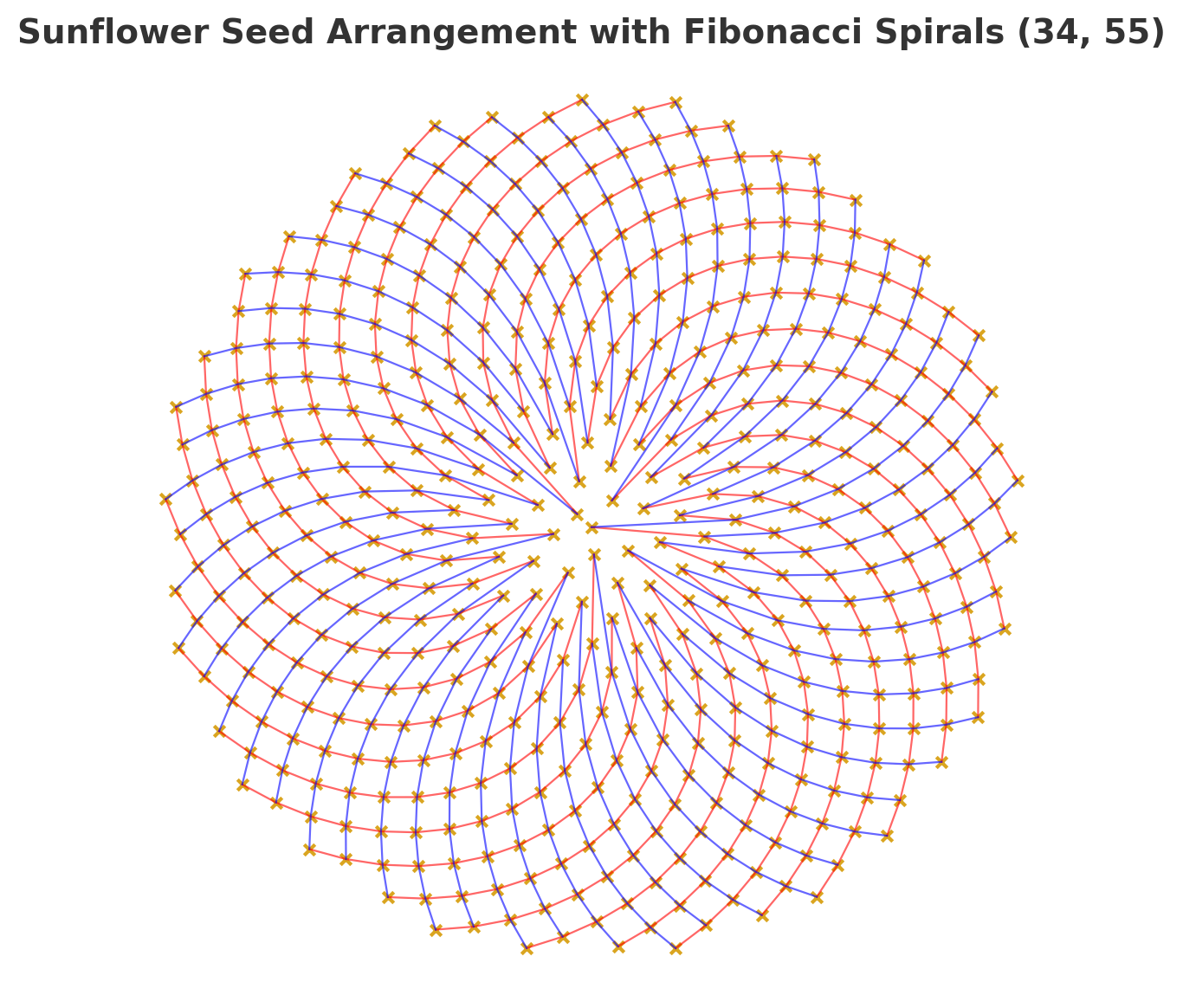
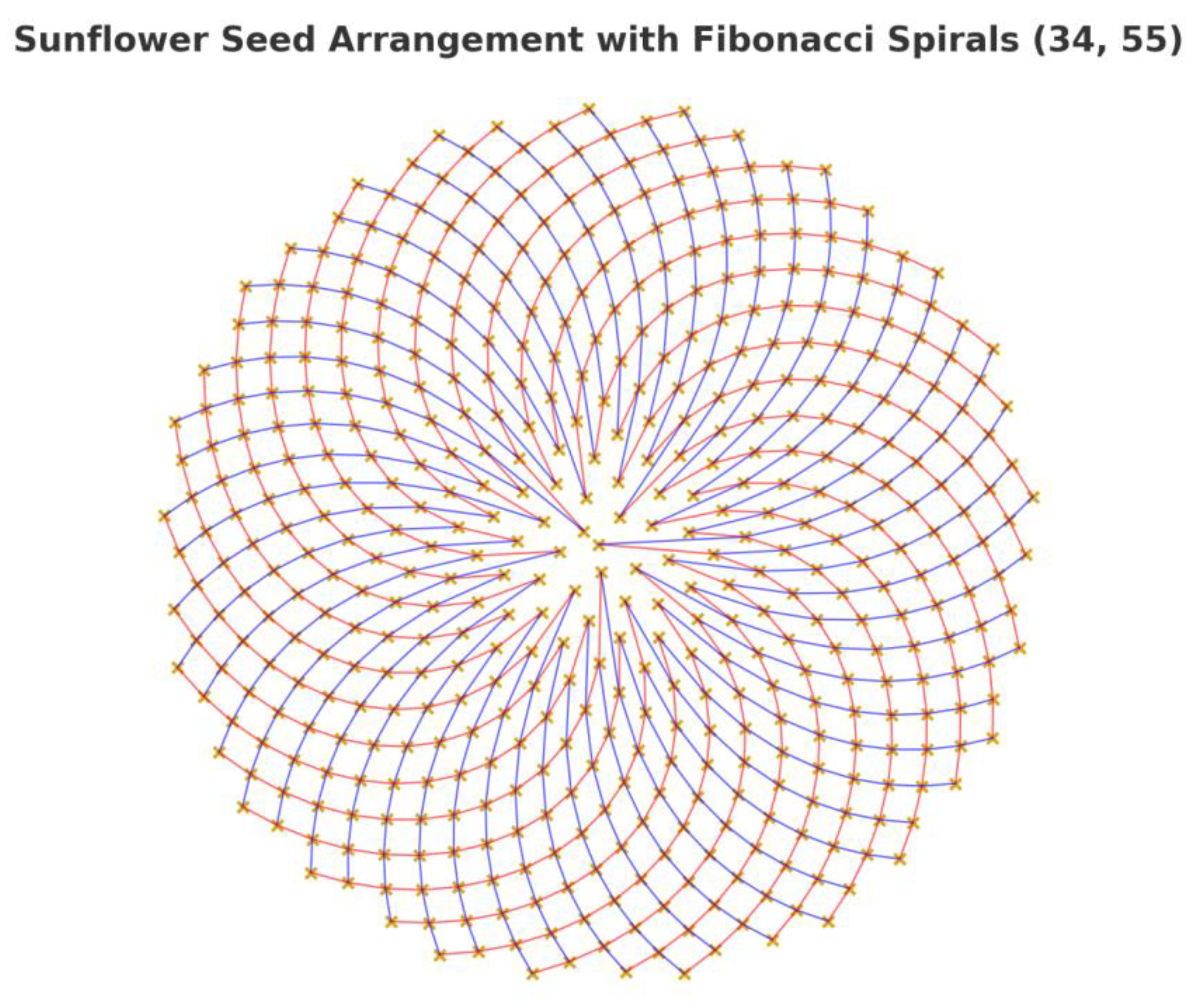
Symmetry is a fundamental principle of biological organization. Radial, bilateral, and spiral symmetries appear across scales, from molecular assemblies to whole organisms. Equally significant is symmetry breaking, which provides the basis for development and evolution by generating asymmetries that allow differentiation and adaptation. Within this broader framework of symmetry, proportionality emerges as a special case. The golden ratio, found in phyllotaxis, shell spirals, and branching structures, exemplifies how harmony and efficiency can be achieved through simple numerical relations. A classic example is the sunflower: the arrangement of its seeds follows spiral phyllotaxis based on Fibonacci numbers, which approximate the golden ratio (Figure 2). This organization maximizes packing density while producing an aesthetically harmonious pattern. In abstract biology, such cases demonstrate how mathematical invariants are realized in biological forms and may be reinterpreted as transferable relational schemata.
The diagram illustrates how spiral phyllotaxis follows Fibonacci sequences (e.g., 34 and 55), approximating the golden ratio. This pattern achieves, both functional efficiency in seed packing and aesthetic harmony, serving as a paradigmatic example of proportionality in biological systems.
4. Methodology
The first step in abstract biology is the construction of formal frameworks that can capture the relational logic of life. Tools such as graph theory, category theory, algebraic structures, and information-theoretic models allow researchers to represent biological processes in a way that highlights their organizational properties rather than their material composition. These formalizations provide a rigorous language in which to describe relations such as metabolism, repair, and reproduction, and to investigate their entailments.
Once formal structures are defined, computational models can be employed to explore how relational networks give rise to systemic properties. Simulations enable the testing of hypotheses about self-maintenance, emergence, and adaptation under controlled conditions, without requiring reduction to biochemical mechanisms. In this sense, simulation functions as a bridge between abstract formalization and empirical observation, providing dynamic demonstrations of organizational principles.
A further step is the comparative study of relational models across different biological scales. Abstract biology emphasizes the portability of organizational principles from molecular networks to cellular dynamics and ecological systems. By comparing models at different levels, it becomes possible to identify invariants of organization patterns that persist despite changes in material substrate or scale of observation. This comparative approach strengthens the claim that relational structures, rather than substances, define life.
Abstract biology also incorporates the principle that life exists as an open system, continuously exchanging matter and energy with its environment in order to sustain organizational closure. In this view, entropy is not simply a thermodynamic measure but a condition of vulnerability: without ongoing exchange, relational structures inevitably decay. The persistence of life depends on the ability to export entropy to the environment while maintaining internal order. Capturing this dynamic is essential to any formal model of living organization.
Finally, abstract biology requires philosophical engagement. Concepts such as autonomy, emergence, and function are central to biology but often lack precise definitions in materialist frameworks. By grounding these concepts in relational models, abstract biology clarifies their meaning and scope. Philosophical reflection thus ensures that abstraction does not become an empty formalism but remains tied to the perennial questions about what life is and how it can be understood.
5. Discussion
The proposal of abstract biology invites both enthusiasm and skepticism. On the one hand, it provides a unifying lens through which diverse biological phenomena can be reinterpreted as manifestations of organizational principles. By shifting the focus from matter to relation, it resonates with long-standing philosophical intuitions about life as form, echoing Aristotelian [13] and cybernetic traditions alike [14].
On the other hand, abstract biology must guard against excessive detachment from empirical biology. Purely formal models, while elegant, risk losing explanatory power if not anchored to real processes. The challenge lies in maintaining a productive dialogue between abstraction and observation allowing models to inform experiments, and experiments to refine models.
A second concern relates to disciplinary legitimacy. Biology, as a predominantly empirical science, is sometimes wary of abstract theorizing. Yet historical precedents, Rashevsky’s mathematical biophysics, Rosen’s relational biology [15], and the subsequent development of systems biology show that abstraction has consistently enriched biological thought. Abstract biology continues this trajectory, offering a meta-framework rather than a replacement for empirical research.
Finally, the implications for other fields are significant. By articulating life in terms of organizational schemata, abstract biology provides conceptual resources for artificial intelligence, synthetic biology, and complex systems research. It encourages the design of artificial agents that are not mere simulations of biochemical details but carriers of life-like relational structures. This prospect is both intellectually stimulating and ethically challenging, raising questions about autonomy, responsibility, and the boundaries of life.
6. Conclusions
Abstract biology positions itself as a field concerned not with what life is made of, but with how life is organized. By emphasizing relations, functions, and schemata, it complements experimental biology with a conceptual science of organization. Its strength lies in the capacity to generate transferable models, linking natural and artificial domains, and to provide new perspectives on one of the oldest questions: what does it mean to be alive?
A useful example of abstract biology can be found in the invention of the airplane. Engineers did not reproduce the anatomy of birds, but abstracted aerodynamic principles from flight in nature. Lift, drag, and wing curvature were recognized as transferable organizational schemata, independent of feathers, muscles, or metabolism. By isolating these relational features, aviation illustrates how biological principles can be re-expressed in a different material domain a hallmark of abstract biology.
References
- H. Louie, ‘Relational biology and Church’s thesis’, Biosystems, vol. 197, p. 104179, Nov. 2020. [CrossRef]
- H. Louie, More Than Life Itself A Synthetic Continuation in Relational Biology, Categories Series, Vol. 1 vols. Frankfurt [now De Gruyter, Berlin]: ontos verlag, 2009. Accessed: Sept. 22, 2025. [Online]. Available: https://ahlouie.com/more-than-life-itself/.
- H. Louie, The Reflection of Life, vol. 29. in IFSR International Series on Systems Science and Engineering, vol. 29. New York, NY: Springer, 2013. [CrossRef]
- N. Rashevsky, Mathematical biophysics; physico-mathematical foundations of biology. New York, Dover Publications, 1960. Accessed: Sept. 21, 2025. [Online]. Available: http://archive.org/details/mathematicalbiop0000rash.
- R. Rosen, ‘A relational theory of biological systems’, Bull. Math. Biophys., vol. 20, no. 3, pp. 245–260, Sept. 1958. [CrossRef]
- R. Rosen, ‘Some results in graph theory and their application to abstract relational biology’, Bull. Math. Biophys., vol. 25, no. 2, pp. 231–241, June 1963. [CrossRef]
- H. Shim and P. A. Fishwick, ‘Visualization and Interaction Design for Ecosystem Modeling’, in Encyclopedia of Ecology, S. E. Jørgensen and B. D. Fath, Eds, Oxford: Academic Press, 2008, pp. 3685–3693. [CrossRef]
- ‘Turing patterns, 70 years later’, Nat. Comput. Sci., vol. 2, no. 8, pp. 463–464, Aug. 2022. [CrossRef]
- P. Schwille, ‘Biology and the art of abstraction’, Biophys. Rev., vol. 9, no. 4, pp. 273–275, Aug. 2017. [CrossRef]
- S. Ehsani, ‘Analytic Philosophy for Biomedical Research: The Imperative of Applying Yesterday’s Timeless Messages to Today’s Impasses’, in Innovative Technologies for Market Leadership: Investing in the Future, P. Glauner and P. Plugmann, Eds, Cham: Springer International Publishing, 2020, pp. 167–200. [CrossRef]
- S. Ehsani, ‘A framework for philosophical biology’, 2020, pp. 167–200. [CrossRef]
- D. C. Krakauer et al., ‘The challenges and scope of theoretical biology’, J. Theor. Biol., vol. 276, no. 1, pp. 269–276, May 2011. [CrossRef]
- K. Kristjánsson, ‘Reason and intuition in Aristotle’s moral psychology: why he was not a two-system dualist’, Philos. Explor., vol. 25, no. 1, pp. 42–57, Jan. 2022. [CrossRef]
- S. A. Umpleby and E. Dent, ‘The Origins and Purposes of Several Conceptions of Systems Theory and Cybernetics’, Dec. 15, 2010, Social Science Research Network, Rochester, NY: 2335858. [CrossRef]
- R. Rosen, Life Itself: A Comprehensive Inquiry Into the Nature, Origin, and Fabrication of Life. Columbia University Press, 1991.
Figure 1.
Levels of abstraction in biology.
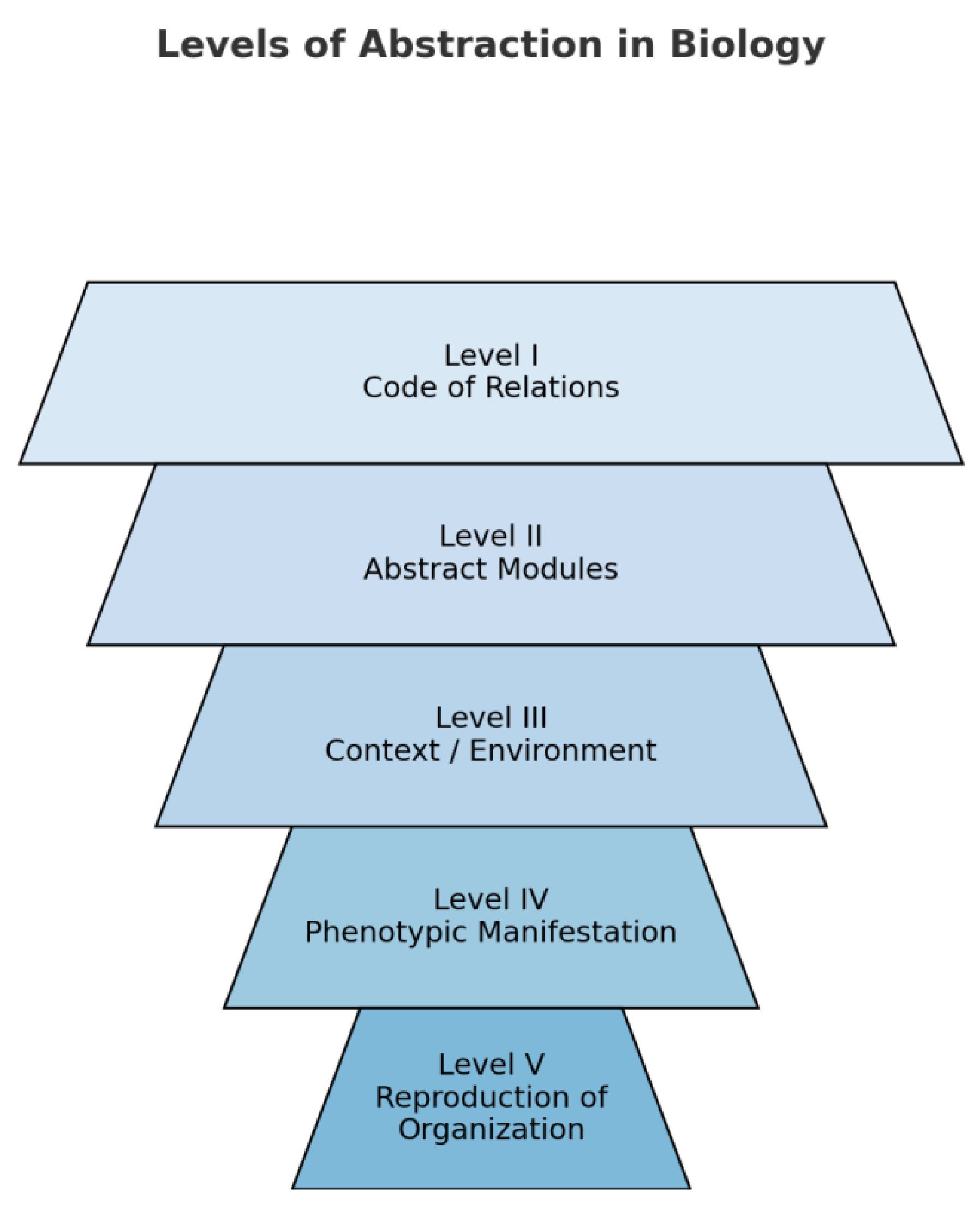
Figure 2.
Sunflower seed arrangement and Fibonacci spirals.
Disclaimer/Publisher’s Note: The statements, opinions and data contained in all publications are solely those of the individual author(s) and contributor(s) and not of MDPI and/or the editor(s). MDPI and/or the editor(s) disclaim responsibility for any injury to people or property resulting from any ideas, methods, instructions or products referred to in the content. |
© 2025 by the authors. Licensee MDPI, Basel, Switzerland. This article is an open access article distributed under the terms and conditions of the Creative Commons Attribution (CC BY) license (http://creativecommons.org/licenses/by/4.0/).
Copyright: This open access article is published under a Creative Commons CC BY 4.0 license, which permit the free download, distribution, and reuse, provided that the author and preprint are cited in any reuse.


