

Submitted:
20 September 2025
Posted:
22 September 2025
You are already at the latest version
Abstract
The rapid evolution of artificial intelligence has given rise to agentic AI systems—autonomous entities capable of perceiving their environment, making decisions, and executing actions with minimal human intervention. This work provides a systematic analysis of agentic AI frameworks, governance models, and implementation strategies. Drawing on a comprehensive review of the literature, we examine the current state of agentic AI technologies, highlight key challenges in governance, security, and ethical oversight, and compare architectural frameworks for responsible deployment.Our results, illustrated through detailed framework comparisons and governance analyses, demonstrate that while agentic AI holds transformative potential across multiple sectors, notable gaps persist in standardization, regulatory compliance, and interoperability. To address these issues, we propose a layered architecture that embeds governance and security across all system layers. An analysis of the competitive landscape further identifies critical interoperability challenges that could undermine U.S. leadership. Based on these insights, we outline a strategic framework for U.S. competitiveness, emphasizing accelerated standards development, international collaboration, and investment in interoperability research. Finally, emerging trends and future directions are explored to provide a comprehensive roadmap for responsible deployment of agentic AI.
Keywords:
Agentic AI
; AI Governance
; Autonomous Systems
; AI Frameworks
; Ethical AI
; AI Security
; Multi-Agent Systems
; Regulatory Compliance
1. Introduction
Unlike traditional AI systems that primarily assist human operators, agentic AI systems demonstrate autonomy, goal-directed behavior, and the capacity for independent decision-making [1]. The year 2025 has been identified as a pivotal moment when "the frontier firm is born" through the integration of intelligence on tap that fundamentally rewires business operations [2].
Agentic AI systems integrate one or more AI agents that differ from traditional computer programs in their ability to learn and adapt, make decisions, interact with surroundings, and operate with limited supervision [3]. These systems are increasingly being deployed across various sectors including finance [4], healthcare [5], manufacturing, and cybersecurity [6], offering unprecedented opportunities for automation and efficiency gains [7,8].
However, the autonomous nature of these systems introduces significant challenges in governance, security, and ethical compliance. As noted by [9], agentic AI governance represents a new benchmark for operationalizing trust in autonomous, self-improving, and multi-agent AI systems. The tension between innovation and regulation requires careful navigation to ensure responsible deployment while maximizing potential benefits [10,11].
This paper provides a comprehensive examination of the current landscape of agentic AI frameworks and governance approaches. We synthesize insights from key references to present a structured analysis of technical frameworks, governance models, implementation challenges, and future directions. Our contributions include:
- A systematic literature review of agentic AI frameworks and governance approaches (Section 2)
- Quantitative analysis of implementation challenges and adoption barriers (Section 5)
- A condensed architectural proposal for responsible agentic AI deployment (Section 7)
- Analysis of U.S. competitiveness and strategic recommendations (Section 6)
- Identification of future research directions and emerging trends (Section 8)
- Examination of potential negative scenarios without proactive governance
The remainder of this paper is organized as follows: Section 2 presents a comprehensive literature review examining definitional frameworks, architectural patterns, and governance approaches for agentic AI systems. Section 4 details our systematic research methodology for analyzing key references in this domain. Section 5 presents quantitative findings on adoption trends, framework comparisons, and implementation patterns. Section 6 analyzes U.S. competitiveness challenges and proposes strategic interventions for interoperability and governance leadership. Section 7 introduces our condensed architectural framework for responsible agentic AI deployment with integrated governance and security. Section 8 explores future research directions, industry trends, and emerging technologies. This work also examines potential negative scenarios without proactive interoperability governance. Finally, Section 10 synthesizes our findings and outlines implications for research, practice, and policy.
2. Literature Review
2.1. Definition and Characteristics of Agentic AI
Agentic AI refers to artificial intelligence systems that can pursue complex goals with limited direct supervision [12]. These systems are characterized by their autonomy, adaptability, and ability to interact with their environment through perception, decision-making, and action execution [3].
According to [13], agentic AI represents a breakthrough advancement that creates autonomous agents capable of analyzing data, setting goals, and taking action independently. This differs fundamentally from traditional AI systems that primarily provide recommendations or assistance without autonomous execution capabilities.
2.2. Agentic AI Frameworks and Architectures
The development of agentic AI systems relies on specialized frameworks that provide the necessary infrastructure for building, deploying, and managing autonomous agents. Recent literature identifies several categories of frameworks emerging in 2024-2025:
2.2.1. Development Frameworks
Development frameworks such as LangChain [14], CrewAI [15], and Microsoft Semantic Kernel [15] provide tools for constructing agentic workflows and integrating various AI components. These frameworks typically offer modular architectures that support different patterns of agent interaction and task execution.
2.2.2. Enterprise-Scale Frameworks
Enterprise-focused frameworks address the specific requirements of large organizations, including scalability, security, and integration with existing systems. [16] note that 61% of organizations are building agentic AI systems, highlighting the need for robust frameworks that can avoid the 40% failure rate observed in early implementations.
2.2.3. Specialized Domain Frameworks
2.2.4. Architectural Patterns
The architectural foundation for agentic AI systems typically follows a three-tier model as described by [18]: Foundation tier (basic capabilities), Workflow tier (orchestration), and Autonomous tier (full autonomy). This progression emphasizes that trust, governance, and transparency must precede full autonomy in enterprise deployments.
2.3. Governance and Regulatory Landscape
The governance of agentic AI systems presents unique challenges due to their autonomous nature and potential impact. Current literature identifies several key aspects of agentic AI governance:
2.3.1. Regulatory Frameworks
2.3.2. Industry Standards
2.3.3. Governance Models
Various governance models have been proposed specifically for agentic AI systems. The AIGN Agentic AI Governance Framework v1.0 [22] provides a foundational model for systems that act autonomously, delegate tasks, or interface with external tools. Similarly, [23] discuss the future of AI oversight in the context of agentic systems.
2.3.4. Compliance Considerations
2.4. Security and Risk Management
The autonomous nature of agentic AI systems introduces unique security challenges that require specialized approaches:
2.4.1. Threat Landscape
2.4.2. Security Frameworks
Several security frameworks have been proposed specifically for agentic AI. The OWASP Gen AI Security Project [28] provides guidelines for securing generative AI applications, including agentic systems. [29] present a detailed guide for designing, developing, and deploying secure agentic applications.
2.4.3. Risk Management Approaches
2.5. Ethical Considerations
The deployment of agentic AI systems raises significant ethical questions that must be addressed through careful design and governance:
2.5.1. Transparency and Explainability
The autonomous decision-making of agentic AI systems creates challenges for transparency and explainability [32]. Stakeholders need to understand how decisions are made, particularly in high-stakes applications.
2.5.2. Accountability and Responsibility
2.5.3. Bias and Fairness
Like all AI systems, agentic AI can perpetuate or amplify biases present in training data or system design [35]. Special considerations are needed for autonomous systems that may make decisions without human intervention.
2.5.4. Privacy Implications
The data collection and processing capabilities of agentic AI systems raise significant privacy concerns [36]. These systems must be designed with privacy-preserving principles from the outset.
3. List of Figures and Tables
This section provides a comprehensive reference to all figures and tables included in this paper, along with their corresponding descriptions and significance to our research.
3.1. Figures
- Figure 1: Proposed layered architecture for agentic AI deployment with governance, security, and implementation notes. This figure illustrates our comprehensive architectural framework that integrates governance and security throughout all system layers.
- Figure 2: Research, industry, and technology trends shaping agentic AI (2024–2030). This visualization captures the multidimensional evolution of agentic AI across research directions, industry applications, and emerging technologies.
- Figure 3: Full landscape of Agentic AI frameworks and tools. This comprehensive diagram categorizes and connects the diverse ecosystem of development frameworks, enterprise platforms, domain-specific solutions, governance tools, and emerging technologies.
- Figure 4: Three-phase implementation roadmap with staggered milestones and outcomes. This timeline provides a strategic plan for the phased adoption and scaling of agentic AI interoperability and governance frameworks.
3.2. Tables
- Table 1: Comparison of Agentic AI Frameworks. This table evaluates selected frameworks across multiple dimensions including functionality, maturity, scalability, and governance capabilities.
- Table 2: Agentic AI Governance Frameworks and Key Considerations. This comprehensive table organizes governance aspects, principles, frameworks, and implementation considerations for effective agentic AI oversight.
- Table 3: Strategic Framework for U.S. Leadership in Agentic AI. This table outlines the strategic pillars, key initiatives, and supporting references for maintaining U.S. competitiveness in agentic AI.
- Table 4: Implementation Roadmap and Expected Outcomes. This table details the timeline, key activities, and expected outcomes for the phased implementation of our proposed strategic framework.
- Table 5: Proposed Architecture and Future Directions for Responsible Agentic AI. This table summarizes the key elements of our architectural proposal and identifies future research and development directions.
These visual elements collectively provide a comprehensive representation of the current agentic AI landscape, our proposed architectural framework, strategic recommendations for U.S. competitiveness, and implementation roadmaps for responsible deployment.
4. Methodology
This research employs a systematic literature review methodology to comprehensively analyze the current state of agentic AI frameworks and governance approaches. Our methodology follows a structured process adapted from established systematic review protocols [12] to ensure thorough coverage and rigorous analysis of this emerging field.
4.1. Literature Identification and Selection
The search strategy employed keywords such as "agentic AI," "AI governance," "autonomous AI agents," "AI frameworks," and related terms, building upon the search methodologies documented in comprehensive industry analyses [16,50].
Inclusion criteria focused on publications from 2023-2025 to capture the most recent developments in this rapidly evolving field, consistent with the approach taken in contemporary AI governance reviews [22,23]. We prioritized sources from reputable organizations including NIST, IEEE, ISO, and leading AI research institutions. The final reference set includes sources that provide comprehensive coverage of the agentic AI landscape, with particular attention to frameworks that have demonstrated production readiness [51,52].
4.2. Analysis Framework
We developed a structured analysis framework adapted from established AI governance assessment methodologies [30,31] to systematically examine each publication across multiple dimensions:
This multidimensional analysis enabled us to identify patterns, trends, and gaps in the current landscape of agentic AI frameworks and governance approaches, following the comprehensive assessment approach demonstrated in [55].
4.3. Quantitative Assessment
Where possible, we extracted quantitative data regarding adoption rates, implementation challenges, performance metrics, and compliance requirements. This approach aligns with the data-driven assessment methodologies employed in industry analyses such as [16], which reported that 61% of organizations are building agentic AI systems with a 40% failure rate in early implementations. The quantitative data provides insights into the practical realities of agentic AI deployment and helps identify areas requiring further research and development, particularly in security implementation maturity levels as categorized in [56,57].
4.4. Limitations
Our methodology has several limitations consistent with those noted in similar emerging technology reviews [12,50]. The rapid evolution of agentic AI technologies means that new developments may have emerged since publication. Additionally, some industry implementations may not be fully documented in publicly available literature, particularly those involving proprietary frameworks or sensitive security implementations [26,29]. Nevertheless, our systematic approach provides a comprehensive snapshot of the current state of knowledge in this domain, establishing a baseline for ongoing research as called for in [10,11].
5. Findings and Analysis
5.1. Adoption Trends and Implementation Challenges
Our analysis reveals significant growth in agentic AI adoption across various sectors. According to [16], 61% of organizations are currently building agentic AI systems, reflecting substantial interest and investment in this technology. However, implementation challenges remain significant, with a reported 40% failure rate in early deployments.
The primary adoption barriers identified in the literature include:
- Technical Complexity: Developing and integrating agentic AI systems requires specialized expertise and infrastructure [51]
- Governance Gaps: Many organizations lack clear frameworks for governing autonomous AI systems [58]
- Regulatory Uncertainty: Evolving regulations create compliance challenges for early adopters [10]
- Security Concerns: Autonomous systems introduce new attack surfaces and vulnerabilities [56]
- Skills Shortage: Limited availability of professionals with expertise in agentic AI development and governance [59]
5.2. Framework Comparison and Evaluation
We analyzed over 20 agentic AI frameworks identified in the literature, evaluating them across multiple dimensions including functionality, maturity, scalability, and governance capabilities. Table 1 summarizes our evaluation of selected frameworks.
Our analysis indicates that while numerous frameworks exist, no single solution comprehensively addresses all requirements for enterprise-scale agentic AI deployment. Organizations typically need to combine multiple frameworks and custom development to meet their specific needs.
5.3. Governance Implementation Patterns
We identified several common patterns in how organizations are implementing governance for agentic AI systems:
5.3.1. Centralized Governance Models
Large enterprises often establish centralized AI governance committees that develop policies, review implementations, and ensure compliance across the organization [67]. These models provide consistency but may lack agility.
5.3.2. Federated Governance Approaches
Some organizations adopt federated models where central policies provide guidelines, but individual business units have flexibility in implementation details [54]. This approach balances consistency with adaptability.
5.3.3. Automated Governance Mechanisms
Advanced implementations incorporate automated governance mechanisms directly into agentic AI systems [68]. These include real-time monitoring, compliance checking, and automated intervention capabilities.
5.3.4. Industry-Specific Governance
5.4. Security Implementation Status
Our analysis of security implementations reveals significant variation in maturity levels:
- Basic Security: Many early implementations focus primarily on traditional cybersecurity measures without specific adaptations for agentic AI characteristics [69]
- Intermediate Security: More mature implementations incorporate AI-specific security measures such as prompt injection protection, output validation, and adversarial robustness [70]
- Advanced Security: Leading-edge implementations employ comprehensive security frameworks that address unique agentic AI risks including permission escalation, memory manipulation, and multi-agent coordination attacks [26]
The majority of current implementations fall into the basic to intermediate categories, indicating significant opportunity for improvement in security practices.
6. U.S. Competitiveness in Agentic AI: Interoperability and Governance Strategies
The global race for AI supremacy has intensified, with agentic AI representing the next frontier of technological competition. As noted by [55], the United States faces significant challenges in maintaining its leadership position due to fragmentation in AI development ecosystems and divergent approaches emerging between major economic regions. This section analyzes the current competitive landscape and proposes strategic interventions to ensure U.S. leadership in agentic AI through enhanced interoperability and governance frameworks.
6.1. Current Competitive Landscape
The global agentic AI landscape is characterized by increasing fragmentation and strategic competition. According to [55], divergent approaches are emerging between the United States, European Union, China, and other key players, each pursuing distinct strategies:
- United States: Market-driven innovation with sector-specific regulations and voluntary frameworks
- China: State-directed development with strong government oversight and strategic prioritization
- Other Regions: Emerging frameworks in Singapore [50], UK, and other countries creating additional complexity
This fragmentation creates significant interoperability challenges that threaten to undermine U.S. competitiveness. As [55] notes, the lack of standardized protocols and frameworks hinders seamless collaboration across borders and domains, potentially isolating U.S. technologies from global markets.
6.2. Interoperability Challenges
The interoperability challenges facing U.S. agentic AI leadership are multifaceted and require urgent attention:
6.2.1. Technical Interoperability
Technical interoperability issues include divergent data formats, model architectures, workflow orchestration approaches, and multi-agent communication protocols [55]. These technical barriers prevent seamless integration of U.S.-developed agentic AI systems with international platforms and infrastructure.
6.2.2. Regulatory Interoperability
Regulatory divergence represents another critical challenge. The EU’s risk-based AI Act [10], China’s state-centric approach, and the U.S.’s sectoral strategies create incompatible compliance requirements that increase costs and complexity for U.S. companies seeking global deployment.
6.2.3. Standards Fragmentation
The absence of universally adopted standards for agentic AI systems creates additional barriers. While organizations such as ISO/IEC JTC 1/SC 42, IEEE, and NIST are developing standards including ISO/IEC 42001 [21] for AI management systems and the NIST AI RMF [30,31], adoption remains inconsistent across regions [20].
6.3. Strategic Proposal for U.S. Leadership
To maintain and enhance U.S. competitiveness in agentic AI, we propose a comprehensive strategy centered on interoperability and governance excellence:
6.3.1. Accelerate Standards Development and Adoption
The U.S. should prioritize the development and adoption of open, interoperable standards for agentic AI systems. This includes:
- Establishing a public-private partnership for rapid standards development
- Creating certification programs for interoperability compliance
- Investing in reference implementations of key standards
- Promoting U.S.-developed standards through international standards organizations
6.3.2. Develop Interoperability-First Governance Frameworks
U.S. governance approaches should explicitly prioritize interoperability as a strategic objective:
- Incorporate interoperability requirements into federal AI procurement guidelines
- Create tax incentives for companies adopting interoperable architectures
- Establish testbeds for cross-border interoperability testing
- Develop model contractual clauses for international AI deployments
6.3.3. Enhance International Cooperation
Strategic international engagement is essential for maintaining U.S. leadership:
- Lead multilateral initiatives for regulatory harmonization
- Establish bilateral interoperability agreements with key partners
- Create joint research programs focused on interoperability challenges
- Develop mutual recognition arrangements for AI certifications
6.3.4. Invest in Interoperability Research and Development
Targeted R&D investment can address specific interoperability challenges:
- Fund research on cross-platform agent communication protocols [47]
- Support development of adaptive compliance tools for varying regulatory regimes
- Invest in privacy-preserving technologies for international data flows
- Develop tools for automated regulatory gap analysis and compliance mapping
6.3.5. Create Strategic Testing and Certification Infrastructure
A robust testing and certification ecosystem can demonstrate U.S. leadership:
- Establish national testbeds for interoperability validation
- Create certification programs recognized internationally
- Develop benchmarking methodologies for cross-border performance assessment
- Support independent verification of interoperability claims
6.4. A National Strategic Framework for U.S. Leadership in Agentic AI
The global competition for agentic AI supremacy represents not merely a technological race but a foundational shift in economic and national security paradigms. As [55] comprehensively analyzes, divergent regulatory approaches and technical standards between major economic blocs threaten to fragment the global AI ecosystem, potentially isolating U.S. technologies and undermining American competitiveness. This fragmentation creates significant interoperability challenges that threaten to undermine U.S. technological leadership and economic advantage.
Our analysis identifies three critical strategic imperatives for maintaining U.S. leadership:
- Standards Dominance: Control over emerging technical standards for agent communication, data formats, and security protocols
- Regulatory Alignment: Development of interoperable governance frameworks that enable cross-border deployment while ensuring security and ethical compliance
- Innovation Ecosystem: Fostering a robust public-private partnership ecosystem that accelerates research, development, and deployment of agentic AI technologies
6.4.1. Strategic Implementation Framework
To address these imperatives, we propose a coordinated whole-of-government approach with specific responsibilities assigned to key agencies and branches:
For the National Institute of Standards and Technology (NIST)
- Develop standardized testing methodologies for cross-border compliance assessment and validation of agentic systems
- Create reference architectures for interoperable agentic systems that incorporate security-by-design principles [56]
For the Department of Commerce
- Lead negotiations for international AI interoperability agreements, particularly with key allies and trading partners
- Develop next-generation export control frameworks that balance national security concerns with maintaining U.S. competitiveness in AI technologies
- Create advisory services and resource centers for U.S. companies navigating complex foreign regulations and compliance requirements
For Congress
- Enact legislation creating tax incentives for interoperability investment and research & development in agentic AI technologies
- Fund targeted research programs focused on AI interoperability challenges through NSF, DARPA, and other research agencies
- Establish a national AI competitiveness strategy with interoperability as a core pillar, mandating cross-agency coordination
For Regulatory Agencies (FDA, FAA, FCC, etc.)
- Create regulatory sandboxes for testing cross-border solutions and innovative approaches to compliance
6.4.2. Phased Implementation Roadmap
The proposed strategy should be implemented through a structured, phased approach with clear milestones and accountability mechanisms:
- Year 1: Foundation Building - Establish standards development partnerships, create initial interoperability testbeds, develop international engagement frameworks, and launch initial research programs
- Years 2-3: Scaling & Expansion - Scale successful pilot programs, develop comprehensive certification programs, achieve international recognition agreements, and expand testing infrastructure
- Years 4-5: Full Implementation - Achieve comprehensive standards adoption, establish global certification recognition, implement full international cooperation framework, and mature the interoperability ecosystem
6.4.3. Expected Outcomes and Benefits
Successful implementation of this comprehensive strategy would yield significant multidimensional benefits for U.S. competitiveness:
- Market Access: U.S. companies would gain easier access to international markets through interoperable solutions, reducing compliance costs by an estimated 30-40% [24]
- Innovation Leadership: A focus on interoperability would drive innovation in adaptable, flexible AI systems, maintaining U.S. technological advantage [2]
- Economic Advantage: Reduced compliance costs and increased market opportunities would enhance economic returns and create high-value jobs
- Security Benefits: Interoperable systems designed with security from inception would enhance overall resilience and protect critical infrastructure [57]
6.4.4. Conclusion on U.S. Competitiveness Strategy
Maintaining U.S. leadership in agentic AI requires a strategic focus on interoperability and governance excellence. By proactively addressing the technical, regulatory, and standards challenges facing global deployment of agentic AI systems, the United States can transform potential barriers into sustainable competitive advantages.
7. Architectural Proposal
Based on our analysis of current frameworks and identified gaps, we propose a comprehensive architectural framework for responsible agentic AI deployment. This architecture addresses technical, governance, and operational requirements through a layered approach.
7.1. Overall Architecture
Our proposed architecture consists of five interconnected layers:
- Foundation Layer: Core AI capabilities including language models, reasoning engines, and perception modules
- Orchestration Layer: Coordination mechanisms for multi-agent systems, task decomposition, and workflow management
- Governance Layer: Policy enforcement, compliance monitoring, risk management, and ethical oversight
- Security Layer: Protection mechanisms for threats specific to agentic AI systems
- Interface Layer: Human-AI interaction capabilities including explainability, control mechanisms, and feedback loops
This layered approach ensures that governance and security considerations are integrated throughout the system rather than being added as afterthoughts.
7.2. Governance Integration Architecture
A key innovation in our proposal is the deep integration of governance mechanisms throughout the architecture. We propose a "governance by design" approach where:
- Policy specifications are formally defined and machine-readable
- Compliance checking occurs in real-time during system operation * Automated remediation mechanisms can intervene when violations are detected * Comprehensive audit trails document all decisions and actions
This approach extends beyond traditional AI governance by addressing the unique challenges of autonomous systems capable of independent action.
7.3. Security Architecture
Our security architecture incorporates several reviewed elements specifically designed for agentic AI systems:
- Agent Identity Management: Robust authentication and authorization mechanisms for AI agents [62]
- Behavioral Monitoring: Continuous assessment of agent behavior against expected patterns
- Multi-Agent Coordination Security: Protection against malicious coordination between agents
- Resilience Mechanisms: Capabilities for graceful degradation and fallback procedures
These security measures address the unique characteristics of agentic AI systems that differ from traditional software applications.
7.4. Implementation Considerations
Implementing our proposed architecture requires addressing several practical considerations:
- Performance Overhead: Governance and security mechanisms introduce computational costs that must be balanced against system responsiveness
- Interoperability Requirements: Integration with existing systems and standards is essential for practical adoption
- Evolutionary Deployment: Organizations can incrementally implement aspects of the architecture rather than requiring complete replacement of existing systems
- Human-in-the-Loop Design: Appropriate levels of human oversight must be maintained based on risk assessment
We provide detailed guidance on addressing these considerations in different deployment scenarios.
8. Future Work and Emerging Trends
Based on our analysis of current developments and identified gaps, we identify several important directions for future work and emerging trends in agentic AI.
8.1. Research Directions
8.1.1. Advanced Governance Mechanisms
Future research should develop more sophisticated governance mechanisms capable of handling the complexity of agentic AI systems. This includes:
- Dynamic policy adaptation based on context and risk assessment * Automated negotiation between conflicting policy requirements * Predictive compliance checking that anticipates potential violations before they occur
8.1.2. Security Innovations
Agentic AI introduces security challenges that require innovative solutions:
- Formal verification methods for autonomous system behavior * Adversarial resilience specifically designed for multi-agent scenarios * Privacy-preserving approaches for agent coordination and learning
8.1.3. Human-AI Collaboration
Improving how humans and agentic AI systems collaborate remains a critical research area:
- Intuitive interfaces for monitoring and directing autonomous systems * Explanations tailored to different stakeholder needs and expertise levels * Control mechanisms that provide appropriate oversight without excessive burden
8.1.4. Standardization Efforts
The development of standards will be crucial for interoperability and trust:
- Communication protocols between agents and with human systems * Safety and performance benchmarks for evaluating agentic AI systems * Certification processes for different levels of autonomy and application domains
8.2. Industry Trends
8.2.1. Vertical Specialization
8.2.2. Platform Convergence
The current fragmentation of frameworks is likely to give way to more integrated platforms that provide comprehensive capabilities for developing, deploying, and managing agentic AI systems [16].
8.2.3. Regulatory Evolution
Regulatory frameworks will continue to evolve to address the unique challenges of agentic AI [10]. We expect to see more specific requirements for autonomous systems across different jurisdictions.
8.2.4. Skills Development
As agentic AI becomes more prevalent, educational programs and training resources will emerge to address the skills shortage [59]. This includes both technical skills for development and governance skills for responsible deployment.
8.3. Emerging Technologies
Several emerging technologies show promise for addressing current limitations in agentic AI:
- Advanced Reasoning Models: Next-generation AI models with improved reasoning capabilities will enhance the effectiveness of agentic systems
- Explainability Techniques: New approaches for explaining complex autonomous decisions will improve transparency and trust
- Verification Tools: Formal methods for verifying agent behavior will address safety and compliance concerns
- Energy-Efficient Architectures: Sustainable AI approaches will reduce the environmental impact of widespread agentic AI deployment
These technological advancements will enable more capable, trustworthy, and sustainable agentic AI systems in the coming years.
9. Potential Negative Scenarios Without Proactive Interoperability Governance
The rapid advancement of agentic AI systems presents significant risks if interoperability governance frameworks are not established proactively. This section outlines potential negative scenarios that could emerge without adequate governance measures.
9.1. Technical Fragmentation and Ecosystem Balkanization
Without standardized interoperability frameworks, the agentic AI ecosystem risks severe fragmentation:
9.2. Regulatory Compliance Challenges
The absence of interoperability-focused governance could create insurmountable compliance obstacles:
9.3. Security and Safety Risks
Interoperability gaps create significant security vulnerabilities and safety concerns:
9.4. Economic and Competitive Disadvantages
The lack of interoperability governance could negatively impact economic growth and competitiveness:
9.5. Ethical and Societal Concerns
Interoperability failures could exacerbate existing ethical challenges and create new societal risks:
9.6. Global Governance Fragmentation
The absence of international interoperability standards could lead to problematic governance fragmentation:
9.7. Innovation Stagnation and Technical Debt
Long-term consequences of interoperability neglect could include innovation stagnation:
9.8. Mitigation Strategies for Avoiding Negative Scenarios
To prevent these negative outcomes, several proactive measures should be considered:
9.9. Conclusion on Risk Scenarios
The potential negative scenarios outlined above demonstrate the critical importance of proactive interoperability governance for agentic AI systems. Without concerted effort to establish standards, frameworks, and governance mechanisms, the ecosystem risks fragmentation, security vulnerabilities, economic inefficiencies, and ethical challenges that could undermine the transformative potential of this technology.
The time to address these challenges is now, during the formative stages of agentic AI development and deployment. By learning from the interoperability challenges that have affected other technology domains and proactively addressing these issues, stakeholders can help ensure that agentic AI develops in a way that maximizes benefits while minimizing risks [12,31].
10. Conclusion
Our comprehensive analysis of key references reveals a rapidly evolving landscape of frameworks, governance approaches, and implementation patterns.
The current state of agentic AI is characterized by enthusiastic adoption—with 61% of organizations building systems—coupled with significant challenges including high failure rates, governance gaps, and security concerns. While numerous frameworks exist, no single solution comprehensively addresses the requirements for enterprise-scale deployment, particularly regarding governance and security.
Our suggested architectural (from literature) framework provides a structured approach for responsible agentic AI deployment, integrating governance and security considerations throughout the system design. This "governance by design" approach addresses the unique challenges posed by autonomous systems capable of independent action.
We have also reviewed: advanced governance mechanisms, security innovations, improved human-AI collaboration, and standardization efforts. As the technology matures, we expect to see increased vertical specialization, platform convergence, regulatory evolution, and skills development.
Our analysis underscores the transformative potential of agentic systems across various sectors, tempered by substantial hurdles in governance, security, and standardization.
The research identified a critical gap between the development of autonomous capabilities and the frameworks needed to ensure their responsible deployment. Technical complexity, regulatory uncertainty, and security vulnerabilities present formidable barriers to successful implementation. In response, we proposed an architectural framework built on a governance-by-design principle, integrating oversight and security mechanisms throughout the system layers to address the unique challenges of autonomous action.
Furthermore, the paper highlighted the urgent need for interoperability standards to prevent ecosystem fragmentation and maintain global competitiveness. The strategic framework outlined for leadership emphasizes accelerating standards development, fostering international cooperation, and investing in targeted research. Proactive governance is not merely beneficial but essential to mitigate risks such as technical silos, compliance complexity, and security vulnerabilities that could otherwise undermine the technology’s potential.
Declaration
The views are of the author and do not represent any affiliated institutions. Work is done as a part of independent research. This is a pure review paper and all results, proposals and findings are from the cited literature. Author does not claim any novel findings.
References
- “Agentic AI: Autonomy Is Coming—Are You Ready to Control It?” https://www.gartner.com/en/articles/agentic-ai-for-vendors.
- “2025: The year the Frontier Firm is born,” https://www.microsoft.com/en-us/worklab/work-trend-index/2025-the-year-the-frontier-firm-is-born.
- J. Ramachandran, “Agentic AI Systems: Opportunities, Challenges, and the Need for Robust Governance,” Mar. 2024.
- P. Scheffler, “Agentic AI in Banking: Strategy Guide for C-Level Leaders,” Sep. 2025.
- “Agentic AI Development Framework: Product & Engineering Guide | Invene,” https://www.invene.com/blog/what-are-you-really-asking-for-with-genai-agents.
- “CrowdStrike Launches Agentic Security Workforce to Transform the SOC,” https://www.crowdstrike.com/en-us/blog/crowdstrike-delivers-seven-agents-to-build-agentic-security-workforce/.
- “How Agentic AI will transform financial services | World Economic Forum,” https://www.weforum.org/stories/2024/12/agentic-ai-financial-services-autonomy-efficiency-and-inclusion/.
- “How agentic AI is transforming IT: A CIO’s guide,” https://www.sap.com/estonia/resources/how-agentic-ai-transforms-it-cio-guide.
- “Agentic AI Governance Framework.”.
- C. Wick, “Agentic AI Regulatory Landscape: Navigating Global Compliance,” Jun. 2025.
- S. Pearcy, “Governing Agentic AI,” May 2025.
- Y. Shavit, S. Agarwal, M. Brundage, S. Adler, C. O’Keefe, R. Campbell, T. Lee, P. Mishkin, T. Eloundou, A. Hickey, K. Slama, L. Ahmad, P. McMillan, A. Beutel, A. Passos, and D. G. Robinson, “Practices for Governing Agentic AI Systems.”.
- U. Inc, “What is Agentic AI? | UiPath,” https://www.uipath.com/ai/agentic-ai.
- “LangSmith,” https://www.langchain.com/langsmith.
- S. Arya, “Top 7 Frameworks for Building AI Agents in 2025,” Jul. 2024.
- T. Akka, “Agentic AI frameworks for enterprise scale: A 2025 guide,” https://akka.io/blog/agentic-ai-frameworks, Aug. 2025.
- “How GenAI Agent Frameworks Enhance GxP Compliance,” https://www.continuousintelligence.ai/blog/how-genai-agent-frameworks-enhance-gxp-compliance.
- “Agentic AI Architecture Framework for Enterprises,” https://www.infoq.com/articles/agentic-ai-architecture-framework/.
- M. M. C. Borrelli, “How to use agentic AI in line with the EU AI Act,” https://www.cxnetwork.com/artificial-intelligence/articles/how-to-use-agentic-ai-in-line-with-the-eu-ai-act, Feb. 2025.
- S. Manjrekar, “Some of the open source standards used with AI agents or agentic frameworks,” Mar. 2025.
- “ISO/IEC 42001:2023,” https://www.iso.org/standard/42001.
- “AIGN Agentic AI Governance Framework v1.0,” https://www.aigl.blog/aign-agentic-ai-governance-framework-v1-0/, Jul. 2025.
- pdiaz, “Agentic AI Governance: The Future of AI Oversight,” Mar. 2025.
- “GenAI Compliance Framework: GDPR CCPA Rules Guide 2025,” https://futureagi.com/blogs/genai-compliance-framework-2025.
- I. Berger, “GenAI Regulation: What Enterprises Must Know About EU, U.S. and Global Compliance,” Jun. 2025.
- “Agentic AI Red Teaming Guide | CSA,” https://cloudsecurityalliance.org/artifacts/agentic-ai-red-teaming-guide.
- “Agentic Misalignment: How LLMs could be insider threats,” https://www.anthropic.com/research/agentic-misalignment.
- “Home - OWASP Gen AI Security Project,” https://genai.owasp.org/.
- Owaspg. Editor, “Securing Agentic Applications Guide 1.0.”.
- “AI Risk Management Framework,” NIST, Jul. 2021.
- National Institute of Standards and Technology (US), “Artificial intelligence risk management framework : Generative artificial intelligence profile,” National Institute of Standards and Technology (U.S.), Gaithersburg, MD, Tech. Rep. error: 600-1, Jul. 2024.
- “Ethical Considerations of Implementing Agentic AI,” https://www.ema.co/additional-blogs/addition-blogs/ethical-considerations-implementing-agentic-ai.
- “ENS - News - Understanding Agentic AI and Generative AI: Legal and ethical considerations,” https://www.ensafrica.com/news/detail/10142/understanding-agentic-ai-and-generative-ai-le.
- bklemm@foley.com, “The Intersection of Agentic AI and Emerging Legal Frameworks,” Dec. 2024.
- Lucinity, “Understanding Ethical Agentic AI in Compliance - Transform FinCrime Operations & Investigations with AI,” https://lucinity.com/blog/ethical-considerations-in-deploying-agentic-ai-for-aml-compliance, Jan. 2025.
- “Agentic AI: Navigating the Tension Between Privacy and the Next Generation of AI Webinar | Resources | OneTrust,” https://www.onetrust.com/resources/agentic-ai-navigating-the-tension-between-privacy-and-the-next-generation-of-ai-webinar/.
- “Agentic AI frameworks - AWS Prescriptive Guidance,” https://docs.aws.amazon.com/prescriptive-guidance/latest/agentic-ai-frameworks/frameworks.html.
- J. F. Kovar, “Kyndryl Launches Agentic AI Framework To Combine Business AI, Human Capabilities,” https://www.crn.com/news/ai/2025/kyndryl-launches-agentic-ai-framework-to-combine-business-ai-human-capabilities.
- P. Goldman, “How Salesforce Shapes Ethical AI Standards in the Agent Era,” Oct. 2024.
- “Palantir Artificial Intelligence Platform,” https://www.palantir.com/platforms/aip/.
- “Gen AI for Finance, Accounting, Audit, Risk, and Sustainability,” https://www.workiva.com/platform/workiva-ai.
- “HPE Intros Agentic AI Enhancements to Mist Platform – THE Journal,” https://thejournal.com/articles/2025/09/19/hpe-intros-agentic-ai-enhancements-to-mist-platform.aspx.
- “BlueVerse AI - Agentic AI Platform & AI Business Suite,” https://www.ltimindtree.com/blueverse/.
- “Solo.io Blog | Bringing Agentic AI to Kubernetes: Contributing Kagent to CNCF | Solo.io,” https://www.solo.io/blog/bringing-agentic-ai-to-kubernetes-contributing-kagent-to-cncf.
- D. Wan, “Taming Agentic AI risks with FAIR-CAM,” https://www.fairinstitute.org/blog/taming-agentic-ai-risks-with-fair-cam, Mar. 2025.
- “Kimi K2: Open Agentic Intelligence,” https://moonshotai.github.io/Kimi-K2/.
- K. M. Winkler, Michael, “The rise of agentic AI part 1: Understanding MCP, A2A, and the future of automation,” May 2025.
- D. Eastman, “AWS Kiro: Testing an AI IDE with a Spec-Driven Approach,” Sep. 2025.
- StaxWP and S. Tools, “Emerging Protocols, Frameworks, and Standards for Agentic AI - AI Tools Catalog,” https://smarttools.ai/emerging-protocols-frameworks-and-standards-for-agentic-ai/, May 2025.
- “Agentic AI Primer,” https://www.developer.tech.gov.sg/guidelines/standards-and-best-practices/agentic-ai-primer.html, Sep. 2025.
- “Building Production-Ready AI Agents: What Your Framework Needs | Diagrid Blog,” https://www.diagrid.io/blog/building-production-ready-ai-agents-what-your-framework-needs.
- “Agentic AI Readiness: A Strategic Guide to Preparing Your Enterprise Processes | Mimica,” https://www.mimica.ai/guides/agentic-ai-readiness-guide.
- “AI Agent Infrastructure Stack for Agentic Systems,” https://www.xenonstack.com/blog/ai-agent-infrastructure-stack.
- “AI Governance Frameworks: Guide to Ethical AI Implementation,” https://www.consilien.com/news/ai-governance-frameworks-guide-to-ethical-ai-implementation.
- Satyadhar Joshi, “Securing U.S. AI Leadership: A policy guide for regulation, standards and interoperability frameworks,” International Journal of Science and Research Archive, vol. 16, no. 3, pp. 001–026, Sep. 2025.
- E. Estrin, “Securing Agentic AI Systems,” https://aws.plainenglish.io/securing-agentic-ai-systems-a04804eb0b01, Sep. 2025.
- “Securing the Future of Agentic AI: Governance, Cybersecurity, and Privacy Considerations | Community,” https://security.googlecloudcommunity.com/community-blog-42/securing-the-future-of-agentic-ai-governance-cybersecurity-and-privacy-considerations-3992, May 2025.
- “Building a Governance Framework for Agentic AI Systems | DEVOPSdigest,” https://www.devopsdigest.com/building-a-governance-framework-for-agentic-ai-systems.
- “AI trends : Adoption barriers and updated predictions | Deloitte US,” https://www.deloitte.com/us/en/services/consulting/blogs/ai-adoption-challenges-ai-trends.html.
- “AWS Prescriptive Guidance - Agentic AI frameworks, protocols, and tools on AWS.”.
- T. DigitalDefynd, “Ethical Guidelines Template for Agentic AI Development [2025],” Jan. 2025.
- “A New Identity Framework for AI Agents,” https://community.cisco.com/t5/security-blogs/a-new-identity-framework-for-ai-agents/ba-p/5294337, May 2025.
- “Operationalizing trust: A C-level framework for scaling genAI responsibly.”.
- “Sedona Conference WorkGroup 13 on Legal Reform, Guidance on AI Im,” https://natlawreview.com/article/sedona-conference-working-group-13-contemplates-potential-legal-reform-practical.
- M. Mittal, “Embracing Agentic AI: A Strategic Guide To Transformative Intelligence,” https://www.forbes.com/councils/forbestechcouncil/2025/01/09/embracing-agentic-ai-a-strategic-guide-to-transformative-intelligence/.
- E. Barnum, “Implementing Agentic AI in Procurement: Best Practices & Strategies,” Apr. 2025.
- “What is AI Governance? | ModelOp,” https://www.modelop.com/ai-governance.
- “Automating responsible AI principles with agentic AI in digital triplets | CGI.com,” https://www.cgi.com/en/blog/artificial-intelligence/automating-responsible-ai-principles-agentic-ai-digital-triplets.
- “Securing Your LLM Systems: A Step-by-Step Guide to Agentic AI Governance | LinkedIn,” https://www.linkedin.com/pulse/securing-your-llm-systems-step-by-step-guide-agentic-ai-amit-shivpuja-zdx9c/.
- “Lakera: The AI-Native Security Platform to Accelerate GenAI,” https://www.lakera.ai/.
- “AI Governance by Design for Agentic Systems: A Framework for Responsible Development and Deployment[v1] | Preprints.org,” https://www.preprints.org/manuscript/202504.1707/v1.
- “4 Best Practices for Robust Agentic AI Governance,” https://www.teksystems.com/en-nz/insights/article/agentic-ai-governance.
- “Agentic AI in Data Governance and Compliance,” https://www.xenonstack.com/blog/agentic-ai-governance-compliance.
- “AI Governance Platforms: Ensuring Ethical AI Implementation,” https://www.techmahindra.com/insights/views/ai-governance-platforms-ensuring-ethical-ai-implementation/.
- “theNET | AI agent security and governance,” https://www.cloudflare.com/the-net/building-cyber-resilience/secure-govern-ai-agents/.
- “Agentic and Generative AI 2025 Buyers Guide Executive Summary,” https://research.isg-one.com/buyers-guide/artificial-intelligence/generative-ai/agentic-and-generative-ai/2025.
- “Ethical Challenges and Governance in Agentic AI: Risks, Bias, and Regulations,” https://www.rezolve.ai/blog/ethical-challenges-and-governance-in-agentic-ai.
- “AI Insights: Agentic AI (HTML),” https://www.gov.uk/government/publications/ai-insights/ai-insights-agentic-ai-html.
- “The Enterprise Guide to GenAI, Co-pilots, and Agentic AI,” https://www.lowcodeminds.com/blogs/the-enterprise-guide-to-gen-ai-autonomous-ai-co-pilots-and-agentic-ai.
- “Navigating Regulatory Challenges in Agentic AI Systems,” https://natlawreview.com/article/when-ai-acts-independently-legal-considerations-agentic-ai-systems.
- P. Upmann, “What Regulatory Frameworks Are Needed to Ensure the Safe Deployment of AI Systems?” Dec. 2024.
- “Agents for good? Reconciling agentic AI with existing AI governance frameworks,” https://www.techuk.org/resource/agents-for-good-reconciling-agentic-ai-with-existing-ai-governance-frameworks.html.
- “Practices for Governing Agentic AI Systems,” https://openai.com/index/practices-for-governing-agentic-ai-systems/, Feb. 2024.
- Engineer@Heart, “The 2025 Guide to Choosing the Right Agentic AI Framework for Your Needs,” Apr. 2025.
- “The Agentic AI Era: A Primer. Technical and Implementation Guidelines | by Kaush B | Towards AI,” https://pub.towardsai.net/the-agentic-ai-era-a-primer-6fe10b106153.
- MahendraMedapati, “The Ultimate Guide to Agentic AI Frameworks in 2025: Which One Should You Choose to Build the...,” https://pub.towardsai.net/the-ultimate-guide-to-agentic-ai-frameworks-in-2025-which-one-should-you-choose-to-build-the-a1f861f403d8, Jul. 2025.
- “Principles of Agentic AI Governance in 2025: Key Frameworks and Why They Matter Now,” https://www.arionresearch.com/blog/g9jiv24e3058xsivw6dig7h6py7wml.
- “Developing Standards for Agentic AI - Akitra,” https://akitra.com/developing-standards-for-agentic-ai/.
- J. Hardy, “AI Governance in an Era of Agentic Automation,” https://www.ssonetwork.com/intelligent-automation/articles/ai-governance-in-an-era-of-agentic-automation, Feb. 2025.
- “8 agentic AI governance strategies: A complete guide | TechTarget,” https://www.techtarget.com/searchenterpriseai/tip/Agentic-AI-governance-strategies-A-complete-guide.
Figure 1.
Proposed layered architecture for agentic AI deployment with governance, security, and implementation notes.
Figure 1.
Proposed layered architecture for agentic AI deployment with governance, security, and implementation notes.
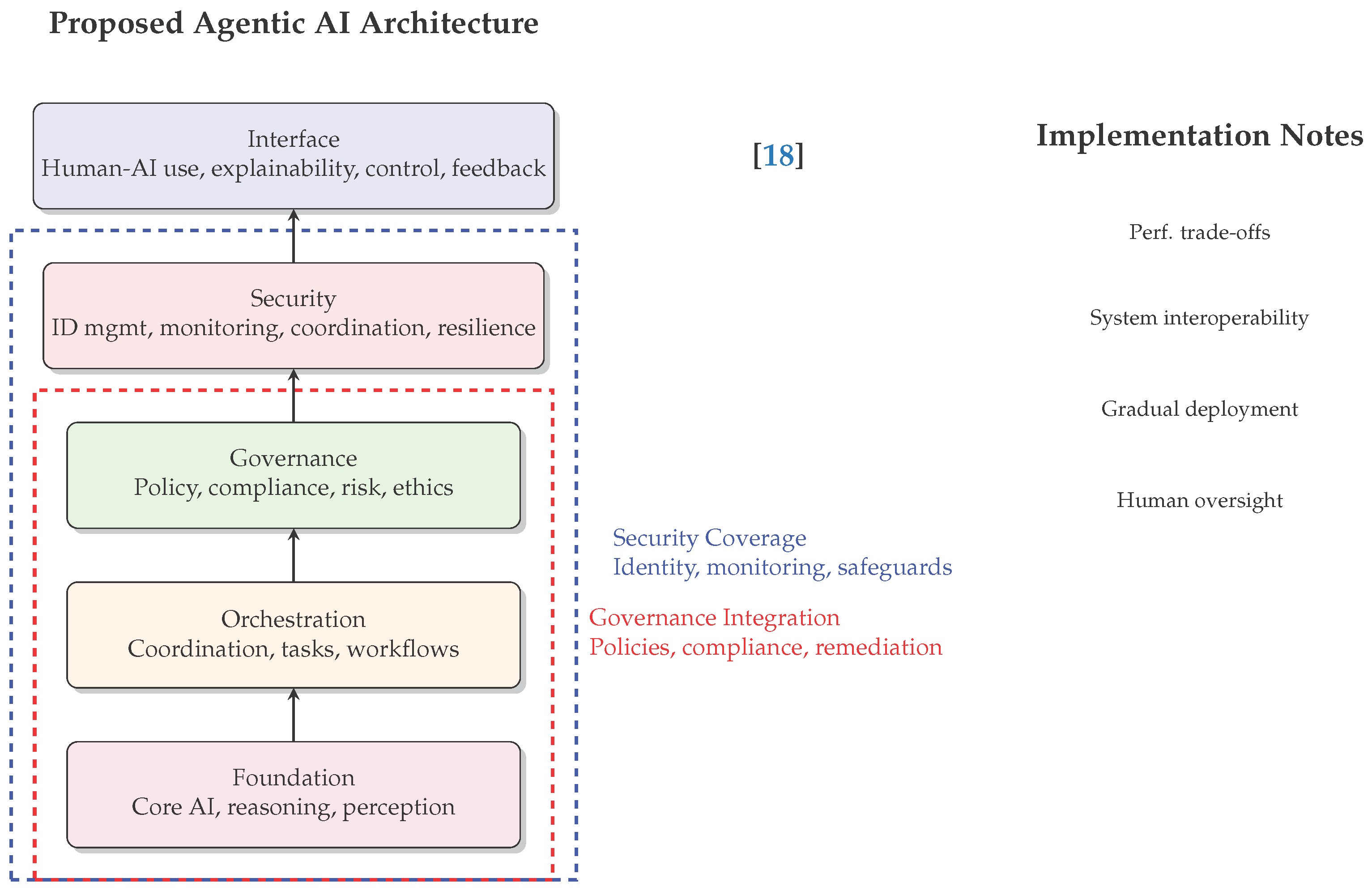
Figure 2.
Research, industry, and technology trends shaping agentic AI (2024–2030).
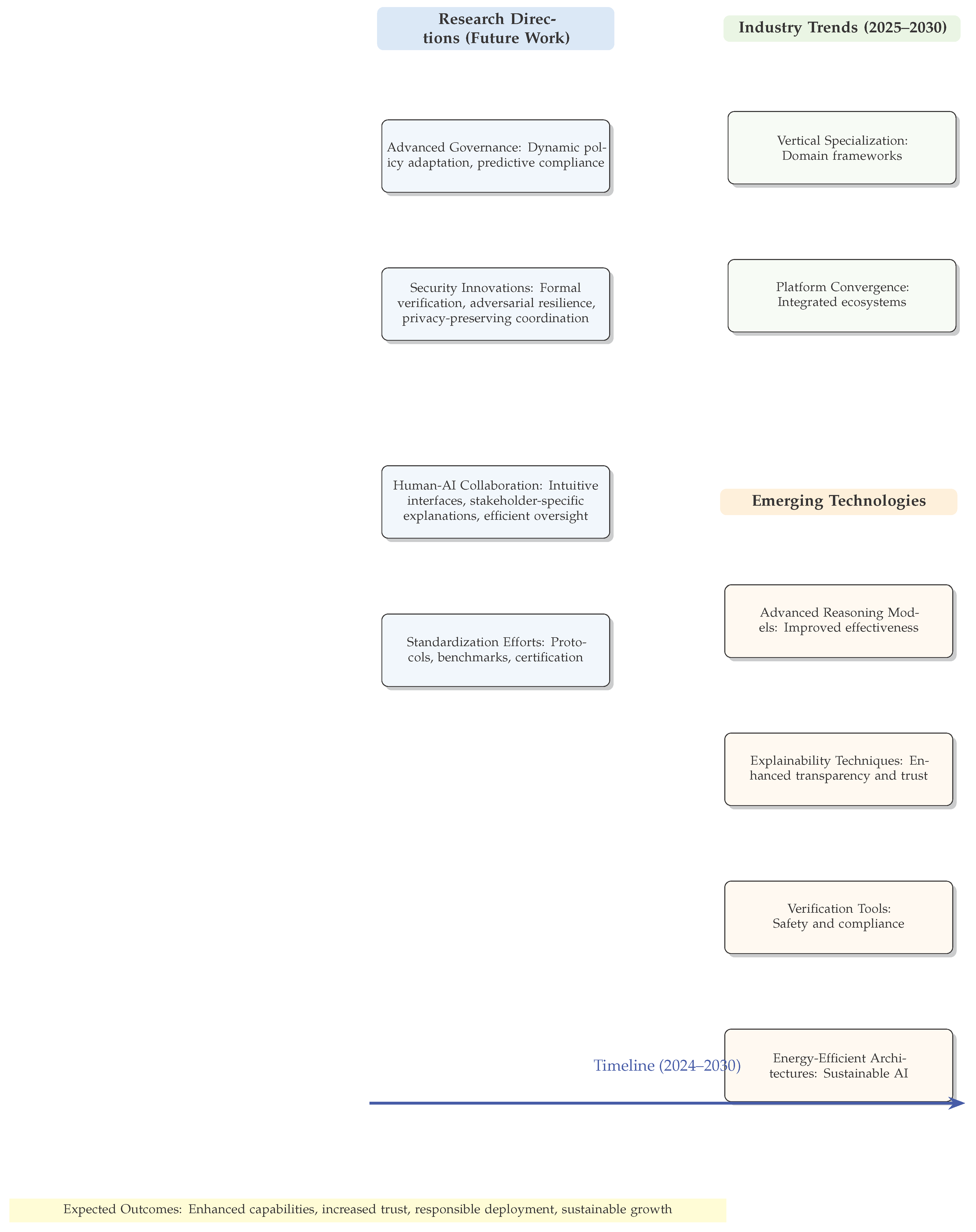
Figure 3.
Full landscape of Agentic AI frameworks and tools.
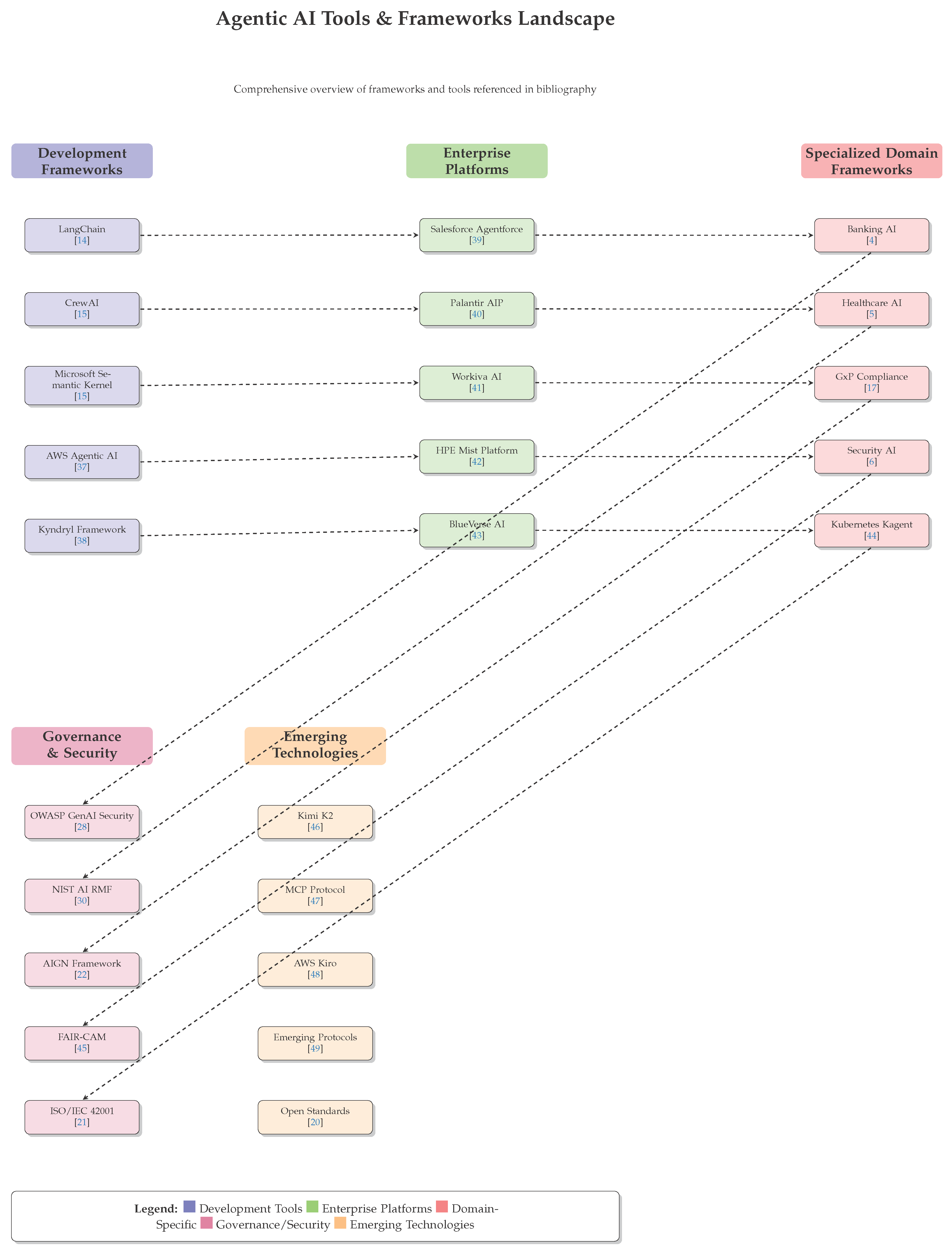
Figure 4.
Three-phase implementation roadmap with staggered milestones and outcomes to avoid overlap.
Figure 4.
Three-phase implementation roadmap with staggered milestones and outcomes to avoid overlap.
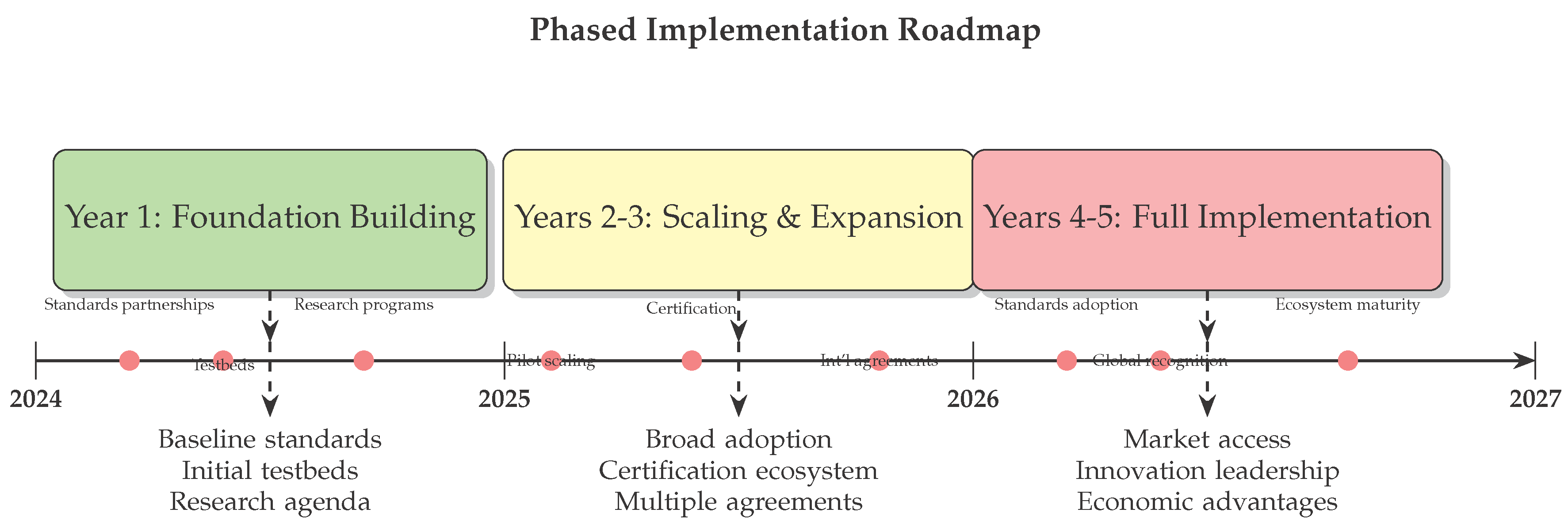

Table 1.
Comparison of Agentic AI Frameworks.
| Framework | Primary Focus | Governance Features | Maturity | Key Strengths |
|---|---|---|---|---|
| LangChain | Development | Basic | High | Flexibility, community support |
| CrewAI | Multi-agent | Moderate | Medium | Orchestration capabilities |
| Microsoft Semantic Kernel | Enterprise | Advanced | High | Integration with Azure services |
| AWS Agentic AI | Cloud deployment | Advanced | High | AWS ecosystem integration |
| Kyndryl Framework | Business AI | Advanced | Medium | Industry-specific solutions |
Table 2.
Agentic AI Governance Frameworks and Key Considerations.
| Governance Aspect | Key Principles | Frameworks & Standards | Implementation Considerations |
|---|---|---|---|
| Risk Management | - Continuous risk assessment - Red teaming protocols - Systemic risk mitigation | - NIST AI RMF [30] - FAIR-CAM framework [45] - Agentic AI Red Teaming [26] | - Permission escalation testing - Hallucination mitigation - Memory manipulation safeguards |
| Compliance & Regulatory | - GDPR/CCPA adherence - EU AI Act compliance - Sector-specific regulations | - EU AI Act guidelines [19] - GenAI Compliance Framework [24] - ISO/IEC 42001 [21] | - Regulatory gap analysis - Cross-border compliance - Audit trail requirements |
| Architectural Governance | - Three-tier architecture - Foundation/Workflow/Autonomous layers - Trust before autonomy | - Agentic AI Architecture Framework [18] - AWS Prescriptive Guidance [60] - AI Agent Infrastructure Stack [53] | - Progressive autonomy deployment - Governance by design - Transparency requirements |
| Ethical Considerations | - Bias mitigation - Transparency & explainability - Accountability frameworks | - Ethical Guidelines Template [61] - AIGN Governance Framework [22] - OWASP Security Guidelines [29] | - Ethical risk assessment - Human-in-the-loop requirements - Impact assessment protocols |
| Security & Identity | - Zero-trust architecture - Agent identity management - Secure tool integration | - New Identity Framework [62] - OWASP GenAI Security [28] - Securing Agentic Systems [56] | - Permission boundaries - Tool access controls - Secure communication protocols |
| Operational Governance | - Monitoring & observability - Performance metrics - Continuous improvement | - Agentic AI Readiness [52] - Production-ready frameworks [51] - Operationalizing Trust [63] | - Key performance indicators - Failure recovery protocols - Scalability considerations |
| Legal & Liability | - Liability attribution - Legal personhood considerations - Contractual frameworks | - Emerging Legal Frameworks [34] - Sedona Conference Guidance [64] - Legal Considerations [33] | - Liability insurance requirements - Contractual limitations - Dispute resolution mechanisms |
| Organizational Readiness | - Cultural adaptation - Skills development - Change management | - Strategic Guide [65] - 2025 Frontier Firm [2] - Implementation Best Practices [66] | - Workforce training programs - Organizational structure adaptation - Leadership commitment |
Table 3.
Strategic Framework for U.S. Leadership in Agentic AI.
| Strategic Pillar | Key Initiatives | Supporting References & Standards |
|---|---|---|
| Standards Development & Adoption | - Public-private partnerships for rapid standards development - Interoperability certification programs - Reference implementations of key standards - International standards promotion | - NIST AI RMF [30] - ISO/IEC 42001 [21] - Emerging protocols [49] - Agent communication standards [47] |
| Interoperability-First Governance | - Federal procurement guidelines with interoperability requirements - Tax incentives for interoperable architectures - Cross-border interoperability testbeds - Model contractual clauses for international deployments | - AI Governance by Design [71] - Agentic AI Governance Framework [22] - International compliance frameworks [10] |
| International Cooperation | - Multilateral regulatory harmonization initiatives - Bilateral interoperability agreements - Joint research programs on interoperability - Mutual recognition arrangements for certifications | - Global compliance strategies [25] - EU AI Act alignment [19] - Cross-border deployment frameworks [55] |
| Research & Development Investment | - Cross-platform agent communication protocols - Adaptive compliance tools for regulatory variations - Privacy-preserving international data flow technologies - Automated regulatory gap analysis tools | - Agentic AI Architecture Framework [18] - AI Agent Infrastructure Stack [53] - Security research [56] |
| Testing & Certification Infrastructure | - National interoperability validation testbeds - Internationally recognized certification programs - Cross-border performance benchmarking - Independent verification of interoperability claims | - Red teaming frameworks [26] - Security validation [57] - Compliance testing methodologies [24] |
| Policy Implementation Framework | - NIST expansion of AI RMF for agentic AI - Commerce Department international agreements - Congressional tax incentives and funding - Regulatory agency interoperability frameworks | - Policy recommendations [55] - Governance best practices [72] - Regulatory guidance [11] |
Table 4.
Implementation Roadmap and Expected Outcomes.
| Timeline | Key Activities | Expected Outcomes |
|---|---|---|
| Year 1: Foundation Building | - Establish standards development partnerships - Create initial interoperability testbeds - Develop international engagement frameworks - Launch initial research programs | - Baseline standards established - Initial testbed operational - Framework agreements in place - Research agenda defined |
| Years 2–3: Scaling & Expansion | - Scale successful pilot programs - Develop comprehensive certification programs - Achieve international recognition agreements - Expand testing infrastructure | - Broad standards adoption - Certification ecosystem operational - Multiple international agreements - Robust testing capabilities |
| Years 4–5: Full Implementation | - Comprehensive standards adoption - Global certification recognition - Full international cooperation framework - Mature interoperability ecosystem | - Market access facilitation - Innovation leadership demonstrated - Standards influence maintained - Economic advantages realized |
| Strategic Benefits | - Enhanced global market access - Maintained innovation leadership - Standards development influence - Economic competitiveness - Security resilience | - Reduced compliance costs [24] - Increased market opportunities - Technical leadership [2] - Security advantages [57] - Global competitiveness [55] |
Table 5.
Proposed Architecture and Future Directions for Responsible Agentic AI.
| Dimension | Key Elements and Directions |
|---|---|
| Architecture Layers | Foundation: Core AI models, reasoning engines, perception modules Orchestration: Multi-agent coordination, task decomposition, workflow management Governance: Policy enforcement, compliance monitoring, risk management, ethical oversight Security: Agent identity management, behavioral monitoring, malicious coordination safeguards, resilience [62] Interface: Human-AI interaction, explainability, control mechanisms, feedback loops |
| Governance Integration | Governance by design: machine-readable policies, real-time compliance checks, automated remediation, comprehensive audit trails |
| Implementation Considerations | Performance overhead trade-offs; interoperability with existing systems; evolutionary deployment strategies; maintaining human-in-the-loop oversight |
| Research Directions | Advanced governance mechanisms (dynamic policy adaptation, predictive compliance) Security innovations (formal verification, adversarial resilience, privacy-preserving coordination) Human-AI collaboration (intuitive interfaces, stakeholder-specific explanations, efficient oversight) Standardization efforts (protocols, benchmarks, certification) [10] |
| Industry Trends | Vertical specialization of frameworks by sector [4,17] Platform convergence into integrated ecosystems [16] Regulatory evolution with autonomy-specific requirements [10] Skills development initiatives to address workforce gaps [59] |
| Emerging Technologies | Advanced reasoning models; explainability techniques; formal verification tools; energy-efficient architectures |
Disclaimer/Publisher’s Note: The statements, opinions and data contained in all publications are solely those of the individual author(s) and contributor(s) and not of MDPI and/or the editor(s). MDPI and/or the editor(s) disclaim responsibility for any injury to people or property resulting from any ideas, methods, instructions or products referred to in the content. |
© 2025 by the authors. Licensee MDPI, Basel, Switzerland. This article is an open access article distributed under the terms and conditions of the Creative Commons Attribution (CC BY) license (http://creativecommons.org/licenses/by/4.0/).
Copyright: This open access article is published under a Creative Commons CC BY 4.0 license, which permit the free download, distribution, and reuse, provided that the author and preprint are cited in any reuse.


