Preprint
Article

This version is not peer-reviewed.

Optimized De-Chlorination Strategy of ASR-Based Solid Recovered Fuel (SRF) via Inorganic Additive and Bamboo Blending

Submitted:

17 September 2025

Posted:

18 September 2025

You are already at the latest version

Abstract

The objective of this study was to investigate the chlorine-related challenges in Automotive Shredder Residue (ASR) by developing a de-chlorination strategy and formulating Solid Recovered Fuel (SRF) pellets with improved environmental and fuel quality. A ternary blending approach was employed using Fe–Ca-based inorganic dechlorinating agents and thorny bamboo biomass as co-materials with ASR. The de-chlorination efficiency, calorific value, and ash content of the resulting SRF were evaluated. Results indicated that the optimal dechlorinating formulation reduced the chlorine content of PVC from 43.26 wt% to 0.59 wt%, achieving a de-chlorination efficiency of 97.23%. A second-order polynomial regression modelη_DeCl = –1.5277x² + 2.5519x – 0.0225R² = 0.9347was developed to predict the de-chlorination performance based on the blending ratio of dechlorinating agent to ASR, demonstrating behavior consistent with first-order reaction kinetics observed in pyrolytic de-chlorination. The final ternary formulation—comprising 55% thorny bamboo, 37.5% ASR, and 7.5% dechlorinating agent—produced SRF pellets with improved overall quality, demonstrating effective chlorine control, reasonable ash content, and enhanced thermal properties suitable for regulatory compliance and practical application. Such findings meet the criteria set by EN ISO 21640:2021 (Class 2), JIS Z7311 (Grade A), and forthcoming Taiwanese SRF regulations. Based on the findings in this work it can be stated that the high de-chlorination potential of Fe–Ca-based additives for chlorine-rich waste and introduces a predictive formulation model that supports both resource circularity and clean fuel production.

Keywords: 
;  ;  ;  ;  ;  ;  

1. Introduction

With the increasing global emphasis on sustainable resource utilization, waste reduction, and carbon neutrality, Solid Recovered Fuel (SRF)—a partly bio-genic form of waste-derived fuel—has emerged as a vital alternative energy source to conventional fossil fuels [1]. SRF refers to a type of solid fuel produced through selective processing and preparation of waste materials, characterized by excellent combustibility, relatively high calorific value, low and stable moisture content, and comparatively low ash content [2] . The SRF production process offers high energy recovery efficiency, diverse raw material options, and flexible treatment adaptability. These advantages have facilitated SRF’s widespread application in high-temperature industrial processes such as cement kilns, industrial boilers, and combined heat and power (CHP) systems. Its adoption not only enhances waste-to-energy conversion rates but also contributes to significant reductions in overall greenhouse gas emissions [3].
Among various SRF feedstocks, Automotive Shredder Residue (ASR) is considered a highly promising material for energy recovery due to its stable supply, large availability, and moderate calorific value (approximately 13–20 MJ/kg). ASR is the non-metallic fraction remaining after end-of-life vehicles undergo shredding and metal recovery, primarily consisting of plastics, rubber, fibers, foams, and fine particles, and is known for its highly heterogeneous composition [4] . However, one of the major technical challenges associated with ASR is its high chlorine content, mainly attributed to the presence of polyvinyl chloride (PVC) [5] and halogenated rubber such as chlorinated butyl rubber [6].According to Vermeulen et al. [6] , ASR often contains polymers such as polypropylene (PP), polyurethane (PUR), PVC, acrylonitrile butadiene styrene (ABS), polymethyl methacrylate (PMMA), and polyethylene terephthalate (PET), and is classified as hazardous waste in some countries. During combustion, ASR tends to release hydrogen chloride (HCl), which can react with metallic elements to form volatile metal chlorides (e.g., PbCl₂, ZnCl₂) [7] . Furthermore, it may also promote the formation of toxic dioxins and furans (PCDD/Fs) [8] , resulting in equipment corrosion, increased air pollutant emissions, added burden on flue gas treatment, and difficulty in meeting regulatory emission standards [9].
Therefore, reducing the chlorine content of ASR, stabilizing its combustion behavior, and improving the final fuel quality are key technological challenges for promoting its energy recovery applications. To suppress chlorine-related pollutants such as HCl, metal chlorides, and dioxins during high-temperature combustion, recent studies have widely adopted inorganic metal-based additives as de-chlorination agents. Among them, calcium-based, iron-based, and other metal oxides e.g., copper and nickel have shown potential as catalysts or sorbents for PVC de-chlorination and chlorine adsorption [10]. Calcium can react with HCl under combustion conditions to form stable, high-melting-point calcium chloride (CaCl₂), thereby reducing the release of corrosive gases and inhibiting dioxin formation [11] . Iron can form FeCl₂ and FeCl₃ compounds by reacting with chlorine, and disrupt the Cl₂–carbon bonding cycle, effectively lowering the generation potential of PCDD/Fs [12]. In this study, an Fe–Ca composite powder was selected as the de-chlorination agent, aiming to integrate the adsorption, neutralization, and toxicant suppression functionalities of both metals, and to enhance its applicability in chlorine-contaminated solid fuels such as ASR.
On the other hand, due to ASR’s loose structure and heterogeneous composition, it exhibits poor compressibility and pelletization behavior, often resulting in uneven heat release and high ash content during combustion. Vijayan et al. [13] pointed out that untreated ASR, due to its fluffy texture and inconsistent particle size, is difficult to process into pellets. Pre-treatment steps such as thermal softening, fine grinding, and sieving are essential to improve its pelletizability and combustion stability. Similarly, Harder et al. [14] noted in their review on ASR pyrolysis that the high heterogeneity of ASR—in terms of composition, moisture content, and heating value—poses significant challenges for thermal conversion, leading to low combustion efficiency and inconsistent process performance. Garrido et al. [15] demonstrated that the addition of high-volatile-content agricultural residues, such as palm trunks, can enhance ASR pelletizability and improve combustion performance. Based on these findings, and in response to ASR's poor compressibility, high ash content, and unstable energy density, this study introduces a biomass co-additive with high volatile matter and medium-to-high calorific value to improve the physical and thermochemical properties of SRF fuel. Among potential candidates, bamboo is considered a suitable biomass fuel due to its high volatile matter and lower ash content compared to ASR [16]. Rusch et al. [17] reported that bamboo typically exhibits a volatile content of 75–85%, fixed carbon between 15–25%, and ash content close to 1%, offering superior energy density and combustion stability relative to common wood species. In this study, thorny bamboo (Bambusa stenostachya)—a fast-growing and widely available species in Taiwan—was selected due to its uniform fiber structure, high volatile content, moderate heating value, and acceptable ash content. These properties make it advantageous for facilitating ignition, increasing energy density, and improving pellet durability. Bamboo is also a renewable and sustainable lignocellulosic resource, whose application not only reduces overall ash and dilutes chlorine content, but also aligns with circular economy and low-carbon energy policies [18]. By combining ASR, Fe–Ca dechlorination agent, and thorny bamboo into a three-phase pellet formulation, this study aims to develop a low-chlorine, high-calorific-value SRF pellet with excellent processability. A systematic evaluation of its dechlorination efficiency, pelletization behavior, and fuel quality was conducted to verify its technical feasibility and application potential.HERE ONE JUSTIFICATION SENTENCE WHY THIS WORK WAS CARRIED OUT , SUCH AS THERE IS LIMITED INFOR ON.... ETC ETC.
This study aims to evaluate the feasibility of producing SRF pellets primarily composed of ASR, blended with thorny bamboo and Fe–Ca-based de-chlorination agents. The experimental objectives of this study are to evaluate how different blending ratios influence the physical properties and pelletizing behavior of the fuel, to determine the effectiveness of Fe–Ca-based powders in reducing chlorine content during processing, and to explore the composition of the resulting combustion ash for its potential reuse or valorization. The findings are expected to provide valuable references for energy recovery technologies utilizing waste plastics and mixed wastes and further promote the clean utilization of chlorine-containing waste and the integrated application of ash as a reusable resource.

2. Materials and Methods

2.1. Materials

Chlorine source:
To evaluate the dechlorination effectiveness of additives on high-chlorine-content materials, commercially available polyvinyl chloride (PVC) powder was selected as a model chlorine-rich additive in this study. The PVC used exhibited high purity and uniform particle size distribution, with a measured chlorine content of approximately 43 wt%. This value is slightly lower than the theoretical chlorine content of PVC polymers (typically around 57 wt%) [19] , which may be attributed to the presence of fillers, plasticizers, or variations in polymer structure. PVC molecules contain a large number of covalently bonded chlorine atoms that can be easily released as hydrogen chloride (HCl) gas during pyrolysis or combustion processes. These gases can further react with other components to form toxic and corrosive compounds such as dioxins (PCDD/Fs) and volatile metal chlorides (e.g., PbCl₂, ZnCl₂) [6,20].
In ASR, PVC is considered one of the primary chlorine sources, as it is extensively used in automotive interior components, wire and cable coatings, and sealing strips [5] . Therefore, using PVC powder as a standardized model for chlorine contamination is a valid approach to simulate the high-chlorine characteristics of ASR. To investigate the influence of additive composition on chlorine removal efficiency, nine formulations of PVC and Ca–Fe based dechlorination agents were designed (Table 1). In all formulations, the PVC content was fixed at 50 wt%, while the Ca:Fe ratio in the dechlorination agent was varied incrementally from 100:0 to 0:100. The total amount of additive was also maintained at 50 wt% across all formulations to ensure consistent reaction conditions, with only the metal composition ratio being altered to assess its contribution to dechlorination performance. Each formulation was tested in six replicates to ensure the reliability of statistical analysis. Furthermore, the particle size of all raw materials was standardized to minimize the effects of mixing heterogeneity and decomposition kinetics variability during the dechlorination process.
Biomass base:
In this study, thorny bamboo (Bambusa stenostachya), a fast-growing and widely distributed bamboo species commonly found in Taiwan, was selected as the primary biomass material. Thorny bamboo belongs to the Poaceae family, subfamily Bambusoideae, and exhibits several favorable characteristics for use as a solid biofuel. These include a volatile matter content exceeding 70%, net calorific value (NCV) over 18 MJ/kg, ash content ranging from 1% to 5%, and fixed carbon content between 10% and 20%. Furthermore, its uniform fiber structure contributes positively to pelletization efficiency and combustion stability [16]. In addition, thorny bamboo is considered a renewable agroforestry residue, with short cultivation cycles and broad regional availability. Its utilization aligns well with circular economy principles and national sustainable energy development strategies [21,22].
Automotive Shredder Residue (ASR):
The ASR used in this study refers to the non-metallic residual fraction generated from end-of-life vehicles after mechanical shredding and metal recovery. ASR is primarily composed of plastics, rubber, fibers, foam, and fine particulate matter, exhibiting a high degree of heterogeneity. Due to its stable supply and moderate to high calorific value potential (approximately 13–20 MJ/kg), ASR is regarded as a promising candidate for energy recovery applications [23] . However, the presence of polyvinyl chloride (PVC) and other halogenated plastics leads to elevated chlorine content, posing a critical limitation for its thermal utilization.
To evaluate the de-chlorination efficiency of chemical additives on high-chlorine waste, commercial PVC powder was first used in preliminary experiments as a standardized chlorine source. Subsequently, actual ASR material was employed in later-stage tests to reflect real-world applicability. Prior to experimentation, the ASR was subjected to crushing, sieving, and drying to control particle size and moisture content (≤10 wt%), aiming to enhance mixing uniformity and compaction stability. Additionally, the ASR underwent proximate analysis for ash content and chlorine concentration to characterize its baseline properties.
Dechlorination agent:
Composite metal-based de-chlorination additives containing calcium and iron were formulated in nine different Ca:Fe ratios (A–I), ranging from 100:0 to 0:100, to investigate the influence of metal composition on the de-chlorination performance of PVC-based high-chlorine fuels within the scope in this work. Under high-temperature conditions, calcium-containing materials decompose to produce calcium oxide (CaO), which exhibits alkaline adsorption capacity and can neutralize hydrogen chloride (HCl) released during combustion, thereby forming stable calcium chloride (CaCl₂) (1) [24] . Meanwhile, iron-based materials react with chlorine to form high-melting-point iron chlorides (e.g., FeCl₂ and FeCl₃) (2), which provide dual functions of chlorine capture and dioxin suppression [25,26] . Through the synergistic interaction of calcium and iron oxides, multiple benefits—including chlorine adsorption, acid neutralization, and toxicity reduction—can be simultaneously achieved, thereby enhancing overall de-chlorination efficiency and enabling the production of solid recovered fuel (SRF) with stable fuel quality.
CaCO3+ 2HCl → CaCl2 + H2O
Fe2O3 + 6HCl → 2FeCl3 + 3H2O

2.2. Experimental Design

Stage 1: Fixed Chlorine Source Simulation Test
To identify the most effective metal-based de-chlorination additive, commercial polyvinyl chloride (PVC) powder was selected as a standardized chlorine source. The PVC was mixed at a 1:1 weight ratio with various Ca–Fe composite powders, with calcium-to-iron ratios ranging from 100:0 to 0:100, designated as Type A–I (see Table 1). Each mixture was thoroughly blended under fixed conditions and subjected to a controlled heating process. The residual chlorine content of each sample was then determined using the mercuric nitrate titration method. The purpose of this test was to evaluate the influence of different Ca–Fe ratios on chlorine removal efficiency and to select the most promising formulation for further experiments.
Stage 2: Application of Optimal Dechlorinating Agent to Real ASR Samples
The dechlorinating agent identified as optimal in the first stage was applied to real ASR to prepare fuel mixtures with varying blend ratios (Table 2). Each mixture was thoroughly homogenized prior to pellet formation and chlorine content analysis. This phase aimed to evaluate the de-chlorination efficiency, ash variation, and practical applicability of the selected additive within the actual ASR matrix. The results were also intended to serve as a reference for subsequent co-blending design with lignocellulosic biomass materials.
Stage 3: Three-Component Co-Pelletization of ASR, Biomass, and Dechlorinating Agent
To enhance the pelletization potential of ASR-based SRF and ensure compliance with relevant regulatory standards, this study adopted thorny bamboo as a biomass co-additive, combined with ASR and a metal-based dechlorinating agent for ternary pellet production. To ensure that the resulting SRF pellets possess practical applicability and regulatory conformity, we referenced multiple international quality standards for SRF classification and control (Table 3). According to EN ISO 21640:2021, SRF is classified into five classes, where Class 2 sets a chlorine (Cl) content limit of ≤ 0.6 wt% and the net calorific value (NCV) must be ≥ 20 MJ/kg — thresholds commonly adopted in industrial applications. Class 1 further tightens these requirements to Cl ≤ 0.2 wt% and NCV ≥ 25 MJ/kg [27]. In Japan’s JIS Z7311:2010 standard for Refuse Paper and Plastic Fuel (RPF), Grade A requires the NCV ≥ 25 MJ/kg and Cl content ≤ 0.6 wt%, while Grade B demands even stricter limits of Cl ≤ 0.3 wt% and ash content ≤ 10 wt% [28] . South Korea’s SRF regulations specify a Cl threshold of ≤ 2 wt% for general SRF, and for bio-SRF, the NCV must be ≥ 3,000 kcal/kg (≈12.56 MJ/kg), with Cl content controlled to ≤ 0.5 wt% [28]. In Taiwan, the Environmental Protection Administration (EPA) released the “Solid Recovered Fuel (SRF) Manufacturing Guidelines and Quality Standards” in 2020, which stipulate minimum SRF requirements of NCV ≥ 2,392 kcal/kg (≈10 MJ/kg) and Cl ≤ 3.0 wt% (dry basis). A recent policy draft proposes a tiered classification system to be implemented by 2025, aiming to further reduce the maximum allowable Cl content to 1.5 wt%, aligning with stricter air pollution control and circular economy targets [3]. Given these international and national standards, the formulations in this study were designed to target a Cl content of ≤ 0.6 wt%, while simultaneously evaluating the calorific value and ash content. The goal was to meet or exceed both domestic and international SRF application criteria.
In summary, the experimental formulations in this study—including the proportions of ASR, de-chlorination agent, and Thorny bamboo—were designed with the goal of maintaining chlorine content below 0.6 wt%, while ensuring compliance with regulatory thresholds for calorific value and ash content in practical fuel applications. Specifically, the target criteria included a calorific value above 15 MJ/kg and ash content controlled around 15 wt%. Based on these criteria, the three primary raw materials selected were: Thorny bamboo (NCV ≈ 18.5 MJ/kg, Cl ≈ 0.0015% [29], Ash ≈ 4.5%), ASR (NCV ≈ 15.0 MJ/kg, Cl ≈ 1.60%, Ash ≈ 18%), and a metal-based de-chlorination agent (assumed non-combustible, Cl = 0%, Ash = 100%). To assess the impact of different raw material ratios on the final fuel quality, this study adopted the Weighted Average Method proposed by Kathiravale et al. (2003) [30] . Equation (3) was used to estimate the higher heating value and ash content of blended SRF samples, assuming that the thermal and physical properties of each material remained unchanged after mixing. Here, Xmix represents the predicted property (e.g., MJ/kg for NCV, or wt% for ash), X denotes the intrinsic property of each component, and W is the mass fraction (w/w) of each in the mixture. Regarding chlorine content, an extended calculation model was developed (Equation 4), incorporating the predicted de-chlorination efficiency based on a regression function (Equation 5) derived from preliminary fixed-chlorine-source tests. These equations allowed the optimization of SRF pellet formulations to maximize ASR usage while minimizing de-chlorination agent input—achieving a balance between high calorific value, low ash, and regulatory chlorine control.
To ensure both low chlorine content and high ASR utilization for practical application and enhanced waste-to-energy efficiency, the maximum allowable ASR content in this study was set at 37.5 wt%, corresponding to a theoretical chlorine contribution of 0.6 wt%. In order to meet regulatory fuel standards, the addition of the de-chlorination agent was also limited. A maximum of 7.5 wt% was selected based on the following integrated considerations: First, the de-chlorination agent is an inorganic, non-combustible material with extremely high ash content (≈ 100 wt%). Excessive inclusion would significantly reduce the overall energy density (MJ/kg) of the fuel and increase ash content, potentially exceeding domestic and international SRF requirements (e.g., ≥ 12.5 MJ/kg calorific value and ≤ 20 wt% ash). Second, due to its poor binding and plasticity characteristics, a high ratio of de-chlorination agent could negatively affect pelletizing efficiency, leading to unstable compaction, mold wear, and increased risk of particle breakage. Third, from an operational and economic perspective, excessive use is cost-inefficient and unfavorable to sustainable material circulation and processing economics. Therefore, under the prerequisite of maintaining Cl < 0.6 wt%, a limit of 7.5 wt% was adopted for the de-chlorination agent, while balancing it with high-volatile and medium-calorific biomass (Thorny bamboo) and high-chlorine ASR as the primary combustible components. The target formulation aimed to achieve an optimal trade-off among heating value, ash content, and pellet-forming stability, resulting in a feasible and environmentally compliant SRF fuel. All test samples were prepared using a lab-scale hydraulic pellet press under the following conditions: formulation ratio of Thorny bamboo: ASR: de-chlorination agent = 55:37.5:7.5 (w/w), die diameter of 12.7 mm, compaction pressure of 300 kgf/cm² (≈ 29.4 MPa), and compression temperature of approximately 100 °C. The produced pellets were subsequently evaluated for physical characteristics, calorific value, chlorine content, and ash content to validate the practical viability of the designed formulation.
Xmix​= ​Xbamboo​⋅Wbamboo​+XASR​⋅WASR​+XDeCl​⋅WDeCl​​
Clfinal(%)=(WASR×ClASR×(1−ηdecl​))+(WBamboo×ClBamboo)
ηdecl​ = -1.5277x2 + 2.5519x - 0.0225
x = De-chlorination Agent / (De-chlorination Agent + ASR)
Based on the estimations derived from equations (3), (4), and (5), the optimized formulation yields a predicted heating value of approximately 15.8 MJ/kg, ash content of 16.7 wt%, and chlorine content of approximately 0.4 wt%, indicating a dechlorination efficiency (η decl) of 36%, effectively reducing the chlorine level from 0.6 wt% to 0.4 wt%. This formulation meets the chlorine content thresholds defined by EN ISO 21640:2021 (Class 2), Japanese JIS Z7311 Grade A, and the future regulatory standards proposed in Taiwan.

2.3. Analytical Methods

Chlorine Content Analysis of the samples
In this study, sample pretreatment was conducted following the Taiwan EPA Method NIEA M402.00B, with reference to ASTM E776-16 and EPA SW-846 Method 9057 for the collection of water-soluble chlorine compounds generated during combustion. The test samples were placed in a high-temperature tubular furnace set at 800 °C and held at that temperature for 30 minutes. Throughout the heating and cooling stages, pure oxygen was continuously supplied to facilitate the release and transport of chlorine-containing gases. During high-temperature decomposition, chlorine compounds in the samples released chlorine gas (Cl₂) or hydrogen chloride (HCl), which were subsequently introduced into an absorption device containing 30% hydrogen peroxide solution(H2O2), where the chlorine gases were absorbed and converted into aqueous HCl solution.
Quantification of chlorine content was performed using the Mercuric Nitrate Titration Method, following the procedures outlined in EPA Method 9252A (SW-846). Under acidic conditions (pH 3.0–3.6), the samples were titrated with a standard mercuric nitrate solution, using diphenylcarbazone as the indicator. The endpoint of the titration was determined when a stable purple coloration appeared, indicating the presence of excess Hg²⁺ ions. Based on the volume of mercuric nitrate consumed during titration, the total chlorine content (wt%) in the sample was calculated. This value was further used to estimate the de-chlorination efficiency (ηdecl) in subsequent experiments.
Thermogravimetric Analysis (TGA) of the samples:
A PerkinElmer TGA 6 thermogravimetric analyzer (USA) was employed to evaluate the thermal decomposition behavior and volatile matter release characteristics of the prepared SRF pellets under an inert atmosphere. Prior to analysis, each sample was evenly and loosely distributed in an open-type sample pan, with an initial weight of approximately 1 mg. The temperature was programmed to increase from 50 °C to 800 °C at a heating rate of 20 °C/min, while continuously purging the system with high-purity nitrogen gas (N₂, 99.99%) at a flow rate of 60 mL/min.
Under these conditions, pyrolysis behavior was characterized by recording the mass loss at various temperature regions, allowing for the estimation of volatile content, thermal stability, and multi-stage decomposition characteristics of the samples. Each sample was tested in triplicate to ensure data repeatability and reliability. The resulting thermogravimetric curves were used to interpret the proportions of organic and inorganic components in the SRF pellets, and served as the basis for calculating the volatile matter and fixed carbon contents.
Moisture Content Analysis of the samples:
The oven-drying method was employed to determine the moisture content of each sample. Following standard procedures for biomass fuels, as specified in ASTM E871-82 or CEN/TS 14774-1:2004, pre-weighed samples were placed in a forced-air drying oven maintained at 105 ± 2 °C. The drying process continued until the weight change was less than 0.1%, which was considered to indicate a constant weight (i.e., equilibrium moisture content). The final dry mass was then recorded to calculate the sample’s moisture content.
Ash Content of the samples:
To evaluate the inorganic residue content and potential slagging burden of each fuel pellet formulation after combustion, the standard ash determination method was applied. According to the procedures specified in ASTM D1102-84 (2013) and CEN/TS 14775:2004, pre-dried samples (dried to constant weight) were placed into porcelain crucibles and introduced into a muffle furnace. The samples were incinerated at 600 ± 25 °C for a minimum of 8 hours. After ashing, the crucibles were allowed to cool to room temperature, and the residual ash was weighed to calculate the ash content (wt%).
Calorific Value Analysisof the samples:
The NCV was employed as the key indicator to evaluate the energy potential of SRF pellets. NCV represents the effective amount of heat released per unit mass of fuel under complete combustion in an oxygen-rich environment, excluding the latent heat of water vaporization. Pellet samples (diameter 12.7 mm, weight 1.0 g ± 0.1 g) produced in the laboratory were analyzed using a IKA® C1 oxygen bomb calorimeter (Germany). The procedure followed the standard protocols outlined in ASTM D5865-13 and CEN/TS 14918:2005. Prior to analysis, all samples were dried at 105 °C to a constant weight to eliminate moisture content. Each fuel formulation was tested in triplicate to ensure the accuracy and reproducibility of the results. The measured calorific values are expressed in MJ/kg to facilitate comparison with national and international SRF standards, such as ISO 21640:2021, JIS Z7311, and Korean Bio-SRF classification.
Statistical and Predictive Modeling Analysis:
A predictive model was established to evaluate the fuel properties of ternary blended formulations composed of thorny bamboo, ASR (automotive shredder residue), and a dechlorinating agent. The NCV and ash content were estimated using the weighted average method based on the material-specific properties and their respective mass ratios in the mixture (Equation 3). Chlorine content was predicted by combining a regression-based dechlorination efficiency model (η_decl) derived from experimental results (Equation 5), with the mass fraction of the dechlorinating agent to estimate total chlorine content (Equation 4), thereby serving as a reference for the environmental compliance of each formulation.
To further investigate the influence of different blend ratios on fuel quality and dechlorination efficiency, all test data were statistically analyzed using SAS Enterprise Guide software. One-way analysis of variance (ANOVA) and Tukey's Honest Significant Difference (HSD) post hoc test were applied (α = 0.05) to identify significant differences among treatments. All experimental results are presented as "mean ± standard deviation (Mean ± SD)," and significant differences between groups are marked with lowercase letters (e.g., a, b, c). Groups with different letter annotations indicate statistically significant differences, whereas those with the same letter are considered statistically similar. This analytical approach provides quantitative support for evaluating and optimizing SRF formulations in terms of heating value, ash content, and chlorine content.

3. Results

3.1. Dechlorination Efficiency of Dechlorinating Agent Formulations (A–I) on PVC

Nine types of pellet tablets with a diameter of 12.7 mm were produced using different dechlorinating agent formulations, and the dechlorination efficiency of nine Ca:Fe ratios (Formulations A–I) was preliminarily evaluated. The results are summarized in Table 4 and depicted in Figure 1. The control group (CONTROL), composed of 100% PVC, exhibited the highest chlorine content at 42.53%, which served as the baseline for calculating dechlorination efficiency. All treatment groups were prepared with the same PVC content (50 wt%) and total dechlorinating agent dosage (50 wt%), with only the Ca:Fe ratio adjusted (ranging from 100:0 to 0:100).
In this study, simulated PVC-containing materials were subjected to de-chlorination tests using various Ca: Fe ratios (Formulations A–I). All samples were analyzed with six replicates (N = 6), and statistical significance was assessed using one-way ANOVA and Tukey’s HSD multiple comparison test (α = 0.05), to evaluate differences in de-chlorination efficiency and ash content across formulations.
Experimental results showed that formulations B to G achieved significantly effective de-chlorination, with residual chlorine contents all below 1 wt% (ranging from 0.48 to 1.71 wt%) and de-chlorination efficiencies (De Cl%) exceeding 91%. According to the Tukey analysis (Table 4), there were no significant differences in Cl content among formulations B–G (all grouped as "b"), while clear distinctions were observed between these and formulations H and I (grouped as "a" or "a, b"). This confirms that Ca: Fe ratios in the range of 50:50 to 25:75 yield the most stable and reliable de-chlorination performance.
Among them, formulation G (Ca: Fe = 25:75) demonstrated the best outcome, with the lowest residual Cl content (0.48 ± 0.26 wt%) and the highest de-chlorination efficiency of 97.75%. This result is likely related to the catalytic role of Fe under high temperatures, facilitating PVC degradation and HCl volatilization [31]. Comparatively, formulation D (Ca: Fe = 62.5:37.5) offered an optimal balance between de-chlorination performance and fuel properties, with a residual Cl content of 0.59 ± 0.17 wt% and a de-chlorination efficiency of 97.23%. This successfully reduced the initial high chlorine content in PVC (43%) to below the regulatory threshold of 0.6 wt%, aligning with international standards for SRF, and helps mitigate the formation of hazardous substances such as dioxins and HCl during combustion.
Regarding ash content, values ranged from 24.92 to 42.96 wt%. Although the Tukey test showed no statistically significant differences across groups (all labeled "a"), practical implications must still consider the impact of additive ratios on elevated ash levels. Formulation D, for instance, showed a relatively lower ash content of 30.31 ± 6.13 wt%, in contrast to high-Fe formulations (e.g., F, G, H, I), which exceeded 40 wt%. Based on the integrated results and statistical evaluation, formulation D can be regarded as the most representative optimal formulation in this study, achieving a well-balanced performance in chlorine reduction, ash content control, and processability—offering strong potential for practical SRF engineering applications.

3.2. Effect of ASR and Dechlorination Agent Mixing Ratio on Chlorine Content Control

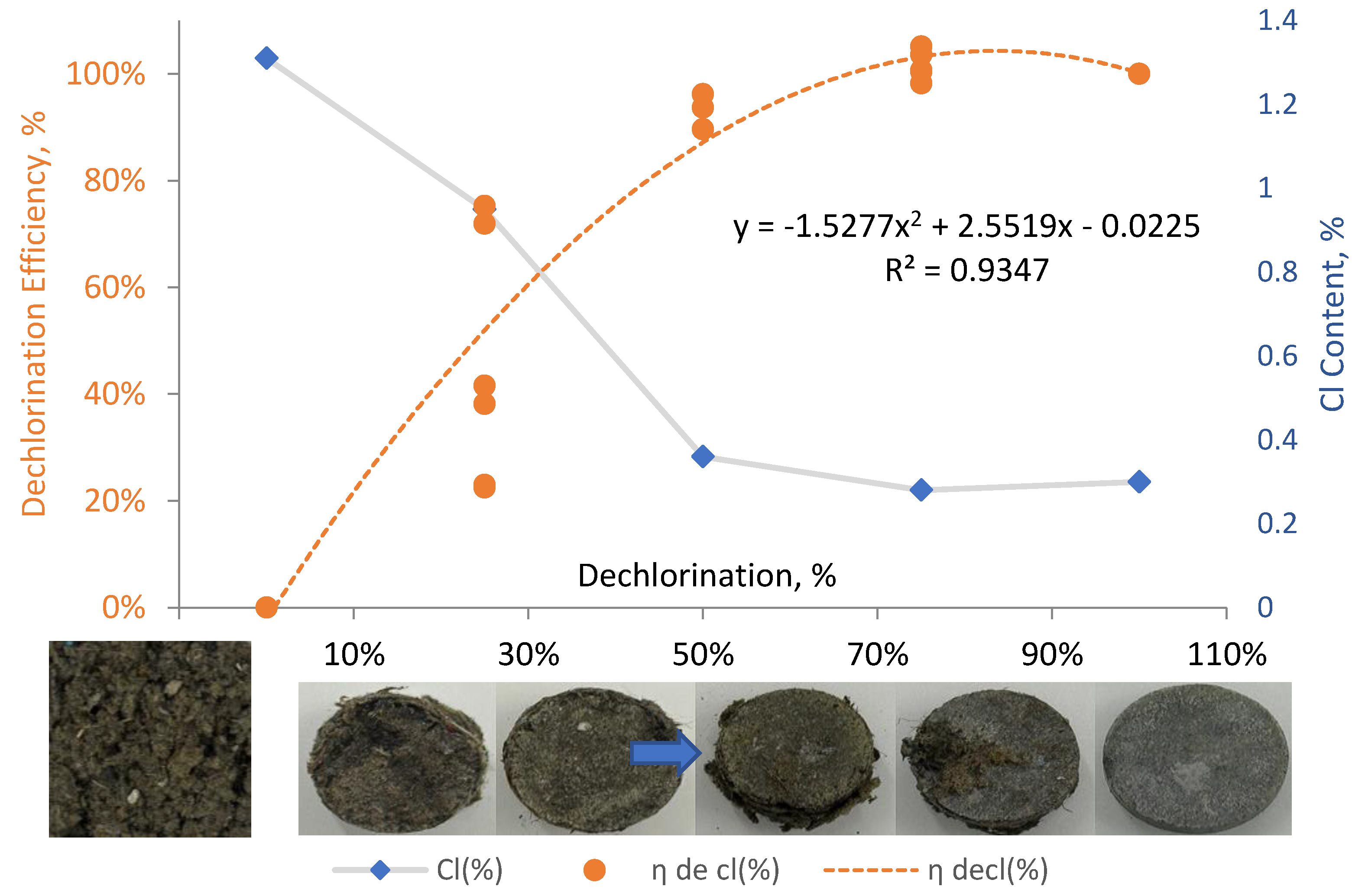
This study further investigated the influence of mixing ratios between ASR and the de-chlorination agent on the chlorine content and de-chlorination efficiency of SRF pellets. As shown in Table 5 and Figure 2, five formulations with varying ASR contents (100%, 75%, 50%, 25%, and 0%) and corresponding de-chlorination agent proportions (0%, 25%, 50%, 75%, and 100%) were designed.
Each formulation underwent pelletizing, drying, and grinding before performing total chlorine content analysis to evaluate the de-chlorination effectiveness. As the proportion of de-chlorination agent increased from 0% to 100%, the chlorine content significantly decreased from 1.31 ± 0.61% (De-cl(D)0%) to 0.28 ± 0.03% (De-cl(D)75%) (p<0.05). Correspondingly, the de-chlorination efficiency (ηDe Cl) improved drastically from 35.64% to 101.98%, indicating that a higher ratio of dechlorination agent effectively enhances chloride removal.
This trend is also evident in the dual-axis graph of Cl (%) and ηDe Cl (%), where chlorine content showed a decreasing pattern while de-chlorination efficiency exhibited exponential growth with increasing de-chlorination agent proportion.
According to the nonlinear regression analysis (dashed line in Figure 2), a strong correlation was observed between dechlorination efficiency and the proportion of the dechlorination agent. The best-fit curve followed a quadratic polynomial relationship(ηDe Cl = -1.5277x² + 2.5519x - 0.0225,R² = 0.9347), which enables effective prediction of dechlorination performance under various mixing ratios.
Further statistical analysis using Tukey’s HSD test revealed that when the proportion of the dechlorination agent exceeded 25% (i.e., Decl(D)50%, Decl(D)75%, and Decl(D)100%), the chlorine content was significantly lower than that of the 0% and 25% groups (p < 0.05). The Cl content ranged between 0.28% and 0.36%, complying with the threshold limit (<0.6 wt%) specified in SRF product standards.
Notably, the Decl(D)75% formulation (75% dechlorination agent) demonstrated the best chlorine control performance, indicating promising practical applicability. However, further increasing the additive ratio beyond this level (e.g., Decl(D)75% to Decl(D)100%) resulted in a diminishing improvement in dechlorination efficiency, or even a slight decline. This phenomenon is attributed to the excessive presence of inorganic additives, which may increase the ash content and negatively affect pellet formation and structural integrity.

3.3. Properties of SRF Pellets Made from Thorny Bamboo / ASR / Dechlorinating Agent Ternary Mixtures

To evaluate the performance of ternary mixed SRF pellets composed of thorny bamboo, ASR, and inorganic dechlorinating agents, this study analyzed their ash content (ASH), net calorific value (NCV), and chlorine content (Cl%). Thermogravimetric analysis (TGA/DTG) was also performed to compare the thermal decomposition behaviors of the individual raw materials and their mixtures. As shown in Table 6, ASR exhibited the highest ash content (18.41 ± 2.59 %) and the lowest NCV (14.66 ± 1.67 MJ/kg), while thorny bamboo had the lowest ash content (4.58 ± 0.07 %), a high NCV of 20.63 ± 0.05 MJ/kg, and a negligible Cl content (0.0015 wt%). The mixed SRF pellets demonstrated a balanced profile, with an ash content of 14.44 ± 0.74 %, a NCV of 19.38 ± 0.14 MJ/kg, and a significantly reduced chlorine content of 0.31 ± 0.04 wt%. These results indicate that the incorporation of bamboo and dechlorinating agents can effectively improve the unfavorable properties of ASR-based fuels.
Based on the estimation results using formulas (3), (4), and (5), the ternary mixture composed of 55% thorny bamboo, 37.5% ASR, and 7.5% dechlorinating agent achieved a predicted de-chlorination efficiency (ηDeCl) of approximately 36.0%. The resulting chlorine content was estimated at 0.384 wt%, successfully reducing the ASR-originated chlorine from 0.6 wt% to below the regulatory threshold. The estimated NCV was around 15.8 MJ/kg, and the ash content was approximately 16.7 wt%, meeting the specifications of EN ISO 21640:2021 (Class 2) and JIS Z7311 Grade A.
When compared with experimental results from Table 6 for the same mix SRF formulation (thorny bamboo/ASR/dechlorinating agent = 55/37.5/7.5), the measured values—Cl = 0.31 ± 0.04 wt%, NCV = 19.38 ± 0.14 MJ/kg, and ash = 14.44 ± 0.74 wt%—indicated slightly higher energy content, lower ash, and even lower chlorine content than the model predicted. This suggests the presence of additional de-chlorination effects in the actual system, such as enhanced gaseous chlorine capture or formation of stable salt byproducts by the dechlorinating agent, leading to conservative estimation results [32]. This also highlights that although the model provides useful reference, experimental validation is still necessary for correction and optimization to achieve more accurate formulation design.
Thermogravimetric Analysis (TGA) of Mix SRF
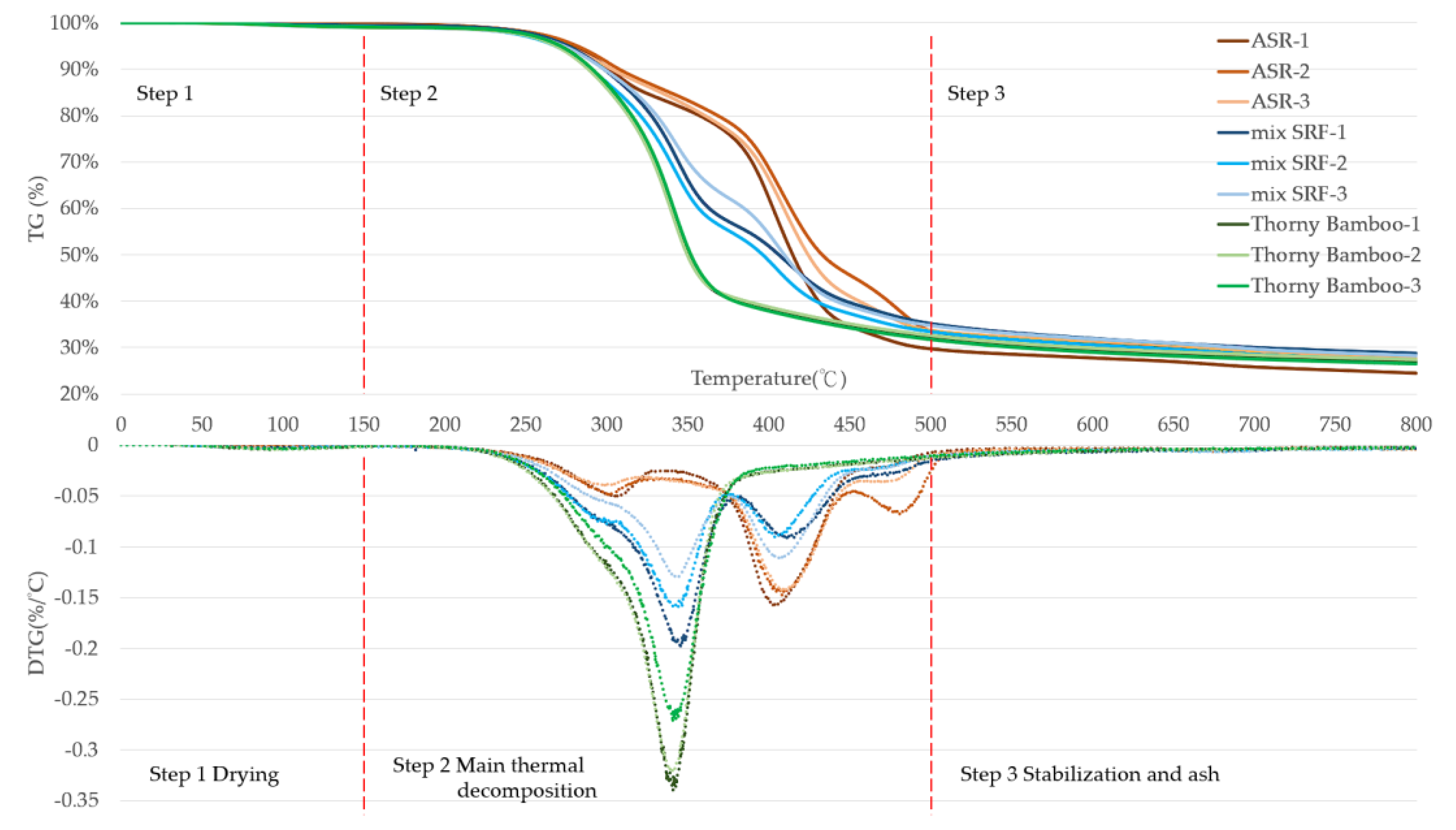
Thermogravimetric analysis (Figure 3) showed that the mix SRF pellets exhibited favorable thermal decomposition stability, with the pyrolysis process clearly divided into three stages:
  • Step 1 (<150 °C): evaporation of moisture and light volatiles.
  • Step 2 (200–400 °C): pyrolysis of major combustible components (e.g., cellulose, hemicellulose, plastic matrix); the DTG curve of mix SRF closely resembled that of thorny bamboo, showing a concentrated decomposition peak, indicating good thermal stability and consistent reaction behavior.
  • Step 3 (>500 °C): corresponds to residual carbonization and inorganic compounds, forming ash.
In the DTG curve, both mix SRF and bamboo showed primary decomposition peaks around 340–380 °C, significantly better than ASR's wide and multi-peaked decomposition region. This suggests that bamboo addition effectively suppresses the unstable multi-stage decomposition behavior of ASR, and that mix SRF demonstrated more stable pyrolysis within 300–500 °C—beneficial for stable combustion output. This behavior is likely due to bamboo’s consistent cellulose and hemicellulose content, along with its extremely low chlorine content (Cl ≈ 0.0015 wt%), making it an effective stabilizing agent for pyrolysis behavior while also reducing undesirable byproduct release from plastic degradation.
Overall, the ternary mixture of thorny bamboo, ASR, and dechlorinating agent not only demonstrated improved thermal decomposition consistency but also achieved low chlorine and moderate ash levels—making it a feasible solution for producing stable and efficient SRF pellets. By leveraging bamboo’s low Cl content to dilute ASR-originated chlorine, along with the synergistic chlorine capture of the inorganic dechlorinating agent, the mix SRF achieved a 76.34% chlorine reduction without significantly sacrificing energy content. This ternary blending strategy offers a promising pathway to balance fuel efficiency with environmental compliance, and holds practical potential for industrial promotion.

4. Discussion

4.1. Effectiveness of Fe–Ca-Based Dechlorinating Agents

This study systematically evaluated the dechlorination efficiency of Fe–Ca composite dechlorinating agents, revealing a significant synergistic effect between calcium and iron. As shown in Table 4, when the Ca:Fe ratio was gradually decreased from 100:0 (Type A) to 25:75 (Type G), the dechlorination efficiency steadily increased, and the chlorine content decreased significantly. This indicates that the presence of Fe plays a crucial role in enhancing chlorine removal. Type G (Ca:Fe = 25:75) demonstrated the best dechlorination performance, with a chlorine content of only 0.48 ± 0.14 wt% and a dechlorination efficiency of 97.75%, confirming that Fe may function as a catalyst or adsorbent in the dechlorination reaction. However, when Fe content was further increased (Type H and I), the dechlorination performance significantly declined. The chlorine content rose back to 7.29 ± 0.74 wt%, and the dechlorination efficiency dropped to 65.72%. This phenomenon is presumed to be due to the following reasons:
a.
Excessive Fe leading to by-product formation: Under high-temperature pyrolysis or carbonization conditions, excess iron may react with chlorine to form stable iron chlorides (e.g., FeCl₃), which can reduce the conversion efficiency of intermediate compounds and thus inhibit the overall dechlorination reaction process [26].
b.
Lack of alkaline neutralization effect: Compared to calcium, which provides alkalinity to neutralize acidic gases and stabilize residues [33] , iron is chemically neutral or mildly acidic. When the Fe proportion is too high and Ca too low, the absence of sufficient alkaline buffering may result in ineffective suppression of HCl gas, thereby lowering chlorine volatilization and reducing overall dechlorination efficiency.
Based on the above findings, although Formula D (Ca:Fe = 62.5:37.5) does not exhibit the highest dechlorination efficiency (ηDe Cl = 97.23%), it achieves an ideal balance between performance and processability—demonstrating effective chlorine removal, moderate ash content (30.31 ± 6.13 wt%), and good pellet mechanical integrity. Moreover, the Tukey HSD statistical analysis confirmed significant differences (p < 0.05) in Cl content and ash levels between Formula A and Formulas D–G, indicating that an appropriate Ca–Fe ratio indeed influences the final fuel quality and dechlorination stability. This observation aligns with previous studies reporting that mixed metal oxides show enhanced dechlorination efficiency when applied to waste plastics or solid fuels [34] . For instance, Chen, Y.C. et al. (2022) [35] demonstrated that the addition of Ca(OH)₂ as a dry-type dechlorinating additive significantly reduced Cl content, primarily through the formation of solid-phase CaCl₂. Other studies have also shown that Al–Mg composite oxides can effectively facilitate chlorine removal from plastics [36] . Furthermore, Fe-based oxides (e.g., Fe₂O₃) can react with HCl under high temperatures to form FeCl₂/FeCl₃, thereby contributing to chlorine fixation and improving dechlorination performance [37]. The inclusion of silica (SiO₂) has also been shown to enhance the Cl fixation capacity of FeCl₂ [26].

4.2. Applicability of the Chlorine Content Prediction Model

A regression-based prediction model was developed to evaluate the residual chlorine content (Cl%) and dechlorination efficiency (ηDeCl) under various ASR and dechlorinating agent blending ratios. To ensure model robustness and simplicity, a second-order polynomial equation was adopted(ηDeCl = -1.5277x2 + 2.5519x - 0.0225). where x represents the weight ratio (wt%) of the dechlorinating agent, and η_DeCl is the corresponding dechlorination efficiency (%). Although this polynomial model demonstrated a strong fit with the experimental data (R² = 0.9347), it may be prone to overfitting or prediction bias at extreme additive levels, particularly under very high or low dechlorinating agent contents [38,39].
Comparison between experimental data and predicted values revealed a behavior consistent with a first-order reaction mechanism in the ASR–dechlorinating agent system: chlorine removal proceeds rapidly at lower additive levels, and efficiency gradually plateaus as the dechlorinating agent reaches saturation [35]. This supports the notion that although polynomial models offer predictive capability, experimental validation is still essential to calibrate model parameters and avoid errors caused by idealized assumptions.
In summary, the quadratic model provides a mechanistically sound and easy-to-use tool for preliminary screening of dechlorination potential across different additive ratios. For future applications, it is recommended to incorporate additional variables (such as ash content, reaction temperature, and initial chlorine concentration) to build a multi-variable predictive model for better performance in complex formulations.

4.3. Technical Feasibility and Regulatory Compliance of Final Pellet Formulation

This study conducted a technical feasibility analysis of SRF pellets produced from a ternary blend of thorny bamboo, ASR, and inorganic dechlorinating agents. In the formulation design, three key criteria were considered to ensure fuel quality and regulatory compliance: chlorine content below 0.6 wt%, net calorific value (NCV) above 15 MJ/kg, and ash content not exceeding 20 wt%. These thresholds align with international standards such as EN ISO 21640:2021 (Class 2), JIS Z7311 (Grade A), and the draft classification framework proposed for SRF in Taiwan.
In the selected formulation (55% thorny bamboo, 37.5% ASR, 7.5% dechlorinating agent by weight), ASR serves as the primary chlorine source, with a Cl content of approximately 1.6 wt%, whereas thorny bamboo and the dechlorinating agent are characterized by low and negligible chlorine contents, respectively. To estimate the overall dechlorination efficiency and the final chlorine concentration of the product, this study applied the regression model established in Section 3 (η_DeCl = –1.5277x² + 2.5519x – 0.0225, R² = 0.9347, where x is the ratio of dechlorinating agent to 「ASR + dechlorinating agent」).
By substituting x = 0.1667 (corresponding to 7.5:37.5), the estimated dechlorination efficiency is approximately 36%. Applying this to the predictive formula yields a final chlorine content (Cl_final) of approximately 0.4 wt%, which is close to the experimentally measured value of 0.31 ± 0.04 wt%, indicating that the model has good predictive accuracy and practical value. Supporting this result, a study by Xie et al. (2023) also reported that the use of inorganic dechlorinating materials such as CaO in high-temperature combustion environments can achieve dechlorination efficiencies exceeding 90% [40], confirming the significant role of dechlorinating agents in the present system.
Regarding calorific value and ash content, the theoretical estimates were approximately 15.8 MJ/kg and 16.7 wt%, respectively, while the experimental results showed a higher calorific value of 19.38 ± 0.14 MJ/kg and a lower ash content of 14.44 ± 0.74 wt%. The higher-than-expected energy content may be attributed to the high volatile matter and low ash content of thorny bamboo, consistent with the findings of Rusch, F., et al. (2021), who reported that various bamboo species exhibit high volatile matter, low ash, and high net calorific value [17] , highlighting their strong potential as biomass fuel materials. Furthermore, TGA–DTG analysis (Figure 3) revealed that the main thermal decomposition stage of the mix SRF (Step 2: 250–450 °C) closely resembled that of the bamboo sample, indicating superior thermal stability and combustion characteristics compared to pure ASR.
In this formulation, the addition of the dechlorinating agent was limited to 7.5 wt%, which not only successfully suppressed the chlorine content within regulatory limits, but also avoided issues associated with high additive ratios—such as elevated ash content, reduced calorific value, and operational difficulties during pelletizing. This aligns with the findings of Taylor, R., et al. (2013), who pointed out that bottom ash residues from gasifiers and incinerators may pose a risk of heavy metal leaching, potentially becoming an environmental burden. Their study emphasized the importance of controlling inorganic components in ASR and RDF treatment systems [41]. The final product, balancing practical application value and the benefits of waste reuse, demonstrates strong technical feasibility and promising environmental potential.

5. Conclusions

This study aimed to convert high-chlorine-content ASR into SRF through co-processing with inorganic dechlorinating agents and thorny bamboo. The research systematically explored the dechlorination mechanism, fuel characteristics, and predictive modeling, with key findings summarized as follows: Firstly, it was confirmed that dual-metal dechlorinating agents containing Fe and Ca exhibit excellent dechlorination performance for PVC-based chlorine-containing materials. The optimal formulation (Type D, Ca:Fe = 62.5:37.5) effectively reduced the chlorine content in PVC from 43.26% to 0.59 ± 0.17 wt%, achieving a dechlorination efficiency of 97.23%, with ash content controlled at 30.31 ± 6.13 wt%. In the ASR–dechlorinating agent mixture system, the dechlorination efficiency (η_DeCl) rapidly increased with additive ratio and then plateaued, suggesting first-order reaction kinetics. A quadratic regression model was established (ηDeCl = –1.5277x² + 2.5519x – 0.0225, R² = 0.9347), successfully predicting the nonlinear relationship between dechlorinating agent ratio and dechlorination efficiency. At x = 0.1667 (i.e., 7.5:37.5 ratio), the model predicted ηDeCl ≈ 36%, yielding an estimated Cl_final of ~0.4 wt%, which closely matched the experimental value of 0.31 ± 0.04 wt%, demonstrating strong predictive accuracy and practical potential. For the final ternary pellet formulation (thorny bamboo 55% : ASR 37.5% : dechlorinating agent 7.5%), SRF pellets were produced under compression conditions (12.7 mm die, 300 kgf/cm², 100 °C), yielding a net calorific value of 19.38 ± 0.14 MJ/kg, ash content of 14.44 ± 0.74 wt%, and chlorine content of 0.31 ± 0.04 wt%. These values all met the regulatory thresholds defined in EN ISO 21640:2021 (Class 2), JIS Z7311 Grade A, and the forthcoming domestic SRF classification standards in Taiwan. Furthermore, these results surpassed theoretical estimates (NCV ≈ 15.8 MJ/kg, ASH ≈ 16.7 wt%).
In summary, this study successfully developed a practical and environmentally beneficial SRF pellet formulation that demonstrates excellent combustion performance, low chlorine emissions, and stable pelletizing characteristics. The constructed dechlorination efficiency prediction model also serves as a valuable tool for future formulation optimization and application extension. Further studies are recommended to incorporate additional variables (e.g., reaction temperature, oxygen atmosphere, metal salt type) to enhance model accuracy and formulation flexibility, facilitating broader application in the valorization of other chlorine-containing waste streams.

Author Contributions

Conceptualization, Yan-Jia Liou, Chun-Shen Cheng, Shu-Hsien Tsai, Chen-Hui Chen and Way Long; methodology, Yan-Jia Liou, Chun-Shen Cheng, Shu-Hsien Tsai, Chen-Hui Chen and Chuan-Chi Chien; software, Chen-Hui Chen; validation, Chen-Hui Chen, Jeng-Wei Tsai and Way Long; formal analysis, Yan-Jia Liou, Chun-Shen Cheng and Chen-Hui Chen; investigation, Chen-Hui Chen and Tung-Lin Wu; re-sources, Way Long, Li-Chi Su and Rung-Jiun Gau; data curation, Chen-Hui Chen and Chuan-Chi Chien; writing—original draft preparation, Chen-Hui Chen; writing—review and editing, Way Long and Yan-Jia Liou; visualization, Chen-Hui Chen and Li-Chi Su; supervision, Way Long and Shu-Hsien Tsai; project administration, Way Long and Shu-Hsien Tsai; funding acquisition, Way Long and Shu-Hsien Tsai, . All authors have read and agreed to the published version of the manuscript.

Funding

This research received no external funding.

Institutional Review Board Statement

The study did not require ethical approval.

Informed Consent Statement

Not applicable.

Acknowledgments

The authors would like to express their sincere gratitude to the Department of Wood Science and Design, National Pingtung University of Science and Technology, for providing essential analytical instruments, including TGA and C1 oxygen bomb calorimeter facilities. Appreciation is also extended to the Agri-Industrial Systems Technology Division, Industrial Technology Research Institute (Central Region Campus) for their technical collaboration and experimental support. The administrative and technical assistance received throughout the study greatly contributed to the successful execution of this research.

Conflicts of Interest

The authors declare no conflict of interest.

References

  1. Gerassimidou, S.; et al. Chlorine in waste-derived solid recovered fuel (SRF), co-combusted in cement kilns: A systematic review of sources, reactions, fate and implications. Critical Reviews in Environmental Science and Technology 2021, 51, 140–186. [Google Scholar] [CrossRef]
  2. Prokeš, R. , et al. Thermomechanical Treatment of SRF for Enhanced Fuel Properties. Fire 2025, 8, 57. [Google Scholar] [CrossRef]
  3. Tsai, W.T., C. H. Tsai, and C.C. Pan, Outlook of Solid Recovered Fuel (SRF) for the Substitution of Fossil Fuels in the Industrial Utilities, in Preprints. 2024, Preprints.
  4. Santini, A.; et al. Auto shredder residue recycling: Mechanical separation and pyrolysis. Waste Management 2012, 32, 852–858. [Google Scholar] [CrossRef] [PubMed]
  5. Roh, S.A.; et al. Pyrolysis and gasification-melting of automobile shredder residue. Journal of the Air & Waste Management Association 2013, 63, 1137–1147. [Google Scholar] [CrossRef] [PubMed]
  6. Vermeulen, I.; et al. Automotive shredder residue (ASR): Reviewing its production from end-of-life vehicles (ELVs) and its recycling, energy or chemicals’ valorisation. Journal of Hazardous Materials 2011, 190, 8–27. [Google Scholar] [CrossRef]
  7. Liu, Q.; et al. Enhancing pyrolysis of automobile shredder residue through torrefaction: Interactions among typical components. Fuel 2025, 390, 134670. [Google Scholar] [CrossRef]
  8. Hatanaka, T., A. Kitajima, and M. Takeuchi, Role of Chlorine in Combustion Field in Formation of Polychlorinated Dibenzo-p-dioxins and Dibenzofurans during Waste Incineration. Environmental Science & Technology, 9456. [Google Scholar]
  9. Acha, E.; et al. Combustion of a Solid Recovered Fuel (SRF) Produced from the Polymeric Fraction of Automotive Shredder Residue (ASR). Polymers 2021, 13, 3807. [Google Scholar] [CrossRef]
  10. Chen, Y.-C., H. -C. Lin, and L.-Y. Chen, Solid fuel recovered from food waste dechlorination: Proof of concept and cost analysis. Journal of Cleaner Production 2022, 360, 132240. [Google Scholar] [CrossRef]
  11. Xie, X.; et al. Effect of granulation on chlorine-release behavior during municipal solid waste incineration. RSC Advances 2023, 13, 24854–24864. [Google Scholar] [CrossRef]
  12. Han, S.; et al. Mitigating heavy metal volatilization during thermal treatment of MSWI fly ash by using iron(III) sulfate as a chlorine depleting agent. Journal of Hazardous Materials 2024, 465, 133185. [Google Scholar] [CrossRef]
  13. Vijayan, S.K., M. A. Kibria, and S. Bhattacharya, A Study on Pyrolysis of Pretreated Automotive Shredder Residue—Thermochemical Calculations and Experimental Work. Frontiers in Sustainability, 2022. [Google Scholar]
  14. Harder, M.K. and O.T. Forton, A critical review of developments in the pyrolysis of automotive shredder residue. Journal of Analytical and Applied Pyrolysis 2007, 79, 387–394. [Google Scholar] [CrossRef]
  15. Garrido, M.A., J. A. Conesa, and M.D. Garcia, Characterization and Production of Fuel Briquettes Made from Biomass and Plastic Wastes. Energies.
  16. Gopan, G., R. Krishnan, and M. Arun, Review of bamboo biomass as a sustainable energy. International Journal of Low-Carbon Technologies, 2733. [Google Scholar]
  17. Rusch, F.; et al. Energy properties of bamboo biomass and mate co-products. SN Applied Sciences 2021, 3, 602. [Google Scholar] [CrossRef]
  18. Ku Aizuddin, K.N.A.; et al. Bamboo for Biomass Energy Production. BioResources 2022, 18. [Google Scholar] [CrossRef]
  19. Elgharbawy, A. , Poly Vinyl Chloride Additives and Applications-A Review. Journal of Risk Analysis and Crisis Response 2022, 12, 3. [Google Scholar] [CrossRef]
  20. Yu, J.; et al. Thermal degradation of PVC: A review. Waste Management 2016, 48, 300–314. [Google Scholar] [CrossRef] [PubMed]
  21. Awogbemi, O. and D.A. Desai, Harnessing the potentials of bamboo as a sustainable feedstock for bioenergy production. Advances in Bamboo Science 2025, 12, 100173. [Google Scholar] [CrossRef]
  22. Chen, W.-H.; et al. Progress in biomass torrefaction: Principles, applications and challenges. Progress in Energy and Combustion Science 2021, 82, 100887. [Google Scholar] [CrossRef]
  23. Khodier, A., K. Williams, and N. Dallison, Challenges around automotive shredder residue production and disposal. Waste Management.
  24. Szydełko, A., W. Ferens, and W. Rybak, The effect of mineral additives on the process of chlorine bonding during combustion and co-combustion of Solid Recovered Fuels. Waste Management.
  25. Lin, X.; et al. Influence of Different Catalytic Metals on the Formation of PCDD/Fs during Co-combustion of Sewage Sludge and Coal. Aerosol and Air Quality Research 2022, 22, 220268. [Google Scholar] [CrossRef]
  26. Hong, L., T. -l. Li, and L.-h. Ye, De-chlorination of poly(vinyl) chloride using Fe2O3 and the improvement of chlorine fixing ratio in FeCl2 by SiO2 addition. High Temperature Materials and Processes 2024, 43, 1. [Google Scholar] [CrossRef]
  27. Santos, S.M. , et al. Brief Overview of Refuse-Derived Fuel Production and Energetic Valorization: Applied Technology and Main Challenges. Sustainability, 1034. [Google Scholar] [CrossRef]
  28. Lin, Y.-Q., C. -H. Tsai, and W.-T. Tsai Progress in Solid Recovered Fuel with an Emphasis on Lignocellulose-Based Biomass—A Mini Review Focused on Japan, South Korea, and Taiwan. Energies, 1671. [Google Scholar] [CrossRef]
  29. Liu, Z.; et al. Comparative properties of bamboo and pine pellets. Wood and fiber science: journal of the Society of Wood Science and Technology.
  30. Kathiravale, S.; et al. Modeling the heating value of Municipal Solid Waste☆. Fuel 2003, 82, 1119–1125. [Google Scholar] [CrossRef]
  31. Arena, U. and F. Di Gregorio, Element partitioning in combustion- and gasification-based waste-to-energy units. Waste Management 2013, 33, 1142–1150. [Google Scholar] [CrossRef]
  32. Dashtestani, F.; et al. Effect of the Presence of HCl on Simultaneous CO2 Capture and Contaminants Removal from Simulated Biomass Gasification Producer Gas by CaO-Fe2O3 Sorbent in Calcium Looping Cycles. Energies 2021, 14, 8167. [Google Scholar] [CrossRef]
  33. Shemwell, B., Y. A. Levendis, and G.A. Simons, Laboratory study on the high-temperature capture of HCl gas by dry-injection of calcium-based sorbents. Chemosphere.
  34. Fekhar, B., L. Gombor, and N. Miskolczi, Pyrolysis of chlorine contaminated municipal plastic waste: In-situ upgrading of pyrolysis oils by Ni/ZSM-5, Ni/SAPO-11, red mud and Ca(OH)2 containing catalysts. Journal of the Energy Institute, 1270. [Google Scholar]
  35. Chen, Y.C. and Y.C. Tsai, Dry dechlorination of solid-derived fuels obtained from food waste and polyvinyl chloride. Sci Total Environ 2022, 841, 156745. [Google Scholar] [CrossRef]
  36. Zhou, Q.; et al. Catalytic degradation and dechlorination of PVC-containing mixed plastics via Al–Mg composite oxide catalysts. Fuel 2004, 83, 1727–1732. [Google Scholar] [CrossRef]
  37. Lingaiah, N.; et al. Catalytic dechlorination of chloroorganic compounds from PVC-containing mixed plastic-derived oil. Applied Catalysis A: General.
  38. Babyak, M.A. , What you see may not be what you get: a brief, nontechnical introduction to overfitting in regression-type models. Psychosom Med 2004, 66, 411–21. [Google Scholar]
  39. Royston, P. and W. Sauerbrei, Improving the robustness of fractional polynomial models by preliminary covariate transformation: A pragmatic approach. Computational Statistics & Data Analysis, 4253. [Google Scholar]
  40. Xie, X.; et al. Effect of granulation on chlorine-release behavior during municipal solid waste incineration. RSC Adv 2023, 13, 24854–24864. [Google Scholar] [CrossRef]
  41. Taylor, R., R. Ray, and C. Chapman, Advanced thermal treatment of auto shredder residue and refuse derived fuel. Fuel.
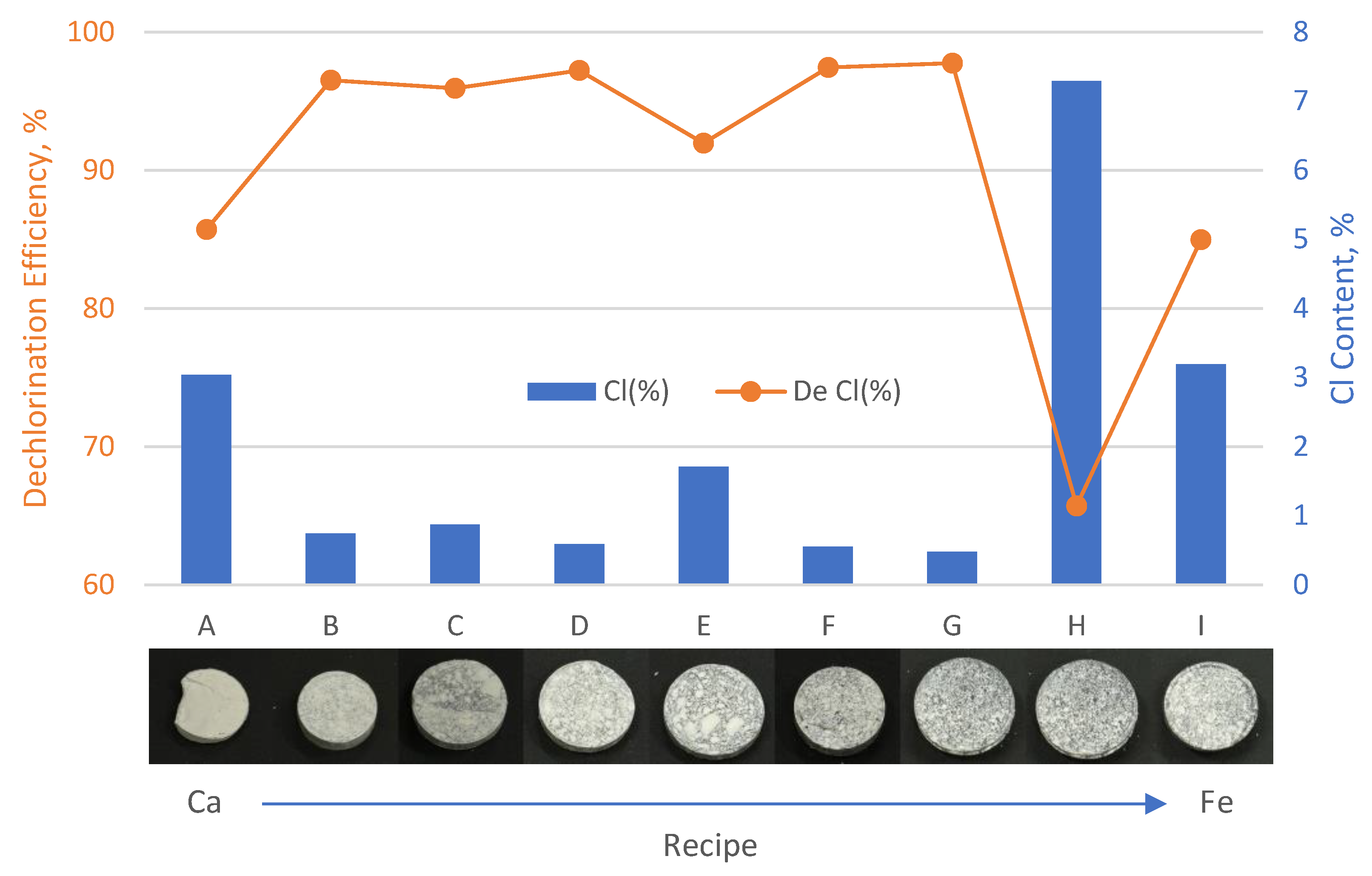
Figure 1. Effect of Ca:Fe Ratio on Chlorine Content and Dechlorination Efficiency.
Preprints 177135 g001
Figure 2. Effect of Dechlorinating Agent Ratio on Chlorine Content and Dechlorination Efficiency of ASR-Based SRF Pellets.
Preprints 177135 g002
Figure 3. Thermogravimetric and Derivative Thermogravimetric Analysis (TGA–DTG) of ASR, Mixed SRF, and Thorny Bamboo Samples.
Preprints 177135 g003
Table 1. Nine Formulations of PVC and Fe–Ca Additives (50:50 mass ratio).
Recipe number PVC content
(wt%)
Chlorine reducing agent type
Ca : Fe ratio
Chlorine reducing agent content (wt%)
A 50 Ca-Fe powder
100:0
50
B 50 Ca-Fe powder
87.5:12.5
50
C 50 Ca-Fe powder
75:25
50
D 50 Ca-Fe powder
62.5:37.5
50
E 50 Ca-Fe powder
50:50
50
F 50 Ca-Fe powder
37.5:62.5
50
G 50 Ca-Fe powder
25:75
50
H 50 Ca-Fe powder
12.5:87.5
50
I 50 Ca-Fe powder
0:100
50
Table 2. Formulation Design of Samples with Different Mixing Ratios of ASR and Dechlorination Agent.
NUMBER ASR content (wt%) Chlorine reducing agent content (wt%)
De-cl(D)-0% 100 0
De-cl(D)-25% 75 25
De-cl(D)-50% 50 50
De-cl(D)-75% 25 75
De-cl(D)-100% 0 100
Table 3. Detailed Comparison of SRF Standards by Country.
Country / Standard Classification / Grade NCV Requirement (MJ/kg) Chlorine Limit
(%)
Ash Limit
(%)
ISO 21640:2021 (EN) Class 1 ≥ 25 ≤ 0.2
Class 2 ≥ 20 ≤ 0.6
Class 3 ≥ 15 ≤ 1.5
Class 4 ≥ 10 ≤ 2.0
Class 5 ≥ 3 ≤ 3.0
Japan JIS Z 7311:2010(RPF) Grade A ≥ 33 ≤ 0.6 ≤ 5
Grade B ≥ 25 ≤ 0.3 ≤ 10
Grade C ≥ 25 ≤ 2.0 ≤ 10
South Korea
(K-SRF,Bio-SRF)
K-SRF ≥ 14.65 ≤ 2.0 ≤ 20
Bio-SRF ≥ 12.56 ≤ 0.5 ≤ 15
Taiwan
(current guideline, 2020)
≥ 10 ≤ 3.0
Taiwan
(proposed 2025 guidelines)
≤ 1.5
Table 4. Evaluation of Ca:Fe-Based Dechlorinating Agent Formulations on PVC Dechlorination Efficiency.
Type N Cl(%) ASH(%) η De Cl(%)
CONTROL 6 42.53 - -
A 6 3.04 ± 1.50 a, b 32.98 ± 19.28 a 85.72
B 6 0.74 ± 0.41 b 24.92 ± 8.28 a 96.52
C 6 0.87 ± 0.23 b 28.39 ± 6.11 a 95.93
D 6 0.59 ± 0.17 b 30.31 ± 6.13 a 97.23
E 6 1.71 ± 1.42 b 31.96 ± 9.01 a 91.95
F 6 0.55 ± 0.22 b 41.05 ± 6.80 a 97.44
G 6 0.48 ± 0.26 b 37.34 ± 6.08 a 97.75
H 6 7.29 ± 7.11 a 42.96 ± 2.09 a 65.72
I 6 3.19 ± 2.96 a, b 42.57 ± 10.55 a 84.99
Table 5. Experimental Results of Chlorine Content, Ash Content, and Dechlorination Efficiency in SRF Pellets under Different Mixing Ratios.
Recipe number N Cl(%) ASH(%) ηDe Cl(%)
De-cl(D)0% 6 1.31 ± 0.61 a 7.21 ± 0.63 a -
De-cl(D)25% 6 0.95 ± 0.41 a 2.56 ± 0.80 b 35.64
De-cl(D)50% 6 0.36 ± 0.02 b 1.93 ± 0.10 b, c 94.06
De-cl(D)75% 6 0.28 ± 0.03 b 1.53 ± 0.01 c 101.98
De-cl(D)100% 6 0.30 ± 0.08 b 1.27 ± 0.07 c 100.00
* ηDe Cl(%)=( De-cl(D)0%- ClTEST )/( De-cl(D)0% - De-cl(D)100% )%. ηDe Cl (%): De-chlorination efficiency of the test sample., De-cl(D)0%: Chlorine content of the 100% ASR sample (no dechlorinating agent), used as the upper reference., ClTEST: Measured chlorine content of the sample with a given dechlorinating agent ratio., De-cl(D)100%: Chlorine content of the 100% dechlorinating agent sample, used as the lower reference.
Table 6. Comparison of Ash Content, Net Calorific Value, and Chlorine Content among ASR, Thorny Bamboo, and Mixed SRF Pellets.
Project N ASH(%) NCV(MJ/kg) Cl(%)
ASR 3 18.41 ± 2.59 a 14.66 ± 1.67 b 1.31 ± 0.61 a
Thorny Bamboo 3 4.58 ± 0.07 c 20.63 ± 0.05 a 0.0015 [29] b
mix SRF 3 14.44 ± 0.74 b 19.38 ± 0.14 a 0.31 ± 0.04 b
Disclaimer/Publisher’s Note: The statements, opinions and data contained in all publications are solely those of the individual author(s) and contributor(s) and not of MDPI and/or the editor(s). MDPI and/or the editor(s) disclaim responsibility for any injury to people or property resulting from any ideas, methods, instructions or products referred to in the content.
Copyright: This open access article is published under a Creative Commons CC BY 4.0 license, which permit the free download, distribution, and reuse, provided that the author and preprint are cited in any reuse.
Prerpints.org logo

Preprints.org is a free preprint server supported by MDPI in Basel, Switzerland.

Subscribe

Disclaimer

Terms of Use

Privacy Policy

Privacy Settings

© 2025 MDPI (Basel, Switzerland) unless otherwise stated