Preprint
Concept Paper

This version is not peer-reviewed.

Aging as a Multifactorial Disorder with Two Stages

Submitted:

16 September 2025

Posted:

18 September 2025

You are already at the latest version

Abstract

Aging (senescence) is characterized by development of diverse senescent pathologies and diseases, leading eventually to death. The major diseases of aging, including cardiovascular disease, cancer and chronic obstructive pulmonary disease (COPD), are multifactorial disorders, resulting from complex interactions between multiple etiologies. Here we propose a general account of how different determinants of aging can interact to generate late-life disease. This account, initially drawn from studies of the nematode Caenorhabditis elegans, depicts senescence as the product a two stage process. The first stage involves the diverse causes of disease prior to aging, that cause disruption of normal biological function. These include infection, mechanical injury and mutation (somatic and inherited). Second, etiologies largely confined to aging: deleterious, late-life consequences of evolved wild-type gene action, including antagonistic pleiotropy. Prior to aging, diverse insults lead to accumulation of various forms of injury that is largely contained, preventing progression to pathology. In later life, wild-type gene action causes loss of containment of latent disruptions, which form foci for pathology development. Pathologies discussed here include late-life recrudescence of infection, osteoarthritis, cancer and consequences of late-life deleterious mutations. Such latent injury foci are analogous to seeds which in later life, in the context of programmatic senescent changes, germinate and develop into disease.

Keywords: 
;  ;  ;  ;  ;  ;  

Introduction

This article is dedicated to Misha Blagosklonny (more formally, Mikhail Vladimirovich Blagosklonny), who died in October 2024. Here I will first briefly introduce several of his key contributions to aging theory, that opened the way to further conceptual developments. I will then describe in detail some new ideas that build upon his earlier breakthroughs.
The community of scientists investigating the biology of aging are brought together more by their interest in the subject than by any shared ideas about its causes. To this day, the field has little consensus with respect to basic, foundational principles. However, it has long been argued that such a foundation may be found in the evolutionary theory of aging (Arnold and Rose, 2023; Rose, 1991). From the very great differences in aging rate and maximum lifespan across animal species, it is evident that aging is predominantly genetically determined, and therefore the product of evolution. For more than half a century, the evolutionary theory of aging has provided a cogent explanation for the existence of aging (Medawar, 1952; Williams, 1957). Most fundamentally, this argues that aging evolves due to reduced selection in later life - the so-called selection shadow (Figure 1A). This tells us that aging is not an adaptation.
The selection shadow can lead to accumulation in populations of mutations with harmful effects in later life, that contribute to aging - this is Peter Medawar’s mutation accumulation (MA) theory (Medawar, 1952). Aging can also evolve as a consequence of the pleiotropic nature of many genes, i.e. where they affect more than one biological characteristic. In some cases genes have both beneficial and harmful consequences; in other words, pleiotropy has antagonistic effects, on health or fitness. As noted by George C. Williams, if the beneficial effect is experienced earlier, and the detrimental effect late enough, natural selection may favor the allele, leading to aging (Williams, 1957) (Figure 1A). The relative importance of AP and MA remains a topic of debate (Flatt and Partridge, 2018; Zhao and Promislow, 2019); however, numerous genes exhibit AP (Austad and Hoffman, 2018; Gems and Kern, 2024).
A long-standing problem is that the evolutionary theory explains why we age but not how we age. It tells us that genes cause aging, and that this can involve MA and AP, but not how genes cause aging, including late-life disease. We lack an explanation in terms of evolutionary physiology (Arnold and Rose, 2023), that unites ultimate (evolutionary) and proximate (mechanistic) accounts.
An important development in theories of aging was the appearance of an evolutionary physiology account in the 1970s, the disposable soma theory (Kirkwood, 1977; Kirkwood and Rose, 1991). This reconciled with evolutionary theory the then popular view that aging is caused by molecular damage accumulation. It argued that processes of somatic maintenance that prevent aging are costly in resource terms, and that such processes compete with growth and reproduction for limited resources. Because natural selection prioritises reproduction over longevity, investment into somatic maintenance is inadequate to prevent aging, i.e. the soma is disposable, and akin to a cheaply-manufactured, throw-away consumer product.
However, research during the 2000s increasing challenged the view that molecular damage is the main, primary cause of aging, casting doubt on the disposable soma theory (Blagosklonny, 2008; Gems and Doonan, 2009; Perez et al., 2009). Moreover, a major role of disposable soma-type mechanisms in lifespan-reproduction trade-offs remains undemonstrated, and in some cases they clearly do not occur (Grandison et al., 2009; Maklakov and Chapman, 2019; Zajitschek et al., 2019). In the mid 2000s an alternative evolutionary physiology account was proposed, by Blagosklonny (Blagosklonny, 2006; Blagosklonny, 2007; Blagosklonny, 2008) and also João Pedro de Magalhães (de Magalhães, 2012; de Magalhães and Church, 2005).
For a detailed overview of this account, see (Gems, 2022). More briefly: echoing an earlier interpretation of AP by Williams himself (Williams, 1957), it argued simply that gene action in later life is pathogenic. Genetically-determined programs that contribute to fitness, in later-life run on or are activated in a manner that promotes pathology (Figure 1B). Blagosklonny noted that such gene action is genetically determined (programmed) but not adaptive (not programmed) and, to disambiguate the two meanings of the word programmed, introduced the term quasi-programmed (Blagosklonny, 2006). He argued that aging is far from being a process of passive breakdown (as in molecular damage accumulation), of loss of function, but is rather is the opposite: an active, quasi-programmed process, of hyperfunction. Hence this evolutionary physiology account is sometimes known as the hyperfunction theory. Blagosklonny himself also referred to it as disposable soma theory 2, arguing that the soma is disposable due to quasi-program action (rather than insufficient somatic maintenance) (Blagosklonny, 2007; Blagosklonny, 2013).
Arguably, the importance of the hyperfunction theory is that it provides a starting point and new direction for thinking about evolutionary physiology, and proximate mechanisms of aging. Further development of programmatic theory beyond hyperfunction include concepts such as hypofunction (de Magalhães and Church, 2005; Maklakov and Chapman, 2019), generation of AP as bad spandrels by biological constraint (Gems and Kern, 2024), costly programs in the context of semelparous reproductive death (Gems et al., 2021; Kern et al., 2023; Kern et al., 2021), and adaptive death (Galimov and Gems, 2020; Galimov and Gems, 2021; Lohr et al., 2019), among other ideas (Gems, 2026; Lemaître et al., 2024; Slade et al., 2024), plus several demonstrations of the action of quasi-programs in aging C. elegans in my own lab (de la Guardia et al., 2016; Gems and de la Guardia, 2013; Wang et al., 2018).

The Multifactorial Model

A further elaboration of the hyperfunction theory, that I proposed in 2022, is the multifactorial model (Gems, 2022). One reason why Blagosklonny argued against the molecular damage theory is its inadequacy as an explanation for diseases of aging (with the exception of cancer). By contrast, he showed how hyperfunction is identifiable as part of the etiology of a range of late-life diseases (Blagosklonny, 2006; Gems, 2022). The multifactorial model represents an attempt to improve on the explanatory power of the hyperfunction theory with respect to late-life disease. The origin of the model is experimental work using C. elegans (described below), and also the four models theory developed in the 1990s by Vladimir Dilman (Dilman, 1994; Gems, 2022).
For a detailed account of the multifactorial model, see (Gems, 2022). Figure 1C presents a simplified version of the model. A feature of diseases of aging familiar to clinicians is that they are highly multifactorial in etiology; this includes cardiovascular disease, COPD, Alzheimer's disease, osteoarthritis, and osteoporosis (Al Anouti et al., 2019; Armstrong, 2013; Glocker et al., 2006; Glyn-Jones et al., 2015; Higashi et al., 2019; Huertas and Palange, 2011). The multifactorial model argues that these etiologies, very broadly, fall into two categories.
The first is etiologies involving insults that cause disease by disrupting normal biological function. Such insults include infectious pathogens (e.g. viruses, bacteria, protozoa, helminths), mechanical injury, mutation (somatic and inherited), and poor nutrition. Disruptions are represented by the left hand box in Figure 1C. The second category of etiology includes pathogenic, programmatic changes that occur in later life, as specified by the wild type genome. These can be understood as, ultimately, the consequence of evolution. It includes late-life effects of AP, that do not result from insults, but from wild-type gene action (Nesse and Williams, 1994). This is represented by the right box in Figure 1C.
The multifactorial model views senescence, including diseases of aging, as the outcome of both disruptions and programmatic aging. According to this view, disruptions are very much part of senescence. Moreover, some diseases that are usually viewed as disruptions are very much diseases of aging. To illustrate, consider sudden acute respiratory syndrome (SARS), a major cause of death during the SARS-CoV-2 (COVID-19) pandemic. SARS occurred mainly among the elderly, due to age changes in immunity, particularly hyperactivity of innate immune function, of programmatic origin (Blagosklonny, 2020). Due to such changes, infections with coronavirus could trigger a lethal cytokine storm, leading to SARS and death. Thus, SARS exemplifies multifactorial diseases of aging. Consistent with this view, age-specific death rates from causes traditionally viewed as intrinsic and extrinsic both increase exponentially with age (Koopman et al., 2015).
In the remainder of this article I will describe further features of the multifactorial model, particularly the relationship between disruptions that occur in early life, and the later processes of programmatic senescence.

How Distinct Causes of Senescence Interact: A Two Stage Model

The distinction between disruptions and genetically-determined etiologies in the multifactorial model (Figure 1C) raises the question of how these two classes of cause interact. Here two plausible premises for further conjecture are (i) that disruptions, since they occur throughout life, will occur prior to the appearance of programmatic aging; and (ii) that, in the main, only through interaction with programmatic changes will disruptions give rise to senescent changes.
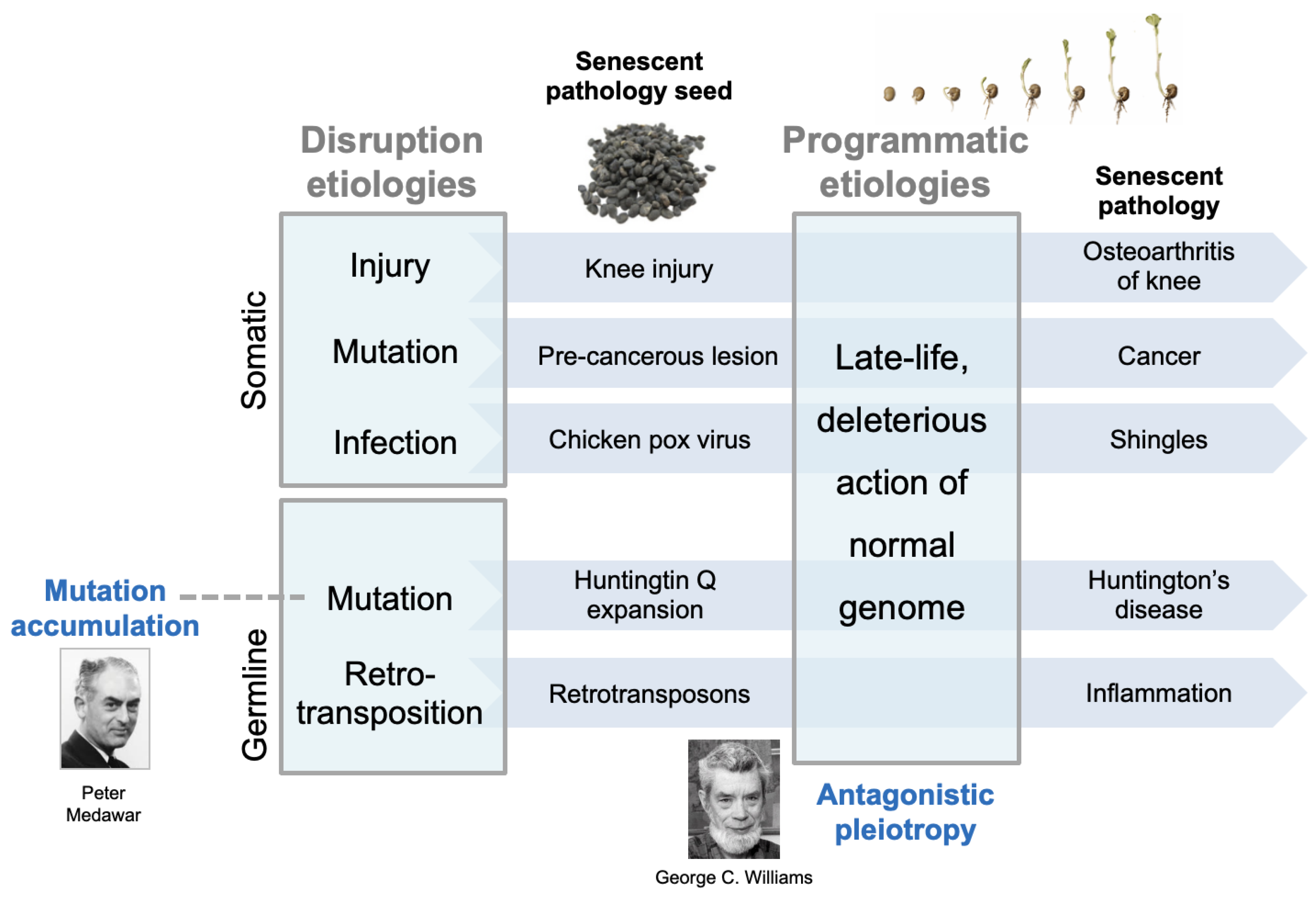
Here I present a two stage model for the development of diseases of aging. This involves two main stages, an early stage involving disruptions only, and a later stage involving both disruptions and programmatic changes. After the diverse insults sustained prior to senescence, the consequent disruptions are often eliminated and health fully restored. However, some disruptions are not fully resolved and are instead contained, allowing health to be sustained during development and reproduction. Critically, latent injury re-emerges as a consequence of programmatic changes caused by the wild-type genome, and ultimately the evolutionary process. These recrudescent injuries form foci for the development of disease (Figure 2).
Using analogies to illustrate the model: the latent, disruption-derived injuries are akin to seeds that remain dormant during the early adulthood and midlife; in later life, processes of senescence determined by the wild-type genome cause the seeds to germinate into late-life pathologies (Figure 2). An alternative view, that emphasises the action of programmatic mechanisms in pathogenesis, is that only in later life can disruptions trigger the development of programmatic pathologies (Gems, 2025).

Origins of the Model: Senescence of the C. elegans Pharynx

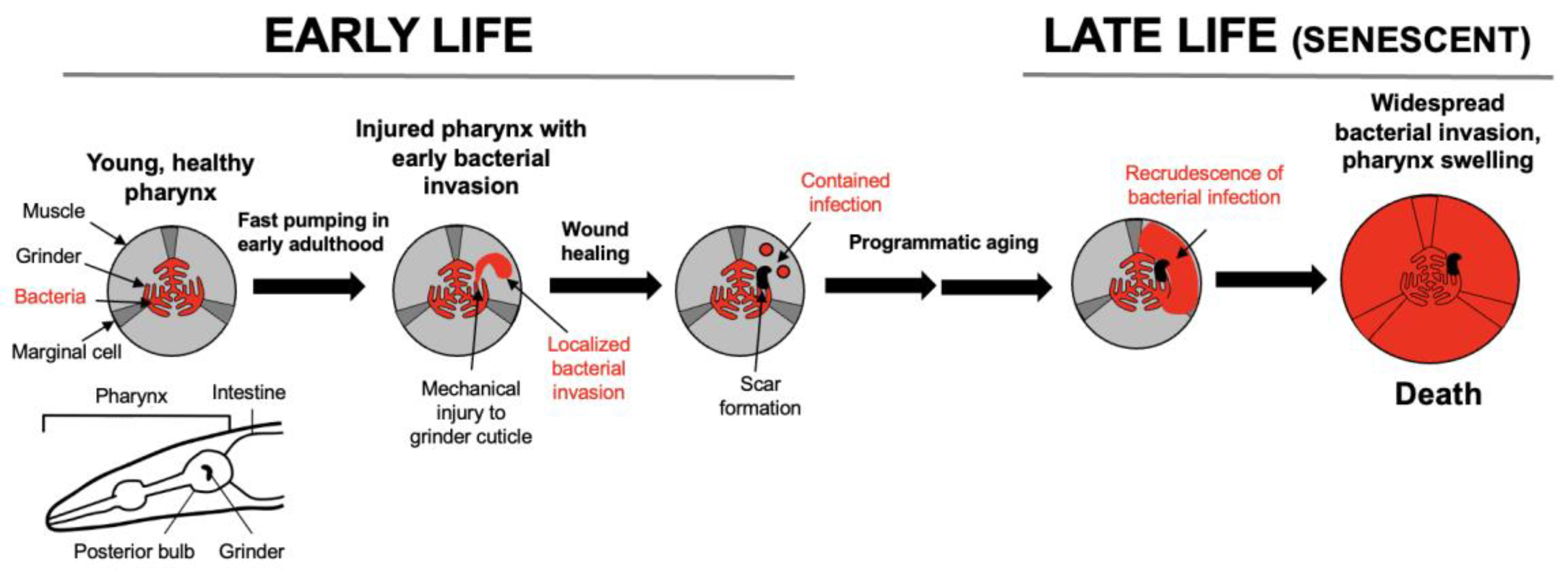
We first conceived of the multifactorial model after studying the origins of late-life disease in C. elegans. Under standard laboratory culture conditions, a common cause of death in aging C. elegans involves infection of the pharynx, the muscular tube anterior to the intestine which ingests and grinds up the worm’s microbial food source (in laboratory studies Escherichia coli OP50) (Zhao et al., 2017). Emergence of this pathology involves at least three distinct etiological components (Figure 3).
First, in early adulthood the rapid chewing action of the pharyngeal grinder leads to perforation of the cuticle that lines the pharynx, due to mechanical damage, i.e. mechanical senescence (Comfort, 1979). Second, small numbers of E. coli invade pharyngeal tissue via the cuticular perforations. These bacilli are then sequestered into membrane-bound inclusions within the cells of the pharynx, probably aided by host innate immunity. The cuticular perforations subsequently heal, leaving a latent infection within the pharynx. In later life, the contained bacilli re-emerge, proliferate and develop into major infections that destroy pharyngeal tissue, causing swelling of the pharynx and, shortly thereafter, death (Zhao et al., 2017). Plausibly, the cause of this later expansion of infection is programmatic aging resulting from the wild-type genome, including immunosenescence (Youngman et al., 2011).
Thus, according to our working model, early injury due to two etiologies, mechanical injury and infection, are contained, but in later life wild-type gene action unmasks the latter, leading to progression to major pathology and death. We subsequently used a conceptual research approach (Blagosklonny and Pardee, 2002), exploring existing literature to test the relevance of this two-stage model to late-life disease in humans, beginning with late-life infection.

Senescent Recrudescence of Early Life Infection

The pattern seen in the etiology of C. elegans death with pharyngeal infection resembles the phenomenon of senescent recrudescence (i.e. reappearance) of infection in humans. This can occur in situations where infectious pathogens are largely cleared earlier in life, but where residual infection escapes host immunity. Such latent infection can re-emerge at times of host immune deficiency, for example due to immunosenescence.
An example of this is chicken pox in childhood remerging as shingles during aging. Chicken pox is caused by infection with the Varicella zoster virus (HZV), which is highly prevalent among children, e.g. 77% by the age of 5 in the UK (Manikkavasagan et al., 2010). The primary infection is characterised by lesions on the skin which normally clear within two weeks of first appearance (Mueller et al., 2008). For a small number of patients, this primary infection develops into shingles (herpes zoster), typically many years or decades after the original infection. The symptoms of shingles differ markedly from those of chicken pox, typically presenting as a vesicular rash (i.e. with fluid-filled sacs) isolated to one dermatome (area of skin provided by a single spinal nerve), and often accompanied by severe pain (Organization, 2016).
V. zoster virions are thought to remain dormant within the dorsal ganglia, re-emerging at times of immune suppression, particularly due to aging. Incidence of shingles increases strongly with advancing age (Hope-Simpson, 1965; Schmader et al., 1995; Yoshikawa and Schmader, 2001). For example, one UK study reported an age increase in annual shingles incidence from 0.74 per 1,000 in 0-9 year olds to 10.1 in 80-89 year olds (Hope-Simpson, 1965). This likely reflects the decline in immune function in late life.
V. zoster is one of a number of pathogens showing senescent recrudescence. Others include polio, caused by Poliovirus, which recurs as post-polio syndrome (Amole and Khouzam-Skelton, 2017; Julien et al., 1999; Sharief et al., 1991); typhus, caused by the bacterium Rickettsia prowazekii, which recurs as Brill-Zinsser Disease (Bechah et al., 2008; Faucher et al., 2012; McQuiston et al., 2010; Stein et al., 1999); and also tuberculosis (TB), caused by the bacterium Mycobacterium tuberculosis.
According to a World Health Organization estimate, around a quarter of the world population is infected with M. tuberculosis, but in most cases infections are latent and asymptomatic (latent TB infection, LTBI). In LTBI, mycobacteria in the lungs are contained and proliferation controlled within granulomas, clusters of phagocytic leukocytes (neutrophils, macrophages), surrounded by T and B lymphocytes. In the progression of LTBI to the more severe, active form of TB, mycobacteria break free from granulomas. Once mycobacteria have spread throughout the lungs, the infection is considered active and can be spread by droplet transmission. Active TB presents with symptoms ranging from those that resemble flu, to multiple organ failure (Pai et al., 2016).
Various factors can increase the relative risk of progression from LTBI to active TB, including surgery, drug abuse, HIV, and also advancing age (Hochberg and Horsburgh, 2013; Horsburgh et al., 2010; Jung et al., 2010). For example, one study found that the incidence rate per 100,000 people rose from 7.3 at ages 21-64 to 14.2 at ages 85-94 (Hochberg and Horsburgh, 2013). In each of these examples, as with contained early infections in the C. elegans pharynx, latent infections recrudesce during organismal senescence, leading to disease.

Early Mechanical Injury as a Focus for Late-Life Disease

The first in the series of etiologies leading in C. elegans to death with an infected pharynx is mechanical injury. Can mechanical injury in early life seed senescent pathology in humans? The C. elegans grinder is one of the few, hard moving parts in this organism; by contrast, in the vertebrate skeleton these are numerous, in the form of articular joints. Mechanical wear and tear to joints is one of a number of etiologies contributing to osteoarthritis (OA), age-related degeneration of cartilage and bone. The most common joint for disabling OA is the knee, with 13% of women and 10% of men over the age of 60 suffering from symptomatic knee OA.
Risk factors for OA include age, female sex, obesity and repetitive joint trauma (Heidari, 2011). Notably, earlier life joint injury increases the risk in old age of OA of the knee (Coggon et al., 2001; Cooper et al., 1998; Englund and Lohmander, 2004; Toivanen et al., 2010) and also the hip (Juhakoski et al., 2009). For example, one Finnish study controlling for other covariates, including age and sex, estimated an adjusted odds ratio of 5.1 for previous knee injury in people with knee OA. It remains unclear whether OA emerges due to later senescent changes causing earlier joint injury to become “uncontained”, or whether subtle changes in gait after injury cause wear-and-tear changes to occur more rapidly.
Nonetheless, the two stage model provides a possible account of interactions between etiologies contributing to OA. The first stage occurs due to mechanical insults to joints, to which various inherited or congenital factors may predispose. The second involves wild-type gene action and programmatic changes, leading to gradual change and hyperfunction in chondrocytes in particular (Gems, 2025). More broadly, the relationship between earlier joint injury and later OA is consistent with the two stage model (Figure 2).
Another form of disruption caused by mechanical stress is traumatic brain injury (TBI), resulting from head injury. Individuals from professions with increased exposure to head trauma, including boxers, American football players and soldiers, have increased risk of chronic traumatic encephalopathy in later life (Kokjohn et al., 2013; McKee and Robinson, 2014; Omalu et al., 2006; Omalu et al., 2005). In the general population, head trauma in early life is associated with an increased risk of developing other forms of late-life dementia (Nordström and Nordström, 2018; Sun et al., 2014). For example, a Taiwanese study of a cohort of one million people, followed between 2005 and 2009, found that 28,551 patients suffered from mild traumatic brain injury (mTBI) (Sun et al., 2014). For those with mTBI the incidence rate of dementia was 1.8 per 1,000 person-year compared to only 0.3 per 1,000 person-year in those without mTBI (hazard ratio 6.34). The nature of the latent damage after TBI is unclear, but one possibility is altered function of the glymphatic system (Sullan et al., 2018).

Early Somatic Mutation and Late-Life Cancer

Another form of disruption leading to disease is somatic mutation, mainly as a cause of cancer. The largest risk factor for cancer is advancing age, and cancer incidence increases exponentially with age (DePinho, 2000; Niccoli and Partridge, 2012). The age increase in cancer rate was initially attributed to time-dependent somatic mutation accumulation alone, as described by the multi-stage theory of carcinogenesis (Armitage and Doll, 1954). More recently, evidence has emerged that senescent changes, particularly to the microenvironment of pre-neoplastic cells, increases the likelihood of progression to metastatic cancer. One predicted driver of such changes is accumulation of senescent cells (sensu Hayflick), including senescent fibroblasts (Campisi, 2013; van Deursen, 2014).
Fibroblast senescence was originally described as cell proliferative exhaustion in vitro, due to shortening of telomeres, and understood as a tumor suppressor mechanism (Campisi, 1997). However, after leaving the cell cycle fibroblasts undergo major differentiative changes (geroconversion), becoming hypertrophic and hyper-secretory, exhibiting the senescence-associated secretory phenotype (SASP), which promotes development of tumors (Coppé et al., 2010) and, as suggested by murine studies, many other senescent pathologies (Baker et al., 2016; Childs et al., 2016). This mysterious behavior in senescent fibroblasts was explained by the discovery that senescent fibroblasts contribute to wound healing (Demaria et al., 2014). Thus, the pathogenic action of senescent cells appears to result from quasi-programmed recapitulation of tissue remodelling and inflammatory functions (Blagosklonny, 2006; Gems and Kern, 2022). The interaction between somatic mutations and senescent cell accumulation conforms to the two stage model (Figure 2). The first etiology involves disruption (DNA damage), and the second programmatic changes leading to futile activation of tissue remodelling functions. Currently, the cause of senescent cell accumulation in vivo is unclear (Wiley and Campisi, 2021); the two stage model postulates that it is largely programmatic.
A related phenomenon is late-life recurrence of cancer that was successfully treated in early life, which can occur, for example, with breast cancer (Dal Lago et al., 1998; Omidvari et al., 2013; Sutton, 1960). For instance, in one case a 73 year old woman presented with a secondary carcinoma of the breast 35 years after the original breast carcinoma was removed (Sutton, 1960). The authors of the report suggested that cells from the original carcinoma had lain dormant and, due to age changes in the patient, had subsequently developed into the secondary carcinoma.

Inherited Mutations and Late-Life Disease

As described, the mutation accumulation (MA) argues that the selection shadow leads to accumulation in populations of inherited mutations with late-life deleterious effects (Medawar, 1952). J.B.S. Haldane reasoned that this could explain the relatively high prevalence of Huntington's disease, despite its genetically dominant mode of inheritance: because the neurodegenerative symptoms emerge only in mid-life, the force of selection to eliminate the mutation is relatively weak (Haldane, 1941). Many genetic diseases show mid- to late-life onset, often accelerating one or more senescent pathologies (unimodal or segmental progeroid conditions, respectively) (Hisama et al., 2016). For example, mutations in various genes linked to b-amyloid processing lead to early onset (familial) Alzheimer's disease (Chouraki and Seshadri, 2014), and mutation of the protein component of telomerase (TERT) leads to increased levels of idiopathic pulmonary fibrosis (IPF) (Diaz de Leon et al., 2010).
But what, in terms of biological mechanisms, is a late-acting deleterious mutation? How do the harmful effects of such mutations remain latent, and then break out in late life to cause pathology? The two stage model provides a potential explanation. We suggest that, as with other forms of disruption-related etiology, harmful effects of such mutations are unmasked by interactions with late-life changes that are, in particular, driven by late-life gene action (Figure 2). For example, senescent cell accumulation and SASP production, which promotes IPF (Schafer et al., 2017), and is promoted by AP, could interact with TERT mutations to cause IPF. The principle involved here is somewhat akin to the classic 1998 study of Hsp90 deficiency in Drosophila, which unmasked phenotypic effects of diverse genetic variants (Rutherford and Lindquist, 1998). The difference here is that in aging it is programmatic changes that lead to such unmasking effects, increasing penetrance of late-acting deleterious mutations.

Retrotransposon Activation

One major, inherited genetic disruption is the large number of retrotransposon-derived sequences, that make up ~45% of the human genome (de Koning et al., 2011). During youth and early adulthood, these retrotransposons remain silent, but during organismal aging, and also cellular senescence in vitro, a small proportion of these retrotransposons become active in a “jail break” mechanism (De Cecco et al., 2013a; De Cecco et al., 2013b). The awakening of these “sleeping dogs of the genome” (Gorbunova et al., 2014) leads to further DNA damage, including insertional mutagenesis. This illustrates again the principle of early containment and later escape of disruption (here inherited) (Figure 2).
When retrotransposon (L1) de-containment occurs during late cellular senescence, this triggers gene expression changes, including a type 1 interferon response that promotes sterile inflammation (De Cecco et al., 2019). Here during cellular senescence, wild-type gene action promotes de-containment of disruption-derived injury, leading to further, pathogenic wild-type gene action. By contrast, one driver of de-containment during aging is accumulation of double-strand DNA breaks (Zhao et al., 2023). This leads to changes in histone methylation and acetylation involving redistribution of the histone deacetylase SIRT6 (Van Meter et al., 2014). Here, damage accumulation leads to de-containment of other disruptions (retrotransposons), leading to further disruption and programmatic change.

Final Remarks

The multifactorial model presents a complex account of the causes of aging, encompassing the evolutionary theory, disruptions and programmatic mechanisms. Given that most late-life diseases are multifactorial disorders, it is no wonder that aging is so difficult to understand. The researcher of aging is akin to a doctor struggling to make a diagnosis with a patient suffering from, say, hepatitis C, toxocariasis, mercury poisoning and Klippel-Trenaunay syndrome, and their complex interactions.

The Multifactorial Model is an Evolutionary Physiology Account

Like the more purely programmatic accounts of Williams, Blagosklonny and de Magalhães (Blagosklonny, 2006; Blagosklonny, 2008; de Magalhães and Church, 2005; Williams, 1957), the multifactorial model provides an evolutionary physiology perspective. It argues that natural selection maintains fitness until after the onset of reproduction, dealing with disruptions either by resolving or, failing that, containing them. Declining selection at later ages results in loss of containment of such disruptions, leading to late-life disease, including recrudescence of infection, osteoarthritis, cancer and manifestation of genetic diseases with late onset, including unimodal and segmental progeroid conditions.

The Multifactorial Model and Anti-Aging Treatments

Better definition of aging and its causes allows a clearer conception of treatments for aging. Anti-aging treatments can be understood as interventions which counteract any etiology of organismal senescence (Gems, 2014). The multifactorial model defines two basic types of anti-aging treatment. First, those that prevent causes of disruption. This could include prevention of infection (e.g. immunization against V. zoster, preventing shingles), of mechanical injury (e.g. use of protective gear in contact sports), and of mutation, both somatic (e.g. sunblock to avoid mutation of cells in skin, cleaner air measures), and inherited (pre-implantation diagnosis, and perhaps one day CRISPR-CAS9 correction of mutations). Second, those that suppress pathogenic late-life, wild-type gene action. One example here is use of rapamycin to inhibit mTOR-driven hyperfunction and quasi-programs (e.g. SASP production), a possibility much discussed by Blagosklonny. Rapamycin has robust anti-aging effects in mice, extending healthspan and lifespan (Harrison et al., 2009; Wilkinson et al., 2012), but whether it similarly affects humans is far from clear. Thus, at present, the available anti-aging treatments with efficacy in human beings are those that act by preventing disruptions.

Acknowledgments

We thank Ann Gilliat (UCL), Vera Gorbunova (University of Rochester), João Pedro de Magalhães (Birmingham University), and Graham Pawelec (Tübingen University) for useful discussion. This work was supported by a Wellcome Trust Investigator Award (215574/Z/19/Z) to D.G..

References

  1. Al Anouti, F.; Taha, Z.; Shamim, S.; Khalaf, K.; Al Kaabi, L.; Alsafar, H. An insight into the paradigms of osteoporosis: From genetics to biomechanics. Bone Rep. 2019, 11, 100216. [Google Scholar] [CrossRef]
  2. Amole, M.; Khouzam-Skelton, N. Diagnosing post-polio syndrome in the elderly, a case report. Geriatrics 2017, 2, 14. [Google Scholar] [CrossRef] [PubMed]
  3. Armitage, P.; Doll, R. The age distribution of cancer and a multi-stage theory of carcinogenesis. Br J Cancer 1954, 8, 1–12. [Google Scholar] [CrossRef]
  4. Armstrong, R.A. What causes Alzheimer's disease? Folia Neuropathol. 2013, 51, 169–188. [Google Scholar] [CrossRef]
  5. Arnold, K.R.; Rose, M.R. Conceptual Breakthroughs in The Evolutionary Biology of Aging; Academic Press, 2023. [Google Scholar]
  6. Austad, S.; Hoffman, J. Is antagonistic pleiotropy ubiquitous in aging biology? Evol Med Public Health 2018, 287–294. [Google Scholar] [CrossRef]
  7. Baker, D.J.; Childs, B.G.; Durik, M.; Wijers, M.E.; Sieben, C.J.; Zhong, J.; Saltness, R.A.; Jeganathan, K.B.; Verzosa, G.C.; Pezeshki, A.; Khazaie, K.; Miller, J.D.; van Deursen, J.M. Naturally occurring p16(Ink4a)-positive cells shorten healthy lifespan. Nature 2016, 530, 184–9. [Google Scholar] [CrossRef]
  8. Bechah, Y.; Capo, C.; Mege, J.; Raoult, D. Epidemic typhus. Lancet Infect Dis. 2008, 8, 417–426. [Google Scholar] [CrossRef] [PubMed]
  9. Blagosklonny, M.V. Aging and immortality: quasi-programmed senescence and its pharmacologic inhibition. Cell Cycle 2006, 5, 2087–102. [Google Scholar] [CrossRef]
  10. Blagosklonny, M.V. Paradoxes of aging. Cell Cycle 2007, 6, 2997–3003. [Google Scholar] [CrossRef]
  11. Blagosklonny, M.V. Aging: ROS or TOR. Cell Cycle 2008, 7, 3344–3354. [Google Scholar] [CrossRef] [PubMed]
  12. Blagosklonny, M.V. MTOR-driven quasi-programmed aging as a disposable soma theory: Blind watchmaker vs. intelligent designer. Cell Cycle 2013, 12, 1842–1847. [Google Scholar] [CrossRef]
  13. Blagosklonny, M.V. From causes of aging to death from COVID-19. Aging (Albany NY) 2020, 12, 10004–10021. [Google Scholar] [CrossRef]
  14. Blagosklonny, M.V.; Pardee, A.B. Conceptual biology: unearthing the gems. Nature 2002, 416, 373. [Google Scholar] [CrossRef]
  15. Campisi, J. Aging and cancer: the double-edged sword of replicative senescence. J Am Geriatr Soc. 1997, 45, 482–488. [Google Scholar] [CrossRef]
  16. Campisi, J. Aging, cellular senescence, and cancer. Annu Rev Physiol. 2013, 75, 685–705. [Google Scholar] [CrossRef]
  17. Childs, B.G.; Baker, D.J.; Wijshake, T.; Conover, C.A.; Campisi, J.; van Deursen, J.M. Senescent intimal foam cells are deleterious at all stages of atherosclerosis. Science 2016, 354, 472–477. [Google Scholar] [CrossRef]
  18. Chouraki, V.; Seshadri, S. Genetics of Alzheimer’s disease. Adv Genet. 2014, 87, 245–294. [Google Scholar] [PubMed]
  19. Coggon, D.; Reading, I.; Croft, P.; McLaren, M.; Barrett, D.; Cooper, C. Knee osteoarthritis and obesity. Int J Obes Relat Metab Disord. 2001, 25, 622–627. [Google Scholar] [CrossRef]
  20. Comfort, A. The Biology of Senescence, Third edition ed.; Elsevier: New York, 1979. [Google Scholar]
  21. Cooper, C.; Inskip, H.; Croft, P.; Campbell, L.; Smith, G.; McLaren, M.; Coggon, D. Individual risk factors for hip osteoarthritis: obesity, hip injury, and physical activity. Am J Epidemiol. 1998, 147, 516–522. [Google Scholar] [CrossRef] [PubMed]
  22. Coppé, J.P.; Desprez, P.Y.; Krtolica, A.; Campisi, J. The senescence-associated secretory phenotype: the dark side of tumor suppression. Annu Rev Pathol. 2010, 5 99–118. [Google Scholar] [CrossRef] [PubMed]
  23. Dal Lago, D.; Villa, G.; Miguoli, R.; Annoni, G.; Vergani, C. An unusual case of breast cancer relapse after 30 years of disease-free survival. Age Ageing 1998, 27, 649–650. [Google Scholar] [CrossRef] [PubMed]
  24. De Cecco, M.; Criscione, S.; Peckham, E.; Hillenmeyer, S.; Hamm, E.; Manivannan, J.; Peterson, A.; Kreiling, J.; Neretti, N.; Sedivy, J. Genomes of replicatively senescent cells undergo global epigenetic changes leading to gene silencing and activation of transposable elements. Aging Cell. 2013a, 12, 247–256. [Google Scholar] [CrossRef]
  25. De Cecco, M.; Criscione, S.; Peterson, A.; Neretti, N.; Sedivy, J.; Kreiling, J. Transposable elements become active and mobile in the genomes of aging mammalian somatic tissues. Aging 2013b, 5, 867–883. [Google Scholar] [CrossRef]
  26. De Cecco, M.; Ito, T.; Petrashen, A.; Elias, A.; Skvir, N.; Criscione, S.; Caligiana, A.; Brocculi, G.; Adney, E.; Boeke, J.; Le, O.; Beauséjour, C.; Ambati, J.; Ambati, K.; Simon, M.; Seluanov, A.; Gorbunova, V.; Slagboom, P.; Helfand, S.; Neretti, N.; Sedivy, J. L1 drives IFN in senescent cells and promotes age-associated inflammation. Nature 2019, 566, 73–78. [Google Scholar] [CrossRef]
  27. de Koning, A.; Gu, W.; Castoe, T.; Batzer, M.; Pollock, D. Repetitive elements may comprise over two-thirds of the human genome. PLoS Genet. 2011, 7, e1002384. [Google Scholar] [CrossRef]
  28. de la Guardia, Y.; Gilliat, A.F.; Hellberg, J.; Rennert, P.; Cabreiro, F.; Gems, D. Run-on of germline apoptosis promotes gonad senescence in C. elegans. Oncotarget 2016, 7, 39082–39096. [Google Scholar] [CrossRef] [PubMed]
  29. de Magalhães, J.P. Programmatic features of aging originating in development: aging mechanisms beyond molecular damage? FASEB J. 2012, 26, 4821–4826. [Google Scholar] [CrossRef]
  30. de Magalhães, J.P.; Church, G.M. Genomes optimize reproduction: aging as a consequence of the developmental program. Physiology 2005, 20, 252–259. [Google Scholar] [CrossRef]
  31. Demaria, M.; Ohtani, N.; Youssef, S.A.; Rodier, F.; Toussaint, W.; Mitchell, J.R.; Laberge, R.M.; Vijg, J.; Van Steeg, H.; Dollé, M.E.; Hoeijmakers, J.H.; de Bruin, A.; Hara, E.; Campisi, J. An essential role for senescent cells in optimal wound healing through secretion of PDGF-AA. Dev Cell. 2014, 31, 722–733. [Google Scholar] [CrossRef] [PubMed]
  32. DePinho, R.A. The age of cancer. Nature 2000, 408, 248–254. [Google Scholar] [CrossRef]
  33. Diaz de Leon, A.; Cronkhite, J.; Katzenstein, A.; Godwin, J.; Raghu, G.; Glazer, C.; Rosenblatt, R.; Girod, C.; Garrity, E.; Xing, C.; Garcia, C. Telomere lengths, pulmonary fibrosis and telomerase (TERT) mutations. PLoS One 2010, 5, e10680. [Google Scholar] [CrossRef]
  34. Dilman, V.M. An integrated, four-component mechanism of aging, Development, Aging and Disease: A New Rationale for an Intervention Strategy; Harwood Academic Publishers, 1994; pp. 151–178. [Google Scholar]
  35. Englund, M.; Lohmander, L. Risk factors for symptomatic knee osteoarthritis fifteen to twenty-two years after meniscectomy. Arthritis Rheum. 2004, 50, 2811–2819. [Google Scholar] [CrossRef] [PubMed]
  36. Faucher, J.-F.; Socolovschi, C.; Aubry, C.; Chirouze, C.; Hustache-Mathieu, L.; Raoult, D.; Hoen, B. Brill-Zinsser Disease in Moroccan Man, France, 2011. Emerging Infectious Diseases 2012, 18, 171–172. [Google Scholar] [CrossRef]
  37. Flatt, T.; Partridge, L. Horizons in the evolution of aging. BMC Biol. 2018, 16, 93. [Google Scholar] [CrossRef]
  38. Galimov, E.R.; Gems, D. Shorter life and reduced fecundity can increase colony fitness in virtual C. elegans. Aging Cell. 2020, 19, e13141. [Google Scholar] [CrossRef]
  39. Galimov, E.R.; Gems, D. Death happy: Adaptive death and its evolution by kin selection in organisms with colonial ecology. Philos Trans R Soc B 2021, 376, 20190730. [Google Scholar] [CrossRef]
  40. Gems, D. What is an anti-aging treatment? Exp Gerontol. 2014, 58, 14–18. [Google Scholar] [CrossRef]
  41. Gems, D. Understanding hyperfunction: an emerging paradigm for the biology of aging. Ageing Res Rev. 2022, 74, 101557. [Google Scholar] [CrossRef]
  42. Gems, D. How aging causes osteoarthritis: an evolutionary physiology perspective. Annals Rheum Dis. 2025, 33, 921–932. [Google Scholar] [CrossRef]
  43. Gems, D. On Aging. What Causes It and How It Leads to the Maladies of Old Age; Columbia University Press, 2026. [Google Scholar]
  44. Gems, D.; de la Guardia, Y. Alternative perspectives on aging in C. elegans: reactive oxygen species or hyperfunction? Antioxid Redox Signal. 2013, 19, 321–329. [Google Scholar] [CrossRef] [PubMed]
  45. Gems, D.; Doonan, R. Antioxidant defense and aging in C. elegans: is the oxidative damage theory of aging wrong? Cell Cycle 2009, 8, 1681–1687. [Google Scholar] [CrossRef]
  46. Gems, D.; Kern, C.C. Is “cellular senescence” a misnomer? Geroscience 2022, 44, 2461–2469. [Google Scholar] [CrossRef]
  47. Gems, D.; Kern, C.C. Biological constraint, evolutionary spandrels and antagonistic pleiotropy. Ageing Res Rev. 2024, 101, 102527. [Google Scholar] [CrossRef]
  48. Gems, D.; Kern, C.C.; Nour, J.; Ezcurra, M. Reproductive suicide: similar mechanisms of aging in C. elegans and Pacific salmon. Front Cell Dev Biol. 2021, 9, 688788. [Google Scholar] [CrossRef]
  49. Glocker, M.O.; Guthke, R.; Kekow, J.; Thiesen, H.J. Rheumatoid arthritis, a complex multifactorial disease: on the way toward individualized medicine. Med Res Rev. 2006, 26, 63–87. [Google Scholar] [CrossRef]
  50. Glyn-Jones, S.; Palmer, A.J.; Agricola, R.; Price, A.J.; Vincent, T.L.; Weinans, H.; Carr, A.J. Osteoarthritis. Lancet 2015, 386, 376–387. [Google Scholar] [CrossRef]
  51. Gorbunova, V.; Boeke, J.; Helfand, S.; Sedivy, J. Sleeping dogs of the genome. Science 2014, 346, 1187–1188. [Google Scholar] [CrossRef]
  52. Grandison, R.C.; Piper, M.D.; Partridge, L. Amino-acid imbalance explains extension of lifespan by dietary restriction in Drosophila. Nature 2009, 462, 1061–4. [Google Scholar] [CrossRef]
  53. Haldane, J.B.S. New Paths in Genetics; Allen and Unwin: London, 1941. [Google Scholar]
  54. Harrison, D.E.; Strong, R.; Sharp, Z.D.; Nelson, J.F.; Astle, C.M.; Flurkey, K.; Nadon, N.L.; Wilkinson, J.E.; Frenkel, K.; Carter, C.S.; Pahor, M.; Javors, M.A.; Fernandez, E.; Miller, R.A. Rapamycin fed late in life extends lifespan in genetically heterogeneous mice. Nature 2009, 460, 392–5. [Google Scholar] [CrossRef] [PubMed]
  55. Heidari, B. Knee osteoarthritis prevalence, risk factors, pathogenesis and features: Part I. Caspian J Internal Med. 2011, 2, 205–212. [Google Scholar]
  56. Higashi, Y.; Gautam, S.; Delafontaine, P.; Sukhanov, S. IGF-1 and cardiovascular disease. Growth Horm IGF Res. 2019, 45, 6–16. [Google Scholar] [CrossRef]
  57. Hisama, F.M.; Oshima, J.; Martin, G.M. How research on human progeroid and antigeroid syndromes can contribute to the longevity dividend initiative. Cold Spring Harb Perspect Med. 2016, 6, a025882. [Google Scholar] [CrossRef] [PubMed]
  58. Hochberg, N.; Horsburgh, C.J. Prevention of tuberculosis in older adults in the United States: obstacles and opportunities. Clin Infect Dis. 2013, 56, 1240–1247. [Google Scholar] [CrossRef] [PubMed]
  59. Hope-Simpson, R.E. The nature of Herpes zoster: a long-term study and a new hypothesis. Proc R Soc Med. 1965, 58, 9–20. [Google Scholar] [CrossRef]
  60. Horsburgh, C.J.; O'Donnell, M.; Chamblee, S.; Moreland, J.; Johnson, J.; Marsh, B.; Narita, M.; Johnson, L.; von Reyn, C. Revisiting rates of reactivation tuberculosis a population-based approach. Am J Resp Critical Care Med. 2010, 182, 420–425. [Google Scholar] [CrossRef]
  61. Huertas, A.; Palange, P. COPD: a multifactorial systemic disease. Ther Adv Respir Dis. 2011, 5, 217–224. [Google Scholar] [CrossRef]
  62. Juhakoski, R.; Heliövaara, M.; Impivaara, O.; Kröger, H.; Knekt, P.; Lauren, H.; Arokoski, J. Risk factors for the development of hip osteoarthritis: a population-based prospective study. Rheumatology (Oxford) 2009, 48, 83–87. [Google Scholar] [CrossRef]
  63. Julien, J.; Leparc-Goffart, I.; Lina, B.; Fuchs, F.; Foray, S.; Janatova, I.; Aymard, M.; Kopecka, H. Post-polio syndrome: poliovirus persistence is involved in the pathogenesis. J Neurol. 1999, 246, 472–476. [Google Scholar] [CrossRef]
  64. Jung, R.; Bennion, J.; Sorvillo, F.; Bellomy, A. Trends in tuberculosis mortality in the United States, 1990-2006: a population-based case-control study. Public Health Rep. 2010, 125, 389–397. [Google Scholar] [CrossRef] [PubMed]
  65. Kern, C.C.; Srivastava, S.; Ezcurra, M.; Hsiung, K.C.; Hui, N.; Townsend, S.; Maczik, D.; Zhang, B.; Tse, V.; Kostantellos, V.; Bähler, J.; Gems, D. C. elegans ageing is accelerated by a self-destructive reproductive programme. Nat Commun. 2023, 14, 4381. [Google Scholar] [CrossRef]
  66. Kern, C.C.; Townsend, S.; Salzmann, A.; Rendell, N.; Taylor, G.; Comisel, R.M.; Foukas, L.; Bähler, J.; Gems, D. C. elegans feed yolk to their young in a form of primitive lactation. Nat Commun. 2021, 12, 5801. [Google Scholar] [CrossRef] [PubMed]
  67. Kirkwood, T.B.L. Evolution of ageing. Nature 1977, 270, 301–304. [Google Scholar] [CrossRef]
  68. Kirkwood, T.B.L.; Rose, M.R. Evolution of senescence: late survival sacrificed for reproduction. Phil Trans R Soc London 1991, 332, 15–24. [Google Scholar]
  69. Kokjohn, T.; Maarouf, C.; Daugs, I.; Hunter, J.; Whiteside, C.; Malek-Ahmadi, M.; Rodriguez, E.; Kalback, W.; Jacobson, S.; Sabbagh, M.; Beach, T.; Roher, A. Neurochemical profile of dementia pugilistica. J Neurotrauma 2013, 30, 981–997. [Google Scholar] [CrossRef]
  70. Koopman, J.; Wensink, M.; Rozing, M.; van Bodegom, D.; Westendorp, R. Intrinsic and extrinsic mortality reunited. Exp Gerontol. 2015, 67, 48–53. [Google Scholar] [CrossRef] [PubMed]
  71. Lemaître, J.-F.; Moorad, J.; Gaillard, J.-M.; Maklakov, A.A.; Nussey, D.H. From hallmarks of ageing to natural selection: A unified framework for genetic and physiological evolutionary theories of ageing. PLoS Biol. 2024, 22, e3002513. [Google Scholar] [CrossRef] [PubMed]
  72. Lohr, J.; Galimov, E.R.; Gems, D. Does senescence promote fitness in Caenorhabditis elegans by causing death? Ageing Res Rev. 2019, 50, 58–71. [Google Scholar] [CrossRef]
  73. Maklakov, A.A.; Chapman, T. Evolution of ageing as a tangle of trade-offs: energy versus function. Proc Biol Sci. 2019, 286, 20191604. [Google Scholar] [CrossRef] [PubMed]
  74. Manikkavasagan, G.; Dezateux, C.; Wade, A.; Bedford, H. The epidemiology of chickenpox in UK 5-year olds: an analysis to inform vaccine policy. Vaccine 2010, 28, 7699–7705. [Google Scholar] [CrossRef]
  75. McKee, A.C.; Robinson, M. Military-related traumatic brain injury and neurodegeneration. Alzheimer’s Dement. 2014, 10, S242–S253. [Google Scholar] [CrossRef]
  76. McQuiston, J.; Knights, E.; Demartino, P.; Paparello, S.; Nicholson, W.; Singleton, J.; Brown, C.; Massung, R.; Urbanowski, J. Brill-Zinsser disease in a patient following infection with sylvatic epidemic typhus associated with flying squirrels. Clin Infectious Diseases 2010, 51, 712–715. [Google Scholar] [CrossRef] [PubMed]
  77. Medawar, P.B. An Unsolved Problem Of Biology; H.K. Lewis: London, 1952. [Google Scholar]
  78. Mueller, N.; Gilden, D.; Cohrs, R.; Mahalingam, R.; Nagel, M. Varicella zoster virus infection: clinical features, molecular pathogenesis of disease, and latency. Neurol Clin. 2008, 26, 675–697. [Google Scholar] [CrossRef]
  79. Nesse, R.M.; Williams, G.C. Why We Get Sick: The New Science of Darwinian Medicine; Random House, 1994. [Google Scholar]
  80. Niccoli, T.; Partridge, L. Ageing as a risk factor for disease. Curr Biol. 2012, 22, R741–R752. [Google Scholar] [CrossRef]
  81. Nordström, A.; Nordström, P. Traumatic brain injury and the risk of dementia diagnosis: A nationwide cohort study. PLoS Medicine 2018, 15, e1002496. [Google Scholar] [CrossRef]
  82. Omalu, B.; DeKosky, S.; Hamilton, R.; Minster, R.; Kamboh, M.; Shakir, A.; Wecht, C. Chronic traumatic encephalopathy in a National Football League player: part II. Neurosurgery 2006, 59, 1086–1092. [Google Scholar] [CrossRef]
  83. Omalu, B.; DeKosky, S.; Minster, R.; Kamboh, M.; Hamilton, R.; Wecht, C. Chronic traumatic encephalopathy in a National Football League player. Neurosurgery 2005, 57, 128–134. [Google Scholar] [CrossRef]
  84. Omidvari, S.; Hamedi, S.; Mohammadianpanah, M.; Nasrolahi, H.; Mosalaei, A.; Talei, A.; Ahmadloo, N.; Ansari, M. Very Late Relapse in Breast Cancer Survivors: a Report of 6 Cases. Iranian J Cancer Prev. 2013, 6, 113–117. [Google Scholar]
  85. Organization, W.H. Varicella and herpes zoster vaccines: WHO position paper. Weekly Epidemiological Record 2016, 25, 265–288. [Google Scholar]
  86. Pai, M.; Behr, M.; Dowdy, D.; Dheda, K.; Divangahi, M.; Boehme, C.; Ginsberg, A.; Swaminathan, S.; Spigelman, M.; Getahun, H.; Menzies, D.; Raviglione, M. Tuberculosis. Nat Rev Disease Primers 2016, 2, 16076. [Google Scholar] [CrossRef] [PubMed]
  87. Perez, V.I.; Bokov, A.; Van Remmen, H.; Mele, J.; Ran, Q.; Ikeno, Y.; Richardson, A. Is the oxidative stress theory of aging dead? Biochim Biophys Acta 2009, 1790, 1005–14. [Google Scholar] [CrossRef] [PubMed]
  88. Rose, M.R. Evolutionary Biology of Aging; Oxford University Press: Oxford, 1991. [Google Scholar]
  89. Rutherford, S.; Lindquist, S. Hsp90 as a capacitor for morphological evolution. Nature 1998, 396, 336–342. [Google Scholar] [CrossRef]
  90. Schafer, M.; White, T.; Iijima, K.; Haak, A.; Ligresti, G.; Atkinson, E.; Oberg, A.; Birch, J.; Salmonowicz, H.; Zhu, Y.; Mazula, D.; Brooks, R.; Fuhrmann-Stroissnigg, H.; Pirtskhalava, T.; Prakash, Y.; Tchkonia, T.; Robbins, P.; Aubry, M.; Passos, J.; Kirkland, J.; Tschumperlin, D.; Kita, H.; LeBrasseur, N. Cellular senescence mediates fibrotic pulmonary disease. Nat Commun. 2017, 8, 14532. [Google Scholar] [CrossRef]
  91. Schmader, K.; George, L.; Burchett, B.; Pieper, C.; Hamilton, J. Racial differences in the occurrence of herpes zoster. J Infect Dis. 1995, 171, 701–704. [Google Scholar] [CrossRef] [PubMed]
  92. Sharief, M.; Hentges, R.; Ciardi, M. Intrathecal immune response in patients with the post-polio syndrome. N Engl J Med. 1991, 325, 749–755. [Google Scholar] [CrossRef] [PubMed]
  93. Slade, L.; Etheridge, T.; Szewczyk, N.L. Consolidating multiple evolutionary theories of ageing suggests a need for new approaches to study genetic contributions to ageing decline. Ageing Res Rev. 2024, 100, 102456. [Google Scholar] [CrossRef] [PubMed]
  94. Stein, A.; Purgus, R.; Olmer, M.; Raoult, D. Brill-Zinsser disease in France. The Lancet 1999, 353, 1936. [Google Scholar] [CrossRef]
  95. Sullan, M.; Asken, B.; Jaffee, M.; DeKosky, S.; Bauer, R. Glymphatic system disruption as a mediator of brain trauma and chronic traumatic encephalopathy. Neurosci Biobehav Rev. 2018, 84, 316–324. [Google Scholar] [CrossRef]
  96. Sun, Y.; Lee, H.; Yang, S.; Chen, T.; Lin, K.; Lin, C.; PN, W.; Tang, L.; Chiu, M. A nationwide survey of mild cognitive impairment and dementia, including very mild dementia, in Taiwan. PLoS One 2014, 9, e100303. [Google Scholar] [CrossRef]
  97. Sutton, M. Late recurrence of carcinoma of breast. BMJ 1960, 2, 1132–1134. [Google Scholar] [CrossRef]
  98. Toivanen, A.; Heliövaara, M.; Impivaara, O.; Arokoski, J.; Knekt, P.; Lauren, H.; Kröger, H. Obesity, physically demanding work and traumatic knee injury are major risk factors for knee osteoarthritis--a population-based study with a follow-up of 22 years. Rheumatology (Oxford) 2010, 49, 308–314. [Google Scholar] [CrossRef]
  99. van Deursen, J.M. The role of senescent cells in ageing. Nature 2014, 509, 439–46. [Google Scholar] [CrossRef] [PubMed]
  100. Van Meter, M.; Kashyap, M.; Rezazadeh, S.; Geneva, A.; Morello, T.; Seluanov, A.; Gorbunova, V. SIRT6 represses LINE1 retrotransposons by ribosylating KAP1 but this repression fails with stress and age. Nat Commun. 2014, 5, 5011. [Google Scholar] [CrossRef]
  101. Wang, H.; Zhao, Y.; Ezcurra, M.; Benedetto, A.; Gilliat, A.; Hellberg, J.; Ren, Z.; Athigapanich, T.; Girstmair, J.; Telford, M.J.; Dolphin, C.T.; Zhang, Z.; Gems, D. A parthenogenetic quasi-program causes teratoma-like tumors during aging in wild-type C. elegans. NPJ Aging Mech Disease 2018, 4, 6. [Google Scholar] [CrossRef] [PubMed]
  102. Wiley, C.D.; Campisi, J. The metabolic roots of senescence: mechanisms and opportunities for intervention. Nat Metab. 2021, 3, 1290–1301. [Google Scholar] [CrossRef] [PubMed]
  103. Wilkinson, J.E.; Burmeister, L.; Brooks, S.V.; Chan, C.C.; Friedline, S.; Harrison, D.E.; Hejtmancik, J.F.; Nadon, N.; Strong, R.; Wood, L.K.; Woodward, M.A.; Miller, R.A. Rapamycin slows aging in mice. Aging Cell. 2012, 11, 675–682. [Google Scholar] [CrossRef]
  104. Williams, G.C. Pleiotropy, natural selection and the evolution of senescence. Evolution 1957, 11, 398–411. [Google Scholar] [CrossRef]
  105. Yoshikawa, T.T.; Schmader, K. Herpes zoster in older adults. Clinical Infectious Diseases 2001, 32, 1481–1486. [Google Scholar] [CrossRef]
  106. Youngman, M.J.; Rogers, Z.N.; Kim, D.H. A decline in p38 MAPK signaling underlies immunosenescence in Caenorhabditis elegans. PLoS Genet. 2011, 7, e1002082. [Google Scholar] [CrossRef]
  107. Zajitschek, F.; Georgolopoulos, G.; Vourlou, A.; Ericsson, M.; Zajitschek, S.; Friberg, U.; Maklakov, A. Evolution under dietary restriction decouples survival from fecundity in Drosophila melanogaster females. J Gerontol A Biol Sci Med Sci. 2019, 74, 1542–1548. [Google Scholar] [CrossRef]
  108. Zhao, X.; Promislow, D.E.L. Senescence and ageing. In The Oxford Handbook of Evolutionary Medicine; Brüne, M., Schiefenhövel, W., Eds.; Oxford University Press: Oxford, UK, 2019; pp. 167–208. [Google Scholar]
  109. Zhao, Y.; Gilliat, A.F.; Ziehm, M.; Turmaine, M.; Wang, H.; Ezcurra, M.; Yang, C.; Phillips, G.; McBay, D.; Zhang, W.B.; Partridge, L.; Pincus, Z.; Gems, D. Two forms of death in aging Caenorhabditis elegans. Nat Commun. 2017, 8, 15458. [Google Scholar] [CrossRef]
  110. Zhao, Y.; Simon, M.; Seluanov, A.; Gorbunova, V. DNA damage and repair in age-related inflammation. Nat Rev Immunol. 2023, 23, 75–89. [Google Scholar] [CrossRef] [PubMed]
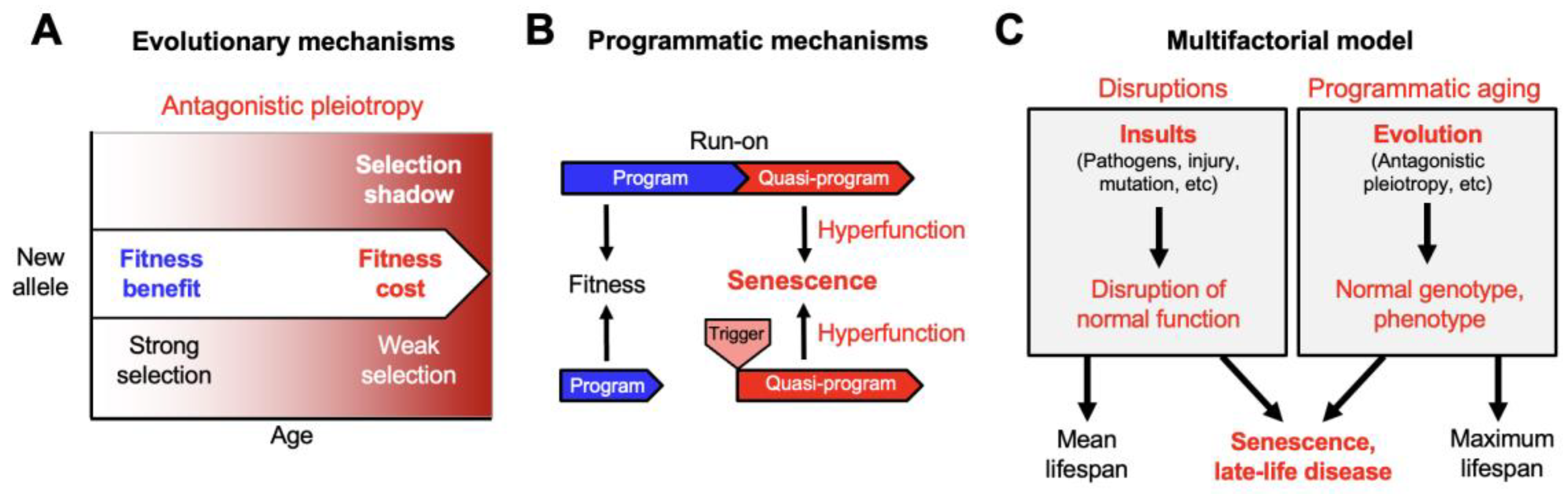
Figure 1. From the evolutionary theory to the multifactorial model. Developing new theory from foundations laid by Misha Blagosklonny. (A) The evolutionary theory of aging. Selection declines at later ages (selection shadow). Consequently, new alleles that promote fitness earlier in life but cause pathology at later ages may be favored by natural selection (antagonistic pleiotropy, AP). (B) Quasi-programmed hyperfunction. AP can be expressed as quasi-programs: genetically determined but non-adaptive derivatives of programs that promote fitness earlier in life. These may arise due to futile program run-on (top) as originally envisaged by Blagosklonny (Blagosklonny, 2006), or triggered reactivation (bottom) (Gems, 2025). (C) The multifactorial model, in simplified form; a more detailed version was presented previously (Gems, 2022). Late-life diseases are typically multifactorial in etiology. These etiologies fall into two broad categories: insults leading to disruption of normal biological function (left, e.g. infectious pathogens, mechanical injury, mutation); and programmatic action of the normal genotype (B), that are pathogenic due to the evolutionary process (A). Differences in lifespan between individuals, and mean lifespans of populations, are strongly determined by disruptions. Maximum (and also mean) lifespan is determined by programmatic aging, as specified by the normal genome. The shorter maximum lifespan of the the mouse Mus musculus (4 years) than the naked mole rat Heterocephalus glaber (31 years) is determined by the normal genome, not disruptions.
Preprints 177055 g001
Figure 2. Two stage model for interactions between earlier and later etiologies. Diverse disruptions of normal biological function resulting from insults are contained and lie dormant within the youthful physiological milieu. In the senescent milieu, containment of such disruptions fails, and they form foci for the development of diverse senescent pathologies. Such contained, latent disruptions are analogous to seeds lying dormant within the host; later, pathogenic wild-type gene action stimulates the seeds to grow; this analogy captures the developmental nature of senescent pathogenesis (de Magalhães and Church, 2005). The early etiologies are those typical of disease causes prior to aging, including infection, mechanical damage, and mutation (somatic and inherited). The main, late-life etiology, wild-type gene action, is predominantly (but not entirely) restricted to senescence. Of evolutionary theories of aging, mutation accumulation (MA): inherited, late-acting deleterious mutations can be understood as those unmasked by later programmatic changes. Antagonistic pleiotropy (AP): this involves late-life programmatic changes themselves.
Preprints 177055 g002
Figure 3. Pathophysiology of pharyngeal senescence in aging C. elegans. High rate of pharyngeal pumping in early adulthood leads to mechanical damage (mechanical senescence) to the pharyngeal cuticle. This perforates the cuticle, allowing minor bacterial invasion of pharyngeal tissue. In later life in ~40% of individuals, the invasion spreads further, leading to widespread infection, pharyngeal swelling and death (Zhao et al., 2017). Bottom left: schematic representation of C. elegans anterior end (head), including the pharynx.
Preprints 177055 g003
Disclaimer/Publisher’s Note: The statements, opinions and data contained in all publications are solely those of the individual author(s) and contributor(s) and not of MDPI and/or the editor(s). MDPI and/or the editor(s) disclaim responsibility for any injury to people or property resulting from any ideas, methods, instructions or products referred to in the content.
Copyright: This open access article is published under a Creative Commons CC BY 4.0 license, which permit the free download, distribution, and reuse, provided that the author and preprint are cited in any reuse.
Prerpints.org logo

Preprints.org is a free preprint server supported by MDPI in Basel, Switzerland.

Subscribe

Disclaimer

Terms of Use

Privacy Policy

Privacy Settings

© 2025 MDPI (Basel, Switzerland) unless otherwise stated