

Submitted:
17 September 2025
Posted:
17 September 2025
You are already at the latest version
Abstract
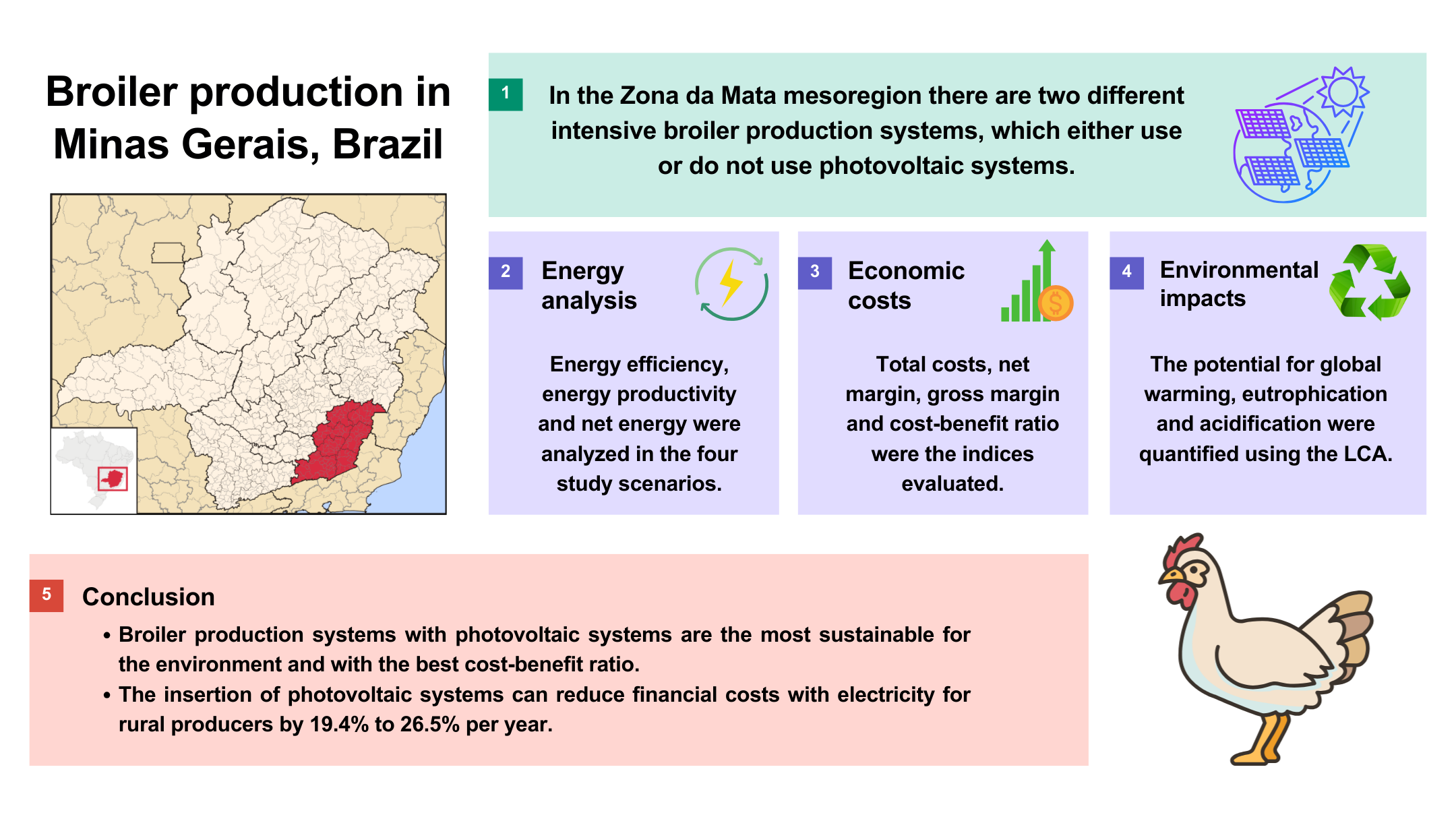
The study analyzed energy, environmental impact and costs in intensive broiler production systems in the southeast of the state of Minas Gerais, Brazil, comparing scenarios with and without photovoltaic systems. Four configurations were evaluated, considering different types of ventilation (positive and negative pressure) and photovoltaic generation. The Life Cycle Assessment (LCA), with a functional unit of 1 kg live weight and a cradle-to-gate approach, indicated that photovoltaic systems reduce between 2.58 t and 4.96 t of CO2-eq annually, in addition to offering better energy efficiency. Economically, sheds with positive pressure ventilation have the lowest cost-benefit ratios, while the feeding subsystem was the one that contributed the most to global warming, among the environmental impact categories evaluated in the LCA. Photovoltaic systems demonstrated the potential to reduce electricity costs between 19.4% and 26.5% per year. However, coffee husks, used as chicken litter, represented 36.5% of production costs, highlighting the need for more economical alternatives. It was concluded that photovoltaic systems are a viable solution to reduce environmental impacts and increase profitability, reinforcing the importance of strategies to optimize the use of resources in poultry farming.
Keywords:
distributed generation
; economic costs
; energy
; greenhouse gas emissions
; life cycle assessment
© 2025 by the authors. Licensee MDPI, Basel, Switzerland. This article is an open access article distributed under the terms and conditions of the Creative Commons Attribution (CC BY) license (http://creativecommons.org/licenses/by/4.0/).
Copyright: This open access article is published under a Creative Commons CC BY 4.0 license, which permit the free download, distribution, and reuse, provided that the author and preprint are cited in any reuse.


