

Submitted:
16 September 2025
Posted:
17 September 2025
You are already at the latest version
Abstract
Background Bridge therapy before surgery is one of indications for intragastric balloon (IGB) implantation. We aim to compare the outcomes of Medsil (non-adjustable), Orbera 365 (non-adjustable) and SPATZ3 (adjustable) IGB used as a bridge therapy before laparoscopic sleeve gastrectomy (LSG). Methods The data of 148 patients with severe obesity (BMI >=50 kg/m2) who underwent IGB implantation as bridge treatment prior to LSG between July 2018 and December 2022 was analysed. Patients were randomly assigned to 3 different IGBs: ORBERA 365 (47 patients), MEDSIL (53 patients), and SPATZ3 (48 patients). Weight loss (kg), BMI reduction and percentage of excess weight loss (%EWL) were measured at 6 months. Results Weight loss after 6 months was the best in the SPATZ3 group (mean 25 kg; median 24,64 kg; 19,46 – 33,04 kg) compared to Medsil (mean 16 kg; median 16 kg; 11,7 – 33 kg) and ORBERA365 (mean 14 kg; median 14,53 kg; 11,54 – 18,26). Weight loss after 6 months was highest in the SPATZ3 group (mean 25 kg) compared to Medsil (16 kg) and ORBERA365 (14 kg). %EWL and %TWL were also greatest in the SPATZ3 group (%EWL: 22.98%; %TWL: 14.0%) compared to Medsil (%EWL: 15.06%; %TWL: 9.4%) and ORBERA365 (%EWL: 13.71%; %TWL: 8.3%). Conclusion The bridge therapy before LSG with adjustable IGB after 6 months seems to be superior to non-adjustable devices.
Keywords:
Intragastric balloon
; Bridge therapy
; Severe obesity
; Laparoscopic sleeve gastrectomy
; Weight loss outcomes
1. Introduction
Obesity is spreading across both developed and developing countries. It often requires lifestyle changes, including diet, exercise, and psychological support, which may only yield a modest weight loss of 3-4%, necessary for delaying the onset of diabetes and other obesity-related complications [1]. When traditional methods fail, options like the intragastric balloon (IGB) come into play. Introduced in the U.S. in 1984, the IGB is a device placed in the stomach to induce satiety, helping reduce food intake [1,2,3].
Initially, the Garren-Edwards Bubble was a widely used IGB, but due to poor performance and complications, it was discontinued. This led to the 1987 "Obesity and the Gastric Balloon" conference, setting new standards for IGB design and use, including BMI thresholds [3]. Subsequent devices like the saline-filled BIB (Orbera), developed in 1991, saw widespread international use, despite not being approved in North America [2,3].
Over the years, multiple countries have developed their own versions of the IGB, like the pear-shaped Taylor balloon in the UK and the Heliosphere BAG in France. The FDA's 2015 approval of newer models like the Reshape Duo and Orbera marked significant advancements in the U.S. market [3].
The placement of an intragastric balloon has several advantages over other weight loss therapies - it is reversible, repeatable, less invasive and preserves anatomy of the gastrointestinal tract [1]. Balloons themselves differ as to the method of insertion, filling medium and recommended implantation duration. They can be used as a standalone method for achieving weight loss in overweight or obese patients or as a bridge therapy before surgical treatment.
The purpose of this study is to evaluate our recent (July 2019 - December 2022) findings and data concerning IGB implantations with emphasis on efficacy as a bridge therapy before LSG in a high volume bariatric centre. Starting with 6 months treatment we aim to evaluate and compare Medsil (CSC Medsil 6 months), Orbera 365 (Apollo Endosurgery; up to 12 months) and SPATZ3 (Spatz FGIA; up to 12 months) balloons used in our setting.
2. Materials and Methods
The data of 148 patients with severe obesity (BMI >50 kg/m², Obesity Class IV) who underwent IGB implantation as bridging therapy prior to LSG between July 2018 and December 2022 in our department was collected and analysed. Patients were divided in 3 groups depending on the type of the implanted IGB device: non-adjustable ORBERA 365 (47 patients, 31,76%), non-adjustable MEDSIL (53 patients, 35,81%), and adjustable SPATZ3 (48 patients, 32,43%). Patients were randomly assigned to selected groups. During the study all patients remained under continuous specialist care and were instructed to follow dietary and life-style recommendations. Detailed patient’s characteristics are presented in Table 1.
Informed consent was obtained from all individual participants included in the study. IGB were implanted for 6 months as a bridging therapy prior to bariatric surgery. All the procedures were performed under intravenous sedation with midazolam and fentanyl using a standard gastroscope (Pentax EZG29-i10 9,8 mm diameter with 3,2 mm working channel). The heart rate and oxygen saturation of the patients were monitored during and for 1 hour after the procedure. Primarily, all IGB were filled with 700 millilitres of saline with the addition of 2–3 ml of a 1% solution of methylene blue.
Subsequently, all patients were reassessed after 3 months. During this follow-up, the patients in the SPATZ3 group received a balloon volume increase procedure totalling to 850 ml. The adjustment was performed on average at week 12 (range 11 – 13 weeks). Although ORBERA365 and SPATZ3 IGB have a recommendation for 12 month-long therapy, in our patients they were explanted endoscopically after 6-months (same as Medsil) from the initial procedure and the data were collected.
This retrospective study was conducted in accordance with the ethical standards of the institutional and national research committee and with the 1964 Helsinki Declaration and its later amendments. Formal approval by the Institutional Review Board (IRB) was waived due to the study's retrospective design, which involved analysis of fully anonymized clinical data without additional interventions.
All the groups were statistically analysed using the Kruskal-Wallis test (alfa= 0,05, statistical significance at p<0.05) comparing the patients’ gender, BMI, weight loss and percentage of excess weight loss (%EWL). %EWL was derived as: [(Initial Weight − Current Weight) / (Initial Weight − IBW)] × 100, reflecting weight loss relative to metabolic risk reduction targets.
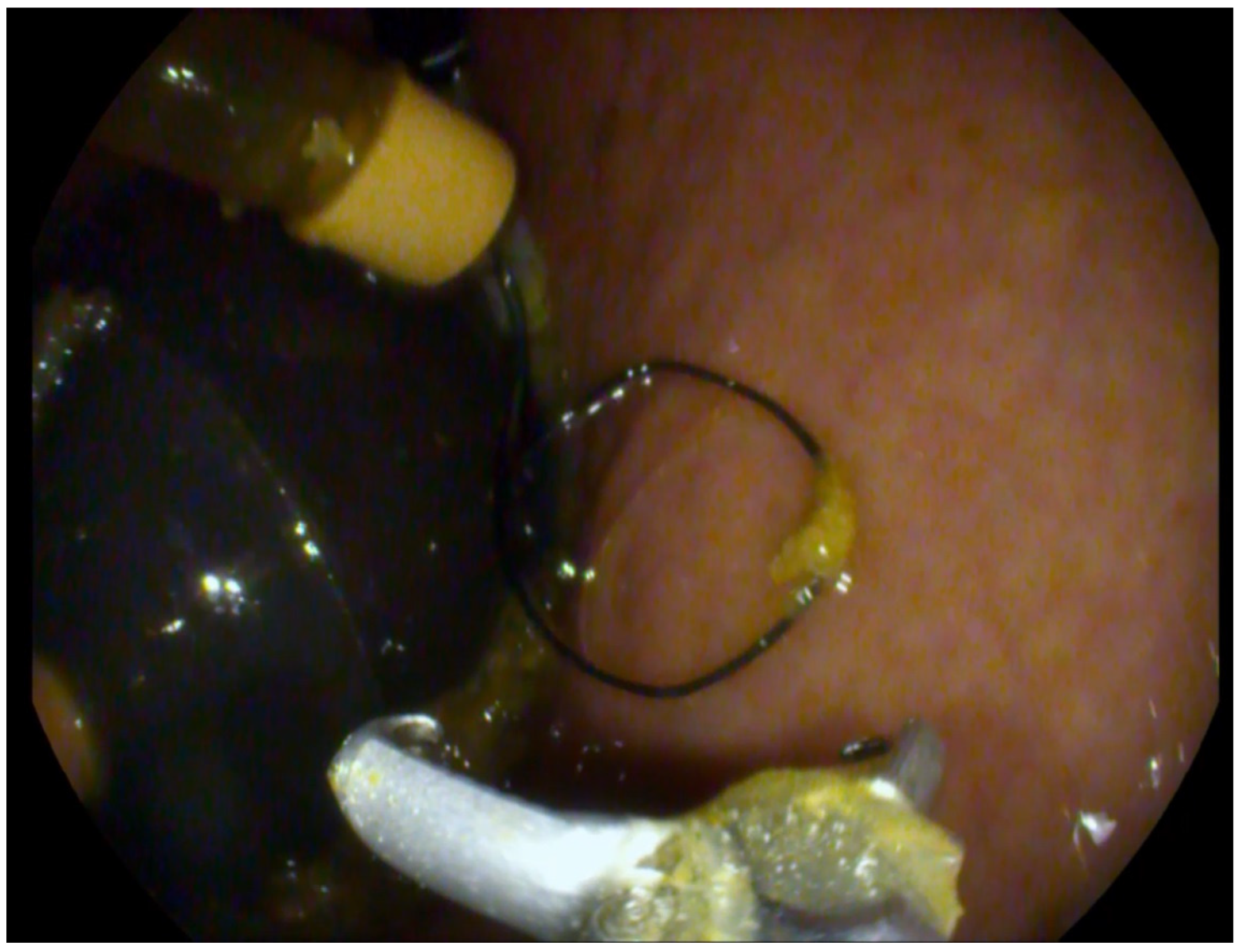
Figure 1.
Endoscopic view of SPATZ3 regulation catheter during volume adjustment, demonstrating the port used for saline inflation in adjustable IGB therapy.
Figure 1.
Endoscopic view of SPATZ3 regulation catheter during volume adjustment, demonstrating the port used for saline inflation in adjustable IGB therapy.
3. Results
No statistically significant differences were found in the selection of groups in terms of age, gender, initial BMI, weight and height. There is a statistically significant difference in BMI reduction, weight loss and %EWL between the groups.
No complications occurred in the studied group of patients and no patient required early removal of IGB. Reduction of BMI after 6 months regardless of gender was the best in the SPATZ3 group (mean 8 kg/m2, median 7,88 kg/m2, ranging 7,06 – 10,55 kg/m2) in comparison with Medsil (mean 5 kg/m2, median 5,17 kg/m2, ranging 4,54 – 9,54 kg/m2) and ORBERA365 (mean 5 kg/m2, median 4,62 kg/m2, ranging 4,19 – 6,24 kg/m2), p= 0.000 (Table 2).
This effect persists also for both genders analysed separately. In women reduction of BMI after 6 months was highest in the SPATZ3 group (mean 8,03 kg/m2, median 7,79 kg/m2, ranging 7,06 – 10,55 kg/m2) in comparison with Medsil (mean 5,42 kg/m2, median 5,08 kg/m2, ranging 4,54 – 8,86 kg/m2) and ORBERA365 (mean 4,74 kg/m2, median 4,62 kg/m2, ranging 4,19 – 6,24 kg/m2), p= 0.000.
In men BMI reduction after 6 months was also highest in the SPATZ3 group (mean 7,98 kg/m2, median 7,95 kg/m2, ranging 7,15 – 9,35 kg/m2) in comparison with Medsil (mean 5,45 kg/m2, median 5,22 kg/m2, ranging 4,57 – 9,54 kg/m2) and ORBERA365 (mean 4,61 kg/m2, median 4,61 kg/m2, ranging 4,24 – 4,97 kg/m2), p= 0.000.
Weight loss after 6 months regardless of gender was the best in the SPATZ3 group (mean 25 kg/m2, median 24,64 kg, ranging 19,46 – 33,04 kg) in comparison with Medsil (mean 16 kg/m2, median 16 kg, ranging 11,7 – 33 kg) and ORBERA365 (mean 14 kg/m2, median 14,53 kg, ranging 11,54 – 18,26, p= 0.000 (Table 3).
These effects persist also for both genders analysed separately. In women weight reduction after 6 months was highest in the SPATZ3 group (mean 24,03 kg/m2, median 25 kg, ranging 19 – 31 kg) in comparison with Medsil (mean 15 kg/m2, median 16 kg, ranging 12 – 25 kg) and ORBERA365 (mean 14,28 kg/m2, median 14 kg, ranging 12 – 18 kg), p= 0.000.
In men weight reduction after 6 months was also highest in the SPATZ3 group (mean 25,67 kg/m2, median 26 kg, ranging 20 – 33 kg) in comparison with Medsil (mean 17,75 kg/m2, median 17 kg, ranging 14 – 33 kg) and ORBERA365 (mean 14,61 kg/m2, median 15 kg, ranging 12 – 17 kg), p= 0.000.
%EWL after 6 months regardless of gender was the best in the SPATZ3 group (mean 22,98%, median 23,10%, ranging 19,54 – 25,53 kg) in comparison with Medsil (mean 15,06%, median 14,88%, ranging 12,49 – 29,99%) and ORBERA365 (mean 13,71%, median 13,88%, ranging 11,58 – 15,14%, p= 0.000 (Table 4).
This effect persists also for both genders analysed separately. In women %EWL after 6 months was highest in the SPATZ3 group (mean 22,56%, median 22,61%, ranging 19,54 – 24,46%) in comparison with Medsil (mean 15,01%, median 14,73%, ranging 12,49 – 29,99%) and ORBERA365 (mean 13,39%, median 13,40%, ranging 11,58 – 14,553%), p= 0.000.
In men %EWL after 6 months was also highest in the SPATZ3 group (mean 23,67%, median 23,48%, ranging 19,54 – 24,26%) in comparison with Medsil (mean 16,05%, median 15,44%, ranging 14,21 – 21,21%) and ORBERA365 (mean 14,22%, median 14,09%, ranging 13,45 – 15,14%), p= 0.000.
To provide a more comprehensive comparison of the IGB therapies, we additionally analyzed the percentage of total weight loss (%TWL) after 6 months. %TWL was highest in the SPATZ3 group (mean 14.0%, median 13.9%; range 10.8%–18.5%) compared to the Medsil group (mean 9.4%, median 9.2%; range 6.5%–14.7%) and the ORBERA365 group (mean 8.3%, median 8.1%; range 6.1%–11.2%). These findings confirm the superior performance of the adjustable balloon (SPATZ3) in terms of overall weight reduction prior to bariatric surgery. The inclusion of %TWL aligns with current recommendations for reporting weight loss outcomes and enhances the clinical relevance of the results.
4. Discussion
IGB devices implantation can be safely used as a stand-alone procedure as well as a bridge therapy before definitive bariatric surgery. Nevertheless, current knowledge shows that IGB therapy results in more satisfying weight-loss effects in short-term than long-term follow-up [8]. The best outcomes are achieved with IGB implantation as a bridge therapy for definitive surgical treatment [4,9] and this recommendation is supported in current guidelines [10]. Patients with a BMI ≤35 kg/m2 and an illness related to obesity (who are not eligible for bariatric surgery) or in situations where there is a lack of access to bariatric procedure or if it is too expensive would probably benefit from IGB implantation as a stand-alone procedure.
According to the Spanish Intragastric Balloon Consensus Statement (SIBC) from 2022 IGB should be considered as a therapeutic method in patients with BMI >25 kg/m2, who gain weight despite proper clinical treatment. Therapy should last at least 6-month and fluid-filled balloons are preferred - no specific balloon type was indicated as superior to others. The balloon, whether adjustable or not, should be filled with 500 – 599 ml of fluid with addition of methylene blue. The decision of changing the IGB volume depends on clinical presentation of the patients – additional volume for diminishing balloon effect/unsatisfactory weight loss or removing volume in case of intolerance. Most often the volume addition is between 200 – 300 ml and the reduced volume is 100 – 150 ml. Some physicians use a syringe manually and some use a pump, but there is no consensus on this. The overall rate of complications after IGB implantation counts for 7,07% in which 0,7% for minor complications. Intolerance rate is around 5% and results in 3,62% early removal rate (up to 1 month after implantation) [5]. Approximately 90% of patients who undergo IGB insertion suffer from some kind of discomfort, the common ones being nausea, vomiting, abdominal pain, constipation - as such patients are treated with proton pump inhibitors and antiemetics before procedure as well as with antispasmodic drugs during the first week of insertion [1].
Brazilian Intragastric Balloon Consensus Statement (BIBC) from 2017 makes a broader indication for IGB implantation when it comes to age of the patients – in Brazil it is minimum 12 years old. Other indications, preparation, the choice of a balloon type, technique and recommendation are similar to the Spanish ones. Authors made a statement that there was no difference in weight loss among different types of IGB [6]. This conclusion was made on the basis of De Castro et al. randomised controlled trial (2010) where outcomes from the therapy with 2 non-adjustable IGB (Heliosphere and Bioenterics-BIB) were compared [7].
The bridge therapy is recommended in super-obese patients (BMI ≥50 kg/m2, Class III) to reduce the risk of morbidity and mortality following the definitive surgical procedure in this group of patients [2]. In such patients, large fatty livers and enlarged omental fat tissue may present a technical challenge for laparoscopic surgery as well as hinder proper visualisation of anatomical structures- rendering successful surgery less likely. In addition bridge therapy is associated with better blood pressure control, improved glucose metabolism, lower risk of a thromboembolism, lower conversion rate and shorter surgery as well as hospital stay. These beneficial results may stem from decreased amount of visceral fat and a decrease of liver volume [2]. This is the so-called “bridge to safe surgery.” According to a study conducted by Ball et al. in 2019 approximately 63% of patients with an IGB inserted prior to proposed bariatric surgery, received it [4]. The remainder who did not have a pre-operative IGB did not undergo the planned bariatric surgery., citing refusal of operation, psychological reasons or other contraindications for surgical treatment [4]. There are also contraindications for IGB for which potential patients should be screened. These include but are not limited to hiatal hernia larger than 5cm, previous gastric surgery, pregnancy, severe liver disease, alcoholism, coagulopathy, a bleeding lesion of upper GI tract [1,2].
There are many types of IGB available in the market, but few scientific studies comparing them. In meta-analysis of randomised trials comparing fluid-filled and gas-filled IGB from 2018 Bazerbachi et. al concluded that therapy based fluid-filled IGB results in weight-loss in 96,8% of patients at 6 months and 96,6% patients at 12 months, which is superior to gas-filled IGB. However, fluid-filled balloons have higher risk of intolerance and early removal compared to gas-filled ones [13]. Swei et al. in 2023 also compared gas-filled (Obalon) and fluid-filled (Orbera) IGB devices in 87 patients – 57 and 30, respectively. There was no statistically significant difference in percent total body weight loss (%TWBL) at IGB removal and in 12-month follow-up. Also in this study fluid-filled IGB devices were proven to have a higher rate of intolerance resulting in early balloon removal [14]. Kozłowska-Petrickzo et al. in 2023 compared the efficacy of 6-months (Orbera) versus 12-months (Orbera365) IGB therapy proving that there is no significant difference in the mean %TBWL between the groups – it was 15,2% and 15,8%, respectively [15]. Genco et al. in 2013 compared adjustable (Adjustable Balloon System, ABS) with non-adjustable (BioEnterics Intragastric Balloon, BIB). 600 ml filled ABS devices were implanted for 12 months in 40 patients and extra inflated after 6 months with 200 ml of saline in 22,5% of the group (9/40 patients) due to poor weight loss. Results were compared with 80 patients treated with BIB for 12 months (6 months therapy followed by reimplantation for next 6 months). Weight loss was similar in both groups with no statistically significant difference [16]. Russo et. al compared the outcomes in 20 patients treated with BIB and 10 patients treated with Spatz ABS – in 2 patients IGB was inflated with extra volume of saline. Authors noticed no differences in median weight loss and BMI at the end of the therapy between used devices, also in a group of patients who underwent adjustment [17], however only 20% of Spatz patients underwent adjustment.
The main measures of IGB therapy effectiveness are weight loss, change of BMI and %EWL. %EWL is defined as a quotient of the amount of weight loss and the difference between patients initial weight and ideal body weight (IBW) expressed as a percentage [11]. Devin's method was used for IBW evaluation in this study [12]. The American Society for Gastrointestinal Endoscopy (ASGE) and The American Society for Metabolic and Bariatric Surgery (ASMBS) Task Force on Endoscopic Bariatric Therapy (EBT) recommends that primary endoscopic bariatric procedures should achieve at least 15% EWL in 12 months follow-up compared to control group with statistical significance [11]. As mentioned in recommendation of ASGE/ASMBS Task Force on EBT, expected durability of bridge therapy prior to bariatric surgery is not crucial and should not be unnecessarily lengthened. More important is to achieve optimal weight loss in order to reduce morbidity and mortality following surgery [11].
All patients included in this study underwent LSG after IGB removal and remain under long-term follow up.
5. Conclusions
Our study in super-obese adult patients undergoing balloon therapy is the first worldwide to compare the outcomes of non-adjustable and adjustable balloons in bridge therapy (before LSG), in which all patients in the adjustable IGB group underwent extra inflation of the device during therapy. The outcomes of the therapy with adjustable IGB extra filled after 3 months seem to be superior to non-adjustable IGB.
We believe that these results may shed new light on the effectiveness of bridge therapy in a selected group of bariatric patients and may have an impact on further development of this method. Further prospective randomised studies are necessary to evaluate clinical usefulness of this report.
Author Contributions
Conceptualization, W.C., K.Ś., T.K., A.M. and J.Ś.; methodology, T.K., A.M. and J.Ś.; data curation, T.K., A.M. and J.Ś.; formal analysis, T.K., A.M. and J.Ś.; investigation, T.K., A.M. and J.Ś.; writing—original draft preparation, W.C. and K.Ś.; writing—review and editing, W.C., K.Ś., T.K., A.M. and J.Ś.; supervision, W.C.; project administration, W.C. All authors have read and agreed to the published version of the manuscript.
Funding
This research received no external funding.
Institutional Review Board Statement
This retrospective study was conducted in accordance with the ethical standards of the institutional and national research committee and with the 1964 Helsinki Declaration and its later amendments. Formal approval by the Institutional Review Board (IRB) was waived due to the study's retrospective design, which involved analysis of fully anonymized clinical data without additional interventions.
Informed Consent Statement
Patient consent was waived due to the retrospective design, which involved analysis of fully anonymized clinical data without additional interventions.
Data Availability Statement
The data presented in this study are available on request from the corresponding author. The data are not publicly available due to privacy and ethical restrictions.
Acknowledgments
No acknowledgments. The authors have reviewed and edited the output and take full responsibility for the content of this publication.
Conflicts of Interest
The authors declare no conflicts of interest.
Abbreviations
The following abbreviations are used in this manuscript:
| IGB | Intragastric Balloon |
| LSG | Laparoscopic Sleeve Gastrectomy |
| BMI | Body Mass Index |
| %EWL | Percentage of Excess Weight Loss |
| %TWL | Percentage of Total Weight Loss |
| IBW | Ideal Body Weight |
| IRB | Institutional Review Board |
| ASGE | American Society for Gastrointestinal Endoscopy |
| ASMBS | American Society for Metabolic and Bariatric Surgery |
| EBT | Endoscopic Bariatric Therapy |
| FDA | Food and Drug Administration |
References
- Jaleel R, Kapoor N, Kalra S. Endoscopic intragastric balloon: A novel therapy for weight loss. J Pak Med Assoc. 2022, 72, 1444–1446. [CrossRef]
- Mathus-Vliegen EMH. Endoscopic treatment: The past, the present and the future. Best Pract Res Clin Gastroenterol. 2014, 28, 685–702. [CrossRef] [PubMed]
- Schapiro M, Benjamin S, Blackburn G, Frank B, Heber D, Kozarek R, Randall S, Stern W. Obesity and the gastric balloon: a comprehensive workshop. Tarpon Springs, Florida, -21, 1987. Gastrointest Endosc. 1987, 33, 323–327. [CrossRef] [PubMed]
- Ball W, Raza SS, Loy J, et al. Effectiveness of Intra-Gastric Balloon as a Bridge to Definitive Surgery in the Super Obese. Obes Surg. 2019;29(6):1932-1936. [CrossRef]
- Espinet Coll E, Del Pozo García AJ, Turró Arau R, Nebreda Durán J, Cortés Rizo X, Serrano Jiménez A, Escartí Usó MÁ, Muñoz Tornero M, Carral Martínez D, Bernabéu López J, Sierra Bernal C, Martínez-Ares D, Espinel Díez J, Marra-López Valenciano C, Sola Vera J, Sanchis Artero L, Domínguez Jiménez JL, Carreño Macián R, Juanmartiñena Fernández JF, Fernández Zulueta A, Consiglieri Alvarado C, Grecco E, Bezerra Silva L, Galvao Neto M. Spanish Intragastric Balloon Consensus Statement (SIBC): practical guidelines based on experience of over 20 000 cases. Rev Esp Enferm Dig. 2023 Jan;115(1):22-34. [CrossRef] [PubMed]
- Neto MG, Silva LB, Grecco E, de Quadros LG, Teixeira A, Souza T, Scarparo J, Parada AA, Dib R, Moon R, Campos J. Brazilian Intragastric Balloon Consensus Statement (BIBC): practical guidelines based on experience of over 40,000 cases. Surg Obes Relat Dis. 2018 Feb;14(2):151-159. [CrossRef] [PubMed]
- De Castro ML, Morales MJ, Del Campo V, Pineda JR, Pena E, Sierra JM, Arbones MJ, Prada IR. Efficacy, safety, and tolerance of two types of intragastric balloons placed in obese subjects: a double-blind comparative study. Obes Surg. 2010 Dec;20(12):1642-6. [CrossRef] [PubMed]
- Zheng Y, Wang M, He S, Ji G. Short-term effects of intragastric balloon in association with conservative therapy on weight loss: a meta-analysis. J Transl Med. 2015 Jul 29;13:246. [CrossRef] [PubMed] [PubMed Central]
- Loo JH, Lim YH, Seah HL, Chong AZQ, Tay KV. Intragastric Balloon as Bridging Therapy Prior to Bariatric Surgery for Patients with Severe Obesity (BMI ≥ 50 kg/m2): a Systematic Review and Meta-analysis. Obes Surg. 2022 Feb;32(2):489-502. [CrossRef] [PubMed]
- Garneau P, Glazer S, Jackson T, Sampath S, Reed K, Christou N, Shaban J, Biertho L. Guidelines for Canadian bariatric surgical and medical centres: a statement from the Canadian Association of Bariatric Physicians and Surgeons. Can J Surg. 2022 Mar 9;65(2):E170-E177. [CrossRef] [PubMed] [PubMed Central]
- ASGE/ASMBS Task Force on Endoscopic Bariatric Therapy. A pathway to endoscopic bariatric therapies. Surg Obes Relat Dis. 2011 Nov-Dec;7(6):672-82. [CrossRef] [PubMed]
- Peterson CM, Thomas DM, Blackburn GL, Heymsfield SB. Universal equation for estimating ideal body weight and body weight at any BMI. Am J Clin Nutr. 2016 May;103(5):1197-203. doi: 10.3945/ajcn.115.121178. Epub 2016 Mar 30. Erratum in: Am J Clin Nutr. 2017 Mar;105(3):772. [PubMed] [PubMed Central]
- Bazerbachi F, Haffar S, Sawas T, Vargas EJ, Kaur RJ, Wang Z, Prokop LJ, Murad MH, Abu Dayyeh BK. Fluid-Filled Versus Gas-Filled Intragastric Balloons as Obesity Interventions: a Network Meta-analysis of Randomized Trials. Obes Surg. 2018 Sep;28(9):2617-2625. [CrossRef] [PubMed]
- Swei E, Almuhaidb A, Sullivan S, Al-Shahrani A, D'Souza FR, Altayar O, Bell S, Maday R, Wagh MS, Mullady D, Bennett M, Early D, Kushnir V. Comparison of the Efficacy and Safety of the FDA-approved Intragastric Balloon Systems in a Clinical Setting. J Clin Gastroenterol. 2023 Jul 1;57(6):578-585. [CrossRef] [PubMed]
- Kozłowska-Petriczko K, Pawlak KM, Wojciechowska K, Reiter A, Błaszczyk Ł, Szełemej J, Petriczko J, Wiechowska-Kozłowska A. The Efficacy Comparison of Endoscopic Bariatric Therapies: 6-Month Versus 12-Month Intragastric Balloon Versus Endoscopic Sleeve Gastroplasty. Obes Surg. 2023 Feb;33(2):498-505. [CrossRef] [PubMed] [PubMed Central]
- Genco A, Dellepiane D, Baglio G, Cappelletti F, Frangella F, Maselli R, Dante MC, Camoirano R, Lorenzo M, Basso N. Adjustable intragastric balloon vs non-adjustable intragastric balloon: case-control study on complications, tolerance, and efficacy. Obes Surg. 2013 Jul;23(7):953-8. [CrossRef] [PubMed]
- Russo T, Aprea G, Formisano C, Ruggiero S, Quarto G, Serra R, Massa G, Sivero L. BioEnterics Intragastric Balloon (BIB) versus Spatz Adjustable Balloon System (ABS): Our experience in the elderly. Int J Surg. 2017 Feb;38:138-140. [CrossRef] [PubMed]

Table 1.
Patients’ characteristics.
| IGB type | Ptx | Gender | BMI | ||||
|---|---|---|---|---|---|---|---|
| Female | Male | Min | Max | Avr | |||
| ORBERA365 | 47 | 31,76% | 29 | 18 | 50,44 | 75,24 | 56,55 |
| Medsil | 53 | 35,81% | 33 | 20 | 50,44 | 76,12 | 57,51 |
| SPATZ3 | 48 | 32,43% | 33 | 15 | 50,44 | 75,38 | 57,24 |
Table 2.
BMI reduction according to type of implanted IGB in both genders (p= 0.000).
| IGB type | Min. BMI reduction | Max. BMI reduction | Mean BMI reduction | Median BMI reduction |
|---|---|---|---|---|
| ORBERA365 | 4,19 | 6,24 | 5 | 4,62 |
| Medsil | 4,54 | 9,54 | 5 | 5,17 |
| SPATZ3 | 7,06 | 10,55 | 8 | 7,88 |
Table 3.
Weight loss according to type of implanted IGB in both genders (p= 0.000).
| IGB type | Min. weight loss | Max. weight loss | Mean weight loss | Median weight loss |
|---|---|---|---|---|
| ORBERA365 | 11,54 | 18,26 | 14 | 14,53 |
| Medsil | 11,7 | 33 | 16 | 16 |
| SPATZ3 | 19,46 | 33,04 | 25 | 24,64 |
Table 4.
& Chart 4: %EWL according to type of implanted IGB in both genders (p= 0.000).
| IGB type | Min. %EWL | Max. %EWL | Mean %EWL | Median %EWL |
|---|---|---|---|---|
| ORBERA365 | 11,58 | 15,14 | 13,71 | 13,88 |
| Medsil | 12,49 | 29,99 | 15,06 | 14,88 |
| SPATZ3 | 19,54 | 25,53 | 22,98 | 23,10 |
Disclaimer/Publisher’s Note: The statements, opinions and data contained in all publications are solely those of the individual author(s) and contributor(s) and not of MDPI and/or the editor(s). MDPI and/or the editor(s) disclaim responsibility for any injury to people or property resulting from any ideas, methods, instructions or products referred to in the content. |
© 2025 by the authors. Licensee MDPI, Basel, Switzerland. This article is an open access article distributed under the terms and conditions of the Creative Commons Attribution (CC BY) license (http://creativecommons.org/licenses/by/4.0/).
Copyright: This open access article is published under a Creative Commons CC BY 4.0 license, which permit the free download, distribution, and reuse, provided that the author and preprint are cited in any reuse.


