

Submitted:
13 September 2025
Posted:
16 September 2025
You are already at the latest version
Abstract
Using Space-Air-Ground Integrated Network (SAGIN) for data transmission requires reliable two-way communication. This work is devoted to the development of theoretical methods for predicting the functioning of SAGIN. The issues of integration existing space, air and ground networks for efficient interaction during heavy traffic and the choice of data transmission modes to ensure the required Quality of Service (QoS) are the main topic of this study. Original models were created for simulation data traffic in SAGIN. Models included Base Station (BS), LEO satellite, low-altitude Remotely Piloted Air Systems (RPASs) connected with Cellular Users (CUs) and were designed using NetCracker Professional 4.1 software. The dependences of the uplink Average Load on the size of transactions for a different number of network users were obtained. The effects of different bandwidths and Bit Error Rate (BER) were studied.
Keywords:
SAGIN
; RPAS
; data traffic
; transaction size
; time between transactions
; BER
; bandwidth
1. Introduction
Space-Air-Ground Integrated Network (SAGIN) includes space, air and ground networks as shown in Figure 1 and represents an important research area in communications, informatics and Air Traffic Control (ATC). SAGIN combines the most modern communication and computing technologies to implement a large network topology with the ability of efficient exchange global information and resources. SAGIN is a complex and dynamic system that has distributed and heterogeneous characteristics that change over time.
SAGIN is still in the early stages of key ideas development, design and deployment. For real effective use, it is not yet sufficiently developed and requires more reliability, flexibility and scalability. The existing SAGIN infrastructure needs to be improved with additional services. On their own, terrestrial networks with increasing service demands cannot provide efficient solutions for huge traffic. Terrestrial networks only together with space and airborne communications infrastructure will be able to expand network services and reduce latency.
High Altitude Platform Station (HAPS), stratospheric drones, Remotely Piloted Air Systems (RPASs) or Unmanned Aerial Vehicles (UAVs), which can provide efficient services anywhere using the creation of a three-dimensional network, can complement satellite constellations in low and medium orbits. In this way, SAGIN will be able to provide full-featured end-to-end communication, computation and caching to achieve high network data rates with minimal latency and high reliability.
The tasks of national security, disaster monitoring, and the development of the Internet of Things (IoT) to expand the coverage of sensors have different requirements for the QoS - latency, security, reliability, bandwidth, and the interface with the client. Providing such a variety of services requires SAGIN to have the flexibility, availability and coverage required. Moreover, each component has its own advantages and disadvantages. Satellite networks have great coverage but high latency. Terrestrial networks can provide minimal latency, but with limited service coverage. These features make it difficult effective combining heterogeneous segments due to the need for constant monitoring of entire system dynamics, the variable load of network traffic, and the availability of heterogeneous resources. HAPS, stratospheric drones and conventional UAVs will play a leading role in creating the middle layer of SAGIN - the air network. This layer needs to be studied in order to understand how HAPS and stratospheric drones can work seamlessly with low-altitude platforms. RPASs/UAVs are generally seen as the backbone of the proposed SAGIN infrastructure. With the use of aerial components, it is possible to create a new structure of the Flying Ad Hoc Network (FANET). Therefore, special attention should be paid to energy efficiency, battery design and proper payload allocation. Many of the proposed architectures focus on aerial and space objects.
In the terrestrial communication system, it is possible to use Worldwide Interoperability for Microwave Access (WiMAX), Wireless Local Area Network (WLAN), Wide Area Network (WAN), 2G - 5G technologies and promising 6G technology. Mobile Edge Computing (MEC) and Ultra Dense Networking (UDN) can be used to perform tasks efficiently on the SAGIN platform. Clients can interact with cloud platforms and traditional ground stations.Our contributions can be summarized as follows. Using the NetCracker software [2], we created models for simulating Base Station (BS) data exchange via Low Earth Orbit (LEO) satellite and RPASs with cellular networks in various operating conditions, for which data traffic characteristics have been calculated for the first time. The results obtained are of practical importance, since they allow predicting the behavior of SAGINI under critical conditions.
This article is organized as follows. In Related Works, we review some works devoted to SAGIN. In Problem Statement and Aim, we note that there are no methods for assessing traffic parameters in SAGIN and formulate the goals of our research. In Models and Calculation Methods, we describe the architecture of proposed models, algorithm and calculation methods. In Results, we describe obtained data. In Discussion, we consider the practical value of our results. In Conclusion, we note the contribution of our research to the development of methods for predicting the SAGIN functioning.
2. Related Works
Specific features of SAGIN include the ability to self-organize, variability over time, and heterogeneity of structure. However, achieving the required traffic delivery parameters is hampered by limited resources in all three network segments. Therefore, improving system integration, reviewing protocols, and optimizing resource distribution management are of fundamental importance for SAGIN. The article [3] provides an overview of SAGIN research related to network design, resource management and performance analysis. The review discusses existing network architectures and technology challenges for the future.
In articles [4,5] the impact of the Free-Space Optical (FSO) channel on SAGIN performance was examined. To simulate the correlation between apertures, an exponential model was used. To take into account the spatial correlation in the air-ground communication channel, as well as air-air in SAGIN, a multivariate gamma-gamma distribution was considered. The effect of fading due to atmospheric turbulence was quantified.SAGIN has limited cross-layer bandwidth. In the article [6] a solution for efficient determining the optimal set of gateways from the air network was proposed, which serves as a relay layer for data delivery between the ground layer and the satellite layer. Numerical results are presented to test the effectiveness of such a solution, and ways of solving the problems are indicated.
Multi-Layered Space-Terrestrial Integrated Networks (MLSTIN) was designed to meet the high consumer demand for 5G wireless data access. The internal heterogeneity of MLSTIN makes it difficult to manage the delivery of large traffic volumes with optimal network performance. In light of this, authors [7] proposes a cross-domain architecture that separates MLSTIN into satellite, aeronautical and terrestrial domains. The design and implementation details of this architecture was discussed, followed by problems and unresolved issues. The authors believe that the proposed architecture can significantly improve the efficiency of MLSTIN.
Technological advances and the integration of satellite communications, the Internet, and mobile wireless networks have resulted in the Space-Terrestrial Integrated Network (STIN). In the article [8], a potential STIN architecture that integrates the extended space network, the Internet, and mobile wireless global access networks anytime anywhere is presented. Authors addresses the key technical issues associated with STIN, including physical transmission technologies, network protocols, routing, resource management, security, and test bed design.
The rapid growth of data traffic for multimedia services and real-time applications is driving the need for Ultra-Dense Networks (UDN). In doing so, the compaction of a large number of static small cells faces the problems of cost savings, energy consumption and control. This necessitates the development of software-defined integrated space-air-ground moving cells (SAGECELL). It is a programmable, scalable and flexible framework for integrating space, air and ground resources, used to match dynamic traffic requirements with network capacity capabilities. The paper [9] provides an overview of the latest literature, then details the conceptual architecture of SAGECELL and highlights the technological advantages. Four typical SAGECELL applications was presented.
SAGIN significantly expands the capabilities of terrestrial wireless networks, which, in turn, can help space and aviation networks to carry out resource-intensive tasks. In the article [10], the key role of network reconfiguration for the coordination of disparate resources in SAGIN was identified. Network Function Virtualization (NFV) and Service Function Chain (SFC) were explored to provide flexible mission offloading.
Due to limited network resources and limited coverage for users in rural and hard-to-reach areas, satellites, UAVs and balloons were used to relay communications signals in addition to terrestrial connections. Therefore, to improve the QoS for such users, SAGINs were proposed, which, however, are much more difficult due to the different characteristics of the three network segments. To make SAGIN more effective, researchers face significant challenges. In the article [11] an artificial intelligence technique for SAGIN optimization was proposed, based on which the main problems of SAGIN were analyzed. The balance of satellite traffic was considered as an example and a deep learning method was proposed to improve the efficiency of traffic management. Simulation results show that deep learning can be an effective tool for improving SAGIN performance.
The paper [12] compares ground-based platforms and satellite wireless communication systems, including their characteristics and unresolved issues. These issues include altitude and coverage, propagation, interference, handoff, power limitations, deployment and maintenance issues, reliability in special events, disaster relief, cost effectiveness, and environmental impact. The OPNET Modeler analyzes the QoS for four wireless systems in terms of temporal events. The results show that space-based wireless systems are superior to terrestrial ones.
In the article [13] SAGIN model was presented for reducing the number of satellite orientation adjustments and increasing the task scheduling time that is generated by satellites, UAVs and ground stations. The scheduling task in SAGIN maximizes the total priorities of the scheduled tasks under given constraints (switchover times, storage capacity, etc.). An intelligent coordinated planning algorithm with adaptive optimization of a swarm was proposed. A resource allocation method with two criteria was developed for reducing planning conflict. The scheduling order was determined by the priority of the task and the deadline. The simulation results demonstrate the benefits of the proposed algorithm.
Microwave spectrum for satellite communications is becoming a scarce resource due to the ever-increasing demand for bandwidth and capacity, which is driving the shift towards optical carrier frequencies. High-speed data transmission from satellites can use optical inter-satellite links. Direct optical communication with the Earth of spacecraft in low Earth orbit is also possible. The article [14] studied the possibility of additional modulation of the laser signal for the ground-to-space radio beacon. Such an optical return link can be used to trigger automatic retransmissions of payload data downlinks, to control the spacecraft without interference, or to download high-speed software onto its onboard processor. A particular problem is uneven optical path attenuation with respect to the downlink and uplinks that cover asymmetric optical paths through the atmosphere. The work defined the architecture of the communication chain, including the transmitter on the ground and in space. The influence of limited optical uplink availability due to blocking by clouds on satellite control was investigated.
Internet of Remote Things (IoRT) networks are used to provide services to intelligent devices that are often remote and dispersed over a large area. The hierarchical space-air-ground architecture can be effectively used in such cases. The work [15] aims to investigate the problem of energy distribution in two-component communication for Space-Air-Ground and Internet of Remote Things (SAG-IoRT) networks using UAV relays. Joint optimization of subchannel selection, uplink power control and UAVs relay deployment was considered. Numerical results confirm that the proposed algorithm gives a gain in the energy efficiency of the system compared to another testing scheme.
In the article [16], an Integrated Satellite and Terrestrial Network (ISTN) architecture was described based on a software-defined network. Taking into account latency, throughput, wavelength fragmentation and load balancing, a heuristic service-oriented algorithm for calculating the path for elastic data flows for complex ISTN heterogeneity was proposed. Simulations show that the end-to-end routing mechanism can reduce ISTN blocking rate, and the authors' proposed algorithm significantly reduces wavelength fragmentation and bandwidth consumption, and has better load balancing performance.
The performance of UAV functions is based on the information exchange between UAVs, as well as between UAVs and Ground Stations (GS), which largely depends on aviation channels. However, there is a lack of comprehensive studies on modeling aviation channels according to specific aviation characteristics and scenarios. The review [17] was dedicated to modeling Air-To-Ground (A2G), Ground-To-Ground (G2G) and Air-To-Air (A2A) links for UAV and air communications under various scenarios. The management of UAV communication budget with allowance for channel losses and channel fading effects was considered. The transmit/receive diversity gain and the spatial multiplexing gain achieved by communicating with UAV using multiple antennas was analyzed.
Authors [18] say that due to the complexity and cost of a real deployment for testing SAGIN, an efficient SAGIN modeling platform is needed. The authors note that it is difficult to design a unified modeling platform because different modeling tools use different programming languages, network structures, and data formats. Therefore, NS-3 was used as the main simulator and interfaces for connecting to other components of the platform for unified modeling. The article presents SAGIN modeling platform that supports various traces and mobility protocols for space, air and terrestrial networks. Centralized and decentralized controllers were implemented to optimize network functions such as access control and resource orchestration.
It was noted [19] that reconciling heterogeneous physical resources in SAGIN is a very difficult task in such a large-scale dynamic network. They offer a reconfigurable service delivery framework based on the Service Function Chain (SFC) for SAGIN. In the SFC, the network functions are virtualized, and the served must pass through certain network functions in a predetermined sequence. In addition, here the main question is how to plan the chains of service functions in large-sized heterogeneous networks, taking into account the resource constraints of both communication and computation. The authors formulate the scheduling problem as an integer nonlinear programming problem. Simulations have shown that proposed algorithm provides near-optimal performance and that SAGIN significantly reduces the likelihood of service blocking.
The Internet of Vehicles with Edge Computing (EC-IoV) was discussed in the paper [20]. EC-IoV is highly dependent on connections and interactions between vehicles and infrastructures and therefore may not work in remote areas. SAGIN's ubiquitous connections and global reach effectively support seamless coverage and are of particular interest to edge computing. The authors in this article reviewed current edge computing research for SAGIN and proposed an integrated space-air-ground network architecture with edge computing support (EC-SAGIN). In order to minimize the time for completing tasks and using satellite resources, a preliminary classification scheme was presented to reduce the size of the action space. In addition, a deep learning simulation-based offloading and caching algorithm for real-time decision-making is used. The simulation results show the effectiveness of the proposed scheme.
3. Statement and Aim
Uninterrupted communication between the space, air and ground segments is a necessary condition for the successful functioning of SAGIN. This is especially important when interfacing SAGIN with cellular terrestrial networks serving many users through multiple RPAS. In this regard, it is important to understand the nature of the change in the channel load with an increase in the number of users, the data rate, and the effect of the load on the number of bit errors. This requires calculations of traffic characteristics for various loading modes, which are currently not available in the literature. Such work actually involves the development of methods for predictive analysis of SAGIN communication channels. This study pursues just such goals.
The aim of this article is to study data transfer and calculate traffic parameters in SAGIN with cellular networks. To do this, we need to: 1) construct models for simulating data exchange using the NetCracker software; 2) obtain dependences of the uplink Average Load on the size of transactions for a different number of network users; 3) study effects of different bandwidths and Bit Error Rate (BER).
4. Models and Calculation Methods
Published studies have proposed a variety of ways to design SAGIN. In this paper, we consider the scenario of data exchange between a base station and users of two cellular networks via a low-orbit satellite and two RPAS, shown in Figure 2. SAGIN models with different numbers of network users (N = 1, 3, 5) were designed using Professional NetCracker 4.1 software.
In all models, the satellite was at an altitude of 1000 km, and RPASs were at an altitude of 1 km. The general designation of the models was chosen as BS-SAT-RPAS1-CU(N = 1-5)-RPAS2-CU(N = 1-5). All communication channels in the models had a data rate of T3 (44 736 Mbps). Base station servers and users had a bandwidth of 10 Mbps, and RPAS had a bandwidth of 1 Gbps. For satellites, only two parameters could be changed - delay time and packet failure probability, which were equal to zero in any case.
Due to the complexity of the created models, the prediction of their behavior was studied by reproducing the data transfer process on a computer. NetCracker as a research method is an analytical simulator for predicting network behavior in real time. The algorithm for calculating the characteristics of a communication channel is described in our article [21]. Model parameters were calculated taking into account the probability distribution law Const (ω(x) = Const, ω(t) = Const) as a statistical distribution of the transactions size and the time between transactions. Our article [22] provides formulas for the length of transactions, the time interval between transactions, and channel average load.
Data transmission was carried out in the form of two-way C3 (Command, Control and Communication) traffic, which consisted of Tactical Data (TD) traffic for flight control and Common Data (CD) traffic for payload transmission. TD traffic was sampled with an FTP (File Transfer Protocol) client profile, and CD traffic with an interLAN (Local Area Network) profile.
5. Results
When transferring data in SAGIN, it is important to understand how the network configuration is related to the quantitative characteristics of traffic. How does an increase in the number of cellular network users change traffic? How does the loading of the communication channel change with the increase in the size of transactions? When does the channel close?
Below are given the calculated dependences of the Average Load for the "BS - Satellite" uplink channel on the transaction size, data transfer rate and the number of bit errors. Models with a different number of network users (N = 1, 3, 5) are considered, which changed simultaneously in both ground networks connected to RPAS1 and RPAS2.
Figure 3 shows the dependences of the uplink Average Load on the size of Common Data transactions for models with different numbers of users. At the same time, the Tactical Data traffic remained constant with TS = 10 Kbits. Messages on both streams are sent every second. Two important facts can be noted. First, when moving from one user to three in both networks, the load increases by about ≈ 3,5 times for all values of TS, and when moving from one user to five, it increases by about ≈ 6,2 times. Secondly, regardless of the number of users, the load on the channel does not grow in a wide range of TS parameter changes - from 10 bits to 10 Kbits. Only at TS > 10 Kbits the load increases. At TS > 100 Kbits the channel is closed for all models. This means that normal data transmission becomes impossible in case of selected tactical traffic transmission conditions.
The established requirements for RPAS cellular communication [23,24] correspond to the data transmission rate over the control channel ≈ 100 Kbps and the payload channel ≈ 50 Mbps. In accordance with these requirements for the Tactical Data in Figure 4, the parameters TS = 100 Kbit, TBT = 1 s were selected. In the simulation, the transmission rate of Common Data was changed from T1 (1,544 Mbps) to E3 (34,368 Mbps) and T3 (44,736 Mbps). The data in Figure 5 shows how changing the data rate affects the channel load in models with different numbers of users. It can be seen that the uplink Average Load increases with decreasing bandwidth and at a bandwidth of 10 Mbps reaches ≈ 9% for a model with N = 1, ≈ 34% for a model with N = 3, and ≈ 60% for a model with N = 5.
In this case, when moving from one to three users in both cellular networks, the load increases by about ≈ 3,8 times, and when moving from one to five users - by about ≈ 6,8 times. With a further decrease in bandwidth, a significant increase in the load of the uplink channel is observed, which makes it almost impossible to transfer data for models with a large number of users for a bandwidth below 10 Mbps.
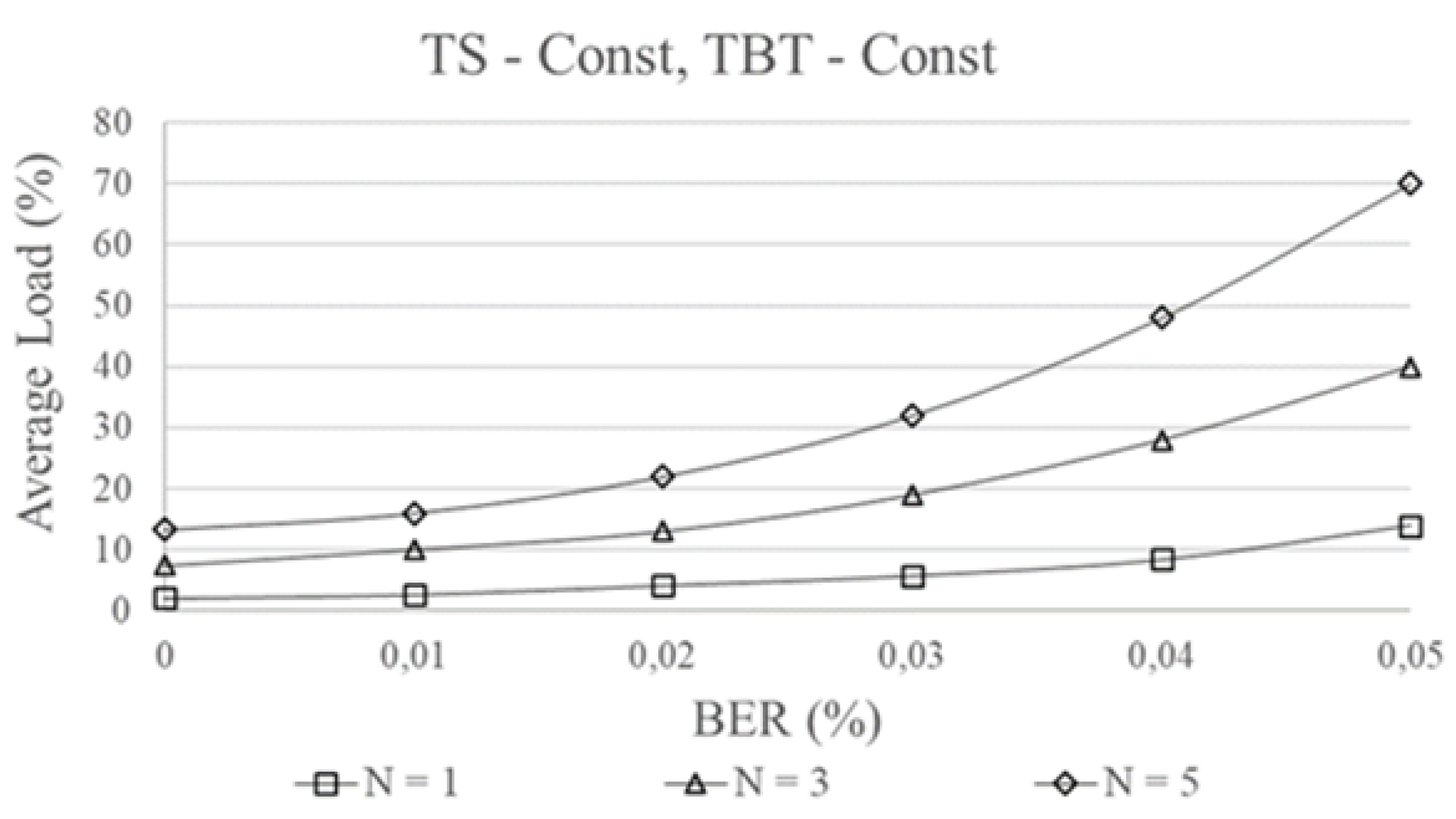
For SAGIN, the reliability of data transmission is critically important, especially with large traffic, leading to congestion of communication channels. The probability of getting distortion for a transmitted data bit is characterized by the bit error rate. For communication channels without additional means of protection against errors, the BER is 10−4 - 10−6, and the BER after Forward Error Correction (FEC) should be less than 10-6. Figure 5 shows the dependences of the uplink Average Load on the BER for TS = 10 Kbits for both Tactical Data traffic and Common Data traffic. The data presented in Figure 5, indicate a high sensitivity of channels to bit errors and require the use of effective error correction methods in SAGIN.
6. Discussion
Networks 1 and 2 shown in Figure 2 can cover not only terrestrial Internet users, but also be used to support other information services such as aviation, dynamic road information services, automatic vehicle control, real-time collection and processing data from remote sensor systems, weather monitoring, Earth observation, disaster relief, precision agriculture and smart cities.
One of the key problems with this is the limited ability to process massive data. In this regard, edge computing has come to be considered as advanced computing paradigm with data processing at the network edge. To do this, computing resources are located in close proximity to terrestrial networks. Thus, network bandwidth requirements, as well as computational and communication delays can be reduced, especially given the problems of limited network coverage and scarcity of network resources.
SAGINs have ubiquitous connections and global reach, which has led in recent years to a paradigm shift from terrestrial edge computing to airborne or orbital edge computing. The main feature of such edge computing is to move ground-based edge computing facilities to satellites and drones to provide ubiquitous, high-bandwidth and reliable cloud computing services. Thus, SAGIN represents the next frontier for edge computing. However, integrating edge computing into SAGIN still faces latency and throughput issues.
The growing popularity and scope of RPASs/UAVs are expanding the capabilities of the conventional terrestrial Internet. To ensure high-performance two-way communication between drones and ground users, RPASs connected to terrestrial cellular networks are increasingly being used. At the same time, an important issue is the ability of existing cellular communication networks intended for terrestrial users also effectively operate in three-dimensional space. Our study is just looking at modeling data traffic in an integrated space-air-ground network with remotely piloted air systems connected to a cellular network. Our work is aimed at investigating satellite integration with multiple cellular networks and multiple RPASs that are being integrated as new airborne user equipment into existing cellular networks. With this integration, RPASs take on the role of flying users in the cellular coverage area and are referred to as RPASs with a connection to the cellular network.
Since deploying a real SAGIN for testing and research is very expensive, computer simulation of all processes that take place in SAGIN became an obvious solution. To do this, it is necessary to create realistic models for the study of broadband communications and conduct a numerical analysis. Such study was carried out by us and allowed drawing conclusions about the achievable QoS in real communications. In our previous articles, we used MATLAB Simulink, NetCracker and ns-3 simulators [25,26,27]. In this article, the simulation was based on the NetCracker software due to its intuitive graphical interface.
So what does the performed modeling of SAGIN's work give and what is the practical value of the results obtained? The main thing is that the obtained dependencies make it possible, with certain reservations, to predict the behavior of the channel when changing traffic parameters set (Figure 3), to understand the effect of reducing the bandwidth (Figure 4), as well as the effect of the channel load on the bit error levels (Figure 5). This information allows estimating the QoS, which is especially important for АТС.
7. Conclusions
This work is devoted to the development of methods for modeling and predicting the functioning of SAGIN. The article proposes models for which quantitative characteristics of data traffic were first obtained. Such data are currently lacking in the existing literature. The simulation allowed setting traffic parameters and observing the resulting bandwidth, packet loss, bit errors and QoS in the built SAGIN models with cellular-connected RPASs. Possession of such information allows more reliable and cheaper settings in the real physical SAGIN infrastructure.
Author Contributions
Volodymyr Kharchenko – V.Kh., Andrii Grekhov – A.G., Vasyl Kondratiuk – V.K. Conceptualization, A.G. and V.Kh.; methodology, A.G.; validation, A.G., V.Kh. and V.K.; investigation, A.G.; resources, V.Kh. and V.K.; writing—original draft preparation, A.G.; writing—review and editing,V.K.; supervision, V.Kh.; project administration, V.K.; All authors have read and agreed to the published version of the manuscript.
Funding
The authors declare that no funds, grants, or other support were received during the preparation of this manuscript.
Data Availability Statement
All data generated and analyzed during this study are included in this article. The datasets generated during the current study are available from the corresponding author on request.
Conflicts of Interest
The authors declare no conflict of interest.
References
- Tang, F., Kawamoto, Y., Kato, N., & Liu, J. (2019). Future intelligent and secure vehicular network toward 6G: Machine-learning approaches. Proceedings of the IEEE, 14, 1–16. [CrossRef]
- NetCracker, 2021, URL: https://www.netcracker.com/.
- Liu, J., Shi, Y., Fadlullah, Z. M., & Kato, N. (2018). Space-air-ground integrated network: A survey. IEEE Communications Surveys & Tutorials, 1–1. [CrossRef]
- Alimi, I. A., Mufutau, A. O., Teixeira, A. L., & Monteiro, P. P. (2018). Performance analysis of Space-Air-Ground Integrated Network (SAGIN) over an arbitrarily correlated multivariate FSO channel. Wireless Personal Communications, 100, 47–66. [CrossRef]
- Alimi, I. A. , Teixeira, A. L., & Monteiro, P. P. (2019). Effects of correlated multivariate FSO channel on outage performance of Space-Air-Ground Integrated Network (SAGIN). Wireless Personal Communications. [CrossRef]
- Shi, Y., Liu, J., Fadlullah, Z. M., & Kato, N. (2018). Cross-layer data delivery in satellite-aerial-terrestrial communication. IEEE Wireless Communications, 25, 138–143. [CrossRef]
- Shi, Y., Cao, Y., Liu, J., & Kato, N. (2018). Cross-domain SDN architecture for multi-layered space-terrestrial integrated networks. IEEE Network, 33, 29–35. [CrossRef]
- Yao, H., Wang, L., Wang, X., Lu, Z., & Liu, Y. (2018). The Space-Terrestrial Integrated Network (STIN): An overview. IEEE Communications Magazine, 2–9. [CrossRef]
- Zhou, Z., Feng, J., Zhang, C., Chang, Z., Zhang, Y., & Huq, K. M. S. (2018). SAGECELL: Software-defined space-air-ground integrated moving cells. IEEE Communications Magazine, 56, 92–99. [CrossRef]
- Zhou, S., Wang, G., Zhang, S., Niu, Z., & Shen, X. S. (2019). Bidirectional mission offloading for agile space-air-ground integrated networks. IEEE Wireless Communications, 26, 38–45. [CrossRef]
- Kato, N., Fadlullah, Z. Md., Tang, F., Mao, B., Tani, S., Okamura, A.J., & Liu, J. (2019). Optimizing space-air-ground integrated networks by artificial intelligence. IEEE Wireless Communications, 1–8. [CrossRef]
- Almalki, F. A. (2019). Comparative and QoS performance analysis of terrestrial-aerial platforms-satellites systems for temporary events. International Journal of Computer Networks & Communications (IJCNC), 11, 1-23. [CrossRef]
- Dai, C.-Q., Li, X., & Chen, Q. (2019). Intelligent coordinated task scheduling in space-air-ground integrated network. Proceedings of the 11th International Conference on Wireless Communications and Signal Processing (WCSP). [CrossRef]
- Knopp, M. T., Spoerl, A., Gnat, M., Rossmanith, G., Huber, F., Fuchs, C., & Giggenbach, D. (2019). Towards the utilization of optical ground-to-space links for low earth orbiting spacecraft. Acta Astronautica, 166, 147–155. [CrossRef]
- Li, Z., Wang, Y., Liu, M., Sun, R., Chen, Y., Yuan, J., & Li, J. (2019). Energy efficient resource allocation for UAV-assisted space-air-ground internet of remote things networks. IEEE Access, 7, 145348–145362. [CrossRef]
- Guo, Q., Gu, R., Dong, T., Yin, J., Liu, Z., Bai, L., & Ji, Y. (2019). SDN-based end-to-end fragment-aware routing for elastic data flows in LEO satellite-terrestrial network. IEEE Access, 1–1. [CrossRef]
- Yan, C., Fu, L., Zhang, J., & Wang, J. (2019). A comprehensive survey on UAV communication channel modeling. IEEE Access, 7, 107769–107792. [CrossRef]
- Cheng, N., Quan, W., Shi, W., Wu, H., Ye, Q., Zhou, H., & Bai, B. (2020). A comprehensive simulation platform for space-air-ground integrated network. IEEE Wireless Communications, 27, 178–185. [CrossRef]
- Wang, G., Zhou, S., Zhang, S., Niu, Z., & Shen, X. (2020). SFC-based service provisioning for reconfigurable space-air-ground integrated networks. IEEE Journal on Selected Areas in Communications, 1–1. [CrossRef]
- Yu, S., Gong, X., Shi, Q., Wang, X., & Chen, X. (2021). EC-SAGINs: Edge computing-enhanced space-air-ground integrated networks for internet of vehicles. IEEE Internet of Things Journal, 1–1. [CrossRef]
- Grekhov, A., Kondratiuk, V., & Ilnytska, S. (2021). Data traffic modeling in RPAS/UAV networks with different architectures. Modelling, 2, 210-223. [CrossRef]
- Ilnytska, S., Li, F., Grekhov, A., & Kondratiuk, V. (2020). Loss estimation for network-connected UAV/RPAS communications. IEEE Access, 1-1. [CrossRef]
- Mishra, D., & Natalizio, E. (2020). A survey on cellular-connected UAVs: Design challenges, enabling 5G/B5G innovations, and experimental advancements. ArXiv. URL: http://arxiv.org/abs/2005.00781.
- 3GPP TR 36.777. Technical specification group radio access network: study on enhanced LTE support for aerial vehicles V15.0.0. (2017).
- Grekhov, A. (2021). Modeling of aircraft and RPAS data transmission via satellites. Research anthology on reliability and safety in aviation systems, spacecraft, and air transport. 187-236. IGI Global, USA, ISBN-10: 1799853578.
- Ilnytska, S., Grekhov, A., & Kondratiuk, V. (2021). Modeling of UAV/RPAS data traffic in space, air, and ground networks. Journal of Field Robotics, 1-9. [CrossRef]
- Kharchenko, V., Grekhov, A., & Kondratiuk, V. (2022). Traffic simulation in SAGIN air segment containing ad hoc network of flying drones. Preprints, 2022010161. [CrossRef]
Figure 1.
Architecture of SAGIN [1].
Figure 1.
Architecture of SAGIN [1].
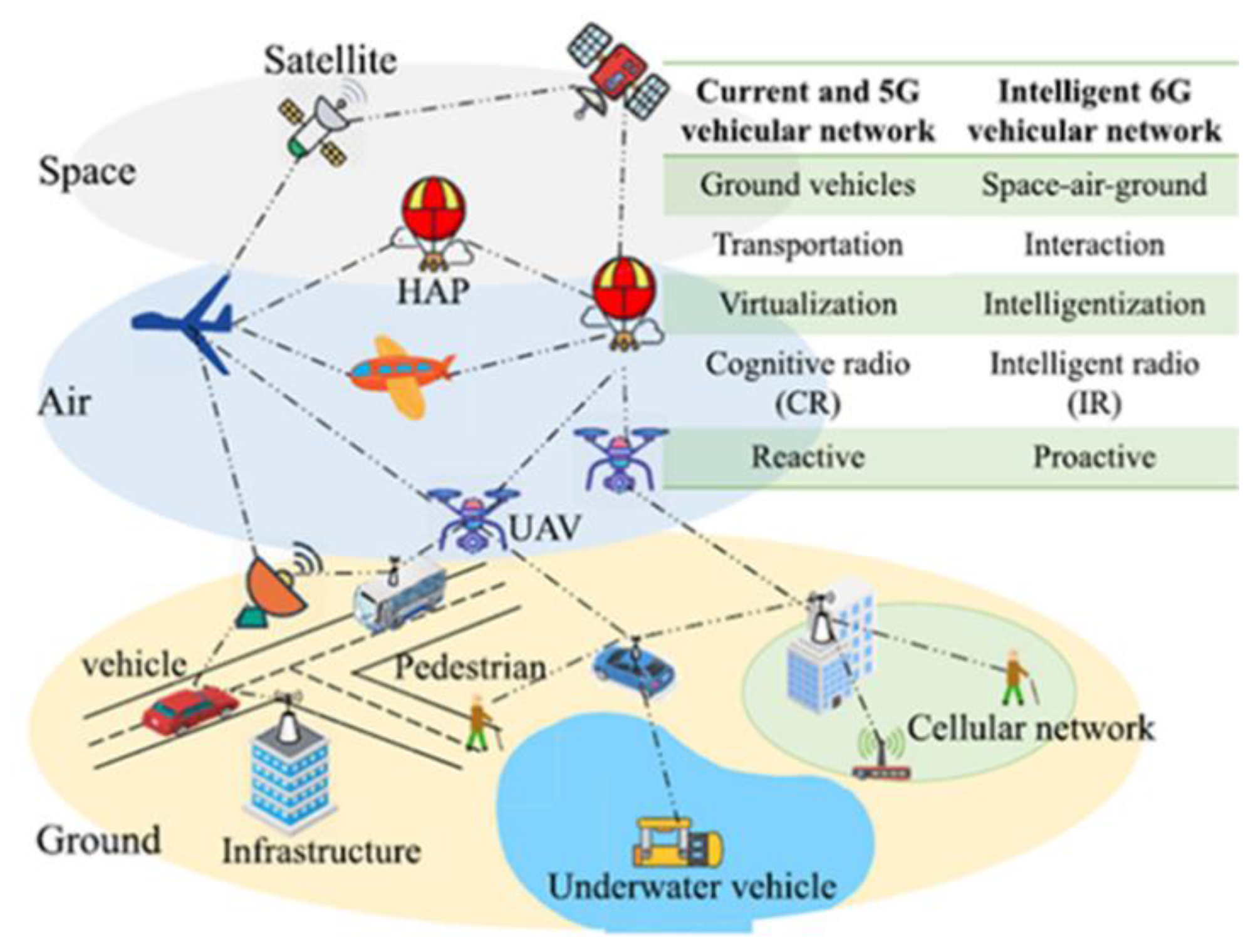
Figure 2.
SAGIN model BS-SAT-RPAS1-CU5-RPAS2-CU5.
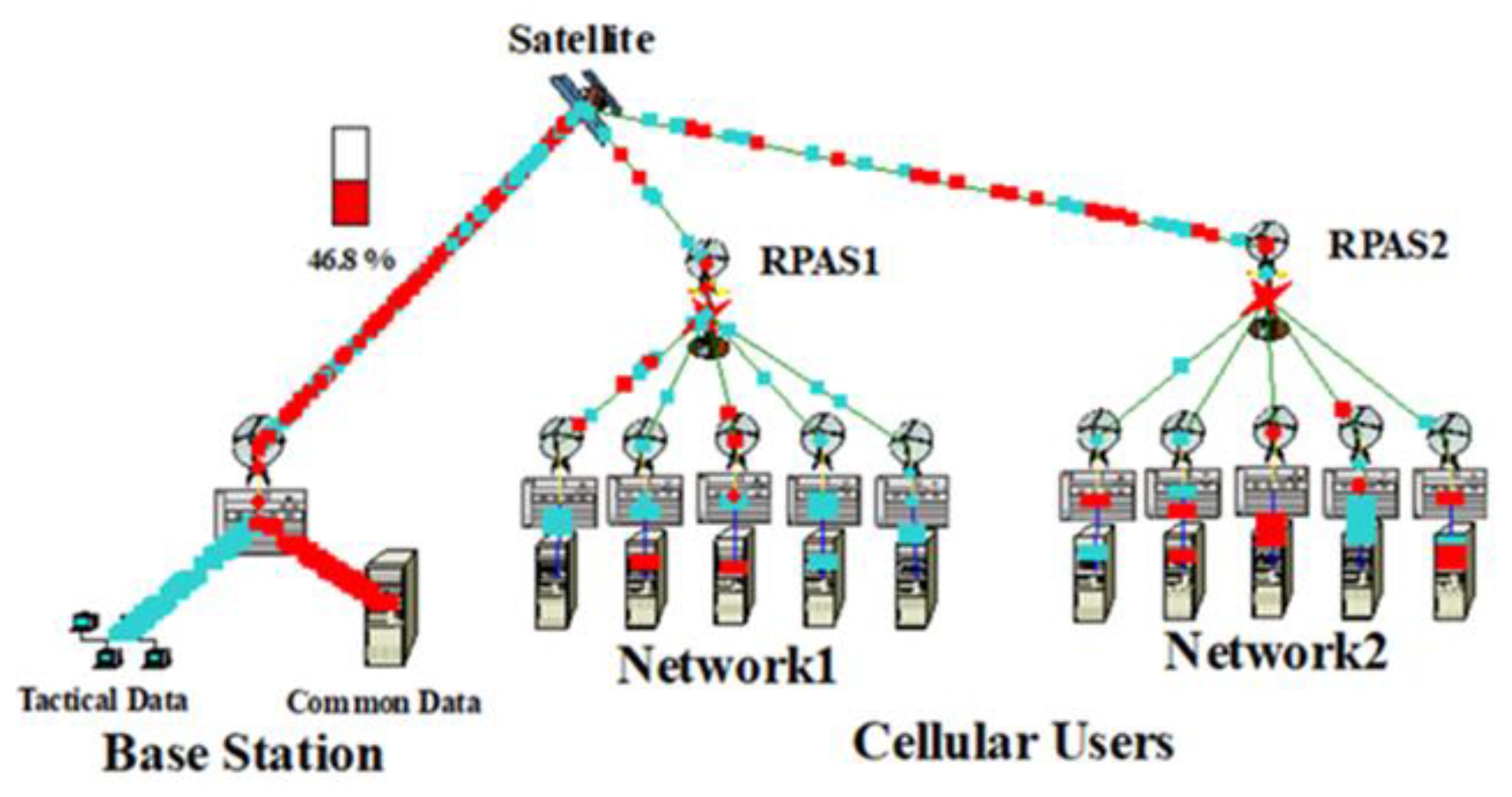
Figure 3.
Dependences of uplink Average Load on Common Data TS (Tactical Data – FTP, TS = 10 Kbits, TBT = 1 s, Common Data – inter LAN, TBT = 1 s, BER = 0%).
Figure 3.
Dependences of uplink Average Load on Common Data TS (Tactical Data – FTP, TS = 10 Kbits, TBT = 1 s, Common Data – inter LAN, TBT = 1 s, BER = 0%).
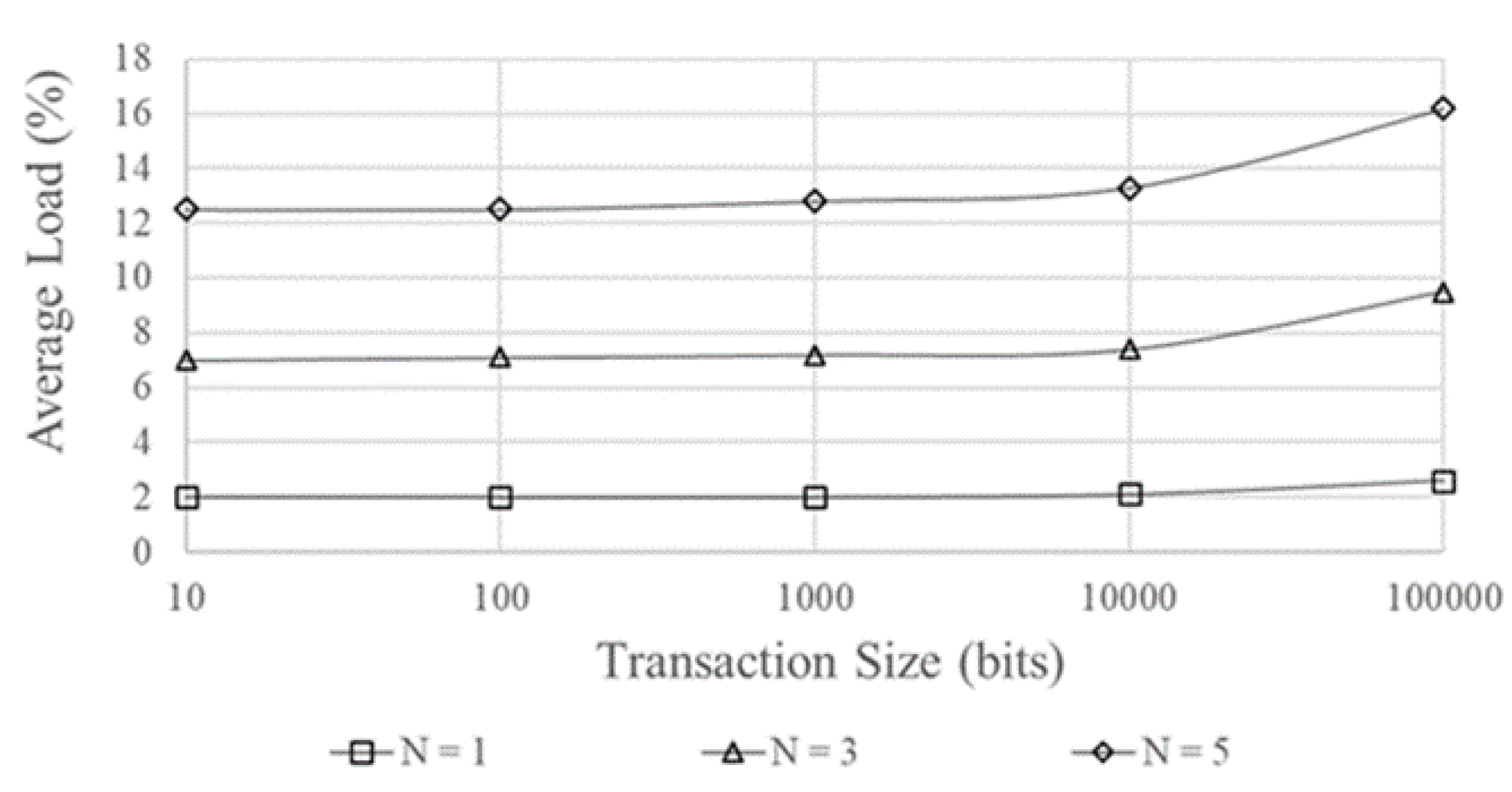
Figure 4.
Dependences of uplink Average Load on bandwidth (Tactical Data – FTP, TS = 100 Kbits, TBT = 1 s, Common Data – inter LAN, TS = 100 Kbits, TBT = 1 s, BER = 0%).
Figure 4.
Dependences of uplink Average Load on bandwidth (Tactical Data – FTP, TS = 100 Kbits, TBT = 1 s, Common Data – inter LAN, TS = 100 Kbits, TBT = 1 s, BER = 0%).
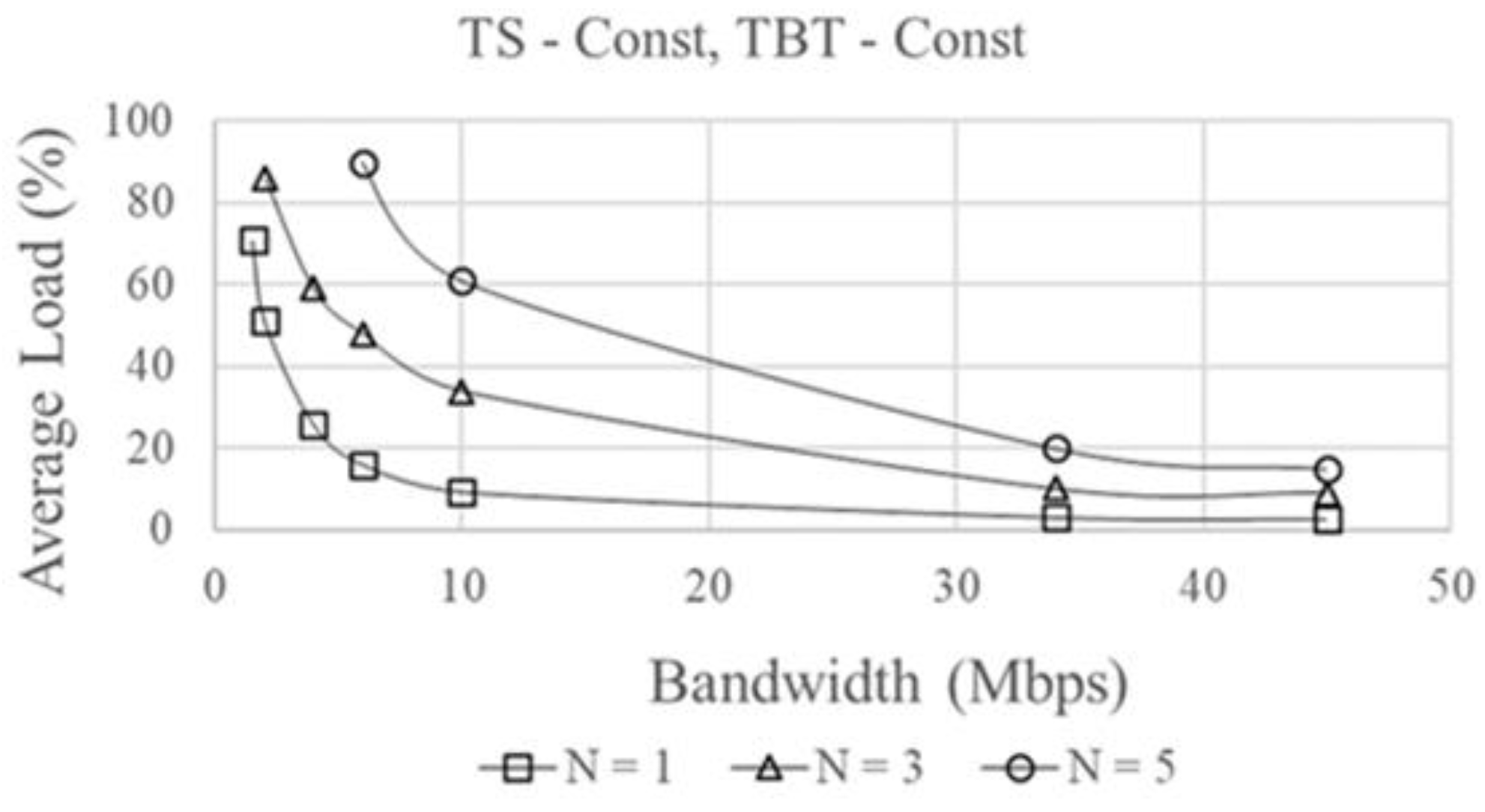
Figure 5.
Dependences uplink Average Load on BER (Tactical Data – FTP, TS = 10 Kbits, TBT = 1 s, Common Data – inter LAN, TS = 10 Kbits, TBT = 1 s).
Figure 5.
Dependences uplink Average Load on BER (Tactical Data – FTP, TS = 10 Kbits, TBT = 1 s, Common Data – inter LAN, TS = 10 Kbits, TBT = 1 s).
Disclaimer/Publisher’s Note: The statements, opinions and data contained in all publications are solely those of the individual author(s) and contributor(s) and not of MDPI and/or the editor(s). MDPI and/or the editor(s) disclaim responsibility for any injury to people or property resulting from any ideas, methods, instructions or products referred to in the content. |
© 2025 by the authors. Licensee MDPI, Basel, Switzerland. This article is an open access article distributed under the terms and conditions of the Creative Commons Attribution (CC BY) license (http://creativecommons.org/licenses/by/4.0/).
Copyright: This open access article is published under a Creative Commons CC BY 4.0 license, which permit the free download, distribution, and reuse, provided that the author and preprint are cited in any reuse.


