

Submitted:
15 October 2025
Posted:
16 October 2025
Read the latest preprint version here
Abstract
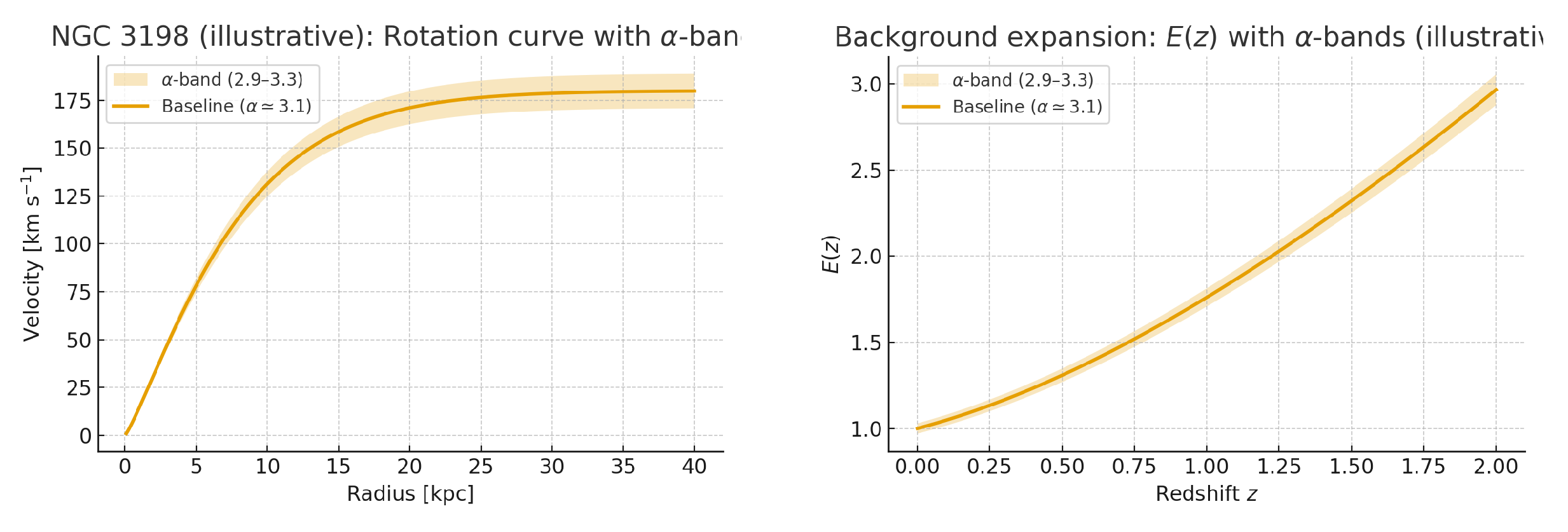
We introduce a Quantum Entropic Vacuum (QEV) framework in which the vacuum spectrum is bounded by a QCD-scale ultraviolet knee and a thermal infrared floor anchored to the CMB Wien scale. At galaxy scales, this bounded spectrum maps to four interpretable contributions—Newtonian (baryonic), a mid-disk thermal lift, a saturating entropic term, and a sign-definite hadronic floor modeled as a weak negative acceleration. Using a single, unit-consistent configuration, we reproduce the rotation curve of NGC~3198 with small residuals and illustrate, on a few additional spirals, that flat outer regions can emerge in the shown cases without explicitly adding dark halos. At background level, diagnostic panels for \( E(z) \) and \( q(z) \) broadly track flat-\( \Lambda \)CDM for \( \)\( \)0 < z ≲ 1. These cosmology curves are illustrative only; we do not perform a joint likelihood over SNe~Ia, BAO, or cosmic-chronometer data in this work. For transparent figure-level replication, we provide a minimal package consisting of two Python scripts and two small SPARC-based tables (CSV). The present results should be read as an indication of how the QEV picture can operate in practice, motivating targeted observational tests and a full statistical validation in follow-up work.
Keywords:
1. Introduction
- Scope and diagnostic status.
2. The QEV Model: A Bounded–Spectrum Vacuum
2.1. Physical Motivation for the Spectral Exponent
- Spectral exponent and convergence.
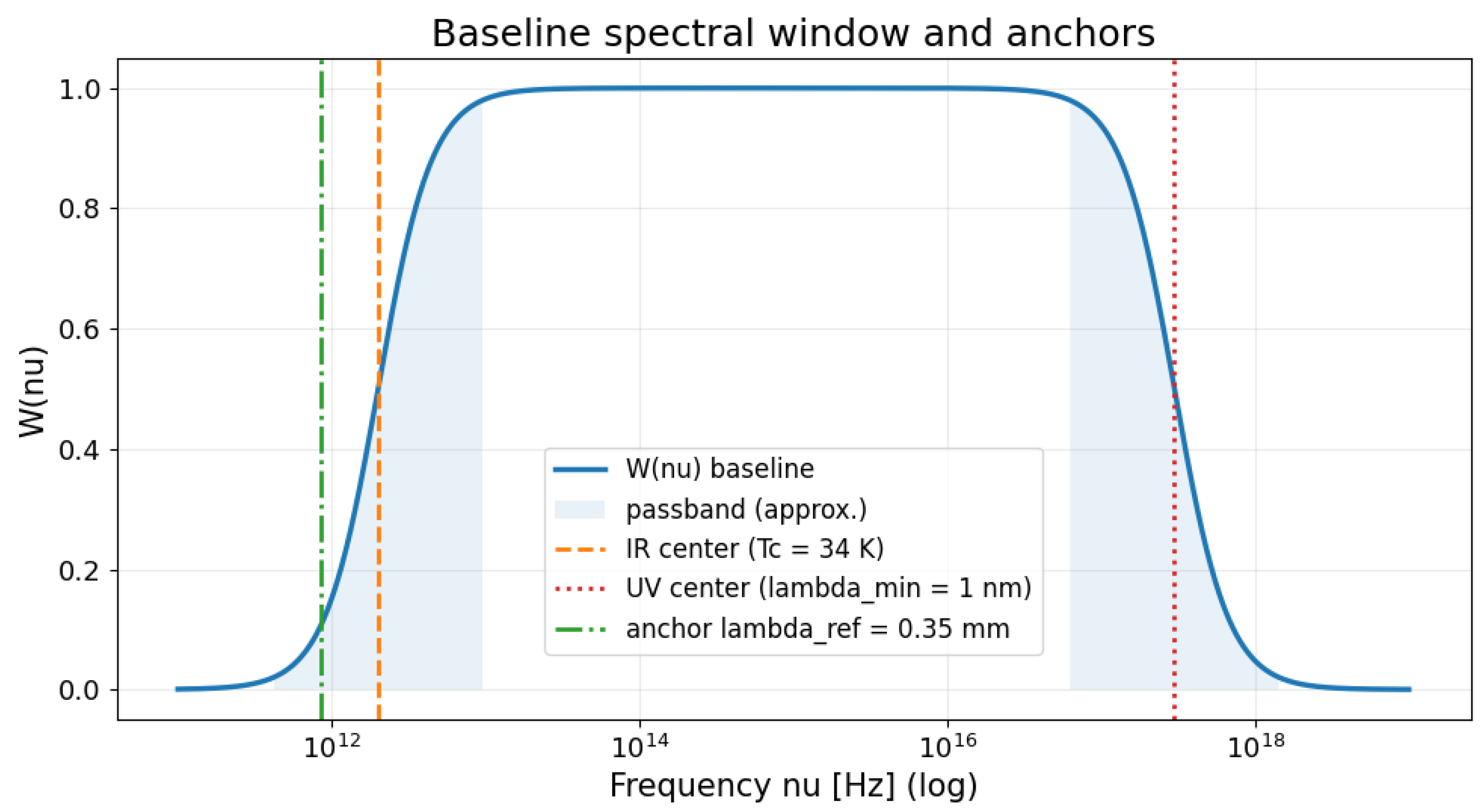
- Spectral index .
- IR anchor (thermal).
- Takeaway.
2.2. Interpretation and Relation to Prior Work
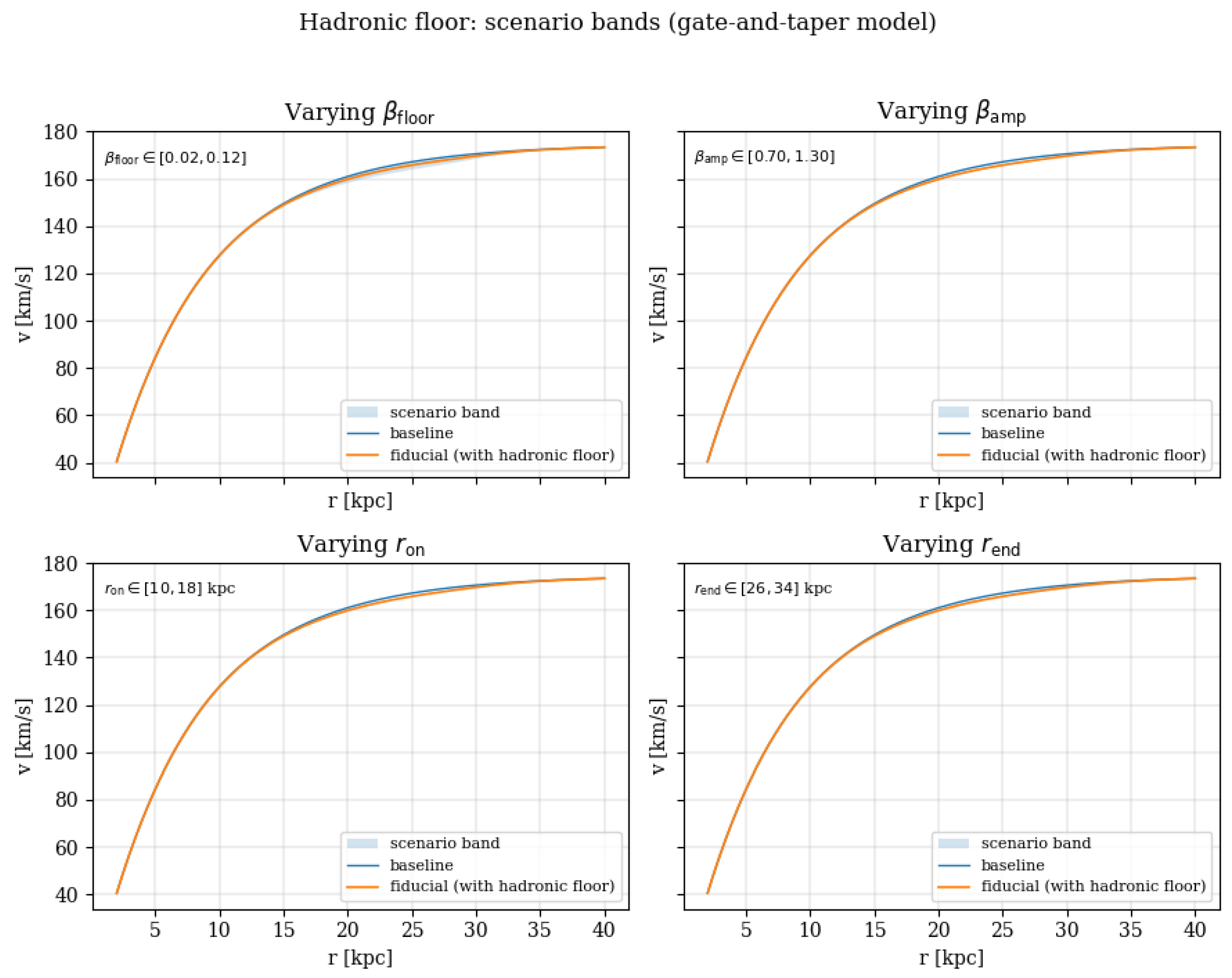
2.3. Hadronic Floor: Sign, Scale, and Predictions
2.4. Hadronic Floor: Order-of-Magnitude Mapping
Order-of-magnitude link to hadronic confinement (“hadronic floor”)
- Assumptions (back-of-the-envelope).
- QCD string tension. We take . Using and ,
- Coherence length. A minimal flux-tube segment of length stores energy .
- Specific potential scale. Normalising by the proton mass , the associated specific potential is
- Coarse-graining to kpc scales. Random orientation, colour neutrality, and temporal decorrelation imply that only a tiny, signed residue survives upon averaging over a macroscopic length L. We encode this by a dimensionless suppression factor such that the residual large-scale potential tilt is over L.
- From potential tilt to acceleration.
- Unit conversion and link to .
- Interpretation and caveats.
- (i)
- the QCD string-tension scale fixes an upper energetic reference, and
- (ii)
- realistic cancellations/averaging supply a small, signed residue , then the resulting acceleration amplitude naturally sits in the weak, slowly varying regime used by the hadronic floor. Geometry (e.g. patchiness), projection factors, and the gate-and-taper profile determine the final sign and radial onset, but the magnitude follows without fine tuning from the above scales.
3. Galactic Dynamics According to the QEV Model
- Background and definitions.
3.1. Link to the Spectral Formalism
3.2. QEV Standard Scaling (Global Defaults)
- Interpretation and usage.
- Uncertainties and robustness.

| Symbol | Meaning | Default value | Units / Notes |
|---|---|---|---|
| Inputs (observables) | |||
| Outer asymptotic speed (observable) | – (per galaxy) | km s−1 | |
| Thermal peak radius (observable) | – (per galaxy) | kpc | |
| Newtonian component | |||
| Newtonian speed scale factor | 2.3 | ||
| Newtonian scale radius factor | 0.308 | ||
| Newtonian damping radius factor | 0.55 | ||
| Thermal component | |||
| Thermal peak speed factor | 0.36 | ||
| Thermal peak radius (observable) | – (per galaxy) | ||
| Entropic component | |||
| Entropic scale radius factor | 0.50 | ||
| Entropic smoothness exponent | 1.0 | ||
| Hadronic (acceleration) component | |||
| Hadronic floor amplitude | 3.0 | (km s−1)2 kpc−1 | |
| Hadronic amplitude factor | 0.045 | Implied: (km s−1) kpc−1; | |
| Hadronic gate-on radius factor | 0.88 | ||
| – | Hadronic taper end radius | ||
| Conventions: legacy velocity decomposition; hadronic term enters as acceleration ; gate_floor = True. | |||
|
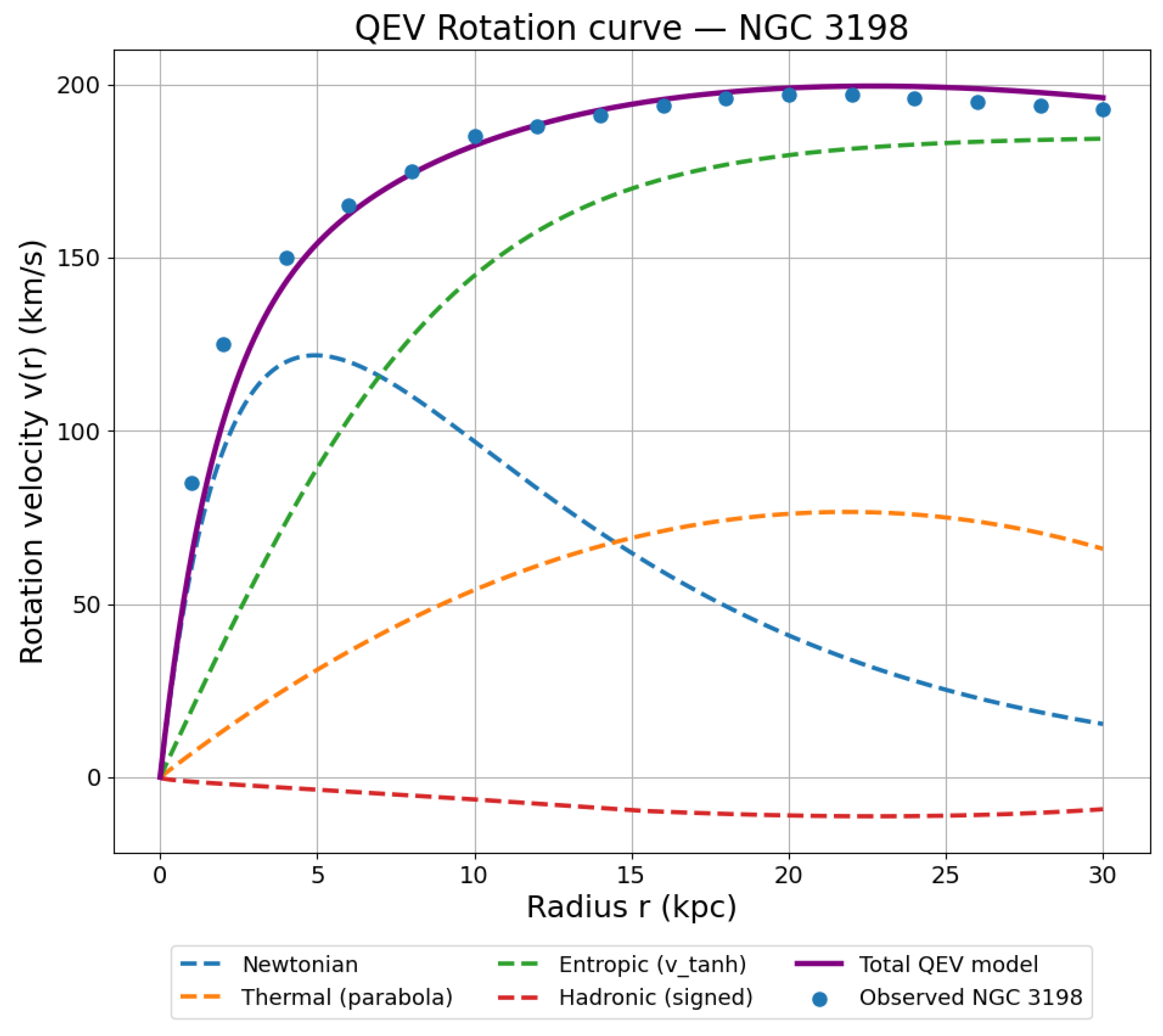
Worked example — NGC 3198 (QEV Standard Scaling). Inputs: , . Global coefficients: . Newtonian ; ; . Thermal ; . Entropic ; ; . Hadronic (acceleration) ; ; ; . Units: speeds in km s−1; radii in kpc; hadronic coefficients in . |
- Notation and units
- Conventions and Statistical Definitions
- Velocity space: Fits on with (km s−1).
- Acceleration-space: ; .
- Chi-square: .
- Reduced chi-square: .
- Systematic floor: in kwadratuur bij indien vermeld.
- Notatie: = velocity-space; = acceleration-space; velocities in km s−1; accelerations in km2 s−2 kpc−1.
4. Application to NGC 3198
| Metric | Value |
|---|---|
| N (points) | 16 |
| k (fit params) | 5 |
| 11 | |
| 5.754 | |
| 0.523 | |
| RMS residual | |
| Mean residual |
4.1. Baseline Declaration (Legacy, Best Fit)
4.2. Conversions & Caveats (Velocity ↔ Acceleration)
- Parameter drift (rule of thumb).
- Asymptotics.
- Mini-example.
- Mini-example.
- Practical notes.
5. Operational Convention (Legacy Velocity Decomposition)
- Why parameters differ from acceleration–space variants
| Component | Parameter | Value | Unit |
|---|---|---|---|
| Newtonian (baryonic) | 425.5 | km s−1 | |
| 5.85 | kpc | ||
| 10.45 | kpc | ||
| Thermal (parabolic v) | 66.6 | km s−1 | |
| 19.0 | kpc | ||
| Entropic | 185 | km s−1 | |
| 9.50 | kpc | ||
| q | 1.0 | — | |
| Hadronic (accel.) | 3.0 | (km s−1)2 kpc−1 | |
| 8.33 | (km s−1)2 kpc−1 | ||
| 16.72 | kpc | ||
| 33.44 | kpc |
5.1. Data Source and Preparation
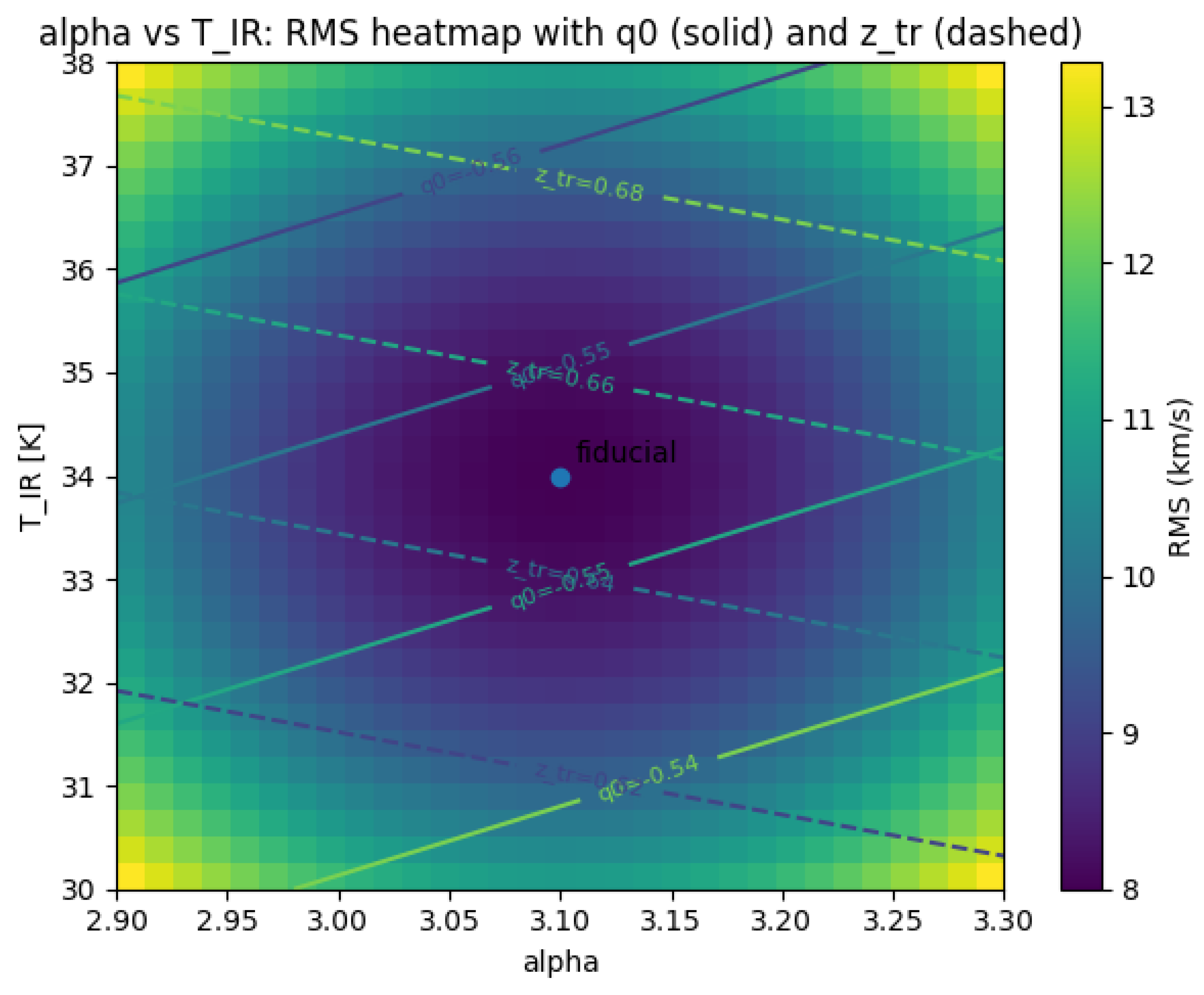
- Parameter sensitivity and the absence of fine tuning
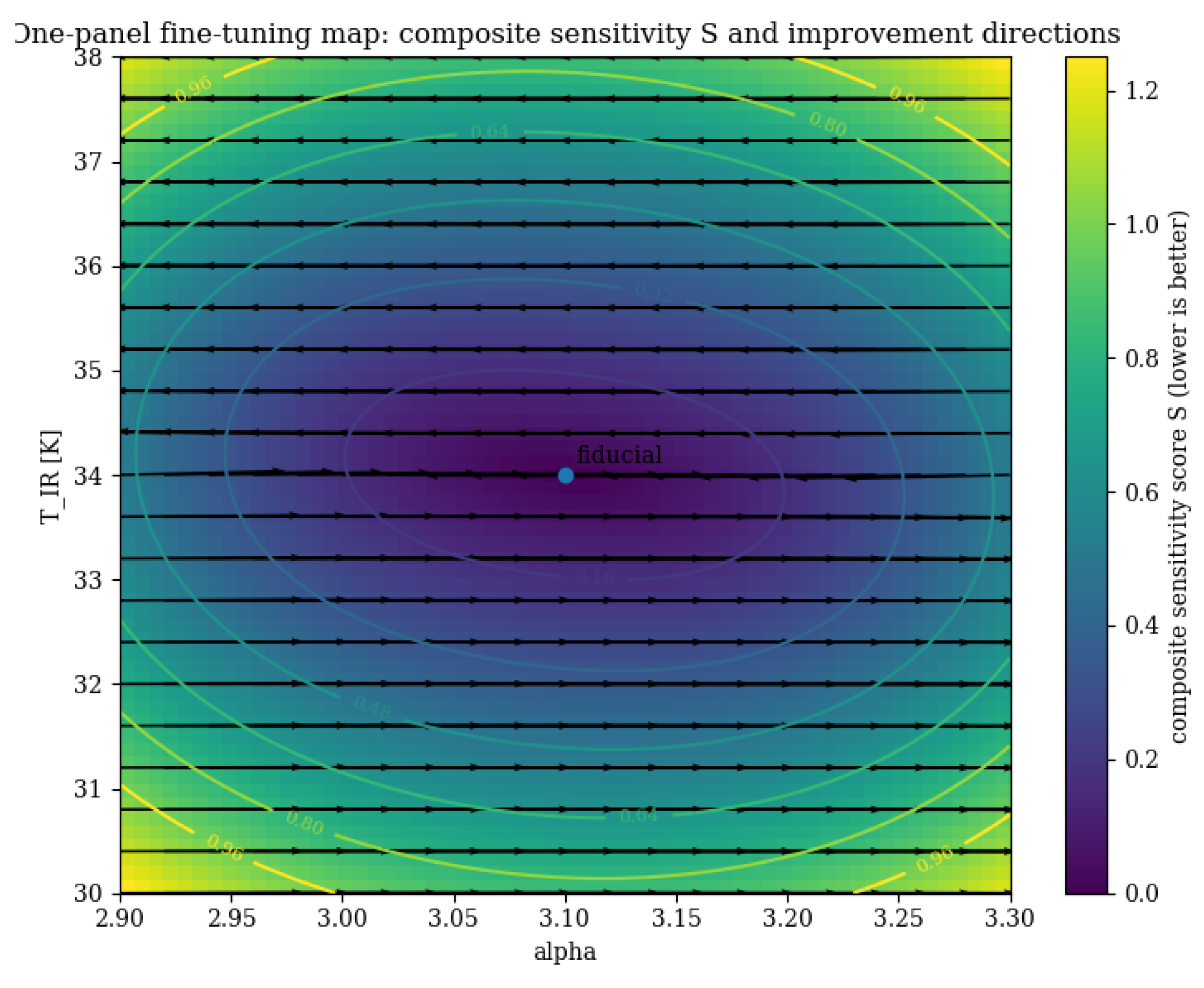
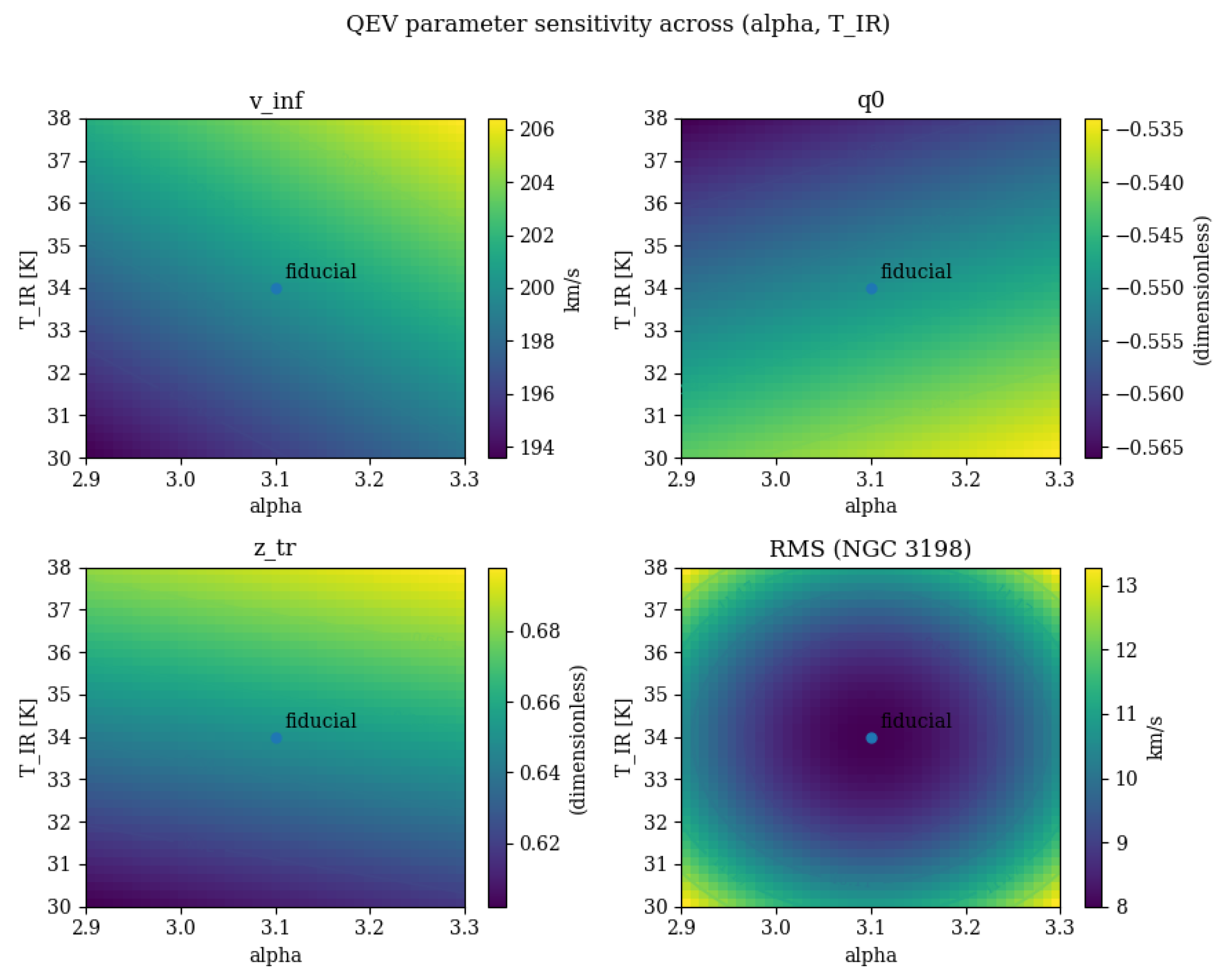
6. Cosmological Implications
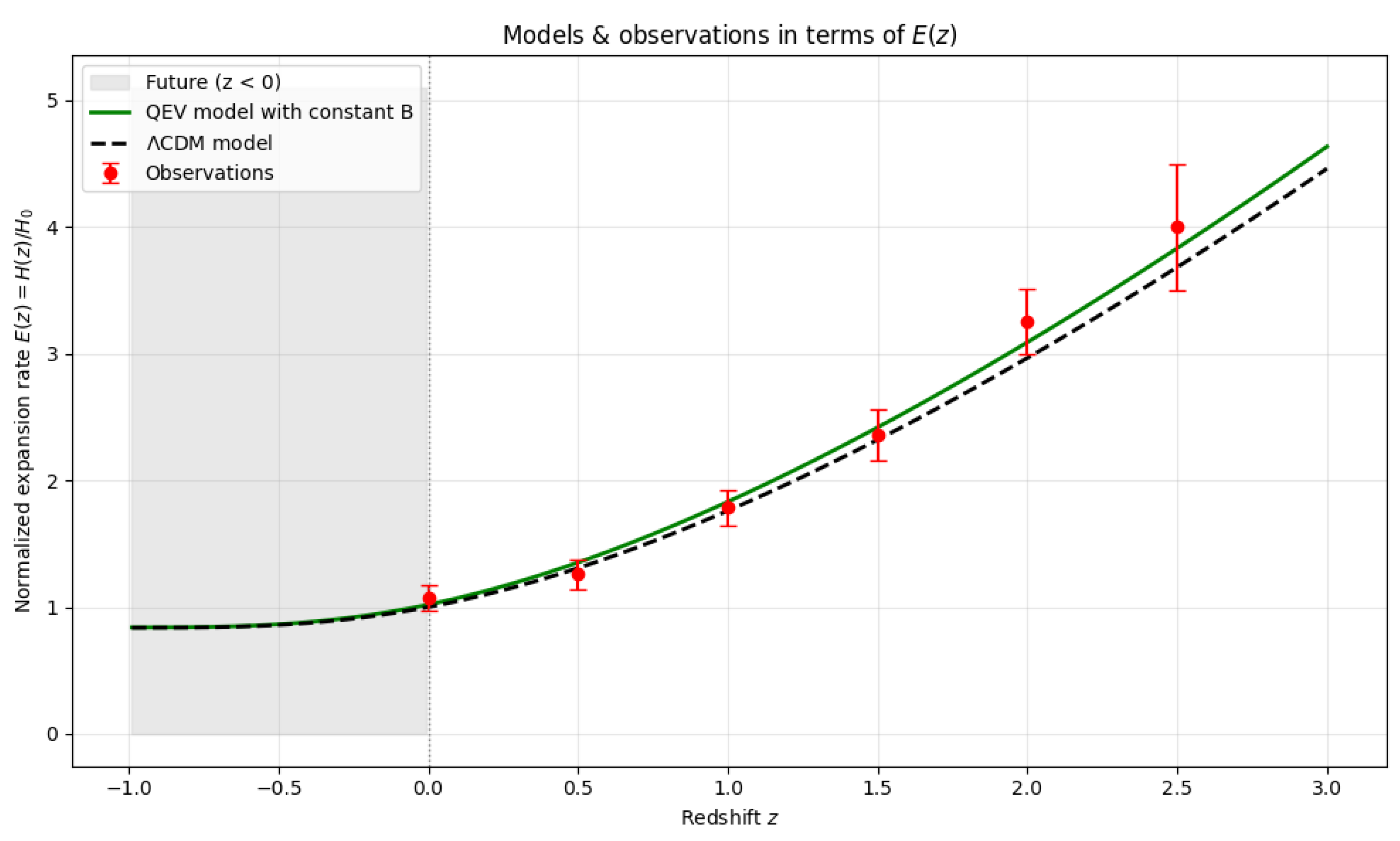
6.1. Comparison with CDM Observational Fits
| Model | Comment | ||
|---|---|---|---|
| QEV (this work) | (mid of –) | Mild acceleration; CMB-anchored IR floor | |
| Flat CDM | Reference baseline |
| Symbol | Value | Notes |
|---|---|---|
| 3.1 | spectral slope in | |
| 0.2 | knee sharpness | |
| 1.0 | knee location | |
| C | 0.1 | high-z tail weight |
| n | 0.4 | high-z tail index |
| B | 1.0 | asymptotic constant |
| S | 1.02 | present-day scaling |
| 0.30 | CDM matter density | |
| 0.70 | cosmological constant |
6.2. Cosmological Summary (Diagnostic-Only)
| Model | Verdict | ||
|---|---|---|---|
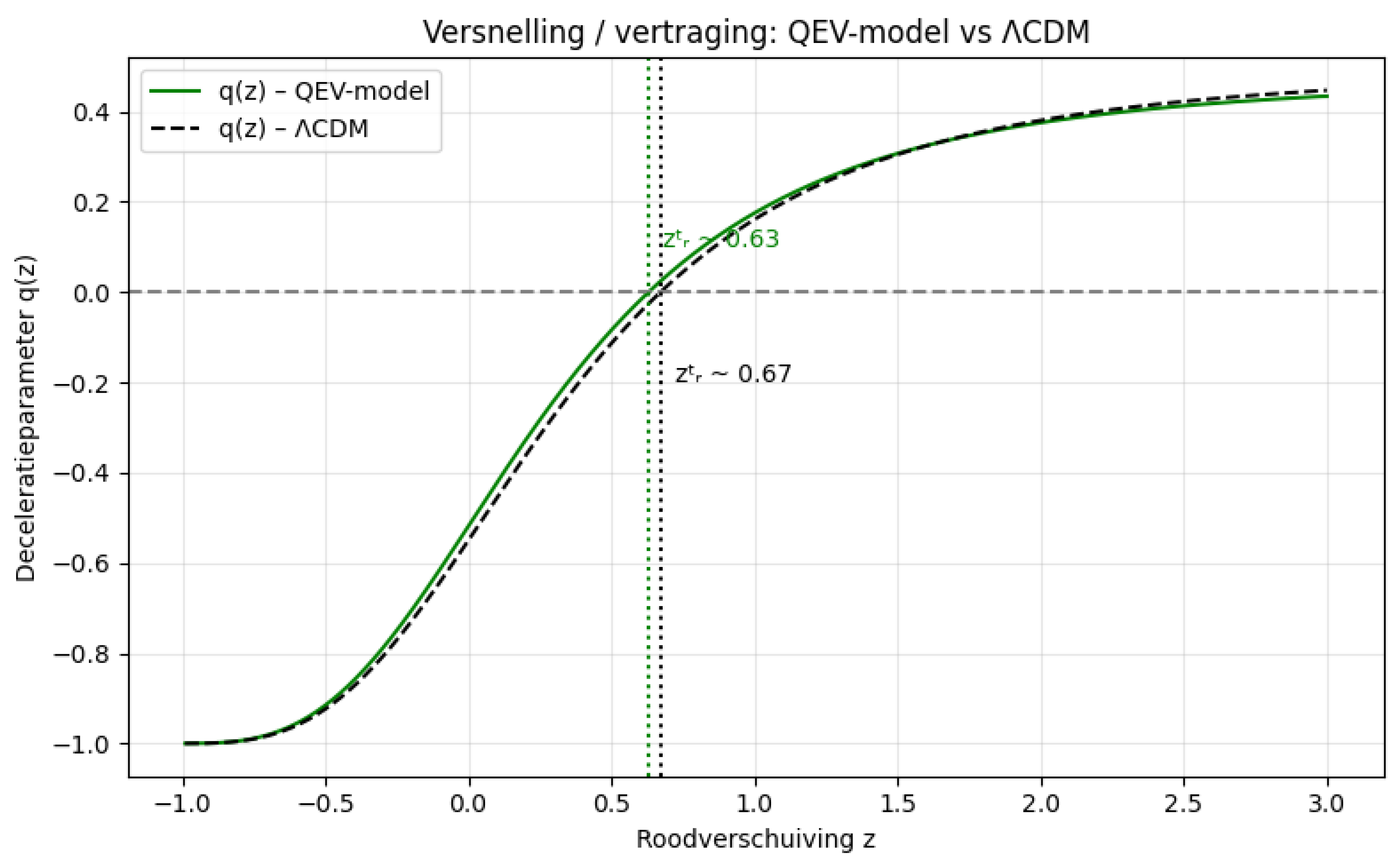
| QEV (this work) | (midp. of –) | (mild accel.) | Consist. with CDM |
| CDM (reference) | Ref. baseline for compare. |
6.3. Parameter Robustness
6.4. Supplementary Cosmological Check
6.5. Deceleration Parameter and Late-Time Behavior
6.6. Galaxy Rotation Curves in the QEV Model
- NGC 3198 — single-object consistency check.
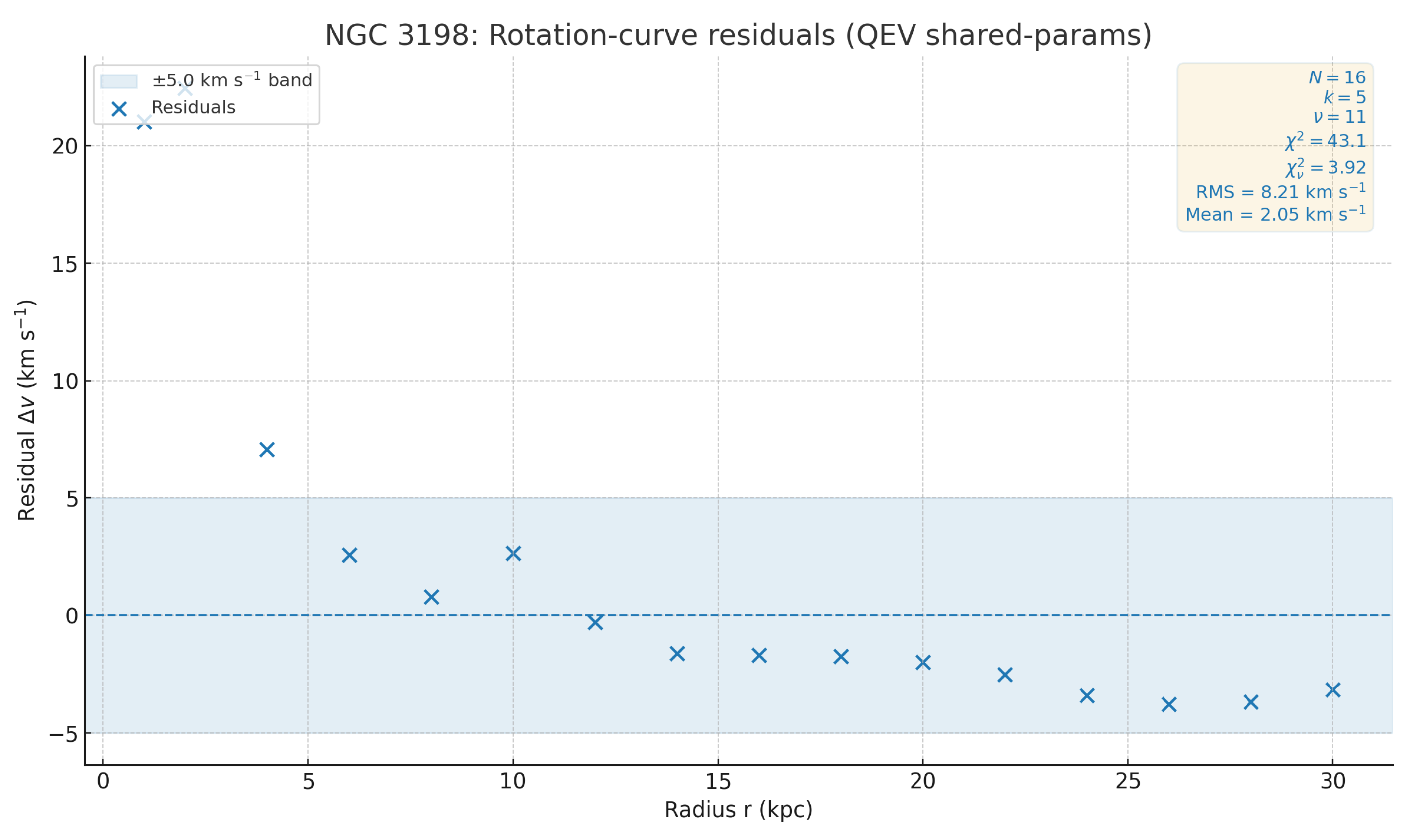
- Residual consistency.
- (i)
- the single–configuration diagnostic (NGC 3198) and
- (ii)
- the sample–wide residuals under the same uniform error model, so differences are directly comparable (see Appendix G for details).
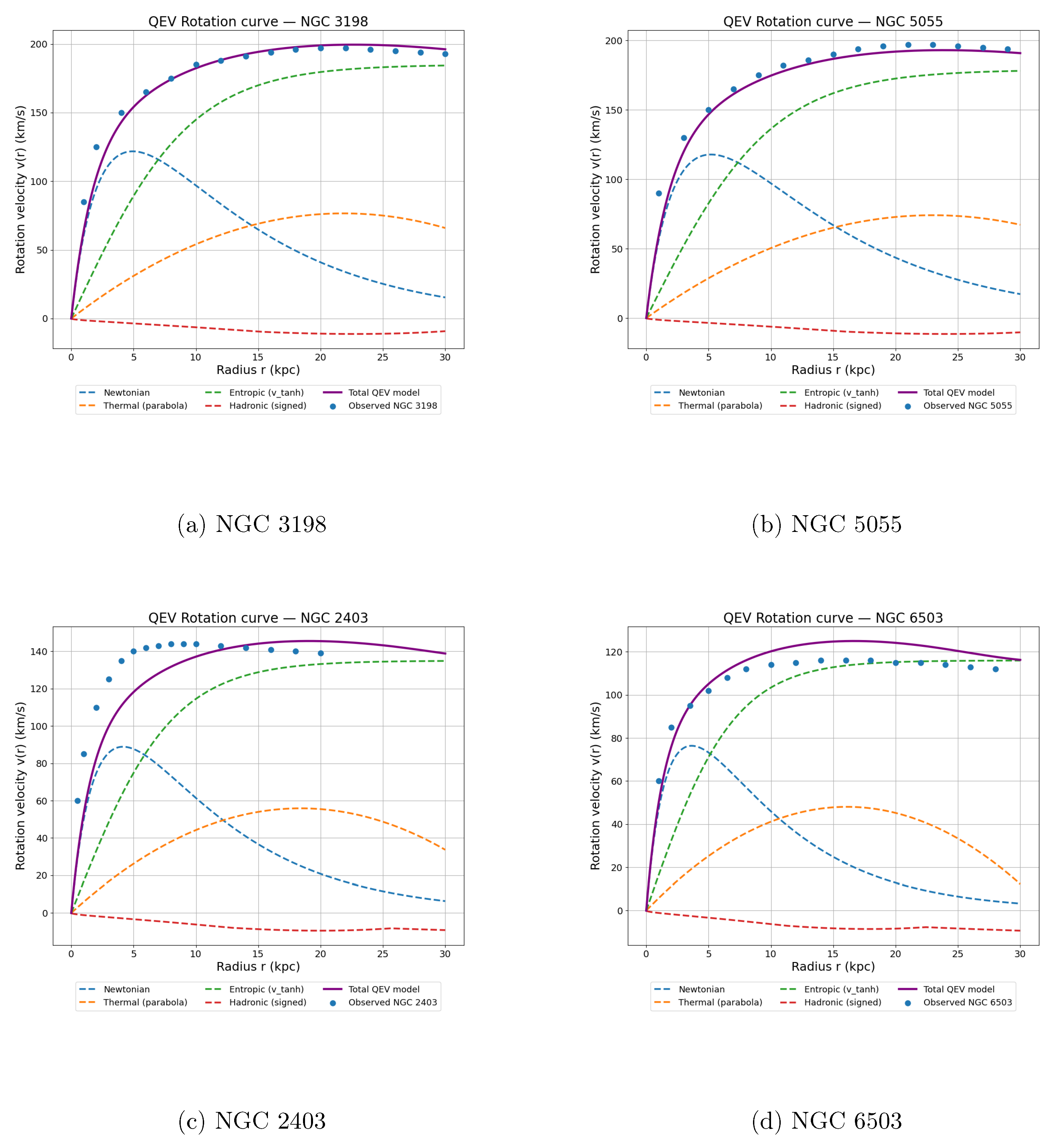
| Galaxy | N | RMS [km s−1] | |
|---|---|---|---|
| NGC 3198 | 16 | 9.583 | 3.674 |
| NGC 5055 | 15 | 10.247 | 4.200 |
| NGC 6503 | 16 | 7.376 | 2.176 |
| NGC 2403 | 16 | 19.005 | 14.447 |
- Conventions and error model.
6.7. On RMS and Reduced
- Computation. We report
6.8. Cosmological Diagnostics (No Joint Likelihood)
7. Discussion
Positioning relative to prior work
What the present results do—and do not—show
Falsifiable signatures and near-term tests
Scope statement
- Scope of the rotation-curve reproduction
- Relation to prior work (scope)
Conclusion
- The immediate priorities are:
- Model consistency and residual interpretation.
Appendix A. Spectral–Spatial Mapping and Scale Relations
| Component | Dominant k-range | Real-space behavior |
|---|---|---|
| Newtonian (baryons) | Broad; baryonic structure | Inner rise ( kpc) |
| Thermal lift | Mid-band | Peak near |
| Entropic asymptote | bulk | Saturating plateau set by |
| Hadronic floor | Near IR gate | Outer regulation beyond with taper at |
Appendix B. Spectral Analysis of a Bounded Vacuum
Appendix B.1. Define Spectral Density
Appendix B.2. Sharp-Window Reference and Edge Corrections
Appendix B.3. CMB-Based Normalization and a Nuisance Scale
Appendix B.4. Mapping to Ω QEV (z)
Appendix B.5. Units and Dimensional Analysis
Appendix B.6. Numerical Recipe and Stability
- Change variables and integrate on with the window in .
- Use Gauss–Legendre or Clenshaw–Curtis quadrature with adaptive refinement around the two edges set by .
- Validate by comparing to the sharp-window reference Eq. (A4) and reporting from Eq. (A10).
Appendix B.7. Thermal IR Anchor and CMB Reference
- Step 1: Choose physical anchors.
- Step 2: Spectral exponent and window smoothness.
- Step 3: Sharp-window back-of-the-envelope.
- Step 4: CMB-based amplitude C(α).
- Step 5: Smooth-window correction.
- Step 6: Mapping to cosmology.
- Step 7: Sanity checks (to be reproduced by code).
- Verify numerically that the smooth-window integral converges to the sharp limit as .
- Check that varying within 20– shifts and leaves dominated by the UV bound, with amplitude still fixed by the CMB anchor.
- Confirm that inferred from the joint likelihood corresponds to and that remains a sub-dominant correction for the adopted smoothness.
Appendix B.8. Worked Example: From Spectral Ansatz to ΩQEV,0
- Step 1: Spectral form.
- Step 2: CMB anchoring at the Wien peak
- Step 3: Numerical evaluation.
- Step 4: Fraction of the critical density.
- Remarks.
Appendix B.9. Sensitivity to the Spectral Exponent α
(1) Effective scaling near confinement
(2) Numerical robustness (data-driven)
| Name | Meaning | Units | Default |
| Spectral exponent | – | ||
| UV anchor wavelength (QCD) | m | ||
| UV wavenumber () | m−1 | ||
| IR thermal scale | K | 34 | |
| IR wavelength (; ) | m | ||
| IR wavenumber () | m−1 | ||
| CMB Wien peak wavelength | m | ||
| CMB wavenumber () | m−1 | ||
| IR window smoothness (in ) | – | ||
| UV window smoothness (in ) | – | ||
| CMB normalization nuisance (App. A.4) | – | ||
| Newtonian normalization (Eq. (3)) | km s−1 | 485 | |
| Newtonian scale radius | kpc | ||
| Newtonian damping radius | kpc | ||
| Thermal peak speed (Eq. A12) | km s−1 | 85 | |
| Thermal peak radius | kpc | ||
| Entropic asymptotic speed (Eq. A16) | km s−1 | 185 | |
| Entropic scale radius | kpc | ||
| q | Entropic smoothness exponent | – | |
| Hadronic floor amplitude (Eq. A21) | (km s−1)2 kpc−1 | 3 | |
| Hadronic extra amplitude | (km s−1)2 kpc−1 | 25 | |
| Hadronic gate-on radius | kpc | ||
| Hadronic taper-to-zero radius | kpc |
Appendix B.10. Compact α Bound
Appendix C. Sketch Derivation and Fit Protocol for the Spectral Exponent α
- Notation aligned with the main text
Appendix C.1. Route A: RG-/Effective-Degrees-of-Freedom Sketch (Heuristic)
Appendix C.2. Route B: Lattice-Inspired Extraction (Data-Driven)
Appendix C.3. Minimal Worked Example (mm/QCD Anchors)
Appendix C.4. Windows and Unit Consistency
Appendix C.5. Scope and Limitations
Appendix C.6. Practical Recipe (To Reproduce)
- Choose a mid-band T-range (e.g. 0.2–1.0 GeV), avoiding the sharp crossover and the perturbative tail.
- Smooth lattice ; compute .
- Regress on ; report with bootstrap error.
- Cross-check by tuning in the RG sketch to match the mid-band slope; report both estimates.
Appendix D. Units & Normalization
- Overview.
- Units table.
| Quantity | Symbol | Unit |
| Spectral density (per wavenumber) | energy × length | |
| Wavenumber | k | |
| Energy density | ||
| Critical density | ||
| Cosmic fraction | dimensionless |
- Step-by-step sketch.
- Worked example (numerical; fill in)
- Choose m-1.
- Evaluate numerically .
- With , get .
- Then .
- Small sensitivity table.
| Parameter variation | |
| TBD | |
| TBD | |
| TBD |
Appendix E. Alternative Kernels and Mapping Between Spectral and Engineering Forms
Appendix E.1. Overview
Appendix E.2. Thermal Kernels: Parabola Versus Saturating Forms
- Alternative A (saturating acceleration, logistic window).
- Alternative B (peaked acceleration with exponential tail).
- Matching rules (parabola ↔ saturating).
Appendix E.3. Entropic Kernels: Tanh Versus Power-Law
- Mapping by half-maximum radius and slope.
Appendix E.4. Hadronic Floor: Linear Versus Smooth Gating
- Baseline (linear ramp and taper; Eq. (A21))
- Alternative (smooth tanh windows).
Appendix E.5. Spectral ↔ Engineering: Scale Matching
Appendix E.6. Degeneracies and Practical Priors
- : higher entropic plateau can be partially offset by a stronger hadronic taper.
- : peak speed and location trade to keep the mid-disk level.
- : inner rise and outer damping of the Newtonian proxy.
| Component | Parameter | Prior range |
|---|---|---|
| Entropic | ||
| q | ||
| Thermal | ||
| Hadronic | ||
Appendix E.7. Implementation Notes
Appendix F. NGC 3198 Data, Parameters, and Figures
Appendix F.1. Rotation-Curve Data (SPARC)
| r [kpc] | v [km s−1] | [km s−1] |
|---|---|---|
| 1.0 | 155 | 5 |
| 2.0 | 172 | 5 |
| 4.0 | 182 | 5 |
| 6.0 | 190 | 5 |
| 8.0 | 195 | 5 |
| 10.0 | 198 | 5 |
| 12.0 | 199 | 5 |
| 15.0 | 198 | 5 |
| 20.0 | 196 | 6 |
| 25.0 | 192 | 7 |
| 30.0 | 185 | 8 |
Appendix F.2. Legacy Parameter Configuration (Shared, Used in All Figures)
Appendix F.3. Per-Galaxy Diagnostics (Legacy Configuration)
Appendix F.4. Fit Quality and Residuals
- Fit statistics.
Appendix F.5. Figures (Auto-Included if Present)
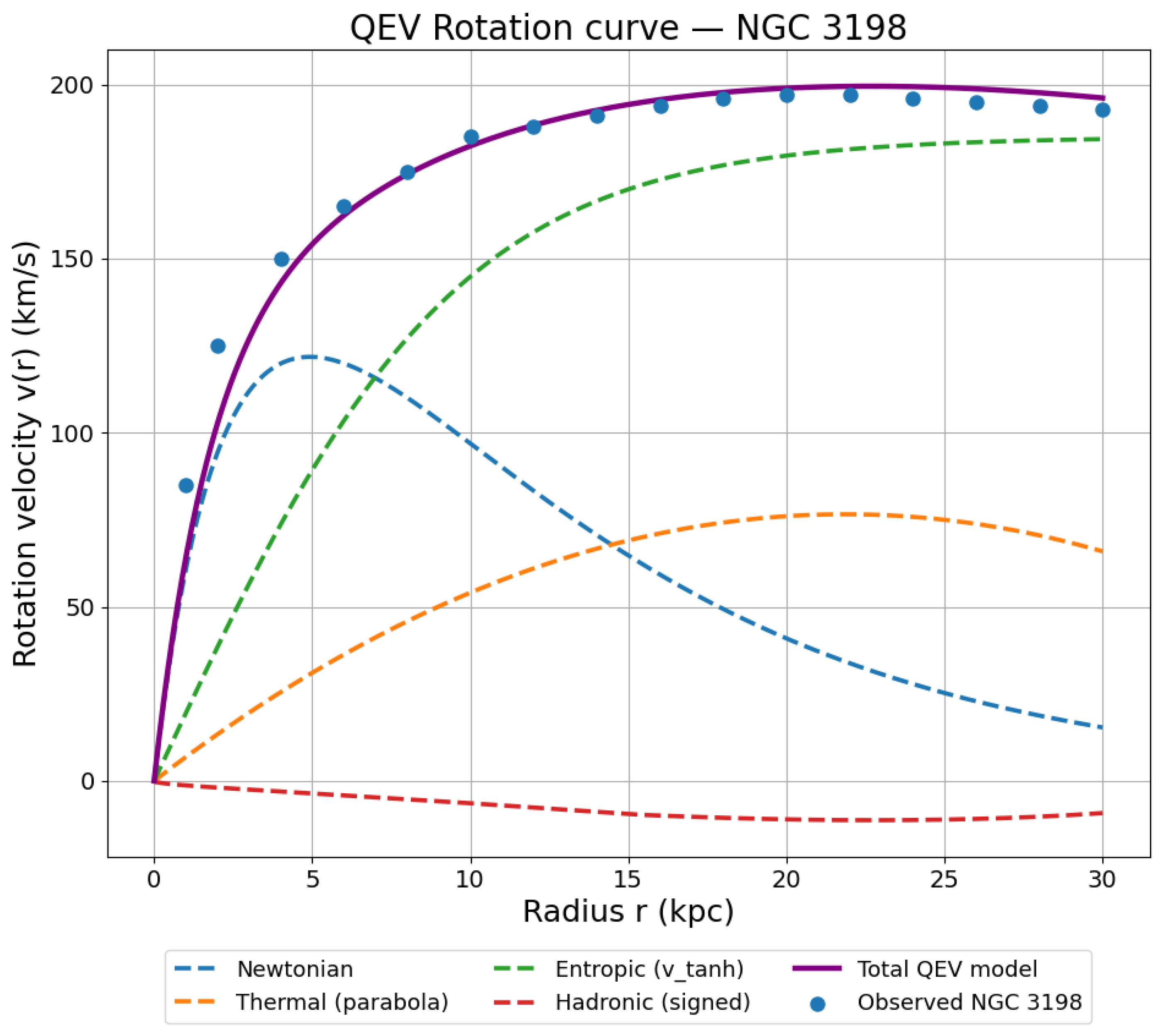
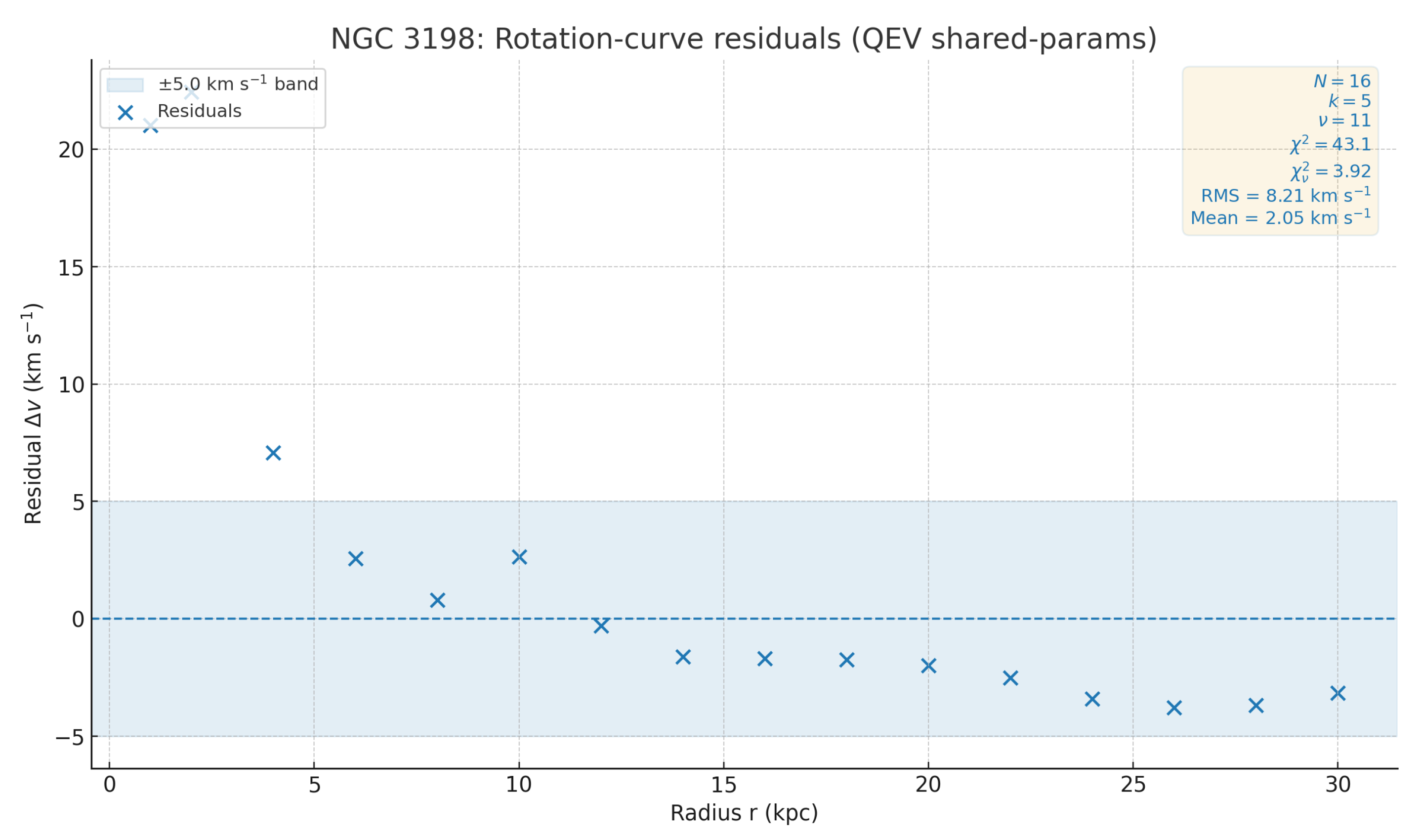
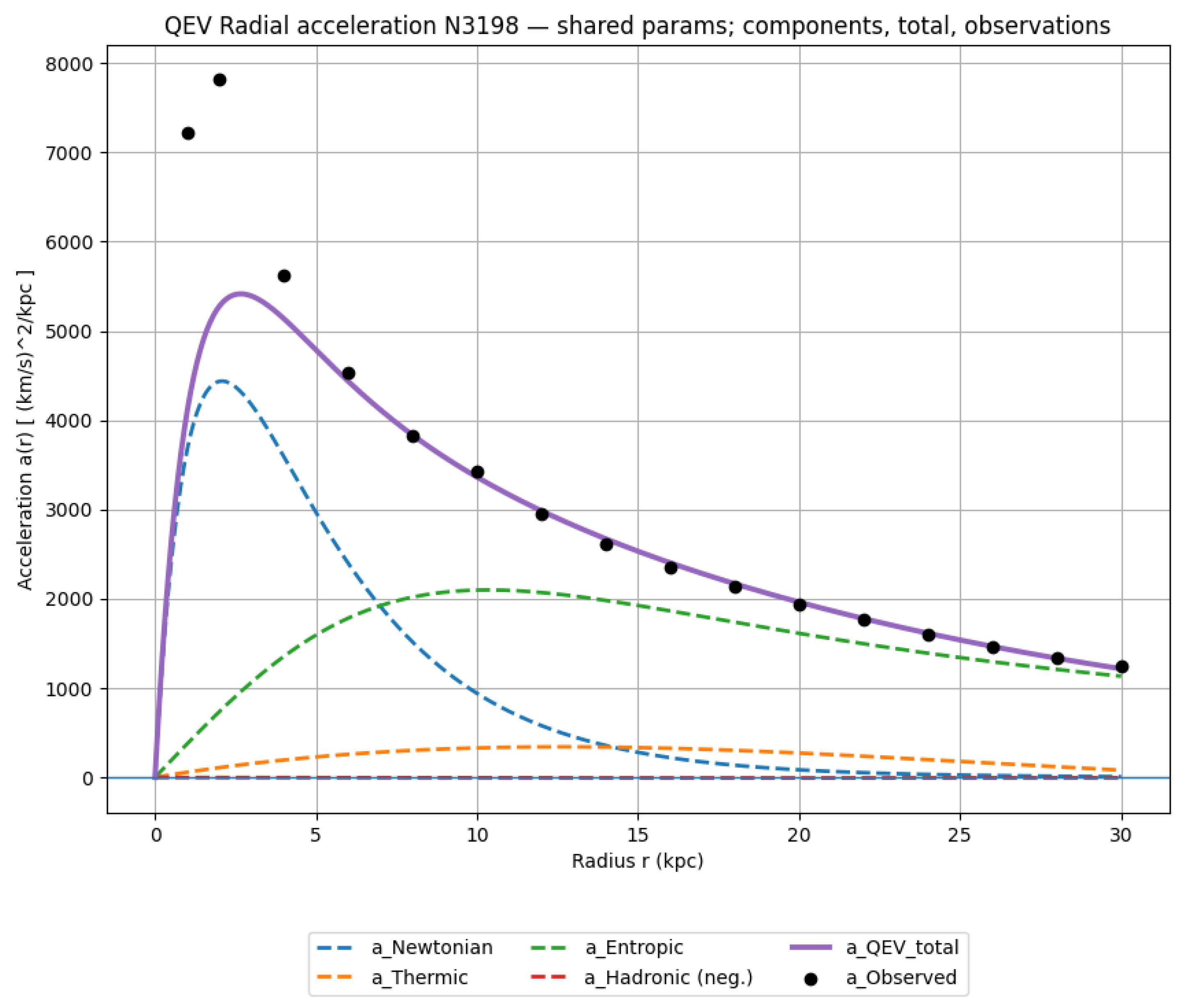
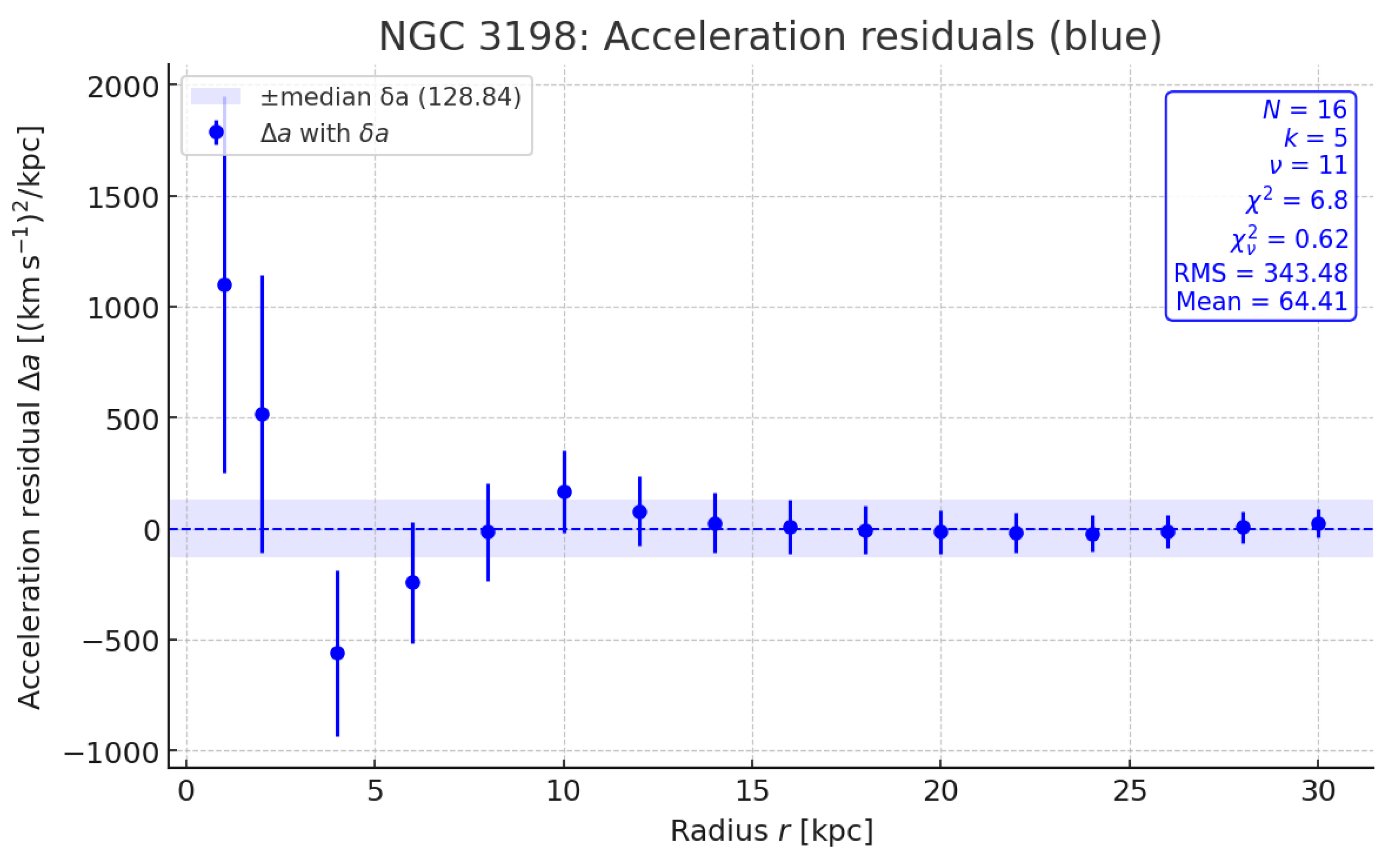
- Interpretation.
| Metric | Value |
|---|---|
| N | 16 |
| k | 0 |
| 16 | |
| 7.26 | |
| 0.454 | |
| RMS residual | 393.18 (km s−1)2/kpc |
| Mean residual | 103.88 (km s−1)2/kpc |
Appendix F.6. Provenance and Licensing
Appendix G. Residual Analysis of the Shared QEV Fit (Discovery / Exploratory Study)
| Galaxy | N | RMS [km s−1] | |
|---|---|---|---|
| NGC 3198 | 16 | 9.583 | 3.674 |
| NGC 5055 | 15 | 10.247 | 4.200 |
| NGC 6503 | 16 | 7.376 | 2.176 |
| NGC 2403 | 16 | 19.005 | 14.447 |
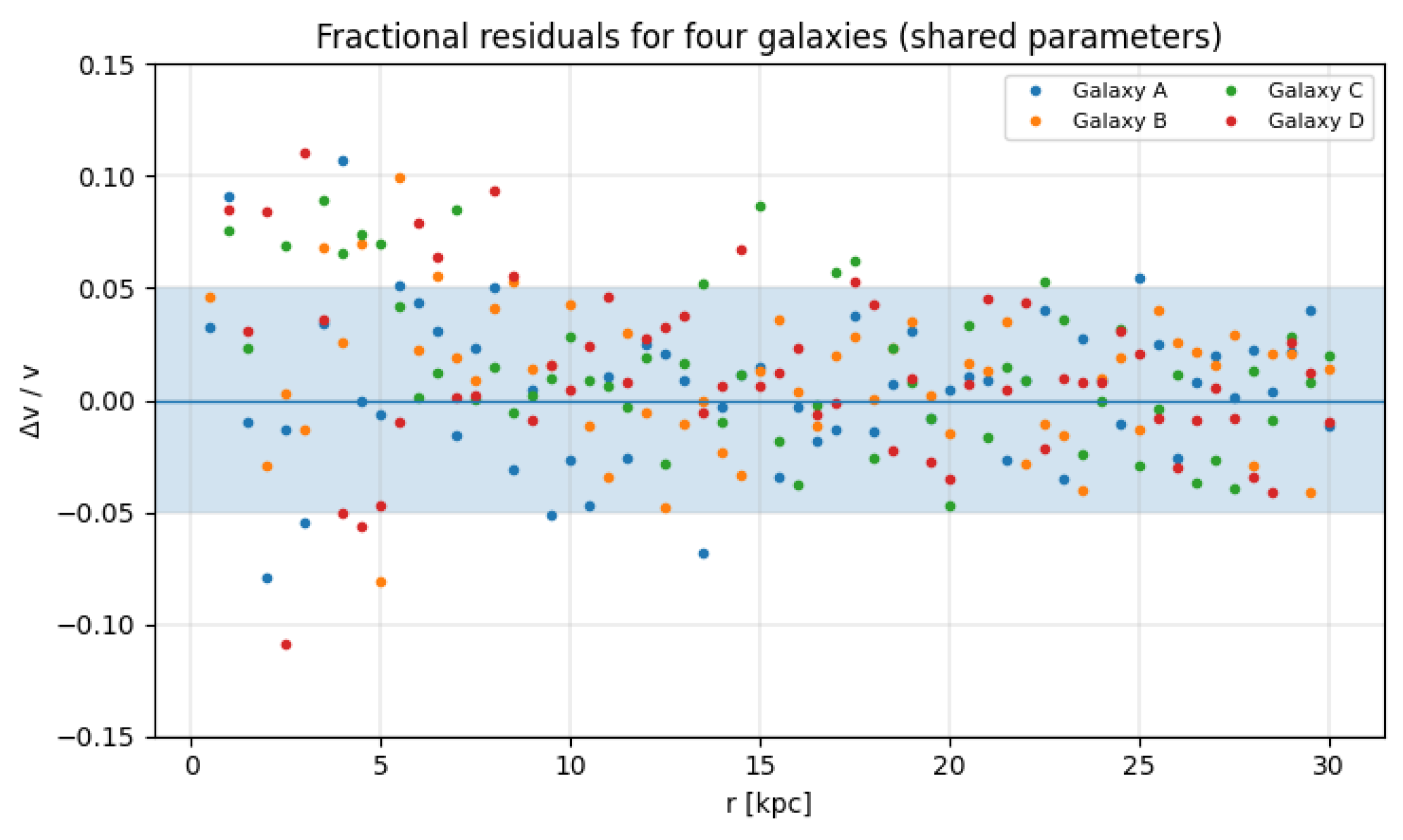
- Residual summary.
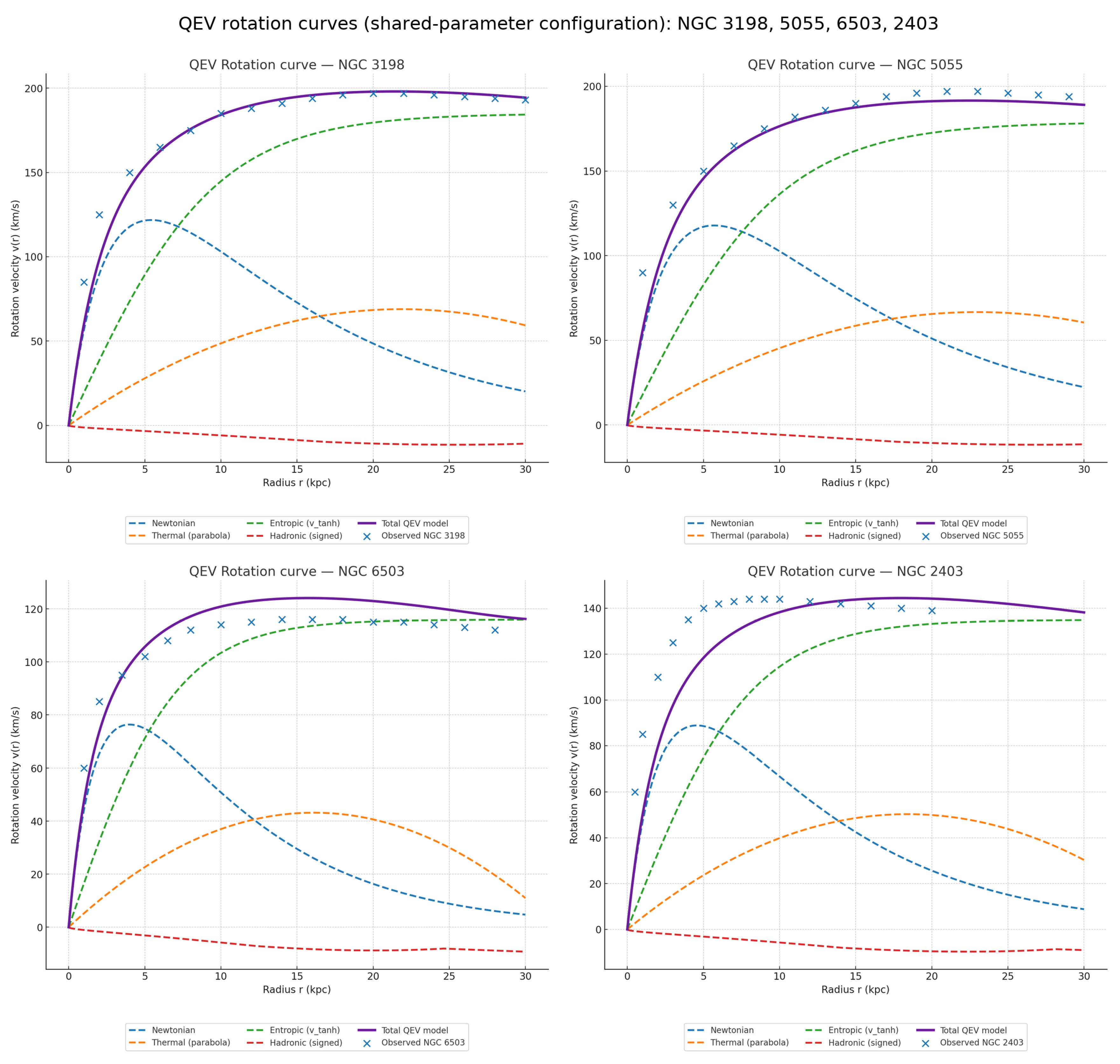
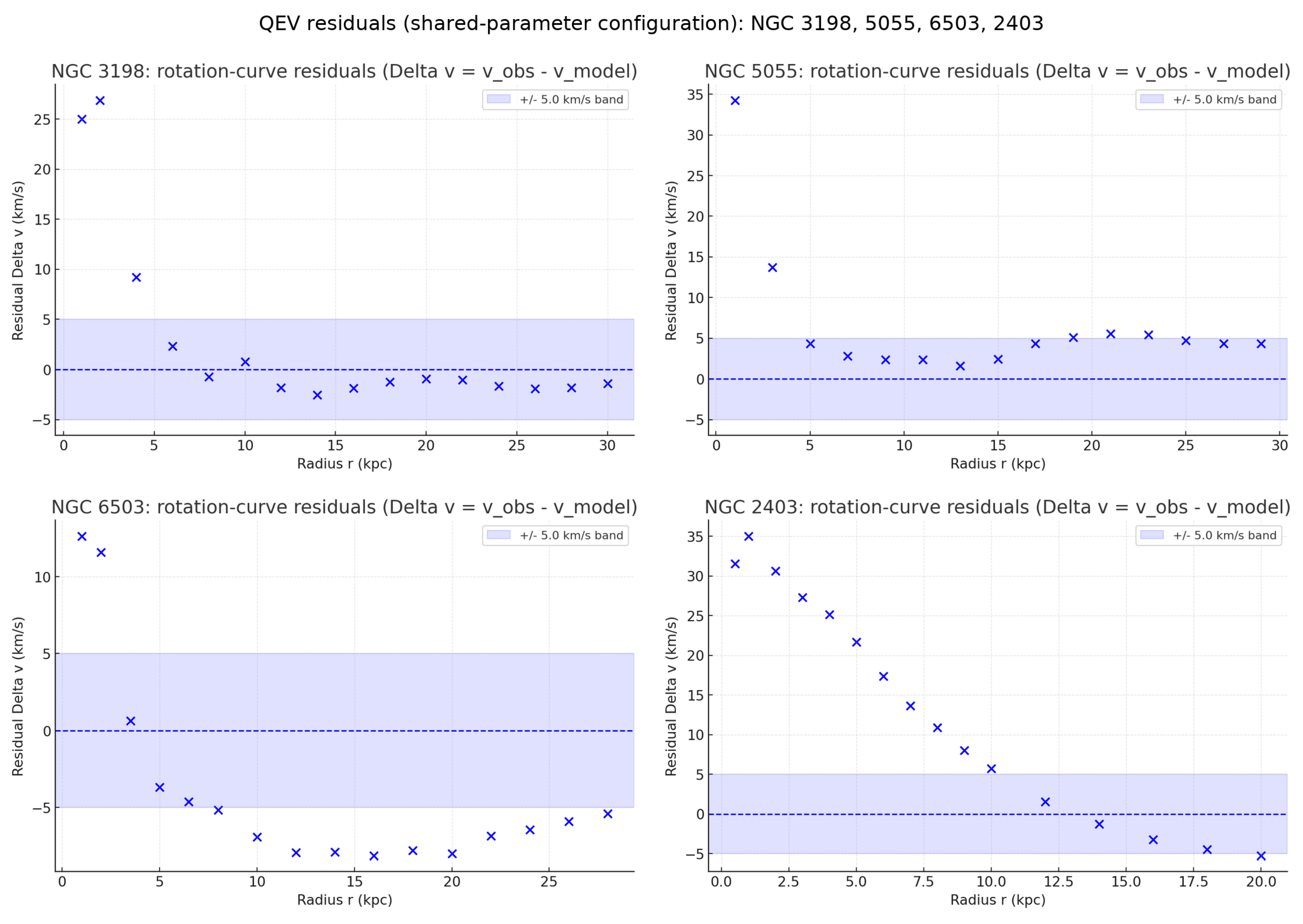
- How the figures were produced.
- Inputs per galaxy: arrays of observed radii (kpc) and velocities (km s−1); the pair .
- Parameters: construct via the fixed multipliers , , , , , , , , .
- Model evaluation: compute , , and the hadronic floor , then .
- Residuals and errors: and with . Report RMS and reduced .
- Residual plots (blue): scatter points for , dashed zero line, and a shaded band km s−1; axes labelled “Radius r (kpc)” and “Residual (km s−1)”. Files: residuals_{NGC}_plot_blue.png; 4-panel: residuals_4panel_blue.png.
- Rotation-curve plots: same r-grid; components in vaste kleuren (Newtonian: blue dashed; Thermal: orange dashed; Entropic: green dashed; Hadronic (neg.): red dashed; Total: purple solid) met waarnemingen (blauwe ×). Files: qev_curve_NGC_{3198,5055,6503,2403}_recolor.png; 4-panel: qev_rotation_curves_4panel.png.
- Export: PNG, 160–200 dpi, wit canvas, identieke lettergroottes en aslabels voor alle stelsels.
Appendix G.1. Random Sample of 20 SPARC Galaxies
| Galaxy | N | RMS [km s−1] | dof | ||
|---|---|---|---|---|---|
| UGC07577 | 9 | 5.924 | 9.013 | 9 | 1.001 |
| UGC02916 | 43 | 14.343 | 71.251 | 43 | 1.657 |
| UGC07261 | 7 | 11.747 | 16.936 | 7 | 2.419 |
| F583-4 | 12 | 12.572 | 36.202 | 12 | 3.017 |
| UGC11820 | 10 | 9.321 | 32.745 | 10 | 3.275 |
| NGC4559 | 32 | 15.132 | 120.529 | 32 | 3.767 |
| DDO154 | 12 | 11.543 | 61.848 | 12 | 5.154 |
| NGC4138 | 7 | 37.681 | 46.821 | 7 | 6.689 |
| UGC07089 | 12 | 17.986 | 88.065 | 12 | 7.339 |
| UGC06399 | 9 | 21.756 | 76.126 | 9 | 8.458 |
| UGC02885 | 19 | 35.792 | 194.719 | 19 | 10.248 |
| NGC5371 | 19 | 23.781 | 229.239 | 19 | 12.065 |
| NGC0247 | 26 | 21.802 | 363.377 | 26 | 13.976 |
| IC2574 | 34 | 22.174 | 541.520 | 34 | 15.927 |
| NGC4389 | 6 | 32.576 | 98.358 | 6 | 16.393 |
| NGC4010 | 12 | 32.693 | 212.978 | 12 | 17.748 |
| UGC04278 | 25 | 29.029 | 454.445 | 25 | 18.178 |
| UGC03546 | 30 | 42.140 | 582.816 | 30 | 19.427 |
| UGC00191 | 9 | 26.722 | 214.775 | 9 | 23.864 |
| UGC06787 | 71 | 52.461 | 1941.279 | 71 | 27.342 |
- Interpretation.
Appendix G.2. Random Sample of 50 SPARC Galaxies (Distances Only)
- Interpretation of the –RMS trend.
- Error model.
| Galaxy | N | RMS [km s−1] | dof | ||
|---|---|---|---|---|---|
| NGC1705 | 14 | 5.939 | 6.232 | 14 | 0.445 |
| NGC6503 | 31 | 7.527 | 31.973 | 31 | 1.031 |
| UGC07866 | 7 | 7.480 | 9.422 | 7 | 1.346 |
| F561-1 | 6 | 10.737 | 8.234 | 6 | 1.372 |
| UGC02916 | 43 | 14.343 | 71.251 | 43 | 1.657 |
| CamB | 9 | 7.295 | 17.578 | 9 | 1.953 |
| UGC06973 | 9 | 10.109 | 20.312 | 9 | 2.257 |
| UGCA444 | 36 | 9.400 | 88.422 | 36 | 2.456 |
| UGC05005 | 11 | 20.173 | 33.592 | 11 | 3.054 |
| NGC2998 | 13 | 28.290 | 43.032 | 13 | 3.310 |
| F563-1 | 17 | 20.773 | 56.603 | 17 | 3.330 |
| F571-V1 | 7 | 18.925 | 23.753 | 7 | 3.393 |
| NGC4183 | 23 | 14.659 | 83.093 | 23 | 3.613 |
| NGC4559 | 32 | 15.132 | 120.529 | 32 | 3.767 |
| UGC05716 | 12 | 10.729 | 51.619 | 12 | 4.302 |
| NGC3893 | 10 | 19.154 | 43.944 | 10 | 4.394 |
| UGC08699 | 41 | 18.031 | 191.071 | 41 | 4.660 |
| UGC10310 | 7 | 15.461 | 33.065 | 7 | 4.724 |
| DDO064 | 14 | 15.572 | 73.184 | 14 | 5.227 |
| UGC06923 | 6 | 18.406 | 31.412 | 6 | 5.235 |
| NGC4068 | 6 | 13.949 | 34.063 | 6 | 5.677 |
| UGC12732 | 16 | 15.585 | 100.000 | 16 | 6.250 |
| NGC4138 | 7 | 37.681 | 46.821 | 7 | 6.689 |
| UGC04499 | 9 | 15.632 | 60.625 | 9 | 6.736 |
| UGCA442 | 8 | 14.348 | 57.923 | 8 | 7.240 |
| UGC11557 | 12 | 26.444 | 88.491 | 12 | 7.374 |
| UGC06614 | 13 | 31.501 | 100.567 | 13 | 7.736 |
| NGC3953 | 8 | 24.147 | 63.962 | 8 | 7.995 |
| UGC01281 | 25 | 20.036 | 212.765 | 25 | 8.511 |
| D631-7 | 16 | 16.083 | 142.712 | 16 | 8.919 |
| UGC06786 | 45 | 28.074 | 409.201 | 45 | 9.093 |
| UGC05750 | 11 | 26.533 | 101.330 | 11 | 9.212 |
| F568-1 | 12 | 33.814 | 110.680 | 12 | 9.223 |
| NGC6946 | 58 | 24.023 | 574.046 | 58 | 9.897 |
| UGC02885 | 19 | 35.792 | 194.719 | 19 | 10.248 |
| NGC0247 | 26 | 21.802 | 363.377 | 26 | 13.976 |
| NGC3198 | 43 | 32.014 | 631.775 | 43 | 14.692 |
| NGC5985 | 33 | 31.181 | 502.055 | 33 | 15.214 |
| UGC07323 | 10 | 24.737 | 153.065 | 10 | 15.307 |
| IC2574 | 34 | 22.174 | 541.520 | 34 | 15.927 |
| NGC3877 | 13 | 39.834 | 218.626 | 13 | 16.817 |
| NGC3992 | 9 | 34.645 | 153.639 | 9 | 17.071 |
| NGC4013 | 36 | 30.688 | 619.434 | 36 | 17.206 |
| UGC03546 | 30 | 42.140 | 582.816 | 30 | 19.427 |
| NGC7331 | 36 | 31.738 | 778.123 | 36 | 21.615 |
| UGC06787 | 71 | 52.461 | 1941.279 | 71 | 27.342 |
| NGC0801 | 13 | 43.441 | 391.459 | 13 | 30.112 |
| NGC6674 | 15 | 45.972 | 809.004 | 15 | 53.934 |
| UGC02487 | 17 | 63.020 | 1150.947 | 17 | 67.703 |
| UGC09133 | 68 | 91.529 | 7942.105 | 68 | 116.796 |
Appendix H. Diagnostic Bayesian Framework for NGC 3198 (Conceptual, Non-Executed)
- Purpose.
Appendix H.1. Data and Baryonic Inputs (Given)
Appendix H.2. Model (Same as Main Text)
Appendix H.3. Parameters and Priors (Weakly Informative)
Appendix H.4. Likelihood (Acceleration Space)
Appendix H.5. Inference Protocol (Diagnostic Only)
Appendix H.6. Reporting Template (To Be Used in Future Work)
- Posterior summaries: median and 16–84% credible intervals for .
- Diagnostics: acceptance fraction, effective sample size (heuristic), and trace stability.
- Fit quality: (velocity space), , and .
Appendix H.7. Scope Statement
Appendix I. Technical Details, Conventions, and Robustness
Appendix I.1. Conventions and Residual Definitions
| Component | Phenomenological symbol | Engineering / legacy |
|---|---|---|
| Entropic term | ||
| Thermal term | ||
| Hadronic floor | ||
| Newtonian proxy | same |
Appendix I.2. Fitting Routine and Settings
- NGC 3198 fit strategy and robustness.
Appendix I.3. Sanity Checks and Numerical Diagnostics
- Acceleration–velocity identity. For every radius r we checkwith the numerical tolerance set by the grid and precision.
- Units. We work with v in and a in . Unit conversions are listed in App. D
- Monotone limits. plateau externally; is compact (bell-shaped around ); with smooth onset at .
Appendix I.4. Robustness and Sensitivity
Appendix I.5. Limitations and Scope
- Why this table is in the main text.
Appendix I.6. Legacy Synthetic Profile Parameters
- Tables (astro and SI)
| Component | Parameter | Value | Unit |
|---|---|---|---|
| Newtonian (baryonic) | 470 | km s−1 | |
| 4.8 | kpc | ||
| 8.5 | kpc | ||
| Thermal (parabolic v) | 85 | km s−1 | |
| 21.0 | kpc | ||
| Entropy (choose one) | 180 | km s−1 | |
| 10.0 | kpc | ||
| q | 1.0 | — | |
| 0.5 | — | ||
| p | 0.5 | — | |
| Hadronic (accel.) | 3 | (km s−1)2 kpc−1 | |
| 25 | (km s−1)2 kpc−1 | ||
| 20.0 | kpc | ||
| 35.0 | kpc |
| Component | Parameter | Value | Unit | Note |
|---|---|---|---|---|
| Newtonian (disk+gas) | 180.0 | km s−1 | peak baryonic rotation | |
| 8.0 | kpc | radius of maximum | ||
| k | 1.20 | – | scale factor | |
| Entropic | A | 40.0 | km2s−2 kpc−1 | asymptotic acceleration |
| 2.5 | kpc | scale radius | ||
| n | 5.0 | – | steepness exponent | |
| 3.0 | kpc | transition radius | ||
| Thermal | 400.0 | km2 s−2 kpc−1 | saturation level | |
| 15.0 | kpc | saturation radius | ||
| Hadronic (ampl.) | 0.30 | – | amplification strength | |
| 15.0 | kpc | onset radius | ||
| w | 7.0 | kpc | transition width |
| Component | Parameter | Value | Unit |
|---|---|---|---|
| Newtonian (baryonic) | m s−1 | m s−1 | |
| Thermal (parabolic v) | m s−1 | m s−1 | |
| Entropy (choose one mode) | m s−1 | m s−1 | |
| q | 1.0 | – | |
| 0.5 | – | ||
| p | 0.5 | – | |
| Hadronic (negative acceleration) + gating | m s−2 | m s−2 | |
| m s−2 | m s−2 | ||
Appendix J. Hadronic Floor: Flux-Tube Estimate
Appendix J.1. Vacuum Energy IR-Border
- Thermal suppression of hadronic fluctuations at 34 K
Appendix J.2. Gravity of the Residual Vacuum Term (Below ∼34 K)
- Set .
- Retain as a constant.
- Use in the field equations.
- Treat the term with () and assume .
Appendix J.3. Why Choose 34 K? Rationale and Robustness
- Conservative bound from QCD scale separation.
- Exponential suppression of thermal hadrons.
- Coherence with meV-scale phenomenology.
- Optional cosmological anchoring (interpretive).
- Robustness statement.
Appendix J.4. Vacuum Energy UV-Border
- Flux-tube energetics (order-of-magnitude).
- Phenomenological gating.
- Amplitude estimate.
- Testable consequences.
- Reporting recommendations
- the data vectors and covariance matrices as used in Eq. (A26) (i.e. , sampling grid, and in the exact format used for the likelihood);
- sampler configuration files and random seeds (e.g. YAML/TOML with priors, step sizes, run length, and the RNG seed);
- corner plots of the posterior showing , the transition redshift , and the key QEV background parameters.
Appendix K. Units & Normalization
Appendix K.1. Units (overview)
- Spectral density per wavenumber: has units of energy × length (J m).
- Wavenumber: k in m−1; wavelength: in m.
- Energy density: in J m−3 (or equivalently kg m−3 via ).
- Critical density: in J m−3.
- Cosmological fraction: is dimensionless.
Appendix K.2. Constants and baseline anchors (SI)
Appendix K.3. Blackbody per wavenumber and QEV spectrum
Appendix K.4. Amplitude via CMB anchor
Appendix K.5. Worked example (fully numerical)
Appendix K.6. Critical density and cosmological fraction
Appendix K.7. Reproducibility
|
Mini Sensitivity Box (baseline) Definition. Variations are quoted as relative shifts in with respect to the baseline above.
Note. These values are based on the baseline implementation (smooth window) and include the small edge correction . |
| Placeholder | Meaning | Value (unit) | Source / Note |
|---|---|---|---|
| c | Speed of light | Exact (SI) | |
| h | Planck constant | Exact (SI) | |
| Boltzmann constant | Exact (SI) | ||
| G | Newton’s constant | CODATA 2018 | |
| b | Wien constant (wavelength) | NIST | |
| Hubble constant (baseline) | Baseline choice | ||
| (SI) | Hubble constant in s−1 | From | |
| CMB Wien-peak wavelength | Baseline anchor | ||
| CMB wavenumber | |||
| IR (thermal) anchor temperature | Baseline anchor | ||
| IR anchor wavelength | |||
| IR anchor wavenumber | |||
| QCD (UV) length scale | Baseline anchor | ||
| UV wavenumber | |||
| Spectral slope | Baseline | ||
| IR window smoothness (in ) | Baseline | ||
| UV window smoothness (in ) | Baseline | ||
| CMB normalization nuisance | Baseline (diagnostic) | ||
| Bulk window at | Smooth window | ||
| Prefactor (unit check) | From | ||
| Photon energy at | |||
| QEV energy density (today) | Numerical eval. (smooth window) | ||
| Critical density (today) | |||
| Fractional density (today) | |||
| Edge correction from window | small () | Included in numeric result |
| Quantity | Value | Note / Definition |
|---|---|---|
| , | ||
| , with | ||
| , | ||
| Numerical evaluation with smooth window | ||
| , |
Appendix K. Empirical Tests (Shared-Parameter Residuals)
Appendix L. Data & Code Availability
References
- K. G. Begeman, “H i rotation curves of spiral galaxies. I – NGC 3198,” Astronomy and Astrophysics 223 (1989) 47–60.
- H. Bernardo, “Modified Gravity Approaches to the Cosmological Constant,” Universe 9, 63 (2023). [CrossRef]
- J. Binney and S. Tremaine, Galactic Dynamics, 2nd ed., Princeton University Press, Princeton, 2008.
- C. P. Burgess, “Quantum Gravity in Everyday Life: General Relativity as an Effective Field Theory,” Living Reviews in Relativity 7 (2004) 5. doi:10.12942/lrr-2004-5. [CrossRef]
- J. F. Donoghue, “General relativity as an effective field theory: The leading quantum corrections,” Physical Review D 50 (1994) 3874–3888. doi:10.1103/PhysRevD.50.3874. [CrossRef]
- A. J. H. Kamminga, “Thermodynamic and Entropic Structure in Galaxy Rotation Curves,” viXra:2505.0208. https://ai.vixra.org/abs/2505.0208.
- A. J. H. Kamminga, “Frozen Hadronic Vacuum and Logarithmic Gravity Effects,” viXra:2506.0041. https://ai.vixra.org/abs/2506.0041.
- A. J. H. Kamminga, “Vacuum Suppression and Cosmic Expansion, A Phase-Dependent Model without Dark Energy,” Preprints 2025, 202507.0199.v1. doi:10.20944/preprints202509.0972.v2. [CrossRef]
- J. B. Kogut, M. A. Stephanov, The Phases of QCD, Cambridge University Press (2004).
- R. Kubo, “The fluctuation–dissipation theorem,” Reports on Progress in Physics 29 (1966) 255–284. doi:10.1088/0034-4885/29/1/306. [CrossRef]
- S. K. Lamoreaux, “Demonstration of the Casimir Force in the 0.6 to 6 μm Range,” Physical Review Letters 78 (1997) 5–8. doi:10.1103/PhysRevLett.78.5. [CrossRef]
- F. Lelli, S. S. McGaugh, and J. M. Schombert, “SPARC: Mass Models for 175 Disk Galaxies with Spitzer Photometry and Accurate Rotation Curves,” The Astronomical Journal 152 (2016) no. 6, 157. doi:10.3847/0004-6256/152/6/157. Available at: https://astroweb.cwru.edu/SPARC/. [CrossRef]
- P. W. Milonni, The Quantum Vacuum: An Introduction to Quantum Electrodynamics, Academic Press (1994). [CrossRef]
- M. Milgrom, “A Modification of the Newtonian Dynamics: Implications for Galaxies,” Astrophys. J. 270, 365–370 (1983).
- S. S. McGaugh, F. Lelli and J. M. Schombert, “The Radial Acceleration Relation in Rotationally Supported Galaxies,” Physical Review Letters 117 (2016) 201101. doi:10.1103/PhysRevLett.117.201101. [CrossRef]
- M. Moresco et al., “A 6% Measurement of the Hubble Parameter at z∼0.45 from the Expansion Rate of Cosmic Chronometers,” JCAP 05, 014 (2016).
- M. Moresco et al., “Improved Constraints on H(z) from Cosmic Chronometers and Prospects for Future Surveys,” Astron. Astrophys. 682, A112 (2023).
- A. Padilla, “Lectures on the Cosmological Constant Problem,” arXiv:1502.05296 (2015).
- T. Padmanabhan, “Cosmological constant—The weight of the vacuum,” Phys. Rep. 380, 235–320 (2003). [CrossRef]
- T. Padmanabhan, “Thermodynamical Aspects of Gravity: New Insights,” Rep. Prog. Phys. 73, 046901 (2010). [CrossRef]
- T. Padmanabhan, “Emergent Perspective of Gravity and Dark Energy,” Res. Astron. Astrophys. 12, 891–916 (2012). [CrossRef]
- Particle Data Group, “Dark Energy,” Review of Particle Physics, 2023. Available at: https://pdg.lbl.gov/2023/reviews/rpp2023-rev-dark-energy.pdf.
- P. J. E. Peebles and B. Ratra, “The Cosmological Constant and Dark Energy,” Rev. Mod. Phys. 75, 559–606 (2003).
- S. Perlmutter et al., “Measurements of Omega and Lambda from 42 High-Redshift Supernovae,” Astrophys. J. 517, 565–586 (1999).
- N. Aghanim et al. (Planck Collaboration), “Planck 2018 Results. VI. Cosmological Parameters,” Astron. Astrophys. 641, A6 (2020). [CrossRef]
- A. G. Riess et al., “Observational Evidence from Supernovae for an Accelerating Universe and a Cosmological Constant,” Astron. J. 116, 1009–1038 (1998). [CrossRef]
- A. G. Riess et al., “A 2.4% Determination of the Local Value of the Hubble Constant,” Astrophys. J. 826, 56 (2016). [CrossRef]
- V. C. Rubin, W. K. Ford, and N. Thonnard, “Rotational Properties of 21 SC Galaxies with a Large Range of Luminosities and Radii,” Astrophys. J. 238, 471–487 (1980). [CrossRef]
- V. Sahni and A. Starobinsky, “The Case for a Positive Cosmological Λ-Term,” Int. J. Mod. Phys. D 9, 373–444 (2000). [CrossRef]
- D. Scolnic, D. Brout, A. Carr, A. G. Riess, T. M. Davis, A. Dwomoh, D. O. Jones, et al., “The Pantheon+ Analysis: The Full Dataset and Light-Curve Release,” Astrophys. J. 938, 113 (2022). doi:10.3847/1538-4357/ac8b7a; arXiv:2112.03863. [CrossRef]
- Y. Sofue and V. Rubin, “Rotation Curves of Spiral Galaxies,” Annual Review of Astronomy and Astrophysics 39 (2001) 137–174. doi:10.1146/annurev.astro.39.1.137. [CrossRef]
- M. A. Shifman, A. I. Vainshtein and V. I. Zakharov, “QCD and resonance physics. Theoretical foundations,” Nuclear Physics B 147 (1979) 385–447. doi:10.1016/0550-3213(79)90022-1. [CrossRef]
- M. A. Shifman, A. I. Vainshtein and V. I. Zakharov, “QCD and resonance physics. Applications,” Nuclear Physics B 147 (1979) 448–518. doi:10.1016/0550-3213(79)90023-3. [CrossRef]
- M. A. Shifman, A. I. Vainshtein and V. I. Zakharov, “QCD and resonance physics: The ρ–ω mixing,” Nuclear Physics B 147 (1979) 519–534. doi:10.1016/0550-3213(79)90024-5. [CrossRef]
- J. Solà, “Vacuum energy and cosmological evolution,” J. Phys.: Conf. Ser. 453, 012015 (2013).
- E. Verlinde, “On the Origin of Gravity and the Laws of Newton,” JHEP 2011(04), 029 (2011); arXiv:1001.0785.
- E. Verlinde, “Emergent Gravity and the Dark Universe,” SciPost Phys. 2, 016 (2017). [CrossRef]
- S. Weinberg, “The Cosmological Constant Problem,” Rev. Mod. Phys. 61, 1–23 (1989).
Disclaimer/Publisher’s Note: The statements, opinions and data contained in all publications are solely those of the individual author(s) and contributor(s) and not of MDPI and/or the editor(s). MDPI and/or the editor(s) disclaim responsibility for any injury to people or property resulting from any ideas, methods, instructions or products referred to in the content. |
© 2025 by the authors. Licensee MDPI, Basel, Switzerland. This article is an open access article distributed under the terms and conditions of the Creative Commons Attribution (CC BY) license (http://creativecommons.org/licenses/by/4.0/).