

Submitted:
08 September 2025
Posted:
09 September 2025
You are already at the latest version
Abstract
Truck congestion around international ports creates persistent challenges for safety, efficiency, environmental performance, and accessibility, especially during container terminal disruptions when long queues of trucks accumulate. Traditional responses have failed to address the issue, probably because they address isolated components and have inadequately accounted for the interdependencies of sociotechnical systems, in which diverse actors pursue partly conflicting goals. The current study helps address this gap by examining how combining Sociotechnical Systems (STS) principles with the Systems-Theoretic Accident Model and Processes (STAMP) could support redesign of truck re-routing procedures during terminal closures at the Port of Rotterdam. Using structured interviews with port management and document analysis, we applied par-allel STS and the STAMP method System-Theoretic Process analyses. STS revealed misalignments among procedures, actor intentions, infrastructure, and communication practices, explaining why diversion protocols often fail. The STAMP method extended this diagnosis by modeling control structures, systematically identifying 92 unsafe control actions and 407 related loss scenarios, which formed the basis of 16 design recommendations. Together, STS and STAMP methods offer diagnostic and prescriptive insights, yielding solutions such as fair-order entry processes, real-time terminal status sharing, and improved cross-actor coordination. Integrating STS and STPA provides a robust framework for redesigning transport and other complex systems to improve their outcomes.
Keywords:
STAMP
; sociotechnical systems
; port
; container terminal
; evacuation
; diversion
1. Introduction
Truck congestion around international ports is a persistent challenge with wide-ranging consequences for road safety, productivity, environmental performance, and port accessibility1,2,3. Such congestion often emerges during major disruptions to container handling at terminals or depots, when long queues of trucks accumulate while waiting to deliver or collect containers4. With container ships growing in capacity and port operations becoming increasingly interdependent and complex5,6 the impacts of these disruptions are amplified.
Traditional responses such as infrastructure expansion or logistical modelling have been used to help reduce truck congestion, but these are inevitably suboptimal as they result in only isolated changes to single system elements7,8. Recent studies and policy debates have emphasized the need for more complete solutions developed through system approaches that acknowledge the sociotechnical complexity of port traffic systems, in which diverse actors—terminal operators, port authorities, truck drivers, cargo owners, and regulators—pursue goals that can align and conflict9,10,11,12. Two system approaches that can be used to understand and intervene in complex systems are Sociotechnical systems (STS) theory and control-theoretic approaches such as the Systems-Theoretic Accident Model and Processes (STAMP). Although it has not been recognized explicitly, each of these paradigms offer distinct strengths that have the potential to be combined in a robust analytical framework for understanding port traffic and similar complex sociotechnical systems. To investigate this potential and help identify more complete solutions for port truck congestion, the current paper investigates how the complementary insights of STS and STAMP can be integrated to improve procedures for re-routing trucks on container terminal closure at the Port of Rotterdam.
1.1. Conceptual Foundations: Sociotechnical Systems and STAMP
1.1.1. Sociotechnical Systems (STS)
The study of sociotechnical systems (STS) grew out of observations that attempts to implement technology often failed due to unforeseen social ramifications of implementation13. STS has since developed into a paradigm with its own theory14. The central idea is that if technology, infrastructure or procedures are developed with too little consideration of the systems in which they will be used, they can interact with social or structural components of the system in unintended ways with undesirable consequences. As trends such as globalization, digitalization and connectivity increase interdependencies between people and structures in transport systems, sociotechnical systems approaches are becoming increasingly relevant15.
Sociotechnical design principles have been developed from a large body of empirical knowledge that allow system designers to optimize mutually influential social and structural system aspects16. These principles have been used to ensure technology fits with the goals, culture and processes of people in the system into which it will be introduced17; to develop design ideas for sociotechnical systems18 and to analyze incidents or accidents and inform future system developers19.
A sociotechnical analysis framework has also been developed to help analyze and optimize systems in line with sociotechnical theory and principles20. Existing or proposed systems can be analyzed using a framework that structures the identification of explicit combinatorial influences among six types of system dimension:
- Human (e.g., roles, behaviors, competencies)
- Intentional (e.g., goals and motives)
- Technological (e.g., digital tools, interfaces)
- Procedural (e.g., formal processes, rules)
- Cultural (e.g., norms, shared beliefs)
- Infrastructural (e.g., physical constraints like road layouts).
Problems often arise not just from a flaw in one dimension, but from misalignments among two or more dimensions, e.g., a procedure requiring real-time updates can be poorly aligned with a culture that discourages information sharing. Mapping misalignments sociotechnical dimensions can highlight opportunities for meaningful system improvement15,19.
1.1.2. System-Theoretic Accident Model and Processes (STAMP)
Even though STAMP has developed as a paradigm independently of the STS, it also recognizes the need to analyse and understand port management systems as complex sociotechnical systems in order to optimize them21. STAMP assumes that system outcomes (e.g. safety, security, efficiency) are the result of the quality of control relationships among social and structural system components. To prevent undesirable system outcomes therefore requires modelling how these components are related by control actions and feedback loops.
In Figure 1, for example, Controller A carries out control actions that influence Controller B, which in turn influences a process.
Controller A could be, for example, an office-based manager instructing an on-site team (Controller B) responsible for diverting trucks (Process). According to STAMP, each "controller" will have a mental or digital representation of (i) the state of the controller or process they are controlling, and (ii) a set of appropriate actions that can be used to influence it. Human controllers will also have ideas about what the likely effects of control actions will be. Each of these aspects of the controller’s process model evolves in response to information about the process being controlled (feedback).
In our example, the actions of the office-based manager (Controller A) will be informed by feedback on the effects of its previous instructions on the on-site team (Controller B) and the trucks being diverted (Process). Since a controller can be technical, human, or a social organization, the key components of any complex sociotechnical system can be linked together by control loops.
Control over a system requires that controllers coordinate control actions to achieve a common purpose, and that each controller receives meaningful, timely and accurate feedback and has a sufficient model of the processes being controlled. Models of control structure help understand how controllers collectively control the quality of system’s output. Of the analytical methods associated with STAMP, System-Theoretic Process Analysis (STPA) is the most popular and is suited to the identification of design flaws, component interactions, and human factors that can lead to undesirable outcomes in existing systems22,23.
1.2. Combining STS and STAMP for a Complementary Systems Analysis
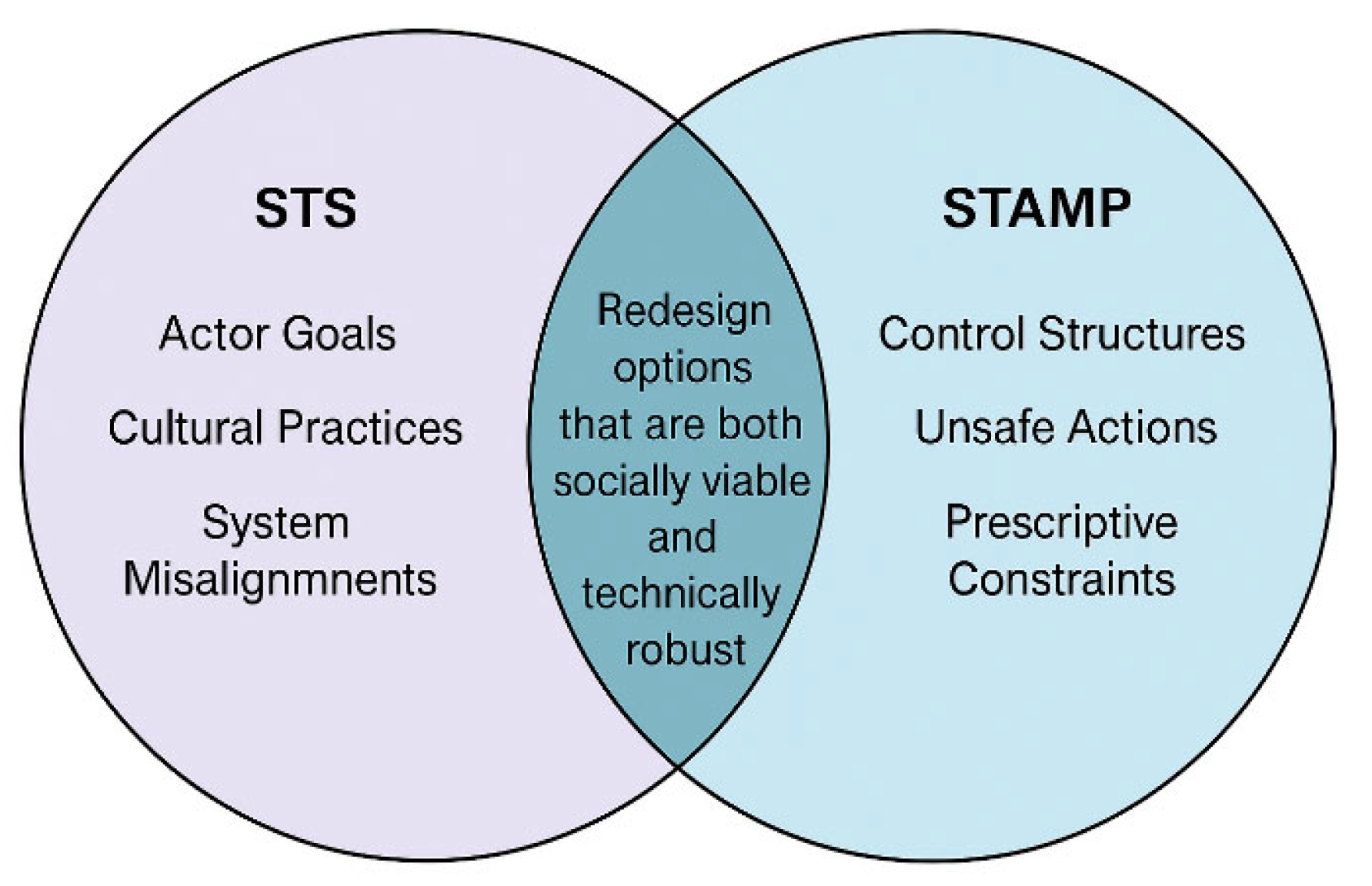
A sociotechnical systems (STS) perspective offers valuable diagnostic insights by explaining how intractable challenges can emerge from the interplay of social and technical dynamics. However, it provides limited explicit guidance on how such challenges might be resolved in practice. Control-theoretic approaches such as the STAMP framework are more prescriptive: they analyze feedback loops and control actions among social and technical actors to identify concrete interventions for improving system performance.
In this sense, the strength of STS lies in explaining why actors behave as they do within a complex system, while STAMP methods clarify how those behaviors affect system outcomes and what can be done to mitigate hazards. Integrating these approaches can address the limitations of each: STS would ensure that redesign efforts account for the lived practices, goals, and values of diverse stakeholders, whereas STAMP methods such as STPA provide technically rigorous solution that are traceable to concrete system outcomes. By combining STS and STAMP, analysts can move beyond purely descriptive diagnosis to incorporate prescriptive redesign. This integration increases the likelihood of solutions that are not only technically robust but also socially viable.
Figure 2.
Complementary aspects of STS and STAMP.
1.3. Aim
This study investigates how the integration of sociotechnical systems (STS) principles and Systems-Theoretic Process Analysis (STPA) can support the redesign of truck re-routing procedures during container terminal closures in an area of the Port of Rotterdam. Our aim is not only to understand why current procedures often fail in practice but also to demonstrate how combining diagnostic insights from STS with the prescriptive power of STPA could lead to more effective, fair, and resilient traffic management solutions. Specifically, we explore how a combined STS/STPA approach can identify misalignments among infrastructure, technology, procedures, and actor behavior, and generate redesign strategies that account for both technical control structures and the lived realities of diverse port stakeholders.
2. Methods
2.1. Case Study: Truck rerouting in the Port of Rotterdam
The system under study comprises the social and technological components involved in diverting container trucks away from terminal entrances during the planned or unplanned closure of container terminals in the Maasvlakte harbor area of the Port of Rotterdam (PoR; see Figure 3).
This harbor area hosts multiple major container terminals that receive truckloads arriving via the Dutch and broader European road networks. Trucks typically deliver containers for transfer to ships; however, terminal operations may be disrupted by planned maintenance or unforeseen events such as high wind conditions, IT system failures, or public health measures (e.g., Covid-19 restrictions). When a terminal is forced to close, port authorities must quickly divert or evacuate trucks already en route or queued near the terminal.
To manage these situations, designated holding areas—known in evacuation protocols as landing zones (LZs)—are used to temporarily buffer truck traffic. If LZs within terminal premises reach capacity, overflow buffering is handled by additional areas located outside the terminal gates, some distance away. Figure 4 shows the locations of the primary LZs (A, B, C, D) relative to the ECT, APMT, and APMT2 container terminals (indicated in pink). When one or more of these terminals closes or reaches capacity, trucks are first diverted to LZ A, which can accommodate approximately 500 trucks. Once LZ A reaches saturation, additional traffic is redirected: trucks destined for ECT, APMT, and APMT2 are sent to LZ B, while those bound for more distant terminals are forwarded to LZ C.
The focal point of this study is the operation of buffer area A during closures of ECT, APMT, and APMT2. Re-routing procedures specify the actions to be taken in such events, including:
- the allocation of truck traffic to specific buffer areas;
- activation of tailored messages on Variable Message Signs (VMS) along approach roads; and
- coordinated responsibilities for personnel in operational roles to facilitate the diversion process.
Leading up to this study in 2021, implementation of these procedures had encountered serious difficulties. In practice, port managers had observed that many truck drivers disregarded diversion instructions and continue toward the closed terminals. Some parked illegally on roads near the terminal entrance. While many were forced to turn around, the problem seemed intractable as traffic would continue to build up on roads near the terminal entrances. As a result, terminal closures often caused congestion, jeopardizing safety, and severely compromising access to roads and other, open terminals in the wider Maasvlakte area.
2.2. Document Review
Documents, traffic management plans, different Scenario documents, driver surveys conducted by PoR, and local and harbour maps were collected and reviewed as part of preparation for interviews and as part of the analysis using STS principles and framework and STPA.
2.3. Data Collection and Analysis with STS and STPA
At the start of 2021, the research team conducted a series of three structured digital interviews with two senior representatives of port management. Both participants were highly experienced in managing truck buffer scenarios and were knowledgeable about the behaviors and perspectives of the various actors involved in terminal operations and re-routing procedures. The interviews were attended by each of the three researchers and were spaced approximately three to four weeks apart. Each session lasted around two hours. The interviews were structured using the System-Theoretic Process Analysis (STPA) methodology, to inform STPA analysis22.
2.3.1. STPA Analysis
Interview 1: System definition and actor mapping. The first interview focused on collaboratively defining the system under analysis and identifying the key actors, their roles, and the relationships between them. This was foundational for constructing an initial model of the system’s control structure. To support later application of sociotechnical systems (STS) analysis, we supplemented the STPA framework with an additional prompt aimed at eliciting the goals and motives of each actor group—an element typically not captured by STPA but central to STS approaches20.
Interview 2: Control dynamics, hazards, and loss scenarios. Between the first and second interviews, the researchers developed a preliminary control structure model using the initial findings. This model was presented to the port experts during the second interview and iteratively developed in collaboration with them. Additional questions were posed to identify relevant system losses, hazards, and “unsafe”1 control actions, in line with STPA procedures. Toward the end of the second session, discussions expanded to include the nature of communication and coordination between actors during both routine operations and various types of terminal closure events. Data from this interview—along with notes from the first interview and supporting procedural documents—served as the foundation for constructing loss scenarios, which describe how specific “unsafe” conditions can emerge from control failures.
Interview 3: Validation and Refinement of Loss Scenarios. The third and final interview was used to present and validate the set of developed loss scenarios. These were reviewed collaboratively with the participants and further elaborated through discussion, ensuring that the models and scenarios accurately reflected real-world practices and challenges in the Maasvlakte operational context.
2.3.2. STS Analysis
Although the interviews were structured around STPA, the responses were suitable for analysis using the sociotechnical framework proposed by Davis et al. (2014)20. This supplementary analysis was conducted through a focused review of audio recordings, in which a single researcher annotated observations related to the six sociotechnical dimensions: human, procedural, intentional, technological, cultural, and infrastructural. Notes were developed using an interpretive application of sociotechnical theory and design principles16. Specifically, influences on re-routing events were analyzed through the lens of the six sociotechnical dimensions—Human, Procedural, Intentional, Technological, Cultural, and Infrastructural—and particular attention was given to combinatorial misalignments across these dimensions. For instance, the intended process during a terminal closure was for port management to contact the traffic control center, which would then activate messages on Variable Message Signs (VMS) to divert inbound truck traffic to designated landing zones (LZs). This sequence implies multiple dimensions: Procedural (the formal re-routing plan), Intentional (intention behind the re-routing plan), Human (port and traffic controllers, their role, experience with re-routing etc.), Technology (telephone systems, VMS), and Infrastructure (road networks). The analysis involved examining how these elements aligned or interacted in practice compared to how they were intended to function. Misalignments were noted when two or more components failed to support one another. For example, a VMS with poor visibility represents a technological constraint that undermines both the procedural intent and human action. Similarly, a poorly worded VMS message may point to a procedural deficiency—such as vague or ambiguous guidance in the re-routing protocol—or to gaps in the training of traffic control staff, thereby misaligning procedures, people, and technology. By identifying such cross-dimensional mismatches, the analysis aimed to surface latent vulnerabilities in the current system and highlight opportunities for more coherent and resilient redesign.
All participants were fully informed about the study objectives, procedures, voluntary participation, anonymity protections, and data rights prior to the interviews.
ChatGPT4.0 was used to help structure presentation of the study this article, but not used in execution or analysis of the research otherwise.
3. Results
In the event of terminal closure, truck drivers en route to closed or imminently closing terminals are intended to be diverted to designated buffer areas. This strategy aims to maintain access to open terminals for other drivers and prevent road congestion (Figure 3). However, in practice, diversion compliance is inconsistent: some drivers remain parked near closed terminals or stop on surrounding roads, contributing to traffic obstructions and unsafe conditions. To identify systemic causes of this breakdown, we conducted STS and STPA analyses of the re-routing procedure. For both analyses the system was defined as the combined people, procedures, technologies, and infrastructures working to achieve safe, orderly, efficient and fair contingency parking on temporary closure of a container terminal due to IT malfunction, storm or other risk.
3.1. STS Analysis
The sociotechnical systems analysis identified several critical misalignments across the six STS dimensions that undermine the effectiveness of the re-routing procedure.
3.1.1. Misalignment Between Procedures and Actor Intentions
While the re-routing procedure aligned well with the overarching goals of terminal operators, to reduce congestion and enhance safety in the terminal, it was less well aligned with the key goals of other system actors, particularly truck drivers. One major source of misalignment concerned fair treatment: the procedure did not ensure that drivers were processed at re-opened terminals in the order of their arrival at the port. As a result, drivers perceived the procedure as unfair and sought alternative strategies to maintain competitive advantage—such as parking near terminal gates rather than diverting. This behavioral adaptation led to unintended consequences, including roadside queuing, obstructed routes, and increased overtaking behavior, directly undermining the safety intention behind the procedure. The extent to which actor goals aligned or conflicted with the re-routing procedure is summarized in Table 1.
3.1.2. Misalignment Between Procedures and Infrastructure
The effectiveness of the re-routing procedure was also constrained by the physical layout of the road network and buffer areas. The existing infrastructure did not support channeling trucks into queues based on their order of arrival, especially when LZs were shared by trucks destined for different terminals. Moreover, the geometry of road access meant that trucks diverted to buffer areas had to drive away from their target terminal, misaligning with driver expectations. Critically, it was not feasible to physically enforce driver compliance by closing access roads to the terminals, as these same roads had to remain open to vehicles bound for other operational terminals. This infrastructural limitation reduced the enforceability of diversion instructions, allowing for discretionary driver behavior. Some drivers would bypass diversion signs to verify terminal status firsthand or gain early positioning.
3.1.3. Misalignment Between Procedures, Culture, and Technology
A further misalignment was observed between formal procedures and the cultural-technological practices of truck drivers. Drivers frequently used social media platforms such as WhatsApp and Facebook to coordinate with their peers, reflecting a long-standing culture of peer-to-peer communication. Social media was used as a tool not only for information sharing but for strategic collaboration. For example, drivers would coordinate actions, parking on specific side roads to improve group positioning for terminal re-entry. At the time of the study, port management had not leveraged social media to communicate directly with drivers, nor was there deployment of sensor- or camera-based monitoring to track truck locations. As a result, management lacked real-time situational awareness of traffic behaviors, while drivers demonstrated high adaptability through informal, decentralized networks and use of newer communication technologies. This asymmetry in technological use and communication modes—hierarchical and analog on one side, distributed and digital on the other—contributed to a disconnect between the intended re-routing process and its real-world implementation.
3.2. STPA Analysis
We applied Systems-Theoretic Process Analysis (STPA) to identify how well the control structure of the re-routing system prevents losses during terminal closures.
3.2.1. Losses, Hazards and System-Level Constraints
Port management identified three key losses to be avoided:
- L1 – Delays to ship departures
- L2 – Road safety risks (collisions or near misses)
- L3 – Damage to the port authority’s reputation for fairness
Next we derived a set of hazards (e.g. unsafe queues, illegal parking, fairness perception failures) and related system constraints that must be enforced to avoid these losses. Examples of system constraints are that trucks should not queue in ways that obstruct access to other terminals, and it should be evident to drivers that entry to reopened terminals occurs in fair order. A full list of hazards and system constraints is given in Appendix A.
3.2.2. Control Structure and Unsafe Control Actions
The system control structure shown in Figure 5 was analysed to identify 92 unsafe control actions (UCA) across communication and coordination links among system actors. Each UCA represented an “unsafe”, omitted, poorly timed or poorly executed action that could violate a system constraint. The full list of UCAs is given in Appendix B.
3.2.3. Loss Scenarios and Design Recommendations
For each UCA, we developed loss scenarios by asking why they could occur in control theoretic terms. This resulted in the identification of 407 loss scenarios, clustered into four categories:
- Unsafe controller actions (51.6%)
- Inadequate feedback/information (26.3%)
- Faulty control paths (14.2%)
- Failures in the process being controlled (7.9%)
Thus for example, the control action “Container terminal fails to tell port management that it will re-open” was unsafe as it would have led to delayed re-entry of trucks and delayed ship departure (L1). This UCA could be explained by ten envisaged loss scenarios e.g. “Terminal does not think that PoR needs to know it will re-open or has re-opened” and “Terminal believes PoR already knows terminal will re-open”.
Finally, from the 407 loss scenarios, we derived 29 preliminary design recommendations, which we synthesized further into 16 final design recommendations (Table 2).
4. Discussion
4.1. Comparison of STPA Recommendations and STS Results
The STS and STPA analyses were clearly complementary. While the STS framework identified why the re-routing procedure broke down in terms of misalignments between actor goals, infrastructure constraints, cultural practices, and technological gaps, the STPA analysis how those breakdowns could be corrected through redesign of control actions and feedback structures. This is illustrated by Table 3.
4.2. Implications for Sociotechnical Design
The findings of this study reinforce the value of combining STS and STPA to both diagnose systemic failures and develop prescriptive redesigns in complex sociotechnical systems. The STS analysis identified a range of misalignments across sociotechnical dimensions, including disconnects between formal procedures and the goals of truck drivers, infrastructural constraints that limited physical enforcement, and cultural-technical mismatches in communication practices between drivers and port management.
These diagnostic insights help explain why, despite the existence of formal re-routing protocols, drivers frequently disregard diversion instructions, seeking instead to position themselves advantageously for terminal re-entry. This behavioral adaptation undermines the safety and fairness goals of the system, leading to congestion, unsafe road conditions, and diminished legitimacy of the diversion procedures.
The STPA analysis complemented these findings by identifying actionable control flaws and specifying redesign strategies to mitigate risks. Many of the 16 design recommendations correspond directly to the failures highlighted in the STS analysis. For example, the recommendation to implement a fair-order process (Recommendation #2) directly responds to the STS-identified misalignment between procedure design and driver expectations. Similarly, recommendations to enhance real-time visibility of terminal status (Recommendation #1) and to coordinate awareness between PoR, coordinators, traffic controllers, and container terminals (Recommendations #3–6) address the fragmented feedback and information flows diagnosed by the STS framework.
While STS emphasized the importance of aligning procedures with actor goals and sociocultural practices, STPA brought precision to how these dynamics could be governed through improved feedback loops, coordination mechanisms, and role-specific responsibilities. Notably, the STPA recommendations go beyond individual component failures to re-engineer control structures—providing a roadmap for system-wide resilience.
Together, the two approaches fulfilled the dual aim of this study: (1) understanding why truck re-routing procedures fail in real-world scenarios, and (2) identifying concrete, implementable redesigns to improve performance. The integration enabled us to bridge the gap between diagnostic insight (why the system fails) and prescriptive guidance (how it can be improved), yielding solutions that are both technically robust and socially grounded. This dual-perspective framework offers a promising template for redesigning other sociotechnical control systems facing similar challenges.
4.3. Study Limitations
While the current study demonstrates the need to account for systemic factors in designing procedures to prevent in-port truck congestion, we do not know the extent to which the precise findings and solutions reported here can be applied to port areas generally. A further limitation of the current study was that information from documents was supplemented by information on operations from two port management representatives. While these representatives had the best working knowledge of how re-routing procedures functioned in practice, as well as experience with and understanding of the other actors involved, a more comprehensive approach involving interviews or workshops with people representing truck drivers and other key system actors could improve re-routing procedures further. Drivers other than truck drivers using the port, cargo owners, shipping lines and other more peripheral actors could also have been considered to a greater extent. Similarly, the STPA analysis was conducted and researcher-constructed control models based on interview data, rather than through a fully participatory or co-design STPA workshop involving all key actors. This may have limited the depth of understanding regarding real-time control decision-making, feedback challenges, or trust dynamics across actors. Although STPA was used successfully to derive actionable redesign recommendations, the method itself does not explicitly account for cultural or behavioral dynamics—a gap the study sought to address by incorporating STS. However, fully integrating these soft system elements into the STPA modeling process remains an ongoing methodological challenge.
4.4. Conclusions
Sociotechnical systems (STS) and Systems-Theoretic Process Analysis (STPA) have been used to understand and generate redesign recommendations for truck re-routing procedures at the Port of Rotterdam. While STS provided a diagnostic lens for understanding misalignments among procedures, actor goals, infrastructure, and communication practices, STPA offered prescriptive tools to redesign control structures, enhance coordination, and reduce the likelihood of systemic losses. By applying both methods, we showed how sociotechnical misalignments can be traced to specific feedback gaps, information delays, or organizational blind spots, and how these can be addressed through coordinated redesign. The integration of descriptive and prescriptive approaches allowed us to generate solutions that are more likely to be both technically feasible and socially viable—including fair-order mechanisms, real-time status sharing, and better synchronization across actors. PoR have been working to integrate these findings as they look to implement technological solutions to ease truck congestion.
As port systems grow more complex and interdependent, there is a growing need for analytical methods that address both the behavioral and structural aspects of control. Our findings suggest that combining STS and STPA holds significant promise for guiding system redesigns that improve resilience, equity, and operational safety. Future applications of this approach in other transport or infrastructure domains could help validate its broader relevance.
Author Contributions
For research articles with several authors, a short paragraph specifying their individual contributions must be provided. The following statements should be used “Conceptualization, ROP, BR, SR; methodology, formal analysis, writing-original draft preparation, ROP; review and editing, ROP; project administration, ROP, BR, SR. All authors have read and agreed to the published version of the manuscript.
Funding
The SAFEWAY project has received funding from the European Union’s Horizon 2020 research and innovation program under grant agreement No 769255. This paper reflects only the views of the authors. Neither the Innovation and Networks Executive Agency (INEA) nor the European Commission is in any way responsible for any use that may be made of the information it contains.
Conflicts of Interest
The authors declare no conflicts of interest.
Appendix A. Loss, Hazards and System Constraints
- Loss
- Port management representatives identified three types of loss (L) that it was important for the system to avoid:
- L-1
- Delay to ship departure
- L-2
- Material or personal injury due to road traffic collision
- L-3
- Port authority get a reputation for unfair practice
- Hazards
- Hazards are system states that increase the risk of losses occurring. The following hazards (H) and subhazards (SH) were identified for the system under study:
- H-1
-
Truck queue outside one container terminal reduces access to another [can lead to L-1, L-2, L-3]
- SH-1.1
- Trucks approach closed terminal instead of buffer area [can lead to H-1]
- SH-1.2
- Too many trucks arrive at open terminal just before it is closed [H-1]
- SH-1.3
- Too high rate of trucks arriving at terminal after it is re-open [H-1]
- H-2
- Trucks parked on main roads or side roads surrounding a container terminal [L-1, L-2, L-3]
- H-3
- Trucks turning around in a road leading to a closed container terminal [L-1, L-2]
- H-4
-
It is not evident to truck drivers in buffer area that all trucks will enter re-opened terminal in order of arrival at port [L-3]
- SH-4.1
- Drivers/firms do not see that all trucks will enter re-opened terminal in order of arrival at port [L-3]
- SH-4.2
- Drivers in buffer area do not see that trucks not using buffer area cannot enter terminal before them [L-3]
- SH-4.3
- Drivers in buffer area do not see that trucks arriving at port just after terminal re-opening will not enter terminal before them [L-3]
- H-5
- Trucks in buffer area do not start to approach terminal once it is re-opened [L-1]
- System constraints
- We considered constraints that need to be upheld by the system in order to prevent loss. Systems constraints are derived from hazards and sub-hazards:
- SC-0
- < X trucks queue on road outside a container terminal [H-1]
- SC-1
- Drivers do not drive to a closed terminal instead of a buffer area [SH-1.1]
- SC-2
- < Y trucks head towards a terminal less than Z minutes before it closes [SH-1.2]
- SC-3
- Rate of trucks [no. of trucks/min] heading towards a re-open terminal limited [SH-1.3]
- SC-4
- Trucks do not park on roads near terminal that is closed, about to close or re-open [H-2]
- SC-5
- Trucks do not enter road leading to a terminal that is closed or about to close [H-3]
- SC-7
- Evident to drivers/firms that trucks enter re-opened terminal in order of arrival at buffer area [SH-4.1]
- SC-8
- Evident to drivers that trucks not buffering do not enter the terminal before trucks that have diverted [SH-4.2}
- SC-9
- Evident to drivers that trucks arriving at port do not enter re-open terminal before trucks coming from buffer area [SH-4.3]
- SC-10
- Trucks progress to correct terminal once it is re-opened [H-5]
Appendix B. Unsafe Control Actions (UCA) with Corresponding Safety Constraints (SC)

| Unsafe Control Actions Identified (UCA) | |||
|---|---|---|---|
| Control action (cf Fig. 3) | Not providing action causes hazard | Providing action causes hazard | Too early, late, out of order |
| 1 Container Terminal to PoR: terminal will close | UCA-1: Container Terminal does not tell PoR that it will close (SC-0,1,2,5,7,8,9) | UCA-2: Container Terminal tells PoR that it will close when it will not (SC-10) | UCA-3: Container Terminal gives PoR insufficient warning that it will close (SC-0,1,2,5) |
| 1 Container Terminal to PoR: terminal will open | UCA-4: Container Terminal does not tell PoR that it will open (SC-10) | UCA-5: Container Terminal tells PoR that it will open when it will not (SC-0,1,2,5) | UCA-6: Container Terminal gives PoR insufficient warning that it will open (SC-10) |
| 2 PoR to On-site Coordinator: instructions on terminal closure | UCA-15: PoR does not give on-site Coordinator instructions to divert from terminal when it closes (SC-0,1,2,4,5) | UCA-16: PoR gives on-site Coordinator instructions to divert drivers from terminal when it will remain open (SC-10) | UCA-17: PoR gives on-site Coordinator instructions too late to divert drivers from terminal (SC-0,1,2,4,5) |
| UCA-19: PoR gives on-site Coordinator inadequate instructions on how to divert drivers from terminal when it closes (SC-0,1,2,4,5,7,8,9,10) | |||
| 2 PoR to On-site Coordinator: instructions on terminal opening | UCA-20: PoR does not give on-site Coordinator instructions to tell drivers to start going to terminal when it re-opens (SC-10) | UCA-21: PoR gives on-site Coordinator instructions to tell drivers to start going to terminal when it will stay closed (SC-0,1,2,4,5) | UCA-22: PoR gives on-site Coordinator instructions too late to tell drivers to start going to terminal when it will re-open (SC-8,9,10) |
| UCA-23: PoR gives on-site Coordinator inadequate instructions on to tell drivers to start going to terminal when it will re-open (SC-0,3,7,8,9,10) | |||
| 3 PoR to Traffic Control Centre: Display “Divert to LZ” | UCA-24: PoR does not instruct Control Centre to display “Divert to LZ” when terminal will close (SC-0,1,2,4,5) | UCA-25: PoR instructs Control Centre to display “Divert to LZ” when terminal will not close (SC-10) | UCA-26: PoR instructs Control Centre too late to display “Divert to LZ” when terminal will close (SC-0,1,2,4,5) |
| UCA-27: PoR does not instruct Control Centre to display “Divert to LZB” when LZA full (SC-1,4) | UCA-28: PoR instructs Control Centre to divert to wrong LZ (SC-7,8,9) | UCA-29: PoR instructs Control Centre too early to display “Divert to LZ” when terminal will close (SC-10) | |
| UCA-30: PoR does not instruct Control Centre to stop display “Divert to LZ” when terminal will open (SC-10) | UCA-31: PoR tells Controll Centre to stop display “Divert to LZ” when terminal still closed (SC-0,1,2,4,5) | UCA-32: PoR instructs Control Centre too late to display “Divert to LZB” as LZA full (SC-1,4) | |
| UCA-33: PoR instructs Control Centre too late to stop display “Divert to LZ” when terminal will open (SC-10) | |||
| 4 Traffic Control Centre to VMS: Display “Divert to LZ | UCA-34: Traffic Control Centre does not program VMS to display “Divert to LZ” when terminal will close (SC-0,1,2,4,5) | UCA-35: Traffic Control Centre instructs VMS to display “Divert to LZ” when terminal will not close (SC-10) | UCA-36: Traffic Control Centre instructs VMS too late to display “Divert to LZ” when terminal will close (SC-0,1,2,4,5) |
| UCA-37: Traffic Control Centre does not program VMS to display “Divert to LZB” when LZA full (SC-1,4) | UCA-38: Traffic Control Centre instructs VMS to display divert to wrong LZ (SC-7,8,9) | UCA-39: Traffic Control Centre instructs VMS too late to display “Divert to LZB” as LZA full (SC-1,4) | |
| UCA-40: Traffic Control Centre does not program VMS to stop display “Divert to LZ” when terminal will open (SC-10) | UCA-41: Traffic Control Centre programs VMS to stop display “Divert to LZ” when terminal still closed (SC-0,1,2,4,5) | UCA-42: Traffic Control Centre programs VMS too late to stop display “Divert to LZ” when terminal will open (SC-10) | |
| UCA-43: Traffic Control Centre programs VMS too early to stop display “Divert to LZ” when terminal will re-open (SC-3) | |||
| 5 On-site Coordinator to on-site Traffic Controller: Divert traffic to LZ | UCA-44: On-site Coordinator does not instruct Traffic Controllers to divert trucks to LZ when terminal will close (SC-0,1,2,4,5) | UCA-45: On-site Coordinator instructs Traffic Controllers to divert trucks to LZ when terminal will stay open (SC-10) | UCA-46: On-site Coordinator instructs Traffic Controllers too late to divert traffic to LZ when terminal will close (SC-0,1,2,4,5) |
| UCA-47: On-site Coordinator instructs Traffic Controllers to divert trucks to wrong LZ when terminal will close (SC-7,8,9) | UCA-48: On-site Coordinator instructs Traffic Controllers too early to divert traffic to LZ when terminal will close (SC-10) | ||
| UCA-49: On-site Coordinator instructs Traffic Controllers to divert trucks headed for different terminal to LZ when terminal will close (SC-10) | |||
| 5 On-site Coordinator to on-site Traffic Controllers: Stop divert traffic to LZ | UCA-50: On-site Coordinator does not instruct Traffic Controllers to stop diverting trucks to LZ when terminal will re-open (SC-10) | UCA-51: On-site Coordinator instructs Traffic Controllers to stop divert trucks to LZ when terminal will remain closed (SC-0,1,2,4,5,7,8,9) | UCA-52: On-site Coordinator instructs Traffic Controllers too late to stop divert trucks to LZ when terminal will re-open (SC-10) |
| 6 On-site Traffic Controllers set out re-routing measures | UCA-53: On-site Traffic Controllers do not set out re-routing measures when terminal will close (SC-0,1,2,4,5) | UCA-54: On-site Traffic Controllers set out re-routing measures when terminal will not close (SC-10) | UCA-55: On-site Traffic Controllers set out re-routing measures too late when terminal will close (SC-0,1,2,4,5) |
| UCA-56: On-site Traffic Controllers set out wrong re-routing measures when terminal will close (SC-4, 10) | UCA-57: On-site Traffic Controllers set out re-routing measures too early when terminal will close (SC-10) | ||
| 6 On-site Traffic Controllers remove re-routing measures | UCA-58: On-site Traffic Controllers do not remove re-routing measures when terminal open (SC-10) | UCA-59: On-site Traffic Controllers remove re-routing measures when terminal still closed (SC-0,1,4,5,7,8,9) | UCA-60: On-site Traffic Controllers remove re-routing measures too late when terminal re-open (SC-8,9,10) |
| 7 On-site Traffic Controllers or Parking Attendant to Driver: Drive to terminal | UCA-61: On-site Traffic Controllers or Parking Attendant do not tell x number of first-to-arrive drivers to drive to terminal when re-open (SC-3,7,10) | UCA-62: On-site Traffic Controllers or Parking Attendant tell Driver to drive to terminal when terminal will remain closed (SC-0,1,2,4,5) | UCA-63: On-site Traffic Controllers or Parking Attendant tell Drivers to drive to terminal in fair order too late after terminal open (SC-8,9,10) |
| UCA-64: On-site Traffic Controllers or Parking Attendant tell Driver to drive to terminal in unfair/random order when terminal will open (SC-0,1,2,4,5) | UCA-65: On-site Traffic Controllers or Parking Attendant tell Drivers to drive to terminal too early before terminal open (SC-0,1,3,4,5) | ||
| 8 On-site Inspector to Driver: move truck from road to LZ | UCA-66: On-site Inspector does not tell Driver: move truck from road to LZ (SC-0,4,7,8) | UCA-67: On-site Inspector tells Driver: move truck from road to wrong LZ (SC-7,9,10) | UCA-68: On-site Inspector tells Driver too late: move truck from road to LZ (SC-0,4,7,8) |
| UCA-69: On-site Inspector tells Driver: move truck from road without designating LZ (SC-7,9) | |||
| 9 On-site Police to Driver: move truck from road to LZ | UCA-70: On-site Police does not tell Driver: move truck from road to LZ (SC-0,4,7,8) | UCA-71: On-site Police tells Driver: move truck from road to wrong LZ (SC-7,9) | |
| UCA-72: On-site Police tells Driver: move truck from road from road without designating LZ (SC-4,7) | |||
| 10 Transporter to Driver(s): Delivery instructions | UCA-73: Transporter informs driver to deliver to terminal as fast as possible (SC-1,2,3,4,5) | ||
| 11 PoR to Parking Attendant: send drivers to terminal | UCA-74: PoR does not ask Attendant to send driver to correct terminal once re-open (SC-9, 10) | UCA-75: PoR asks Attendant to send driver to terminal that will not open (SC-0,1,3,4,5) UCA-76: PoR asks Attendant to send driver to terminal in unfair order (SC-7) |
|
| 12 Terminal to gate: close | UCA-77: Terminal closes gate too early (SC-0,1,4,5) UCA-78: Terminal closes gate too late (SC-8) |
||
| 12 Terminal to gate: open | UCA-79: Terminal opens gate too early, allowing in trucks who have not waited at LZ (SC-7,8,9) UCA-80: Terminal opens gate too late when trucks are on way from LZ (SC-0,1,4,5) |
||
| 13 Driver: Drives to terminal | UCA:82: Driver does not drive to terminal that is open or about to re-open (SC-10) | UCA-81: Driver drives to terminal that is closed or about to close (SC-0,1,2,4,5) | UCA83: Driver arrives too late at terminal about to close (SC-0,1,2,4,5) |
| UCA-84: Driver drives to wrong terminal (SC-1,4,5) | |||
| 13 Driver: Drives to LZ | UCA-85: Driver routed to LZ on way into port does not drive to designated LZ (SC-0,1,2,4,5) | UCA-86: Driver drives to full LZ | UCA-88: Driver drives to LZ too early – terminal yet to shut (SC-10) |
| 14 Driver: Enters info on social media | UCA-89: Driver tells other drivers to drive to closed terminal (SC-0,1) | UCA-91: Driver tells other drivers too late that terminal about to close (SC-0,1,2,4,5) | |
| UCA-90: Driver tells other drivers terminal about to close (SC-0,1,2,4,5) | |||
| UCA-92: Driver tells other drivers terminal has re-opened (SC-3, 7, 8, 9) | |||
| 1 | Note that although the terms “hazard” and “unsafe” as used in STAMP can be misleading as they do not necessarily relate to safety per se. Hazards are system states that can lead to loss of any desirable system outcome – not just safety, but efficiency, punctuality, security, equal treatment and so on. Likewise, “unsafe” can mean |
References
- Hall, S. Traffic Planning in Port Cities - Discussion Paper; ITF/OECD; ITF Roundtable 169; Simon Fraser University: Buenos Aires, 2017. [Google Scholar]
- JICA, 2018. Overcoming Congestion Issues, Presentation by Japan International Cooperation Agency, accessed online 5th June 2024 https://www.jica.go.jp/.
- Osadume, R. , Okene, A., Uzoma, B. & Enaruna, D. An Evaluation of the delay factors in Nigeria’s seaports: A study of the Apapa port complex. Journal of Transportation and Logistics 2023, 8, 191–204. [Google Scholar] [CrossRef]
- Iyoob, M. Z.; van Niekerk, B. CAUDUS: An optimisation model to reducing port traffic congestion. In 2021 International Conference on Artificial Intelligence, Big Data, Computing and Data Communication Systems (icABCD); 2021; pp 1–7. [CrossRef]
- Zhang, W. , Li, C. & Gai, W. (2024). How does evacuation risk change over time? Influences on evacuation strategies during accidental toxic gas releases. International Journal of Disaster Risk Reduction 2024, 108, 104531. [Google Scholar] [CrossRef]
- Liu, Z. , Dong, G. and Gui, Y. Data-driven emergency evacuation decision for cruise ports under Covid-19: an improved genetic algorithm and simulation. Physica A: Statistical mechanics and its applications. 2023. [Google Scholar] [CrossRef]
- Lau, Y. K. H.; Lee, M. Y. N. Simulation study of port container terminal quay side traffic. In AsiaSim 2007. Communications in Computer and Information Science, vol. 5. Springer, Berlin.; 2007.
- Vis, I. F. A.; de Koster, R. (M. ) B. M.; Savelsbergh, M. W. P. Minimum vehicle fleet size under time-window constraints at a container terminal. Transportation Science 2005, 39, 249–260. [Google Scholar] [CrossRef]
- Lange, A.-K.; Schwientek, A.; Jahn, C. Reducing truck congestion at ports – Classification and trends. In: Jahn, Carlos Kersten, Wolfgang Ringle, Christian M. (Ed.): Digitalization in Maritime and Sustainable Logistics: City Logistics, Port Logistics and Sustainable Supply Chain Management in the Digital Age. Proceedings of the Hamburg International Conference of Logistics (HICL); Vol 24; Hamburg University of Technology (TUHH), Institute of Business Logistics and General Management: Hamburg, Germany, 2017; pp 37–58.
- Estrada, W. More holistic approach needed to address backlog at our ports. Published online at CalMatters , November 18, 2021. Accessed online 2nd June 2024. https://calmatters.org/commentary/2021/11/more-holistic-approach-needed-to-address-backlog-at-our-ports/.
- Martin, J.; Thomas, B. J. The container terminal community. Maritime Policy & Management 2010, 28, 279–292. [Google Scholar] [CrossRef]
- Meersman, H.; Van de Voorde, E.; Vanelslander, T. Port congestion and implications to maritime logistics. In: Song, D.-W., Panayides, P. M., Eds. Maritime Logistics; Emerald Group Publishing Limited, 2012; 49–68. [CrossRef]
- Trist, E. L.; Bamforth, K. W. Some social and psychological consequences of the longwall method of coal-getting: An examination of the psychological situation and defences of a work group in relation to the social structure and technological content of the work system. Human Relations 1951, 4, 3–38. [Google Scholar] [CrossRef]
- Fischer, L.; Baskerville, R. Revising the socio-technical perspective for the 21st century: New mechanisms at work. Journal of database management 2020, 31, 19. [Google Scholar] [CrossRef]
- Phillips, R.O.; Berg, S.-H. Sociotechnical factors supporting mobile phone use by bus drivers. IISE Transactions on Occupational Ergonomics and Human Factors, 2023, 11(1-2):1-13.
- Clegg, C. Sociotechnical principles for system design. Applied Ergonomics 2000, 31, 463–477. [Google Scholar] [CrossRef] [PubMed]
- Hughes, H. P. N.; Clegg, C. W.; Bolton, L. E.; Machon, L. C. Systems scenarios: A tool for facilitating the socio-technical design of work systems. Ergonomics 2017, 60, 1319–1335. [Google Scholar] [CrossRef] [PubMed]
- Read, G., J. M.; Beanland, V.; Lenné, M., G.; Stanton, N. A.; Salmon, P. M. Integrating Human Factors Methods and Systems Thinking for Transport Analysis and Design; CRC Press: Boca Raton, FL, 2017. [Google Scholar]
- Challenger, R.; Clegg, C. W. Crowd disasters: A socio-technical systems perspective. Contemporary Social Science 2011, 6, 343–360. [Google Scholar] [CrossRef]
- Davis, M. C.; Challenger, R.; Dharshana, N. W. J.; Clegg, C. Advancing sociotechnical systems thinking: A call for bravery. Applied Ergonomics 2014, 45, 171–180. [Google Scholar] [CrossRef] [PubMed]
- Leveson, N. A New accident model for engineering safer systems. Safety Science 2004, 42, 237–270. [Google Scholar] [CrossRef]
- Leveson, N.; Thomas, J. STPA Handbook; 2018.
- Phillips, R. O.; Rutten, B.; Rezvani, S. Sociotechnical Systems Analysis of Extreme Events and Implications for Infrastructure Management Systems (D4.2). EU H2020 Project “Safeway” Deliverable 4.2; European Commision, 2021.
Figure 1.
Structure of a single control loop, adapted from [22].
Figure 1.
Structure of a single control loop, adapted from [22].
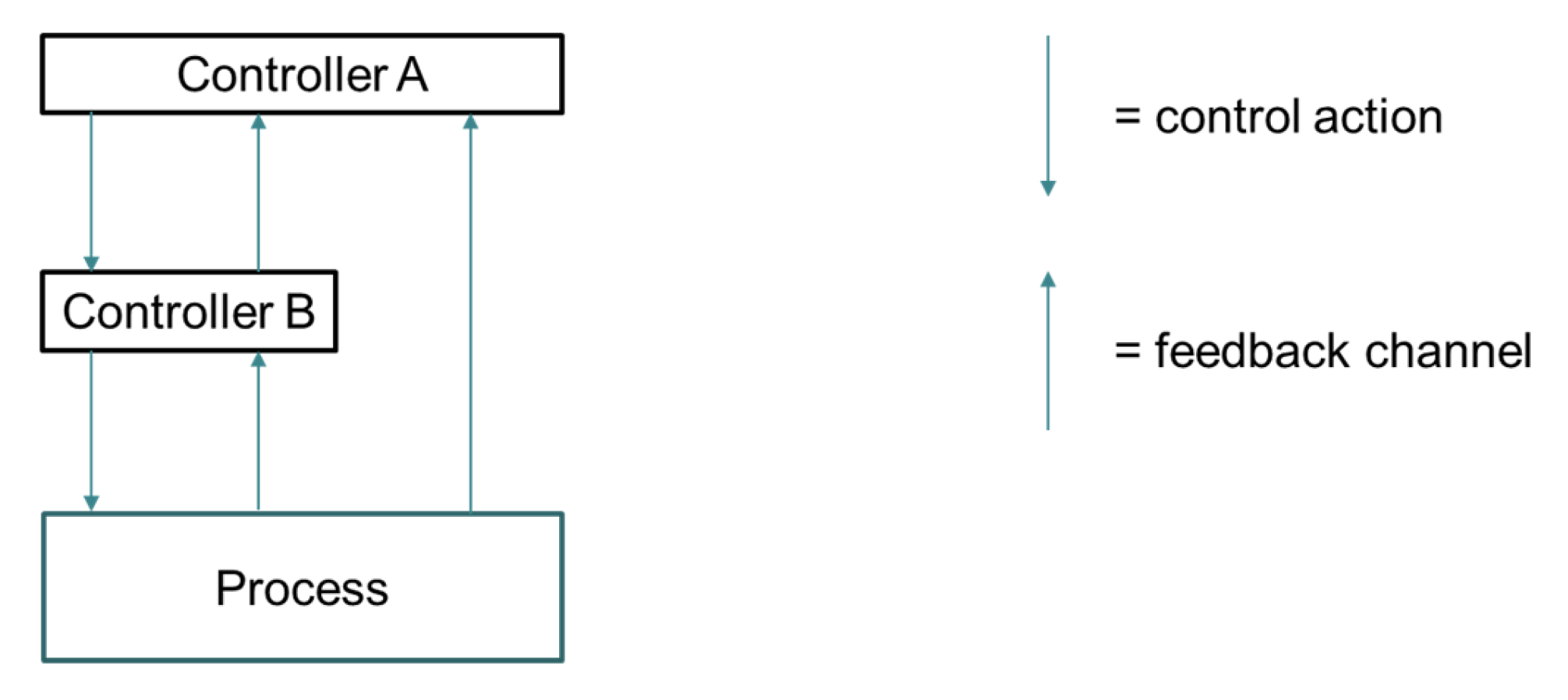
Figure 3.
Maasvlakte harbor area (circled) in relation to the broader Rotterdam region.
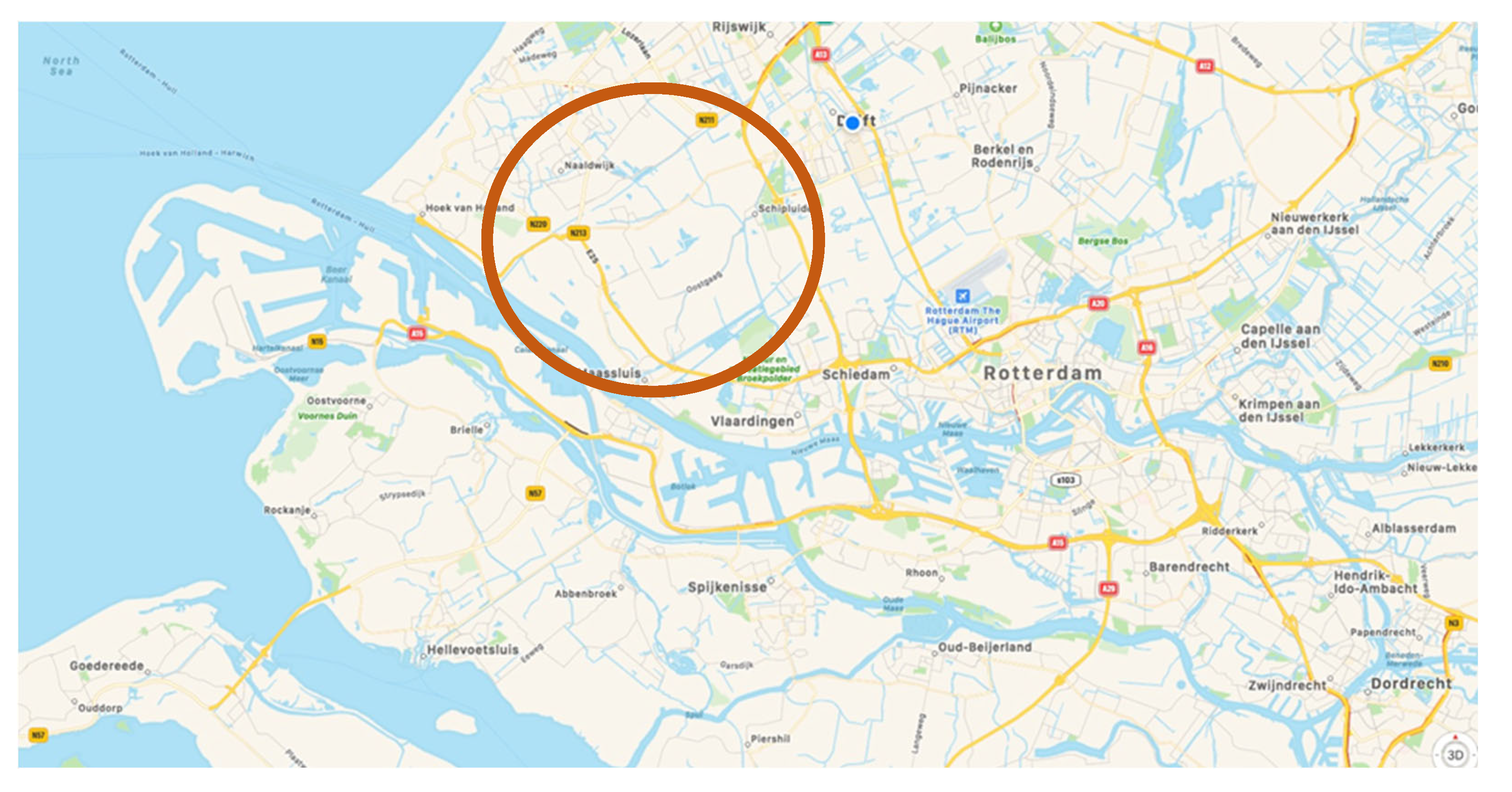
Figure 4.
Locations of truck landing zones A, B, C, D (blue) and nearby container terminals (pink) in the Maasvlakte area.
Figure 4.
Locations of truck landing zones A, B, C, D (blue) and nearby container terminals (pink) in the Maasvlakte area.
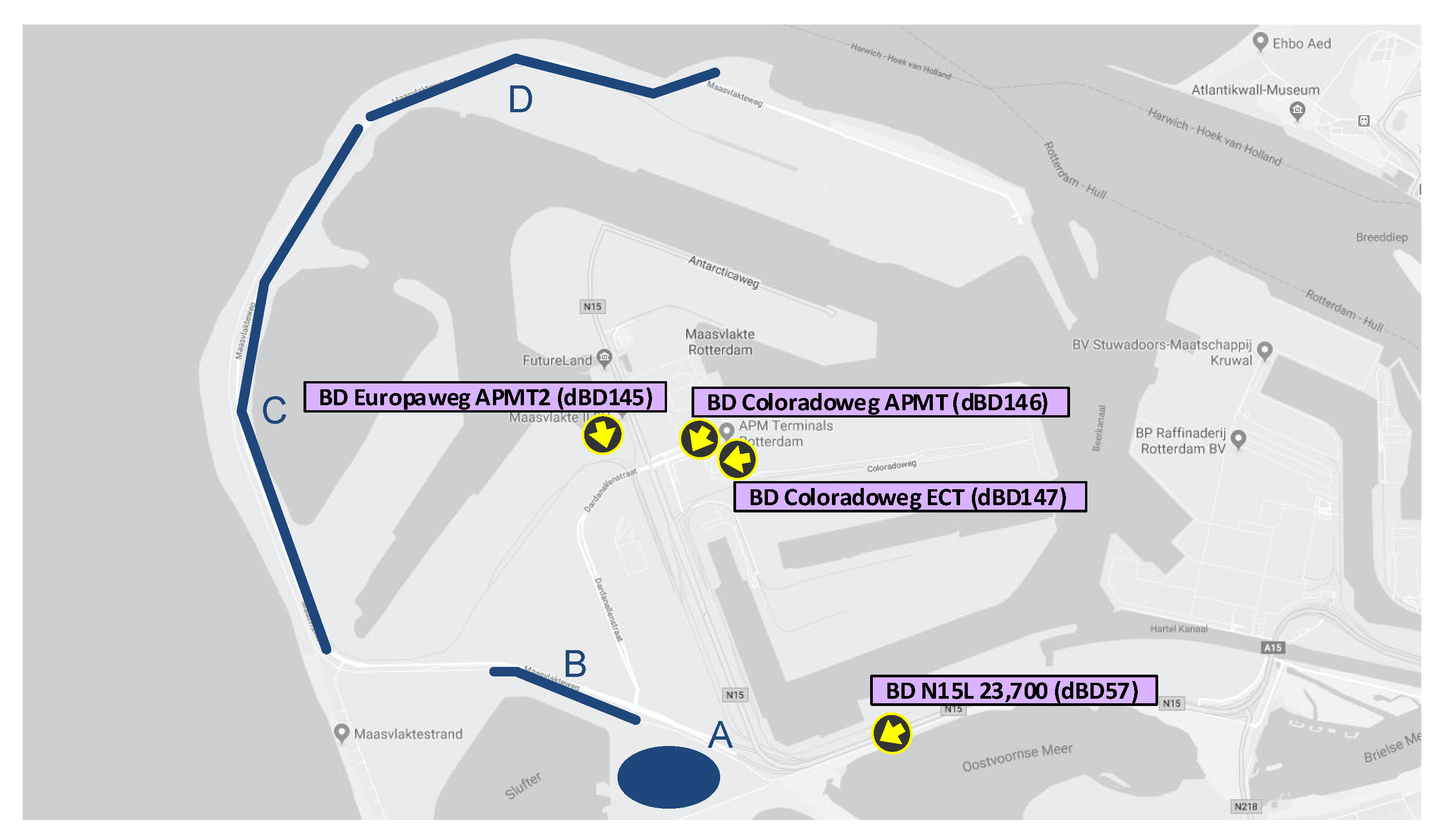
Figure 5.
System control structure. LZ = Landing Zone, RWS = state road administration; PoR =Port of Rotterdam; VMS = variable message sign; WIS = state road inspector, VMC-ZWN = regional traffic control center dealing with traffic on roads leading to and from PoR. For further explanation, see text.
Figure 5.
System control structure. LZ = Landing Zone, RWS = state road administration; PoR =Port of Rotterdam; VMS = variable message sign; WIS = state road inspector, VMC-ZWN = regional traffic control center dealing with traffic on roads leading to and from PoR. For further explanation, see text.
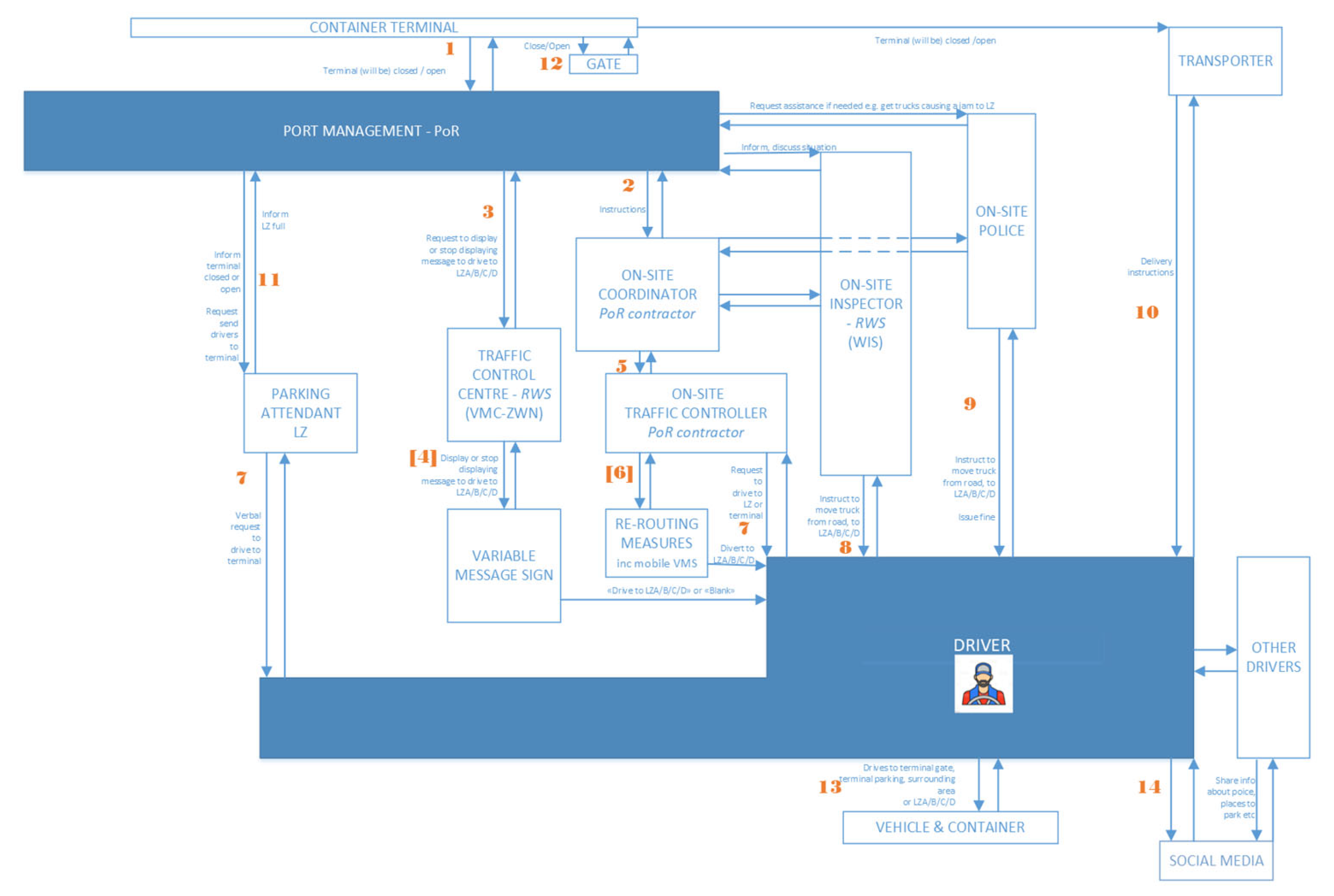
Table 1.
Alignment of re-routing procedure with goals of key actor groups.
| STS dimension | |||
|---|---|---|---|
| Human | Intentional | Procedural | |
| Actor | Goal | Does re- routing as intended align? | Does re-routing in practice align? |
| Port management | -Clear roads for terminal access | Yes | No |
| -Effective terminal (re-)entry | No | No | |
| -Fair treatment of different transporters and drivers | No | No | |
| -Road safety | Yes | No | |
| Container terminal management | -Minimise ship delay | Yes | No |
| -Process containers effectively | Yes | No | |
| Truck driver | -Rest, fuel, refresh | Yes | Yes |
| -Drop-off container and progress further | No | No | |
| -Deliver punctually to satisfy transport company management | No | No | |
| -Road safety | Yes | No | |
Table 2.
Summary of final set of 16 design recommendations – suggestions on how to avoid loss scenarios.
Table 2.
Summary of final set of 16 design recommendations – suggestions on how to avoid loss scenarios.
| # | Design recommendation | Explanation | # loss scenarios avoided |
|---|---|---|---|
| 1 | Key actors see container terminal status and plans | Ensure all key actors (PoR, coordinators, traffic controllers, parking attendants, transporters, and drivers) see including both current and upcoming open/closed status. | 77 |
| 2 | Fair-order process | Develop and implement a process—co-designed with drivers and traffic personnel—to ensure trucks in buffer zones enter reopened terminals in the order of arrival, maintaining fairness and compliance. | 62 |
| 3 | Coordinator aware of Traffic Controller actions |
Ensure coordinators have real-time insight into traffic controllers' availability, actions taken, interpretation of instructions, and ongoing plans | 53 |
| 4 | PoR aware of Coordinator readiness | Provide Port of Rotterdam with visibility into coordinators’ preparedness, resource needs, and time requirements to manage truck diversions effectively. | 52 |
| 5 | Container Terminal aware of PoR readiness |
Ensure container terminals are informed of PoR’s operational readiness, diversion timelines, and current traffic management priorities when planning closures or reopenings. | 45 |
| 6 | PoR aware of Traffic Control Centre operations |
Give PoR insight into the Traffic Control Centre’s readiness, actions, and interpretation of terminal status changes, especially related to VMS updates. | 30 |
| 7 | Redirect drivers violating fair-order | Equip PoR and inspectors with tools to identify, locate, and redirect drivers queuing improperly on roads instead of at designated buffer areas. | 29 |
| 8 | Route incoming drivers via LZ |
Inform drivers clearly and in real time about terminal status, legal access timing, designated LZs, routes, queue lengths, and available facilities to ensure orderly routing. | 28 |
| 9 | PoR / Coordinator aware of LZ staff actions |
Enable PoR and coordinators to track how parking attendants and traffic controllers are interpreting and executing instructions, with direct situational awareness at LZs. | 22 |
| 10 | PoR see traffic around terminals | Provide PoR with real-time situational awareness of terminal-adjacent traffic to detect and address emerging queues, obstructions, or incidents. | 21 |
| 11 | LZ staff aware of driver needs and actions | Require parking attendants and traffic controllers to confirm drivers' understanding of re-routing messages and respond to their needs or misunderstandings. | 10 |
| 12 | Off-route warnings for drivers | Implement alerts for drivers straying from approved re-routing paths, with PoR oversight to monitor responses and intervene if needed. | 10 |
| 13 | Coordinate driver messages |
PoR/other actor or device must check and ensure consistency and coordination of messages drivers receive from VMS, re-routing measures and different actors, and as far as possible visualize these processes in real time. If possible, they should get insight into driver opinion about re-routing e.g. messaging on social media. | 8 |
| 14 | Re-route to different LZ | PoR (and Coordinator) needs sight on LZ and projections on capacity from sensors, or Parking Attendant / Traffic Controllers. | 8 |
| 15 | Coordinate traffic flow from LZ to terminal | To prevent queues forming outside terminal and ensure efficiency, PoR to coordinate flow of traffic from LZ to terminal with flow of entry to CT. | 5 |
| 16 | CT trigger to tell PoR about closure | CT needs internal trigger and check that PoR informed about sudden / planned closure. | 4 |
Table 3.
Linking STS findings to STPA design recommendations.
| Theme | STS findings | STPA design recommendations |
Links |
|---|---|---|---|
| Fairness | Procedure misaligned with truck driver and port manager goals (e.g. no guarantee of fair order entry) → drivers attempt to ‘game’ the system. | #2 Fair-order process #7 Redirect drivers threatening fair order #15 Coordinate traffic flow from LZ to terminal |
STPA offers concrete redesigns (fair-order process, enforcement) addressing misaligned goals flagged in STS. |
| Information asymmetry |
Lack of awareness and coordination across actors (drivers, terminals, PoR, traffic control) due to infrastructure, technology gaps. | #1 Real-time terminal status sharing #3–6, 9–10 Awareness of other actors’ plans, readiness, and actions #16 Trigger for PoR notification |
STPA directly targets the fragmented information flows identified in STS; it prescribes real-time feedback loops that the STS framework diagnosed as missing. |
| Layout of physical infrastructure | Existing infrastructure (road layouts, LZs) prevents enforcement of compliance or sequencing; LZs shared among trucks with different destinations. | #8 Route drivers via LZs, give info on capacity #14 Rerouting to different LZs #12 Off-route warnings |
STPA extends STS diagnosis by suggesting how to technically and procedurally improve driver routing and infrastructure awareness. |
| Culture and communication |
Drivers use decentralized, social media-based coordination; port managers use slower, hierarchical communication → asymmetry in adaptability. | #13 Coordinate driver messages; monitor messaging trends #11 Attendants check understanding with drivers |
STPA recommendations touch on this issue by promoting more coordinated and responsive messaging but fall short of fully integrating cultural practices identified in STS. |
| Resilience through coordination | Procedures don’t reflect emergent behavior or actor adaptation in real-world scenarios. | Most STPA recommendations (#1–16) focus on building feedback loops and visibility across actors. |
STPA offers a systemic control model, operationalizing the adaptability and coordination challenges flagged in STS. |
Disclaimer/Publisher’s Note: The statements, opinions and data contained in all publications are solely those of the individual author(s) and contributor(s) and not of MDPI and/or the editor(s). MDPI and/or the editor(s) disclaim responsibility for any injury to people or property resulting from any ideas, methods, instructions or products referred to in the content. |
© 2025 by the authors. Licensee MDPI, Basel, Switzerland. This article is an open access article distributed under the terms and conditions of the Creative Commons Attribution (CC BY) license (http://creativecommons.org/licenses/by/4.0/).
Copyright: This open access article is published under a Creative Commons CC BY 4.0 license, which permit the free download, distribution, and reuse, provided that the author and preprint are cited in any reuse.


