

Submitted:
03 September 2025
Posted:
04 September 2025
You are already at the latest version
Abstract
Type 2 diabetes mellitus (T2D) is a chronic metabolic disease associated with macro and microvascular complications. Premature death, a worse quality of life, and a persistent need for medical care are the results of this disease. A key component of its pathophysiology is inflammation. This study aimed to evaluate the association between specific inflammatory biomarkers (IL-6, IL-8, IL-1β, IL-18, TNF-α, miR-155, and miR-146a) and the progression of T2D in Ecuadorian patients. Following the inclusion criteria, 198 patients were selected for a biomarker study out of the initial 598 participants. Patients were classified into four groups, based on disease stage in non-diabetic controls (NDC), controlled diabetic patients (CT2D), uncontrolled diabetic patients (NC-T2D), and diabetic patients with kidney disease (DKD). The results showed that IL8, IL-6, Leptin, and Adiponectin in-creased according to disease stage. We also observed a downregulation of miRNA-146a in T2D (NDC = 1, C-T2D = 0.44, NC-T2D = 0.26, DKD = 0.40). Using binary logistic regression, we determined the association between T2DM and the inflammatory biomarkers, considering their cut-off points IL-8 (OR = 6.733), IL-6 (OR = 4.436), Leptin (OR = 13.765), and miR-146a (OR = 4.062). The association between DKD and adiponectin was also deter-mined (OR = 4.154). This study highlights a clear association between the stage of Type 2 diabetes mellitus and chronic inflammation, reflected in altered levels of specific inflammatory biomarkers.
Keywords:
inflammation
; cytokines
; microRNA
; type 2 diabetes mellitus
1. Introduction
More than 530 million individuals worldwide are estimated to have type 2 diabetes (T2D), with a global prevalence of 10.5% [1]. Notably, four out of every five individuals with diabetes reside in low- and middle-income countries [2] . In Ecuador, T2D ranked as the second leading cause of mortality in 2021, affecting 4.7% of adults aged 20 to 79 years [3]. Patients diagnosed with T2D are at increased risk for severe complications such as retinopathy, neuropathy, nephropathy, and cardiovascular disease. These complications contribute to reduced quality of life and prolonged need for medical attention [4]. Among these, diabetic kidney disease (DKD)—affecting approximately 40% of individuals with diabetes—is the most common cause of end-stage renal disease (ESRD) and serves as a major predictor of mortality [5,6].
DKD is characterized by fibrotic processes, activation of the renin-angiotensin system (RAS), and oxidative stress, which are driven by molecules such as TNF-α, glomerular membrane growth factor, and mesangial growth factor. These processes lead to key morphological and inflammatory alterations, including mesangial expansion, thickening of the glomerular basement membrane, and podocyte injury. These changes increase intra-glomerular pressure, contributing to glomerular hypertrophy, reduced glomerular filtration rate, and proteinuria [7].
Although kidney biopsy remains the gold standard for diagnosing diabetic nephropathy, its invasive nature underscores the urgent need to identify novel, non-invasive biomarkers to monitor DKD progression [8,9].
Mounting evidence highlights the central role of inflammation in the pathogenesis of diabetic nephropathy [6,10]. Persistent hyperglycemia and accumulation of advanced glycation end-products (AGEs) promote renal cell death and trigger the release of damage-associated molecular patterns (DAMPs), which activate pattern recognition receptors (PRRs), including Toll-like receptors (TLRs). This activation initiates an innate immune response [11]. As nephropathy progresses, TLR signaling enhances nuclear factor-κB (NF-κB) activation, resulting in excessive production of inflammatory cytokines such as interleukin (IL) IL-6, IL-1β, IL-18, and TNF-α [7]. Moreover, NF-κB stimulates the expression of transforming growth factor-β1 (TGF-β1), a key pro-fibrotic cytokine implicated in DKD pathogenesis [12,13]. Elevated serum IL-8 concentrations, which correlate with the severity of renal impairment, have shown prognostic value in individuals with kidney disease [14]. Additionally, IL-8 promotes neutrophil activation and chemotaxis and contributes to mesangial cell proliferation and extracellular matrix accumulation within the glomerulus—hallmarks of renal fibrosis [15].
Among the various microRNAs implicated in DKD, miR-146a and miR-155 have emerged as key regulators of immune and inflammatory pathways. miR-146a attenuates the overproduction of cytokines such as TNF-α, IL-6, and IL-1β, thereby contributing to immune equilibrium [16,17]. Conversely, miR-155 acts as a pro-inflammatory effector that is transcriptionally upregulated by NF-κB and exacerbates inflammation by inhibiting suppressors of cytokine signaling 1 (SOCS1), a pivotal negative regulator of the JAK/STAT and NF-κB pathways [18,19]. Dysregulation of both miR-146a and miR-155 has been documented in renal tissues and systemic circulation of diabetic individuals, highlighting their dual potential as biomarkers and therapeutic targets in the progression of diabetic complications.
Moreover, alterations in adipokine profiles are frequently observed in patients with nephropathy, potentially contributing to heightened inflammation, disrupted appetite regulation, and accelerated atherosclerosis [20]. Hyperleptinemia is commonly observed at the onset of chronic kidney disease (CKD) and tends to worsen with disease progression [21]. Adiponectin, an anti-inflammatory adipokine that enhances insulin sensitivity and downregulates proinflammatory cytokines such as TNF-α and IL-6, is often dysregulated in CKD [22]. Therefore, the leptin-to-adiponectin ratio, an indicator of adipose tissue dysfunction, has been proposed as a potential biomarker of renal impairment [20].
Given the limitations of current diagnostic approaches for early detection and monitoring renal damage in patients with T2D, this study aimed to evaluate the potential of inflammatory cytokines (TNF-α, IL-6, IL-8), adipokines (adiponectin, leptin), and microRNAs (miR-155, miR-146a) as candidate biomarkers for disease stage association.
2. Materials and Methods
2.1. Patients
A cross-sectional observational study was conducted, involving 598 fasting patients aged 40 years or older who were diagnosed with type 2 diabetes mellitus (T2DM). The diagnosis of T2DM was performed according to the criteria established by the Committee of Experts for the identification and categorization of the disease, at a type C public health center (Chimbacalle) located in Quito, Ecuador [23]. From this group, 198 patients were selected based on the inclusion criteria and divided into four categories: (1) controlled diabetic patients (T2DM-C), defined as those with an HbA1c value ≤6%; (2) uncontrolled diabetic patients (T2DM-NC), with HbA1c values >7% but <8% and without kidney disease (defined as a glomerular filtration rate [GFR] >60 ml/min/1.73 m²); (3) diabetic patients with kidney disease (DKD), characterized by an HbA1c value >7% and a GFR <60 ml/min/1.73 m²; and (4) non-diabetic controls (NDC), consisting of non-diabetic patients without kidney disease and with fasting glucose <100 mg/dL for biomarker evaluation. In addition, patients with high blood pressure were included as a non-excluding condition in this study.
2.2. Biochemical Parameters and Cytokines
All participants fasted before blood sample collection. Peripheral venous blood (10ml) was collected into tubes without anticoagulant and transported to the laboratory under cold chain conditions (4°C). Samples were processed within two hours post-collection. Serum was aliquoted and stored at –20°C until analysis. Biochemical parameters—including glucose, HbA1c, lipid profile (total cholesterol, triglycerides, HDL, LDL), SGOT, SGPT, urea, and creatinine—were quantified using validated protocols of the Biomedical Research Institute, Central University of Ecuador. IL-6, IL-8, TNF-α, leptin, and adiponectin were determined by ELISA, using the commercial R&D system (Barcelona, Spain) following the manufacturer's instructions.
2.3. MicroRNA RT qPCR Assays
Peripheral venous blood (4 mL) was collected in heparin tubes from fasting patients. Peripheral blood mononuclear cells (PBMCs) were isolated from low-density gradient centrifugation using Ficoll [24]. Total RNA was isolated from PBMCs using the Mirvana kit (Invitrogen-Netherlands). The endogenous gene RNU-44 (cat no. 4427975, assay ID 1094) was used to normalize the cycle threshold (CT) values of RNA. Primers hsa-miR-146a (cat no. 4427975, assay ID 000468) and hsa-miR-155 (cat no. 4427975, assay ID 002623) for stem-looped reverse transcription were used to obtain cDNA for mature microRNAs (appendix 1). RNA was transcribed using the TaqMan microRNA reverse transcription kit (Applied Biosystems). qPCR was performed using predesigned TaqMan microRNA assays and the TaqMan Universal Master Mix, No AmpEraseUNG (Supplementary information). The qPCR was performed under the following conditions: 2 min at 50˚C, 10 min at 95˚C, followed by 40 cycles of 15 s at 95˚C, and finally 1 min at 60˚C in the Quant Studio 5 Real-Time PCR System (Applied Biosystems). Using the 2-dCt technique, the relative quantification of expression was determined. By deducting the Ct value of the endogenous control in each sample from the Ct value of the microRNA of interest in the same samples, the Ct values in this approach are normalized by the endogenous control gene (RNU44), yielding delta Ct (dCt) values.
2.4. Statistical Analysis
The Kolmogorov-Smirnov test was used to determine the normality of the variables. The demographic, clinical, and molecular variables of the four groups were compared using ANOVA and Kruskal-Wallis with the Bonferroni post hoc test. We conducted ROC curves to identify the cut-off points that enable the identification of microRNAs and interleukins as potential biomarkers; logistic regression analysis was used to determine the predictive factors in the studied groups. Bivariate models were used for binary variables in the logistic regression analysis, whereas multivariate models were used for variables with more than two categories, controlling for age, sex, BMI, smoking status, and exercise. Statistical significance was defined as values of p<0.005. IBM's SPSS v25 software was used for statistical analysis. GraphPad Prism software (version 5.02) was used to create figures.
2.5. Ethical Declaration
All patients who were recruited at the type C Public Health Center in Quito, Ecuador (Chimbacalle) signed an informed consent form that was previously authorized by the Human Research Ethics Committee of Central University of Ecuador under approval number 0007-FCM-DD-2018.
3. Results
A total of 598 patients were initially recruited for the study. Following application of the inclusion and exclusion criteria, 198 participants were selected for further analysis of circulating cytokines, adipokines, and microRNAs. These individuals were stratified into four clinical groups based on disease status: non-diabetic controls (NDC), patients with controlled type 2 diabetes (C-T2D), patients with uncontrolled type 2 diabetes (NC-T2D), and individuals with diabetic kidney disease (DKD), characterized by glomerular damage.
Demographic analysis revealed no significant differences in sex distribution among the groups. In contrast, DKD patients were substantially older (p < 0.001) in all comparisons, including the DKD group (NDC vs. DKD, C-T2D vs. DKD, and NC-T2D vs. DKD). (Table 1).
Clinical and biochemical parameters showed trends consistent with disease progression. Glucose and glycated hemoglobin (HbA1c) levels were significantly elevated in the NC-T2D and DKD groups compared to NDC and C-T2D (p < 0.001), reflecting poor glycemic control. Interestingly, body mass index (BMI) was significantly higher in C-T2D patients than in non-diabetic controls, but decreased in NC-T2D and DKD patients (p < 0.05), potentially reflecting metabolic dysregulation or disease-related complications. Diastolic blood pressure was significantly elevated in the DKD group compared to NDC (p = 0.036). Renal function markers, including serum creatinine, urea, and the Modification of Diet in Renal Disease (MDRD) equation, were markedly altered in the DKD group (p < 0.001), consistent with impaired renal function characteristic of diabetic nephropathy.
Analysis of circulating cytokines and adipokines revealed disease stage-dependent alterations. Levels of IL-6, IL-8, TNF-α, leptin, and adiponectin differed significantly when comparing NDC to C-T2D (IL-6 p = 0.001; IL-8 p < 0.001; TNF-α p = 0.011), NC-T2D (IL-6 p = 0.001; IL-8 p < 0.001; TNF-α p = 0.011), and DKD (IL-6 p < 0.001; IL-8 p < 0.001; TNF-α p D= 0.002) (Table 2). A progressive increase in IL-6, IL-8, leptin, and adiponectin levels was observed with advancing disease severity. In contrast, TNF-α significantly decreased with disease progression compared to NDC, indicating a complicated and perhaps compensatory immunometabolism response as T2D advances.
Regarding non-coding RNA biomarkers, miR-146a expression—assessed via CT values—differed significantly between NDC and C-T2D (p = 0.041), with a borderline significance between NDC and NC-T2D (p = 0.053). Fold change analysis (normalized to healthy controls, set at 1.0) revealed consistent downregulation of miR-146a in diabetic groups: C-T2D = 0.44, NC-T2D = 0.26, DKD = 0.40. These patterns suggest a potential role for miR-146a in the inflammatory and metabolic disturbances associated with diabetes stage. In contrast, miR-155 expression did not differ significantly between HC and any diabetic group (Figure 1), indicating a limited role in this population.
To evaluate the diagnostic potential of these biomarkers, receiver operating characteristic (ROC) curve analysis was performed. Area under the curve (AUC) values for IL-6, IL-8, TNF-α, leptin, and miR-146a demonstrated strong discriminatory power for differentiating diabetic from non-diabetic individuals (p < 0.001 for all). Optimal cut-off values were identified using the Youden index: IL-6 ≥ 7.465 pg/mL (sensitivity 71.13%, specificity 68.09%), IL-8 ≥ 20.28 pg/mL (sensitivity 71.62%, specificity 72.55%), TNF-α ≥ 7.875 pg/mL (sensitivity 62.16%, specificity 62.00%), leptin ≥ 3.605 ng/mL (sensitivity 83.67%, specificity 72.55%), and miR-146a expression ≥ 9.885 (sensitivity 65.22%, specificity 68.42%) (Figure 2).
Subsequent binary logistic regression analysis using these cut-offs confirmed their statistical association with T2D. All selected biomarkers demonstrated significant odds ratios: IL-8 (OR = 6.733, p < 0.001), IL-6 (OR = 4.436, p < 0.001), leptin (OR = 13.765, p < 0.001), and miR-146a (OR = 4.062, p = 0.009), underscoring their potential as diagnostic or prognostic indicators (Table 3).
Finally, to identify biomarkers specifically associated with diabetic kidney disease, a separate ROC analysis was conducted. Adiponectin emerged as a significant predictor of DKD (p < 0.005), with an optimal cut-off point of ≥ 8.30 µg/mL (sensitivity 71.74%, specificity 60.0%) (Figure 3).
Logistic regression analysis confirmed that adiponectin levels above this threshold were strongly associated with increased DKD risk (OR = 4.154, p < 0.001) (Table 4).
4. Discussion
Inflammation is an important player in the onset, stage, and outcome of T2D, as is shown in our study. Contrary to expectations, elevated TNF-α levels in the control group may be explained by their high rates of obesity and dyslipidemia, common issues in Ecuador's general population. Prevalence of obesity is 22.3% and overweight is 39.5% in the Ecuadorian population, with the rates being greater in low-altitude (coast and Galapagos) and metropolitan areas [25]. Notably, in our study, in the control group, 74% had high cholesterol, 90% had elevated LDL, and 34% high triglycerides, with many exceeding a BMI of 25. Obesity is now widely recognized as a chronic inflammatory condition. Since the 1990s, it has been known that excess fat tissue produces TNF-α and other proinflammatory signals [26]. Free fatty acids fuel this inflammatory cycle [27]. Thus, the control group’s metabolic profile likely contributed to increased TNF-α, highlighting how “normal” populations may already show underlying inflammation. IL-8 is synthesized and secreted by endothelial and epithelial cells, macrophages, and fibroblasts. Its pro-inflammatory action includes the recruitment and activation of neutrophils, T lymphocytes, and basophils, with the consequent cell apoptosis, fibrosis, and defective angiogenesis [28]. Farhan Mohammed et al. showed higher serum levels of IL-8 in T2D patients compared to healthy controls [29]. Another cross-sectional study showed increasing amounts of IL-8 as the patients' renal function declined [14]. A study conducted by Loretelli et al. shows that targeting the IL-8 and C-X-C chemokine receptor types 1 and 2 (CXCR1/2) axis may reduce the burden of diabetic kidney disease [30]. These findings are consistent with our findings that individuals with uncontrolled diabetes and kidney disease had considerably higher levels of IL-8 with an OR = 6.733 (95% CI 3.307-13.709), indicating that chronic inflammation plays a crucial role in the development and advancement of microvascular damage in diabetic patients.
Importantly, several studies indicate that worsening of glucose control is positively and linearly associated with high levels of IL-6 [31]. Current evidence indicates a crucial role of IL-6 in podocyte injury [32]. Podocyte hypertrophy observed in diabetic nephropathy (DN) may be related to IL-6 signaling through the activation of Janus kinase 2/signal transducer and activator of transcription 3 signaling pathway (JAK2/STAT3) [33]. Interestingly, treatment with IL-6 antibody reduced apoptosis of these cells [34]. Our work supports previous researchers' findings, which indicate that the length and severity of the diabetes condition are correlated with a linear upward expression of IL-6.
Many studies have been carried out regarding the relationship between leptin and diabetic complications. For example, a risk factor for the decrease of renal function has been identified to be the serum leptin levels [35]. On the other hand, some studies have demonstrated that there was no variation in leptin levels between diabetic individuals with and without nephropathy [36]. In our research, leptin was the biomarker that showed the strongest association, OR = 13.765 (95% CI 6.474 - 29.267), with T2D progression. Leptin is therefore an attractive option as a biomarker for the onset of diabetic complications.
Diabetic nephropathy (DN) is one of the long-term consequences of inadequate glycemic management in individuals with T2D [5]. Multiple studies have demonstrated a link between prolonged immune system activation and higher susceptibility to renal disease development. Adiponectin has anti-inflammatory, anti-apoptotic, and anti-fibrotic effects on the kidneys, reducing oxidative stress [37]. Jia et al showed that CKD patients had higher circulating levels of adiponectin, which was associated with a higher risk of death [38]. As a potential defense against damage driven by inflammation and chronic oxidative stress, we also discovered in our study that the group of diabetic patients with kidney disease had much greater levels of adiponectin than the non-diabetic controls.
MicroRNAs are short RNA chains that control gene transcription and perform a variety of biological functions, including regulating inflammatory responses, apoptosis, and promoting cell proliferation [39]. In type 2 diabetes, miRNA-146a functions as a molecular switch that controls insulin signaling and inflammation. Its dysregulation can worsen inflammation, leading to insulin resistance, and cause other T2D-related problems [40,41]. The development of nephropathy, neuropathy, wound healing, olfactory dysfunction, cardiovascular diseases, and retinopathy in diabetes patients has all been connected to the dysregulation of miR-146a expression [42]. In a streptozotocin-induced diabetes model, renal macrophage infiltration, glomerular hypertrophy, fibrosis, and proteinuria were markedly worsened in miR-146a−/− mice [43]. By directly downregulating its target genes, such as TNF receptor-associated factor 6 (TRAF6) and IL-1 receptor-associated kinase 1 (IRAK1), which are downstream adaptors of TLRs, miR-146a's function is based on regulation via the NF-κB signaling pathway. This results in a negative feedback control loop that dampens or stops an excessive inflammatory response [44,45,46]. Additionally, miR-NA-146a targets IRAK2, which further affects the inflammatory signaling cascade. Also, miRNA-146a is predicted to target genes involved in adhesion, migration, cell differentiation, and morphological change that encode for the expression of cell adhesion molecule L1 (L1CAM), MMP-9, CXCR4, vimentin (VIM), and E-cadherin. These genes may also be involved in the inflammatory processes linked to type 2 diabetes [44,47,48]. Furthermore, some research indicates that the insulin receptor substrate-1 (IRS-1), a crucial element of the insulin signaling system, can be directly targeted by miRNA-146a-5p to decrease its tyrosine phosphorylation [49]. This implies that miRNA-146a may influence glucose homeostasis by regulating insulin receptor activation and insulin signaling. In previous research, we revealed that T2D patients had considerably lower blood levels of miR-146a than non-diabetics [40]. In this study, we verified that miR-146a was significantly downregulated when polled all T2D (data not shown) and in the C-T2D sub-group; however, we lost significance in the NC-T2D because of group variability. In the DKD group, we observed a slight increase in its expression, perhaps because it acts as a buffer against the negative effects caused by inflammation. However, in the final stages of DKD, loss of the protective anti-inflammatory mechanism of miR-146a could lead to accelerated DN. The bivariate analysis revealed that miR-146a was significant, and the ROC curve was used to examine its potential as a type 2 diabetes predictor. The miR-146a cut-off point was ≥ 9.885 expression level, showing a sensitivity of 65.22%, and specificity of 68.42% with an OR = 4.02. Taken together, these results identify miR-146a as a novel anti-inflammatory noncoding RNA associated with T2D. In contrast, in this study, we did not find a significant T2D association related to microRNA155.
Current diagnostic methods for T2DM, such as fasting plasma glucose (FPG), HbA1c, and oral glucose tolerance tests (OGTT), are well-established but often detect the disease at later stages, when metabolic dysfunction is already pronounced. These methods, although valuable, do not typically reflect the underlying immunoinflammatory disturbances that precede hyperglycemia. According to our findings, a number of the assessed cytokines, adipokines, and non-coding RNAs could have additional diagnostic relevance, especially in the early stages of the illness. Notably, IL-8 and leptin showed a strong statistical association with T2DM (OR = 6.733 and 13.765, respectively, both p < 0.001), and leptin’s robust odds ratio highlights its potential utility. IL-6 and miR-146a also showed significant associations (OR = 4.436 and 4.062, respectively), pointing to their relevance in disease onset and progression.
Importantly, ROC analysis showed that these biomarkers have moderate-to-high sensitivity and specificity. Adiponectin, for example, showed a sensitivity of 71.74% and specificity of 60.0% for diagnosing DKD, making it a good option for detecting renal problems early on, something that is not possible with traditional glycemic indicators alone. The anti-inflammatory, insulin-sensitizing, and vasculoprotective properties of adiponectin, an adipokine, are well-established [50]. Chronic low-grade inflammation, increased cardiometabolic risk, and insulin resistance have all been repeatedly linked to decreased levels of circulating adiponectin. In this context, the observation that adiponectin levels were reduced across all T2D groups, and even more markedly in patients with uncontrolled T2D, carries important mechanistic and clinical implications. The reduction of adiponectin across T2D groups, especially in uncontrolled T2D and independently of BMI, suggests qualitative dysfunction of adipose tissue rather than quantity of adiposity. This points toward adiponectin as both a marker and potential mediator of metabolic deterioration, highlighting the importance of addressing adipose tissue health in the management of T2D beyond weight control alone.
When combined, these biomarkers have the potential to greatly improve risk detection and early diagnosis, even though they are not meant to take the place of present standards. Especially in individuals who are prediabetic or in the early stages of the dis-ease, their capacity to represent the inflammatory and immunometabolism landscape provides a more comprehensive knowledge of T2DM etiology and development.
The cross-sectional nature of our study, based on a one-time blood sampling, limits our ability to infer causality between inflammatory markers and the progression of T2D. However, we identified potential associations that may be explored in future longitudinal studies to confirm their clinical application.
5. Conclusions
This study highlights the potential of inflammatory biomarkers—namely, leptin, IL-8, IL-6, miR-146a, and adiponectin—to enhance existing methods of diagnosis for T2D, especially in its initial phases, indicating underlying immune and inflammatory dysregulations that occur before hyperglycemia. Leptin and IL-8 exhibited robust correlations with T2DM, whereas adiponectin displayed moderate diagnostic efficacy for diabetic kidney disease (DKD). Although the study's cross-sectional design constrains causal inference, these findings establish a basis for subsequent longitudinal research to validate their clinical significance in diagnosis, monitoring, and personalized intervention strategies.
Author Contributions
Conceptualization, L.B.R., V.A., and J.P.G.; methodology, D.A.V. and C.C.H.; validation, F.B.G., R.B.G., and D.S.R.; formal analysis, V.A. and L.B.R.; investigation, L.B.R.; resources, L.B.R.; writing—original draft preparation, V.A., D.A.V., C.C.H.; writing—review and editing, L.B.R., J.P.G., F.B.G., R.B.G., D.S.R.; supervision, J.P.G.; All authors have read and agreed to the published version of the manuscript.
Funding
This research received no external funding.
Institutional Review Board Statement
The study was conducted following the Declaration of Helsinki and approved by the Human Research Ethics Committee of Central University of Ecuador under approval number 0007-FCM-DD-2018.
Informed Consent Statement
Informed consent was obtained from all subjects involved in the study.
Data Availability Statement
The data presented in this study are available on request from the corresponding author.
Acknowledgments
We sincerely thank Universidad Tecnológica Equinoccial (UTE) for providing financial support to cover the publication fees for this research.
Conflicts of Interest
The authors declare no conflicts of interest.
Appendix A
The appendix is an optional section that can contain details and data supplemental to the main text—for example, explanations of experimental details that would disrupt the flow of the main text but nonetheless remain crucial to understanding and reproducing the research shown; figures of replicates for experiments of which representative data is shown in the main text can be added here if brief, or as Supplementary data. Mathematical proofs of results not central to the paper can be added as an appendix.
Appendix B
All appendix sections must be cited in the main text. In the appendices, Figures, Tables, etc. should be labeled starting with “A”—e.g., Figure A1, Figure A2, etc.
References
- Magliano, D. J.; Boyko, E. J. IDF Diabetes Atlas, 10th edition. scientific committee. Brussels: International Diabetes Federation. 2021.
- O’Hearn, M.; Lara-Castor, L.; Cudhea, F.; Miller, V.; Reedy, J.; Shi, P.; Zhang, J.; Wong, J.B.; Economos, C.D.; Micha, R.; Mozaffarian, D. Incident type 2 diabetes attributable to suboptimal diet in 184 countries. Nat Med. 2023;29(4):982-995. [CrossRef]
- Instituto Nacional de Estadística y Censos (INEC). Boletín Técnico Registro Estadístico de Defunciones Generales. 2020.
- World Health Organization (WHO). Definition, diagnosis, and classification of Diabetes Mellitus and its Complications. World Health Organization (WHO), Department of Noncommunicable Disease Survelliance. 1999. pp. 1–66.
- Alicic RZ, Rooney MT, Tuttle KR. Diabetic Kidney Disease: Challenges, Progress, and Possibilities. Clin J Am Soc Nephrol CJASN. 2017 Dec 7;12(12):2032–45.
- Reidy K, Kang HM, Hostetter T, Susztak K. Molecular mechanisms of diabetic kidney disease. J Clin Invest. 2014 Jun;124(6):2333–40.
- Donate-Correa, J.; Ferri, C.M.; Sanchez-Quintana, F.; Perez-Castro, A.; Gonzalez-Luis, A.; Martín-Núñez, E. ; Mora-Fernandez,C.; Navarro-Gonzalez, J.F. Inflammatory Cytokines in Diabetic Kidney Disease : Pathophysiologic and Therapeutic Implications. Front Med (Lausanne). 2021;7. [CrossRef]
- Pérez-Pevida B, Llavero M, Gargallo J, Escalada J. Complicaciones microvasculares de la diabetes. Med - Programa Form Médica Contin Acreditado. 2016 Sep 1;12(17):958–70.
- Ritz E, Rychlík I, Locatelli F, Halimi S. End-stage renal failure in type 2 diabetes: A medical catastrophe of worldwide dimensions. Am J Kidney Dis Off J Natl Kidney Found. 1999 Nov;34(5):795–808.
- Wada J, Makino H. Inflammation and the pathogenesis of diabetic nephropathy. Clin Sci Lond Engl 1979. 2013 Feb;124(3):139–52.
- Tang SCW, Yiu WH. Innate immunity in diabetic kidney disease. Nat Rev Nephrol. 2020 Apr;16(4):206–22.
- Zhao L, Zou Y, Liu F. Transforming Growth Factor-Beta1 in Diabetic Kidney Disease. Front Cell Dev Biol. 2020 Mar 24;8:187.
- Hildebrandt X, Ibrahim M, Peltzer N. Cell death and inflammation during obesity: “Know my methods, WAT(son).” Cell Death Differ. 2023 Feb;30(2):279–92.
- Liu SY, Chen J, Li YF. Clinical significance of serum interleukin-8 and soluble tumor necrosis factor-like weak inducer of apoptosis levels in patients with diabetic nephropathy. J Diabetes Investig. 2018 Sep;9(5):1182–8.
- Hung PH, Hsu YC, Chen TH, Lin CL. Recent Advances in Diabetic Kidney Diseases: From Kidney Injury to Kidney Fibrosis. Int J Mol Sci. 2021 Nov 1;22(21):11857.
- Boldin MP, Taganov KD, Rao DS, Yang L, Zhao JL, Kalwani M, et al. miR-146a is a significant brake on autoimmunity, myeloproliferation, and cancer in mice. J Exp Med. 2011 Jun 6;208(6):1189–201.
- Chen S, Feng B, Thomas AA, Chakrabarti S. miR-146a regulates glucose induced upregulation of inflammatory cytokines extracellular matrix proteins in the retina and kidney in diabetes. PloS One. 2017;12(3):e0173918.
- O’Connell RM, Kahn D, Gibson WSJ, Round JL, Scholz RL, Chaudhuri AA, et al. MicroRNA-155 promotes autoimmune inflammation by enhancing inflammatory T cell development. Immunity. 2010 Oct 29;33(4):607–19.
- Prieto I, Kavanagh M, Jimenez-Castilla L, Pardines M, Lazaro I, Herrero del Real I, et al. A mutual regulatory loop between miR-155 and SOCS1 influences renal inflammation and diabetic kidney disease. Mol Ther Nucleic Acids. 2023 Sep 27;34:102041.
- D’Marco L, Puchades MJ, Gorriz JL, Romero-Parra M, Lima-Martínez M, Soto C, et al. Epicardial Adipose Tissue, Adiponectin and Leptin: A Potential Source of Cardiovascular Risk in Chronic Kidney Disease. Int J Mol Sci. 2020 Feb 1;21(3):978.
- Korczynska J, Czumaj A, Chmielewski M, Swierczynski J, Sledzinski T. The Causes and Potential Injurious Effects of Elevated Serum Leptin Levels in Chronic Kidney Disease Patients. Int J Mol Sci. 2021 Apr 28;22(9):4685.
- Zorena K, Jachimowicz-Duda O, Ślęzak D, Robakowska M, Mrugacz M. Adipokines and Obesity. Potential Link to Metabolic Disorders and Chronic Complications. Int J Mol Sci. 2020 May 18;21(10):3570.
- American Diabetes Association. Diagnosis and Classification of Diabetes Mellitus. Diabetes Care. 2011 Jan;34(Suppl 1):S62.
- Knijff EM, Breunis MN, van Geest MC, Kupka RW, Ruwhof C, de Wit HJ, et al. A relative resistance of T cells to dexamethasone in bipolar disorder. Bipolar Disord. 2006 Dec;8(6):740–50.
- Pérez-Galarza J, Baldeón L, Franco OH, Muka T, Drexhage HA, Voortman T, et al. Prevalence of overweight and metabolic syndrome, and associated sociodemographic factors among adult Ecuadorian populations: the ENSANUT-ECU study. J Endocrinol Invest. 2021 Jan;44(1):63–74.
- Hotamisligil GS, Shargill NS, Spiegelman BM. Adipose expression of tumor necrosis factor-alpha: direct role in obesity-linked insulin resistance. Science. 1993 Jan 1;259(5091):87–91.
- Boden, G. Obesity, insulin resistance and free fatty acids. Curr Opin Endocrinol Diabetes Obes. 2011 Apr;18(2):139–43.
- ResearchGate [Internet]. [cited 2025 Sep 1]. (PDF) Interleukin 8 and diabetic nephropathy. Available from: https://www.researchgate.net/publication/284186255_Interleukin_8_and_diabetic_nephropathy.
- Assessment of Interleukin (8) in Type 2 Diabetes Mellitus. ResearchGate [Internet]. 2025 Aug 6 [cited 2025 Sep 1]; Available from: https://www.researchgate.net/publication/367929534_Assessment_of_Interleukin_8_in_Type_2_Diabetes_Mellitus.
- Loretelli C, Rocchio F, D’Addio F, Ben Nasr M, Castillo-Leon E, Dellepiane S, et al. The IL-8-CXCR1/2 axis contributes to diabetic kidney disease. Metabolism. 2021 Aug;121:154804.
- Mirza S, Hossain M, Mathews C, Martinez P, Pino P, Gay JL, et al. Type 2-diabetes is associated with elevated levels of TNF-alpha, IL-6 and adiponectin and low levels of leptin in a population of Mexican Americans: a cross-sectional study. Cytokine. 2012 Jan;57(1):136–42.
- Feigerlová E, Battaglia-Hsu SF. IL-6 signaling in diabetic nephropathy: From pathophysiology to therapeutic perspectives. Cytokine Growth Factor Rev. 2017 Oct;37:57–65.
- Jo HA, Kim JY, Yang SH, Han SS, Joo KW, Kim YS, et al. The role of local IL6/JAK2/STAT3 signaling in high glucose-induced podocyte hypertrophy. Kidney Res Clin Pract. 2016 Dec;35(4):212–8.
- Kim DI, Park SH. Sequential signaling cascade of IL-6 and PGC-1α is involved in high glucose-induced podocyte loss and growth arrest. Biochem Biophys Res Commun. 2013 Jun 14;435(4):702–7.
- Hanai K, Babazono T, Mugishima M, Yoshida N, Nyumura I, Toya K, et al. Association of serum leptin levels with progression of diabetic kidney disease in patients with type 2 diabetes. Diabetes Care. 2011 Dec;34(12):2557–9.
- Wilson C, Nelson R, Nicolson M, Pratley R. Plasma leptin concentrations: no difference between diabetic Pima Indians with and without nephropathy. Diabetologia. 1998 Jul;41(7):861–2.
- Lee JY, Yang JW, Han BG, Choi SO, Kim JS. Adiponectin for the treatment of diabetic nephropathy. Korean J Intern Med. 2019 May;34(3):480–91.
- Jia T, Carrero JJ, Lindholm B, Stenvinkel P. The complex role of adiponectin in chronic kidney disease. Biochimie. 2012 Oct;94(10):2150–6.
- Szostak J, Gorący A, Durys D, Dec P, Modrzejewski A, Pawlik A. The Role of MicroRNA in the Pathogenesis of Diabetic Nephropathy. Int J Mol Sci. 2023 Mar 25;24(7):6214.
- Baldeón R L, Weigelt K, de Wit H, Ozcan B, van Oudenaren A, Sempértegui F, et al. Decreased serum level of miR-146a as sign of chronic inflammation in type 2 diabetic patients. PloS One. 2014;9(12):e115209.
- Xie Y, Chu A, Feng Y, Chen L, Shao Y, Luo Q, et al. MicroRNA-146a: A Comprehensive Indicator of Inflammation and Oxidative Stress Status Induced in the Brain of Chronic T2DM Rats. Front Pharmacol. 2018;9:478.
- Ghaffari M, Razi S, Zalpoor H, Nabi-Afjadi M, Mohebichamkhorami F, Zali H. Association of MicroRNA-146a with Type 1 and 2 Diabetes and their Related Complications. J Diabetes Res. 2023;2023:2587104.
- Bhatt K, Lanting LL, Jia Y, Yadav S, Reddy MA, Magilnick N, et al. Anti-Inflammatory Role of MicroRNA-146a in the Pathogenesis of Diabetic Nephropathy. J Am Soc Nephrol JASN. 2016 Aug;27(8):2277–88.
- Gilyazova I, Asadullina D, Kagirova E, Sikka R, Mustafin A, Ivanova E, et al. MiRNA-146a—A Key Player in Immunity and Diseases. Int J Mol Sci. 2023 Aug 14;24(16):12767.
- Maratni NPT, Saraswati MR, Ayu Dewi NN, Suastika K. MIRNA146a And Diabetes-Related Complications: A Review. Curr Diabetes Rev. 2023;19(9):e141022209958.
- Rottiers V, Näär AM. MicroRNAs in Metabolism and Metabolic Disorders. Nat Rev Mol Cell Biol. 2012 Mar 22;13(4):239–50.
- Baldeón R L, Weigelt K, de Wit H, Ozcan B, van Oudenaren A, Sempértegui F, et al. Type 2 Diabetes Monocyte MicroRNA and mRNA Expression: Dyslipidemia Associates with Increased Differentiation-Related Genes but Not Inflammatory Activation. PloS One. 2015;10(6):e0129421.
- Ghuwalewala S, Ghatak D, Das S, Roy S, Das P, Butti R, et al. MiRNA-146a/AKT/β-Catenin Activation Regulates Cancer Stem Cell Phenotype in Oral Squamous Cell Carcinoma by Targeting CD24. Front Oncol. 2021;11:651692.
- Wu D, Xi QY, Cheng X, Dong T, Zhu XT, Shu G, et al. miR-146a-5p inhibits TNF-α-induced adipogenesis via targeting insulin receptor in primary porcine adipocytes. J Lipid Res. 2016 Aug;57(8):1360–72.
- Ren Y, Zhao H, Yin C, Lan X, Wu L, Du X, et al. Adipokines, Hepatokines and Myokines: Focus on Their Role and Molecular Mechanisms in Adipose Tissue Inflammation. Front Endocrinol. 2022;13:873699.
Figure 1.
Fold change values with interquartile range (IQR) of miR-146a and miR-155 (endogenous reference gene RNU-44) extracted from peripheral blood mononuclear cells (PBMC). Differences between groups were tested using the Kruskal-Wallis test. Non-diabetic Controls (NDC), controlled diabetics (C-T2D), non-controlled diabetics (NC-T2D), and diabetics with glomerular alteration (DKD).
Figure 1.
Fold change values with interquartile range (IQR) of miR-146a and miR-155 (endogenous reference gene RNU-44) extracted from peripheral blood mononuclear cells (PBMC). Differences between groups were tested using the Kruskal-Wallis test. Non-diabetic Controls (NDC), controlled diabetics (C-T2D), non-controlled diabetics (NC-T2D), and diabetics with glomerular alteration (DKD).
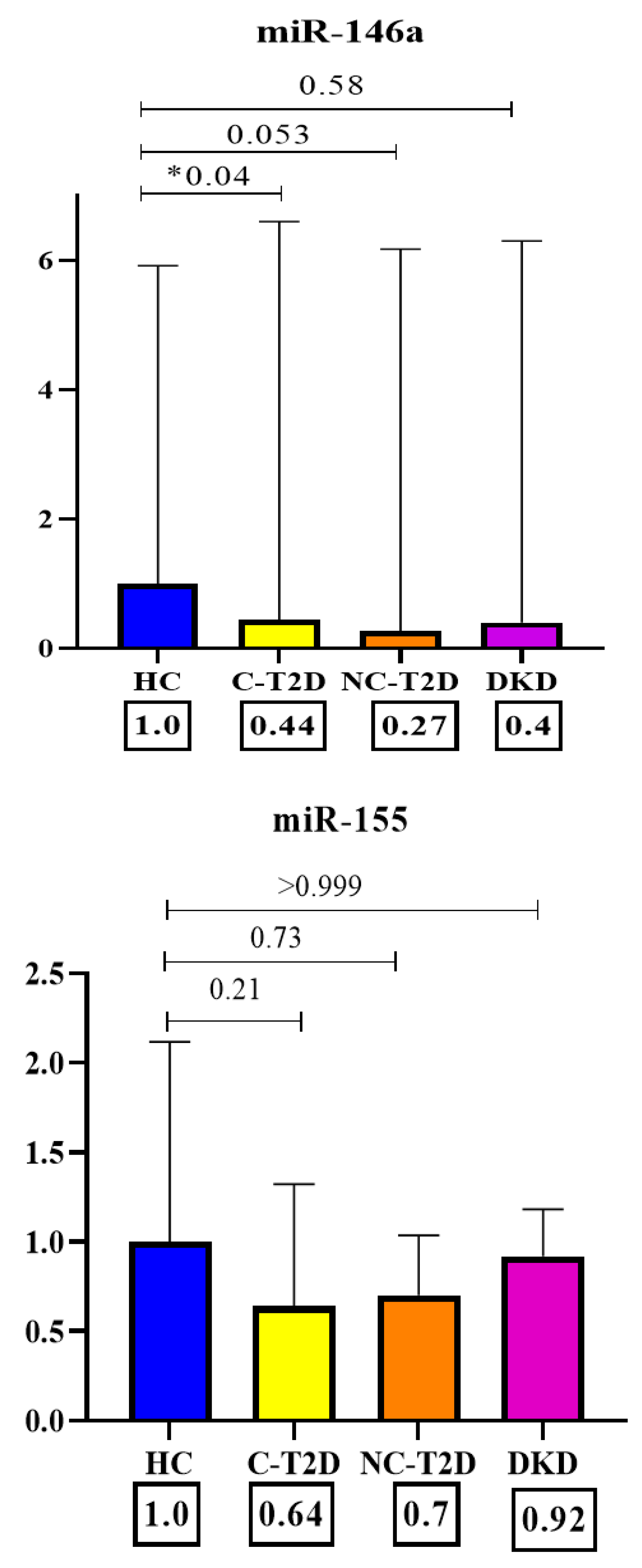
Figure 2.
A: ROC curve showing the area under the curve (AUC) and cut-off points for biomarkers (IL-6, IL-8, Leptin, Adiponectin) associated with T2D. B: ROC curve showing the area under the curve (AUC) and cut-off points for miR-146a (real expression) associated with T2D. The real expression was calculated with the 2^-delta CT method.
Figure 2.
A: ROC curve showing the area under the curve (AUC) and cut-off points for biomarkers (IL-6, IL-8, Leptin, Adiponectin) associated with T2D. B: ROC curve showing the area under the curve (AUC) and cut-off points for miR-146a (real expression) associated with T2D. The real expression was calculated with the 2^-delta CT method.
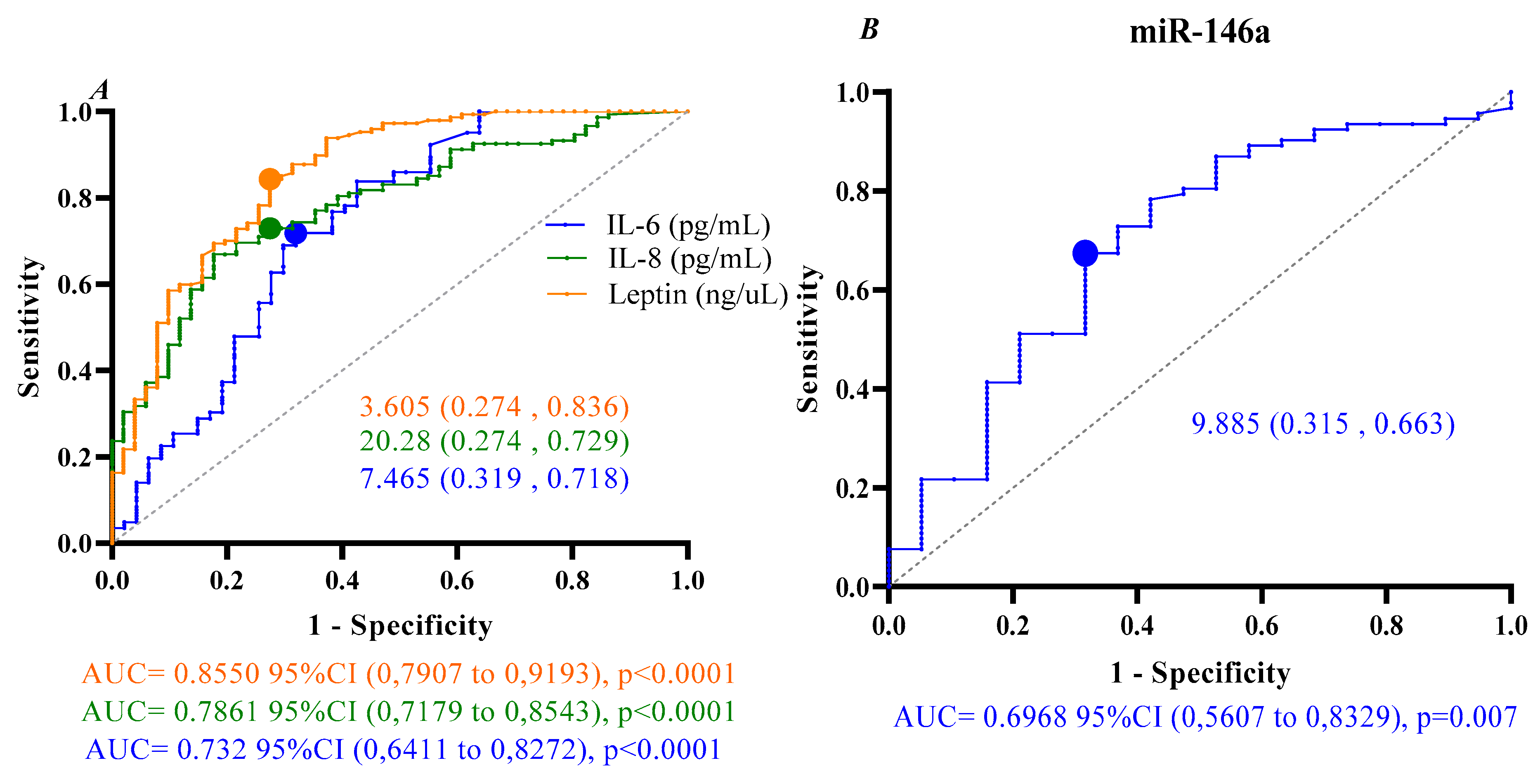
Figure 3.
ROC curve showing the area under the curve (AUC) and cut-off points for biomarker Adiponectin associated with diabetes and kidney disease.
Figure 3.
ROC curve showing the area under the curve (AUC) and cut-off points for biomarker Adiponectin associated with diabetes and kidney disease.
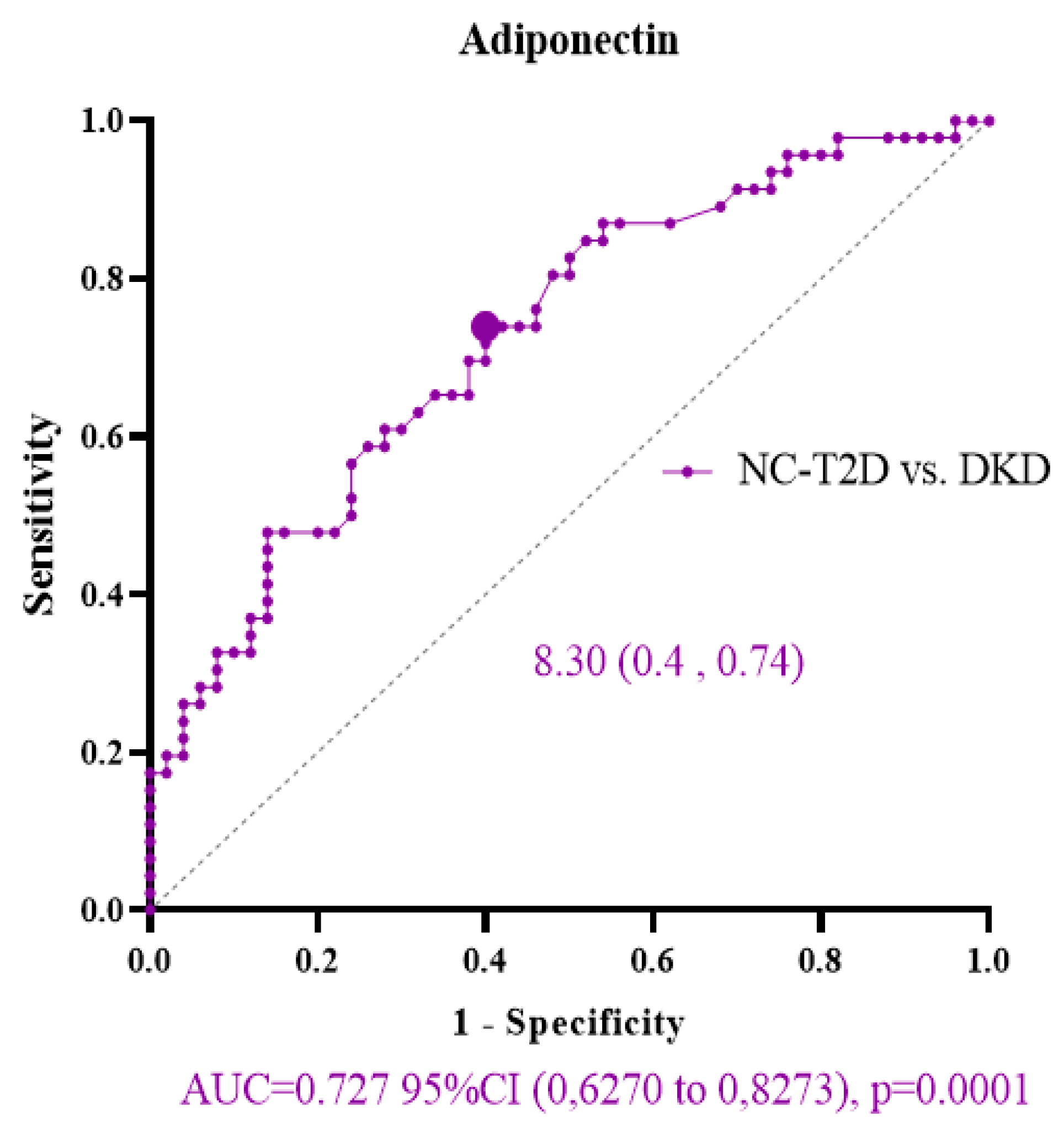

Table 1.
Clinical characteristics of study groups: Non-diabetic Controls (NDC), Controlled-diabetics (C-T2D), non-controlled diabetics (NC-T2D), and Diabetics with glomerular alteration (DKD) groups.
Table 1.
Clinical characteristics of study groups: Non-diabetic Controls (NDC), Controlled-diabetics (C-T2D), non-controlled diabetics (NC-T2D), and Diabetics with glomerular alteration (DKD) groups.
| NDC (n=49) | C-T2D (n=50) | NC-T2D (n=50) | DKD (n=49) | p-value | ||
|---|---|---|---|---|---|---|
| Female (%) | 39(79.52) | 40 (80.0) | 45 (90.0) | 45(91.84) | 0.175 | |
| Male (%) | 10(20.41) | 10(20.0) | 5(10.0) | 4(8.16) | ||
|
Age (years) |
59 ± 8 |
60 ± 8 |
59 ± 10 |
72 ± 11 |
0.000 NDC vs. DKD p=0.000 C-T2D vs. DKD p=0.000 NC-T2D vs. DKD p=0.000 |
|
| Exercise | Yes | 6 (12.24) | 41 (83.67) | 38 (79.17) | 39 (79.59) | 0.649 |
| Not | 43 (87.76) | 8 (16.33) | 10 (20.83) | 10 (20.41) | ||
| Smoker | Yes | 7 (14.29) | 4 (8.16) | 6 (12.24) | 5 (10.20) | 0.795 |
| Not | 42 (85.71) | 45 (91.84) | 43 (87.76) | 44 (89.80) | ||
| Length of illness (years) | 8 ± 5 | 9 ± 7 | 16 ± 11 |
0.000 C-T2D vs. NC-T2D p=0.042 C-T2D vs. DKD p=0.000 NC-T2D vs. DKD p=0.000 |
||
| Age at diagnosis (years) | 53 ± 10 | 54 ± 12 | 52 ± 14 |
0.005 NC-T2D vs C-T2D p=0.018 NC-T2D vs. DKD p=0.012 C-T2D vs. DKD p=1.00 |
||
| Medication | Metformin | 39 (79.59) | 17 (36.17) | 3 (6.12) |
0.000 C-T2D vs. Metf p=0.000 DKD vs. Metf p=0.000 |
|
| Metformin/Gilbenclamide | 3 (6.12) | 12 (25.53) | 15 (30.61) | |||
| Insuline | 0 (0) | 1 (2.13) | 6 (12.24) | |||
| Insuline/Metformine | 7 (14.29) | 16 (34.04) | 23 (46.95) | |||
| Gilbenclamide/Insuline/Metformine | 0 (0) | 1 (2.13) | 2 (4.08) | |||
| Family history | Yes | 39 (79.59) | 32 (65.31) | 29 (58) | 26 (54.17) | 0.006 |
| Not | 10 (20.41) | 17 (34.69) | 21 (42) | 22 (45.83) | ||
| BMI (kg/m2) | 31.1 ± 4.2 | 30.8 ± 5.6 | 30.4 ± 4.4 | 27.2 ± 4.2 |
0.001 NDC vs. DKD p=0.007 C-T2D vs. DKD p=0.002 NC-T2D vs. DKD p=0.029 |
|
| SBP (mmHg) | 121 ± 12 | 121 ± 10 | 121 ± 12 | 124 ± 16 | 0.427 | |
| DBP (mmHg) | 74 ± 6 | 74 ± 7 | 73 ± 74.74 | 70 ± 8 |
0.03 NDC vs. DKD p=0.036 |
|
| Glucose (mg/dL) | 82 ± 9 | 100 ± 15 | 141 ± 84.84 | 161 ± 46 |
0.000 NDC vs. DKD p=0.000 C-T2D vs. DKD p=0.000 NC-T2D vs. DKD p=0.000 |
|
|
HbA1C (%) |
5.6 ± 0.5 |
5.8 ± 0.4 |
7.5 ± 0.3 |
8.8 ± 0.9 |
0.000 NDC vs. DKD p=0.000 C-T2D vs. DKD p=0.000 NC-T2D vs. DKD p=0.000 |
|
| Cholesterol (mg/dL) | 193 ± 37 | 185 ± 38 | 174 ± 37.37 | 200 ± 37 | 0.136 | |
| Triglycerides (mg/dL) | 174 ± 68 | 161 ± 85 | 168 ± 68.68 | 171 ± 76 | 0.801 | |
| HDL (mg/dL) | 47 ± 13 | 48 ± 10 | 45 ± 8 | 48 ± 13 | 0.653 | |
| LDL (mg/dL) | 106 ± 33 | 104 ± 35 | 92 ± 33 | 105 ± 31 | 0.369 | |
| SGOT (U/L) | 21.90 ± 12.96 | 22.35 ± 13.93 | 23.25 ± 10.23 | 21.00 ± 24.08 | 0.583 | |
| SGPT (U/L) | 12.85 ± 10.73 | 13.40 ± 7.61 | 15.20 ± 6.24 | 11.00 ± 7.21 | 0.657 | |
| Urea (mg/dL) | 33.00 ± 8.90 | 32.00 ± 10.16 | 27.50 ± 9.27 | 40.00 ± 45.01 |
0.000 NDC vs. NC-T2D p= 0.020 NC-T2D vs. DKD p=0.000 C-T2D vs. DKD p=0.002 |
|
| Creatine (mg/dL) | 0.90 ± 0.15 | 0.90 ± 0.15 | 0.85 ± 0.0 | 1.10 ± 1.02 |
0.000 NDC vs. DKD p=0.000 NC-T2D vs. DKD p=0.000 C-T2D vs. DKD p=0.002 |
|
| MDRD (mL/min) |
70.10 ± 11.04 | 73.35 ± 11.48 | 76.45 ± 10.75 | 52.80 ± 17.56 |
0.000 NDC vs. DKD p=0.000 C-T2D vs. DKD p=0.000 NC-T2D vs. DKD p=0.000 |
|
T2D : type 2 diabetes, BMI : body mass index, SBP : systolic blood pressure, DBP : diastolic blood pressure, HbA1C : glycosylated hemoglobin, HDL : high-density lipoproteins, LDL : low-density lipoproteins, SGOT : Serum Glutamic Oxaloacetic Transaminase, SGPT : Serum Glutamic Pyruvic Transaminase, MDR : Glomerular filtration rate. The mean +/-SD is displayed for the variables with a normal distribution, such as age, BMI, cholesterol, and LDL, whereas the median +/-IQR is displayed for the variables with a non-normal distribution.
Table 2.
Inflammatory biomarkers of Non-diabetic Controls (NDC), controlled diabetics (C-T2D), non-controlled diabetics (NC-T2D), and diabetics with glomerular alteration (DKD).
Table 2.
Inflammatory biomarkers of Non-diabetic Controls (NDC), controlled diabetics (C-T2D), non-controlled diabetics (NC-T2D), and diabetics with glomerular alteration (DKD).
| Variable | NDC | C-T2D | NC-T2D | DKD | p-value |
|---|---|---|---|---|---|
| IL-8 (pg/mL) | 14.91 ± 12.05 | 30.66 ± 27.45 | 30.38 ± 27.94 | 30.66 ± 24.78 |
0.000 NDC vs. C-T2D p=0.000 NDC vs. NC-T2D p=0.000 NDC vs. DKD p=0.000 |
| IL-6 (pg/mL) | 3.09 ± 10.63 | 11.62 ± 9.10 | 10.48± 14.13 | 12.16 ± 13.29 |
0.000 NDC vs. C-T2D p=0.001 NDC vs. NC-T2D p=0.001 NDC vs. DKD p=0.000 |
| TNF-α (pg/mL) | 9.28 ± 3.17 |
6.73 ± 3.43 | 6.90 ± 2.70 | 5.58 ± 3.94 |
0.001 NDC vs. C-T2D p=0.011 NDC vs. NC-T2D p=0.011 NDC vs. DKD p=0.002 |
| Leptin (ng/mL) | 1.32 ± 4.46 | 11.14 ± 6.96 | 9.84 ± 7.85 | 8.65 ± 8.12 |
0.000 NDC vs. C-T2D p=0.000 NDC vs. NC-T2D p=0.000 NDC vs. DKD p=0.000 |
| Adiponectin (ug/mL) | 6.17 ± 5.54 | 9.30 ± 5.43 | 6.65 ± 4.12 | 11.30 ± 6.55 |
0.000 NDC vs. C-T2D p=0.006 NDC vs. NC-T2D p=0.000 NDC vs. DKD p=0.001 |
| miR-146a (CT) | 6.09 ± 21.44 | 23.67 ± 34.30 | 15.57 ± 32.87 | 12.70 ± 25.50 |
0.0299 NDC vs. C-T2D p=0.041 NDC vs. NC-T2D p=0.053 NDC vs. DKD p=0.583 |
| miR-155 (CT) | 0.82 ± 5 | 2.05 ± 3.67 | 1.68 ± 1.87 | 1.06 ± 1.44 | 0.1529 NDC vs. C-T2D p=0.213 NDC vs. NC-T2D p=0.734 NDC vs. DKD p=0.999 |
TNF-α: tumor necrosis factor alpha, IL-8: Interleukin-8, IL-6: Interleukin-6, miR-146a: microRNA-146a, miR-155: microRNA-155. For miR-146a and miR-155, the real expression value was calculated with the 2^-delta CT method. All the variables have a non-normal distribution (median+/-IQR).
Table 3.
Binary logistic regression analysis for Biomarkers and microRNAs to determine patients' risk of developing diabetes.
Table 3.
Binary logistic regression analysis for Biomarkers and microRNAs to determine patients' risk of developing diabetes.
| Variable | p-value | B | OR | OR 95% CI | |
|---|---|---|---|---|---|
| LI | HI | ||||
| IL-8 ≥ 20.28 (pg/mL) | 0.000 | 1.907 | 6.733 | 3.307 | 13.709 |
| IL-6 ≥ 7.465 (pg/mL) | 0.001 | 1.490 | 4.436 | 2.266 | 8.987 |
| Leptin ≥ 3.605 (ng/mL) | 0.001 | 2.622 | 13.765 | 6.474 | 29.267 |
| miR-146a ≥ 9.885 (real expression) | 0.009 | 1.402 | 4.062 | 1.410 | 11.705 |
B: unstandardized regression coefficient for each independent variable in the model, OR: Odds Ratio, LI: low interval, HI: high interval.
Table 4.
Multivariate logistic regression analysis for Biomarkers and microRNAs to determine a patient's risk of diabetes and kidney disease.
Table 4.
Multivariate logistic regression analysis for Biomarkers and microRNAs to determine a patient's risk of diabetes and kidney disease.
| Variable | p-value | B | OR | OR 95% CI | |
|---|---|---|---|---|---|
| LI | HI | ||||
| Adiponectin ≥ 8.30 (ug/mL) NC-T2D vs. DKD | 0.001 | 1.424 | 4.154 | 1.776 | 9.718 |
B: unstandardized regression coefficient for each independent variable in the model, OR: Odds Ratio, LI: low interval, HI: high interval.
Disclaimer/Publisher’s Note: The statements, opinions and data contained in all publications are solely those of the individual author(s) and contributor(s) and not of MDPI and/or the editor(s). MDPI and/or the editor(s) disclaim responsibility for any injury to people or property resulting from any ideas, methods, instructions or products referred to in the content. |
© 2025 by the authors. Licensee MDPI, Basel, Switzerland. This article is an open access article distributed under the terms and conditions of the Creative Commons Attribution (CC BY) license (http://creativecommons.org/licenses/by/4.0/).
Copyright: This open access article is published under a Creative Commons CC BY 4.0 license, which permit the free download, distribution, and reuse, provided that the author and preprint are cited in any reuse.


