

Submitted:
02 September 2025
Posted:
03 September 2025
You are already at the latest version
Abstract
Amid the global dual transformation toward deep decarbonization and net-zero emissions, carbon sequestration pathways have become indispensable pillars of climate governance. Natural sinks and engineered carbon removal approaches exhibit high heterogeneity in sequestration mechanisms, temporal effectiveness, environmental externalities and societal acceptance. Yet, current research lacks an integrated understanding of cross-pathway synergies, spatial deployment logics and dynamic scheduling strategies, calling for a more systemic and adaptive framework. This review provides a comprehensive synthesis of the carbon storage structure and regulatory drivers of terrestrial (forests, wetlands) and marine sinks, assessing their spatial potential and ecological coupling. It also critically evaluates the technological readiness, sequestration stability and deployment thresholds of engineered options such as BECCS, DAC, enhanced weathering and ocean alkalinization. Key divergences between natural and artificial pathways are highlighted in terms of carbon removal capacity, energy intensity, deployment timing and governance risk. We identify persistent bottlenecks, including the absence of synergistic deployment models, resource and institutional constraints at the regional scale, unquantified system feedbacks and limitations in monitoring, reporting and verification (MRV) mechanisms. These issues inhibit the scale-up and long-term stability of carbon sink systems. To address these challenges, we propose a Pathway-Region-Temporal (P-R-T) scheduling model that integrates technological characteristics, spatial suitability and sequencing dynamics into a unified optimization framework. We further advance a “Carbon Flow-Storage-Feedback Loop” architecture to guide the adaptive evolution of carbon sink systems under uncertainty, enabling coordinated deployment, real-time optimization and policy responsiveness. We argue for a strategic shift from fragmented pathway management toward systemic carbon sink engineering, integrating multi-path coordination, dynamic feedback recognition, scalable infrastructure and robust MRV systems. Such an approach lays the scientific foundation for achieving high-resilience, low-risk net-zero trajectories in global carbon governance.
Keywords:
carbon sink pathways
; nature-based and engineered sequestration
; Pathway-Region-Temporal (P-R-T) scheduling model
; system feedback mechanisms
; carbon sink system coupling
1. Introduction
Global climate change, one of the most urgent environmental crises of the 21st century, is primarily driven by the persistent accumulation of anthropogenic greenhouse gases in the atmosphere. This accumulation has triggered a cascade of profound and interconnected impacts, including global warming, intensified extreme weather events, accelerated biodiversity loss and a sustained rise in sea levels. These systemic changes progressively erode the structural resilience of ecosystems and heighten risks to human security, posing serious challenges to the sustainability of coupled human–natural systems across multiple spatial and temporal scales (Akhmieva et al., 2024; Kotz et al., 2024). Since the onset of the Industrial Revolution, the global mean surface temperature has increased by approximately 1.1 °C, as reported in the Sixth Assessment Report of the Intergovernmental Panel on Climate Change (IPCC). This warming trend is projected to intensify further in the absence of rapid and sustained mitigation efforts (Esper et al., 2024; Follingstad, 2023). CO₂, accounting for over 76 percent of total radiative forcing, remains the most significant contributor to anthropogenic climate change. Due to its long atmospheric lifetime and cumulative warming effects, CO₂ has become the central focus of international climate policy (Meinshausen et al., 2020; Ussiri and Lal, 2017). Although the Paris Agreement articulates a clear objective to limit global warming to within 1.5 °C above pre-industrial levels, recent empirical assessments indicate that global CO₂ emissions continue to rise, casting serious doubt on the feasibility of achieving this target under current policy and technological conditions (Friedlingstein et al., 2024; International Energy Agency, 2024). In this context, the imperative to remove CO₂ directly from the atmosphere, particularly to offset residual emissions that are resistant to abatement through conventional mitigation pathways, has become a central concern in the evolving architecture of global climate governance.
As a foundational pillar for achieving net-zero emission targets, carbon dioxide removal (CDR) technologies have increasingly become a focal point in international climate policy and scientific discourse. Among the diverse array of CDR modalities, carbon sequestration emerges as one of the most promising pathways, owing to its capacity to remove atmospheric CO₂ and store it over extended timescales in terrestrial or marine systems through both natural and engineered processes (Rueda et al., 2021; Fuss et al., 2018). By contributing not only to the reduction of atmospheric CO₂ concentrations, but also to ancillary environmental benefits such as improved soil health, enhanced ecosystem resilience and the promotion of sustainable agricultural practices, carbon sequestration offers a multidimensional framework that integrates mitigation, adaptation and development goals (Smith et al., 2019). Currently, sequestration pathways are broadly categorized into two major types: natural carbon sinks, which include forest ecosystems, wetlands and oceanic carbon uptake processes; and engineered or anthropogenic approaches, such as geological carbon storage, mineral carbonation and artificial enhancement of oceanic carbon sinks (Minx et al., 2018; Griscom et al., 2017). The strategic value of these approaches lies not only in their decarbonization potential, but also in their ability to ensure the durability of carbon storage and to regulate biogeochemical processes across spatial and temporal scales. Therefore, a systematic investigation into the mechanistic foundations, storage capacities and spatiotemporal dynamics of various carbon sequestration technologies is critical to advancing the scientific basis of global carbon neutrality strategies. It also enables the effective integration of diverse mitigation options into coherent and adaptive climate governance frameworks (Davin, 2022).
In recent years, carbon sequestration technologies have evolved from early-stage, singular, nature-based approaches into a multifaceted, multi-scalar system that integrates diverse pathways and technical paradigms. This transformation reflects an increasing convergence between Nature-based Solutions (NbS) and engineering-based solutions, resulting in a diversified framework encompassing ecosystem carbon sinks, engineered capture and storage systems and geo-mineralogical processes (Global CCS Institute, 2023; Griscom et al., 2017). Within this evolving landscape, NbS approaches prioritize the utilization of ecological processes in forests, wetlands, croplands and marine environments to absorb and retain atmospheric CO₂. These methods are widely recognized for their low implementation costs, substantial co-benefits for biodiversity and ecosystem services and broad applicability across geographical regions, making them indispensable to the dual objectives of the United Nations Framework Convention on Climate Change and the Convention on Biological Diversity (Seddon et al., 2020). Concurrently, engineering-based techniques, including Carbon Capture, Utilization and Storage (CCUS), biochar burial, enhanced mineral weathering and ocean-based carbon enhancement—are undergoing rapid development and pilot deployment, particularly in the context of decarbonizing heavy industry and supporting national carbon neutrality agendas (Liu et al., 2024; Zhang et al., 2022). Research priorities have accordingly shifted from evaluating the effectiveness of isolated methods to exploring the integration of multiple sequestration pathways, the coupling of carbon sources and sinks and the systemic coordination of climate mitigation strategies (Snæbjörnsdóttir et al., 2020). On the one hand, emerging studies indicate that carbon storage stability, life-cycle emissions and system boundary definitions vary significantly across different sequestration modes. This variation necessitates comparative assessments employing Life Cycle Assessment (LCA) frameworks and system dynamics modeling (Al-Sakkari et al., 2024; Cui et al., 2024; Wang et al., 2024). On the other hand, increasing attention has been directed toward the sustainability and vulnerability of natural carbon sinks, as risk factors such as forest fires, methane emissions from wetlands and ocean acidification may undermine the net sequestration benefits and even result in adverse feedbacks (Kwon et al., 2024; Doughty et al., 2023; Zhan and Tong, 2023). Moreover, the challenge of spatially optimizing the allocation of diverse sequestration pathways, fostering functional complementarity among them and embedding differentiated metrics into carbon markets and climate policy frameworks has emerged as a critical issue in the construction of coherent global carbon strategies (He et al., 2024; Wong et al., 2022). Taken together, the increasing diversification and cross-scale integration of carbon sequestration approaches not only broaden the theoretical and technological avenues for achieving net-zero emissions, but also impose greater demands on the precision of carbon sink assessments, the robustness of system integration methodologies and the design of adaptive regulatory architectures.
Although recent years there have witnessed a steady increase in studies targeting individual carbon sink pathways, comprehensive syntheses that systematically integrate both natural and anthropogenic carbon sequestration mechanisms remain conspicuously limited. Critically, existing reviews seldom address the synergistic effects between pathways, the multiscale spatial heterogeneity of carbon dynamics, or the long-term stability of carbon storage—dimensions that are essential for robust climate mitigation planning (Luo et al., 2024; Wang et al., 2024; Niu et al., 2021). The prevailing literature is predominantly confined to singular ecosystems or specific technological routes, with methodological approaches heavily skewed toward case studies and quantitative estimations. As a result, key cross-systemic feedbacks, particularly those operating at the interface of natural, engineered, and socio-political systems, which remain conceptually underdeveloped. Furthermore, the dynamic evolution of source–sink relationships and their structural implications for carbon neutrality strategies are yet to be systematically theorized (Piao et al., 2022; Yang et al., 2022). At the regional level, integrative assessments that bridge global and national (especially Chinese) carbon sink capacities remain insufficient. Current efforts often fall short in characterizing spatial–temporal variability in sequestration potential, identifying key biophysical and institutional drivers, and quantifying the associated uncertainties (Fang et al., 2024; Wang et al., 2023). Compounding this issue is the lack of standardized metrics and precision thresholds in carbon sink monitoring and evaluation protocols, which hampers cross-scalar comparability and undermines the reliability of model outputs for decision-making. This methodological fragmentation poses substantial barriers to the identification and prioritization of carbon removal options under policy and investment constraints (Dong et al., 2024). In light of these limitations, a coordinated, multi-pathway, and interdisciplinary synthesis is urgently needed, one that not only reconstructs a robust classification framework for natural and engineered sequestration modalities, but also systematically contrasts their carbon uptake intensity, storage durability, co-benefits, and environmental trade-offs. Such a synthesis must explicitly attend to the divergent evolutionary trajectories, mechanistic heterogeneities, and regulatory bottlenecks across pathways and spatial scales. Ultimately, this endeavor will provide the critical epistemological infrastructure for designing accountable, efficient, and regionally adaptive portfolios of carbon neutrality technologies.
This review aims to systematically synthesize the major natural and engineered carbon sequestration pathways worldwide by analyzing their mechanistic foundations, spatial configurations, performance metrics and projected developmental trajectories. Through this effort, the study seeks to support the design and optimization of multi-scalar carbon neutrality strategies. Drawing upon authoritative global datasets and high-impact scientific literature, the review first establishes a unified classification framework that integrates Nature-based and Engineering-based Solutions, thereby enabling a coherent comparative analysis within a single conceptual structure. Second, using the latest observational and simulation-based data from terrestrial and marine ecosystems, the review examines the carbon storage potential, sink intensity and spatial distribution patterns of representative ecosystems across both global and Chinese regional contexts. Third, the review assesses the spatiotemporal heterogeneity, storage durability and co-benefit potential associated with different carbon sequestration pathways, while identifying the key environmental and anthropogenic drivers that shape the dynamics of carbon sink behavior. Lastly, it outlines critical scientific questions, methodological challenges and policy implications for the future development of carbon sequestration technologies, with particular emphasis on the need for pathway integration, multi-scale system coupling and high-resolution monitoring frameworks (Smith et al., 2016).
In comparison with previous syntheses, the novelty of this review lies in three core contributions. First, it integrates natural and engineered pathways into a unified, full-spectrum carbon sequestration roadmap that reflects cross-system synergies. Second, it provides a focused examination of carbon sink evolution across multiple scales, from global to regional to China-specific contexts. Third, it highlights cutting-edge research concerning the uncertainties in sequestration mechanisms and the stability of long-term carbon storage. By constructing a systematic cognitive framework of carbon sequestration pathways, this review offers both theoretical grounding and policy guidance for the collaborative deployment of net-zero emission strategies. Moreover, it provides a knowledge foundation for future cross-scale modeling efforts and high-precision carbon sink accounting.
2. Mechanism-Based Classification
As a critical strategy for achieving negative emissions in the context of global climate change mitigation, carbon sinks can be broadly categorized into two principal pathways—NbS and Engineering-based Solutions—based on their carbon storage media, underlying mechanisms and technological modalities (Minx et al., 2018; Griscom et al., 2017). NbS primarily rely on biogeochemical processes within terrestrial and marine ecosystems, where carbon is absorbed and sequestered over long timescales through mechanisms such as photosynthesis, sedimentary carbon burial and oceanic carbon pumps. In addition to their substantial carbon sequestration potential, NbS approaches also contribute to ecosystem service provisioning and biodiversity conservation, thus aligning climate mitigation goals with broader environmental and sustainability objectives. In contrast, Engineering-based Solutions entail the active intervention in carbon cycling processes through the deployment of technologies such as CCUS, mineral carbonation, enhanced weathering and ocean-based carbon enhancement techniques. These methods are characterized by their scalability, rapid response potential and high permanence of storage, making them particularly suitable for hard-to-abate sectors and for future scenarios targeting net-zero emissions.
Grounded in the mechanistic principles of carbon sink formation and informed by recent advances in empirical and modeling research, this chapter provides a systematic synthesis of the structural features, operative mechanisms and key controlling factors associated with both natural and engineered carbon sequestration approaches. The objective is to establish a theoretical foundation and analytical framework that can support the coordinated optimization of sequestration pathways and the design of robust, science-informed carbon neutrality strategies.
2.1. Nature-Based Solutions
Within the global framework of carbon neutrality strategies, NbS have increasingly emerged as one of the most feasible, cost-effective and co-beneficial pathways for climate mitigation (Lu et al., 2022). Anchored in the carbon dynamics of forests, wetlands, croplands, grasslands and marine ecosystems, NbS approaches operate through biogeochemical processes that absorb and sequester atmospheric CO₂. These processes not only enable long-term carbon storage, but also yield multiple ecological co-benefits, including biodiversity conservation, hydrological regulation and the prevention of land degradation (Seddon et al., 2021). Compared with engineering-based approaches, which often entail high energy inputs and technical complexity, NbS pathways offer significant advantages in terms of lower sequestration costs, greater system resilience and diversified forms of carbon storage. As a result, they have been explicitly recognized in multiple international climate governance frameworks, including the Paris Agreement, the IPCC Sixth Assessment Report and the Nature Agreement, as critical instruments for bridging the current emissions gap and the long-term net-zero target (IPCC, 2022; Mulder and Initiative, 2021).
Depending on their operative medium and sequestration mechanisms, NbS pathways can be further categorized into two major types: terrestrial and marine ecosystem-based approaches. Terrestrial pathways primarily rely on carbon uptake via photosynthesis and soil organic carbon storage in systems such as forests, croplands and wetlands. In contrast, Marine pathways are dominated by oceanic carbon pump mechanisms and the functioning of coastal “blue carbon” systems, which facilitate large-scale CO₂ uptake and long-term sequestration through sediment burial in oceanic basins (DeVries et al., 2017; Duarte et al., 2013). This section provides a comprehensive analysis of the mechanistic foundations, spatial distribution patterns, sequestration capacities and temporal dynamics of these two categories, with the aim of constructing a coherent and ecologically grounded typology of natural carbon sinks. Such a synthesis is intended to serve as a foundational component for the design and integration of carbon sequestration strategies within broader mitigation portfolios.
2.1.1. Terrestrial Ecosystems Pathway
Terrestrial ecosystems play a central role in the global carbon cycle by converting atmospheric CO₂ into organic carbon through photosynthesis and storing it within vegetation and soil carbon pools. This process represents one of the most significant natural carbon sequestration pathways globally (Green and Keenan, 2022). It involves two principal fluxes: carbon uptake through Gross Primary Production (GPP) and carbon release via Ecosystem Respiration (RE), with Net Ecosystem Exchange (NEE) defined as the difference between these two processes (Yang et al., 2022; Chapin et al., 2002). In theory, ecosystems under stable climatic regimes and minimal disturbance are expected to approach a carbon equilibrium state (Figure 1) (Odum, 1969). In practice, however, terrestrial ecosystems have consistently acted as net carbon sinks, primarily due to changes induced by climate variability and anthropogenic disturbances.
Because of their high carbon fixation rates, stable storage media and long-term sequestration timescales ranging from decades to centuries, terrestrial pathways are widely considered among the most scalable and impactful natural carbon sinks (Po et al., 2022). In recent decades, elevated atmospheric CO₂ concentrations and the associated "CO₂ fertilization effect" have enhanced photosynthetic activity across many regions. This response has led to regionally strengthened carbon sink capacities when coupled with increased nitrogen and phosphorus deposition and intensifying hydrological cycles (Wang et al., 2020). These dynamics have not only elevated terrestrial carbon sequestration potential but have also reinforced the strategic role of land-based systems in climate mitigation frameworks.
Nonetheless, terrestrial carbon sinks face growing uncertainties and biophysical constraints. Their sequestration performance is jointly controlled by multiple interacting factors, including climatic conditions, soil nutrient availability, water status and disturbance regimes. Under scenarios of intensified climate extremes and ongoing land-use transitions, these systems are particularly susceptible to destabilization (Fatichi et al., 2019; Searchinger et al., 2018; Fatichi et al., 2014). In addition, emerging evidence suggests that some models may overestimate the long-term sequestration potential of terrestrial ecosystems. For instance, forest carbon sinks are constrained by stand age with carbon uptake typically plateauing or declining in mature forests (Shang et al., 2023; Xu et al., 2023). It is projected that global forest carbon sinks may begin to decline in the latter half of the 21st century, exhibiting a "peak sink" phenomenon (Xu et al., 2023). More critically, several of the currently enhancing factors including warming and CO₂ fertilization, may exhibit unstable or even adverse effects over time. Global warming could push vegetative physiological processes toward critical thresholds, potentially leading to inhibited photosynthesis or forest dieback in some biomes (Doughty et al., 2023). Moreover, climate-induced droughts and heatwaves may offset sequestration gains and in some cases trigger regime shifts from carbon sinks to carbon sources (Cao et al., 2022). The CO₂ fertilization effect itself may also weaken under persistently high atmospheric CO₂ concentrations, thereby reducing future photosynthetic efficiency and carbon storage (Wang et al., 2020).
At the national scale, reliance on terrestrial carbon sinks alone to achieve carbon neutrality may be insufficient. In the case of China, for example, terrestrial ecosystems are estimated to absorb approximately 1.3 petagrams of CO₂ annually, while national emissions require sequestration of around 2.1 petagrams, resulting in a structural gap of over 40% (Bao, 2023). Furthermore, large-scale implementation of terrestrial sequestration measures would demand extensive land and water resources, potentially creating trade-offs with food security and other ecosystem service functions (Hasler et al., 2024; Weber et al., 2024). Afforestation, for instance, although beneficial for carbon storage, may inadvertently alter surface albedo or increase aerosol emissions, thereby inducing counteracting climatic effects (Weber et al., 2024).
In summary, terrestrial ecosystem pathways offer substantial potential for carbon storage and multiple co-benefits, making them foundational to NbS based on mitigation frameworks. Nevertheless, their carbon sequestration capacity is bounded by structural constraints and long-term uncertainties. To enhance their efficacy and resilience, it is essential to embed these systems within precision management regimes and evidence-based regulatory mechanisms. Looking forward, terrestrial ecosystems should be positioned as the "foundational carbon reservoir" in integrated nature–technology mitigation systems, serving a strategic stabilizing role during key phases of the global carbon transition.
2.1.2. Marine Ecosystems
As the largest carbon sink within the global carbon cycle, ocean ecosystems are estimated to sequester approximately one-quarter of anthropogenic CO₂ emissions over long timescales (Li et al., 2023; DeVries et al., 2017; Behrenfeld et al., 2006). The oceanic carbon sequestration process encompasses a range of interconnected subsystems, including water columns, planktonic communities, sedimentary regimes and coastal ecosystems (Bernardino et al., 2024). Owing to their expansive spatial extent, long sequestration timescales and high carbon storage stability, marine systems exhibit a carbon regulatory capacity that surpasses terrestrial counterparts in both magnitude and durability. The underlying mechanisms and driving forces of oceanic carbon sinks are inherently complex. Sequestration is mediated not only by physicochemical processes associated with the inorganic carbon cycle, but also by biologically driven systems centered around phytoplankton and microbial communities. These processes coalesce to form a multi-scale, multi-mechanism carbon network that underpins the ocean's role as a persistent and dynamic carbon reservoir (Jiao et al., 2020; Jiao et al., 2018; Legendre et al., 2015).
Oceanic carbon sequestration is underpinned by four principal mechanisms (Table 1): the solubility pump, the biological pump, the carbonate pump and the microbial carbon pump (Legendre et al., 2015; Henson et al., 2012; Jiao et al., 2010). The solubility pump operates through the partial pressure gradient of CO₂ between the atmosphere and ocean surface, whereby CO₂ is dissolved in surface waters and subsequently transported to the deep ocean via the sinking of cold, high-density water masses, resulting in mid- to long-term carbon storage (Jiao et al., 2010). The biological pump relies on the photosynthetic activity of phytoplankton, which fixes atmospheric carbon into particulate organic carbon (POC) that is exported through the food web and partially buried in deep-sea sediments. As the dominant pathway for organic carbon flux, it plays a central role in biogenic carbon export; however, its efficiency is limited, with only 0.1% to 1% of surface-fixed carbon ultimately stored in long-term reservoirs (Friedlingstein et al., 2023; Kattsov et al., 2001). The carbonate pump is mediated by calcifying organisms such as coccolithophores, which precipitate calcium carbonate (CaCO₃) that is subsequently exported through gravitational settling (Renaud et al., 2002). In contrast, the microbial carbon pump enables non-sinking sequestration by transforming labile dissolved organic carbon (DOC) into refractory dissolved organic carbon (RDOC), thereby bypassing physical transport mechanisms and contributing to carbon retention over centennial to millennial timescales (Jiao et al., 2010). Carbon sequestration by ocean ecosystems is performed through both open-ocean and coastal subsystems. Coastal ecosystems, including mangroves, salt marshes and seagrass meadows, have been widely studied due to their high local sequestration efficiencies and ecological visibility (McTigue et al., 2019; Donato et al., 2011). Nonetheless, the aggregate carbon sink capacity of these systems remains insufficient to generate meaningful climate mitigation outcomes at the planetary scale from a global climate perspective (Nellemann et al., 2009). Building on natural processes, a range of technological interventions has recently been proposed to enhance ocean-based carbon removal. These include ocean alkalinization, iron fertilization to augment biological pump efficiency, deep-sea carbon injection and sedimentary carbon burial. By altering seawater carbonate equilibria, promoting phytoplankton productivity or physically isolating carbon in the deep ocean, these approaches are believed to possess significant sequestration potential (Liu et al., 2022; Teng and Zhang, 2018). In particular, the theoretical elaboration of microbial carbon pump dynamics and the stability of RDOC formation has expanded the conceptual basis for low-disturbance, long-term sequestration mechanisms, thereby supporting the future development of low-risk and verifiable ocean-based carbon sinks (Jiao et al., 2010).
Despite their considerable potential, ocean carbon sink pathways are confronted by several critical challenges. First, ocean acidification, driven by the ongoing uptake of atmospheric CO₂, has been shown to negatively affect the survival and calcification processes of marine organisms, thereby compromising the effectiveness of the carbonate pump (DeVries et al., 2017). Second, surface ocean warming and the increased stratification of the upper mixed layer can reduce vertical nutrient and carbon transport, weakening both the solubility and biological pumps and thereby limiting the depth and permanence of carbon sequestration (Gruber et al., 2019; Solomon et al., 2009). In addition, technological enhancement strategies face persistent uncertainties. The ecological risks associated with large-scale interventions remain inadequately assessed and the potential for biogeochemical feedbacks has not been fully resolved. Furthermore, international governance frameworks, including ethical standards and regulatory oversight for marine geoengineering, are still lacking. Standardized protocols for the monitoring, reporting and verification (MRV) of ocean carbon removal are yet to be developed, which hinders the operationalization of these pathways at scale (Kim et al., 2024). Consequently, ocean-based carbon sequestration is currently more appropriately positioned as a long-term, supplemental mechanism for durable carbon storage within global climate governance regimes, rather than as a substitute for land-based mitigation strategies or direct emission reduction efforts (Jiao, 2012).
In summary, ocean ecosystem-based pathways serve as an indispensable component of the global carbon neutrality agenda, owing to their high degree of carbon storage stability, mechanistic complexity and long-term effectiveness. Through the coupling of physical, chemical and biological processes, oceans function as a uniquely resilient carbon sink that complements terrestrial sequestration systems in both scale and durability. Moving forward, it is imperative that cross-scale observational platforms and mechanistic modeling frameworks be systematically strengthened to improve the understanding of ocean carbon dynamics. Concurrently, the co-development of foundational marine science and engineered carbon removal technologies should be prioritized, so that the potential of ocean-based negative emissions can be fully realized. These efforts must be pursued under a precautionary ecological framework to ensure environmental integrity, while also serving as the scientific and regulatory foundation for the incorporation of marine carbon sinks into integrated, verifiable and equitable climate governance structures.
2.2. Artificial Carbon Sequestration Pathways
As atmospheric concentrations of greenhouse gases continue to rise, the carbon sink capacity of natural ecosystems alone has become insufficient to meet the temporal and quantitative demands of global carbon neutrality targets (Xia et al., 2023; Wang et al., 2021). Although forests, wetlands and marine systems play an irreplaceable foundational role in the global carbon cycle, their sequestration potentials are inherently constrained by spatial limitations, ecological stability thresholds and temporal variability (Friedlingstein et al., 2024). In response to these limitations, the development of engineered carbon sequestration pathways has emerged as a critical technological pillar for achieving deep decarbonization and long-term climate stabilization (IPCC, 2022). Engineered carbon sinks typically involve the direct capture, transformation, storage, or material utilization of CO₂, enabling the transfer of carbon from short-term biogeochemical cycles into long-term or permanent reservoirs. These approaches are characterized by their goal-oriented design, technical controllability and capacity for large-scale deployment (Hepburn et al., 2019). Depending on their underlying mechanisms and storage media, engineered carbon sequestration pathways can be broadly categorized into geological storage, mineral carbonation, Direct Air Capture (DAC), carbon-negative material production and engineered biological storage systems. These modalities collectively span the full operational chain of “capture-transport-transformation-sequestration” (Tanzer and Ramírez, 2019). This section provides a systematic assessment of the fundamental principles, application scenarios, engineering constraints and future prospects associated with each class of engineered carbon sequestration approaches. Particular emphasis is placed on their potential to complement the limitations of natural sinks, enhance overall carbon storage efficiency and contribute meaningfully to the design of diversified, robust and verifiable carbon neutrality strategies.
2.2.1. Geological-Mineralogical Pathways
The lithosphere constitutes one of Earth's primary natural carbon reservoirs, containing an estimated carbon stock of approximately 3.5×10⁸ petagrams of carbon (Pg C), which is nearly ten thousand times greater than that of the combined exogenic systems, including the atmosphere, oceans, biosphere and surficial sediments (Lee et al., 2019). Geological–Mineralogical Carbon Sequestration (GMCS) is based on the abundant presence of alkaline silicate and carbonate minerals within the lithosphere, whereby atmospheric or anthropogenic CO₂ is converted into thermodynamically stable carbonate compounds through chemical weathering or mineral carbonation reactions (Berner, 1994; Brady, 1991; Meybeck, 1987). This pathway has attracted significant attention as a technically viable option for long-term carbon storage, primarily due to the inherent stability of its sequestration products, the minimal risk of post-sequestration leakage and its theoretically vast scalability. As a result, GMCS is increasingly recognized as one of the most promising approaches for achieving permanent carbon sequestration over millennial timescales (Kelemen et al., 2020; Hartmann et al., 2013).
Enhanced Weathering is a geoengineering approach that accelerates natural silicate weathering by mechanically pulverizing alkaline silicate minerals, such as olivine and basalt, to substantially increase their reactive surface area. As a result, the rate of CO₂-mineral reactions is significantly enhanced, enabling the stable sequestration of carbon over timescales exceeding one thousand years (Hartmann et al., 2013) (Figure 2a). When the resulting rock powder is applied to agricultural soils, it not only facilitates the conversion of atmospheric CO₂ into bicarbonates (HCO₃⁻) and carbonate minerals, but also ameliorates soil acidity, supplements essential macro- and micronutrients and indirectly enhances plant photosynthesis and biological carbon sequestration through improved soil health (Kantzas et al., 2022; Beerling et al., 2018). In conventional agriculture, powdered carbonate rocks are often used to correct soil pH in degraded lands. However, such practices can lead to unintended CO₂ emissions, as carbonates react with nitrates in the soil to release gaseous CO₂, potentially converting croplands into net carbon sources (Hartmann et al., 2013; West and McBride, 2005). To address this drawback, basalt-based enhanced weathering has been proposed as an alternative, with theoretical calculations indicating that one metric ton of basalt could sequester up to 300 kg of CO₂. When deployed in croplands, this approach offers the dual benefits of climate mitigation and carbon-smart agriculture (Beerling et al., 2018). Although enhanced weathering has demonstrated promising results at laboratory and pilot scales (Jerden et al., 2024; Li et al., 2024; Kantzas et al., 2022; Xiaoping et al., 2022; Beerling et al., 2020), several environmental and economic challenges remain. These include the sustainability of mineral resource extraction, the energy costs associated with grinding and transportation, the risk of particulate matter pollution and the potential accumulation of heavy metals in soils. These concerns highlight the need for comprehensive life-cycle assessments and integrated evaluation frameworks prior to large-scale deployment (Bufe et al., 2024).
Mafic and ultramafic rocks, owing to their relatively high reactivity, exhibit significantly faster dissolution and weathering rates under natural conditions compared to other lithologies, conferring a distinct geochemical advantage for carbon sequestration (Heřmanská et al., 2023). In-situ Mineral Carbonation exploits this property by injecting compressed CO₂ into subsurface formations composed of basalt or ultramafic rocks, where geochemical reactions between the injected CO₂ and host minerals facilitate the formation of stable carbonate precipitates. This process has been commercially demonstrated in the CarbFix project in Iceland, where mineralization was achieved within 1~2 years and carbon storage was secured with minimal risk of post-injection leakage. These results indicate that in-situ carbonation has the potential to deliver geologically stable CO₂ sequestration on millennial timescales (Gíslason et al., 2018; Matter et al., 2016). Despite its promise, the process is not without operational constraints. As carbonate precipitation proceeds, the progressive reduction in pore space and formation permeability may limit the long-term injectivity of CO₂ into the reservoir (Jeon et al., 2023; Hehe et al., 2023; Kelemen et al., 2011). Moreover, the high-pressure injection process introduces the potential for subsurface mechanical disturbances and geofluid contamination, particularly in structurally sensitive or tectonically active regions (Jeon et al., 2023; Hehe et al., 2023). Consequently, the success and safety of in-situ carbonation deployments are heavily dependent on precise geological site characterization, rigorous hydromechanical modeling and the implementation of high-resolution, real-time monitoring systems (Snæbjörnsdóttir et al., 2020).
Ex-situ Mineral Carbonation involves the reaction of purified alkaline materials, such as magnesium oxide (MgO), with atmospheric or industrial-source CO₂ under controlled conditions to produce stable and recoverable carbonate precipitates (McQueen et al., 2020). One representative application is the "CO₂ sponge" system, which operates through a cyclical process of calcination, adsorption and precipitation. This approach has been designed to reduce the volume of stored materials while enhancing resource utilization efficiency (McQueen et al., 2020; Pokrovsky and Schott, 2004) (Figure 2b). In addition, the carbonation of cementitious materials through post-production weathering has emerged as a significant non-structural sequestration pathway. Global estimates suggest that cement-related carbonation currently offsets approximately 0.25 Pg CO₂ per year, partially mitigating emissions from the construction materials sector. While these technologies offer notable advantages in terms of high conversion efficiency and strong potential for integration with existing industrial processes, several bottlenecks persist. These include land area requirements, limitations in material circularity, challenges in waste residue management and potential environmental risks associated with secondary products (Kelemen et al., 2020).
Geological–Mineralogical Carbon Sequestration offers a diversified portfolio of technologies for constructing long-duration, stable and low-leakage carbon removal mechanisms. Spanning a continuum from basalt-enhanced agriculture to in-situ subsurface injection and industrial ex-situ recovery, this approach constitutes a relatively complete mineral-to-carbonate transformation chain. However, most of these technologies remain at the experimental or early commercialization stage and their deployment at scale requires the incorporation of more realistic process parameters into Earth system models. In parallel, interdisciplinary research is urgently needed to assess the ecological risks, energy costs and scalability constraints associated with each approach. Under the dual conditions of supportive climate policy frameworks and optimized resource allocation, the geological-mineralogical pathway is well-positioned to serve as a critical pillar in future carbon neutrality infrastructures, offering both permanence and systemic resilience in long-term climate mitigation strategies.
2.2.2. Carbon Capture, Utilization and Storage (CCUS)
Given the continued dominance of fossil fuels within the global energy mix, pathways toward net-zero emissions must necessarily incorporate strategies for managing high-concentration point sources of carbon. As an engineering-driven end-of-pipe solution, CCUS has been developed to capture CO₂ from industrial emissions or directly from ambient air, followed by its conversion into value-added products or permanent geological sequestration. Through this integrated approach, a closed-loop system encompassing carbon sources, carbon fluxes and carbon sinks can be established. At the current stage of the energy transition, CCUS is widely recognized as a transitional mitigation pillar that bridges existing fossil-based infrastructures with long-term decarbonization trajectories, particularly in hard-to-abate sectors such as power generation, steel and cement production (Lin et al., 2022; de Coninck and Benson, 2014).
Carbon Capture, as the upstream core of the CCUS framework, defines the boundary conditions for subsequent utilization and storage stages. Capture technologies are typically categorized into three integration modes: pre-combustion, post-combustion and oxyfuel combustion or DAC. Among these, post-combustion absorption has achieved the highest technological maturity. Solvent systems based on monoethanolamine (MEA) have been widely deployed in coal-fired power plants and industrial facilities such as steel manufacturing (Dinca et al., 2018). However, the high energy demand and solvent regeneration costs associated with this approach have emerged as critical bottlenecks limiting large-scale commercial adoption. In response, current research has increasingly shifted toward next-generation capture techniques, including high-selectivity membrane separation, non-aqueous solvent absorbents and thermoelectric-integrated systems. These innovations aim to enhance separation efficiency while reducing the specific energy consumption of the capture process (Hepburn et al., 2019).
Carbon Utilization aims to establish partial resource circularity by converting captured CO₂ into economically valuable products. Four representative pathways have been widely explored. Firstly, chemical synthesis involves the use of CO₂ as a feedstock for the production of fuels and chemicals such as methanol and polycarbonates. Secondly, mineralization-based utilization employs industrial alkaline wastes—including phosphogypsum, steel slag and red mud, to react with CO₂ and form stable carbonates, which can be incorporated into construction materials (Xie et al., 2012). Thirdly, biological utilization includes microalgae-based photosynthetic fixation and BioEnergy with Carbon Capture and Storage (BECCS) (Dinca et al., 2018). Fourthly, conversion to high-value materials enables CO₂ to be transformed into advanced carbon-based products such as carbon nanotubes and graphene (Xu et al., 2023; Xue et al., 2021). Although high-value products offer added economic returns, their total CO₂ uptake capacity remains relatively limited. In contrast, mineralization and construction-material pathways, while less economically attractive, have gained attention in recent years due to the abundance of feedstocks and potential for large-scale deployment (Hepburn et al., 2019; Rodosta and Ackiewicz, 2014). While the carbon residence time in utilization pathways is generally shorter than that in dedicated storage options, their unique advantages in economic co-benefits and industrial integration render them particularly suitable for near-field, site-coupled deployment within industrial clusters.
Carbon Capture and Storage (CCS) constitutes a critical component in ensuring that captured CO₂ is permanently isolated from the atmosphere, thereby enabling the integrity of long-term mitigation strategies (Lin et al., 2022). The primary forms of geological storage include three key approaches. Firstly, deep saline aquifer storage is suitable for large-scale and long-duration sequestration, offering high geochemical stability and potential for in-situ mineralization under reactive conditions (Ringrose et al., 2021; Cai et al., 2021; Kelemen et al., 2019). Secondly, enhanced oil recovery (EOR) enables CO₂ injection into depleted or mature hydrocarbon reservoirs, enhancing oil recovery while concurrently achieving economic co-benefits through partial geological sequestration. Thirdly, coal seam storage leverages the adsorption capacity of coal matrices, wherein CO₂ displaces methane and enables both energy recovery and carbon retention (Mathieson et al., 2011). A number of large-scale projects have demonstrated the industrial viability and regulatory implementability of these approaches. Notable examples include the Sleipner project in Norway (operational since 1996), the Gorgon project in Australia (with an annual storage capacity of 4 Mt CO₂) and the Petra Nova facility in the United States. These projects have served as global templates for technical validation and policy experimentation in CCS deployment. Nevertheless, substantial barriers continue to impede the widespread adoption of CCS. High capital expenditure, difficulties in assessing long-term leakage risks and the substantial costs associated with continuous monitoring and verification represent persistent challenges (Snæbjörnsdóttir et al., 2020; de Coninck and Benson, 2014). Overcoming these limitations will require advancements in subsurface characterization technologies, the development of risk-based monitoring frameworks and the integration of supportive financial and regulatory instruments to ensure environmental integrity and economic feasibility.
With its high degree of engineering controllability and adaptability to point-source emissions, CCUS provides a strategically resilient platform for decarbonizing carbon-intensive industries. By offering a technologically "defensible retreat" for sectors with limited short-term alternatives, CCUS serves as a transitional anchor in pathways toward deep emission reductions. Nevertheless, when assessed from a life-cycle systems perspective, the overall mitigation efficiency of CCUS remains constrained by several structural limitations. These include the substantial energy requirements of capture processes, the extensive infrastructure needed for CO₂ transport and distribution networks and the technical and administrative burdens associated with MRV systems. Together, these factors pose significant challenges to the scalability and systemic efficiency of CCUS deployment. Future development of CCUS must therefore be guided by the optimization of cost structures, the enhancement of policy incentive frameworks and the promotion of cross-pathway technological integration. A critical priority lies in advancing CCUS from an isolated engineering solution to an embedded, modular component within broader energy and industrial systems. By aligning carbon mitigation with resource circularity, such a transformation would enable the synergistic optimization of environmental performance and economic resilience (Zhang et al., 2023; Richards, 2004).
2.2.3. Ocean-Based Engineering Enhancement
The expansion of terrestrial carbon sinks has been increasingly constrained by land-use conflicts, biological disturbances and climate feedback mechanisms, all of which pose serious challenges to both the scalability and long-term reliability of land-based sequestration strategies (IPCC, 2022; Keenan and Williams, 2018; Schroeder, 1992). In contrast, the ocean, as the largest dynamic carbon reservoir on Earth, offers substantial buffering capacity, vast spatial availability and intrinsic biogeochemical self-regulation. These characteristics render it a critical frontier for the development of engineered negative emission technologies in the coming decades (National Academies of Sciences et al., 2021). Ocean-based engineering enhancement pathways aim to amplify the ocean’s capacity for carbon uptake by altering seawater chemistry or modulating biological processes, thereby increasing both the rate of air-sea CO₂ flux absorption and the efficiency of vertical carbon export. Through such interventions, marine systems are expected to contribute a new and scalable dimension to global negative emissions portfolios, particularly in the context of long-term climate stabilization goals (Friedlingstein et al., 2023).
Since the onset of the Industrial Revolution, approximately one-third of anthropogenic CO₂ emissions have been absorbed by the world’s oceans, resulting in a measurable decline of roughly 0.1 pH units in surface seawater (Jiang et al., 2019; Doney et al., 2009; Nellemann et al., 2009). This process of ocean acidification has reduced the saturation state of calcium carbonate minerals, thereby impairing the physiological functioning of calcifying organisms such as coccolithophores and crustaceans, while also destabilizing broader marine ecological networks (Keenan and Williams, 2018; Zhang et al., 2015; Orr et al., 2005). In response to these changes, Ocean Alkalinity Enhancement (OAE) has been proposed as a geoengineering strategy aimed at both mitigating ocean acidification and enhancing long-term carbon uptake. This approach involves the deliberate addition of alkaline minerals, including olivine, serpentine and various carbonate compounds-into seawater to promote the chemical conversion of dissolved CO2 into bicarbonate (HCO₃⁻) and carbonate ions (CO₃²⁻), thereby reducing the partial pressure of CO2 (pCO₂) and stabilizing its residence in aqueous form (Hangx and Spiers, 2009; Kheshgi, 1995). A representative method within this category is Seawater Olivine Addition, which capitalizes on the mineral’s global abundance, high reactivity and relatively fast weathering rate (Velbel, 2009). Upon dissolution, olivine releases divalent cations such as Mg²⁺ and Fe²⁺, which subsequently react with pCO₂ to form stable carbonate precipitates. Theoretically, up to 0.57 tonnes of CO2 can be sequestered per tonne of olivine applied (Hauck et al., 2016). Beyond its role in buffering ocean acidity and enhancing seawater alkalinity, this process also releases essential nutrients that stimulate phytoplankton growth, thereby facilitating primary productivity. As such, OAE has been recognized for its potential to generate a combined chemical-biological enhancement effect, contributing to both carbon removal and marine ecosystem functioning (Hauck et al., 2016).
Currently, two primary geomorphological deployment strategies have been proposed for olivine application in coastal environments. The first involves distributing olivine particles across subtidal zones, where wave-driven abrasion facilitates gradual dissolution and mineral-CO₂ interactions. The second strategy targets intertidal areas or sandy beaches, where bioturbation and hydrodynamic forces are leveraged to accelerate weathering processes (Meysman and Montserrat, 2017; Montserrat et al., 2017; Hangx and Spiers, 2009) (Figure 3). Although this technique is characterized by relatively low ecological intrusion and broad environmental adaptability, several challenges persist. These include high energy demands associated with mineral comminution, the potential release of trace metals during weathering and uncertainties regarding long-term ecological consequences. Therefore, comprehensive assessments that integrate life-cycle carbon footprint analysis and ecological risk modeling are urgently needed to evaluate the net environmental and climate benefits of this approach (National Academies of Sciences et al., 2021).
The ocean has absorbed over 90% of the excess heat from global warming as well as a substantial portion of anthropogenic CO2 emissions (von Schuckmann et al., 2020). However, nearly one-third of the global upper ocean, including vast regions such as the Southern Ocean, remains limited in primary productivity due to a deficiency in essential nutrients and trace elements, particularly iron (Moore et al., 2013; Andrews et al., 2003). Ocean Iron Fertilization (OIF), derived from the Iron Hypothesis, posits that in High-Nutrient, Low-Chlorophyll (HNLC) regions, such as the Southern Ocean and equatorial Pacific, the availability of iron is the primary limiting factor for phytoplankton growth. Artificial iron addition has been shown to significantly enhance chlorophyll concentration and primary productivity, thereby strengthening the biological pump and facilitating the export of organic carbon to deeper ocean layers (Boyd et al., 2000; Coale et al., 1996; Martin, 1990). Field experiments conducted over the past three decades, including IRONEX and EIFEX, have confirmed surface-level carbon uptake increases following iron fertilization. However, these studies have generally failed to observe sustained enhancement of deep-ocean carbon flux, indicating that remineralization processes in the upper ocean substantially offset the net sequestration potential (Yoon et al., 2018; Buesseler et al., 2005). Moreover, artificial iron fertilization appears considerably less efficient than natural iron inputs from aeolian dust deposition or hydrothermal vents (Buesseler et al., 2005). Dynamic shifts in limiting nutrients, such as phosphorus and silicate, during fertilization further complicate the carbon uptake process, potentially introducing new ecological constraints (Pollard et al., 2009; Baar et al., 2008; Blain et al., 2007). To enhance long-term sequestration efficiency and mitigate risks of eutrophication, future iron fertilization strategies must transition toward multi-element optimization and ecosystem-responsive designs. Approaches such as co-application of iron-nitrogen complexes or targeted algal species modulation may offer pathways to improve carbon export ratios while maintaining ecological stability (Sunda, 2012; Zhou et al., 2018; Harrison, 2000).
Despite the promising technical potential and theoretical feasibility demonstrated by OAE and OIF, their large-scale deployment remains constrained by uncertainties regarding sequestration permanence, ecological perturbations and regulatory oversight. The intrinsic complexity of marine ecosystems implies that localized interventions may inadvertently lead to shifts in phytoplankton community structure, trophic reorganization or the emergence of long-term hypoxic zones. Furthermore, certain pathways such as deep-ocean carbon export still lack robust mechanistic understanding of their feedbacks within the global biological pump framework. Consequently, any ocean-based carbon removal intervention must strictly adhere to the regulatory principles established under the London Convention and Protocol (LC/LP), which govern marine-based Negative Emissions Technologies (NETs). These principles emphasize that environmental impacts must be measurable, reversible and supported by a robust MRV framework to ensure accountability and transparency. Overall, ocean-based engineering enhancement pathways offer an expansive frontier for carbon removal by enabling large-scale spatial deployment and coupling multiple sequestration mechanisms. These features render them a critical complement to terrestrial CDR options in achieving long-term net-zero emission goals. However, the underlying technology suite remains at the experimental or early demonstration stage, with unresolved issues concerning scientific validation and environmental ethics. Moving forward, it is imperative to advance these approaches within an integrated framework encompassing mechanistic modeling, ecological risk assessment and adaptive policy governance. The establishment of regionally tailored pilot zones and demonstration platforms is essential for generating verifiable and context-sensitive ocean-based carbon removal solutions, thereby supporting global carbon neutrality agendas.
3. Quantifying Natural and Anthropogenic Carbon Sinks
Carbon sinks, in a broad sense, encompass both the capacity of natural ecosystems such as forests, wetlands and oceans to absorb atmospheric CO₂ and a suite of engineered interventions, including CCS and BECCS. Natural sinks serve as fundamental regulators within the global carbon cycle, whereas anthropogenic sinks represent emerging technological pathways designed to supplement and extend the mitigation potential of natural systems. With the advancement of the Paris Agreement and the formalization of carbon neutrality goals, the global understanding of carbon sinks has undergone a conceptual transition from being viewed primarily as ecological functions to being recognized as critical assets within carbon accounting systems and central components of integrated climate governance. This evolving perspective reflects a growing emphasis on the systematic assessment, optimization and deployment of both natural and engineered carbon sinks to support long-term decarbonization strategies.
3.1. Overview of Carbon Sink Distributions in Natural and Anthropogenic Systems
The global carbon sink system has exhibited pronounced responsiveness and structural evolution over the past several decades (Table 2). Between the 1960s and the 2020s, anthropogenic carbon emissions (including fossil CO₂ emissions and land-use change) increased from 4.6 ± 0.7 GtC/yr to a projected 11.4 ± 0.9 GtC/yr in 2024. Nevertheless, the sink components have expanded their carbon uptake capacity correspondingly. Long-term trends in atmospheric CO₂ growth rates, oceanic carbon uptake and terrestrial sequestration reveal the temporally dynamic nature of the global carbon cycle.
Oceanic carbon sinks have shown a sustained increase in their uptake, growing from 1.2 ± 0.4 GtC/yr in the 1960s to an estimated 3.0 ± 0.6 GtC/yr by 2024. Currently, oceans account for approximately 45% of total annual carbon sequestration, underscoring their critical buffering role in mid- to long-term climate regulation. However, this marginal efficiency may face decline due to ocean warming, acidification and changes in the depth of the surface mixed layer. Terrestrial carbon sinks, including the soil–vegetation system and land-use-induced feedbacks, have also exhibited a general upward trend, reaching a peak of 3.2 ± 0.9 GtC/yr during 2014–2023, comprising nearly 50% of global sink capacity. Yet, this value sharply declined to 2.3 ± 1.1 GtC/yr in 2023, highlighting the high sensitivity of terrestrial sinks to disturbances such as extreme weather, wildfires and droughts. The 2024 projection indicates a recovery to 3.2 ± 1.5 GtC/yr, albeit with substantial uncertainty, suggesting that terrestrial sink instability is emerging as a critical bottleneck in global carbon budget governance. With terrestrial and oceanic sinks absorbing a relatively consistent share of emissions, approximately 45% of anthropogenic CO₂ remains in the atmosphere, acting as the principal driver of the intensifying greenhouse effect (Liu et al., 2024). The atmospheric CO₂ growth rate (GATM), a concentrated reflection of source–sink imbalance, is expected to reach 6.1 ± 0.3 GtC/yr in 2024—3.6 times higher than in the 1960s. This indicates that natural sinks continue to buffer emissions, but their growth remains insufficient to offset the accelerating pace of fossil-derived carbon inputs.
In terms of structural distribution, the combined oceanic and terrestrial carbon sinks in 2024 are projected to sequester 6.2 GtC/yr, equating to 54.4% of total anthropogenic emissions, while the remaining 45.6% accumulates in the atmosphere. The residual imbalance term in the global carbon budget (BIM = –0.9 GtC/yr) suggests that carbon sink estimates may involve optimistic assumptions, or that key regional feedback mechanisms have yet to be fully captured. It is noteworthy that engineering-based pathways such as CCUS have received growing policy emphasis, but their current annual contribution remains below 0.1 GtC/yr, far from matching the scale required to supplement or replace natural sinks (Agarwal, 2022).
As one of the world’s major carbon emitters, China also plays a critical role in global carbon sink formation and carbon sequestration potential. Since the 1960s, China’s anthropogenic carbon budget has undergone significant expansion and structural transformation (Friedlingstein et al., 2024) (Table 3). In the 1960s, China’s fossil fuel CO₂ emissions remained relatively low, approximately 0.15 GtC/yr (Andrew and Peters, 2024; Liu et al., 2015). Simultaneously, large-scale agricultural reclamation and deforestation led to substantial land-use change (LUC) emissions of about 0.10 GtC/yr, bringing total anthropogenic emissions to 0.25 GtC/yr (Houghton and Hackler, 2003). During this period, the net atmospheric CO₂ growth was 0.11 GtC/yr, while terrestrial and oceanic carbon sinks accounted for 0.08 and 0.06 GtC/yr, respectively (Liu et al., 2015; Sarmiento et al., 2010). The minimal budget imbalance (~0.01 GtC/yr) suggests that China’s carbon cycle was in a relatively closed state during its early development phase. From the 1970s to the 1980s, rapid economic growth and accelerated industrialization led to a sharp increase in fossil fuel CO₂ emissions, reaching 0.31 and 0.53 GtC/yr in the respective decades (Andrew and Peters, 2024; Xia et al., 2024). In parallel, carbon emissions from land-use change gradually declined, falling from 0.10 GtC/yr in the late 1970s to around 0.05 GtC/yr by the end of the 1980s (Houghton and Hackler, 2003). Total anthropogenic emissions rose significantly to 0.58 GtC/yr, causing atmospheric CO₂ growth to increase to 0.26 GtC/yr. Although both terrestrial and oceanic sinks responded by increasing to 0.19 and 0.13 GtC/yr, respectively (Piao et al., 2009; Quéré et al., 2003; Fung, 1993), their response lagged behind the emission surge, indicating a delay in carbon sink feedback. A pivotal shift occurred in the 1990s, when land-use change began transitioning from a carbon source to a net sink (-0.01 GtC/yr), largely driven by large-scale afforestation and ecological restoration policies (Houghton and Nassikas, 2017). Although fossil fuel emissions continued to rise, reaching approximately 0.85 GtC/yr (Andrew and Peters, 2024; Xia et al., 2024), the deceleration of LUC-related emissions moderated the overall growth in total anthropogenic emissions (0.84 GtC/yr). During this period, atmospheric CO₂ growth was recorded at 0.37 GtC/yr, while terrestrial and oceanic sinks increased to 0.26 and 0.19 GtC/yr, respectively (Le Quéré et al., 2009; Piao et al., 2009; Quéré et al., 2003; Fung, 1993). The budget imbalance narrowed to approximately 0.02 GtC/yr, indicating a trend toward near-equilibrium (Xia et al., 2024). In the early 21st century, China’s fossil fuel emissions entered a phase of rapid growth, reaching 1.54 GtC/yr by the 2000s (Andrew and Peters, 2024; Xia et al., 2024). Meanwhile, land-use change evolved into a significant carbon sink (-0.10 GtC/yr) (Zhu et al., 2025; Houghton and Nassikas, 2017) and terrestrial sink capacity surged to 0.45 GtC/yr, with oceanic sinks expanding to 0.33 GtC/yr (Xia et al., 2024). Although atmospheric accumulation also rose sharply to 0.64 GtC/yr, the enhanced sink capacities substantially alleviated CO₂ accumulation pressures, maintaining the budget imbalance below 0.03 GtC/yr—suggesting a relatively closed system once again (Friedlingstein et al., 2024). Since the 2010s, China’s fossil fuel emissions have plateaued at a high level, averaging around 2.69 GtC/yr (Andrew and Peters, 2024; Xia et al., 2024). Concurrently, continued ecological restoration and land policies transformed land-use change into a robust carbon sink (-0.18 GtC/yr) (Piao et al., 2009), boosting terrestrial sink strength to 0.78 GtC/yr, while oceanic sinks increased to 0.58 GtC/yr (Andrew and Peters, 2024; Xia et al., 2024). Despite a net atmospheric CO₂ increase of 1.10 GtC/yr, the enhanced natural sinks effectively mitigated emission pressures, maintaining the carbon budget residual at a relatively low level (~0.05 GtC/yr) (Friedlingstein et al., 2024).
Overall, from the 1960s to the present, China's carbon budget system has shifted from a low-level, near-balanced status to a dynamic equilibrium under high-intensity emissions. The role of terrestrial ecosystems has undergone a notable transformation from being a net source to becoming a critical sink, while the ocean has consistently served as a stable buffering system. This transition reflects the complex, nonlinear feedbacks between anthropogenic emissions and natural sinks, highlighting the essential role of sink enhancement strategies in achieving future carbon neutrality. With continued policy implementation and ecosystem restoration efforts, China's natural carbon sinks are projected to reach 0.35~0.40 Pg C/yr by 2060, potentially offsetting only 10~80% of national CO₂ emissions far from sufficient to meet full carbon neutrality targets (Xu et al., 2024).
In summary, both global and China's carbon sink systems exhibit complex, multi-scale and dynamically evolving characteristics. While natural pathways remain the primary contributors to current carbon absorption, the increasing uncertainties in climate and ecological feedbacks necessitate the development of engineered pathways as effective complements. These two approaches should be integrated into a mutually reinforcing governance framework to ensure robust and resilient carbon sink management (Wang et al., 2015). A detailed assessment of the carbon sequestration capacities, spatial distributions and future trajectories of terrestrial and oceanic ecosystems at both global and national scales, which provides a critical quantitative foundation for evaluating artificial sink potentials and designing integrated carbon neutrality strategies.
3.2. Assessment of Terrestrial Ecosystem Carbon Sinks
Terrestrial ecosystems serve as a major component of the global natural carbon sink by fixing atmospheric CO2 through plant photosynthesis and storing it in biomass and soils. According to the Global Carbon Budget (Friedlingstein et al., 2023), terrestrial ecosystems absorb nearly 30% of CO2 emissions from fossil fuel combustion and land-use change, with an average annual carbon sink flux of approximately 2~3 Pg C. This makes them a critical pillar of current carbon neutrality strategies. Globally, the terrestrial carbon stock is estimated to range between 2800 and 3300 Pg C, primarily stored in vegetation and soils. The net carbon sink of terrestrial systems has increased from (−0.2±0.9) Pg C/yr in the 1960s to (1.9±1.1) Pg C/yr in the 2010s (Yang et al., 2022). Different subtypes of terrestrial ecosystems exhibit substantial variation in carbon storage, sink intensity and responses to climate change. For instance, forest ecosystems represent the dominant terrestrial carbon sink with concentrated carbon stocks and high biological productivity; in contrast, wetlands, croplands and grasslands show more diverse carbon dynamics due to heterogeneity in hydrological processes, management practices and disturbance regimes (Li et al., 2024; Dinc and Vatandaslar, 2020). This section aims to systematically assess the carbon sink capacities of major terrestrial ecosystems, including forests, wetlands, grasslands, croplands and deserts, based on existing quantitative studies. By synthesizing the distribution of carbon stocks, sink intensities and enhancement potentials, the analysis seeks to reveal the synergistic and complementary roles of different ecosystems in global carbon neutrality pathways (Table 4).
3.2.1. Forest Ecosystems
Forest ecosystems are the cornerstone of terrestrial carbon sinks, storing nearly one-third of the global terrestrial carbon pool and acting as the most dynamic system in exchanging carbon with the atmosphere (Pan et al., 2011; Schroeder, 1992). Their carbon sink function is primarily driven by photosynthesis, which captures atmospheric CO₂ and stores it in plant biomass and soils (Po et al., 2022; Piao et al., 2020; Carvalhais et al., 2014; Tans et al., 1990; Broecker et al., 1979). However, this carbon uptake is neither stable nor uniform, which varies significantly over time and space, influenced by forest age, climate variability, disturbance history and management practices (Zhang et al., 2017).
Globally, forest ecosystems store approximately 861±66 Pg C with 42% residing in above- and below-ground biomass and 44% in surface soils, thereby forming a dual carbon pool system that combines short-term reactivity with long-term stability (Pan et al., 2011). Forests currently absorb about 1.10 ± 0.8 Pg C/yr, making them the largest contributor to terrestrial carbon sinks. Notably, forest carbon uptake has increased over recent decades from 1.74 Pg C/yr in the 1980s to 2.15 Pg C/yr during 2001–2010 (Pugh et al., 2019). Despite their high primary productivity, tropical forests remain a source of uncertainty in the global carbon budget due to the competing effects of extensive deforestation (~1.6 Pg C/yr) and natural regeneration (Pan et al., 2011; Dixon et al., 1994).
China’s forest ecosystems play a dominant role in the national terrestrial carbon sink, contributing approximately 80% of the country’s natural carbon sequestration flux and form the ecological foundation for achieving its “dual-carbon” targets (Tang et al., 2018). The total forest carbon stock in China is estimated at 30.83 ± 1.57 Pg C, with about 21.7 Pg C stored in natural and planted forests (Piao et al., 2022; Yu et al., 2022; Fang et al., 2018; Tang et al., 2018). In recent years, forest carbon sink capacity has significantly increased due to large-scale vegetation restoration initiatives such as the Grain-for-Green Program and the Three-North Shelter Forest Project. Between 2001 and 2010, China’s forest carbon sequestration reached 0.163 Pg C/yr, nearly five times the level observed during the 1990s (Wang et al., 2021; Fang et al., 2018; Tang et al., 2018; Zhang et al., 2015). Looking ahead, the enhancement potential of China’s terrestrial ecosystems is projected to reach approximately 0.636–0.686 Pg C/yr (Zhong et al., 2023; Fang et al., 2018; Wang et al., 2015).
Despite the considerable potential of forest carbon sinks, their long-term sustainability faces multiple challenges (Reiners, 1973; Wilson Cl and Matthews Wh, 1970). First, the carbon uptake capacity tends to saturate as forests age; projections suggest that global forest carbon sinks may decline from 0.4 Pg/yr in 2060 to 0.2 Pg/yr by 2100 (Shang et al., 2023; Xu et al., 2023). Second, global warming may reduce forest productivity, particularly under increasing frequency of droughts and heatwaves, where enhanced ecosystem respiration could offset the gains from photosynthesis (Doughty et al., 2023; Cao et al., 2022). Additionally, large-scale afforestation may trigger system-level feedbacks involving water resources, soil nutrients and surface albedo; some studies estimate that up to one-third of the cooling effects could be neutralized (Hasler et al., 2024; Weber et al., 2024). In the absence of sound policy frameworks and scientific management, the carbon sink potential of forests may be overestimated (Green and Keenan, 2022).
In summary, forest ecosystems play an irreplaceable role in both global and China’s terrestrial carbon sink systems. They constitute the primary component of current carbon sequestration and serve as a critical pillar for future carbon neutrality pathways. However, their carbon sequestration capacity is not unlimited and faces significant risks of decline due to saturation effects, climate change and ecological feedbacks. Therefore, enhancing the long-term stability of forest carbon sinks requires refined forest management, multi-scale monitoring and policy-driven interventions.
3.2.2. Wetland Ecosystems
Wetland ecosystems play a distinctive and complex role within the global carbon cycle, functioning as one of the most critical natural carbon sink subsystems. Their capacity for long-term carbon sequestration is primarily driven by high net primary productivity and sustained accumulation of organic matter under anaerobic and water-saturated conditions, which significantly suppress aerobic decomposition. This biogeochemical configuration enables wetlands to act as long-lived carbon reservoirs. However, a fundamental trade-off emerges between their function as carbon sinks and their status as substantial sources of greenhouse gases, particularly methane, which is generated through anaerobic microbial processes in saturated soils. This intrinsic duality has led to persistent academic debate regarding the net carbon balance of wetlands and their definitive role as either a carbon sink or source within Earth’s system dynamics (Saunois et al., 2020; Mitsch et al., 2013).
Current estimates indicate that global wetland ecosystems contain approximately 208 petagrams of carbon (Pg C), with about 97% of this total (equivalent to roughly 202 Pg C), stored within soil organic carbon pools (Adams et al., 1990; Post et al., 1982). This substantial carbon retention arises from the synergistic effects of reduced decomposition rates, long-term peat accumulation and persistent water saturation, which collectively inhibit aerobic microbial respiration and minimize carbon release. Although wetlands occupy only around 3% of the Earth’s terrestrial surface, they account for over one-third of the planet’s total soil organic carbon stock, thereby representing the second-largest terrestrial carbon reservoir after forests (Temmink et al., 2022; Wang, 2019). The global mean net carbon sequestration rate of wetlands is estimated at approximately 0.83 Pg C per year, with some latitudinal bands demonstrating exceptionally high accumulation capacities (Mitsch et al., 2013). Despite the fact that wetlands serve as major natural sources of methane emissions, contributing between 20% and 30% of the global CH₄ budget, their overall carbon balance remains dominantly negative. This implies that, under present ecological and climatic conditions, most wetlands continue to operate as net carbon sinks (Saunois et al., 2020).
Within China, estimates of carbon storage in wetland ecosystems exhibit substantial variability, ranging from 3.62 to 16.87 petagrams of carbon (Pg C), with a median value of approximately 7.6 Pg C. The annual carbon sequestration by Chinese wetlands is currently estimated at around 0.12 Pg C/yr (Xiao et al., 2019; Xu et al., 2018; Zheng et al., 2013). The total wetland area in China spans approximately 23.4 million hectares (Zi, 2021) and its current potential carbon sink capacity is projected at roughly 6.57 teragrams of carbon (Tg C) per year (Xiaonan et al., 2008). Projections suggest that this capacity could increase to 35 Tg C/yr by 2030 and 52 Tg C/yr by 2060, contingent upon favorable ecological and policy conditions (Lu et al., 2022). Among various wetland types, coastal mangroves, freshwater marshes and peatlands are identified as the principal contributors to carbon fixation. However, these systems are also characterized by heightened sensitivity to global environmental changes, including sea-level rise, hydrological shifts and temperature anomalies, which may affect their long-term carbon storage dynamics and resilience.
Climate change has exerted profound impacts on both the structure and functional integrity of wetland ecosystems, thereby altering their role within the global carbon cycle. On one hand, global warming and sea-level rise have led to a substantial reduction in wetland area, with net losses estimated at approximately 4,000 km² over recent decades, significantly impairing the long-term capacity of wetlands to sequester carbon (Bianchi et al., 2024). On the other hand, increasing aridity and elevated temperatures have disrupted hydrological equilibria within these systems, accelerating the mineralization of soil organic matter and enhancing the emissions of both CO₂ and methane. As a result, some wetlands have undergone a functional transition from net carbon sinks to net carbon sources (Yang et al., 2024; Bao et al., 2023; Leifeld and Menichetti, 2018). In addition to climatic drivers, anthropogenic disturbances such as land reclamation, urban expansion and agricultural drainage have further undermined the sustainability of wetland carbon sink functions, intensifying the need for integrated conservation and adaptive management strategies (Meli and Bruno, 2021).
At present, the restoration of degraded wetlands and the safeguarding of existing wetland ecological functions have become key measures in climate adaptation strategies adopted by many countries. Research indicates that wetland restoration projects, such as mangrove rehabilitation, water level regulation and peatland rewetting, can restore carbon sink capacity in the short term and slow the release of greenhouse gases (Liu et al., 2024). Meanwhile, the establishment of dynamic monitoring networks and carbon flux observation systems is essential for timely updates on the carbon source-sink status of wetlands, thereby improving the accuracy of carbon assessments and enhancing the stability of their sink functions (Xu et al., 2024).
In summary, wetland ecosystems serve an irreplaceable role within the terrestrial carbon sink network, exhibiting substantial carbon storage capacity and considerable enhancement potential. However, their vulnerability under the dual pressures of climate change and anthropogenic disturbance remains a critical concern. Future policy efforts should prioritize strengthening the resilience of wetland systems, advancing ecological compensation mechanisms and promoting cross-regional cooperation on carbon sink governance, in order to ensure the sustained and reinforced carbon sequestration function of wetlands over the long term.
3.2.3. Cropland Ecosystems
Cropland ecosystems occupy a dual position within the global carbon cycle: they serve as both critical infrastructure for global food production and as potential carbon sinks, while simultaneously functioning as significant sources of greenhouse gas emissions. The carbon sequestration capacity of these systems is highly dependent on anthropogenic management practices, including tillage regimes, crop rotation patterns, straw return, fertilization strategies and irrigation modes (Yang et al., 2022; Sun et al., 2008). Due to the predominance of short-cycle carbon flows, carbon within croplands tends to circulate rapidly between plant biomass, soil and atmosphere, resulting in a carbon budget that is highly dynamic and subject to managerial control (Wu et al., 2024).
At the global scale, the estimated stock of soil organic carbon within the upper one meter of cropland soil ranges between 128 and 165 Pg C, with tropical and subtropical regions exhibiting comparatively lower carbon densities due to elevated decomposition rates associated with higher temperatures (Zhang et al., 2017; Global Soil Data Task, 2014; Jobbagy and Jackson, 2000). Between 1975 and 2010, the annual mean carbon sequestration of global croplands was approximately 0.11 Pg C/yr (Karstens et al., 2022). Although this contribution is lower than that of forests and wetlands, croplands exhibit substantial potential for additional sequestration, particularly when conservation tillage, cover cropping, green manuring and straw incorporation are implemented to enhance organic carbon inputs.
China represents one of the largest national cropland carbon pools globally. The soil organic carbon stock within the top 30 cm of Chinese croplands is estimated at approximately 7.5 Pg C (Friedlingstein et al., 2020). In response to national strategies promoting food security and ecological agriculture, the carbon sink function of cropland ecosystems has increased markedly. Empirical studies indicate that annual cropland carbon sequestration in China rose from 9.6 Tg/yr during the 1980s to 30.9 Tg/yr in the 2010s, with projections suggesting increases to 104 Tg/yr by 2030 and 223 Tg/yr by 2060 (Lu et al., 2022; Yang et al., 2022). This growth has been particularly pronounced in regions such as the Huang-Huai-Hai Plain, the middle and lower Yangtze River basin and the black soil belt of Northeast China, where rotation and soil rehabilitation practices have been actively implemented (Tang et al., 2019; Qin et al., 2013).
However, the long-term stability of agricultural carbon sinks is constrained by dual pressures from soil erosion and non-CO₂ greenhouse gas emissions. It is estimated that in 2012 alone, global soil erosion exceeded 36 billion tons, leading to significant losses of surface organic carbon into aquatic systems and increasing the instability of soil carbon reservoirs (Bianchi et al., 2024; Wang et al., 2023). Moreover, agricultural lands are major sources of potent greenhouse gases such as nitrous oxide (N₂O) and methane with food production systems accounting for approximately one-third of global greenhouse gas emissions. When emissions from subsoil layers and agroecosystem processes are incorporated, both global and national estimates of agricultural carbon sequestration potential require reevaluation (Lu et al., 2022; Yang et al., 2022). The trade-off between carbon sequestration and greenhouse gas emissions thus emerges as a critical variable in policy formulation (Driscoll et al., 2024; Saunois et al., 2020).
In the future, there remains considerable scope to enhance the carbon sink capacity of cropland ecosystems through the optimization of agricultural management and transformation of cultivation practices. For instance, the incorporation of crop residues and their conversion into livestock feed can facilitate the reintegration of organic carbon into soil pools. Additionally, reducing tillage intensity and improving surface cover can decelerate organic matter mineralization and lower the risk of soil erosion. Furthermore, the application of precision irrigation and site-specific fertilization strategies holds promise for mitigating non-CO₂ greenhouse gas emissions, such as nitrous oxide and methane (Zhao et al., 2024). By integrating carbon sequestration enhancement with emission reduction across cropland systems, agricultural landscapes can evolve into foundational components of long-term carbon neutrality strategies.
3.2.4. Grassland Ecosystems
Grassland ecosystems represent a critical yet still uncertain component of the global carbon cycle. Occupying approximately 20% of the Earth’s terrestrial surface, these expansive ecosystems offer multiple ecological services including livestock provisioning, biodiversity conservation and water regulation, while simultaneously functioning within a complex carbon exchange regime that involves both carbon sequestration and greenhouse gas emissions (Carvalhais et al., 2014). The carbon sink capacity of grasslands is constrained by a suite of interacting factors such as climatic variability, fluctuations in aboveground biomass and anthropogenic grazing pressures. Consequently, assessments of their carbon balance diverge significantly across spatial scales and methodological approaches, reflecting the inherent heterogeneity and dynamic nature of grassland carbon dynamics.
Current estimates suggest that global grassland ecosystems store approximately 520 Pg of carbon, with over 80% of this total residing in subsurface soil layers, predominantly in the form of soil organic carbon (Sharrow and Ismail, 2004; Ajtay et al., 1979). Nevertheless, due to the high variability in grassland biomass and their pronounced sensitivity to hydrothermal conditions, grassland carbon sink dynamics are more temporally and spatially unstable compared to those of forest or wetland systems. Drawing upon global eddy covariance flux tower data, Liang et al. (2020) reported that grasslands functioned as a net carbon source between 1982 and 2001 with an average flux of -1.9±0.1 Pg C/yr. In contrast, Liu et al. (2015), employing a stock-change approach, concluded that global grasslands were broadly carbon neutral. Complementing these perspectives, Chang et al. (2021) used ecosystem model simulations to estimate an average annual carbon sink of approximately 0.37±0.19 Pg C/yr for grasslands, underscoring their potential contribution to terrestrial carbon sequestration under specific environmental and management conditions.
Within the Chinese context, grassland ecosystems are primarily distributed across the Qinghai-Tibet Plateau, the Inner Mongolia Plateau and the Xinjiang region, where they function as vital ecological frontiers safeguarding regional environmental stability. Estimates derived from the National Carbon Project indicate that, during the period from 2001 to 2010, China's grassland vegetation carbon pool exhibited a net declining trajectory, with an average carbon flux of -3.4 Tg C /yr, thereby manifesting a weak net carbon source status (Fang et al., 2018; Tang et al., 2018). This decline is principally attributable to sustained losses in soil organic carbon stocks, which have been exacerbated by multiple stressors, including climatic aridification, excessive grazing intensity, progressive grassland degradation and shifts in land use.
Several interrelated drivers critically influence the carbon sequestration capacity of grassland ecosystems, including overgrazing, livestock-derived emissions, climate change and soil disturbance. Intensive grazing activities often result in reduced vegetation cover and increased soil compaction, both of which accelerate the loss of soil organic carbon and undermine long-term carbon retention (Ren et al., 2024). Concurrently, enteric fermentation and excreta emissions from herbivorous livestock constitute major sources of methane and nitrous oxide (N₂O), collectively contributing to an estimated annual radiative forcing equivalent to approximately 1.0±0.2 Pg CO₂-eq under the GWP100 metric (Chang et al., 2021). In contrast, elevated atmospheric CO₂ concentrations and increased nitrogen deposition have enhanced net primary productivity in certain grassland regions, partially offsetting carbon losses and augmenting sequestration capacity. The coexistence of these opposing processes has rendered the global grassland carbon balance approximately neutral, underscoring the complexity and dynamic equilibrium of this ecosystem within the terrestrial carbon cycle.
For the management of carbon sinks in grassland ecosystems, it is necessary to strengthen the application of sustainable grazing systems and grassland restoration techniques. Studies have shown that measures such as rotational grazing, artificial reseeding and ecological enclosure can effectively increase aboveground biomass and promote soil carbon accumulation (Zhou et al., 2021). In addition, it is important to enhance the quantification of greenhouse gas emissions from livestock systems and to develop integrated carbon balance models encompassing grassland, animals and soil, in order to improve the accuracy of carbon sink assessments and the responsiveness of related policies (Chang et al., 2021). Overall, grassland ecosystems are emerging as critical components within global carbon neutrality strategies, yet their carbon sink functionality remains constrained by unstable source-sink dynamics and persistent anthropogenic disturbances (Sun et al., 2020). Realizing the full mitigation potential of grasslands will necessitate coordinated ecological management, targeted policy interventions and the expansion of high-resolution monitoring networks to support more accurate carbon budgeting and strategic pathway development.
3.2.5. Desert Ecosystems
Desert ecosystems, occupying approximately 30% to 50% of global terrestrial surfaces, represent a significant component of the Earth's dryland biosphere, particularly within arid and semi-arid climatic zones (Ren et al., 2023; Huang, 2016). Historically, their limited vegetation cover, low net primary productivity and high spatial heterogeneity have led to an underestimation of their role in the global carbon cycle (Yang et al., 2022; Schlesinger, 2017). However, emerging research has highlighted their latent capacity to contribute meaningfully to carbon sequestration, especially through expansive areal coverage and inorganic carbon stabilization pathways, thereby offering non-negligible enhancement potential within the broader carbon budget.
Estimates suggest that the total carbon stock in global desert ecosystems is approximately 250 Pg C, with more than 95% of this carbon stored in soils either as organic or inorganic carbon, while the contribution from aboveground biomass remains minimal (Carvalhais et al., 2014). For instance, in China, desert regions span an estimated 165 million hectares, with soil carbon accounting for roughly 2.48 Pg C and vegetation carbon approximately 0.97 Pg C (Yang et al., 2022; Wang et al., 2021; Cheng et al., 2020). Owing to the extreme constraints imposed by water scarcity and temperature variability, microbial carbon assimilation in these systems typically occurs during brief moisture pulses and is often followed by rapid CO₂ efflux driven by thermal gradients and precipitation fluctuations, resulting in temporally unstable carbon sink dynamics(Čapková and Řeháková, 2023; Yang et al., 2020).
Despite such variability, desert ecosystems demonstrate potential in terms of inorganic carbon sequestration, particularly through geochemical and hydrological processes. Mechanisms including carbonate rock weathering, bicarbonate accumulation in saline-alkaline soils and subsurface transport and precipitation of dissolved inorganic carbon offer viable long-term carbon stabilization pathways (Li et al., 2015). Moreover, the augmentation of SOC remains critical. Recent findings by Tao et al. (2023) underscore a positive correlation between microbial carbon use efficiency (CUE) and SOC retention, suggesting that enhancing microbial metabolic functionality could improve carbon storage capacity in desert soils. In parallel, Hirt et al. (2023) have proposed a systems-based "plant–microbe–mineral" framework, wherein drought-adapted vegetation (e.g., Suaeda salsa, Alhagi sparsifolia) and targeted microbial inoculants synergistically promote carbonate mineral formation while concurrently improving soil structure and ecological resilience. This dual-pathway mechanism integrates organic and inorganic processes, reinforcing both carbon retention and the ecological functionality of dryland systems.
Nonetheless, the ecological costs and systemic vulnerabilities associated with desert carbon sinks require critical attention. On the one hand, aridity, wind erosion and salinity impose constraints on vegetation growth and carbon inputs. On the other hands, large-scale afforestation or vegetation interventions, if implemented without adequate hydrological planning, may lead to groundwater depletion, biotic homogenization and carbon balance disruption (Huang et al., 2024; Nan et al., 2024; Tariq et al., 2024). Hence, effective carbon sink governance in desert landscapes must be grounded in principles of ecological appropriateness and long-term functional stability with careful monitoring to mitigate unintended feedbacks.
In summary, the desert ecosystems are characterized by low carbon storage density on a per-unit-area basis, but their extensive spatial coverage and capacity for inorganic carbon stabilization confer a distinctive strategic value within the broader context of global carbon sequestration. Moving forward, it is imperative to strengthen integrative research efforts focused on microbial processes, carbonate formation dynamics and ecological restoration interventions in arid regions. Such an approach will facilitate the transformation of desert landscapes into marginal yet functionally significant carbon sink zones, thereby contributing to the realization of global carbon neutrality targets.
3.2.6. Urban Ecosystems
With the acceleration of global urbanization, urban ecosystems have progressively evolved from being studied primarily as sources of carbon emissions to being recognized as critical nodes within the global carbon cycle. Although urban areas occupy only approximately 3% of the Earth's terrestrial surface, they exert a disproportionate influence on global carbon dynamics, accounting for up to 22% of terrestrial carbon uptake and 24% of carbon emissions. This structural imbalance between spatial extent and functional impact underscores the dual role of urban ecosystems as both significant carbon sinks and major sources, positioning them as indispensable components in contemporary carbon budget assessments (Zhao et al., 2013).
From the perspective of carbon reservoir architecture, urban ecosystems comprise three primary carbon pools: soil carbon stocks, vegetation carbon storage and anthropogenically constructed carbon reservoirs. Urban soils, particularly those found in green spaces, parks and urban forest belts, retain considerable amounts of stable organic carbon, thereby serving as a foundational component of urban carbon sequestration (Churkina, 2008). Beyond natural reservoirs, urban infrastructure contributes to novel carbon sinks through the incorporation of carbon-containing materials such as concrete and timber, as well as through landfills, particularly via the burial of non-biodegradable waste. Current estimates suggest that built infrastructure globally stores approximately 6.7 Pg C, while landfills sequester an additional 30 Pg C (Churkina, 2016; Zhao et al., 2013). Mechanistically, urban carbon sinks are further enhanced by irrigation and transpiration in urban green spaces, which can reduce surface temperatures and energy consumption, indirectly augmenting carbon sequestration capacity (Li et al., 2024). In this context, low-carbon construction materials such as carbonated concrete are increasingly recognized as promising strategies for long-term urban carbon storage.
In China, the advancement of the national “Dual-Carbon” strategy has catalyzed the systematic development of urban carbon sequestration research. Empirical studies indicate that urban forests and public green spaces in major cities such as Beijing, Guangzhou and Chengdu are capable of absorbing between 0.5 and 2.3 Mg C/ha annually with some areas approaching a state of “green space carbon neutrality” (Liu et al., 2025; Chen et al., 2024; Xu et al., 2023). Concurrently, the implementation of green roofs, urban wetland parks and sponge city infrastructure has contributed to the emergence of hybrid “green-blue carbon sink infrastructures” across numerous urban centers. In recent years, the establishment of urban carbon monitoring frameworks has further progressed. Cities such as Shenzhen and Hangzhou have initiated pilot programs featuring grid-based carbon emission accounting and carbon sink function assessment, thereby enhancing the granularity and efficacy of urban carbon asset management (Yang et al., 2024; Wen et al., 2023).
However, urban carbon sink research continues to face a series of challenges. Firstly, urban expansion often comes at the cost of native high-carbon-sequestration lands, such as wetlands and forests, which are widely replaced by impervious surfaces, resulting in a net loss of carbon storage capacity (Churkina et al., 2010). Secondly, pollution in urban water bodies has made lakes and rivers significant sources of greenhouse gas emissions with CH₄ and CO₂ fluxes notably higher than those in natural aquatic systems (Yang et al., 2024). Additionally, concentrated carbon emissions in urban areas create "carbon hotspots," where the sequestration capacity remains insufficient to offset the intense anthropogenic carbon source pressure.
3.3. Assessment of Carbon Sequestration in Marine Ecosystems
The mechanisms underpinning oceanic carbon sequestration such as the solubility and biological pumps have been extensively examined, but the actual sequestration capacity of marine ecosystems necessitates a multidimensional quantitative evaluation. This section aims to construct a comprehensive assessment framework through four analytical dimensions: the structural composition and reservoir distribution of oceanic carbon pools, the intensity and spatiotemporal variability of carbon sinks, the differentiation between coastal and open ocean regions and the projected future trajectories of ocean carbon sequestration. It is important to note that the mechanistic principles of key processes like the solubility and biological pumps have been elaborated in Section 2.1.2 and will not be reiterated here. Instead, the present discussion focuses on synthesizing empirical observations and simulation-based findings to examine the distribution patterns, storage forms and dynamic evolution of various carbon pools. This approach provides a robust foundation for quantitatively evaluating marine carbon sinks and informing evidence-based policy development.
3.3.1. Composition and Reservoir Structure of Marine Carbon Sinks
Marine ecosystems constitute the largest and most stable carbon sink within the global carbon cycle with a carbon storage capacity and spatiotemporal regulatory potential that far exceed those of terrestrial ecosystems. This renders the ocean an irreplaceable component in long-term strategies to mitigate climate change (Friedlingstein et al., 2024). Current estimates indicate that the global oceanic carbon reservoir holds approximately 38,000 Pg C (Friedlingstein et al., 2023; Khatiwala et al., 2019; Sarmiento and Gruber, 2002), accounting for more than 93% of the total global carbon pool. This reservoir is predominantly composed of Dissolved Inorganic Carbon (DIC), with lesser proportions of DOC, Particulate Organic Carbon (POC) and Particulate Inorganic Carbon (PIC) (Bao, 2023; DeVries et al., 2017; Khatiwala et al., 2009; Nellemann et al., 2009). Systematic identification of the compositional structure and functional dynamics of these carbon fractions is essential for constraining ocean carbon sink assessments and for anticipating the sensitivity of marine carbon reservoirs to future climate perturbations.
In terms of carbon speciation, DIC constitutes the predominant form of carbon storage in the ocean, accounting for more than 94% of the total marine carbon pool. Composed primarily of bicarbonate ions (HCO₃⁻), carbonate ions (CO₃²⁻) and dissolved CO₂, DIC exhibits high chemical stability and a substantial capacity for long-term sequestration (Friedlingstein et al., 2023; Khatiwala et al., 2019; Sarmiento and Gruber, 2002). The global DIC reservoir is estimated at approximately 35,720 Pg C, which is over ten times greater than the total terrestrial carbon stock (Millero, 2016; Hansell et al., 2009). This carbon enters the ocean via air-sea gas exchange and is gradually transported into the deep ocean through vertical mixing and thermohaline circulation, establishing a millennial-scale reservoir of sequestered carbon. Although accounting for only about 2% of the oceanic carbon pool (approximately 700 Pg C), DOC is broadly distributed across the water column. Notably, its refractory fraction (Refractory DOC, RDOC) can persist for several centuries or longer, offering a pathway for long-term sequestration without particulate settling (Millero, 2016; Hansell et al., 2009). In contrast, POC and PIC represent relatively minor components, estimated at around 4.75 Pg C and 0.15 Pg C respectively. Despite their limited quantities, these particulate forms are essential to the operation of the biological pump and carbonate pump, playing critical roles in vertical carbon export and sedimentary burial (Friedlingstein et al., 2023; Johnson and Bif, 2021; Burdige, 2005).
In terms of spatial distribution, DIC is predominantly concentrated in deep ocean layers, whereas DOC exhibits greater activity within the euphotic zone, where primary production is most intense. POC and PIC display pronounced vertical gradients, reflecting their participation in biological and carbonate pumping processes. In contrast to terrestrial systems, which are characterized by rapid surface carbon fixation and equally rapid turnover, the oceanic carbon reservoir is largely sequestered within deep water masses and marine sediments at depths ranging from several hundred to several thousand meters. This configuration imparts a higher degree of temporal persistence and resilience to external disturbances (DeVries et al., 2017). For instance, in the case of China, the total oceanic carbon stock is estimated at approximately 167.8 Pg C, of which over 98% is comprised of DIC. DOC and POC account for approximately 3.5 Pg C and 0.13 Pg C, respectively, proportions that are broadly consistent with global distributions (Jiao et al., 2018).
In summary, the oceanic carbon sink represents a highly stratified system composed of multiple interrelated carbon forms, each exhibiting distinct storage magnitudes and biogeochemical behaviors that underpin their differentiated roles within the global carbon cycle. Unlike terrestrial ecosystems, where carbon sequestration is primarily governed by fluctuations in biomass, the ocean's carbon composition is more structurally complex and biogeochemically stable. In particular, DIC and RDOC form the foundational components of long-term, effectively irreversible sequestration. Enhancing the predictive and modeling capacity of oceanic carbon sinks will critically depend on improved observations and mechanistic understanding of the vertical distribution, spatiotemporal variability and ecological coupling of these diverse carbon forms.
3.3.2. Evaluation of Ocean Carbon Sink Intensity at Global and Regional Scales
Within the global carbon cycle, the oceanic carbon sink plays a pivotal role in absorbing and sequestering anthropogenic CO₂ emissions over long timescales. Recent advances in multi-source observations and model-based simulations suggest that marine ecosystems absorb approximately 40% of fossil fuel-derived CO₂ emissions (Friedlingstein et al., 2024), with an average annual net sink intensity estimated at 2.5±0.5 Pg C/yr (DeVries et al., 2017). Although gross oceanic primary productivity appears to assimilate up to 53 Pg C/yr, the majority of organic carbon is remineralized during vertical transport and subsequently re-emitted into the atmosphere. Only a small fraction of RDOC becomes buried in seafloor sediments, resulting in an effective long-term sequestration of approximately 2.8±0.4 Pg C/yr, contributing to a total marine carbon stock of around 1750 Pg C. However, the spatial distribution of ocean carbon sink intensity at both global and regional scales exhibits marked heterogeneity, influenced by a complex interplay of physical regimes, biological processes and anthropogenic perturbations. Accurately identifying and quantifying these spatial variations in carbon flux is fundamental to improving climate model precision and informing the development of regionally differentiated emission reduction strategies.
At the global scale, the Southern Ocean emerges as the most significant marine CO₂ sink, accounting for approximately 40% of the total oceanic carbon uptake (0.7~1.0 Pg C/yr). This dominance is largely attributed to its vigorous upwelling systems and cold, saline surface waters, which facilitate efficient absorption of atmospheric CO₂ and its subsequent transport to deeper ocean layers (Gruber et al., 2023; Hauck et al., 2023). The North Atlantic represents the second-largest oceanic carbon sink with an estimated annual uptake of around 0.5 Pg C/yr. This high sequestration capacity is primarily driven by the formation of North Atlantic Deep Water (NADW), which enhances air-sea CO₂ exchange and enables effective vertical sequestration of carbon into the deep ocean(Olafsson et al., 2021). In contrast, equatorial and tropical ocean regions often function as net CO₂ sources due to upwelling-induced outgassing. These processes offset a portion of the oceanic carbon sink, thereby reducing the overall carbon uptake efficiency in these zones (Zhang et al., 2025; Zhang et al., 2022).
At the regional scale, marginal seas, semi-enclosed basins and coastal zones exhibit pronounced spatial and temporal variability in carbon fluxes. In the case of China's coastal waters, recent estimates suggest an annual carbon sink of approximately 69.8 to 106.5 Tg C/yr (Liu et al., 2022). Within this region, the Bohai Sea, Yellow Sea and East China Sea generally act as CO₂ sinks, whereas parts of the South China Sea may function as seasonal sources of CO₂ (Liu et al., 2024). However, when assessed on an interannual basis, China's marginal seas tend to be net sources of atmospheric CO₂ with an estimated annual outgassing flux of about 9.5±53 Tg C (Liu et al., 2018). This variability is largely governed by a combination of terrestrial inputs, organic matter sedimentation, hydrodynamic mixing and climate-driven factors (Zhao et al., 2021). Additionally, specific carbon sink contributions have been identified within coastal subsystems: mariculture contributes approximately 2.27 to 4.06 Tg C/yr, coastal wetlands contribute about 2.86 to 5.85 Tg C/yr and the broader nearshore waters account for 64.70 to 96.55 Tg C/yr (Liu et al., 2022). Notably, coastal ecosystems such as mangroves, salt marshes and seagrass beds, despite covering only 0.2% of the global ocean surface, contribute disproportionately to oceanic carbon storage. Due to their high soil carbon density, exceptional sequestration efficiency and long-term burial capacity, these blue carbon ecosystems are responsible for approximately 50% of carbon burial in marine sediments. Globally, the total carbon stock in coastal vegetated habitats is estimated at around 0.238 Pg with an average burial rate of 218 g C m⁻²/yr (Nellemann et al., 2009).
Variations in temporal resolution, spatial coverage and model assumptions across different estimation approaches constitute a major source of uncertainty in quantifying oceanic carbon sink strength. Current mainstream methods include: Firstly, direct flux measurements from in situ platforms such as buoys and ship-based pCO₂ monitoring; Secondly, atmospheric inversion techniques; Thirdly, numerical modeling approaches including the Ocean Circulation Inverse Model (OCIM) and simulations from the Coupled Model Intercomparison Project Phase 6 (CMIP6); and Fourthly, remote sensing inversions and hybrid methodologies. Literature indicates that the divergence in estimates among these approaches can exceed 30%, substantially affecting the reliability of global carbon budgets and the formulation of climate mitigation policies (Konovalov et al., 2025; Chandra et al., 2022; Feng et al., 2019; Sarmiento et al., 2000). Consequently, advancing integrated, cross-scale and multi-method evaluations is critical for improving the quantitative precision of marine carbon sink assessments.
Although the global ocean currently functions as a net carbon sink, its future sequestration capacity is increasingly subject to uncertainty. On one hand, surface ocean warming is expected to reduce CO₂ solubility, thereby weakening the solubility pump mechanism (Solomon et al., 2009). On the other hand, enhanced upper-ocean stratification may inhibit vertical mixing and deep-water exchange, diminishing the efficiency of carbon transport and long-term sequestration in deeper layers (De Lavergne et al., 2014). More critically, shifts in the frequency and intensity of climate phenomena such as tropical Pacific El Niño-Southern Oscillation (ENSO) events, Arctic ice retreat and subtropical gyre variability may amplify interannual fluctuations in oceanic carbon uptake and, in some cases, transiently reverse net uptake into net emission states (Landschützer et al., 2016). In summary, the magnitude of ocean carbon sinks exhibits pronounced spatial and temporal heterogeneity at both global and regional scales, necessitating coordinated integration of multi-source observations, model coupling and regional process diagnostics. Improving the precision of carbon sink quantification, elucidating the mechanisms underlying carbon sink variability and identifying potential tipping points are essential to informing the strategic design of global carbon neutrality pathways.
3.3.3. Evolutionary Trends and Future Potential of Ocean Carbon Sinks
Against the backdrop of ongoing global warming and intensifying anthropogenic emissions, ocean carbon sink systems are undergoing substantial dynamic adjustments. Although the ocean currently absorbs approximately 2.5 ± 0.5 Pg C annually (Friedlingstein et al., 2024), accounting for nearly 40% of anthropogenic CO₂ emissions, both long-term observational records and Earth system model simulations indicate a potential decline in this sink capacity over the coming decades. In some scenarios, oceanic carbon uptake may even shift temporarily to a net source state (Gruber et al., 2019; Solomon et al., 2009). Consequently, identifying the trajectory of ocean carbon sink evolution and assessing its future potential are not only central to closing the global carbon budget, but also form a scientific foundation for designing climate governance frameworks and operationalizing negative emissions strategies.
Over the past several decades, the global ocean carbon sink has exhibited a general increasing trend, although accompanied by pronounced interannual variability. Between the 1980s and 2010s, oceanic carbon uptake rose from approximately 1.5 Pg C/yr to over 2.5 Pg C/yr (Landschützer et al., 2016), largely driven by enhanced air-sea partial pressure gradients and wind-driven upwelling dynamics. However, since the 2010s, a number of observational studies have reported episodic weakening of carbon sink strength in key regions such as the Southern Ocean and tropical Pacific with interannual fluctuations reaching ±0.5 Pg C (Li et al., 2023; DeVries et al., 2017; Behrenfeld et al., 2006). These fluctuations are primarily attributed to increased frequency of El Niño-Southern Oscillation (ENSO) events, variability in Antarctic Circumpolar Current intensity and accelerated retreat of polar sea ice (Sun and Du, 2025; Resplandy et al., 2015).
In terms of future potential, scenario-based projections under the IPCC AR6 framework consistently suggest a trajectory toward saturation of the ocean carbon sink. Under high-emission scenarios such as SSP5-8.5, oceanic CO₂ uptake efficiency is expected to decline by more than 30% by 2100, with annual carbon sequestration potentially dropping below 2.0 Pg C/yr (Gooya et al., 2023; McKinley et al., 2023). This anticipated weakening is driven by multiple interconnected processes: Firstly, surface ocean warming reduces CO₂ solubility, thereby weakening the solubility pump (Yamamoto et al., 2018); Secondly, intensified upper-ocean stratification limits vertical mixing, impeding the downward transport of carbon into the deep ocean (Yamamoto et al., 2018); and Thirdly, nutrient limitation combined with ocean acidification suppresses phytoplankton productivity, reducing the efficiency of the biological pump (Dunne, 2023). These effects are particularly pronounced in polar regions, where persistent heat accumulation in the surface ocean and weakening wind stress are systematically eroding the carbon sink capacity at mid-to-high latitudes (Gruber et al., 2019).
Regional-scale assessments indicate that marginal seas and coastal ecosystems exhibit greater dynamic potential as carbon sinks. In recent years, regions such as China’s coastal seas, the Baltic Sea and the Mediterranean have shown increasing trends in carbon uptake, partially attributed to coastal eutrophication and temperature-induced phytoplankton blooms that enhance primary productivity (Liu et al., 2022). However, such short-term enhancements are inherently unsustainable and may be offset by adverse consequences, including the expansion of hypoxic zones and disruptions to carbonate system equilibrium, both of which can undermine the long-term stability of carbon sinks (Breitburg et al., 2018). Moreover, while coastal ecosystems demonstrate considerable carbon sequestration rebound potential under restoration and conservation policies, their overall contribution to the global carbon cycle remains constrained due to their limited spatial extent (DeVries et al., 2017; Duarte et al., 2013).
The engineering potential for enhancing oceanic carbon sinks has emerged as a significant focal point within the domain of climate mitigation research. Proposed interventions such as ocean alkalinization, artificial upwelling and iron fertilization exhibit theoretical capacity to augment oceanic carbon uptake. For instance, the annual introduction of 30~100 million tonnes of calcium hydroxide [Ca(OH)₂] into targeted marine regions has been estimated to enhance carbon sequestration efficiency by approximately 5~10% (Renforth and Henderson, 2017). Nonetheless, the large-scale implementation of these approaches remains constrained by unresolved challenges, including ecological risk assessment, limited monitoring capability and ethical and policy-related considerations, thereby precluding the establishment of viable deployment frameworks (Burns, 2023). In conclusion, although the global ocean carbon sink has demonstrated a strengthening trend over recent decades, its future efficacy is increasingly threatened by climate-induced perturbations and anthropogenic pressures. Accurately identifying the underlying biogeochemical drivers, reducing methodological uncertainties in carbon flux assessments and establishing cross-scale, integrative observational-modeling frameworks constitute essential priorities for mitigating these risks. Moving forward, it will be imperative to ensure that any interventions aimed at enhancing oceanic carbon sequestration proceed in a manner that safeguards ecosystem integrity, while promoting synergistic integration of NbS and low-risk engineered approaches, thereby consolidating the role of ocean systems as a foundational component of long-term global carbon storage.
3.3.4. Uncertainty in Ocean Carbon Sink Estimation and Comparative Assessment of Emerging Approaches
Although the ocean serves as a crucial component of the global carbon cycle, substantial uncertainties persist in quantifying its carbon uptake. Discrepancies among observational systems and modeling approaches in estimating air–sea CO₂ fluxes, carbon reservoir structures and spatial distributions have hindered the accurate assessment of the ocean’s carbon sink capacity and its response mechanisms. Therefore, identifying sources of estimation error, comparing methodological differences and exploring the integration of advanced techniques are essential for improving assessment accuracy and policy applicability.
Firstly, methodological differences constitute a fundamental source of uncertainty in ocean carbon sink estimation. Presently, primary approaches include: Firstly, empirical models of air–sea pCO₂ based on Surface Ocean CO₂ Atlas (SOCAT) data; Secondly, three-dimensional biogeochemical models such as NEMO-PISCES and CESM; Thirdly, atmospheric inversion techniques using Δ¹⁴C and O₂/N₂ observations; and Fourthly, fused products of satellite remote sensing and buoy-based data (e.g., CMEMS, OBPG) (Rödenbeck et al., 2015; Fay and McKinley, 2014). For example, in the 2023 Global Carbon Budget, model-derived estimates of ocean carbon uptake ranged from 2.3 to 3.1 Pg C/yr, yielding a relative uncertainty of up to ±20% (Friedlingstein et al., 2023). Notably, the largest discrepancies arise in the Southern Ocean and tropical regions, attributable to sparse pCO₂ observations and the high variability of physical processes, respectively (Gruber et al., 2019).
Secondly, the uneven spatiotemporal distribution of observational data introduces pronounced regional biases. Global estimates of air-sea CO₂ fluxes largely depend on databases such as the SOCAT. However, high-frequency pCO₂ observations are concentrated in shipping-dense regions of the North Atlantic and North Pacific, whereas substantial data gaps persist in the Southern Hemisphere, mid-latitude and low-latitude marginal seas and seasonally ice-covered high-latitude regions. These limitations hinder the extrapolation capability of interpolation models (e.g., neural networks, multivariate regression), increasing uncertainties in data-scarce areas (Gruber et al., 2023; Gloege et al., 2021). Moreover, vertical carbon transport observations are constrained by limited buoy coverage and maintenance frequency, while deep-sea sedimentation and RDOC flux measurements remain largely unavailable (Johnson et al., 2017).
Thirdly, modeling uncertainties stem from the parameterization of key processes, boundary and initial conditions and the representation of feedback mechanisms. Current coupled models (e.g., NEMO-TOPAZ, MITgcm-BLING) diverge significantly in estimates of mixed layer depth, biological pump efficiency and nutrient cycling. Such structural and parametric variations can exert nonlinear effects on carbon sink estimates, particularly in the deep ocean and high-latitude regions (Wang and Fennel, 2024; Jung et al., 2020). For instance, many models simplify phytoplankton productivity responses and inadequately represent nutrient regeneration and thermohaline feedbacks. These simplifications contribute to substantial variation in biological pump efficiency estimates with regional discrepancies reaching several tens of percent (Siegel et al., 2022; Basu and Mackey, 2018).
Fourthly, emerging research increasingly emphasizes the integration of multi-source observational data with machine learning techniques. Recent efforts have employed machine learning models such as Random Forests, XGBoost and deep neural networks to reconstruct regional air-sea CO₂ fluxes by assimilating diverse variables (e.g., pCO₂, sea surface temperature, salinity, chlorophyll concentration) (Kämäräinen, 2022). For example, the RFRE model developed by Chen et al. (2019) in the Gulf of Mexico significantly improved the accuracy of pCO₂ predictions, demonstrating the potential of such techniques in regional flux estimation. Concurrently, autonomous platforms such as Argo-Carbon floats, underwater gliders and next-generation satellite missions (e.g., OCO-2, PACE) are addressing existing spatiotemporal gaps (Roemmich et al., 2019). Moreover, international initiatives such as the Global Climate Observing System and the Surface Ocean CO₂ Network, which are promoting a shift from indirect estimation to integrated observation-model coupling for carbon flux monitoring (Heinze et al., 2021).
In summary, current estimations of ocean carbon sinks are subject to multiple layers of uncertainty, primarily arising from observational scarcity, simplified model structures and insufficient understanding of regional system complexities. Future research should emphasize the integration of observations, modeling and mechanistic understanding. Specifically, efforts should focus on: Firstly, enhancing the global density of pCO₂ observations, with particular emphasis on improving coverage in marginal seas and high-latitude regions; Secondly, refining model parameterizations to better capture extreme events, nonlinear feedbacks and long-term trends; and Thirdly, advancing the integration of artificial intelligence with data assimilation techniques to establish dynamic, iterative and self-learning estimation frameworks. These strategies are essential to provide more robust data support for climate governance and carbon neutrality planning.
3.4. Anthropogenic Carbon Dioxide Removal
Although natural ecosystems play an irreplaceable role as buffers in the global carbon cycle, the growing pressure of sustained carbon emissions and increasing climate variability has exposed significant limitations in relying solely on nature-based pathways to achieve deep decarbonization. Ecosystem carbon sinks such as forests, wetlands, croplands and oceans are generally constrained by limited sequestration capacity, short carbon residence times and high vulnerability to climate disturbances (Minx et al., 2018; Griscom et al., 2017). To achieve the strategic goals set forth in the Paris Agreement, including net-zero emissions and the limitation of global warming to within 1.5°C, international efforts are increasingly focused on engineered approaches that enhance anthropogenic carbon sink capacities. These are commonly referred to as CDR technologies. Engineered CDR methods are characterized by a high degree of goal specificity and technical controllability. They function by capturing, transforming, storing or converting CO₂ into stable materials, thereby transferring it from the active carbon cycle to long-term geological or material reservoirs (Tanzer and Ramírez, 2019). Compared to natural carbon sinks, which rely primarily on internal system regulation, engineered pathways place greater emphasis on long-term interventions and large-scale environmental operations. This distinction allows them to circumvent constraints associated with land availability and ecological integrity, offering pathways toward higher-capacity and more stable carbon sequestration.
Based on differences in carbon sequestration media and underlying mechanisms, engineered carbon removal pathways can be classified into several representative subtypes. These include BECCS, direct air carbon capture and storage (DACCS), enhanced weathering, biochar application, industrial carbon mineralization and ocean-based carbon enhancement techniques. Each of these approaches demonstrates unique carbon sequestration potential and deployment challenges under varying geographic, industrial and policy contexts. A systematic comparative analysis is urgently required to inform regional carbon neutrality strategies and to facilitate prioritization among competing technological options. This section provides a comprehensive evaluation of the six aforementioned core technological pathways. Maintaining an ecosystem-based perspective consistent with the previous discussion on NbS, the assessment focuses on five key dimensions: underlying mechanisms, carbon sequestration capacity, environmental impacts, technological maturity and economic feasibility. The analysis begins with BECCS, which currently constitutes a focal point in both academic research and policy agendas.
3.4.1. Bioenergy with Carbon Capture and Storage (BECCS)
BECCS is widely regarded as one of the most promising negative emission technologies currently available. It is also the only engineering pathway capable of achieving net-negative carbon emissions during energy conversion processes. BECCS is considered a critical component in most climate models for achieving the 1.5°C target set forth in the Paris Agreement (Weihs et al., 2022; Gough et al., 2018; Muri, 2018). By absorbing atmospheric CO₂ through biomass production and subsequently capturing and sequestering carbon during energy conversion, BECCS enables the transfer of carbon from the active carbon cycle to long-term storage reservoirs. This distinguishes it from conventional carbon-neutral approaches, offering greater carbon removal potential and system-level controllability. Consequently, BECCS has emerged as a strategically significant option within global climate governance frameworks (Weimann and Bentsen, 2024).
The BECCS process comprises two key stages: the first involves the fixation of atmospheric CO₂ through photosynthesis into plant biomass, thereby forming a biological carbon sink. The second entails the capture of CO₂ released during the combustion, gasification or fermentation of biomass, followed by long-term sequestration through geological injection or mineralization (Kemper, 2015). The overall carbon removal efficiency of BECCS can exceed 85% with theoretical estimates indicating a net removal of approximately 1.1 to 1.5 tonnes of CO₂ per tonne of dry biomass (Fajardy & Mac Dowell, 2017).
At the global level, BECCS projects are currently transitioning from pilot-scale operations to large-scale demonstration phases. As of 2024, more than 20 BECCS projects are either operational or under development worldwide with a total CO₂ capture capacity of approximately 3 Mt CO₂ per year. These projects are primarily concentrated in the bioethanol industry, combined heat and power (CHP) systems and the pulp and paper manufacturing sector (Global CCS Institute, 2023). Representative examples include the BECCS project implemented by Archer Daniels Midland (ADM) in Illinois, USA, which injects approximately 1,000 tonnes of CO₂ per day, resulting in an annual sequestration capacity of 1 Mt CO₂. Another example is the Drax Power Station in the United Kingdom, which is advancing a biomass combustion and CO₂ capture system with a target annual capture capacity of 8 Mt CO₂ (Donnison et al., 2020; Finley, 2014). Despite these developments, the current scale of deployment remains significantly below the cumulative 20–30 Gt CO₂ required by integrated assessment models to meet climate targets.
However, the large-scale deployment of BECCS is accompanied by significant resource and environmental costs, particularly in relation to land use, ecosystem integrity and energy density. Numerous studies have indicated that large-scale cultivation of energy crops may conflict with objectives concerning food security, biodiversity conservation and water resource management, necessitating careful trade-offs through policy design, land-use planning and technological optimization (Ganeshan et al., 2023; Babin et al., 2021; Donnison et al., 2021). On the other hand, BECCS systems face several life-cycle challenges, including the low energy density of biomass fuels, dispersed feedstock supply and high energy demand for CO₂ capture, which collectively raise the threshold for achieving net-positive carbon removal efficiency. Additionally, N₂O emissions during biomass cultivation, pressure on water resources and the carbon footprint associated with biomass transport further increase uncertainty regarding the net-negative emissions potential of BECCS (Saari et al., 2023; Jones, 2020; Pour, 2019). At the policy level, a major obstacle to BECCS lies in the lack of effective incentive mechanisms for non-market-based carbon removal. Most countries have yet to establish carbon credit trading systems that fully account for CO₂ removal pathways, rendering BECCS economically less viable compared to conventional renewable energy technologies (Lefvert and Grönkvist, 2024; Yang et al., 2024; Pour, 2019). Although the European Union, the United Kingdom and the United States have incorporated BECCS into their national climate strategies and carbon budget models, corresponding economic incentives, MRV frameworks and ecological compensation mechanisms remain in early stages of development. This lack of institutional infrastructure has severely constrained the commercial deployment and large-scale expansion of BECCS technologies (Nehler and Fridahl, 2022; Fridahl et al., 2020).
The future development of BECCS should focus on three critical domains. Firstly, resource coupling optimization is essential, involving the use of non-food biomass sources such as agricultural and forestry residues as well as municipal organic waste to alleviate conflicts with land use and food security. Secondly, technological integration and upgrading should be prioritized, particularly through enhancing the synergy among biomass gasification, synthetic fuel production and carbon capture systems to improve both energy-carbon recovery efficiency and overall economic viability. Thirdly, innovation in policy frameworks is required to accelerate the establishment of robust carbon removal crediting systems, traceable carbon storage standards and mechanisms for compensating ecological externalities. These efforts are necessary to facilitate the transition of BECCS from pilot demonstrations to systematic deployment. Although BECCS is not the sole pathway toward carbon neutrality, it plays an irreplaceable role in addressing residual emissions from hard-to-abate sectors and in constructing a long-term, stable carbon sink infrastructure.
3.4.2. Direct Air Capture and Carbon Storage (DACCS)
DACCS is an engineered negative emissions technology that removes CO₂ directly from ambient air using either alkaline liquid sorbents (e.g., NaOH, Ca(OH)₂) or solid amine-functionalized materials (e.g., polyethyleneimine, PEI). This process typically includes a high-temperature desorption stage for sorbent regeneration and high-purity CO₂ recovery, which is subsequently stored geologically or utilized in industrial applications (Komma and Dillon, 2024; Garza et al., 2023). A key advantage of DACCS lies in its source-independence, allowing flexible deployment across geographies and high compatibility with renewable energy systems (Terlouw et al., 2021).
As of 2024, approximately 20 DAC pilot or demonstration projects have been deployed globally, mainly in the United States, Canada and Europe, with a cumulative annual CO₂ capture capacity below 0.02 Gt CO₂/yr (Ozkan, 2024; Barahimi et al., 2023). Representative cases include Climeworks' “Orca” and “Mammoth” modular DAC systems in Switzerland and Carbon Engineering’s liquid absorption–thermal regeneration process in Canada, both of which exemplify modular deployment and pathway integration (McQueen et al., 2020; Bui et al., 2018). In China, DACCS remains at the exploratory stage, with research focused on low-energy adsorbent design and CO₂ capture–hydrogen system integration (Li et al., 2024; Shi et al., 2023). Although current commercial penetration is limited, DACCS has been incorporated into the EU’s Carbon Removal Certification Framework and the United States’ Inflation Reduction Act, indicating significant future development potential (Yang et al., 2024; Rickels et al., 2021).
In theory, DACCS possesses a CO₂ capture potential of 5~12 Gt CO₂ per year, with upper estimates reaching 10 Gt CO₂/yr (Goldberg et al., 2023; Psarras et al., 2017). However, current unit capture costs remain high, ranging from USD 200 to 600 per tonne of CO₂, which significantly exceeds the cost of BECCS (approximately USD 100~200/t) and mineral carbonation pathways (USD 50~150/t) (Chiquier et al., 2022; Lehtveer and Emanuelsson, 2021). These elevated costs stem primarily from the low atmospheric CO₂ concentration (approximately 420 ppm), which results in high energy requirements. For example, the NaOH-based liquid absorption route typically demands 6.6~9.9 GJ/t CO₂ in heat and 1.3~1.8 GJe (or roughly 0.36~0.5 MWh) in electricity (Chatterjee and Huang, 2020). Improving sorbent performance, advancing thermal integration and enhancing compatibility with renewable energy are key to reducing the economic threshold for DACCS (Cao et al., 2024; Lee et al., 2023).
DACCS exerts minimal disturbance on ecosystems, requiring neither extensive land nor significant water inputs and thus exhibits a substantially smaller environmental footprint compared to BECCS or enhanced weathering (Jeswani et al., 2022). Nonetheless, the storage phase remains reliant on deep saline aquifers or depleted hydrocarbon reservoirs, introducing geological risks analogous to those associated with conventional CCS, including leakage and induced seismicity (Satterfield et al., 2023). Notably, public acceptance of DACCS tends to be high, particularly in urban settings, positioning it as a socially acceptable “low-disruption, high-transparency, high-trust” carbon removal pathway (Satterfield et al., 2023).
Current research on DACCS is concentrated on four major frontier areas. Firstly, the development of high-selectivity sorbent materials, such as metal–organic frameworks (MOFs), aims to enhance CO₂ selectivity and stability under low-concentration and high-humidity atmospheric conditions (Zhang et al., 2023; Hornbostel et al., 2022). Secondly, efforts are being made to improve the energy efficiency of the adsorption–desorption cycle by integrating waste heat, solar thermal energy and low-temperature heat pump technologies (Zhu et al., 2022). Thirdly, DACCS is increasingly being integrated with carbon-neutral industrial chains, such as hydrogen production and synthetic fuels, in order to establish a closed-loop carbon system (Paulsen et al., 2024). Fourthly, optimization of CO₂ transport and storage site matching mechanisms is being pursued to reduce energy consumption and associated emissions during carbon flow management. In addition, digital twin technologies and artificial intelligence-based scheduling systems are emerging as core enablers for the flexible deployment of modular DAC units (Wang et al., 2024).
With its geographical flexibility, long-term storage potential and independence from specific emission sources, the DACCS pathway offers a complementary route for residual capture and deep negative emissions within the framework of global carbon neutrality. In contexts characterized by constrained resource availability and limited natural carbon sinks, DACCS represents a technically controllable and minimally intrusive long-term solution. However, its large-scale deployment remains constrained by high costs, energy system integration challenges and the lack of robust certification mechanisms. Future development should focus on strengthening policy incentives, industrial-scale demonstrations and international collaboration, thereby facilitating the transition of DACCS from proof-of-concept to regional implementation and global scalability. In this context, DACCS may serve as a critical strategic reserve pathway within the broader negative emissions portfolio.
3.4.3. Enhanced Weathering & Mineral Carbonation
Enhanced weathering and Mineral Carbonation represent a class of geochemical carbon removal approaches that achieve long-term and stable CO₂ sequestration by accelerating the natural reactions between alkaline silicate minerals (such as olivine, pyroxene, serpentine and basalt) and atmospheric or aqueous CO₂. These weathering reactions involve the transformation of CO₂ into bicarbonate ions (HCO₃⁻), which are transported through water systems, or into solid carbonates (e.g., CaCO₃ and MgCO₃) that are deposited at the surface or within geological strata (Kelemen et al., 2020; Hartmann et al., 2013). This process emulates and amplifies the long-term carbon sink mechanism intrinsic to Earth's natural carbon cycle and is regarded as one of the few pathways capable of delivering geologically stable and effectively irreversible sequestration on millennial timescales.
Globally, research on Enhanced Weathering and Mineral Carbonation has primarily focused on two implementation routes: field application in agricultural systems and the treatment of mine tailings. Countries such as the United Kingdom, Australia and Iceland have initiated trials involving the application of basalt rock dust in croplands to enhance carbon sequestration and improve soil health (Holden et al., 2024; Linke et al., 2024; Buckingham and Henderson, 2023). Companies such as Climeworks and CarbFix have advanced pilot-scale projects combining ultramafic rocks and industrial by-products (e.g., steel slag) for carbonation in Iceland and other regions (Clark et al., 2020; Nguyen, 2017). The CarbFix2 project in Iceland, which utilizes basalt injection, has achieved over 10,000 tonnes of CO₂ sequestration annually with in situ monitoring and modeling confirming high reaction rates and geological stability (Ratouis et al., 2022). Although large-scale deployment has not yet materialized in China, geological resources such as ultramafic formations in the Sichuan Basin, the Tibetan Plateau and the Hainan volcanic belt provide a solid foundation for future applications (Zhao et al., 2024). Notably, the inclusion of “mineral carbonation technologies” in China's national R&D action plan on carbon peaking and neutrality marks a transition from exploratory research to systematic development.
Model-based estimates indicate that magnesium-rich silicate resources such as ultramafic and basaltic rocks could provide a theoretical global sequestration capacity of 10 to 25 gigatonnes of CO₂ per year (Nisbet et al., 2024). Applying weathered rock powder to merely 3 to 5% of the world's cropland area could sequester approximately 1 to 2 Gt CO₂ annually (Baek et al., 2023). Furthermore, the release of weathering products like Mg²⁺ and Ca²⁺ can buffer soil acidity and enhance crop yields, offering agricultural co-benefits. However, the economic viability of this pathway is closely tied to the efficiency of the integrated chain involving mineral pulverization, transportation, field application and contact time. The current cost of carbon removal via enhanced weathering is estimated at 80~180 USD per tonne of CO₂, with energy consumption largely dominated by rock grinding. Pulverizing rock to particles smaller than 100 μm typically requires 1~5 GJ per tonne of CO₂ captured, making it the principal energy bottleneck in the system (Jerden et al., 2024; Li et al., 2024; Kantzas et al., 2022; Xiaoping et al., 2022; Beerling et al., 2020). Compared with CCS or DAC pathways, enhanced weathering entails relatively low ecological disturbance and is well-suited for surface application in agricultural or forested landscapes. It may also yield secondary environmental benefits, including soil conditioning and heavy metal adsorption (Suhrhoff, 2022). However, certain rock powders (e.g., olivine) may contain trace heavy metals such as nickel and chromium, necessitating stringent control over application rates and frequency to mitigate ecological accumulation risks (Haque et al., 2020). Additionally, due to the multiyear timescale required for measurable carbon sequestration, validation cycles for carbon credits are relatively long, potentially affecting the tradability of this approach in carbon markets.
Future advancements in enhanced weathering are expected to focus on three principal domains. Firstly, mineral resource optimization, including the development of low-energy comminution technologies and the regional evaluation of carbon sequestration potential, is critical to reducing energetic and logistical constraints associated with large-scale deployment(Abdalqadir et al., 2024). Secondly, the establishment of robust carbon flux modeling and standardized MRV frameworks is necessary to ensure traceability and credibility in carbon accounting (Knapp et al., 2023). Thirdly, the integration of enhanced weathering practices within agricultural systems aims to amplify both ecological and economic co-benefits, thereby enhancing system-level sustainability (Abdalqadir et al., 2024). Additionally, the synergistic deployment of enhanced weathering alongside other CDR approaches such as BECCS and biochar application has emerged as a frontier in designing diversified and multifunctional carbon sequestration landscapes (Belmonte et al., 2021). Enhanced weathering and mineral carbonation provide an engineered carbon sink option that combines geological stability with ecological compatibility. The forms of carbon sequestration are stable and traceable, suitable for large areas of low-quality land, farmland and mine tailings with strong regional scalability and long-term deployment potential. However, this pathway is currently in the experimental verification stage. The absence of standardized MRV systems, heavy metal risk regulation mechanisms and carbon market recognition standards limits its acceptance in policy frameworks. In the future, efforts should be directed toward geological resource surveys, agricultural integration trials and the construction of risk assessment models, in order to promote a leap from “theoretical potential” to “engineering practice”.
3.4.4. Biochar Sequestration
Biochar is a carbon-rich solid generated through the pyrolysis of biomass—such as crop residues, forestry by-products, and livestock manure—under oxygen-limited or anoxic conditions. Characterized by a high degree of aromaticity and structural stability, biochar exhibits soil residence times ranging from several decades to over a century (Rodrigues et al., 2023; Nan et al., 2021). During pyrolysis, approximately 40–60% of the biomass carbon is transformed into biochar, forming a recalcitrant carbon pool resistant to microbial mineralization (Rodrigues et al., 2023). Moreover, the material’s inherent porosity and abundance of surface functional groups enhance soil physicochemical properties, improve water retention capacity, and stimulate microbial activity. Through a synergistic mechanism linking biomass residue utilization, fossil energy substitution, and soil carbon sequestration, biochar can indirectly reinforce the carbon sink capacity of agricultural systems (Voruganti, 2023; Yang et al., 2022).
The global scientific discourse on biochar originated from studies of Amazonian “black earth” (Terra Preta) and other carbon-enriched soils, whose exceptional long-term stability and soil-amending potential have provided a theoretical foundation for contemporary biochar deployment pathways (Makepa and Chihobo, 2024). Over the past decade, a nascent biochar industry has emerged in regions including North America, Southeast Asia, and China. The United States Department of Agriculture has integrated biochar application into selected agricultural programs (Rittl, 2015). Around 2022, the estimated annual global biochar production reached 0.7 Mt, potentially sequestering ~0.25 Mt CO₂ annually (Karan et al., 2023). In China, the sector is undergoing a strategic transition from mere agricultural waste treatment to an integrated “rural carbon sink” and “farmland emission reduction” paradigm. For example, Heilongjiang in Northeast China is advancing corn-stalk biochar production to strengthen regional carbon sinks, while South China and the Yangtze River Economic Belt are exploring its utility in orchard soil rehabilitation and emission reduction through pyrolysis pathways (Shao, 2025; Huang et al., 2023). In the Beijing–Tianjin–Hebei region, agricultural organic waste-to-energy initiatives are being incorporated into regional carbon governance frameworks (Luan et al., 2023). A growing body of literature advocates the development of multi-objective biochar systems that combine carbon sequestration, emission mitigation, and soil restoration to facilitate agricultural decarbonization (Pandey et al., 2024). On average, each tonne of biochar can sequester approximately 0.9 tonnes of CO₂-equivalent, with the global technical potential estimated at 2.2–6.6 Gt CO₂ annually (Yang et al., 2021; Windeatt, 2015).
From an economic perspective, the biochar pathway is typically anchored in the localized pyrolysis of agricultural residues, which minimizes transportation distance and energy input, thereby achieving carbon abatement costs of roughly USD 30–120 per tonne CO₂—substantially lower than DAC or carbon capture, utilization, and storage (CCUS) options (Rodrigues et al., 2023). Additionally, pyrolysis co-products such as syngas and bio-oil can serve as alternative fuels, improving system-level energy efficiency and profitability (Laird et al., 2016). This low-cost, distributed nature renders biochar particularly attractive for deployment in developing countries, where it has already emerged as a low-barrier option within multilateral climate finance initiatives and voluntary carbon market mechanisms (Kibret et al., 2016).
Ecologically, the biochar pathway exhibits relatively low environmental risk, with numerous agricultural applications confirming its safety. Under well-controlled pyrolysis conditions, heavy metal and polycyclic aromatic hydrocarbon (PAH) contents typically remain below land-application thresholds, posing negligible environmental hazards (Xu, 2023; Raj et al., 2021). Nevertheless, contaminated feedstocks or improper thermal regimes may lead to the formation and release of PAHs and other hazardous by-products, potentially undermining land-use acceptance (Lucie et al., 2017). Consequently, the establishment of globally harmonized biochar quality standards—such as those developed by the International Biochar Initiative (IBI)—is imperative. Furthermore, the expansion of the biochar industry intersects with issues of farmer participation, waste ownership, and land-based carbon rights, necessitating clear property-right frameworks and certified carbon asset accounting methodologies (Salma et al., 2024). At present, most biochar carbon credits remain confined to voluntary markets, where limited public awareness and immature pricing mechanisms constrain large-scale adoption (Fawzy et al., 2021).
Future optimization of the biochar pathway encompasses multiple strategic directions. These include the development of low-cost, modular pyrolysis systems to enhance decentralized, on-site production capacity in rural contexts (Sakib et al., 2020); the promotion of co-pyrolysis using diversified feedstocks such as agricultural residues, forestry by-products, and organic municipal waste (Ghodake et al., 2021); the engineering of function-specific biochar products—such as nutrient-loaded, heavy-metal-immobilizing, or bioactivity-enhancing variants (Bolan et al., 2021); and the deep integration of biochar carbon credits into compliance markets such as the China Certified Emission Reduction (CCER) scheme and the Integrity Council for the Voluntary Carbon Market framework (Adhikari et al., 2023). Moreover, studies indicate that combining biochar with microbial inoculants and applying it to degraded or arid agricultural soils can significantly increase carbon retention and boost integrated agronomic benefits, positioning it as a cornerstone of sustainable agricultural practices (Zyngier, 2016).
Owing to its low cost, long-term stability, and deep integration with agricultural systems, biochar stands out as one of the most deployment-ready engineered carbon sink technologies, particularly suited to densely cultivated regions and low- to middle-income countries. Nevertheless, its sequestration efficiency is modulated by feedstock properties, pyrolysis parameters, and site-specific application contexts, underscoring the urgent need for regional-scale suitability models and standardized MRV frameworks. Moving forward, biochar should function as a strategic bridge between natural ecosystems and engineered carbon removal pathways. Through policy incentives, carbon market integration, and technological diffusion, it is possible to build multifunctional systems that integrate carbon sequestration, agricultural productivity enhancement, and waste valorization—thereby strengthening biochar’s strategic position within global climate governance.
3.4.5. Carbon Mineralization & Building Materials
The industrial carbon mineralization pathway involves the reaction of CO₂ with calcium- and/or magnesium-rich industrial byproducts such as steel slag, cement clinker, construction debris, red mud and fly ash to form stable calcium and magnesium carbonates, thereby achieving solid mineral sequestration of carbon (Liu et al., 2021). This carbonation process is characterized by high thermodynamic stability, low leakage risk and long-term carbon residence times exceeding 1,000 years. Moreover, the resulting carbonate products can be reused as construction materials, facilitating a closed-loop system of carbon "capture–conversion–utilization" (Bian et al., 2024; Marinković, 2024; Ye et al., 2023). Core technological pathways include: Firstly, direct carbonation of alkaline solid waste (direct gas–solid carbonation); Secondly, CO₂-enhanced curing of cementitious composites; Thirdly, coupling reactions between industrial CO₂ and waste-derived minerals (e.g., MgO-based looping); Fourthly, production of carbon-cured recycled bricks or concrete from construction waste (Bian et al., 2024; Marinković, 2024; Ye et al., 2023).
At present, developed countries in Europe and North America have implemented a number of pilot or early-stage commercial carbon mineralization facilities within the steel, cement and construction materials sectors. For instance, the Canadian company CarbonCure has adopted a CO₂ injection process in concrete production to reduce its carbon footprint (Bomgardner, 2018), while the U.S.-based Blue Planet utilizes calcium carbonate synthesis technology to produce green aggregate, which has been piloted in infrastructure projects such as San Francisco International Airport (Christenson and Walters, 2014). In China, a preliminary technological framework has emerged for carbonated building materials derived from steel slag, carbon-cured bricks made from tailings and carbonated concrete. Several research institutes and enterprises are exploring pathways for the implementation of demonstration projects in these areas (Marinković, 2024).
It is estimated that the global annual production of alkaline industrial solid waste exceeds 30 Gt, with approximately 10~15 Gt possessing reactive potential for carbon mineralization, yielding a theoretical CO₂ sequestration potential of up to 4 Gt CO₂ per year (Pan et al., 2020). The mitigation cost for carbon-cured construction materials typically ranges between 40 and 90 USD per ton of CO₂, significantly lower than that of DAC and other engineered removal pathways, thereby offering strong economic feasibility (Walker et al., 2024). Compared with subsurface geological storage, carbonated building materials not only allow for resource recovery but also enable partial cost offset through product sales, thereby improving the overall economic return of such projects. In urban regions with high rates of building renovation and substantial solid waste generation, this pathway holds promise for integration with urban mining initiatives and the implementation of green building material standards (Meng et al., 2021).
The carbon mineralization pathway exhibits a high degree of ecological safety. However, its large-scale deployment still faces several environmental challenges, including the heterogeneity of industrial solid waste, potential heavy metal release and dust management issues (Marinković, 2024). Different types of waste materials such as fly ash and red mud vary significantly in terms of alkalinity, mineral composition and reactivity, necessitating tailored processing techniques (Wang et al., 2024). On the societal front, the lack of comprehensive market education regarding green building materials and the underdevelopment of carbon labeling systems have constrained the widespread adoption of carbonated products in major infrastructure projects (Meng et al., 2021). Furthermore, certain carbonation processes require chemical additives or operation under high pressure, leading to increased energy consumption and negatively impacting the overall life-cycle carbon efficiency of the technology (Liu et al., 2021).
Future developments in industrial carbon mineralization are expected to focus on three main directions. Firstly, process optimization and reaction enhancement aim to increase reaction rates and carbon conversion efficiency through techniques such as high-pressure and high-temperature conditions, the use of surfactant additives and ultrasonic stimulation (Galina et al., 2023). Secondly, pathway integration involves coupling CO₂ captured from CCUS systems with the carbonated building materials industry to establish a closed-loop system encompassing capture, storage and utilization (Kumar et al., 2024). Thirdly, digitalization and carbon asset tracking seek to improve the quantifiability of carbon storage in building materials and its compatibility with carbon trading schemes through digital quality control and MRV systems (Meng et al., 2021). In addition, emerging approaches such as the extraction of magnesium ions from seawater and their reaction with CO₂ to synthesize magnesium carbonate are gaining attention due to the abundance of raw materials and mild reaction conditions, offering promising low-carbon potential (Ho and Iizuka, 2025).
The industrial carbon mineralization pathway, characterized by its high stability, resource efficiency and compatibility with industrial systems, serves as a critical technological bridge linking carbon sequestration with the circular utilization of building materials. It is particularly suitable for deployment in areas with concentrated urban solid waste, clusters of high-emission industries and regions undergoing infrastructure renewal. As such, it offers a practical and impactful solution for near- to mid-term industrial decarbonization and the greening of construction materials. However, its large-scale implementation remains constrained by the limitations of solid waste collection infrastructure, underdeveloped product certification systems and insufficient policy incentives. To enable the transition from “technical demonstration” to “market mainstream,” future efforts should focus on strengthening industry standards, improving green procurement mechanisms and advancing pathways for the monetization of carbon assets.
3.4.6. Ocean-Based Engineering Enhancement
Ocean-based engineering carbon enhancement pathways rely on anthropogenic interventions in marine ecosystems and geochemical processes to enhance the ocean’s capacity for carbon uptake and long-term sequestration. These interventions function primarily through the modification of seawater chemistry, the stimulation of primary productivity, or the alteration of CO₂ flux dynamics. The core techniques include: Firstly, OAE, which increases seawater alkalinity by adding alkaline minerals such as olivine, limestone, or magnesium salts, thereby improving CO₂ solubility and buffering capacity (Dale et al., 2024); Secondly, OIF, which involves the introduction of iron sources into HNLC regions to stimulate phytoplankton growth and activate the biological pump (Jiang et al., 2024); Thirdly, complementary approaches such as nutrient modulation, artificial upwelling and deep-sea carbon injection (Jürchott et al., 2024). Collectively, these methods aim to enhance the air–sea CO₂ concentration gradient, accelerate vertical carbon flux and prolong sequestration timescales, thus constructing an engineered carbon sink network driven by biological, chemical and physical processes.
Since Martin (1990) proposed the “iron hypothesis,” a total of thirteen international OIF field experiments have been conducted in the Southern Ocean, the equatorial Pacific and the North Atlantic such as EIFEX, LOHAFEX and SEEDS, demonstrating short-term increases in phytoplankton biomass and reductions in local partial pressure of CO₂ (pCO₂) (Boyd et al., 2000; Coale et al., 1996; Martin, 1990). Research on OAE remains primarily at the laboratory and numerical modeling stages, with the field still in the early phase of conceptual validation. Preliminary in situ experiments have been carried out in regions such as the Yellow Sea of China, assessing the impacts of olivine addition on the marine carbonate system and microbial communities (Hu et al., 2024; Ren et al., 2022). Laboratory studies have also confirmed interactions between olivine and phytoplankton, revealing its facilitative role in dissolution processes (Li et al., 2024). However, large-scale engineering deployment has not yet occurred globally and such initiatives still require broader environmental assessment and technical validation (Geerts et al., 2025).
The theoretical carbon sequestration potential of OAE and OIF is considerable. According to estimates by the National Academies (2021), global OAE could sequester between 10 and 100 Gt CO₂ per year, while the potential of OIF ranges from approximately 1~3 Gt CO₂ per year, depending on implementation scale, reaction efficiency and sequestration permanence (National Academies Of Sciences, 2021). Specifically, each tonne of olivine applied in OAE can absorb approximately 0.6 tonnes of CO₂, with the byproducts magnesium and silicon serving as nutrients that enhance marine primary productivity (Hauck et al., 2016). In terms of cost, OIF offers relatively low marginal abatement costs, estimated between USD 5 and 50 per tonne of CO₂ with optimal scenarios reaching as low as USD 7~21 per tonne. However, the permanence of sequestration is limited and ecological feedbacks remain uncertain (Emerson et al., 2024). OAE is estimated to cost between USD 60 and 150 per tonne of CO₂, with costs influenced by energy demands for mineral grinding, mineral type and transportation distances (Tyka, 2025; Schwinger et al., 2024). Compared to DACCS, which typically exceeds USD 200 per tonne of CO₂, ocean-based enhancement pathways offer advantages in terms of lower energy consumption and greater spatial adaptability, making them particularly suitable for marine nations and regions with limited terrestrial resources (Bach et al., 2023).
Despite their substantial technical potential, ocean-based CDR pathways face ongoing ecological and ethical controversies. OIF may induce adverse feedbacks including alterations in phytoplankton community structure, expansion of hypoxic zones and increased emissions of greenhouse gases such as N₂O and CH₄ (Jiang et al., 2024; Cullen and Boyd, 2008). Ocean Alkalinity Enhancement (OAE) also entails risks, including potential heavy metal release, local pH perturbations and disruptions to the marine carbonate system (Hartmann et al., 2023). The London Protocol imposes stringent restrictions on OIF experiments conducted for non-research purposes, emphasizing the importance of reversibility, monitorability and minimizing ecological disturbance (Rohr, 2019). Furthermore, ocean-based NETs often evoke concerns related to "geoengineering" among the public. These perceptions highlight the urgent need for robust public engagement strategies and the establishment of internationally agreed regulatory frameworks (Güssow et al., 2010).
Future breakthroughs in ocean-based CDR engineering are expected to focus on the following key directions: Firstly, the development of multi-nutrient co-fertilization systems such as the combined application of iron, silicon and phosphorus is proposed to enhance the efficiency of the biological pump while mitigating the risk of phytoplankton community imbalance (Hauck et al., 2016); Secondly, the optimization of alkaline material delivery methods, through integration with tidal dynamics and high-surface-area materials, aims to improve reactive surface area and weathering efficiency (Hangx and Spiers, 2009; Kheshgi, 1995); Thirdly, the establishment of integrated carbon flux monitoring systems combining remote sensing, ocean buoys and numerical models will be essential for the dynamic assessment of regional carbon sequestration efficacy, ecological effects and carbon credit accounting (Terlouw et al., 2021); Fourthly, the exploration of synergies with CCUS strategies such as subsea CO₂ injection to facilitate in situ carbonate precipitation or coupling with BECCS and OAE to build an integrated land–ocean carbon sink network, presents promising pathways for system-level optimization (Muri and Sathyanadh, 2024). The advancement of multinational cooperation platforms, regional pilot zones and ethical–regulatory frameworks will be crucial preconditions for the large-scale deployment of these ocean-based engineering approaches.
Ocean-based CDR pathways, characterized by high storage capacity, extensive spatial applicability andmedium-term to long-term carbon residence potential, offer a strategic extension and complementary approach to achieving global carbon neutrality targets. Nonetheless, due to the intrinsic complexity of their biogeochemical mechanisms and heightened environmental sensitivity, their large-scale implementation necessitates a robust foundation encompassing scientific understanding, ethical considerations andregulatory governance. At this stage, ocean-based engineering approaches are best regarded as exploratory technologies within the broader mid-term to long-term CDR portfolio. Their deployment is particularly suited to nations with substantial maritime jurisdiction, where pilot-scale trials and anticipatory research initiatives may be prioritized. To facilitate their transition from conceptual frameworks to operational maturity, it is imperative to establish cross-disciplinary and multi-scale platforms that integrate numerical simulation, empirical observation andpolicy coordination. Such integration is essential for advancing ocean-based CDR pathways toward verifiable, scalable and environmentally sound carbon removal solutions.
3.4.7. Comparison and Synthesis of Artificial CDR Pathways
Engineered CDR pathways rely on anthropogenic interventions to capture CO₂ and achieve long-term storage. These mechanisms can be broadly categorized into three types. Firstly, biologically based pathways including BECCS, biochar and certain ocean fertilization approaches utilize photosynthetic processes to convert atmospheric CO₂ into organic matter, which is subsequently sequestered in soils, geological formations or materials; Secondly, physicochemical pathways such as DACCS, conventional CCS and OAE achieve CO₂ purification and mineral fixation through energy-intensive physical and chemical transformations; Thirdly, hybrid pathways such as industrial carbon mineralization and enhanced weathering integrate solid waste management with inorganic carbon storage.These diverse approaches differ substantially in terms of carbon flux magnitude, reaction timescales, storage form (organic versus inorganic) anddegree of engineering intervention. Collectively, they constitute a multi-mechanism framework for engineered carbon removal (Table 5).
Currently, the BECCS and CCS pathways exhibit relatively high levels of technological maturity, with several projects such as the Drax power station in the United Kingdom and the Sleipner project in Norway,having entered the stage of commercial deployment, corresponding to Technology Readiness Levels (TRL) 8~9 (McQueen et al., 2020; Bui et al., 2018). In contrast, DACCS remains at the pilot to demonstration stage, with mainstream technologies reaching TRL 6~7, though it continues to face significant challenges related to scalability and cost-effectiveness (Bisotti et al., 2024). Ocean-based approaches including OAE and OIF are currently at the experimental validation to early demonstration phase (TRL<6) and are subject to considerable ecological and regulatory constraints (Halloran et al., 2025). By comparison, biochar and industrial carbon mineralization demonstrate higher process maturity (TRL 7~8) and show substantial deployment potential in the agricultural and construction sectors (Marinković, 2024; Christenson and Walters, 2014).
Different carbon removal pathways exhibit significant variation in terms of sequestration potential, cost and energy consumption. DACCS offers long-term removal potential on the order of several hundred gigatons of CO₂, but is constrained by high specific energy requirements (8~12 GJ per ton of CO₂) and elevated costs ranging from 300 to 600 USD per ton, limiting its near-term scalability (Chiquier et al., 2022; Galán-Martín et al., 2021; Lehtveer and Emanuelsson, 2021). In contrast, BECCS and CCS demonstrate comparatively lower costs (50–150 USD/t), yet their deployment is restricted by reliance on biomass feedstock or proximity to emission sources (Adun et al., 2024; Prado et al., 2023). Enhanced weathering and mineral carbonation present a potential annual sequestration capacity of 5~10 Gt CO₂ with high geochemical stability, although challenges remain concerning raw material extraction and associated transport energy demands (Javadi et al., 2024; Chiquier et al., 2022). Biochar offers relatively low costs (30~100 USD/t) and delivers co-benefits such as soil enhancement, making it particularly suitable for application in low-income and middle-income regions (Presty et al., 2024; Chiquier et al., 2022). Ocean-based methods such as OAE and OIF theoretically exceed 10 Gt CO₂ per year in removal potential, but uncertainties persist regarding ecological feedbacks and long-term sequestration efficiency (Muri and Sathyanadh, 2024; Chiquier et al., 2022).
The ecological disturbance intensity associated with different carbon removal pathways significantly influences their social acceptability. Due to its extensive land requirements, BECCS may trigger biodiversity loss and food security concerns. Ocean-based approaches such as OIF and OAE pose potential risks to marine ecosystems, including heavy metal release and ethical controversies, necessitating strict adherence to international regulatory frameworks such as the London Protocol to mitigate associated risks (Muri and Sathyanadh, 2024; Gough and Mander, 2019). In contrast, biochar application and industrial carbon mineralization pathways are generally associated with higher public acceptance, owing to their co-benefits such as soil improvement and recycled building materials (Jones et al., 2017). Although CCS and DACCS exert relatively low ecological impacts, their long-term effectiveness depends heavily on robust MRV systems (Shackley et al., 2009). Consequently, the deployment of carbon removal technologies requires the development of effective public engagement mechanisms, ecological monitoring platforms and supportive incentive frameworks.
The suitability of various carbon removal pathways must be aligned with national resource endowments and stages of development. Developed countries are well-positioned to prioritize the advancement of DACCS and CCS, leveraging their technological capacity and industrial integration to promote high-efficiency carbon removal. In contrast, developing countries may focus on cost-effective and ecologically synergistic options such as biochar, industrial carbon mineralization and pilot-scale OAE (Chiquier et al., 2025). Integrated deployment strategies such as combining CCS with industrial mineralization or BECCS with biochar can enhance overall system efficiency while mitigating environmental risks (Deng et al., 2025). At the policy level, there is a need to establish an incentive framework that links carbon credits, emissions reductions and land use. Furthermore, a robust international regulatory framework centered on MRV should be developed to ensure transparency, traceability and equity in pathway implementation (Nawaz and Satterfield, 2024).
Engineered carbon sinks demonstrate strategic potential in complementing the limited capacity of natural carbon sequestration. However, the heterogeneity across different pathways in terms of efficiency, adaptability, risk profile and cost necessitates a differentiated and integrative approach. Future efforts should promote cross-pathway integration research, strengthen LCA s and advance models capturing ecological and socio-economic feedbacks, thereby supporting the establishment of a deployment system that integrates technological, institutional and economic dimensions. As carbon neutrality transitions into a deep decarbonization phase, engineered carbon removal is expected to evolve from a supplementary function to a foundational pillar of mitigation strategy. In this context, countries should develop region-specific deployment strategies based on their resource endowments and climate policy frameworks. Simultaneously, efforts should be coordinated within a global governance architecture to ensure that engineered carbon removal solutions are implemented in a manner that is equitable, transparent and scalable.
4. Strategic Governance of Multi-Pathway Carbon Sequestration
4.1. Integrated Deployment Strategy and Boundary Coordination of Multi-Pathway Carbon Sequestration
Achieving global carbon neutrality requires not only the advancement of individual carbon sequestration pathways but also the construction of an integrated system that enables the synergistic deployment of both nature-based and engineered solutions. NbS including forest restoration, wetland rehabilitation, soil carbon enhancement and marine ecosystem augmentation are characterized by low implementation costs, strong ecological co-benefits and broad social acceptability. However, these approaches face inherent structural limitations, such as the saturation of carbon sequestration capacity, temporal lags in ecosystem response and high sensitivity to climatic variability, thereby constraining their ability to meet global carbon removal targets independently (Keenan and Williams, 2018; Zhang et al., 2015; Orr et al., 2005). In contrast, engineered carbon removal pathways, such as DAC, BECCS, CCUS and enhanced mineral weathering, offer higher sequestration rates, greater technical controllability and substantial carbon removal potential. These attributes have attracted increasing policy and scientific attention in recent carbon mitigation strategies. Nevertheless, the deployment of such technologies faces substantial challenges, including high energy consumption, ecological disturbance and complex regulatory requirements, all of which constrain their large-scale implementation (Keerthi, 2024; Günther and Ekardt, 2022). In response to this systemic challenge, this research proposes the Pathway-Region-Temporal (P-R-T) tri-dimensional coordination model as an optimization framework for multi-pathway carbon sink deployment.
4.1.1. Pathway Dimension: Structural Differences and Synergistic Potential between Nature-Based and Engineered Carbon Sinks
To accurately characterize the structural differences between nature-based and engineered carbon sequestration pathways, a multidimensional comparative framework can be constructed along six key axes: carbon sequestration rate, storage permanence, technological maturity, marginal abatement cost, energy intensity and ecological risk. For instance, forest and wetland-based pathways exhibit high long-term stability and substantial ecological co-benefits, yet are constrained by relatively low sequestration rates and heightened sensitivity to ecological disturbances. In contrast, engineered pathways such as BECCS and DAC offer high sequestration rates and greater process controllability, but entail considerable energy demands and elevated marginal costs.
Given these differentiated characteristics, the strategic deployment of a multi-pathway carbon sink system should adhere to the principle of “nature-based pathways as the foundation, engineered pathways as the supplement.” Specifically, due to their long-term stability and low ecological risk, NBS should form the structural basis of the carbon sink portfolio, while engineered pathways with their short-cycle and high-intensity removal capabilities, can be deployed flexibly in response to urgent mitigation needs. Such an approach enables the construction of a balanced, adaptive and synergistic carbon sink system that maximizes both climate and ecological benefits (Minx et al., 2018; Fuhrman et al., 2021).
4.1.2. Regional Dimension: Spatial Suitability and Geo-Resource Coupling in Carbon Sink Deployment
The large-scale deployment of carbon removal pathways requires a finely tuned spatial alignment with regional geo-resource endowments, infrastructure readiness and socio-institutional contexts. On a global scale, substantial heterogeneity exists in both natural capital and socio-economic configurations, resulting in marked disparities in the spatial suitability of various carbon sink modalities (Weng et al., 2021; Zappala et al., 2019; Chiquier et al., 2025). For instance, regions such as North America and Northern Europe, endowed with extensive subsurface geological formations and robust policy infrastructures for CCS, offer conducive environments for energy-intensive and storage-reliant pathways like DAC and CCUS. Conversely, tropical and Southeast Asian regions, characterized by high ecological productivity and biodiversity, present more favorable conditions for NbS such as afforestation, wetland restoration and BECCS. In arid zones, such as the Sahara Desert or central Australia, pathways with minimal hydrological demand including enhanced weathering and mineral carbonation offer more viable options. Therefore, constructing a pathway–region suitability matrix—leveraging GIS and multi-criteria decision analysis (MCDA) can significantly enhance the strategic precision and system-level optimization of carbon sink deployment (Muslemani et al., 2020).
Developing a spatially explicit pathway–region compatibility atlas necessitates identifying region-specific prioritizations and suitability zonations for each carbon removal pathway. For example, China's eastern coastal industrial corridors are strategically aligned with the deployment of DAC and CCUS, capitalizing on the region's dense energy infrastructure and emissions concentration. In contrast, southwestern provinces are better suited to wetland restoration, forest regrowth and biochar applications, leveraging synergies with ongoing ecological restoration efforts. Northern arid zones may benefit from a hybrid deployment of solar-powered DAC and mineral weathering, thereby mitigating hydrological stress. This compatibility atlas not only provides a scientific basis for spatial planning of carbon removal technologies but also underpins regionally differentiated and precision-oriented climate governance frameworks.
4.1.3. Temporal Dimension: Dynamic Evolution and Phased Deployment of Multimodal Carbon Sink Pathways
The deployment of carbon sink systems is inherently dynamic rather than static, requiring temporal modulation and staged implementation in accordance with the evolving maturity of technologies and the tightening constraints of carbon budgets (Moore and Kovacs, 2018; Cao et al., 2024). A robust temporal framework must therefore be constructed based on a comprehensive assessment of each pathway’s TRL, deployment responsiveness, energy intensity and economic feasibility. During the near-term peak emissions phase (2025~2035), rapid mitigation is paramount, necessitating the prioritization of high-efficiency and technologically mature solutions such as BECCS and CCUS, which offer immediate and large-scale carbon removal potential. In the mid-term phase (2035~2050), as the global carbon budget becomes increasingly constrained, the strategic emphasis should gradually shift toward ecologically benign and long-residency pathways, such as biochar application in agriculture, enhanced weathering and wetland and forest restoration, which ensure both sustainability and economic viability. Beyond 2050, in the long-term decarbonization horizon, deployment should focus on ultra-low-energy, geochemically stable pathways including ocean alkalinity enhancement and microbial carbon pumps, thereby enhancing long-duration sequestration and systemic resilience.
Collectively, this section articulates an integrated deployment logic grounded in the P-R-T triadic framework, offering a multi-dimensional lens to guide strategic planning for carbon sink technologies. By addressing the structural heterogeneity of removal pathways, spatial-geographical resource matching and temporally adaptive rollout, this model transcends the limitations of single-pathway, static planning paradigms. It enables a paradigm shift toward integrated, dynamic and systems-level design of carbon removal infrastructures. Moving forward, future research should deepen the scenario-based applications of the P–R–T model, incorporating uncertainty quantification and policy feedback loops to enhance the adaptability, precision and institutional compatibility of carbon sink deployment strategies.
4.2. Systemic Evolution and Adaptive Deployment of Carbon Sink Pathways
The triadic scheduling framework centered on P-R-T Model has largely been constructed upon static assumptions and idealized deployment environments, thereby failing to adequately capture the dynamic evolutionary characteristics, complex feedback mechanisms and institutional perturbation risks inherent in real-world carbon sink systems. Given the extended temporal horizon of carbon neutrality targets, the uncertain trajectories of technological maturation and the nonlinearity of climate-society interactions, future carbon sink deployment must transcend static optimization paradigms. Instead, it must evolve toward an adaptive, evolutionary system capable of continuous adjustment in response to ecological variability, technological innovation and regulatory fluctuations.
A primary challenge in the deployment of carbon sinks lies in the intrinsic uncertainty and potential reversibility of feedback mechanisms within natural systems. For instance, while forest restoration can facilitate substantial carbon sink expansion during its early stages, its long-term stability is highly contingent upon variables such as species selection, soil carbon saturation rates and the frequency of climatic extremes (Liu et al., 2022; Piao et al., 2022). Under scenarios of intensified droughts, heatwaves, or pest outbreaks, forest carbon sinks may transition into net carbon sources, reversing their intended mitigation effect (Doughty et al., 2023; Cao et al., 2022). Similarly, the carbon sequestration potential of wetland systems is tightly coupled with hydrological connectivity and the marginal risk of methane emissions, leading to dual threshold dynamics that alternate between carbon storage and release. In this context, optimizing carbon sink deployment necessitates the incorporation of feedback response functions and carbon tipping threshold models, which enable scenario-based assessments of long-term stability and risk distributions across different pathways. This analytical integration is essential to identify latent "sink tipping points" and regions of systemic vulnerability, thereby informing the design of resilient and adaptive deployment strategies.
The deployment of carbon removal pathways is inherently constrained by marginal abatement decay, a phenomenon wherein the cost-effectiveness of emissions reductions diminishes as deployment scales up. Initially, carbon abatement can be achieved at relatively low unit costs; however, as resource constraints intensify and spatial saturation thresholds are approached, the marginal efficiency of each pathway declines progressively (Huang et al., 2025; Liu and Song, 2021). For example, DAC technologies can operate efficiently in high carbon-price regions, yet their substantial energy demands and high operational loads render them increasingly cost-prohibitive as the ambient carbon concentration diminishes, thereby accelerating the rise in marginal costs over time (Cao et al., 2024; Lee et al., 2023). Similarly, enhanced weathering on croplands offers low-cost, high-yield abatement potential in its early phases. However, as suitable land becomes saturated and the logistical radius for transporting mineral powders extends, its marginal returns diminish sharply. To address this trajectory, it is critical to develop integrated Marginal Abatement Cost Curves alongside resource–cost dynamic functions that model the temporal evolution of pathway viability. Such models enable the real-time reprioritization of deployment strategies, ensuring that carbon removal efforts follow an optimized evolutionary trajectory that adapts to shifting resource, spatial and economic constraints.
To address the pronounced spatiotemporal heterogeneity and feedback complexity inherent in the coupled deployment of multiple carbon removal pathways, it is imperative to introduce intelligent, adaptive optimization tools capable of real-time strategic reconfiguration. Leveraging MRV systems as foundational data infrastructures, a Smart Deployment Optimizer should be developed. This tool, powered by AI-driven reinforcement learning algorithms, would integrate multidimensional data streams across P-R-T axes to enable rolling recalibration and multi-objective adjustment of deployment strategies. Upon receiving early warning signals of ecological perturbations, such a system could autonomously rebalance the distribution of pathway portfolios within affected regions. Similarly, in response to sudden carbon price volatility, it could dynamically modulate the temporal intensity of deployment, thereby establishing a resilient and environmentally responsive scheduling framework. To further enhance decision-making under uncertainty, the optimization framework should be underpinned by Bayesian Networks and Monte Carlo Simulations, enabling probabilistic reasoning over fluctuating policy incentives, evolving carbon market dynamics and shifting levels of public acceptance. For example, in scenarios characterized by declining policy support or growing societal resistance, the system could default to passive redundancy deployment, reallocating capacity toward low-sensitivity pathways such as enhanced weathering on agricultural land or biochar application. This would preserve the overall carbon removal trajectory while minimizing political or ecological backlash. By transitioning from a fixed-pathway selection model to a strategic portfolio optimization paradigm, this approach substantially improves the deployment system’s immunity to institutional and market perturbations, thereby supporting long-term climate stability through resilient, intelligent and adaptive carbon infrastructure.
From a systems-oriented perspective, the optimal deployment of carbon sinks should be conceptualized as a triadic co-evolutionary mechanism encompassing Carbon Flow, Carbon Storage and Feedback Loops. The Carbon Flow component refers to the end-to-end configuration that links emission sources, carbon capture technologies, transport infrastructure and final storage pathways. Its optimization depends on spatial connectivity constraints and the identification of thermodynamic and logistical efficiency frontiers. In parallel, Carbon Storage centers on the intrinsic characteristics of each sequestration pathway, emphasizing retention timescales, geochemical or biological stability and the evaluation of composite storage mechanisms. These parameters provide the foundational criteria upon which dispatching strategies and infrastructure investments are structured. Crucially, the Feedback Loop introduces a dynamic regulatory layer by integrating real-time signals from ecological responses, institutional shifts and MRV systems. Through continuous monitoring and interpretive modeling, feedback mechanisms inform adjustments to deployment nodes, facilitate the substitution of marginal technologies and enable structural reconfigurations across the portfolio of carbon removal options. Collectively, this structural model reframes deployment strategies away from static configuration toward a paradigm characterized by temporal responsiveness, pathway substitution and redundant risk buffering. As such, it supports the transition of carbon sink systems toward greater agility, robustness and resilience, endowing them with the adaptive capacity necessary to navigate the deep uncertainties that characterize global climate governance.
In conclusion, the deployment of carbon sink systems has fundamentally shifted from a problem of static planning to a complex modeling challenge involving multi-feedback, multi-objective and multi-disturbance coupling. The evolving landscape of carbon neutrality necessitates the construction of an adaptive deployment system that is capable of identification, modulation and evolution under dynamic socio-ecological and policy conditions. This transformation requires the synergistic integration of machine learning algorithms, ecological modeling, institutional foresight and systems optimization frameworks to ensure that carbon removal mechanisms are equipped to serve long-term climate stabilization objectives.
Only through the integration of three critical capacities (evolutionary adaptability, intelligent scheduling and systemic resilience), can carbon removal pathways achieve high-quality deployment and long-term sustainability. This triadic foundation transforms carbon sink mechanisms from static infrastructures into responsive agents within the broader climate governance framework, thereby enabling them to meaningfully contribute to the achievement of enduring climate stabilization goals.
4.3. The Integrated Platform Mechanism Linking Industry, Region and Carbon Removal Pathways
Under the framework of the “dual-carbon” strategy and the trend of multi-scale carbon governance transformation, the deployment of carbon sink pathways is no longer merely a technological or regional issue. Instead, it requires the construction of an integrated deployment platform that spans industrial systems, geographic units and carbon removal pathways. Unlike traditional “pathway-isolated” or “technology-prioritization” models, this platform aims to break the silos between carbon sink approaches and realize cross-domain coupling of resources, emissions and sequestration processes, thereby maximizing mitigation efficiency while enhancing the resilience of deployment systems. Against this backdrop, the concept of Carbon Sink System Engineering has gradually emerged as a core paradigm to promote multi-pathway integration, multi-stakeholder coordination and multi-factor optimization (Xu et al., 2024; Low et al., 2022; Cao et al., 2021).
Industrial systems serve not only as the primary source of carbon emissions but also as the core platform for constructing CCS networks. Within this logic, establishing a coupled chain that links high-emission industrial clusters as nodes, negative emission technologies as conduits and carbon sequestration or resource utilization as endpoints can substantially enhance both carbon sink efficiency and economic viability. For instance, CCUS can be deployed in proximity to steel, power and chemical industrial clusters, enabling near-site sequestration, with the captured CO₂ subsequently directed toward mineral carbonation, microalgae-based bioconversion, or carbon-cured construction materials, thus forming a closed-loop system encompassing industry, capture and sequestration (Muslemani et al., 2020). In the agricultural sector, agricultural residues can be converted into biomass fuels for BECCS deployment, while farmlands can be integrated with enhanced weathering and soil biochar pathways, thereby establishing a fully coupled chain of waste-to-resource transformation, energy conversion and land-based carbon sequestration (Waheed et al., 2025; Belmonte et al., 2022). Concurrently, the future development of “negative emission industrial systems” is expected to give rise to a new category of infrastructure—Carbon Sequestration Hubs. These hubs are envisioned to co-locate DAC units, subsurface injection systems, mineralization modules and MRV platforms to enable pathway integration, energy sharing and coordinated carbon data management. For example, in a regional carbon hub, CO₂ can be simultaneously routed into CCUS reservoirs, carbon-sequestering construction material lines and algal bioreactors, with the system dynamically allocating flow according to carbon pricing, sequestration efficiency and technological load, thereby optimizing the overall return-to-risk profile of the deployment.
The deployment boundaries of carbon sink pathways are fundamentally constrained by pronounced heterogeneity in regional resource endowments, industrial configurations and institutional contexts. A growing body of global studies highlights the highly uneven spatial distribution of different carbon removal modalities. For example, the Nordic region, with its abundant subsurface geological storage capacity, is particularly suited for large-scale CCUS deployment; Southeast Asia’s tropical ecosystems provide favorable conditions for BECCS and forest-based carbon sinks; whereas arid zones such as the Sahara and central Australia demonstrate greater potential for mineralization and enhanced weathering strategies (Chiquier et al., 2025; Wu et al., 2024; Weng et al., 2021; Zappala et al., 2019). Against this backdrop, the construction of a regionally adaptive carbon sink scheduling platform, based on GIS and MCDA, emerges as a necessary spatial foundation for integrated pathway deployment. This platform should incorporate several core components. A resource–pathway matching engine must enable multidimensional coupling between land use typologies, hydrological conditions, energy mix profiles and CO₂ source intensities with the logic of pathway selection and siting. A cross-regional coordination module should dynamically optimize deployment rhythms and portfolio structures by integrating regional carbon budgets, carbon pricing schemes and infrastructure capacities. Additionally, an institutional compatibility module must assess variations in policy incentive strength, public acceptance and governance capacity, thereby classifying and ranking deployment risks across jurisdictions. In the case of China, such spatially nuanced planning implies prioritizing CCUS and DAC systems in the eastern coastal industrial belt to leverage agglomerated emissions sources and robust infrastructure. In contrast, southwestern regions should emphasize ecological carbon sinks and farmland weathering to construct low-intervention systems that capitalize on biomass abundance and ecosystem restoration potential. In the arid northern zone, a hybrid configuration of mineral weathering and solar-powered DAC may offer a “low water use–high carbon removal” deployment paradigm. This multidimensional integration of pathway, region and resource configurations significantly enhances both the strategic adaptability and systemic resilience of carbon sink deployment.
The complexity inherent in the deployment of multipathway carbon sinks poses fundamental structural challenges to prevailing governance models. Existing institutional frameworks remain predominantly oriented toward the performance regulation and carbon credit quantification of individual pathways, with limited capacity to evaluate the interactive effects and integrative outcomes across diverse carbon removal modalities. To address this gap, a paradigm shift is needed from pathway-centric regulation to a platform-based governance system that fosters institutional integration and credit interconnectivity. One promising direction is the establishment of a Carbon Sink Credit Consortium, which would define exchange rules and performance-weighted mechanisms across different pathways. Under such a framework, the ecological co-benefits of NbS (e.g., forest restoration) could be translated into additional credit premiums, while energy-intensive technologies (e.g., DACCS or mineralization) would be subject to negative marginal adjustments in credit allocation (Huang et al., 2025; Liu and Song, 2021). Simultaneously, governance architecture must incorporate mechanisms to mediate resource competition among pathways, such as land-use conflicts between BECCS and food systems or energy competition between CCUS and electricity grids. Complementing these mechanisms, the development of a Cross-pathway Carbon Registry is essential to enable harmonized MRV protocols, interoperable data infrastructures and unified regulatory metrics. Such a registry would facilitate horizontal comparability, vertical evolution and interregional operability of diverse carbon sink strategies. Embedded within the platform should be AI-enabled risk alert systems and multi-scenario simulators capable of dynamically identifying systemic vulnerabilities and assessing synergistic potentials. Through these integrated tools, the governance of negative emissions can evolve toward greater intelligence and adaptivity, ultimately supporting a more resilient and effective carbon removal ecosystem.
In summary, the construction of an integrated “industry–region–pathway” carbon sequestration platform represents not merely a technical or resource optimization imperative, but a pivotal transition in climate governance from fragmented interventions to systemic and resilient management. This paradigmatic shift necessitates embedding carbon removal deployment within the intersecting domains of spatial planning, institutional evolution and data-driven intelligent governance. Such integration enables the establishment of a comprehensive support system that spans technological coordination, spatial allocation and regulatory alignment. Crucially, it is only through this multidimensional framework that a forward-looking, environmentally adaptive and continuously evolving negative emissions deployment architecture can be realized, which is one capable of substantively supporting the high-quality attainment of global climate mitigation targets.
4.4. Deployment Bottlenecks and Scientific Gaps
Despite the global progression of carbon sequestration pathways from proof-of-concept to pilot-scale deployment, accompanied by the continuous advancement of implementation practices and policy frameworks, the operational performance of carbon sink systems remains encumbered by profound, multidimensional and interdisciplinary bottlenecks when viewed through the lens of systemic optimization and governance realization. More critically, substantial epistemic gaps persist in core areas of scientific understanding, resulting in a recurrent structural paradox wherein technically feasible carbon removal strategies are frequently undermined by systemic disequilibrium and policy inertia. This section delineates 5 principal dimensions through which to analyze the current deployment barriers and unresolved research challenges.
One of the most salient practical challenges in current carbon sink deployment lies in the fragmentation of governance regimes and the persistence of policy path dependence. In many countries and regions, carbon sinks continue to be treated at the institutional level as ancillary ecological projects or emission offset instruments, rather than being integrated into governance architectures on equal footing with mainstream mitigation pathways (Xu, 2024; Pan et al., 2022; Barchiesi, 2007). For instance, forest-based carbon sequestration and ecological restoration are often subsumed under ecological redline policies and land-use planning, whereas CCUS and DAC fall under the regulatory jurisdiction of the energy sector. This regulatory disjunction across pathways has led to fragmented policy incentives, duplicative deployment procedures and non-aligned standards (Liu et al., 2023; Prado et al., 2023). Moreover, given the high sensitivity of carbon removal pathways to technological maturity and short-term return on investment, policymaking tends to favor quantifiable, low-cost solutions, resulting in a governance lock-in to specific technologies and a lack of dynamic integration or adaptive recalibration (Meng et al., 2023). At its core, this bottleneck stems from the absence of an overarching governance architecture capable of orchestrating the multi-pathway–multi-region–multi-actor nexus. The result is a proliferation of “institutional silos” among carbon sink strategies, undermining synergistic deployment and systemic co-benefits. This underscores the urgent need to establish an integrated governance mechanism that enables pathway interoperability, credit fungibility and shared risk frameworks, thereby laying the institutional and policy foundations for cross-technology integration.
From a scientific mechanism perspective, current carbon sink pathways still exhibit substantial knowledge gaps in carbon sequestration mechanisms, retention stability and multi-layered feedback processes. For example, in enhanced weathering technologies, the rate of mineral carbonation is constrained by complex environmental variables such as soil pH, moisture availability and particle surface area. At present, there is a lack of standardized rate functions and residence time models (Longman et al., 2025). In DAC pathways, the degradation mechanisms of sorbents under extreme environmental conditions remain unclear, while the impact of land-use changes on the carbon sequestration potential in BECCS systems has yet to be captured by stable cross-scale modeling frameworks (Günther and Ekardt, 2022; Fuhrman et al., 2021). Furthermore, the “superimposed effects” and “nonlinear interactions” among different pathways have not been systematically modeled. For instance, the synergistic effects between forest restoration and biochar in soil layers and the flue gas–resource feedback loop between CCUS and microalgae pathways, remain underexplored (Chiquier et al., 2025; Zhao et al., 2024). Therefore, it is necessary to strengthen mechanism-level process simulation, environmental sensitivity analysis and nonlinear feedback identification and to develop a unified mechanistic model framework that spans multiple pathways.
The feasibility of deploying carbon sink pathways ultimately hinges on their ability to deliver quantifiable, verifiable and tradable emissions reductions. However, the current MRV systems remain significantly lagging behind the operational demands of large-scale deployment. Nature-based carbon sinks largely depend on remote sensing techniques and estimation models, which are often limited by low spatial accuracy and substantial cumulative errors. In contrast, engineered pathways offer real-time monitoring capabilities, yet the absence of internationally harmonized regulatory indicators prevents the establishment of credit equivalency across different pathways (Lebling et al., 2024; Campbell et al., 2022). More critically, existing MRV frameworks are predominantly based on static, periodic assessments and lack the capacity to dynamically track system evolution or provide timely feedback adjustments. For instance, marginal abatement decay, ecological disturbance shocks, or policy-induced disruptions are scarcely captured or quantified within current MRV structures. Looking forward, it is imperative to integrate Internet of Things (IoT) sensor networks, blockchain-based recording mechanisms and AI-driven anomaly detection models into the MRV architecture to enable high-frequency monitoring and multi-source data fusion. Such enhancements would significantly improve the system's “data self-healing” capacity and adaptive resilience (Ma et al., 2024; Ma et al., 2024).
Carbon sink pathways are not isolated modules but components of a coupled network system. However, current mainstream deployment strategies still focus on optimizing individual pathways, overlooking marginal compensation mechanisms and feedback coupling structures between them. For example, wetland restoration can enhance regional carbon sink capacity in the short term, while engineered pathways such as CCUS may induce injection pressure fluctuations that affect the operational stability of surrounding systems (Kaipov et al., 2023; Yang et al., 2019). At present, there is a lack of systematic research on potential spatial resource competition and system interference between nature-based and engineered carbon removal pathways during deployment. In addition, the connection between pathway feedback mechanisms and the broader socio-economic system has not been incorporated into deployment models. For instance, under conditions of sharp carbon price fluctuations or energy structure adjustments, different pathways may face sudden efficiency reversals or withdrawal risks, leading to system-level "deployment collapse." Therefore, carbon sink deployment models should integrate system dynamics, complex network theory and feedback tipping point identification mechanisms to achieve pathway evolution forecasting and resilience assessment. Although various carbon sink pathway models have been gradually improved at the theoretical level, the lack of systematic integrated modeling tools remains a key shortcoming limiting coordinated deployment. Mainstream models such as Integrated Assessment Models (IAM) can capture the macro-level impact of pathways but lack detailed modeling of technical constraints, resource spatiality and feedback mechanisms at the micro level. LCA, by contrast, focuses on the full lifecycle of a single pathway and is insufficient for addressing multi-pathway deployment scenarios. Furthermore, carbon sink deployment spans multiple levels, from plot-scale interventions to global-scale coordination and currently no tools exist that support multi-dimensional integration across pathway, region, institution, technology and environmental domains. Thus, it is necessary to develop modular and scalable carbon sink system toolchains (e.g., CDR-OPT, NEGEM Toolkit) that support pathway portfolio optimization, spatial adaptation simulation, deployment resilience evaluation and institutional sensitivity analysis, thereby achieving co-construction, co-sharing and co-evolution among pathways.
The future trajectory of carbon sink systems will be determined less by the relative superiority of individual pathways and more by the development of a scientifically grounded framework capable of enabling their dynamic deployment, systemic integration and adaptive feedback regulation. At present, a fundamental limitation lies in the absence of a comprehensive cognitive closed-loop architecture that integrates mechanistic understanding, feedback analysis, regulatory oversight, modelling precision and governance coordination. Consequently, research priorities must shift from the verification of standalone pathway potential toward the construction of fully integrated deployment systems and from the optimization of isolated technologies to the orchestration of multi-pathway co-evolution. This paradigm shift necessitates the development of a triadic knowledge infrastructure—comprising system dynamics modelling, multi-source data fusion and policy-institutional linkage that can robustly support long-term carbon governance. Such an integrative epistemological transition is not merely a frontier challenge for Earth system science, but a critical enabler of high-fidelity, durable progress toward global climate mitigation objectives.
4.5. Future Prospects and Strategic Pathways for Multi-Track Carbon Sequestration Deployment
In the context of accelerating progress toward global carbon neutrality, the deployment paradigm for carbon sink pathways must transition from traditional unit-based selection and static scheduling toward a strategic model characterized by systemic integration, dynamic evolution and cross-scalar coupling. While current deployment strategies remain heavily reliant on assessments of technological feasibility and economic cost, the future carbon sink system requires a comprehensive scheduling framework centered on system adaptability, deployment resilience and institutional coordination. This framework must account for the high heterogeneity across carbon removal pathways in terms of biogeographic suitability, carbon residence time, ecological risk tolerance and social acceptability. Moreover, the integration of systems optimization theory and complex network scheduling mechanisms is essential to enable the spatiotemporal and pathway-level optimization of carbon sink resources.
Firstly, the deployment logic must shift from a pathway-centric to a system-oriented perspective to avoid resource inefficiency and coupling conflicts caused by technological silos and fragmented decision-making. For instance, under increasingly stringent carbon budget constraints, technologies such as DAC and CCUS, despite their capacity for high-intensity carbon removal in the short term, require careful integration into regional power grids and alignment with spatial carbon source distributions due to their high energy demand (Gutsch and Leker, 2024; Ishaq et al., 2022). In contrast, pathways such as wetland restoration, biochar application and afforestation offer advantages in long-term storage stability and ecological co-benefits and should be prioritized in ecologically sensitive areas or strategic carbon reservoirs. Accordingly, cross-pathway marginal abatement curves and dynamic scheduling matrices must be constructed based on carbon residence time, return-on-cost timelines and storage uncertainties to enable temporally and spatially differentiated deployment strategies.
Secondly, deployment mechanisms must exhibit a high degree of dynamic adaptiveness to cope with uncertainties arising from feedback loops, pathway failures and policy disruptions. For example, the diminishing marginal returns of forest-based sinks on marginal lands, the water-intensive nature of BECCS leading to resource competition with agriculture and the energy constraints associated with DAC present significant challenges in later stages of deployment (Bamiere et al., 2023; Yu et al., 2023; Liu and Song, 2021; Moore and Kovacs, 2018). These factors may collectively alter the slope of abatement cost curves over time. Therefore, deployment models should incorporate feedback response mechanisms, dynamic traceback functions and rolling optimization algorithms to recalibrate pathway portfolios at each stage. Future advances should focus on Adaptive Pathways Planning and the development of digital twin systems for carbon sinks, which, informed by real-time MRV data, would allow model recalibration and strategy adjustment, thereby facilitating a fundamental shift from static rule-based deployment to system learning–based optimization.
Thirdly, on the platform dimension, the establishment of integrated physical units centered around “carbon sink infrastructure” is essential. The concept of Carbon Sequestration Hubs exemplifies such integration, where DAC units, mineralization reactors, algal bioreactors and geological injection wells are co-located to enable coordinated scheduling and shared energy-material flows across pathways. This multi-pathway physical coupling not only enhances deployment efficiency but also reduces the marginal cost of capture–transport–storage systems. In parallel, GIS and MCDA should be used to generate carbon sink suitability maps that incorporate natural resource endowments, energy structure, transport infrastructure, social acceptance and carbon market dynamics to guide regionally differentiated, cross-pathway deployment strategies.
Finally, at the institutional level, policy frameworks must evolve from pathway-specific incentive schemes toward systems-coupled governance mechanisms that enable cross-pathway value recognition, credit trading and risk-sharing. For example, a “Carbon Sink Credit Platform” could facilitate the comparability and exchangeability of credits generated from different pathways and introduce a pricing framework that reflects performance weights and ecological synergy coefficients. This would foster a flexible and inclusive carbon sink trading ecosystem. Moreover, establishing a Carbon Sink Credit Consortium would enable institutional nesting and governance coordination across actors involved in infrastructure development, technology transfer, data interoperability and revenue allocation.
In summary, the strategic priority for future multi-pathway carbon sink deployment lies not in merely expanding technological scales, but in constructing a deployment system endowed with evolutionary logic, spatial coupling, value closure and governance elasticity. This paradigm shift responds directly to the operational constraints of carbon neutrality and offers a critical pathway for enhancing the efficiency and resilience of the global climate governance regime. Realizing a new era of carbon sink deployment (multi-pathway, multi-scale and cross-system) will require concerted efforts by researchers, policymakers and industry stakeholders to transform deployment paradigms, platform architectures and institutional designs.
5. Conclusion
Against the backdrop of a global transition in climate governance from mitigation-oriented strategies to the pursuit of net-zero emissions, the systemic deployment of carbon sink pathways has emerged as a critical pillar for achieving carbon neutrality. This study concentrates on the synergistic integration of natural carbon sinks and engineered CDR modalities, with the explicit aim of transcending the conventional paradigm characterized by “pathway isolation, static deployment, and institutional fragmentation.” To this end, it develops an integrated Pathway–Region–Temporal (P–R–T) coupling framework that elucidates the strategic logic underpinning multi-pathway carbon sink deployment across diverse ecological contexts and temporal milestones, thereby advancing the research frontier from single-technology evaluation toward systemic integration and optimization. By conducting a fine-grained analysis of the fundamental mechanisms, spatial configurations, and technical potentials of both natural and engineered carbon sinks, the study identifies the heterogeneity among pathways in terms of carbon removal efficiency, resource constraints, and risk structures. Building upon this insight, the P–R–T framework is further extended into an evolutionary deployment system endowed with feedback regulation capabilities and institutional adaptability, facilitating the transformation of carbon sink systems toward a state of high coupling, resilience, and epistemic robustness.
The findings suggest that the principal challenge in global carbon sink deployment lies not in the intrinsic performance limitations of individual pathways, but in the failure to effectively reconcile the pronounced heterogeneity across pathways in spatial deployment opportunities, marginal benefits, and ecological feedbacks. Natural carbon sinks, such as forests, wetlands, and marine systems, offer irreplaceable advantages in co-benefits and long-term stability, yet suffer from delayed deployment responses and limited spatial redundancy. In contrast, engineered CDR options, including DAC, BECCS, and CCUS, exhibit rapid deployment potential, high operational intensity, and mechanistic clarity, but face challenges of high resource demands and low social acceptance. Consequently, constructing a deployment system grounded in “pathway complementarity, regional adaptation, and temporal evolution” can mitigate institutional and ecological externalities arising from pathway competition, while simultaneously enhancing overall carbon removal efficiency and policy coherence. Conceptually, the P–R–T model advances the theoretical trajectory of carbon sink research from a static “pathway optimization” paradigm toward a dynamic “systemic coupling” paradigm. Practically, it provides a highly operational and adaptable integrative framework, offering decision-making guidance for multi-scalar governance actors in pathway scheduling, regional matching, and policy steering.
From the perspective of dynamic deployment mechanisms, this study identifies critical systemic challenges, including nonlinear feedbacks, diminishing marginal returns, and institutional perturbations over the long-term operation of carbon sink systems. To address these, it proposes the design of an “intelligent deployment decision-maker” that integrates MRV systems with artificial intelligence-based optimization algorithms, enabling rolling adjustments and multi-pathway reallocation. Moreover, the incorporation of social response simulation and risk propagation analysis enhances the policy adaptability and societal resilience of deployment strategies. At the coupling level, the research advances the concept of “carbon sink systems engineering,” emphasizing deep cross-pathway, cross-regional, and cross-sectoral collaboration and structural integration. For instance, establishing integrated Carbon Hubs and Sink Consortia can close the loop of capture–storage–utilization–regulation, facilitating a transformation from isolated deployments toward regional clusters, industrial value chains, and ecological networks.
Nevertheless, the study acknowledges three key limitations. First, from a data perspective, regionally harmonized metrics remain lacking for storage potential, life-cycle emissions, and ecological disturbance across pathways. Second, from a modeling standpoint, although the P–R–T framework exhibits integrative capacity, more finely resolved modeling is required to capture feedback dynamics and nonlinear couplings among pathways. Third, institutionally, existing carbon market mechanisms fail to bridge natural carbon sinks with engineered CDR pathways, with no unified accounting standards for pathway credit conversion. Future research could thus prioritize three directions: the development of a global “carbon sink digital twin system” integrating remote sensing, MRV, and sensor networks for real-time dynamic assessment; the incorporation of Bayesian optimization and reinforcement learning to enhance the adaptive tuning of deployment models; and the design of institutional innovations based on ecological co-benefits and risk-sharing mechanisms, thereby shifting the governing capacity of carbon sink systems from mere “sequestration potential” toward comprehensive “governance capability.”
In sum, this study, adopting a systems engineering perspective, proposes a new paradigm for multi-pathway carbon sink deployment that underscores functional complementarity, spatiotemporal coupling, and institutional coordination among pathways. This systemic framework not only extends the theoretical boundaries and practical modalities of carbon removal strategies, but also has the potential to serve as a cornerstone for building globally coherent negative-emission governance architectures and coordinated regional deployment mechanisms. In the context of accelerating carbon neutrality efforts, it offers a theoretically robust and operationally feasible reference for national-level strategies aimed at delivering high-efficiency, low-risk, and quantifiable carbon sink policies.
Funding
This research was supported by the National Key Research and Development Plan (2022YFF0801201), the National Natural Science Foundation of China (U1911202), and the Guangdong Key Areas Research and Development Project (2020B1111370001).
Data Availability
The data presented in this study are available upon request from the corresponding author.
Conflict of Interest
The authors declare that they have no competing interests.
References
- Global CCS Institute, 2023. Global Status of CCS 2023, Global CCS Institute, Melbourne.
- Abdalqadir, M.; Hughes, D.; Gomari, S.R.; Rafiq, U. A state of the art of review on factors affecting the enhanced weathering in agricultural soil: strategies for carbon sequestration and climate mitigation. Environ. Sci. Pollut. Res. 2024, 31, 19047–19070. [Google Scholar] [CrossRef]
- Adams, J.M.; Faure, H.; Faure-Denard, L.; McGlade, J.M.; Woodward, F.I. Increases in terrestrial carbon storage from the Last Glacial Maximum to the present. Nature 1990, 348, 711–714. [Google Scholar] [CrossRef]
- Adhikari, S.; Moon, E.; Paz-Ferreiro, J.; Timms, W. Comparative analysis of biochar carbon stability methods and implications for carbon credits. Sci. Total. Environ. 2023, 914, 169607. [Google Scholar] [CrossRef] [PubMed]
- Adun, H.; Ampah, J.D.; Bamisile, O.; Ozsahin, D.U.; Staffell, I. Sustainability implications of different carbon dioxide removal technologies in the context of Europe's climate neutrality goal. Sustain. Prod. Consum. 2024, 47, 598–616. [Google Scholar] [CrossRef]
- Agarwal, S. Carbon removal – pathways, technologies and need. Baltic Carbon Forum. 2022. [Google Scholar]
- Ajtay, G.L.; Ketner, P.; Duvigneaud, P. Terrestrial primary production and phytomass. SCOPE Report 1979, 13, 129–181. [Google Scholar]
- Akhmieva, R.; Vagapova, A.; Gumaev, I.; Riccardo, V.; Petaja, T.; Kukhar, V. Assessing the Impact: Escalating Greenhouse Gas Emissions and Their Effects. E3S Web of Conferences. 2024. [Google Scholar]
- Al-Sakkari, E.G.; Ragab, A.; Dagdougui, H.; Boffito, D.C.; Amazouz, M. Carbon capture, utilization and sequestration systems design and operation optimization: Assessment and perspectives of artificial intelligence opportunities. Sci. Total. Environ. 2024, 917, 170085. [Google Scholar] [CrossRef]
- Andrew, R.M.; Peters, G.P. The Global Carbon Project’s fossil CO2 emissions dataset. (No Title). 2024. [Google Scholar]
- Andrews, S.C.; Robinson, A.K.; Rodríguez-Quiñones, F. Bacterial iron homeostasis. FEMS Microbiol. Rev. 2003, 27, 215–237. [Google Scholar] [CrossRef]
- de Baar, H.J.W.; Gerringa, L.J.A.; Laan, P.; Timmermans, K.R. Efficiency of carbon removal per added iron in ocean iron fertilization. Mar. Ecol. Prog. Ser. 2008, 364, 269–282. [Google Scholar] [CrossRef]
- Babin, A.; Vaneeckhaute, C.; Iliuta, M.C. Potential and challenges of bioenergy with carbon capture and storage as a carbon-negative energy source: A review. Biomass- Bioenergy 2021, 146. [Google Scholar] [CrossRef]
- Bach, L.T.; Tamsitt, V.; Baldry, K.; McGee, J.; Laurenceau-Cornec, E.C.; Strzepek, R.F.; Xie, Y.; Boyd, P.W. Identifying the Most (Cost-)Efficient Regions for CO2 Removal With Iron Fertilization in the Southern Ocean. Glob. Biogeochem. Cycles 2023, 37. [Google Scholar] [CrossRef]
- Baek, S.H.; Kanzaki, Y.; Lora, J.M.; Planavsky, N.; Reinhard, C.T.; Zhang, S. Impact of Climate on the Global Capacity for Enhanced Rock Weathering on Croplands. Earth's Futur. 2023, 11. [Google Scholar] [CrossRef]
- Bamiere, L.; et al. A marginal abatement cost curve for greenhouse gases attenuation by additional carbon storage in french agricultural land. 2023. [Google Scholar]
- Bao, T.; Jia, G.; Xu, X. Weakening greenhouse gas sink of pristine wetlands under warming. Nat. Clim. Chang. 2023, 13, 462–469. [Google Scholar] [CrossRef]
- Barahimi, V.; Ho, M.; Croiset, E. From Lab to Fab: Development and Deployment of Direct Air Capture of CO2. Energies 2023, 16, 6385. [Google Scholar] [CrossRef]
- Barchiesi, S. On whether vegetation could contribute to major climate change mitigation efforts: forestry for carbon credits or carbon credits for forestry? A multi-criteria decision support model for forest carbon offsets. 2007. [Google Scholar]
- Basu, S.; Mackey, K.R.M. Phytoplankton as Key Mediators of the Biological Carbon Pump: Their Responses to a Changing Climate. Sustainability 2018, 10, 869. [Google Scholar] [CrossRef]
- Basu, S.; Mackey, K.R.M. Phytoplankton as Key Mediators of the Biological Carbon Pump: Their Responses to a Changing Climate. Sustainability 2018, 10, 869. [Google Scholar] [CrossRef]
- Beerling, D.J.; Leake, J.R.; Long, S.P.; Scholes, J.D.; Ton, J.; Nelson, P.N.; Bird, M.; Kantzas, E.; Taylor, L.L.; Sarkar, B.; et al. Farming with crops and rocks to address global climate, food and soil security. Nat. Plants 2018, 4, 138–147. [Google Scholar] [CrossRef]
- Beerling, D.J.; Kantzas, E.P.; Lomas, M.R.; Wade, P.; Eufrasio, R.M.; Renforth, P.; Sarkar, B.; Andrews, M.G.; James, R.H.; Pearce, C.R.; et al. Potential for large-scale CO2 removal via enhanced rock weathering with croplands. Nature 2020, 583, 242–248. [Google Scholar] [CrossRef]
- Behrenfeld, M.J.; O’Malley, R.T.; Siegel, D.A.; McClain, C.R.; Sarmiento, J.L.; Feldman, G.C.; Milligan, A.J.; Falkowski, P.G.; Letelier, R.M.; Boss, E.S. Climate-driven trends in contemporary ocean productivity. Nature 2006, 444, 752–755. [Google Scholar] [CrossRef]
- Belmonte, B.A.; Aviso, K.B.; Benjamin, M.F.D.; Tan, R.R. A fuzzy optimization model for planning integrated terrestrial carbon management networks. Clean Technol. Environ. Policy 2021, 24, 289–301. [Google Scholar] [CrossRef]
- Belmonte, B.A.; Aviso, K.B.; Benjamin, M.F.D.; Tan, R.R. A fuzzy optimization model for planning integrated terrestrial carbon management networks. Clean Technol. Environ. Policy 2021, 24, 289–301. [Google Scholar] [CrossRef]
- Bernardino, A.F.; Mazzuco, A.C.A.; Costa, R.F.; Souza, F.; Owuor, M.A.; Nobrega, G.N.; Sanders, C.J.; Ferreira, T.O.; Kauffman, J.B. The inclusion of Amazon mangroves in Brazil’s REDD+ program. Nat. Commun. 2024, 15, 1–10. [Google Scholar] [CrossRef] [PubMed]
- Berner, R.A.; Kothavala, Z. GEOCARB III: A revised model of atmospheric CO2 over Phanerozoic time. Am. J. Sci. 2001, 301, 182–204. [Google Scholar] [CrossRef]
- Bian, S.; Yao, C.; Xiang, X.; Zhang, Y.; Yan, L.; Fan, F.; Bai, J.; Wang, R. Study on the mechanism of biomass ash in carbonation of magnesium slag and its main mineral phases. Constr. Build. Mater. 2024, 450. [Google Scholar] [CrossRef]
- Bianchi, T.S.; Mayer, L.M.; Amaral, J.H.F.; Arndt, S.; Galy, V.; Kemp, D.B.; Kuehl, S.A.; Murray, N.J.; Regnier, P. Anthropogenic impacts on mud and organic carbon cycling. Nat. Geosci. 2024, 17, 287–297. [Google Scholar] [CrossRef]
- Bisotti, F.; Hoff, K.A.; Mathisen, A.; Hovland, J. Direct Air capture (DAC) deployment: A review of the industrial deployment. Chem. Eng. Sci. 2023, 283. [Google Scholar] [CrossRef]
- Blain, S.; Quéguiner, B.; Armand, L.; Belviso, S.; Bombled, B.; Bopp, L.; Bowie, A.; Brunet, C.; Brussaard, C.; Carlotti, F.; et al. Effect of natural iron fertilization on carbon sequestration in the Southern Ocean. Nature 2007, 446, 1070–1074. [Google Scholar] [CrossRef]
- Bolan, N.; Hoang, S.A.; Beiyuan, J.; Gupta, S.; Hou, D.; Karakoti, A.; Joseph, S.; Jung, S.; Kim, K.-H.; Kirkham, M.; et al. Multifunctional applications of biochar beyond carbon storage. Int. Mater. Rev. 2021, 67, 150–200. [Google Scholar] [CrossRef]
- Bomgardner, M.M., 2018. CarbonCure links with Airgas for concrete. AMER CHEMICAL SOC 1155 16TH ST, NW, WASHINGTON, DC 20036 USA.
- Boyd, P.W.; Watson, A.J.; Law, C.S.; Abraham, E.R.; Trull, T.; Murdoch, R.; Bakker, D.C.E.; Bowie, A.R.; Buesseler, K.O.; Chang, H.; et al. A mesoscale phytoplankton bloom in the polar Southern Ocean stimulated by iron fertilization. Nature 2000, 407, 695–702. [Google Scholar] [CrossRef]
- Brady, P.V. The effect of silicate weathering on global temperature and atmospheric CO2. J. Geophys. Res. 1991, 96, 18101–18106. [Google Scholar] [CrossRef]
- Breitburg, D.; Levin, L.A.; Oschlies, A.; Grégoire, M.; Chavez, F.P.; Conley, D.J.; Garçon, V.; Gilbert, D.; Gutiérrez, D.; Isensee, K.; et al. Declining oxygen in the global ocean and coastal waters. Science 2018, 359, eaam7240. [Google Scholar] [CrossRef]
- Broecker, W.S.; Takahashi, T.; Simpson, H.J.; Peng, T.-. .-H. Fate of Fossil Fuel Carbon Dioxide and the Global Carbon Budget. Science 1979, 206, 409–418. [Google Scholar] [CrossRef] [PubMed]
- Buckingham, F.; Henderson, G. The enhanced weathering potential of a range of silicate and carbonate additions in a UK agricultural soil. Sci. Total. Environ. 2023, 907, 167701. [Google Scholar] [CrossRef]
- Buesseler, K.O.; Andrews, J.E.; Pike, S.M.; Charette, M.A.; Goldson, L.E.; Brzezinski, M.A.; Lance, V.P. Particle export during the Southern Ocean Iron Experiment (SOFeX). Limnol. Oceanogr. 2005, 50, 311–327. [Google Scholar] [CrossRef]
- Bufe, A.; Rugenstein, J.K.C.; Hovius, N. CO 2 drawdown from weathering is maximized at moderate erosion rates. Science 2024, 383, 1075–1080. [Google Scholar] [CrossRef]
- Bui, M.; Adjiman, C.S.; Bardow, A.; Anthony, E.J.; Boston, A.; Brown, S.; Fennell, P.S.; Fuss, S.; Galindo, A.; Hackett, L.A.; et al. Carbon capture and storage (CCS): the way forward. Energy Environ. Sci. 2018, 11, 1062–1176. [Google Scholar] [CrossRef]
- Burdige, D.J. Burial of terrestrial organic matter in marine sediments: A re-assessment. Glob. Biogeochem. Cycles 2005, 19. [Google Scholar] [CrossRef]
- Burns, W. Governance of ocean-based carbon dioxide removal research under the United Nations convention on the law of the sea. Me. L. Rev. 2023, 75, 37. [Google Scholar] [CrossRef]
- Campbell, A.D.; Fatoyinbo, T.; Charles, S.P.; Bourgeau-Chavez, L.L.; Goes, J.; Gomes, H.; Halabisky, M.; Holmquist, J.; Lohrenz, S.; Mitchell, C.; et al. A review of carbon monitoring in wet carbon systems using remote sensing. Environ. Res. Lett. 2022, 17, 025009. [Google Scholar] [CrossRef]
- Cao, D.; Zhang, J.; Han, J.; Zhang, T.; Yang, S.; Wang, J.; Prodhan, F.A.; Yao, F. Projected Increases in Global Terrestrial Net Primary Productivity Loss Caused by Drought Under Climate Change. Earth's Futur. 2022, 10. [Google Scholar] [CrossRef]
- Cao, F.; Kikkawa, S.; Yamada, H.; Kawasoko, H.; Yamazoe, S. Low-Temperature Desorption of CO2 from Carbamic Acid for CO2 Condensation by Direct Air Capture. ACS omega 2024, 9, 40075–40081. [Google Scholar] [CrossRef] [PubMed]
- Cao, R.; Huang, G.; Chen, J.; Li, Y. A fractional multi-stage simulation-optimization energy model for carbon emission management of urban agglomeration. Sci. Total. Environ. 2021, 774. [Google Scholar] [CrossRef]
- apková, K. and Řeháková, K., 2023. Microbial Architects of the Cold Deserts: A Comprehensive Research of Biological Soil Crusts in the High-Altitudinal Cold Deserts of the Western Himalayas, ARPHA Conference Abstracts. Pensoft Publishers, pp. e106961.
- Carvalhais, N.; Forkel, M.; Khomik, M.; Bellarby, J.; Jung, M.; Migliavacca, M.; Μu, M.; Saatchi, S.; Santoro, M.; Thurner, M.; et al. Global covariation of carbon turnover times with climate in terrestrial ecosystems. Nature 2014, 514, 213–217. [Google Scholar] [CrossRef]
- Carvalhais, N.; Forkel, M.; Khomik, M.; Bellarby, J.; Jung, M.; Migliavacca, M.; Μu, M.; Saatchi, S.; Santoro, M.; Thurner, M.; et al. Global covariation of carbon turnover times with climate in terrestrial ecosystems. Nature 2014, 514, 213–217. [Google Scholar] [CrossRef]
- Chandra, N.; et al. Estimated regional CO 2 flux and uncertainty based on an ensemble of atmospheric CO 2 inversions. Atmospheric Chemistry and Physics 2022, 22, 9215–9243. [Google Scholar] [CrossRef]
- Chang, J.; Ciais, P.; Gasser, T.; Smith, P.; Herrero, M.; Havlík, P.; Obersteiner, M.; Guenet, B.; Goll, D.S.; Li, W.; et al. Climate warming from managed grasslands cancels the cooling effect of carbon sinks in sparsely grazed and natural grasslands. Nat. Commun. 2021, 12, 1–10. [Google Scholar] [CrossRef]
- Chapin, S.; Matson, P.A.; Mooney, H.A.; Chapin, M.C. Principles of Terrestrial Ecosystem Ecology. Springer: New York, 2002. [Google Scholar]
- Chatterjee, S.; Huang, K.-W. Unrealistic energy and materials requirement for direct air capture in deep mitigation pathways. Nat. Commun. 2020, 11, 1–3. [Google Scholar] [CrossRef]
- Chen, M.; Zang, R.; An, Y.; Yang, Y.; Fu, G.; Xu, Z.; Wu, D.; Liu, Y. Spatio-Temporal Disparity of Ecosystem Carbon Sequestration Capacity in the Region of Chengde, China. Pol. J. Environ. Stud. 2024, 34, 6121–6132. [Google Scholar] [CrossRef]
- Chen, S.; Hu, C.; Barnes, B.B.; Wanninkhof, R.; Cai, W.-J.; Barbero, L.; Pierrot, D. A machine learning approach to estimate surface ocean pCO2 from satellite measurements. Remote. Sens. Environ. 2019, 228, 203–226. [Google Scholar] [CrossRef]
- Chiquier, S.; Gurgel, A.; Morris, J.; Chen, Y.-H.H.; Paltsev, S. Integrated assessment of carbon dioxide removal portfolios: land, energy, and economic trade-offs for climate policy. Environ. Res. Lett. 2025, 20, 024002. [Google Scholar] [CrossRef]
- Chiquier, S.; Gurgel, A.; Morris, J.; Chen, Y.-H.H.; Paltsev, S. Integrated assessment of carbon dioxide removal portfolios: land, energy, and economic trade-offs for climate policy. Environ. Res. Lett. 2025, 20, 024002. [Google Scholar] [CrossRef]
- Chiquier, S.; Patrizio, P.; Bui, M.; Sunny, N.; Mac Dowell, N. A comparative analysis of the efficiency, timing, and permanence of CO2 removal pathways. Energy Environ. Sci. 2022, 15, 4389–4403. [Google Scholar] [CrossRef]
- Chiquier, S.; Patrizio, P.; Bui, M.; Sunny, N.; Mac Dowell, N. A comparative analysis of the efficiency, timing, and permanence of CO2 removal pathways. Energy Environ. Sci. 2022, 15, 4389–4403. [Google Scholar] [CrossRef]
- Chiquier, S.; Patrizio, P.; Bui, M.; Sunny, N.; Mac Dowell, N. A comparative analysis of the efficiency, timing, and permanence of CO2 removal pathways. Energy Environ. Sci. 2022, 15, 4389–4403. [Google Scholar] [CrossRef]
- Christenson, N.; Walters, J. SkyMine Carbon Mineralization Pilot Project. 2014. [Google Scholar]
- Churkina, G. Modeling the carbon cycle of urban systems. Ecol. Model. 2008, 216, 107–113. [Google Scholar] [CrossRef]
- Churkina, G. The Role of Urbanization in the Global Carbon Cycle. Front. Ecol. Evol. 2016, 3, 144. [Google Scholar] [CrossRef]
- Churkina, G.; Brown, D.G.; Keoleian, G. Carbon stored in human settlements: the conterminous United States. Glob. Chang. Biol. 2009, 16, 135–143. [Google Scholar] [CrossRef]
- Clark, D.E.; Oelkers, E.H.; Gunnarsson, I.; Sigfússon, B.; Snæbjörnsdóttir, S.Ó.; Aradóttir, E.S.; Gíslason, S.R. CarbFix2: CO2 and H2S mineralization during 3.5 years of continuous injection into basaltic rocks at more than 250 °C. Geochim. et Cosmochim. Acta 2020, 279, 45–66. [Google Scholar] [CrossRef]
- Coale, K.H.; Johnson, K.S.; Fitzwater, S.E.; Gordon, R.M.; Tanner, S.; Chavez, F.P.; Ferioli, L.; Sakamoto, C.; Rogers, P.; Millero, F.; et al. A massive phytoplankton bloom induced by an ecosystem-scale iron fertilization experiment in the equatorial Pacific Ocean. Nature 1996, 383, 495–501. [Google Scholar] [CrossRef]
- Cui, Q.; Shi, Y.; Yang, Z.; Song, X.; Peng, J.; Liu, Q.; Fan, M.; Wang, L. An integrated system of CO2 geological sequestration and aquifer thermal energy storage: Storage characteristics and applicability analysis. Energy Convers. Manag. 2024, 318. [Google Scholar] [CrossRef]
- Cullen, J.J.; Boyd, P.W. Predicting and verifying the intended and unintended consequences of large-scale ocean iron fertilization. Mar. Ecol. Prog. Ser. 2008, 364, 295–301. [Google Scholar] [CrossRef]
- Dale, A.W.; Geilert, S.; Diercks, I.; Fuhr, M.; Perner, M.; Scholz, F.; Wallmann, K. Seafloor alkalinity enhancement as a carbon dioxide removal strategy in the Baltic Sea. Commun. Earth Environ. 2024, 5, 1–11. [Google Scholar] [CrossRef]
- Davin, É.L. Land–climate interactions. 2022. [Google Scholar]
- de Coninck, H.; Benson, S.M. Carbon dioxide capture and storage: issues and prospects. Annual review of environment and resources 2014, 39, 243–270. [Google Scholar] [CrossRef]
- de Coninck, H.; Benson, S.M. Carbon dioxide capture and storage; issues and prospects. Annual review of environment and resources 2014, 39, 243–270. [Google Scholar] [CrossRef]
- de Lavergne, C.; Palter, J.B.; Galbraith, E.D.; Bernardello, R.; Marinov, I. Cessation of deep convection in the open Southern Ocean under anthropogenic climate change. Nat. Clim. Chang. 2014, 4, 278–282. [Google Scholar] [CrossRef]
- Deng, X.; Teng, F.; Zhang, X.; Fan, J.-L.; Forsell, N.; Reiner, D.M. Co-deploying biochar and bioenergy with carbon capture and storage improves cost-effectiveness and sustainability of China’s carbon neutrality. One Earth 2025, 8, 101172. [Google Scholar] [CrossRef]
- DeVries, T.; Holzer, M.; Primeau, F. Recent increase in oceanic carbon uptake driven by weaker upper-ocean overturning. Nature 2017, 542, 215–218. [Google Scholar] [CrossRef]
- DeVries, T.; Holzer, M.; Primeau, F. Recent increase in oceanic carbon uptake driven by weaker upper-ocean overturning. Nature 2017, 542, 215–218. [Google Scholar] [CrossRef]
- DeVries, T.; Holzer, M.; Primeau, F. Recent increase in oceanic carbon uptake driven by weaker upper-ocean overturning. Nature 2017, 542, 215–218. [Google Scholar] [CrossRef]
- Dinc, M.; Vatandaslar, C. ANALYZING CARBON STOCKS IN A MEDITERRANEAN FOREST ENTERPRISE: A CASE STUDY FROM KIZILDAG, TURKEY. CERNE 2019, 25, 402–414. [Google Scholar] [CrossRef]
- Dinca, C.; Slavu, N.; Cormoş, C.-C.; Badea, A. CO2 capture from syngas generated by a biomass gasification power plant with chemical absorption process. Energy 2018, 149, 925–936. [Google Scholar] [CrossRef]
- Dixon, R.K.; Solomon, A.M.; Brown, S.; Houghton, R.A.; Trexier, M.C.; Wisniewski, J. Carbon Pools and Flux of Global Forest Ecosystems. Science 1994, 263, 185–190. [Google Scholar] [CrossRef]
- Donato, D.C.; Kauffman, J.B.; Murdiyarso, D.; Kurnianto, S.; Stidham, M.; Kanninen, M. Mangroves among the most carbon-rich forests in the tropics. Nat. Geosci. 2011, 4, 293–297. [Google Scholar] [CrossRef]
- Doney, S.C., Fabry, V.J., Feely, R.A. and Kleypas, J.A., 2009. Ocean Acidification: The Other CO2 Problem. Annual Review of Marine Science, 1(Volume 1, 2009): 169-192.
- Dong, L.; Wang, Y.; Ai, L.; Cheng, X.; Luo, Y. A review of research methods for accounting urban green space carbon sinks and exploration of new approaches. Front. Environ. Sci. 2024, 12, 1350185. [Google Scholar] [CrossRef]
- Donnison, C.; Holland, R.A.; Hastings, A.; Armstrong, L.; Eigenbrod, F.; Taylor, G. Bioenergy with Carbon Capture and Storage (BECCS): Finding the win–wins for energy, negative emissions and ecosystem services—size matters. GCB Bioenergy 2020, 12, 586–604. [Google Scholar] [CrossRef]
- Donnison, C., Holland, R., Harris, Z., Eigenbrod, F. and Taylor, G., 2021. Improved biodiversity from food to energy: Meta-analysis of land-use change to dedicated bioenergy crops, EGU General Assembly Conference Abstracts, pp. EGU21-6737.
- Doughty, C.E.; Keany, J.M.; Wiebe, B.C.; Rey-Sanchez, C.; Carter, K.R.; Middleby, K.B.; Cheesman, A.W.; Goulden, M.L.; da Rocha, H.R.; Miller, S.D.; et al. Tropical forests are approaching critical temperature thresholds. Nature 2023, 621, 105–111. [Google Scholar] [CrossRef]
- Driscoll, A.W.; Conant, R.T.; Marston, L.T.; Choi, E.; Mueller, N.D. Greenhouse gas emissions from US irrigation pumping and implications for climate-smart irrigation policy. Nat. Commun. 2024, 15, 1–9. [Google Scholar] [CrossRef] [PubMed]
- Duarte, C.M.; Losada, I.J.; Hendriks, I.E.; Mazarrasa, I.; Marbà, N. The role of coastal plant communities for climate change mitigation and adaptation. Nat. Clim. Chang. 2013, 3, 961–968. [Google Scholar] [CrossRef]
- Duarte, C.M.; Losada, I.J.; Hendriks, I.E.; Mazarrasa, I.; Marbà, N. The role of coastal plant communities for climate change mitigation and adaptation. Nat. Clim. Chang. 2013, 3, 961–968. [Google Scholar] [CrossRef]
- Dunne, J.P. Physical Mechanisms Driving Enhanced Carbon Sequestration by the Biological Pump Under Climate Warming. Glob. Biogeochem. Cycles 2023, 37. [Google Scholar] [CrossRef]
- Emenike, O.; Michailos, S.; Finney, K.N.; Hughes, K.J.; Ingham, D.; Pourkashanian, M. Initial techno-economic screening of BECCS technologies in power generation for a range of biomass feedstock. Sustain. Energy Technol. Assessments 2020, 40. [Google Scholar] [CrossRef]
- Emerson, D.; Sofen, L.E.; Michaud, A.B.; Archer, S.D.; Twining, B.S. A Cost Model for Ocean Iron Fertilization as a Means of Carbon Dioxide Removal That Compares Ship- and Aerial-Based Delivery, and Estimates Verification Costs. Earth's Futur. 2024, 12. [Google Scholar] [CrossRef]
- Esper, J.; Torbenson, M.; Büntgen, U. 2023 summer warmth unparalleled over the past 2,000 years. Nature 2024, 631, 94–97. [Google Scholar] [CrossRef] [PubMed]
- Fang, H.; Fan, L.; Ciais, P.; Xiao, J.; Fensholt, R.; Chen, J.; Frappart, F.; Ju, W.; Niu, S.; Xiao, X.; et al. Satellite-based monitoring of China's above-ground biomass carbon sink from 2015 to 2021. Agric. For. Meteorol. 2024, 356. [Google Scholar] [CrossRef]
- Fang, J.; Yu, G.; Liu, L.; Hu, S.; Chapin, F.S., III. Climate change, human impacts, and carbon sequestration in China. Proc. Natl. Acad. Sci. USA 2018, 115, 4015–4020. [Google Scholar] [CrossRef]
- Fang, J.; Yu, G.; Liu, L.; Hu, S.; Chapin, F.S., III. Climate change, human impacts, and carbon sequestration in China. Proc. Natl. Acad. Sci. USA 2018, 115, 4015–4020. [Google Scholar] [CrossRef]
- Fatichi, S.; Leuzinger, S.; Körner, C. Moving beyond photosynthesis: from carbon source to sink-driven vegetation modeling. New Phytol. 2013, 201, 1086–1095. [Google Scholar] [CrossRef]
- Fatichi, S.; Pappas, C.; Zscheischler, J.; Leuzinger, S. Modelling carbon sources and sinks in terrestrial vegetation. New Phytol. 2018, 221, 652–668. [Google Scholar] [CrossRef]
- Fawzy, S.; Osman, A.I.; Yang, H.; Doran, J.; Rooney, D.W. Industrial biochar systems for atmospheric carbon removal: a review. Environ. Chem. Lett. 2021, 19, 3023–3055. [Google Scholar] [CrossRef]
- Fay, A.R.; McKinley, G.A. Global open-ocean biomes: mean and temporal variability. Earth Syst. Sci. Data 2014, 6, 273–284. [Google Scholar] [CrossRef]
- Feng, S.; Lauvaux, T.; Keller, K.; Davis, K.J.; Rayner, P.; Oda, T.; Gurney, K.R. A Road Map for Improving the Treatment of Uncertainties in High-Resolution Regional Carbon Flux Inverse Estimates. Geophys. Res. Lett. 2019, 46, 13461–13469. [Google Scholar] [CrossRef]
- Finley, R.J. An overview of the Illinois Basin–Decatur project. Greenhouse Gases: Science and Technology 2014, 4, 571–579. [Google Scholar] [CrossRef]
- Follingstad, G. Tipping Points for a Seminal New Era of Climate Resilience and Climate Justice. J. Clim. Resil. Justice 2023, 1, 3–7. [Google Scholar] [CrossRef]
- Fridahl, M.; Bellamy, R.; Hansson, A.; Haikola, S. Mapping Multi-Level Policy Incentives for Bioenergy With Carbon Capture and Storage in Sweden. Front. Clim. 2020, 2. [Google Scholar] [CrossRef]
- Friedlingstein, P.; et al. Global Carbon Budget 2020. Earth System Science Data 2020, 12, 3269–3340. [Google Scholar] [CrossRef]
- Friedlingstein, P.; et al. Global carbon budget 2022. Earth system science data 2022, 14, 4811–4900. [Google Scholar] [CrossRef]
- Friedlingstein, P.; et al. Global Carbon Budget 2023. Earth System Science Data 2023, 15, 5301–5369. [Google Scholar] [CrossRef]
- Friedlingstein, P.; et al. Global carbon budget 2024. Earth System Science Data Discussions 2024, 2024, 1–133. [Google Scholar] [CrossRef]
- Fuhrman, J.; Clarens, A.; Calvin, K.V.; Doney, S.C.; A Edmonds, J.; O’rOurke, P.; Patel, P.L.; Pradhan, S.; Shobe, W.; McJeon, H.C. The role of direct air capture and negative emissions technologies in the shared socioeconomic pathways towards +1.5 °C and +2 °C futures. Environ. Res. Lett. 2021, 16, 114012. [Google Scholar] [CrossRef]
- Fung, I., 1993. Models of oceanic and terrestrial sinks of anthropogenic CO2: A review of the contemporary carbon cycle, Biogeochemistry of Global Change: Radiatively Active Trace Gases Selected Papers from the Tenth International Symposium on Environmental Biogeochemistry, San Francisco, August 19–24, 1991. Springer, pp. 166-189.
- Fuss, S.; Lamb, W.F.; Callaghan, M.W.; Hilaire, J.; Creutzig, F.; Amann, T.; Beringer, T.; Garcia, W.d.O.; Hartmann, J.; Khanna, T.; et al. Negative emissions—Part 2: Costs, potentials and side effects. Environ. Res. Lett. 2018, 13, 063002. [Google Scholar] [CrossRef]
- Galán-Martín, Á.; Vázquez, D.; Cobo, S.; Mac Dowell, N.; Caballero, J.A.; Guillén-Gosálbez, G. Delaying carbon dioxide removal in the European Union puts climate targets at risk. Nat. Commun. 2021, 12, 1–12. [Google Scholar] [CrossRef]
- Galina, N.R.; Arce, G.L.A.F.; Maroto-Valer, M.; Ávila, I. Experimental Study on Mineral Dissolution and Carbonation Efficiency Applied to pH-Swing Mineral Carbonation for Improved CO2 Sequestration. Energies 2023, 16, 2449. [Google Scholar] [CrossRef]
- Ganeshan, P.; S, V.V.; Gowd, S.C.; Mishra, R.; Singh, E.; Kumar, A.; Kumar, S.; Pugazhendhi, A.; Rajendran, K. Bioenergy with carbon capture, storage and utilization: Potential technologies to mitigate climate change. Biomass- Bioenergy 2023, 177. [Google Scholar] [CrossRef]
- Garza, D.; Dargusch, P.; Wadley, D. A Technological Review of Direct Air Carbon Capture and Storage (DACCS): Global Standing and Potential Application in Australia. Energies 2023, 16, 4090. [Google Scholar] [CrossRef]
- Geerts, L.J.J.; Hylén, A.; Meysman, F.J.R. Review and syntheses: Ocean alkalinity enhancement and carbon dioxide removal through marine enhanced rock weathering using olivine. Biogeosciences 2025, 22, 355–384. [Google Scholar] [CrossRef]
- Ghodake, G.S.; Shinde, S.K.; Kadam, A.A.; Saratale, R.G.; Saratale, G.D.; Kumar, M.; Palem, R.R.; Al-Shwaiman, H.A.; Elgorban, A.M.; Syed, A.; et al. Review on biomass feedstocks, pyrolysis mechanism and physicochemical properties of biochar: State-of-the-art framework to speed up vision of circular bioeconomy. J. Clean. Prod. 2021, 297. [Google Scholar] [CrossRef]
- Gíslason, S.R.; Sigurdardóttir, H.; Aradóttir, E.S.; Oelkers, E.H. A brief history of CarbFix: Challenges and victories of the project’s pilot phase. Energy Procedia 2018, 146, 103–114. [Google Scholar] [CrossRef]
- Global Soil Data Task, 2014. Global Soil Data Products CD-ROM Contents (IGBP-DIS). ORNL Distributed Active Archive Center.
- Gloege, L.; McKinley, G.A.; Landschützer, P.; Fay, A.R.; Frölicher, T.L.; Fyfe, J.C.; Ilyina, T.; Jones, S.; Lovenduski, N.S.; Rödenbeck, C.; et al. Quantifying Errors in Observationally Based Estimates of Ocean Carbon Sink Variability. Glob. Biogeochem. Cycles 2021, 35. [Google Scholar] [CrossRef]
- Goldberg, D.S.; Nawaz, S.; Lavin, J.; Slagle, A.L. Upscaling DAC Hubs with Wind Energy and CO2 Mineral Storage: Considerations for Large-Scale Carbon Removal from the Atmosphere. Environ. Sci. Technol. 2023, 57, 21527–21534. [Google Scholar] [CrossRef]
- Gooya, P.; Swart, N.C.; Hamme, R.C. Time-varying changes and uncertainties in the CMIP6 ocean carbon sink from global to local scale. Earth Syst. Dyn. 2023, 14, 383–398. [Google Scholar] [CrossRef]
- Gough, C.; Garcia-Freites, S.; Jones, C.; Mander, S.; Moore, B.; Pereira, C.; Röder, M.; Vaughan, N.; Welfle, A. Challenges to the use of BECCS as a keystone technology in pursuit of 1.5⁰C. Glob. Sustain. 2018, 1. [Google Scholar] [CrossRef]
- Gough, C.; Mander, S. Beyond Social Acceptability: Applying Lessons from CCS Social Science to Support Deployment of BECCS. Curr. Sustain. Energy Rep. 2019, 6, 116–123. [Google Scholar] [CrossRef]
- Green, J.K.; Keenan, T.F. The limits of forest carbon sequestration. Science 2022, 376, 692–693. [Google Scholar] [CrossRef] [PubMed]
- Griscom, B.W.; et al. Natural climate solutions. Proceedings of the National Academy of Sciences 2017, 114, 11645–11650. [Google Scholar] [CrossRef] [PubMed]
- Gruber, N.; et al. The Oceanic Sink for Anthropogenic CO2. Science 2019, 305, 367–371. [Google Scholar]
- Gruber, N.; Bakker, D.C.E.; DeVries, T.; Gregor, L.; Hauck, J.; Landschützer, P.; McKinley, G.A.; Müller, J.D. Trends and variability in the ocean carbon sink. Nat. Rev. Earth Environ. 2023, 4, 119–134. [Google Scholar] [CrossRef]
- Gruber, N.; Landschützer, P.; Lovenduski, N.S. The Variable Southern Ocean Carbon Sink. Annu. Rev. Mar. Sci. 2019, 11, 159–186. [Google Scholar] [CrossRef]
- Günther, P.; Ekardt, F. Human Rights and Large-Scale Carbon Dioxide Removal: Potential Limits to BECCS and DACCS Deployment. Land 2022, 11, 2153. [Google Scholar] [CrossRef]
- Güssow, K.; Proelss, A.; Oschlies, A.; Rehdanz, K.; Rickels, W. Ocean iron fertilization: Why further research is needed. Mar. Policy 2010, 34, 911–918. [Google Scholar] [CrossRef]
- Gutsch, M.; Leker, J. Co-assessment of costs and environmental impacts for off-grid direct air carbon capture and storage systems. Commun. Eng. 2024, 3, 1–14. [Google Scholar] [CrossRef]
- Halloran, P.R.; Bell, T.G.; Burt, W.J.; Chu, S.N.; Gill, S.; Henderson, C.; Ho, D.T.; Kitidis, V.; La Plante, E.; Larrazabal, M.; et al. Seawater carbonate chemistry based carbon dioxide removal: towards commonly agreed principles for carbon monitoring, reporting, and verification. Front. Clim. 2025, 7, 1487138. [Google Scholar] [CrossRef]
- Hangx, S.J.; Spiers, C.J. Coastal spreading of olivine to control atmospheric CO2 concentrations: A critical analysis of viability. Int. J. Greenh. Gas Control. 2009, 3, 757–767. [Google Scholar] [CrossRef]
- Hansell, D.A.; Carlson, C.A.; Repeta, D.J.; Schlitzer, R. Dissolved Organic Matter in the Ocean: A Controversy Stimulates New Insights. Oceanography 2009, 22, 202–211. [Google Scholar] [CrossRef]
- Haque, F.; Chiang, Y.W.; Santos, R.M. Risk assessment of Ni, Cr, and Si release from alkaline minerals during enhanced weathering. Open Agric. 2020, 5, 166–175. [Google Scholar] [CrossRef]
- Harrison, K.G. Role of increased marine silica input on paleo-pCO2 levels. Paleoceanography 2000, 15, 292–298. [Google Scholar] [CrossRef]
- Hartmann, J.; West, A.J.; Renforth, P.; Köhler, P.; De La Rocha, C.L.; Wolf-Gladrow, D.A.; Dürr, H.H.; Scheffran, J. Enhanced chemical weathering as a geoengineering strategy to reduce atmospheric carbon dioxide, supply nutrients, and mitigate ocean acidification. Rev. Geophys. 2013, 51, 113–149. [Google Scholar] [CrossRef]
- Hartmann, J.; Suitner, N.; Lim, C.; Schneider, J.; Marín-Samper, L.; Arístegui, J.; Renforth, P.; Taucher, J.; Riebesell, U. Stability of alkalinity in ocean alkalinity enhancement (OAE) approaches – consequences for durability of CO2 storage. Biogeosciences 2023, 20, 781–802. [Google Scholar] [CrossRef]
- Hasler, N.; Williams, C.A.; Denney, V.C.; Ellis, P.W.; Shrestha, S.; Hart, D.E.T.; Wolff, N.H.; Yeo, S.; Crowther, T.W.; Werden, L.K.; et al. Accounting for albedo change to identify climate-positive tree cover restoration. Nat. Commun. 2024, 15, 1–11. [Google Scholar] [CrossRef]
- Hauck, J.; Gregor, L.; Nissen, C.; Patara, L.; Hague, M.; Mongwe, P.; Bushinsky, S.; Doney, S.C.; Gruber, N.; Le Quéré, C.; et al. The Southern Ocean Carbon Cycle 1985–2018: Mean, Seasonal Cycle, Trends, and Storage. Glob. Biogeochem. Cycles 2023, 37. [Google Scholar] [CrossRef]
- Hauck, J.; Köhler, P.; Wolf-Gladrow, D.; Völker, C. Iron fertilisation and century-scale effects of open ocean dissolution of olivine in a simulated CO 2 removal experiment. Environ. Res. Lett. 2016, 11, 024007. [Google Scholar] [CrossRef]
- He, H.; Guo, F.; Li, L.; Ding, R. Coupling relationship and development patterns of agricultural emission reduction, carbon sequestration, and food security. Sci. Total. Environ. 2024, 955, 176810. [Google Scholar] [CrossRef]
- Heinze, C.; et al. The quiet crossing of ocean tipping points. Proceedings of the National Academy of Sciences 2021, 118, e2008478118. [Google Scholar] [CrossRef]
- Henson, S.A.; Sanders, R.; Madsen, E. Global patterns in efficiency of particulate organic carbon export and transfer to the deep ocean. Glob. Biogeochem. Cycles 2012, 26. [Google Scholar] [CrossRef]
- Hepburn, C.; Adlen, E.; Beddington, J.; Carter, E.A.; Fuss, S.; Mac Dowell, N.; Minx, J.C.; Smith, P.; Williams, C.K. The technological and economic prospects for CO2 utilization and removal. Nature 2019, 575, 87–97. [Google Scholar] [CrossRef] [PubMed]
- Heřmanská, M.; Voigt, M.J.; Marieni, C.; Declercq, J.; Oelkers, E.H. A comprehensive and consistent mineral dissolution rate database: Part II: Secondary silicate minerals. Chem. Geol. 2023, 636. [Google Scholar] [CrossRef]
- Hirt, H.; Boukcim, H.; Ducousso, M.; Saad, M.M. Engineering carbon sequestration on arid lands. Trends Plant Sci. 2023, 28, 1218–1221. [Google Scholar] [CrossRef]
- Ho, H.; Iizuka, A. A Comparative Study of Mineral Carbonation Using Seawater for CO2 Utilization: Magnesium-Based System Versus Calcium-Based System with Low Energy Input. Adv. Energy Sustain. Res. 2025, 6. [Google Scholar] [CrossRef]
- Holden, F.; Davies, K.; Beerling, D.; Hume, R.; Bird, M.; Nelson, P. In-field carbon dioxide removal via weathering of crushed basalt applied to acidic tropical agricultural soil. The Science of the total environment 2024, 176568. [Google Scholar] [CrossRef]
- Hornbostel, K.; et al. Core-Shell Metal-Organic-Frameworks for Direct Air Capture. Proceedings of the 16th Greenhouse Gas Control Technologies Conference (GHGT-16) 2022, 23–24. [Google Scholar] [CrossRef]
- Houghton, R.A.; Hackler, J.L. Sources and sinks of carbon from land-use change in China. Glob. Biogeochem. Cycles 2003, 17. [Google Scholar] [CrossRef]
- Houghton, R.A.; Nassikas, A.A. Global and regional fluxes of carbon from land use and land cover change 1850–2015. Glob. Biogeochem. Cycles 2017, 31, 456–472. [Google Scholar] [CrossRef]
- Hu, Y.; Chen, L.; Ren, H.; Liu, J. Potential of CO2 sequestration by olivine addition in offshore waters: A ship-based deck incubation experiment. Mar. Environ. Res. 2024, 201, 106708. [Google Scholar] [CrossRef] [PubMed]
- Huang, X., 2016. Research progress on coupling relationship between carbon and water of ecosystem in arid area, International Conference on Geo-Informatics in Resource Management and Sustainable Ecosystems. Springer, pp. 456-465.
- Huang, X.; Chen, X.; Guo, Y.; Wang, H. Study on Utilization of Biochar Prepared from Crop Straw with Enhanced Carbon Sink Function in Northeast China. Sustainability 2023, 15, 6104. [Google Scholar] [CrossRef]
- Huang, X.; Zhou, T.; Zhang, N. How does the carbon market influence the marginal abatement cost? Evidence from China's coal-fired power plants. Appl. Energy 2024, 378. [Google Scholar] [CrossRef]
- Huang, Y.; Gao, G.; Ran, L.; Wang, Y.; Fu, B. Afforestation Reduces Deep Soil Carbon Sequestration in Semiarid Regions: Lessons From Variations of Soil Water and Carbon Along Afforestation Stages in China's Loess Plateau. J. Geophys. Res. Biogeosciences 2024, 129. [Google Scholar] [CrossRef]
- International Energy Agency, 2024. World Energy Outlook 2024, International Energy Agency, Paris.
- IPCC. Climate change 2022: Mitigation of climate change; Cambridge University Press: Cambridge, United Kingdom; New York, NY, USA, 2022. [Google Scholar]
- Ishaq, H.; Foxall, R.; Crawford, C. Performance assessment of offshore wind energy integrated monoethanolamine synthesis system for post-combustion and potential direct air capture. J. CO2 Util. 2022, 64. [Google Scholar] [CrossRef]
- Javadi, P.; O’rOurke, P.; Fuhrman, J.; McJeon, H.; Doney, S.C.; Shobe, W.; Clarens, A.F. The impact of regional resources and technology availability on carbon dioxide removal potential in the United States. Environ. Res. Energy 2024, 1, 045007. [Google Scholar] [CrossRef]
- Jeon, H.; Shin, H.C.; Yun, T.K.; Han, W.S.; Jeong, J.; Gwag, J. A Comprehensive Review of Geological CO2 Sequestration in Basalt Formations. Econ. Environ. Geol. 2023, 56, 311–330. [Google Scholar] [CrossRef]
- Jerden, J.; Mejbel, M.; Filho, A.N.Z.; Carroll, M.; Campe, J. The impact of geochemical and life-cycle variables on carbon dioxide removal by enhanced rock weathering: Development and application of the Stella ERW model. Appl. Geochem. 2024, 167. [Google Scholar] [CrossRef]
- Jeswani, H.K.; Saharudin, D.M.; Azapagic, A. Environmental sustainability of negative emissions technologies: A review. Sustain. Prod. Consum. 2022, 33, 608–635. [Google Scholar] [CrossRef]
- Jiang, H.-B.; Hutchins, D.A.; Zhang, H.-R.; Feng, Y.-Y.; Zhang, R.-F.; Sun, W.-W.; Ma, W.; Bai, Y.; Wells, M.; He, D.; et al. Complexities of regulating climate by promoting marine primary production with ocean iron fertilization. Earth-Science Rev. 2024, 249. [Google Scholar] [CrossRef]
- Jiang, H.-B.; Hutchins, D.A.; Zhang, H.-R.; Feng, Y.-Y.; Zhang, R.-F.; Sun, W.-W.; Ma, W.; Bai, Y.; Wells, M.; He, D.; et al. Complexities of regulating climate by promoting marine primary production with ocean iron fertilization. Earth-Science Rev. 2024, 249. [Google Scholar] [CrossRef]
- Jiang, L.-Q.; Carter, B.R.; Feely, R.A.; Lauvset, S.K.; Olsen, A. Surface ocean pH and buffer capacity: past, present and future. Sci. Rep. 2019, 9, 1–11. [Google Scholar] [CrossRef]
- Jiao, N.; Herndl, G.J.; Hansell, D.A.; Benner, R.; Kattner, G.; Wilhelm, S.W.; Kirchman, D.L.; Weinbauer, M.G.; Luo, T.; Chen, F.; et al. Microbial production of recalcitrant dissolved organic matter: long-term carbon storage in the global ocean. Nat. Rev. Microbiol. 2010, 8, 593–599. [Google Scholar] [CrossRef]
- Jiao, N.; Liu, J.; Jiao, F.; Chen, Q.; Wang, X. Microbes mediated comprehensive carbon sequestration for negative emissions in the ocean. Natl. Sci. Rev. 2020, 7, 1858–1860. [Google Scholar] [CrossRef]
- Jobbagy, E.G.; Jackson, R.B. The Vertical Distribution of Soil Organic Carbon and Its Relation to Climate and Vegetation. Ecological Applications 2000, 10, 423–436. [Google Scholar] [CrossRef]
- Johnson, K.S.; Plant, J.N.; Coletti, L.J.; Jannasch, H.W.; Sakamoto, C.M.; Riser, S.C.; Swift, D.D.; Williams, N.L.; Boss, E.; Haëntjens, N.; et al. Biogeochemical sensor performance in the SOCCOM profiling float array. J. Geophys. Res. Oceans 2017, 122, 6416–6436. [Google Scholar] [CrossRef]
- Johnson, K.S.; Bif, M.B. Constraint on net primary productivity of the global ocean by Argo oxygen measurements. Nat. Geosci. 2021, 14, 769–774. [Google Scholar] [CrossRef]
- Jones, C.R.; Olfe-Kräutlein, B.; Naims, H.; Armstrong, K. The Social Acceptance of Carbon Dioxide Utilisation: A Review and Research Agenda. Front. Energy Res. 2017, 5. [Google Scholar] [CrossRef]
- Jones, M. Can biomass supply meet the demands of BECCS? 2020. [Google Scholar]
- Jung, H.-C.; Moon, B.-K.; Lee, H.; Choi, J.-H.; Kim, H.-K.; Park, J.-Y.; Byun, Y.-H.; Lim, Y.-J.; Lee, J. Development and Assessment of NEMO(v3.6)-TOPAZ(v2), a Coupled Global Ocean Biogeochemistry Model. Asia-Pacific J. Atmospheric Sci. 2019, 56, 411–428. [Google Scholar] [CrossRef]
- Jürchott, M.; Koeve, W.; Oschlies, A. The response of the ocean carbon cycle to artificial upwelling, ocean iron fertilization and the combination of both. Environ. Res. Lett. 2024, 19, 114088. [Google Scholar] [CrossRef]
- Kaipov, Y.; Theuveny, B.; Maurya, A.; Alawagi, A. CO2 Injectivity Test Proves the Concept of CCUS Field Development. ADIPEC. 2023. [Google Scholar]
- Kämäräinen, M., 2022. Comment on bg-2022-108 Anonymous Referee # 1 Referee comment on " Evaluation of gradient boosting and random forest methods to model subdaily variability of the atmosphere – forest CO 2 exchange.
- Kantzas, E.P.; Martin, M.V.; Lomas, M.R.; Eufrasio, R.M.; Renforth, P.; Lewis, A.L.; Taylor, L.L.; Mecure, J.-F.; Pollitt, H.; Vercoulen, P.V.; et al. Substantial carbon drawdown potential from enhanced rock weathering in the United Kingdom. Nat. Geosci. 2022, 15, 382–389. [Google Scholar] [CrossRef]
- Karan, S.K.; Woolf, D.; Azzi, E.S.; Sundberg, C.; Wood, S.A. Potential for biochar carbon sequestration from crop residues: A global spatially explicit assessment. GCB Bioenergy 2023, 15, 1424–1436. [Google Scholar] [CrossRef]
- Karstens, K.; Bodirsky, B.L.; Dietrich, J.P.; Dondini, M.; Heinke, J.; Kuhnert, M.; Müller, C.; Rolinski, S.; Smith, P.; Weindl, I.; et al. Management-induced changes in soil organic carbon on global croplands. Biogeosciences 2022, 19, 5125–5149. [Google Scholar] [CrossRef]
- Kattsov et al., 2001. Contribution of Working Group 1 to the Third Assessment Report of the Intergovernmental Panel on Climate Change.
- Keenan, T.F.; Williams, C.A. The Terrestrial Carbon Sink. Annual Review of Environment and Resources 2018, 43, 219–243. [Google Scholar] [CrossRef]
- Keerthi, M.M. Innovative Approaches To Carbon Sequestration Emerging Technologies And Global Impacts On Climate Change Mitigation. Environ. Rep. 2024, 6, 15–18. [Google Scholar] [CrossRef]
- Kelemen, P.; Benson, S.M.; Pilorgé, H.; Psarras, P.; Wilcox, J. An Overview of the Status and Challenges of CO2 Storage in Minerals and Geological Formations. Front. Clim. 2019, 1. [Google Scholar] [CrossRef]
- Kelemen, P.B.; Matter, J.; Streit, E.E.; Rudge, J.F.; Curry, W.B.; Blusztajn, J. Rates and Mechanisms of Mineral Carbonation in Peridotite: Natural Processes and Recipes for Enhanced, in situ CO2 Capture and Storage. Annu. Rev. Earth Planet. Sci. 2011, 39, 545–576. [Google Scholar] [CrossRef]
- Kelemen, P.B.; McQueen, N.; Wilcox, J.; Renforth, P.; Dipple, G.; Vankeuren, A.P. Engineered carbon mineralization in ultramafic rocks for CO2 removal from air: Review and new insights. Chem. Geol. 2020, 550. [Google Scholar] [CrossRef]
- Kemper, J. Biomass and carbon dioxide capture and storage: A review. Int. J. Greenh. Gas Control. 2015, 40, 401–430. [Google Scholar] [CrossRef]
- Khatiwala, S.; Primeau, F.; Hall, T. Reconstruction of the history of anthropogenic CO2 concentrations in the ocean. Nature 2009, 462, 346–349. [Google Scholar] [CrossRef] [PubMed]
- Khatiwala, S.; Schmittner, A.; Muglia, J. Air-sea disequilibrium enhances ocean carbon storage during glacial periods. Sci. Adv. 2019, 5, eaaw4981. [Google Scholar] [CrossRef] [PubMed]
- Kheshgi, H.S. Sequestering atmospheric carbon dioxide by increasing ocean alkalinity. Energy 1995, 20, 915–922. [Google Scholar] [CrossRef]
- Kibret, H.A., Ramayya, A.V. and Abunie, B.B., 2016. DESIGN , FABRICATİON AND SENSITVTY TESTING OF AN EFFICIENT BONE PYROLYSİS KILN AND BIOCHAR BASED INDIGENOUS FERTILIZER PELLETIZING MACHINE FOR LINKING RENEWABLE ENERGY WITH CLIMATE SMART AGRICULTURE.
- Kim, S.T.; Conklin, S.D.; Redan, B.W.; Ho, K.K.H.Y. Determination of the Nutrient and Toxic Element Content of Wild-Collected and Cultivated Seaweeds from Hawai‘i. ACS Food Sci. Technol. 2024, 4, 595–605. [Google Scholar] [CrossRef]
- Knapp, W.J.; Stevenson, E.I.; Renforth, P.; Ascough, P.L.; Knight, A.C.G.; Bridgestock, L.; Bickle, M.J.; Lin, Y.; Riley, A.L.; Mayes, W.M.; et al. Quantifying CO2 Removal at Enhanced Weathering Sites: a Multiproxy Approach. Environ. Sci. Technol. 2023, 57, 9854–9864. [Google Scholar] [CrossRef]
- Komma, R.B.; Dillon, G.P. Development and Characterization of Polyethylenimine-Infiltrated Mesoporous Silica Foam Pellets for CO2 Capture. ACS Omega 2024, 9, 32881–32892. [Google Scholar] [CrossRef]
- Konovalov, I.B.; Golovushkin, N.A.; Mareev, E.A. Using OCO-2 Observations to Constrain Regional CO2 Fluxes Estimated with the Vegetation, Photosynthesis and Respiration Model. Remote Sensing 2025, 17, 177. [Google Scholar] [CrossRef]
- Kotz, M.; Levermann, A.; Wenz, L. The economic commitment of climate change. Nature 2024, 628, 551–557. [Google Scholar] [CrossRef]
- Kumar, R.; Chung, W.J.; Khan, M.A.; Son, M.; Park, Y.-K.; Lee, S.S.; Jeon, B.-H. Breakthrough innovations in carbon dioxide mineralization for a sustainable future. Rev. Environ. Sci. Bio/Technology 2024, 23, 739–799. [Google Scholar] [CrossRef]
- Kwon, E.Y.; Dunne, J.P.; Lee, K. Biological export production controls upper ocean calcium carbonate dissolution and CO 2 buffer capacity. Sci. Adv. 2024, 10, eadl0779. [Google Scholar] [CrossRef]
- Laird, D.; et al. The Pyrolysis-Bioenergy-Biochar Pathway to Carbon-Negative Energy. 2016. [Google Scholar]
- Landschützer, P.; Gruber, N.; Bakker, D.C.E. Decadal variations and trends of the global ocean carbon sink. Glob. Biogeochem. Cycles 2016, 30, 1396–1417. [Google Scholar] [CrossRef]
- Le Quéré, C.; Raupach, M.R.; Canadell, J.G.; Marland, G.; Bopp, L.; Ciais, P.; Conway, T.J.; Doney, S.C.; Feely, R.A.; Foster, P.; et al. Trends in the sources and sinks of carbon dioxide. Nat. Geosci. 2009, 2, 831–836. [Google Scholar] [CrossRef]
- Lebling, K.; Riedl, D.; Leslie-Bole, H. Measurement, Reporting, and Verification for Novel Carbon Dioxide Removal in US Federal Policy. 2024. [Google Scholar] [CrossRef]
- Lee, C.A., Jiang, H., Dasgupta, R. and Torres, M., 2019. A Framework for Understanding Whole-Earth Carbon Cycling. Cambridge University Press, United Kingdom, pp. 313-357.
- Lee, J.W.; Ahn, H.; Kim, S.; Kang, Y.T. Low-concentration CO2 capture system with liquid-like adsorbent based on monoethanolamine for low energy consumption. J. Clean. Prod. 2023, 390. [Google Scholar] [CrossRef]
- Lefvert, A.; Grönkvist, S. Lost in the scenarios of negative emissions: The role of bioenergy with carbon capture and storage (BECCS). Energy Policy 2023, 184. [Google Scholar] [CrossRef]
- Legendre, L.; Rivkin, R.B.; Weinbauer, M.G.; Guidi, L.; Uitz, J. The microbial carbon pump concept: Potential biogeochemical significance in the globally changing ocean. Prog. Oceanogr. 2015, 134, 432–450. [Google Scholar] [CrossRef]
- Lehtveer, M.; Emanuelsson, A. BECCS and DACCS as Negative Emission Providers in an Intermittent Electricity System: Why Levelized Cost of Carbon May Be a Misleading Measure for Policy Decisions. Front. Clim. 2021, 3. [Google Scholar] [CrossRef]
- Lehtveer, M.; Emanuelsson, A. BECCS and DACCS as Negative Emission Providers in an Intermittent Electricity System: Why Levelized Cost of Carbon May Be a Misleading Measure for Policy Decisions. Front. Clim. 2021, 3. [Google Scholar] [CrossRef]
- Leifeld, J.; Menichetti, L. The underappreciated potential of peatlands in global climate change mitigation strategies. Nat. Commun. 2018, 9, 1–7. [Google Scholar] [CrossRef]
- Li, C.; Liu, X.; Li, Y.; Jiang, Y.; Guo, X.; Hutchins, D.A.; Ma, J.; Lin, X.; Dai, M. The interactions between olivine dissolution and phytoplankton in seawater: Potential implications for ocean alkalinization. Sci. Total. Environ. 2023, 912, 168571. [Google Scholar] [CrossRef]
- Li, D.-W.; Huang, J.-L.; Yu, D.; Zhang, D.; Zhang, X.-L. Development of low-carbon technologies in China's integrated hydrogen supply and power system. Adv. Clim. Chang. Res. 2024, 15, 936–947. [Google Scholar] [CrossRef]
- Li, P.; Wang, Z.-H.; Wang, C. The potential of urban irrigation for counteracting carbon-climate feedback. Nat. Commun. 2024, 15, 1–13. [Google Scholar] [CrossRef]
- Li, Y.; Wang, Y.; Houghton, R.A.; Tang, L. Hidden carbon sink beneath desert. Geophys. Res. Lett. 2015, 42, 5880–5887. [Google Scholar] [CrossRef]
- Li, Y.; Wang, Y.; Houghton, R.A.; Tang, L. Hidden carbon sink beneath desert. Geophys. Res. Lett. 2015, 42, 5880–5887. [Google Scholar] [CrossRef]
- Li, Y.; Yang, R.; Zhang, X.; Xu, L.; Zhu, C. Understanding drivers of the spatial variability of soil organic carbon in China's terrestrial ecosystems. Land Degrad. Dev. 2023, 35, 308–320. [Google Scholar] [CrossRef]
- Li, Z.; England, M.H.; Groeskamp, S. Recent acceleration in global ocean heat accumulation by mode and intermediate waters. Nat. Commun. 2023, 14, 1–14. [Google Scholar] [CrossRef]
- Li, Z.; Planavsky, N.J.; Reinhard, C.T. Geospatial assessment of the cost and energy demand of feedstock grinding for enhanced rock weathering in the coterminous United States. Front. Clim. 2024, 6, 1380651. [Google Scholar] [CrossRef]
- Liang, W.; Zhang, W.; Jin, Z.; Yan, J.; Lü, Y.; Wang, S.; Fu, B.; Li, S.; Ji, Q.; Gou, F.; et al. Estimation of Global Grassland Net Ecosystem Carbon Exchange Using a Model Tree Ensemble Approach. J. Geophys. Res. Biogeosciences 2020, 125. [Google Scholar] [CrossRef]
- Lin, Q.; Zhang, X.; Wang, T.; Zheng, C.; Gao, X. Technical Perspective of Carbon Capture, Utilization, and Storage. Engineering 2022, 14, 27–32. [Google Scholar] [CrossRef]
- Linke, T.; Oelkers, E.; Dideriksen, K.; Möckel, S.; Nilabh, S.; Grandia, F.; Gislason, S. The geochemical evolution of basalt Enhanced Rock Weathering systems quantified from a natural analogue. Geochim. et Cosmochim. Acta 2024, 370, 66–77. [Google Scholar] [CrossRef]
- Liu, C.; Liu, G.; Casazza, M.; Yan, N.; Xu, L.; Hao, Y.; Franzese, P.P.; Yang, Z. Current Status and Potential Assessment of China’s Ocean Carbon Sinks. Environ. Sci. Technol. 2022, 56, 6584–6595. [Google Scholar] [CrossRef]
- Liu, C.; Liu, G.; Casazza, M.; Yan, N.; Xu, L.; Hao, Y.; Franzese, P.P.; Yang, Z. Current Status and Potential Assessment of China’s Ocean Carbon Sinks. Environ. Sci. Technol. 2022, 56, 6584–6595. [Google Scholar] [CrossRef]
- Liu, F.; Hu, M.; Huang, W.; Chen, C.X.; Li, J. Future Carbon Sequestration and Timber Yields from Chinese Commercial Forests under Shared Socioeconomic Pathways. Forests 2023, 14, 153. [Google Scholar] [CrossRef]
- Liu, N.; Song, F. Marginal Abatement Cost of Carbon Emissions under Different Shared Socioeconomic Pathways. Sustainability 2021, 13, 13693. [Google Scholar] [CrossRef]
- Liu, N.; Song, F. Marginal Abatement Cost of Carbon Emissions under Different Shared Socioeconomic Pathways. Sustainability 2021, 13, 13693. [Google Scholar] [CrossRef]
- Liu, S.S.; Song, J.M.; Li, X.G.; Yuan, H.M.; Duan, L.Q.; Li, S.C.; Wang, Z.B.; Ma, J. Enhancing CO2 storage and marine carbon sink based on seawater mineral carbonation. Mar. Pollut. Bull. 2024, 206, 116685. [Google Scholar] [CrossRef]
- Liu, W.; Teng, L.; Rohani, S.; Qin, Z.; Zhao, B.; Xu, C.C.; Ren, S.; Liu, Q.; Liang, B. CO2 mineral carbonation using industrial solid wastes: A review of recent developments. Chem. Eng. J. 2021, 416. [Google Scholar] [CrossRef]
- Liu, X.; Zhao, S.; Li, X.; Li, J.; Wang, X. Research on Carbon Sequestration Capacity of Urban Park Green Space in the Central Urban Area of Beijing and Driving Factors Thereof. Landsc. Arch. 2025, 32, 32–40. [Google Scholar] [CrossRef]
- Liu, Y.; Xiao, X.; Gao, W.; Fan, Y.; Tao, S.; Ding, Y.; Zhao, M. The magnitude and potential of the sedimentary carbon sink in the Eastern China Marginal Seas. Palaeogeogr. Palaeoclim. Palaeoecol. 2024, 655. [Google Scholar] [CrossRef]
- Liu, Y.Y.; van Dijk, A.I.J.M.; de Jeu, R.A.M.; Canadell, J.G.; McCabe, M.F.; Evans, J.P.; Wang, G. Recent reversal in loss of global terrestrial biomass. Nat. Clim. Chang. 2015, 5, 470–474. [Google Scholar] [CrossRef]
- Liu, Z.; Guan, D.; Wei, W.; Davis, S.J.; Ciais, P.; Bai, J.; Peng, S.; Zhang, Q.; Hubacek, K.; Marland, G.; et al. Reduced carbon emission estimates from fossil fuel combustion and cement production in China. Nature 2015, 524, 335–338. [Google Scholar] [CrossRef] [PubMed]
- Liu, Z.; Fagherazzi, S.; He, Q.; Gourgue, O.; Bai, J.; Liu, X.; Miao, C.; Hu, Z.; Cui, B. A global meta-analysis on the drivers of salt marsh planting success and implications for ecosystem services. Nat. Commun. 2024, 15, 1–12. [Google Scholar] [CrossRef]
- Liu, Z.; Deng, Z.; Davis, S.J.; Ciais, P. Global carbon emissions in 2023. Nature Reviews Earth & Environment 2024, 5, 253–254. [Google Scholar] [CrossRef]
- Longman, J.; Mills, B.J.W.; Merdith, A.S. Limited long-term cooling effects of Pangaean flood basalt weathering. Nat. Commun. 2025, 16, 1–10. [Google Scholar] [CrossRef] [PubMed]
- Low, S.; Baum, C.M.; Sovacool, B.K. Rethinking Net-Zero systems, spaces and societies:“Hard” versus “soft” alternatives for nature-based and engineered carbon removal. Global Environmental Change 2022, 75, 102530. [Google Scholar] [CrossRef]
- Lu, N.; Tian, H.; Fu, B.; Yu, H.; Piao, S.; Chen, S.; Li, Y.; Li, X.; Wang, M.; Li, Z.; et al. Biophysical and economic constraints on China’s natural climate solutions. Nat. Clim. Chang. 2022, 12, 847–853. [Google Scholar] [CrossRef]
- Lu, N.; Tian, H.; Fu, B.; Yu, H.; Piao, S.; Chen, S.; Li, Y.; Li, X.; Wang, M.; Li, Z.; et al. Biophysical and economic constraints on China’s natural climate solutions. Nat. Clim. Chang. 2022, 12, 847–853. [Google Scholar] [CrossRef]
- Luan, P.; Liu, X.; Li, X.; Yang, H.; Zhang, Y.; Qu, X. The spatiotemporal evolution of agricultural net carbon sink under the dual carbon target in Hebei Province, China. Second International Conference on Sustainable Technology and Management (ICSTM 2023). 2023. [Google Scholar]
- Lucie, G.; Karel, K.; Rusín, J.; Pryszcz, A.; Weisheitelová, M. Biochar – Ecological Product and Its Application in Environmental Protection. DEStech Trans. Eng. Technol. Res. 2017. [Google Scholar] [CrossRef]
- Luo, H.; Cheng, F.; Barckholtz, T.A.; Greig, C.; Larson, E.D. Biopower with molten carbonate fuel cell carbon dioxide capture: Performance, cost, and grid-integration evaluations. Energy Convers. Manag. 2024, 322. [Google Scholar] [CrossRef]
- Luo, Y.; Lü, Y.; Guo, X.; Liu, Y.; Zhang, L.; Li, T. The thresholds of forest-to-grassland ratios can be critical for harmonizing ecosystem service relationships spatiotemporally in dryland regions. Appl. Geogr. 2024, 169. [Google Scholar] [CrossRef]
- Ma, J.; Zhou, Y.; Zheng, Y.; He, L.; Wang, H.; Niu, L.; Yu, X.; Cao, W. Advances in Geochemical Monitoring Technologies for CO2 Geological Storage. Sustainability 2024, 16, 6784. [Google Scholar] [CrossRef]
- Ma, J., Zhou, Y., Cao, W. and Jinfeng, L. (eds.), 2024. Research on a CO2 Internet of Things online monitoring system for geotechnical engineering construction .
- Makepa, D.C.; Chihobo, C.H. Sustainable pathways for biomass production and utilization in carbon capture and storage—a review. Biomass- Convers. Biorefinery 2024, 15, 11397–11419. [Google Scholar] [CrossRef]
- Marinković, S. Mineral carbonation of industrial wastes for application in cement-based materials. Gradjevinski materijali i Konstr. 2024, 67, 147–165. [Google Scholar] [CrossRef]
- Martin, J.H. Glacial-interglacial CO2 change: The Iron Hypothesis. Paleoceanography 1990, 5, 1–13. [Google Scholar] [CrossRef]
- Mathieson, A.; Midgely, J.; Wright, I.; Saoula, N.; Ringrose, P. In Salah CO2 Storage JIP: CO2 sequestration monitoring and verification technologies applied at Krechba, Algeria. Energy Procedia 2011, 4, 3596–3603. [Google Scholar] [CrossRef]
- Matter, J.M.; Stute, M.; Snæbjörnsdottir, S.Ó.; Oelkers, E.H.; Gislason, S.R.; Aradottir, E.S.; Sigfusson, B.; Gunnarsson, I.; Sigurdardottir, H.; Gunnlaugsson, E.; et al. Rapid carbon mineralization for permanent disposal of anthropogenic carbon dioxide emissions. Science 2016, 352, 1312–1314. [Google Scholar] [CrossRef] [PubMed]
- A McKinley, G.; Bennington, V.; Meinshausen, M.; Nicholls, Z. Modern air-sea flux distributions reduce uncertainty in the future ocean carbon sink. Environ. Res. Lett. 2023, 18, 044011. [Google Scholar] [CrossRef]
- McQueen, N.; Psarras, P.; Pilorgé, H.; Liguori, S.; He, J.; Yuan, M.; Woodall, C.M.; Kian, K.; Pierpoint, L.; Jurewicz, J.; et al. Cost Analysis of Direct Air Capture and Sequestration Coupled to Low-Carbon Thermal Energy in the United States. Environ. Sci. Technol. 2020, 54, 7542–7551. [Google Scholar] [CrossRef]
- McQueen, N.; Kelemen, P.; Dipple, G.; Renforth, P.; Wilcox, J. Ambient weathering of magnesium oxide for CO2 removal from air. Nat. Commun. 2020, 11, 1–10. [Google Scholar] [CrossRef]
- McTigue, N.; Davis, J.; Rodriguez, A.B.; McKee, B.; Atencio, A.; Currin, C.; Rodriguez, T. Sea Level Rise Explains Changing Carbon Accumulation Rates in a Salt Marsh Over the Past Two Millennia. J. Geophys. Res. Biogeosciences 2019, 124, 2945–2957. [Google Scholar] [CrossRef]
- Meinshausen, M.; Nicholls, Z.R.J.; Lewis, J.; Gidden, M.J.; Vogel, E.; Freund, M.; Beyerle, U.; Gessner, C.; Nauels, A.; Bauer, N.; et al. The shared socio-economic pathway (SSP) greenhouse gas concentrations and their extensions to 2500. Geosci. Model Dev. 2020, 13, 3571–3605. [Google Scholar] [CrossRef]
- Meli, M. and Bruno, L., 2021. Changes in land use in the last two centuries in the Po lowlands (northern Italy), EGU General Assembly Conference Abstracts, pp. EGU21-9780 .
- Meng, J.; Liao, W.; Zhang, G. Emerging CO2-Mineralization Technologies for Co-Utilization of Industrial Solid Waste and Carbon Resources in China. Minerals 2021, 11, 274. [Google Scholar] [CrossRef]
- Meng, J.; Lu, F.; Cheng, B. China’s Climate Change Policy Attention and Forestry Carbon Sequestration Growth. Forests 2023, 14, 2273. [Google Scholar] [CrossRef]
- Meybeck, M. Global chemical weathering of surficial rocks estimated from river dissolved loads. Am. J. Sci. 1987, 287, 401–428. [Google Scholar] [CrossRef]
- Meysman, F.J.R.; Montserrat, F. Negative CO 2 emissions via enhanced silicate weathering in coastal environments. Biol. Lett. 2017, 13. [Google Scholar] [CrossRef]
- Millero, F.J. Chemical Oceanography. Chemical Oceanography. 2016. [Google Scholar]
- Minx, J.C.; Lamb, W.F.; Callaghan, M.W.; Fuss, S.; Hilaire, J.; Creutzig, F.; Amann, T.; Beringer, T.; Garcia, W.d.O.; Hartmann, J.; et al. Negative emissions—Part 1: Research landscape and synthesis. Environ. Res. Lett. 2018, 13, 063001. [Google Scholar] [CrossRef]
- Mitsch, W.J.; et al. Wetlands, carbon and climate change. Landscape Ecology 2013, 28, 583–597. [Google Scholar] [CrossRef]
- Montserrat, F.; Renforth, P.; Hartmann, J.; Leermakers, M.; Knops, P.; Meysman, F.J.R. Olivine Dissolution in Seawater: Implications for CO2 Sequestration through Enhanced Weathering in Coastal Environments. Environ. Sci. Technol. 2017, 51, 3960–3972. [Google Scholar] [CrossRef]
- Moore, C.M.; Mills, M.M.; Arrigo, K.R.; Berman-Frank, I.; Bopp, L.; Boyd, P.W.; Galbraith, E.D.; Geider, R.J.; Guieu, C.; Jaccard, S.L.; et al. Processes and patterns of oceanic nutrient limitation. Nat. Geosci. 2013, 6, 701–710. [Google Scholar] [CrossRef]
- Moore, K.A.; Kovacs, K.F. Marginal Cost of Carbon Abatement through Afforestation of Agricultural Land in the Mississippi Delta. 2018. [Google Scholar]
- Mulder, I. and Initiative, E.O.L.D., 2021. State of finance for nature: Tripling investments in nature-based solutions by 2030.
- Muri, H. The role of large—scale BECCS in the pursuit of the 1.5°C target: an Earth system model perspective. Environ. Res. Lett. 2018, 13, 044010. [Google Scholar] [CrossRef]
- Muri, H. and Sathyanadh, A., 2024. Report on carbon cycle interactions and efficacy of land-based CDRs (e.g. BECCS), when combined with oceanic CDRs (individually or in a portfolio) .
- Muri, H. and Sathyanadh, A., 2024. Report on carbon cycle interactions and efficacy of land-based CDRs (eg BECCS), when combined with oceanic CDRs (individually or in a portfolio) .
- Muslemani, H.; Liang, X.; Kaesehage, K.; Wilson, J. Business Models for Carbon Capture, Utilization and Storage Technologies in the Steel Sector: A Qualitative Multi-Method Study. Processes 2020, 8, 576. [Google Scholar] [CrossRef]
- Nan, G.; He, X.; Ma, L.; Qin, S.; Han, L.; Xu, S. Identify a sustainable afforestation pattern for soil carbon sequestration: Considering both soil water-carbon conversion efficiency and their coupling relationship on the Loess Plateau. Land Degrad. Dev. 2024, 35, 2058–2070. [Google Scholar] [CrossRef]
- Nan, H.; Yin, J.; Yang, F.; Luo, Y.; Zhao, L.; Cao, X. Pyrolysis temperature-dependent carbon retention and stability of biochar with participation of calcium: Implications to carbon sequestration. Environ. Pollut. 2021, 287, 117566. [Google Scholar] [CrossRef]
- National Academies of Sciences, E.A.M. et al., 2021. A Research Strategy for Ocean-based Carbon Dioxide Removal and Sequestration. National Academies Press (US), Washington (DC).
- National Academies Of Sciences, E.A.M., 2021. A research strategy for ocean-based carbon dioxide removal and sequestration.
- Nawaz, S.; Satterfield, T. Towards just, responsible, and socially viable carbon removal: lessons from offshore DACCS research for early-stage carbon removal projects. Environ. Sci. Policy 2023, 151. [Google Scholar] [CrossRef]
- Nehler, T.; Fridahl, M. Regulatory Preconditions for the Deployment of Bioenergy With Carbon Capture and Storage in Europe. Front. Clim. 2022, 4. [Google Scholar] [CrossRef]
- Nellemann, C. et al., 2009. Blue carbon - A rapid response assessment. Environment, 9.
- Nguyen, T., 2017. Climeworks joins project to trap CO2. Chemical & Engineering News.
- Nisbet, H.; Buscarnera, G.; Carey, J.W.; Chen, M.A.; Detournay, E.; Huang, H.; Hyman, J.D.; Kang, P.K.; Kang, Q.; Labuz, J.F.; et al. Carbon Mineralization in Fractured Mafic and Ultramafic Rocks: A Review. Rev. Geophys. 2024, 62. [Google Scholar] [CrossRef] [PubMed]
- Nisbet, H.; Buscarnera, G.; Carey, J.W.; Chen, M.A.; Detournay, E.; Huang, H.; Hyman, J.D.; Kang, P.K.; Kang, Q.; Labuz, J.F.; et al. Carbon Mineralization in Fractured Mafic and Ultramafic Rocks: A Review. Rev. Geophys. 2024, 62. [Google Scholar] [CrossRef]
- Niu, T.; Yu, J.; Yue, D.; Yang, L.; Mao, X.; Hu, Y.; Long, Q. The Temporal and Spatial Evolution of Ecosystem Service Synergy/Trade-Offs Based on Ecological Units. Forests 2021, 12, 992. [Google Scholar] [CrossRef]
- Odum, E.P. The Strategy of Ecosystem Development. Science 1969, 164, 262–270. [Google Scholar] [CrossRef]
- Olafsson, J.; Olafsdottir, S.R.; Takahashi, T.; Danielsen, M.; Arnarson, T.S. Enhancement of the North Atlantic CO2 sink by Arctic Waters. Biogeosciences 2021, 18, 1689–1701. [Google Scholar] [CrossRef]
- Orr, J.C.; et al. Anthropogenic ocean acidification over the twenty-first century and its impact on calcifying organisms. Nature 2005, 437, 681–686. [Google Scholar] [CrossRef] [PubMed]
- Ozkan, M. Atmospheric alchemy: The energy and cost dynamics of direct air carbon capture. MRS Energy Sustain. 2024, 12, 46–61. [Google Scholar] [CrossRef]
- Pan, C.; Shrestha, A.; Innes, J.L.; Zhou, G.; Li, N.; Li, J.; He, Y.; Sheng, C.; Niles, J.-O.; Wang, G. Key challenges and approaches to addressing barriers in forest carbon offset projects. J. For. Res. 2022, 33, 1109–1122. [Google Scholar] [CrossRef]
- Pan, S.-Y.; Chen, Y.-H.; Fan, L.-S.; Kim, H.; Gao, X.; Ling, T.-C.; Chiang, P.-C.; Pei, S.-L.; Gu, G. CO2 mineralization and utilization by alkaline solid wastes for potential carbon reduction. Nat. Sustain. 2020, 3, 399–405. [Google Scholar] [CrossRef]
- Pan, Y.; Birdsey, R.A.; Fang, J.; Houghton, R.; Kauppi, P.E.; Kurz, W.A.; Phillips, O.L.; Shvidenko, A.; Lewis, S.L.; Canadell, J.G.; et al. A Large and Persistent Carbon Sink in the World’s Forests. Science 2011, 333, 988–993. [Google Scholar] [CrossRef]
- Pandey, P.; Swaroopa, V.J.; Kushal; Sahu, P. L.; Parmar, B. A Comprehensive Review on Carbon Sequestration Potential and Addition of Organic Carbon to Soil. Int. J. Environ. Clim. Chang. 2024, 14, 724–733. [Google Scholar] [CrossRef]
- Paulsen, M.; Petersen, S.; Lozano, E.; Pedersen, T. Techno-economic study of integrated high-temperature direct air capture with hydrogen-based calcination and Fischer–Tropsch synthesis for jet fuel production. Appl. Energy 2024, 369. [Google Scholar] [CrossRef]
- Piao, S.; Fang, J.; Ciais, P.; Peylin, P.; Huang, Y.; Sitch, S.; Wang, T. The carbon balance of terrestrial ecosystems in China. Nature 2009, 458, 1009–1013. [Google Scholar] [CrossRef]
- Piao, S.; Wang, X.; Wang, K.; Li, X.; Bastos, A.; Canadell, J.G.; Ciais, P.; Friedlingstein, P.; Sitch, S. Interannual variation of terrestrial carbon cycle: Issues and perspectives. Glob. Chang. Biol. 2019, 26, 300–318. [Google Scholar] [CrossRef]
- Piao, S.; He, Y.; Wang, X.; Chen, F. Estimation of China’s terrestrial ecosystem carbon sink: Methods, progress and prospects. Sci. China Earth Sci. 2022, 65, 641–651. [Google Scholar] [CrossRef]
- Pokrovsky, O.S.; Schott, J. Experimental study of brucite dissolution and precipitation in aqueous solutions: surface speciation and chemical affinity control. Geochim. et Cosmochim. Acta 2004, 68, 31–45. [Google Scholar] [CrossRef]
- Pollard, R.T.; Salter, I.; Sanders, R.J.; Lucas, M.I.; Moore, C.M.; Mills, R.A.; Statham, P.J.; Allen, J.T.; Baker, A.R.; Bakker, D.C.E.; et al. Southern Ocean deep-water carbon export enhanced by natural iron fertilization. Nature 2009, 457, 577–580. [Google Scholar] [CrossRef]
- Post, W.M.; Emanuel, W.R.; Zinke, P.J.; Stangenberger, A.G. Soil carbon pools and world life zones. Nature 1982, 298, 156–159. [Google Scholar] [CrossRef]
- Pour, N.M., 2019. Status of bioenergy with carbon capture and storage—potential and challenges. Bioenergy with Carbon Capture and Storage .
- Prado, A.; Chiquier, S.; Fajardy, M.; Mac Dowell, N. Assessing the impact of carbon dioxide removal on the power system. iScience 2023, 26, 106303. [Google Scholar] [CrossRef] [PubMed]
- Prado, A.; Chiquier, S.; Fajardy, M.; Mac Dowell, N. Assessing the impact of carbon dioxide removal on the power system. iScience 2023, 26, 106303. [Google Scholar] [CrossRef] [PubMed]
- Presty, R.; Massol, O.; Jagu, E.; da Costa, P. Mapping the landscape of carbon dioxide removal research: a bibliometric analysis. Environ. Res. Lett. 2024, 19, 103004. [Google Scholar] [CrossRef]
- Psarras, P.; Krutka, H.; Fajardy, M.; Zhang, Z.; Liguori, S.; Mac Dowell, N.; Wilcox, J. Slicing the pie: how big could carbon dioxide removal be? WIREs Energy Environ. 2017, 6. [Google Scholar] [CrossRef]
- Pugh, T.A.M.; Lindeskog, M.; Smith, B.; Poulter, B.; Arneth, A.; Haverd, V.; Calle, L. Role of forest regrowth in global carbon sink dynamics. Proc. Natl. Acad. Sci. USA 2019, 116, 4382–4387. [Google Scholar] [CrossRef]
- Qin, Z.; Huang, Y.; Zhuang, Q. Soil organic carbon sequestration potential of cropland in China. Glob. Biogeochem. Cycles 2013, 27, 711–722. [Google Scholar] [CrossRef]
- Quéré, C.L.; et al. Two decades of ocean CO2 sink and variability. Tellus B: Chemical and Physical Meteorology 2003, 55, 649–656. [Google Scholar] [CrossRef]
- Raj, A.; Yadav, A.; Arya, S.; Sirohi, R.; Kumar, S.; Rawat, A.P.; Thakur, R.S.; Patel, D.K.; Bahadur, L.; Pandey, A. Preparation, characterization and agri applications of biochar produced by pyrolysis of sewage sludge at different temperatures. Sci. Total. Environ. 2021, 795, 148722. [Google Scholar] [CrossRef]
- Ratouis, T.M.; Snæbjörnsdóttir, S.Ó.; Voigt, M.J.; Sigfússon, B.; Gunnarsson, G.; Aradóttir, E.S.; Hjörleifsdóttir, V. Carbfix 2: A transport model of long-term CO2 and H2S injection into basaltic rocks at Hellisheidi, SW-Iceland. Int. J. Greenh. Gas Control. 2022, 114. [Google Scholar] [CrossRef]
- A Reiners, W. Terrestrial detritus and the carbon cycle. . 1973, 303–27. [Google Scholar]
- Ren, H.; Hu, Y.; Liu, J.; Zhang, Z.; Mou, L.; Pan, Y.; Zheng, Q.; Li, G.; Jiao, N. Response of a Coastal Microbial Community to Olivine Addition in the Muping Marine Ranch, Yantai. Front. Microbiol. 2022, 12, 805361. [Google Scholar] [CrossRef] [PubMed]
- Ren, S.; Terrer, C.; Li, J.; Cao, Y.; Yang, S.; Liu, D. Historical impacts of grazing on carbon stocks and climate mitigation opportunities. Nat. Clim. Chang. 2024, 14, 380–386. [Google Scholar] [CrossRef]
- Ren, Y.; Chen, Y.; Chen, D.; Zhang, H. Spatial and temporal effects on the value of ecosystem services in arid and semi-arid mountain areas—A case study from Helan Mountain in Ningxia, China. Front. Ecol. Evol. 2023, 10. [Google Scholar] [CrossRef]
- Renaud, S.; Ziveri, P.; Broerse, A.T. Geographical and seasonal differences in morphology and dynamics of the coccolithophore Calcidiscus leptoporus. Mar. Micropaleontol. 2002, 46, 363–385. [Google Scholar] [CrossRef]
- Renforth, P.; Henderson, G. Assessing ocean alkalinity for carbon sequestration. Rev. Geophys. 2017, 55, 636–674. [Google Scholar] [CrossRef]
- Resplandy, L.; Séférian, R.; Bopp, L. Natural variability of CO2 and O2 fluxes: What can we learn from centuries-long climate models simulations? Journal of Geophysical Research: Oceans 2015, 120, 384–404. [Google Scholar] [CrossRef]
- Richards, K.R. A Brief Overview of Carbon Sequestration Economics and Policy. Environ. Manag. 2004, 33, 545–558. [Google Scholar] [CrossRef]
- Rickels, W.; Proelß, A.; Geden, O.; Burhenne, J.; Fridahl, M. Integrating Carbon Dioxide Removal Into European Emissions Trading. Front. Clim. 2021, 3. [Google Scholar] [CrossRef]
- Ringrose, P.S.; Furre, A.-K.; Gilfillan, S.M.; Krevor, S.; Landrø, M.; Leslie, R.; Meckel, T.; Nazarian, B.; Zahid, A. Storage of Carbon Dioxide in Saline Aquifers: Physicochemical Processes, Key Constraints, and Scale-Up Potential. Annu. Rev. Chem. Biomol. Eng. 2021, 12, 471–494. [Google Scholar] [CrossRef] [PubMed]
- Rittl, T.F., 2015. Challenging the claims on the potential of biochar to mitigate climate change. Wageningen University and Research .
- Rödenbeck, C.; Bakker, D.C.E.; Gruber, N.; Iida, Y.; Jacobson, A.R.; Jones, S.; Landschützer, P.; Metzl, N.; Nakaoka, S.; Olsen, A.; et al. Data-based estimates of the ocean carbon sink variability – first results of the Surface Ocean pCO2 Mapping intercomparison (SOCOM). Biogeosciences 2015, 12, 7251–7278. [Google Scholar] [CrossRef]
- Rödenbeck, C. et al., 2015. Data-based estimates of the ocean carbon sink variability – first results of the Surface Ocean pCO2 Mapping intercomparison (SOCOM). Biogeosciences, 12(23): 7251-7278.
- Rodosta, T. and Ackiewicz, M., 2014. US DOE/NETL Core R&D Program for Carbon Storage Technology Development. In: Dixon, T., Herzog, H. and Twinning, S. (Dixon, T., Herzog, H. and Twinning, S.(Editors), 12TH INTERNATIONAL CONFERENCE ON GREENHOUSE GAS CONTROL TECHNOLOGIES, GHGT-12, 12th International Conference on Greenhouse Gas Control Technologies (GHGT), pp. 6368-6378.
- Rodrigues, L.; Budai, A.; Elsgaard, L.; Hardy, B.; Keel, S.G.; Mondini, C.; Plaza, C.; Leifeld, J. The importance of biochar quality and pyrolysis yield for soil carbon sequestration in practice. Eur. J. Soil Sci. 2023, 74. [Google Scholar] [CrossRef]
- Roemmich, D.; Alford, M.H.; Claustre, H.; Johnson, K.; King, B.; Moum, J.; Oke, P.; Owens, W.B.; Pouliquen, S.; Purkey, S.; et al. On the Future of Argo: A Global, Full-Depth, Multi-Disciplinary Array. Front. Mar. Sci. 2019, 6. [Google Scholar] [CrossRef]
- Rohr, T. Southern Ocean Iron Fertilization: An Argument Against Commercialization but for Continued Research Amidst Lingering Uncertainty. J. Sci. Policy Gov. 2019. [Google Scholar] [CrossRef]
- Rueda, O.; Mogollón, J.; Tukker, A.; Scherer, L. Negative-emissions technology portfolios to meet the 1.5 °C target. Glob. Environ. Chang. 2021, 67. [Google Scholar] [CrossRef]
- Saari, J.; Peltola, P.; Kuparinen, K.; Kaikko, J.; Sermyagina, E.; Vakkilainen, E. Novel BECCS implementation integrating chemical looping combustion with oxygen uncoupling and a kraft pulp mill cogeneration plant. Mitig. Adapt. Strat. Glob. Chang. 2023, 28, 1–26. [Google Scholar] [CrossRef]
- Sakib, K.N.; Ahmed, S.N.; Mubdee, A.; Kirtania, K. Biochar Production from Waste Biomass using Modular Pyrolyzer for Soil Amendment. Chem. Eng. Res. Bull. 2021, 14–19. [Google Scholar] [CrossRef]
- Salma, A.; Fryda, L.; Djelal, H. Biochar: A Key Player in Carbon Credits and Climate Mitigation. Resources 2024, 13, 31. [Google Scholar] [CrossRef]
- Sarmiento, J.L.; et al. Sea-air CO2 fluxes and carbon transport: A comparison of three ocean general circulation models. Global Biogeochemical Cycles 2000, 14, 1267–1281. [Google Scholar] [CrossRef]
- Sarmiento, J.L.; Gloor, M.; Gruber, N.; Beaulieu, C.; Jacobson, A.R.; Fletcher, S.E.M.; Pacala, S.; Rodgers, K. Trends and regional distributions of land and ocean carbon sinks. Biogeosciences 2010, 7, 2351–2367. [Google Scholar] [CrossRef]
- Sarmiento, J.L.; Gruber, N. Sinks for Anthropogenic Carbon. Phys. Today 2002, 55, 30–36. [Google Scholar] [CrossRef]
- Satterfield, T.; Nawaz, S.; St-Laurent, G.P. Exploring public acceptability of direct air carbon capture with storage: climate urgency, moral hazards and perceptions of the ‘whole versus the parts’. Clim. Chang. 2023, 176, 1–21. [Google Scholar] [CrossRef]
- Saunois, M.; et al. The Global Methane Budget 2000–2017. Earth Syst. Sci. Data 2020, 12, 1561–1623. [Google Scholar] [CrossRef]
- Schlesinger, W.H. An evaluation of abiotic carbon sinks in deserts. Glob. Chang. Biol. 2016, 23, 25–27. [Google Scholar] [CrossRef]
- Schroeder, P. Carbon storage potential of short rotation tropical tree plantations. For. Ecol. Manag. 1992, 50, 31–41. [Google Scholar] [CrossRef]
- Schwinger, J.; Bourgeois, T.; Rickels, W. On the emission-path dependency of the efficiency of ocean alkalinity enhancement. Environ. Res. Lett. 2024, 19, 074067. [Google Scholar] [CrossRef]
- Searchinger, T.D.; Wirsenius, S.; Beringer, T.; Dumas, P. Assessing the efficiency of changes in land use for mitigating climate change. Nature 2018, 564, 249–253. [Google Scholar] [CrossRef]
- Seddon, N.; Chausson, A.; Berry, P.; Girardin, C.A.J.; Smith, A.; Turner, B. Understanding the value and limits of nature-based solutions to climate change and other global challenges. Philos. Trans. R. Soc. B: Biol. Sci. 2020, 375, 20190120. [Google Scholar] [CrossRef]
- Seddon, N.; Smith, A.; Smith, P.; Key, I.; Chausson, A.; Girardin, C.; House, J.; Srivastava, S.; Turner, B. Getting the message right on nature-based solutions to climate change. Glob. Chang. Biol. 2021, 27, 1518–1546. [Google Scholar] [CrossRef]
- Shackley, S.; Reiner, D.; Upham, P.; de Coninck, H.; Sigurthorsson, G.; Anderson, J. The acceptability of CO2 capture and storage (CCS) in Europe: An assessment of the key determining factors. Int. J. Greenh. Gas Control. 2009, 3, 344–356. [Google Scholar] [CrossRef]
- Shang, R.; Chen, J.M.; Xu, M.; Lin, X.; Li, P.; Yu, G.; He, N.; Xu, L.; Gong, P.; Liu, L.; et al. China’s current forest age structure will lead to weakened carbon sinks in the near future. Innov. 2023, 4, 100515. [Google Scholar] [CrossRef]
- Shao, M. Straw Biochar Production and Carbon Emission Reduction Potential in the Yangtze River Economic Belt Region. Pol. J. Environ. Stud. 2024, 34, 2349–2357. [Google Scholar] [CrossRef] [PubMed]
- Sharrow, S.; Ismail, S. Carbon and nitrogen storage in agroforests, tree plantations, and pastures in western Oregon, USA. Agrofor. Syst. 2004, 60, 123–130. [Google Scholar] [CrossRef]
- Shi, W.; Ji, Y.; Zhang, X.; Fang, M.; Wang, T.; Jiang, L. Understandings on design and application for direct air capture: From advanced sorbents to thermal cycles. Carbon Capture Sci. Technol. 2023, 7. [Google Scholar] [CrossRef]
- Siegel, D.A.; DeVries, T.; Cetinić, I.; Bisson, K.M. Quantifying the Ocean's Biological Pump and Its Carbon Cycle Impacts on Global Scales. Annu. Rev. Mar. Sci. 2023, 15, 329–356. [Google Scholar] [CrossRef]
- Smith, P.; Davis, S.J.; Creutzig, F.; Fuss, S.; Minx, J.; Gabrielle, B.; Kato, E.; Jackson, R.B.; Cowie, A.; Kriegler, E.; et al. Biophysical and economic limits to negative CO2 emissions. Nat. Clim. Chang. 2015, 6, 42–50. [Google Scholar] [CrossRef]
- Smith, P.; Adams, J.; Beerling, D.J.; Beringer, T.; Calvin, K.V.; Fuss, S.; Griscom, B.; Hagemann, N.; Kammann, C.; Kraxner, F.; et al. Land-Management Options for Greenhouse Gas Removal and Their Impacts on Ecosystem Services and the Sustainable Development Goals. Annu. Rev. Environ. Resour. 2019, 44, 255–286. [Google Scholar] [CrossRef]
- Snæbjörnsdóttir, S.Ó.; et al. Carbon dioxide storage through mineral carbonation. Nature Reviews Earth & Environment 2020, 1, 90–102. [Google Scholar]
- Solomon, S.; Plattner, G.-K.; Knutti, R.; Friedlingstein, P. Irreversible climate change due to carbon dioxide emissions. Proc. Natl. Acad. Sci. USA 2009, 106, 1704–1709. [Google Scholar] [CrossRef]
- Solomon, S.; Plattner, G.-K.; Knutti, R.; Friedlingstein, P. Irreversible climate change due to carbon dioxide emissions. Proc. Natl. Acad. Sci. USA 2009, 106, 1704–1709. [Google Scholar] [CrossRef]
- Suhrhoff, T.J. Phytoprevention of Heavy Metal Contamination From Terrestrial Enhanced Weathering: Can Plants Save the Day? Front. Clim. 2022, 3. [Google Scholar] [CrossRef]
- Sun, Q.; Du, Y. Impact of SST and ocean dynamics on the interannual variability of air-sea CO2 fluxes in the tropical Pacific. Clim. Dyn. 2025, 63, 1–14. [Google Scholar] [CrossRef]
- Sun, Y.; Yang, Y.; Zhao, X.; Tang, Z.; Wang, S.; Fang, J. Global patterns and climatic drivers of above- and belowground net primary productivity in grasslands. Sci. China Life Sci. 2020, 64, 739–751. [Google Scholar] [CrossRef] [PubMed]
- Sunda, W.G. Feedback Interactions between Trace Metal Nutrients and Phytoplankton in the Ocean. Front. Microbiol. 2012, 3, 204. [Google Scholar] [CrossRef]
- Taillardat, P.; Friess, D.A.; Lupascu, M. Mangrove blue carbon strategies for climate change mitigation are most effective at the national scale. Biol. Lett. 2018, 14, 20180251. [Google Scholar] [CrossRef]
- Tang, H.; Liu, Y.; Li, X.; Muhammad, A.; Huang, G. Carbon sequestration of cropland and paddy soils in China: potential, driving factors, and mechanisms. Greenh. Gases: Sci. Technol. 2019, 9, 872–885. [Google Scholar] [CrossRef]
- Tang, X.; Zhao, X.; Bai, Y.; Tang, Z.; Wang, W.; Zhao, Y.; Wan, H.; Xie, Z.; Shi, X.; Wu, B.; et al. Carbon pools in China’s terrestrial ecosystems: New estimates based on an intensive field survey. Proc. Natl. Acad. Sci. USA 2018, 115, 4021–4026. [Google Scholar] [CrossRef]
- Tans, P.P.; Fung, I.Y.; Takahashi, T. Observational Constraints on the Global Atmospheric CO$_2$ Budget. Science 1990, 247, 1431–1438. [Google Scholar] [CrossRef]
- Tanzer, S.E.; Ramírez, A. When are negative emissions negative emissions? Energy Environ. Sci. 2019, 12, 1210–1218. [Google Scholar] [CrossRef]
- Tao, F.; Huang, Y.; Hungate, B.A.; Manzoni, S.; Frey, S.D.; Schmidt, M.W.I.; Reichstein, M.; Carvalhais, N.; Ciais, P.; Jiang, L.; et al. Microbial carbon use efficiency promotes global soil carbon storage. Nature 2023, 618, 981–985. [Google Scholar] [CrossRef]
- Tariq, A.; Graciano, C.; Sardans, J.; Zeng, F.; Hughes, A.C.; Ahmed, Z.; Ullah, A.; Ali, S.; Gao, Y.; Peñuelas, J. Plant root mechanisms and their effects on carbon and nutrient accumulation in desert ecosystems under changes in land use and climate. New Phytol. 2024, 242, 916–934. [Google Scholar] [CrossRef] [PubMed]
- Temmink, R.J.M.; Lamers, L.P.M.; Angelini, C.; Bouma, T.J.; Fritz, C.; van de Koppel, J.; Lexmond, R.; Rietkerk, M.; Silliman, B.R.; Joosten, H.; et al. Recovering wetland biogeomorphic feedbacks to restore the world’s biotic carbon hotspots. Science 2022, 376, 594. [Google Scholar] [CrossRef] [PubMed]
- Teng, Y.; Zhang, D. Long-term viability of carbon sequestration in deep-sea sediments. Sci. Adv. 2018, 4, eaao6588. [Google Scholar] [CrossRef] [PubMed]
- Terlouw, T.; Treyer, K.; Bauer, C.; Mazzotti, M. Life cycle assessment of direct air carbon capture and storage with low-carbon energy sources. Environmental science & technology 2021, 55, 11397–11411. [Google Scholar]
- Tyka, M.D., 2025. Efficiency metrics for ocean alkalinity enhancements under responsive and prescribed atmospheric pCO2 conditions. Biogeosciences.
- Ussiri, D.A.N. and Lal, R., 2017. Variability and Change in Climate.
- Velbel, M.A. Dissolution of olivine during natural weathering. Geochim. et Cosmochim. Acta 2009, 73, 6098–6113. [Google Scholar] [CrossRef]
- von Schuckmann, K. et al., 2020. Heat stored in the Earth system: where does the energy go? Earth System Science Data.
- Voruganti, C. Biochar Applications in Soil Restoration: Enhancing Soil Health and Carbon Sequestration. Environ. Rep. 2023, 5, 1–4. [Google Scholar] [CrossRef]
- Waheed, A.; Xu, H.; Qiao, X.; Aili, A.; Yiremaikebayi, Y.; Haitao, D.; Muhammad, M. Biochar in sustainable agriculture and Climate Mitigation: Mechanisms, challenges, and applications in the circular bioeconomy. Biomass- Bioenergy 2024, 193. [Google Scholar] [CrossRef]
- Walker, I.; Bell, R.; Rippy, K. Mineralization of alkaline waste for CCUS. npj Mater. Sustain. 2024, 2, 1–17. [Google Scholar] [CrossRef]
- Wang, B.; Fennel, K. Distinct sources of uncertainty in simulations of the ocean biological carbon pump at different depths. Commun. Earth Environ. 2024, 5, 1–10. [Google Scholar] [CrossRef]
- Wang, E.; Navik, R.; Miao, Y.; Gao, Q.; Izikowitz, D.; Chen, L.; Li, J. Reviewing direct air capture startups and emerging technologies. Cell Rep. Phys. Sci. 2024, 5. [Google Scholar] [CrossRef]
- Wang, F.; et al. Technologies and perspectives for achieving carbon neutrality. The innovation 2021, 2. [Google Scholar] [CrossRef]
- Wang, J.; Yu, J.; Shen, M.; Che, S. Study on the Optimization of Carbon Sequestration in Shanghai’s Urban Artificial Wetlands: The Cases of Shanghai Fish and Dishui Lake. Land 2024, 13, 2148. [Google Scholar] [CrossRef]
- Wang, L.; Zhao, J.; Li, F.; Chen, G. Spatial Coupling of Carbon Sink Capacity with High-Quality Development Based on Exploitation and Protection Pattern. Sustainability 2023, 15, 8108. [Google Scholar] [CrossRef]
- Wang, L.; Gao, J.; Shen, W.; Shi, Y.; Zhang, H. Carbon storage in vegetation and soil in Chinese ecosystems estimated by carbon transfer rate method. Ecosphere 2021, 12, e03341. [Google Scholar] [CrossRef]
- Wang, L.; Gao, J.; Shen, W.; Shi, Y.; Zhang, H. Carbon storage in vegetation and soil in Chinese ecosystems estimated by carbon transfer rate method. Ecosphere 2021, 12, e03341. [Google Scholar] [CrossRef]
- Wang, Q.; Zhang, W.; Xia, J.; Ou, D.; Tian, Z.; Gao, X. Multi-Scenario Simulation of Land-Use/Land-Cover Changes and Carbon Storage Prediction Coupled with the SD-PLUS-InVEST Model: A Case Study of the Tuojiang River Basin, China. Land 2024, 13, 1518. [Google Scholar] [CrossRef]
- Wang, Q.; Zheng, H.; Zhu, X.; Yu, G. Primary estimation of Chinese terrestrial carbon sequestration during 2001–2010. Sci. Bull. 2015, 60, 577–590. [Google Scholar] [CrossRef]
- Wang, S. Quantifying Peatland Carbon Dynamics Using Mechanistically-Based Biogeochemistry Models, Purdue University. 2019. [Google Scholar]
- Wang, S.; Zhang, Y.; Ju, W.; Chen, J.M.; Ciais, P.; Cescatti, A.; Sardans, J.; Janssens, I.A.; Wu, M.; Berry, J.A.; et al. Recent global decline of CO 2 fertilization effects on vegetation photosynthesis. Science 2020, 370, 1295–1300. [Google Scholar] [CrossRef]
- Wang, S.; Zou, F.; Luo, H. An all solid waste CO2 sequestration material consist of multiple calcium silicate clinkers by carbide slag, copper tailing and red mud: Clinker crystal transformation and carbonation hardening properties. Constr. Build. Mater. 2024, 450. [Google Scholar] [CrossRef]
- Wang, X.; Li, S.; Wang, L.; Zheng, M.; Wang, Z.; Song, K. Effects of cropland reclamation on soil organic carbon in China's black soil region over the past 35 years. Glob. Chang. Biol. 2023, 29, 5460–5477. [Google Scholar] [CrossRef]
- Weber, J.; et al. Chemistry-albedo feedbacks offset up to a third of forestation’s CO2 removal benefits. Science 2024, 383, 860–864. [Google Scholar] [CrossRef] [PubMed]
- Weihs, G.F.; Jones, J.; Ho, M.; Malik, R.; Abbas, A.; Meka, W.; Fennell, P.; Wiley, D. Life cycle assessment of co-firing coal and wood waste for bio-energy with carbon capture and storage – New South Wales study. Energy Convers. Manag. 2022, 273. [Google Scholar] [CrossRef]
- Weimann, G.G.; Bentsen, N.S. Potential for carbon dioxide removal of carbon capture and storage on biomass-fired combined heat and power production. GCB Bioenergy 2024, 16. [Google Scholar] [CrossRef]
- Weimann, G.G.; Bentsen, N.S. Potential for carbon dioxide removal of carbon capture and storage on biomass-fired combined heat and power production. GCB Bioenergy 2024, 16. [Google Scholar] [CrossRef]
- Wen, D.; Li, X.; Wang, X.; Hong, M.; Zhou, W.; Xu, N. Evaluating the impact of multi scenario land use change simulation on carbon storage at different scales: a case study of Pearl River Delta Urban Agglomeration. Front. Ecol. Evol. 2023, 11, 1259369. [Google Scholar] [CrossRef]
- Weng, Y.; Cai, W.; Wang, C. Evaluating the use of BECCS and afforestation under China’s carbon-neutral target for 2060. Appl. Energy 2021, 299. [Google Scholar] [CrossRef]
- West, T.O.; McBride, A.C. The contribution of agricultural lime to carbon dioxide emissions in the United States: dissolution, transport, and net emissions. Agric. Ecosyst. Environ. 2005, 108, 145–154. [Google Scholar] [CrossRef]
- Wilson Cl and Matthews Wh, 1970. Mans impact on the global environment: assessment and recommendations for action.
- Windeatt, J.H., 2015. Assessing the potential of biochar from crop residues to sequester CO2: scenarios to 2100, University of Leeds.
- Wong, J.; Santoso, J.; Went, M.; Sanchez, D. Market Potential for CO2 Removal and Sequestration from Renewable Natural Gas Production in California. Environ. Sci. Technol. 2022, 56, 4305–4316. [Google Scholar] [CrossRef]
- Wu, H.; Cui, H.; Fu, C.; Li, R.; Qi, F.; Liu, Z.; Yang, G.; Xiao, K.; Qiao, M. Unveiling the crucial role of soil microorganisms in carbon cycling: A review. Sci. Total. Environ. 2023, 909, 168627. [Google Scholar] [CrossRef] [PubMed]
- Wu, W.; Nel, W.; Ji, J.; Chen, J. Prospects for the potential carbon sink effects of afforestation to enhance weathering in China. J. Asian Earth Sci. 2024, 276. [Google Scholar] [CrossRef]
- Xia, X. et al., 2023. The carbon budget of China: 1980-2021. Science bulletin.
- Xia, X.; et al. The carbon budget of China: 1980–2021. Science Bulletin 2024, 69, 114–124. [Google Scholar] [CrossRef] [PubMed]
- Xiao, D.; Deng, L.; Kim, D.; Huang, C.; Tian, K. Carbon budgets of wetland ecosystems in China. Glob. Chang. Biol. 2019, 25, 2061–2076. [Google Scholar] [CrossRef]
- Xiaonan, D.; Xiaoke, W.; Lu, F.; Zhiyun, O. Primary evaluation of carbon sequestration potential of wetlands in China. Ecol. Front. 2008, 28, 463–469. [Google Scholar] [CrossRef]
- Xu, D.; Bisht, G.; Tan, Z.; Sinha, E.; Di Vittorio, A.V.; Zhou, T.; Ivanov, V.Y.; Leung, L.R. Climate change will reduce North American inland wetland areas and disrupt their seasonal regimes. Nat. Commun. 2024, 15, 1–14. [Google Scholar] [CrossRef]
- Xu, F.; Wang, X.; Li, L. NPP and Vegetation Carbon Sink Capacity Estimation of Urban Green Space Using the Optimized CASA Model: A Case Study of Five Chinese Cities. Atmosphere 2023, 14, 1161. [Google Scholar] [CrossRef]
- Xu, H.; Yue, C.; Zhang, Y.; Liu, D.; Piao, S. Forestation at the right time with the right species can generate persistent carbon benefits in China. Proc. Natl. Acad. Sci. 2023, 120. [Google Scholar] [CrossRef]
- Xu, L.; Yu, G.; He, N.; Wang, Q.; Gao, Y.; Wen, D.; Li, S.; Niu, S.; Ge, J. Carbon storage in China’s terrestrial ecosystems: A synthesis. Sci. Rep. 2018, 8, 1–13. [Google Scholar] [CrossRef]
- Xu, M. Research Progress of Environmental Risk Substances in the Preparation of Biochar. Highlights Sci. Eng. Technol. 2023, 40, 245–250. [Google Scholar] [CrossRef]
- Xu, M.; Zhang, Z.; Yue, C.; Zhao, J.; Zhang, P.; Wang, M.; Wang, J.; Zhao, H.; Liu, J.; Tang, X.; et al. Contributions of China's terrestrial ecosystem carbon uptakes to offsetting CO2 emissions under different scenarios over 2001–2060. Glob. Planet. Chang. 2024, 238. [Google Scholar] [CrossRef]
- Xu, P.; Li, J.; Qian, J.; Wang, B.; Liu, J.; Xu, R.; Chen, P.; Zhou, W. Recent advances in CO2 fixation by microalgae and its potential contribution to carbon neutrality. Chemosphere 2023, 319, 137987. [Google Scholar] [CrossRef] [PubMed]
- Xu, S. Forestry offsets under China’s certificated emission reduction (CCER) for carbon neutrality: regulatory gaps and the ways forward. Int. J. Clim. Chang. Strat. Manag. 2024, 16, 140–156. [Google Scholar] [CrossRef]
- Xu, X.; Jiao, F.; Lin, D.; Qiu, J.; Zou, C.; Zhang, K. Assessment of the potential for carbon sink enhancement in the overlapping ecological project areas of China. Front. Plant Sci. 2024, 15, 1482077. [Google Scholar] [CrossRef]
- Xue, Y.; Zhou, X.; Zhu, Y.; Chen, H. Rational Construction of Light-Driven Catalysts for CO2 Reduction. Energy Fuels 2021, 35, 5696–5715. [Google Scholar] [CrossRef]
- Yamamoto, A.; Abe-Ouchi, A.; Yamanaka, Y. Long-term response of oceanic carbon uptake to global warming via physical and biological pumps. Biogeosciences 2018, 15, 4163–4180. [Google Scholar] [CrossRef]
- Yang, C.-M.; Li, S.; Huang, D.-X.; Lo, W. Performance Evaluation of Carbon-Neutral Cities Based on Fuzzy AHP and HFS-VIKOR. Systems 2024, 12, 173. [Google Scholar] [CrossRef]
- Yang, F.; Huang, J.; He, Q.; Zheng, X.; Zhou, C.; Pan, H.; Huo, W.; Yu, H.; Liu, X.; Meng, L.; et al. Impact of differences in soil temperature on the desert carbon sink. Geoderma 2020, 379. [Google Scholar] [CrossRef]
- Yang, H.; Chen, X.; Tang, J.; Zhang, L.; Zhang, C.; Perry, D.C.; You, W. External carbon addition increases nitrate removal and decreases nitrous oxide emission in a restored wetland. Ecol. Eng. 2019, 138, 200–208. [Google Scholar] [CrossRef]
- Yang, P.; Fankhauser, S.; Smith, S.M.; Sundvor, I.; Hirmer, S.; Johnstone, I.; Stemmler, J. Policy support for BECCS and DACCS in Europe: the view of market participants. Environ. Res. Lett. 2024, 19, 094022. [Google Scholar] [CrossRef]
- Yang, P.; Fankhauser, S.; Smith, S.M.; Sundvor, I.; Hirmer, S.; Johnstone, I.; Stemmler, J. Policy support for BECCS and DACCS in Europe: the view of market participants. Environ. Res. Lett. 2024, 19, 094022. [Google Scholar] [CrossRef]
- Yang, Q.; Mašek, O.; Zhao, L.; Nan, H.; Yu, S.; Yin, J.; Li, Z.; Cao, X. Country-level potential of carbon sequestration and environmental benefits by utilizing crop residues for biochar implementation. Appl. Energy 2021, 282. [Google Scholar] [CrossRef]
- Yang, Q.; Chen, S.; Li, Y.; Liu, B.; Ran, L. Carbon Emissions From Chinese Inland Waters: Current Progress and Future Challenges. J. Geophys. Res. Biogeosciences 2024, 129. [Google Scholar] [CrossRef]
- YANG, Y.; Shi, Y.; SUN, W.; CHANG, J.; ZHU, J.; CHEN, L.; Wang, X.; GUO, Y.; ZHANG, H.; YU, L.; et al. Terrestrial carbon sinks in China and around the world and their contribution to carbon neutrality. Sci. Sin. Vitae 2022. [Google Scholar] [CrossRef]
- Yang, Y.; et al. Terrestrial carbon sinks in China and around the world and their contribution to carbon neutrality. Science China. Life sciences 2022, 65, 861–895. [Google Scholar] [CrossRef] [PubMed]
- Yang, Y.; Sun, K.; Liu, J.; Chen, Y.; Han, L. Changes in soil properties and CO2 emissions after biochar addition: Role of pyrolysis temperature and aging. Sci. Total. Environ. 2022, 839, 156333. [Google Scholar] [CrossRef] [PubMed]
- Ye, J.; Liu, S.; Zhao, Y.; Li, Y.; Fang, J.; Zhang, H.; Guan, X. Development of Ultrafine Mineral Admixture from Magnesium Slag and Sequestration of CO2. Buildings 2023, 13, 204. [Google Scholar] [CrossRef]
- Yoon, J.-E.; Yoo, K.-C.; Macdonald, A.M.; Yoon, H.-I.; Park, K.-T.; Yang, E.J.; Kim, H.-C.; Lee, J.I.; Lee, M.K.; Jung, J.; et al. Reviews and syntheses: Ocean iron fertilization experiments – past, present, and future looking to a future Korean Iron Fertilization Experiment in the Southern Ocean (KIFES) project. Biogeosciences 2018, 15, 5847–5889. [Google Scholar] [CrossRef]
- Yu, Z.; Dong, Y.; Lu, C.; Agathokleous, E.; Zhang, L.; Liu, S.; Zhou, G. China’s forestation on marginal land was less efficient in carbon sequestration compared with non-marginal land. One Earth 2023, 6, 1692–1702. [Google Scholar] [CrossRef]
- Zappala, L.C.; Balucan, R.D.; Vaughan, J.; Steel, K.M. Analysis of a reactive distillation process to recover tertiary amines and acid for use in a combined nickel extraction-mineral carbonation process. Environ. Prog. Sustain. Energy 2019, 38. [Google Scholar] [CrossRef]
- Zhan, P.-F.; Tong, C. Methane emissions partially offset carbon sink function in global wetlands: An analysis based on global data. 2023, 34, 2958–2968. [Google Scholar] [CrossRef] [PubMed]
- Zhang, C.; Ju, W.; Chen, J.M.; Wang, X.; Yang, L.; Zheng, G. Disturbance-induced reduction of biomass carbon sinks of China’s forests in recent years. Environ. Res. Lett. 2015, 10, 114021. [Google Scholar] [CrossRef]
- Zhang, F.; Wang, Z.; Glidden, S.; Wu, Y.P.; Tang, L.; Liu, Q.Y.; Li, C.S.; Frolking, S. Changes in the soil organic carbon balance on China’s cropland during the last two decades of the 20th century. Sci. Rep. 2017, 7, 1–9. [Google Scholar] [CrossRef] [PubMed]
- Zhang, F.; Pan, Y.; Birdsey, R.A.; Chen, J.M.; Dugan, A. Seeking potential contributions to future carbon budget in conterminous US forests considering disturbances. Theor. Appl. Clim. 2016, 130, 971–978. [Google Scholar] [CrossRef]
- Zhang, M.; Cheng, Y.; Bao, Y.; Zhao, C.; Wang, G.; Zhang, Y.; Song, Z.; Wu, Z.; Qiao, F. Seasonal to decadal spatiotemporal variations of the global ocean carbon sink. Glob. Chang. Biol. 2021, 28, 1786–1797. [Google Scholar] [CrossRef]
- Zhang, M.; Cheng, Y.; Zhang, H.; Huang, C.; Wang, G.; Zhao, C.; Zhang, Y.; Yang, Q.; Song, Z.; Qiao, F. Spatiotemporal variability of air–sea CO2 fluxes in response to El Niño-related marine heatwaves in the tropical Pacific Ocean. Mar. Environ. Res. 2025, 204, 106949. [Google Scholar] [CrossRef]
- Zhang, X.; Zhao, H.; Yang, Q.; Yao, M.; Wu, Y.-N.; Gu, Y. Direct air capture of CO2 in designed metal-organic frameworks at lab and pilot scale. Carbon Capture Sci. Technol. 2023, 9. [Google Scholar] [CrossRef]
- Zhang, X.; Li, K.; Wei, N.; Li, Z.; Fan, J.-L. Advances, challenges, and perspectives for CCUS source-sink matching models under carbon neutrality target. Carbon Neutrality 2022, 1, 1–11. [Google Scholar] [CrossRef]
- Zhang, X., Yang, X. and Lu, X., 2023. China Carbon Dioxide Capture, Utilization and Storage (CCUS) Annual Report (2023), The Administrative Center for China's Agenda 21,Global CCS institute,Tsinghua University, Beijing.
- Zhao, B.; Yao, P.; Bianchi, T.S.; Yu, Z.G. Controls on Organic Carbon Burial in the Eastern China Marginal Seas: A Regional Synthesis. Glob. Biogeochem. Cycles 2021, 35. [Google Scholar] [CrossRef]
- Zhao, R.; Zhong, Z.; Yu, Y.; Lü, R.; Shi, T.; Wang, N.; Cheng, J. Numerical simulation of CO2 storage by basalts in Xingouzui formation, Jianghan Basin, China. Int. J. Greenh. Gas Control. 2024, 134. [Google Scholar] [CrossRef]
- Zhao, S.; Zhu, C.; Zhou, D.; Huang, D.; Werner, J.; Bond-Lamberty, B. Organic Carbon Storage in China's Urban Areas. PLOS ONE 2013, 8, e71975. [Google Scholar] [CrossRef]
- Zhao, X.; Li, R.-C.; Liu, W.-S.; Xue, Y.-H.; Sun, R.-H.; Wei, Y.-X.; Chen, Z.; Lal, R.; Dang, Y.P.; Xu, Z.-Y.; et al. Estimation of crop residue production and its contribution to carbon neutrality in China. Resour. Conserv. Recycl. 2024, 203. [Google Scholar] [CrossRef]
- Zhao, X.; Mignone, B.K.; Wise, M.A.; McJeon, H.C. Trade-offs in land-based carbon removal measures under 1.5 °C and 2 °C futures. Nat. Commun. 2024, 15, 1–13. [Google Scholar] [CrossRef]
- Zheng, Y.; Niu, Z.; Gong, P.; Dai, Y.; Shangguan, W. Preliminary estimation of the organic carbon pool in China’s wetlands. Chin. Sci. Bull. 2012, 58, 662–670. [Google Scholar] [CrossRef]
- Zhong, J.; Zhang, X.; Guo, L.; Wang, D.; Miao, C.; Zhang, X. Ongoing CO2 monitoring verify CO2 emissions and sinks in China during 2018–2021. Sci. Bull. 2023, 68, 2467–2476. [Google Scholar] [CrossRef]
- Zhou, L.; Tan, Y.; Huang, L.; Fortin, C.; Campbell, P.G.C. Aluminum effects on marine phytoplankton: implications for a revised Iron Hypothesis (Iron–Aluminum Hypothesis). Biogeochemistry 2018, 139, 123–137. [Google Scholar] [CrossRef]
- Zhu, X.; Xie, W.; Wu, J.; Miao, Y.; Xiang, C.; Chen, C.; Ge, B.; Gan, Z.; Yang, F.; Zhang, M.; et al. Recent advances in direct air capture by adsorption. Chem. Soc. Rev. 2022, 51, 6574–6651. [Google Scholar] [CrossRef]
- Zhu, Y.; Xia, X.; Canadell, J.G.; Piao, S.; Lu, X.; Mishra, U.; Wang, X.; Yuan, W.; Qin, Z. China’s carbon sinks from land-use change underestimated. Nat. Clim. Chang. 2025, 15, 428–435. [Google Scholar] [CrossRef]
- Zyngier, R.L. 2016. Biochar amendments to agricultural soils: the potential for soil physicochemical improvement and carbon sequestration.
- Bao, R. 2023., 53(04): 1-7 (in Chinese).
- Cai, B.F. Li, Q. and Zhang, X., 2021. (in Chinese).
- Cheng, L.L., Que, X., Yang, L., Yao, X.L. and Lu, Q., 2020., 35(06): 690-698 (in Chinese).
- Xiaoping, D.; Jianqiang, M.; Chuang, L.; Du, Xinhao. Assessment of the carbon sequestration potential of enhanced weathering in China. Journal of Nanjing University(Natural Sciences) (in Chinese). 2022, 58, 961–970. [Google Scholar]
- Hehe, J.; Jiamin, W.; Bo, W. REVIEW IN RESEARCH PROGRESS IN CARBON SEQUESTRATION TECHNOLOGY FROM A PETROLOGICAL AND GEOCHEMICAL PERSPECTIVE. Quaternary Sciences (in Chinese). 2023, 43, 494–508. [Google Scholar]
- Jiao, N.Z. 2012., 42(10): 1473-1486 (in Chinese).
- Jiao, N.Z.; et al. , 2018. Scientia Sinica(Terrae), 48(11): 1393-1421 (in Chinese).
- Liu, Q.; et al. , 2018. Scientia Sinica(Terrae), 48(11): 1422-1443 (in Chinese).
- Po, S.L. , Yue, C., Ding, J.Z. and Guo, Z.T., 2022., 52(07): 1419-1426 (in Chinese).
- Sun, W.J.; Huang, Y.; Zhang, W.; Yu, Y.Q. Key Issues on Soil Carbon Sequestration Potential in Agricultural Soils. ADVANCES IN EARTH SCIENCE (in Chinese). 2008, 23, 996–1004. [Google Scholar]
- Xie, H.P.; et al. , 2012., 44(04): 1-5 (in Chinese).
- Yu, G.R. , Zhu, J.X., Xu, L. and He, N.P., 2022., 37(04): 490-501 (in Chinese).
- Zhang, J.F. , Gao, X.L., Zhou, F.X., Li, P.M. and Zhuang, W., 2015., 34(4): 630-640 (in Chinese).
- Zi, R.Z.Y.B. , 2021. (in Chinese).
Figure 1.
Key Factors Influencing Carbon Sequestration Potential in Terrestrial Ecosystems and Net Productivity Dynamics.
Figure 1.
Key Factors Influencing Carbon Sequestration Potential in Terrestrial Ecosystems and Net Productivity Dynamics.
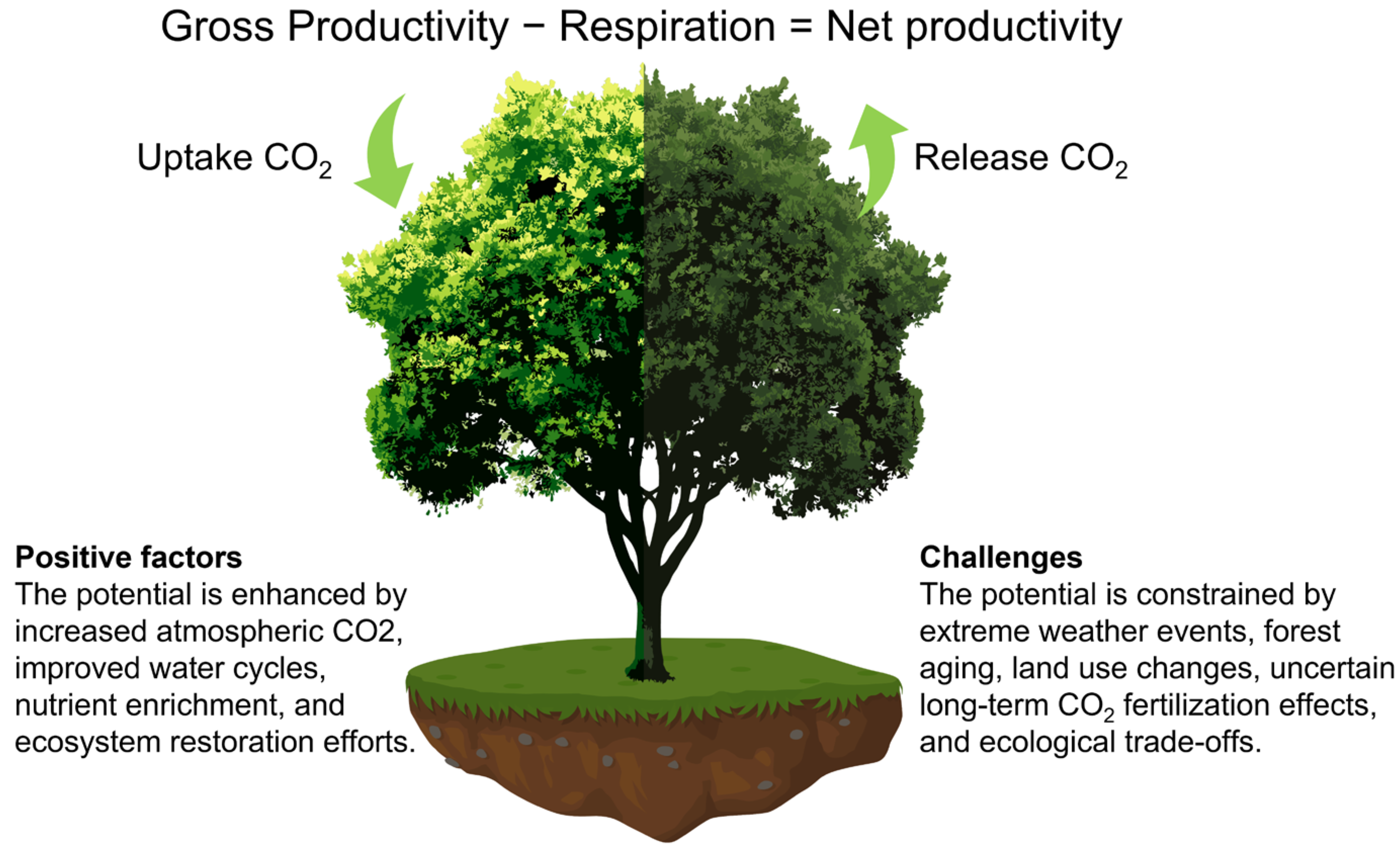
Figure 2.
(a) Mechanism of accelerated weathering of basalt; (b) Carbonization and decarbonization process of magnesium oxide.
Figure 2.
(a) Mechanism of accelerated weathering of basalt; (b) Carbonization and decarbonization process of magnesium oxide.
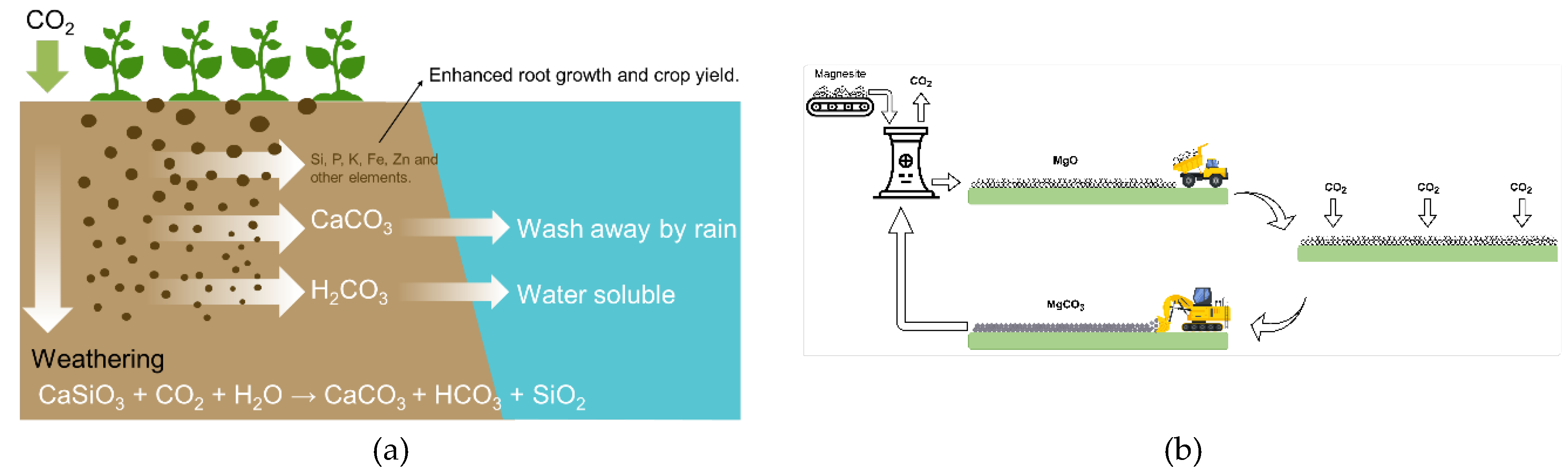
Figure 3.
Enhanced silicate weathering in coastal systems is a four-stage process.
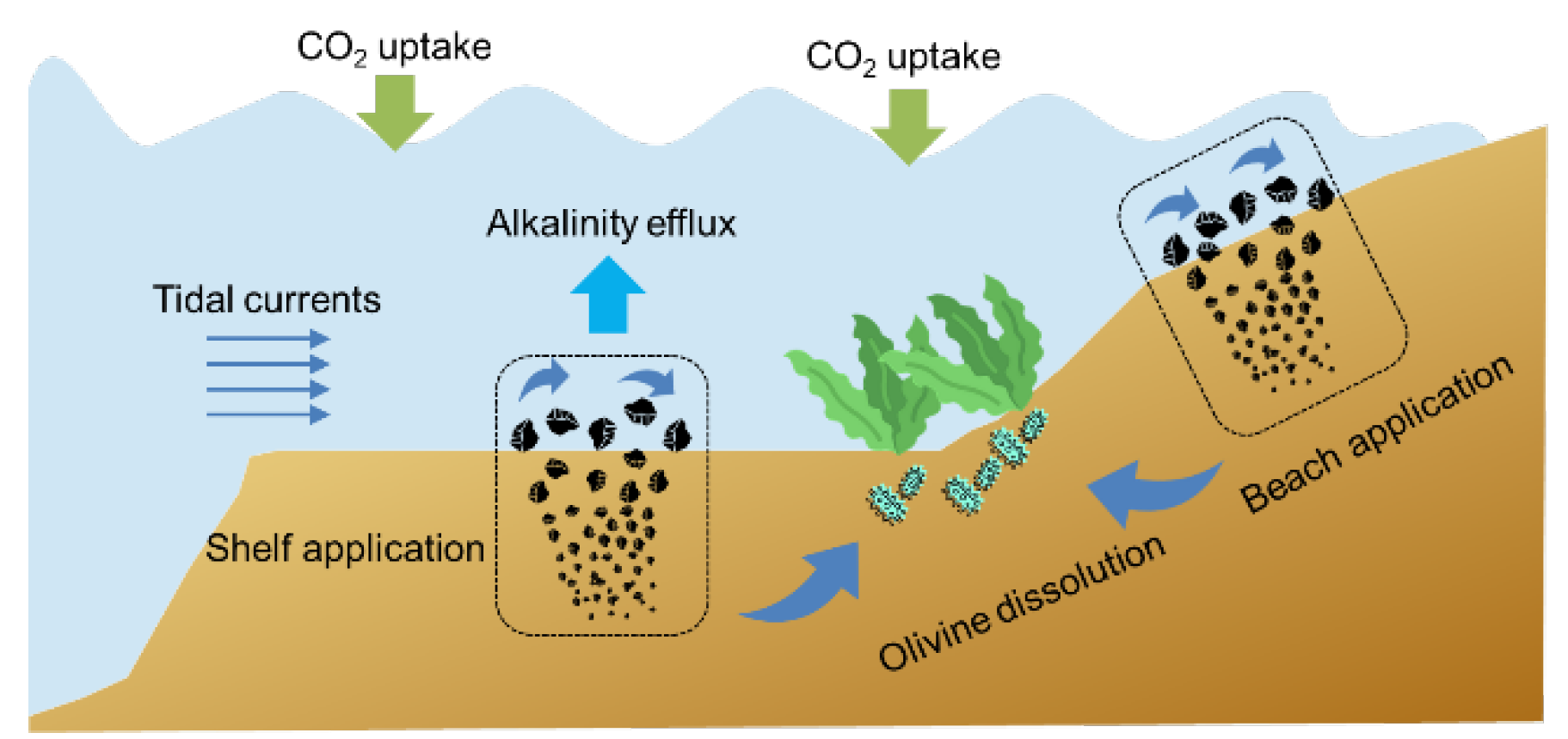

Table 1.
Comparative Characteristics and Engineering Adaptability of Four Oceanic Carbon Sequestration Mechanisms.
Table 1.
Comparative Characteristics and Engineering Adaptability of Four Oceanic Carbon Sequestration Mechanisms.
| Mechanism | Solubility Pump | Biological Pump | Carbonate Pump | Microbial Carbon Pump |
|---|---|---|---|---|
| Primary Medium | Surface water & cold deep water | Phytoplankton → POC | Calcifying plankton (e.g. coccoliths) | DOC → RDOC via microbial transformation |
| Sequestration Form | Dissolved CO₂ in deep ocean | Organic carbon in sediments | CaCO₃ sedimentation | Recalcitrant dissolved organic carbon |
| Timescale | Mid to long (1–10² yr) | Short to mid (1–10 yr) | Long-term (10²–10³ yr) | Ultra-long (>10³ yr) |
| Efficiency | Moderate (approx. 25% of ocean uptake) | Low (<1% of surface POC reaches deep sea) | Moderate | Potentially high (RDOC stock buildup) |
| Technical Maturity | Natural process | Moderate | Moderate | Low–Moderate |
| MRV Feasibility | Low (diffuse process, hard to track) | Medium (biological proxies, export fluxes) | Medium (particulate tracking feasible) | Low (invisible to current carbon flux monitoring) |
| Key Uncertainties / Risks | Ocean stratification, warming impact | Remineralization, nutrient limitation | Ocean acidification, calcifier response | Microbial pathway regulation, chemical turnover |
Table 2.
Anthropogenic CO₂ Budget Summary (GtC/yr) (Data from (Friedlingstein et al., 2024)).
| Time | Fossil CO₂ Emissions | Land-use Change | Total Emissions | Atmospheric Growth | Ocean Sink | Land Sink | Budget Imbalance |
|---|---|---|---|---|---|---|---|
| 1960s | 3.0 ± 0.2 | 1.6 ± 0.7 | 4.6 ± 0.7 | 1.7 ± 0.07 | 1.2 ± 0.4 | 1.2 ± 0.5 | 0.5 |
| 1970s | 4.7 ± 0.2 | 1.4 ± 0.7 | 6.1 ± 0.7 | 2.8 ± 0.07 | 1.5 ± 0.4 | 2.0 ± 0.8 | -0.1 |
| 1980s | 5.5 ± 0.3 | 1.4 ± 0.7 | 6.9 ± 0.8 | 3.4 ± 0.2 | 1.9 ± 0.4 | 1.8 ± 0.8 | -0.2 |
| 1990s | 6.4 ± 0.3 | 1.6 ± 0.7 | 7.9 ± 0.8 | 3.1 ± 0.2 | 2.1 ± 0.4 | 2.5 ± 0.6 | 0.2 |
| 2000s | 7.8 ± 0.4 | 1.4 ± 0.7 | 9.2 ± 0.8 | 4.0 ± 0.2 | 2.3 ± 0.4 | 2.8 ± 0.7 | 0.0 |
| 2014~2023 | 9.7 ± 0.5 | 1.1 ± 0.7 | 10.8 ± 0.9 | 5.2 ± 0.2 | 2.9 ± 0.4 | 3.2 ± 0.9 | -0.4 |
| 2023 | 10.1 ± 0.5 | 1.0 ± 0.7 | 11.1 ± 0.9 | 5.9 ± 0.2 | 2.9 ± 0.4 | 2.3 ± 1.1 | 0.0 |
| 2024 (projection.) | 10.2 ± 0.5 | 1.2 ± 0.7 | 11.4 ± 0.9 | 6.1 ± 0.3 | 3.0 ± 0.6 | 3.2 ± 1.5 | -0.9 |
Table 3.
Anthropogenic CO₂ Budget Summary (GtC/yr) (Data from (Friedlingstein et al., 2024)).
| Period | Fossil CO₂ Emissions | Land-Use Change Emissions | Total Emissions | Atmospheric CO₂ Growth | Ocean Sink | Land Sink | Budget Imbalance |
|---|---|---|---|---|---|---|---|
| 1960s | ~0.15 | ~0.10 (source) | 0.25 | 0.11 | 0.06 | ~0.08 | 0.01 (residual) |
| 1970s | ~0.31 | ~0.10 (source) | ~0.41 | ~0.18 | ~0.09 | ~0.13 | ~0.01 (residual) |
| 1980s | ~0.53 | ~0.05 (source) | ~0.58 | ~0.26 | ~0.13 | ~0.19 | ~0.01 (residual) |
| 1990s | ~0.85 | ~–0.01 (sink) | ~0.84 | ~0.37 | ~0.19 | ~0.26 | ~0.02 (residual) |
| 2000s | ~1.54 | ~–0.10 (sink) | ~1.44 | ~0.64 | ~0.33 | ~0.45 | ~0.03 (residual) |
| 2010s | ~2.69 | ~–0.18 (sink) | ~2.51 | ~1.10 | ~0.58 | ~0.78 | ~0.05 (residual) |
Table 4.
Global and Chinese carbon stock and net sink estimates for major terrestrial ecosystems.
| Ecosystem | Global carbon stock (Pg C) | Global net sink (Pg C /yr) |
China carbon stock (Pg C) | China net sink (Pg C /yr) |
Key uncertainty / Comment |
|---|---|---|---|---|---|
| Forests | 861 ± 66 | 1.10 ± 0.80 | 30.83 ± 1.57 | 0.16 (2001–2010) | Future saturation; disturbance risk |
| Wetlands | 208 | 0.83 | 7.6 (range: 3.6–16.9) | 0.12 | CH₄ offset potential; large area loss |
| Croplands | 128–165 | 0.11 | 7.5 | 0.03 (2010s) | Highly management-dependent |
| Grasslands | ≈ 520 | 0.37 ± 0.19 | ≈ 2.0 (soil only) | –0.0034 (2001–2010) | Interannual variability; grazing pressure |
| Deserts | ≈ 250 | - | 2.48 | - | Inorganic C pathways; sparse data |
| Urban areas | ~37 (6.7 buildings + ~30 landfill) | Data limited (depends on greening, GHG offset) | ~0.2–0.3 (urban greenspace estimate) | < 0.01 (Beijing, Guangzhou range) | Emission offset limits; land competition |
Note:All values are synthesized from peer-reviewed literature cited in section 3.2 and its sub-sections (3.2.1–3.2.6).
Table 5.
Comparative Table of CDR Pathways.
| CDR Pathway | Removal Potential (Gt CO₂/yr) |
Cost Range (USD/t CO₂) | Energy Consumption (GJ/t CO₂) |
Technology Readiness Level (TRL) |
|---|---|---|---|---|
| BECCS | 1 – 5 | 60 – 120 | 1.5 – 3.5 | 8 – 9 |
| DACCS | 5 – 10 | 300 – 600 | 6.0 – 12.0 | 5 – 6 |
| Biochar Application | 0.5 – 2 | 30 – 100 | 0.5 – 1.5 | 7 – 8 |
| Enhanced Weathering (e.g., basalt) | 2 – 4 | 80 – 250 | 1.0 – 4.0 | 5 – 7 |
| Industrial Carbonation (e.g., cement, slag) | 1 – 2 | 50 – 150 | 1.5 – 3.0 | 6 – 8 |
| CCS (Point-Source CCS) | 5 – 7 | 50 – 100 | 2.0 – 4.0 | 9 |
| OAE/OIF (Ocean Alkalinity Enhancement / Iron Fertilization) | 5 – 20 | 80 – 200 | 1.0 – 6.0 | 4 – 6 |
Disclaimer/Publisher’s Note: The statements, opinions and data contained in all publications are solely those of the individual author(s) and contributor(s) and not of MDPI and/or the editor(s). MDPI and/or the editor(s) disclaim responsibility for any injury to people or property resulting from any ideas, methods, instructions or products referred to in the content. |
© 2025 by the authors. Licensee MDPI, Basel, Switzerland. This article is an open access article distributed under the terms and conditions of the Creative Commons Attribution (CC BY) license (http://creativecommons.org/licenses/by/4.0/).
Copyright: This open access article is published under a Creative Commons CC BY 4.0 license, which permit the free download, distribution, and reuse, provided that the author and preprint are cited in any reuse.


