

Submitted:
01 September 2025
Posted:
03 September 2025
You are already at the latest version
Abstract
Background: Ethical leadership and ethical climate are generally considered protective factors against burnout, while affective commitment has traditionally been understood as a personal resource that enhances employee well-being. However, recent evidence suggests that, under specific contextual conditions, these variables may also operate as demands that intensify emotional strain. Objective: This study examines how telework intensity moderates the relationships between ethical leadership, affective commitment, principle-based ethical climate, and burnout. Methods: Data were drawn from a doctoral study conducted in the Colombian electricity sector. Moderation analyses were performed to assess whether the number of telework days per week altered the strength and direction of associations between organizational variables and the dimensions of burnout. Results: Telework intensity did not moderate the relationship between ethical leadership and affective commitment, but it strengthened the positive association between affective commitment and emotional exhaustion. Moreover, it reversed the role of a principle-based ethical climate: from being positively associated with emotional exhaustion and depersonalization to acting as a protective factor under medium to high telework intensity. Conclusions: The findings challenge conventional assumptions about affective commitment and ethical climate, highlighting the ambivalent role of telework. They underscore the need for more nuanced theoretical frameworks and management practices that are sensitive to emerging psychosocial risks in virtual work environments.
Keywords:
telework intensity
; burnout
; ethical leadership
; ethical climate
; affective commitment
1. Introduction
The accelerated shift to telework during the COVID-19 pandemic not only transformed daily work routines but also reshaped the psychosocial architecture of organizations (Kniffin et al., 2021). While working from home is often associated with flexibility, autonomy, and improved work–life balance, research has consistently shown that its consequences for employee well-being are ambivalent (Rudolph et al., 2021). High telework intensity—commonly defined as the number of days per week an employee works remotely—has been linked to positive outcomes such as reduced commuting stress, but also to adverse effects such as isolation and emotional exhaustion (Chung & van der Lippe, 2020; Molino et al., 2020). These contradictions underscore the importance of conceptualizing telework intensity not as inherently beneficial or detrimental, but as a contextual condition that shapes the impact of organizational practices and employee attitudes.
Within this evolving landscape, ethical leadership and ethical climate have been identified as key organizational resources that foster trust, psychological safety, and prosocial behavior (Brown & Treviño, 2006; Neubert et al., 2009). Ethical leaders promote fairness, transparency, and concern for others, while principle-based ethical climates (Victor & Cullen, 1988) create shared moral expectations that can shield employees from moral conflict and distress (Kammeyer-Mueller et al., 2016). Similarly, affective commitment—defined as an emotional bond with the organization—has been regarded as a personal resource that enhances motivation, engagement, and resilience (Meyer & Allen, 1991; Schaufeli & Salanova, 2011).
However, recent studies suggest that these resources are not unconditionally protective. Under conditions of sustained telework, affective commitment may paradoxically increase the risk of emotional strain, as highly committed employees devote substantial energy to sustaining relationships and meeting organizational expectations across blurred work–home boundaries (Lazauskaite-Zabielske et al., 2022). Likewise, ethical climates, though generally beneficial, may become demanding when employees perceive excessive rigidity without sufficient opportunities for support or dialogue (Borrelli et al., 2023). In this sense, constructs traditionally framed as resources may also function as demands, depending on telework intensity and the broader organizational environment.
Despite these insights, little is known about how telework intensity shapes the interplay between ethical leadership, principle-based ethical climate, affective commitment, and burnout. Moreover, prior research has often conceptualized burnout globally, without distinguishing its core dimensions. This study addresses this gap by focusing specifically on emotional exhaustion and depersonalization, the two dimensions most closely linked to deteriorations in psychological well-being and organizational functioning (Maslach et al., 2001).
The Colombian electricity sector provides a pertinent context for this analysis, combining responsibility for essential services, 24/7 operational demands, and accelerated digitalization. By examining whether telework intensity moderates the effects of ethical leadership, ethical climate, and affective commitment on emotional exhaustion and depersonalization, this brief report—derived from a doctoral dissertation, seeks to clarify whether these constructs operate as stable protective resources or whether, under certain conditions, they may also contribute to emotional strain.
Despite the growing interest in telework, significant gaps remain in understanding how its intensity reshapes the dynamics between ethics, commitment, and employee well-being. Previous studies have either examined these constructs separately or treated burnout as a unitary phenomenon, often overlooking its multidimensional nature. Although important contributions have been made in North American, European, and increasingly Asian contexts, much less is known about these dynamics in Latin America and in high-responsibility industries such as the electricity sector. This brief report directly addresses these limitations by analyzing unpublished data from a doctoral study, focusing on the Colombian electricity sector. In doing so, it advances knowledge by clarifying whether ethical leadership, affective commitment, and an ethical climate of principles consistently act as protective resources, or whether under conditions of varying telework intensity they may paradoxically transform into psychological demands that contribute to emotional strain.
Importantly, this article presents results that have not been previously published in other outputs of the dissertation, ensuring that the findings discussed here are original and contribute new insights to the academic debate on ethics, telework, and burnout. In doing so, it advances a more nuanced understanding of telework as a “double-edged sword” in shaping the relationships between ethics, commitment, and burnout.
2. Materials and Methods
2.1. Participants and Sampling Strategy
The research was conducted within the Colombian electricity sector, a context that concentrates a highly qualified workforce due to the technical and professional requirements of most positions. The population of interest comprised employees whose roles involved creativity and problem-solving as central tasks, while operational staff with limited cognitive demands were excluded.
A multi-stage probability sampling design was adopted to maximize representativeness. First, five major urban centers—Bogotá, Medellín, Cali, Pereira, and Manizales—were selected as geographical clusters given their relevance for the sector. Within these clusters, six organizations agreed to participate: EPM, ISA, CIDET, XM, CHEC, and DISPAC. Employees from these organizations were then randomly invited to participate. The minimum required sample size was estimated at 382 participants (95% confidence level), and a total of 448 valid responses were obtained, thus ensuring sufficient statistical power for the analyses.
The sample included 273 men (61%) and 175 women (39%). Most participants were under 50 years old (82%), had postgraduate qualifications (60%), and held permanent contracts (81%). The distribution by position was: analysts (69%), support staff (17%), middle managers (9%), and directors (5%). Average telework intensity was 3.3 days per week, with approximately 28% reporting full-time remote work.
2.2. Data Collection Procedure
Data were collected between November and December 2021 through an online questionnaire administered via Microsoft Forms. The study was introduced to organizations through the collective action platform of the sector, and participation was voluntary. Prior to completing the survey, participants were provided with information regarding the purpose of the research, confidentiality guarantees, and withdrawal rights. Data collection sessions were carried out during working hours, with the presence of the researcher to clarify potential questions.
2.3. Measures
Validated instruments widely used in international research were adapted to the Colombian context:
- Ethical Leadership: Measured with the 10-item unidimensional scale by Brown et al. (2005). Cronbach’s alpha in this study: 0.92.
- Principle-Based Ethical Climate: Assessed with the 11-item scale developed by Victor and Cullen (1988), comprising three dimensions: personal morality, rules and procedures, and professional codes and laws. Cronbach’s alpha: 0.74.
- Affective Commitment: Measured with the Meyer and Allen (1993). Cronbach’s alpha: 0.86.
- Burnout: Evaluated using the Maslach Burnout Inventory–General Survey (Schaufeli et al., 1996). Emotional exhaustion (5 items, α = 0.90) and depersonalization (5 items; α = 0.90; item 13 removed due to low factor loading).
- Telework Intensity: Operationalized as the self-reported number of telework days per week (1–5), following Vander Elst et al. (2017) and Virick et al. (2010).
All scales used a 6-point Likert response format ranging from 1 (“strongly disagree”) to 6 (“strongly agree”).
2.4. Ethical Considerations
The research protocol was reviewed and approved by the Ethics Committee of the University of Vic – Central University of Catalonia (July 21, 2021; code 170/2021). The evaluation confirmed compliance with ethical guidelines, including informed consent and data confidentiality, in line with the Code of Good Scientific Practice of the Spanish Ministry of Science and Innovation.
2.5. Analytical Strategy
Moderation analyses were conducted using Hayes’s PROCESS macro for SPSS (Model 1; Hayes, 2018). Telework intensity was tested as a moderator of the associations between ethical leadership, affective commitment, principle-based ethical climate, and burnout dimensions. Gender, age, and tenure were included as covariates. Statistical significance was set at p < 0.05. In line with best practices, the psychometric properties of all measurement instruments—including inter-variable correlations, convergent and discriminant validity, and model fit indices obtained through confirmatory factor analysis—were rigorously evaluated in the broader doctoral project from which this brief report derives (Santiago-Torner, 2025, p. 65). As these aspects were already extensively validated, the present manuscript focuses exclusively on the moderation analyses and results that have not been previously disseminated.
3. Results
3.1. Ethical Leadership and Affective Commitment
The moderation analysis indicated that telework intensity did not significantly alter the relationship between ethical leadership and affective commitment. Ethical leadership showed a positive and significant association with affective commitment (b = 0.25, p = 0.001), while the interaction term with telework intensity was non-significant (b = 0.02, p = 0.670). These findings suggest that the positive effect of ethical leadership on affective commitment remains stable, regardless of the number of telework days (revise Table 1).
3.2. Affective Commitment and Emotional Exhaustion
A different pattern was observed when examining the relationship between affective commitment and emotional exhaustion. The results showed a significant interaction between the two (b = 0.27, p < 0.05). Simple slope analysis revealed that as the intensity of teleworking increases, the positive impact of affective commitment on emotional exhaustion also increases. This result indicates that, in scenarios of This result indicates that, in scenarios of intensive teleworking, affective commitment does not protect against burnout but rather can coexist with it and even enhance it, given the additional effort required to maintain social interactions and respond to stricter ethical demands (revise Table 2 and Figure 1).
3.3. Ethical Climate and Emotional Exhaustion
Telework intensity also moderated the relationship between an ethical climate of principles and emotional exhaustion (revise Table 3). At low levels of telework intensity, a principles-based ethical climate was positively associated with emotional exhaustion. However, at high telework intensity, the relationship reversed and became negative, indicating that ethical climate acted as a protective factor under intensive telework conditions (revise Figure 2).
3.4. Ethical Climate and Depersonalization
A more specific moderation pattern was observed for depersonalization. Under low, medium, or high intensity teleworking conditions, the ethical climate was negatively associated with depersonalization. These results suggest that as teleworking intensity increases, it promotes a better person–environment fit, clarifies roles, and makes ethical standards seem more achievable, which reduces the likelihood of depersonalization.
3.5. Synthesis of Findings
In summary, the results indicate that telework intensity exerts a differential moderating effect across variables. Ethical leadership’s influence on affective commitment remained stable, independent of telework conditions. However, high telework intensity intensified the emotional costs of affective commitment and simultaneously transformed the role of ethical climate from a potential source of strain into a protective factor against burnout, particularly in the dimensions of emotional exhaustion and depersonalization. Figure 1, Figure 2 and Figure 3 visually illustrate these patterns, complementing the statistical evidence provided in Table 1, Table 2, Table 3 and Table 4.
4. Discussion
The findings of this study provide novel evidence on the role of telework intensity in the dynamics between ethical leadership, affective commitment, principle-based ethical climates, and burnout. First, it was confirmed that telework intensity does not moderate the relationship between ethical leadership and affective commitment, reinforcing the robustness of this link across different work contexts. Leadership behavior emerges as a central factor in shaping employees’ attitudes. Ethical leaders significantly contribute to integrating organizational values with employees’ attitudes and behaviors, establishing ethical standards that are enacted through consistent conduct. Such coherence enhances job satisfaction and, consequently, employees’ affective commitment. Social exchange theory offers a solid explanatory framework (Cook et al., 2013; Kim et al., 2022). Unlike economic exchange, which is transactional, social exchange relies on trust, mutual affection, and reciprocity. In this sense, behaviors of honesty, reliability, compassion, concern for others, and principled decision-making—hallmarks of ethical leadership—strengthen employees’ affective commitment to both the leader and the organization (Asif et al., 2019; Park et al., 2023). This result confirms that the positive relationship between ethical leadership and affective commitment is established and sustained regardless of whether the context of interaction is face-to-face or virtual.
Second, the findings reveal a counterintuitive result: affective commitment is positively associated with emotional exhaustion at all levels of telework intensity, although this relationship becomes particularly pronounced under conditions of high virtual interaction. Affective commitment is characterized by high energy and strong emotional identification with work. Employees may develop affective bonds with different organizational referents, such as supervisors or coworkers (Bouraoui et al., 2019; Mercurio, 2015). In this respect, telework intensity may affect this relationship in at least two ways. First, highly committed employees tend to mobilize greater emotional resources and effort to maintain connections with colleagues through frequent virtual interactions. In such contexts, technology does not fully satisfy the basic need for relatedness, creating frustration among highly committed employees and leading to greater vulnerability to emotional exhaustion (Lazauskaite-Zabielske et al., 2022; Lazauskaitė-Zabielskė et al., 2023). This finding challenges the traditional assumption that affective commitment is the antithesis of burnout. As Schaufeli and Salanova (2011) argue, both experiences can occur simultaneously. Second, telework intensity may amplify supervisors’ ethical demands, compelling employees to engage in constant emotional readjustments that increase fatigue. From the perspective of the Job Demands–Resources theory (Bakker & Demerouti, 2017), affective commitment typically operates as a resource. However, under intensive telework conditions, when maintaining social connection and meeting escalating ethical expectations require additional emotional investment, this resource may shift into a demand that undermines psychological well-being.
With respect to principle-based ethical climates, the results provide a more nuanced understanding of their role. Specifically, high telework intensity inversely moderates the relationship between this type of climate and emotional exhaustion. In other words, teleworking more than three days per week becomes a protective factor that mitigates potential normative rigidity. A principle-based ethical climate establishes values and norms that morally regulate individual and group behavior in both in-person and virtual settings. Moreover, it seeks to provide employees with the necessary tools to act ethically and to handle ethically deviant situations (Teresi et al., 2019). Nevertheless, an overly rigid ethical climate may generate unintended consequences, such as limiting trust, discouraging open expression of viewpoints due to fear of reprisal, and negatively affecting employee well-being (Borrelli et al., 2023; Santiago-Torner et al., 2025a, 2025b). This finding reinforces the idea that organizational ethics, although conceived as a resource, may become a source of psychological strain when managed rigidly.
In this regard, the obligation to behave in strictly ethical ways at work can give rise to moral distress, ethical conflict, role ambiguity, and burnout (Atabay et al., 2015; Kammeyer-Mueller et al., 2016). However, high telework intensity may buffer these effects by reducing direct exposure to ethical tensions and preventing sustained emotional overstimulation (Santiago-Torner et al., 2023). Indeed, a stable, albeit virtual, work environment can foster trust, clarify roles, and render ethical standards more attainable, thereby reducing perceived ethical conflicts (Rivaz et al., 2020). Recent studies support this view, showing that telework intensity contributes to improved person–environment fit and strengthens trust-based relationships (Jaiswal et al., 2024). Along this line, it is reasonable to expect that an adequate adaptation to the job may allow a principle-based ethical climate to interact more positively with personal morality and integrity, thereby mitigating demands associated with burnout (Santiago-Torner et al., 2024).
Finally, and coherently, a principle-based ethical climate was negatively associated with depersonalization across all levels of telework intensity. This suggests that having a solid yet flexible ethical framework helps prevent emotional distancing and cynical attitudes toward colleagues and clients, regardless of the work modality. In virtual contexts, where social interaction tends to diminish, shared values act as a moral anchor that sustains empathy and strengthens organizational identification (Stankevičienė et al., 2024). These findings highlight the cohesion-building role of organizational ethics, particularly in technologically mediated contexts, by providing meaning, belonging, and social cohesion.
Taken together, the findings indicate that telework intensity does not exert a homogeneous effect: it preserves the positive influence of ethical leadership on commitment, intensifies the emotional cost of affective commitment, transforms principle-based ethical climates from a potential source of tension into a protective resource, and reinforces their role in buffering both emotional exhaustion and depersonalization. These results underscore the need for more nuanced theoretical frameworks that recognize the ambivalent character of telework: it is neither inherently a resource nor a demand, but rather a dynamic context that reshapes how organizational factors influence psychological well-being.
4.1. Theoretical Implications
The findings of this study contribute to advancing theoretical debates on ethical leadership, ethical climate, and telework by emphasizing the complex and ambivalent role that work context plays in shaping organizational outcomes.
First, the confirmation that telework intensity does not moderate the positive relationship between ethical leadership and affective commitment reinforces the context-independent validity of social exchange theory. Ethical leadership behaviors—grounded in integrity, fairness, and reciprocity—appear to foster affective commitment regardless of whether interactions occur in physical or virtual settings. This suggests that the relational mechanisms proposed by social exchange theory remain robust in digitally mediated environments, extending its applicability to hybrid and remote work contexts.
Second, the counterintuitive finding that affective commitment is positively associated with emotional exhaustion, particularly under high telework intensity, challenges the traditional conceptual dichotomy between commitment and burnout. These results imply that affective commitment can simultaneously function as a resource and as a demand, depending on contextual conditions. This insight aligns with, but also extends, the Job Demands–Resources framework by showing that under telework-intensive conditions, affective commitment may shift from being a protective resource to becoming a strain-inducing demand. This dual role calls for a reconceptualization of affective commitment in remote work settings, moving away from linear assumptions toward a more dynamic and context-contingent perspective.
Third, the evidence that a principle-based ethical climate can act either as a source of strain or as a protective factor highlights the conditional nature of ethical climates. While rigid moral environments may heighten moral distress and psychological strain in traditional settings, high telework intensity appears to mitigate these risks and transform principle-based climates into resources that protect against burnout. This finding suggests the need to refine ethical climate theory by incorporating contextual moderators—such as work modality—that shape whether ethical norms are experienced as supportive or constraining.
Finally, the robust negative association between principle-based ethical climates and depersonalization across all levels of telework intensity underscores the cohesive and integrative function of shared ethical values in virtual work contexts. This supports the argument that ethical climates can serve as anchors of organizational identification and moral orientation, even when opportunities for social interaction are reduced. Thus, the study adds to emerging theories of virtual work by showing how shared values, rather than physical proximity, may constitute the primary drivers of cohesion and empathy in digital environments.
In sum, the study contributes to theory by (a) reaffirming the contextual resilience of social exchange theory, (b) problematizing traditional assumptions regarding affective commitment as purely protective, (c) extending ethical climate theory toward a conditional and context-sensitive framework, and (d) integrating telework intensity as a pivotal boundary condition in models of organizational behavior.
4.2. Practical Implications
The results of this study provide several actionable insights for managers and human resource practitioners seeking to foster well-being and resilience in increasingly hybrid and remote workplaces.
First, the consistent positive association between ethical leadership and affective commitment, regardless of work modality, underscores the need to prioritize ethical leadership development as a core managerial competency. Organizations should embed ethical leadership principles into training programs, leadership pipelines, and performance evaluation systems. This requires not only teaching compliance with ethical codes but also cultivating relational skills such as transparency, consistency, and compassion, which are particularly crucial in remote interactions where informal trust-building opportunities are limited.
Second, the finding that affective commitment, while desirable, can simultaneously increase emotional exhaustion under high telework intensity highlights a potential paradox for employee well-being. Managers must therefore strike a balance between encouraging commitment and preventing over-engagement. Practical measures include setting realistic workload boundaries, monitoring digital communication intensity, and designing “digital recovery” practices such as designated offline periods. HR departments can also implement commitment audits—regular assessments to ensure that high levels of affective attachment do not inadvertently translate into chronic emotional strain.
Third, the ambivalent role of principle-based ethical climates suggests that ethical norms must be operationalized in flexible and context-sensitive ways. Rather than enforcing rigid ethical codes that may heighten stress, managers should frame ethical principles as enabling guidelines that provide clarity without stifling autonomy. In remote settings, this can be achieved by integrating ethical decision-making scenarios into virtual team discussions, offering consultative spaces for moral dilemmas, and ensuring that ethics are embedded into digital collaboration tools in a supportive—not punitive—manner.
Fourth, the consistent negative association between principle-based climates and depersonalization across telework intensities emphasizes the importance of leveraging shared values to sustain empathy and organizational identification. Managers can reinforce ethical values through rituals and practices that create a sense of collective moral identity—for example, opening virtual meetings with brief reflections on organizational values, celebrating ethical conduct in recognition systems, and aligning reward structures with integrity-driven behaviors. These practices anchor social cohesion and counteract the relational erosion often observed in virtual teams.
Finally, the broader implication is that telework intensity should be treated as a boundary condition in HR policy design. Organizations must move away from “one-size-fits-all” approaches to leadership and ethical culture, instead tailoring interventions to the specific mix of in-person and virtual work that characterizes their teams. This involves developing adaptive HR frameworks that allow ethical leadership, value-based climates, and employee well-being practices to be recalibrated as telework intensity shifts.
In summary, the study suggests that organizational leaders should: (a) institutionalize ethical leadership as a relational competency; (b) monitor the double-edged effects of affective commitment; (c) frame ethical climates as supportive rather than prescriptive; (d) cultivate shared values to maintain empathy in virtual contexts; and (e) incorporate telework intensity as a critical design parameter in HR policies. Together, these measures provide a roadmap for building healthier, more resilient organizations in an era of intensified digital work.
4.3. Limitations and Future Research Directions
This study, while contributing novel insights into the ambivalent role of telework intensity in the relationship between ethical leadership, principle-based ethical climates, and burnout, is not without limitations. Acknowledging these constraints is essential to properly contextualize the findings and guide future inquiry.
First, the study relied on a cross-sectional design, which restricts the ability to make strong causal inferences. Although the theoretical frameworks used (social exchange theory and the job demands–resources model) provide a plausible explanation for the observed relationships, longitudinal or experimental designs would allow researchers to examine how the dynamics between ethical leadership, telework intensity, and burnout evolve over time.
Second, the data were collected from a single national context, which may limit generalizability. Telework intensity and perceptions of ethical leadership are likely shaped by cultural norms, labor regulations, and organizational traditions. Future studies should adopt cross-cultural or multinational samples to capture potential differences across institutional and cultural settings, particularly between collectivist and individualist contexts.
Third, while this study focused on two central dimensions of burnout—emotional exhaustion and depersonalization—it did not incorporate the full spectrum of well-being outcomes. Variables such as work engagement, psychological detachment, or technostress could enrich our understanding of how telework intensity simultaneously creates resources and demands.
Fourth, the reliance on self-reported measures raises the possibility of common method variance. Although methodological precautions were taken, future research should incorporate multisource or multimethod designs, such as supervisor ratings, peer evaluations, or digital trace data, to triangulate findings.
Fifth, the study examined telework intensity as a quantitative variable but did not fully capture qualitative aspects of remote work such as autonomy, task interdependence, or digital overload. Future research could explore whether different configurations of remote work conditions moderate the effects of ethical leadership and ethical climates in more nuanced ways.
Finally, the unexpected positive association between affective commitment and emotional exhaustion in telework settings calls for deeper theoretical exploration. Future studies could investigate the mechanisms behind this paradox, considering variables such as role boundary blurring, emotional regulation strategies, or virtual presenteeism. Such inquiries would help clarify whether affective commitment, under certain conditions, becomes a double-edged sword in the digital workplace.
In sum, future research should prioritize longitudinal, cross-cultural, multimethod, and multidimensional approaches to refine our understanding of how ethical leadership and ethical climates interact with telework intensity to shape employee well-being. By addressing these gaps, scholars can develop a more comprehensive and context-sensitive framework for managing ethical and psychological challenges in hybrid and remote work environments.
5. Conclusions
This study advances our understanding of the complex interplay between ethical leadership, principle-based ethical climates, and burnout, while highlighting the ambivalent role of telework intensity as a contextual factor. The findings demonstrate that ethical leadership consistently fosters affective commitment, regardless of the degree of remote work, underscoring the robustness of ethical conduct as a driver of trust and attachment in organizational life.
At the same time, the study uncovers a paradoxical outcome: affective commitment, traditionally regarded as a protective factor, is positively associated with emotional exhaustion across all levels of telework intensity, with the relationship becoming particularly pronounced under highly virtualized conditions. This counterintuitive finding reveals that commitment can, under certain circumstances, function as a double-edged sword, intensifying emotional costs when relational needs are unmet and ethical demands become more salient.
The results also show that telework intensity moderates the role of principle-based ethical climates in meaningful ways. While rigid ethical environments may generate stress and conflict under low telework intensity, higher levels of remote work appear to transform such climates into protective resources, reducing emotional exhaustion and preventing moral overstrain. Furthermore, principle-based ethical climates consistently mitigate depersonalization, offering a cohesive ethical framework that anchors empathy and identification with the organization, even in virtual settings.
Taken together, these findings challenge simplified views of telework as either a resource or a demand, illustrating instead its ambivalent nature. Telework intensity reconfigures how established organizational factors—ethical leadership, affective commitment, and ethical climates—translate into well-being or strain. Recognizing this complexity is essential for both scholars and practitioners seeking to understand and manage the psychological consequences of work in increasingly hybrid and digital contexts.
Funding
This research received no external funding.
Institutional Review Board Statement
The study was conducted in accordance with the Declaration of Helsinki and approved by the Research Ethics Committee of the University of Vic—Central University of Catalonia (protocol code 170/2021 and 20 July 2021).
Informed Consent Statement
Informed consent was obtained from all subjects involved in the study.
Data Availability Statement
The original data presented in the study and the questionnaire used are openly available at The Open Science Framework repository at https://osf.io/w2g5b/?view_only=f8b9995262ed469eab5413f302dd83c4, accessed on 23 January 2025. In addition, the doctoral thesis can be consulted via the following link: https://www.tdx.cat/handle/10803/694925?locale-attribute=es
Conflicts of Interest
The author declare no conflicts of interest.
References
- Asif, Qing, Hwang, & Shi. (2019). Ethical Leadership, Affective Commitment, Work Engagement, and Creativity: Testing a Multiple Mediation Approach. Sustainability, 11(16), 4489. [CrossRef]
- Atabay, G., Çangarli, B. G., & Penbek, Ş. (2015). Impact of ethical climate on moral distress revisited: multidimensional view. Nursing ethics, 22(1), 103-116. [CrossRef]
- Bakker, A. B., & Demerouti, E. (2017). Job demands–resources theory: Taking stock and looking forward. Journal of Occupational Health Psychology, 22(3), 273–285. [CrossRef]
- Borrelli, I., Rossi, M. F., Melcore, G., Perrotta, A., Santoro, P. E., Gualano, M. R., & Moscato, U. (2023). Workplace ethical climate and workers’ burnout: A systematic review. Clinical Neuropsychiatry, 20(5), 405-414. [CrossRef]
- Bouraoui, K., Bensemmane, S., Ohana, M., & Russo, M. (2019a). Corporate social responsibility and employees’ affective commitment. Management Decision, 57(1), 152–167. [CrossRef]
- Brown, M. E., & Treviño, L. K. (2006). Ethical leadership: A review and future directions. The Leadership Quarterly, 17(6), 595–616. [CrossRef]
- Brown, M. E., Treviño, L. K., & Harrison, D. A. (2005). Ethical leadership: A social learning perspective for construct development and testing. Organizational Behavior and Human Decision Processes, 97(2), 117–134. [CrossRef]
- Chung, H., & van der Lippe, T. (2020). Flexible working, work–life balance, and gender equality: Introduction. Social Indicators Research, 151(2), 365–381. [CrossRef]
- Cook, K. S., Cheshire, C., Rice, E. R., & Nakagawa, S. (2013). Social exchange theory. In Handbook of social psychology (pp. 61-88). Dordrecht: Springer Netherlands. [CrossRef]
- Hayes, A. F. (2018). Partial, conditional, and moderated moderated mediation: Quantification, inference, and interpretation. Communication monographs, 85(1), 4-40. [CrossRef]
- Jaiswal, A., Sengupta, S., Panda, M., Hati, L., Prikshat, V., Patel, P., & Mohyuddin, S. (2024). Teleworking: role of psychological well-being and technostress in the relationship between trust in management and employee performance. International Journal of Manpower, 45(1), 49–71. [CrossRef]
- Kammeyer-Mueller, J. D., Simon, L. S., & Judge, T. A. (2016). A Head Start or a Step Behind? Understanding How Dispositional and Motivational Resources Influence Emotional Exhaustion. Journal of Management, 42(3), 561–581. [CrossRef]
- Kim, H., So, K. K. F., & Wirtz, J. (2022). Service robots: Applying social exchange theory to better understand human–robot interactions. Tourism Management, 92(1), 104537. [CrossRef]
- Kniffin, K. M., Narayanan, J., Anseel, F., Antonakis, J., Ashford, S. P., Bakker, A. B., Bamberger, P., Bapuji, H., Bhave, D. P., Choi, V. K., Creary, S. J., Demerouti, E., Flynn, F. J., Gelfand, M. J., Greer, L. L., Johns, G., Kesebir, S., Klein, P. G., Lee, S. Y., ... Vugt, M. V. (2021). COVID-19 and the workplace: Implications, issues, and insights for future research and action. American Psychologist, 76(1), 63–77. [CrossRef]
- Lazauskaitė-Zabielskė, J., Urbanavičiūtė, I., & Žiedelis, A. (2023). Pressed to overwork to exhaustion? The role of psychological detachment and exhaustion in the context of teleworking. Economic and Industrial Democracy, 44(3), 875–892. [CrossRef]
- Lazauskaite-Zabielske, J., Ziedelis, A., & Urbanaviciute, I. (2022). When working from home might come at a cost: the relationship between family boundary permeability, overwork climate and exhaustion. Baltic Journal of Management, 17(5), 705–721. [CrossRef]
- Maslach, C., Schaufeli, W. B., & Leiter, M. P. (2001). Job burnout. Annual Review of Psychology, 52, 397–422. [CrossRef]
- Mercurio, Z. A. (2015). Affective Commitment as a Core Essence of Organizational Commitment. Human Resource Development Review, 14(4), 389–414. [CrossRef]
- Meyer, J. P., & Allen, N. J. (1991). A three-component conceptualization of organizational commitment. Human Resource Management Review, 1(1), 61–89. [CrossRef]
- Meyer, J. P., Allen, N. J., & Smith, C. A. (1993). Commitment to organizations and occupations: Extension and test of a three-component conceptualization. Journal of Applied Psychology, 78(4), 538–551. [CrossRef]
- Molino, M., Ingusci, E., Signore, F., Manuti, A., Giancaspro, M. L., Russo, V., Zito, M., & Cortese, C. G. (2020). Wellbeing costs of technology use during remote working: An investigation using the Italian translation of the technostress creators scale. Sustainability, 12(15), 5911. [CrossRef]
- Neubert, M. J., Carlson, D. S., Kacmar, K. M., Roberts, J. A., & Chonko, L. B. (2009). The virtuous influence of ethical leadership behavior: Evidence from the field. Journal of Business Ethics, 90(2), 157–170. [CrossRef]
- Park, J. G., Zhu, W., Kwon, B., & Bang, H. (2023). Ethical leadership and follower unethical pro-organizational behavior: examining the dual influence mechanisms of affective and continuance commitments. The International Journal of Human Resource Management, 34(22), 4313–4343. [CrossRef]
- Rivaz, M., Asadi, F., & Mansouri, P. (2020). Assessment of the Relationship between Nurses’ Perception of Ethical Climate and Job Burnout in Intensive Care Units. Investigación y Educación En Enfermería, 38(3), e12. [CrossRef]
- Rudolph, C. W., Allan, B., Clark, M., Hertel, G., Hirschi, A., Kunze, F., Shockley, K., Shoss, M., Sonnentag, S., & Zacher, H. (2021). Pandemics: Implications for research and practice in industrial and organizational psychology. Industrial and Organizational Psychology, 14(1-2), 1–35. [CrossRef]
- Santiago-Torner, C. (2023). Teleworking and emotional exhaustion in the Colombian electricity sector: The mediating role of affective commitment and the moderating role of creativity. Intangible Capital, 19(2), 207-258. [CrossRef]
- Santiago-Torner, C. (2025). ¿El liderazgo y los climas éticos amortiguan o promueven el burnout en el Sector Eléctrico Colombiano? [Tesis doctoral, Universitat de Girona]. TDX (Tesis Doctorals en Xarxa). https://www.tdx.cat/handle/10803/694925.
- Santiago-Torner, C., Corral-Marfil, J. A., Jiménez-Pérez, Y., & Tarrats-Pons, E. (2025a). Impact of ethical leadership on autonomy and self-efficacy in virtual work environments: The disintegrating effect of an egoistic climate. Behavioral Sciences, 15(1), 95. [CrossRef]
- Santiago-Torner, C., Corral-Marfil, J.-A., & Tarrats-Pons, E. (2024). Relationship between Personal Ethics and Burnout: The Unexpected Influence of Affective Commitment. Administrative Sciences, 14(6), 123. [CrossRef]
- Santiago-Torner, C., González-Carrasco, M., & Miranda-Ayala, R. (2025b). Relationship between ethical climate and burnout: A new approach through work autonomy. Behavioral Sciences, 15(2), 121. [CrossRef]
- Schaufeli, W. B., Leiter, M. P., Maslach, C., & Jackson, S. E. (1996). Maslach Burnout Inventory–General Survey. In C. Maslach, S. E. Jackson, & M. P. Leiter (Eds.), MBI manual (3rd ed.). Consulting Psychologists Press.
- Schaufeli, W., & Salanova, M. (2011). Work engagement: On how to better catch a slippery concept. European Journal of Work and Organizational Psychology, 20(1), 39–46. [CrossRef]
- Stankevičienė, A., Grincevičienė, N., Diskienė, D., & Drūteikienė, G. (2024). The Influence of personal skills for telework on organisational commitment: The mediating effect of the perceived intensity of telework. JEEMS Journal of East European Management Studies, 28(4), 606-629. [CrossRef]
- Teresi, M., Pietroni, D., Barattucci, M., Giannella, V. A., & Pagliaro, S. (2019). Ethical climate(s), organizational identification, and employees’ behavior. Frontiers in Psychology, 10(1), 1356. [CrossRef]
- Vander Elst, T., Verhoogen, R., Sercu, M., Van den Broeck, A., Baillien, E., & Godderis, L. (2017). Not extent of telecommuting, but job characteristics as proximal predictors of work-related well-being. Journal of Occupational and Environmental Medicine, 59(10), e180–e186. [CrossRef]
- Victor, B., & Cullen, J. B. (1988). The organizational bases of ethical work climates. Administrative Science Quarterly, 33(1), 101–125. [CrossRef]
- Virick, M., DaSilva, N., & Arrington, K. (2010). Moderators of the curvilinear relation between extent of telecommuting and job and life satisfaction: The role of performance outcome orientation and worker type. Human Relations, 63(1), 137–154. [CrossRef]
Figure 1.
Effect of telework intensity on the relationship between affective commitment and emotional exhaustion. Note: The figure illustrates that affective commitment consistently predicts higher levels of emotional exhaustion, and this association is progressively amplified as telework intensity increases (low, medium, high). This finding highlights the paradoxical role of affective commitment, which, under conditions of greater virtual work, may transform from a resource into a psychological demand that exacerbates strain.
Figure 1.
Effect of telework intensity on the relationship between affective commitment and emotional exhaustion. Note: The figure illustrates that affective commitment consistently predicts higher levels of emotional exhaustion, and this association is progressively amplified as telework intensity increases (low, medium, high). This finding highlights the paradoxical role of affective commitment, which, under conditions of greater virtual work, may transform from a resource into a psychological demand that exacerbates strain.
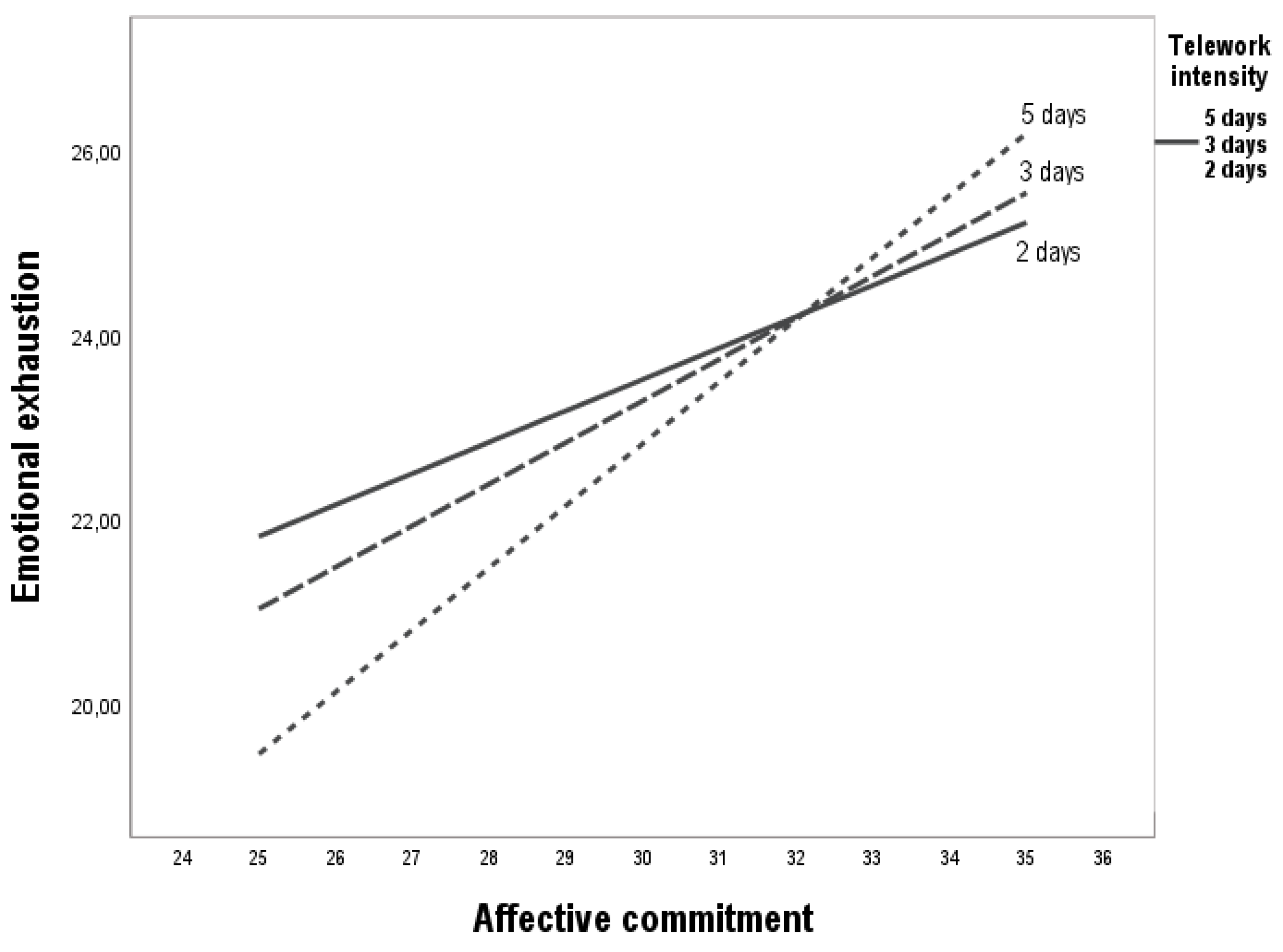
Figure 2.
Effect of telework intensity on the relationship between ethical climate of principles and emotional exhaustion. Note: At low telework intensity, a principled ethical climate is positively associated with emotional exhaustion, suggesting that excessive normative expectations can be psychologically taxing. However, under medium and high telework intensity, this relationship reverses, with the ethical climate acting as a protective factor that buffers emotional exhaustion. This moderation underscores the ambivalent role of telework in reshaping the effects of ethical contexts.
Figure 2.
Effect of telework intensity on the relationship between ethical climate of principles and emotional exhaustion. Note: At low telework intensity, a principled ethical climate is positively associated with emotional exhaustion, suggesting that excessive normative expectations can be psychologically taxing. However, under medium and high telework intensity, this relationship reverses, with the ethical climate acting as a protective factor that buffers emotional exhaustion. This moderation underscores the ambivalent role of telework in reshaping the effects of ethical contexts.
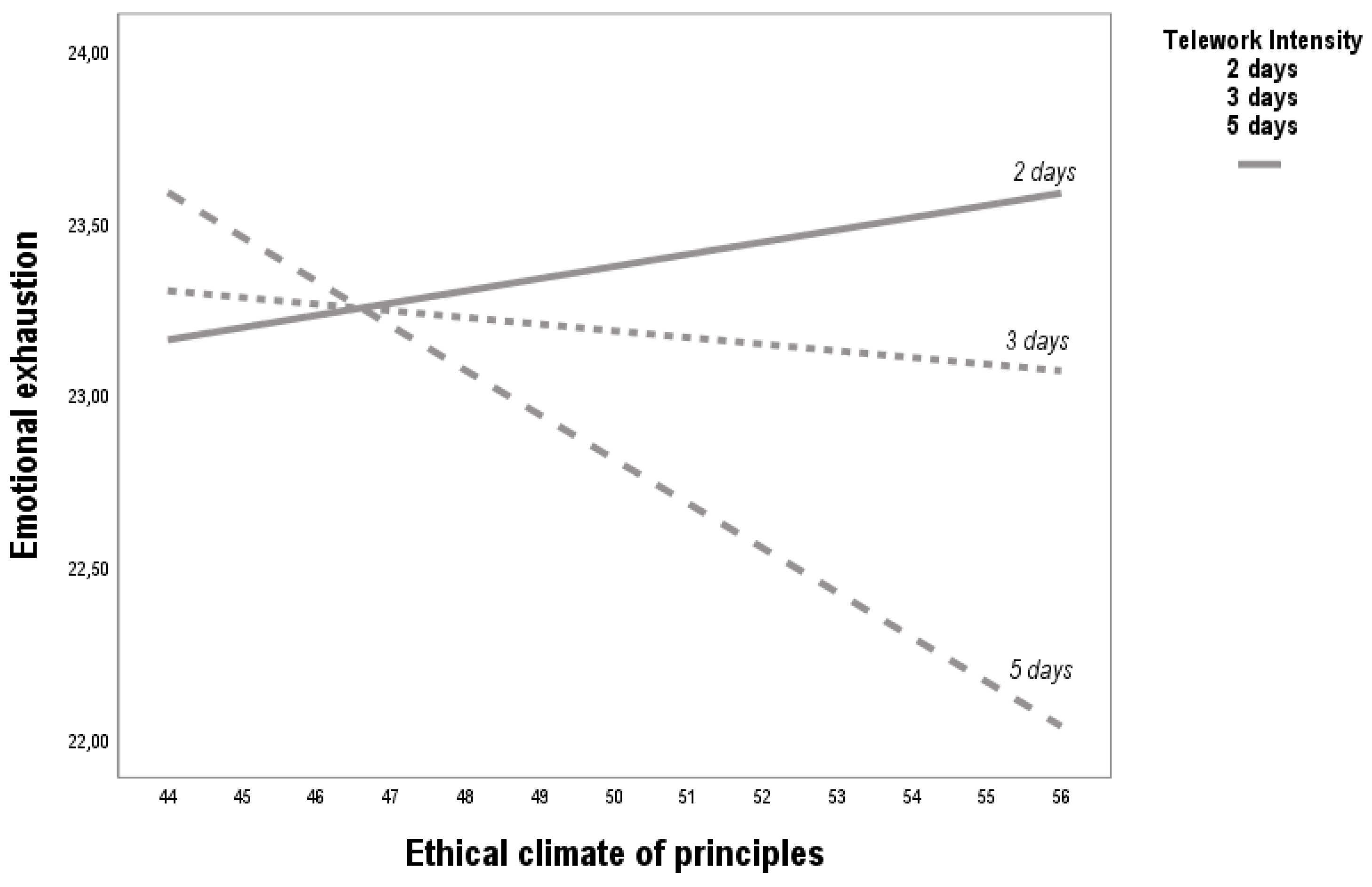
Figure 3.
Effect of telework intensity on the relationship between ethical climate of principles and depersonalization. Note: The figure shows that telework intensity consistently reverses the positive relationship between principled ethical climate and depersonalization. Across low, medium, and high levels of telework, the ethical climate functions as a buffer, mitigating emotional distancing and cynicism toward colleagues and clients. This suggests that in virtualized work environments, shared moral principles can foster cohesion and reduce the risk of depersonalization.
Figure 3.
Effect of telework intensity on the relationship between ethical climate of principles and depersonalization. Note: The figure shows that telework intensity consistently reverses the positive relationship between principled ethical climate and depersonalization. Across low, medium, and high levels of telework, the ethical climate functions as a buffer, mitigating emotional distancing and cynicism toward colleagues and clients. This suggests that in virtualized work environments, shared moral principles can foster cohesion and reduce the risk of depersonalization.
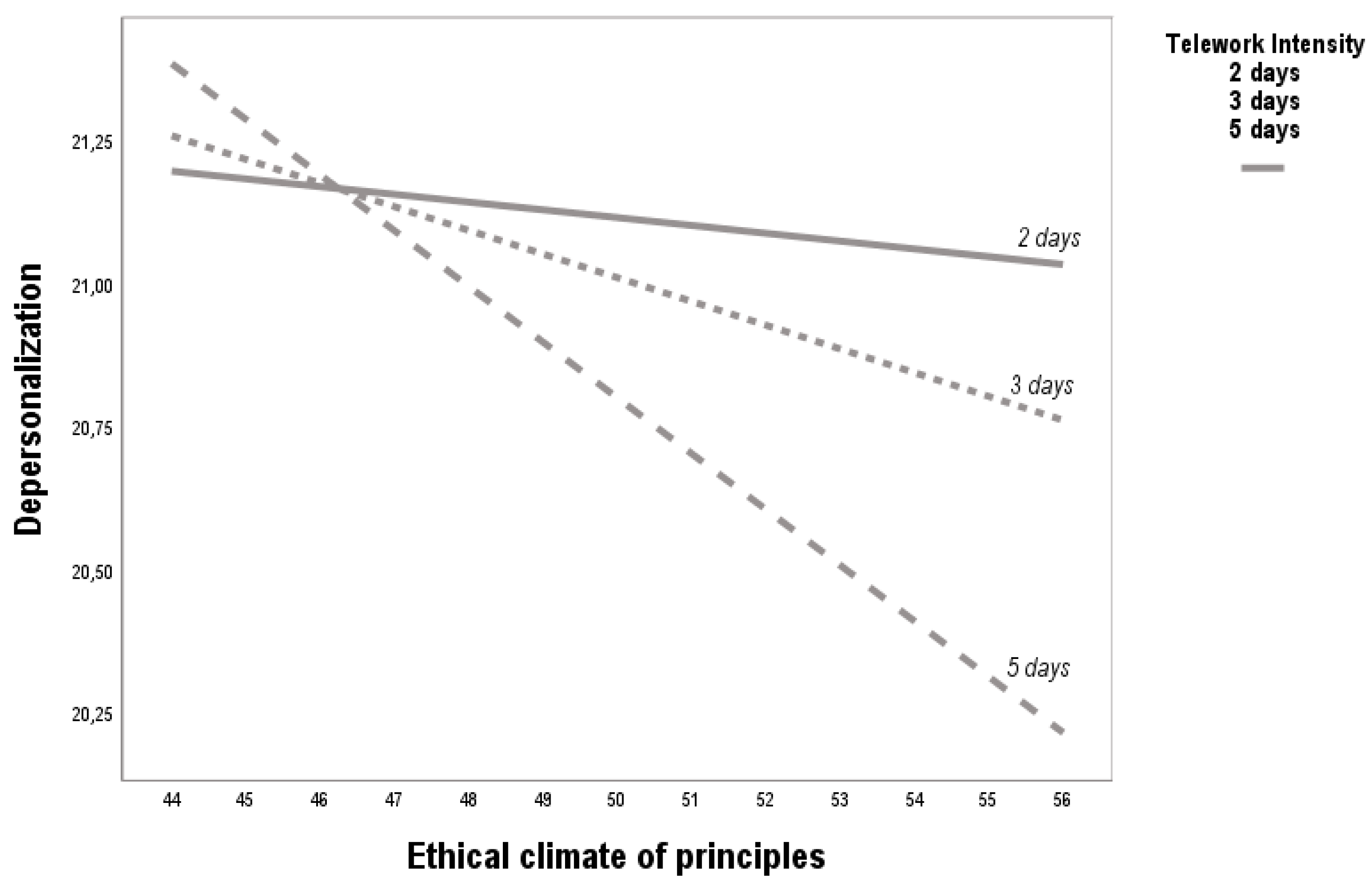

Table 1.
Moderation of Telework Intensity Between Ethical Leadership and Affective Commitment.
| Model Summary | R | R² | ΔR² | F (df1, df2) | p |
|---|---|---|---|---|---|
| Outcome variable: | Affective commitment (Y) | ||||
| Overall model | 0.29 | 0.09 | 0.02 | 14.01 (3. 443) | < 0.01 |
| Predictor | b | SE | t | p | 95% CI [LLCI, ULCI] |
| Constant | 22.50 | 3.17 | 7.01 | 0.01 | [16.27, 28.74] |
| Ethical Leadership (X) | 0.25 | 0.06 | 3.42 | 0.01 | [0.11, 0.39] |
| Telework Intensity (W) | −0.59 | 1.01 | −0.56 | 0.57 | [−1.60, 3.21] |
| Interaction (X × W) | 0.02 | 0.02 | 0.43 | 0.67 | [−0.07, 0.05] |
Note. Affective commitment was regressed on ethical leadership (X), telework intensity (W), and their interaction term (X × W). The interaction did not reach statistical significance, b = 0.02, t = 0.43, p = 0.67. (N = 448).
Table 2.
Moderation of Telework Intensity Between Affective Commitment and Emotional Exhaustion.
| Model Summary | R | R² | ΔR² | F (df1, df2) | p |
|---|---|---|---|---|---|
| Outcome variable: | Emotional Exhaustion (Y) | ||||
| Overall model | 0.46 | 0.21 | 0.08 | 39.09 (3. 444) | < 0.01 |
| Predictor | b | SE | t | p | 95% CI [LLCI, ULCI] |
| Constant | 15.46 | 3.65 | 4.23 | 0.01 | [8.29, 22.64] |
| Affective Commitment (X) | 0.27 | 0.12 | 2.25 | 0.02 | [0.04, 0.51] |
| Telework Intensity (W) | −2.49 | 1.08 | −2.29 | 0.02 | [−4.62, −0.35] |
| Interaction (X × W) | 0.08 | 0.04 | 2.14 | 0.03 | [0.06, 0.15] |
Note. Emotional exhaustion was regressed on affective commitment (X), telework intensity (W), and their interaction term (X × W). The interaction is statistically significant, b = 0.08, t = 2.14, p = 0.03. (N = 448).
Table 3.
Moderation of Telework Intensity Between Climate of Principles and Emotional Exhaustion.
| Model Summary | R | R² | ΔR² | F (df1, df2) | p |
|---|---|---|---|---|---|
| Outcome variable: | Emotional Exhaustion (Y) | ||||
| Overall model | 0.46 | 0.22 | 0.09 | 24.58 (5. 442) | < 0.01 |
| Predictor | b | SE | t | p | 95% CI [LLCI, ULCI] |
| Constant | 24.53 | 4.30 | 4.13 | 0.01 | [4.32, 23.69] |
| Climate of principles (X) | 0.20 | 0.07 | 3.42 | 0.01 | [0.11, 0.39] |
| Telework Intensity (W) | −2.72 | 1.46 | −3.66 | 0.02 | [−1.60, −0.21] |
| Interaction (X × W) | −0.06 | 0.03 | −3.95 | 0.02 | [−0.11, −0.02] |
Note. Emotional exhaustion was regressed on climate of principles (X), telework intensity (W), and their interaction term (X × W). The interaction is statistically significant, b = −0.06, t = −3.95, p = 0.02. (N = 448).
Table 4.
Moderation of Telework Intensity Between Climate of Principles and Depersonalization.
| Model Summary | R | R² | ΔR² | F (df1, df2) | p |
|---|---|---|---|---|---|
| Outcome variable: | Depersonalization (Y) | ||||
| Overall model | 0.58 | 0.34 | 0.12 | 35.79 (5. 442) | < 0.01 |
| Predictor | b | SE | t | p | 95% CI [LLCI, ULCI] |
| Constant | 24.41 | 4.17 | 4.28 | 0.01 | [4.10, 23.01] |
| Climate of principles (X) | 0.26 | 0.07 | 4.32 | 0.01 | [0.21, 0.79] |
| Telework Intensity (W) | −2.12 | 1.66 | −3.26 | 0.02 | [−1.16, −0.31] |
| Interaction (X × W) | −0.05 | 0.02 | −3.25 | 0.02 | [−0.42, −0.12] |
Note. Depersonalization was regressed on climate of principles (X), telework intensity (W), and their interaction term (X × W). The interaction is statistically significant, b = −0.05, t = −3.25, p = 0.02. (N = 448).
Disclaimer/Publisher’s Note: The statements, opinions and data contained in all publications are solely those of the individual author(s) and contributor(s) and not of MDPI and/or the editor(s). MDPI and/or the editor(s) disclaim responsibility for any injury to people or property resulting from any ideas, methods, instructions or products referred to in the content. |
© 2025 by the authors. Licensee MDPI, Basel, Switzerland. This article is an open access article distributed under the terms and conditions of the Creative Commons Attribution (CC BY) license (http://creativecommons.org/licenses/by/4.0/).
Copyright: This open access article is published under a Creative Commons CC BY 4.0 license, which permit the free download, distribution, and reuse, provided that the author and preprint are cited in any reuse.


