

Submitted:
29 August 2025
Posted:
01 September 2025
You are already at the latest version
Abstract
This study proposes a novel SSA-EMS framework that integrates Singular Spectrum Analysis (SSA) with Effect-Matched Spatial Filtering (EMS), combining the noise-reduction capability of SSA with the dynamic feature extraction advantages of EMS to optimize cross-subject EEG-based emotion feature extraction. Experiments were con-ducted using the SEED dataset under two evaluation paradigms: "cross-subject sample combination" and "subject-independent" assessment. Random Forest (RF) and SVM clas-sifiers were employed to perform pairwise classification of three emotional states—positive, neutral, and negative. Results demonstrate that the SSA-EMS framework achieves RF classification accuracies exceeding 98% across the full frequency band, sig-nificantly outperforming single frequency bands. Notably, in the subject-independent evaluation, model accuracy remains above 96%, confirming the algorithm’s strong cross-subject generalization capability. Experimental results validate that the SSA-EMS framework effectively captures dynamic neural differences associated with emotions. Nevertheless, limitations in binary classification and the potential for multimodal exten-sion remain important directions for future research.
Keywords:
EEG
; emotion recognition
; EMS
; SSA
; cross-subject
1. Introduction
EEG hold significant value for emotion recognition due to their high temporal resolution and non-invasive nature[1,2]. However, their practical application faces numerous challenges stemming from the inherent biophysical properties of EEG signals and the complexity of emotions themselves[3,4,5]. EEG signals exhibit typical non-stationary characteristics and low signal-to-noise ratios, making them highly susceptible to interference from physiological artifacts[6,7]. The challenges become even more pronounced in cross-subject EEG emotion recognition tasks[8,9]. Beyond the intrinsic complexity of the signals, individual differences in physiology and psychology further exacerbate the difficulty of EEG-based emotion recognition[10,11]. As a result, EEG emotion recognition models often perform well in within-subject scenarios but demonstrate significantly reduced generalization capability in cross-subject settings[12,13].
To address this challenge, researchers have proposed various innovative methods to enhance the cross-subject adaptability of models by improving signal processing techniques or machine learning frameworks[14,15]. Anuragi A et al. proposed an automated cross-subject emotion recognition framework based on EEG signals, employing the Fourier-Bessel Series Expansion-based Empirical Wavelet Transform (FBSE-EWT) method. They demonstrated the effectiveness of the proposed framework using machine learning models such as Artificial Neural Networks (ANN) and k-Nearest Neighbors (k-NN), showing superior performance in human emotion classification compared to other state-of-the-art emotion classification models [16]. Wenhui Guo and Yaxuan Li et al. introduced a Functional Connectivity-Enhanced Feature Group Attention Network (FC-FAN) for cross-subject emotion recognition. Comprehensive evaluations indicate that this framework achieves outstanding performance in cross-subject emotion recognition tasks, effectively capturing the spatiotemporal features of EEG signals while clearly analyzing the nonlinear relationships among electrode signals [17]. Yong Peng and Honggang Liu et al. proposed a joint EEG feature transfer and semi-supervised cross-subject emotion recognition model, which achieves global optimality by simultaneously optimizing the shared subspace projection matrix and target labels. The joint learning paradigm of this model significantly improves emotion recognition performance on both the SEED and SEED-IV datasets [18].
Schurger et al. proposed EMS algorithm[19]. Traditional spatial filtering methods rely on predefined spatial regions or fixed spatial filters, whose static nature limits their ability to dynamically adapt to the temporal evolution of neural activity. The core advantage of EMS lies in its "experiment-effect-driven" characteristic, which constructs time-varying spatial filters to capture the spatiotemporal dynamics of emotional differences[19]. Although the EMS algorithm can effectively track the dynamic changes of experimental effects, its direct construction of filters based on raw signal differences makes it susceptible to interference from high-frequency noise and artifacts. To address this issue, this study proposes a novel framework, SSA-EMS, which integrates EMS with SSA. The SSA-EMS framework leverages the strengths of SSA in time series denoising and reconstruction, as well as the advantages of EMS in spatial filtering and dynamic adaptation, aiming to achieve effective feature extraction from EEG signals.
2. Dataset and Methods
2.1. Dataset
The SEED dataset, provided by Shanghai Jiao Tong University, is a publicly available dataset primarily used for EEG-based affective computing research [20]. This dataset contains EEG signals from 15 Chinese participants (7 males and 8 females). EEG signals were recorded using a 62-channel electrode cap based on the international 10–20 system, covering major brain regions. Each participant completed 15 trials, during which they watched 15 film clips, each approximately 4 minutes long. These clips were carefully selected and edited to effectively elicit one of three distinct target emotions: positive, neutral, or negative. Prior to each clip, a 5-second cue was presented, followed by a 45-second period for self-assessment after viewing. A 15-second rest period was provided between consecutive clips. The presentation order of the films was specifically designed to prevent two clips targeting the same emotion from being shown consecutively [20]. The entire experiment was conducted over three sessions per participant, with sessions spaced approximately one week apart. Each session corresponds to one data file, resulting in a total of 45 files. Data in each file are stored as a matrix in the format "channels × data points" and saved in .mat format. To protect privacy, participant identities are anonymized using numerical identifiers[20].
2.2. Preprocessing
This study utilized the "Preprocessed_EEG" EEG data files provided by the SEED dataset, as these files have already undergone downsampling and preprocessing. The data were downsampled to 200 Hz and filtered using a 0–75 Hz bandpass filter[21].
2.3. Methods
2.3.1. EMS Algorithm
EMS is a data-driven, effect-oriented spatial filtering method designed to reduce high-dimensional EEG data into time series that reveal specific experimental effects. Grounded in matched filter theory and operating under the assumption of independent and identically distributed (i.i.d.) noise, EMS dynamically constructs spatial filters that align with the experimental effect of interest. At each time point, the method estimates, in a data-driven manner, a spatial filter that captures the spatial pattern of differences between experimental conditions. The original data are then projected onto this adaptively derived "functional axis" in sensor space[19]. Unlike methods based on anatomical landmarks or prior assumptions, EMS derives its filters directly from the empirically observed contrast patterns between experimental conditions. Furthermore, the filter weights are adjusted dynamically over time to maximize the expression of the targeted experimental effect in the sensor space, thereby enhancing the temporal resolution and sensitivity of effect detection.
The core mathematical principle of the EMS algorithm is to find the optimal projection direction that maximizes the difference between two classes of signals.
Here, and represent the average response patterns under two different conditions, respectively. The analytical solution to this optimization problem is given by:
The geometric interpretation is that by constructing the normal vector of a hyperplane, the signed distance from each data to the hyperplane is computed, where a positive value indicates that the data lies on the side pointed to by the normal vector, and a negative value indicates that it lies on the opposite side.
2.3.2. SSA Algorithm
SSA is a non-parametric time series analysis method based on linear algebra and dynamical systems theory[22,23,24,25]. Its core idea is to decompose a complex time series into several components with clear physical interpretations (such as trend, periodicity, and noise) through a "decomposition–reconstruction" procedure, thereby achieving objectives such as denoising, forecasting, and periodicity extraction[26,27,28]. Compared with traditional methods such as Fourier transform and wavelet transform, SSA does not rely on the assumption of data stationarity, thus exhibiting greater adaptability, especially for analyzing non-stationary and nonlinear time series[29,30,31]. The SSA algorithm consists of two main stages—decomposition and reconstruction[32,33,34]—and can be specifically divided into the following four key steps:
Step 1. Embedding
Given a time series sequence of length , select a window length(typically ), and construct the trajectory matrix . Here, , and the matrix is an Hankel matrix.
Step 2. Singular Value Decomposition (SVD)
The trajectory matrix is subjected to SVD decomposition . The trajectory matrix can be represented as a sum of elementary components and
where and are the -th columns of and , respectively.
Step 3: Grouping
Based on the magnitude of the outlier values, select the first components (typically , and discard the remaining components (noise):
For example, in the analysis of brain electrical signals, the first three components may correspond to the main neural oscillation modes, while higher-order components may represent noise.
Step 4. Reconstruction
The reconstructed matrix after dimensionality reduction is transformed back into a time series through diagonal averaging. The formula for this transformation is given by:
where represents the set of elements on the -th diagonal line, and is the number of elements on the -th diagonal line. Finally, the denoised signal is obtained.
From the perspective of information theory, this process is essentially a re-distribution and filtering of the amount of information in time series[35]. The information content of a system can be expressed as:
where represents the proportion of the total energy occupied by the i-th singular value, i.e.,
where is the i-th singular value, and r is the rank of the trajectory matrix. This entropy value reflects the energy distribution of the signal in various modes. Therefore, the information-theoretic basis of SSA denoising lies in: retaining high modes (low entropy, corresponding to signals), and discarding low modes (high entropy, corresponding to noise), thus achieving signal-noise separation.
2.3.3. Feature Extraction Process Based on SSA-EMS Algorithm
The process of the EMS algorithm can be divided into two stages: spatial filter learning and data projection[19]. This paper combines the respective advantages of SSA and EMS, embedding SSA into the learning process of the EMS spatial filter, and proposes a SSA-EMS feature extraction algorithm based on a three-stage entropy control framework of "noise entropy suppression → mutual information optimization → entropy rate convergence". The algorithm flow is as follows:
1. Spatial Filter Learning
Let the dataset be denoted as , where represents the EEG of the i-th epoch (with N being the number of epochs, C the number of channels, and T the number of time points), and is the binary classification label corresponding to .
Step 1. Calculate the mean values of categories: Calculate the average response corresponding to two categories in the dataset.
where and are the number of epochs for category 0 and category 1, respectively.
Step 2. Apply SSA preprocessing: Perform singular spectrum analysis on the mean values of the two categories separately to remove noise and retain important components.
Step 3. Construct the spatial filter: Calculate the differential spatial filter , where is the spatial filter matrix.
Step 4. Normalization processing: Normalize the spatial filter by time points column-wise.
where is a small constant to prevent division by zero.
In SSA, a signal is typically decomposed into four components. In this study, the first three principal components were retained to achieve signal denoising and feature enhancement. These first three components generally correspond to the dominant trend and prominent oscillatory patterns in the signal, encompassing key neural rhythms related to the task, while the fourth component mostly contains high-frequency noise or non-specific fluctuations[36]. Directly computing the differential spatial filter based on class-averaged signals may amplify these noise components, compromising the stability of feature extraction. Therefore, by retaining the first three components, the core neural activity features can be effectively preserved, while more robustly extracting stable differential patterns between the two conditions, thereby enhancing the reliability of the analysis.
2. Data Projection—mutual information optimization
In the data projection stage, the learned spatial filter is applied to the data set , where is the normalized spatial filter that can be calculated through Einstein summation and convention to compute the projection feature vector .
SSA-EMS employs a time-varying spatial filter to achieve dynamic feature selection, which is essentially minimizing the conditional entropy . Compared with traditional static filters, this algorithm reduces the conditional uncertainty between features and emotional labels by constructing a difference space . The optimization is achieved through:
where the projected feature is calculated using Einstein summation and dot product, optimizing the mutual information .
3. Construction of Stable Representations—Entropy rate convergence
To obtain stable neural dynamic representations and construct feature representations that can be used for classification, let , where is the transformed feature for the i-th epoch, and is its label. For each class , calculate the average feature vector corresponding to the two classes:
where is the number of epochs in class k. This process, by averaging the same class of epochs in , can obtain more stable neural dynamic representations.
The essence of this stage is to reduce entropy. The entropy of the feature within a single epoch reflects the temporal uncertainty. Under the assumption of independent and identically distributed (i.i.d.) noise, averaging over same class can lead to entropy reduction:
This process suppresses individual random variations and enhances the generalization ability across samples.
From the above process, it can be seen that the SSA-EMS algorithm can reduce the high-dimensional feature to a feature matrix , thus achieving the purpose of dimensionality reduction. is the time-domain feature vector extracted by the SSA-EMS algorithm, which can be used for subsequent classification training and recognition.
The aforementioned procedure can also employ leave-one-out or cross-validation methods for spatial filter learning and data projection to achieve better robustness. This study adopts the above procedure combined with a stratified 5-fold cross-validation method for spatial filter learning and data projection.
2.3.4. Cross-Subject Data Processing in Seed Emotional EEG
This study conducts cross-subject emotion recognition research based on the first experimental EEG data of 15 subjects from the SEED dataset. Each subject's file contains 15 EEG segments (5 positive, 5 neutral, and 5 negative). A total of 225 EEG signal samples (75 per emotional category) were collected from the 15 subjects. All EEG data were preprocessed using the MNE library into standard Raw objects [37] and segmented into 1-second epochs .
1. Cross-subject sample combination data processing
In traditional cross-subject studies, "subject-independent" evaluation typically employs a simple strategy of splitting training and test sets, which is a coarse-grained approach that makes it difficult to precisely characterize model transfer performance under different subject combinations. To overcome this limitation, this study designs a more challenging cross-subject combination data fusion method: by computing the Cartesian product between emotional A data from each subject and emotional B data from each subject, thereby forming all pairwise combinations of samples across subjects. This method not only preserves the core advantages of "subject-independent" evaluation, but also enables assessment of the model's emotional transfer performance between subjects, suppressing interference caused by inter-subject variability. The specific implementation steps are as follows:
Step 1. Emotional pairing: Construct three emotional combinations: positive vs negative, positive vs neutral, and negative vs neutral.
Step 2. Data combination: For each emotional combination (A vs B), combine 75 samples of type A and 75 samples of type B using the Cartesian product, resulting in 5,625 sample units.
Step 3. Data Concatenation: Concatenate the two types of emotions in each sample unit along the first dimension to form a three-dimensional matrix .
Step 4. Dimensionality Reduction: Apply the SSA-EMS method to reduce the three-dimensional matrix to a feature matrix , where each row represents the features of one emotion category.
Step 5. Feature Integration: After processing all 5625 sample units, construct a two-dimensional feature matrix containing 11250 (5625 × 2) feature vectors.
2. Subject-Independent Evaluation Method
This study also adopts the conventional subject-independent evaluation paradigm to verify the performance of the SSA-EMS algorithm. The specific implementation is as follows:
1. Data Partitioning:
Training set: EEG data from the first 7 subjects.
Test set: EEG data from the last 8 subjects.
2. Sample Construction Strategy:
For each pair of emotion combinations (A vs B), the following procedure is adopted:
Step 1. For each subject, 15 samples of class A and 15 samples of class B are selected from their three experimental sessions (as noted, each subject participated in three sessions approximately one week apart).
Step 2. A Cartesian product operation is performed to generate 225 (15×15) sample pairs, all derived from the same subject. All sample pairs are strictly maintained as within-subject combinations, avoiding any cross-subject mixing.
3. Dataset Scale:
Total training set: 7 subjects × 225 units = 1,575 sample units
Total test set: 8 subjects × 225 units = 1,800 sample units
This scheme strictly adheres to the core requirements of subject-independent evaluation: (1) complete subject-level separation between training and test sets; (2) all data combinations maintain within-subject consistency; (3) ensuring that the model never accesses data from any test subject during training[38].
3. Results
3.1. Cross-Subject Sample Combination Classification
This experiment employs stratified 5-fold cross-validation to separately evaluate the influence of different frequency bands on the classification of emotional states for the three experimental groups: "positive vs neutral", "positive vs negative", and "neutral vs negative". A Random Forest classifier (n_estimators=100) and a Radial Basis Function Support Vector Machine (RBF-SVM, kernel='rbf', C=1, gamma='scale') are used to compare classification performance. The final experimental result is the average recognition rate from the stratified 5-fold cross-validation.
Figure 1 shows the recognition accuracy for pairwise classification of three emotional states (positive vs neutral, negative vs neutral, positive vs negative) across different frequency bands (All band, Delta, Theta, Alpha, Beta, and Gamma). The x-axis represents different frequency bands, and the y-axis represents the recognition accuracy.
As shown in Figure 1, the RF outperformed SVM across all tasks and frequency bands. For instance, in the negative vs. neutral emotion classification task using the All Bands, RF achieved an accuracy of 98.61%, compared to 94.10% for SVM; in the Delta band for the negative vs. positive emotion classification task, RF achieved an accuracy of 95.11%, also higher than SVM’s 92.16%.
In the recognition of the three emotion state combinations, the performance using the full frequency band was superior to that of each individual frequency band. Notably, RF classifier achieved particularly high accuracy in the full frequency band, with classification accuracies of 98.61%, 98.44%, and 98.63% for the negative vs. neutral, negative vs. positive, and neutral vs. positive tasks, respectively.
In the single-band classification tasks, the Delta band consistently achieved the highest classification accuracy among the five individual bands (95.27% for negative vs. neutral, 95.11% for negative vs. positive, and 94.98% for neutral vs. positive). The Gamma band ranked second, with accuracies exceeding 90% across all tasks, demonstrating strong classification performance. The Theta, Alpha, and Beta bands generally yielded lower classification accuracies compared to the Delta and Gamma bands.
The confusion matrix is a fundamental tool for evaluating classification model performance, providing an intuitive visualization of the model’s discriminative ability across different classes[39,40]. Since RF demonstrated the best classification performance, the figure presents the confusion matrices of the RF model on the test set using All-band features for the three binary emotion classification combinations (negative vs neutral, negative vs positive, neutral vs positive), with the corresponding classification accuracies annotated. Overall, the model exhibited excellent performance across all three classification tasks, with accuracies exceeding 98%. The highest accuracy of 98.63% was achieved for the “neutral vs positive” combination.
Figure 2.
Confusion matrix of RF under All-band feature classification. (a) negative vs neutral; (b) negative vs positive; (c) neutral vs positive.
Figure 2.
Confusion matrix of RF under All-band feature classification. (a) negative vs neutral; (b) negative vs positive; (c) neutral vs positive.
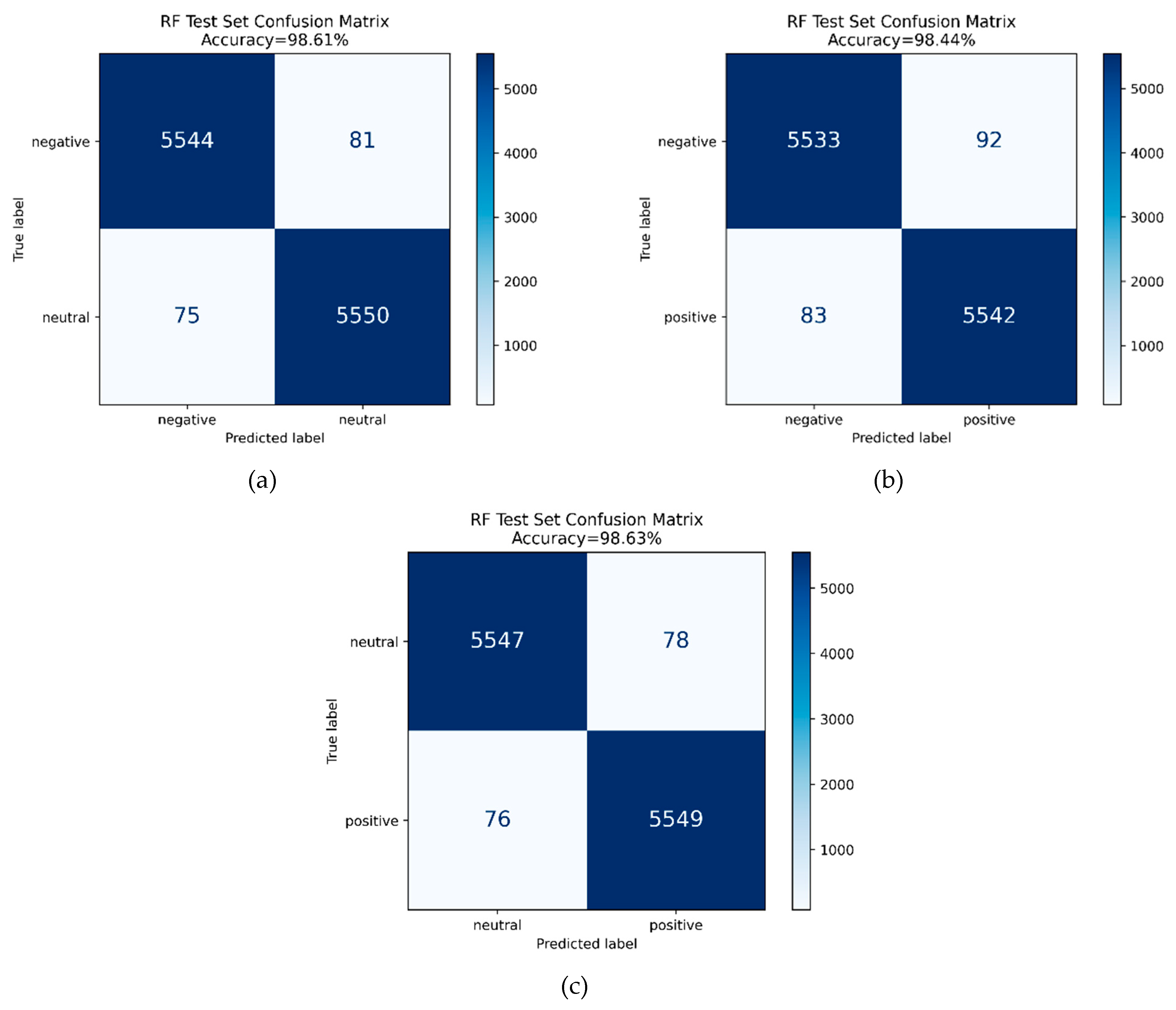
As evident from the confusion matrices, the diagonal elements (5544 vs 5550, 5533 vs 5542, 5547 vs 5549) exhibit deep blue high-value regions, with proportions exceeding 98%, indicating the model’s exceptionally high accuracy in correctly classifying samples. The off-diagonal regions show lighter colors, corresponding to a small number of misclassified samples, specifically manifested as low false positive (FP) and false negative (FN) counts, with the values being close (81 vs 75, 92 vs 83, 78 vs 76), suggesting the model does not exhibit a significant bias towards any particular class, demonstrating well-balanced classification performance.
3.2. Classification Results of “Subject-Independent” Evaluation
This experiment employed a Random Forest model (n_estimators=100) to evaluate EEG-based emotion recognition in a subject-independent paradigm using a binary classification task. The final result is the average recognition rate obtained through stratified 5-fold cross-validation. The confusion matrix analysis results for the three test sets are shown in Figure 3. In Figure a (Neutral vs Positive) and Figure b (Negative vs Neutral), both false positive (FP) and false negative (FN) counts remain low and are similar in magnitude, indicating that the model exhibits no significant bias toward either class, demonstrating well-balanced classification performance. Notably, in Figure c (Negative vs Positive), the misclassification rate for positive emotions is significantly higher than that for negative emotions (FN=116 vs FP=18), indicating that positive emotion samples are more prone to misclassification.
Despite these differences, all three emotion binary classification tasks achieved excellent performance on the test set (accuracy >96%), and comprehensive analysis indicates that the SSA-EMS algorithm possesses strong cross-subject generalization capability in cross-subject experiments.
4. Discussion
This study employed the SSA-EMS algorithm to process and analyze EEG data from three emotional unit combinations (neutral vs positive, negative vs neutral, negative vs positive). The results demonstrate that the SSA-EMS algorithm exhibits excellent classification performance both in cross-subject data processing and in the "subject-independent" evaluation framework. This performance advantage stems from the complementary effects of SSA's denoising capability and EMS's strategy of maximizing inter-class differences. The physiological differences between emotional units are the fundamental cause of signal amplitude differentiation, while the mathematical principle of EMS lies in capturing the EEG pattern differences between two emotional states through spatial filters, thereby maximizing the divergence between the two classes. When brain activity differences are prominent, this also leads to larger mean differences between classes. The synergistic effect of SSA and EMS constitutes the key to the algorithm's superior classification performance. Specifically, SSA enhances the signal-to-noise ratio by decomposing and reconstructing the trajectory matrix to remove high-frequency noise, which in turn enables the spatial filter weights computed by the subsequent EMS algorithm to achieve higher discriminability. Furthermore, the normalization mechanism of the filter amplifies the impact of intrinsic differences, essentially enhancing features by optimizing weight distribution across channels. The combined effect of these mechanisms enables the SSA-EMS algorithm to achieve significant advantages in feature extraction for emotional EEG signals.
From the perspective of information theory, the SSA-EMS algorithm constructs a three-stage entropy control framework: "noise entropy suppression → mutual information optimization → entropy rate convergence."
1. SSA Layer: Reduces the noise entropy of the input signal and improves the signal-to-noise ratio (SNR):
2. EMS Layer: Maximizes mutual information using a differential filter:
3. Stable Representation Layer: Achieves entropy rate convergence:
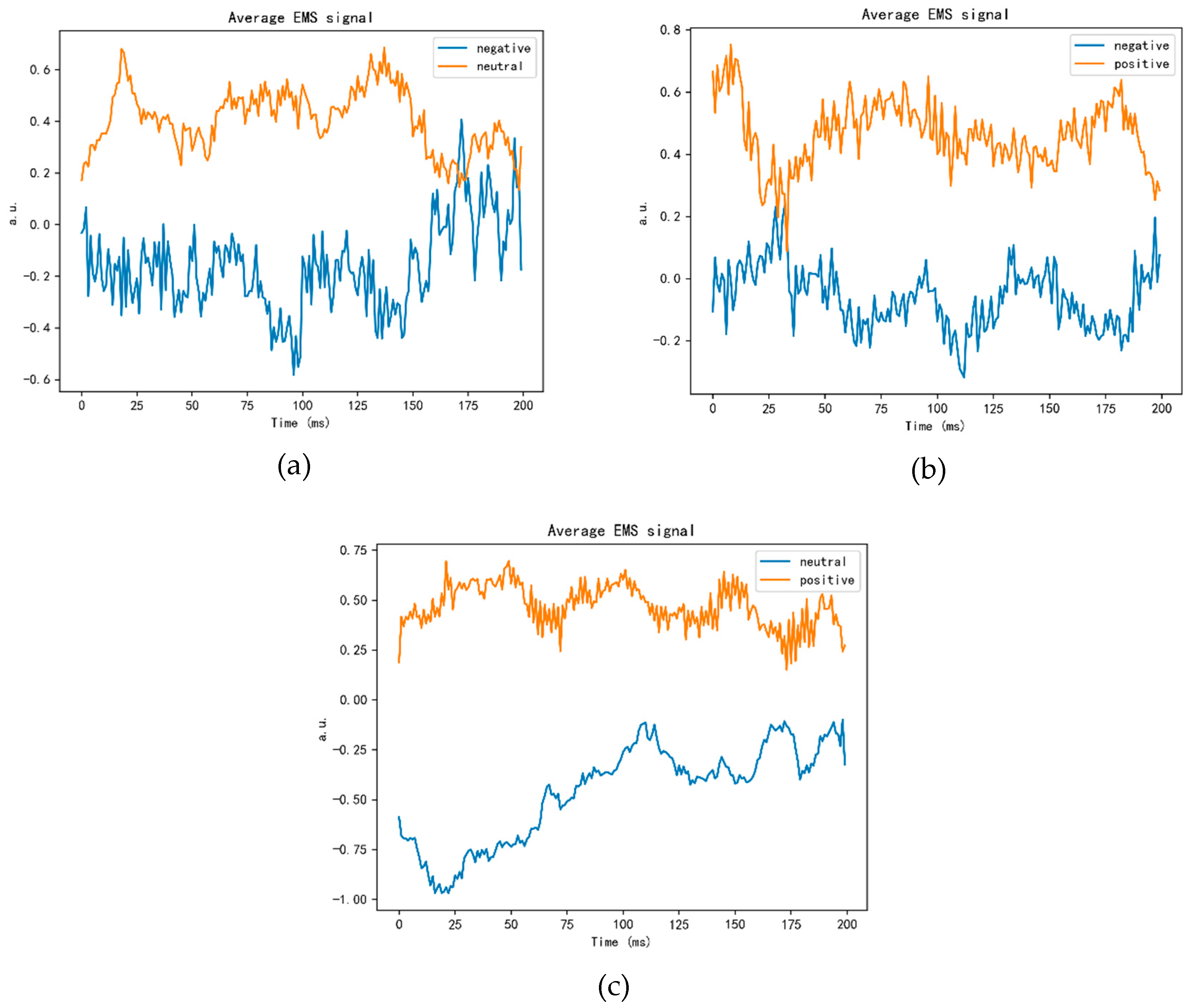
Figure 4 displays the average feature signals of three randomly selected emotional unit combinations from the full-frequency band, processed by the SSA-EMS algorithm. As shown, the average features of different emotional unit combinations exhibit significant distinguishability. It should be noted that the feature curve shapes presented in Figure 4 represent only one example among many possible configurations. Although diverse curve morphologies can be generated by different emotional unit combinations (not all shown due to space limitations), these features consistently maintain stable distinguishability. The results indicate that the SSA-EMS algorithm can effectively capture the intrinsic differential characteristics of distinct EEG emotional states, demonstrating significant universality in binary emotional classification.
This study is compared with the research conducted by Jie Quan, Yihang Dong, Longbin Jin, and their colleagues. Jie Quan et al. proposed a cross-subject emotion EEG classification algorithm based on multi-source domain selection and sub-domain adaptation. Experiments on two public datasets, SEED and SEED-IV, demonstrated that the proposed method achieved average classification accuracies of 92.83% and 79.30%, respectively [41]. Yihang Dong et al. introduced a multimodal cross-scale fusion model named "Mood Reader". The related experiments were carried out on the SEED and SEED-V public datasets, showing that when the Mood Reader model combined DE features and employed a sliding window sequential combination (w SWC) strategy, the recognition rate was 93.12%±4.75% [42]. Longbin Jin and Eun Yi Kim innovatively proposed a cross-subject emotion prediction model integrating temporal analysis with spatial correlation characteristics. Experiments on the DEAP physiological signal emotion dataset and the Shanghai Jiao Tong University SEED dataset indicated significant advantages when channel features were used in conjunction with LSTM: achieving accuracies of 98.93% and 99.10% in the DEAP valence and arousal binary classification tasks, respectively, and reaching a recognition accuracy of 99.63% in the SEED three-classification task, surpassing the current state-of-the-art levels [43].
Compared with previous studies, the present research still has the following limitations: The SSA-EMS algorithm is restricted to binary classification tasks, which prevents it from handling multi-class problems simultaneously. Since emotion recognition typically involves multiple states (e.g., happiness, anger, sadness, surprise), the model cannot be directly applied to multi-class scenarios. Although three emotion categories are included in the study, they require multiple binary classifications to be combined, thereby reducing the model’s capability in distinguishing complex emotional states. Therefore, extending the binary classification algorithm to a multi-class framework constitutes a direction for future research. Additionally, integrating the EEG features processed by SSA-EMS with other physiological signals to construct a multimodal fusion approach for emotion recognition could be explored.
5. Conclusions
The SSA-EMS algorithm proposed in this study significantly enhances cross-subject EEG-based emotion recognition performance by integrating the noise-reduction capability of singular spectrum analysis with the dynamic difference enhancement property of effect-matching spatial filtering. Experiments demonstrate that the algorithm achieves over 98% accuracy in binary classification tasks of positive, neutral, and negative emotions using All-band features, with high recognition rates also observed in the Delta and Gamma bands, and the Random Forest classifier outperforms the Support Vector Machine. Rigorous "subject-independent" evaluation further validates the model's generalization ability on unseen subjects (accuracy >96%), indicating that the SSA-EMS algorithm can stably extract dynamic features of emotional EEG. However, the algorithm supports only binary classification tasks, limiting its application in complex multi-emotion scenarios; future research should explore extensions to multi-class classification and strategies for multimodal physiological signal fusion.
Author Contributions
Conceptualization, Y.L.; methodology, Y.L.; validation, Y.L.; data curation, Y.L.; writing—original draft preparation, Y.L.; writing—review and editing, Y.L. and J.C. All authors have read and agreed to the published version of the manuscript.
Funding
This research was supported by the National Natural Science Foundation of China under Grant 62377018, the National Key R\&D Program of China under Grant 2024YFC3308300, the selfdetermined Research Funds of CCNU from the Colleges’ Basic Research and Operation of MOE under Grants CCNU24ZZ154.
Institutional Review Board Statement
Not applicable.
Data Availability Statement
Further inquiries can be directed to the corresponding authors.
Conflicts of Interest
The authors declare no conflicts of interest.
References
- Muthunayagom, Prince and A. C. Subhajini. Deciphering Feelings: Exploring EEG Data for Human Emotion Recognition. 2024 International Conference on Sustainable Communication Networks and Application (ICSCNA) (2024): 1181-1187.
- Chang, Jiang, Zelin Wang and Jieru Jia. Enhancing Emotion Recognition in EEG Signals using Fractional Fourier Transform. 2024 IEEE 17th International Conference on Signal Processing (ICSP) (2024): 110-115.
- Gkintoni, Evgenia, Anthimos Aroutzidis, Hera Antonopoulou and Constantinos Halkiopoulos. From Neural Networks to Emotional Networks: A Systematic Review of EEG-Based Emotion Recognition in Cognitive Neuroscience and Real-World Applications. Brain Sciences 15 (2025): n. pag.
- Rahman, Md. Musta-E-Nur, Ajay Krishno Sarkar, Md. Amzad Hossain, Md. Selim Hossain, Md. Rabiul Islam, Md. Biplob Hossain, Julian M. W. Quinn and Mohammad Ali Moni. Recognition of human emotions using EEG signals: A review. Computers in biology and medicine 2021, 136, 104696. [Google Scholar]
- Gkintoni, Evgenia, Anthimos Aroutzidis, Hera Antonopoulou and Constantinos Halkiopoulos. From Neural Networks to Emotional Networks: A Systematic Review of EEG-Based Emotion Recognition in Cognitive Neuroscience and Real-World Applications. Brain Sciences 15 (2025): n. pag.
- Hbibi, Bechir, Cyrine Khiari, Karlton Wirsing, Lamine Mili, Kamel Baccar and Abdelkader Mami. Identifying and Removing Interference and Artifacts in Multifractal Signals With Application to EEG Signals. IEEE Access 2023, 11, 119090–119105. [Google Scholar] [CrossRef]
- Sadiya, Sari, Tuka Alhanai and Mohammad M. Ghassemi. Artifact Detection and Correction in EEG data: A Review. 2021 10th International IEEE/EMBS Conference on Neural Engineering (NER) (2021): 495-498.
- Lu, Wei, Xiaobo Zhang, Lingnan Xia, Hua Ma and Tien Ping Tan. Domain adaptation spatial feature perception neural network for cross-subject EEG emotion recognition. Frontiers in Human Neuroscience 18 (2024): n. pag.
- Liu, Shuaiqi, Zeyao Wang, Yanling An, Bing Li, Xinrui Wang and Yudong Zhang. DA-CapsNet: A multi-branch capsule network based on adversarial domain adaption for cross-subject EEG emotion recognition. Knowl. Based Syst. 2023, 283, 111137. [Google Scholar]
- Wang, Wenxu, Jia Yang, Shengjia Li, Bin Wang, Kun Yang, Shengbo Sang, Qiang Zhang and Boyuan Liu. A Random Forest Weights and 4-Dimensional Convolutional Recurrent Neural Network for EEG Based Emotion Recognition. IEEE Access 2024, 12, 39549–39563. [Google Scholar] [CrossRef]
- Jafari, Mahboobeh, Afshin Shoeibi, Marjane Khodatars, Sara Bagherzadeh, Ahmad Shalbaf, David López-García, Juan Manuel Górriz and U. Rajendra Acharya. Emotion recognition in EEG signals using deep learning methods: A review. Computers in biology and medicine 2023, 165, 107450. [Google Scholar]
- Chen, Bianna, C. L. Philip Chen and Tong Zhang. GDDN: Graph Domain Disentanglement Network for Generalizable EEG Emotion Recognition. IEEE Transactions on Affective Computing 2024, 15, 1739–1753. [Google Scholar] [CrossRef]
- Wang, Y. , Zhang, B., & Tang, Y. (2024). DMMR: Cross-Subject Domain Generalization for EEG-Based Emotion Recognition via Denoising Mixed Mutual Reconstruction. Proceedings of the AAAI Conference on Artificial Intelligence, 38(1), 628-636. [CrossRef]
- Li, Ping, Ao Li, Xinhui Li and Zhao Lv. Cross-Subject Emotion Recognition with CT-ELCAN: Leveraging Cross-Modal Transformer and Enhanced Learning-Classify Adversarial Network. Bioengineering 12 (2025): n. pag.
- Liang, Shuang, Linzhe Li, Wei Zu, Wei Feng and Wenlong Hang. Adaptive deep feature representation learning for cross-subject EEG decoding. BMC Bioinformatics 25 (2024): n. pag.
- Anuragi, A.; Sisodia, D.S.; Pachori, R.B. EEG-based cross-subject emotion recognition using Fourier-Bessel series expansion based empirical wavelet transform and NCA feature selection method. Inf. Sci. 2022, 610, 508–524. [Google Scholar] [CrossRef]
- Guo, Wenhui, Yaxuan Li, Mengxue Liu, Rui Ma and Yanjiang Wang. Functional connectivity-enhanced feature-grouped attention network for cross-subject EEG emotion recognition. Knowl. Based Syst. 2024, 283, 111199. [Google Scholar] [CrossRef]
- Peng, Yong, Honggang Liu, Wanzeng Kong, Feiping Nie, Bao-Liang Lu and Andrzej Cichocki. Joint EEG Feature Transfer and Semisupervised Cross-Subject Emotion Recognition. IEEE Transactions on Industrial Informatics 2023, 19, 8104–8115. [Google Scholar] [CrossRef]
- Aaron Schurger, Sebastien Marti, and Stanislas Dehaene. Reducing multi-sensor data to a single time course that reveals experimental effects. BMC Neuroscience, 2013. [CrossRef]
- Investigating Critical Frequency Bands and Channels for EEG-based Emotion Recognition with Deep Neural Networks", Wei-Long Zheng, and Bao-Liang Lu, IEEE Transactions on Autonomous Mental Development (IEEE TAMD), 2015.
- Duan, R.N.; Zhu, J.Y.; Lu, B.L. Differential Entropy Feature for EEG-based Emotion Classification. In Proceedings of the 6th International IEEE EMBS Conference on Neural Engineering (NER), San Diego, CA, USA, 6–8 November 2013; pp. 81–84. [Google Scholar]
- Hassani, Hossein. Singular Spectrum Analysis: Methodology and Comparison. Journal of Data Science (2021): n. pag.
- Rodrigues, Paulo Canas, Pétala G. da S. E. Tuy and Rahim Mahmoudvand. Randomized singular spectrum analysis for long time series. Journal of Statistical Computation and Simulation 2018, 88, 1921–1935. [Google Scholar] [CrossRef]
- Kume, Kenji and Naoko Nose-Togawa. An Adaptive Orthogonal SSA Decomposition Algorithm for a Time Series. Adv. Data Sci. Adapt. Anal. 10 (2018): 1850002:1-1850002:15.
- Alomar, Abdullah, Munther A. Dahleh, Sean Mann and Devavrat Shah. SAMoSSA: Multivariate Singular Spectrum Analysis with Stochastic Autoregressive Noise. ArXiv abs/2305.16491 (2023): n. pag.
- Sanseverino, Claudio M. Rocco. Singular spectrum analysis and forecasting of failure time series. Reliab. Eng. Syst. Saf. 2013, 114, 126–136. [Google Scholar] [CrossRef]
- Gulyaev, A.V. and Svetlana V. Pivneva. Application of wavelet transformation and singular spectral analysis in time series decomposition. Highly available systems (2024): n. pag.
- Golyandina, Nina and Anatoly A. Zhigljavsky. SSA for Forecasting, Interpolation, Filtering and Estimation. Singular Spectrum Analysis for Time Series (2020): n. pag.
- Ghanbarzadeh, Mitra and Mina Aminghafari. “A New Hybrid-Multiscale SSA Prediction of Non-Stationary Time Series.” Fluctuation and Noise Letters 2016, 15, 1650005.
- Harmouche, Jinane, Dominique Fourer, François Auger, Pierre Borgnat and Patrick Flandrin. The Sliding Singular Spectrum Analysis: A Data-Driven Nonstationary Signal Decomposition Tool. IEEE Transactions on Signal Processing 2018, 66, 251–263. [Google Scholar] [CrossRef]
- Leles, Michel Carlo Rodrigues, João Pedro Hallack Sansão, Leonardo Amaral Mozelli and Homero Nogueira Guimarães. Improving reconstruction of time-series based in Singular Spectrum Analysis: A segmentation approach. Digit. Signal Process. 2017, 77, 63–76. [Google Scholar]
- Bonenberger, Christopher M. A., Wolfgang Ertel, Friedhelm Schwenker and Markus Schneider. Singular Spectrum Analysis and Circulant Maximum Variance Frames. Adv. Data Sci. Adapt. Anal. 14 (2022): 2250008:1-2250008:27.
- Mahmoudvand, Rahim, Nader Najari and Mohammad Zokaei. On the Optimal Parameters for Reconstruction and Forecasting in Singular Spectrum Analysis. Communications in Statistics - Simulation and Computation 42 (2013): 860 - 870.
- Golyandina, Nina, Vladimir Nekrutkin and Anatoly A. Zhigljavsky. Analysis of Time Series Structure - SSA and Related Techniques. Monographs on statistics and applied probability (2001).
- Jiang, Jian and Hong-Bo Xie. Denoising Nonlinear Time Series Using Singular Spectrum Analysis and Fuzzy Entropy. Chinese Physics Letters 2016, 33, 100501–100501. [Google Scholar] [CrossRef]
- Bonizzi, Pietro, Joël M. H. Karel, Olivier Meste and Ralf L. M. Peeters. Singular Spectrum Decomposition: a New Method for Time Series Decomposition. Adv. Data Sci. Adapt. Anal. 6 (2014): n. pag.
- Alexandre Gramfort, Martin Luessi, Eric Larson, Denis A. Engemann, Daniel Strohmeier, Christian Brodbeck, Roman Goj, Mainak Jas, Teon Brooks, Lauri Parkkonen, and Matti S. Hämäläinen. MEG and EEG data analysis with MNE-Python. Frontiers in Neuroscience, 7(267):1–13, 2013. [CrossRef]
- Hwang, Sunhee, Minsong Ki, Kibeom Hong and Hyeran Byun. Subject-Independent EEG-based Emotion Recognition using Adversarial Learning. 2020 8th International Winter Conference on Brain-Computer Interface (BCI) (2020): 1-4.
- Hamel, Lutz. Model Assessment with ROC Curves. Encyclopedia of Data Warehousing and Mining (2009).
- Fahmy Amin, Mahmoud. Confusion Matrix in Binary Classification Problems: A Step-by-Step Tutorial. Journal of Engineering Research 6.5 (2022): 0–0. Journal of Engineering Research. Web.
- Quan, Jie, Y. Li, Lingyue Wang, Renjie He, Shuo Yang and Lei Guo. EEG-based cross-subject emotion recognition using multi-source domain transfer learning. Biomed. Signal Process. Control. 84 (2023): 104741.
- Dong, Yihang et al. Multi-modal Mood Reader: Pre-trained Model Empowers Cross-Subject Emotion Recognition.” ArXiv abs/2405.19373 (2024): n. pag.
- Jin, L.; Kim, E.Y. Interpretable Cross-Subject EEG-Based Emotion Recognition Using Channel-Wise Features. Sensors 2020, 20, 6719. [Google Scholar] [CrossRef] [PubMed]
Figure 1.
Recognition accuracy of emotional states across different frequency bands. (a) negative vs neutral; (b) negative vs positive; (c) neutral vs positive.
Figure 1.
Recognition accuracy of emotional states across different frequency bands. (a) negative vs neutral; (b) negative vs positive; (c) neutral vs positive.
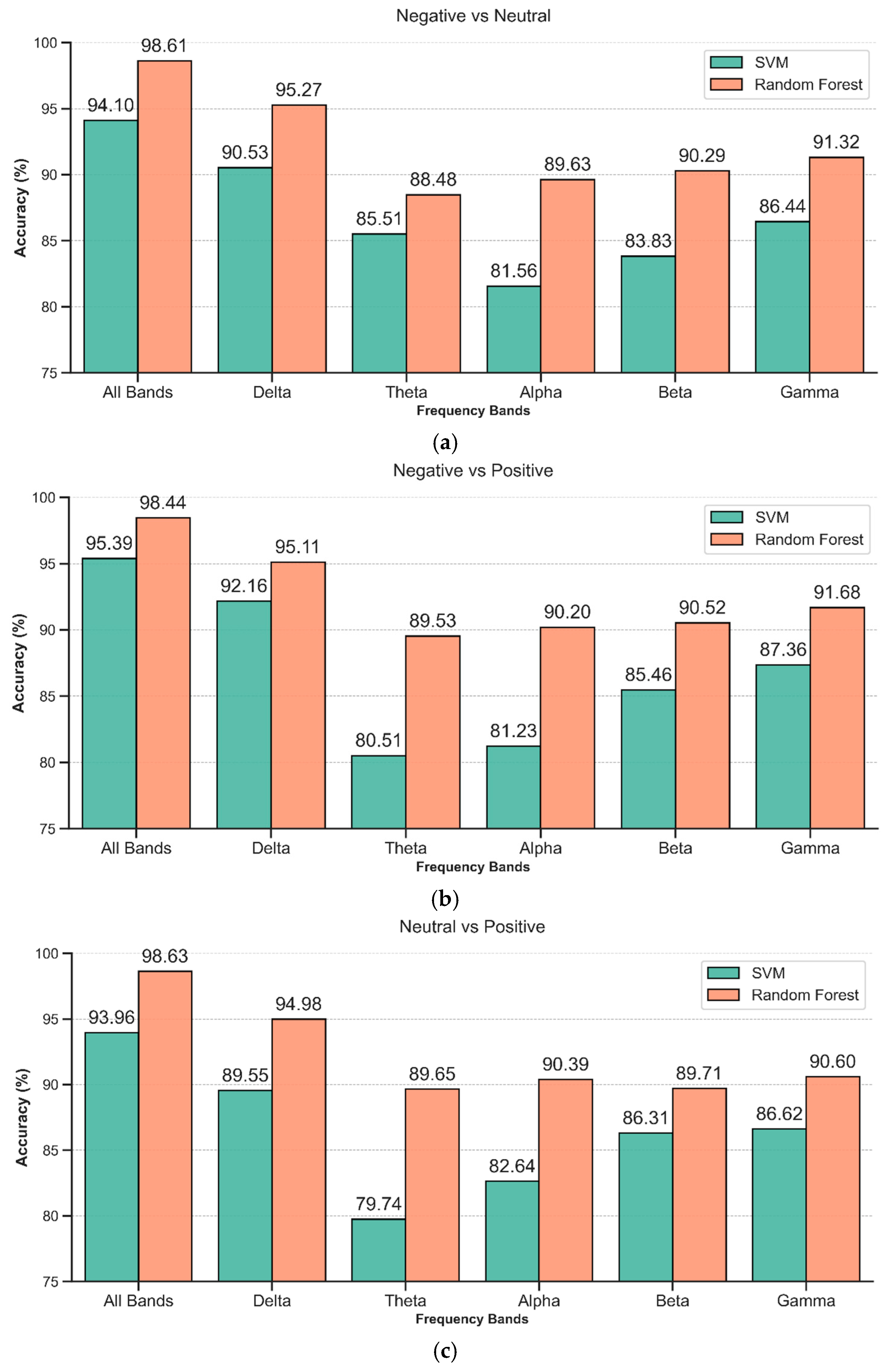
Figure 3.
Confusion matrix of RF under "subject-independent" evaluation. (a) negative vs neutral; (b) negative vs positive; (c) neutral vs positive.
Figure 3.
Confusion matrix of RF under "subject-independent" evaluation. (a) negative vs neutral; (b) negative vs positive; (c) neutral vs positive.
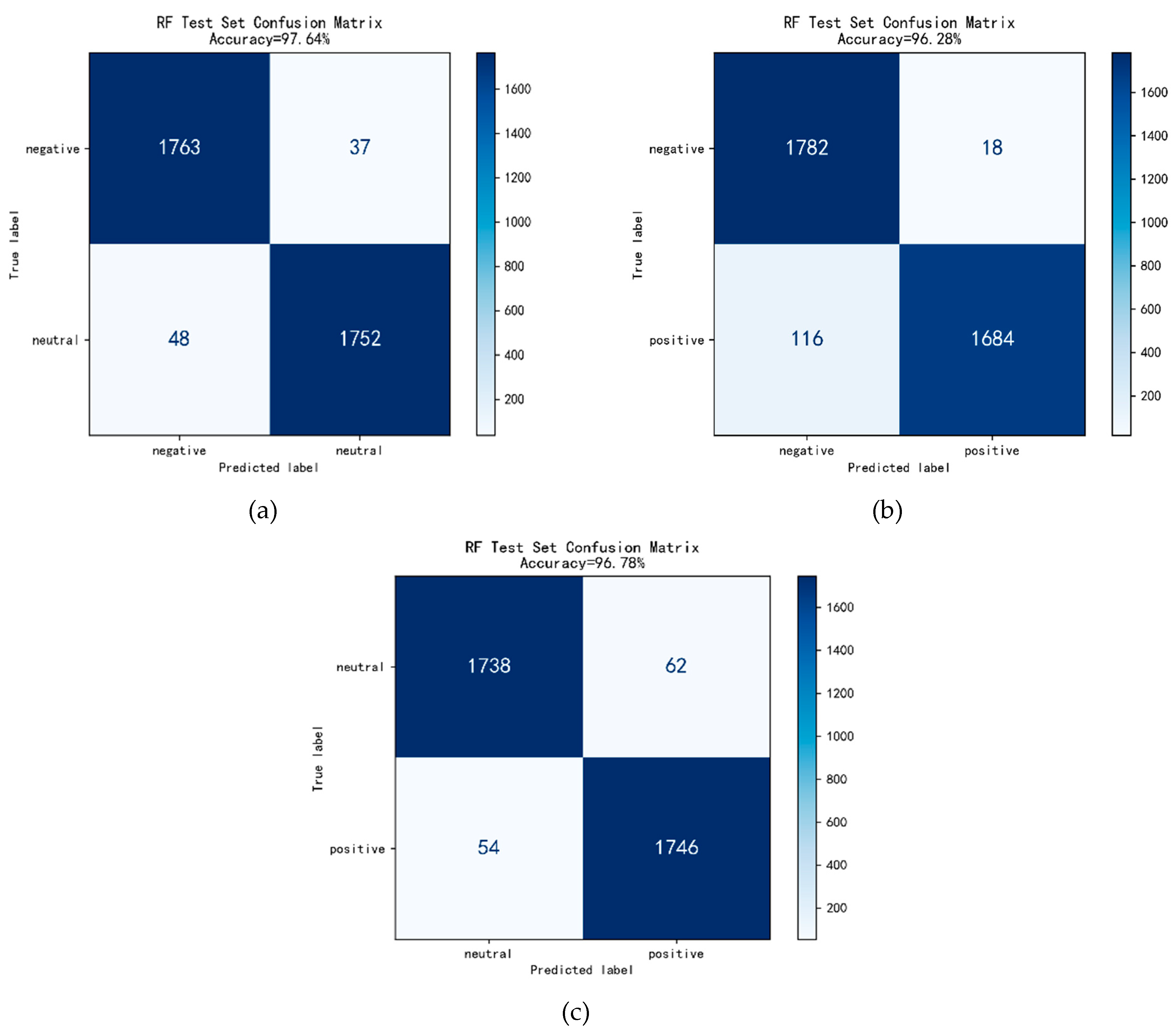
Figure 4.
Examples of average feature signals for three emotional unit combinations. (a) negative vs neutral; (b) negative vs positive; (c) neutral vs positive.
Figure 4.
Examples of average feature signals for three emotional unit combinations. (a) negative vs neutral; (b) negative vs positive; (c) neutral vs positive.
Disclaimer/Publisher’s Note: The statements, opinions and data contained in all publications are solely those of the individual author(s) and contributor(s) and not of MDPI and/or the editor(s). MDPI and/or the editor(s) disclaim responsibility for any injury to people or property resulting from any ideas, methods, instructions or products referred to in the content. |
© 2025 by the authors. Licensee MDPI, Basel, Switzerland. This article is an open access article distributed under the terms and conditions of the Creative Commons Attribution (CC BY) license (http://creativecommons.org/licenses/by/4.0/).
Copyright: This open access article is published under a Creative Commons CC BY 4.0 license, which permit the free download, distribution, and reuse, provided that the author and preprint are cited in any reuse.