

Submitted:
28 August 2025
Posted:
29 August 2025
You are already at the latest version
Abstract
Background/Objectives: Academic burnout is an emerging problem among nursing students, characterized by emotional exhaustion, cynicism and reduced academic efficacy. Sport interventions have shown a positive effect on nurses as a preventive strategy against burnout. The aim was to evaluate effectiveness of a nature sport program in the levels of academic burnout in nursing students Methods: a randomized clinical trial was performed. The intervention was a 12-week a nature exercise program with two sessions each week. The main dependent variables were burnout (measured with MBI-SS), stress (measured with PSS) and anxiety and depression (measured with HADS). Results: sample size with n=50 in the control group and n=58 in the intervention group (81.81% response rate). After the intervention significant differences were found in emotional exhaustion (p<0.001), stress (p<0.05) and mean steps per day (p<0.001), with the mean values being lower in IG: emotional exhaustion (3.28 points) stress (2.85 points) and steps per day a week (1381 steps). Conclusions: A nature exercise program has some positive effects in emotional exhaustion, stress and steps per day a week.
Keywords:
sport
; academic burnout
; nursing
; university students
; prevention
; mental health
1. Introduction
The term “burnout” comes from the English verb “to burn,” which means to consume oneself, and the adverb “out,” which means outside, extinguished, finished. From these two terms comes the word “burnout,” which means “to be burned out.” [1].
Before burnout was discussed scientifically, in the field of psychiatry, specialists Schwartz and Will published a description of a nurse affected by this syndrome in the journal Psychiatry in 1953. They described the case of Miss Jones, who worked in a psychiatric hospital and showed symptoms of exhaustion, irritability, demotivation, and indifference towards patients and colleagues. “Her depressed mood made her irritable, she felt exhausted and was insensitive and indifferent, particularly towards patients. Now Miss Jones only sees the negative side of her work and avoids social contact with patients and colleagues” [2].
Burnout syndrome was first discussed in 1969, when Bradley [3] described it as a psychological disorder. A few years later, in 1974, Freudemberg [4] studied the behavior of workers at an addiction center, finding that they were increasingly tired, dissatisfied, and showing less interest in their work. Over time, this caused some of these people to develop symptoms of depression, anxiety, and stress.
Cristina Maslach [5] and her team devised a system in 1986 to assess Burnout Syndrome, called the Maslach Burnout Inventory (MBI). This test-based system has been modified over the years. The current MBI studies three dimensions of burnout: emotional exhaustion (EE), depersonalization (D), and reduced personal fulfillment (PF). The Likert-type test consists of seven possible responses rated from 0 to 6. This questionnaire has been validated, adapted, and translated into different languages [6]. In Spain, it was adapted by Seisdedos [7] in 1997.
Following the parameters of the World Health Organization (WHO), which defines health in its constitution as “a state of complete physical, mental, and social well-being and not merely the absence of disease or infirmity” (1946) [8], it can be inferred from this definition that protecting the mental health of workers is essential to achieving optimal health.
The WHO has developed the “Comprehensive Mental Health Action Plan 2013-2030,” whose purpose is “to promote mental well-being, prevent mental disorders, provide care, improve recovery, promote human rights, and reduce mortality, morbidity, and disability among people with mental disorders” [9].
Burnout goes beyond “being burned out” at work; it is a problem that, due to its characteristics, can have a very negative impact on people’s physical and mental health [10].
Many groups can suffer from burnout syndrome; however, this condition is highly prevalent among nursing staff [11], which leads to increased absenteeism, which in turn creates real problems at the organizational level and in terms of worker protection [12]. This is a significant problem, as workplaces are affected by absenteeism, reduced staffing levels, increased waiting times, and a decline in the quality of care [13].
Among the groups that are susceptible to burnout are university students, with nursing students experiencing high levels of stress and burnout during their training [14,15]. Some studies indicate that one way to reduce the symptoms of burnout in university students is to maintain healthy lifestyle habits, including proper nutrition, meditation, good sleep hygiene, and physical activity [16,17]. Physical activity has shown positive impact in burnout in university students, thus, it is important to assess if these effects are also found in nursing students and if doing the exercise outdoor in nature can have a greater impact.
The aim of the study was to analyze the effectiveness of a physical activity program in nature on burnout in nursing students.
2. Materials and Methods
A randomised clinical trial was conducted. The writing was done following CONSORT checklist (Supplementary Material) [18]. It was registered in OSF in August of 2025 (osf.io/93ndg)
2.1. Participants
Nursing students at their second year from the University of Granada who were included in the study. Students diagnosed with anxiety disorder or depression were excluded. Baseline data was collected the first week of March and post-intervention data after 12 weeks intervention May 2025.
2.2. Sample Size
The sample size was calculated using G*Power software, using a two-tailed Student’s t-test for comparison of means. A moderate effect size (d = 0.5), a significance level of 0.05, and 80% statistical power (1–β = 0.80) were assumed, with equal allocation between groups (1:1). Under these parameters, a total of 128 participants (64 per group) were estimated to be required to detect statistically significant differences in burnout levels based on sport practice. All the students from the second course (n=132) were invited to participate in the study and randomized.
2.3. Randomization
We used Excel software with “RANDOM.ENTRE(1;2)” formula. Number 1 was assigned to control group and number 2 to intervention group. Each participant in the excel randomly received one number.
2.4. Intervention
The intervention consisted of a 12-week in person and in the nature exercise sessions. Two sessions were performed each week, one included walking in the mountain for 1 hour and another 1-hour strength-resistance training session in an exercise park in front of the beach or outdoor in the university. There were 24 sessions in total. The sessions were led by one of the researchers who is also a professor of the subject “Sports physiology”. The control group (CG) received the same information as the intervention group the day of the baseline measurement about the importance of exercise and number of steps per day for health.
2.5. Study Variables and Data Collection
Data collection was done through an online questionnaire using Google Form. The baseline measurement was performed in March 2025 and the second measurement one day after the 12-weeks intervention. The questionnaire included the following variables: socio-demographic variables (age, gender, marital status, educational level, having children), occupational variables (working and studying at the same time, number of hours working per week, engagement with university) and psychological variables (burnout, anxiety, stress and depression) and mean number of steps per week (using their smartphones stepcounts). The independent variable was the exercise intervention.
The validated instruments for psychological variables were Maslach Burnout Inventory–Student Survey (MBI-SS) for burnout (15-item for Emotional Exhaustion, Cynicism and Academic Efficacy) the Perceived Stress Scale (PSS) in its 10-item version for stress, Utrecht Work Engagement Scale (UWES) for assessing work engagement with the 9-item short version (UWES-9), Hospital Anxiety and Depression Scale (HADS) for measuring Anxiety and Depression with 14 items.
2.6. Blinding
The intervention was not blinded, nor for the researchers and for the participants due to its own characteristics. Data analysis was blinded for the researcher who did the data analysis in the software.
2.7. Statistical and Qualitative Data Analysis
First, a descriptive analysis with central-tendency measures (mean and standard deviation) for continuous variables and frequency analysis for categorical variables were performed.
Kolmogorov-Smirnov test was used to check normality of continuous variables. Baseline and postintervention inter-group mean difference was performed with the unpaired-sample Student’s t-test for continuous variables and Chi-Square test for categorical variables.
Analyses were performed with the SPSS 28 statistical package.
2.8. Ethical Aspects
Before agreeing to participate, all participants received information about the study and that they could leave the study at any time without having to give any reason. Participation was voluntary and anonymous. The study was approved by the ethics committee of the University of Granada (4638/CEIH/2024) in November of 2024.
3. Results
3.1. Baseline Descriptive Analysis of the Sample:
132 persons were randomized and invited to participate. The final sample was n=108 nursing students with n=50 in the control group and n=58 in the intervention group (81.81% response rate). The flow diagram is shown in Figure 1.
Most of the participants were women (79.93%), single (92.41%) and without children (96.02%). Comparing both group at baseline no differences were found between the intervention and the control group excepting the variable “marital status”.
Table 1 shows the characteristics of each group at baseline and the result of the statistical test for comparison between groups.
Post-Intervention Scores
During the 12 weeks intervention 2 people were lost from the initial measurement in the IG, leaving n=48. After the intervention 3 variables had significant differences between CG and IG emotional exhaustion (p=0.028), stress (p=0.037) and mean steps per day (p<0.001), with the mean values being lower in IG: emotional exhaustion (3.28 points) stress (2.85 points) and steps per day a week (1381 steps). The mean post-intervention values are shown in Table 2.
4. Discussion
In response to the aim of the study, we found that a scheduled sports intervention in nature for nursing students significantly reduced academic burnout, especially levels of emotional exhaustion and stress, compared to the control group.
These data are consistent with the scientific literature on the subject, which highlights the therapeutic role of outdoor physical exercise as a modulator of psychological well-being in adolescents, university students, and healthcare professionals in general [19,20].
After 12 weeks of outdoor aerobic and strength training, there was a significant reduction in emotional exhaustion and stress levels compared to the control group. This result is consistent with the study conducted by Ricardo-Rosales et al.[21], in which university students who underwent an aerobic exercise program reduced their level of emotional exhaustion by 26.4%, while the group that underwent an intervention based on strength training improved their emotional exhaustion to a lesser extent (19.5%).
Regarding the dimensions of burnout, for depersonalization and efficacy, no statistically significant relationship was found with physical exercise in nature. Unlike other studies, which found a significant association between student participation in a sports program based on strength exercises and improved levels of depersonalization and efficacy [21,22]. This finding could be interpreted in terms of the 12-week sports program that our students followed, which is considered insufficient in duration to influence the dimensions of burnout syndrome mentioned above [22]. Similarly, it is possible that the physical exercise performed by the students was not of the intensity required for them to experience significant changes in their mental health, sleep quality, improved engagement, or reduced physical vulnerability to stress [23].
Likewise, scientific literature has described the existence of several variables that act as mediators between physical exercise and the development of academic burnout, such as resilience and self-efficacy [21,24]. These mediators act to protect students from the psychological effects of stress experienced in the university environment [25].
Similarly, the benefits of practicing sports in nature for students’ mental health, especially in terms of anxiety control, stress management, and fatigue, have been widely described in the scientific literature [26,27]. Studies describe how nursing students show greater interest in caring for their physical and mental well-being as they progress through their studies [26,28,29]. In other words, students who are closer to practicing as nurses tend to sign up for more sports activities and create healthy lifestyle habits, especially after the lockdown due to the COVID-19 pandemic [28]. These data are consistent with the results obtained in the study, showing that students in the intervention group had a significantly higher average number of steps per day than those in the control group.
4.1. Limitations of the Study and Future Research.
The main limitations of this study were the non-probabilistic sampling method, the loss of students during the intervention, and the possible influence of the proximity of the exam period on the students’ responses. This could have influenced the fact that the relationship between variables did not become significant in some analyses.
4.2. Strengths of the Study.
For future research, a longitudinal study could be conducted to collect data on the students who participated in this study and analyze whether practicing outdoor sports during their formative years has had a significant influence on the development of burnout in the workplace.
5. Conclusions
After analyzing the results obtained, we can conclude that it is necessary to include a physical exercise program in nature in each year of the nursing degree program as a preventive strategy against the development of academic burnout. These organized outdoor activities appear to be effective in improving the levels of emotional fatigue and stress of nursing students, as well as increasing the average number of steps per week.
Supplementary Materials
The following supporting information can be downloaded at the website of this paper posted on Preprints.org, CONSORT checklist.
Author Contributions
Conceptualization, IPC, MJMJ, GACD and JLGU; methodology, JLGU, GACD and MJMJ; software, NSM, IPC.; validation, SGO, MDLC and NSM; formal analysis, GACD and JLGU; investigation, IPC, MDLC, JLGU, MJMJ; resources, IPC, SGO; data curation, IPC and SGO; writing—original draft preparation, IPC, MJMJ, JLGU; writing—review and editing, GACD, NSM ; visualization, SGO, JLGU; supervision, NSM, GACD; project administration, JLGU, GACD, MJMJ; funding acquisition, GACD, JLGU and MJMJ. All authors have read and agreed to the published version of the manuscript.
Funding
This research has been funded by Instituto de Salud Carlos III (ISCIII) through project “PI23/01440”, funded by CE-15-UGR24 from Ciudad Autónoma de Ceuta-UGR and supported by grant C-SEJ-043-UGR23 funded by Consejería de Universidad, Investigación e Innovación and by ERDF Andalusia Program 2021-2027.
Institutional Review Board Statement
The study was approved by the ethics committee of the University of Granada (approval code: 4638/CEIH/2024, approval date: 12 November 2024).
Informed Consent Statement
Informed consent was obtained from all subjects involved in the study.
Data Availability Statement
The raw data supporting the conclusions of this article will be made available by the authors on request.
Acknowledgments
This study is a part of the doctoral thesis of the first author in the program of Clinical Medicine and Public Health from the University of Granada.
Conflicts of Interest
The authors declare no conflicts of interest. The funders had no role in the design of the study; in the collection, analyses, or interpretation of data; in the writing of the manuscript; or in the decision to publish the results.
Abbreviations
The following abbreviations are used in this manuscript:
| CG | Control group |
| IG | Intervention group |
References
- Online Etymology Dictionary. Burnout [Internet]. Etymonline; [citado 2025 Ago 24]. Disponible en: https://www.etymonline.com/word/burn-out.
- Schwartz, M.S.; Will, G.T. Low morale and mutual withdrawal on a hospital ward. Psychiatry 1953, 16, 337–53. [Google Scholar] [CrossRef] [PubMed]
- Bradley, H.B. Community-based treatment for young adult offenders. Crime and Delinquency 1969, 15, 359–70. [Google Scholar] [CrossRef]
- Freudenberger, H.J. Staff burn-out. Journal of Social Issues, 1974, 30, 159–165. [Google Scholar] [CrossRef]
- Maslach, C.; Jackson, S.E. Maslach Burnout Inventory. Palo Alto, CA: Consulting Psychologists Press; 1981.
- Schaufeli, W.B.; Leiter, M.P.; Maslach, C. Burnout: 35 years of research and practice. Career Development International, 2009, 14, 204–220. [Google Scholar] [CrossRef]
- Seisdedos, N. MBI Inventario Burnout de Maslach. Madrid, España: TEA Ediciones. 1997.
- WHO Constitución de la Organización Mundial de la Salud. Recuperado en abril de 2024 de https://www.who.int/es/about/accountability/governance/constitution.
- WHO Plan de Acción Integral sobre Salud Mental 2013-2030. Recuperado en abril de 2024 de https://www.who.int/es/publications/i/item/9789240031029.
- Salvagioni, D.A.J.; Melanda, F.N.; Mesas, A.E.; González, A.D.; Gabani, F.L.; de Andrade, S.M. Physical, psychological and occupational consequences of job burnout: A systematic review of prospective studies. PLoS One. 2017, 12, e0185781. [Google Scholar] [CrossRef] [PubMed]
- Woo, T.; Ho, R.; Tang, A.; Tam, W. Global prevalence of burnout symptoms among nurses: a systematic review and meta-analysis. J Psychiatr Res. 2020, 123, 9–20. [Google Scholar] [CrossRef] [PubMed]
- Lee, C.; Vu, T.H.T.; Fuller, J.A.; Freedman, M.; Bannon, J.; Wilkins, J.T.; Moskowitz, J.T.; Hirschhorn, L.R.; Wallia, A.; Evans, C.T. The association of burnout with work absenteeism and the frequency of thoughts in leaving their job in a cohort of healthcare workers during the COVID-19 pandemic. Frontiers in Health Services 2023, 3, 1272285. [Google Scholar] [CrossRef]
- Garcia, C.L.; Abreu, L.C.; Ramos, J.L.S.; Castro, C.F.D.; Smiderle, F.R.N.; Santos, J.A.D.; Bezerra, I.M.P. Influence of Burnout on Patient Safety: Systematic Review and Meta-Analysis. Medicina (Kaunas). 2019, 55, 553. [Google Scholar] [CrossRef]
- Aguayo-Estremera, R.; Membrive-Jiménez, M.J.; Albendín-García, L.; Gómez-Urquiza, J.L.; Romero-Bejar, J.L.; De la Fuente-Solana, E.I.; Cañadas, G.R. Analyzing Latent Burnout Profiles in a Sample of Spanish Nursing and Psychology Undergraduates. Healthcare (Basel). 2024, 12, 438. [Google Scholar] [CrossRef]
- Gómez-Urquiza, J.L.; Velando-Soriano, A.; Membrive-Jiménez, M.J.; Ramírez-Baena, L.; Aguayo-Estremera, R.; Ortega-Campos, E.; Cañadas-De la Fuente, G.A. Prevalence and levels of burnout in nursing students: A systematic review with meta-analysis. Nurse Educ Pract. 2023, 72, 103753. [Google Scholar] [CrossRef]
- Lu, J.; Wang, Y.; Liu, X.; Zhang, Q.; Yan, Y. Psychological mechanisms of healthy lifestyle and academic burnout: a moderated mediation model. Frontiers in Psychology 2025, 16, 1533693. [Google Scholar] [CrossRef] [PubMed]
- Rosales-Ricardo, Y.; Ferreira, J.P. Effects of Physical Exercise on Burnout Syndrome in University Students. MEDICC Rev. 2022, 24, 36–39. [Google Scholar] [CrossRef] [PubMed]
- Hopewell, S.; Chan, A.W.; Collins, G.S.; Hróbjartsson, A.; Moher, D.; Schulz, K.F.; Tunn, R.; Aggarwal, R.; Berkwits, M.; Berlin, J.A.; Bhandari, N.; Butcher, N.J.; Campbell, M.K.; Chidebe, R.C.W.; Elbourne, D.; Farmer, A.; Fergusson, D.A.; Golub, R.M.; Goodman, S.N.; Hoffmann, T.C.; Ioannidis, J.P.A.; Kahan, B.C.; Knowles, R.L.; Lamb, S.E.; Lewis, S.; Loder, E.; Offringa, M.; Ravaud, P.; Richards, D.P.; Rockhold, F.W.; Schriger, D.L.; Siegried, N.L.; Staniszewska, S.; Taylor, R.S.; Thabane, L.; Torgerson, D.; Vohra, S.; White, I.R.; Boutron, I. CONSORT 2025 explanation and elaboration: updated guideline for reporting randomised trials. BMJ 2025, 388, e081124. [Google Scholar] [CrossRef] [PubMed]
- Gao, J.; Tian, X.; Wu, H. Exploring the mediating role of social support in sports participation and academic burnout among adolescent students in China. Front. Psychol. 2025, 16, 1591460. [Google Scholar] [CrossRef]
- Khalaf, Y.A.; AbdulJabbar, M.A.; Ali, O.A. The effect of sports job burnout on the performance of workers in student activities departments in Iraqi universities. Retos: Nuevas Perspect. Educ. Física Deporte Recreación 2025, 66, 1–10. [Google Scholar]
- Rosales-Ricardo, Y.; Caiza, M.V.; Sánchez-Cañizares, M.; Ferreira, J.P. Ejercicios físicos en los niveles de Síndrome de Burnout y la Variabilidad de la Frecuencia Cardíaca de estudiantes universitarios. Medicina (Ribeirão Preto) 2021, 54, 1–10. [Google Scholar] [CrossRef]
- Chen, K.; Liu, F.; Mou, L.; Zhao, P.; Guo, L. How physical exercise impacts academic burnout in college students: The mediating effects of self-efficacy and resilience. Front. Psychol. 2022, 13, 964169. [Google Scholar] [CrossRef]
- Khosravi, M. Burnout among Iranian medical students: Prevalence and its relationship to personality dimensions and physical activity. Eur. J. Transl. Myol. 2021, 1, 411. [Google Scholar] [CrossRef]
- Dunston, E.R.; Messina, E.S.; Coelho, A.J.; Chriest, S.N.; Waldrip, M.P.; Vahk, A.; et al. Physical activity is associated with grit and resilience in college students: Is intensity the key to success? J. Am. Coll. Health 2022, 70, 216–222. [Google Scholar] [CrossRef]
- Fernández-Castillo, A.; Fernández-Prados, M.J. Resilience and burnout in educational science university students: Developmental analysis according to progression in the career. Curr. Psychol. 2021, 40, 1–10. [Google Scholar] [CrossRef]
- Kelley, C.; Mack, D.E.; Wilson, P.M. Does physical activity in natural outdoor environments improve wellbeing? A meta-analysis. Sports 2022, 10, 103. [Google Scholar] [CrossRef]
- Vella, S.A.; Aidman, E.; Teychenne, M.; Smith, J.J.; Swann, C.; Rosenbaum, S.; et al. Optimising the effects of physical activity on mental health and wellbeing: A joint consensus statement from Sports Medicine Australia and the Australian Psychological Society. J. Sci. Med. Sport 2023, 26, 132–139. [Google Scholar] [CrossRef]
- Kim, C. Awareness of Healthy Life and Mental Health of Nursing College Students before and after the COVID-19 Outbreak with the Involvement in Sports Activities. Rev. Psicol. Deporte 2024, 33, 95–104. [Google Scholar]
- Herbert, C.; Meixner, F.; Wiebking, C.; Gilg, V. Regular Physical Activity, Short-Term Exercise, Mental Health, and Well-Being Among University Students: The Results of an Online and a Laboratory Study. Front. Psychol. 2020, 11, 509. [Google Scholar] [CrossRef]
Figure 1.
Flow diagram.
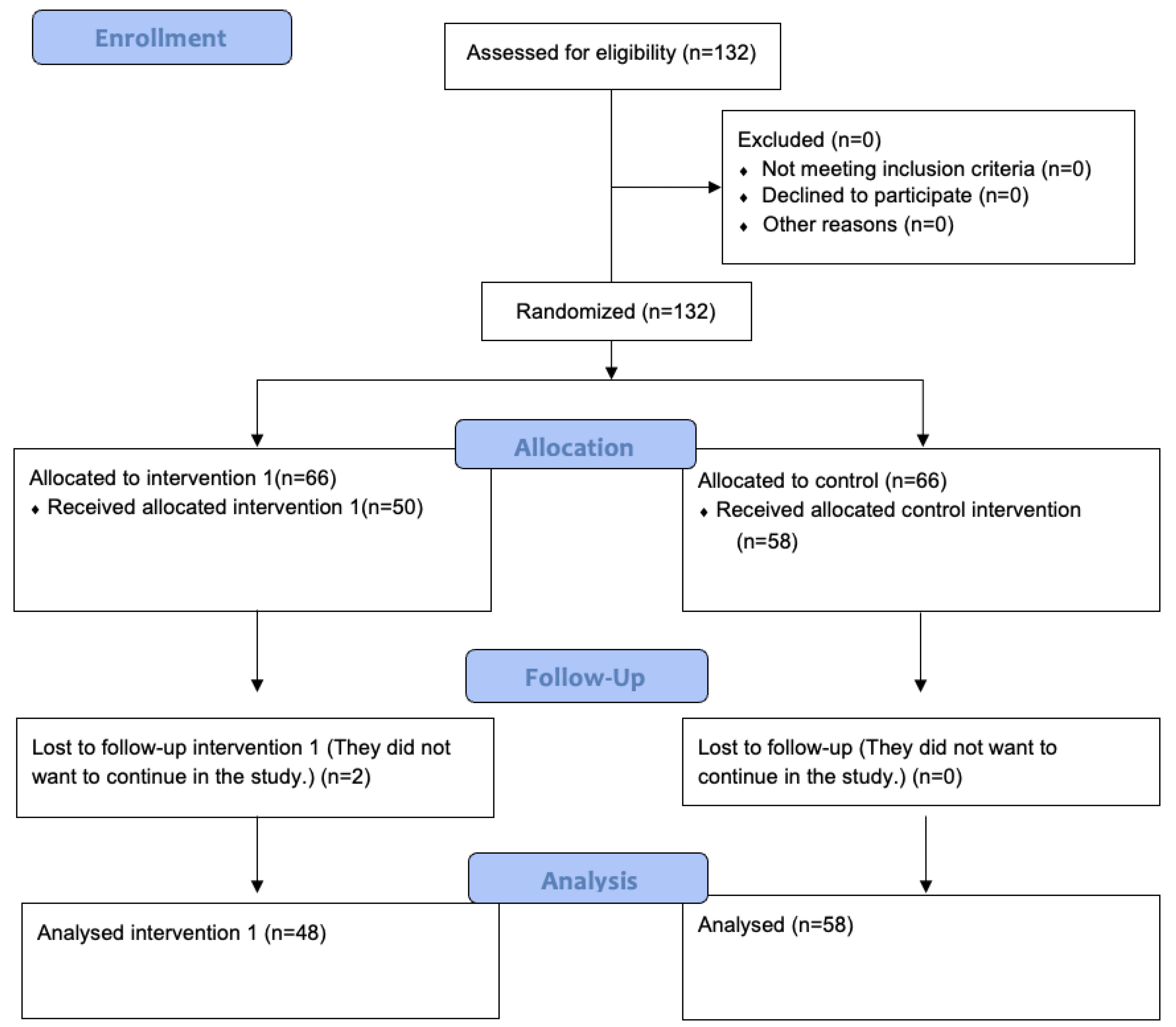

Table 1.
Baseline characteristics. n=108 (Control group (CG) n=50; Intervention group (IG)=58).
| Variable | Mean (standard deviation) | t | p-value | |
| Age | CG:22.28(7.87) IG: 21.24(1.83) |
12,951 | 0,332 | |
| Working hours per week | CG: 3.7(12.22) IG:3.65(12.22) |
0,311 | 0,982 | |
| Mean steps per day | CG: 7912.04(1150.88,04) IG: 8237.64(1284.77) |
0,986 | 0,171 | |
| Emotional exhaustion | CG: 14.86(7.76) IG:12.44(7.28) |
0,259 | 0,083 | |
| Cynicism | CG:4.06(4.13) IG: 4.55(5.08) |
1,151 | 0,587 | |
| Academic efficacy | CG: 26.54(5.42) IG1: 23.68(9.20) |
16,381 | 0,057 | |
| Stress | CG:18.76(6.75) IG1:18.44(7.08) |
0,024 | 0,816 | |
| Anxiety | CG: 9.46(3.42) IG: 9.27(3.79) |
0,820 | 0,793 | |
| Depression | CG: 12.28(1.96) IG1: 12,65(2.54) |
2,401 | 0,063 | |
| Engagement | CG:3.96(1.18) IG1:3.50(1.54) |
2,912 | 0,073 | |
| Categorical variables | Group | Categories % | Chi-square | p |
| Sex | CG | Male:16% Female:84% |
1.09 | 0,295 |
| IG | Male:24.4% Female:75.86% |
|||
| Marital Status | CG | Single:90% Couple:10% |
96.70 | <0,001 |
| IG | Single:94.82% Coupled:5.16% |
|||
| Children | CG | No:94% | 3.57 | 0,167 |
| IG | No:98.04% | |||
| Working and studying | CG | Yes:12% | 1.46 | 0,227 |
| IG | Yes:20.64% | |||
| Emotional exhaustion | CG | Low (50%), medium (16%) and high (34%) | 2.66 | 0,264 |
| IG | low (63.64%), medium (15.48%) and high (20.64%) | |||
| Cynicism | CG: | low (74%), medium (22%) and high (4%%) | 0.448 | 0,799 |
| IG1: | low (70.52%), medium (22.36%) and high (6.88%) | |||
| Academic efficacy | CG | high (44%), medium (34%) and low (22%) | 2.76 | 0,252 |
| IG | high (43%), medium (22.36%) and low (34.4%) | |||
| Burnout | CG | 46% | 3.72 | 0,444 |
| IG | 37.84% |
Note: Control group =CG; Intervention group 1= IG1; Gamified intervention group 2 = IG2.
Table 2.
Postintervention means (GC n=50; GI n=48) and comparation.
| Variable | Mean (standard deviation) | t | p-value |
|---|---|---|---|
| Emotional exhaustion | GC: 17.24(7.31) GI:13.96(6.39) |
2.23 | 0,028 |
| Cynicism | CG:5.29(5.43) | -0.28 | 0,779 |
| IG: 5.60(4.84) | |||
|
Professional efficiency |
0,486 | ||
| CG: 26.05(4.69) | 0.699 | ||
| IG: 25.15 (6.69) | |||
| Stress | CG:20.35(7.25) IG: 17.50(5.36) |
2.11 | 0,037 |
| Anxiety | CG: 9.59(2.76) IG: 9.27(3.36) |
0.46 | 0,641 |
| Depression | CG: 11.97(2.51) IG: 11.39(2.87) |
1.06 | 0,291 |
| Engagement | CG: 4.04(1.04) IG: 4.06(1.13) |
-0.10 | 0,920 |
| Mean steps per day | CG: 8573(1337.22) IG: 9954.55(1204.85) |
-5.06 | <0,001 |
Note: Control group =CG; Intervention group (sport intervention) = IG.
Disclaimer/Publisher’s Note: The statements, opinions and data contained in all publications are solely those of the individual author(s) and contributor(s) and not of MDPI and/or the editor(s). MDPI and/or the editor(s) disclaim responsibility for any injury to people or property resulting from any ideas, methods, instructions or products referred to in the content. |
© 2025 by the authors. Licensee MDPI, Basel, Switzerland. This article is an open access article distributed under the terms and conditions of the Creative Commons Attribution (CC BY) license (http://creativecommons.org/licenses/by/4.0/).
Copyright: This open access article is published under a Creative Commons CC BY 4.0 license, which permit the free download, distribution, and reuse, provided that the author and preprint are cited in any reuse.


