

Submitted:
25 August 2025
Posted:
26 August 2025
Read the latest preprint version here
Abstract
The role of energy communities (ECs) in the energy transition is well documented in the Global North but less explored in the Global South. This paper examines the implementation of on-grid ECs in Latin America, considering conceptual diversity along with regulatory, socio-political, business, and technical aspects. An inductive approach using secondary data was employed to identify ECs characteristics and implementation patterns. The study reviewed 104 references, documented 33 on-grid ECs, and utilized the Multi-Level Perspective (MLP) to analyze developments at niche, regime, and landscape levels. Results indicate that Latin America’s dependence on fossil fuels for economic activity, fiscal revenues, and within a low-diversified energy mix is gradually shaping socio-technical regimes. In this context, on-grid ECs emerge as niche-level innovations with three primary patterns: (1) fostering just and democratic energy systems through social engagement; (2) promoting equitable business benefit distribution via cooperatives and third parties; and (3) enabling grid connection and diversification of non-conventional energy sources, customized to community needs, resources, and geographies. This research helps fill knowledge gaps regarding ECs in under-studied regions, providing insights into sustainable energy transitions through the MLP framework.
Keywords:
energy communities
; energy transition
; Latin America
; multilevel perspective
1. Introduction
Energy communities (ECs) are recognized as an alternative with great potential to strengthen and accelerate a more just energy transition and reduce energy poverty [1,2]. The energy transition refers to the replacement of conventional, non-renewable fossil fuels for producing electricity, heat, and mechanical energy with renewable energy sources (RES) for the same purpose. This transition could result in decentralized, locally based energy systems with a mix of locally available RES sufficient to meet 100% of society’s energy needs [3]. ECs could be defined as legally constituted entities based on the voluntary participation of their members with the possibility of producing, consuming, storing, and selling energy in pursuit of economic, social, and environmental benefits [4]. Energy poverty occurs when households lack access to quality energy or cannot afford to pay for it, forcing them to reduce their energy consumption to levels that compromise the health and well-being of their inhabitants [5].
Currently, three-quarters of greenhouse gas emissions are linked to energy consumption, which has risen by 19% over the last decade. In 2021, these emissions grew by 6% due to the post-COVID economic recovery, even though the share of renewable energies in global energy consumption increased to 12.6% in 2020 [6]. According to global figures [7], achieving the target of 1.5 degrees Celsius by 2050 is becoming increasingly unlikely at the current growth rate of greenhouse gas emissions. Climate change is evident on all continents and impacts the environment and numerous economic sectors [8]. There is widespread consensus on the necessity of transitioning to an economy centred on clean energy, alongside increasing public awareness of the actual cost of fossil fuels and a rising demand for clean energy [9].
Due to the potential of renewable sources, Latin America’s energy transition has historically featured a low-carbon matrix in power generation. According to the Latin American Energy Organization (OLADE) [10], in 2010, the region had a potential of 11.9 GW/m2 of solar photovoltaic, 66.6 m/s of wind, 8,650.6 MW of geothermal, and 705.3 GW of hydroelectric power. Nevertheless, renewable sources have not yet displaced fossil fuels [11]. According to OLADE [12], in 2000, 77% of the electricity produced in the region came from hydropower, 20% from fossil fuels, 2% from nuclear plants, and 1% from biomass. By 2022, 46.42% of the electricity generated came from hydropower, 33.56% from fossil fuels, 8,19% from wind, 5% from biomass, 1.94% from nuclear plants, and 4.42% from solar sources. On the demand side, Latin America’s share of electricity in final energy consumption was 16% in 2000, increasing to 19.5% in 2022. Considering the size of their matrices, Uruguay (56%), Chile (33%), and Brazil (47.4%) were the most prominent in incorporating hydro, solar, wind, biomass, and geothermal sources in 2022.
Moreover, the energy transition involves significant transformations aimed at reducing the environmental impact of the energy industry and fostering changes in energy business models [13,14]. It emphasizes ecological efficiency in energy production while also contributing to consumers’ energy culture and raising awareness of the value of energy as a critical resource for the economy and the sustainable development of regions [15,16]. Sustainable development prioritizes the involvement of local communities, justice, and social transformation [17,18].
Energy communities (ECs) hold immense potential for a fair energy transition and poverty alleviation [18]. ECs have rapidly increased globally, demonstrating their capacity to create sustainable local energy systems. Most studies refer to ECs that utilize solar photovoltaic energy, often in combination with batteries and heat pumps [19]. Microgrids, Virtual Power Plants (VPPs), Energy Hubs (EH), and Active Distribution Networks (ADN) are the technical counterparts of energy communities within energy systems [20].
ECs have garnered significant attention from the Global North for informing and engaging end-users to become more responsible energy consumers and participants in distributed renewable energy generation [21]. Europe has placed ECs at the heart of its energy strategy and the anticipated transformation of its energy system through the Clean Energy Package - CEP (2016), the Renewable Energy Directive - RED II (2018), and the Internal Electricity Market Directive - IEMD (2019) [22,23].
The CEP recognized and defined energy communities as legally constituted entities and market participants with rights to trade, consume, and produce energy [4]. Renewable Energy Communities (RECs) and Citizen Energy Communities (CECs) were defined by the REDII in 2018 and by the IEMD in 2019, respectively. RECs and CECs aim to provide benefits for communities and the environment rather than financial gains. While CECs have no restrictions on the technology used or the location of projects, RECs can only use renewable energy technologies in proximity projects [22].
ECs open the doors to new management and business models and provide regulation services to the grid [24]. However, the implementation process reveals differences among European countries due to varying national contexts [21]. While studies highlight economic, environmental, and social benefits, barriers such as regulatory challenges, financial access, and low public awareness persist [19]. Moreover, convincing consumers to join the EC and change their energy behavior requires effective business models that ensure energy security [22].
Literature has received limited attention regarding energy communities (ECs) in low- and middle-income regions, particularly in Asia, Africa, and Latin America. Studies focus on isolated rural communities experiencing energy poverty, where hybrid energy solutions disconnected from transmission grids are examined. In these cases of rural energy communities that lack grid connection, government support is crucial for overcoming high investment costs and the level of community organization necessary to ensure the sustainability of the solution [25,26].
Few of the existing energy communities in Sub-Saharan Africa are primarily established to address energy access gaps, as well as underlying concerns such as poverty reduction and health improvement [23]. Most of Latin America’s ECs are off-grid, isolated ventures that are disconnected from the local or national electrical grid and focus on meeting basic human needs by employing hydropower, solar, wind, biomass, and biogas technologies [11].
Initially, the literature on EC in Latin America focused on off-grid projects that addressed electricity access in isolated localities [27]. However, since 2018, it has acknowledged EC projects as a viable on-grid alternative, facilitating self-consumption, exchange, and sale of electricity to the local or national grid, primarily in the Brazilian and Chilean urban contexts [28]. Accessing non-conventional renewable energy sources and transporting electric energy requires social innovations in relationships with territories inhabited by ethnic minorities, characterized by limited State presence, a history of violence, poverty, and low social capital [16,29]. Energy communities exemplify these social innovations. Nevertheless, the region lacks clear political definitions, effective promotion, and robust regulatory frameworks for ECs. Striving for standardized scholarly definitions and interpretations of ECs in Latin American countries presents an exciting challenge. Exploring ECs more deeply is a necessary and ambitious undertaking in this region [11].
How could on-grid energy communities accelerate the energy transition in Latin America? Based on this central question, the following secondary questions will be explored:
- What are the main characteristics of energy communities worldwide?
- How are energy communities being implemented in Latin America?
- At what level are the barriers to a just and sustainable energy transition in the region for grid-connected energy communities?
This paper aims to provide an overview of implementing on-grid ECs in Latin America’s energy transition by addressing the proliferation of concepts, as well as regulatory, socio-political, business, and technical aspects. This research adopts the Multi-Level Perspective (MLP) to understand how energy communities, as niches of innovation, take advantage of opportunities or face the challenges of a specific policy regime and landscape pressure [30]. MLP is preferred over other approaches, such as the techno-economic paradigm (TEP) and the Institutional Analysis and Development (IAD) framework. The advantage of MLP compared to the different frameworks is its capacity to examine the transition sustainability in the energy system from multiple dimensions, describe the phenomenological outlines of transitions, and provide a framework for strategic thinking about long-term transformative change [1,31].
The research employs an inductive method [32,33], with secondary data to identify general characteristics of energy communities and patterns of implementation in Latin America. Then, these patterns are discussed from the MLP perspective to extract generalizable insights such as barriers at different levels of the energy transition in the region. Secondary data are derived from a systematic literature review of 104 references in the Web of Science, Scopus, and Google Scholar databases, as of July 2025. This review made it possible to map energy communities worldwide [34,35]. And to identify patterns of implementation in Latin America, thanks to thirty-three documented cases [5,36].
This work offers new insights into on-grid energy communities, as previous studies in Latin America have mainly focused on energy communities in remote areas. Furthermore, it provides a critical approach by systematically comparing documented cases from a multi-level perspective to deepen understanding of the on-grid ECs’ role in the energy transition. It benefits researchers, policymakers, practitioners, and citizens interested in Latin America.
The text is divided into five sections. Firstly, the theoretical framework is introduced from a Multi-Level Perspective, regarded as an appropriate model for studies on sustainable energy transitions. Secondly, the data and methods are outlined, emphasizing the inductive approach employed. Thirdly, the results are presented by mapping energy communities globally and identifying patterns of on-grid EC implementation in the Latin American region. Fourthly, the findings are examined within the Multi-Level perspective to identify obstacles to the energy transition, and limitations of the study and future research lines are suggested. Finally, the conclusion summarizes the key findings, and main theoretical and practical contributions.
2. Theoretical Framework
The Multi-Level Perspective (MLP) approach contributes to the understanding of innovation in the sustainability of transitions. It provides a functional general approach to analyze how innovation can lead to large-scale changes in the energy system [37]. MLP presents a unique opportunity to study ECs as an innovative energy transition niche and to explore socio-technical aspects [1,38]. By combining ideas from evolutionary economics, the sociology of innovation, and institutional theory, it enhances understanding of technological transitions as significant, long-term changes in technology, user practices, regulation, networks, infrastructure, and symbolic meaning. Furthermore, it sheds light on the sustainable transition dynamics of innovative niches and the external trends that reinforce changes in dominant practices [38].
The MLP approach is criticized for several conceptual and practical limitations. Among the main conceptual limitations is the insufficient attention given to issues such as power and cultural meanings. The approach also faces criticism for privileging bottom-up disruptive processes and incremental innovation while underestimating phenomena of destabilization and political processes. This leads to inadequate consideration of the labor market, monetary systems, inequality, and poverty [39]. In the context of the energy transition, the MLP approach, as well as the niche strategic management approach, is criticized for not contributing to the understanding of the special aspects at the regional and local level [40].
However, the purpose of this research is to understand how energy communities, as socio-technical innovations, capitalize on opportunities or overcome barriers in the energy system by accelerating a sustainable transition to a low-carbon economy. The MLP approach is helpful to achieve this purpose, as it helps to understand the interdependence between innovation processes, energy regimes, and contextual pressures such as climate change [40]. Additionally, MLP enables analysis of long-term transformative change. The advantage of MLP over other frameworks (the techno-economic paradigm -TEP- and the institutional analysis and development framework -IAD) lies in its ability to observe the transition in the energy system from multiple dimensions, describing the phenomenological outlines of transitions and offering a framework for long-term transformative change [33]. The following paragraphs examine the MLP approach and its prior applications in the study of energy communities.
2.1. The Multi-Level Perspective Framework
The multilevel perspective comprises three levels, which are hierarchically integrated as analytical and heuristic concepts for understanding the dynamics of socio-technical change. At the middle level is the idea of the socio-technical regime, which analyses the stability of existing technological developments and trajectories that foster incremental innovation. At the macro level, the landscape is examined, referring to external factors of slow change that influence technological trajectories. Lastly, at the micro level, innovations are generated and developed in the niches. These levels are hierarchically integrated so that the regimes are embedded in the landscape and the niches in the regimes (Table 1).
Landscape adapts slowly to triggers such as climate change, influencing both socio-technical and niche levels of adaptation. However, changes in the landscape are largely exogenous and beyond the immediate reach of niche and regime-level actors [37]. Socio-technical regimes describe standard practices and rules across various technological sectors, policies, and market regimes. The niche level provides space for experimentation and learning and has the potential to incentivize change[40]. Over time, niche developments can progress from experimentation to stabilization, diffusion, and eventually institutionalization [41].
Innovations are confronted by regimes of shared norms and stabilized by techno-economic, social, cognitive, and political lock-in mechanisms. These regimes serve as selection environments for the wider adoption and diffusion of emerging innovation niches, which are promoted through the activities of business actors, policymakers, and special interest groups. Innovation niches and regimes are influenced by macro-level phenomena, which can include both slow-changing trends (e.g., demographics, climate warming) and acute shocks (e.g., oil price shocks, pandemics) [37].
The key point of the MLP approach is that the success of new technology depends not only on processes within the niche but also on developments at the existing regime and landscape levels. However, technological transformation begins in the niche, as it is at this level that the seed of change lies [31].
2.2. MLP Analysis of Energy Communities
Figure 1 illustrates the application of MLP to energy communities. At the niche level, energy communities serve as innovation spaces for new energy production and consumption models. At the regime level, centralized energy systems are the current frameworks that energy communities aim to transform or complement. At the landscape level, various external factors, such as climate change, energy prices, and social movements, can either create or restrict opportunities for energy transition. In the diagram, the solid line depicts a downward process where each level influences the next, generating opportunities or barriers. The dotted lines show an upward process where each level builds upon these opportunities or is impacted by the barriers.
Research on socio-technical transitions emerged in innovation studies in the early 2000s. Among the transitions studied so far, renewable energies stand out. The MLP approach has been used in this context to analyze green technologies and social innovations embedded in energy communities [39]. MLP enables the study of Community Shared Solar (CSS) as an innovative niche in energy transition and allows for exploring its socio-technical aspects. “The most critical area that needs to be reformed for CSS to become dominant in energy systems is the change in the ruling regime, in both the socio-political and the regulatory and institutional fields, to provide space for the expansion of CSS and to help it to reach the landscape level.” [38]
The landscape level encompasses slow-changing factors, such as the availability of renewable resources, geographic location, technical specialization, and the organization of the energy market. While these landscape factors change slowly, they influence socio-technical regimes and niche levels. In this intricate relationship, the emergence of energy communities as an innovation niche is influenced by a) local adaptation of the game’s rules, b) research, technological development, and innovation at the niche level, and c) trust, motivation, and acceptance among individuals and communities [1]
Furthermore, the MLP could clarify the multilevel structural context in which energy community projects have emerged. For instance, RED II and its local transposition in Europe were essential at the regime level, acknowledging that “European citizens can establish ECs to produce, share, and store renewable energy. This change at the regime level has created new opportunities for niche actors interested in innovative ways to consume and produce renewable energy” [42]. Niches are complex spaces where technological and social innovations develop simultaneously. Energy communities emerge in niches and contribute to the transition of energy systems. In the case of the Netherlands, niche energy communities aid in the transition by connecting with actors at the regime level [43]. Similarly, in Italy, this connection to the regime level is strongly influenced by local contexts, with divergent structural and institutional conditions affecting the effectiveness and speed of implementation [44].
3. Materials and Methods
The research employs an inductive method [32,33], with secondary data to better understand how energy communities could accelerate the energy transition in Latin America. First, general characteristics of energy communities and patterns of implementation in Latin America are identified. Then, these patterns are discussed from the MLP perspective to extract generalizable insights such as barriers at different levels of the energy transition in the region.
Secondary data are derived from a systematic literature review of 104 references in the Web of Science, Scopus, and Google Scholar databases, as of July 2025. This review made it possible to map energy communities worldwide [34,35]. And to identify patterns of implementation in Latin America, thanks to thirty-three documented cases [5,36].
A systematic literature review is conducted through a combination of bibliometric and content analysis. Bibliometric analysis is performed with VOSviewer software to construct a map of knowledge based on a research query and keyword co-occurrences [45]. A search equation (Table 2) was applied by July 2025 in the Scopus and Web of Science databases [46]. A total of 874 references were found (after removing duplicates) to build the knowledge map.
The knowledge map is produced using a clustering technique that identifies and visualizes grouped keywords within a network [47]. This technique is based on graph theory and modularity-based clustering. The VOSviewer software constructs a distance-based map, where the distance between items reflects their co-occurrence of keywords [45]. More similar items are positioned closer together on the map. The goal is to find clusters where items within the same cluster have strong links to one another, while items from different clusters exhibit weaker links. The resulting map illustrates how keywords are grouped into themes that can represent research areas [47,48].
Employing a rigorous and systematic approach, the PRISMA model [49] selects 104 references (Figure 2). Subsequently, a content analysis was conducted to map energy communities worldwide, identifying their main topics and knowledge gaps. This analysis also aimed to identify documented cases of energy communities in Latin America, revealing patterns of implementation in the previously characterized aspects.
Furthermore, as energy communities are currently implemented primarily as pilot projects, a qualitative comparison of the documented cases was chosen and utilized [5]. The systematic literature review yielded only eight references related to cases in Latin America. Consequently, it was essential to broaden the search by using the snowball technique and consulting the Google Scholar database in Spanish (Table 2). An additional twenty-five references were identified, enabling us to document 33 cases of energy communities connected to Latin America’s electricity grid, each offering valuable insights into the practical aspects of the energy transition. The selection of cases included in the analysis was based on three criteria: 1) EC projects from Latin America, 2) EC connected to the grid, and 3) availability of online information.
Generative artificial intelligence (GenAI) has been utilized in this paper to produce Figure 1 (ChatGPT) and the graphical abstract (Microsoft 365 Copilot).
4. Results
First, worldwide energy communities are mapped, characterizing their main topics, research problems, and results from previous studies. Then, documented cases are analyzed to identify patterns of implementation in the Latin American region.
4.1. Mapping Energy Communities Worldwide
Publications on energy communities are very recent (Figure 3). According to our search equation, the first publication was recorded in 2015. Since then, the number of publications per year has increased exponentially, reaching a maximum of 189 in 2024. These references are published in specialized energy journals, among which the following stand out: Energies, Energy Research and Social Sciences, Energy Policy, and Renewable and Sustainable Energy Reviews.
The knowledge map was created from a cross-reference analysis (Figure A1), which examined the 874 references in the database query. The results revealed seven clusters based on keyword co-occurrences. Table 3 shows the total co-occurrences of keywords per cluster. Clusters 1 and 5 have the highest number of co-occurrences, highlighting the current relevance of regulatory, institutional, and socio-political issues. Clusters 3, 2, and 6 follow in order of importance, emphasizing the importance of defining energy communities from a business and economic perspective. Subsequently, clusters 4 and 7 are defined by their technological development, illustrating energy communities from that viewpoint.
Literature reviews reveal two approaches to analyzing energy communities. One approach addresses multiple issues to provide a comprehensive understanding of the evolution of energy communities [19,22,42]. The other focuses on specific issues based on the level of development and availability of information, such as regulation and institutional factors [20,50], business models [51,52], sustainability [36,53], and technological development [51,54]. In our case, it is appropriate to adopt a comprehensive approach, first defining an overall vision on the main topics and then identifying previous research problems and results.
4.1.1. Energy Communities’ Main Topics
The seven clusters presented above were aggregated by themes, resulting in five issues, which are presented in Table 4 and described in the following paragraphs: 1) Energy Community Definitions, 2) Business and Economics, 3) Regulatory and Institutional, 4) Socio-political, and 5) Technical.
4.1.1.1. Energy Community Definitions
EC definitions relate to processes, typologies, legal structures, activities, and objectives. The energy community would be derived from energy citizenship as people’s rights and responsibilities for a just and sustainable energy transition. People seek to overcome structural barriers, distribute benefits and burdens fairly, and create a representative and inclusive energy decision-making process [42]. An energy community entails sharing beliefs and values or ways of thinking and living, the involvement of different actors with a participatory decision-making process, allocating costs and benefits, considering any RES and their complementarity, flexibility, and bidirectionality of their energy flows, and sharing a technological device that materially connects members [1,4].
There is a shift away from understanding community as a process and an increasing emphasis on community as a place [4]. Critical aspects of EC include geographic proximity, ensuring that local stakeholders are beneficiaries [55]. The local Energy Community (LEC) definition encompasses this aspect, as it pertains to energy community organizations that are based on voluntary and open participation. Natural people, local authorities, and the private sector (SMEs) effectively control it. The primary purpose of LEC is to provide benefits for local communities where it operates, rather than focusing on financial profits [56].
According to [24], there are at least seven legal forms for ECs: 1) Energy cooperatives, 2) Limited partnerships, 3) Community trusts and foundations, 4) Housing associations, 5) Non-profit customer-owned partnerships, 6) Public-private partnerships, and 7) Public utility companies. Energy cooperatives are the most common and fastest-growing legal form of ECs in countries with relatively advanced renewable energy and communities. However, the Consumer Stock Ownership Plan (CSOP) is applicable for project scaling when seed capital is limited and when citizen members are in the minority, needing advice to ensure representation vis-à-vis SMEs and municipalities. A CSOP employs an intermediary operating company and facilitates the involvement of individual consumers as investors through a trusteeship, representing the consumer-beneficiaries [55,57,58].
4.1.1.2. Business and Economics
Electricity market design, business models (BMs), pricing, and benefits distribution drive EC business and economics. The following division of electricity market designs for active end-users and their potential BMs is proposed [5]:
1) Off-grid: This solution is designed for prosumers in remote areas who can be technically and economically energy-independent. This group of individuals is likely to remain relatively small.
2) On-grid: This applies to modern distribution networks and microgrids that connect prosumers to the power grid. Modern distribution networks provide consumers with access to electricity and allow prosumers to transfer the excess energy they generate into the grid. They are electrical grids with bidirectional energy flows, where the penetration of renewable energy sources is low due to technical and economic barriers. Microgrids are small-scale power systems comprised of small-scale energy generators, storage installations, power loads, and control units. Unlike modern distribution network design, a microgrid manages a network within a defined region. The microgrid model can be decentralized (peer-to-peer), centralized (aggregator), or hybrid. In the peer-to-peer model, consumers, prosumers, and service providers buy and sell electricity and other energy services directly, negotiating with one another and applying bilateral contracts. In the centralized model, an aggregator (intermediary) connects end users of energy to a wholesale market or facilitates energy flow between consumers and prosumers. In the hybrid model, the EC can be nested within another.
The business models include the organizational structures that drive energy modeling and the practical implementation of ECs [51]. There are two Energy Business Models for ECs based on asset ownership [52]: 1) the customer-side, which relies on the direct purchase of energy technologies by end-users aiming to become prosumers or take advantage of Demand-side management, and 2) the third-party side, where upfront costs to users are eliminated, as they are financed by third-party companies, usually utilities, which retain control, ownership and assume all risks. Given the investment required, the energy community BM can be either customer-based, third-party-based, or a hybrid form.
Electricity pricing and benefit distribution detail the reward distribution and the pricing methodologies considered for ECs [51]. The economic benefits for the members of ECs derive from self-consumption, excess energy produced and incentives. The first two favor prosumers, while incentives favor all participants and can be divided according to different schemes. A business model must be established to allocate economic benefits. The members or a third party can manage the business model of an EC. Involving a third-party minimizes financial barriers by allowing individual users to partially own the renewable generation system and avoid significant upfront capital investments [22].
Pricing involves several cost allocation methods, but more information is needed in the literature on its EC applications [51,59]. The three most used methods are 1) flat energy pricing (FEP), 2) time-of-use energy pricing (TOU), and 3) segment energy pricing (SEG). TOU is the most widely used cost-allocation method, aiming to distinguish between electricity prices during peak hours (high prices) and off-peak hours (low prices). Next, FEP is a method where the electricity rate is fixed, and households pay the same rate for electricity consumption. Finally, SEG aims to differentiate the price of electricity based on consumption thresholds: low when electricity consumption is below the threshold, and high when it exceeds the threshold. It is used to allocate costs among local community members.
4.1.1.3. Regulatory and Institutional
The regulatory and institutional framework concerns formal and informal rules for EC governance, including legislation, support mechanisms, and cultural practices. This aspect is crucial, as it can either hinder the growth and emergence of energy communities or facilitate their development [38]. The support of subnational government [60,61] and third-sector actors such as NGOs [62] could increase internal momentum and enable ECs to integrate into and adapt the existing regulatory and institutional framework. In the European context, for instance, the Clean Energy Package -CEP (2016), Renewable Energy Directive - RED II (2018), Internal Electricity Market Directive - IEMD (2019), and REPowerEU Plan (2022) defined the EC regulatory and institutional framework [63,64]. This regulatory framework clarifies the activity sector, rights and obligations, and the legal and instructional basis for the functioning of European energy communities [20].
The most relevant support mechanisms are incentives, subsidies, dedicated funds, and regulatory sandboxes [21]. Incentives such as net metering, net billing, and feed-in tariffs are essential policies for promoting the diffusion of ECs. Net metering is predominantly used in the United States, while net billing and feed-in tariffs are commonly implemented in Europe and Latin America [65,66]. Net metering and billing incentives differ in terms of what prosumers receive for energy exports. Net metering offers compensation at the retail rate, whereas net billing is compensated at the wholesale rate. Feed-in tariffs aim to provide producers with a guaranteed, above-market price, usually involving long-term contracts [52].
The most common subsidies are tax reductions and investment grants. ECs receive tax deductions corresponding to the amount of energy they avoid transferring to the grid. The government finances investment grants, and municipalities are the primary beneficiaries, contributing a portion of the investment cost [66].
Subnational government entities allocate funds to purchase and install renewable energy systems, while regional calls primarily target local authorities and public administrations as significant aggregators of the EC initiative [21]. The regulatory sandboxes serve as real-world testing environments, such as the CSOPs mentioned above, to assess the incentives and business models needed to address the lack of compatibility with existing legal and regulatory frameworks [57].
Proximity and place-based approaches enhance EC by facilitating the exchange of tangible (RES, financial resources) and intangible (trust, knowledge) assets [67]. Contexts are critical for cultural practices because they influence how actors interact within networks related to ECs. In Italy, for instance, initiatives launched in the North are characterized by a more effective presence of companies, universities, and research institutes. Conversely, due to the socioeconomic context, initiatives related to energy poverty issues promoted by NGOs predominate in the South [68].
4.1.1.4. Socio-Political
The socio-political driver concerns participation in decision-making, social acceptance, and willingness to join EC projects. Various authors have proposed a co-design form of engagement as an effective strategy for engaging different stakeholders at all levels [23]. Participation is crucial for sharing data and controlling energy consumption through digital technologies [5]. Trust among stakeholders, market conditions, voluntary citizen participation, and sharing benefits would increase EC’s social acceptance [1].
Financial incentives are crucial; however, participation depends on social, economic, technical, and environmental motivations [69]. Small projects should be supported with incentives such as feed-in tariffs, which have facilitated citizen participation [70]. Moreover, social empowerment in peer-to-peer communities may lead to multiple benefits for community members, including prosumers and traditional consumers [71]. Public funding and the role of a trusted third party as intermediaries between citizens investing in ECs through crowdfunding platforms and project developers are critical issues in incentivizing citizen participation. This role could be assumed by umbrella organizations and networks [70].
People with positive attitudes toward joining an EC, influenced by friends, family, and neighbors, and who feel capable of doing so, will subsequently also have an increased intent to join an EC [72]. Cooperation arises when the community is strongly motivated to prioritize sustainability and environmental concerns while reducing dependence on external energy [73]. Climate protection projects, such as ECs, shape pro-environmental attitudes and behavior. Involvement in an EC motivates members to improve their energy behavior and show interest in a decentralized and participatory energy transition [74].
However, EC stakeholders may have different motivations for participation, and these motivations can change over time depending on their understanding of EC systems, insight into other stakeholders’ objectives, and shifting political ideas. According to [69], the primary motivations for EC stakeholders are: 1) For companies, a reliable energy system with environmental and technical advantages is more interesting than one focused solely on economic profit. 2) Non-commercial institutions seek an EC to enhance their image and achieve long-term benefits. 3) For citizen cooperatives, joining an EC is motivated by increased renewable energies, inclusion and greater autonomy for citizens. 4) Local governments mainly want an EC to strengthen community sentiment and awareness among citizens and to become CO2-neutral. 5) The local distribution system operator (DSO) only supports ECs when they contribute to the primary grid by avoiding significant investments.
4.1.1.5. Technical
The EC technical driver encompasses energy sources and technologies, EC structures and networking, as well as information and communication technologies (ICT). Most studies refer to ECs based on solar photovoltaic energy, often combined with batteries and heat pumps [19]. Microgrids, Virtual Power Plants (VPPs), Energy Hubs (EH), and Active Distribution Networks (ADN) serve as technical counterparts to energy communities in energy systems [20].
Smart cities are seen as macro energy hubs where multiple energy systems, or micro energy hubs, are integrated. Cyber-physical systems (CPS) efficiently operate and monitor these micro hubs using sensors, actuators, and recorders. The interconnection of these micro energy hubs is essential for achieving high reliability and economic efficiency in the energy systems of smart cities, providing various types of energy from distributed generation by local CPSS [75,76].
Since Microgrids were discussed above, the other EC structures and networking are briefly described here. VPPs are virtual entities with numerous stakeholders and clustering dispersed generating units, flexible loads, and storage systems [36]. A community-based Virtual Power Plant (cVPP) enables citizens to consume, generate and exchange electricity, providing demand-side flexibility in energy markets. By aggregating and coordinating distributed energy resources through digital technologies, a cVPP can mimic conventional power plants [77].
EH is where various energy carriers’ production, conversion, storage, and consumption occur. ADN is an efficient platform to control a combination of distributed energy resources, defined as generators, loads, and storage. It enables CEC operation because its functionality is not limited to proximity [20].
Blockchain is a key ICT that enables decentralized networking and allows for the interoperability of smaller-scale microgrid-based projects while ensuring privacy and security [78]. Three blockchain technologies are often used in networking [36]: 1) Distributed applications help to deploy smart contracts without fraud, control, or interference from third parties. 2) Trading tokens (cryptocurrency): energy tokenization is a contracting scheme between an energy producer and an energy buyer. 3) Smart contracts are programs stored on a blockchain that run when predetermined conditions are met. Other ICT software architectures exist, such as cloud-based platforms (hosting the platform and related applications), P2P network technology, and blockchain as a service platform, where a third-party service provider is responsible for setting up all necessary blockchain technology and corresponding infrastructure for a fee [36].
4.1.2. Research Problems and Findings of Previous Studies
A systematic review of prior work identified 23 relevant literature reviews on energy communities (ECs) (Table A2). These reviews address diverse research interests, which can be grouped into three categories: (1) comprehensive approaches to ECs, (2) specific thematic aspects, and (3) territorial perspectives. This categorization is not exhaustive, but it allows for a more synthetic overview of research questions and key results.
4.1.2.1. Comprehensive Approaches to Energy Communities
Comprehensive reviews examine ECs through the lenses of energy transition, sustainability, and operational challenges. In the context of energy transition, ECs are seen as strategic accelerators of decarbonization. Reviews highlight enabling conditions such as socio-political support, governance structures, and favorable regulations [1,38]. However, ECs remain complex socio-technical systems that require coordination across social, economic, and environmental domains. In terms of sustainability, reviews emphasize interactions within rural and urban ECs, as well as the role of enabling technologies like positive energy districts and virtual power plants [36,53]. Cooperation among actors and digital technologies—including IoT, smart meters, peer-to-peer trading, and blockchain—are identified as crucial. Finally, reviews on operational challenges point to regulatory barriers, financial obstacles, and persistent data management issues [2,22]. Smart grid solutions are noted for increasing flexibility and integrating ECs into wider electricity systems, but they raise new concerns about privacy and data security.
4.1.2.2. Specific Thematic Aspects
Other reviews focus on conceptual, economic, institutional, socio-political, and technological dimensions of ECs:
- Regulation and institutions. Reviews highlight the need for clear recognition of stakeholder rights and obligations, especially for prosumers and collective actors. At the European level, EC frameworks define rights and responsibilities regarding microgrids, energy hubs, and virtual power plants [20]. Yet, tensions persist between decentralized ownership and the natural monopoly of transmission and distribution infrastructure.
- Socio-political dimensions. Citizen participation and energy democracy remain central, but barriers include limited willingness to participate, organizational challenges, and regulatory uncertainty [50].
- Technological innovation. Reviews emphasize ICT-based tools, including blockchain and smart grids, for managing distributed resources [54,56,78]. Microgrids are seen as essential to address variability, while blockchain facilitates trust, aggregation, and peer-to-peer exchange. Nevertheless, privacy and security remain unresolved challenges.
4.1.2.3. Territorial Perspectives
A third research strand situates ECs within regional contexts. Most reviews concentrate on Europe [5,19,24], with case-specific analyses of countries such as Italy [21] and Greece [3]. By contrast, only a few reviews address the Global South: one for Sub-Saharan Africa (SSA) [23] and two from Latin America [11,79].
In SSA, ECs remain rare due to underdeveloped energy systems, insufficient seed capital, and weak institutional support. Reviews highlight the lack of enabling regulation and limited transfer of ownership from government or donor-driven projects to local communities [23].
In Latin America, ECs are more advanced but still face obstacles. Brazil has pioneered on-grid ECs in urban areas and developed regulatory frameworks, while Chile has created institutional bodies for collective projects. Across the region, ECs often operate as cooperatives or municipal initiatives, integrating distributed renewable resources and considering cultural and environmental factors [11]. Barriers include weak infrastructure, limited education, and regulatory gaps. Reviews stress the need for stronger financial support, policy development, and educational programs to ensure equitable distribution of benefits [79].
Finally, several common themes emerge across the three categories of literature:
- Institutional and socio-political support is decisive. Reviews consistently show that laws, policies, and governance structures—together with active citizen participation—are central to EC emergence and sustainability.
- Technology is essential but underregulated. Smart grids, IoT, and blockchain enable flexibility and trust but raise unresolved issues of privacy, interoperability, and cybersecurity
- Business models are evolving. EC models are shifting from grassroots initiatives toward more professionalized, multi-service structures, with growing emphasis on environmental and social goals.
- Territorial disparities persist. Europe dominates the literature, while SSA and Latin America remain underexplored despite their distinct challenges and opportunities.
4.2. Patterns of On-Grid Energy Communities Implementation in Latin America
Grid-connected energy communities in Latin America have been poorly documented in the databases consulted. The total number of references in Latin America allowed the documentation of 33 case studies (Table A1), which helped identify the following three patterns of implementation of EC within Latin America’s energy transition. These patterns were identified based on the main themes observed in the mapping of energy communities (section 4.1.1). The first pattern integrates regulatory, institutional, and sociopolitical aspects. The second relates to business and the economy. The third concerns technical aspects.
4.2.1. Just and Democratic Energy Systems with Social Engagement
Electrical regulation in Latin America (Table A3) has considered collective on-grid energy generation arrangements in Brazil (2015), Mexico (2015), Argentina (2017), Chile (2018), and Colombia (2018). Since 2015 (REN 687), Brazilian residential and commercial condominiums, cooperatives (gathering individuals and eventually firms), or consortiums (gathering the private sector) have been recognized. They can introduce their remaining electric flows into the public grid through the one-to-one net-metering scheme. In Mexico, the energy transition law was enacted in 2015, which regulates the sustainable use of energy, as well as the obligations regarding clean energies and the reduction of polluting emissions in the electric industry. In Argentina, enacting Law No. 27,424 in December 2017 constitutes the first significant step at the national level toward new decentralized energy models. The law establishes the legal and contractual conditions for residential grid users to generate their energy for self-consumption, called “microgeneration,” and inject the surplus into the grid. In 2018, Chile considered (Law No. 21,118) a collective on-grid arrangement as part of the residential DG cluster, which applies to the efficient cogeneration of NCREs. Regulation of distributed generation in Colombia (CREG Resolution 174, 2021 and Resolution 101 072, 2025) allows small-scale distributed generation (residential, industrial, and commercial users) connected to the grid as small-scale self-generators and distributed generators (up to 5 MW).
Current regulations are insufficient to guarantee more just and democratic systems with social engagement, and the paradigm shift from consumer citizens to engaged prosumers is not guaranteed [80]. Strict, centrally produced regulations define a series of requirements that are difficult for small prosumers to meet at the micro level [81].
These were the cases of Juazeiro, Brazil, and La Estrecha, Colombia. The Juazeiro project was done using a top-down approach without any co-design process. It hindered residents’ appropriation and prevented them from taking concrete actions to demand the necessary adaptations for its reactivation [65]. The project was disconnected from the grid in January 2017 due to its inability to adopt a proper technical agreement and adapt to legal regulations [82].
The La Estrecha Solar Community pilot project involved a university and energy companies cooperating with local citizens to create a solar community model. After the operation stage, the project is expected to end, and the solar community will have to be dismantled due to the lack of regulatory figures for collective self-consumption and the lack of incentives or institutional support to motivate communities to develop this type of scheme [83].
Thus, energy citizenship must be consolidated so communities and energy cooperatives can participate more in environmental decisions [84]. In addition, training through co-creation processes and technical assistance is necessary for citizens and civil society to cope with EC projects [82,85]. A distinctive element was the incorporation of socioeconomic variables and the generation of instances of citizen participation at different stages of the Armstrong EC project in Argentina. A solidarity-based management model was achieved through a series of community workshops based on an agreement document called “Citizens’ Agreement for a Sustainable Future and Democratic Energy Management” [86].
4.2.2. Incentives and Equitable Distribution of Business Benefits
Cooperatives are perceived as a developing format that might reinforce community involvement and social articulation within EC development. Energy cooperatives in Chile are closely associated with municipalities and public institutions, which is a positive aspect of local governance (Til Til, Nueva Zelandia, and Coopeumo cases). Brazilian energy cooperatives are occasionally perceived solely to decrease electricity bills without promoting cooperative social engagement (Coober, Enercred, Compartsol cases) [80]. Distributed electric power generation is driven by cooperatives such as Armstrong in Argentina, where a reserve fund is created with the value of the energy generated to reinvest in new equipment and extend the system [87].
Third parties take on the role of investors when primary users lack the necessary means. Although energy payments and emissions can be reduced, social commitment is not necessarily achieved [80]. This is the case of Enercred and Compartsol, Brazil. These energy communities are cooperatives in which an external investor owns the PV system, and the members rent shares of the PV system. This hybrid business model between cooperatives and third parties has proven successful thanks to its growth since 2017 [88]. Another third-party business model is La Estrecha, Colombia, where a public utility represents the distributed generators and sells the electricity to the energy distributor at the wholesale market price (approximately 30% of the retail price paid by users). The generators’ representative delivers the money from the sale to each community member as a token to be deducted from the energy bill [83].
Incentives such as net metering and feed-in tariffs are essential policies to encourage the diffusion of DG. In Brazil, net metering was adopted as a GD incentive regime through ANEEL Resolution 482/2012, while a feed-in tariff regime was applied in 2004 through the Incentive Program for Alternative Electricity Sources -PROINFA-, which was destined exclusively for small hydro, wind, and biomass sources, with the projects being predominantly on utility-scale [65]. In Argentina, while national legislation promotes the net-billing tariff scheme, the provinces of Santa Fe and Salta have reoriented their strategy towards a feed-in tariff system [87]. Chile has a net billing scheme instead of a net metering scheme like other countries, and residential consumers and distributors are not very interested in distributed generation schemes because the economics are just not favorable [89].
Access to solar DG for low-income populations has been limited since the initial investment is high, and net metering is only used by the wealthiest of the population [65]. Technically, however, the economic benefit of forming energy communities is higher than when consumer units served at low voltage work individually [90,91].
4.2.3. Grid Connection and Diversification of Non-Conventional Energy Sources
Energy sources and technologies were the EC technical drivers documented in the consulted literature. In decreasing order, Latin America’s energy transition will be based on solar photovoltaic and wind energy. Gas will be strategic as a transition technology, and storage technologies equivalent to 10% of the total installed capacity will be needed with the help of existing water reservoirs [92]. Grid-connected ECs in Chile and Brazil rely heavily on solar power thanks to abundant sunlight. As of September 2023, Chile’s installed residential DG capacity was 202.7 MW. Since 2021, five collective projects have installed 119.7 kW of solar PV. In 2023, Brazil reached 24 GW of installed capacity in DG, equivalent to more than 2 million projects nationwide. This equals 2.8% of DG capacity and 6,752 shared generation projects. [80]. Colombia’s wind and solar generation capacity increased from 1% in 2019 to a projected 12% in 2023 and jumped from 0 small-scale prosumers in 2018 to over 3,500 in 2022 [83].
However, other energy sources may be necessary depending on the community’s needs, local resources, and geographies. For example, biomass is an example of an agro-environment [80]. Proximity to high-voltage transmission lines is recognized as one of the most critical limiting factors for renewable energy development [93].
5. Discussion
The findings are examined within the Multi-Level perspective to identify obstacles to the energy transition, and limitations of the study and future research directions are suggested.
5.1. Barriers to the Latin American Energy Transition
The MLP framework facilitated the study of on-grid EC as an innovative niche in Latin America’s energy transition while exploring socio-technical regimes. Table 5 shows the barriers to energy transition at each analysis level for on-grid energy communities. Latin America’s energy transition landscape reflects the economy’s reliance on fossil fuels for its functioning and fiscal revenue. This reliance creates a significant obstacle to implementing renewable energy policies in the short and medium term. However, progress has been made in decarbonizing economies, and local communities are increasingly vocal in their opposition to large energy projects [84].
Latin America’s energy transition landscape has gradually influenced socio-technical regimes, and several regulatory barriers need to be addressed. Non-conventional Renewable Energy (NCREs) and Distributed Generation (DG) emerged in the 2000s as political alternatives and became established in public policies and regulations [83]. Subsequently, energy communities (ECs), as milestones of energy transition, emerged in the second wave of institutions in the 2010s, refining the rules to encompass a broader spectrum of NCREs and DG projects, including on-grid ECs [28].
The Latin American cases documented show that energy transition policy is vulnerable to weak regulatory systems and limited diversity in energy generation sources [28]. The relative share of renewable energy sources in Brazil’s primary energy supply mix still needs improvement. The challenge of developing energy communities in this country lies in the subscription-based market model, which is essential for distributed generation. This model hinders the democratization of energy through active citizen participation, reverting to the traditional market paradigm dominated by large players [94].
In Argentina, financial restrictions, political issues, and reliance on fossil fuels hinder the diversification of the energy matrix [84]. In this country, the implementation of distributed renewable energy remains largely untapped, primarily because most provincial regulations do not permit private individuals to install such systems. Public companies, electric cooperatives, and citizens are leading new energy management models thanks to Law 27.424 enacted in 2017 [87]. However, under this law, user-generators must purchase the equipment, secure installation authorizations, and anticipate recovering their investment in about eight years. This law prohibits sharing, ceding, or selling production surpluses within an energy community or to other market operators [95].
Chile’s government implements a net billing scheme that favors distributed generation over community energy production initiatives [89]. In Colombia, although the law has been in effect for a decade, the deployment of non-conventional renewable energy sources has been limited. These sources account for less than 2% of the national interconnected system’s adequate capacity. However, the implementation of the new regulation (Decree 2236 of 2023 and CREG Resolution 101072 of 2025) marks a turning point for the country’s energy communities. Before the new regulation, small-scale self-generation was restricted to a single user, rendering community schemes impossible. Additionally, the concept of a distributed generator required the community to operate as a public utility company, incurring the same tax and administrative burdens as a significant energy generator, which hindered self-consumption and permitted only the sale of energy [94]. The processes for establishing a Distributed Generator were not entirely clear (despite CREG 174, 2021), and according to the La Estrecha case, the estimated timeframe for confirming a DG (through an already constituted public utility company) was roughly one year [96]. The actors and energy markets associated with energy communities (ECs) remained undeveloped and unregulated. No regulatory mechanisms facilitated energy exchanges between peers or energy commercialization through methods outside traditional approaches [97].
Colombia also requires greater knowledge, skilled labor, and technical tools to establish and manage EC projects, such as Comuna 13 and La Estrecha. Before the new regulations, technological developments and financing mechanisms enabling energy exchanges between peers and energy commercialization through non-traditional schemes were not widely established or disseminated [97]. The price at which the community can sell energy is significantly lower than the price it pays. Additionally, there were no specific incentives, such as profit-sharing from selling the energy produced. Another barrier persists: many communities cannot take advantage of the tax benefits from the incentives outlined in Law 1715-2014 and 2099-2021 regarding income or accelerated depreciation. It is common for many community participants not to file or pay income tax due to their low income [96]. Therefore, national and local policies did not promote the formation and management of energy communities [97]. With the new regulations, the socio-technical regime changes, fostering social innovation at the niche level. Several of these barriers are addressed as the means to form energy communities become clearer, and the potential for selling and exchanging energy surpluses serves as an incentive for their short- and medium-term development.
The regulatory framework, social engagement, and equitable distribution scheme of business benefits influence the emergence of energy communities as an innovation niche in Latin America’s energy transition. However, barriers remain for on-grid energy communities in Argentina. Administrative procedures are complex, and accessing finance is challenging due to a lack of investor confidence and high real or perceived investor risk. Additionally, there is insufficient citizen interest because of limited time for voluntary commitment and a lack of motivation among community members [95].
According to the analyzed Brazilian cases, the barriers depend on the experience of the cooperatives. Young ECs face challenges such as a lack of understanding of the cooperative model and the high initial capital required. For more experienced cooperatives, the main barrier is a greater technical knowledge and understanding of shared DG regulations. Cooperatives such as Sicoob and Coopercitrus are starting to test the shared DG model internally by compensating for the energy generated in several consumer units of the cooperative itself. Once they grasp how the credits are compensated, they can offer energy to their members [88].
Installing distributed generation systems alone is insufficient for creating energy communities. Energy communities extend beyond renewable energy generation and aim to drive social impact, technology adoption, education, resilience, and economic development in local populations. Lessons from Colombia indicate that forming autonomous energy communities was improbable in the regulatory context before 2022 [98]. Regulation has since changed in favor of energy communities, but it remains too early to assess its impact.
5.2. Study Limitations and Future Research Directions
Two significant limitations of this study should be recognized—first, the scope of the Multi-Level Perspective (MLP). While the MLP has proven helpful for analyzing sustainability transitions, it tends to underestimate the influence of power relations, cultural dynamics, and political contestation. Additionally, it tends to favor bottom-up incremental innovation, often at the expense of broader political–economic structures. Second, breadth was emphasized over depth. A regional-scale perspective was intentionally chosen, but this restricted the opportunity to explore micro-level dynamics within specific energy community cases.
Future research can address these gaps by drawing on complementary theoretical frameworks. For example, Actor–Network Theory (ANT) could shed light on how technologies are co-constructed by human and non-human actors, while Innovation and Technology Diffusion Theory could explain the pathways of renewable energy adoption across different social and cultural contexts.
The creation of ECs has become a matter of global significance, driven by their potential to achieve economic, environmental, and efficiency improvements in the shift towards renewable energy. However, research has not fully kept pace with these swift developments. A broad spectrum of concepts appears in literature, but theoretical contributions remain fragmented and seldom integrate into wider interdisciplinary debates.
From a policy perspective, several urgent challenges emerge. Research should deepen its engagement with the energy poverty nexus, streamline regulatory procedures for grid connection, and develop standardized frameworks for legalization and technical support. Effective policies could incorporate differentiated tariffs, accessible financing options, and fair benefit-sharing mechanisms, while also encouraging external investment. At the operational level, data management remains a significant bottleneck. Real-time data on electricity demand and generation are essential for predicting system behavior and for optimally sizing flexible resources (e.g., battery–inverter systems) alongside distributed or community-based generation.
Despite increasing momentum, key questions persist regarding the techno-economic feasibility of ECs and the development of suitable business models for specific contexts. Their deployment will probably require flexible, adaptive, and iterative approaches based on “learning-by-doing,” supported by stronger collaboration between public institutions and private sector actors. Profitability and environmental sustainability must be balanced, indicating that future research should investigate pathways to optimal resource utilization with active community involvement. Particularly, in situ studies of on-grid ECs are vital to monitor progress in citizen engagement, ICT integration, and governance frameworks—ultimately enhancing both theoretical understanding and practical outcomes for sustainable energy transitions in Latin America.
5. Conclusions
This study explored how energy communities (ECs) can accelerate the energy transition in Latin America. First, it identified the defining features of ECs globally. Second, it recognized patterns in the establishment of ECs in Latin America based on these global themes. Finally, it examined obstacles to the regional energy transition using the Multi-Level Perspective (MLP), framing ECs as socio-technical innovations at the niche level.
The global mapping of ECs indicates that development is more advanced in Europe, where the Common European Framework (CEP, RED II, IEMD) acts as a regional policy driver. Innovations include virtual power plants, tariff incentives, and citizen–university engagement. However, formalization is hindered by complex administrative procedures.
In Latin America, ECs have mainly emerged as social innovations, with communities collectively owning, controlling, and benefiting from energy generation, reducing reliance on subsidies and enhancing living conditions. The analysis identified three recurring patterns of on-grid EC implementation:
- Aiming for fair and democratic energy systems through active social engagement.
- Use of incentives like net metering and feed-in tariffs to encourage a more equitable distribution of benefits through cooperatives and third parties.
- Connecting to the grid and diversifying non-conventional energy sources tailored to community needs, resources, and geographical specificities.
From an MLP perspective, Latin America’s energy transition landscape is characterized by a heavy reliance on fossil fuels for both economic functioning and fiscal revenue, with limited diversification of the energy mix—factors that are gradually shaping socio-technical regimes. ECs expanded in the 2010s following regulatory reforms on non-conventional renewable energy and distributed generation. Niche-level growth has been supported by regulation, social engagement, and equitable benefit-sharing mechanisms. Nonetheless, barriers remain, including complex administrative procedures, financial constraints, low public awareness, and the need for greater technical expertise and innovation capacity.
Author Contributions
Jorge-Andrés Polanco: conceptualization, methodology, formal analysis, writing, and visualization. Gabriel García Martínez: review and editing, supervision, and funding acquisition.
Funding
The University of Medellin, Colombia, and the Polytechnic University of Valence, Spain, supported this work.
Data Availability Statement
The original contributions presented in this study are included in the article. Further inquiries can be directed to the corresponding author.
Acknowledgments
The authors thank the Universidad de Medellín and the Universidad Politécnica de Valencia for supporting this work.
Conflicts of Interest
The authors declare that they have no known competing financial interests or personal relationships that could have appeared to influence the work reported in this paper.
Abbreviations
The following abbreviations are used in this manuscript:
| AND | Active Distribution Networks. |
| ANEEL | National Electric Energy Agency. |
| BMs | Business Models. |
| CEC | Citizen Energy Communities. |
| CEP | Clean Energy Package. |
| CREG | Energy and Gas Regulation Commission. |
| CSOP | Consumer Stock Ownership Plan. |
| CSS | Community-Shared Solar. |
| cVPP | Community-based Virtual Power Plant |
| DG | Distributed Generation. |
| DSM | Demand-side Management. |
| DSO | Distribution system operator |
| ECs | Energy Communities. |
| EE | Energy Efficiency. |
| EMD | Electricity Market Directive. |
| EH | Energy Hubs. |
| EPC | Energy Performance Contracting. |
| ESCO | Community Energy Services Company. |
| FEP | Flat Energy Pricing. |
| ICT | Information and communication technologies |
| IEMD | Internal Electricity Market Directive. |
| IoT | Internet of Things. |
| kW | KiloWatts. |
| LEC | Local Energy Communities |
| MLP | Multi-Level Perspective. |
| MW | Mega-Watts. |
| NCREs | Non-Conventional Renewable Energy Sources |
| NGOs | Non-Governmental Organizations. |
| P2P | Peer-to-peer. |
| P4P | Pay for Performance. |
| PROINFA | Program for Alternative Electricity Sources. |
| PRISMA | Preferred Reporting Items for Systematic Reviews and Meta-Analyses. |
| PV | Photo-Voltaic. |
| REC | Renewable Energy Communities. |
| RED | Renewable Energy Directive. |
| RES | Renewable Energy Source. |
| SG | Smart Grid. |
| SEG | Segment energy pricing. |
| SMEs | Small and Medium Enterprises. |
| SSA | Sub-Saharan Africa. |
| TOU | Time-of-use energy pricing. |
| VPPs | Virtual Power Plants. |
Appendix A
Figure A1.
Energy Transition and Energy Communities Knowledge Map.
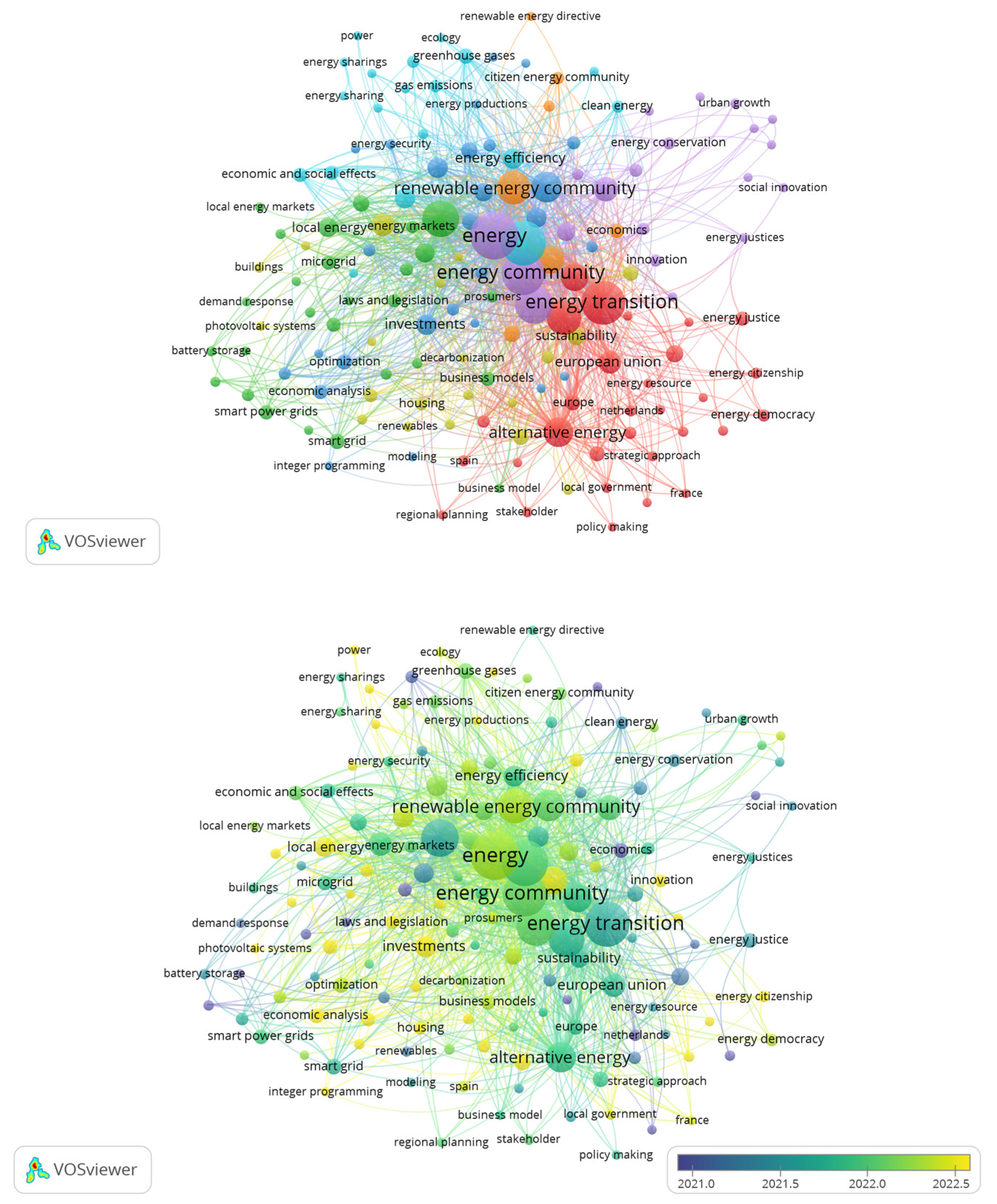

Table A1.
On-grid Energy Community Cases.
| Country | On-Grid Energy Community | Description | Reference |
|---|---|---|---|
| Argentina | Armstrong | The Santa Fe province was Argentina’s first jurisdiction to enable the possibility of connecting distributed renewable energy systems to the grid. In 2013, the Armstrong Electric Cooperative joined a project with the National Technological University and the National Institute of Industrial Technology research group to develop an intelligent grid with distributed generation in Armstrong. The project’s first stage focused on commissioning two types of photovoltaic systems: a 200 kW generation plant in the Armstrong Industrial Area (owned by the cooperative) and 50 1.5 kW systems on the roofs of the cooperative’s users’ homes. | [11,86,87] |
| Brazil | Juazeiro | The program was implemented by the Caixa Econômica Federal (CAIXA public bank) in partnership with Brazil Solair (private company) in the Praia do Rodeadouro and Morada do Salitre condominiums, both located in Juazeiro, Bahia, Brazil and part of the popular housing program My House My Life (MCMV—Minha Casa Minha Vida, Law 11.977/2009). The program’s objective was to generate energy and income, help the development of solar technology in the distributed modality in Brazil, and reduce poverty. In 2014, 9156 photovoltaic (PV) panels of 230 W were installed on the rooftops of popular residences, and 6 micro-wind turbines of 5kWp in the common area, totaling 2.1MWp of renewable generation capacity in the condominiums as mentioned earlier, considered the first mini plant of PV distributed generation in Brazil. | [65,82] |
| Coober | Coober Energy Cooperative is located in Paragominas (PA) and has had a 75 kW solar photovoltaic system installed on the ground and connected to the grid since 2016. The energy generated offsets the electricity bill of its 23 members. | [88] | |
| Cooper Sustentavel | Cooper Sustentavel Energy Cooperative is in the towns of São José (SC) and Arcos (MG). It has installed two solar photovoltaic systems, 1 kW and 0.5 kW, on the ground and connected to the grid since 2017. The energy generated offsets the electricity bill of its 34 members. | ||
| Enercred | The Enercred Energy Cooperative is located in Pedralva (MG) and has had a 180 kW photovoltaic solar system installed on the ground and connected to the grid since 2017. The energy generated offsets the electricity bill of its 90 members. | ||
| Compartsol | Compartsol Energy Cooperative is in Araçoiaba da Serra (SP). It has a 1.4 MW solar photovoltaic system installed on the ground and connected to the grid since 2017. The energy generated offsets the electricity bill of its 63 members. | ||
| Sicoob Centro-Serrano ES | The Sicoob Energy Cooperative is located in the town of Santa Maria de Jetibá (ES) and has had a 36 kW photovoltaic solar system installed on rooftops and connected to the grid since 2017. The energy generated offsets the electricity bill for 6 of its members. | ||
| Coopercitrus | The Coopercitrus Energy Cooperative is in Bebedouro (SP). It has a 1 MW solar photovoltaic system installed on the ground and connected to the grid since 2019. The energy generated offsets the electricity bills of 28 of its members. | ||
| Sistema Sicoob ES | Sistema Sicoob Energy Cooperative Sicoob has a 1 MW solar photovoltaic system installed on rooftops and connected to the grid since 2019. The energy generated offsets the electricity bill to 170 member users of this and other cooperatives. | ||
| Alka Energy | ALKA Energia is an energy management company in the Agricopel group in Florianópolis, SC. It generates 1 MW of solar PV energy and offers its customers clean energy with reliability and savings. With ALKA, you can reduce your energy bill by up to 20%—an essential saving for any business. | [99] | |
| Nex Energy | NEX Energy generates energy through photovoltaic, hydroelectric, biomass, and biogas systems. It operates in 10 states and uses energy credits. | ||
| Cogecom | Cogecom was founded in 2018 and is based in Curitiba, PR. The cooperative currently has 820 members connected to Copel and generates renewable energy through a biomass plant in Carambeí-PR (5000 kW) and a biogas plant in Castrolândia-PR, PR. | ||
| Paraná Energia | Paraná Renewable Energy Cooperative was founded on May 30, 2019. Paraná Energia prioritizes the principles of equality and democratic participation and works to generate financial savings for all its members. | ||
| Ambicoop | The Ambicoop Cooperative, based in Toledo-PR, arose from the need to structure a collective solution to the environmental problem of animal waste in western Paraná. A pilot project was set up in 2021 and is scheduled to start operating by the end of 2023. The waste will be collected through a piping system, and a centralized biogas plant will use the waste to generate renewable energy and produce biofertilizer. It has a generation capacity of 2,300 kW and benefits 48 consumers by receiving energy credits. | ||
| Sun Mobi | Pay-as-you-go solar energy. Sun Mobi manages all the infrastructure and maintenance of the solar farms (13MW installed capacity) that generate clean, renewable energy. The energy generated is injected into the distribution network and transformed into credits, which can be used on any electricity bill of consumers of CPFL Piratininga, CPFL Paulista, COPEL, Enel and Elektro. | ||
| Hadar do Sol | The Hadar do Sol Cooperative, established in 2022, is an initiative that generates solar energy and provides energy credits. The energy is generated in the cooperative’s power plants and then integrated into the electricity concessionaire’s grid. The distribution of this energy among our members follows a division established by the cooperative. | ||
| Enercred | In 2017, Enercred pioneered the renewable energy subscription model for residential and commercial consumers in Minas Gerais. Enercred currently has two photovoltaic solar power plants in Pedralva-MG, which have 180 kWp of installed power together. These plants supply renewable and decentralised energy to 200 homes connected to CEMIG. | ||
| RenovaEco | RenovaEco Renewable Energy Cooperative was founded at the end of 2019 based on the understanding of its 25 founding members of the existing needs, opportunities, and challenges related to renewable energy and local cooperatives. RenovaEco is a Renewable Energy Cooperative that acts as a platform to connect renewable energy suppliers with those interested in consuming this energy. | ||
| Ciclos | In 2018, Sicoob-ES set up the Platform Cooperative - Ciclos, a solution to increase the range of products and services offered to the Credit Union’s members. Today, the platform offers telephony services, renewable energy, and health solutions. To generate solar energy, Sicoob-ES inaugurated a 1 MWp complex comprising ten photovoltaic generating plants (UFV), which serve both Sicoob branches in the state and Ciclos members. Of this complex, 240 kWp currently generates credits for 86 households connected to EDP’s distribution network in Espírito Santo. | ||
| Cooperativa de Energias Renováveis do Nordeste | This cooperative was established in 2021 to generate solar energy and offer energy credits. Twenty-six homes and businesses benefit from the generation. | ||
| Sol Invictus | Since 2020, Sol Invictus has hired photovoltaic plants at competitive prices and passed on the energy credits to its members. The members receive their credit quota directly on their electricity bill. The utility company deducts this amount, and the member pays the deducted amount to Sol Invictus at a discount. | ||
| Mobe Coop | The Electricity Consumers’ Co-operative (Mobe Coop) is a shared distributed generation cooperative founded in 2020. It has an installed capacity of 56 kW and provides energy credits to 24 consumers. | ||
| Cooperativa Ben Viver | The Bem Viver cooperative is a photovoltaic solar energy generation initiative founded in 2020. The cooperative currently has two electricity generation plants (63 kW). The energy generated is injected into the distributor’s grid and converted into energy credits, which are subsequently apportioned (shared) among the members according to a percentage proportional to the investment made by each member in the energy generation plant. | ||
| Cooerma | COOERMA was formed in 2019 in the municipality of Açailândia in the southwestern region of Maranhão. The first photovoltaic solar plant is being completed in the village of Curvelândia, in Vila Nova dos Martirios - MA. The plant has an installed capacity of 75 kW, which will be injected into the Equatorial Energia utility grid via its own 75 kW substation to generate credits on the bills of cooperative members spread across the municipalities of Açailândia - MA, Cidelândia - MA, Imperatriz - MA and the capital São Luís do Maranhão. | ||
| Chile | Petorca Sustentable | It is a user group initiative created in 2021. The Municipality of Petorca is part of the project, while the 18 other participants are “electro-dependent” beneficiaries. The development organization of the community project, i.e., the one in charge of the development and support phases before construction, is AMC Energía. It has an installed capacity of 66.3 kW of solar photovoltaic energy. It is currently in operation. | [99] |
| Til Til | The Community solar plant is a cooperative, created in 2023, of services of 40 people/associated organizations, located in the metropolitan region of Santiago. SOLCOR is the installer of the project, but EBP Chile, Red de Pobreza Energética, EGEA ONG, REPIC, the Municipality of Tiltil, Pro Tiltil, ECOSYS and Codelco are accompanying the project. It has an installed capacity of 50 kW of photovoltaic solar energy. It is currently out of operation. | ||
| Nueva Zelandia | Community solar energy. It is a group founded in 2022 that offers solar energy to 20 people/organizations. Of the participants in the Municipality of Independencia; 15 are neighbors of Población Juan Antonio Ríos, a neighbor of the school where the solar panels are mounted, and 4 are investors. The organization developing the community project is the Red Genera Work Cooperative, which oversees the development and support phases before construction. It is currently out of operation with an installed capacity of 15 kW of photovoltaic solar energy. | ||
| Cooperativa Coopeumo | It is a group of 9 users receiving injections and 328 associated people and organizations created in 2021. Coopeumo shares energy between Coopeumo Cooperative establishments and public buildings such as schools and health centers of the Municipality of Pichidegua. The development organization of the community project, meaning the one in charge of the development and support phases before construction, is the Red Genera Worker Cooperative. It has an installed power of 32 kW of photovoltaic solar energy. | ||
| Colombia | Comuna 13 | It is Colombia’s first peer-to-peer energy exchange pilot, in a joint work of EIA University, EPM, ERCO, NEU, and University College London. The pilot consisted of digitally connecting 12 residential users of different strata and a cultural center, distributed in different neighborhoods of the Metropolitan Area of the Aburrá Valley, through a digital platform, through which the purchase and sale of the energy they generated and consumed were simulated. | [94,97,99] |
| La Estrecha | La Estrecha Solar Community. In 2021, a university and several energy companies cooperated with local citizens to create a solar community in a middle-income neighborhood in Medellin, Colombia. The community aims to enable the beneficiaries to produce energy and sell it to the grid operator for economic benefit. The community comprises 24 stratum families, three living in the same block. Under a distributed generation scheme, these families were installed with two photovoltaic systems with 6 kWp and 14 kWp capacities. | [83,99,100] | |
| Alagro | The Alagro Cooperative comprises 236 agricultural producers, mainly in the dairy sector, to whom it provides collection, purchasing, and marketing services. As a pilot test, in 2021, the Cooperative received a photovoltaic energy generation system for 1 of its tanks, located in the Abreo district of the municipality of Rionegro (Antioquia), where around 150 liters of milk are collected daily from 10 producer families. This implementation has strengthened the cooperative in the social (legitimacy and institutional experience), economic (cost reduction), and environmental (reduction of 1 ton of CO2 emissions per year) spheres. | [99] | |
| Mexico | La Esperanza | Located in Tlaquepaque, Jalisco, La Esperanza is a cooperative project that produces zero-emission bricks using photovoltaic technology and electric hydraulic presses. Surplus energy will be sold to the electricity grid. | [99] |
| CEEOAX | The Oaxaca Energy and Ecology Cooperative was established in 2022. It was created to train indigenous communities in agroecological production and fair trade. The cooperative also has an installed capacity of 10 kW of solar energy, allowing it to sell surplus energy to the grid. |
Table A2.
Previews literature reviews on energy communities and energy transition.
| ID | Year | Title | Reference |
|---|---|---|---|
| 1 | 2021 | Business models for energy communities: A review of key issues and trends | [52] |
| 2 | 2022 | The role of energy democracy and Energy Citizenship for participatory energy transitions: A comprehensive review | [50] |
| 3 | 2022 | Conceptualizing community in energy systems: A systematic review of 183 definitions | [4] |
| 4 | 2022 | Towards collective energy Community: Potential roles of microgrid and blockchain to go beyond P2P energy trading | [78] |
| 5 | 2021 | Towards data-driven energy communities: A review of open-source datasets, models, and tools | [54] |
| 6 | 2022 | A transition perspective on Energy Communities: A systematic literature review and research agenda | [1] |
| 7 | 2023 | A review and mapping exercise of energy community regulatory challenges in European member states based on a survey of collective energy actors | [20] |
| 8 | 2021 | A review of energy communities in Sub-Saharan Africa as a transition pathway to energy democracy | [23] |
| 9 | 2022 | Greek Islands’ Energy Transition: From Lighthouse Projects to the Emergence of Energy Communities | [3] |
| 10 | 2022 | Conceptual design of energy market topologies for communities and their practical applications in EU: A comparison of three case studies | [5] |
| 11 | 2022 | Thermal/Cooling Energy on Local Energy Communities: A Critical Review | [56] |
| 12 | 2023 | An interdisciplinary understanding of energy citizenship: Integrating psychological, legal, and economic perspectives on a citizen-centred sustainable energy transition | [42] |
| 13 | 2023 | The Emerging Trends of Renewable Energy Communities’ Development in Italy | [21] |
| 14 | 2022 | Economic, social, and environmental aspects of Positive Energy Districts—A review | [53] |
| 15 | 2022 | Renewable energy communities or ecosystems: An analysis of selected cases | [36] |
| 16 | 2023 | Key Aspects and Challenges in the Implementation of Energy Communities | [22] |
| 17 | 2023 | Critical Review on Community-Shared Solar-Advantages, Challenges, and Future Directions | [38] |
| 18 | 2024 | A Review of Renewable Energy Communities: Concepts, Scope, Progress, Challenges, and Recommendations | [2] |
| 19 | 2024 | European energy communities: Characteristics, trends, business models and legal framework | [24] |
| 20 | 2024 | Exploring the academic landscape of energy communities in Europe: A systematic literature review | [19] |
| 21 | 2023 | Energy Communities: A review on trends, energy system modeling, business models, and optimisation objectives | [51] |
| 22 | 2022 | Energy communities in sustainable transitions: the South American case | [11] |
| 23 | 2025 | Key aspects and challenges for successful energy communities: A comparative analysis between Latin America and developed countries | [79] |
Table A3.
Latino American’s On-grid Energy Communities Legislation Background.
| Country | Year, Norm | Description | References |
|---|---|---|---|
| Argentina | 1998, Law 25.019 | National Wind and Solar Energy Regime. Individuals or legal entities domiciled in the country may generate electric energy from wind and solar energy constituted under the legislation in force. | [101] |
| 2006, Law 26.190 | It is the National Promotion Regime for using renewable energy sources to produce electricity. This law promotes the realization of new investments in electric energy production undertakings based on using renewable energy sources throughout the national territory. | [87,102] | |
| 2015, Law 27.191 | National promotion Regime for using renewable energy sources to produce electric power. Modification. Creation of the public trust fund. The objective of this regime is to achieve a contribution of renewable energy sources up to eight percent (8%) of the national electric energy consumption by December 31, 2017. | [87,103] | |
| 2017, Law 27.424 | Scheme for promoting distributed generation of renewable energy integrated into the electric power grid. The purpose of this law is to set the policies and establish the legal and contractual conditions for the generation of electric energy of renewable origin by users of the distribution network for their self-consumption, with an eventual injection of surpluses to the network, and to establish the obligation of the providers of the public distribution service to facilitate such injection, ensuring free access to the distribution network. | [87,104] | |
| Brazil | 2012, Resolution 482 | National Electric Energy Agency - ANEEL’s Normative Resolution No. 482 establishes the general conditions for the access of distributed microgeneration and mini-generation to electricity distribution systems and the electricity compensation system and makes other provisions. | [105] |
| 2015, Resolution 687 | It improves the previous resolution (Normative Resolution No. 482) by reducing the barriers to the insertion of distributed generation by allowing prosumers to access the distribution system, either individually or in groups (in the form of a condominium, consortium or cooperative, and remote self-consumption). Through the one-to-one net-metering scheme, this norm regulates shared DGs such as condominiums, consortia, and cooperatives. | [88,90,106] | |
| 2022, Law 14.300 | It establishes the legal framework for distributed microgeneration and mini-generation, the Electricity Compensation System (SCEE), and the Social Renewable Energy Program (PERS). It modifies the amount of credit compensation so that distribution costs, representing 30% of the electricity bill, will be deducted. Another meaningful change is that shared generation may be structured in legal forms other than cooperatives and consortiums. In this way, the distributed energy model by subscription may continue to grow in Brazil and adopt other legal forms. | [94,107] | |
| Chile | 2008, Law 20.257 | It introduces amendments to the general law of electric utilities regarding generating electric energy with non-conventional renewable energy sources - NCREs. The first quota regulation specifies that NCREs must supply 10 % of power by 2024. This law was updated in 2013 (Law 20.698) by setting a new quota and deadline of 20 % by 2025. | [28,108] |
| 2012, Law 20.571 | It regulates the payment of electricity tariffs for residential generators. End users subject to pricing who consume electricity generation equipment by non-conventional renewable means or efficient cogeneration facilities for their consumption shall have the right to inject the energy generated in this way into the distribution network through the respective connections. | [28,91,109] | |
| 2018, Law 21.118 | It amends the general law of electric utilities to encourage the development of residential generators. It considers collective on-grid arrangements—on-grid ECs—part of the residential distributed generation cluster. This framework applies to efficient cogeneration or Non-Conventional Renewable Energies (NCREs). Thus, groups of citizens with a shared power generation infrastructure of up to 300 kW can inject electricity into the public grid. | [28,110] | |
| Colombia | 1996, Resolution 84 | The Energy and Gas Regulatory Commission -CREG—regulates the activities of the Auto-generator connected to the National Interconnected System through Resolution 84. | [111] |
| 2014, Law 1715 | The Renewable Energy Law regulates the integration of non-conventional renewable energies into the National Energy System. This law aims to promote the development and use of non-conventional energy sources, storage systems for such sources, and efficient use of energy, mainly renewable ones, in the national energy system. Distributed generation is regulated through two figures: small-scale self-generation and distributed generation. | [94,112] | |
| 2018, Resolution 30 | This CREG resolution regulates small-scale self-generation and distributed generation activities in the National Interconnected System. Resolution CREG 174 of 2021 repealed it. | [94,113] | |
| 2021, Resolution 174 | This CREG resolution regulates operational and commercial aspects to allow the integration of small-scale self-generation and distributed generation into the National Interconnected System (SIN). It also regulates aspects of the connection procedure for large-scale self-generators with a declared maximum power of less than 5 MW. | [94,100,114] | |
| 2023, Law 2294 | It is the Law by which the national development plan 2022- 2026 “Colombia global power of life” is enacted. Article 190 proposes amending Law 1715 to incorporate energy communities. | [94,115] | |
| 2023, Decree 2236 | Partially regulate Article 235 of Law 2294 of 2023 of the National Development Plan 2022 - 2026 concerning the Energy Communities within the framework of the Just Energy Transition in Colombia. | [116] | |
| 2025, Resolution 101 072 | This CREG resolution regulates the integration of energy communities into the National Energy System and issues other provisions for non-interconnected areas. | [117] | |
| Mexico | 2014, Law --- | Energy Industry Law. This law regulates the planning and control of the National Electric System, the Public Service of Transmission and Distribution of Electric Energy, and other activities of the electric industry. The purpose of the law is to promote the sustainable development of the electricity industry and to guarantee its continuous, efficient, and safe operation for the benefit of users, as well as compliance with the obligations of universal public service obligations, Clean Energy, and the reduction of polluting emissions. | [93,118] |
| 2015, Agreement --- | An agreement was reached whereby the Ministry of Energy issued the Electricity Market Bases. The Electricity Market Bases are a regulatory body composed of general administrative provisions that contain the principles for the design and operation of the Wholesale Electricity Market, including the auctions referred to in the Electricity Industry Law. | [93,119] | |
| 2015, Law --- | Energy Transition Law. The law regulates the sustainable use of energy, as well as the obligations regarding clean energies and the reduction of polluting emissions in the electric industry, maintaining the competitiveness of the productive sectors. | [93,120] |
References
- M. L. Lode, G. te Boveldt, T. Coosemans, and L. Ramirez Camargo, “A transition perspective on Energy Communities: A systematic literature review and research agenda,” Renewable and Sustainable Energy Reviews, vol. 163, p. 112479, Jul. 2022. [CrossRef]
- S.; Ahmed et al., “A Review of Renewable Energy Communities: Concepts, Scope, Progress, Challenges, and Recommendations,” Sustainability (Switzerland), vol. 16, no. 5, p. 1749, Feb. 2024. [CrossRef]
- D. Al Katsaprakakis et al., “Greek Islands’ Energy Transition: From Lighthouse Projects to the Emergence of Energy Communities,” Energies (Basel), vol. 15, no. 16, p. 5996, Aug. 2022. [CrossRef]
- T. Bauwens et al., “Conceptualizing community in energy systems: A systematic review of 183 definitions,” Renewable and Sustainable Energy Reviews, vol. 156, p. 111999, Mar. 2022. [CrossRef]
- E. Neska and A. Kowalska-Pyzalska, “Conceptual design of energy market topologies for communities and their practical applications in EU: A comparison of three case studies,” Renewable and Sustainable Energy Reviews, vol. 169, p. 112921, Nov. 2022. [CrossRef]
- REN21, “Renewables 2022. Global Status Report,” Paris, 2022.
- REN21, “Renewables 2023 Global Status Report Collection, Global Overview,” 2023.
- P. F. Borowski, “Mitigating Climate Change and the Development of Green Energy versus a Return to Fossil Fuels Due to the Energy Crisis in 2022,” Energies 2022, Vol. 15, Page 9289, vol. 15, no. 24, p. 9289, Dec. 2022. [CrossRef]
- L. Gitelman and M. Kozhevnikov, “Energy Transition Manifesto: A Contribution towards the Discourse on the Specifics Amid Energy Crisis,” Energies 2022, Vol. 15, Page 9199, vol. 15, no. 23, p. 9199, Dec. 2022. [CrossRef]
- Organización Latinoamericana de Energía (OLADE), “Potencial de Energías Renovables en América Latina.” Accessed: May 01, 2025. Available online: https://sielac.olade.org/WebForms/Reportes/ReporteDato3.aspx?oc=61&or=690&ss=2&v=1.
- B. P. González, J. E. Viglio, and L. da Costa Ferreira, “Energy communities in sustainable transitions - The South American Case,” Sustainability in Debate, vol. 13, no. 2, pp. 156–174, Aug. 2022. [CrossRef]
- Organización Latinoamericana de Energía (OLADE), “Panorama Energético De América Latina Y El Caribe 2023,” 2023.
- L. Gitelman and M. Kozhevnikov, “Energy Transition Manifesto: A Contribution towards the Discourse on the Specifics Amid Energy Crisis,” Energies 2022, Vol. 15, Page 9199, vol. 15, no. 23, p. 9199, Dec. 2022. [CrossRef]
- L. Gitelman and M. Kozhevnikov, “New Business Models in the Energy Sector in the Context of Revolutionary Transformations,” Sustainability 2023, Vol. 15, Page 3604, vol. 15, no. 4, p. 3604, Feb. 2023. [CrossRef]
- L. Gitelman and M. Kozhevnikov, “New Business Models in the Energy Sector in the Context of Revolutionary Transformations,” Sustainability 2023, Vol. 15, Page 3604, vol. 15, no. 4, p. 3604, Feb. 2023. [CrossRef]
- L. C. Villegas Rodrigues, J.-A. Polanco, and M. Escobar-Sierra, SOSTENIBILIDAD Y PAZ Una memoria empresarial desde el sector eléctrico colombiano. Medellín: Sello Editorial Universidad de Medellín, 2025. Accessed: Aug. 21, 2025. Available online: https://udemedellin.edu.co/lanzamiento-del-libro-sostenibilidad-y-paz/.
- S. M. P. Pulice, E. A. Branco, A. L. C. F. Gallardo, D. R. Roquetti, and E. M. Moretto, “Evaluating Monetary-Based Benefit-Sharing as a Mechanism to Improve Local Human Development and its Importance for Impact Assessment of Hydropower Plants in Brazil,” Journal of Environmental Assessment Policy and Management, vol. 21, no. 1, pp. 1–42, Mar. 2019. [CrossRef]
- P. I. Sholihah and S. Chen, “Improving living conditions of displacees: A review of the evidence benefit sharing scheme for development induced displacement and resettlement (DIDR) in urban Jakarta Indonesia,” World Dev Perspect, vol. 20, no. July, 2020. [CrossRef]
- F. Gianaroli, M. Preziosi, M. Ricci, P. Sdringola, M. A. Ancona, and F. Melino, “Exploring the academic landscape of energy communities in Europe: A systematic literature review,” J Clean Prod, vol. 451, p. 141932, Apr. 2024. [CrossRef]
- M. Haji Bashi et al., “A review and mapping exercise of energy community regulatory challenges in European member states based on a survey of collective energy actors,” Renewable and Sustainable Energy Reviews, vol. 172, p. 113055, Feb. 2023. [CrossRef]
- Tatti, S. Ferroni, M. Ferrando, M. Motta, and F. Causone, “The Emerging Trends of Renewable Energy Communities’ Development in Italy,” Sustainability (Switzerland), vol. 15, no. 8, p. 6792, Apr. 2023. [CrossRef]
- G. Yiasoumas et al., “Key Aspects and Challenges in the Implementation of Energy Communities,” Energies (Basel), vol. 16, no. 12, p. 4703, Jun. 2023. [CrossRef]
- Ambole, K. Koranteng, P. Njoroge, and D. L. Luhangala, “A Review of Energy Communities in Sub-Saharan Africa as a Transition Pathway to Energy Democracy,” Sustainability (Switzerland), vol. 13, no. 4, p. 2128, Feb. 2021. [CrossRef]
- López et al., “European energy communities: Characteristics, trends, business models and legal framework,” Renewable and Sustainable Energy Reviews, vol. 197, p. 114403, Jun. 2024. [CrossRef]
- E. I. C. Zebra, H. J. van der Windt, B. Olubayo, G. Nhumaio, and A. P. C. Faaij, “Scaling up the electricity access and addressing best strategies for a sustainable operation of an existing solar PV mini-grid: A case study of Mavumira village in Mozambique,” Energy for Sustainable Development, vol. 72, pp. 58–82, Feb. 2023. [CrossRef]
- E. I. Come Zebra, H. J. van der Windt, G. Nhumaio, and A. P. C. Faaij, “A review of hybrid renewable energy systems in mini-grids for off-grid electrification in developing countries,” Renewable and Sustainable Energy Reviews, vol. 144, p. 111036, Jul. 2021. [CrossRef]
- M. Montedonico, F. Herrera-Neira, A. Marconi, A. Urquiza, and R. Palma-Behnke, “Co-construction of energy solutions: Lessons learned from experiences in Chile,” Energy Res Soc Sci, vol. 45, pp. 173–183, Nov. 2018. [CrossRef]
- B. Poque González, J. E. Viglio, Y. M. Macia, and L. da Costa Ferreira, “Redistributing power? Comparing the electrical system experiences in Chile and Brazil from a historical institutional perspective,” Energy Res Soc Sci, vol. 101, p. 103129, Jul. 2023. [CrossRef]
- T. Roa-Avendaño, Energías para la transición. Reflexiones y relatos, no. marzo. Bogotá: Censat Agua Viva y Fundación Heinrich Boll, 2021.
- Teladia and H. van der Windt, “Lights, Policy, Action: A Multi-Level Perspective on Policy Instrument Mix Interactions for Community Energy Initiatives,” Energies 2025, Vol. 18, Page 2823, vol. 18, no. 11, p. 2823, May 2025. [CrossRef]
- F. W. Geels, “Technological transitions as evolutionary reconfiguration processes: a multi-level perspective and a case-study,” Res Policy, vol. 31, no. 8–9, pp. 1257–1274, Dec. 2002. [CrossRef]
- N. Magnani and V. M. Cittati, “Combining the Multilevel Perspective and Socio-Technical Imaginaries in the Study of Community Energy,” Energies (Basel), vol. 15, no. 5, 2022. [CrossRef]
- M. L. Lode, G. te Boveldt, T. Coosemans, and L. Ramirez Camargo, “A transition perspective on Energy Communities: A systematic literature review and research agenda,” Renewable and Sustainable Energy Reviews, vol. 163, p. 112479, Jul. 2022. [CrossRef]
- Jiménez-Inchima, J.-A. Polanco, and M. Escobar-Sierra, “Good living of communities and sustainability of the hydropower business: mapping an operational framework for benefit sharing,” Energy, Sustainability and Society 2021 11:1, vol. 11, no. 1, pp. 1–20, Mar. 2021. [CrossRef]
- D. Suárez-Gómez, J.-A. Polanco, and M. Escobar-Sierra, “Understanding the role of territorial factors in the large-scale hydropower business sustainability: A systematic literature review,” Energy Reports, vol. 7, pp. 3249–3266, Nov. 2021. [CrossRef]
- O. Adu-Kankam and L. M. Camarinha-Matos, “Renewable energy communities or ecosystems: An analysis of selected cases,” Heliyon, vol. 8, no. 12, p. e12617, Dec. 2022. [CrossRef]
- F. W. Geels, F. Kern, and W. C. Clark, “Sustainability transitions in consumption-production systems,” Proc Natl Acad Sci U S A, vol. 120, no. 47, p. e2310070120, Nov. 2023. [CrossRef]
- N. Narjabadifam, J. Fouladvand, and M. Gül, “Critical Review on Community-Shared Solar—Advantages, Challenges, and Future Directions,” Energies (Basel), vol. 16, no. 8, p. 3412, Apr. 2023. [CrossRef]
- F. W. Geels, “Socio-technical transitions to sustainability: a review of criticisms and elaborations of the Multi-Level Perspective,” Curr Opin Environ Sustain, vol. 39, pp. 187–201, Aug. 2019. [CrossRef]
- Berlo, O. Wagner, and M. Heenen, “The Incumbents’ Conservation Strategies in the German Energy Regime as an Impediment to Re-Municipalization—An Analysis Guided by the Multi-Level Perspective,” Sustainability 2017, Vol. 9, Page 53, vol. 9, no. 1, p. 53, Dec. 2016. [CrossRef]
- F. W. Geels, “Technological transitions as evolutionary reconfiguration processes: a multi-level perspective and a case-study,” Res Policy, vol. 31, no. 8–9, pp. 1257–1274, Dec. 2002. [CrossRef]
- R. S. Hamann et al., “An interdisciplinary understanding of energy citizenship: Integrating psychological, legal, and economic perspectives on a citizen-centred sustainable energy transition,” Energy Res Soc Sci, vol. 97, p. 102959, Mar. 2023. [CrossRef]
- G. Dóci, E. Vasileiadou, and A. C. Petersen, “Exploring the transition potential of renewable energy communities,” Futures, vol. 66, pp. 85–95, Feb. 2015. [CrossRef]
- Musolino and D. Farinella, “Renewable Energy Communities as Examples of Civic and Citizen-Led Practices: A Comparative Analysis from Italy,” Land (Basel), vol. 14, no. 3, p. 603, Mar. 2025. [CrossRef]
- J. van Eck and L. Waltman, “Software survey: VOSviewer, a computer program for bibliometric mapping,” Scientometrics, vol. 84, no. 2, pp. 523–538, 2010. [CrossRef]
- J. Van Eck and L. Waltman, “Accuracy of citation data in Web of Science and Scopus,” J Organomet Chem, vol. 798, pp. 229–233, 2015.
- Waltman, N. J. van Eck, and E. C. M. Noyons, “A unified approach to mapping and clustering of bibliometric networks,” J Informetr, vol. 4, no. 4, pp. 629–635, Oct. 2010. [CrossRef]
- N. J. Van Eck and L. Waltman, Visualizing Bibliometric Networks. 2014. [CrossRef]
- D. Moher et al., “Preferred reporting items for systematic reviews and meta-analyses: The PRISMA statement,” Aug. 2009, American College of Physicians. [CrossRef]
- Wahlund and J. Palm, “The role of energy democracy and energy citizenship for participatory energy transitions: A comprehensive review,” Energy Res Soc Sci, vol. 87, p. 102482, May 2022. [CrossRef]
- E. Barabino et al., “Energy Communities: A review on trends, energy system modelling, business models, and optimisation objectives,” Sustainable Energy, Grids and Networks, vol. 36, p. 101187, Dec. 2023. [CrossRef]
- F.G. Reis, I. Gonçalves, M. A.R. Lopes, and C. Henggeler Antunes, “Business models for energy communities: A review of key issues and trends,” Renewable and Sustainable Energy Reviews, vol. 144, p. 111013, Jul. 2021. [CrossRef]
- Casamassima, L. Bottecchia, A. Bruck, L. Kranzl, and R. Haas, “Economic, social, and environmental aspects of Positive Energy Districts—A review,” WIREs: Energy and Environment, vol. 11, no. 6, p. e452, Nov. 2022. [CrossRef]
- H. Kazmi, Í. Munné-Collado, F. Mehmood, T. A. Syed, and J. Driesen, “Towards data-driven energy communities: A review of open-source datasets, models and tools,” Renewable and Sustainable Energy Reviews, vol. 148, p. 111290, Sep. 2021. [CrossRef]
- C. E. Hoicka, J. Lowitzsch, M. C. Brisbois, A. Kumar, and L. Ramirez Camargo, “Implementing a just renewable energy transition: Policy advice for transposing the new European rules for renewable energy communities,” Energy Policy, vol. 156, p. 112435, Sep. 2021. [CrossRef]
- G. Papatsounis, P. N. Botsaris, and S. Katsavounis, “Thermal/Cooling Energy on Local Energy Communities: A Critical Review,” Energies (Basel), vol. 15, no. 3, p. 1117, Feb. 2022. [CrossRef]
- Lowitzsch, C. E. Hoicka, and F. J. van Tulder, “Renewable energy communities under the 2019 European Clean Energy Package – Governance model for the energy clusters of the future?,” Renewable and Sustainable Energy Reviews, vol. 122, p. 109489, Apr. 2020. [CrossRef]
- C. Guetlein and J. Schleich, “Empirical insights into enabling and impeding factors for increasing citizen investments in renewable energy communities,” Energy Policy, vol. 193, p. 114302, Oct. 2024. [CrossRef]
- Li and Ö. Okur, “Economic analysis of energy communities: Investment options and cost allocation,” Appl Energy, vol. 336, p. 120706, Apr. 2023. [CrossRef]
- E. Moretti and E. Stamponi, “The Renewable Energy Communities in Italy and the Role of Public Administrations: The Experience of the Municipality of Assisi between Challenges and Opportunities,” Sustainability (Switzerland), vol. 15, no. 15, p. 11869, Aug. 2023. [CrossRef]
- Martens, “Investigating subnational success conditions to foster renewable energy community co-operatives,” Energy Policy, vol. 162, p. 112796, Mar. 2022. [CrossRef]
- De Vidovich, “Niches Seeking Legitimacy: Notes about Social Innovation and Forms of Social Enterprise in the Italian Renewable Energy Communities,” Sustainability (Switzerland), vol. 16, no. 9, p. 3599, Apr. 2024. [CrossRef]
- Comisión Europea, “RepowerEU - Comisión Europea,” Bruselas, 2022.
- European Commission, “Clean energy for all Europeans package.” Accessed: Oct. 14, 2024. Available online: https://energy.ec.europa.eu/topics/energy-strategy/clean-energy-all-europeans-package_en.
- F. Barroco Fontes Cunha et al., “Renewable energy planning policy for the reduction of poverty in Brazil: lessons from Juazeiro,” Environ Dev Sustain, vol. 23, no. 7, pp. 9792–9810, Jul. 2021. [CrossRef]
- S. Barbaro and G. Napoli, “Energy Communities in Urban Areas: Comparison of Energy Strategy and Economic Feasibility in Italy and Spain,” Land (Basel), vol. 12, no. 7, p. 1282, Jun. 2023. [CrossRef]
- De Vidovich, L. Tricarico, and M. Zulianello, “How Can We Frame Energy Communities’ Organisational Models? Insights from the Research ‘Community Energy Map’ in the Italian Context,” Sustainability (Switzerland), vol. 15, no. 3, p. 1997, Feb. 2023. [CrossRef]
- Musolino, G. Maggio, E. D’Aleo, and A. Nicita, “Three case studies to explore relevant features of emerging renewable energy communities in Italy,” Renew Energy, vol. 210, pp. 540–555, Jul. 2023. [CrossRef]
- S. Heuninckx, G. te Boveldt, C. Macharis, and T. Coosemans, “Stakeholder objectives for joining an energy community: Flemish case studies,” Energy Policy, vol. 162, p. 112808, Mar. 2022. [CrossRef]
- Dudka, N. Moratal, and T. Bauwens, “A typology of community-based energy citizenship: An analysis of the ownership structure and institutional logics of 164 energy communities in France,” Energy Policy, vol. 178, p. 113588, Jul. 2023. [CrossRef]
- Pena-Bello, D. Parra, M. Herberz, V. Tiefenbeck, M. K. Patel, and U. J. J. Hahnel, “Integration of prosumer peer-to-peer trading decisions into energy community modelling,” Nat Energy, vol. 7, no. 1, pp. 74–82, Dec. 2021. [CrossRef]
- D. Conradie, O. De Ruyck, J. Saldien, and K. Ponnet, “Who wants to join a renewable energy community in Flanders? Applying an extended model of Theory of Planned Behaviour to understand intent to participate,” Energy Policy, vol. 151, p. 112121, Apr. 2021. [CrossRef]
- L. Toderean, V. R. Chifu, T. Cioara, I. Anghel, and C. B. Pop, “Cooperative Games Over Blockchain and Smart Contracts for Self-Sufficient Energy Communities,” IEEE Access, vol. 11, pp. 73982–73999, 2023. [CrossRef]
- J. Radtke, Ö. Yildiz, and L. Roth, “Does Energy Community Membership Change Sustainable Attitudes and Behavioral Patterns? Empirical Evidence from Community Wind Energy in Germany,” Energies (Basel), vol. 15, no. 3, p. 822, Jan. 2022. [CrossRef]
- M. Nozarian, A. Fereidunian, and M. Barati, “Smart City Energy Infrastructure as a Cyber-Physical System of Systems: Planning, Operation, and Control Processes,” Smart Cyber-Physical Power Systems: Fundamental Concepts, Challenges, and Solutions, pp. 99–123, Jan. 2025. [CrossRef]
- M. Nozarian, A. Fereidunian, and M. Barati, “Reliability-Oriented Planning Framework for Smart Cities: From Interconnected Micro Energy Hubs to Macro Energy Hub Scale,” IEEE Syst J, vol. 17, no. 3, pp. 3798–3809, Sep. 2023. [CrossRef]
- L. F. M. van Summeren, S. Breukers, and A. J. Wieczorek, “Together we’re smart! Flemish and Dutch energy communities’ replication strategies in smart grid experiments,” Energy Res Soc Sci, vol. 89, p. 102643, Jul. 2022. [CrossRef]
- Y. Wu, Y. Wu, H. Cimen, J. C. Vasquez, and J. M. Guerrero, “Towards collective energy Community: Potential roles of microgrid and blockchain to go beyond P2P energy trading,” Appl Energy, vol. 314, p. 119003, May 2022. [CrossRef]
- L. Galindo Noguera, L. S. Mendoza Castellanos, S. Ardila Cruz, and G. Osorio-Gómez, “Key aspects and challenges for successful energy communities: A comparative analysis between Latin America and developed countries,” Renewable and Sustainable Energy Reviews, vol. 216, p. 115687, Jul. 2025. [CrossRef]
- B. Poque González, A. S. Silvino, Y. M. Macia, and L. da Costa Ferreira, “Institutional conditions for the development of energy communities in Chile and Brazil,” Sustainability in Debate, vol. 14, no. 3, pp. 88–121, Dec. 2023. [CrossRef]
- Lampis and C. Bermann, “Public Policy and Governance Narratives of Distributed Energy Resources in Brazil,” Ambiente & Sociedade, vol. 25, p. e01132, Apr. 2022. [CrossRef]
- F. Barroco Fontes Cunha, C. Carani, C. A. Nucci, C. Castro, M. Santana Silva, and E. Andrade Torres, “Transitioning to a low carbon society through energy communities: Lessons learned from Brazil and Italy,” Energy Res Soc Sci, vol. 75, p. 101994, May 2021. [CrossRef]
- J. P. Cárdenas Álvarez, J. George, J. Giraldo Quiroz, J. A. Estrada Walker, J. M. España Forero, and S. Ortega Arango, “REDEFINIENDO LAS COMUNIDADES ENERGÉTICAS PARA UNA TRANSICIÓN JUSTA. Una visión crítica sobre la Comunidad Solar La Estrecha en Medellín, Colombia,” 2023.
- Lampis et al., “Energy transition or energy diversification? Critical thoughts from Argentina and Brazil,” Energy Policy, vol. 171, p. 113246, Dec. 2022. [CrossRef]
- R. Palma-Behnke et al., “Lowering Electricity Access Barriers by Means of Participative Processes Applied to Microgrid Solutions: The Chilean Case,” in Proceedings of the IEEE, Institute of Electrical and Electronics Engineers Inc., Sep. 2019, pp. 1857–1871. [CrossRef]
- S. M. Garrido, “‘Por un futuro sustentable y una gestión democrática de la energía’: la experiencia de construir un sistema de generación alternativa en la ciudad de Armstrong, Argentina,” Estudios Avanzados, no. 29, pp. 40–55, 2018.
- M. Kazimierski, “La energía distribuida como modelo post-fósil en Argentina,” Economía, sociedad y territorio, vol. 20, no. 63, pp. 397–428, May 2020. [CrossRef]
- K. Schneider, M. O. M. de Oliveira, C. Japp, P. S. Manoel, and R. Rüther, “Community solar in Brazil: The cooperative model context and the existing shared solar cooperatives up to date,” in Proceedings of the ISES Solar World Congress 2019 and IEA SHC International Conference on Solar Heating and Cooling for Buildings and Industry 2019, 2019, pp. 1594–1605. [CrossRef]
- F. Fuentes González, E. Sauma, and A. H. van der Weijde, “The Scottish experience in community energy development: A starting point for Chile,” Renewable and Sustainable Energy Reviews, vol. 113, p. 109239, Oct. 2019. [CrossRef]
- R. C. Lotero and H. F. De Souza, “Optimal Selection of Photovoltaic Generation for a Community of Electricity Prosumers,” IEEE Latin America Transactions, vol. 18, no. 4, pp. 791–799, Apr. 2020. [CrossRef]
- F. Fuentes González, A. H. van der Weijde, and E. Sauma, “The promotion of community energy projects in Chile and Scotland: An economic approach using biform games,” Energy Econ, vol. 86, p. 104677, Feb. 2020. [CrossRef]
- Galván et al., “Exporting sunshine: Planning South America’s electricity transition with green hydrogen,” Appl Energy, vol. 325, p. 119569, Nov. 2022. [CrossRef]
- V. Magar, A. Peña, A. N. Hahmann, D. A. Pacheco-Rojas, L. S. García-Hernández, and M. S. Gross, “Wind Energy and the Energy Transition: Challenges and Opportunities for Mexico,” Sustainability (Switzerland), vol. 15, no. 6, p. 5496, Mar. 2023. [CrossRef]
- M. Ramírez-Tovar and K. Scheinder, “Por más, y por menos, comunidades energéticas en la generación ciudadana: diálogo entre las regulaciones brasileña y colombiana,” Energía y equidad, no. 6, pp. 14–25, 2023.
- R. Rodríguez and A. J. Anuzis, “POTENCIALIDAD PARA LA IMPLEMENTACIÓN DE COMUNIDADES ENERGÉTICAS SUSTENTABLES EN LA PROVINCIA DE CÓRDOBA, ARGENTINA,” ENERLAC. Revista de Energía de Latinoamérica y el Caribe, vol. V, no. 2, 2021.
- Ramirez-Tovar, J. España, L. Restrepo, and J. Giraldo, “Barreras Regulatorias Para La Implementación De Comunidades Energéticas En Colombia,” 2022.
- J. Molina Castro, L. F. Buitagro, S. Téllez, S. Giraldo, and J. Zapata, “Comunidades Energéticas: Modelos para el empoderamiento de los usuarios en Colombia,” ENERLAC. Revista De energía De Latinoamérica Y El Caribe, vol. VII, no. 1, pp. 110–133, 2023.
- J. P. Cárdenas Álvarez, J. George, J. Giraldo Quiroz, J. A. Estrada Walker, J. M. España Forero, and S. Ortega Arango, “Recomendaciones para el desarrollo de comunidades energéticas en Colombia-Policy brief,” 2023.
- DGRV, Fotovoltaica UFSC, Universidad EIA, and Energeia, “Energia.Coop. Plataforma de energía cooperativa.” Accessed: Aug. 06, 2024. Available online: https://www2.energia.coop/.
- J. Tejada Medina and S. E. Baquero Vides, “Comunidades energéticas en Colombia: un enfoque jurídico para la sostenibilidad y la participación ciudadana en el ámbito de la transición energética,” Universidad EAFIT, 2023.
- Ministerio de Justicia de la Nación, “Ley 25.019.” Accessed: Sep. 04, 2024. Available online: https://servicios.infoleg.gob.ar/infolegInternet/anexos/50000-54999/53790/texact.htm.
- Boletín Oficial República Argentina, “Ley 26.190.” Accessed: Sep. 04, 2024. Available online: https://www.argentina.gob.ar/sites/default/files/ley_26190-2006.pdf.
- Ministerio de Justicia de la Nación, “Ley 27.191.” Accessed: Sep. 04, 2024. Available online: https://servicios.infoleg.gob.ar/infolegInternet/anexos/250000-254999/253626/norma.htm.
- Ministerio de Justicia de la Nación, “Ley 27.424.” Accessed: Sep. 04, 2024. Available online: https://servicios.infoleg.gob.ar/infolegInternet/anexos/305000-309999/305179/norma.htm.
- AGÊNCIA NACIONAL DE ENERGIA ELÉTRICA – ANEEL, “RESOLUÇÃO NORMATIVA No 482.” Accessed: Sep. 04, 2024. Available online: https://solistec.com.br/wp-content/uploads/2016/03/RN-482-2012.pdf.
- AGÊNCIA NACIONAL DE ENERGIA ELÉTRICA – ANEEL, “RESOLUÇÃO NORMATIVA No 687.” Accessed: Sep. 04, 2024. Available online: https://solistec.com.br/wp-content/uploads/2016/03/RN-687-2015.pdf.
- Diario Oficial da Union, “LEI No 14.300.” Accessed: Sep. 04, 2024. Available online: https://pesquisa.in.gov.br/imprensa/jsp/visualiza/index.jsp?jornal=515&pagina=4&data=07/01/2022.
- Ministerio de Economía, “Ley 20257.” Accessed: Sep. 04, 2024. Available online: https://www.bcn.cl/leychile/navegar?idNorma=270212.
- Ministerio de Energía, “Ley 20571.” Accessed: Sep. 04, 2024. Available online: https://www.bcn.cl/leychile/navegar?idNorma=1038211.
- Ministerio de Energía, “Ley 21118.” Accessed: Sep. 04, 2024. Available online: https://www.bcn.cl/leychile/navegar?idNorma=1125560.
- Comisión de Regulación de Energía y Gas - CREG, “Resolución 84 de 1996.” Accessed: Sep. 05, 2024. Available online: https://gestornormativo.creg.gov.co/gestor/entorno/docs/resolucion_creg_0084_1996.htm.
- Ministerio de Minas y Energía, “Ley 1715 de 2014.” Accessed: Sep. 05, 2024. Available online: https://www.funcionpublica.gov.co/eva/gestornormativo/norma.php?i=57353.
- Comisión de Regulación de Energía y Gas - CREG, “Resolución 030 de 2018.” Accessed: Sep. 05, 2024. Available online: https://gestornormativo.creg.gov.co/gestor/entorno/docs/resolucion_creg_0030_2018.htm.
- Comisión de Regulación de Energía y Gas - CREG, “Resolución 174 de 2021.” Accessed: Sep. 05, 2024. Available online: https://gestornormativo.creg.gov.co/gestor/entorno/docs/resolucion_creg_0174_2021.htm.
- Congreso de Colombia, “Ley 2294 de 2023.” Accessed: Sep. 05, 2024. Available online: https://www.funcionpublica.gov.co/eva/gestornormativo/norma.php?i=209510.
- Ministerio de Minas y Energía, “Decreto 2236 de 2023 sobre comunidades energéticas en Colombia.” Accessed: Apr. 30, 2025. Available online: https://normativame.minenergia.gov.co/normatividad/6821/norma/.
- Comisión de Regulación de Energía y Gas - CREG, “Resolución 101 072 sobre comunidades energéticas en Colombia.” Accessed: Apr. 30, 2025. Available online: https://creg.gov.co/loader.php?lServicio=Documentos&lFuncion=infoCategoriaConsumo&tipo=RE.
- Congreso de los Estados Mexicanos, “Ley de la Industria Eléctrica.” Accessed: Sep. 05, 2024. Available online: https://www.diputados.gob.mx/LeyesBiblio/pdf/LIElec.pdf.
- Gobierno de México, “Acuerdo por el que la Secretaría de Energía emite las Bases del Mercado Eléctrico.” Accessed: Sep. 05, 2024. Available online: http://www.dof.gob.mx/nota_detalle.php?codigo=5407715&fecha=08/09/2015.
- Congreso de los Estados Mexicanos, “Ley de la Transición Energética.” Accessed: Sep. 05, 2024. Available online: https://www.diputados.gob.mx/LeyesBiblio/pdf/LTE.pdf.
Figure 1.
MLP applied to energy communities.
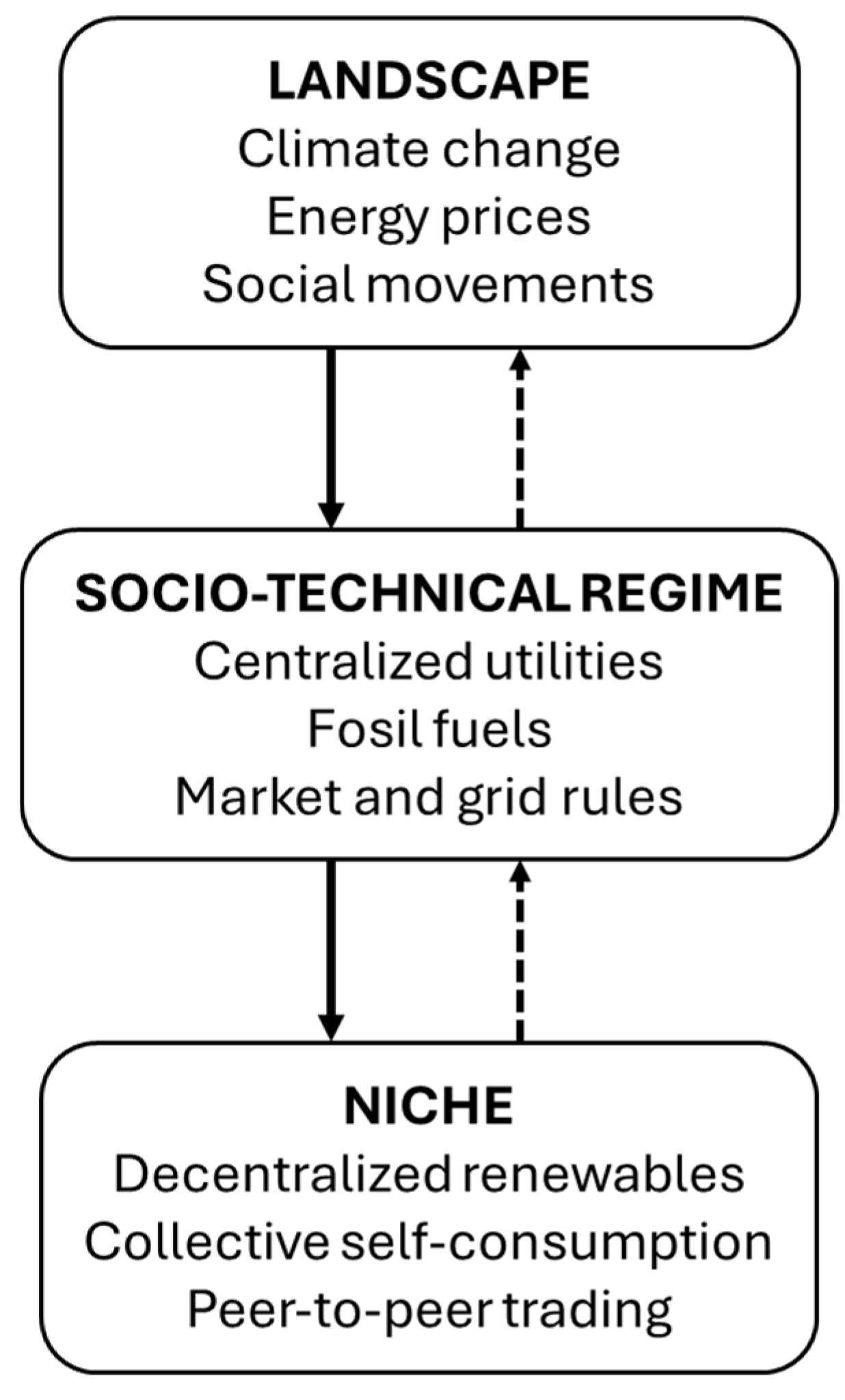
Figure 2.
PRISMA model application.
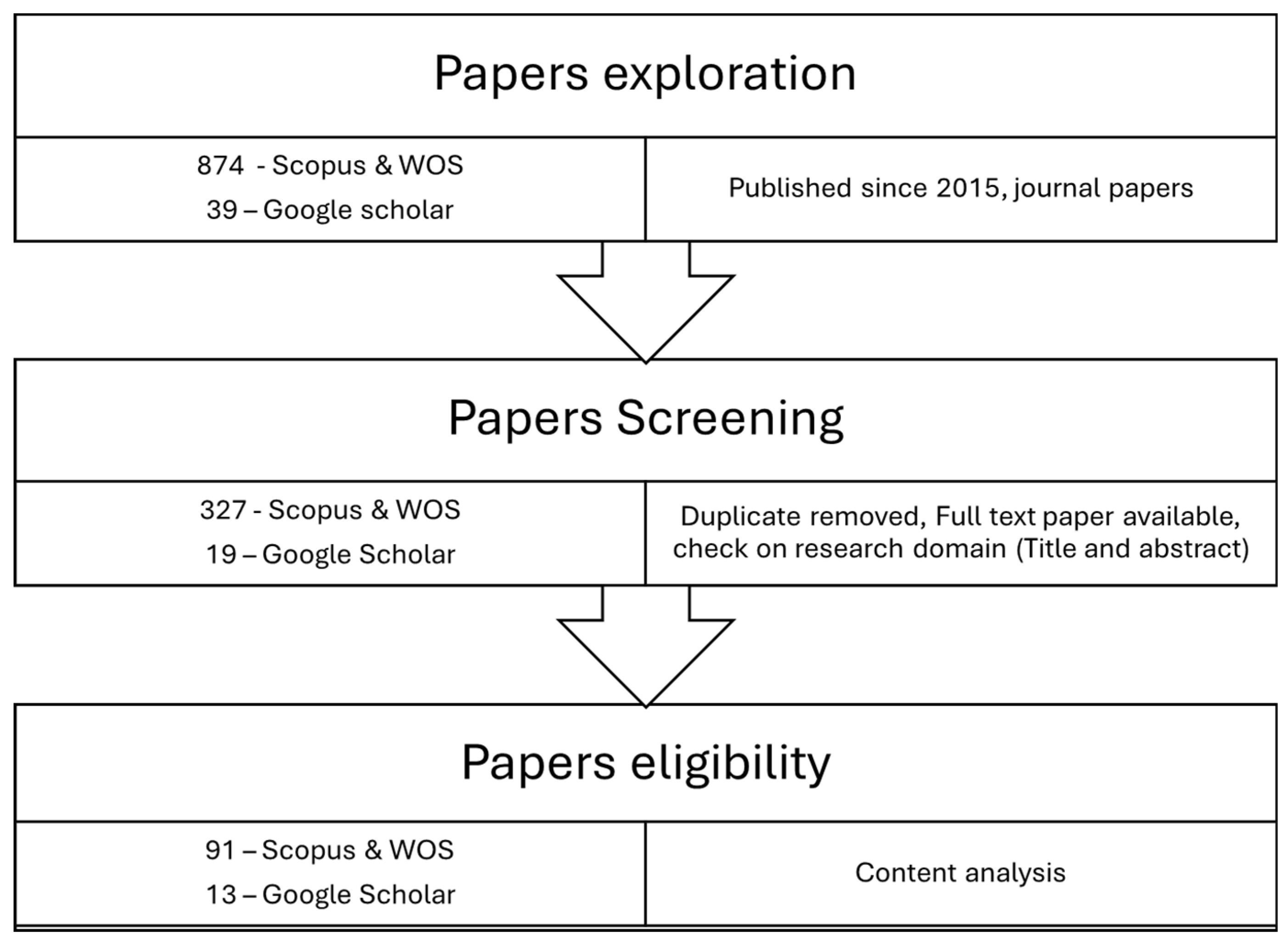
Figure 3.
References published in Scopus and Web of Science databases on energy communities and energy transition.
Figure 3.
References published in Scopus and Web of Science databases on energy communities and energy transition.
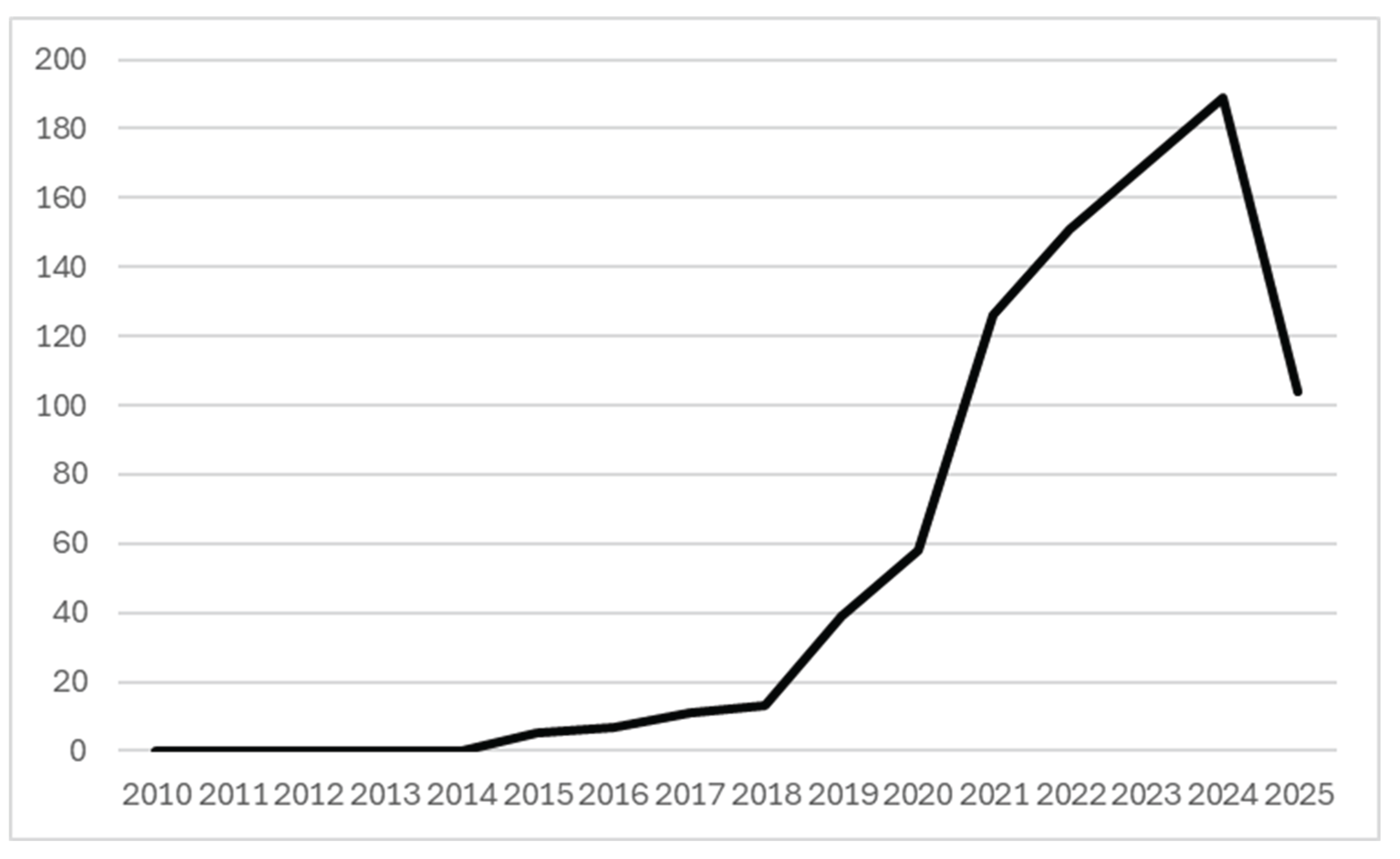
Table 1.
Three levels of analysis of socio-technical changes.
| Levels of Analysis | Description | Examples |
|---|---|---|
| Macro Level - Landscape | It consists of a set of structural trends that define the societal context. It is an external structure of broader technological factors that is difficult to change. | Climate change, Energy prices, economic growth, wars, emigration, broad political coalitions, cultural and normative values, and environmental problems. |
| Meso Level – Regimes | It refers to the rules created by different social groups, which orient and coordinate activities. It stabilizes existing socio-technical configurations, allowing innovation to occur incrementally. It encompasses culture, symbolic meaning, sectoral policies, markets, and user practices, among other factors. | Centralized Fossil Fuel-Based Electricity Regime; Utility-Centered Business Model Regime, etc. |
| Micro Level - Niche | It forms “protected spaces” that shield radical innovations from competition with dominant practices, thus encouraging pioneering activities by new entrants, such as inventors, start-ups, or grassroots players. It provides the space for learning processes and social networks that support innovation, such as supply chains and user-producer relationships. | Renewable energy generation technologies (solar, wind, biomass), energy storage systems, electric vehicles, etc. |
Table 2.
Search equations used for literature review.
| Reference Source | Search String | Results |
| Scopus and Web of Science | “energy community” OR “energy communities” AND “energy transition*” AND (“energy polic*” OR sustain* OR “sustainable development” OR “renewable energ*”) | 79 |
| Scopus and Web of Science | Snowball technic | 12 |
| Google Scholar | allintitle: “América Latina” OR Latinoamérica OR argentina OR bolivia OR ecuador OR uruguay OR paraguay OR venezuela OR colombia OR méxico OR brasil OR chile OR “costa rica” OR perú “comunidades energéticas” | 13 |
| TOTAL | 104 |
Table 3.
Keywords’ clusters.
| Cluster | Keywords | Co-Occurrences |
|---|---|---|
| 1 | energy transition, energy policy, alternative energy, renewable energy, European union, community energy, energy market, Europe, energy justice, energy democracy, energy resources, Germany, energy citizenship, Netherlands, Spain | 525 (22%) |
| 2 | renewable energy resources, local energy, prosumer, power markets, smart grid, business models, local energy community, microgrid, smart power grids, commerce, laws and legislation, electric batteries, energy markets, electricity generation, prosumers, battery storage | 341 (14%) |
| 3 | renewable energies, investments, climate change, energy utilization, energy management, energy systems, solar energy, optimization, economic analysis, fossil fuels, environmental impact, optimizations, electric energy storage, energy planning, solar power generation, wind power, energy security | 346 (15%) |
| 4 | renewable energy source, sustainability, Italy, renewable energy sources, profitability, energy use, housing, buildings, collective self-consumption, decarbonization, photovoltaic system, regulatory framework, regulatory frameworks, renewables | 194 (8%) |
| 5 | Energy, energy community, energy communities, sustainable development, decision making, sustainable energy, energy sector, energy conservation, innovation, photovoltaics | 496 (21%) |
| 6 | energy transitions, community is, energy efficiency, greenhouse gases, economic and social effects, self-consumption, blockchain, clean energy, gas emissions, natural resources | 297 (13%) |
| 7 | renewable energy community, renewable energy communities, case studies, economics, citizen energy community, citizen energy communities, renewable energy directive | 166 (7%) |
Table 4.
Summary of Energy Community’s issues.
| Issues | Definitions |
|---|---|
| 1. Energy community definitions | Process, identity, technology, typology, legal structure, activities and objectives |
| 2. Business and economics | Electricity market design, Business models (BMs), pricing, and benefits distribution |
| 3. Regulatory and institutional | Formal and informal rules for EC governance, such as legislation, support mechanisms, and cultural practices |
| 4. Socio-political | Participation in decision-making, social acceptance, and willingness to join EC projects. |
| 5. Technical | Energy sources and technologies, EC structures and networking, and information and communication technologies (ICT) |
Table 5.
On-grid Energy Communities and Barriers to Latin America’s Energy Transition.
| Three Levels of Analysis | On-grid ECs Topics | Barriers to Energy Transition |
| Macro Level-Landscape |
|
|
| Meso Level-Regimes |
|
|
| Micro Level-Niches |
|
|
Disclaimer/Publisher’s Note: The statements, opinions and data contained in all publications are solely those of the individual author(s) and contributor(s) and not of MDPI and/or the editor(s). MDPI and/or the editor(s) disclaim responsibility for any injury to people or property resulting from any ideas, methods, instructions or products referred to in the content. |
© 2025 by the authors. Licensee MDPI, Basel, Switzerland. This article is an open access article distributed under the terms and conditions of the Creative Commons Attribution (CC BY) license (https://creativecommons.org/licenses/by/4.0/).
Copyright: This open access article is published under a Creative Commons CC BY 4.0 license, which permit the free download, distribution, and reuse, provided that the author and preprint are cited in any reuse.


