

Submitted:
21 August 2025
Posted:
27 August 2025
You are already at the latest version
Abstract
Drag performance, while often seen as entertainment, serves as a transformative and political act within academic settings. This study investigates the lived experiences of drag queens in a public university, focusing on the socio-educational effects of their visibility. Grounded in Queer Theory, the research explores how drag intersects with identity formation, resistance against institutional norms, political expression, and the need for community and institutional support. Utilizing a qualitative descriptive-phenomenological method and online written interviews, four major themes emerged: engaging in drag for personal development, challenging restrictive academic structures, using drag for cultural and political advocacy, and seeking peer and institutional support. These findings reveal that drag is more than performance—it is a tool for empowerment, activism, and educational inclusion. The study underscores the need for academic institutions to move beyond symbolic gestures toward genuine structural change. When drag is embraced within education, it transforms schools into inclusive spaces that affirm gender diversity and challenge oppressive norms.
Keywords:
drag
; identity
; resistance
; queer theory
; inclusion
1. Introduction
Drag performance and queer representation are vital in gender studies, sociology, and media studies as they challenge traditional gender norms and promote LGBTQ+ visibility (Hancock, 2017). Historically, drag has served as both entertainment and political resistance, playing a key role in LGBTQ+ activism, including the Stonewall riots (Taylor & Rupp, 2004). Over time, it has evolved from underground spaces to mainstream media through shows like RuPaul’s Drag Race, shaping public perceptions of gender and identity (Brennan, 2017; Kavka, 2018). Drag fosters self-expression and empowerment, allowing performers to navigate and redefine gender boundaries (Morris, 2022). It also serves as a political tool, raising awareness of issues such as discrimination, HIV/AIDS, and queer rights (Taylor & Rupp, 2004). Beyond entertainment, drag builds strong community networks that offer support and advocacy for marginalized groups (Hancock, 2017). Its presence in media and digital platforms amplifies LGBTQ+ voices, influencing cultural narratives and policies (Brennan, 2017). Additionally, drag intersects with race, class, and cultural identity, reflecting broader social struggles and resistance (Morris, 2022). Studying drag provides insights into the complexities of gender performance and its impact on society (LeMaster, 2022). It highlights how artistic expression can challenge oppression and foster inclusivity (Pritchard, 2020). Drag’s historical and contemporary significance makes it a crucial subject for understanding the evolving landscape of gender and sexuality (Taylor & Rupp, 2004). Recognizing its role in activism, identity, and media representation enriches discussions on diversity and social change (Hancock, 2017).
Research on drag queens primarily focuses on private spaces like bars and nightclubs, which lack perspective and impact in other settings, particularly schools. Based on prior research, there is a significant population gap. Some of these subpopulations remain unexplored and under-researched, despite their importance in understanding the life experiences of drag queens. An investigation of this group is necessary as it will provide insight into a new population in different settings (Miles, 2017). Existing studies often overemphasize white, adult drag queens, limiting the scope of knowledge. There is a lack of research exploring drag queens' navigation of educational environments and the formation of queer identities within these spaces. It is suggested that lesser-known sites, such as schools where queer bodies create varied gender and sexual subjectivities, need to be explored so that they can give more insight into how queer people attain a distinctive comprehension of their gender identity (Ladera, 2024). The current literature also overlooks the connecting point of drag with criteria including gender, racial background, and income bracket, restricting a broad understanding of their lives. While some studies tackle aging drag queens and drag queens in the media, they lack substantial empirical data, creating another common research gap. The need for research in non-traditional spaces like schools is crucial to comprehend how queer individuals construct their gender and sexual individuality. Further research should investigate the experiences of lesser-represented groups within the drag community, such as students who are drag queens. The literature to date offers a start, but stronger evidence is required for a full understanding. This gap in research calls for an in-depth study to fill the absence of empirical data and the population gap in this field. The specific lives of drag queens demand in-depth research to appreciate their challenges and contributions to society properly.
This research seeks to determine how the actual experiences of drag queens influence the queering of educational institutions. Based on the study question, “How do the lived experiences of drag queens influence the queering of the educational setting?”, this research explores how schools shape gender identities and performances. Specifically, it aims to determine how drag performance challenges or reshapes traditional gender norms within academic spaces, contributing to broader discussions on gender expression in formal institutions. By anchoring itself in Symbolic Interactionism and Queer Theory, this study provides empirical evidence on how educational environments respond to and interact with drag as a form of gender performance. Ultimately, this research seeks to promote more inclusive educational practices, enriching queer literature and fostering safer, more accepting spaces for LGBTQ+ individuals in academic institutions.
2. Materials and Methods
Research Design
This adopted a qualitative descriptive research approach with a touch of phenomenology to deeply explore and amplify the lived experiences of the drag queen participants. This qualitative method allowed for the in-depth examination of the complexities and multifaceted nature of the drag queens' lived realities and how they contributed to the queering of educational institutions. Through this approach, the researchers gathered rich, detailed accounts from the drag queens to understand the phenomenon from their viewpoints and frame of reference (Keenan & Mess, 2020).
Instrument
The primary research instrument used in this study was a researcher-developed semi-structured interview guide, designed to explore the in-depth experiences and perspectives of drag queens within educational settings. Given the qualitative nature of the research, the guide featured open-ended questions to encourage detailed and reflective responses (Toynton, 2006). The interview guide consisted of four (4) main sections: (1) demographic information to establish the participants’ background and context; (2) questions centered on drag queens' actual experiences, including personal challenges and triumphs; (3) items addressing the influence of drag within educational institutions; and (4) questions exploring participants’ insights and interpretations related to Symbolic Interactionism and Queer Theory. Each section was thoughtfully structured to capture both personal narratives and theoretical perspectives concerning identity and social interaction. To ensure the appropriateness, clarity, and relevance of the interview questions, the guide was reviewed and validated by a panel of experts in qualitative research and gender studies. This process ensured that the instrument was capable of eliciting rich, meaningful data aligned with the research objectives.
Research Informants
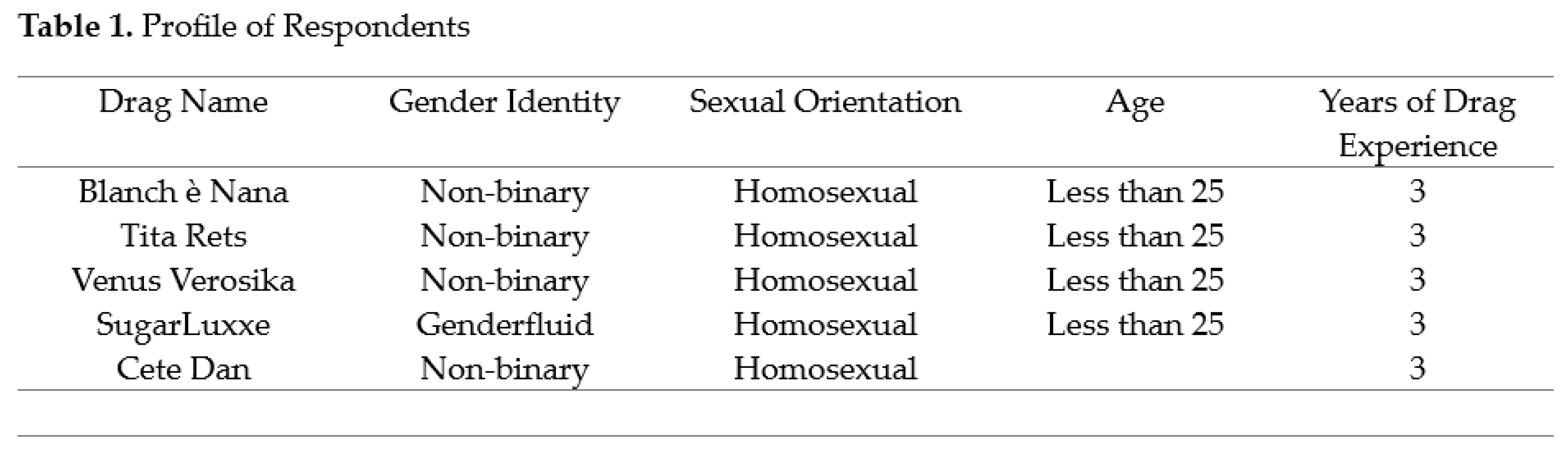
This research employed purposeful sampling to select five (5) drag queen informants from a public university who were actively engaged in educational settings. The informants specifically included gay drag queens with two to three years of experience in drag performance. The selection focused on students with direct involvement in academic environments to ensure the relevance of their insights to the research objective, examining the intersection of drag queens' lived experiences and educational contexts.
Data Collection Procedure
The data gathering process began after the Dean of the College of Education approved the study. Before conducting the interviews, all participants gave their informed consent to the researchers. The goal of the study, the voluntary nature of their involvement, and the ethical issues—particularly the guarantee of anonymity through the use of drag names and the confidentiality of the information shared—were explained to them. After confirming consent, the researchers carried out a written interview via a Google form. Each interview varied in duration based on the participant’s availability and willingness to provide detailed responses. The researchers ensured ongoing communication and followed up with the informants when necessary for clarification or additional insights.
Data Analysis
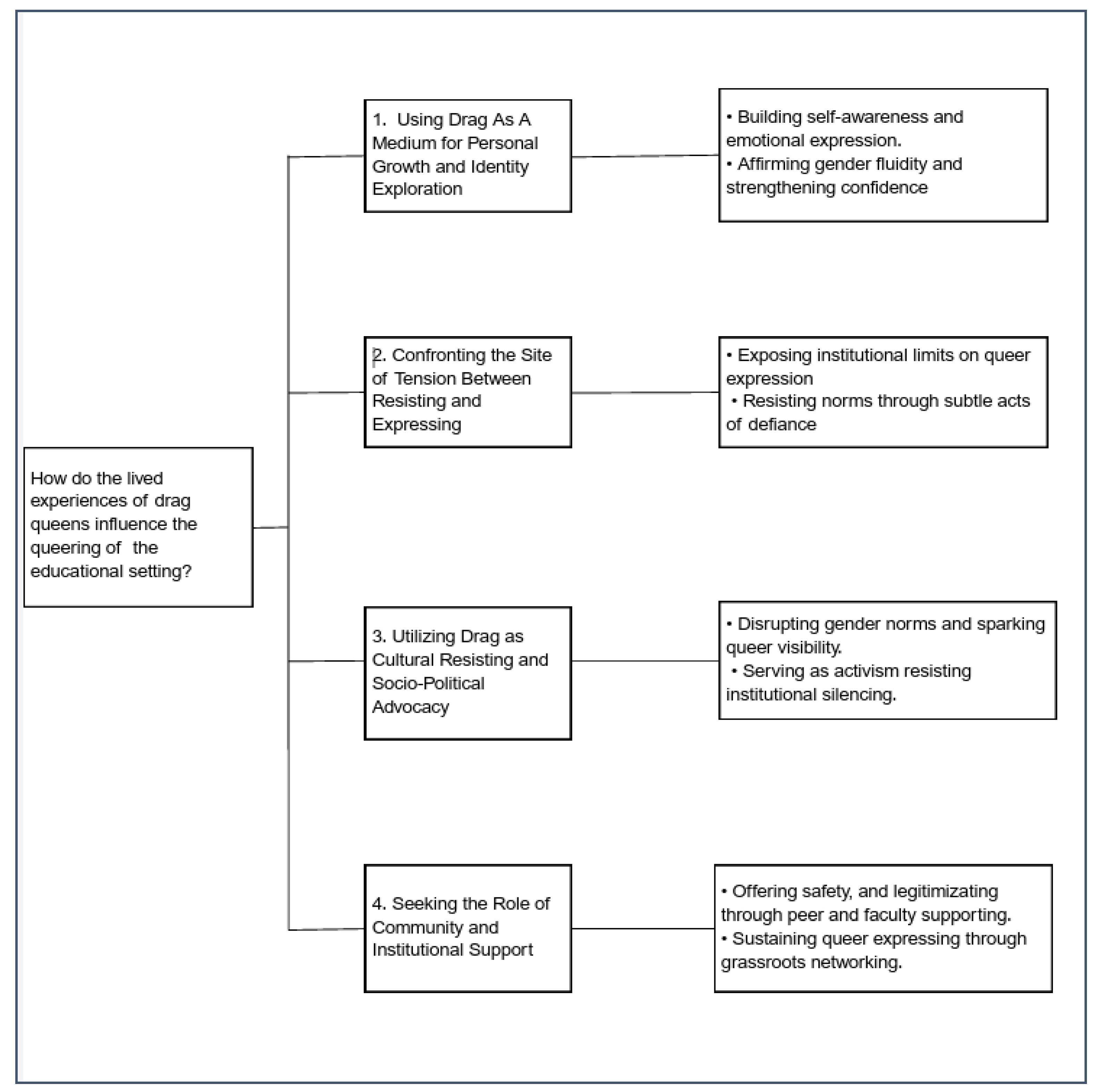
This study adopted thematic analysis by Clarke and Braun’s (2006) using a six-phase framework. The process involves becoming deeply familiar with the data, assigning codes, developing overarching themes, reviewing those themes for consistency, clearly defining them, and finally presenting the findings. We carefully reviewed the transcripts and manually coded them to find common patterns in the participants' stories. Key themes were grouped into four main areas: (1) Using Drag for Personal Growth and Identity Exploration, (2) Facing the Tension Between Resisting and Expressing, (3) Using Drag for Cultural Resistance and Social-Political Advocacy, and (4) Seeking Community and Institutional Support. These categories showed the different realities that affected the academic and social experiences of drag performers in schools, and they included subthemes that focused on specific parts of those experiences.
3. Results
Findings
The Using Drag as a Medium for Personal Growth and Identity Exploration highlights how drag provides a transformative space for performers to explore, affirm, and celebrate their identities. Participants shared how engaging in drag enhanced their self-awareness, built resilience, and deepened their understanding of gender as fluid and performative. Through theatrical expression, performers were able to process emotions, embody different perspectives, and grow more confident in their authentic selves. Drag, therefore, becomes not just an artistic outlet but a powerful tool for identity formation and personal empowerment. Specifically, this theme is reflected in two (2) key ways: (1)Building self-awareness and emotional expression, (2) Affirming gender fluidity and strengthening confidence.
Blanche Nana shared, "It is transformative because we are keeping the audience entertained and informed." This highlights the dual function of drag as a medium for both emotional and intellectual engagement.
Tita Rets reflected, "It helped me see life from a different perspective," emphasizing how drag can open one’s worldview.
Venus Verosika expressed, "Through drag in an academic setting, I experienced a transformation that went beyond just performance. It reshaped how I saw myself and how I used my voice. It taught me to be braver, to take up space unapologetically."
SugarLuxxe noted, "It pushed me to blur the lines between art, advocacy, and education, showing that learning doesn’t always have to look traditional."
Cete Dan explained, "Exploring the perspective of various characters that I played gave me a wider point of view, hence impacting my empathy for others."
These narratives revealed how drag performances help artists accept who they are, confront self-doubt, and grow by playing different characters and connecting with the audience. Altogether, this theme sets the stage for understanding how deeply personal and affirming drag can be, preparing us to examine the social barriers that challenge this expression.
Confronting the tensions between resistance and expression revealed that educational institutions sometimes offer spaces for queer expression but also create rules and cultures that limit full inclusion. Participants shared experiences of facing conservative policies, hesitant administration, and subtle resistance, like silence, microaggressions, and lack of support. These challenges show the fragile balance between being visible and being regulated. As a result, performers often feel they need to tone down or justify their expressions to be accepted in academic settings. This theme is clear in two key ways: (1) identifying institutional limits on queer expression, and (2) pushing back against norms through small acts of defiance.
Blanche Nana shared, "The school’s policies are strict on dress codes. It is difficult to fully express myself if certain dress codes are prohibited."
Venus Verosika recalled, "Some of my teachers scolded me regarding my drag persona. They consider it taboo."
SugarLuxxe revealed, "Some people labeled it as 'performative activism,' criticizing us for using drag as a vehicle for social commentary instead of action."
Cete Dan emphasized, "The school administration hindered the conduct of the drag competition in 2022," reflecting institutional interference in drag expression.
Tita Rets, by contrast, noted, "I don't think there is any conflict," suggesting some academic spaces may tolerate drag expression without overt discrimination.
These experiences show that institutions respond to drag in uneven and sometimes contradictory ways. Acceptance may coexist with restrictive policies, and visibility is often conditional. In light of these complexities, many performers have turned their art into a form of protest—an entry point into the next theme.
Utilizing drag as a Cultural Resistance and Socio-Political Advocacy shows that, beyond performance, drag operates as a socio-political statement that challenges dominant norms and promotes queer visibility. Participants portrayed drag as a tool for activism, education, and resistance, especially within conservative environments. It confronts rigid binaries, redefines gender roles, and opens critical discussions about identity, diversity, and representation. In this context, drag disrupts the status quo and serves as a bold critique of cultural and institutional silencing. This theme, therefore, is reflected in two key areas: (1) Disrupting gender norms and sparking queer visibility, and (2) serving as activism resisting institutional silencing.
Blanche Nana asserted, "Drag is political. We challenge the status quo. We afflict the comfortable and hopefully change their wrong idea of the LGBT community."
Venus Verosika echoed, "Drag challenges and exaggerates gender expressions, highlighting that gender is a social construct."
SugarLuxxe shared, "My presence in drag isn’t just about performing, but reclaiming our rightful space and showing that gender expression doesn’t have to fit into rigid, binary molds."
Tita Rets reflected, "Yes, drag performances challenge gender norms."
Cete Dan confirmed, "Yes, my performances challenge gender norms within the school."
These statements reveal that drag is more than just entertainment—it is resistance. Through their art, drag queens critique institutional structures, educate audiences, and foster a vision of cultural transformation. Yet this power to challenge and inspire would not be possible without support—an element explored in the final theme.
Seeking the Role of Community, Peer, and Institutional Support. Supportive relationships in academic settings were important for the success of drag performers. Classmates helped with costumes, while faculty provided mentorship and support. This network created a feeling of safety and belonging. Participants noted that even though administrative systems change slowly, support from students and progressive teachers validated their art and gave them the encouragement to keep going and take the lead. This theme is shown in two key ways: (1) Providing safety and legitimizing art through support from peers and faculty, and (2) Sustaining queer expression through grassroots networking.
Blanche Nana credited Sir T and Sir J, stating, "They acted as advisors within the drag community. The WVSU Student Council is also supportive of the cause."
Tita Rets expressed gratitude to "Drag Queens, Sir T, and Sir J" for championing drag within the university.
Venus Verosika mentioned, "Sir R told me I was born to do this. Also, my classmates and best friend helped me."
SugarLuxxe said, "Some of my fellow students have been my loudest cheerleaders, and some faculty members genuinely appreciated what drag brought to the table."
Cete Dan emphasized the impact of "Mr. J, the most supportive figure who helped us establish the drag community."
These narratives reveal how supportive relationships—both formal and informal—are essential in nurturing drag expression. Peers and faculty allies help affirm the value of drag as an art form and identity, and their support ensures that drag performers dare to persist, resist, and thrive within academic spaces. As these stories show, drag is not only an individual pursuit—it flourishes in community.
Figure 1.
Thematic Map of the Informant’s Lived Experiences as a Drag Queen in an Educational Setting.
Figure 1.
Thematic Map of the Informant’s Lived Experiences as a Drag Queen in an Educational Setting.
4. Discussion
This study looked at the experiences of drag queens in a public educational space. It identified four (4) main themes: (1) using drag for personal growth and exploring identity; (2) dealing with the tension between resistance and expression; (3) using drag for cultural resistance and socio-political advocacy; and (4) seeking community, peer, and institutional support. These themes show that drag in academia serves not just as a performance but also as a teaching method and a political statement. When viewed through the lens of modern Queer Theory, drag becomes a powerful space where gender, power, and resistance come together.
Drag plays an important role in personal growth. Through drag, participants became more aware of their identities, built emotional resilience, and developed confidence in expressing their authentic selves. These experiences align with Butler’s (2021) concept of gender as a performative act, where identity is shaped and reshaped through repeated expressions. Case and Meier (2020) also support this idea, noting that queer performance in educational spaces encourages reflection, identity exploration, and emotional development. As a result, drag becomes a transformative process that fosters healing and self-understanding.
At the same time, self-expression is often challenged by institutional constraints. While some schools provide opportunities for queer visibility, others enforce strict rules and maintain conservative norms that limit inclusion. Participants encountered restrictions such as dress codes, silent disapproval, and limited administrative support. These experiences reflect McBride’s (2021) concept of “regulated visibility,” where LGBTQ+ expression is tolerated only within certain boundaries. Similarly, Snapp et al. (2019) found that even supportive school climates can still uphold heteronormative expectations. Greteman (2022) describes this struggle as a form of “double consciousness,” where queer students are constantly balancing visibility with caution. These challenges illustrate the complex dynamics of performing drag within academic systems that are not always ready to embrace diverse expressions of gender and identity fully.
Performing in drag was a way to challenge dominant gender norms, advocate for visibility, and initiate conversations about LGBTQ+ rights and representation. This supports Bailey and Trudell’s (2021) concept of "drag pedagogy," where performance becomes a tool for education and activism. Muñoz’s (1999) idea of “disidentification” is also relevant here, as participants used drag not just to conform or oppose dominant culture, but to transform it from within. Kumashiro (2020) further explains that drag as public pedagogy allows educators and students to confront traditional ways of learning and imagine more inclusive alternatives. In this way, drag becomes more than art—it becomes a platform for change.
The research also found that support systems served a critical part in sustaining drag expression within academic spaces. Participants pointed to the encouragement they received from classmates, faculty members, and student organizations as essential to their continued participation in drag. These findings are supported by Kosciw et al. (2022), who noted that LGBTQ+ students thrive in environments where peers and educators affirm them. Craig et al. (2021) add that when institutional support accompanies visibility, queer students are more likely to flourish. However, as Sears (2023) argues, symbolic gestures of support must eventually lead to real changes in policy and structure. Without institutional reform, efforts to create inclusive spaces may remain limited in impact.
Taken together, these themes show how drag functions as a space for empowerment, resistance, education, and solidarity. It allows performers to explore who they are while challenging the systems around them. This reflects what Puar (2017) describes as “queer world-making”—a practice of reshaping cultural and institutional norms to create more inclusive futures. By making their presence visible, drag performers are contributing to the transformation of educational spaces and broadening what is considered acceptable and meaningful in learning environments.
Although this study provides meaningful insights, its scope is limited. It centered on a small number of drag performers from one university, which may not capture the broader experiences of drag artists in other academic settings or institutions. Including perspectives from faculty, students, and administrators in future research could provide a more comprehensive view. Additionally, expanding the study to include other forms of gender performance and using mixed methods could deepen understanding and enhance generalizability.
Despite these limitations, this study adds to ongoing conversations about the role of drag in education. It highlights the importance of recognizing drag not only as performance but as a legitimate form of expression, resistance, and education. In school environments where gender norms still prevail, drag performers are helping lead the way toward more inclusive and affirming practices. Their presence calls for continued efforts to turn symbolic support into structural change—and to reimagine education as a space where every identity is respected, affirmed, and celebrated.
5. Conclusions
Drag in educational spaces serves as a powerful means of affirming identity and challenging societal norms, ultimately driving meaningful change. It promotes personal development and increases visibility for queer individuals, thriving within supportive communities. These experiences encourage academic institutions to move beyond surface level and work towards genuine structural reforms. When drag is recognized as both an expressive art form and a form of advocacy, schools transform into empowering environments that honor, respect, and celebrate all identities.
Author Contributions
This research was a team effort, with each member contributing important parts. Brent Jasper B. Nobleza, the leader, guided the overall work and made sure the paper was clear, organized, and complete. Kieth Avegayle L. Morales analyzed the data and helped explain the main ideas. Jules Terence C. Azucena worked on the methodology and made sure the research process was clear and appropriate. The group also thanks Dr. John Erwin P. Pedroso for his guidance, support, and helpful advice during the study.
Funding
This research received no external funding.
Informed Consent Statement
Informed consent was obtained from all subjects involved in the study. Likewise, written informed consent has been obtained from the participants to publish this paper”.
Acknowledgments
To all who made this research possible, thank you!
Conflicts of Interest
The authors declare no conflicts of interest.
References
- Berkowitz, D., Belgrave, L., & Halberstein, R. A. (2007). The Interaction of Drag Queens and Gay Men in Public and Private Spaces. Journal of Homosexuality, 52(3-4), 11–32. [CrossRef]
- Brennan, N., & Gudelunas, D. (2023). Drag in the global digital public sphere: queer visibility, online discourse and political change. Routledge.
- Burnes, T. R. , & Stanley, J. L. (2017). Teaching LGBTQ psychology: queering innovative pedagogy and practice. American Psychological Association.
- Butler, J. (1990). Gender Trouble: Vol. Volume 1, Chapter 12, Page 159-172, (pp. 89–6438). Routledge. https://research.edgehill.ac.uk/en/publications/drag-kings-and-queens-of-higher-education? (Original work published 1990).
- Craig, S. L., Eaton, A. D., McInroy, L. B., Leung, V. W. Y., & Krishnan, S. (2021). Can Social Media Participation Enhance LGBTQ+ Youth Well-Being? Development of the Social Media Benefits Scale. Social Media + Society, 7(1). [CrossRef]
- EDWARD, M. (2020). Drag Kings and Queens of Higher Education. Edge Hill University, Volume 1, Chapter 12, Page 159-172,(9781350082953), 159 172. Contemporary Drag Practices & Performers. https://research.edgehill.ac.uk/en/publications/drag-kings-and-queens-of-higher-education?
- Edward, M., & Farrier, S. (2020). Contemporary Drag Practices and Performers: Vol. Drag in a Changing Scene Volume 1 (1st Edition). Bloomsbury Publishing.
- Eric Darnell Pritchard. (2017). Fashioning Lives: black queers and the Politics of Literacy (pp. 306). Southern Illinois University Press.
- Galyna Kotliuk. (2023). Gender on Stage: Drag Queens and Performative Femininity. Scientific Notes of Ternopil National Pedagogical University (Ternopil Volodymyr Hnatiuk National Pedagogical University), Volume 7, Issue 1, 8–14. International Journal of European Studies. [CrossRef]
- Greaf, C. (2015). Drag queens and gender identity. Journal of Gender Studies, 25(6), 655–665. [CrossRef]
- Halberstam, J. (1998). Female masculinity: Vol. Volume 1, Chapter 12, Page 159-172, (p. 360). Duke University Press. https://www.dukeupress.edu/female-masculinity-twentieth-anniversary-edition.
- J. Greteman, A. (2022). Queers Teach This! Bloomsbury Publishing Plc. [CrossRef]
- José Esteban Muñoz. (2019). Disidentifications. U of Minnesota Press.
- Kavka, M. (2018). Reality TV: Its contents and discontents. Critical Quarterly, 60(4), 5–18. [CrossRef]
- Keenan, H., & Hot Mess, L. M. (2021). Drag pedagogy: The playful practice of queer imagination in early childhood. Curriculum Inquiry, 50(5), 1–21. [CrossRef]
- Knutson, D., Koch, J. M., Sneed, J., & Lee, A. (2018). The Emotional and Psychological Experiences of Drag Performers: A Qualitative Study. Journal of LGBT Issues in Counseling, 12(1), 32–50. [CrossRef]
- Kosciw, J. G., Clark, C. M., Truong, N. L., Zongrone, A. D., & Glsen, G. (1000). The 2019 National School Climate Survey: The Experiences of Lesbian, Gay, Bisexual, Transgender, and Queer Youth in Our Nation’s Schools. A Report from GLSEN. Gay, Lesbian, And Straight Education Network (GLSEN). 121 West 27Th Street, Suite 804, New York, NY 1. Tel: 212-727-; Fax: 212-727-; E-Mail: Glsen@Glsen.org; Web Site: Http://Www.Glsen.org -00-00.
- Kumashiro, K. K. (2024). Against Common Sense: Teaching and Learning Toward Social Justice.
- Martino, W. (2022). Supporting Transgender Students and Gender-Expansive Education in Schools: Investigating Policy, Pedagogy, and Curricular Implications. Teachers College Record: The Voice of Scholarship in Education, 124(8), 3–16. [CrossRef]
- Martino, W., & Cumming-Potvin, W. (2018). Transgender and gender expansive education research, policy and practice: reflecting on epistemological and ontological possibilities of bodily becoming. Gender and Education, 30(6), 687–694. [CrossRef]
- McBride, R.-S., & Neary, A. (2021). Trans and gender diverse youth resisting cisnormativity in school. Gender and Education, 33(8), 1–18. [CrossRef]
- McBrien, J., Rutigliano, A., & Sticca, A. (2022). The Inclusion of LGBTQI+ students across education systems. OECD Education Working Papers. [CrossRef]
- Moustakas, C. (1994). Phenomenological research methods. [CrossRef]
- Nast, C. (2022, June 30). Targeting Drag Queens in Classrooms Is a “War on Imagination.” Teen Vogue. https://www.teenvogue.com/story/drag-queens-in-the-classroom.
- Niall Brennan, & Gudelunas, D. (2017). RuPaul’s Drag Race and the Shifting Visibility of Drag Culture: the Boundaries of Reality TV (1st ed., pp. XIII, 309). Springer International Publishing. https://research.edgehill.ac.uk/en/publications/drag-kings-and-queens-of-higher-education? (Original work published in 2017).
- Open Society Foundations. (2019, April). Understanding Sex Work in an Open Society. Understanding Sex Work in an Open Society. https://www.opensocietyfoundations.org/explainers/understanding-sex-work-open-society.
- Puar, J. K. (2017). The Right to Maim. Duke University Press. [CrossRef]
- Sears, J. T. (2023). Symbolic inclusion in queer education: A call for actionable support. International Journal of Critical Pedagogy, 14(1), 48–63. 14(1), 48–63.
- Snapp, S. D., Watson, R. J., Russell, S. T., Diaz, R. M., & Ryan, C. (2019). Social Support Networks for LGBT Young Adults: Low-Cost Strategies for Positive Adjustment. Family Relations, 64(3), 420–430. [CrossRef]
- Taylor, V., & Rupp, L. J. (2004). Chicks with Dicks, Men in Dresses. Journal of Homosexuality, 46(3-4), 113–133. [CrossRef]
- The Christian Institute. (2023, September 25). What are drag queens doing in schools? Christian.org.uk. https://www.christian.org.uk/features/what-are-drag-queens-doing-in-schools/.
- Torr, D., & Bottoms, S. J. (2010). Sex, drag, and male roles: investigating gender as performance. University Of Michigan Press.
- Toynton, R. (2006). “Invisible other” Understanding safe spaces for queer learners and teachers in adult education. Studies in the Education of Adults, 38(2), 178–194. [CrossRef]
Disclaimer/Publisher’s Note: The statements, opinions and data contained in all publications are solely those of the individual author(s) and contributor(s) and not of MDPI and/or the editor(s). MDPI and/or the editor(s) disclaim responsibility for any injury to people or property resulting from any ideas, methods, instructions or products referred to in the content. |
© 2025 by the authors. Licensee MDPI, Basel, Switzerland. This article is an open access article distributed under the terms and conditions of the Creative Commons Attribution (CC BY) license (http://creativecommons.org/licenses/by/4.0/).
Copyright: This open access article is published under a Creative Commons CC BY 4.0 license, which permit the free download, distribution, and reuse, provided that the author and preprint are cited in any reuse.