
Submitted:
24 August 2025
Posted:
25 August 2025
You are already at the latest version
Abstract
Indonesia is one of the countries in the world experiencing a number of devastating and rare earthquake events. Ranging from the Aceh and Palu quakes to the current rare Bekasi quakes in August 2025. In this article we present the data and statistics that demonstrate an obvious relationship between the occurrence of planetary conjunctions and strong and rare earthquake events. A comprehensive study for particular Indonesia has not been done in recent decades. Here, we elaborate on how planetary conjunctions are associated with major earthquakes ranging from 6.3 to 9.3. The results confirm that if the earth is joining with the alignment, then there is a possibility of a strong earthquake (> 7), as can be seen in the Aceh earthquakes. If the planet parallelism is present, then there is a possibility of a strong earthquake, as can be seen in the Palu earthquakes. Those planetary conjunctions are also associated with the presence of a series of moderate and rare earthquakes in Bekasi recently. The planetary conjunctions then can be monitored in advance then allow us to estimate and to prepare, anticipating the devastating earthquakes.
Keywords:
Aceh
; conjunction
; earthquake
; planetary
Highlights:
- If the earth is joining with the alignment, then there is a possibility of a strong earthquake (> 7).
- If the earth is nearby the alignment of Mercury and Venus, then there is a possibility of a moderate earthquake (< 7).
- If the planet parallelism is present, then there is a possibility of a strong earthquake (> 7).
- Sun within alignment contributes to the possibility of strong and rare earthquakes.
1. Introduction
Current studies on earthquake events are still dependent on the geological approach. While alternative studies and approaches are offered. These approaches are elaborating on the earth's and other planets' positions relative to each other within the planetary alignment context and frameworks. In reality, this innovation has existed since antiquity and serves as a stand-in for the understanding of the great ancient mathematicians, astronomers, and philosophers, including Pythagoras, Philolaus, Eudoxus, Plato, Archimedes, Aristotle, Hypatia, and many more (Safronov 2016, Safronov 2020). The astronomical method of long-term seismic prediction of seismic activity have been used in the Ancient World. In different periods of time and in different regions, this astronomical method of long-term seismic forecasting was called differently. In Ancient Egypt, this was called the Sirius principle or the Orion belt, due to the fact that the three stars of Orion and Sirius form a linear configuration in the celestial firmament an correlated with earthquake events in ancient Egypt. This approach was known as the Pythagorean theory of musical strings in ancient Greece (570–490 BC). The technique was applied at the Archimedes level in Sicily and later in the Roman Republic and Empire. Specifically, Archimedes' phrase is well-known. Later in Europe, Kepler studied how the Sun's behavior was affected by planets coming together in alignment (Kepler 1606).
As is well known, a critical examination of the feasibility of earthquake prediction was published by Geller (1997). It highlited the potential for earthquake prediction based on planet alignment (Gribbin 1971). In current contemporary earthquake science, the planetary alignment has considerably effect on nature phenomenon in earth. It should be noted that mostly and currently the researchers again wrote about the tidal effect at planet alignment. In the Asia region, represented by work by Ip (1976), associations of the occurrence of planetary conjunctions and earthquakes have been discussed. Indonesia is one of the countries in the world experiencing a number of devastating and rare earthquake events. Studies and information on the associations of the occurrence of planetary conjunctions and earthquakes are still limited, and this is all the urgency of this study.
2. Methods
2.1. Study Object
The object of our research is several strong earthquakes in several locations in Indonesia. Those earthquakes ranged from the earthquake in Aceh, Sumatra, in 2004; Jogjakarta, Java, in 2006; Palu, Sulawesi, in 2018; Pandeglang, Banten, in 2022; Sarmi, Papua, in 2025; and several earthquakes that happened from 17 to 20 August 2025 recently. During this period, several earthquakes, yet categorized as moderate, occurred in sequence across Indonesia. It happens in Bekasi. The attribute information of the earthquakes, including the epicentrum and depth, magnitude, and time, was recorded and retrieved from available earthquake databases issued by relevant agencies.
2.2. Measurements and Types of Planetary Conjunctions
The definitions and characteristics of planetary conjunctions are divided into four schemes. Basically, the planetary conjunctions involve at least three planets. The difference lies in the presence of planet Earth and the sun and whether Earth and the sun are joining the alignment or not. The planetary conjunctions were described as the order of planets at certain times based on direct astronomical observation and the astronomical database provided by NASA.

Table 1.
Types of planetary conjunctions.
| Name | Remark | Reff. |
|---|---|---|
| Planetary linear scheme or Archimedes’ lever | Earth included | Yan (2020) |
| Planetary triangular scheme or generalized Archimedes’ lever | Earth excluded | |
| Contiguous or opposite heliocentric alignment scheme or Kepler conjunction | Sun included | Nesvorný & Vokrouhlický (2014) |
| Generalized Kepler’ conjunction | Sun excluded |
3. Results
The table of earthquakes and its attributes, along with planetary conjunctions, are available in Table 2 and Figure 1, Figure 2, Figure 3, Figure 4, Figure 5 and Figure 6. In Aceh, Sumatra, an earthquake happened in 2004 with a magnitude of 9.3; it observed a straight alignment involving earth. The order was Venus, Mercury, and Earth. The sun was observed on the side of Mercury. Meanwhile, Mars was nearby Venus. In the earthquake in Jogjakarta, Java, with a magnitude of 6.3 in 2006, lower than the previous earthquake in Aceh, Sumatra, there was a straight alignment involving Venus, Mercury, and Mars. This time the alignment excludes Earth. In the earthquake in Palu, Sulawesi, with a magnitude as high as 7.4 in 2018 in Palu, Sulawesi, a straight alignment involving Mercury, sun and Venus was observed. During this time, a parallelism was also observed. The parallelism includes Mercury paired with the sun and Venus paired with Earth. A straight alignment involving the sun and earth with the order of sun, Mercury, Venus, and Earth was observed during an earthquake in Pandeglang, Banten, with a magnitude of 6.6 in 2022.
Besides the effect of earthquakes on planetary conjunctions, this situation also recorded moderate earthquakes with a magnitude of less than 7. From 17 to 20 August 2025, there were several earthquakes. Among those earthquakes, there were several earthquakes that happened inland, including earthquakes in Lampung, Sumatra, and Bekasi, Java. During these earthquakes, there is a straight alignment involving the sun, Mercury, Venus, and Jupiter. This time the alignment excludes Earth.
4. Discussions
The effects of planetary conjunctions on earthquakes were plausibly explained by the gravitational theory. It is coined since early 1960 (Tomaschek1959) and the latest by Moudden et al. (2024) as the planetary attraction act and gravity force works as a trigger force changes the speed of the Earth's rotation. The occurrence of earthquakes is only a consequence of a relative slowdown of the rotational/revolving speed of the Earth, which urges the Earth’s plates to move (Awadh 2021). Simultaneously, the planetary gravity force creates stress in the Earth's plates (Li 2006). This effect becomes imminent and reaches its optimum when the earth joins the alignment and experiences high planetary attraction and gravity force. The confirmation for this is the Aceh, Sumatra earthquake with magnitude of 9.3 in 2004 with planet order of V-Me-E forming straight line. This finding is in agreement with the current finding by Azoos in 2024 that alignments involving Jupiter, Saturn, Uranus, and Neptune confirm interesting correlations between planetary acceleration and the mean daily number of earthquakes.
Earthquakes in Indonesia are dominated by alignment, whether the Sun joins the conjunctions or the nearby alignment is in agreement with others and previous earthquakes. The earthquake in Turkey was also related to this situation where the conjunctions are present and the Sun is included. In Turkey, the order of alignment was Jupiter, Venus, and the Sun. Similar alignments involving the sun were also observed in the Peru earthquakes in 1942 and 1974 and in Chile. The presence of the sun was also responsible for the presence of inland earthquakes in Indonesia that are quite rare as this can be observed in Lampung and Bekasi, The association of Sun effects on particular moderate earthquakes when the Sun joins the alignment is in corroboration with previous study. An important factor influencing the earthquakes with magnitudes below 6.0 may be the Sun's rotation. This might be particularly relevant for earthquakes that have a magnitude of 5.0 to 6 (Zhang et al. 2013) and this comparable to the magnitude of earthquakes in this study ranging from 2.3 to 5.8. .
The earthquake in Indonesia has recorded at least one parallelism during Palu, Sulawesi earthquake with magnitude of 7.4 in 2018. The parallelism involves Mercury paired with the sun and Venus paired with Earth. Similar parallelism associated with strong earthquakes has been reported in Alaska (1986) and in West Guinea (1914). In Alaska, the Mars-Earth line was parallel to the Sun-Venus line. In West Guinea, the Jupiter-Earth line was parallel to the Mercury-Venus line.
5. Limitations of the Study
The study elaborating how the planetary alignment affects the event of an earthquake is proving room for improvement. In the future, it should be developed and improved by incorporating numerous variables. Those recommended variables should be incorporating variables related to the sun and moon and other planetary bodies.
6. Conclusions
This is the first study, to the best of our knowledge, that elaborates on how the planetary alignment affects the event of an earthquake, in particular in Indonesia. This may confirm this association. The degree and magnitude of an earthquake are related to the characteristics of planetary alignment. By using the earthquake in Indonesia as an example, we provide the following conclusion:If the earth is joining with the alignment, then there is a possibility of a strong earthquake (> 7); if the earth is nearby the alignment of Mercury and Venus, then there is a possibility of a moderate earthquake (< 7); if the planet parallelism is present, then there is a possibility of a strong earthquake (> 7), and the sun within the alignment contributes to the possibility of strong and rare earthquakes.
Funding
This research was funded through internal funding mechanisms of Center for Health and Earth Modeling (CHEM).
Declaration of Competing Interest
The authors declare that they have no known competing financial interests or personal relationships that could have appeared to influence the work reported in this paper.
Data availability
Data will be made available on request.
References
- Azooz, A. A. (2024). Planets influences on earthquakes. Research Square (Research Square). [CrossRef]
- Awadh, S.M. (2021). Solar system planetary alignment triggers tides and earthquakes. J Coast Conserv 25, 30. [CrossRef]
- Fan, Y. (2020). Design of a planetary gear mechanism of a seven-speed automatic transmission based on the lever method. Journal of Physics Conference Series, 1449(1), 012098. [CrossRef]
- Geller, RJ. (1997). Earthquake Prediction: A Critical Review. Geophysical Journal International, 131, 425-450.
- Gribbin, J. (1971). Relation of Sunspot and Earthquake Activity. Science, 173, 558.
- Hung, C.C. (2007). Apparent Relations between Solar Activity and Solar Tides Caused by the Planets. NASA/TM-2007-214817.
- Ip, W.H. (1976) Chinese Records on the Correlation of Heliocentric Planetary Alignments and Earthquakes Activities. Icarus, 29, 435-436.
- Kepler, J. (1606). De Stella Nova in Pede Serpentarii. [On the New Star in Ophiu-chus’s Foot.] Institut für Astronomie, Universität Wien, Wien.
- Li, Y. (2006). An examination of the correlation between earthquake, positions of solar system bodies and solid tide. SCI China Ser G 49, 367–376. [CrossRef]
- Moudden, T. E., Amnai, M., Choukri, A., Fakhri, Y., & Noreddine, G. (2024). Artificial intelligence for assessing the planets’ positions as a precursor to earthquake events. Journal of Geodynamics, 102057. [CrossRef]
- Nesvorný, D., & Vokrouhlický, D. (2014). The Effect Of Conjunctions On The Transit Timing Variations Of Exoplanets. The Astrophysical Journal, 790(1), 58. [CrossRef]
- Safronov, A. N. (2016). Antikythera Mechanism and the Ancient World. Journal of Archaeology, 2016, 1–19. [CrossRef]
- Safronov, A.N. (2020). The Archimedes’ Lever and Vesuvius Eruption A.D. 79. Journal of Anthropological and Archaeological Sciences, 1(4). [CrossRef]
- Tomaschek, R. (1959). Great Earthquakes and the Astronomical Positions of Uranus. [CrossRef]
- Zhang, Z., Wu, S., Li, J. (2013). The solar and lunar effect of earthquake duration and distribution.
- Earthquake Science, 26(2), 117–124. [CrossRef]
Figure 1.
Planetary conjunctions during Aceh, Sumatra earthquake (9.3, 2004; V-Me-E).
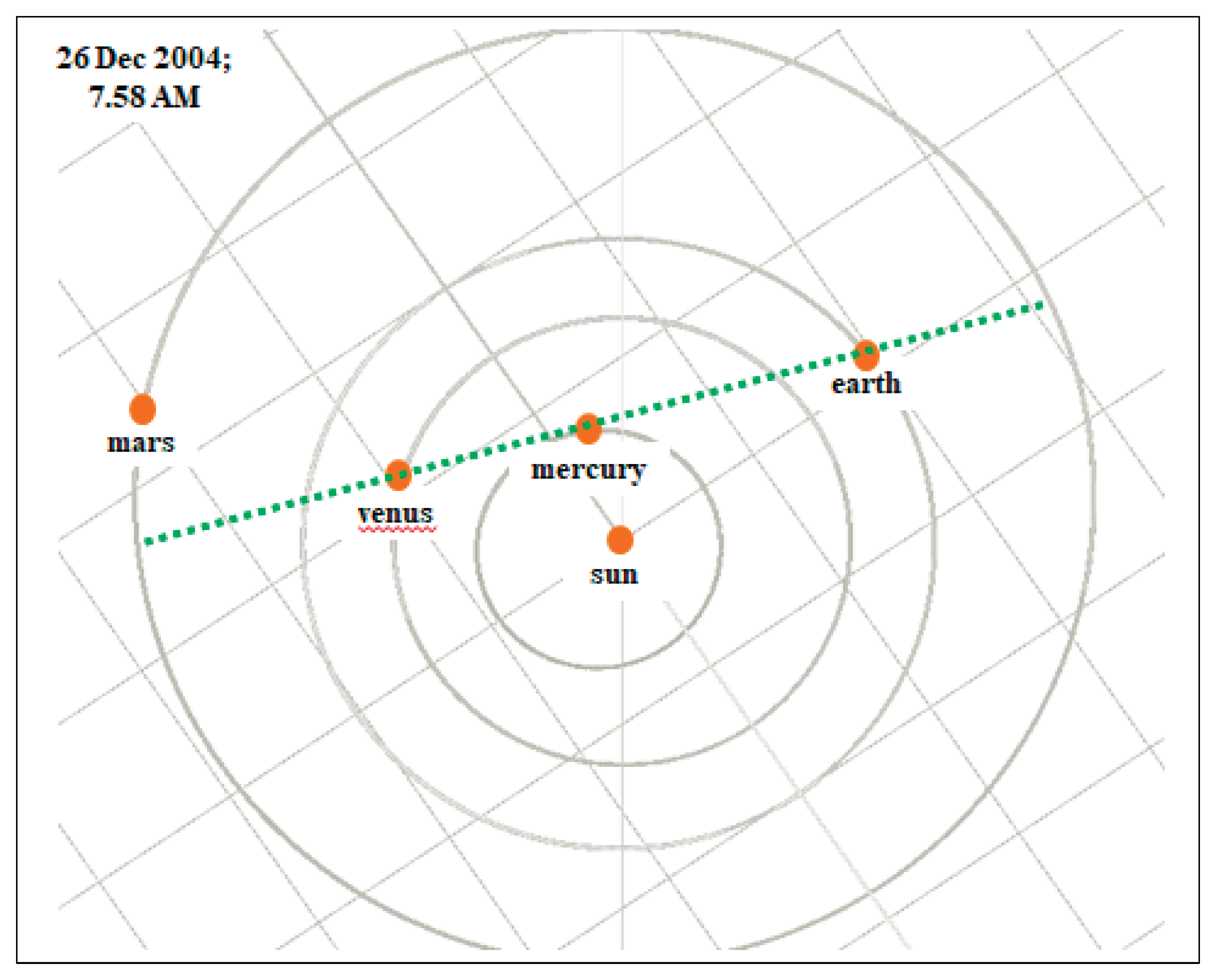
Figure 2.
Planetary conjunctions during Jogjakarta, Java earthquake (6.3, 2006; Ma-Me-(sun)-V).
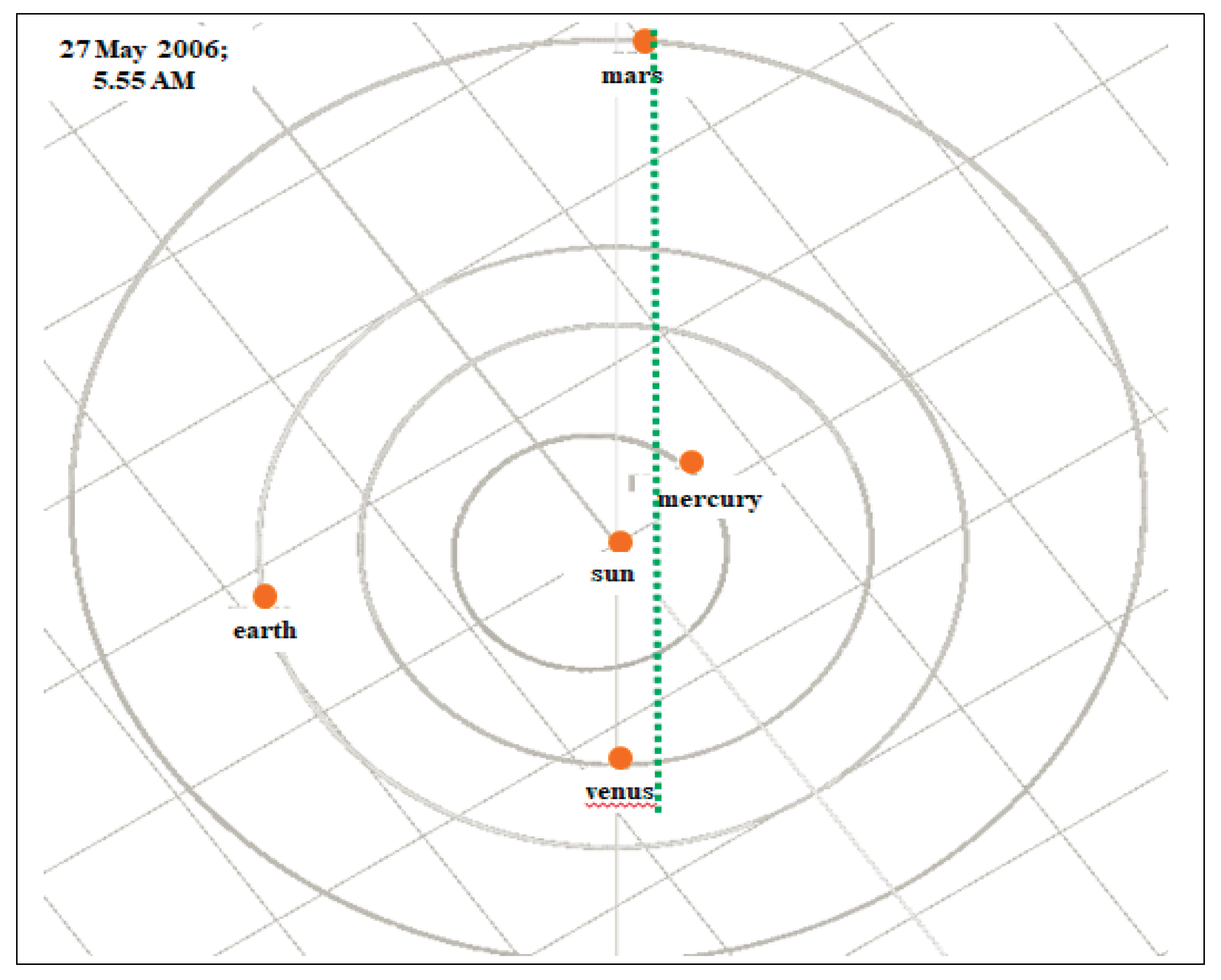
Figure 3.
Planetary conjunctions during Palu, Sulawesi earthquake (7.4, 2018; Me-(sun)-V-E, MeS//VE).
Figure 3.
Planetary conjunctions during Palu, Sulawesi earthquake (7.4, 2018; Me-(sun)-V-E, MeS//VE).
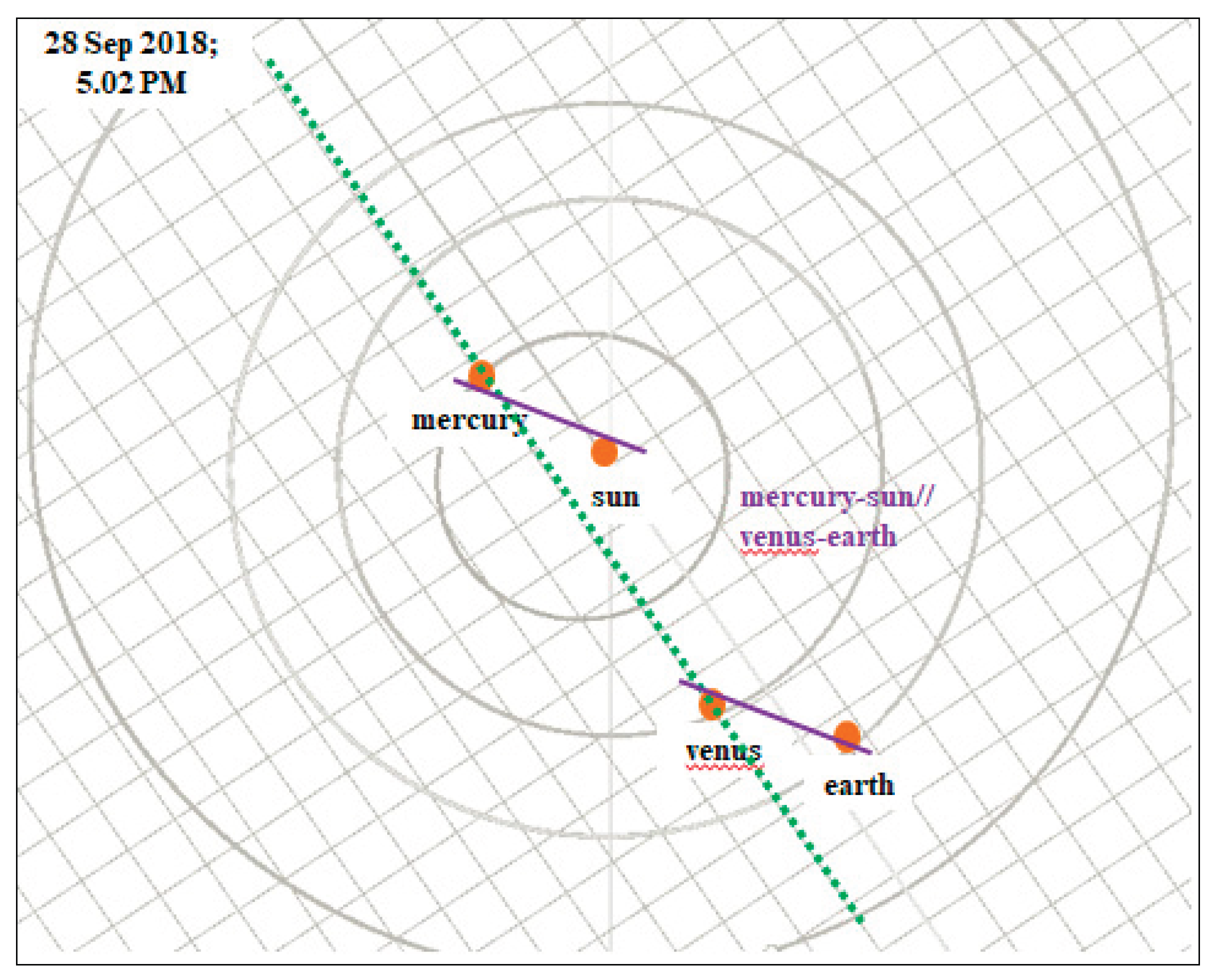
Figure 4.
Planetary conjunctions during Pandeglang, Banten earthquake (6.6, 2022; (sun)-Me-V-E).
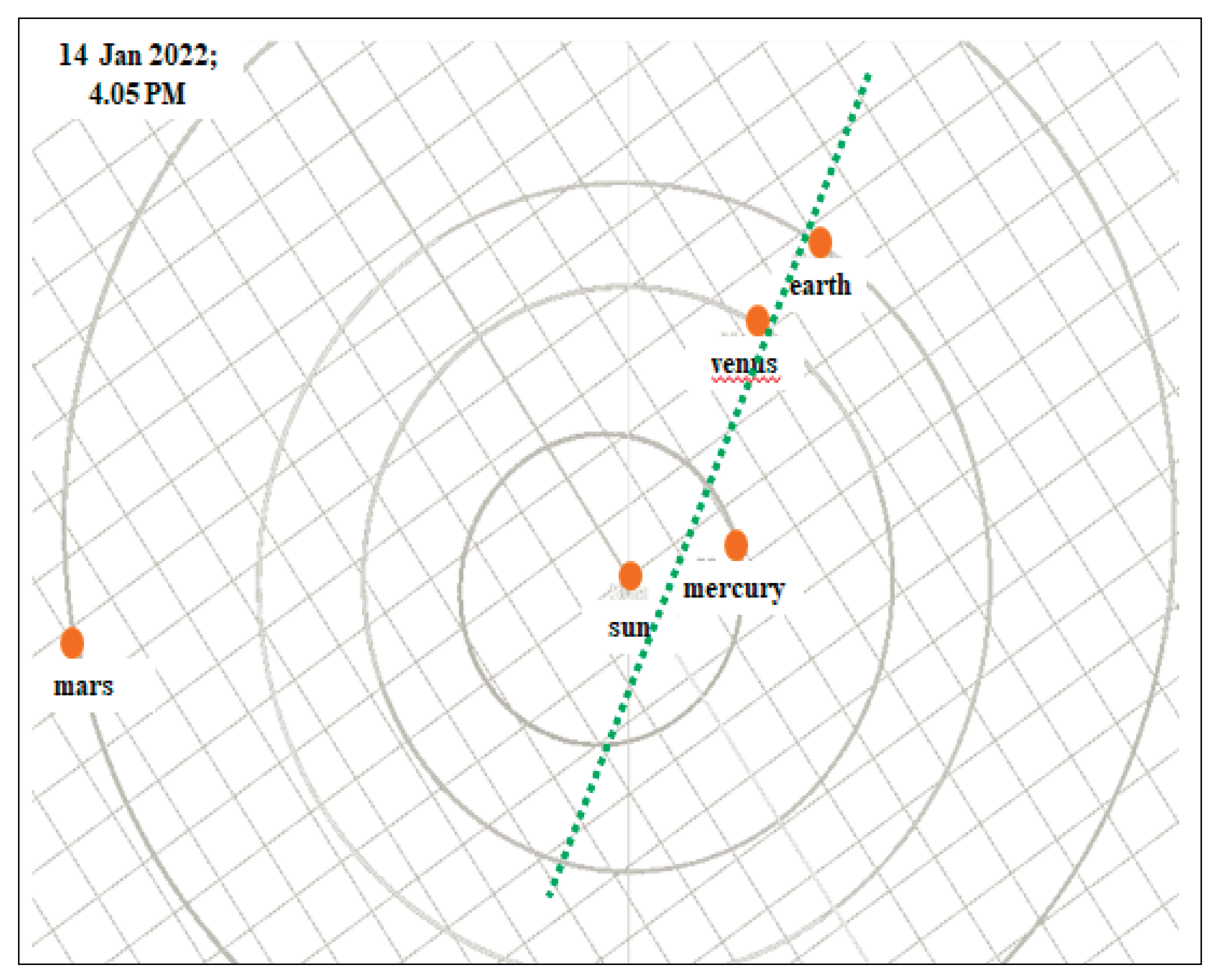
Figure 5.
Planetary conjunctions during Sarmi, Papua earthquake (6.3, 2025; Me-V).
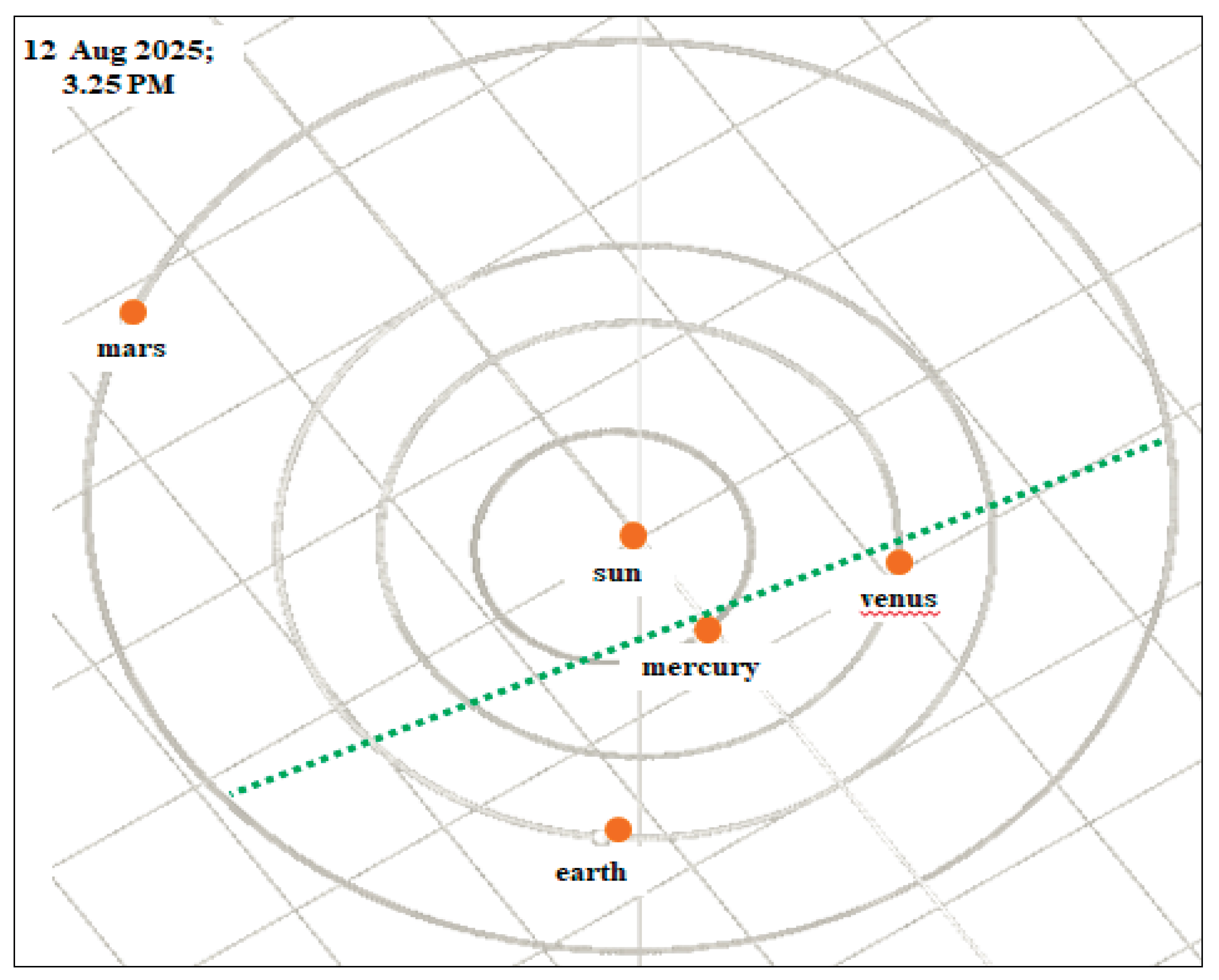
Figure 6.
Planetary conjunctions during Poso, Sulawesi, Bekasi, Java, and Lampung, Sumatra earthquakes (2.3-5.8, 2025; (sun)-Me-V-J).
Figure 6.
Planetary conjunctions during Poso, Sulawesi, Bekasi, Java, and Lampung, Sumatra earthquakes (2.3-5.8, 2025; (sun)-Me-V-J).
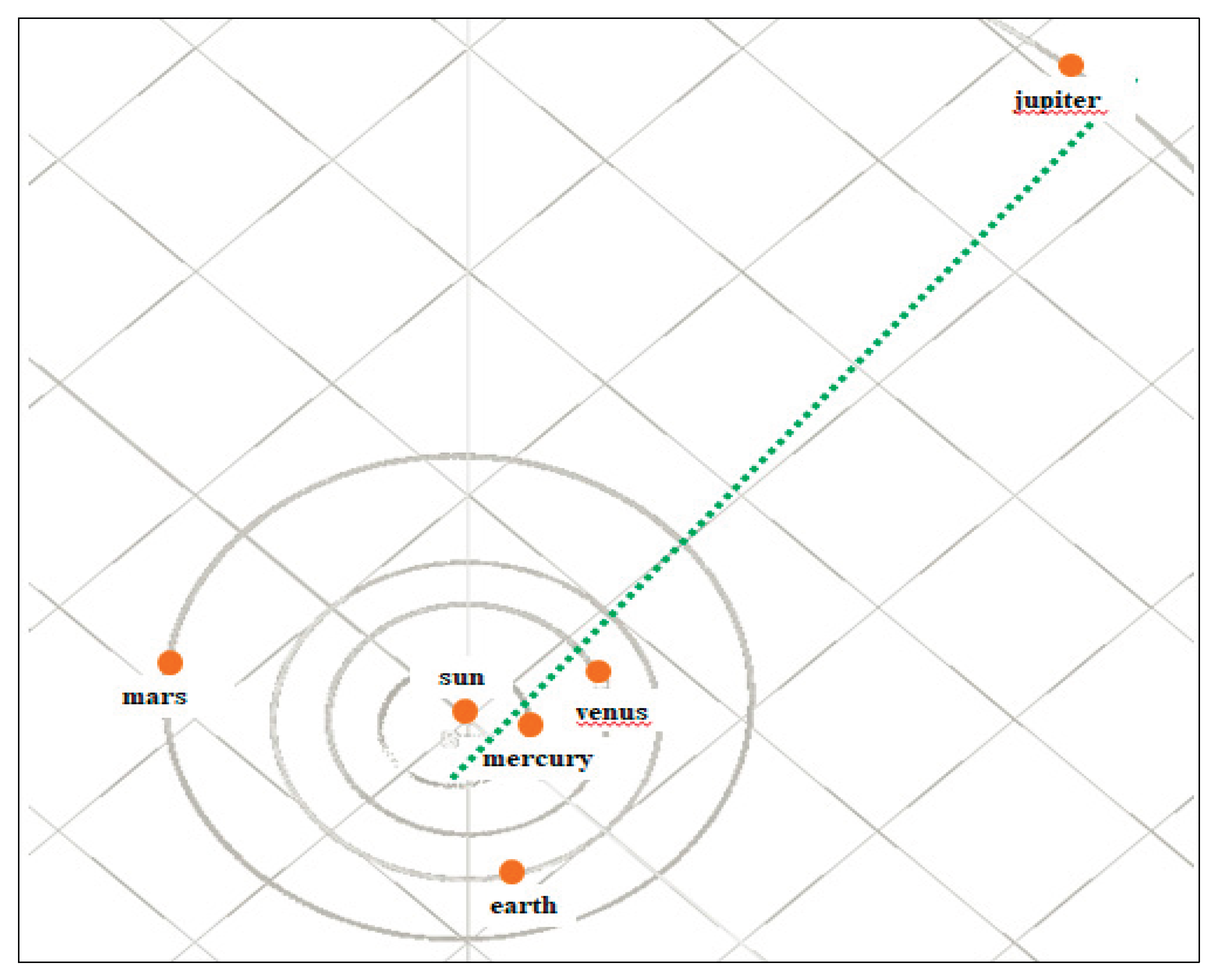
Table 2.
Associations of planetary conjunctions with the strong and rare earthquake events in Indonesia.
Table 2.
Associations of planetary conjunctions with the strong and rare earthquake events in Indonesia.
| ocations | Epicentrum and depth | Magnitude | Time | Planetary conjunctions | Figure |
|---|---|---|---|---|---|
| Aceh, Sumatra | Sea, 30 km | 9.3 | 26 Dec 2004; 7.58 AM | V-Me-E | 1 |
| Jogjakarta, Java | Sea, 12.5 km | 6.3 | 27 May 2006; 5.55 AM | Ma-Me-(sun)-V | 2 |
| Palu, Sulawesi | Sea, 20 km | 7.4 | 28 Sep 2018; 5.02 PM | Me-(sun)-V-E | 3 |
| Pandeglang, Banten | Sea, 12 km | 6.6 | 14 Jan 2022; 4.05 PM | (sun)-Me-V-E | 4 |
| Sarmi, Papua | Sea, 38 km | 6.3 | 12 Aug 2025; 3.25 PM | Me-V | 5 |
| Poso, Sulawesi | Sea, 10 km | 5.8 | 17 Aug 2025; 6.38 AM | (sun)-Me-V-J | 6 |
| Lampung, Sumatra | Land, 11 km | 2.3 | 19 Aug 2025; 2.55 PM | ||
| Bekasi, Java | Land, 10 km | 4.9 | 20 Aug 2025; 7.55 PM |
Abbreviations: V = venus, Me = mercury, Ma = mars, J = jupiter.
Disclaimer/Publisher’s Note: The statements, opinions and data contained in all publications are solely those of the individual author(s) and contributor(s) and not of MDPI and/or the editor(s). MDPI and/or the editor(s) disclaim responsibility for any injury to people or property resulting from any ideas, methods, instructions or products referred to in the content. |
© 2025 by the authors. Licensee MDPI, Basel, Switzerland. This article is an open access article distributed under the terms and conditions of the Creative Commons Attribution (CC BY) license (http://creativecommons.org/licenses/by/4.0/).
Copyright: This open access article is published under a Creative Commons CC BY 4.0 license, which permit the free download, distribution, and reuse, provided that the author and preprint are cited in any reuse.


