

Submitted:
25 August 2025
Posted:
26 August 2025
You are already at the latest version
Abstract
The rapid seismic performance assessment of large structural inventories has become a necessity. This is essential for regional seismic risk assessment and management. However, traditional approaches for estimating the seismic response of structures are either computationally demanding or insufficiently accurate, highlighting the need for new techniques such as data-driven approaches. This paper thus aims to provide a systematic review of machine learning applications in seismic performance assess-ment. By synthesizing trends, key challenges, and future opportunities. A systematic review of 150 peer-reviewed articles published in scopus indexed journals between 2016 and 2025 was conducted using a targeted search string, followed by bibliometric analysis to highlight the research landscape. A classification of ML techniques is pre-sented, followed by a brief overview of the commonly used ML models in seismic per-formance assessment applications. Overall, the analysis of the reviewed papers re-vealed three primary applications: (i) failure mode identification and capacity predic-tion, (ii) seismic demand and damage state prediction, and (iii) seismic response time series prediction. While the findings underscore the potential of ML in advancing seismic performance assessment, several challenges persist, including data scarcity, the black-box nature of ML models, limited generalization capabilities, and high com-putational costs. Potential pathways forward include integrating physics into ML model training, expanding annotated datasets, adapting state of-the-art algorithms for structural engineering applications.
Keywords:
machine learning
; seismic performance assessment
; surrogate modeling
; probabilistic fragility analysis
; nonlinear structural response
1. Introduction
Earthquakes are among the most devastating natural disasters in the world. They threaten human life, safety, and the national economy [1]. Over the past decades, significant advances, notably the shift in the design methodology from code-based to performance-based principles, have improved the resilience of structures against seismic events [2]. Nevertheless, conventional methods for seismic performance assessment still face critical limitations [3]. High-fidelity numerical simulations and detailed analytical evaluations can capture complex structural behavior [4], but they are computationally intensive and time-consuming, rendering them impractical for evaluating extensive structures inventories in near real-time, such as post-disaster evaluations. On the other hand, simplified empirical approaches and code-based prescriptive methods sacrifice accuracy and often rely on coarse assumptions that may not generalize well to real-world structures. These challenges underscore a pressing need for novel, efficient, and reliable techniques to predict how structures will perform during earthquakes.
ML methods are generally divided into three large categories: (i) supervised learning, (ii) unsupervised learning, and (iii) reinforcement learning (RL) [5]. The hierarchical structure of popular ML algorithms, mainly the first two categories, supervised and unsupervised, is illustrated in Figure 1. Supervised, unsupervised, and reinforcement learning have been increasingly applied in earthquake engineering for tasks such as seismic demand prediction, damage state classification, and structural control. With increasing computational power and data availability, ML applications in seismic performance assessment have grown rapidly, enabling models to capture complex relationships between structural features, seismic demands, and damage outcomes. Several review studies have summarized ML applications in structural and earthquake engineering, highlighting progress across different tasks. Table 1 provides a concise overview of representative surveys:
These studies demonstrate the growing interest in leveraging ML for seismic applications; however, they do not provide a holistic view of state-of-the-art ML and deep learning methods across all seismic performance assessment tasks, nor do they offer comprehensive bibliometric mapping of the field.
In light of the above, the present review aims to fill this critical gap by providing a comprehensive, up-to-date synthesis of ML and DL applications in seismic performance assessment. Over 150 peer-reviewed studies published between 2016 and 2025 are reviewed, covering machine learning techniques applied to evaluate or predict the seismic performance of structures. To organize the discussion, the literature is grouped into three primary application areas: (i) ML models for identifying failure modes and predicting structural capacity, (ii) ML-driven prediction of seismic demands and damage states, and (iii) data-driven simulation of structural response time series under earthquake loading. For each category, we critically examine representative studies, highlighting the achievements, limitations, and data requirements of the proposed ML models. We further discuss cross-cutting challenges such as limited training data, the “black-box” nature of complex models, and issues of generalization and bias that currently hinder broader ML adoption in earthquake engineering. In doing so, this review not only summarizes the state-of-the-art but also draws attention to knowledge gaps and future research opportunities.
2. Research Trend Analysis
A systematic academic literature review is conducted to thoroughly examine the applications of ML in seismic performance assessment of structures and infrastructure. This process involves a thorough search and analysis of relevant articles and visualizing them using viewer software [13]. The viewer mainly maps scientific knowledge by analyzing large academic datasets, allowing for a clear depiction of research impact, citation patterns, and thematic clusters within a given field. For this purpose, the Scopus database was selected due to its indexation of a wide range of journals, conference proceedings, and books relevant to civil engineering [14]. The search string used was [TITLE-ABS-KEY ((“ML” OR “Data-Driven” OR Surrogate OR “Deep Learning”) AND Seismic AND (“Performance” OR “Behavior” OR “Response”) AND (“Assessment” OR “Prediction” OR “Forecast”))]. The search string was created in such a way that it retrieves all the articles that included specific keywords in their titles, abstracts, or keywords. The initial search pulled a total of 2044 papers. However, it was clear that articles that were out of the scope of this study were present. Various filters were applied to refine the search string further to narrow the search area. Only articles from 2016 to 2025 were considered in English within the subject area of Engineering, and only papers from well-known journals in Structural Earthquake Engineering were targeted. After applying these filters and removing duplicates, 288 articles remained. The selected articles were screened carefully based on their titles, abstracts, and, when necessary, full-text reviews.
After screening, 150 articles were deemed highly relevant and selected for inclusion in the final analysis. The detailed process followed is illustrated in Figure 2. This workflow depicts the steps involved, from database selection to the final bibliometric analysis. The selected 150 articles were processed to perform bibliometric analysis and generate visual maps of the research landscape [13]. Author-keyword co-occurrence analysis was conducted to map the relationships between different keywords as shown in Figure 3. In this visualization, nodes represent specific keywords depending on the type of analysis. The size of each node reflects the frequency of that term within the dataset. The connections between nodes indicate the strength. In the analysis of author-keyword co-occurrence, it shows keyword co-occurrence. The connections in the bibliographic coupling map show the number of shared references between documents. The closer the nodes are to each other, the stronger the relationship between the concepts. The different colors on each map show different groups and clusters within the dataset.
The analysis of viewer-generated maps exhibits key research trends and areas of focus. The most prominent keywords are ML, deep learning, seismic performance assessment, seismic response prediction, and damage state prediction. These keywords are close to each other. Their proximity on the map indicates a strong interconnection between these keywords. It is also evident from the maps that seismic performance assessment and various other similar topics, such as seismic response prediction and damage state prediction, are intersected with ML and deep learning. The bibliographic coupling maps highlight the different research groups present in the dataset.
The increase in integrating soft computing and advanced ML techniques into seismic performance assessment is clear from Figure 4, showing yearly trends in the number of publications in this research area from 2016 to 2025.
3. Overview of ML Models
This section may be divided by subheadings. It should provide a concise and precise description of the experimental results, their interpretation, as well as the experimental conclusions that can be drawn.
3.1. Regression-Based Algorithms: Linear and Polynomial Regression
Linear (or simple) regression is the most basic and widely used algorithm in ML and statistics, mainly for continuous variable prediction. It models the relationship between independent input variables (mixed discrete or continuous) and continuous dependent output variables by fitting a linear function to the observed data, as shown in Figure 5a. The model parameters are typically optimized by minimizing the mean squared error (MSE) between predicted and actual values, making this approach a frequent initial choice for tasks such as structural drift or deformation estimation. When the underlying relationship exhibits higher complexity or nonlinearity, polynomial regression extends the basic linear approach by adding higher-order terms, thereby capturing more complex response trends. In seismic performance assessments, datasets are often high-dimensional and prone to multicollinearity. Under these conditions, lasso (L1 regularization) and ridge (L2 regularization) become essential. By penalizing large coefficients, both forms of regularization reduce overfitting and enhance model interpretability [15].
Logistic regression is the most widely used algorithm for classification tasks, including both binary and multi-class predictions. It employs sigmoid functions, as shown in Figure 5b. This is particularly valuable when distinguishing between two classes, such as damaged and undamaged structures. or assigning multiple performance categories via one-vs.-all or SoftMax functions. Applications in seismic engineering include categorizing structural performance levels or predicting failure states. A single linear decision boundary is not enough to model relationships in non-linear or extreme datasets. To combat this issue, various regularization techniques (namely L1 and L2) are used to regularize the models, improve the generalization, and prevent overfitting, especially in feature space on high-dimensional or noisy features [15].
3.2. Ensemble Learning
Ensemble techniques combine individual models to improve the model’s stability and predictive power. This technique permits higher predictive performance by combining multiple ML models into one predictive model. Some models perform well in modeling one aspect of the data, while others work well in modeling another aspect. Combining predictions from several simple models reduces the individual weaknesses of simple models. This provides a composite prediction where the final accuracy is better than the accuracy of the individual models. Ensemble methods can be trained in two primary ways: sequentially or in parallel. In sequential ensemble methods, base learners are generated consecutively to utilize dependence between the base learners. Parallel ensemble methods are applied where base learners are generated independently and in parallel, leveraging the benefits of diversity among models to reduce variance. Bagging methods such as RF employ this approach. A combination of diverse simple models can be achieved through different strategies: i) averaging, ii) weighted averaging, and iii) bagging or bootstrap aggregation. In simple averaging, equal weights are assigned to different models despite some models performing better than others. In the weighted averaging case, weights are applied to each model based on its performance, allowing stronger models to contribute more significantly to the final prediction. Bagging or bootstrapping reduces variance in prediction by taking the mean of multiple estimates. It creates randomly sampled datasets of the original training data, trains several ML models for each dataset, and then takes the average of all the predictions to make the final predictions [16].
RF is the most popular example of an ensemble ML method that combines multiple decision trees to produce a more generalized model. The standard decision-tree (DT) models are prone to bias and overfitting. RF mitigates these issues by generating de-correlated DT from random subsets of the data and averaging their outputs. This process enhances the generalizability of the model. Figure 6a depicts a standard DT, while Figure 6b shows the structure of RF [16]. AdaBoost is a boosting technique that helps mix multiple weak models into one strong model. It improves the weaknesses of previous models iteratively. First, a model that best classifies the training dataset is trained and analyzed for its weaknesses. Another model is explicitly trained to counter the weakness of the previous model by increasing the weights to misclassified observations. This process continues until the complete training data fits without significant error. Figure 7 illustrates this process.
Gradient boosting trains several models in a gradual, additive, and sequential manner. Using a gradient descent procedure minimizes a model’s loss function by iteratively adding weak learners that predict the residual errors of previous models. Modeling is stopped when errors do not have any pattern that can be modeled [17]. eXtreme Gradient Boosting (XGBoost) is an advanced implementation designed for speed and performance. It incorporates regularization techniques to prevent overfitting and utilizes second-order derivatives in its optimization process for improved accuracy.
3.3. Support Vector Machine
Introduced in 1995, the Support Vector Machines (SVMs) are a robust ML technique initially developed for classification and regression analysis as a part of the statistical learning theory [18]. This ML model is founded on the idea of finding the best hyperplane that separates the classes while maximizing the margin between the hyperplane and the nearest data points (support vectors) from both classes. This aspect, referred to as structural risk minimization, enables the model to generalize well to unseen data, which makes it an attractive method for applications that demand a balance between complexity and predictive capability. Figure 8a illustrates the classification decision boundary, while Figure 8b demonstrates the regression application of SVMs [19].
SVMs have been applied in many engineering fields, including earthquake engineering, due to their ability to model complicated, nonlinear relationships between input variables (e.g., ground motion parameters, structural characteristics) and output variables (e.g., damage states, failure modes). For example, SVMs have been applied in seismic fragility assessment by classifying the damage states of Reinforced Concrete (RC) structures and predicting the backbone curve parameters [20]
In SVMs, kernel functions (for example, radial basis function (RBF), polynomial, and sigmoid) inject data into a higher-dimensional space where linear decision boundaries can be applied. This gives SVM the ability to capture highly non-linear relationships, which are often present in seismic datasets. However, tuning hyperparameters (regularization, gamma, and epsilon) is crucial for effective application. SVMs, while advantageous, face challenges such as high computational costs for large datasets, sensitivity to feature scaling requiring preprocessing, and bias risks from imbalanced seismic datasets [19].
3.4. Artificial Neural Networks (ANNs) and its Variants
Inspired by biological neural networks’ structure and functioning, ANNs comprise a series of interconnected layers of artificial neurons that compute and transfer data inputs, allowing the modeling of complicated, nonlinear relationships. As shown in Figure 9, each neuron assigns weights and biases to the input values, derives a weighted sum, and then passes the sum through an activation function (for example, ReLU, Sigmoid, Tanh). As research progressed, deeper architectures, known as Deep Neural Networks (DNNs), were introduced. These networks enable the extraction of features at multiple levels across hidden layers. Within this framework, specific DNN types have been used to solve problems associated with seismic performance assessment. As illustrated in Figure 10, Convolutional Neural Networks (CNNs) are a special type of neural network widely used for tasks such as image classification and feature extraction from ground motion data, enabling the improved prediction of structural response under seismic loading. The convolution layer is the important layer. It extracts features from the input image. After the convolution layer, it passes through an activation function, which helps learn complex non-linear relationships. The pooling layer reduces the dimensional space of spatial features while retaining critical information. After several convolution and pooling layers, the feature maps are reduced into a manageable 1D vector. This vector is then passed through a fully connected layer for final prediction. [21]
Moreover, Recurrent Neural Networks (RNNs), with their improved variants such as Long Short-Term Memory (LSTM) networks and Gated Recurrent Units (GRUs), are primally good at tackling sequential data such as time-history seismic responses, capturing long-term dependencies. Figure 11a,b illustrates the internal workings of these models. LSTM networks address the vanishing gradient problem in standard RNNs, making them effective for long-term sequence data like acceleration time series. The LSTM architecture includes a forget gate, which uses a sigmoid function to decide which parts of the Long-Term Memory (LTM) to retain or discard. The input gate determines what new information to add to the memory. This allows LSTM to store significant updates in LTM adaptively. The output gate determines which part of the memory will contribute to the final output at the current time step. ANNs and their variants face challenges in seismic applications, including overfitting due to limited datasets, high computational costs for training deep networks, interpretability issues as “black box” models, and data scarcity. [21]
4. Overview of ML Models
4.1. Failure Mode Identification & Capacity Prediction
Failure mode identification and capacity prediction of structural components accurately has always been acknowledged as the foundation of seismic engineering. Historically, we have understood how to forecast the performance of structures by utilizing data gathered from sensors and measuring instruments during experimental tests conducted under controlled environments or from numerical simulations of specific structural components and systems. Data is then processed through statistical models to estimate parameters like stiffness, strength, and deformation capacities. Early approaches primarily used simple mathematical formulations to model relationship between the parameters. However, due to the evolution of computing power, dataset volume, and analytical methods, ML models emerged as a powerful tool capable of capturing complex relationships between variables, surpassing the limitations of traditional regression-based models.
This section reviews studies using experimental and numerical simulation databases of structural components as input datasets for various ML models to predict failure modes, strength and deformation capacities, and backbone curve model parameters. Figure 12a provides an overview of ML models employed in these studies, revealing a strong dependence on ensemble methods, support vector machines (SVM), and artificial neural networks (ANN). On the other hand, Figure 12b shows the overview of structural components that have been analyzed in these studies, where a majority of the components studied are RC columns, shear walls, and beam-column joints. The list of key studies is summarized in Table 2, detailing the datasets, outputs, and ML models utilized. While this review focuses on ML applications in seismic performance assessment, mainly studies utilizing datasets from experimental tests or numerical simulations are included, it excludes studies employing image-based datasets, satellite imagery, UAV data, or similar approaches, as these were beyond the scope of this systematic review and did not get pulled by the search string used. This explicit exclusion allows us to narrow down the review’s focus to the specific area of interest. It provides a well-rounded discussion of the ML methods dedicated to structural performance.
Traditional regression-based curve fitting techniques are widely used due to their simplicity and interpretability. However, they cannot handle complex datasets. On the other hand, ML models gained prominence due to their ability to learn complex relationships from raw data. For instance, a study by Dabiri et al. [22] compared ML models such as RF, ANN, and SVM against traditional regression-based models (Linear and polynomial regression) for predicting the ductility ratio of RC beam-column joints. ML models outperformed regression-based models, with RF performing the best. Providing the balance between accuracy, computational efficiency, and interpretability. The feature importance analysis showed that reinforcement ratio is the most significant predictor for ductility ratio. Similarly various studies have utilized a number of ML algorithms along with ensemble learning techniques for various tasks, such as predicting the plastic hinge length (PHL) [23], failure modes, lateral strength capacity, deformation capacity of columns [24], equivalent damping ratios [25,26], etc., for interpreting the model’s prediction Shapley Additive exPlanations (SHAP) explanation is used [27]. It was found that most of these studies have reported the superior performance of ensemble ML models such as XGBoost (XGB), RF (RF), and Gradient Boosting (GB), with XGBoost achieving a 97% success rate in classifying failure modes [28] but were less interpretable than simpler models like Lasso Regression. Studies reviewed include various structural components such as RC columns [28,29], Beam-Column Joints [30,31], RC shear walls [32], RC composite columns (SRC) [33], and bridge pier [34,35,36].
Recent studies have implemented deep neural networks (DNNs) for modeling hysteresis behavior and backbone curves, demonstrating their ability to generalize complex cyclic response patterns. Such as Djerrad et al. [37] developed three DNN architectures, Bi-LSTM (Bidirectional long short-term memory), LSTM-AE (LSTM-based autoencoder), and CNNs (Convolutional neural networks) for predicting hysteresis loops under cyclic loading and pushover curves under monotonic loading conditions for RC shear walls. Horton et al. [38] Employed Deep Learning Neural Networks (DNNs) to predict parameters of the modified-Ibarra–Krawinkler (mIK) model for Reduced Beam Section (RBS) connections using a database of 1,480 finite element (FE) models. Their two-step approach first classified the failure mode and then followed by the prediction of the parameters, which achieved 96% accuracy, highlighting the effectiveness of DNNs for cyclic loading scenarios. A significant challenge in utilizing advanced ML techniques, like deep neural networks (DNN), for structural engineering applications is their data dependency and black-box nature. To address these limitations, Genetic programming (GP) approaches have been introduced as interpretable frameworks to overcome the black-box nature and data dependency of advanced ML models in structural engineering. These approaches have been utilized for various tasks, such as predicting backbone curves of RC block shear walls [39], shear capacity of exterior beam-column connections under cyclic loading [40], and deriving explicit mathematical expressions for backbone curves using Symbolic Regression (GP-SR) [41]. Empirical-based Support Vector Machine (SVM) models have also been proposed, these models are incorporating parameter sensitivity analysis into the training process ensuring, outputs align with empirical knowledge by rejecting physically inconsistent models and select the best-performing ones [42]. However, a limitation of traditional SVMs is their design for generating single-output predictions. In seismic performance assessment, where multiple backbone curve parameters must be predicted simultaneously, retraining SVMs for each parameter is computationally inefficient. Luo et al. [43] addressed this issue by enhancing SVMs to predict multiple outputs in a single training process, thereby reducing computational overhead. Deger et al. [44] utilized the Gaussian process regression GPR for its ability to output multiple parameters at once. In addition to this, unlike traditional ML models, GPR adopts a probabilistic framework, allowing for estimation of uncertainty in predictions. Addressing limited dataset availability, Chen et al. [45] proposed an active-learning framework to reduce the exhaustive manual labeling process required in supervised ML tasks. This framework dynamically selects the most informative data points for labeling, optimizing model training efficiency. Aging and degradation of buildings causes a shift in the statistical properties of the input data, leading to a mismatch between training and real-world data [46]. In seismic datasets, there is frequently an uneven distribution, where cases of undamaged conditions outnumber those with damage, resulting in a risk of overfitting. Xu et al. [47] in his research on the effects of corrosion on failure modes dealt with a problem of data imbalance and demonstrated that ensemble machine-learning models can handle uneven datasets while maintaining reasonable accuracy.

Table 2.
List of key Studies.
| Reference | Data Samples | Output | ML Model |
|---|---|---|---|
| Deger and Taskin [25] | 384 RC Shear walls | backbone curve model parameters | GPR |
| Nguyen et al [48] | 369 RC Shear walls | Prediction of shear capacity | ANN |
| Zhang et al. [24] | 429 RC Shear walls | Prediction of failure modes and associated capacities | XGBoost, GB, RF |
| Horton et al. [38] | 1480 FE beam-column joints | Prediction of parameters in the modified Ibarra–Krawinkler (mIK) model for hysteresis. | DNN |
| Gao et al. [41] | 388 RC walls | Prediction of piecewise linear backbone curve | Genetic Programming-based symbolic regression (GP-SR) |
| Chen et al. [49] | 475 RC Columns | Prediction of backbone and cyclic deterioration parameters. | RF with Active Learning |
| Ma et al. [50] | 452 RC beams | Prediction of performance level limits considering crack development. | Seven Regression ML models |
| Haggag et al. [28] | 486 RC columns | Prediction of failure mode and ultimate capacity. | Decision Trees and Ensemble Techniques |
| Elgamel et al. [39] | 74 cyclically loaded (RCBSWs) | Prediction of the backbone curve of RCBSWs | Multigene Genetic Programming (MGGP) |
| Anwar et al. [40] | 216 cyclically loaded BCJs | Prediction of seismic shear strength of exterior beam-column joints (BCJs) | Mechanics guided data-driven model MGGP |
| Mangalathu and Jeon [31] | 536 RC BCJs | failure modes identification and shear strength prediction of BCJs. | Lasso Regression and RF |
| Mangalathu et al. [32] | 393 RC Shear Walls | To classify failure modes of RC shear walls | Naïve Bayes, K-NN, DT, RF, AdaBoost, XGBoost, LightGBM, and CatBoost. |
| Yaghoubi et al. [26] | 161 rectangular shear walls. | To predict the equivalent damping ratio | LR, K-NN, Kernel Ridge Regression, SVR, and GPR |
4.2. Seismic Demand and Damage State Prediction
This section reviews studies that employ surrogate models and other ML approaches to predict seismic demands and classify structural damage states. Figure 13a summarizes the distribution of ML and DL models utilized for demand and damage prediction, highlighting the dominance of probabilistic and deep learning frameworks. Figure 13b presents the application frequency across different structural systems, indicating that RC and steel moment-resisting frames have been most widely studied. A detailed list of representative studies is provided in Table 3, which outlines the class of structures investigated, the outputs predicted, and the ML models applied. Unlike Section 4.1, which focused on experimental and numerical component-level data, this section emphasizes surrogate-based approaches that enable regional or large-scale seismic assessments.
Predicting seismic demands (e.g., peak drifts, accelerations, or member forces) and seismic damage states is of vital importance in improving the resilience of structures and maximizing the benefits of seismic design. Conventional methods, e.g., non-linear time history analyses (NLTHA), while providing accurate predictions, are computationally cumbersome and not ideal for larger applications such as regional simulations or post-earthquake rapid assessments. To mitigate these issues, recent investigations focus on surrogate models, which can map ground motion characteristics (e.g., PGA, PGV, source-to-site distance, Magnitude) and structural parameters (e.g., geometric properties, material properties, etc.) to engineering demand parameters (EDPs) (e.g., MIDR, lateral displacement), for various classes of structures enabling cost-effective and scalable evaluations. Many of the reviewed studies have developed surrogate prediction models. Table 3 presents a list of key studies focused on surrogate modeling for nonlinear seismic demand prediction. Responses from these models are then used to develop probabilistic seismic demand models (PSDMs) and later combined with threshold capacities to get fragility curves [51,52,53,54]. Further, improving upon traditional logistic regression (LR), Maximum Likelihood estimate (MLE), and Monte Carlo Simulation (MCS) based fragility curves. The adaptive fragility curves [55] directly predict the fragility curve parameters (e.g., α, β), providing adaptive curves to specific ground motion. Another group of researchers directly used classification algorithms to classify damage states. Instead of predicting continuous demand values, these models output a discrete damage category (e.g., none, slight, moderate, extensive, collapse) given input features [56,57].
While useful, deterministic predictions from these studies fail to account for aleatoric uncertainty related to input variables (e.g., seismic excitation and structural properties) and the epistemic uncertainty associated with modeling. To address these issues, Ding et al. [58] introduced an innovative framework for seismic fragility assessment that combines natural gradient boosting (NGBoost), a probabilistic ML technique utilizing predefined distributions (such as Gaussian), with time-series K-means (TK-means) clustering to effectively capture the variability in ground motion data, as well as Latin Hypercube Sampling (LHS) for sampling structural model parameters, allowing for a direct calculation of the conditional probability that structural damage will exceed a specific threshold. In a similar vein, Rayjada et al [59] accounted for record-to-record RTR variability in ground motion along with uncertainty in lumped plasticity beam-column backbone model parameters through the use of the Gaussian process regression (GPR) model. The overall impact of these uncertainties on fragility curves was evaluated using an LHS-based Monte Carlo simulations strategy (MCS). Gao et al. [60] took another approach by kriging-based nonlinear autoregressive with exogenous (NARX) model to convey the uncertainties. They employed the generalized hysteretic Bouc-Wen model with internal uncertainties to simulate stiffness and strength degradation. A probabilistic stochastic ground motion model was introduced to depict the external uncertainties. The overarching terms of the NARX model were identified through a least-angle regression algorithm, and the kriging model was used to substitute uncertain parameters into their respective NARX model coefficients, demonstrating that the kriging NARX model serves as an effective and efficient meta-model method better than MCS for quantifying uncertainty in systems. Similarly, Kundu et al. [61] developed an LSTM-based deep learning algorithm for quantifying stochastic earthquake loading and structural design parameter uncertainty in seismic response prediction. Alternatively, Noureldin et al. [62] introduced a probabilistic framework using a Quality-Driven Neural Network (QDN) to provide distribution-free prediction intervals (PI) for seismic structural responses. This approach directly models the bounds of the responses using a flexible and non-parametric approach. The QDN directly learns to predict the lower bound (L) and upper bound (U) of the response for a given confidence level (e.g., 95%) without assuming any underlying distribution. The model is trained to ensure that the true response (y) lies within the interval [L, U] with a high probability (e.g., 95%). These methodologies highlight the increasing use of probabilistic ML models to address the uncertainties in seismic response evaluation, enabling robust and reliable frameworks for diverse applications, as explored in studies [59,62,63,64,65,66,67,68].
Recent studies have emphasized incorporating time-frequency domain features to enhance prediction accuracy further, as these allow models to capture both the temporal (dynamic) progression and spectral (non-stationary) characteristics of ground motions. For example, wavelet transforms, or Fourier spectra of ground motions have been used as inputs to ML models so that frequency content and duration effects are accounted for in demand prediction [69]. Zhang et al. (2023) [70] developed a neural network that takes time-frequency characteristics (via wavelet-based features) of ground motions to predict building response, resulting in better performance than using scalar IMs alone. Lu et al. (2021) [71] similarly leveraged time-frequency distributions in a deep learning model for rapid regional damage. Park et al. (2024) [72] compared using time-domain versus combined time-and-frequency-domain data for predicting nonlinear structural response and found that including frequency-domain information improved the predictions significantly. Tang et al. [73] developed custom loss function that utilize frequency domain information: i) a pure frequency domain loss function and ii) a combination of frequency and time-domain loss functions using Fourier transforms. The performances of these loss functions were evaluated against those achieved with the traditional mean squared error (MSE) loss function, demonstrating that the frequency domain loss function delivered improved results. Dang-Vu et al. [74] proposed a frequency-based data-driven model that predominantly uses the frequency spectrum of earthquakes as input data. Results showed good agreements with the conventional fragility curves.
One practical use-case for ML surrogates is regional seismic risk assessment. Traditional regional loss estimation (e.g., in FEMA P-58 or HAZUS methodologies) can be very computationally expensive if using NLTHA for each building. ML models, once trained, can instantly predict building damage or loss, enabling near-real-time regional damage maps after an earthquake. [75] . Xu et al [76] proposed a real-time regional seismic damage assessment framework based on a Long Short-Term Memory (LSTM) neural network architecture. This framework bypasses the dependence on fragility-based damage models due to their reliance on ground motion characteristics, soil conditions, and structural geometric properties. Extending rapid response prediction for post-event assessments to early warning applications or real-time regional seismic damage assessment, Wang et al. [69,77] proposed a framework to predict the PGA by using P-wave data, which arrives earlier than more destructive S-wave ground motions. early predicted PGA and fragility curves can then be used to estimate seismic damage. Some studies have extended ML demand predictions to support decision-making for example, Hu et al. (2022), [64] developed a machine-learning-driven approach for residual displacement-based design of steel frames with self-centering braces, effectively using ML to invert the performance assessment problem and identify optimal design parameters that achieve desired performance. Falcone et al. (2022) [78] trained an ANN to predict the feasibility of certain retrofit techniques for RC buildings given their characteristics. Identifying a feasible and cost-effective seismic retrofit configuration for vulnerable structures is computationally intensive. ML-based surrogate models can provide approximate solutions, thereby reducing the solution’s space and computational burden.
These predictive models usually are black boxes and rely on the large quantity and quality of the dataset for their training, which is scarce. Researchers have adopted innovative strategies to reduce data dependence without sacrificing accuracy. One such approach is the integration of physics principles within ML models, for e.g., [79,80,81]. Physics-based ML models are trained in various ways. For example, Chen et al. [82] utilized a simplified lumped-mass model instead of a detailed FEM, reducing computational load while capturing essential dynamics. Data from these models is then applied in pretraining to produce approximate responses with minimal simulation requirements. Then, few-shot incremental learning refines the model using a limited set of full NLTHA simulations, enhancing accuracy without extensive computational costs. Zhang and Xiong et al. [79,83] used another way of implementing PINNs by combining “Data Loss with Physics Loss” with the state space model (SSM) for smooth integration. Guo et al. [84] incorporated deep neural networks (DNNs) into a classical numerical integration, e.g., Newmark’s beta method, by using an exponential integration time-stepper. The integration stepper calculates the state variables (e.g., displacement, velocity, and restoring forces) and feeds its prediction into the physics loss function to verify whether its prediction values satisfy the underlying physical laws. Mokhtari et al. [85] developed a global frame structure model with Buckling-Restrained Braces (BRBs) that combines physics-based modeling for linear components with a physics-informed data-driven surrogate model for nonlinear components. The global response is obtained by solving the coupled equations of motion, integrating the contributions from both the physics-based and ML models. Although Physics-Informed Neural Networks (PINNs) have shown considerable promise in scenarios with scarce labeled data, numerous current neural network surrogate models face challenges in generalization. These models are frequently customized for particular tasks and excel only on datasets that resemble the ones used for their initial training. Consequently, they fail to provide precise predictions for related instances where data is limited. Hu et al. [86] introduced a hybrid framework known as physics knowledge-based transfer learning (Phy-KTL) neural networks. The effectiveness of Phy-KTL in predicting seismic responses between specific structures is numerically validated when compared to data-driven neural networks, PINNs, and data-based transfer learning (Data-KTL). An application in the real world illustrates how Phy-KTL can transfer features obtained from a numerical model to a physical structure tested on a shaking table, confirming that Phy-KTL is both resilient and efficient in improving the prediction of seismic responses for target buildings with a limited amount of labeled data. Various physics-based ML models are here [80,81,87,88,89,90,91].
For areas with low-to-moderate seismicity, strong ground motion GM data with enough destructive power is not available. Developing an ML model for rapid seismic risk assessment requires a high-quality dataset. The dataset must represent a complete range of scenarios in an equally distributed manner. The limited availability of strong GM data will lead to an imbalance in the dataset which leads to biased models. To overcome this, researchers have explored different data augmentation techniques [92]. The spectrum-compatible ground motion GM data-augmentation method demonstrated improved accuracies in predictions that surpassed those of the traditional amplitude scaling-based data-augmentation method [93]. Another strategy proposed by Martakis et al. [94] is using planned demolitions. They give engineers a chance to utilize stronger vibrations produced during demolition work to gain deeper insights into the dynamic behavior of current structures.
Sparse instrumentation in buildings is a critical problem in structural health monitoring or un-instrumented buildings in post-earthquake assessment. Seismic Response Reconstruction (SRR) is crucial. Ghahari et al. [95] proposed a two-step hybrid model combining a physics-based shear-flexural beam model with Gaussian process regression (GPR) to predict responses at non-instrumented floors while quantifying uncertainties. Abdelmalek-Lee et al. [96] introduced a dual model that uses kriging combined with the extreme gradient boosting (XGBoost) algorithm to reconstruct seismic response demands in un-instrumented buildings using the response measurements from those that are equipped with strong motion sensors.
Several researchers have adopted deep learning models, primarily end-to-end long short-term memory networks, to predict structural seismic responses in a data-driven manner and have achieved remarkable improvements. However, further research is required to reduce the training cost and complexity while maintaining the prediction accuracy of end-to-end models. Ahmed et al. [97,98] introduced a generalized Overlapping stacked LSTM framework to reduce the training time for damage assessment for ductile RC buildings and RC structures of varying heights, geometric properties, and material characteristics. They combined ground motion time-history data with scalar input features. Similarly, Tang et al. [99] developed a pre-training strategy to reduce training costs and complexity. Zhong et al. [100] introduced probabilistic learning on manifold (PLoM), a novel surrogate modeling technique. It combines diffusion maps for nonlinear dimension reduction with Markov chain Monte Carlo (MCMC) to identify localized data clusters and efficiently generate new data samples for high-dimensional problems. Instead of developing a functional (parametric) mapping from the vector-valued input parameters to output responses, it learns a probabilistic mapping between the joint distributions of input parameters and output responses.
Incremental dynamic analysis (IDA) of complex structures is of great significance for seismic analysis and design but is often constrained by computational cost. Jiao et al. [101] proposed the Kriging model and entropy-based sequential sampling, a concept from information theory to adaptively select the IMs to improve IDA’s computational efficiency.
Table 3.
Representative review studies on ML applications in earthquake engineering.
| References | Class of Structures |
|---|---|
| Kazemi et al [53], Zhang et al [102], Hwang et al [103], Chen & Guan [49], Aloisio et al [104] | RC MRFs |
| Nguyen et al [105], Bond et al [81], Kazemi et al [52], Samadian et al [106], Liu et al [107] | Steel MRFs |
| Coskun et al [108], Aloisio et al [104], Chalabi et al [109] | Masonry buildings |
| Nguyen et al [110], da Silva et al [111], Liao et al [112] | Base isolated buildings |
| Hu et al. [64] Zhang et al. [113] Zhang et al. [114] Hu et al.[115] Hu et al. [116] | Self-Centering Components |
| Yazdanpanah et al [117], Yi et al [118], Liao et al [119], Dai et al [120], Rezaei et al [121], Li et al [122], Todorov & Muntasir [123], Pang et al [124] | Bridges |
| Xing et al [125], Zhang et al [126], Wei et al [127], Zhao et al [128], Zhang et al [129], Xiang et al [130] | High-Speed Railway Bridges |
4.3. Seismic Response Time Series Prediction
Predicting time-history seismic response reveals the complete picture of structural behavior during earthquakes, going beyond peak demand and damage state measures. It enlightens temporal and spectral characteristics of dynamic responses, such as transients, frequency contents, and nonlinear interactions, and allows realistic response analysis and cumulative damage estimation. This approach gives more profound insights into displacement, velocity, and acceleration over time. This has implications for performance-based design, structural health monitoring, and real time response prediction. Traditionally, getting the time-series response requires solving the equations of motion with a numerical integration scheme (like Newmark’s method) given a model of the structure (e.g., a finite element model or a simplified nonlinear oscillator model). ML approaches, by contrast, attempt to learn the input-output mapping from ground motion to structural response directly from data (which could be simulation data or real recordings). Essentially, the ML model acts as a surrogate for the structural system’s differential equations. Studies in this section include a variety of ML models used for different aspects of seismic response prediction.
Earthquake response is inherently sequential (the response at time t+Δt depends on the state at time t), Therefore sequential models such as recurrent neural networks (RNNs) are used to predict the response of hysteretic single degree of freedom (SDOF) system [131]. Variants like Long Short-Term Memory (LSTM) networks [97,132] and Gated Recurrent Units (GRUs) [133] have been extensively used because of their ability to learn long-term dependencies in sequences, which is crucial for structural responses that involve stiffness degradation, cyclic accumulation of damage, and other history-dependent effects. Recent studies scaled this up Kundu et al. (2022) [61] developed an LSTM-based deep learning algorithm to predict the nonlinear seismic response of structures with uncertainty quantification. Their model took as input not just the raw ground motion but also randomly sampled structural properties (to represent uncertainty) and produced a distribution of response histories. This approach effectively combined time-series prediction with the probabilistic aspect, yielding a tool that can do stochastic response simulation quickly.
However, CNNs [134] have been adapted to extract features from ground motion data and predict structural responses, leveraging their ability to model relationships in sequential data. Furthermore, hybrid models such as ConvLSTM-based spatiotemporal frameworks [135] have shown promise in structural response prediction by capturing both spatial correlations and temporal dependencies in structural response data in SHM applications. The spatiotemporal approach outperforms traditional LSTM and AR models, particularly in scenarios with strong spatial correlations.
Peng et al. [136] compared three distinct models: Piecewise Linear Least Squares (PLLS), a traditional regression-based method; Fully Connected Neural Network (FCNN), and LSTM Neural Network (LSTMNN). under three loading conditions (periodic, impact and seismic). They highlighted that LSTMNN performed better in terms of accuracy, robustness, and noise resistance but required more computational effort. To reduce the computational cost Kundu et al. used stacked LSTM to predict seismic responses of bridge columns. Several works introduced Bi-directional LSTMs (BiLSTMs), which process the sequence forward and backward. For example, Yazdanpanah et al. (2022) [137] employed a BiLSTM to predict seismic response of bridge piers, harnessing the idea that reading the time series in both directions (though not causal for real-time prediction) can improve learning of features that are salient over the whole duration. The BiLSTM indeed showed improved accuracy over a standard LSTM in capturing complex hysteresis, by effectively reducing overfitting and better learning long-term dependencies. Attention mechanisms have also been introduced. Liao et al. (2023) [138] proposed an Attention-enhanced LSTM (AttLSTM) model in contrast to conventional LSTM models, AttLSTM that learns to weight the most critical time steps/features in the sequence when making predictions. By doing so, it can focus on significant response phases (e.g., peaks or phase shifts) and ignore redundant parts. Liao’s AttLSTM improved prediction accuracy and resilience especially for subtle or long-duration responses, by effectively telling the model “Where to look” in the time series.
5. Challenges and Opportunities
Machine Learning is rapidly becoming disruptive across sectors, and its applications in seismic performance evaluation offer benefits over traditional approaches. However, much change is still needed to overcome challenges. A considerable issue in applying ML to seismic performance assessment is the lack of high-quality, diverse datasets. Effective training of ML models requires large data, and in areas such as seismic performance assessment obtaining diverse high-quality data requires high-fidelity simulations or field tests which are either difficult or impossible. Various studies have developed their own dataset by conducting nonlinear analysis or by collecting data from previous research. A comprehensive list of datasets that were made available in the reviewed studies and ML models has been compiled in Table 4. The table includes details on the ML model used, a variable to be predicted, and hyperlinks to the sources for the reader’s reference. When it comes to the ML models, there are equally significant challenges. Many advanced ML approaches, particularly those relying on deep learning, operate as “black boxes,” producing results without offering clear insight into how those results were derived. This lack of transparency makes engineers wary of using such models for critical safety decisions. Another frequent pitfall is overfitting, while ML models can achieve excellent performance on training data, they often fail to generalize well to unseen data due to overfitting. This is a significant concern in seismic performance assessment, where datasets are often small and specific, making the models prone to overfitting. ML models require further fine-tuning by adjusting the size or content of the training, validating, and testing data and architecture of the algorithm e.g., (layers/neurons in the neural network, hyper-parameter tuning, etc.,) automated hyper-parameter tuning can be done using Bayesian updating and other optimization techniques [57]. Then, there is the issue of computational requirements. Training large-scale ML models is expensive in terms of computing resources [97]. Furthermore, many models yield deterministic results, unable to account for the uncertainties in the seismic performance evaluation problem, such as variability in the seismic occurrences, material characteristics, and structural responses. Lastly, the absence of practical applications in seismic evaluation highlights another major challenge.
Given that issues around data deficiency are so prominent, research should focus on developing reliable transfer learning techniques in which knowledge can be transferred across models, maximizing the benefits of the available data [86]. Establishment of strong data-sharing platforms for researchers and organizations to share valuable datasets. Moreover, prioritizing new solutions, such as data augmentation techniques [92,139], is important. Where the data gets altered and used to synthetically expand the available training data set size and synthetic data generation in which new data are artificially generated based on the features of existing real datasets. Blending ML with physics-based approaches is a potential avenue on the modeling side. By embedding the physical laws directly into the design, the models become not just more accurate but also far more interpretable [80,140]. Another important aspect is dealing with uncertainty. More recently, researchers have started to incorporate probabilistic methodologies into ML models in order for them to adapt to the variable and unpredictable nature of earthquake engineering [61,68,141]. Also, continuous management and improvement of these trained models are essential. These models can be updated like software updates by the researchers as more data becomes available. Lastly, detailed reliability analysis of these models can support and expedite the adoption of ML in practical engineering applications.
Table 4.
Compilation of Trained ML and DL models from various sources.
| References | ML Models | Links |
|---|---|---|
| Xu et al. 2022 [142] | RecursiveLSTM | https://github.com/xzk8559/RecursiveLSTM/tree/main/data |
| Chou et al. 2024 [143] | GraphLSTM | https://github.com/CMMAi/GraphLSTM-nonlinear-dynamic-analysis/tree/main/Data |
| Zhang et al. 2024 [144] Wen et al. 2022 [145] |
DNN CNN |
https://github.com/wenwp/StruNet_TH/tree/main/data |
| Mangalathu et al. 2020 [146] | Various ML Models with Active Learning | https://shorturl.at/79eyG |
| Zhang et al. 2020 [147] | PhyCNN | https://github.com/zhry10/PhyCNN/tree/master/data |
| Liu et al. 2025 [148] | rcGAN | https://github.com/Liujiming20/rcGAN/tree/main/NSGA |
| Tang et al. 2024 [149] | XGBoost | https://github.com/alan-dut/ResSMRF/blob/main/model.pkl |
| Kuo et al. 2024 [150] | GNN-LSTM-based Fusion Model | https://shorturl.at/jwq19 |
| Guo et al. 2023 [84] | Physics-DNN Hybridized Time-Stepper | https://github.com/JiaGuoLab/pdhi/tree/main |
| Zhong et al. 2023 [151] | EE-UQ software | https://shorturl.at/TP7UK |
| Zhang et al. 2019 [152] | DeepLSTM | https://github.com/zhry10/DeepLSTM/tree/master/data |
| Gentile et al. 2022 [153] | Gaussian process regression | https://github.com/robgen/surrogatedPSDM/tree/main |
| Mangalathu et al. 2020 [32] | KNN, DT, RF, AdaBoost, XGBoost, Light GBM, CatBoost | https://github.com/sujithmangalathu/Shear-Wall-Failure-Mode/tree/master |
| AswinVishnu | ANN | https://shorturl.at/3PYA8 |
| Sheny | RF, AdaBoost, XGBoost, Light GBM | https://shorturl.at/HPtd9 |
| Eugene Denteh | XGBOOST, Light GBM, RF, AdaBoost | https://github.com/EugeneDenteh/Machine_Learning_model_for_the_failure_mode_classification_of_R.C_columns/tree/main |
| Angarita et al. 2024 [154] | RF, ANN | ML-Pushover/ML_Models at main · carlosantr/ML-Pushover · GitHub |
| Yaghoubi et al. 2023 [26] | GPR | https://github.com/SiamakTY/ML-for-Equivalent-Damping-Ratio |
| Rayjada et al. 2023 [59] | GPR | https://github.com/Satwikpr/Backbone_GPR |
| Kourehpaz et al. 2022 [75] | K-Nearest neighbor, Decision Tree, RF, AdaBoost, GBM | https://shorturl.at/JIo9u |
6. Conclusions
ML has become recognized as an influential technique in evolving seismic performance assessment that can overcome significant limitations of conventional methods. To this end this study conducted a systematic review of studies on ML applications in seismic performance assessment. Presented a detailed research trend analysis to highlight the intersection between ML techniques and Seismic performance assessment. The analysis reveals that ML application studies have broadly evolved into three interconnected domains i) Failure mode and capacity prediction, ii) Seismic demand and damage state prediction, and iii) Seismic response time series prediction. Findings highlights that surrogate assisted seismic assessment methodologies have the potential to reduce the computational burden and enable real-time decision-making for emergency response and large-scale regional risk assessments. Furthermore, the integration of uncertainty quantification through probabilistic ML frameworks addresses a fundamental limitation of traditional deterministic approaches, enabling risk-informed decision-making that is essential for performance-based seismic design and retrofit prioritization strategies. Ensemble ML models such as XGBoost (XGB), Random Forests (RF), Gradient Boosting (GB) and support vector machines demonstrating superior performance in classifying failure modes of RC shear walls, beam-column joints and columns. The integration of physics-guided features has particularly enhanced model interpretability and generalization capabilities with studies achieving classification accuracies exceeding 90% for well-represented failure modes.
Deep neural networks and Gaussian process regression have emerged as powerful tools for probabilistic seismic demand modeling, effectively capturing aleatory and epistemic uncertainties. The introduction of probabilistic ML frameworks, such as Natural Gradient Boosting (NGBoost) and Quality-Driven Neural Networks (QDN), represents a significant advancement in providing distribution-free prediction intervals and uncertainty quantification. Long Short-Term Memory (LSTM) networks and their variants (BiLSTM, AttLSTM) have revolutionized time-dependent response prediction, with attention mechanisms enabling models to focus on critical response phases. The development of physics-informed neural networks (PINNs) and hybrid approaches combining mechanistic models with data-driven components shows promise for maintaining physical consistency while leveraging computational efficiency.
It was found that ML models can effectively predict failure modes, seismic demands, and time-dependent structural responses. Data scarcity, model interpretability, and computational demands are still significant barriers to its adoption. Physics-based insights, transfer learning, and the development of probabilistic ML frameworks appear to be three viable paths forward in addressing these issues. Table 4 provides a comprehensive list of available datasets and trained models from various sources.
Abbreviations
The following abbreviations are used in this manuscript:
| ANN | Artificial neural network |
| MLP-NN | Multi-Layer Perceptron neural network |
| MDOF | Multi-degree of freedom system |
| GP-SR | Gaussian process-symbolic regression |
| ML | Machine Learning |
| DNN | Deep learning |
| LSTM | Long short-term memory |
| RNN | Recurrent neural network |
| GRU | Gated recurrent unit |
| CNN | Convolutional neural network |
| XGBoost | eXtreme gradient boost |
| AdaBoost | Adaptive Boosting |
| RF | RF |
| DT | Decision Tree |
| SVM | Support Vector Machines |
| GPR | Gaussian process regression |
| MGGP | Multi-gene gaussian process |
| MSE | Mean squared error |
| MAE | Mean absolute error |
| DoF | Degree of freedom |
| 3D | Three dimensional |
| UD | Uniform dimensional |
| MAPE | Mean absolute percentage error |
| FCNN | Fully connected neural network |
| SHAP | sHapley additive explanation |
| GNN | Graph neural network |
| SRR | Seismic response reconstruction |
| SMA | Shape memory alloy |
| QDN | Quality-driven neural networks |
| MLS-SVMR | Multioutput-least squares support vector machine regression |
| RBS | Reduced beam section |
| DW-SVTR | Double-weighted support vector transfer regression |
| MIDR | Maximum inter-story drift |
| NLTHA | Nonlinear time history analysis |
| LHS | Latin hypercube sampling |
| PLLS | Piecewise linear least squares |
| FEM | Finite element modeling |
| NARX-NN | Nonlinear autoregressive exogenous neural network |
| m-BWBN | Modified bouc-wen-baber-noori model |
| rcGAN | Recurrent conditional generative adversarial network |
| RMSE | Root mean-squared error |
| RC COL | Reinforce Concrete Column |
| RC SW | Reinforce Concrete Shear wall |
| BCJ | Beam-Column Joint |
| RBS | Reduced Beam Section |
References
- UNDP. Bureau for Crisis Prevention and Recovery, Reducing disaster risk: a challenge for development: a global report / United Nations Development Programme, Bureau for Crisis Prevention and Recovery, 2004.
- P.K.V.R. Padalu, M. Surana, An Overview of Performance-Based Seismic Design Framework for Reinforced Concrete Frame Buildings, Iranian Journal of Science and Technology, Transactions of Civil Engineering 48 (2024) 635–667. [CrossRef]
- T.J. Sullivan, D.P. Welch, G.M. Calvi, Simplified seismic performance assessment and implications for seismic design, Earthquake Engineering and Engineering Vibration 13 (2014) 95–122. [CrossRef]
- A.M. Mwafy, A.S. Elnashai, Static pushover versus dynamic collapse analysis of RC buildings, Eng Struct 23 (2001) 407–424. [CrossRef]
- I.H. Sarker, Machine Learning: Algorithms, Real-World Applications and Research Directions, SN Comput Sci 2 (2021) 160. [CrossRef]
- A. Afshar, G. Nouri, S. Ghazvineh, S.H. Hosseini Lavassani, Machine-Learning Applications in Structural Response Prediction: A Review, Practice Periodical on Structural Design and Construction 29 (2024). [CrossRef]
- Y. Xie, Deep Learning in Earthquake Engineering: A Comprehensive Review, 2024.
- F. Soleimani, D. Hajializadeh, State-of-the-Art Review on Probabilistic Seismic Demand Models of Bridges: Machine-Learning Application, Infrastructures (Basel) 7 (2022). [CrossRef]
- H. Sun, H. V. Burton, H. Huang, Machine learning applications for building structural design and performance assessment: State-of-the-art review, Journal of Building Engineering 33 (2021). [CrossRef]
- J.C. Jimenez, O.G. Dela Cruz, Machine Learning for Seismic Vulnerability Assessment: A Review, in: Lecture Notes in Civil Engineering, Springer Science and Business Media Deutschland GmbH, 2024: pp. 177–187. [CrossRef]
- H.T. Thai, Machine learning for structural engineering: A state-of-the-art review, Structures 38 (2022) 448–491. [CrossRef]
- Y. Xie, M. Ebad Sichani, J.E. Padgett, R. DesRoches, The promise of implementing machine learning in earthquake engineering: A state-of-the-art review, Earthquake Spectra 36 (2020) 1769–1801. [CrossRef]
- N.J. van Eck, L. Waltman, Software survey: VOSviewer, a computer program for bibliometric mapping, Scientometrics 84 (2010) 523–538. [CrossRef]
- V.K. Singh, P. Singh, M. Karmakar, J. Leta, P. Mayr, The journal coverage of Web of Science, Scopus and Dimensions: A comparative analysis, Scientometrics 126 (2021) 5113–5142. [CrossRef]
- N.R. Draper, H. Smith, Applied Regression Analysis, Wiley, 1998. [CrossRef]
- X. Dong, Z. Yu, W. Cao, Y. Shi, Q. Ma, A survey on ensemble learning, Front Comput Sci 14 (2020) 241–258. [CrossRef]
- J.H. Friedman, Greedy function approximation: A gradient boosting machine., The Annals of Statistics 29 (2001). [CrossRef]
- V.N. Vapnik, The Nature of Statistical Learning Theory, Springer New York, New York, NY, 2000. [CrossRef]
- R.G. Brereton, G.R. Lloyd, Support Vector Machines for classification and regression, Analyst 135 (2010) 230–267. [CrossRef]
- S.N. Mahmoudi, L. Chouinard, Seismic fragility assessment of highway bridges using support vector machines, Bulletin of Earthquake Engineering 14 (2016) 1571–1587. [CrossRef]
- J. Heaton, Ian Goodfellow, Yoshua Bengio, and Aaron Courville: Deep learning, Genet Program Evolvable Mach 19 (2018) 305–307. [CrossRef]
- H. Dabiri, K. Rahimzadeh, A. Kheyroddin, A comparison of machine learning- and regression-based models for predicting ductility ratio of RC beam-column joints, Structures 37 (2022) 69–81. [CrossRef]
- T.G. Wakjira, M.S. Alam, U. Ebead, Plastic hinge length of rectangular RC columns using ensemble machine learning model, Eng Struct 244 (2021). [CrossRef]
- H. Zhang, X. Cheng, Y. Li, X. Du, Prediction of failure modes, strength, and deformation capacity of RC shear walls through machine learning, Journal of Building Engineering 50 (2022) 104145. [CrossRef]
- Z.T. Deger, G. Taskin, A novel GPR-based prediction model for cyclic backbone curves of reinforced concrete shear walls, Eng Struct 255 (2022). [CrossRef]
- S.T. Yaghoubi, Z.T. Deger, G. Taskin, F. Sutcu, Machine learning-based predictive models for equivalent damping ratio of RC shear walls, Bulletin of Earthquake Engineering 21 (2023) 293–318. [CrossRef]
- S. Mangalathu, S.H. Hwang, J.S. Jeon, Failure mode and effects analysis of RC members based on machine-learning-based SHapley Additive exPlanations (SHAP) approach, Eng Struct 219 (2020). [CrossRef]
- M. Haggag, M.K. Ismail, W. El-Dakhakhni, An interpretable machine learning approach for predicting the capacity and failure mode of reinforced concrete columns, Advances in Structural Engineering (2024). [CrossRef]
- H. Cheng, B. Yu, Physics-based natural gradient boosting probabilistic prediction model for seismic failure modes of reinforced concrete columns, Structures 66 (2024) 106858. [CrossRef]
- P. Saha, S.C. Sapkota, S. Das, Prediction of Strength and Failure Modes in Reinforced Concrete Beam–Column Joints using Ensemble Machine Learning Techniques, Structural Engineering International (2024) 1–15. [CrossRef]
- S. Mangalathu, J.S. Jeon, Classification of failure mode and prediction of shear strength for reinforced concrete beam-column joints using machine learning techniques, Eng Struct 160 (2018) 85–94. [CrossRef]
- S. Mangalathu, H. Jang, S.H. Hwang, J.S. Jeon, Data-driven machine-learning-based seismic failure mode identification of reinforced concrete shear walls, Eng Struct 208 (2020). [CrossRef]
- B.-L. Lai, R.-L. Bao, X.-F. Zheng, G. Vasdravellis, M. Mensinger, Machine-learning assisted analysis on the seismic performance of steel reinforced concrete composite columns, Structures 68 (2024) 107065. [CrossRef]
- T.-Y. Wu, R.-T. Wu, P.-H. Wang, T.-K. Lin, K.-C. Chang, Development of a high-fidelity failure prediction system for reinforced concrete bridge columns using generative adversarial networks, Eng Struct 286 (2023) 116130. [CrossRef]
- S. Mangalathu, J.-S. Jeon, Machine Learning–Based Failure Mode Recognition of Circular Reinforced Concrete Bridge Columns: Comparative Study, Journal of Structural Engineering 145 (2019).
- R. Mo, L. Chen, Y. Chen, C. Xiong, C. Zhang, Z. Chen, E. Lin, Prediction and correlations estimation of seismic capacities of pier columns: Extended Gaussian process regression models, Structural Safety 109 (2024) 102457. [CrossRef]
- A. Djerrad, Y. Zhou, S. Meng, Efficient deep learning based models for rapid prediction of RC shear wall responses under monotonic and cyclic loading, Journal of Building Engineering 98 (2024). [CrossRef]
- T.A. Horton, I. Hajirasouliha, B. Davison, Z. Ozdemir, Accurate prediction of cyclic hysteresis behaviour of RBS connections using Deep Learning Neural Networks, Eng Struct 247 (2021). [CrossRef]
- H. Elgamel, M.K. Ismail, A. Ashour, W. El-Dakhakhni, Backbone model for reinforced concrete block shear wall components and systems using controlled multigene genetic programming, Eng Struct 274 (2023). [CrossRef]
- M.M. Anwar, M.K. Ismail, H.A. Hodhod, W. El-Dakhakhni, H.H.A. Ibrahim, Mechanics guided data-driven model for seismic shear strength of exterior beam-column joints, Structures 69 (2024). [CrossRef]
- G. Ma, Y. Wang, H.J. Hwang, Genetic programming-based backbone curve model of reinforced concrete walls, Eng Struct 283 (2023). [CrossRef]
- Z. Liu, A. Guo, Empirical-based support vector machine method for seismic assessment and simulation of reinforced concrete columns using historical cyclic tests, Eng Struct 237 (2021). [CrossRef]
- H. Luo, S.G. Paal, Machine Learning–Based Backbone Curve Model of Reinforced Concrete Columns Subjected to Cyclic Loading Reversals, Journal of Computing in Civil Engineering 32 (2018). [CrossRef]
- Z.T. Deger, G. Taskin, A novel GPR-based prediction model for cyclic backbone curves of reinforced concrete shear walls, Eng Struct 255 (2022). [CrossRef]
- P.Y. Chen, K.C. Lee, T.L. Li, Prediction of parameters in the Ibarra–Medina–Krawinkler model for reinforced concrete columns using random forest and active learning, Soil Dynamics and Earthquake Engineering 185 (2024). [CrossRef]
- M. Chen, Y. Park, S. Mangalathu, J.-S. Jeon, Effect of data drift on the performance of machine-learning models: Seismic damage prediction for aging bridges, Earthq Eng Struct Dyn (2024). [CrossRef]
- J.G. Xu, W. Hong, J. Zhang, S.T. Hou, G. Wu, Seismic performance assessment of corroded RC columns based on data-driven machine-learning approach, Eng Struct 255 (2022). [CrossRef]
- D.D. Nguyen, V.L. Tran, D.H. Ha, V.Q. Nguyen, T.H. Lee, A machine learning-based formulation for predicting shear capacity of squat flanged RC walls, Structures 29 (2021) 1734–1747. [CrossRef]
- P.Y. Chen, X. Guan, A multi-source data-driven approach for evaluating the seismic response of non-ductile reinforced concrete moment frames, Eng Struct 278 (2023). [CrossRef]
- C. Ma, J.-W. Chi, F.-C. Kong, S.-H. Zhou, D.-C. Lu, W.-Z. Liao, Prediction on the seismic performance limits of reinforced concrete columns based on machine learning method, Soil Dynamics and Earthquake Engineering 177 (2024). [CrossRef]
- W. Xu, Y. Zhao, W. Yang, D. Yu, Y. Zhao, Seismic fragility analysis of RC frame structures based on IDA analysis and machine learning, Structures 65 (2024). [CrossRef]
- F. Kazemi, N. Asgarkhani, R. Jankowski, Predicting seismic response of SMRFs founded on different soil types using machine learning techniques, Eng Struct 274 (2023). [CrossRef]
- F. Kazemi, N. Asgarkhani, R. Jankowski, Machine learning-based seismic fragility and seismic vulnerability assessment of reinforced concrete structures, Soil Dynamics and Earthquake Engineering 166 (2023). [CrossRef]
- J. Qian, Y. Dong, Surrogate-assisted seismic performance assessment incorporating vine copula captured dependence, Eng Struct 257 (2022). [CrossRef]
- Q. Xiong, Q. Kong, C. Yuan, Y. Li, K. Ji, H. Xiong, Fusing physics-based and machine learning models for rapid ground-motion-adaptative probabilistic seismic fragility assessment, Journal of Building Engineering 87 (2024) 108938. [CrossRef]
- S. Bhatta, J. Dang, Machine Learning-Based Classification for Rapid Seismic Damage Assessment of Buildings at a Regional Scale, Journal of Earthquake Engineering 28 (2024) 1861–1891. [CrossRef]
- K. Kostinakis, K. Morfidis, K. Demertzis, L. Iliadis, Classification of buildings’ potential for seismic damage using a machine learning model with auto hyperparameter tuning, Eng Struct 290 (2023). [CrossRef]
- J.Y. Ding, D.C. Feng, E. Brunesi, F. Parisi, G. Wu, Efficient seismic fragility analysis method utilizing ground motion clustering and probabilistic machine learning, Eng Struct 294 (2023). [CrossRef]
- S.P. Rayjada, M. Raghunandan, J. Ghosh, Machine learning-based RC beam-column model parameter estimation and uncertainty quantification for seismic fragility assessment, Eng Struct 278 (2023). [CrossRef]
- X. Gao, H. Hou, L. Huang, G. Yu, C. Chen, Evaluation of Kriging-NARX Modeling for Uncertainty Quantification of Nonlinear SDOF Systems with Degradation, International Journal of Structural Stability and Dynamics 21 (2021). [CrossRef]
- A. Kundu, S. Ghosh, S. Chakraborty, A long short-term memory based deep learning algorithm for seismic response uncertainty quantification, Probabilistic Engineering Mechanics 67 (2022) 103189. [CrossRef]
- M. Noureldin, T. Abuhmed, M. Saygi, J. Kim, Explainable probabilistic deep learning framework for seismic assessment of structures using distribution-free prediction intervals, Computer-Aided Civil and Infrastructure Engineering 38 (2023) 1677–1698. [CrossRef]
- A. Delaviz, S. Yaghmaei-Sabegh, Development of a new framework based on Gaussian regression process for rapid fragility analysis of 2-DoF base-isolated structures, Structures 53 (2023) 1135–1149. [CrossRef]
- S. Hu, S. Zhu, W. Wang, Machine learning-driven probabilistic residual displacement-based design method for improving post-earthquake repairability of steel moment-resisting frames using self-centering braces, Journal of Building Engineering 61 (2022). [CrossRef]
- M.H. Soleimani-Babakamali, M. Zaker Esteghamati, Estimating seismic demand models of a building inventory from nonlinear static analysis using deep learning methods, Eng Struct 266 (2022). [CrossRef]
- Y. Pang, X. Zhou, W. He, J. Zhong, O. Hui, Uniform Design–Based Gaussian Process Regression for Data-Driven Rapid Fragility Assessment of Bridges, Journal of Structural Engineering 147 (2021).
- T. Kim, J. Song, O.S. Kwon, Probabilistic evaluation of seismic responses using deep learning method, Structural Safety 84 (2020). [CrossRef]
- Latif, M. Surana, A. Banerjee, Effects of material properties uncertainty on seismic fragility of reinforced-concrete frames using machine learning approach, Journal of Building Engineering 86 (2024). [CrossRef]
- H. Wang, L. Xu, X. Xie, A Convolutional Neural Networks Model Based on Wavelet Packet Transform for Enhanced Earthquake Early Warning, International Journal of Structural Stability and Dynamics (2024). [CrossRef]
- P. Zhang, Y. Li, Y. Lin, H. Jiang, Time-Frequency Feature-Based Seismic Response Prediction Neural Network Model for Building Structures, Applied Sciences (Switzerland) 13 (2023). [CrossRef]
- X. Lu, Y. Xu, Y. Tian, B. Cetiner, E. Taciroglu, A deep learning approach to rapid regional post-event seismic damage assessment using time-frequency distributions of ground motions, Earthq Eng Struct Dyn 50 (2021) 1612–1627. [CrossRef]
- H.S. Park, S.H. Yoo, D.Y. Yun, B.K. Oh, Investigation on employment of time and frequency domain data for predicting nonlinear seismic responses of structures, Structures 61 (2024). [CrossRef]
- W.-J. Tang, D.-S. Wang, J.-C. Dai, L. Tong, Z.-G. Sun, Deep Learning Frequency Loss Functions for Predicting the Seismic Responses of Structures, International Journal of Structural Stability and Dynamics (2024). [CrossRef]
- H. Dang-Vu, Q.D. Nguyen, T. Chung, J. Shin, K. Lee, Frequency-based Data-driven Surrogate Model for Efficient Prediction of Irregular Structure’s Seismic Responses, Journal of Earthquake Engineering 26 (2022) 7319–7336. [CrossRef]
- P. Kourehpaz, C. Molina Hutt, Machine Learning for Enhanced Regional Seismic Risk Assessments, Journal of Structural Engineering 148 (2022).
- Y. Xu, X. Lu, B. Cetiner, E. Taciroglu, Real-time regional seismic damage assessment framework based on long short-term memory neural network, Computer-Aided Civil and Infrastructure Engineering 36 (2021) 504–521. [CrossRef]
- H. Wang, L. Xu, X. Xie, G. Zhang, Improvement of the seismic resilience of regional buildings: A multi-objective prediction model for earthquake early warning, Soil Dynamics and Earthquake Engineering 179 (2024). [CrossRef]
- R. Falcone, A. Ciaramella, F. Carrabs, N. Strisciuglio, E. Martinelli, Artificial neural network for technical feasibility prediction of seismic retrofitting in existing RC structures, Structures 41 (2022) 1220–1234. [CrossRef]
- R. Zhang, Y. Liu, H. Sun, Physics-guided convolutional neural network (PhyCNN) for data-driven seismic response modeling, Eng Struct 215 (2020). [CrossRef]
- Y. Zhou, S. Meng, Y. Lou, Q. Kong, Physics-Informed Deep Learning-Based Real-Time Structural Response Prediction Method, Engineering 35 (2024) 140–157. [CrossRef]
- R.B. Bond, P. Ren, J.F. Hajjar, H. Sun, Physics-informed machine learning for seismic response prediction of nonlinear steel moment resisting frame structures, n.d.
- S.Z. Chen, D.C. Feng, E. Taciroglu, Prior knowledge-infused neural network for efficient performance assessment of structures through few-shot incremental learning, Computer-Aided Civil and Infrastructure Engineering 39 (2024) 1928–1945. [CrossRef]
- Q. Xiong, Q. Kong, H. Xiong, L. Liao, C. Yuan, Physics-informed deep 1D CNN compiled in extended state space fusion for seismic response modeling, Comput Struct 291 (2024). [CrossRef]
- J. Guo, R. Enokida, D. Li, K. Ikago, Combination of physics-based and data-driven modeling for nonlinear structural seismic response prediction through deep residual learning, Earthq Eng Struct Dyn 52 (2023) 2429–2451. [CrossRef]
- F. Mokhtari, A. Imanpour, Hybrid data-driven and physics-based simulation technique for seismic analysis of steel structural systems, Comput Struct 295 (2024). [CrossRef]
- Y. Hu, W. Guo, Z. Xu, C. Shi, Physics knowledge-based transfer learning between buildings for seismic response prediction, Soil Dynamics and Earthquake Engineering 177 (2024). [CrossRef]
- M. Zaker Esteghamati, M.M. Flint, Do all roads lead to Rome? A comparison of knowledge-based, data-driven, and physics-based surrogate models for performance-based early design, Eng Struct 286 (2023). [CrossRef]
- M. Raissi, P. Perdikaris, G.E. Karniadakis, Physics-informed neural networks: A deep learning framework for solving forward and inverse problems involving nonlinear partial differential equations, J Comput Phys 378 (2019) 686–707. [CrossRef]
- S. Sadeghi Eshkevari, M. Takáč, S.N. Pakzad, M. Jahani, DynNet: Physics-based neural architecture design for nonlinear structural response modeling and prediction, Eng Struct 229 (2021). [CrossRef]
- W. Liao, X. Wang, Y. Fei, Y. Huang, L. Xie, X. Lu, Base-isolation design of shear wall structures using physics-rule-co-guided self-supervised generative adversarial networks, Earthq Eng Struct Dyn 52 (2023) 3281–3303. [CrossRef]
- X. Yang, Y. Lei, J. Wang, H. Zhu, W. Shen, Physics-enhanced machine learning-based optimization of tuned mass damper parameters for seismically-excited buildings, Eng Struct 292 (2023). [CrossRef]
- S.S. Parida, S. Bose, M. Butcher, G. Apostolakis, P. Shekhar, SVD enabled data augmentation for machine learning based surrogate modeling of non-linear structures, Eng Struct 280 (2023) 115600. [CrossRef]
- Q. Cheng, A. Li, H. Ren, C.C. Por, W. Liao, L. Xie, Rapid seismic-damage assessment method for buildings on a regional scale based on spectrum-compatible data augmentation and deep learning, Soil Dynamics and Earthquake Engineering 178 (2024). [CrossRef]
- P. Martakis, Y. Reuland, M. Imesch, E. Chatzi, Reducing uncertainty in seismic assessment of multiple masonry buildings based on monitored demolitions, Bulletin of Earthquake Engineering 20 (2022) 4441–4482. [CrossRef]
- F. Ghahari, D. Swensen, H. Haddadi, E. Taciroglu, A hybrid model-data method for seismic response reconstruction of instrumented buildings, Earthquake Spectra 40 (2024) 1235–1268. [CrossRef]
- E. Abdelmalek-Lee, H. Burton, A dual Kriging-XGBoost model for reconstructing building seismic responses using strong motion data, Bulletin of Earthquake Engineering 22 (2024) 3563–3589. [CrossRef]
- B. Ahmed, S. Mangalathu, J.S. Jeon, Generalized stacked LSTM for the seismic damage evaluation of ductile reinforced concrete buildings, Earthq Eng Struct Dyn 52 (2023) 3477–3503. [CrossRef]
- B. Ahmed, S. Mangalathu, J.S. Jeon, Seismic damage state predictions of reinforced concrete structures using stacked long short-term memory neural networks, Journal of Building Engineering 46 (2022). [CrossRef]
- W.-J. Tang, D.-S. Wang, H.-B. Huang, J.-C. Dai, F. Shi, A Pre-Trained Deep Learning Model for Fast Online Prediction of Structural Seismic Responses, International Journal of Structural Stability and Dynamics 24 (2024). [CrossRef]
- K. Zhong, J.G. Navarro, S. Govindjee, G.G. Deierlein, Surrogate modeling of structural seismic response using probabilistic learning on manifolds, Earthq Eng Struct Dyn 52 (2023) 2407–2428. [CrossRef]
- S. Jiao, H. Hou, D. Ran, C. Chen, X. Zeng, M. Gao, F. Xiong, Adaptive sequential sampling Kriging method and its application in incremental dynamic analysis, World Earthquake Engineering 38 (2022) 218–228. [CrossRef]
- C. Zhang, W. Wen, C. Zhai, J. Jia, B. Zhou, Structural nonlinear seismic time-history response prediction of urban-scale reinforced concrete frames based on deep learning, Eng Struct 317 (2024). [CrossRef]
- S.H. Hwang, S. Mangalathu, J. Shin, J.S. Jeon, Machine learning-based approaches for seismic demand and collapse of ductile reinforced concrete building frames, Journal of Building Engineering 34 (2021). [CrossRef]
- A. Aloisio, Y.D. Santis, F. Irti, D.P. Pasca, L. Scimia, M. Fragiacomo, Machine learning predictions of code-based seismic vulnerability for reinforced concrete and masonry buildings: Insights from a 300-building database, Eng Struct 301 (2024). [CrossRef]
- H.D. Nguyen, N.D. Dao, M. Shin, Prediction of seismic drift responses of planar steel moment frames using artificial neural network and extreme gradient boosting, Eng Struct 242 (2021). [CrossRef]
- D. Samadian, I.B. Muhit, A. Occhipinti, N. Dawood, Surrogate models for seismic and pushover response prediction of steel special moment resisting frames, Eng Struct 314 (2024). [CrossRef]
- J. Liu, L. Duan, Y. Jiang, L. Zhao, J. Zhao, A rcGAN-based surrogate model for nonlinear seismic response analysis and optimization of steel frames, Eng Struct 323 (2025). [CrossRef]
- O. Coskun, R. Aktepe, A. Aldemir, A.E. Yilmaz, M. Durmaz, B.G. Erkal, E. Tunali, Seismic risk prioritization of masonry building stocks using machine learning, Earthq Eng Struct Dyn 53 (2024) 4432–4450. [CrossRef]
- R. Chalabi, O. Yazdanpanah, K.M. Dolatshahi, Nonmodel rapid seismic assessment of eccentrically braced frames incorporating masonry infills using machine learning techniques, Journal of Building Engineering 79 (2023). [CrossRef]
- H.D. Nguyen, N.D. Dao, M. Shin, Machine learning-based prediction for maximum displacement of seismic isolation systems, Journal of Building Engineering 51 (2022). [CrossRef]
- A.H.A. da Silva, D.P. Pohl, B. Stojadinović, Displacement prediction equations for seismic design of single friction pendulum base-isolated structures, Earthq Eng Struct Dyn 53 (2024) 3880–3903. [CrossRef]
- Y. Liao, H. Tang, R. Li, L. Ran, L. Xie, Seismic response prediction and parameters estimation of the frame structure equipped with the base isolation-fluid inerter system (FS-BIFI) based on the PI-LSTM model, Eng Struct 309 (2024). [CrossRef]
- D. Zhang, Y. Chen, C. Zhang, G. Xue, J. Zhang, M. Zhang, L. Wang, N. Li, Prediction of seismic acceleration response of precast segmental self-centering concrete filled steel tube single-span bridges based on machine learning method, Eng Struct 279 (2023). [CrossRef]
- R. Zhang, S. Hu, W. Wang, Probabilistic residual displacement-based design for enhancing seismic resilience of BRBFs using self-centering braces, Eng Struct 295 (2023). [CrossRef]
- S. Hu, M.S. Alam, Probabilistic Nonlinear Displacement Ratio Prediction of Self-centering Energy-absorbing Dual Rocking Core System under Near-fault Ground Motions Using Machine Learning, Journal of Earthquake Engineering 27 (2023) 488–519. [CrossRef]
- S. Hu, S. Zhu, M. Shahria Alam, W. Wang, Machine learning-aided peak and residual displacement-based design method for enhancing seismic performance of steel moment-resisting frames by installing self-centering braces, Eng Struct 271 (2022). [CrossRef]
- O. Yazdanpanah, M. Chang, M. Park, C.-Y. Kim, Seismic response prediction of RC bridge piers through stacked long short-term memory network, Structures 45 (2022) 1990–2006. [CrossRef]
- R. Yi, X. Li, S. Zhu, Y. Li, X. Xu, A deep leaning method for dynamic vibration analysis of bridges subjected to uniform seismic excitation, Soil Dynamics and Earthquake Engineering 168 (2023). [CrossRef]
- Y. Liao, R. Lin, R. Zhang, G. Wu, Attention-based LSTM (AttLSTM) neural network for Seismic Response Modeling of Bridges, Comput Struct 275 (2023). [CrossRef]
- L. Dai, W. Zhang, S. Tian, Convolutional neural network estimation of bridge linear elastic seismic response, Earthquake Engineering and Engineering Dynamics 41 (2021) 188–195. [CrossRef]
- H. Rezaei, P. Zarfam, E.M. Golafshani, G.G. Amiri, Seismic fragility analysis of RC box-girder bridges based on symbolic regression method, Structures 38 (2022) 306–322. [CrossRef]
- C. Li, H. Li, X. Chen, Fast seismic response estimation of tall pier bridges based on deep learning techniques, Eng Struct 266 (2022). [CrossRef]
- B. Todorov, A.H.M. Muntasir Billah, Machine learning driven seismic performance limit state identification for performance-based seismic design of bridge piers, Eng Struct 255 (2022). [CrossRef]
- Y. Pang, X. Zhou, W. He, J. Zhong, O. Hui, Uniform Design–Based Gaussian Process Regression for Data-Driven Rapid Fragility Assessment of Bridges, Journal of Structural Engineering 147 (2021).
- C. Xing, Z. Xu, H. Wang, Structural seismic responses prediction using the gradient-enhanced hybrid PINN, Advances in Structural Engineering 27 (2024) 1962–1970. [CrossRef]
- X. Zhang, X. Xie, H. Zhao, Z. Shao, B. Wang, Q. Han, Y. Pan, P. Xiang, Seismic response prediction method of train-bridge coupled system based on convolutional neural network-bidirectional long short-term memory-attention modeling, Advances in Structural Engineering (2024). [CrossRef]
- B. Wei, X. Zheng, L. Jiang, Z. Lai, R. Zhang, J. Chen, Z. Yang, Seismic response prediction and fragility assessment of high-speed railway bridges using machine learning technology, Structures 66 (2024). [CrossRef]
- H. Zhao, B. Wei, P. Zhang, P. Guo, Z. Shao, S. Xu, L. Jiang, H. Hu, Y. Zeng, P. Xiang, Safety analysis of high-speed trains on bridges under earthquakes using a LSTM-RNN-based surrogate model, Comput Struct 294 (2024). [CrossRef]
- P. Zhang, H. Zhao, Z. Shao, L. Jiang, H. Hu, Y. Zeng, P. Xiang, A rapid analysis framework for seismic response prediction and running safety assessment of train-bridge coupled systems, Soil Dynamics and Earthquake Engineering 177 (2024). [CrossRef]
- P. Xiang, X. Peng, X. Xie, H. Zhao, Z. Shao, Z. Liu, Y. Chen, P. Zhang, Adaptive GN block-based model for seismic response prediction of train-bridge coupled systems, Structures 66 (2024). [CrossRef]
- T. Wang, H. Li, M. Noori, R. Ghiasi, S.-C. Kuok, W.A. Altabey, Seismic response prediction of structures based on Runge-Kutta recurrent neural network with prior knowledge, Eng Struct 279 (2023) 115576. [CrossRef]
- C. Ning, Y. Xie, L. Sun, LSTM, WaveNet, and 2D CNN for nonlinear time history prediction of seismic responses, Eng Struct 286 (2023). [CrossRef]
- Y. Wu, Z. Yin, H. Zhang, W. Geng, Prediction of nonlinear seismic response of underground structures in single- and multi-layered soil profiles using a deep gated recurrent network, Soil Dynamics and Earthquake Engineering 168 (2023). [CrossRef]
- Q. Xiong, Q. Kong, H. Xiong, L. Liao, C. Yuan, Physics-informed deep 1D CNN compiled in extended state space fusion for seismic response modeling, Comput Struct 291 (2024). [CrossRef]
- R. Zhang, L. Meng, ; Zhu Mao, H. Sun, A.M. Asce, Spatiotemporal Deep Learning for Bridge Response Forecasting, (2021).
- H. Peng, J. Yan, Y. Yu, Y. Luo, Time series estimation based on deep Learning for structural dynamic nonlinear prediction, Structures 29 (2021) 1016–1031. [CrossRef]
- O. Yazdanpanah, M. Chang, M. Park, C.Y. Kim, Seismic response prediction of RC bridge piers through stacked long short-term memory network, Structures 45 (2022) 1990–2006. [CrossRef]
- Y. Liao, R. Lin, R. Zhang, G. Wu, Attention-based LSTM (AttLSTM) neural network for Seismic Response Modeling of Bridges, Comput Struct 275 (2023). [CrossRef]
- Q. Cheng, A. Li, H. Ren, C.C. Por, W. Liao, L. Xie, Rapid seismic-damage assessment method for buildings on a regional scale based on spectrum-compatible data augmentation and deep learning, Soil Dynamics and Earthquake Engineering 178 (2024). [CrossRef]
- R. Zhang, Y. Liu, H. Sun, Physics-informed multi-LSTM networks for metamodeling of nonlinear structures, Comput Methods Appl Mech Eng 369 (2020). [CrossRef]
- S.P. Rayjada, M. Raghunandan, J. Ghosh, Machine learning-based RC beam-column model parameter estimation and uncertainty quantification for seismic fragility assessment, Eng Struct 278 (2023). [CrossRef]
- Z. Xu, J. Chen, J. Shen, M. Xiang, Recursive long short-term memory network for predicting nonlinear structural seismic response, Eng Struct 250 (2022) 113406. [CrossRef]
- Y. Chou, P. Kuo, K. Li, W. Chang, Y. Huang, C. Chen, Inductive graph-based long short-term memory network for the prediction of nonlinear floor responses and member forces of steel buildings subjected to orthogonal horizontal ground motions, Earthq Eng Struct Dyn (2024). [CrossRef]
- C. Zhang, W. Wen, C. Zhai, J. Jia, B. Zhou, Structural nonlinear seismic time-history response prediction of urban-scale reinforced concrete frames based on deep learning, Eng Struct 317 (2024) 118702. [CrossRef]
- W. Wen, C. Zhang, C. Zhai, Rapid seismic response prediction of RC frames based on deep learning and limited building information, Eng Struct 267 (2022) 114638. [CrossRef]
- S. Mangalathu, J.-S. Jeon, Regional Seismic Risk Assessment of Infrastructure Systems through Machine Learning: Active Learning Approach, Journal of Structural Engineering 146 (2020).
- R. Zhang, Y. Liu, H. Sun, Physics-guided convolutional neural network (PhyCNN) for data-driven seismic response modeling, Eng Struct 215 (2020) 110704. [CrossRef]
- J. Liu, L. Duan, Y. Jiang, L. Zhao, J. Zhao, A rcGAN-based surrogate model for nonlinear seismic response analysis and optimization of steel frames, Eng Struct 323 (2025) 119199. [CrossRef]
- Q. Tang, Y. Cui, J. Jia, Machine learning-based surrogate resilience modeling for preliminary seismic design, Journal of Building Engineering 98 (2024) 111226. [CrossRef]
- P.-C. Kuo, Y.-T. Chou, K.-Y. Li, W.-T. Chang, Y.-N. Huang, C.-S. Chen, GNN-LSTM-based fusion model for structural dynamic responses prediction, Eng Struct 306 (2024) 117733. [CrossRef]
- K. Zhong, J.G. Navarro, S. Govindjee, G.G. Deierlein, Surrogate modeling of structural seismic response using probabilistic learning on manifolds, Earthq Eng Struct Dyn 52 (2023) 2407–2428. [CrossRef]
- R. Zhang, Z. Chen, S. Chen, J. Zheng, O. Büyüköztürk, H. Sun, Deep long short-term memory networks for nonlinear structural seismic response prediction, Comput Struct 220 (2019) 55–68. [CrossRef]
- R. Gentile, C. Galasso, Surrogate probabilistic seismic demand modelling of inelastic single-degree-of-freedom systems for efficient earthquake risk applications, Earthq Eng Struct Dyn 51 (2022) 492–511. [CrossRef]
- C. Angarita, C. Montes, O. Arroyo, Machine learning – based approach for predicting pushover curves of low-rise reinforced concrete frame buildings, Structures 70 (2024). [CrossRef]
Figure 1.
Detailed classification of ML techniques.
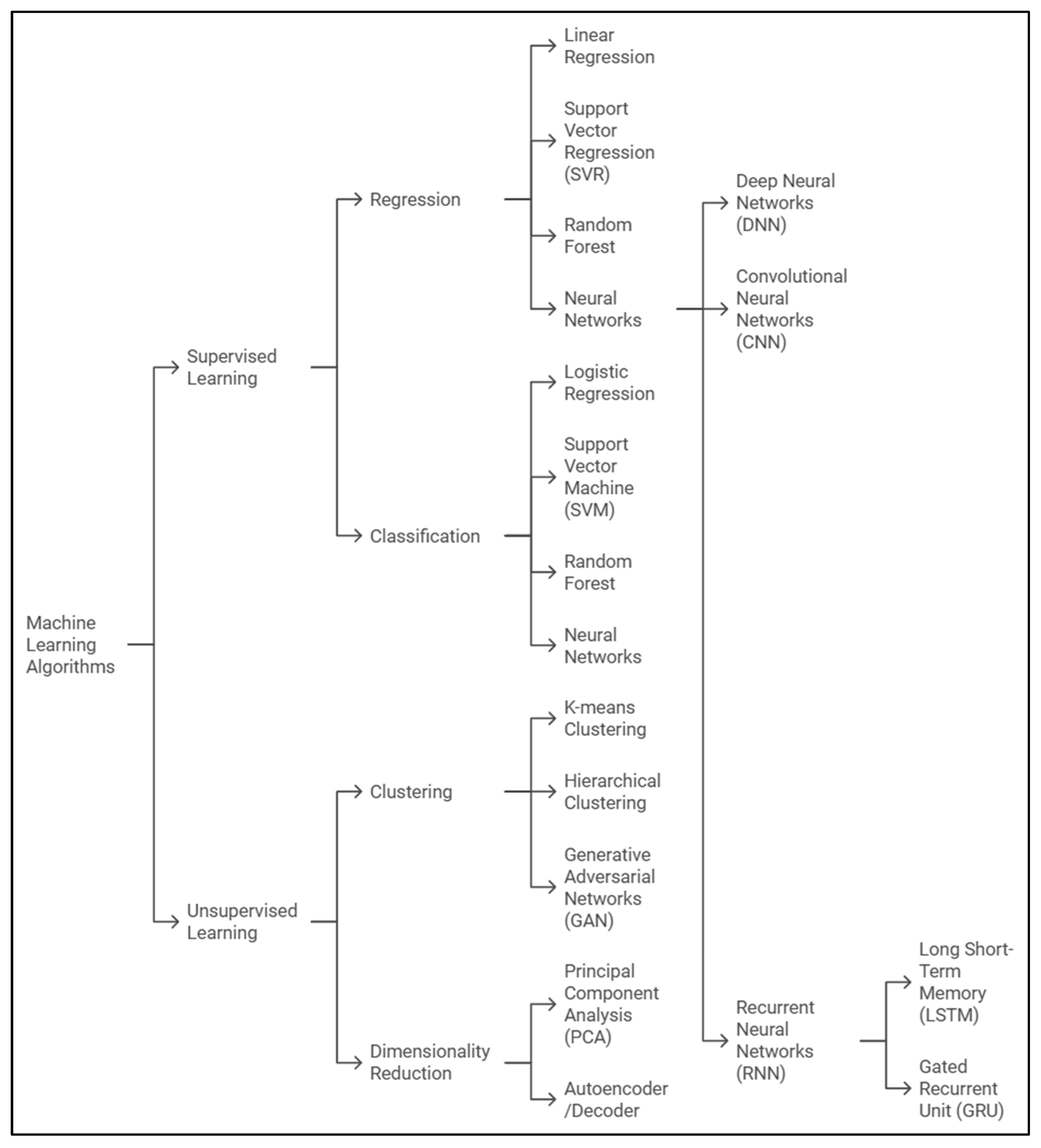
Figure 2.
Workflow for systematic literature review and bibliometric analysis.
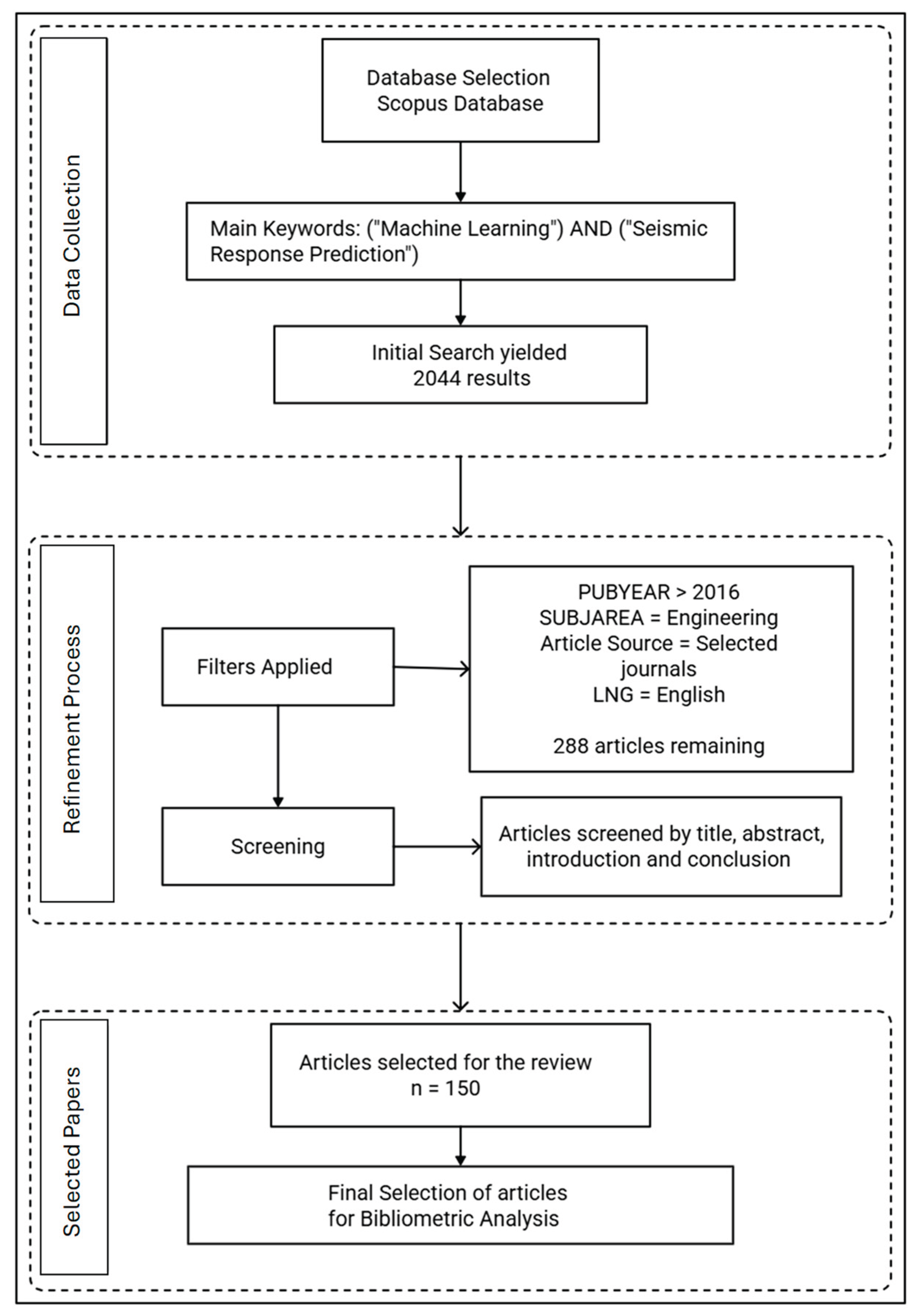
Figure 3.
Keywords co-occurrence network with the threshold of 3.
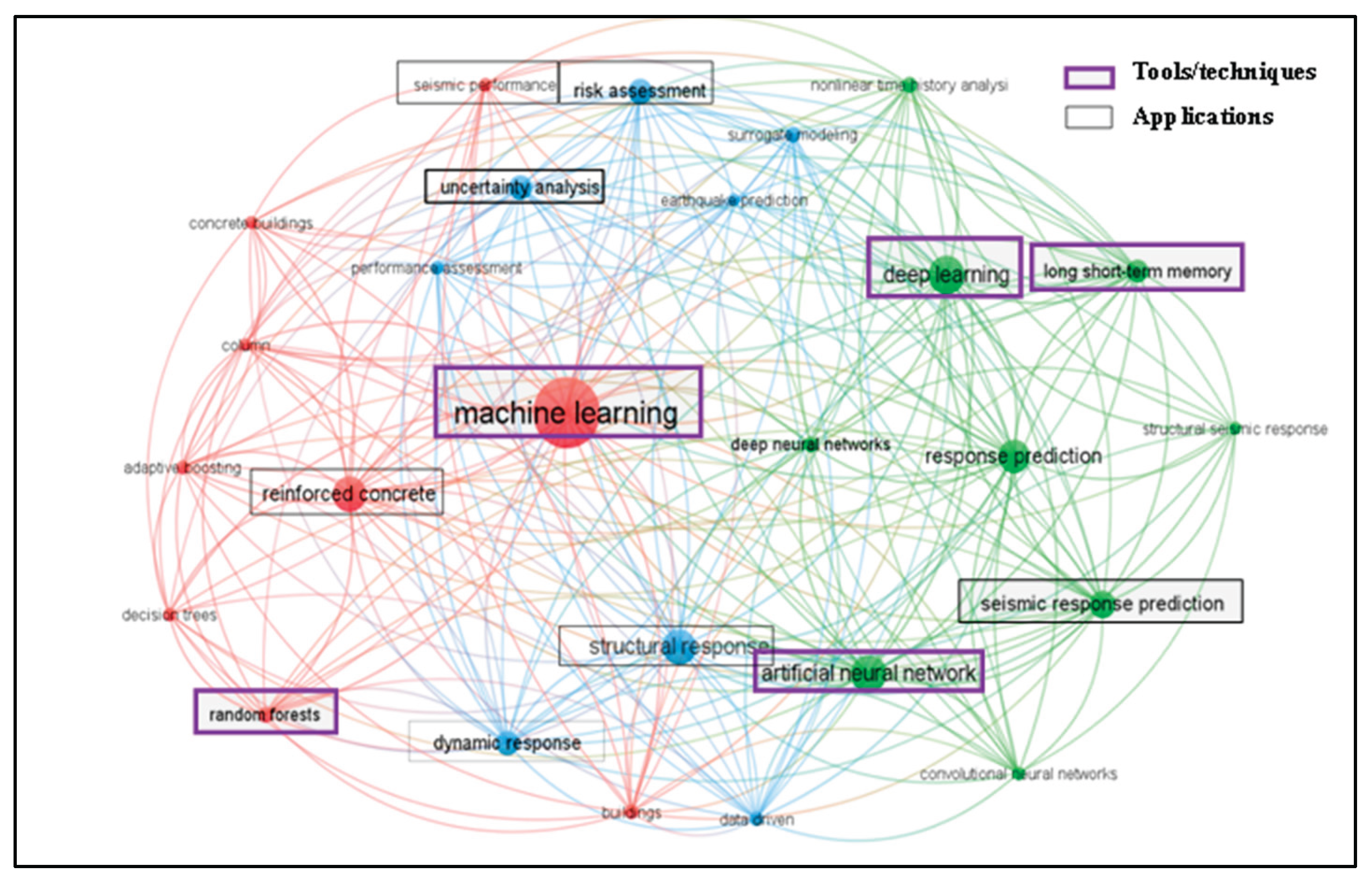
Figure 4.
Yearly trend of document publications related to ML applications in seismic performance assessment.
Figure 4.
Yearly trend of document publications related to ML applications in seismic performance assessment.
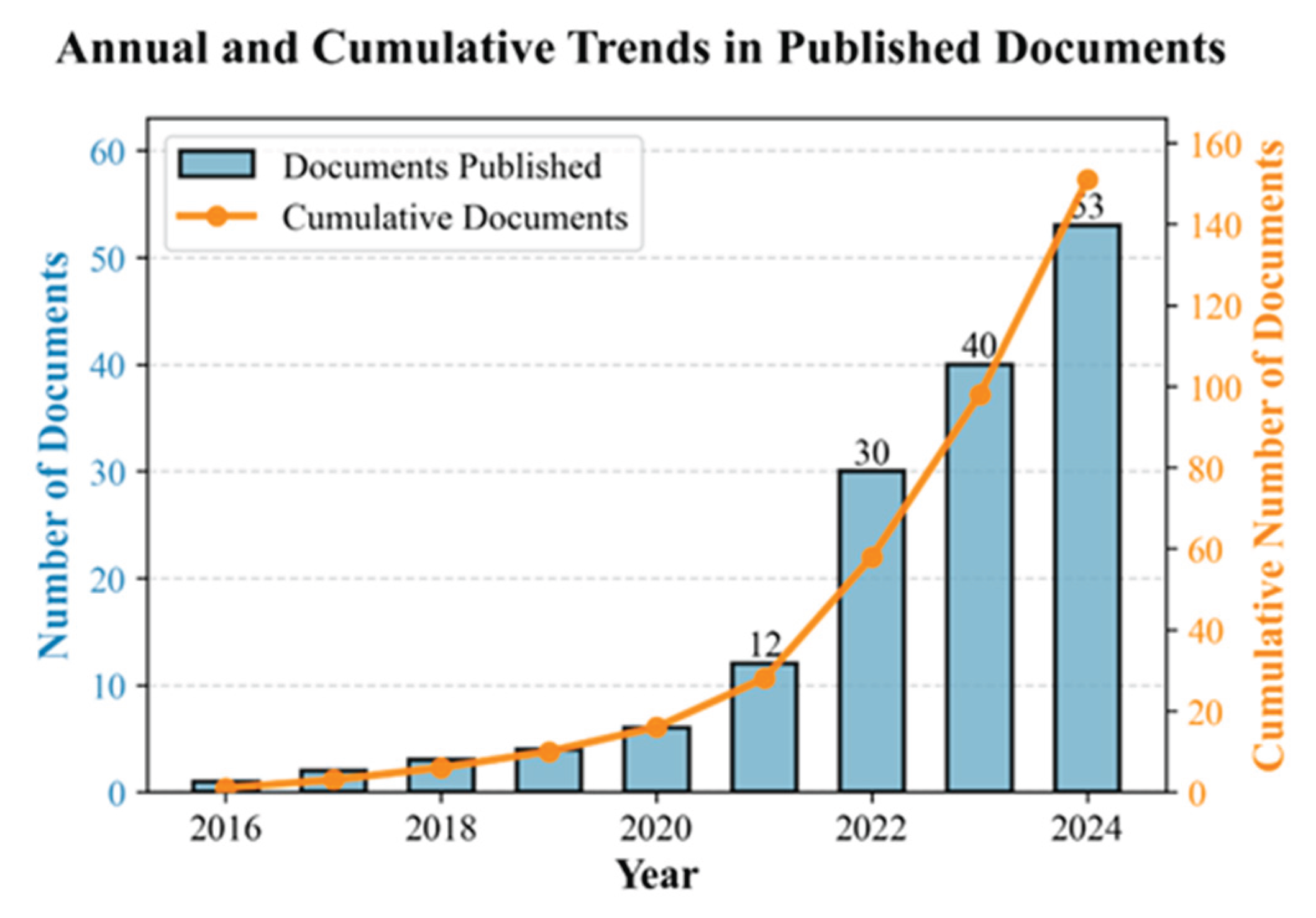
Figure 5.
Regression-based algorithms: (a) linear; and (b) logistic regression.
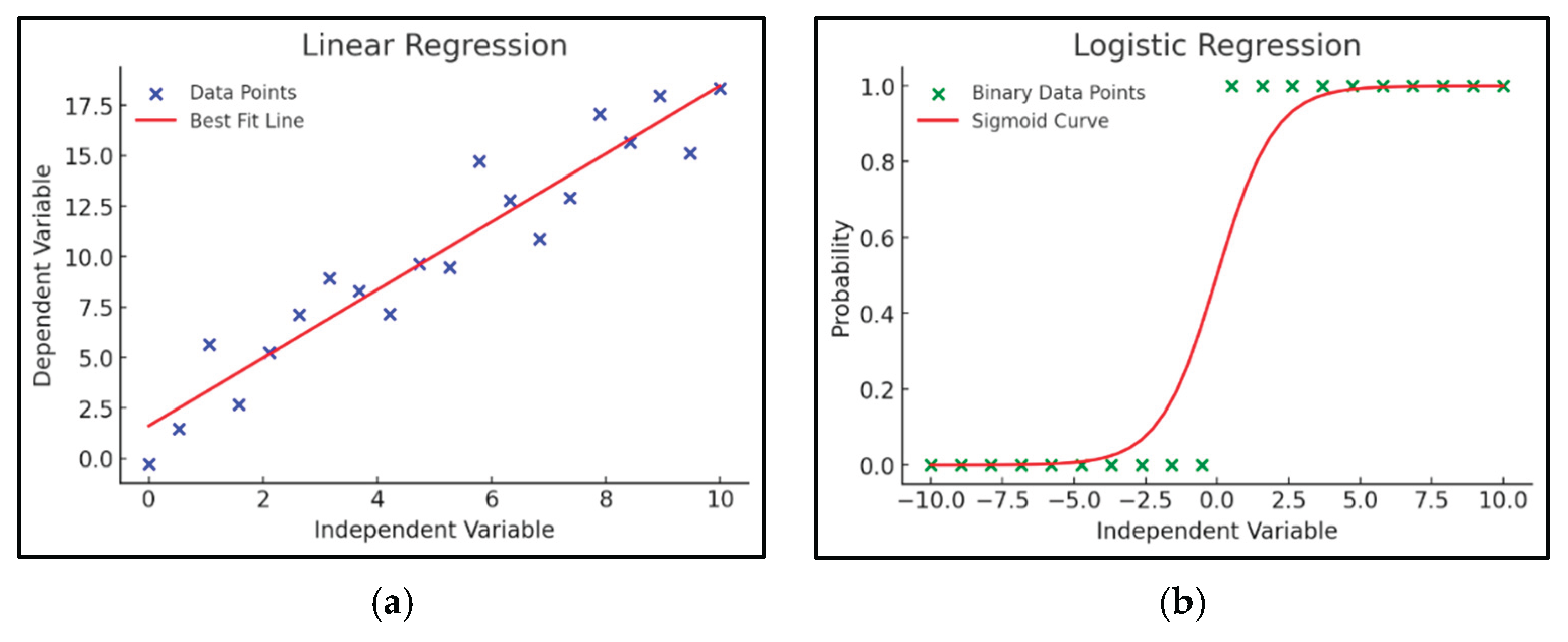
Figure 6.
Example of ensemble model: (a) Standard decision tree DT, and (b) Random Forest (RF) tree diagram.
Figure 6.
Example of ensemble model: (a) Standard decision tree DT, and (b) Random Forest (RF) tree diagram.
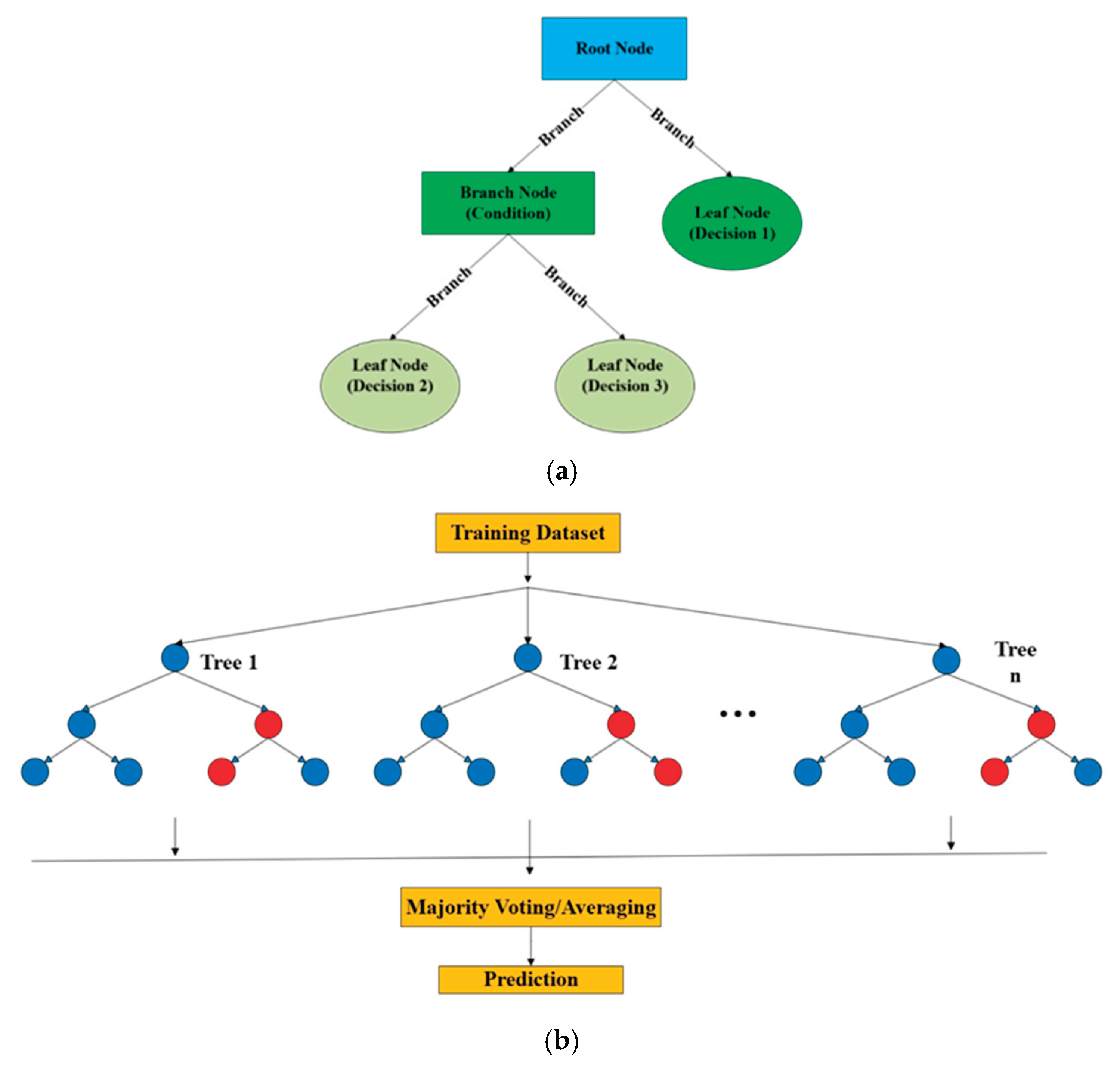
Figure 7.
Graphical representation of the adaptive boosting technique AdaBoost.
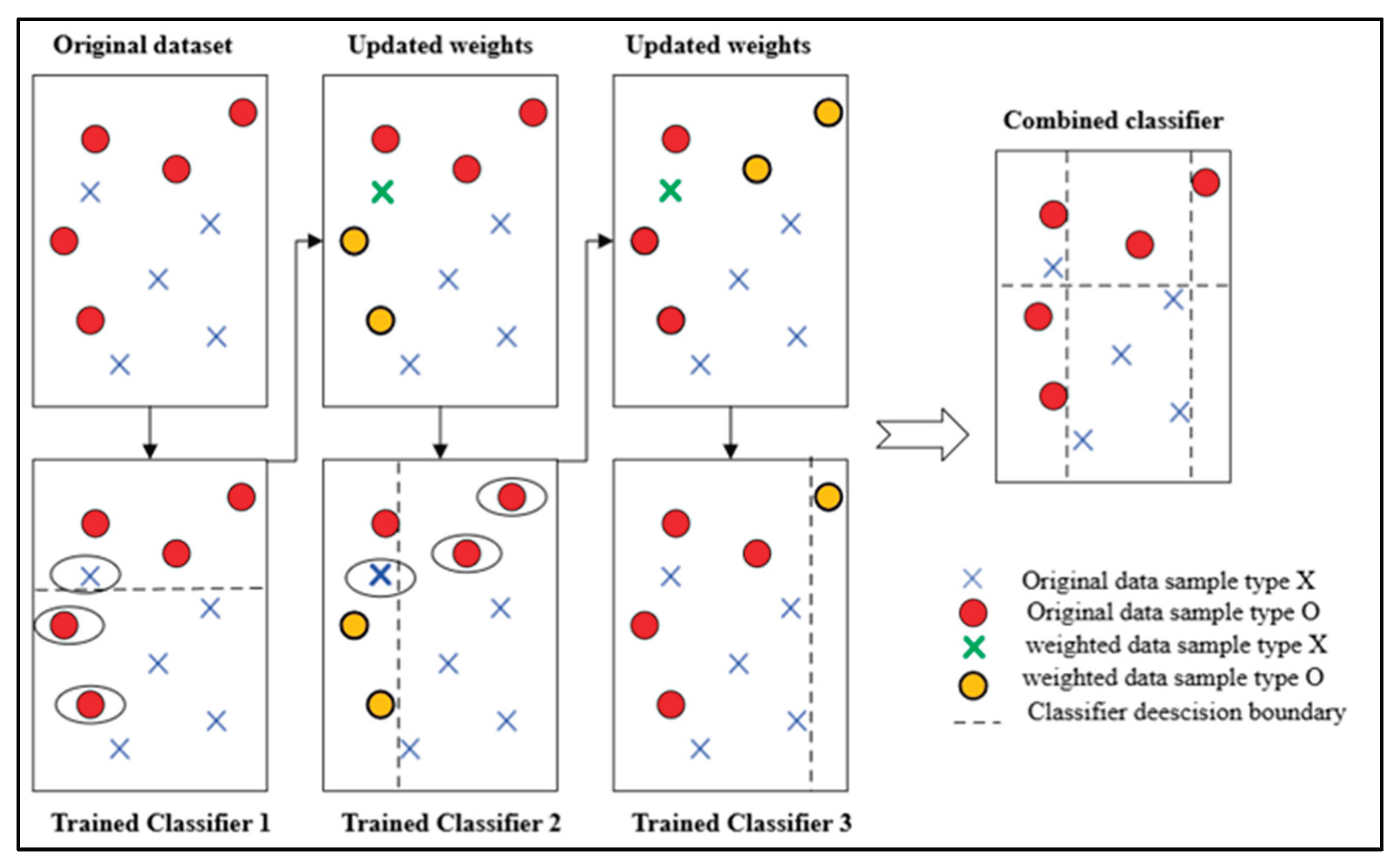
Figure 8.
Support Vector Machine (SVM) for the following: (a) Classification and (b) Regression.
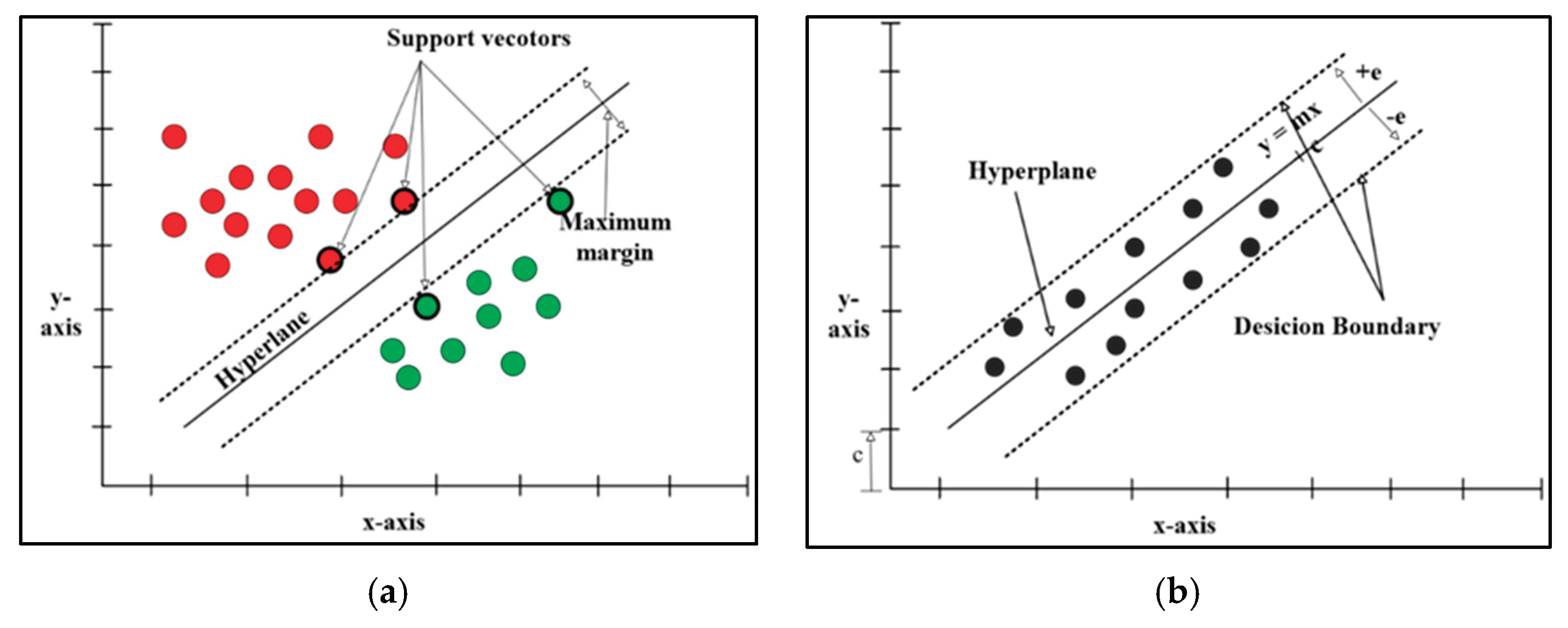
Figure 9.
Illustration of a typical Artificial Neural Networks (ANNs).
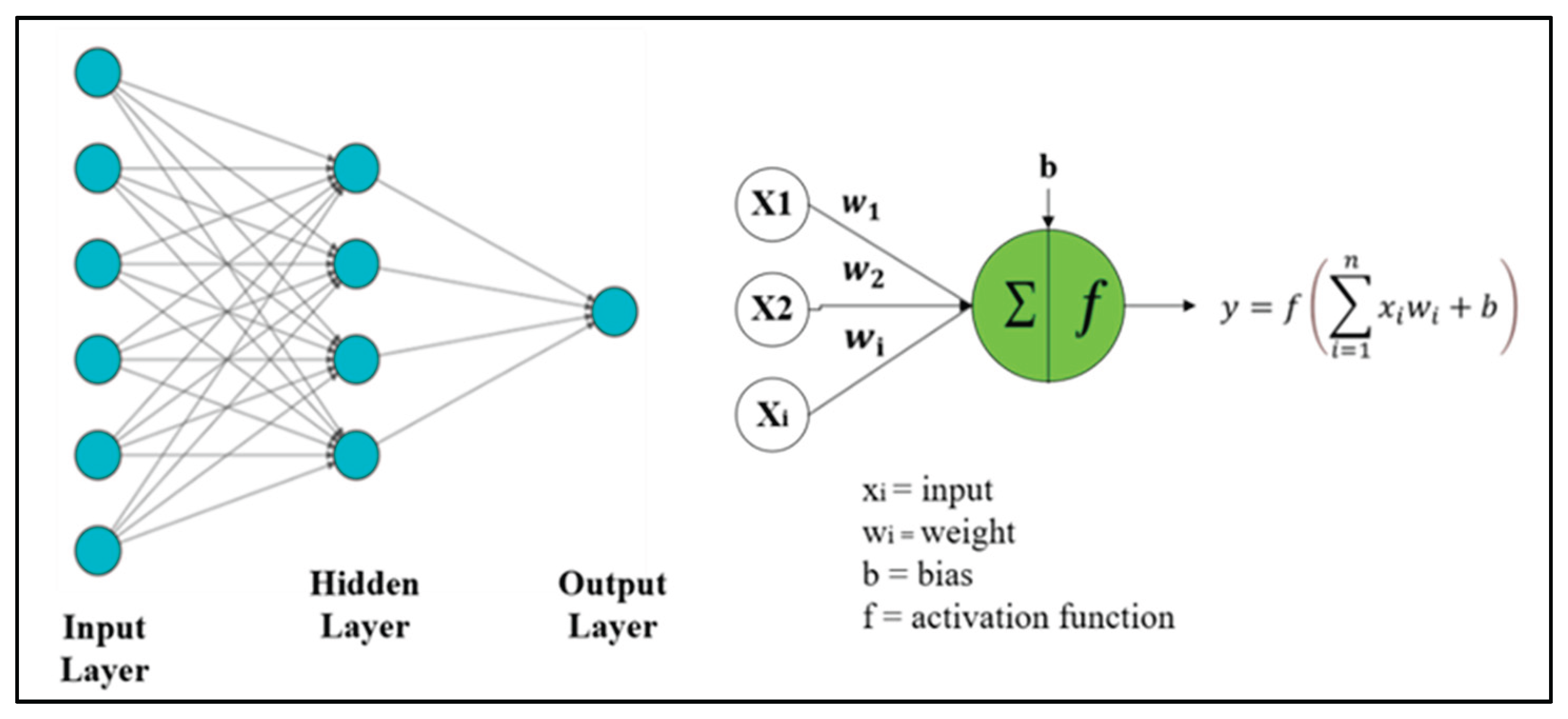
Figure 10.
Example of Convolutional Neural Network (CNNs).
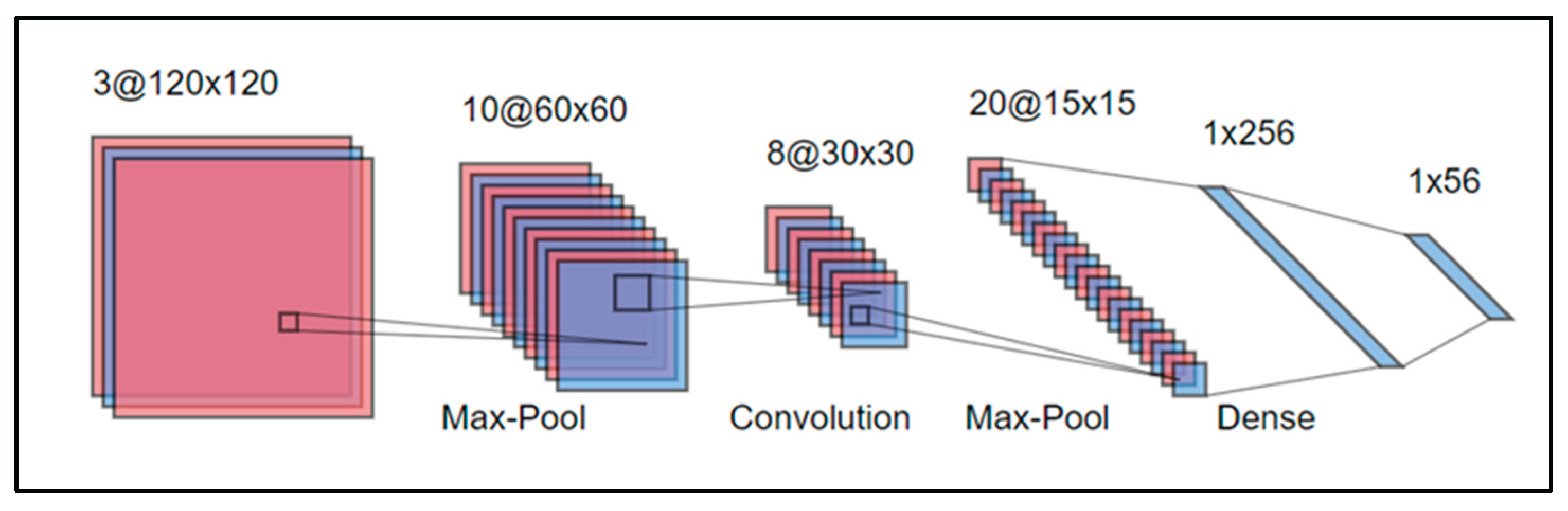
Figure 11.
Example of recurrent Long-Short-Term Memory (LSTM) neural network: (a) recurrent and (b) long-short-term.
Figure 11.
Example of recurrent Long-Short-Term Memory (LSTM) neural network: (a) recurrent and (b) long-short-term.
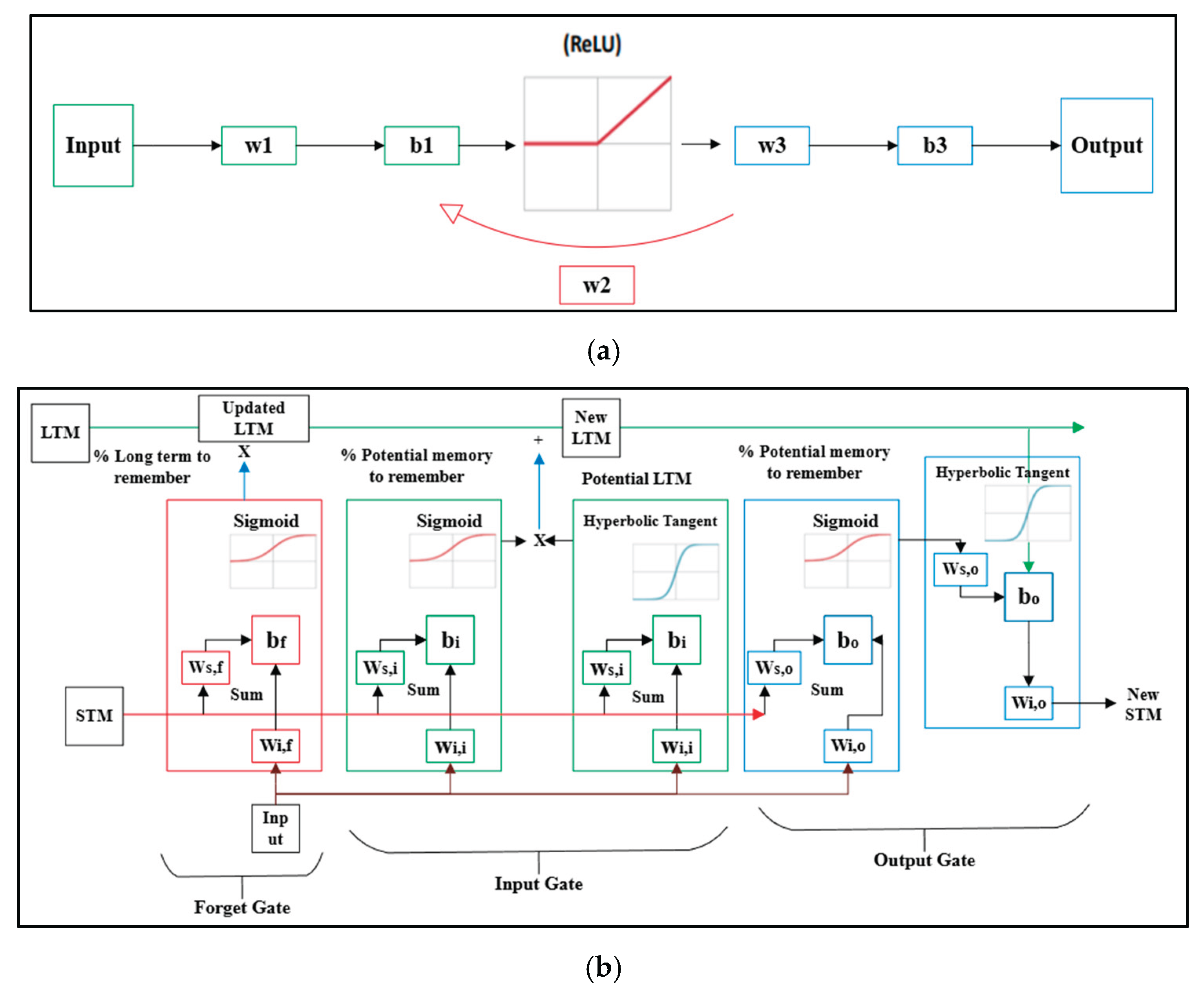
Figure 12.
Model Distribution and Application Frequency: (a) Distribution of ML and DL Models used in Failure Mode Identification & strength/capacity prediction; (b) Frequency of Applications in Different Structural Components.
Figure 12.
Model Distribution and Application Frequency: (a) Distribution of ML and DL Models used in Failure Mode Identification & strength/capacity prediction; (b) Frequency of Applications in Different Structural Components.
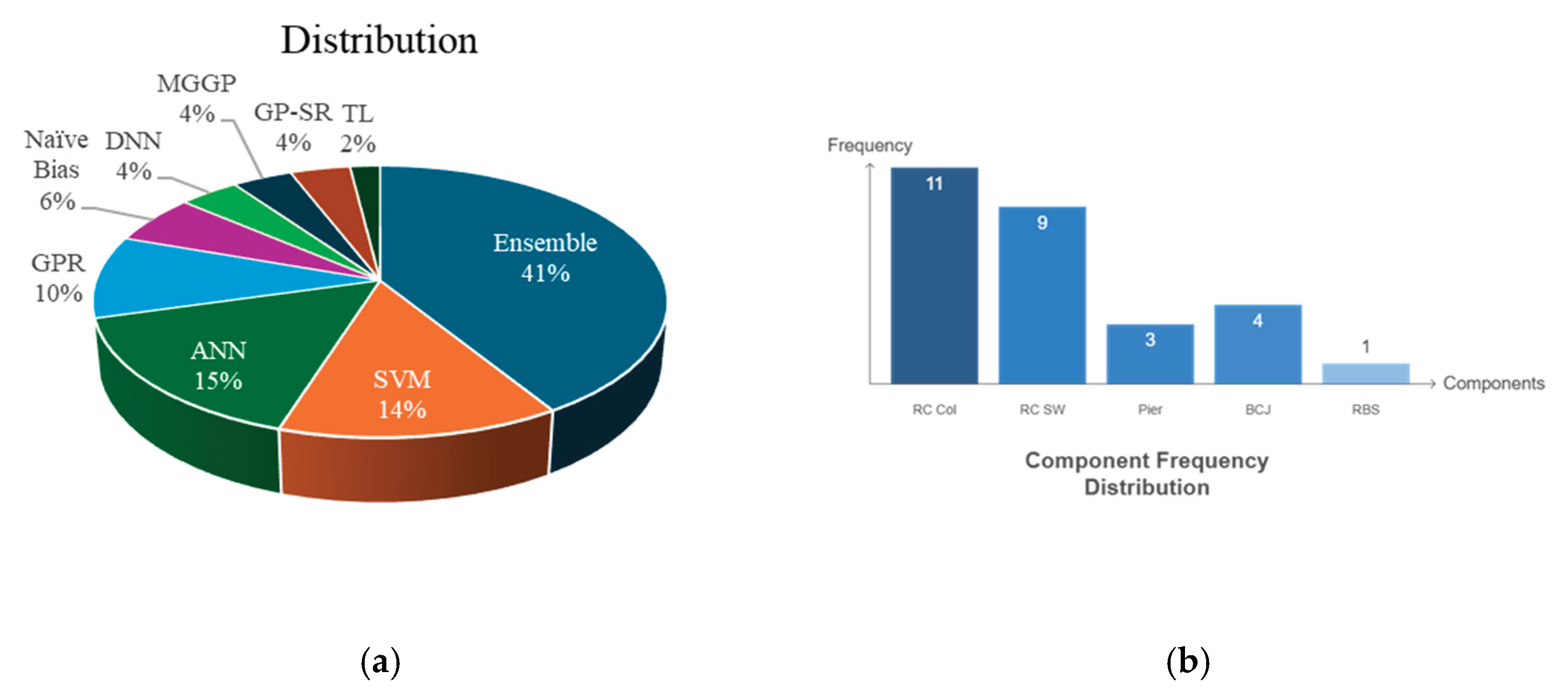
Figure 13.
Model Distribution and Application Frequency: (a) Distribution of ML and DL Models used in Failure Mode Identification & strength/capacity prediction; (b) Frequency of Applications in Different Structural Components.
Figure 13.
Model Distribution and Application Frequency: (a) Distribution of ML and DL Models used in Failure Mode Identification & strength/capacity prediction; (b) Frequency of Applications in Different Structural Components.
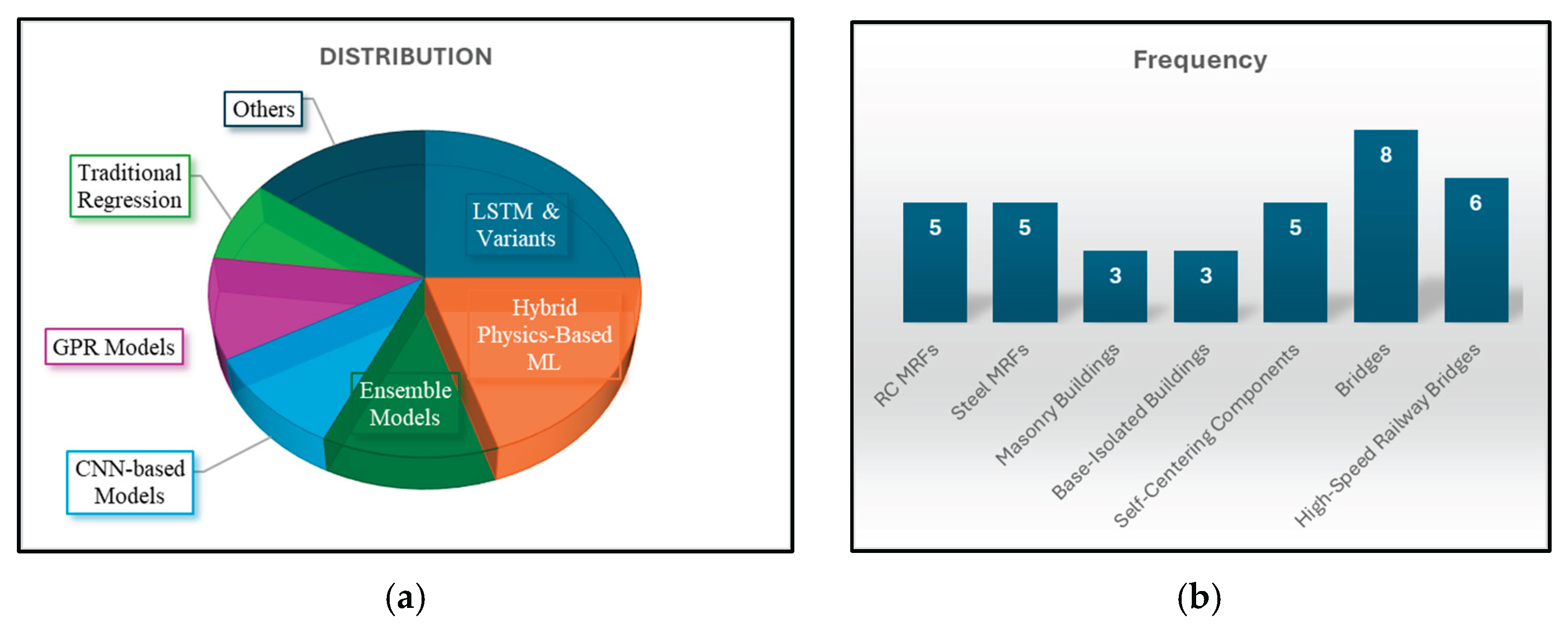
Table 1.
Representative review studies on ML applications in earthquake engineering.
| References | Titles |
|---|---|
| Afshar et al. 2024 [6] | Machine-Learning Applications in Structural Response Prediction: A Review |
| Xie 2024 [7] | Deep Learning in Earthquake Engineering: A Comprehensive Review |
| Soleimani et al. 2022 [8] | State-of-the-Art Review on Probabilistic Seismic Demand Models of Bridges: Machine-Learning Application |
| Sun et al. 2021 [9] | Machine learning applications for building structural design and performance assessment: State-of-the-art review |
| Jimenez et al. 2024 [10] | Machine Learning for Seismic Vulnerability Assessment: A Review |
| Thai 2022 [11] | Machine learning for structural engineering: A state-of-the-art review |
| Xie et al. 2020 [12] | The promise of implementing machine learning in earthquake engineering: A state-of-the-art review |
Disclaimer/Publisher’s Note: The statements, opinions and data contained in all publications are solely those of the individual author(s) and contributor(s) and not of MDPI and/or the editor(s). MDPI and/or the editor(s) disclaim responsibility for any injury to people or property resulting from any ideas, methods, instructions or products referred to in the content. |
© 2025 by the authors. Licensee MDPI, Basel, Switzerland. This article is an open access article distributed under the terms and conditions of the Creative Commons Attribution (CC BY) license (http://creativecommons.org/licenses/by/4.0/).
Copyright: This open access article is published under a Creative Commons CC BY 4.0 license, which permit the free download, distribution, and reuse, provided that the author and preprint are cited in any reuse.


