
Submitted:
21 August 2025
Posted:
22 August 2025
Read the latest preprint version here
Abstract
A suggested new inverse-square law force, similar to Gravity, but it is coupled to angular momentum instead mass, explains without any further assumptions, the Dark Matter, predicting the flat rotation curves of galaxies, the Bullet Cluster, the Tully-Fisher relation, the existence of Dark Matter in galaxies' Halos, the absence of Dark Matter in our solar system and others, besides the Dark Energy with the smallness of its value. This force is negligible at small distances from the center of rotation of a given system. It increases with distance from the center until it dominates over the gravity force, which is shown to happen in the outer regions of galaxies or large-scale universe structures. hence, a force of the large-scale structures. This new force is mediated by particles carrying spin 2, which emerge naturally from gauging the Lorentz symmetry of spacetime and are coupled to the angular momentum density tensor as its source. The existence of this field is essential for completing the Einstein field of gravity, which dominates the smaller scales. The coupling constant calculated from the observed galactic parameters of this force appears to be so small that it cannot be detected in any laboratory, which may explain why "dark matter" has not been found despite extensive research. Dark Matter and Energy are shown to be just two different integrative parts of this single force. This paper includes the theoretical framework and down-to-earth calculations proving the above-mentioned arguments.
Keywords:
dark energy
; dark matter
; angular momentum
; flat rotation curves
; Tully-Fisher relation
; gravity
1. Introduction
The rotating stars around the galaxy were found to be in deviation from classical gravity calculations [20], which is also known as the galaxies’ flat rotation curves. The velocity of a star revolving around the galaxy’s center becomes constant as we get more distant from the galaxy’s center, instead of decreasing according to Newton’s law of gravity. Many theories are trying to explain these flat curves. The two most popular theories are the Dark Matter [21], which suggests very weakly interacting particles. This matter should be found mainly in the galaxies’ halos; this extra mass should explain this deviation and many other unexplained phenomena. The problem with this theory is that no such particles have been found until now, despite continuous intensive searches for decades. The other theory is Modified Newtonian Dynamics (MOND) [18], which argues that at far distances from the galaxy’s center, where the acceleration is very low, Newtonian dynamics becomes invalid, and we should use non-Newtonian dynamics. In other words, the second law must be changed to explain these deviations. This theory also has problems, as many observations are against it [22].
Another independent unexplained phenomenon is the expansion of the universe, which Current physics can’t explain either. There is a mysterious energy source called Dark Energy that drives this expansion. Many models are suggested to explain this kind of energy [23], like Einstein’s cosmological constant, quintessence field [24], and others, but none of them have much success.
Dark Matter and Dark Energy make up most of the universe [23].
Here, we suggest a new field. Called the Blue Field, whose quantum excitation or particle,is the Bluon, carries spin 2. This new field is coupled to the angular momentum tensor of the matter, making a measurable force between them. This force is so tiny that its effects can be measured only at large distances.
This new field can explain the two phenomena, the Dark Matter (the "missing mass") and the Dark Energy, as one single entity. In other words, unify them in one field.
This field is also motivated by the symmetries of space-time, the Lorentz symmetry. This field is derived by gauging this symmetry, which we will show later on.
The coupling constant of this field is found to be so small that no laboratory on Earth can measure it. This explains why it has not been spotted yet. Its effect is observable only at large scales, e.g., the halos of galaxies.
we will start with a classical description of the suggested Blue Force and how it explains flat rotation curves of spiral galaxies, the Tully-fisher relation [16], estimating its coupling constant from available cosmological data, reproduces MOND predictions using only regular Newtonian dynamics, calculating the missing mass of the galaxies, clusters, Explaining the Bullet Cluster phenomenon by introducing a new type of light rays’ bending that depends not on the curvature of space-time as in Einstein’s general relativity but the orbital angular momentum the photons carry. The Dark Energy formulation will also be derived, and its value will be estimated and compared to observations, with a very good match. Other cosmological observations will also be discussed. at the end, we will show the quantization of the Blue Field and how it naturally emerges from gauging Lorentz symmetry and the derivation of the classical force law, which we started this paper with. See the next section.
2. The Proposed Model at the Classical Level
The space-time is invariant under translation symmetry, and the conserved current of this symmetry is the 4d stress-energy tensor , which is the source of the familiar gravity field. The space-time is also invariant under the Lorentz group, and the conserved current of this symmetry is the 4d angular momentum tensor density . What is the equivalent force or field charged under this symmetry, and has the angular momentum tensor as its source? As we know, none. Here, we suggest another gravity-like field force that is charged under the Lorentz symmetry and coupled to the angular momentum tensor, which should complete the picture of the invariance of space-time under the Poincaré group (Lorentz group+translation ).
In this context, the suggested potential produced between two point rotating objects is as follows:
. are constant angular momentum tensor of each particle. The produced force is:
r is the distance between the two particles’ centers of mass. g is the coupling constant of the force. This formulation is very similar to the Coulomb law. The angular momentum here is analogous to the electric charge. In a continuum medium , it becomes:
and the potential energy:
is the angular momentum spatial density.
The carrying particle of this field has spin 2 as a gravity field (Graviton), thus always an attractive force [5].
The angular momentum tensor in four dimensions:
where , P is the four-momentum and X is the four position.[2,3].
The tensor is additive, the total angular momentum of a system is the sum of the angular momentum tensors for each constituent of the system:
Next, there are six independent quantities altogether. Each of them forms a conserved quantity. The three components
are the familiar classical 3-space orbital angular momentum , and the left three:
are the dynamic mass moments multiplied by c. The three dynamic mass moments are defined as [3]
They are conserved quantities and equivalent to the conservation of the center of mass (C.O.M):
Choosing t=0 frame and a particle almost at rest (or in the center-of-mass coordinates in the case of an ensemble [6] ), i.e., . Substituting in the dynamic mass moment gives:
Or in short:
Where , m is the particle’s mass, and is the distance from the center of mass. Next, defining:
Therefore, can be considered as "spatial angular momentum" in which the particle is "moving " at the speed of light (particle has () speed and anti-particle has () speed, i.e., moving backward in time).like the electromagnetic tensor expansion [25]
where is equivalent to and is equivalent to , we obtain:
The same is the case of two different angular momenta :
Hence, the force becomes:
with the definition: .
This force can be split into two interesting parts using the following fact:
Because , Equation21 becomes:
It is defined as the force between the dynamic mass moments of two particles.
This force is constant across space-time and thus will be canceled out in the bulk except for the edges, as will be shown later on, and will play the role of Dark Energy. Therefore, this part can be canceled out and replaced by constant energy density (the Dark Energy) across space-time, which will also be shown later on.Hence, we are left with a non-constant local force :
Which will play the role of Dark Matter, as will be shown in the coming sections.
2.1. The Force Between Two Spatial Angular Momenta and the Subsequent Dark Matter Explanation
The total angular momentum is:
Where is the orbital angular momentum, and is the self-rotation angular momentum or the spin (in classical terms, because we deal with stars, not elementary particles).
The force between two spatial angular momenta by the Blue Field is:
(27)
Throughout this paper, the angular momenta are assumed co-linear , so we will use and reciprocally unless otherwise stated.
This assumption is reasonable and natural because all the rotating masses mostly rotate in the same plane as the ecliptic plane in the solar system or the disc of a galaxy.
2.1.1. The Force Between the Sun and the Earth
choosing the Sun to be located at and the Earth to be located at and choosing the reference point to be , i.e., , and . . thus,
The sun’s mass is bigger than the Earth’s mass : . thus,
is the center of mass. Therefore, approximately, the Earth is at a distance r from the C.O.M., and the Sun is at from it, i.e,
The Sun’s angular momentum is:
is the moment of inertia of the sun is the angular velocity of the sun around itself. The first term is zero because of Equation(30)
The Earth’s angular momentum is:
is the moment of inertia of the Earth, and is the angular velocity of the Earth around itself. Because the Earth has a big orbital angular momentum and a tiny bulk, the latter is negligible. By substituting in Equation(26) we obtain:
The force decays as ! Unlike gravity, which decays as .
Therefore, doesn’t contribute.
2.1.2. The Force Between a Galaxy and a Star and the Flat Rotation Curves
Choose the Galaxy to be located at and the star to be located at and choose the reference point to be : , Thus:
The galaxy’s mass is bigger than the star’s mass : . gives,
Therefore, the star is at a distance r from the C.O.M. and the Galaxy at from it, i.e.,
The Galaxy’s angular momentum:
Where is the galaxy’s spin around itself, and is the orbital angular momentum around the center of mass (binary system with the star). The first term is zero due to Equation(39) because the galaxy is massive compared to the star.
The star’s angular momentum:
Where is the moment of inertia of the star, is the angular velocity of the star around itself (spin). Because the star has a big orbital angular momentum and a tiny bulk, the latter is negligible. is the orbital angular momentum of a rotating star around the galaxy at a distance r from the galaxy’s center with orbital velocity :
Calculating the for a Galaxy with a disk shape (two-dimensional as spiral galaxies): Taking a general mass density distribution in a unit area A, the mass is :
m is any integer number. Calculating the mass enclosed at radius r:
assuming a general velocity distribution of the mass density:
n is any integer number. Thus, the total spin becomes:
Therefore,
Where depends on the shape, mass, and velocity distribution of a given Galaxy.
The force becomes:
Next, the stable orbits of a rotating star around the center of the Galaxy by including the Gravity and the Blue Field forces, are given by :
with the limits,
Therefore, the velocity continues to be constant to very far distances from the galaxy’s center (even very far beyond the Halo), which follows the recent big research that found so [14]. This contradicts the popular Dark Matter theory, which predicts a velocity drop after the halo of the galaxy ends (most of the Dark Matter lies there according to Dark Matter theory ) , which wasn’t found in this research.
The radius at which the two forces become equal, we denote by :
- The Gravity Force dominates. So we ignored the Blue Force.
- The Blue Force dominates. So we ignore the Gravity Force.
- Transition zone. The two forces are equal.
Calculating by equating the two forces:
From the Gravity Force, we know:
Substituting in Equation (53) gives:
Hence, the orbital velocity of the stars around the center of the Galaxy can be approximated:
where c is constant.
A spiral galaxy built approximately from a disk (approximated by 2d mass density- we ignore the bulge which is smaller than the planar late-type spiral galaxies (by Hubble’s classification of galaxies) and include it in the disk ) and a Halo , is which is very sparse relative to the disk, so can be set to zero or almost zero. Thus, the mass of the galaxy versus distance r from the center can be modeled as (in section (Section 2.1.4) we will explain why this approximation is true ):
Calculating the rotational velocity expected from the Gravity Force only (assuming the Blue Field doesn’t exist) around the center of the Galaxy according to Newton’s law:
gives:
Adding the Blue Force using Equation(56) and assuming the radius of the disk( R) is
we also assume that most of the mass of the galaxy is enclosed in (all the mass concentrated in the center of the galaxy) which is not the same as which is defined as the radius of where there are still visible stars bounded to the galaxy, it can be far away from its center and the total mass density there approaches zero i.e., but the total mass of the galaxy. We call the effective galaxy radius.
Beyond the disk or effective galaxy’s radius , the Gravity Force is weak, and the Blue Force begins to dominate. Therefore:
Where and constant, equals:
The Halo is very sparse. Therefore, doesn’t contribute to the total angular momentum of the galaxy , which will remain constant as no more mass (angular momentum) is added. then
M is the total mass of the galaxy, and S is the total angular momentum of the galaxy. Therefore, the velocity remains constant, i.e., . Hence, a flat rotation curve !
The asymptotic velocity (at a radius very distant from the center of the Galaxy) is:
Or in short,
The sparse halo indicates again that beyond , there is negligible mass and angular momentum. Thus, doesn’t change.
2.1.3. Extracting the Coupling Constant g
Calculating the total angular momentum of the Galaxy according to Equation(49)
for the contribution is negligible and is set to zero. Putting (the Galaxy’s radius) , which depends on each spiral galaxy type. According to Equation(60), ( the Galaxy’s mass) and Eqs.(63) (64) gives:
using Equation (56)
gives:
canceling from the two sides:
where depends on the shape, mass, and velocity distribution of the given Galaxy, M is the total mass of the galaxy, and R is the disk’s radius.
2.1.4. The Tully-Fisher Relation and Modified Newtonian Dynamics (MOND)
Tully–Fisher relation (TFR) is an empirical relation between the asymptotic rotation velocity of the galaxy’s outer stars and the galaxy’s mass (M): [16] This relation can be derived from Eqs. (58),(55) as follows :
From Gravity Force:
The spiral Galaxies have a discoid shape and a mass density of the disk according to Enisato profile [17] as follows:
The parameter controls the degree of curvature of the profile. For spiral galaxies [19]. is the mass density at the center of the galaxy.
A is the scale length of the galaxy, and the radius of a spiral galaxy () which can be defined, for example, where the mass density (visible mass) becomes n times lower than :
So the total mass of the galaxy (in 2d disc shape), by integration by parts, is:
For the exponents approximated by, we obtain,
thus,
substitute in Equation (74) gives:
hence,
choosing r to be the radius we obtain,
But M( the Galaxy’s mass) according to Equation(65) and using Equation(66) gives:
which is TFR!
Next, the Modified Newtonian dynamics (MOND) is an alternative theory for Dark Matter that explains the TFR [18], which predicts the empirical relation:
where [18] is a tiny constant acceleration, below which the classical gravity stops working, and the realm of non-Newtonian dynamics dominates. Equating to the relation in Equation (82) gives:
Substituting the values in this equation gives an average mass density .
by Equation(79) , aslo satisfies
Substituting in Equation (83) gives:
This is the gravitational acceleration at the radius where the Gravity Force becomes equal to the Blue Force calculated before. Beyond this radius or below this acceleration, the Blue Force dominates and gives a deviation from the gravitational acceleration as expected. Thus, the Blue Force recapitulates the MOND predictions without the need for MOND itself. The regime is equivalent to the MOND regime in MOND theory, where the Newtonian dynamics isn’t valid anymore according to MOND, but here it is just because of another Newtonian force, the Blue Force.
Must be a constant among the spiral galaxies, so these arguments can hold. It is the average mass density in the central regions of spiral galaxies. It could be constant because of similar dynamics in the Galaxy’s center, e.g., the supermassive black hole effects.
2.2. The Force Between Two Identical Dynamic Mass Moments and the Emergence of Dark Energy
The potential energy between two dynamic mass moments of two objects, according to the approximation in Equation (22) is:
and the force between them:
The center of mass of two particles located at and the distance in between is r. Choosing the reference point to be . Thus , ,⇒.
The two masses are identical . Thus:
Substituting in Equation(88) gives
The force is independent of r! ,it is a constant in space-time.
This force doesn’t have any special direction. it is a uniform force that cancels out in the bulk except for the boundary and acts upon it like the pressure of a gas pushing the edges of a container, but with a negative force, as this force is always attractive. Therefore, it behaves like vacuum energy! The relation between energy density and pressure is given by:
Where P is the pressure, and A is a unit of area. This is a Lorentz invariant constant energy density in space-time that can play the role of a vacuum-like energy. Thus, the Dark Energy. The energy density is :
where the Planck mass. The full calculation is in the Appendix C
3. Calculations and Predictions of the Model
Let’s do some calculations and see how the suggested model fits the cosmological observations.
3.1. Estimating the Coupling Constant g
Taking the average of Equation(73):
Using the well-known covariance formula:
Gives:
Defining:
Gives:
Using the variance formula:
Gives:
Thus, the can be calculated by up to multiplicative and additive constants.
Thus:
Which is estimated the coupling constant for the suggested Blue Force.
It is impossible to measure this tiny value in any lab on Earth. This explains why the "Dark Matter" is so elusive and has not been detected yet in any particle accelerator!
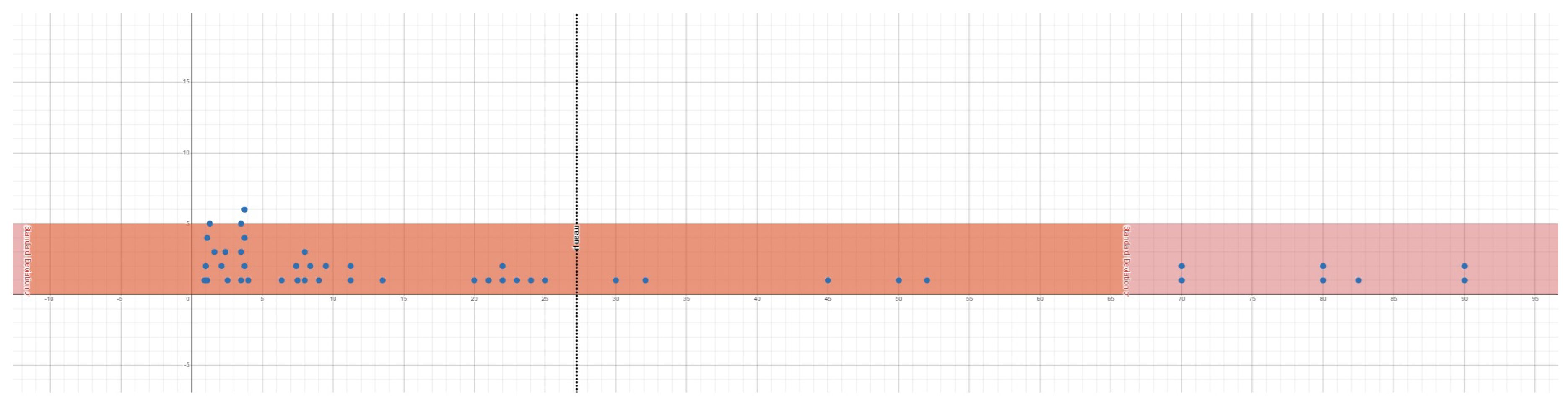
Next, the values of are closely situated around the mean and only one standard deviation from it. i.e., they are minimally dispersed as shown in Figure (Figure 1). This strongly supports the existence of this new force.
Notice in these calculations, we didn’t include the errors from the measurements of the radii and masses of the galaxies to keep the simplicity of the calculation, including their errors:
thus,
where we ignored . Then, the average error for is :
3.2. Estimating the Dark Energy Density
The coupling constant estimated in the previous section is .
The Planck mass is given:. Substituting values in Equation (94) the Dark Energy is:
The well-known observed Dark Energy value is about : The two values are very close! Besides, this new force explains why the known Dark Energy density is so small (almost zero), a hierarchy problem. Here, it is obvious because the coupling constant of this new force g is almost zero.
3.3. The Effects on Our Solar System
From Equation(113), the Blue Force between the sun and Earth is:
Where is the total spin (self-rotation) of the Sun, is the moment of inertia of the Sun: , where is the Sun’s mass, is its radius, and its self-rotation angular velocity. is the earth’s mass, is the orbital angular velocity of the earth’s rotation around the sun. , where is the revolving velocity of the Earth around the Sun. is the distance between the Sun () and the Earth (). renaming quantities for more clarity: , , , , ,. Rearranging terms of Equation (113) gives:
Inserting the well-known values:
G= Gravity constant.
.
.
.
.
by Equation (107). then,
Hence, the force is immeasurable in our solar system!. This explains why there is no "Dark Matter" in our solar system!
Inserting parameters of other planets in the solar system gives similar results.
The r in which the Blue Force becomes comparable or greater than gravity is when , using the well-known orbital velocity of the earth , which is about m/sec, gives:
While the radius of the Milky Way Galaxy is only about m. Therefore, there is no way we can measure this force.
Next, replacing the Sun with the Milky Way Galaxy parameters and substituting , which is also known as the galactic year, the time the Sun takes to revolve around the center of the galaxy. It is also considered the asymptotic rotational velocity as the sum exists in the outer regions of the Milky Way. We obtain:
Miraculously!, the Blue force equates the gravity at radii located in the Milky Galaxy edges, i.e., the Halo! (The Milky Way Disk’s radius ) This explains why the "hypothetical Dark Matter" lies mainly there! as this force becomes as strong as gravity and starts to dominate.
3.4. The Dark Matter & Energy in Different Structures of the Universe
3.4.1. Cluster’s Dark Matter & Energy
The potential energy of the Blue Field between two galaxies in a cluster of galaxies is:
is the position of the two galaxies. The Blue Force is:
is the total angular momentum. is the orbital angular momentum of each galaxy around its center of mass, and is the spin of each of the two galaxies around itself. assuming the two galaxies are identical (radius of the galaxy ). (orbital velocity), (self-rotational velocity ) and choosing . thus, . we have orbital-orbital interaction, spin-spin interaction, and spin-orbit interaction of the galaxies within the cluster (the interaction between a galaxy and the center of mass of the cluster is negligible as the latter is very massive as done in Equation(42)). Substituting and arranging terms in Equation(118) gives:
Where (grav. pot.) Stands for gravitational potential energy. Taking the average:
where (for a uniform random distribution [] ).
Gives:
This Blue potential energy quickly overcomes gravitational potential energy at large distances as the "coupling constant " grows quadratically relative to gravity. using values: R is the radius of an average galaxy, for the Milky Way . The average speed of a galaxy’s rotation around itself of the Milky Way is about ( galactic year). The galaxy’s orbital velocity in the cluster is about ( galaxy’s orbital velocity [26]). The cluster’s total radius is about (cluster’s total radius [26]). The average distance between galaxies is about [15] and from previous sections. G is the gravitational constant. Substituting these values in Equation (120) gives ( is negligible relative to 4 ):
Now, calculating the supposed "effective mass" that contributes to this potential energy, substituting back in :
thus,
assuming the cluster () has N galaxies with mass M each :
Therefore, the effective (measured) mass of the cluster is bigger than its actual mass (times 20 ); this extra mass is considered as the "Dark Matter"! This follows, in a rough estimation, the observation that most of the cluster’s mass, about 90%, is "Dark Matter" [4].
Notice that even when two masses are moving in a straight line relative to each other, they still have angular momentum . is the distance to their center of mass. The angular momentum for a linearly moving particle is:
Therefore, although the net angular momentum of the cluster may be zero as it doesn’t rotate in total, however, the galaxies within still have angular momentum relative to each other, according to the above argument (angular momentum density). Thus, the orbital-orbital interaction of galaxies within the cluster is non-zero if the galaxies move in straight relative to each other or circular orbits around their center of mass, and the above calculation still holds in both cases.
Now, the second part of the interaction is the dynamic mass moment. The dynamic mass moment force of the cluster is given by:
c is the speed of light. is the position of the galaxies.
Assuming the two galaxies are identical and choosing .
Plugging into Equation(128) and arranging terms gives:
This force is isotropic and constant across space-time (not only within the cluster) and thus cancels out with the other clusters in the universe. This equation is similar to Equation(92) for the Dark Energy. Thus, it is a part of the Dark Energy in Equation(94), but its value is negligible compared to the Dark Energy of the vacuum, as the vacuum is more energetically dense (Planck mass density) as follows: The Dark Energy of the vacuum from Equation(94) :
where the is the Planck density, which equals the Planck mass in a Planck volume= , where is a Planck length (in natural units). For the cluster, its Dark Energy density is:
is the average mass density of the cluster.
3.4.2. The universe’s Dark Matter & Energy
The density of galaxies in the entire universe is similar to the cluster of galaxies [14]Hence, Equation(120) also holds for the entire universe and gives the same result:
So the effective (measured) mass of the universe () which has n galaxies with mass M each, is:
Therefore, the effective (measured) mass of the universe is bigger than its actual mass. This extra mass is considered the "Dark Matter"! This is in accordance, in a rough estimation, with the observation that most of the universe’s mass, about 90%, is "Dark Matter" [27].
Now, the second part of the interaction is the dynamic mass moment. The dynamic mass moment force in the universe is:
c is the speed of light. is the position of the two adjacent galaxies in the universe.
Assuming the two galaxies are identical and choosing .
Plugging into equation (134) and arranging terms gives:
This force is isotropic and constant across the entire universe, just as in the galaxy’s case in Eq (131). The Dark Energy of the vacuum is as shown in Equation(130). For the universe, its Dark Energy density would be:
is the average mass density of the universe.
3.4.3. Galaxy’s Dark Matter & Energy
The same calculation in the cluster Section 3.4.1 can be applied to an elliptical galaxy or spiral galaxy, which can be considered as a "cluster of stars", the attraction between the angular momenta of its randomly moving stars imitates the existence of the "Dark Matter" within it, and the dynamic mass moment as Dark Energy as follows:
The potential energy of the Blue Field between two stars in the galaxy is:
is the position of the stars.
And the Blue Force is:
is the total angular momentum. is the orbital angular momentum of each star around its center of mass, and is the spin of each of the two stars. assuming the two stars are identical (radius of the star ) , (orbital velocity), (self-rotational velocity), and choosing , then . we have orbital-orbital interaction, spin-spin interaction, and spin-orbit interaction of the stars within the galaxy (the interaction between a star and the center of mass of the galaxy is negligible as the latter is very massive as done in Equation(42)).
Substituting and arranging terms in Equation(137) gives:
Where (grav. pot.) Stands for gravitational potential. Taking the average:
Where , for a uniform random distribution [] of an elliptical galaxy. , for spiral galaxies, all the stars rotate in the same plane (the galaxy’s disk), gives:
The spin of the stars is negligible to the orbital angular momentum around the galaxy, so we ignore the first term, which gives:
This Blue potential energy quickly overcomes gravitational potential energy at large distances as the "coupling constant" grows quadratically relative to gravity. plugging values: The average speed of a star’s rotation around the galaxy’s center of mass is about (galactic year) for the Milky Way, and the average distance between stars within the galaxy is about ( National Radio astronomy observatory [28]) for the Milky Way. From previous sections. G is the gravitational constant. Substituting in Eq (142) gives,
Which is negligible within the galaxy itself. But if we take r to be in the edges (the halo ) of the galaxy, i.e., (the radius of the Milky Way) and substitute back for :
Thus, this extra gravity potential is sensible only at the edges (Halo) of galaxies and negligible in the center of galaxies! This explains why the hypothetical Dark Matter lies only in the halo! This extra potential in the halo also makes the flat rotation curve that we dealt with in the previous section.
Now, the second part of the interaction is the dynamic mass moment. The dynamic mass moment force in the galaxy is:
c is the speed of light. is the position of the stars.
Assuming the two stars are identical and choosing . Plugging into Eq (145) and arranging terms gives:
Again, this force is isotropic and constant across the entire universe (not only the galaxy). Thus, it cancels out. This equation is similar to Equation(92) for the Dark Energy. Thus, it is a part of the Dark Energy in Equation(94), but its value is negligible to the field potential of the vacuum as the vacuum is more energetically dense(Planck mass density) as follows: The Dark Energy of the vacuum is as shown in Equation(130).
For the galaxy, its Dark energy density is:
is the average mass density of the galaxy.
3.4.4. Solar System’s Dark Matter
The potential energy of the Blue Field between two planets in the solar system is:
is the position of the planets.
And the Blue Force is:
J is the total angular momentum. is the orbital angular momentum of each planet around its center of mass d is the spin of each of the two planets.
Assuming the two planets are identical (radius of the planet ) , (orbital velocity), (self-rotational velocity), and choosing .
Thus, we have orbital-orbital interaction, spin-spin interaction, and spin-orbit interaction of the stars within the galaxy (the interaction between a planet and the center of the solar system, i.e., the sun is negligible as the latter is very massive as done in Equation(42)).
Arranging terms in Equation(148) :
Where because all the planets rotate in the same plane.
The spin of the planets is negligible compared to their orbital angular momentum around the sun. we ignore the first term gives:
putting values:(all of the following values available on the internet ) for Earth and Mars: The average speed of the Earth’s rotation around the galaxy’s center of mass is about for Earth and Mars.
The average distance between Earth and Mars is . From previous sections. G is the gravitational constant.
Substituting in equation (151)
Which is very negligible and can’t be measured. Even if we take r to be at the edges of the solar system, i.e., the distance from Earth to Pluto , and take v to be the highest speed between the two planets, which is the Earth, substitute back for gives:
Taking r to be at the edges of the solar system, i.e., an object in the Oort cloud, which is about , and taking v as the speed of Earth gives:
Thus, the Blue Field is negligible in the solar system. This is in accordance with the observed fact that there is no Dark Matter in our solar system!
Now, the second part of the interaction is the dynamic mass moment. The dynamic mass moment force in the solar system:
c is the speed of light. Where are the positions of the two planets.
Assuming the two planets are identical and choosing . Putting in equation (155) and arranging terms gives:
Again, this force is isotropic and constant across the entire universe (not only the solar system). Thus, it cancels out. This equation is similar to Equation(92) for the Dark Energy. Thus, it is a part of the Dark Energy in Equation(94), but its value is negligible to the field potential of the vacuum as the vacuum is more energetically dense(Planck mass density) For the solar system, its Dark Energy density is :
is the average mass density of the galaxy. Notice that this argument is repeating and is true for every structure of the universe (cluster, galaxy, ...), gives a uniform constant force across all the space-time which cancels out in the bulk (except the boundary) and gives a Dark Energy-like effect, it is still negligible to the Blue Field potential of the vacuum in eq(94) as the vacuum is more energetically dense (Planck mass density) which is higher than any structure’s density of the universe. On the other hand, the force (between spatial angular momenta) depends on the of the galaxies, which aren’t uniform and thus aren’t canceled out and do contribute to the potential energy of the cluster, which is interpreted as the Dark Matter as discussed above.
3.5. The Bullet Cluster
The Bullet Cluster [1] consists of two colliding clusters of galaxies in which the Dark Matter in the halo of these two clusters isn’t interrupted by this collision, and it is used to defy any alternative theory of Dark Matter as not inert particles. This phenomenon can be explained by light lensing exerted by this new force as follows:The light rays is also affected by this new force as they also contain orbital angular momentum, The force between light and a galaxy/cluster (M) then is:
Where is the angle between the two angular momenta. we took its absolute value as this force is always attractive. Substituting for the angular momentum of the light:
Where is the "mass" of light in classical terms. Where wave number of the light. Radius to the center of the cluster. In this paper, we treat this phenomenon in the classical view only. The angular momentum of the cluster is the angular momentum of its constituents () after the impaction:
Gives:
Thus, the coupling constant is anisotropic and depends on the angle! This coupling constant increases with distance from the cluster center, exceeding the gravity strength at larger distances. This bending of light is so weak that we see it only in very huge cosmological structures like clusters that also have huge angular momentum (of the impaction). Galaxies aren’t huge enough, so we can’t observe this phenomenon at their scale. This extra bending plays the role of "Dark Matter".
Again, here we introduced only a classical treatment of the bending of the light as if it had a mass. Gravity bends the light beam by changing the curvature of space-time. classical-qualitative description of the Bullet Cluster to convey the idea.
4. Discussion
The suggested tensoric Blue Field can explain various observations of the supposed Dark Matter and Dark Energy in one simple, laconic formulation. This force is coupled to the angular momentum tensor of particles (the charges of the force) and has been shown to increase with distance till overcoming gravity at large distances. Thus dominating the universe at large scales. The Blue Field is the gauge field of the Lorentz symmetry and carries spin 2. It is also an interaction of the light and bends its route, which can explain the light lensing around the Bullet Cluster without the need for the hypothetical "Dark Matter".The current model manages to produce the famous Tully-Fisher relation (TFR) explained by MOND [16]. The estimated coupling constant of this field by rough estimation from cosmological observation such as galaxies’ masses and radii is found to be incredibly tiny that no effects can be measured in our solar system including any particle detector on earth that fits the fact no "dark" matter has been detected in our solar system or any deviation from newton’s law of gravity. This force becomes measurable only at the galaxy scale, especially at the Halo region, where the force, as has been shown, increases enough to affect the orbits of stars. This force causes the star to orbit the galaxy’s center at a constant speed, making the flat rotation curves observed in the outskirts of galaxies and explaining the fact that "Dark Matter" is mainly found in the galaxy’s halo. The same argument applies to other galaxy types, such as elliptical galaxies. At the cluster scale and bigger scales, the missing mass or "Dark Matter" is nothing more than the interaction between the galaxies via the Blue Force. It also helped the formation of the first galaxies and gave them their initial angular momentum. At these large scales, gravity is too weak to cause matter to clump together, which makes the presence of this force crucially important. The other part of the angular momentum tensor is the dynamic mass moment (besides the spatial angular momentum). This part gives a constant force across space-time. This constant force canceled out in the bulk of space-time except for the boundaries, thus making a negative pressure imitating the vacuum energy and contributing to the universe’s expansion, becoming a possible origin of the mysterious "Dark Energy" hypothesized to drive this expansion. The smallness of the coupling constant of the Blue Force explains why the value of this Dark Energy is so tiny. This Blue Field emerges as has been shown from gauging the Lorentz symmetry (in the Appendix), and its current is the angular momentum, thus completing the gravity picture which emerges from the translational symmetry of space-time, and its current is the stress-energy tensor. Together, they make the space-time invariant under the local Poincaré group. Thus, in light of this new field, Dark Energy and matter are no longer "dark" and are just the two sides of the same coin, so we gave them a color, the Blue Field. We used very rough cosmological data to estimate the coupling constant to show the principles, how the suggested model works, and how it can explain the mentioned observations. More accurate values and calculations are needed to get more accurate observations and predictions. Furthermore, in the Bullet Cluster description, we describe it in very general lines and qualitative descriptions. A more rigorous mathematical formulation could be done to make more specific predictions. Lastly, the fact that no pure dark galaxies, dark clusters, or dark stars that contain only Dark Matter have ever been seen, although it is the most abundant material in the universe. According to the Dark Matter theory, the Dark Matter" always tracks the regular matter and supports the current model, as there is no actual extra mass, just a missing twin of Einstein gravity. All of the calculations in this paper are approximated calculations because we used rough observed data. More accurate data could be used to get more accurate results, but the proof of concept has been shown.
5. Conclusion
The longstanding mysterious cosmological observations, including the missing mass ("Dark Matter" ) incarnated by flat rotation curves of galaxies, the Bullet Cluster, Tully fisher relation and Dark Energy with its very tiny value (close to zero) can be explained in a simple model by suggesting one new field, the Blue Field, carrying spin 2. The coupling constants of this new field are so tiny that it becomes dominant only at large distances. Thus explaining the existence of "Dark Matter" mainly in galaxies’ Halos and the absence of Dark Matter in our solar system. The potential energy of this field can be the "missing energy" of the universe. Because of the smallness of its coupling constant but increasing with distance makes this force the architect of the big scales of the universe from the galactic scale and bigger, where the gravity is too weak to play a role and make this field a good candidate even a needed one to understand the universe formation at a big scale especially with the observation of missing energy and mass on the big scale.
Appendix A

Table A1.
Spiral galaxies and . Source: freestarcharts.com.
Table A1.
Spiral galaxies and . Source: freestarcharts.com.
| No. | Name | M ( kg) | R ( m ≈ 10,000 ly) | |
|---|---|---|---|---|
| No. | Name | M ( kg) | R ( m ≈ 10,000 ly) | |
| 1 | IC 342 | 1 | 7.5 | 7.5 |
| 2 | ISOHDFS 27 | 13 | 4 | 52 |
| 3 | Messier 58 | 10.7 | 3 | 32.1 |
| 4 | Messier 61 | 0.7 | 5 | 3.5 |
| 5 | Messier 77 | 5 | 10 | 50 |
| 6 | Messier 81 | 2.5 | 4.5 | 11.25 |
| 7 | Messier 83 | 0.4 | 2.75 | 1.1 |
| 8 | Messier 88 | 4 | 5.25 | 21 |
| 9 | Messier 90 | 10 | 8.25 | 82.5 |
| 10 | Messier 91 | 4 | 5 | 20 |
| 11 | Messier 94 | 0.4 | 2.5 | 1 |
| 12 | Messier 95 | 0.4 | 2.3 | 0.92 |
| 13 | Messier 96 | 1 | 4 | 4 |
| 14 | Messier 98 | 10 | 8 | 8 |
| 15 | Messier 99 | 1.5 | 4.25 | 6.37 |
| 16 | Messier 100 | 4 | 6.25 | 25 |
| 17 | Messier 101 | 10 | 9 | 90 |
| 18 | Messier 104 | 1 | 3.75 | 3.75 |
| 19 | Messier 106 | 1 | 9 | 9 |
| 20 | Messier 108 | 4 | 5.5 | 22 |
| 21 | Messier 109 | 10 | 9 | 90 |
| 22 | Maffei 2 | 1 | 3.5 | 3.5 |
| 23 | NGC 891 | 5 | 6 | 30 |
| 24 | NGC 1097 | 10 | 7 | 70 |
| 25 | NGC 2403 | 0.5 | 3.25 | 1.625 |
| 26 | NGC 4565 | 10 | 7 | 70 |
| 27 | NGC 4631 | 4 | 6 | 24 |
| 28 | NGC 5005 | 4 | 5.5 | 22 |
| 29 | NGC 6946 | 1 | 3.75 | 3.75 |
| 30 | NGC 7331 | 10 | 8 | 80 |
| 31 | NGC 2775 | 1 | 3.5 | 3.5 |
| 32 | NGC 3626 | 0.4 | 2.75 | 1.1 |
| 33 | NGC 4244 | 0.4 | 3.25 | 1.3 |
| 34 | NGC 4559 | 2.5 | 4.5 | 11.25 |
| 35 | IC 2497 and Hanny’s Voorwerp | 4 | 5.75 | 23 |
| 36 | Messier 51 | 1 | 3.75 | 3.75 |
| 37 | Messier 66 | 2 | 4.75 | 9.5 |
| 38 | Milky Way | 9 | 5 | 45 |
| 39 | Andromeda | 8 | 10 | 80 |
| 40 | Messier 65 | 2 | 4.2 | 8.4 |
| 41 | M64 Black Eye | 1.6 | 1.6 | 2.56 |
| 42 | Messier 74 | 3 | 4.5 | 13.5 |
| 43 | Messier 98 | 2 | 4 | 8 |
| 44 | Messier 81 | 0.5 | 4.25 | 2.12 |
| 45 | Sculptor Galaxy | 50 | 4.25 | 212 |
| 46 | Messier 96 | 0.8 | 3 | 2.4 |
| 47 | Sunflower Galaxy | 1.6 | 4.63 | 7.4 |
Appendix B Kinetic Corrections of the Dynamic Mass Moments
In the definition of Equation (13), we used resting particles. Now, including the kinetic energy:
Choosing t=0 frame, calculating gives:
in total,
Substituting in Equation(88), all the masses are equal, giving the same force
Now, using the average velocity of an ensemble of particles:
where T is the temperature and is the Boltzmann constant. gives:
Therefore, the force becomes bigger in a hot universe.
On the other hand, the temperature effects are limited to the Planck energy :
Thus, the maximal force (of the vacuum) is:
Appendix C Calculating the Dark Energy from the Bluon Field
The potential energy of the dynamical mass moment is:
where , defining (according to Equation(A42)) and using the natural units . The potential of felt by a "test mass moment charge" is (in analogy with of the electromagnetic field):
hence,
The center of mass of two particles is located at . Choosing the reference point to be . thus , ,⇒.
and in case the two masses are equal to m:
Substituting in the potential energy term of Equation(A12) gives:
Using the interaction term of the Lagrangian (energy density):
Where are the gauge fields of the Blue Field, V is a volume unit, and the four-current. This field is non-Abelian because it is charged under the Lorentz symmetry group ( discussed in section (Appendix D) ).
Because there are only static charges () according to Equation (22)., thus, we can put , therefore: and the four-current is and , substituting in Equation (A17) gives:
thus,
Because there are no currents . then . Therefore:
then,
is the Blue Field strength tensor.
Thus, the Lagrangian becomes :
Where is the equivalent to from the QED Lagrangian in M.K.S units, .
Where and is the electric constant, here in the Blue Field, its equivalent is g
Thus and is the "electric" Blue Field constant is the coupling constant for the Blue Field, and is the "magnetic" Blue Field constant. gives
Working with :
Putting vacuum parameters gives
Here, we have put the absolute value; it is positive energy density, as can be easily seen from:
like the electromagnetic tensor expansion [25] . But here, only the zeroth component of isn’t zero and constant in time, so we have only an electric field, i.e.,
Thus, the absolute value is correct, and the energy density is positive. Thus, repulsive.
This is a constant energy density in space-time that can play the role of Dark Energy density where is Einstein’s cosmological constant and Here, we suppose that the known Quantum vacuum energy density (zero point energy) from quantum field theory (QFT) , where the Planck mass ( in natural units ) is somehow canceled (we will give a suggested explanation in another paper), and we are left with .
Hence,
The Blue Force could explain the Dark Energy!
Appendix D Quantization of the Blue Field and the Relation to Local Lorentz Symmetry
The space-time is invariant under the Lorentz group = . The conserved current of this symmetry is the 4d angular momentum tensor density . Gauging this symmetry gives six spin 2 gauge fields in the adjoint representation , for the first and another for the second of the product . Further discussion of this symmetry and corresponding fields is provided in another paper. The Lagrangian of these fields:
Where is the kinetic energy of the field , and the second term is the coupling to matter (angular momentum tensor current). is the coupling constant. The equation of motion of these fields is:
where is the covariant derivative and is the dual tensor field. These equations are similar to the gluon fields’ equation of motion, but the symmetry is ) instead of . The charge of this gauged symmetry is ℏ, equivalent to the color charge in QCD. Therefore, the angular momentum becomes quanta of ℏ, .i.e., where n is an integer for bosons and half for fermions.
Next, to find the interaction at the classical level, we will start with a simple vector field, taking the simple familiar QED or the photon. The well-known interaction term of the photon with matter is:
g is the coupling constant. contracting gives the propagator . The potential between two charges (massless photon) [12]:
We put as the force constant [11], and e is the electric charge (conserved current charge).
Now, moving to a tensor field, we will take the familiar gravity field, the massless graviton. The interaction term of the Graviton with matter is:
The potential between two similar charges by using again the equation [12]: The electric charge e is now replaced by the conserved charge of the translation symmetry
contracting gives the propagator , the minus is for the attractive force. But , then defining the gravity constant gives:
On the other hand, the gravitational constant from the Einstein field equation is gives:
Which is Newtonian classical gravity!
In the case of two different masses, it gives:
using the identity (putting ):
thus,
Now, finding the supposed Blue Field interaction at the classical level:
is the coupling constant. is a 1 mass dimension field. This can be seen as the angular momentum density’s mass dimension is where the angular momentum tensor is dimensionless.
The electric charge e is now replaced by the conserved charge of the rotational symmetry.
The potential between two charges by using again the equation [12]:
Contracting gives the propagator for massless Blueon; the minus is for the attractive force.
Gives:
These charges are quantized thus:
Here, we only considered the tree-level interaction, see Equation(A34) ignoring loop interactions of the Non-abelian gauge fields, which come into play only in high field strengths, as we are dealing with cosmology at the fringes of Galaxies, where the field is weak enough that the weak field approximation is valid. Besides, the estimated coupling constant of this field turns out to be so weak that there is no place in the current universe where the field will be strong enough, except in the vicinity of rotating black holes, which we will not deal with in this paper. Therefore, the potential and force can be considered Abelian, like the Coulomb law (the angular momentum analogous to the electric charge). Thus, the approximation above for the force and potential is good enough for this paper.
This force is always attractive [5], as the gauge boson of this field, as shown, is a 2-rank tensor field, i.e., spin 2 particle, as gravity, but anti-symmetric as the angular momentum is anti-symmetric.
References
- Maruša Bradač et al 2008 ApJ 687 959. DOI 10.1086/591246.
- M. Fayngold (2008). Special Relativity and How it Works. John Wiley & Sons. p. 138. ISBN 978-3-527-40607-4.
- Goldstein, H. (2002). Classical Mechanics (3rd ed.). Addison-Wesley.
- Bautz, L. P.; Morgan, W. W. (December 1970). "On the Classification of the Forms of Clusters of Galaxies" (PDF). Astrophysical Journal. 162: L149. Bibcode:1970ApJ...162L.149B. doi:10.1086/180643. A&AA ID. AAA004.160.015. Retrieved March 10, 2012.
- An Introduction To Quantum Field Theory - M. Peskin, D. Schroeder p.126. Peskin, Michael, and Schroeder, Daniel. An Introduction to Quantum Field Theory.Addison-Wesley 1995, page 126.
- Goldstein, Herbert and Poole, Charles P., and Safko, John L.Classical Mechanics. Addison-Wesley, 3rd edition.pages 311-312.
- Cabral, Francisco; Lobo, Francisco S. N.; Rubiera-Garcia, Diego (December 2019). "Einstein–Cartan–Dirac gravity with U(1) symmetry breaking". The European Physical Journal C. 79 (12): 1023. arXiv:1902.02222. Bibcode:2019EPJC...79.1023C. ISSN 1434-6044. [CrossRef]
- Neville, Donald E. (15 February 1980). "Gravity theories with propagating torsion". Physical Review D. 21 (4): 867–873. Bibcode:1980PhRvD..21..867N. doi:10.1103/physrevd.. 21.867. ISSN 0556-2821.
- Dr David Tong.Quantum Field Theory. Part 3 Mathematical Tripos. p 15-17.
- Landau, L.D.; Lifshitz, E.M. (2010). The Classical Theory of Fields (4th ed.). Butterworth-Heinemann. pp. 84–85. ISBN 978-0-7506-2768-9.
- Griffiths, David J. (2017). Introduction to Quantum Mechanics. Cambridge, United Kingdom: Cambridge University Press. p. 415. ISBN 978-1-107-17986-8.
- Schwartz M.D.(2014) .Quantum Field Theory and Standard Model, p.436.Equation(23.86). ISBN 978-1-107-03473-0.
- Dynamical Dark Energy in light of the latest observations. Zhao, Gong-Bo; Raveri, Marco; Pogosian, Levon et al.In: Nature Astronomy, Vol. 1, No. 9, 09.2017, p. 627-632.
- Indefinitely Flat Circular Velocities and the Baryonic Tully–Fisher Relation from Weak Lensing.Tobias Mistele et al 2024 ApJL 969 L3.DOI 10.3847/2041-8213/ad54b0.
- L.M. Krauss and G. Starkman. Teaching about Cosmology, 1999 AAPT. Page 1.1. ISBN-13. 978-0917853920.
- Tully, R.B.; Fisher, J.R.(1977)."A New Method of Determining Distances to Galaxies". Astronomy and Astrophysics. 54 (3): 661–673. Bibcode:1977A&A....54..661T.
- J. Einasto (1965), Kinematics and dynamics of stellar systems, Trudy Inst. Astrofiz. Alma-Ata 5, 87.
- Milgrom, Mordehai (2014). "MOND laws of galactic dynamics". Monthly Notices of the Royal Astronomical Society. 437 (3): 2531–2541. arXiv:1212.2568. Bibcode:2014MNRAS.437.2531M. doi:10.1093/mnras/stt2066. S2CID 118840212.
- Trujillo, I.; Graham, Alister W.; Caon, N. (2001-09-01). "On the estimation of galaxy structural parameters: The Sérsic model". Monthly Notices of the Royal Astronomical Society. 326 (3): 869–876. arXiv:astro-ph/0102393. Bibcode:2001MNRAS.326..869T. doi:10.1046/j.1365-8711.2001.04471.x. ISSN 0035-8711.
- Bosma, A. (1978). The Distribution and Kinematics of Neutral Hydrogen in Spiral Galaxies of Various Morphological Types (PhD). Rijksuniversiteit Groningen. Retrieved December 30, 2016 – via NASA/IPAC Extragalactic Database.
- Trimble, V. (1987). "Existence and nature of Dark Matter in the universe" (PDF). Annual Review of Astronomy and Astrophysics. 25: 425–472. Bibcode:1987ARA&A..25..425T. doi:10.1146/annurev.aa.25.090187.002233. ISSN 0066-4146. S2CID 123199266. Archived.
- McGaugh, S. (2015). "A Tale of Two Paradigms: The Mutual Incommensurability of LCDM and MOND". Canadian Journal of Physics. 93 (2): 250–259. arXiv:1404.7525. Bibcode:2015CaJPh..93..250M. doi:10.1139/cjp-2014-0203. S2CID 51822163.
- Idicherian Lonappan, Anto; Kumar, Sumit; R, Ruchika; Ananda Sen, Anjan (21 February 2018). "Bayesian evidences for Dark Energy models in light of current observational data". Physical Review D. 97 (4): 043524. arXiv:1707.00603. Bibcode:2018PhRvD..97d3524L. doi:10.1103/PhysRevD.97.043524. S2CID 119249858.
- Ratra, P.; Peebles, L. (1988). "Cosmological consequences of a rolling homogeneous scalar field". Physical Review D. 37 (12): 3406–3427. Bibcode:1988PhRvD..37.3406R. doi:10.1103/PhysRevD.37.3406. PMID 9958635.
- D. J. Griffiths (2007). Introduction to Electrodynamics (3rd ed.). Pearson Education, Dorling Kindersley. ISBN 978-81-7758-293-2.
- "Groups & Clusters of Galaxies". Chandra X-ray Observatory.
- https://home.cern/science/physics.
- https://public.nrao.edu/.
Disclaimer/Publisher’s Note: The statements, opinions and data contained in all publications are solely those of the individual author(s) and contributor(s) and not of MDPI and/or the editor(s). MDPI and/or the editor(s) disclaim responsibility for any injury to people or property resulting from any ideas, methods, instructions or products referred to in the content. |
© 2025 by the authors. Licensee MDPI, Basel, Switzerland. This article is an open access article distributed under the terms and conditions of the Creative Commons Attribution (CC BY) license (http://creativecommons.org/licenses/by/4.0/).
Copyright: This open access article is published under a Creative Commons CC BY 4.0 license, which permit the free download, distribution, and reuse, provided that the author and preprint are cited in any reuse.


