

Submitted:
21 August 2025
Posted:
22 August 2025
You are already at the latest version
Abstract
Background: Groundwater arsenic contamination in the middle Indo-Gangetic plains is an emerging threat to human and livestock health. The present study was performed to determine the arsenic concentration in water and its residue level (bioaccumulation) in feed and the cattle reared in groundwater contaminated with Arsenic. A pilot study was executed to select the affected cattle of the contaminated (Test group) and uncontaminated zone (Control group) in Patna district. Based on the preliminary survey and study observations, ten cattle from the Akbapur village of Naubatpur block were selected as the control (C) group. Another ten cattle from Kasimchak village in Danapur block of Patna district, separated by 24 km were selected as the test (T) group. All selections were made to fulfil the inclusion criteria. Feed, water, and other biological samples such as blood, milk, hair, urine and dung were collected from each group. Samples were wet-digested, and As was analysed using an atomic absorption spectrophotometer (AAS) and a VGA generator. The mean level of As in the test group water (0.0785 ±0.004) and feed (1.046± 0.076) samples of Kashimchak village were above the WHO's permissible level and significantly higher than the As values in water and feed from the control group. The residue of As concentration in blood, milk, hair, urine and dung of test group were 0.286 ± 0.008, 0.08± 0.003, 1.692± 0.173, 0.083± 0.004, and 0.440± 0.011, respectively which was also significantly higher than control group (0.011± 0.003, 0.013 ± 0.006, 0.103 ± 0.0191, 0.032 ± 0.003, and 0.073 ± 0.009, respectively). The study thus indicates the bioaccumulation of As in cattle of contaminated areas, consequently impacting livestock's health and production. Government attention is required in the endemic districts of Bihar, which have geogenic contamination of arsenic in groundwater, to mitigate animal exposure for optimal production, good health, and welfare.
Keywords:
arsenic
; toxicity
; cattle
; bioaccumulation
; groundwater
; assessment marker
; public health
Introduction
Arsenic (As) is a metalloid element present ubiquitously in the Earth’s crust, found in the natural environment, soil, groundwater, and plants (Mandal, 2017). Arsenic in drinking water above the maximum permissible limit (MPL) of 0.01 mg/L has been recognized as a major public health concern in several regions of the world, including India, affecting the human population and entering into the food chain through livestock and agricultural products (Maji et al., 2016). Epidemiological evidence indicated that it is also a carcinogen in both human and animal beings (WHO, 2003). Bangladesh, India, and China have the largest number of people in the world affected by chronic As toxicity due to drinking of As-contaminated groundwater (Rahman et al., 2019). The Ganga and Brahmaputra river floodplains in India are affected by arsenic groundwater contamination. Bihar state, located in the middle Indo-Gangetic plains, is also affected by groundwater arsenic contamination. After the first reports of As-contamination in groundwater from Semaria Ojhapatti village in Bhojpur district of Bihar, it has been detected in groundwater across 18 districts, posing a significant threat to the health and well-being of more than 10 million people (Rahman et al., 2019). Intensification of water testing facilities and government policy on reclamation of these areas by installation of water purification systems and provision of alternative sources of drinking water under the Government Har Ghar Nal-Jal Yojana, arsenic contaminated water as a source to human habitat in these districts is limited, but the affected area persist affecting livestock (Shrivastava, 2016; Dube et al., 2024). However, farm animals in the same area still suffer unknowingly due to free and easy access to the contaminated groundwater for livestock management. The As-contamination in cattle occurs directly from contaminated drinking water and indirectly from paddy straw, crops, and vegetables grown in these areas. The MPL in drinking water and straw is 0.01 mg/L and 2.60 mg/kg, respectively (WHO, 2005; Jones and Hatch, 1945). Most animals, mainly ruminants rearing in As-prone areas, do not show specific clinical symptoms of As-bioaccumulation. However, eliminating significant amounts of As from dung, urine, hair and milk further contaminates the pasture land and human food chain (Datta et al.,2010). Thus, the estimation of As concentration in hair is considered one of the important biomarkers for detecting arsenicosis in human beings and animals (Nandi et al., 2005). Several published reports are available on the various aspects of groundwater As-contamination in the Bihar state, including the extent and magnitude of contamination, human health effects from As toxicity (Ghosh et al., 2009; Nath et al., 2013; Singh et al., 2014; Singh, 2015; Singh and Vedwan, 2015; Kumar et al., 2015; Abhinav et al., 2016; Kumar et al., 2016; Chakraborti et al., 2016). There is a paucity of information about the impact of groundwater arsenic on farm animals and bioaccumulation of As in their body and its elimination via urine, milk, excreta, etc., in the As-affected areas of Bihar. Therefore, the present study aims to study the impact of geogenic As-contaminated water sources for cattle and estimation of As-bioaccumulation in blood and hair, and its elimination via milk, urine, and excreta as an index of exposure in the endemic area of Bihar.
Materials and Methods
Selection of Study Area: A pilot study was performed to select the study area based on available data from the Public Health Engineering Department (PHED), Government of Bihar, about the groundwater arsenic contamination level in different districts of Bihar (Dube et al., 2024). A pilot study estimated arsenic concentration in drinking groundwater in the selected areas of Patna district of Bihar in the middle Indo-Gangetic plain (Figure 1a; 1b). Based on the concentration of Arsenic below the MPL in drinking groundwater, Akabarpur in Naubatpur block was selected as the control (C) village, whereas Kashimchak village of Danapur block of Patna district was considered as the test village (T), having Arsenic in groundwater exceeding the MPL.
Animals selection and sampling: Ten (10) clinically healthy milch cattle from each of these selected villages were randomly selected for the study, qualifying the inclusion criteria. Inclusion criteria for selection included the following:
- a)
- Lactating cattle were born, reared, and maintained on fodder and water from the selected villages.
- b)
- The water source for drinking was groundwater from shallow tubewells burrowed about 40-100 meters.
- c)
- Cattle have a proper history of routine vaccination and deworming, and no clinical signs of infectious diseases.
Sampling from these selected cattle was carried out from October to November 2023. Sampling included aseptic blood collection from the jugular vein, morning and evening pooled milk, tail hair, voided urine, and dung from each of the 10 animals selected from C and T villages. Groundwater from the tubewells (n=10) as a source of drinking water and feed straw (n=10) grown in the local vicinity of these villages provided to these cattle were also collected and marked. The Institutional Animal Ethics Committee approved the study, Bihar Animal Sciences University Vide no. IAEC/ BVC/20/17.
Reagents and Chemicals: All diagnostic /analytical chemicals used in the study were procured from a local vendor supplying products from Hi-Media Laboratories Pvt. Ltd., Mumbai, and Merck Life Science Private Limited, Mumbai. The biochemical kits used in the study were commercial kits from the Coral clinical system, Tulip Diagnostics (P) Ltd., Uttarakhand.
Arsenic estimation: Total Arsenic in water, straw, blood, milk, hair, urine, and dung was quantified by wet ashing procedure in a hot plate using tri-acid mixture of nitric acid, perchloric acid, and sulphuric acid (10:4:1) following the method of Dutta et al., 2010. Briefly, the digested samples were diluted with deionized Millipore water, passed through Whatman filter paper No. 4 (Rankem, India), and made up to 10 ml. Followed by adding and properly mixing 5 mL concentrated hydrochloric acid (HCl). Then the mixture of 1 ml of potassium iodide (5% w/v) and ascorbic acid (5% w/v) was added, and the aliquot was incubated at room temperature for 45 min to transform arsenate to arsenite. The final volume was made up to 25 ml using Millipore water and the As concentration was read in an Atomic Absorption Spectrometer (AAS) equipped with vapor generation accessories (model No. VGA77). The operating parameters were: lamp, Arsenic hollow cathode lamp; wavelength, 193.7 nm; slit width, 0.5 nm; lamp current, 10.0 mA; vapor type, air/acetylene; air flow,10.00 Lmin 1; inert gas for hydride generation, Argon. Reducing agent (aqueous solution of 0.6% sodium borohydride prepared in 0.5% w/v sodium hydroxide) and 40% HCl prepared immediately before use. The working standards were 2.5, 5, 10, 15 and 20 mg/L and prepared using the same procedure as the test sample.
Statistical analysis. The data was analyzed using one-way ANOVA using SPSS 22.0 statistical software. The student’s t-test was used to analyze group differences. Pearson corelation 2-tailed was applied to understand arsenic correlation in different samples. Statistical significance was determined at p ≤0.05.
Result and Discussion
Total Arsenic in Water and Feed
Arsenic intake by drinking water is considered potentially toxic, especially for large animals, resulting in its bioaccumulation and chronic toxicity. The arsenic level in the groundwater of C village was far below the MPL, with a mean value of 0.007±0.0011 mg/L. The mean (S.E.) and range of Arsenic in groundwater of T villages were significantly higher than those of C village and above the MPL of Arsenic in drinking water for livestock of 0.05 mg/L recommended by NRC, 2001, or 0.025 mg/L recommended by CCME, 1993 (Table 1). The water supplied to the cattle of T village was exposed to excess Arsenic, resulting in its bioaccumulation and excretion. A similar study of Ghosh et al. (2009) observed high arsenic contamination in groundwater above 0.01 mg/L to 0.05 mg/L in all the blocks of Patna district, except Bihta, Naubatpur, and Ghoswani. Four hotspots were reported in Maner, Danapur, Bakhtiyarpur, and Barh with arsenic concentration in drinking water exceeding 0.011 mg/L. Our selection site also included one hotspot of the Danapur block (T) and one arsenic-free block of Patna in the Naubatpur block (C), which corroborates the observation of Ghosh et al. (2009). The milch animal consumes an average of 59.38 litres of daily drinking water (Saha et al., 2022). Based on the above average daily drinking water intake, a lactating cow of Kashimchak (T) consumed more than 10 times higher Arsenic (4.69 mg) in drinking water alone compared to lactating cattle (0.416 mg) of Akbarpur (C) village every day.
The mean As concentration in the feed of selected cattle of Kashimchak village (group T) is 1.046±0.076 mg/kg, which is higher than the As-contaminated cattle feed level (0.058±0.015 mg/kg) of the control group of Akabarpur village (Table 1). The As concentration in the straw collected from both these villages was far below the MPL of 2.60 mg/kg (Jones and Hatch, 1945). Considering feedback from the livestock owners of these two villages, they were daily feeding with an average of 15 kg of straw, and therefore, cattle of Kashimchak (T) and Akabarpur (C) villages additionally ingested 15.69 mg and 0.87 mg of Arsenic per day, respectively. Therefore, a cow consumes more As through a straw than water, even though the As concentration was far below the MPL. This observation suggests that As predominantly enters the cows through straw, followed by drinking water. The toxic dose mg/kg body weight for oral sodium arsenite (NaAsO2) is 6.5, 7.5, 11, and 2 in horses, cattle, sheep, and pigs, respectively and for arsenic trioxide (As2O3) is 7.5-11 in pigs and 33-55 in horses, cattle and sheep (Mandal, 2017). Lactating cattle of village T consumed more arsenic (20.38 mg) daily than village C (1.286 mg) cattle through As-contaminated straw and water.
Total Arsenic in Lactating Cattle
Understanding the daily intake of arsenic by cattle, its bioaccumulation in body parts, and elimination was measured in blood, tail hair, milk, urine, and dung. Table 2 summarizes the mean ±S.E. concentrations (mg/L) in different biological samples collected from lactating cattle of T and C villages in Patna district.
A significantly high arsenic concentration in the cattle blood (0.287±0.008 mg/L) of Kashimchak (T) was recorded compared with cattle (0.011±0.003 mg/L) of the control village. Arsenic in cattle blood in the affected Kashimchak village of Danapur block (T) was above the usual physiological limit of 0.05 mg/L, suggesting potential poisoning (Rana et al., 2010). Higher As levels observed in the blood of exposed cattle of group T compared to cattle of group C in Akabarpur in Naubatpur block, Patna. The findings can be ascribed to absorption due to high intake of As, mainly through contaminated drinking water and feed. This elevated blood As level in cattle predisposed the cattle to the risk of developing sub-clinical toxicity. Similar to our observation, a high level of As was reported in cattle blood (0.284±0.014 ppm) of Nonaghata village of Nadia district, West Bengal, affected with geogenic arsenic contamination (Rana et al., 2008).
Arsenic bioaccumulation in cattle was assessed by estimating its residues in the tail hair of cattle. The mean±S.E. concentration (mg/kg) of As in hair samples of the affected Kashimchak village (1.692±0.173) was significantly higher than that of the control village, Akabarpur (0.103±0.019) in Naubatpur block, Patna (Table 2). Available data on arsenic concentration in the hair of exposed cattle is as high as 5-10 mg/kg, whereas in non-exposed cattle, hair should contain < 0.5mg/kg (Radostits et al., 2000). Our observation also corroborated this available data, though arsenic residue in the tail hair samples of exposed cattle was at the lower limits (0.88-2.24 mg/kg), but still very high compared to unexposed cattle. Arsenic is a poisonous metalloid that exerts its toxic effect by combining with sulfhydryl group-containing enzymes (Prakash et al., 2015). Keratin has high sulfhydryl content and, therefore, As accumulates in tissues like hair and nails(Bjørklund, 2020). Deposition in hair starts within 2 weeks of exposure, and As stays fixed at this site for years (Klaassen, 2006). Therefore, arsenic in hair can be used as a biomarker for its current and past exposure in cattle exposed to natural contamination. Therefore, a high As concentration in hair in the present study may be considered an important marker for suggesting chronic exposure in Kashimchak (T) village lactating cattle.
The arsenic concentration in the milk of lactating cattle of the village (T) Kashimchak was significantly higher than that of the control group cattle of village Akbarpur (C). The increased As secretion in milk is evident due to a higher amount of As ingestion by exposed cattle of Kashimchak village in Danapur block, Patna. The maximum acceptable As level in milk is 0.1 mg/L, specified by EU and FAO/WHO standards (Joint et al., 2011). The result suggests that the As concentration in a few cattle in village T was near the MPL of 0.1 mg/L, which can have public health consequences.
The mean concentration of As in the urine of Akabarpur (C) and Kashimchak (T) cattle was 0.032±0.003 and 0.083±0.004 mg/L, respectively. The As concentration in the cattle urine of Kashimchak village (T) was significantly higher than that of Akabarpur (C) village, suggesting dose-dependent elimination from the exposed body. The findings corroborated the previous observation of Lakso et al. (1975), who opined that the permissible limit of As in cattle urine is 0.05-0.17 mg/L. Urine is one of the most important biological samples through which all toxins are excreted, thus providing an important biomarker for most toxicants (Pal et al., 2007). The findings of this study are also in line with the previous reports of Pal et al. (2007) and Rana et al. (2008). They demonstrated that urinary arsenic levels rise with the intake of inorganic As through drinking water, similar to our observations. Similar elimination was evident from the dung of these sampled animals. The As concentration in dung sampled from cattle of Kashimchak was also significantly higher than that of Akbarpur village (Table 2). Different studies on arsenicosis and the level of As concentration in milk, meat, eggs, hair, urine and dung of livestock has been carried out in several As endemic areas of West Bengal by different workers and significantly higher concentrations of As were found in the above-mentioned samples (Rana et al., 2014; Datta et al., 2010).
The correlation coefficient of arsenic concentration in samples analysed from the contaminated Kashimchak village (T) indicates that the As concentration in most samples, except groundwater, is positively correlated (Table 3). However, As-residue in the tail hair and its secretion in urine from exposed cattle were significantly correlated with all other samples analysed, except groundwater, proving their suitability as representative biological samples for the field study to evaluate As exposure and toxicity. Groundwater alone cannot provide a conclusive detail about the As exposure in cattle, since the total exposure depends on intake from both feed and water.
Although there was no visible clinical manifestation of toxicity, significantly increased As concentration in different biological samples indicates subclinical toxicity and may directly impact health, reproduction, and production.
Conclusion
The study thus indicates the bioaccumulation of As in cattle of contaminated areas in blood and hair and elimination from milk, urine, and faeces. Cow milk consumption from an arsenic-contaminated area may cause public health hazards due to arsenic elimination in the milk. In geogenic As-affected areas, tail hair and urine can be a valuable indicator for assessing arsenic toxicity in cattle, avoiding animal distress in blood collection, and thus promoting animal welfare.
Acknowledgment
The authors thank the Vice Chancellor, Dean Postgraduate Studies, Bihar Animal Sciences University, Patna, Bihar, India, for providing the facilities to conduct the present study. Help rendered by Dr Jaspreet Singh, Scientist, NBFGR, Lucknow, for the GIS map is acknowledged.
Conflict of Interest
All authors declare that they have no conflict of interest.
References
- Abhinav, S., Navin, S., Verma, S. K., Kumar, R., Ali, M., Kumar, A. and Ghosh, A. K. (2016, June). Groundwater and blood samples assessment for arsenic toxicity in rural population of Darbhanga district of Bihar, India. In Arsenic research and global sustainability–proceedings of the 6th international congress on arsenic in the environment. CRC Press, Taylor & Francis, London (pp. 419-420).
- Bjørklund, G., Oliinyk, P., Lysiuk, R., Rahaman, M. S., Antonyak, H., Lozynska, I., Lenchyk, L. and Peana, M. (2020). Arsenic intoxication: general aspects and chelating agents. Archives of toxicology, 94(6): 1879-1897.
- CCME (Canadian Council of Ministers of the Environment). (1993). Appendix XV—Protocols for deriving water quality guidelines for the protection of agricultural water uses (October 1993). In: Canadian water quality guidelines, Canadian Council of Resource and Environment Ministers. Available online: https://ccme.ca/en/res/arsenic-canadian-water-quality-guidelines-for-the-protection-of-agricultural-water-uses-en.pdf (accessed on 17 July 2025).
- Chakraborti, D., Rahman, M. M., Ahamed, S., Dutta, R. N., Pati, S. and Mukherjee, S.C. (2016). Arsenic contamination of groundwater and its induced health effects in Shahpur block, Bhojpur district, Bihar state, India: risk evaluation. Environmental Science and Pollution Research, 23(10): 9492-9504.
- Datta, B. K., Mishra, A., Singh, A., Sar, T. K., Sarkar, S., Bhatacharya, A., Chakraborty, A.K. and Mandal, T. K. (2010). Chronic arsenicosis in cattle with special reference to its metabolism in arsenic endemic village of Nadia district West Bengal, India. Science of the total environment, 409(2): 284-288.
- Dey, T. K., Banerjee, P., Bakshi, M., Kar, A. and Ghosh, S. (2014). Groundwater arsenic contamination in West Bengal: current scenario, effects and probable ways of mitigation. International Letters of Natural Sciences, 13: 45–58. https://doi.org/10.18052/www.scipress.com/ILNS.13.45. [CrossRef]
- Dube R.S, Singh S, Gupte A, Modi A. (2024) Arsenic Contamination in Eastern India: Exploring the Impact, Mitigation, and Bioremediation Strategies. Curr Agri Res, 12(2). [CrossRef]
- Ghosh, A., Singh, S. K., Bose, N., Roy, N. P., Singh, S. K., Upadhyaya, A. K., ... and Singh, A. (2009). Arsenic Hot Spots Detected in Patna District, Bihar (India) A Serious Health Hazard for Estimated Human Population of 5.5 Lakhs. Assessment of groundwater resources and management, 62-70.
- Joint F (2011). Organization WH, Additives WECoF. Evaluation of certain contaminants in food: seventy-second [72nd] report of the Joint FAO/WHO Expert Committee on Food Additives: World Health Organization.s.
- Jones, J.S. and Hatch, M.B. (1945). Spray residues and crop assimilation of Arsenic and lead. Soil Sci., 60:277–88.
- Klaassen, C. D. (2006). Heavy metals and heavy-metal antagonists. In: Goodman & Gilman’s the pharmacological basis of therapeutics, 1753-1775.
- Kumar, A., Ali, M., Rahman, S. M., Iqubal, A. M., Anand, G., Niraj, P. K., Shankar, P. and Kumar, R. (2015). Groundwater arsenic poisoning in “Tilak Rai Ka Hatta” village of Buxar district, Bihar, India causing severe health hazards and hormonal imbalance. J Environ Anal Toxicol, 5(4): 1-7.
- Kumar, A., Kumar, R., Ali, M., Gahlot, V. and Ghosh, A. (2016). Groundwater arsenic poisoning in Buxar District, Bihar, India: health hazards. In Arsenic Research and Global Sustainability: Proceedings of the Sixth International Congress on Arsenic in the Environment (As2016), June 19-23, 2016, Stockholm, Sweden (Vol. 378). CRC Press.
- Lakso, A. N. and Kliewer, W. M. (1975). The influence of temperature on malic acid metabolism in grape berries: I. Enzyme responses. Plant physiology, 56(3): 370-372.
- Maji, C., Sarkar, S., Biswas, S., Patra, P. H., Datta, B. K., Bandyopadhyay, S., Biswas, T.K., Jana, C. and Mandal, T. K. (2016). Experimental assessment of arsenic toxicity in garole sheep in India. Emerging Contaminants, 2(3): 128-134.
- Rahman, M. S., Kumar, A., Kumar, R., Ali, M., Ghosh, A. K. and Singh, S. K. (2019). Comparative quantification study of arsenic in the groundwater and biological samples of Simri village of Buxar District, Bihar, India. Indian journal of occupational and environmental medicine, 23(3): 126-132. [CrossRef]
- Nandi, D., Patra, R.C. and Swarup, D. (2005). Arsenic residues in hair samples from cattle in some Arsenic affected areas of west Bengal, India. Environ. Contamin. Toxicol. 75 (2): 251-256.
- Nath, A., Vendan, P.S., Kumar, S., Kumar, A. and Singh, J.K. (2013). Toxicity due to Arsenic in Gangetic Zone of Patna, India, and its linkage with cancer. J. Environ. Anal. Toxicol. 3: 192.
- National Research Council (NRC) (1991). Arsenic in Drinking Water. (1999). Arsenic in drinking water. National Academy Press, Washington, DC, pp 1-310.
- Pal, A., Nayak, B., Das, B., Hossain, M. A., Ahamed, S., and Chakraborti, D. (2007). Additional danger of arsenic exposure through inhalation from burning of cow dung cakes laced with Arsenic as a fuel in Arsenic affected villages in Ganga–Meghna–Brahmaputra plain. J. environ. Monit, 9(10), 1067-1070.
- Paramita Mandal (2017) An insight of environmental contamination of Arsenic on animal health Emerging Contaminants 3 (1), 17-22.
- Prakash, C., Soni, M. and Kumar, V. (2015). Biochemical and molecular alterations following arsenic-induced oxidative stress and mitochondrial dysfunction in rat brain. Biological trace element research, 167(1): 121-129.
- Radostits. O.M. Gay, C.C. Blood, D.C. Incheliff, K.W. (2000). Veterinary medicine: A textbook of the diseases of cattle. Sheep, Pigs, goats and horses. 9th ed. W.B. Saunders Company. London, Philadelphia. 1585-1589.
- Rana, T., Bera, A. K., Das, S., Bhattacharya, D., Bandyopadhyay, S., Pan, D., & Das, S. K. (2010). Effect of chronic intake of arsenic-contaminated water on blood oxidative stress indices in cattle in an arsenic-affected zone. Ecotoxicology and environmental safety, 73(6), 1327-1332.
- Rana, T., Sarkar, S., Mandal, T., Bhattacharyya, K., Roy, A., & Kol, L. (2008). Contribution of Arsenic from agricultural food chain to cow milk in highly arsenic prone zone in Nadia District of West Bengal in India. The Int J Vet Med, 4(2).
- Roy P, and Saha A. (2002). Review article of Metabolism and toxicity of Arsenic a human carcinogen. Curr Sci. 82:38–45.
- Saha, U. S., Prajapati, J. B., Sompurkar, M. S., & Mohapatra, S. S. (2022). Water Footprint of Milk Production in India: A case of Anand District of Gujarat. IRMA Working Paper 336, Pp 1-29 ISSN 2454-7115. Retrieved on 19.08.2025 https://www.academia.edu/86222336/Water_Footprint_of_Milk_Production_in_India_A_case_of_Anand_District_of_Gujarat.
- Shrivastava BK. (2016) Policy intervention for arsenic mitigation in drinking water in rural habitations in India: achievements and challenges. J Water Health, 14:827-838.
- Singh, A. and Choudhary, S.K. (2010). Arsenic in groundwater in five villages under Nathnagar Block of Bhagalpur District, Bihar. Ecoscan, 4(2&3): 213-216.
- Singh, S.K. and Vedwan, N., (2015). Mapping composite vulnerability to groundwater arsenic contamination: an analytical framework and a case study in India. Natural Hazards, 75(2), pp.1883-1908.
- Singh, S.K., (2015). Groundwater arsenic contamination in the Middle-Gangetic plain, Bihar (India): the danger arrived. Int. Res. J. Environ. Sc, 4(2):70-76.
- Singh, S.K., Ghosh, A.K., Kumar, A., Kislay, K., Kumar, C., Tiwari, R.R., Parwez, R., Kumar, N. and Imam, M.D., 2014. Groundwater arsenic contamination and associated health risks in Bihar, India. Int. J. Environ. Res., 8(1), pp.49-60 2161-0525.
- WHO (2003). Environmental Health Criteria-224. Arsenic and Arsenic Compounds, second ed., World Health Organization, Geneva,.
- WHO (2005). Water sanitation and health. Guidelines for drinking water quality. 3rd ed. Geneva.
Figure 1.
(a) Google Map of Arsenic-affected village Kashimchak (T) and safe village Akbarpur (C) in Patna district of Bihar in MIGP. (b). GIS map of the sampling area (T & C) in Patna district, Bihar in MIGP.
Figure 1.
(a) Google Map of Arsenic-affected village Kashimchak (T) and safe village Akbarpur (C) in Patna district of Bihar in MIGP. (b). GIS map of the sampling area (T & C) in Patna district, Bihar in MIGP.
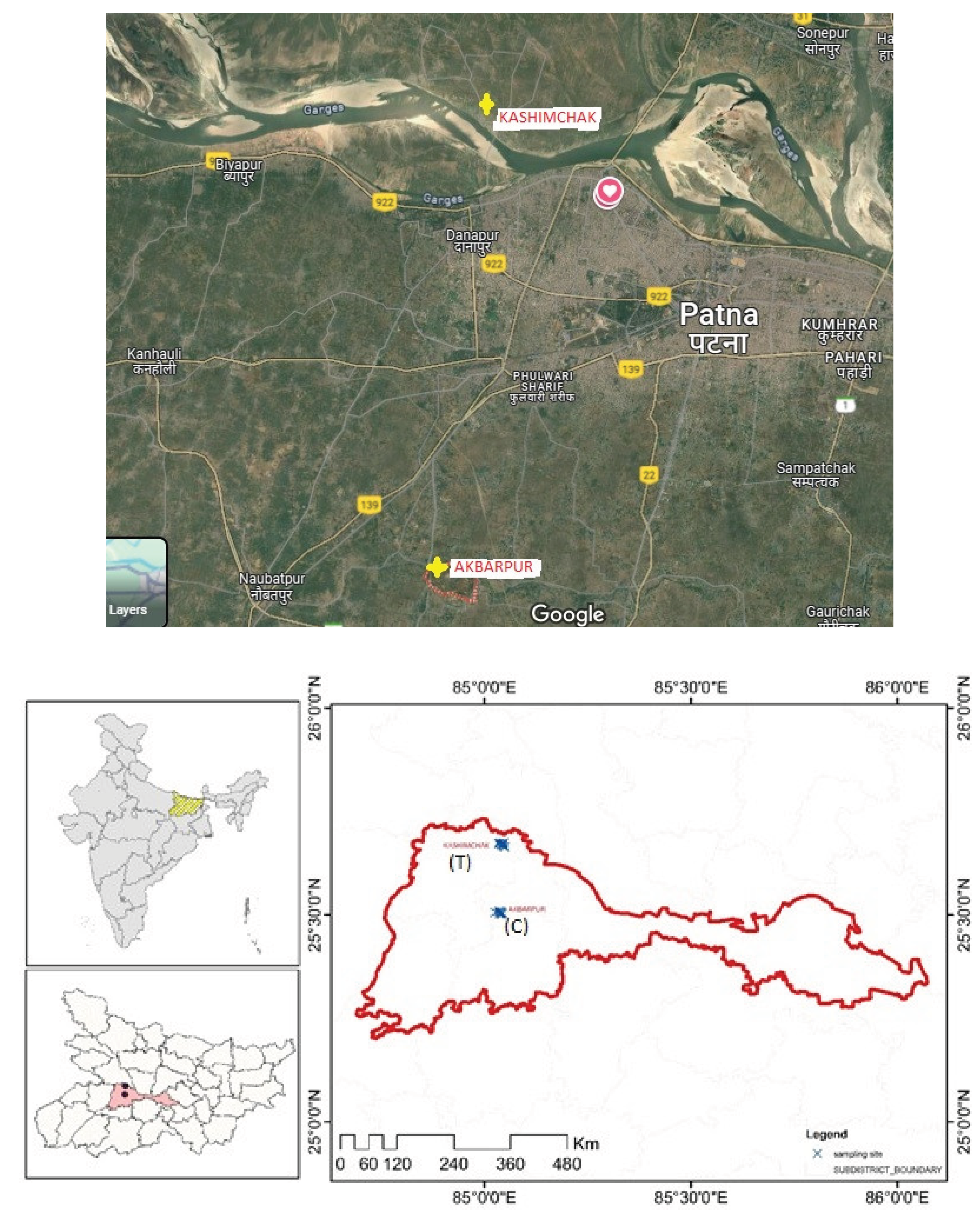

Table 1.
Total arsenic concentration (Mean± S.E and range in parentheses) in water (n=10) and straw (n=10) collected from the Kashimchak (T) and Akbarpur (C) village.
Table 1.
Total arsenic concentration (Mean± S.E and range in parentheses) in water (n=10) and straw (n=10) collected from the Kashimchak (T) and Akbarpur (C) village.
| Kashimchak (T) As-affected village | Akbarpur (C) As-safe village | |
| Water (mg/L) |
0.079±0.0045a (0.06-0.1) |
0.007±0.0012b (0.00-0.01) |
| Straw (mg/Kg) |
1.046±0.077a (0.55-1.35) |
0.058±0.016b (0.1-0.17) |
Values with different superscripts varied significantly between rows (P≤0.05).
Table 2.
Total arsenic residue (Mean± S.E. and range in parentheses) in biological samples (n=10) of lactating cattle of Kashimchak (T) and Akbarpur (C) village.
Table 2.
Total arsenic residue (Mean± S.E. and range in parentheses) in biological samples (n=10) of lactating cattle of Kashimchak (T) and Akbarpur (C) village.
| Sample | Arsenic (ppm) concentration | |
| Kashimchak (T) | Akbarpur (C) | |
| Blood (mg/L) | 0.287±0.008a (0.24-0.32) |
0.011±0.003b (0.00-0.04) |
| Hair (mg/kg) | 1.692±0.173a (0.88-2.24) |
0.103±0.0191b (0.03-0.19) |
| Milk (mg/L) | 0.080±0.003a (0.07-0.10) |
0.013±0.006b (0.00-0.07) |
| Urine (mg/L) | 0.083±0.004a (0.06-0.10) |
0.032±0.003b (0.02-0.05) |
| Faeces (mg/kg) | 0.440±0.011a (0.37-0.49) |
0.073±0.009b (0.03-0.49) |
Values with different superscripts varied significantly between rows (p≤0.05).
Table 3.
Pearson correlations of arsenic concentration in various biological samples, groundwater, and straw as feed (n=10) in the Kashimchak village of Patna district
Table 3.
Pearson correlations of arsenic concentration in various biological samples, groundwater, and straw as feed (n=10) in the Kashimchak village of Patna district
| Feed | Water | Blood | Milk | Hair | Urine | Dung | ||
| Feed | Pearson Correlation | 1 | 0.391 | 0.948** | 0.897** | 0.892** | 0.837** | 0.804** |
| Water | Pearson Correlation | 0.391 | 1 | 0.207 | 0.247 | 0.303 | 0.153 | 0.191 |
| Blood | Pearson Correlation | 0.948** | 0.207 | 1 | 0.934** | 0.787** | 0.773** | 0.742* |
| Milk | Pearson Correlation | 0.897** | 0.247 | 0.934** | 1 | 0.727* | 0.701* | 0.610 |
| Hair | Pearson Correlation | 0.892** | 0.303 | 0.787** | 0.727* | 1 | 0.857** | 0.792** |
| Urine | Pearson Correlation | 0.837** | 0.153 | 0.773** | 0.701* | 0.857** | 1 | 0.815** |
| Dung | Pearson Correlation | 0.804** | 0.191 | 0.742* | 0.610 | 0.792** | 0.815** | 1 |
**. Correlation is significant at the 0.01 level (2-tailed). *. Correlation is significant at the 0.05 level (2-tailed).
Disclaimer/Publisher’s Note: The statements, opinions and data contained in all publications are solely those of the individual author(s) and contributor(s) and not of MDPI and/or the editor(s). MDPI and/or the editor(s) disclaim responsibility for any injury to people or property resulting from any ideas, methods, instructions or products referred to in the content. |
© 2025 by the authors. Licensee MDPI, Basel, Switzerland. This article is an open access article distributed under the terms and conditions of the Creative Commons Attribution (CC BY) license (http://creativecommons.org/licenses/by/4.0/).
Copyright: This open access article is published under a Creative Commons CC BY 4.0 license, which permit the free download, distribution, and reuse, provided that the author and preprint are cited in any reuse.


