

Submitted:
20 August 2025
Posted:
21 August 2025
You are already at the latest version
Abstract
The integration of blockchain technology into the agrifood and fishing industries has in-14 troduced transformative approaches to certification, addressing critical challenges such as 15 traceability, transparency and compliance with sustainability standards. This paper pre-16 sents a comprehensive survey of blockchain-based certification technologies and method-17 ologies in these industries, offering a structured classification and analysis of existing so-18 lutions. Certification systems are categorized based on their purpose, technological archi-19 tecture, application domains, supply chain stages, and stakeholder involvement. The sur-20 vey examines how blockchain enhances trust through immutable record-keeping, smart 21 contracts, and decentralized verification mechanisms, ensuring authenticity and account-22 ability across the supply chain. Special attention is given to case studies and implementa-23 tions that focus on ensuring food safety, verifying sustainability claims, and fostering con-24 sumer trust through transparent labeling. Furthermore, the paper identifies technological 25 barriers, such as scalability and interoperability, and puts forward a collection of func-26 tional and non-functional requirements for holistic blockchain implementation. By 27 providing a detailed overview of current trends and gaps, this study aims to guide re-28 searchers, industry stakeholders, and policymakers in adopting and optimizing block-29 chain technologies for certification. The findings highlight the potential of blockchain to 30 innovate certification systems, easing the way for more resilient, sustainable, and con-31 sumer-centric agrifood and fishing industries.
Keywords:
blockchain
; distributed systems
; networks
; fisheries industry
1. Introduction
The agrifood and fisheries sectors are critical pillars of global food security and economic stability, encompassing complex supply chains that involve a diverse set of stakeholders, from producers and processors to distributors and consumers [1]. However, these economical activities are rampant with challenges such as traceability issues, food fraud and counterfeit, mislabeling, and lack of compliance with sustainability or sanitary standards. Traditional certification systems, which have been conceived to address these challenges, often rely on centralized, human-centric frameworks that can be opaque, prone to errors, and susceptible to tampering. In this context, blockchain technology has emerged as a transformative tool, offering innovative solutions to enhance certification processes through its core attributes of decentralization, immutability and transparency in applications ranging from manufacturing to UAVs [2]. By decentralizing data storage and enabling transparent verification mechanisms, blockchain mitigates many of the shortcomings of traditional systems. In the agrifood and fisheries industries, blockchain has introduced new paradigms for certification, enabling stakeholders to verify the authenticity of claims such as product origin, production methods, and compliance with sustainability standards [3,4]. Blockchain-based certification can ensure that seafood labeled as "sustainably caught" or produced as "organic" genuinely meets the specified criteria. These systems address critical consumer demands for transparency and ethical practices, while also helping producers and regulators combat food fraud and illegal activities. Critical to blockchain appeal is its ability to facilitate end-to-end traceability across supply chains. By creating immutable records of each transaction and production step, blockchain enables stakeholders to track products from origin to consumption. This level of traceability is particularly valuable in the fisheries industry, where issues such as species substitution, Illegal, Unreported, and Unregulated (IUU) fishing or fraudulent labeling are prevalent. Smart contracts —programmable agreements executed automatically on blockchain— further enhance the efficiency and reliability of certification systems by automating compliance checks and enforcing rules without the need for intermediaries. Despite its transformative potential, the adoption of blockchain-based certification systems is not without challenges. Technological barriers, such as scalability limitations and interoperability between different blockchain networks, remain significant concerns. Moreover, the socio-economic aspects of adoption (such as the cost of implementation, the need for stakeholder training, and regulatory acceptance) offer additional hurdles. For small-scale producers and fishers, the financial and technical burden of integrating blockchain technology can be prohibitive, limiting its accessibility and equitable adoption. Furthermore, the heterogeneity of global supply chains requires tailored solutions that can address region-specific challenges and meet diverse regulatory requirements.
1.1. Paper Contributions
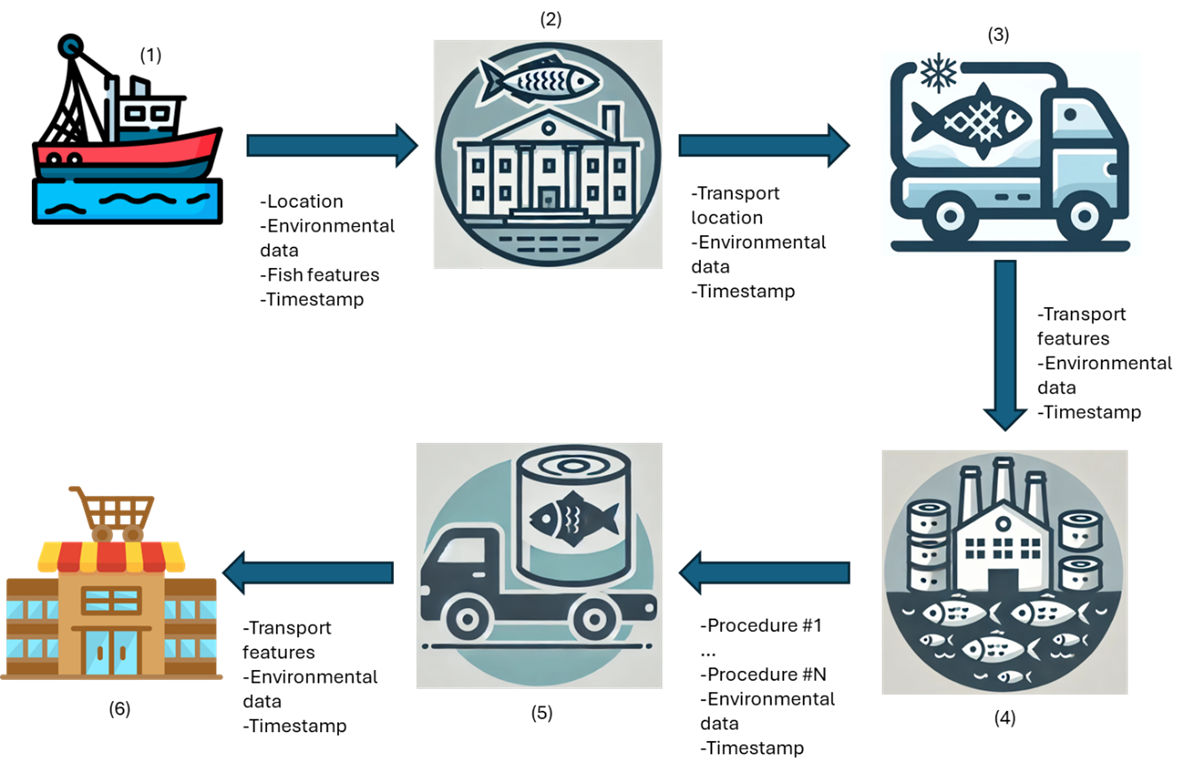
This paper aims to provide a comprehensive survey of blockchain-based certification technologies and methodologies in the fisheries sector. Within this application domain, blockchain-based certification refers to the process of leveraging blockchain technology to issue, manage, and verify digital certifications for products, processes, or entities. In the context of fish supply chains, it ensures that certifications are securely recorded on an immutable, decentralized ledger. This approach provides enhanced trust by enabling stakeholders and consumers to verify the authenticity and integrity of certifications in real time. Smart contracts can automate compliance checks, while tokenization can represent certificates digitally for easy tracking. A blockchain-based certification fosters transparency, reduces fraud, and ensures traceability throughout the supply chain. As far as the fishing industry is concerned, a typical system built with these features will work as represented in Figure 1: (1) fishing boats with sensors collecting information about location, environmental parameters, fish features and a timestamp capture the fish. The obtained data can be uploaded onto a blockchain for transparency, redundancy and security purposes. It is afterwards sent to a fish market or a fish auction house (2) where environmental and time-related information can be collected and uploaded as well, with the same procedures applied for refrigerated transport, food processing and market delivery -steps (3), (4) and (5)- so the information can be checked at the consumers´ end at (6). By offering a structured classification and analysis of existing solutions, the survey included in this manuscript identifies key trends, gaps, and opportunities for future research and implementation. The survey also highlights case studies that demonstrate the practical benefits of blockchain in ensuring food safety, verifying sustainability claims, and fostering consumer trust. By addressing technological and socio-economic challenges, this research seeks to guide stakeholders in leveraging blockchain to create more resilient, transparent, and consumer-centric certification systems. Lastly, this study provides a list of functional and non-functional requirements to tackle the open issues found, so that it can be used for the future implementation of a new blockchain-based certification.
1.2. Paper Structure
An introduction to the main ideas and topics dealt with in this survey has already been offered in section 1. Section 2 provides the guidelines of the classification that has been put forward for the solutions found about blockchain-based certifications in the fishing industry. It also includes a justification on why each of the criteria used in the classification has been regarded as a critical one. Section 3 offers the bulk of the study of the state of the art provided in this manuscript. It contains the solutions that have been found, their main features, advantages and disadvantages, along with what means are used to fit in the classification that has been conceived for this manuscript. Section 4 has the conceived requirements for a suitable blockchain solution in aquaculture resulting from the study. Section 5 has the conclusions that have been reached upon completing this study, especially related to the open issues that have been found in existing literature. Potential future works are mentioned as well. Acknowledgements and bibliographical references close this manuscript.
2. Proposed Classification
To have a complete survey of the solutions that are used in this application domain, a classification criterion is required to organize the features of the existing proposals. Consequently, a collection of categories has been established so that the existing information about solutions will be integrated in each of them. Each of these categories makes use of several parameters that further specify what is being taken into consideration:
1. Certification Purpose: it is used for aligning blockchain-based certification systems with stakeholder needs, focusing on specific goals such as traceability, quality assurance, regulatory compliance, and sustainability. It differentiates cases, ensuring systems are tailored to their objectives and meet market demands for transparency and trust. This category facilitates comparative analysis to identify strengths and weaknesses in existing solutions. Its main features are as follows:
•Traceability and Transparency: Technologies focused on tracking products from origin to consumer, ensuring supply chain transparency.
•Quality Assurance: Certifying compliance with quality standards, such as organic, non-GMO (Genetically Modified Organisms), or sustainably sourced products.
•Regulatory Compliance: Verifying adherence to legal standards and regulations, food safety or fishing quotas.
•Sustainability and Ethical Practices: Supporting certifications for eco-friendly, fair trade, or socially responsible production.
2. Technology Type: it is essential in the classification to categorize solutions based on their access control, operational models, and suitability for specific use cases. It helps distinguish between permissioned blockchains (restricted access, suited for regulatory or enterprise needs), permissionless blockchains (open access, ideal for consumer-facing transparency), and hybrid solutions (combining features of both for tailored applications). This differentiation is crucial for understanding the scalability, security, and interoperability of various systems. The main characteristics derived from this category are:
•Permissioned Blockchains: Systems with restricted access, often used for regulatory or enterprise solutions.
•Permissionless Blockchains: Open-access systems allowing anyone to participate, often used for consumer-facing transparency.
•Hybrid Solutions: Combining elements of permissioned and permissionless blockchains for tailored use cases.
3. Functional Features: they define the technical mechanisms that enable blockchain certification systems to function effectively. Smart contracts automate processes like compliance checks and certifications, reducing manual errors and enhancing efficiency. Tokenization allows digital representation of certifications or goods, enabling seamless tracking and transfer of ownership. Decentralized Identity (DID) ensures secure, tamper-proof verification of stakeholder identities, fostering trust and accountability. Their main resulting features are as follows:
•Smart Contracts: Automating certification and compliance processes.
•Tokenization: Using digital tokens to represent certified goods or standards.
•Decentralized Identity (DID): Ensuring secure identity verification for stakeholders.
4. Application Domain: it identifies the specific industries or sectors where blockchain technologies are applied, such as agrifood or fisheries. This categorization ensures solutions are tailored to address the unique challenges and requirements of each domain, like species substitution in fisheries or organic certification in agrifood. It helps stakeholders evaluate relevance, applicability, and feasibility within their context. Additionally, it highlights industry-specific benefits, such as enhanced sustainability tracking or fraud prevention. Features related to this category are:
•Agrifood Industry: Applications specific to crop production, livestock, and processed food.
•Fisheries and Aquaculture: Solutions tailored to fish catch, sustainable harvesting, and aquaculture management.
5. Supply Chain Stage: it ensures that blockchain-based certification systems address specific needs and challenges at different points in the supply chain. Each stage—production, processing, distribution, and retail—has unique processes, stakeholders, and data requirements. For instance, production focuses on origin verification, while processing ensures product integrity and prevents fraud like species substitution. Distribution tracks logistics and storage conditions, while retail provides transparency and labeling for consumer trust. Its main features are:
•Production: Certifying practices at the farm or fishing vessel level.
•Processing and Packaging: Ensuring integrity and compliance during processing stages.
•Distribution: Tracking products through logistics and transportation networks.
•Retail and Consumer Interaction: Providing certifications directly to consumers for informed purchasing.
6. Geographical and Cultural Context: this category is needed because it ensures solutions are tailored to the specific needs, regulations, and practices of different regions and communities. Global standards (e.g., ISO, MSC) facilitate international trade and compliance across diverse markets, promoting consistency and interoperability. However, localized systems address region-specific challenges, such as unique cultural practices, traditional fishing or farming methods, and regional regulatory requirements. This dual focus helps balance global uniformity with local relevance, ensuring inclusivity and practicality. The most relevant features to consider are:
•Global Standards: Technologies designed to meet international certifications.
•Localized Systems: Solutions addressing regional or community-specific certification needs.
7. Adoption and Stakeholder Involvement: it is critical in the classification because it determines the practical implementation and success of blockchain-based certification systems. Stakeholder collaboration ensures that the system addresses the needs of all parties, including producers, regulators, and consumers, fostering trust and accountability. Adoption mechanisms like government-led initiatives or industry consortia provide the organizational structure and resources necessary for widespread implementation. Engagement with stakeholders helps overcome barriers such as cost, training, and regulatory compliance, ensuring equitable access. Main characteristics are:
•Government-Led Initiatives: Certifications managed by regulatory bodies.
•Industry Consortia: Collaborative efforts between companies and industry groups.
•Independent and Open-Source Platforms: Decentralized solutions driven by third parties or open communities.
8. Data Management and Analytics: they are used to ensure the effective operation and credibility of blockchain-based certification systems. They enable the recording, storage, and analysis of vast datasets generated across the supply chain, ensuring traceability and transparency. Static data systems manage fixed attributes like product origin, while dynamic systems handle real-time data, such as environmental monitoring. Analytics tools help detect patterns, anomalies, and compliance issues, enhance decision-making and prevention of fraud. They also support predictive insights for optimizing supply chain operations and maintaining quality standards. The most prominent features are:
•Static Data Systems: Certifying fixed attributes, such as origin or organic status.
•Dynamic Data Systems: Managing real-time data, such as temperature monitoring or location tracking.
3. Study of the state of the art
A review of the existing literature to investigate the available options in the application domain of blockchain certification applied to the fishing industry is presented.
3.1. Studied Literature
Kumar Patro et al. [5] propose a private Ethereum blockchain-based solution to address traceability challenges in the fishery supply chain, encompassing both wild-caught and farmed fish. The proposed system integrates smart contracts, Interplanetary File System (IPFS) for distributed storage, and decentralized applications (DApps) to automate and secure processes across the supply chain. Key stakeholders like fish farmers, foodstuffs processors, distributors and retailers interact through predefined smart contracts, ensuring accountability and transparency. The solution uses cryptographic methods to create unique identifiers and maintain immutable records for traceability. The advantages include decentralized and tamper-proof data management, enhanced accountability, and automated compliance with regulatory standards. However, the system faces drawbacks such as reliance on accurate data input and scalability issues with Ethereum. As far as the classification that has been previously established is concerned, this piece of research is strongly oriented at being a permissioned application that provides traceability and transparency. Smart contracts are exclusively used in a fisheries and aquaculture environment for production stages, whereas global standards are attempted to be met. Finally, smart open-source contracts are offered, along with dynamic data related to shipment and fish growth. The overview of the solution has been displayed in Table 1.
Odayne Haughton et al. [6] explore the integration of blockchain technologies into supply chain management, focusing again on the sustainable fishing industry to demonstrate how seafood can be traced from what the authors refer to as "bait to plate", which constitutes a parallelism with the term “farm-to-fork” used in smart farming and precision agriculture. This study proposes a hybrid blockchain architecture that combines permissioned ledgers for sensitive data with public ledgers for information with high transparency requirements in an attempt to make use of the advantages of both public blockchains and private ones. Smart contracts are used to automate processes, ensuring data immutability and create digital passports with scannable QR codes to foster consumer trust and provide access to traceability information. The proof-of-concept system designed in the study highlights several advantages, including tamper-proof record-keeping (as something that is taking for granted since the solution makes use of blockchain), reduced fraud, and improved stakeholder trust. It also goes beyond providing a mere theoretical study and is useful to offer some feedback with regards to performance. Technology aligns well with sustainability goals and regulatory standards. However, challenges such as high implementation costs, limited regulatory frameworks and stakeholder reluctance, especially among small and medium-sized enterprises, pose significant barriers for its actual testing and deployment. Major features of the solution have been displayed in Table 2.
Francisco Blaha et al. show in [7] the potential of blockchain in seafood value chains, focusing on improving traceability, compliance, and sustainability. Their solution outlines blockchain ability to address IUU fishing, fraud and other inefficiencies. By leveraging features like immutability, decentralization, and smart contracts, blockchain can ensure real-time data acquisition and secure data sharing among stakeholders. The study highlights examples of blockchain applications and evaluates Critical Tracking Events (CTEs) and Key Data Elements (KDEs) required for effective traceability. Advantages include the ability to enhance transparency, prevent fraud, and improve stakeholder accountability. The presented technology aligns with global standards and supports initiatives like ecolabel certifications for sustainability. However, the paper acknowledges several limitations that are common in this kind of developments: blockchain adoption is hindered by high implementation costs, technical barriers in developing regions and limited regulatory frameworks. Furthermore, blockchain's reliance on accurate data input and its energy consumption pose challenges. Table 3 contains the details of the solution studied.
Nishanth Rao Dugyala et al. [8] explore the application of blockchain technology in streamlining the certification processes within the Indian fisheries export industry, which plays a significant role as a revenue and job supplier. It highlights the challenges faced by traditional certification systems, such as inefficiencies, lack of transparency, and potential fraud, and proposes a DApp integrated with blockchain and IPFS. The certification process involves fishermen and seafood processors registering with government authorities like the Marine Products Export Development Authority (MPEDA). Pre-harvest checks ensure compliance with sustainable fishing regulations, while post-harvest inspections assess quality, hygiene, and contamination levels. The DApp facilitates the entire certification process, from application submission to certificate issuance. The system offers stakeholders —such as fishermen, processors, government agencies, and consumers— a transparent and efficient method to track, verify, and authenticate certification details. The proposed framework provides several advantages, including enhanced traceability, reduced administrative overhead, and improved stakeholder trust. However, the paper acknowledges challenges, such as the high costs of blockchain implementation, dependency on technology literacy among stakeholders and potential scalability issues. Table 4 shows the most prominent characteristics of the solution.
Shereen Ismail et al. [9] review and propose an intelligent blockchain and IoT-enabled fish supply chain framework to tackle the challenges of IUU fishing activities, seafood fraud, and inefficiencies in traditional supply chain systems. By integrating blockchain technology with IoT devices, such as RFID tags, GPS trackers and spectroscopy tools, the framework ensures traceability, data authenticity and product quality verification throughout harvesting, processing, packaging, and distribution. The study also introduces Machine Learning (ML) to enhance fraud detection, quality assessment, and decision-making in supply chain operations. The system demonstrates a significant number of advantages, including improved transparency, real-time traceability, automated fraud detection, and the ability to meet regulatory standards. It addresses consumer and stakeholder concerns about product authenticity, safety, and sustainability. However, it faces challenges like high implementation costs, scalability issues, interoperability concerns, and organizational resistance. The paper concludes that while blockchain-based solutions have transformative potential for fish supply chains, further research is needed to address technical and operational barriers, emphasizing the integration of ML and IoT technologies for an optimized and secure supply chain system. Table 5 displays the solution according to our classification
Naoum Tsolakis et al. [10] investigate how blockchain can enhance supply chain design to meet United Nations Sustainable Development Goals (SDGs) within the Thai fish industry. By creating a blockchain-centric architecture, the study attempts to address critical issues already known and faced in this kind of application domain (illegal fishing, labor abuses, and environmental challenges), aiming to ensure traceability, transparency, and ethical practices. It proposes four design principles —data archetypes (used for linking datasets across multiple supply chain levels), data capture (gathering data to ensure accountability and trust in supply chain operations), data consistency (data archetypes should not be developed solely for regulatory compliance but should extend beyond legal requirements to ensure reliable and continuous traceability), and data interoperability (ensures that disparate supply chain processes and operations are accounted for in a blockchain-based system)— necessary for implementing blockchain technology effectively in fish supply networks. Empirical evidence, gathered from case studies, highlights the lack of standardized data structures and the need for better integration across supply chain stakeholders. Advantages include improved data transparency, enhanced compliance with regulations, and alignment with sustainability goals, contributing to food security and economic growth. Furthermore, blockchain also fosters consumer trust by preventing fraud and ensuring ethical labor practices. However, the study identifies significant barriers, such as high costs, technical limitations in data capture, and inconsistent data standards across supply chain nodes. Additionally, the lack of regulatory enforcement and resistance to change among stakeholders impede adoption. The studied solution has a similar focus compared to the previous ones in terms of purpose. Smart contracts are used in a permissioned blockchain that attempts to cover all the actors in the supply chain, from global and particular geographic points of view with mentions on stakeholders and different data systems with a strong emphasis on certification purposes. Table 6 displays each of these elements.
Xu Wang et al. [11] present the BeFAQT (Blockchain-enabled Fish Provenance and Quality Tracking) system, designed to address challenges in fish supply chains such as lack of traceability, quality assessment or secure data sharing. This system integrates blockchain with Attribute-Based Encryption (ABE), IoT technologies and AI-powered tools like image processing and electronic noses (E-nose powered by active gas sensors that can detect the odor and generate electrical signals from chemical vapors). BeFAQT offers real-time tracking of fish quality and provenance, improving consumer confidence, regulatory compliance, and supply chain efficiency. By ensuring trusted data sharing among stakeholders via blockchain use, the system supports sustainability and ethical practices while reducing fraud and inefficiencies. The key advantages include enhanced traceability, automated quality tracking, and privacy-preserving data access. The multilayer blockchain architecture greatly assist in ensuring these aspects, as it provides a fine-grained access control, secure proof of provenance and tamper-proof records, which are of decisive usefulness to guarantee that the identified fish is suitable for its consumption. The integration of IoT and AI significantly improves data accuracy, enabling better decision-making for stakeholders. However, the system presents several challenges, such as high implementation costs, technological complexity, and the need for stakeholder alignment. Table 7 shows how this certification makes use of a permissioned blockchain that stores information aiming to cover all stages in the supply chain. Offering a certification system for fisheries and aquaculture remains the main purpose of the proposal. It follows global standards for quality, traceability (for example, it provides an ID for each fish box that makes possible tracking each of them), ethical practices and manages both static and dynamic data systems.
Mohamed Rawidean Mohd Kassim [12] explores the integration of Internet of Things (IoT) and blockchain technologies in smart agriculture. The paper proposes a five-layer IoT-blockchain architecture for smart agriculture applications, incorporating data sensing, network communication, middleware for blockchain management, and business analysis layers. The study highlights cases such as farm, irrigation, soil, and nutrient management, which collectively enhance efficiency and sustainability in agricultural practices. Advantages for this architecture include increased productivity, improved data security, and reduced dependency on centralized systems, making it suitable for addressing food quality and safety issues. Blockchain decentralized ledger and IoT real-time data capabilities offer a robust solution for agricultural challenges. Unfortunately, the paper identifies significant barriers such as scalability, high computational costs, lack of standardization, and limited technical expertise, particularly among smallholder farmers. Table 8 displays the most significant features of the solution studied. Traceability and quality assurance are of significant interest, along with usage of smart contracts in a permissioned blockchain. Smart contracts are proposed as a data exchange mechanism for a general-purpose solution (oriented towards agrifood rather than more specific fisheries). Data management and analytics are significantly taken into account as well.
Manuel Luna et al. [13] explore a blockchain-based framework to enhance traceability, fraud prevention, and compliance with EU environmental policies in the aquaculture sector. It integrates smart contracts to automate supply chain controls, ensuring adherence to sustainable feeding practices, animal welfare, and waste management. The blockchain framework addresses critical supply chain challenges, including food fraud, product traceability, and regulatory compliance, by leveraging decentralized, transparent, and immutable records. By doing so, it aligns aquaculture operations with the EU’s green transition and Farm to Fork strategies applied to the fisheries and aquaculture industries, promoting transparency and consumer trust. Advantages of the proposed framework include enhanced compliance with sustainability standards, reduced instances of fraud, improved traceability and automation of regulatory processes made possible with smart contracts. These features help firms maintain competitiveness while adhering to stringent environmental policies. However, challenges remain, such as the high implementation cost of blockchain technologies, technical complexities for regular end users, and the need for collaboration among stakeholders. Table 9 shows how this solution is very clearly oriented towards certification with permissioned blockchains and a smart contract-enabled, aquaculture-oriented industry focus. Production and consumer interaction are the most prominent features considered from the supply chain, whereas taking into account both global and EU regulatory frameworks. Data management and analytics characteristics are strongly present in the presented framework too.
Othmane Friha et al. [14] propose a robust security framework integrating blockchain, fog computing, and Software-Defined Networking (SDN) for agricultural, Internet of Things (IoT) applications. In the context of this manuscript, SDN enhances network management and security in the proposed agricultural IoT framework by enabling programmable control, efficient resource management, and automated responses. It uses virtual switches, distributed controllers, and OpenFlow protocols for dynamic flow management. SDN also mitigates DDoS attacks by detecting malicious traffic and ensuring secure blockchain operations. The framework focuses on secure IoT data management, real-time analytics, and reliable network management. The architecture includes a heterogeneous system consisting of an IoT layer for data collection, a fog layer for low-latency processing, and a blockchain network for immutable data storage. It uses Hyperledger Sawtooth blockchain and SDN controllers to mitigate Distributed Denial of Service (DDoS) attacks that would disrupt the system and ensure secure, programmable network functionality. The experimental evaluation demonstrates the framework's effectiveness in enhancing IoT security and resilience under network stress. The proposed solution has several advantages, including improved data integrity, network management, and resistance to DDoS attacks, making it highly suitable for smart farming applications. The integration of blockchain enhances transparency and traceability, while SDN ensures adaptable and efficient network control. However, the system's complexity and high computational demands could limit adoption among small-scale farmers, who like many other end users, are unaware of the technological complexity of the deployed systems. Table 10 shows that the proposal is structured around the usage of permissioned blockchains for traceability and transparency in the agrifood industry (which makes it less specific than aquaculture but is in turn more portable to other application domains), with a specific target in production-level IoT systems. Global standards are taken into account, as well as data management and analytics-related features, which are featured in a prominent manner due to the collection of static IoT data (soil conditions, network settings).
Satyabrata Aich et al. [15] provide a comprehensive review of the integration of IoT with blockchain technology in supply chain management across various sectors, including automotive, pharmaceutical, food, and retail industries. It emphasizes how IoT-enabled blockchain systems can overcome the limitations of traditional supply chains, such as lack of transparency, poor traceability, inefficiency in handling demand fluctuations, and susceptibility to fraud. By leveraging features like decentralization, immutability and transparency, the proposed system improves traceability, links information flows with material flows, and reduces fraud and violations in the supply chain. The authors describe how blockchain decentralized, secure, and immutable nature ensures data integrity and reduces fraud, while IoT connects information and material flows for real-time updates. Case studies in automotive, pharmaceutical, food, and retail industries show improved logistics, reduced operational costs, and better inventory control. Advantages of the ideas include enhanced trust among stakeholders, improved operational efficiency, and better compliance with standards. Additionally, the paper provides sector-specific examples and benefits, like inventory optimization in the automotive sector and fraud detection in the pharmaceutical industry. However, open issues such as high implementation costs, lack of user awareness and technical complexities are highlighted as barriers to widespread adoption. This piece of research also features a case study on seafood supply chains, showcasing how IoT and blockchain can address issues like illegal fishing and mislabeling. As has happened before, this manuscript offers a review of a collection of solutions, rather than putting forward one; requirements to make an actual implementation that solves to an extent the issues that have been found by this study are not present either. It is displayed in Table 11 how the study performed in the paper tends to focus on permissioned blockchains that enable the usage of smart contracts that are compliant with the most relevant global standards for data transmission and storage. It is also encouraged how cooperation within industry can spread the adoption of blockchain. Static data tends to be managed with ease in the studied proposals.
Edward Alexander Jaya et al. [16] present a blockchain-based traceability system for fishery products to improve data integrity and transparency within the supply chain in Indonesia. The authors propose a decentralized solution using Hyperledger Fabric, emphasizing its suitability due to features like permissioned access, smart contracts, and data immutability. The system involves four key stakeholders: a) harbors, b) fish processing units, c) marketers, and d) the public. It ensures that all organizations must achieve consensus before any modifications are made to the traceability chain, addressing issues such as data inconsistency and unauthorized alterations that are prevalent in centralized systems. The authors provide performance tests that show high throughput and acceptable response times, despite some potential latency issues derived from chain increasing length. CouchDB, an open-source, NoSQL database developed by the Apache Software Foundation, is used for decentralized data storage. In fact, it is described in the manuscript as “the ledger itself consists of a CouchDB world state ledger that enables users to get complex information with nested queries to retrieve the weight of fishery products”. Advantages of the system include enhanced trustworthiness, fault tolerance, and improved traceability. The use of smart contracts automates critical processes such as product transfers and activity logging, while the decentralized architecture reduces the risk of single points of failure. It is also described how the system faces challenges such as increased latency and reduced throughput as the traceability chain length and number of users grow. This is a common issue with blockchain applications that are linked to the consensus algorithm; making it fast enough without losing any of their capabilities for transaction validation remains an open challenge in blockchain-related deployments. Table 12 depicts how this solution revolves around traceability and transparency in the fisheries and aquaculture industry by means of permissioned blockchains (as Hyperledger Fabric is one of them). Smart contracts are put forward as part of the solution, with a focus on production and distribution in the supply chain. Overall global standards are taken into consideration, along with and static data transfers.
Adrian E. and Christian E. Coronado Mondragon [17] explore the feasibility of integrating Internet of Things (IoT) and agnostic blockchain technology within the fisheries supply chain, focusing on a case in Atlantic Canada. It highlights IoT's capacity to gather real-time data through sensors, enhancing communication among networked devices. The adoption of blockchain can offer facilities that other systems will not, like improved traceability, transparency, and security in supply chains, especially for perishable goods like seafood. The authors propose an agnostic blockchain architecture combining public and private blockchains, tailored to handle fisheries' complex logistics and multiple stakeholders. This design enables secure data sharing, traceable product history, and automated compliance through smart contracts. However, as happened in other solutions, scalability remains a significant challenge due to the high number of touchpoints in supply chains. Implementing agnostic blockchain helps address interoperability but introduces complexities in ensuring robust cross-chain communication. Energy consumption, technological literacy, and high initial costs are additional barriers to adoption. Furthermore, the reliance on IoT-generated data raises concerns about data accuracy and reliability. Despite these challenges, the proposed model offers significant potential for improving fisheries' operational efficiency, ensuring product quality, and enhancing consumer trust. Future research should explore alternative agnostic blockchain architectures like sidechains and hash-locking to further optimize supply chain operations. Table 13 shows how this proposal has taken a hybrid approach in terms of blockchain permissions (as it is explicitly mentioned in the paper that “The proposed agnostic blockchain architecture comprises two type of blockchain: one public and one private”) for fisheries and aquaculture oriented to traceability and transparency in production and distribution of foodstuffs, while keeping a significant interest on information standardization and data management for both static (identification of origin, handling conditions) and dynamic (real-time monitoring) data systems. Standards are also taken into consideration, both in terms of technology and in terms of health and safety.
V.P. Premkkumar et al. [18] present a smart aquaculture system that integrates Artificial Intelligence (AI), Internet of Things (IoT), and blockchain technology to enhance fish farming by ensuring real-time water quality monitoring and secure data management. The system employs various sensors to track critical water parameters like pH, temperature, turbidity, ammonia, and dissolved oxygen, with data securely stored on the blockchain. AI assists in diagnosing fish diseases such as Epizootic Ulcerative Syndrome (EUS) and Ichthyophthirus, enhancing fish health and reducing mortality. An Android application alerts farmers of unclean conditions and allows remote monitoring. The approach makes possible the improvement of aquaculture productivity by automating water quality control and reducing manual labor, ensuring high-quality fish production. The advantages of this system include real-time data collection, secure and tamper-proof data storage via blockchain and early disease detection through AI, contributing to sustainable aquaculture practices. However, the system disadvantages include high implementation costs, reliance on internet connectivity for IoT functionality (other IoT developments that make use of sensors might need it too, but they can still send and receive data locally throughout a WSN), and the need for technical expertise to manage and maintain the integrated technologies (which is a common flaw in most of the analyzed solutions anyway). Energy consumption associated with blockchain operations and latency in real-time data processing could also affect system efficiency. Especially when high energy-consuming algorithms like Proof-of-Work are used. As displayed in Table 14, certification purposes are of significant interest in this proposal in the context of permissioned blockchains for fisheries and aquaculture. Data Management and analytics have a strong stress as well.
Aruna Subramanian et al. [19] explore the potential of blockchain technology to enhance traceability and accountability in food supply chains, focusing on dairy, agriculture, and seafood sectors. It identifies critical issues like food safety, sustainability, and communication gaps in traditional supply chains and proposes blockchain-based frameworks for addressing these challenges. For the dairy supply chain, the paper emphasizes using blockchain, IoT, and smart contracts to ensure complete traceability from production to distribution. In agriculture, a decentralized model is proposed for improving transparency and reducing inefficiencies, incorporating smart contracts, RFID tags, and IoT devices. The seafood sector focuses on improving traceability, combating illegal fishing, and enhancing consumer trust using blockchain-based solutions. However, it is also mentioned how this latter sector is lacking maturity for blockchain implementation, due to several reasons: a) the fragmented structure of the industry, involving multiple stakeholders across different regions, b) limited technological infrastructure among small-scale participants and challenges in ensuring accurate data entry undermine system reliability, c) interoperability issues with existing systems and IoT devices and d) regulatory uncertainty across regions adds complexity. The advantages provided by these frameworks offer significant potential for addressing food fraud, ensuring regulatory compliance, and promoting sustainability. However, the paper also highlights challenges such as high implementation costs, scalability issues, and technical complexity. In particular, the seafood supply chain faces additional obstacles due to its fragmentation and dynamic nature. This piece of research does not offer a specific implementation or a set requirements to perform it. As shown in Table 15, multiple purpose solutions are studied for certification purposes, which attempt to cover the supply chain stages in the agrifood, fisheries and aquaculture application domains. Both static and dynamic data systems are used by the studied solutions whenever certification activities must be carried out.
Pritam Rani et al. [20] introduce a blockchain-based framework for the seafood industry, integrating Non-Fungible Tokens (NFTs), smart contracts and IPFS to revolutionize payments and traceability. The proposed system transforms seafood items into unique NFTs, which are tied to detailed product metadata, ensuring end-to-end traceability and authenticity. Payments are automated and secure, managed through Ethereum-based smart contracts. IPFS is used for decentralized storage of payment data, providing additional transparency and tamper-proof records. Performance evaluation using JMeter demonstrates the system’s scalability and efficiency under high transaction loads. Advantages of this framework include enhanced transparency and fraud prevention. The integration of NFTs promotes sustainability and ethical fishing practices by offering consumers real-time access to product details. However, challenges include high implementation costs, technical expertise requirements, and potential scalability issues. Table 16 depicts how traceability and sustainability are important features in this solution, along with permissionless or hybrid blockchain technologies that can make use of both smart contracts and tokens. Distribution and retail are the main sectors related to this solution in the supply chain, whereas data management and analytics remain activities of high interest.
Muhamad Alfarisy et al. [21] focus on developing a service-oriented platform using blockchain as a service to securely record fishing data based on quota policies, supporting Indonesia's blue economy goals. The proposed system addresses overfishing and data manipulation issues in the self-assessment system used by the E-PIT platform. It is mentioned by the authors that these systems rely heavily on manual data input by fishers and stakeholders, which can lead to intentional manipulation or unintentional errors in reporting fishing quotas and catches. Additionally, there is limited oversight and verification, making it difficult to ensure data accuracy and integrity. Finally, the lack of real-time data collection and integration with automated systems such as IoT devices further compromises the reliability of the data. By integrating IoT for data collection and blockchain for secure, immutable storage, the system ensures transparency and compliance with fishing quotas. The Service Computing System Engineering (SCSE) methodology is employed to design and evaluate the platform. The advantages include improved data integrity, reduced manual input errors, and enhanced traceability of fishing activities. The service-oriented approach also ensures modularity and reusability. However, the platform faces challenges such as high initial implementation costs, the need for standardized IoT hardware, and potential scalability issues in larger, distributed systems. While the platform shows promise for sustainable marine resource management, further integration of monitoring tools and predictive intelligence for zoning and illegal fishing detection is suggested to expand its capabilities. Table 17 shows the strong characteristics related to certification purposes as part of a permissioned blockchain. It is inferred from the paper that production is the main area of interest in the supply chain for this proposal, along with a generalistic geographical context for standards.
Shashika Lokuliyana et al. [22] propose "Aqua Safe," a blockchain-based maritime communication system that integrates IoT and ad hoc networks to enhance communication and data security between fishing vessels and land stations. The system leverages LoRaWAN technology for long-distance, low-power data transmission and blockchain for secure, decentralized data storage and communication. In this context, LoRaWAN provides wide coverage over the maritime environment, facilitating real-time transmission of crucial data such as fish catch records, vessel location, weather updates and emergency alerts. The developed system includes functionalities such as fisheries activity monitoring, boundary detection (a feature that leverages GPS data and blockchain integration to monitor and enforce maritime boundaries, so it can alert vessels when approaching restricted zones, ensuring compliance with fishing regulations, preventing illegal activities, and enhancing maritime security), weather condition analysis, and collision avoidance systems. The innovative approach ensures secure and tamper-proof communication by encrypting and hashing data transmitted through LoRa nodes. Advantages of the proposed system include enhanced data security, real-time communication, and cost-effective deployment compared to traditional satellite-based methods. The system supports sustainability by preventing illegal fishing and ensuring boundary compliance. However, its scalability could be limited by LoRaWAN coverage and reliance on blockchain, which may lead to latency and complexity in large-scale implementations. Furthermore, integrating renewable energy sources like solar and wave power may face feasibility issues in certain maritime conditions. Table 18 shows how this solution has a significant focus on sustainability or localization for fisheries and fishing fleets but does not particularly orient itself to provide certification or certification-related features with regards to the supply chain or how trade can be done via smart contracts or tokenization. Nevertheless, due to the nature of the information involved, dynamic data systems are thoroughly considered.
Pooja Joshi et al. [23] explore the integration of Industry 4.0 technologies into contemporary fisheries management, introducing the concept of "Fishers 4.0." It highlights the potential of technologies such as IoT, blockchain, and AI in addressing challenges in fisheries management, including overfishing, regulatory compliance, and supply chain inefficiencies. The authors argue that by leveraging these technologies, stakeholders can improve traceability, enhance decision-making, and ensure sustainable practices. In addition to the usefulness provided by blockchain (decentralized and secure information storage) and IoT (real-time monitoring of fishing activities, vessel tracking, and environmental conditions), AI plays a crucial role in the manuscript by enabling predictive analytics for fish stock assessments, optimizing fishing operations, and enhancing decision-making through real-time data analysis. It also supports automated compliance monitoring, reducing IUU fishing and improving overall fisheries management efficiency. In this regard, the authors propose a framework that integrates these tools to create a digital ecosystem for the fisheries industry. The paper's strengths lie in its forward-thinking approach and its detailed analysis of how advanced technologies can solve real-world challenges. It successfully demonstrates how these technologies can streamline operations and promote sustainability. However, the study also points out potential drawbacks, including high implementation costs (which is a typical challenge in this kind of application domain), the need for significant stakeholder training, and challenges related to data privacy and security. Table 19 shows how this solution has a strong drive on certification for fisheries and aquaculture industries, yet other tools like smart contracts or tokenization of assets are not considered. Global standards for sustainable and traceable fisheries management are taken into account, and the solution makes use of dynamic data systems.
Ouafae Pes Serouali Ouariti and Jalila Bennouri [24] investigate the integration of blockchain technology in sustainable supply chain management, focusing specifically on the fisheries sector. It emphasizes blockchain's potential to enhance transparency, traceability and sustainability in supply chains while identifying factors influencing its adoption. Through an exploratory study and literature analysis, the authors highlight blockchain's ability to provide a) tamper-proof records, b) ensure regulatory compliance and c) improve the ecological footprint by reducing inefficiencies. The paper also addresses current challenges, such as technology costs, stakeholder resistance, and the need for supportive regulatory frameworks. The study outlines blockchain's advantages, including enhanced consumer trust through transparent data sharing, optimization of resource use, and the facilitation of ethical labor practices. However, it also points out disadvantages, such as limited technological infrastructure in certain regions and the complexity of integrating blockchain into existing systems. Although the authors of the manuscript claim that they “have identified the main factors that influence the adoption of blockchain technology that can improve the sustainability of a supply chain” they have not elaborated a collection of functional and/or non-functional requirements that can be used for a future design or implementation that will fit the application domain of aquaculture and fisheries industries. Table 20 displays how the studied solutions have certification within permissioned blockchains in fisheries and aquaculture as one of the usual main goals, while keeping a significant interest in production and distribution of goods in the supply chain and making use of static data systems for the certification of fishing origins and quota compliance is also of major relevance, so that dynamic data systems are taken into account with the latter option.
Lei Hang et al. [25] propose a blockchain-based platform for fish farming to ensure agricultural data integrity, leveraging IoT devices for real-time environmental monitoring and automated control. The main advantages of the approach include enhanced data security through immutability and transparency of blockchain records, scalability achieved via a permissioned network, and off-chain storage using CouchDB (as it was done in [16]) to handle large datasets efficiently. Hyperledger Fabric serves as the blockchain framework, offering a permissioned network that ensures high throughput, robust access control, and data privacy. It facilitates secure data management, supports smart contracts for automating processes, and uses CouchDB for efficient off-chain storage, enhancing scalability and performance. Smart contract automates processes such as data validation and resource management, improving operational efficiency while ensuring privacy by restricting data access to authorized users. The smart contract data is modeled as JavaScript Object Notation (JSON) so that it can be correctly understood and visualized for end users. Moreover, the use of Hyperledger Fabric ensures high throughput and robust access control, crucial for sensitive agricultural data. However, the paper highlights challenges such as integration with legacy systems, which may require significant amount of time and resources. The blockchain's high computational demands for consensus protocols could also limit scalability. Additionally, the prototype currently handles only a single parameter (water level), limiting its applicability. It is described how future expansions will need to address multi-parameter integration, real-world deployment issues like secure data transmission, and user-friendly interfaces for broader adoption among farmers. Table 21 shows how traceability and sustainability by making use of a permissioned blockchain are of major importance in this proposal. Production in the supply chain is the most prominent step that benefits from this proposal; it also makes intense use of data management and analytics-related features, both static (management of aquaculture parameters) and dynamic (real-time monitoring of different metrics).
Ahm Shamsuzzoha et al. [26] introduce a blockchain-enabled traceability system designed for the sustainable seafood industry, focusing on transparency and compliance throughout the fish supply chain. Using the Tracey project as a case study in the Philippines, it integrates blockchain technology with a smartphone app to empower small-scale fishermen by recording and validating fish catch and trade data. In this region of the world, fishermen face challenges such as inaccurate catch reporting, lack of transparency in the supply chain, and difficulties meeting regulatory requirements. The Tracey system addresses these issues by enabling real-time data recording, improving traceability, ensuring regulatory compliance, and enhancing trust among stakeholders through secure, immutable blockchain-based data management. This approach ensures compliance with export standards, such as catch certification and hygiene requirements, while offering consumers access to immutable and reliable information about the origin and authenticity of seafood products. A smartphone app has been developed, which enables fishermen to record essential catch information, including species, weight, length, and capture location. It is used to ensure real-time data entry, enhancing traceability and transparency in the seafood supply chain, and supports regulatory compliance and facilitates seamless data integration into the blockchain system. Advantages of the system include secure data storage, enhanced operational efficiency, and improved trust among stakeholders, supported by a user-friendly app that simplifies data management. However, the paper also highlights challenges like limited connectivity in rural areas, low technological literacy among fishermen, high implementation costs and scalability limitations, which could restrict broader adoption in developing regions. Table 22 further reinforces these views, as permissioned blockchains for certification purposes in fisheries and aquaculture are the most significant topics for the system that has been developed. No smart contracts are conceived to be used in this proposal, though.
Peter Howson [27] explores the potential of blockchain technology to enhance trust and equity in marine conservation and fisheries supply chain management. It discusses applications like traceability of fish catches, combating illegal fishing, reducing slavery in the fishing industry, and mitigating marine pollution. Advantages include increased transparency in seafood provenance, improved consumer trust, and enhanced monitoring of labor conditions. Blockchain also supports sustainable fisheries by tracking fishing activities and ensuring compliance with legal standards. Its decentralized nature ensures data immutability and transparency, supporting initiatives like smart contracts for compliance and resource mobilization for marine conservation. However, challenges have also been included in the studied manuscript; they include the high costs of onboarding blockchain systems, especially for small-scale fishers, and the risk of inaccurate data entry ("garbage in, garbage out"). Additionally, regulatory challenges, especially in developing regions, hinder widespread adoption. The technology reliance on supporting infrastructure like IoT and reliable internet also limits its applicability in remote areas where internet connectivity can be faulty of next to nonexistent. Moreover, the author of the manuscript argues that while blockchain promises decentralized control from a purely technological point of view, permissioned blockchains controlled by major corporations could centralize power, counteracting the technology's equitable potential. The author concludes that while blockchain offers promising solutions for sustainable fisheries management, its effectiveness depends on addressing these technological, economic, and regulatory challenges, particularly ensuring inclusive access for artisanal fishers and robust mechanisms for accurate data entry. Unfortunately, as has happened in some other manuscripts studied, there is no mention on how a particular solution should be like. Table 23 shows the main features of the studied paper, which deals mostly with what features and requirements would be desirable for a certification solution in the application domain of aquaculture. Among other aspects, the usage of smart contracts in production and distribution appear as relevant features, along with data management analytics from the static and dynamic points of view.
Akhtaruzzaman Khan et al. [28] propose ShrimpChain, a hybrid blockchain-based framework designed to enhance the export potential of Bangladeshi shrimp by addressing transparency and traceability issues in the shrimp supply chain. The framework combines public and private blockchains, enabling stakeholders to enter production and supply chain data via mobile/web applications and IoT devices. A unique scoring-based certification method is proposed, where shrimp quality is assessed based on authenticated data from various supply chain stages. Advantages of this approach include improved food safety, enhanced product traceability, and increased consumer trust, which are vital for meeting international standards. The framework empowers farmers by providing them with greater market control, potentially boosting profits by eliminating intermediaries. It also enables real-time monitoring, early warning systems, and efficient contamination management, significantly reducing the risk of export bans. However, disadvantages include challenges related to implementing IoT-based blockchain solutions in Bangladesh, where technical infrastructure and skilled personnel are limited. The dependence on manual data entry could introduce human error and data manipulation risks, although mitigated by the proposed community consensus mechanism. Additionally, while the scoring system aims to ensure data reliability, its effectiveness depends on widespread stakeholder adoption and cooperation. Table 24 shows the main features of this proposed solution. The importance of having a reliable certification system is shown here. In this case, a hybrid solution combining elements from both public and private blockchains is put forward. The solution shows compatibility with the different domains of the agrifood industry and aquaculture, as well as production and distribution in the supply chain. Use of standards related to data sharing is highlighted, along with data management for static and dynamic data systems.
Lastly, Naif Alsharabi et al. [29] integrate blockchain and AI technologies to enhance traceability, transparency, and sustainability in fisheries. It proposes a decentralized system leveraging blockchain for recording fish catch data and smart contracts for automating interactions among stakeholders. AI models like eighth version of You Only Look Once (YOLO) improve marine surveillance by detecting objects such as fish and pollutants, while IoT sensors enable real-time monitoring of water quality and fish stock levels. Advantages include improved data accuracy, transparency, and sustainability in fisheries management. However, challenges such as cost, data security and limited infrastructure in remote areas are mentioned as well. The system's effectiveness in ensuring compliance, promoting eco-friendly practices, and reducing overfishing is promising, but widespread adoption requires addressing socioeconomic barriers and scalability issues. Those features are shown in Table 25, as certification applied to fisheries and aquaculture appears as the most suitable way to classify the solution. Production and distribution in the supply chain are important too, with both static and dynamic data systems being integrated in this studied proposal as well.
Considering the studied solutions, despite the advantages of blockchain-based certification in fisheries and supply chains, several open issues remain unresolved. While blockchain technology offers enhanced transparency, traceability, and data immutability, ensuring product authenticity and sustainability, it faces significant technical, organizational, and regulatory challenges. High implementation and operational costs remain a barrier, especially for small-scale producers who lack the financial resources and technical infrastructure to adopt such systems. Scalability issues hinder the ability of current blockchain networks to process large volumes of transactions efficiently, affecting real-time applications like logistics and quality monitoring. Interoperability concerns arise from the lack of standardized frameworks, making integration with existing supply chain systems and IoT devices complex. Moreover, blockchain systems, particularly those using Proof-of-Work consensus, are energy-intensive, raising sustainability concerns. Data privacy is another critical issue, as balancing transparency with confidentiality is challenging in open networks. Finally, regulatory uncertainties and inconsistent legal frameworks across regions further complicate adoption. Table 25 shows in a specific way how each of the categories and sub-categories have several problems that must be solved.

Table 25.
Main advantages and disadvantages found in the studied literature.
| Category | Sub-Category | Advantages | Disadvantages |
| Certification Purpose | Traceability and Transparency | Secure and transparent tracking from origin to consumer. | High implementation costs; reliance on advanced infrastructure. |
| Quality Assurance | Enhances consumer trust through compliance with quality standards. | Challenges in standardizing across supply chains. | |
| Regulatory Compliance | Facilitates adherence to legal and regulatory requirements. | Limited adoption in small-scale or remote settings. | |
| Sustainability and Ethical Practices | Promotes eco-friendly practices and resource management. | Requires significant engagement and technological literacy. | |
| Technology Type | Permissioned Blockchains | Secure and controlled access to sensitive supply chain data. | Resource-intensive to manage and scale. |
| Permissionless Blockchains | Democratized access and transparency for consumers. | Trust and accuracy issues in open systems. | |
| Hybrid Solutions | Flexible, scalable, and secure solutions for diverse use cases. | Integration complexity and potential lack of uniformity. | |
| Functional Features | Smart Contracts | Automates compliance, reducing manual effort. | Complex design and management requirements. |
| Tokenization | Potential for representing certified products digitally. | Limited awareness and adoption of tokenization. | |
| Decentralized Identity (DID) | Enhances security in stakeholder identity verification. | Barriers in cost and technical adoption for small players. | |
| Application Domain | Agrifood Industry | Improves transparency and quality assurance in agrifood systems. | Not always tailored to all agrifood use cases. |
| Fisheries and Aquaculture | Enhances traceability and accountability in fisheries management. | Dependent on robust infrastructure and stakeholder buy-in. | |
| Supply Chain Stage | Production | Supports sustainable practices at production levels. | Small producers face adoption barriers. |
| Processing and Packaging | Ensures integrity during packaging and compliance monitoring. | Resource-intensive maintenance requirements. | |
| Distribution | Tracks logistics with real-time, immutable data. | High reliance on IoT and logistics networks. | |
| Retail and Consumer Interaction | Builds trust through transparent provenance information. | Limited consumer engagement without education. | |
| Geographical and Cultural Context | Global Standards | Aligns with international sustainability standards. | Global standards may neglect regional nuances. |
| Localized Systems | Adapts to regional requirements effectively. | Customization needs significant stakeholder involvement. | |
| Adoption and Stakeholder Involvement | Government-Led Initiatives | Facilitates compliance with government support. | Limited funding or alignment in some government projects. |
| Industry Consortia | Encourages stakeholder collaboration for better standards. | Barriers due to competing industry interests. | |
| Independent and Open-Source Platforms | Supports decentralized innovation and flexibility. | Scalability and support challenges in open systems. | |
| Data Management and Analytics | Static Data Systems | Captures critical certification data (e.g., origin, compliance). | Static systems may lack adaptability. |
| Dynamic Data Systems | Enables real-time monitoring for environmental variables. | Dynamic systems demand significant IoT investment. |
3.2. Open Issues
Considering the aforementioned aspects in a wider manner (scalability, interoperability, data privacy concerns, regulatory uncertainties, implementation costs, stakeholder resistance), there is a collection of open issues that have been elaborated, which can be used to identify the most prominent problems found in the existing literature. Such collection is as follows:
1. Technical and Infrastructure Challenges:
•High Costs: Implementation and maintenance costs for blockchain and IoT systems remain prohibitive, especially for small-scale producers [30].
•Scalability: Current blockchain systems face limitations in scaling to handle large volumes of transactions efficiently [31].
•Interoperability: Lack of standardization and difficulty integrating blockchain with existing supply chain systems and IoT devices [32].
•Latency: Delays in processing and validating transactions hinder real-time applications like logistics and quality monitoring [33].
•Energy Consumption: Blockchain solutions, particularly proof-of-work systems, are energy-intensive, raising sustainability concerns [34].
2. Data Management and Analytics:
•Data Integrity: Ensuring the accuracy and reliability of data input into blockchain systems remains a challenge [35].
•Real-Time Monitoring: While dynamic systems provide real-time insights, they require significant IoT and analytics investments [36].
•Privacy: Balancing transparency with the need for confidentiality in sensitive supply chain data [37].
3. Adoption and Usability:
•Technological Literacy: Stakeholders often lack the technical expertise to adopt and manage blockchain-based solutions effectively [38].
•Resistance to Change: Many stakeholders in traditional industries are hesitant to adopt new technologies due to uncertainties or distrust [39].
•Lack of Awareness: Limited understanding of the benefits of tokenization, smart contracts, and decentralized identity systems [40].
4. Legal and Regulatory Barriers:
•Regulatory Uncertainty: Inconsistent regulations across regions complicate the deployment of blockchain solutions [41].
•Legal Recognition: Smart contracts and blockchain-based certifications often lack formal legal recognition in many jurisdictions [42].
•Data Sovereignty: Cross-border data sharing raises questions about compliance with local and international laws [43].
5. Stakeholder Collaboration:
•Misaligned Interests: Competing priorities and lack of trust among stakeholders hinder collaborative efforts [44].
•Government and Industry Involvement: Limited government funding or support and lack of established consortia slow adoption [45].
6. Industry-Specific Challenges:
•Small-Scale Producers: High entry barriers prevent small fishers and farmers from participating in blockchain-enabled ecosystems [46].
•Tailored Solutions: Many blockchain applications are generic and not tailored to the specific needs of industries like the ones put forward in the application domain of this manuscript (fisheries or agrifood, [47]).
7. Consumer Engagement:
•Low Awareness: Consumers are often unaware of how blockchain ensures product quality, sustainability, or provenance [48].
•User Interfaces: Despite efforts done in this direction [49], lack of user-friendly interfaces and platforms for consumers to access blockchain-verified data.
8. Security and Trust:
•Data Tampering: Vulnerabilities at the point of data entry (e.g., IoT devices) undermine the trust in blockchain systems [50].
•Consensus Mechanisms: Certain consensus protocols are prone to centralization risks, reducing system resilience [51].
4. Requirements for a suitable blockchain solution in aquaculture
Designing a blockchain-based solution for fish certification involves identifying software-based functional and non-functional requirements that ensure the system achieves its intended goals while maintaining performance, reliability, and scalability. As an output from the previously shown study on the state of the art, a collection of functional and non-functional requirements has been elaborated.
4.1. Functional Requirements
Functional requirements in this blockchain-based fish certification will define the essential operations the system must perform to address key challenges like traceability, data security, and compliance. These requirements include a) real-time tracking of fish from catch to consumer, b) seamless integration with IoT devices for automated data collection, and c) secure data storage with immutability. Additionally, smart contract automation functionalities will ensure compliance with regulatory frameworks, while permissioned access controls will manage data privacy concerns. Interoperability will enable further adoption of existing supply chain, and user-friendly interfaces address technological literacy gaps. Furthermore, scalability mechanisms must be incorporated to handle high transaction volumes efficiently, ensuring widespread usability and long-term viability. Therefore, the specific capabilities that the system must have are the following ones:
1. Certification and traceability:
•Product traceability: Record the journey of fish products from catch to consumer, including timestamps, locations, and handlers [52].
•Certification management: Support certification standards (e.g., organic, MSC) and generate verifiable digital certificates [53].
•Batch identification: Assign unique IDs to batches for tracking and auditing purposes [54].
2. Blockchain functionality:
•Smart contracts: Automate certification, compliance checks, and payment settlements between stakeholders [58,59].
•Tokenization: Represent certifications or fish batches as tokens for easy tracking and exchange [60,61].
•Consensus mechanisms: Implement efficient consensus protocols (e.g., proof of stake) for transaction validation [62,63].
3. Integration with IoT devices:
•IoT data collection: Integrate sensors to monitor environmental conditions (e.g., temperature, humidity, location) during transportation and storage [64,65].
4. User roles and permissions:
•Role-based access control: Define roles (e.g., fishers, regulators, distributors) with specific permissions to view, add, or modify data [68].
•Decentralized Identity Management (DID): Authenticate stakeholders securely and manage their identities [69].
5. Reporting and analytics:
•Compliance Reporting: Generate reports for regulatory bodies based on blockchain records [70].
•Audit Trail: Provide a complete audit trail for certification and supply chain events [71].
•Consumer Transparency: Offer user-friendly interfaces for consumers to verify product provenance [72].
6. Interoperability:
•Standardized Data Formats: Use data standards (e.g., GS1) for seamless integration with other supply chain systems [73].
•API Support: Provide APIs for third-party applications to interact with the blockchain [74].
4.2. Non-Functional Requirements
Non-functional requirements in this blockchain-based fish certification define the system’s quality attributes and operational constraints to ensure efficiency, security, and usability. Scalability is critical to handle high transaction volumes without performance degradation, while energy-efficient consensus mechanisms address sustainability concerns. Security measures, including encryption and access controls, protect sensitive supply chain data. Interoperability ensures seamless integration with existing enterprise and IoT systems, reducing adoption barriers. Regulatory compliance mechanisms must align with global and local legal standards. Additionally, user-friendly interfaces improve accessibility for non-technical stakeholders, while high system availability and fault tolerance guarantee continuous operation in dynamic and distributed environments. Considering these aspects, non-functional requirements have been described as follows:
1. Performance and Scalability:
•High Throughput: Support large transaction volumes without performance degradation [75].
•Scalability: Accommodate an increasing number of stakeholders, IoT devices, and transactions [76].
2. Security:
•Data Integrity: Ensure data remains unaltered through cryptographic hashing [77].
•Access Control: Prevent unauthorized access with robust authentication and encryption protocols [78].
•Resilience: Protect against attacks like DDoS or Sybil attacks on the blockchain [79].
3. Reliability:
•Fault Tolerance: Maintain availability during node failures or network disruptions [80].
•Data Redundancy: Use distributed storage to ensure data persistence [81].
4. Usability:
•User-Friendly Interface: Provide intuitive dashboards for stakeholders and consumers [82].
•Mobile and Web Access: Support cross-platform accessibility via tools as wallets [83].
5. Compliance:
•Regulatory Adherence: Ensure compliance with data protection laws (e.g., GDPR) and industry-specific standards [84].
•Data Sovereignty: Handle sensitive data according to regional regulations [85].
6. Interoperability:
•Cross-Blockchain Compatibility: Allow interactions with other blockchain networks if needed [86].
•Legacy System Integration: Enable smooth migration or co-existence with traditional systems [87].
7. Sustainability:
8. Cost-Effectiveness:
Table 26 shows the relationship between the open issues that have been found in literature and how they can be mitigated by designing a solution that will make use of the functional and non-functional requirements that have been defined. By aligning specific requirements with corresponding issues, the table highlights how critical aspects such as scalability, interoperability, data privacy, regulatory compliance, and stakeholder engagement can be addressed. The analysis emphasizes how each functional requirement supports essential operational capabilities, while non-functional requirements ensure performance, security, and sustainability, ultimately facilitating the successful implementation of blockchain-based certification systems in the application domain of fisheries and aquaculture industry.
Several key considerations must be addressed to ensure its effectiveness and adoption. Stakeholder involvement is crucial, as engaging fishers, processors, regulators, and consumers in the development process helps refine functional requirements and improve usability. Understanding their needs ensures the system aligns with industry expectations and regulatory frameworks, increasing its acceptance and long-term sustainability. Iterative development is another essential factor, requiring an agile methodology that allows continuous improvements and adaptability to emerging challenges. Given the evolving nature of blockchain technology and supply chain requirements, incremental updates based on feedback ensure that the system remains relevant and efficient. Additionally, pilot testing plays a vital role in validating the system’s effectiveness before full-scale deployment. Conducting pilots in controlled environments allows developers to identify weaknesses, optimize performance, and address potential security concerns. These pilot programs also help assess the feasibility of integrating IoT devices, smart contracts, and data analytics while ensuring that end-users can effectively interact with the system. By focusing on stakeholder collaboration, agile development, and real-world testing, the blockchain-based certification system can achieve greater reliability, adoption, and impact, ultimately strengthening transparency, sustainability, and compliance in the fisheries supply chain.
5. Conclusions
The integration of blockchain technology in agrifood and fisheries certification presents a transformative shift in supply chain transparency, traceability, and regulatory compliance. By leveraging decentralized ledger technology, blockchain enables the creation of immutable records, enhancing trust among stakeholders and reducing instances of fraud, mislabeling, and illegal fishing. Smart contracts further automate compliance processes, ensuring seamless validation of sustainability and quality standards. This paper has highlighted various blockchain-based solutions that address key certification challenges, emphasizing their role in meeting industry requirements for food safety, ethical sourcing, and regulatory adherence. While blockchain enhances end-to-end traceability in fisheries, its adoption is hindered by several technical and socio-economic barriers.
Among the primary challenges, scalability and interoperability remain significant hurdles for widespread blockchain implementation. Many existing blockchain networks struggle to handle large transaction volumes efficiently, making them less suitable for real-time traceability applications in high-demand supply chains. Furthermore, the lack of interoperability between different blockchain platforms and legacy supply chain management systems complicate integration efforts, limiting the scalability of blockchain-based certification frameworks. Addressing these technical limitations requires ongoing research into consensus mechanisms that balance security, efficiency, and environmental sustainability, as well as standardization efforts to facilitate cross-platform compatibility.
Economic and social factors also play a critical role in blockchain adoption. High implementation and maintenance costs pose significant barriers, particularly for small-scale producers and fishers who may lack the financial resources to invest in blockchain infrastructure. Additionally, limited technological literacy among stakeholders further slows adoption, requiring extensive training and support mechanisms. Resistance to change remains a common challenge, with many traditional supply chain participants hesitant to shift from centralized, paper-based certification models to decentralized digital systems. Successful implementation will require industry-wide collaboration, government incentives, and regulatory frameworks that promote blockchain accessibility and affordability.
Regulatory uncertainty is another significant concern for blockchain-based certification in agrifood and fisheries. While blockchain provides tamper-proof records that can support compliance with international sustainability and food safety standards, the absence of clear legal frameworks and inconsistent regulations across different regions create obstacles for widespread deployment. Smart contracts and blockchain-based digital certifications often lack formal legal recognition, posing challenges in enforcement and dispute resolution. Governments and regulatory bodies must work towards developing standardized policies that facilitate the legal adoption of blockchain technology in supply chains while addressing issues related to data sovereignty, privacy, and cross-border trade regulations.
Despite these challenges, the potential of blockchain to revolutionize agrifood and fisheries certification remains significant. By integrating blockchain with complementary technologies such as IoT, AI, and cloud computing, certification systems can achieve enhanced efficiency, automation, and real-time monitoring capabilities. The use of IoT sensors in fishing vessels and processing facilities, for instance, can automate data collection and ensure accurate recording of environmental conditions, further strengthening certification integrity. AI-powered analytics can enhance fraud detection and compliance monitoring, making blockchain-based certification more reliable and actionable. Future research should focus on refining these integrations, ensuring that blockchain solutions remain both scalable and accessible to stakeholders across the supply chain.
All in all, blockchain-based certification represents a major advancement in ensuring the authenticity, sustainability, and compliance of agrifood and fisheries products. However, its successful implementation requires addressing challenges related to scalability, interoperability, economic feasibility, regulatory acceptance, and user adoption. Industry stakeholders, policymakers, and researchers must collaborate to develop standardized, cost-effective, and inclusive blockchain solutions that cater to the diverse needs of global food supply chains. With the right strategies and frameworks in place, blockchain has the potential to create a more transparent, ethical, and consumer-trusted certification ecosystem, ultimately contributing to a more resilient and sustainable global food industry.
Future works involve considering the collection of functional and non-functional requirements that have been set in this study to develop, deploy and test a blockchain-based implementation of a system based on the information that has been collected in this manuscript. With the functional and non-functional requirements made already available the next step is having a software design for the solution that will contain subsystems, components and activities that show how those components related to each other and how they mutually use each other. Once the design has become solid enough, implementation works will be performed, along with the required testing that will guarantee that the proposed solution is feasible in an industrial environment.
Author Contributions
Isaac Olayemi Olaleye, Oluwafemi Olowojuni and Asoro Ojevwe Blessing collaborated on equal parts to the research and paper investigation, data curation, writing and original draft preparation. Jesús Rodríguez-Molina reviewed, supervised the article and also contributed to the writing and original draft preparation. All authors have read and agreed to the published version of the manuscript.
Funding
This research was made possible with the support of the Erasmus+ KA171 program call, which enabled economic support for the research stays of the Ibadan University personnel (transport, housing, manutention) that have co-authored this article at the Technical University of Madrid.
Conflicts of Interest
The authors declare no conflicts of interest.
References
- Kumar, A.K.; Aeri, M.; Grover, A.; Agarwal, J.; Kumar, P.; Raghu, T. Secured supply chain management system for fisheries through IoT. Meas. Sensors 2022, 25. [Google Scholar] [CrossRef]
- Rodriguez-Molina, J.; Corpas, B.; Hirsch, C.; Castillejo, P. SEDIBLOFRA: A Blockchain-Based, Secure Framework for Remote Data Transfer in Unmanned Aerial Vehicles. IEEE Access 2021, 9, 121385–121404. [Google Scholar] [CrossRef]
- Royo, P.M.; Rodriguez-Molina, J.; Garbajosa, J.; Castillejo, P. Towards Blockchain-Based Internet of Things Systems for Energy Smart Contracts With Constrained Hardware Devices and Cloud Infrastructure. IEEE Access 2021, 9, 77742–77757. [Google Scholar] [CrossRef]
- Ortega, J.C.Ú.; Rodríguez-Molina, J.; Martínez-Núñez, M.; Garbajosa, J. A Proposal for Decentralized and Secured Data Collection from Unmanned Aerial Vehicles in Livestock Monitoring with Blockchain and IPFS. Appl. Sci. 2022, 13, 471. [Google Scholar] [CrossRef]
- Patro, P.K.; Jayaraman, R.; Salah, K.; Yaqoob, I. Blockchain-Based Traceability for the Fishery Supply Chain. IEEE Access 2022, 10, 81134–81154. [Google Scholar] [CrossRef]
- Haughton, O.; Campbell, C.; Howe, G.; Walcott, T. H. Evaluating the integration of Blockchain Technologies in Supply Chain Management: a case study of sustainable fishing. 2022 International Conference on Computing, Networking, Telecommunications & Engineering Sciences Applications (CoNTESA), Skopje, North Macedonia, 2022, pp. 51-56. [CrossRef]
- Blaha, F.; Katafono, K. 2020. Blockchain application in seafood value chains. FAO Fisheries and Aquaculture Circular No. 1207. Rome, FAO.
- 8. Dugyala, N. R.; Deepthi, R. Blockchain Based Architectural Model for Certification in Indian Fisheries Export. 2024 15th International Conference on Computing Communication and Networking Technologies (ICCCNT), Kamand, India, 2024, pp. 1-7. [CrossRef]
- Ismail, S.; Reza, H.; Salameh, K.; Zadeh, H.K.; Vasefi, F. Toward an Intelligent Blockchain IoT-Enabled Fish Supply Chain: A Review and Conceptual Framework. Sensors 2023, 23, 5136. [Google Scholar] [CrossRef]
- Tsolakis, N.; Niedenzu, D.; Simonetto, M.; Dora, M.; Kumar, M. 2021. Supply network design to address United Nations Sustainable Development Goals: A case study of blockchain implementation in Thai fish industry. Journal of Business Research, Elsevier, vol. 131(C), pages 495-519.
- Wang, X.; Yu, G.; Liu, R.P.; Zhang, J.; Wu, Q.; Su, S.W.; He, Y.; Zhang, Z.; Yu, L.; Liu, T.; et al. Blockchain-Enabled Fish Provenance and Quality Tracking System. IEEE Internet Things J. 2021, 9, 8130–8142. [Google Scholar] [CrossRef]
- Kassim, M. R. M. Applications of IoT and Blockchain in Smart Agriculture: Architectures and Challenges. 2022 IEEE International Conference on Computing (ICOCO), Kota Kinabalu, Malaysia, 2022, pp. 253-258. [CrossRef]
- Luna, M.; Fernandez-Vazquez, S.; Castelao, E.T.; Fernández, Á.A. A blockchain-based approach to the challenges of EU’s environmental policy compliance in aquaculture: From traceability to fraud prevention. Mar. Policy 2023, 159. [Google Scholar] [CrossRef]
- Friha, O.; Ferrag, M. A.; Shu, L.; Nafa, M. A Robust Security Framework based on Blockchain and SDN for Fog Computing enabled Agricultural Internet of Things. 2020 International Conference on Internet of Things and Intelligent Applications (ITIA), Zhenjiang, China, 2020, pp. 1-5. [CrossRef]
- Aich, S.; Chakraborty, S.; Sain, M.; Lee, H.; Kim, H. A Review on Benefits of IoT Integrated Blockchain based Supply Chain Management Implementations across Different Sectors with Case Study. 2019 21st International Conference on Advanced Communication Technology (ICACT), PyeongChang, Korea (South), pp. 138-141. [CrossRef]
- Jaya, E. A.; Candra, M. Z. C.; Ferindra, T. D. Development of Blockchain-Based Traceability System for Fishery Products. 2021 International Conference on Data and Software Engineering (ICoDSE), Bandung, Indonesia, 2021, pp. 1-6. [CrossRef]
- Mondragon, A. E. C.; Mondragon, C. E. C.; Coronado, E. S. Feasibility of Internet of Things and Agnostic Blockchain Technology Solutions: A Case in the Fisheries Supply Chain. 2020 IEEE 7th International Conference on Industrial Engineering and Applications.
- Premkkumar, V. P.; Gayathri, C.; Priyadharshini, P.; Praveenkumar, G. AI & IoT based Control and Traceable Aquaculture with Secured Data using Blockchain Technology. 2023 Second International Conference on Electronics and Renewable Systems (ICEARS), Tuticorin, India, 2023, pp. 1-6.
- Subramanian, A.; Selvaraj, B.; Sivakumar, R.; Tabassum, R.; Rajaram, S. Enhancing Supply Chain Traceability with Blockchain Technology: A Study on Dairy, Agriculture, and Seafood Supply Chains. 2023 3rd International Conference on Pervasive Computing and Social Networking (ICPCSN), Salem, India, 2023, pp. 967-971. [CrossRef]
- Rani, P.; Sharma, P.; Gupta, I. Blockchain-Based Tokenized Taste: Revolutionizing Seafood Transactions with NFTs. 2024 Fourth International Conference on Advances in Electrical, Computing, Communication and Sustainable Technologies (ICAECT), Bhilai, India, 2024, pp. 1-6. [CrossRef]
- Alfarisy, M.; Suhardi; Muhamad, W. Development of a Service-Oriented Platform and Blockchain as a Service to Secure Recording of Measured Fishing Data Based on Quota in Support of The Blue Economy. 2024 International Conference on ICT for Smart Society (ICISS), Bandung, Indonesia, 2024, pp. 1-6. [CrossRef]
- Lokuliyana, S.; Wellalage, S.; Warusavithana, L.; Pathirana, M.; Kodithuwakku, S.; Munasinghe, T. Aqua Safe: Blockchain Based Maritime Communication System using Ad hoc Network. 2022 13th International Conference on Computing Communication and Networking Technologies (ICCCNT), Kharagpur, India, 2022, pp. 1-6. [CrossRef]
- Joshi, P.; Bhatt, A.; Aggarwal, G. Fishers 4.0: Revolutionizing Contemporary Fisheries Management through Industry 4.0 Integration. 2024 International Conference on Healthcare Innovations, Software and Engineering Technologies (HISET), Karad, India, 2024, pp. 150-155. [CrossRef]
- Ouariti, O. P. Z.; Bennouri, J. Blockchain technology in sustainable supply chain management: from theoretical expectations to application perspective. Case of the fisheries sector. 2022 14th International Colloquium of Logistics and Supply Chain Management (LOGISTIQUA), El Jadida, Morocco, 2022, pp. 1-6. [CrossRef]
- Hang, L.; Ullah, I.; Kim, D.-H. A secure fish farm platform based on blockchain for agriculture data integrity. Comput. Electron. Agric. 2020, 170. [Google Scholar] [CrossRef]
- Shamsuzzoha, A.; Marttila, J.; Helo, P. Blockchain-enabled traceability system for the sustainable seafood industry. Technol. Anal. Strat. Manag. 2023, 36, 3891–3905. [Google Scholar] [CrossRef]
- Howson, P. Building trust and equity in marine conservation and fisheries supply chain management with blockchain. Mar. Policy 2020, 115. [Google Scholar] [CrossRef]
- Khan, A.; Hossain, E.; Shahaab, A.; Khan, I. ShrimpChain: A blockchain-based transparent and traceable framework to enhance the export potentiality of Bangladeshi shrimp. Smart Agricultural Technology, Volume 2, 2022, 100041, ISSN 2772-3755. [CrossRef]
- Alsharabi, N.; Ktari, J.; Frikha, T.; Alayba, A.; Alzahrani, A.J.; Jadi, A.; Hamam, H. Using blockchain and AI technologies for sustainable, biodiverse, and transparent fisheries of the future. J. Cloud Comput. 2024, 13, 1–17. [Google Scholar] [CrossRef]
- Pincheira, M.; Vecchio, M.; Giaffreda, R. Characterization and Costs of Integrating Blockchain and IoT for Agri-Food Traceability Systems. Systems 2022, 10, 57. [Google Scholar] [CrossRef]
- Rožman, N.; Corn, M.; Škulj, G.; Berlec, T.; Diaci, J.; Podržaj, P. Exploring the Effects of Blockchain Scalability Limitations on Performance and User Behavior in Blockchain-Based Shared Manufacturing Systems: An Experimental Approach. Appl. Sci. 2023, 13, 4251. [Google Scholar] [CrossRef]
- Nur, M., Hakim, L., Amrozi, Y. Challenges in using blockchain for supply chain management information systems. 2020. J ti undip jurnal teknik industri. 15. 82-92. [CrossRef]
- Jean, G. 2024. Impact of Real-Time Freight Tracking on E-supply Chain Coordination and Delivery Performance. Available online: https://www.researchgate.net/publication/384882306_Impact_of_Real-Time_Freight_Tracking_on_E-supply_Chain_Coordination_and_Delivery_Performance. Last access: 11th February.
- 34. Drăgnoiu, A. -E.; Platt, M.; Wang, Z.; Zhou, Z. The More You Know: Energy Labelling Enables More Sustainable Cryptocurrency Investments. 2023 IEEE 43rd International Conference on Distributed Computing Systems Workshops (ICDCSW), Hong Kong, Hong Kong, 2023, pp. 73-78. [CrossRef]
- Al-Breiki, H.; Rehman, M.H.U.; Salah, K.; Svetinovic, D. Trustworthy Blockchain Oracles: Review, Comparison, and Open Research Challenges. IEEE Access 2020, 8, 85675–85685. [Google Scholar] [CrossRef]
- Yu, T.; Wang, X. 2020. Real-Time Data Analytics in Internet of Things Systems. 10.1007/978-981-4585-87-3_38-1. Available online: https://www.researchgate.net/publication/343711981_Real-Time_Data_Analytics_in_Internet_of_Things_Systems/citation/download Last access: 11th February.
- Islam, M.; Rehmani, M. H.; Chen, J. Transparency-privacy Trade-off in Blockchain-Based Supply Chain in Industrial Internet of Things. 2021 IEEE 23rd Int Conf on High Performance Computing & Communications; 7th Int Conf on Data Science & Systems; 19th Int Conf on Smart City; 7th Int Conf on Dependability in Sensor, Cloud & Big Data Systems & Application (HPCC/DSS/SmartCity/DependSys), Haikou, Hainan, China, 2021, pp. 1123-1130, doi: 10.1109/HPCC-DSS-SmartCity-DependSys53884.2021.00174.
- Mohammed, A.; Potdar, V.; Quaddus, M.; Hui, W. Blockchain Adoption in Food Supply Chains: A Systematic Literature Review on Enablers, Benefits, and Barriers. IEEE Access 2023, 11, 14236–14255. [Google Scholar] [CrossRef]
- Georgiou, K.; Mittas, N.; Mamalikidis, I.; Mitropoulos, A.; Angelis, L. Analyzing the Roles and Competence Demand for Digitalization in the Oil and Gas 4.0 Era. IEEE Access 2021, 9, 151306–151326. [Google Scholar] [CrossRef]
- Li, X.; Wu, X.; Pei, X.; Yao, Z. Tokenization: Open Asset Protocol on Blockchain. 2019 IEEE 2nd International Conference on Information and Computer Technologies (ICICT), Kahului, HI, USA, 2019, pp. 204-209. [CrossRef]
- Han, S.; Park, S. A Gap Between Blockchain and General Data Protection Regulation: A Systematic Review. IEEE Access 2022, 10, 103888–103905. [Google Scholar] [CrossRef]
- Chen, E.; Qin, B.; Zhu, Y.; Song, W.; Wang, S.; Chu, C.-C.W.; Yau, S.S. SPESC-Translator: Towards Automatically Smart Legal Contract Conversion for Blockchain-Based Auction Services. IEEE Trans. Serv. Comput. 2021, 15, 3061–3076. [Google Scholar] [CrossRef]
- Su, M.; Zhao, R.; Jiang, J.; Zhao, J.; Wang, M.; Zha, D.; Li, C. A blockchain system supporting cross-border data protection and consistency verification in unified global carbon emissions trading framework. J. Clean. Prod. 2024, 448. [Google Scholar] [CrossRef]
- Ganeshu, P.; Fernando, T.; Keraminiyage, K. Barriers to, and Enablers for, Stakeholder Collaboration in Risk-Sensitive Urban Planning: A Systematised Literature Review. Sustainability 2023, 15, 4600. [Google Scholar] [CrossRef]
- Morrison, M.; Mourby, M.; Gowans, H.; Coy, S.; Kaye, J. Governance of research consortia: challenges of implementing Responsible Research and Innovation within Europe. Life Sci. Soc. Policy 2020, 16, 1–19. [Google Scholar] [CrossRef]
- Nisar, U.; Zhang, Z.; Wood, B.P.; Ahmad, S.; Ellahi, E.; Haq, S.I.U.; Alnafissa, M.; Abd-Allah, E.F. Unlocking the potential of blockchain technology in enhancing the fisheries supply chain: an exploration of critical adoption barriers in China. Sci. Rep. 2024, 14, 1–19. [Google Scholar] [CrossRef]
- Menon, S.; Jain, K. Blockchain Technology for Transparency in Agri-Food Supply Chain: Use Cases, Limitations, and Future Directions. IEEE Trans. Eng. Manag. 2021, 71, 106–120. [Google Scholar] [CrossRef]
- Campos, A. 2024. Blockchain and Fashion’s Sustainable Development: A Systematic Literature Review. [CrossRef]
- IEEE Standard for Application Interface Specification for Blockchain Systems. in IEEE Std 3217-2023, vol., no., pp.1-60, 20 Oct. 2023. [CrossRef]
- Song, J. G.; Park, C. H.; Jo, D. H.; Jang, J. W. A Comparative Performance Analysis of Vulnerability Detection Schemes for Specific Blockchain Applications. 2023 Congress in Computer Science, Computer Engineering, & Applied Computing (CSCE), Las Vegas, NV, USA, 2023, pp. 1716-1720. [CrossRef]
- Petrović, V. B. Dragan, D.; Gajlć, D. B. Accidental Centralization: Pitfalls of Blockchain-Based Project Architectures. 2024 11th International Conference on Electrical, Electronic and Computing Engineering (IcETRAN), Nis, Serbia, 2024, pp. 1-7.
- Hsu, Y.-C.; Chen, A.-P., Wang, C.-H. A RFID-enabled traceability system for the supply chain of live fish. 2008 IEEE International Conference on Automation and Logistics, Qingdao, 2008, pp. 81-86. [CrossRef]
- Blockchain-based Technology. 2023 Eighth International Conference on Science Technology Engineering and Mathematics (ICONSTEM), Chennai, India, 2023, pp. 1-9. [CrossRef]
- Jia, J.; Wu, O.; Li, S.; Ma, R.; Zhang, H. A Scheduling Algorithm for Hyperledger Fabric Based on Transaction Batch Processing. 2024 23rd International Symposium on Parallel and Distributed Computing (ISPDC), Chur, Switzerland, 2024, pp. 1-8.
- Li, L.; Jin, D.; Zhang, T.; Li, N. A Secure, Reliable and Low-Cost Distributed Storage Scheme Based on Blockchain and IPFS for Firefighting IoT Data. IEEE Access 2023, 11, 97318–97330. [Google Scholar] [CrossRef]
- Zsákai, P.; Bálint, K. Secure Storage of Sensitive Data in the Blockchain. 2024 IEEE 22nd Jubilee International Symposium on Intelligent Systems and Informatics (SISY), Pula, Croatia, 2024, pp. 000581-000586.
- Najeh, B.; Hentati, A. I.; Fourati, M.; Fourati, L. C.; Alanezi, A. BlockChain-based Cooperative UAVs for Secure Data Acquisition and Storage. 2023 15th International Conference on Developments in eSystems Engineering (DeSE), Baghdad & Anbar, Iraq, 2023, pp. 268-273. [CrossRef]
- Saleh, M. A.; Khatri, S. P.; Ghrayeb, A.; Refaat, S. S. A Review on the Applications of Blockchain-Based Smart Contracts in the Smart Grid. 2024 4th International Conference on Smart Grid and Renewable Energy (SGRE), Doha, Qatar, 2024, pp. 1-6. [CrossRef]
- Jha, S.; Alapatt, B.; George, J. Blockchain-Enabled Smart Contracts in Agriculture: Enhancing Trust and Efficiency. 2024 IEEE International Conference on Contemporary Computing and Communications (InC4), Bangalore, India, 2024, pp. 1-6. [CrossRef]
- Sharma, A.; Sharma, A.; Tripathi, A.; Chaudhary, A. Real Estate Registry Platform Through NFT Tokenization Using Blockchain. 2024 2nd International Conference on Disruptive Technologies (ICDT), Greater Noida, India, 2024, pp. 335-340. [CrossRef]
- Golding, O.; Yu,G.; Lu, Q.; Xu, X. Carboncoin: Blockchain Tokenization of Carbon Emissions with ESG-based Reputation. 2022 IEEE International Conference on Blockchain and Cryptocurrency (ICBC), Shanghai, China, 2022, pp. 1-5.
- Endurthi, A.; Khare, A. Two-Tiered Consensus Mechanism Based on Proof of Work and Proof of Stake. 2022 9th International Conference on Computing for Sustainable Global Development (INDIACom), New Delhi, India, 2022, pp. 349-353.
- Lei, P.; Tan M.; Xia, S. An Improved Scheme for Proof-of-Stake Based on Block Memory. 2022 IEEE 5th International Conference on Information Systems and Computer Aided Education (ICISCAE), Dalian, China, 2022, pp. 466-470. [CrossRef]
- Castiglione, A.; Esposito, J.G.; Loia, V.; Nappi, M.; Pero, C.; Polsinelli, M. Integrating Post-Quantum Cryptography and Blockchain to Secure Low-Cost IoT Devices. IEEE Trans. Ind. Informatics 2024, 21, 1674–1683. [Google Scholar] [CrossRef]
- Villegas-Ch, W.; Govea, J.; Gutierrez, R.; Mera-Navarrete, A. Optimizing Security in IoT Ecosystems Using Hybrid Artificial Intelligence and Blockchain Models: A Scalable and Efficient Approach for Threat Detection. IEEE Access 2025, 13, 16933–16958. [Google Scholar] [CrossRef]
- Huang, T.-L.; Huang, J. Design and analysis of a real-time multicast routing algorithm in Inter-Blockchain networks. 2021 22nd Asia-Pacific Network Operations and Management Symposium (APNOMS), Tainan, Taiwan, 2021, pp. 33-36. [CrossRef]
- Mohammadi, F.; Sanjari, M.; Saif, M. A Real-Time Blockchain-Based Multifunctional Integrated Smart Metering System. 2022 IEEE Kansas Power and Energy Conference (KPEC), Manhattan, KS, USA, 2022, pp. 1-3. [CrossRef]
- Neyadi, D.; Puthal, D.; Dutta, J.; Damiani, E. Role-based Access Control in Private Blockchain for IoT Integrated Smart Contract. 6th IFIP International Internet Of Things (Iot) Conference, 2023.
- Padmanegara, O. H.; Putri, R. K.; Yuliani, R.; Masli, E. K. Blockchain and The Public Sector: Blockchain-Based Identity Management Systems For Public Services and The Impact on Privacy and Security Risks. 2023 International Conference on Digital Business and Technology Management (ICONDBTM), Lombok, Nusa Tenggara Barat, Indonesia, Indonesia, 2023, pp. 1-6. [CrossRef]
- Alzubaidi, A.; Mitra, K.; Patel, P.; Solaiman, E. A Blockchain-based Approach for Assessing Compliance with SLA-guaranteed IoT Services. 2020 IEEE International Conference on Smart Internet of Things (SmartIoT), Beijing, China, 2020, pp. 213-220.
- Ahmad, A.; Saad, M.; Al Ghamdi, M.; Nyang, D.; Mohaisen, D. BlockTrail: A Service for Secure and Transparent Blockchain-Driven Audit Trails. IEEE Syst. J. 2021, 16, 1367–1378. [Google Scholar] [CrossRef]
- Yeh, J. -Y.; Liao, S. -C.; Wang Y. -T.; Chen, Y. -J. Understanding Consumer Purchase Intention in a Blockchain Technology for Food Traceability and Transparency context. 2019 IEEE Social Implications of Technology (SIT) and Information Management (SITIM), Matsuyama, Japan, 2019, pp. 1-6. [CrossRef]
- Standards - IEEE Blockchain Technical Community. Available online: https://blockchain.ieee.org/standards. Last accessed: 13th February 2025.
- Blockchain.com APIs. Available online: https://www.blockchain.com/explorer/api. Last accessed: 13th February 2025.
- Menon, S.; Jain, K. Blockchain Technology for Transparency in Agri-Food Supply Chain: Use Cases, Limitations, and Future Directions. IEEE Trans. Eng. Manag. 2021, 71, 106–120. [Google Scholar] [CrossRef]
- Basudan, S. A Scalable Blockchain Framework for Secure Transactions in IoT-Based Dynamic Applications. IEEE Open J. Commun. Soc. 2023, 4, 1931–1945. [Google Scholar] [CrossRef]
- Sharma, D.; Saxena, M. Different Cryptographic Hash Functions for Security in the Blockchain. 2023 International Conference on Data Science and Network Security (ICDSNS), Tiptur, India, 2023, pp. 1-6. [CrossRef]
- McCabe, C.; Mohideen, A.I.C.; Singh, R. A Blockchain-Based Authentication Mechanism for Enhanced Security. Sensors 2024, 24, 5830. [Google Scholar] [CrossRef]
- Swathi, P.; Modi, C.; Patel, D. Preventing Sybil Attack in Blockchain using Distributed Behavior Monitoring of Miners. 2019 10th International Conference on Computing, Communication and Networking Technologies (ICCCNT), Kanpur, India, 2019, pp. 1-6. [CrossRef]
- Vedant, A.; Yadav, A.; Sharma, S.; Thite, O.; Sheikh, A. A Practical Byzantine Fault Tolerance Blockchain for Securing Vehicle-to-Grid Energy Trading. 2022 Global Energy Conference (GEC), Batman, Turkey, 2022, pp. 288-293. [CrossRef]
- Kumar, R.; Tripathi, R. Implementation of Distributed File Storage and Access Framework using IPFS and Blockchain. 2019 Fifth International Conference on Image Information Processing (ICIIP), Shimla, India, 2019, pp. 246-251.
- Dutta, J.; Barman, S.; Sen, S.; Routh, A.; Chattopadhyay, M.; Chattopadhyay, S. Easypay: a user-friendly blockchain-powered payment gateway. Clust. Comput. 2024, 27, 10633–10652. [Google Scholar] [CrossRef]
- Suratkar, S.; Shirole, M.; Bhirud, S. Cryptocurrency Wallet: A Review. 2020 4th International Conference on Computer, Communication and Signal Processing (ICCCSP), Chennai, India, 2020, pp. 1-7.
- Han, S.; Park, S. A Gap Between Blockchain and General Data Protection Regulation: A Systematic Review. IEEE Access 2022, 10, 103888–103905. [Google Scholar] [CrossRef]
- Zhang, Y.; Yang, J.; Lei, H.; Bao, Z.; Lu, N.; Shi, W.; Chen, B. PACTA: An IoT Data Privacy Regulation Compliance Scheme Using TEE and Blockchain. IEEE Internet Things J. 2023, 11, 8882–8893. [Google Scholar] [CrossRef]
- Yeh, K.-H.; Yang, G.-Y.; Butpheng, C.; Lee, L.-F.; Liu, Y.-H. A Secure Interoperability Management Scheme for Cross-Blockchain Transactions. Symmetry 2022, 14, 2473. [Google Scholar] [CrossRef]
- Downey, L.X.; Bauchot, F.; Roling, J. Blockchain for Business Value: A Contract and Work Flow Management to Reduce Disputes Pilot Project. IEEE Eng. Manag. Rev. 2018, 46, 86–93. [Google Scholar] [CrossRef]
- Pineda, M.; Jabba, D.; Nieto-Bernal, W.; Pérez, A. Sustainable Consensus Algorithms Applied to Blockchain: A Systematic Literature Review. Sustainability 2024, 16, 10552. [Google Scholar] [CrossRef]
- Habibullah, S.M.; Alam, S.; Ghosh, S.; Dey, A.; De, A. Blockchain-based energy consumption approaches in IoT. Sci. Rep. 2024, 14, 1–10. [Google Scholar] [CrossRef]
- Owe, O.; Fazeldehkordi, E. A lightweight approach to smart contracts supporting safety, security, and privacy. J. Log. Algebraic Methods Program. 2022, 127, 100772. [Google Scholar] [CrossRef]
- 91. Kang, T. -S.; Joo, M. -I.; Kim, B. -S.; Lee, T. -G. Blockchain-based Lightweight Transaction Process Modeling and Development. 2022 24th International Conference on Advanced Communication Technology (ICACT), PyeongChang Kwangwoon_Do, Korea, Republic of, 2022, pp. 113-118. [CrossRef]
- Jandaeng, C.; Chukleang, T.; Kongsen, J.; Koad, P.; Thu, M. Transaction Fees Minimization in Blockchain-Based Home Delivery System. IEEE Access 2024, 12, 109197–109209. [Google Scholar] [CrossRef]
- Li, J.; Yuan, Y.; Wang, S.; Wang, F. -Y. Transaction Queuing Game in Bitcoin BlockChain. 2018 IEEE Intelligent Vehicles Symposium (IV), Changshu, China, 2018, pp. 114-119.
- Wang, C.; Li, P.; Fan, X.; Tang, Z.; Zeng, Y.; Sakurai, K. Phoenix: A Live Upgradable Blockchain Client. IEEE Trans. Sustain. Comput. 2023, 8, 703–714. [Google Scholar] [CrossRef]
- Sun, J.; Wu, C.; Ye, J. Blockchain-based Automated Container Cloud Security Enhancement System. 2020 IEEE International Conference on Smart Cloud (SmartCloud), Washington, DC, USA, 2020, pp. 1-6. [CrossRef]
Figure 1.
Supply chain and information integrated onto a blockchain.
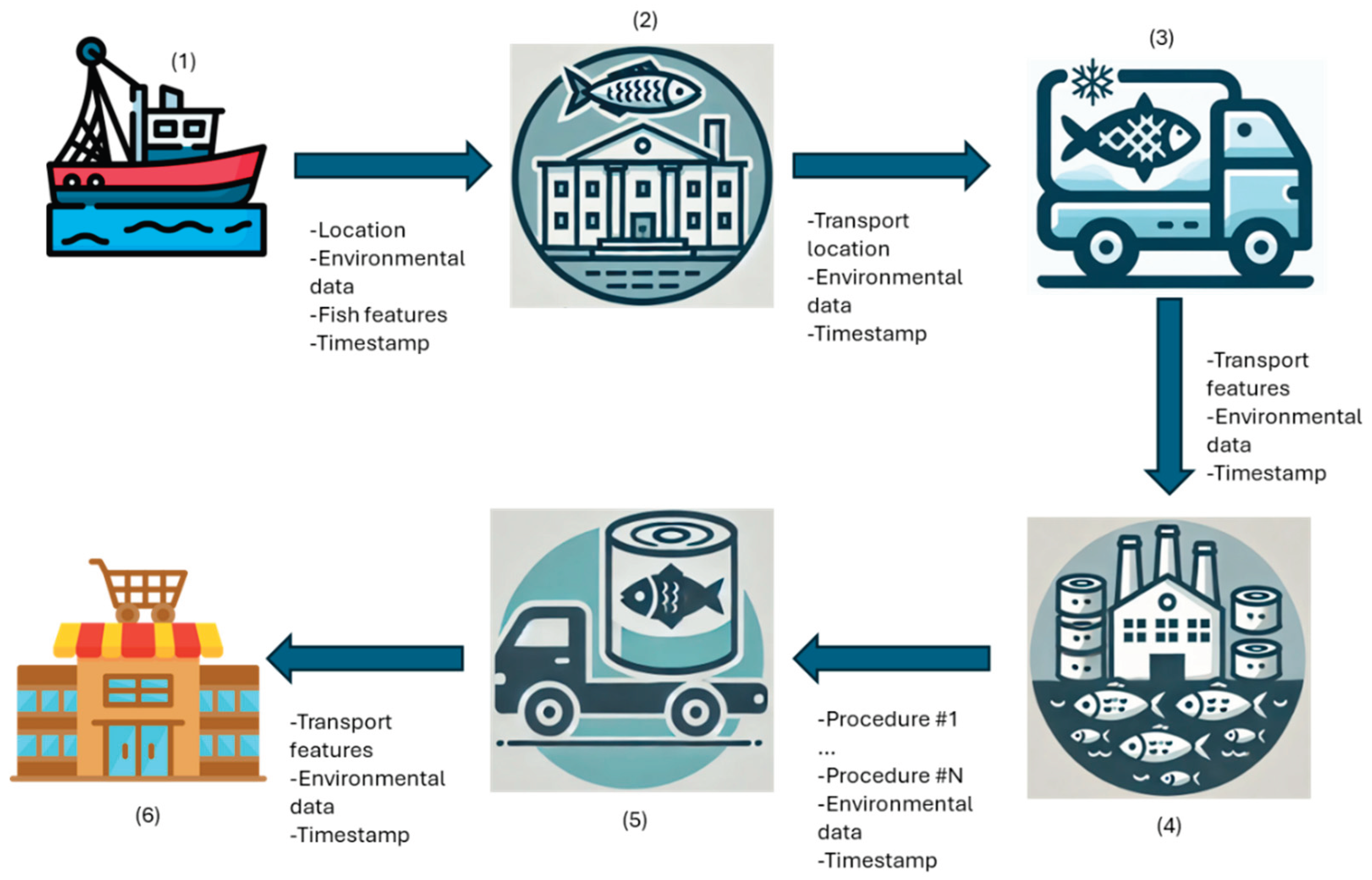
Table 1.
Classification of [5] most relevant features.
Table 1.
Classification of [5] most relevant features.
| Category | Sub-Category | Relevance to Paper |
| Certification Purpose | Traceability and Transparency | High: Focus on end-to-end traceability and transparency for fishery products |
| Quality Assurance | Moderate: Implicitly supports quality assurance through immutable records | |
| Regulatory Compliance | High: Ensures compliance with regulatory standards via smart contracts | |
| Sustainability and Ethical Practices | Moderate: Indirectly promotes sustainability through traceability | |
| Technology Type | Permissioned Blockchains | High: Uses permissioned blockchain (Ethereum private network) |
| Permissionless Blockchains | Low: Does not involve open access blockchain systems | |
| Hybrid Solutions | Low: No hybrid blockchain elements explicitly mentioned | |
| Functional Features | Smart Contracts | High: Extensive use of smart contracts to automate processes |
| Tokenization | Low: No mention of tokenization in the system | |
| Decentralized Identity (DID) | Low: No focus on decentralized identity verification | |
| Application Domain | Agrifood Industry | Low: Not applicable to agrifood; specific to fisheries |
| Fisheries and Aquaculture | High: Directly addresses fisheries and aquaculture supply chains | |
| Supply Chain Stage | Production | High: Certifies practices at the production level (e.g., wild-caught, farmed fish) |
| Processing and Packaging | High: Tracks and validates during processing and packaging | |
| Distribution | Moderate: Includes distribution tracking but less emphasis | |
| Retail and Consumer Interaction | Low: Limited consumer interaction; provides QR code data access | |
| Geographical and Cultural Context | Global Standards | High: Aims to meet global traceability and regulatory standards (FDA is included as one system participant) |
| Localized Systems | Moderate: Nothing prevents it from being adapted to local contexts | |
| Adoption and Stakeholder Involvement | Government-Led Initiatives | Moderate: Could support government-led initiatives for traceability |
| Industry Consortia | Moderate: Industry-wide collaboration implied but not explicitly stated | |
| Independent and Open-Source Platforms | High: Open-source smart contracts available for adaptation | |
| Data Management and Analytics | Static Data Systems | High: Static data like species ID, PCR reports, and origin details are certified |
| Dynamic Data Systems | High: Manages dynamic data like shipment updates and fish growth profiles |
Table 2.
Classification of [6] most relevant features.
Table 2.
Classification of [6] most relevant features.
| Category | Sub-Category | Relevance to Paper |
| Certification Purpose | Traceability and Transparency | High: Focus on ensuring end-to-end traceability in the seafood supply chain |
| Quality Assurance | Moderate: Supports quality assurance implicitly through verified records | |
| Regulatory Compliance | High: Verifies compliance with regulations, including food safety | |
| Sustainability and Ethical Practices | High: Aligns with sustainability practices by preventing illegal fishing | |
| Technology Type | Permissioned Blockchains | Moderate: Permissioned elements used for sensitive data |
| Permissionless Blockchains | Low: Does not employ open access permissionless blockchain systems | |
| Hybrid Solutions | High: Hybrid blockchain solution combines permissioned and public elements (private ledger for sensitive data, public ledger used for material that requires a high level of confidence) | |
| Functional Features | Smart Contracts | High: Extensively uses smart contracts for automation and traceability |
| Tokenization | Low: No evidence of tokenization features in the system | |
| Decentralized Identity (DID) | Moderate: Includes some use of digital identity features for authentication | |
| Application Domain | Agrifood Industry | Low: Not targeted at the agrifood industry |
| Fisheries and Aquaculture | High: Directly applies to fisheries and aquaculture for seafood traceability | |
| Supply Chain Stage | Production | High: Certifies fishing practices and captures data at the production stage |
| Processing and Packaging | High: Tracks compliance and integrity during processing and packaging | |
| Distribution | High: Includes comprehensive tracking through distribution networks | |
| Retail and Consumer Interaction | High: Enables consumer interaction via QR codes and digital passports | |
| Geographical and Cultural Context | Global Standards | High: Aims to align with international standards for supply chain traceability (developed works has the intention of eventually becoming an industry standard.) |
| Localized Systems | Moderate: Can address regional challenges but not specifically localized | |
| Adoption and Stakeholder Involvement | Government-Led Initiatives | Moderate: Could support government initiatives for sustainability |
| Industry Consortia | Moderate: Industry collaboration implied but not explicitly discussed | |
| Independent and Open-Source Platforms | High: Open-source smart contracts align with decentralized platforms | |
| Data Management and Analytics | Static Data Systems | High: Certifies static data such as species and origin details |
| Dynamic Data Systems | High: Manages dynamic data like geolocation, timestamps, and logistical updates |
Table 3.
Classification of [7] most relevant features.
Table 3.
Classification of [7] most relevant features.
| Category | Sub-Category | Relevance to Paper |
| Certification Purpose | Traceability and Transparency | High: Emphasizes tracking products from origin to consumer for transparency |
| Quality Assurance | Moderate: Implies quality assurance through traceability systems | |
| Regulatory Compliance | High: Supports compliance with legal fishing quotas and food safety standards | |
| Sustainability and Ethical Practices | High: Advocates eco-label certifications and responsible sourcing | |
| Technology Type | Permissioned Blockchains | Moderate: Discusses restricted blockchain use for sensitive supply chain data |
| Permissionless Blockchains | Low: Does not explicitly use open-access systems | |
| Hybrid Solutions | High: Advocates combining permissioned and public blockchain elements | |
| Functional Features | Smart Contracts | High: Smart contracts automate tracking and compliance processes |
| Tokenization | Low: Tokenization is not a focus of this paper | |
| Decentralized Identity (DID) | Low: No clear evidence of decentralized identity features | |
| Application Domain | Agrifood Industry | Low: Not relevant to agrifood; specific to seafood supply chains |
| Fisheries and Aquaculture | High: Directly applies to fisheries and aquaculture for seafood traceability | |
| Supply Chain Stage | Production | High: Focuses on certifying practices at fishing vessel and production levels |
| Processing and Packaging | High: Ensures data integrity during seafood processing stages | |
| Distribution | Moderate: Discusses tracking logistics but not in detail | |
| Retail and Consumer Interaction | High: Provides consumer-facing data access via QR codes for informed decisions | |
| Geographical and Cultural Context | Global Standards | High: Aligns with international traceability and certification standards |
| Localized Systems | Moderate: Can adapt to regional traceability needs but not explicitly highlighted | |
| Adoption and Stakeholder Involvement | Government-Led Initiatives | Moderate: Supports government-driven sustainability and traceability initiatives |
| Industry Consortia | Moderate: Highlights potential for industry-wide collaboration | |
| Independent and Open-Source Platforms | High: Suggests decentralized platforms and open-source approaches | |
| Data Management and Analytics | Static Data Systems | High: Certifies fixed data like origin, species, and sustainability claims |
| Dynamic Data Systems | High: Manages real-time data like logistics and location tracking |
Table 4.
Classification of [8] most relevant features.
Table 4.
Classification of [8] most relevant features.
| Category | Sub-Category | Relevance to Paper |
| Certification Purpose | Traceability and Transparency | High: Emphasizes end-to-end traceability and transparency in fisheries exports |
| Quality Assurance | Moderate: Supports quality assurance through certification processes | |
| Regulatory Compliance | High: Ensures compliance with domestic and international regulations | |
| Sustainability and Ethical Practices | High: Advocates sustainability and ethical practices via transparent certification | |
| Technology Type | Permissioned Blockchains | High: Utilizes permissioned blockchain for secure and private data management |
| Permissionless Blockchains | Low: Does not explicitly use permissionless blockchain systems | |
| Hybrid Solutions | Moderate: Explores potential for combining permissioned and public blockchain elements | |
| Functional Features | Smart Contracts | High: Smart contracts automate certification workflows and data management |
| Tokenization | Low: Tokenization is not discussed in this framework | |
| Decentralized Identity (DID) | Low: No evidence of decentralized identity features being employed | |
| Application Domain | Agrifood Industry | Low: Not applicable to the agrifood sector |
| Fisheries and Aquaculture | High: Specifically targets fisheries and aquaculture for seafood certification | |
| Supply Chain Stage | Production | High: Focuses on certifying practices at the production and vessel levels |
| Processing and Packaging | High: Ensures compliance and integrity during processing and packaging stages | |
| Distribution | Moderate: Discusses tracking logistics but lacks a detailed exploration | |
| Retail and Consumer Interaction | High: Provides consumer-facing data access via QR codes and blockchain verification | |
| Geographical and Cultural Context | Global Standards | High: Aligns with global standards for seafood certification and export |
| Localized Systems | Moderate: Addresses regional requirements through government integration | |
| Adoption and Stakeholder Involvement | Government-Led Initiatives | High: Emphasizes collaboration with government initiatives like Matsya Sampada Yojana |
| Industry Consortia | Moderate: Highlights opportunities for industry consortia but not explicitly detailed | |
| Independent and Open-Source Platforms | High: Supports open-source smart contracts for broad accessibility | |
| Data Management and Analytics | Static Data Systems | High: Certifies static data such as origin, species, and compliance |
| Dynamic Data Systems | High: Manages dynamic data like inspections, status updates, and logistics |
Table 5.
Classification of [9] most relevant features.
Table 5.
Classification of [9] most relevant features.
| Category | Sub-Category | Relevance to Paper |
| Certification Purpose | Traceability and Transparency | High: Focuses on ensuring traceability and transparency across the fish supply chain |
| Quality Assurance | High: Verifies product quality through IoT and blockchain-based systems | |
| Regulatory Compliance | High: Ensures adherence to fishing quotas and food safety standards | |
| Sustainability and Ethical Practices | High: Promotes sustainability by reducing illegal and unethical fishing practices | |
| Technology Type | Permissioned Blockchains | Moderate: Mentions the use of permissioned systems for secure data sharing |
| Permissionless Blockchains | Low: Does not involve open-access permissionless blockchain systems | |
| Hybrid Solutions | Moderate: Explores hybrid elements, integrating IoT and machine learning | |
| Functional Features | Smart Contracts | High: Smart contracts automate fraud detection and data validation |
| Tokenization | Low: Tokenization is not part of the proposed framework | |
| Decentralized Identity (DID) | Low: Does not include decentralized identity mechanisms | |
| Application Domain | Agrifood Industry | Low: Not applicable to agrifood, focuses on fisheries |
| Fisheries and Aquaculture | High: Designed for fisheries and aquaculture applications | |
| Supply Chain Stage | Production | High: Certifies practices at the production stage, including IoT-enabled data collection |
| Processing and Packaging | High: Tracks and validates product integrity during processing and packaging | |
| Distribution | High: Monitors distribution using GPS and IoT devices | |
| Retail and Consumer Interaction | Moderate: Limited direct consumer interaction, focuses on transparency via QR codes | |
| Geographical and Cultural Context | Global Standards | High: Aligns with international standards for traceability and quality assurance |
| Localized Systems | Moderate: Potential to adapt to regional requirements but not explicitly discussed | |
| Adoption and Stakeholder Involvement | Government-Led Initiatives | Moderate: Can integrate with government initiatives to enforce compliance |
| Industry Consortia | Moderate: Potential for collaboration among industry stakeholders, though not emphasized | |
| Independent and Open-Source Platforms | High: Emphasizes open systems for ML and IoT integration | |
| Data Management and Analytics | Static Data Systems | High: Certifies fixed data such as origin and species |
| Dynamic Data Systems | High: Manages dynamic data, including real-time tracking and condition monitoring |
Table 6.
Classification of [10] most relevant features
Table 6.
Classification of [10] most relevant features
| Category | Sub-Category | Relevance to Paper |
| Certification Purpose | Traceability and Transparency | High: Focuses on ensuring traceability and transparency in the fish supply chain |
| Quality Assurance | Moderate: Addresses quality assurance through compliance with ethical and labor standards | |
| Regulatory Compliance | High: Aims to verify compliance with legal and regulatory frameworks, including fishing quotas | |
| Sustainability and Ethical Practices | High: Aligns with sustainability and ethical practices by addressing SDG goals | |
| Technology Type | Permissioned Blockchains | High: Discusses the use of permissioned systems for secure data sharing and tracking |
| Permissionless Blockchains | Low: Does not explicitly involve permissionless blockchain systems | |
| Hybrid Solutions | Moderate: Explores potential hybrid solutions integrating data interoperability | |
| Functional Features | Smart Contracts | Moderate: Smart contracts could automate certain processes, though not deeply detailed |
| Tokenization | Low: Tokenization is not a focus of this framework | |
| Decentralized Identity (DID) | Low: Does not include decentralized identity features | |
| Application Domain | Agrifood Industry | Low: Not applicable to agrifood, focuses on fisheries |
| Fisheries and Aquaculture | High: Directly relevant to fisheries and aquaculture supply chains | |
| Supply Chain Stage | Production | High: Focuses on certifying sustainable practices at the production stage |
| Processing and Packaging | High: Ensures compliance during processing and packaging, with improved data consistency | |
| Distribution | Moderate: Discusses the distribution stage but lacks significant emphasis | |
| Retail and Consumer Interaction | Moderate: Limited consumer interaction, focuses on providing transparency indirectly | |
| Geographical and Cultural Context | Global Standards | High: Aims to align with global standards for sustainable fisheries supply chains |
| Localized Systems | High: Addresses local compliance challenges within the Thai fish industry | |
| Adoption and Stakeholder Involvement | Government-Led Initiatives | Moderate: Suggests potential collaboration with government bodies for enforcement |
| Industry Consortia | Moderate: Implies opportunities for collaboration among industry stakeholders | |
| Independent and Open-Source Platforms | Moderate: Highlights potential for independent systems with shared standards | |
| Data Management and Analytics | Static Data Systems | High: Certifies static data, including origin and regulatory compliance attributes |
| Dynamic Data Systems | Moderate: Explores real-time data management, though not deeply discussed |
Table 7.
Classification of [11] most relevant features .
Table 7.
Classification of [11] most relevant features .
| Category | Sub-Category | Relevance to Paper |
| Certification Purpose | Traceability and Transparency | High: Real-time tracking of fish provenance ensures transparency and accountability |
| Quality Assurance | High: Automates quality assessment using AI tools like image processing and E-nose | |
| Regulatory Compliance | High: Ensures compliance with food safety and fishing regulations through blockchain records | |
| Sustainability and Ethical Practices | High: Supports sustainability by reducing fraud and enhancing ethical practices as part of the features typical of blockchain | |
| Technology Type | Permissioned Blockchains | High: Utilizes permissioned blockchain for secure, stakeholder-specific data sharing |
| Permissionless Blockchains | Low: Does not involve permissionless blockchain systems for public participation | |
| Hybrid Solutions | Moderate: Combines permissioned blockchain with IoT for tailored use cases | |
| Functional Features | Smart Contracts | Moderate: Smart contracts are hinted as useful for automated tracking and validation processes |
| Tokenization | Low: Tokenization is not part of the proposed framework | |
| Decentralized Identity (DID) | Low: Does not implement decentralized identity features | |
| Application Domain | Agrifood Industry | Low: Not relevant to agrifood, focuses solely on fisheries |
| Fisheries and Aquaculture | High: Specifically targets fisheries and aquaculture for provenance and quality tracking | |
| Supply Chain Stage | Production | High: Certifies practices at the production level using IoT and blockchain integration |
| Processing and Packaging | High: Ensures quality and compliance during processing and packaging stages | |
| Distribution | Moderate: Discusses tracking logistics but with limited emphasis on distribution | |
| Retail and Consumer Interaction | High: Enables consumer interaction via QR codes, ensuring informed purchasing decisions | |
| Geographical and Cultural Context | Global Standards | High: Aligns with global standards for quality, traceability, and ethical practices |
| Localized Systems | Moderate: Can adapt to localized needs through attribute-based encryption and customization | |
| Adoption and Stakeholder Involvement | Government-Led Initiatives | Moderate: Potential for collaboration with government bodies to support sustainability goals |
| Industry Consortia | Moderate: Suggests industry consortia for widespread adoption but lacks explicit detail | |
| Independent and Open-Source Platforms | High: Emphasizes the use of open-source tools for secure and flexible implementation | |
| Data Management and Analytics | Static Data Systems | High: Certifies static data like origin, species, and certification status |
| Dynamic Data Systems | High: Manages dynamic data such as real-time tracking and quality parameters |
Table 8.
Classification of [12] most relevant features.
Table 8.
Classification of [12] most relevant features.
| Category | Sub-Category | Relevance to Paper |
| Certification Purpose | Traceability and Transparency | High: Enables traceability and transparency through IoT data collection and blockchain immutability |
| Quality Assurance | High: IoT sensors ensure quality monitoring, and blockchain verifies compliance | |
| Regulatory Compliance | Moderate: Discusses regulatory alignment but not deeply detailed | |
| Sustainability and Ethical Practices | High: Promotes eco-friendly and sustainable agricultural practices | |
| Technology Type | Permissioned Blockchains | High: Utilizes permissioned blockchain for secure stakeholder interactions |
| Permissionless Blockchains | Low: Does not focus on permissionless blockchain implementations | |
| Hybrid Solutions | Moderate: Suggests hybrid models integrating IoT and blockchain systems | |
| Functional Features | Smart Contracts | High: Proposes smart contracts for automating data verification and compliance processes |
| Tokenization | Low: Tokenization is not discussed | |
| Decentralized Identity (DID) | Low: Decentralized identity mechanisms are not implemented | |
| Application Domain | Agrifood Industry | High: Focuses on agrifood, specifically on smart agriculture and crop management |
| Fisheries and Aquaculture | Low: Not relevant to fisheries and aquaculture | |
| Supply Chain Stage | Production | High: Addresses production-level practices, particularly in soil and nutrient management |
| Processing and Packaging | Moderate: Mentions processing and packaging but not a central focus | |
| Distribution | Moderate: Distribution is indirectly included through traceability efforts | |
| Retail and Consumer Interaction | Moderate: Enhances consumer trust via transparent data but not directly addressed | |
| Geographical and Cultural Context | Global Standards | High: Aligns with global sustainability and traceability goals |
| Localized Systems | Moderate: Discusses the potential for regional adoption and customization | |
| Adoption and Stakeholder Involvement | Government-Led Initiatives | Moderate: Government involvement is implied but not extensively covered |
| Industry Consortia | Moderate: Industry collaboration is suggested as a potential avenue for adoption | |
| Independent and Open-Source Platforms | Low: Does not emphasize open-source implementations | |
| Data Management and Analytics | Static Data Systems | High: Certifies static data like crop origin and quality attributes |
| Dynamic Data Systems | High: Manages dynamic data such as real-time environmental conditions and resource usage |
Table 9.
Classification of [13] most relevant features .
Table 9.
Classification of [13] most relevant features .
| Category | Sub-Category | Relevance to Paper |
| Certification Purpose | Traceability and Transparency | High: Ensures traceability and transparency for aquaculture products |
| Quality Assurance | High: Supports compliance with quality standards, including sustainable feed and animal welfare | |
| Regulatory Compliance | High: Verifies compliance with EU regulations, particularly environmental policies | |
| Sustainability and Ethical Practices | High: Aligns aquaculture operations with sustainability and ethical practices | |
| Technology Type | Permissioned Blockchains | High: Uses permissioned blockchains to control data access among stakeholders |
| Permissionless Blockchains | Low: Does not involve permissionless blockchain systems | |
| Hybrid Solutions | Moderate: Explores the potential for hybrid solutions but lacks extensive details | |
| Functional Features | Smart Contracts | High: Implements smart contracts for automating regulatory and compliance processes |
| Tokenization | Low: Tokenization is not discussed | |
| Decentralized Identity (DID) | Low: Decentralized identity mechanisms are not implemented | |
| Application Domain | Agrifood Industry | Low: Decentralized identity mechanisms are not implemented |
| Fisheries and Aquaculture | High: Directly applies to fisheries and aquaculture for compliance and traceability | |
| Supply Chain Stage | Production | High: Certifies practices at the production level, including sustainable farming |
| Processing and Packaging | Moderate: Mentions packaging stages but not a major focus | |
| Distribution | Moderate: Mentions packaging stages but not a major focus | |
| Retail and Consumer Interaction | High: Enhances consumer trust by providing verifiable product certifications | |
| Geographical and Cultural Context | Global Standards | High: Aligns with global standards for sustainable aquaculture practices |
| Localized Systems | High: Addresses regional compliance needs, particularly within the EU context | |
| Adoption and Stakeholder Involvement | Government-Led Initiatives | High: Relies on government-led initiatives for enforcement and adoption |
| Industry Consortia | Moderate: Suggests industry collaboration but not extensively detailed | |
| Independent and Open-Source Platforms | Low: Does not emphasize open-source platforms | |
| Data Management and Analytics | Static Data Systems | High: Certifies static data like origin and production compliance |
| Dynamic Data Systems | High: Manages dynamic data such as farming conditions and compliance events |
Table 10.
Classification of [14] most relevant features.
Table 10.
Classification of [14] most relevant features.
| Category | Sub-Category | Relevance to Paper |
| Certification Purpose | Traceability and Transparency | High: Ensures traceability and transparency through blockchain and fog computing integration |
| Quality Assurance | Moderate: Improves data integrity and compliance but not focused on certification standards | |
| Regulatory Compliance | Moderate: Addresses regulatory challenges indirectly via secure data management | |
| Sustainability and Ethical Practices | Moderate: Supports sustainable practices by enhancing agricultural IoT data security | |
| Technology Type | Permissioned Blockchains | High: Utilizes permissioned blockchains for secure agricultural data sharing |
| Permissionless Blockchains | Low: Does not emphasize permissionless blockchain systems | |
| Hybrid Solutions | Moderate: Discusses potential hybrid models integrating IoT and blockchain systems | |
| Functional Features | Smart Contracts | Moderate: Smart contracts are implied for network management and automation |
| Tokenization | Low: Tokenization is not a focus of the paper | |
| Decentralized Identity (DID) | Low: Decentralized identity mechanisms are not implemented | |
| Application Domain | Agrifood Industry | High: Directly relevant to agrifood, particularly in smart agriculture IoT systems |
| Fisheries and Aquaculture | Low: Not relevant to fisheries and aquaculture | |
| Supply Chain Stage | Production | High: Targets production-level IoT systems for monitoring and data security |
| Processing and Packaging | Moderate: Processing and packaging stages are not a primary focus | |
| Distribution | Moderate: Distribution is not a primary focus | |
| Retail and Consumer Interaction | Moderate: not a primary focus | |
| Geographical and Cultural Context | Global Standards | High: Aligns with global standards for IoT and blockchain technology |
| Localized Systems | Moderate: Discusses the potential for localized adoption but lacks specifics | |
| Adoption and Stakeholder Involvement | Government-Led Initiatives | Moderate: Suggests government-led initiatives for promoting IoT and blockchain adoption |
| Industry Consortia | Moderate: Encourages collaboration among industry stakeholders for framework implementation | |
| Independent and Open-Source Platforms | Low: Does not focus on independent or open-source platforms | |
| Data Management and Analytics | Static Data Systems | High: Certifies static IoT data such as soil conditions and network settings |
| Dynamic Data Systems | High: Real-time data analytics are considered |
Table 11.
Classification of [15] most relevant features.
Table 11.
Classification of [15] most relevant features.
| Category | Sub-Category | Relevance to Paper |
| Certification Purpose | Traceability and Transparency | High: Explores blockchain's potential for tracking transparency across multiple sectors |
| Quality Assurance | Moderate: Addresses quality assurance but not specific to agriculture or food systems | |
| Regulatory Compliance | Moderate: Regulatory alignment is discussed in broader contexts, not specialized | |
| Sustainability and Ethical Practices | Moderate: Supports ethical practices but more through general applications like sustainability | |
| Technology Type | Permissioned Blockchains | High: Permissioned systems are heavily emphasized for enterprise solutions |
| Permissionless Blockchains | Moderate: Permissionless systems are mentioned but not the focal point | |
| Hybrid Solutions | Moderate: Hybrid systems are briefly discussed as a future application | |
| Functional Features | Smart Contracts | High: Highlights smart contracts for automating processes across various industries |
| Tokenization | Low: Tokenization is mentioned but not elaborated upon | |
| Decentralized Identity (DID) | Low: Decentralized Identity is not a primary focus of the study | |
| Application Domain | Agrifood Industry | Moderate: Discusses agrifood applications but in a broad, conceptual sense |
| Fisheries and Aquaculture | Low: Not relevant to fisheries and aquaculture directly | |
| Supply Chain Stage | Production | Low: Production-level applications are not a direct focus |
| Processing and Packaging | Low: Processing and packaging are mentioned only tangentially | |
| Distribution | Moderate: Addresses logistics and distribution through transparency use cases | |
| Retail and Consumer Interaction | Moderate: Indirectly supports consumer trust through blockchain-based transparency | |
| Geographical and Cultural Context | Global Standards | High: Aligns with global frameworks and standards in blockchain adoption |
| Localized Systems | Moderate: Discusses regional systems but lacks specifics | |
| Adoption and Stakeholder Involvement | Government-Led Initiatives | Moderate: Government involvement is suggested but not deeply analyzed |
| Industry Consortia | High: Encourages collaboration among industry consortia for broader adoption | |
| Independent and Open-Source Platforms | Moderate: Suggests open-source possibilities but not emphasized | |
| Data Management and Analytics | Static Data Systems | High: Highlights blockchain's role in managing static data securely |
| Dynamic Data Systems | Moderate: Dynamic data use is discussed but not a central element of the paper |
Table 12.
Classification of [16] most relevant features.
Table 12.
Classification of [16] most relevant features.
| Category | Sub-Category | Relevance to Paper |
| Certification Purpose | Traceability and Transparency | High: Focuses on ensuring traceability and transparency in fisheries supply chains |
| Quality Assurance | Moderate: Supports quality assurance through data integrity and stakeholder consensus | |
| Regulatory Compliance | Moderate: Discusses compliance with traceability standards but not regulatory specifics | |
| Sustainability and Ethical Practices | Moderate: Supports ethical practices by reducing fraud and ensuring traceability | |
| Technology Type | Permissioned Blockchains | High: Uses permissioned blockchain (Hyperledger Fabric) for secure data sharing |
| Permissionless Blockchains | Low: Does not emphasize permissionless blockchain applications | |
| Hybrid Solutions | Low: Hybrid blockchain solutions are not discussed | |
| Functional Features | Smart Contracts | High: Implements smart contracts for automating traceability processes |
| Tokenization | Low: Tokenization is not a focus of the study | |
| Decentralized Identity (DID) | Low: Decentralized identity mechanisms are not implemented | |
| Application Domain | Agrifood Industry | Low: Not directly relevant to broader agrifood industries |
| Fisheries and Aquaculture | High: Tailored specifically to fisheries and aquaculture traceability | |
| Supply Chain Stage | Production | High: Certifies production practices through blockchain-enabled monitoring |
| Processing and Packaging | Moderate: Processing and packaging are mentioned but not central to the system | |
| Distribution | High: Includes distribution as part of supply chain traceability improvements | |
| Retail and Consumer Interaction | Moderate: Enhances consumer trust indirectly via transparency, but not directly discussed | |
| Geographical and Cultural Context | Global Standards | High: Aligns with global traceability standards but lacks explicit alignment with certifications |
| Localized Systems | High: Designed for regional use in Indonesia, addressing local supply chain needs | |
| Adoption and Stakeholder Involvement | Government-Led Initiatives | Moderate: Suggests potential for government collaboration but lacks specific examples |
| Industry Consortia | Moderate: Industry collaboration implied but not elaborated upon | |
| Independent and Open-Source Platforms | Low: Independent or open-source platforms are not discussed | |
| Data Management and Analytics | Static Data Systems | High: Focuses on static data certification such as origin and production records |
| Dynamic Data Systems | Moderate: Dynamic data management mentioned but not deeply explored |
Table 13.
Classification of [17] most relevant features.
Table 13.
Classification of [17] most relevant features.
| Category | Sub-Category | Relevance to Paper |
| Certification Purpose | Traceability and Transparency | High: Ensures traceability and transparency across the fisheries supply chain |
| Quality Assurance | Moderate: Enhances quality assurance through IoT-enabled monitoring of product conditions | |
| Regulatory Compliance | Moderate: Addresses compliance with standards indirectly through improved data integrity | |
| Sustainability and Ethical Practices | Moderate: Promotes sustainability by enabling better resource management and reducing waste | |
| Technology Type | Permissioned Blockchains | High: Utilizes permissioned blockchains for secure, private data sharing among stakeholders |
| Permissionless Blockchains | Low: Does not emphasize permissionless blockchain systems | |
| Hybrid Solutions | High: Implements a hybrid model combining public and private blockchain features | |
| Functional Features | Smart Contracts | Moderate: Mentions potential use of smart contracts but not deeply explored |
| Tokenization | Low: Tokenization is not a focus of the study | |
| Decentralized Identity (DID) | Low: Decentralized identity mechanisms are not implemented | |
| Application Domain | Agrifood Industry | Low: Does not focus on agrifood applications |
| Fisheries and Aquaculture | High: Focuses on fisheries and aquaculture supply chain management | |
| Supply Chain Stage | Production | High: Certifies production processes using real-time IoT data and blockchain recording |
| Processing and Packaging | Moderate: Discusses packaging but not a primary focus | |
| Distribution | High: Includes distribution as part of supply chain traceability and monitoring | |
| Retail and Consumer Interaction | Moderate: Indirectly builds consumer trust through transparency and data integrity | |
| Geographical and Cultural Context | Global Standards | High: Aligns with global traceability and sustainability standards |
| Localized Systems | High: Addresses regional challenges in Newfoundland and Labrador's fisheries supply chain | |
| Adoption and Stakeholder Involvement | Government-Led Initiatives | Moderate: Government involvement is implied but not explicitly discussed |
| Industry Consortia | Moderate: Recommends collaboration among industry stakeholders for successful adoption | |
| Independent and Open-Source Platforms | Low: Independent and open-source platforms are not emphasized | |
| Data Management and Analytics | Static Data Systems | High: Highlights static data management for certifications like origin and handling conditions |
| Dynamic Data Systems | High: Includes dynamic data systems for real-time monitoring of environmental and product metrics |
Table 14.
Classification of [18] most relevant features.
Table 14.
Classification of [18] most relevant features.
| Category | Sub-Category | Relevance to Paper |
| Certification Purpose | Traceability and Transparency | High: Ensures traceability and transparency through blockchain for aquaculture operations |
| Quality Assurance | High: Supports quality assurance by monitoring water parameters and fish health | |
| Regulatory Compliance | Moderate: Addresses compliance with standards indirectly through secure data management | |
| Sustainability and Ethical Practices | High: Promotes sustainability by reducing fish mortality and optimizing resource use | |
| Technology Type | Permissioned Blockchains | High: Uses permissioned blockchain to securely store and share aquaculture data |
| Permissionless Blockchains | Low: Does not focus on permissionless blockchain systems | |
| Hybrid Solutions | Low: Does not focus on features from both technologies | |
| Functional Features | Smart Contracts | Moderate: Smart contracts are implied but not deeply explored for compliance automation |
| Tokenization | Low: Tokenization is not discussed in the paper | |
| Decentralized Identity (DID) | Low: Decentralized identity mechanisms are not implemented | |
| Application Domain | Agrifood Industry | Low: Not directly relevant to broader agrifood applications |
| Fisheries and Aquaculture | High: Tailored specifically to fisheries and aquaculture operations | |
| Supply Chain Stage | Production | High: Certifies production-level practices through IoT and AI-enabled monitoring |
| Processing and Packaging | Moderate: Processing and packaging are mentioned but not a primary focus | |
| Distribution | Moderate: Includes distribution as part of supply chain traceability but not extensively detailed | |
| Retail and Consumer Interaction | Moderate: Enhances consumer trust indirectly via data transparency and traceability | |
| Geographical and Cultural Context | Global Standards | High: Aligns with global standards for traceability and data integrity |
| Localized Systems | Moderate: Suggests potential for localized implementation but lacks specific examples | |
| Adoption and Stakeholder Involvement | Government-Led Initiatives | Moderate: Implies government involvement but not explicitly discussed |
| Industry Consortia | Moderate: Encourages industry collaboration but lacks detailed examples | |
| Independent and Open-Source Platforms | Low: Independent and open-source platforms are not a focus of the study | |
| Data Management and Analytics | Static Data Systems | High: Highlights static data management for water quality and fish health certifications |
| Dynamic Data Systems | High: Includes dynamic data systems for real-time water parameter monitoring and fish behavior analysis |
Table 15.
Classification of [19] most relevant features.
Table 15.
Classification of [19] most relevant features.
| Category | Sub-Category | Relevance to Paper |
| Certification Purpose | Traceability and Transparency | High: Ensures traceability and transparency across dairy, agriculture, and seafood supply chains |
| Quality Assurance | High: Enhances quality assurance by certifying compliance with safety and quality standards | |
| Regulatory Compliance | High: Supports regulatory compliance by improving data integrity and traceability | |
| Sustainability and Ethical Practices | High: Promotes sustainability and ethical practices by enabling transparency and reducing fraud | |
| Technology Type | Permissioned Blockchains | High: Uses permissioned blockchains for secure data sharing and stakeholder access control |
| Permissionless Blockchains | Moderate: Mentions permissionless systems for consumer-facing transparency but not a primary focus | |
| Hybrid Solutions | Moderate: Explores hybrid models for combining public and private blockchain features | |
| Functional Features | Smart Contracts | High: Implements smart contracts for automating compliance processes and enhancing efficiency |
| Tokenization | Low: Tokenization is not deeply discussed in the paper | |
| Decentralized Identity (DID) | Low: Decentralized identity mechanisms are not a focus of the study | |
| Application Domain | Agrifood Industry | High: Relevant to agrifood sectors like dairy and agriculture through enhanced traceability |
| Fisheries and Aquaculture | High: Directly addresses fisheries and aquaculture with specific case studies | |
| Supply Chain Stage | Production | High: Certifies production-level practices using IoT, RFID tags, and blockchain solutions |
| Processing and Packaging | Moderate: Discusses packaging stages as part of supply chain integrity improvements | |
| Distribution | High: Includes distribution as part of traceability and transparency objectives | |
| Retail and Consumer Interaction | Moderate: Builds consumer trust indirectly through enhanced transparency and data security | |
| Geographical and Cultural Context | Global Standards | High: Aligns with global standards for food safety, sustainability, and traceability |
| Localized Systems | Moderate: Suggests regional adaptations but lacks detailed localized implementation strategies | |
| Adoption and Stakeholder Involvement | Government-Led Initiatives | Moderate: Mentions the role of governments in encouraging adoption but lacks specifics |
| Industry Consortia | Moderate: Industry collaboration is recommended to address scalability and implementation challenges | |
| Independent and Open-Source Platforms | Low: Independent or open-source platforms are not emphasized in the discussion | |
| Data Management and Analytics | Static Data Systems | High: Highlights static data systems for certifying product origin, quality, and safety |
| Dynamic Data Systems | High: Incorporates dynamic data systems like real-time monitoring of transportation and storage conditions |
Table 16.
Classification of [20] most relevant features.
Table 16.
Classification of [20] most relevant features.
| Category | Sub-Category | Relevance to Paper |
| Certification Purpose | Traceability and Transparency | High: Ensures traceability and transparency by transforming seafood items into NFTs |
| Quality Assurance | Moderate: Supports quality assurance indirectly by linking product metadata to NFTs | |
| Regulatory Compliance | Moderate: Addresses regulatory compliance through smart contracts but not deeply explored | |
| Sustainability and Ethical Practices | High: Promotes sustainability by combating fraud and enhancing ethical fishing practices | |
| Technology Type | Permissioned Blockchains | Low: Does not use permissioned blockchains in the proposed framework |
| Permissionless Blockchains | High: Leverages permissionless blockchain systems for consumer-facing transparency | |
| Hybrid Solutions | Moderate: Explores hybrid possibilities through integration of public and decentralized storage systems | |
| Functional Features | Smart Contracts | High: Implements smart contracts for automating payments and verifying transactions |
| Tokenization | High: Utilizes tokenization to represent seafood products as NFTs | |
| Decentralized Identity (DID) | Low: Decentralized identity mechanisms are not discussed | |
| Application Domain | Agrifood Industry | Low: Not focused on broader agrifood applications |
| Fisheries and Aquaculture | High: Highly relevant to fisheries and aquaculture through seafood-specific case studies | |
| Supply Chain Stage | Production | Moderate: Production-level practices are linked to traceability but not explicitly detailed |
| Processing and Packaging | Low: Processing and packaging stages are not a primary focus | |
| Distribution | High: Enhances traceability and transparency during distribution through IPFS and blockchain | |
| Retail and Consumer Interaction | High: Builds consumer trust through NFT-based transparency and product data access | |
| Geographical and Cultural Context | Global Standards | High: Aligns with global standards for transparency and traceability in seafood supply chains |
| Localized Systems | Moderate: Potential for localized adoption but lacks explicit examples | |
| Adoption and Stakeholder Involvement | Government-Led Initiatives | Low: Government involvement is not explicitly discussed |
| Industry Consortia | Moderate: Encourages collaboration among industry stakeholders but lacks detailed examples | |
| Independent and Open-Source Platforms | Low: Independent or open-source platforms are not emphasized | |
| Data Management and Analytics | Static Data Systems | High: Highlights static data certification such as product metadata linked to NFTs |
| Dynamic Data Systems | High: Incorporates dynamic data systems for transaction and payment monitoring |
Table 17.
Classification of [21] most relevant features.
Table 17.
Classification of [21] most relevant features.
| Category | Sub-Category | Relevance to Paper |
| Certification Purpose | Traceability and Transparency | High: Focuses on traceability and transparency of fishing quotas using blockchain |
| Quality Assurance | Moderate: Supports quality assurance indirectly through improved data integrity | |
| Regulatory Compliance | High: Verifies compliance with legal standards, particularly fishing quotas | |
| Sustainability and Ethical Practices | High: Promotes sustainability by addressing overfishing and improving resource management | |
| Technology Type | Permissioned Blockchains | High: Utilizes permissioned blockchain for secure and controlled data storage |
| Permissionless Blockchains | Low: Does not use permissionless blockchains in the proposed system | |
| Hybrid Solutions | Moderate: Mentions hybrid potential but focuses primarily on permissioned systems | |
| Functional Features | Smart Contracts | Moderate: Smart contracts are implied for quota management but not deeply explored |
| Tokenization | Low: Tokenization is not a focus of the study | |
| Decentralized Identity (DID) | Low: Decentralized identity mechanisms are not discussed | |
| Application Domain | Agrifood Industry | Low: Not focused on agrifood industry applications |
| Fisheries and Aquaculture | High: Tailored specifically to fisheries and aquaculture quota management | |
| Supply Chain Stage | Production | High: Monitors production-level activities like fishing vessel operations |
| Processing and Packaging | Moderate: Processing and packaging are not explicitly discussed | |
| Distribution | Moderate: Includes distribution through traceability mechanisms but lacks detailed focus | |
| Retail and Consumer Interaction | Low: Does not directly address consumer interaction | |
| Geographical and Cultural Context | Global Standards | High: Aligns with global standards for sustainable fisheries management |
| Localized Systems | High: Designed for localized implementation addressing Indonesia’s specific challenges | |
| Adoption and Stakeholder Involvement | Government-Led Initiatives | High: Suggests government collaboration for enforcing and monitoring quotas |
| Industry Consortia | Moderate: Encourages industry collaboration but lacks explicit details | |
| Independent and Open-Source Platforms | Low: Independent and open-source platforms are not discussed | |
| Data Management and Analytics | Static Data Systems | High: Focuses on static data systems for certifying fishing quotas and recorded activities |
| Dynamic Data Systems | Moderate: Dynamic data systems are implied but not deeply explored |
Table 18.
Classification of [22] most relevant features.
Table 18.
Classification of [22] most relevant features.
| Category | Sub-Category | Relevance to Paper |
| Certification Purpose | Traceability and Transparency | Moderate: Enhances traceability and communication but not directly focused on supply chain transparency |
| Quality Assurance | Low: Does not emphasize quality assurance certifications | |
| Regulatory Compliance | Moderate: Supports regulatory compliance through monitoring and boundary detection | |
| Sustainability and Ethical Practices | High: Promotes sustainability by preventing illegal fishing and supporting eco-friendly practices | |
| Technology Type | Permissioned Blockchains | Moderate: Uses permissioned blockchain for secure and controlled communication storage |
| Permissionless Blockchains | Low: Does not use permissionless blockchain systems | |
| Hybrid Solutions | Moderate: Explores hybrid systems with blockchain and decentralized ad hoc networks | |
| Functional Features | Smart Contracts | Low: Smart contracts are not implemented or discussed in the paper |
| Tokenization | Low: Tokenization is not a focus of the study | |
| Decentralized Identity (DID) | Low: Decentralized identity mechanisms are not mentioned | |
| Application Domain | Agrifood Industry | Low: Not relevant to broader agrifood applications |
| Fisheries and Aquaculture | High: Specifically addresses fisheries and aquaculture communication challenges | |
| Supply Chain Stage | Production | Moderate: Monitors production-level activities like fishing vessel operations but not a direct focus |
| Processing and Packaging | Low: Processing and packaging are not addressed | |
| Distribution | Moderate: Supports distribution through enhanced communication but not a primary focus | |
| Retail and Consumer Interaction | Low: Does not emphasize consumer interaction | |
| Geographical and Cultural Context | Global Standards | Moderate: Could align with global standards for maritime communication and fishing compliance |
| Localized Systems | High: Designed for localized maritime systems addressing specific regional challenges | |
| Adoption and Stakeholder Involvement | Government-Led Initiatives | Moderate: Implies government involvement for compliance but lacks specifics |
| Industry Consortia | Moderate: Suggests collaboration among maritime stakeholders but not detailed | |
| Independent and Open-Source Platforms | Low: Independent and open-source platforms are not discussed | |
| Data Management and Analytics | Static Data Systems | Moderate: Static data like vessel logs and boundary records are managed |
| Dynamic Data Systems | High: Dynamic data systems monitor real-time weather, location, and communication metrics |
Table 19.
Classification of [23] most relevant features.
Table 19.
Classification of [23] most relevant features.
| Category | Sub-Category | Relevance to Paper |
| Certification Purpose | Traceability and Transparency | High: Focuses on improving traceability through digital technologies in fisheries |
| Quality Assurance | Moderate: Supports quality assurance indirectly by enabling better decision-making | |
| Regulatory Compliance | High: Addresses regulatory compliance through enhanced monitoring and data sharing | |
| Sustainability and Ethical Practices | High: Promotes sustainability by integrating tools for eco-friendly fisheries management | |
| Technology Type | Permissioned Blockchains | Moderate: Suggests permissioned systems for data security but not extensively detailed |
| Permissionless Blockchains | Moderate: Explores open systems for transparency but not deeply analyzed | |
| Hybrid Solutions | Moderate: Hybrid approaches are implied but not explicitly discussed | |
| Functional Features | Smart Contracts | Low: Smart contracts are not explicitly addressed in the proposed framework |
| Tokenization | Low: Tokenization is not a focus of the study | |
| Decentralized Identity (DID) | Low: Decentralized identity mechanisms are not mentioned | |
| Application Domain | Agrifood Industry | Low: Decentralized identity mechanisms are not mentioned |
| Fisheries and Aquaculture | High: Directly addresses fisheries and aquaculture through innovative technology integration | |
| Supply Chain Stage | Production | High: Monitors production practices via IoT and AI-enabled tools |
| Processing and Packaging | Low: Processing and packaging are not discussed | |
| Distribution | Moderate: Supports distribution improvements indirectly through enhanced data flows | |
| Retail and Consumer Interaction | Moderate: Builds consumer trust through better traceability and transparency | |
| Geographical and Cultural Context | Global Standards | High: Aligns with global standards for sustainable and traceable fisheries management |
| Localized Systems | Moderate: Proposes regional adaptations but lacks detailed localization examples | |
| Adoption and Stakeholder Involvement | Government-Led Initiatives | Moderate: Suggests government involvement for successful implementation |
| Industry Consortia | Moderate: Encourages industry collaboration but without explicit examples | |
| Independent and Open-Source Platforms | Low: Independent or open-source platforms are not emphasized | |
| Data Management and Analytics | Static Data Systems | Moderate: Manages static data for origin and compliance tracking |
| Dynamic Data Systems | High: Incorporates dynamic data systems for real-time monitoring and decision-making |
Table 20.
Classification of [24] most relevant features.
Table 20.
Classification of [24] most relevant features.
| Category | Sub-Category | Relevance to Paper |
| Certification Purpose | Traceability and Transparency | High: Focuses on traceability and transparency for sustainable fisheries supply chains |
| Quality Assurance | Moderate: Supports quality assurance indirectly through improved data integrity and accountability | |
| Regulatory Compliance | High: Verifies adherence to regulations such as fishing quotas and labor practices | |
| Sustainability and Ethical Practices | High: Promotes sustainability by reducing inefficiencies and supporting ethical practices | |
| Technology Type | Permissioned Blockchains | High: Suggests permissioned blockchain systems for secure enterprise solutions |
| Permissionless Blockchains | Moderate: Explores consumer-facing transparency but not the primary focus | |
| Hybrid Solutions | Moderate: Implies hybrid blockchain systems for tailored use cases | |
| Functional Features | Smart Contracts | Low: Smart contracts are not explicitly discussed |
| Tokenization | Low: Tokenization is not explored in this paper | |
| Decentralized Identity (DID) | Low: Decentralized identity mechanisms are not mentioned | |
| Application Domain | Agrifood Industry | Moderate: Indirectly applicable to agrifood through transferable frameworks |
| Fisheries and Aquaculture | High: Tailored to fisheries and aquaculture supply chain improvements | |
| Supply Chain Stage | Production | High: Monitors production practices for regulatory compliance and transparency |
| Processing and Packaging | Moderate: Mentions packaging and processing but not extensively detailed | |
| Distribution | High: Tracks products through logistics for enhanced transparency | |
| Retail and Consumer Interaction | Moderate: Builds consumer trust through data-driven transparency but not a direct focus | |
| Geographical and Cultural Context | Global Standards | High: Aligns with global standards like MSC for sustainable fisheries management |
| Localized Systems | Moderate: Addresses regional challenges but lacks specific localization examples | |
| Adoption and Stakeholder Involvement | Government-Led Initiatives | Moderate: Mentions government role in policy support but not deeply explored |
| Industry Consortia | Moderate: Encourages collaboration among industry stakeholders for adoption | |
| Independent and Open-Source Platforms | Low: Independent or open-source platforms are not emphasized | |
| Data Management and Analytics | Static Data Systems | High: Highlights static data systems for certifying fishing origins and quota compliance |
| Dynamic Data Systems | Moderate: Mentions dynamic data systems but not deeply explored |
Table 21.
Classification of [25] most relevant features.
Table 21.
Classification of [25] most relevant features.
| Category | Sub-Category | Relevance to Paper |
| Certification Purpose | Traceability and Transparency | High: Ensures data traceability and transparency through blockchain integration in fish farms |
| Quality Assurance | Moderate: Supports quality assurance by automating data processes like anomaly filtering | |
| Regulatory Compliance | Moderate: Addresses regulatory compliance through secure and immutable data storage | |
| Sustainability and Ethical Practices | High: Promotes sustainability by optimizing resource and energy use in aquaculture | |
| Technology Type | Permissioned Blockchains | High: Utilizes permissioned blockchains for secure, enterprise-level data management |
| Permissionless Blockchains | Low: Does not focus on permissionless blockchains | |
| Hybrid Solutions | Moderate: Hybrid approaches are implied but not the focus | |
| Functional Features | Smart Contracts | High: Implements smart contracts for automated anomaly detection and actuator controls |
| Tokenization | Low: Tokenization is not discussed | |
| Decentralized Identity (DID) | Low: Decentralized identity mechanisms are not a focus of this paper | |
| Application Domain | Agrifood Industry | Moderate: Could be adapted to broader agrifood industry scenarios |
| Fisheries and Aquaculture | High: Specifically tailored to fisheries and aquaculture use cases | |
| Supply Chain Stage | Production | High: Monitors production activities like water quality and fish health via IoT |
| Processing and Packaging | Low: Processing and packaging are not discussed | |
| Distribution | Moderate: Distribution improvements are implied through traceable data but not detailed | |
| Retail and Consumer Interaction | Low: Retail and consumer interaction are not addressed | |
| Geographical and Cultural Context | Global Standards | Moderate: Aligns with global standards for sustainable and transparent aquaculture |
| Localized Systems | Moderate: Provides a localized solution but lacks specific regional examples | |
| Adoption and Stakeholder Involvement | Government-Led Initiatives | Moderate: Government-led adoption is implied but not explicitly discussed |
| Industry Consortia | Moderate: Encourages collaboration among aquaculture industry stakeholders | |
| Independent and Open-Source Platforms | Low: Independent or open-source platforms are not emphasized | |
| Data Management and Analytics | Static Data Systems | High: Highlights static data systems for managing aquaculture parameters |
| Dynamic Data Systems | High: Includes dynamic data systems for real-time monitoring of environmental and operational metrics |
Table 22.
Classification of [26] most relevant features.
Table 22.
Classification of [26] most relevant features.
| Category | Sub-Category | Relevance to Paper |
| Certification Purpose | Traceability and Transparency | High: Focuses on tracking products from origin to consumer, ensuring supply chain transparency |
| Quality Assurance | Moderate: Supports compliance with hygiene and quality standards indirectly | |
| Regulatory Compliance | High: Verifies adherence to legal standards like catch certifications | |
| Sustainability and Ethical Practices | High: Promotes eco-friendly and sustainable fishing practices through data transparency | |
| Technology Type | Permissioned Blockchains | High: Uses permissioned blockchain to control access and ensure secure data |
| Permissionless Blockchains | Moderate: Consumer-facing transparency possible but not the primary focus | |
| Hybrid Solutions | Moderate: Hybrid features could be inferred but not explicitly detailed | |
| Functional Features | Smart Contracts | Low: Smart contracts are not explicitly utilized in the study |
| Tokenization | Low: Tokenization is not discussed | |
| Decentralized Identity (DID) | Low: Decentralized identity mechanisms are not implemented | |
| Application Domain | Agrifood Industry | Low: Not focused on broader agrifood applications |
| Fisheries and Aquaculture | High: Specifically tailored to the fisheries and aquaculture sector | |
| Supply Chain Stage | Production | High: Monitors production at the fishing vessel level via mobile data collection |
| Processing and Packaging | Low: Processing and packaging are not discussed in detail | |
| Distribution | Moderate: Distribution is supported indirectly through transparent data sharing | |
| Retail and Consumer Interaction | Moderate: Improves consumer trust through data-driven transparency | |
| Geographical and Cultural Context | Global Standards | High: Aligns with global standards for sustainable fishing and export compliance |
| Localized Systems | High: Designed for localized implementation in the Philippines | |
| Adoption and Stakeholder Involvement | Government-Led Initiatives | Moderate: Mentions government involvement but does not deeply explore policies |
| Industry Consortia | Moderate: Encourages industry collaboration among supply chain stakeholders | |
| Independent and Open-Source Platforms | Low: Independent or open-source platforms are not a focus | |
| Data Management and Analytics | Static Data Systems | High: Certifies fixed attributes like origin and compliance data |
| Dynamic Data Systems | Moderate: Real-time tracking systems are implied but not extensively detailed |
Table 23.
Classification of [27] most relevant features.
Table 23.
Classification of [27] most relevant features.
| Category | Sub-Category | Relevance to Paper |
| Certification Purpose | Traceability and Transparency | High: Supports traceability in the fisheries supply chain to prevent illegal fishing |
| Quality Assurance | Moderate: Improves compliance with quality standards but not a direct focus | |
| Regulatory Compliance | High: Verifies compliance with regulations against illegal fishing and labor violations | |
| Sustainability and Ethical Practices | High: Advocates for sustainable and ethical practices through improved accountability | |
| Technology Type | Permissioned Blockchains | High: Permissioned blockchains ensure secure, tamper-proof data in supply chains |
| Permissionless Blockchains | Moderate: Permissionless systems are relevant but not the primary focus | |
| Hybrid Solutions | Moderate: Hybrid systems are implied but not explicitly discussed | |
| Functional Features | Smart Contracts | High: Smart contracts are suggested for automating compliance and conservation goals |
| Tokenization | Low: Tokenization is not addressed in this context | |
| Decentralized Identity (DID) | Low: Decentralized identity mechanisms are not explored | |
| Application Domain | Agrifood Industry | Low: Not applicable to broader agrifood industry use cases |
| Fisheries and Aquaculture | High: Tailored to fisheries and aquaculture management with a focus on sustainability | |
| Supply Chain Stage | Production | High: Tracks production-level activities like fish catch and vessel monitoring |
| Processing and Packaging | Moderate: Processing and packaging are not emphasized but indirectly supported by traceability | |
| Distribution | High: Enhances distribution through transparent and immutable records | |
| Retail and Consumer Interaction | Moderate: Builds consumer trust by sharing transparent and reliable product data | |
| Geographical and Cultural Context | Global Standards | High: Aligns with global standards to combat illegal fishing and promote sustainable practices |
| Localized Systems | Moderate: Addresses regional inequities but lacks detailed localized examples | |
| Adoption and Stakeholder Involvement | Government-Led Initiatives | Moderate: Suggests government-led adoption but does not explore deeply |
| Industry Consortia | Moderate: Encourages industry collaboration but lacks specific examples | |
| Independent and Open-Source Platforms | Low: Independent or open-source platforms are not highlighted | |
| Data Management and Analytics | Static Data Systems | High: Certifies fixed attributes like fish origin and compliance with fishing regulations |
| Dynamic Data Systems | High: Utilizes dynamic systems for real-time monitoring of supply chain data |
Table 24.
Classification of [28] most relevant features.
Table 24.
Classification of [28] most relevant features.
| Category | Sub-Category | Relevance to Paper |
| Certification Purpose | Traceability and Transparency | High: Ensures end-to-end traceability in the shrimp supply chain |
| Quality Assurance | Moderate: Improves food safety and compliance with quality standards indirectly | |
| Regulatory Compliance | High: Facilitates adherence to export regulations and food safety requirements | |
| Sustainability and Ethical Practices | High: Promotes sustainable farming practices and empowers small-scale farmers | |
| Technology Type | Permissioned Blockchains | High: Employs permissioned blockchains for data security and controlled access |
| Permissionless Blockchains | Moderate: Transparency for consumers is possible but not a primary focus | |
| Hybrid Solutions | High: Hybrid blockchain setup combines public and private elements effectively | |
| Functional Features | Smart Contracts | Moderate: Mentions automated processes but does not focus on smart contracts |
| Tokenization | Low: Tokenization is not included in this framework | |
| Decentralized Identity (DID) | Low: Decentralized identity mechanisms are not explored | |
| Application Domain | Agrifood Industry | High: Applicable to agrifood systems with a focus on shrimp farming |
| Fisheries and Aquaculture | High: Specifically tailored to fisheries and aquaculture, especially shrimp | |
| Supply Chain Stage | Production | High: Tracks production-level activities and ensures farmer compliance with best practices |
| Processing and Packaging | Moderate: Processing and packaging are indirectly supported through traceability | |
| Distribution | High: Enhances distribution through immutable data and cold chain management | |
| Retail and Consumer Interaction | Moderate: Provides consumers with reliable provenance data but not the main focus | |
| Geographical and Cultural Context | Global Standards | High: Aligns with global export standards for sustainability and food safety |
| Localized Systems | High: Adaptable to local systems with community participation and consensus mechanisms | |
| Adoption and Stakeholder Involvement | Government-Led Initiatives | Moderate: Government involvement is suggested but not extensively discussed |
| Industry Consortia | Moderate: Encourages collaboration among stakeholders but lacks detailed examples | |
| Independent and Open-Source Platforms | Low: Independent or open-source platforms are not emphasized | |
| Data Management and Analytics | Static Data Systems | High: Captures fixed data attributes like origin, quality certification, and compliance |
| Dynamic Data Systems | High: Includes real-time monitoring of logistical elements such as cold chain management |
Table 25.
Classification of [29] most relevant features.
Table 25.
Classification of [29] most relevant features.
| Category | Sub-Category | Relevance to Paper |
| Certification Purpose | Traceability and Transparency | High: Enhances traceability and transparency of fish supply chain through blockchain |
| Quality Assurance | Moderate: Supports compliance with quality standards indirectly via traceability | |
| Regulatory Compliance | High: Helps meet regulatory requirements for fishing quotas and food safety laws | |
| Sustainability and Ethical Practices | High: Promotes eco-friendly practices by tracking environmental impact and preventing overfishing | |
| Technology Type | Permissioned Blockchains | High: Uses permissioned blockchain for secure, controlled data access |
| Permissionless Blockchains | Moderate: Could involve open systems for public access but not explicitly discussed | |
| Hybrid Solutions | Moderate: Combines elements of IoT and blockchain for tailored monitoring solutions | |
| Functional Features | Smart Contracts | High: Utilizes smart contracts for automating compliance processes |
| Tokenization | Low: Tokenization is not discussed in this context | |
| Decentralized Identity (DID) | Low: Decentralized identity mechanisms are not explored | |
| Application Domain | Agrifood Industry | Moderate: Adaptable to agrifood sectors but not the focus of the study |
| Fisheries and Aquaculture | High: Tailored to fisheries and aquaculture management with AI-driven insights | |
| Supply Chain Stage | Production | High: Tracks production-level activities including fish catch and vessel monitoring |
| Processing and Packaging | Moderate: Processing and packaging are not emphasized but indirectly supported | |
| Distribution | High: Supports distribution transparency through real-time monitoring and immutable records | |
| Retail and Consumer Interaction | Moderate: Provides consumers with data transparency but not a primary focus | |
| Geographical and Cultural Context | Global Standards | High: Aligns with global sustainability standards and regulatory compliance |
| Localized Systems | High: Adaptable to local systems but lacks specific examples of regional implementation | |
| Adoption and Stakeholder Involvement | Government-Led Initiatives | Moderate: Encourages government adoption but lacks detailed exploration |
| Industry Consortia | Moderate: Promotes collaboration among stakeholders but lacks specific consortia examples | |
| Independent and Open-Source Platforms | Low: Independent or open-source platforms are not highlighted | |
| Data Management and Analytics | Static Data Systems | High: Captures fixed attributes like origin and compliance information |
| Dynamic Data Systems | High: Incorporates dynamic systems for real-time monitoring of environmental and logistical data |
Table 26.
Relation between open issues and requirements.
| Category | Sub-Category | Functional and/or Non-Functional Requirement | How the Requirement Mitigates the Open Issue |
| Technical and Infrastructure Challenges | High costs | Cost-Effectiveness: Low transaction fees, efficient maintenance | Reduces operational costs, making blockchain adoption more feasible for small-scale producers |
| Scalability | High Throughput & Scalability: Supports increasing transactions and stakeholders | Ensures that blockchain systems can handle larger volumes of transactions efficiently | |
| Interoperability | Standardized Data Formats & API Support | Facilitates seamless integration with existing supply chain systems and IoT devices | |
| Latency | Consensus Mechanisms: Efficient protocols (e.g., Proof of Stake) | Reduces transaction validation delays, improving real-time data processing | |
| Energy Consumption | Sustainability: Energy-efficient consensus mechanisms | Lowers the environmental impact of blockchain operations by reducing energy usage | |
| Data Management and Analytics | Data Integrity | Immutable Records & Cryptographic Hashing | Ensures that once data is recorded, it cannot be altered, preserving accuracy and reliability |
| Real-Time Monitoring | IoT Data Collection & Real-Time Updates | Provides immediate updates from IoT sensors, enhancing tracking and monitoring | |
| Privacy | Access Control & Decentralized Identity Management (DID) | Balances transparency with confidentiality, allowing only authorized access to sensitive data | |
| Adoption and Usability | Technological Literacy | User-Friendly Interface & Mobile/Web Access | Simplifies system usability, making it accessible even for non-technical stakeholders |
| Resistance to Change | Stakeholder Engagement & Training Modules | Encourages industry-wide adoption by demonstrating clear benefits and providing training | |
| Lack of Awareness | Consumer Transparency & Compliance Reporting | Educates stakeholders and consumers on blockchain benefits through accessible reporting tools | |
| Legal and Regulatory Barriers | Regulatory Uncertainty | Regulatory Adherence & Data Sovereignty | Ensures compliance with international and local legal frameworks |
| Legal Recognition | Smart Contracts & Digital Certification Management | Provides verifiable blockchain-based certificates that align with legal frameworks | |
| Data Sovereignty | Compliance with Regional Data Regulations | Manages cross-border data sharing while ensuring compliance with local laws | |
| Stakeholder Collaboration | Misaligned Interests | Government & Industry Collaboration. | Encourages the formation of consortia to align stakeholder priorities |
| Government and Industry Involvement | Government & Industry Collaboration. | Consortia with public and/or private stakeholders | |
| Industry-Specific Challenges | Small-Scale Producers | Low-Cost Entry & Role-Based Access Control | Reduces entry barriers by offering affordable solutions and access control for different user roles |
| Tailored Solutions | Industry-Specific Blockchain Features | Adapts blockchain functionalities to meet the specific needs of fisheries and agrifood sectors | |
| Consumer Engagement | Global Standards | Standardized Data Formats, API support | Used to provide understandable information among global parties |
| Localized Systems | Standardized Data Formats, API support | Used to provide understandable information among local parties | |
| Adoption and Stakeholder Involvement | Low Consumer Awareness | Consumer-Friendly Verification Tools | Provides easy-to-use platforms for consumers to verify product origins and sustainability claims |
| User interfaces | Intuitive Dashboards & Mobile Support | Enhances accessibility and engagement with blockchain-certified products | |
| Security and Trust | Data Tampering | Secure IoT Integration & Audit Trails | Prevents fraudulent data input by ensuring IoT-collected data is stored immutably |
| Consensus Mechanisms | Resilience & Security Against Centralization Risks | Ensures decentralized and transparent transaction validation, reducing single points of failure |
Disclaimer/Publisher’s Note: The statements, opinions and data contained in all publications are solely those of the individual author(s) and contributor(s) and not of MDPI and/or the editor(s). MDPI and/or the editor(s) disclaim responsibility for any injury to people or property resulting from any ideas, methods, instructions or products referred to in the content. |
© 2025 by the authors. Licensee MDPI, Basel, Switzerland. This article is an open access article distributed under the terms and conditions of the Creative Commons Attribution (CC BY) license (http://creativecommons.org/licenses/by/4.0/).
Copyright: This open access article is published under a Creative Commons CC BY 4.0 license, which permit the free download, distribution, and reuse, provided that the author and preprint are cited in any reuse.


