

Submitted:
19 August 2025
Posted:
20 August 2025
You are already at the latest version
Abstract
Nowadays, electric vehicles play a critical and promising role in auto industries. This study presents how electric car interiors makes an innovative appeal to elicit consumers' needs by characteristics so they could prefer the design inside vehicle based on essential features of design. Thus, this study investigates why consumers prefer the interior design of electric vehicles and what specific characteristics make them prefer electric car interiors from the perspective of innovation. Furthermore, this study applies the preference-based research method to disclose the significant meaning for the innovative appeal of electric cars in this study. Hence, the evaluation grid method is applied to decode experts’ professional contents and outlines them by using a semantic hierarchical diagram of electric vehicle interiors. Then, this study conducts a questionnaire survey based on consumers’ reactions and analyzes it by using quantification theory type I. The four best original evaluation items of electric car interior are determined as "tasteful," "Avant-grade," “technical innovation” and "sustainable innovation." Then, the four factors that can be performed using their corresponding reasons and characteristics. This study contributes critical suggestions for interior designers and researchers of electric vehicles. The study also provides useful information to user-centered interaction design, sustainability, and consumer psychology.
Keywords:
electric car interior
; user-centered interaction design
; consumer psychology
; Miryoku engineering
; quantification theory type I
1. Introduction
Electric Vehicles (EV) play an important and promising role in the auto market and comprise Battery Electric Vehicle (BEV), Hybrid Electric Vehicle (HEV), Plug-in Hybrid Electric Vehicle (PHEV), and Fuel Cell Electric Vehicle [1]. The sale of EV reached more than 10 million vehicles all over the world in 2022 and are expected to grow to 14 million ones in 2023 [2]. Nowadays, humans face various environment impact and attempt to solve it by using the means of environmental protection and energy-saving solutions. The development of electric vehicles (EVs) could be viewed as a practical and effective way and become a dominant trend.
However, developing EVs to save earth by using these venerable reasons are not close to humans’ live and not enough to influence EV consumers’ preference since they have to consider various practical needs, such as functions and usability. Hence, how to provide EV consumers a selection that they desire to make is a necessary issue for EV manufacturers. Furthermore, this study endeavors to prove that the progressive appeal of EV can motivate EV consumers’ preferences. For example, Ford Mustang Mach-E uses advanced and tech-laden interior design to make a futuristic impression on EV consumers [3]. In addition, BMW i7 applies some special materials to create modern and novel atmospheres in EV according to IEA’s annual Global Electric Vehicle Outlook [2]. These evidences indicate that EV manufacturers attempt to attract consumers by applying fashion design characteristics to car interiors. Furthermore, a clear trend of creating smoother and more elegant surfaces of car interior is formed to give consumers a futuristic impression on appearance [4]. This point of view discloses the possible development direction of electric car interior design.
Furthermore, consumers’ preferences and considerations to car interiors are generally changing; hence, how to motivate their needs and evoke their concepts of sustainable fashion based on the advantage of EV itself could be manufacturers’ significant subjects. However, transfer customers’ expectation of internal combustion engine vehicle (ICEV) interiors to EV ones could be a giant engineering because drivers’ long-term accumulated concepts and affections are not easy to be reversed. Hence, how to make a prospective impression on consumers using EV interiors and increase their purchase motivation based on their emotions motivates me to study this research topic. This study focuses on consumers’ preferences that are concerned with innovations and excludes other ones, such as their ergonomic tendencies. Hence, related fields, such as aesthetics, fashion, sustainability and innovation, are also studied in this article. Furthermore, the concept “innovation” is used to inspire consumers’ motivations twoards EV interiors in this study and reacts the points of view from Jochen Paesen, Kia’s vice president for interior design, who argues that designing an “inspiring space” is critical for EVs [5]. However, designing an inspiring space is more difficult then writing it because this assignment is involved with how to motivate consumers’ feelings by using the advantage of EV interior. In addition, innovative design considerations of EV interior design that is used to attract consumers is necessary for car manufacturers.
Customer-based design of EV interior is more and more valued as EVs gradually become popular. Hence, more researchers have embarked on studying EV interior design in recent years. Regnault et al. studied inside design of future vehicle by testing static, thermal and acoustic comfort of passenger [6] but did not probe the interaction between users and car interiors based on humans’ emotions.In addition, Shen et al. studied the functional and usable appeal of interior design with regard of crossover B-Car [7]. However, the way that crossover B-Car interiors attract consumers is different form EVs. On the one hand, crossover B-Car interiors attract consumers who prefer cost-effective design for not only saving money but also acquiring their practical needs. On the other hand, EV interiors aim consumers who put emphasis on pursuing prospective experience. Compared to previous studies, this study aims to explore the appeal of EV interior design based on consumers’ feelings and preferences for innovation. Hence, this study focuses on the design characteristics inside EVs, including textures, technologies, decorations, innovations, and sustainability
Besides the consideration of saving energy, EVs reverse the traditional interior design of ICEV and attract consumers’ prospective emotions. This point motivates me to study the appeal of EV, including its unique styles and characteristics. Furthermore, the strategies that can inspire consumers’ sustainable, modern, and innovative feelings can be developed based on gauging their psychological reactions to EV interiors. Hence, this study assumes that consumers prefer EV interiors because they are motivated through the innovative design.
Furthermore, this study probes how EV interior design can motivate consumers’ emotions based on innovative characteristics. Thus, this study aims to the following three research question related to consumers’ reactions for exploration:
(1) Why do consumers prefer EV interior design over ICEV in innovative aspects?
(2) What innovative characteristics do EV interiors have that fascinate consumers?
(3) What are the implications of EV interiors that enlighten the innovative design of automotive manufacturer?
Hence, I formed a hypothesis that the innovative attractiveness of EV interiors has significant connections with consumers’ emotions, cognition, and perception and elevates consumer preferences further. Compared to ICEV, EV interiors attract consumes through the innovative concepts that make them have new experience completely. In addition, I found that the various characteristics of EV interiors effect consumers’ psychological considerations. Hence, this study applied Miryoku Engineering as a technical system to depict the relationship network that is constructed by consumers’ psychological needs and design characteristics. Furthermore, this study applied the evaluation grid method (EGM) to probe how consumers prefer EV interior based on determining the critical appeal factors and design characteristics from the innovative aspects. EGM, as a qualitative assessment tool, can be conducted through expert interviews and semantic analysis in this study. Then, this study conducts a questionnaire survey that can be analyzed through Quantification Theory Type I. Quantification Theory Type I, as a quantitative assessment tool, was used to evaluate how important each evaluation item was.
Thus, this article are composed of seven sections. First, the “introduction section” provides critical market information, motivations, issues, definitions in this study for readers. Second, the section “related works” reviews critical studies that involve the fields of ergonomics, design, and Miryoku Engineering. Third, this study expound the purpose, critical issues, and methods to attain the goal in the section “research objectives”. Fourthly the way how EGM and Quantification Theory Type I are used to collect and analyze data based on Miryoku Engineering is presented in the section “research method”. Fifth, the section “discussion” provides the analytical information for the results of the research instruments in this study. Sixth, the research finding, implication, and contributions are disclosed in the section “conclusion”.
2. Related Works
This study reviews critical literature concerned with car interior design, including consumers’ emotions, fashion, sustainability, human-car interaction, innovation and the theoretical basis of this study in the following section. As a consequence, this study explores the critical issues of interaction to comprehend how consumers communicate with EV interiors in Section 2.1. Furthermore, I review some critical article related to innovative design that is concerned with sustainability and technology in Section 2.2. In Section 2.3, this study probes the design issues concerning evaluating consumer experience. In Section 2.4, I introduce the application and achievement of Miryoku Engineering and how this theory is applied to this study.
This study reviews key literature related to car interior design, focusing on consumer emotions, fashion, sustainability, human–vehicle interaction, innovation, and the theoretical foundation underpinning this research. Accordingly, the following subsections address several critical issues:
- ·
- Section 2.1 explores the key aspects of interaction to understand how consumers engage with EV interiors.
- ·
- Section 2.2 reviews selected studies on innovative design, particularly those addressing sustainability and technology.
- ·
- Section 2.3 examines design-related issues concerning the evaluation of consumer experiences.
- ·
- Section 2.4 introduces the application and achievements of Miryoku Engineering, and explains how this theory is incorporated into the present study
2.1. Human-Vehicle Communication
Consumers’ feelings toward a car come from the results of communication between them and vehicles. In addition, car interiors could be viewed as a bridge between a consumer and a vehicle. Hence, car interior design is key to consumers’ emotions and perceptions. Furthermore, the key point to let car interior conduct successful communication with consumers lies in the design inside a vehicle. More specifically, a designer’s considerations to car interior has great influence on how consumers feel in a car. Thus, Dembirbilek (2003) conducted a survey on users’ emotional level through the “meaning” that could be designed into a product to “communicate” with them. Furthermore, the issue how to create an attractive, habitable care interior by putting emphasis on human sensibilities is critical to develop cars [8]. Hence, the interplay between stimulus properties and perceived characteristics inside a car could be appreciated through investigation [9]. Furthermore, the relationship between complexity (or the arousal potential of a stimulus) and preference could be further probed through an inverted U-Shaped [10]. In addition, Lee et al. used virtual prototyping to analyze the relationship between the user impressions and the design elements of a product through a systematic method [11]. The above mentioned arguments disclose how design elements of a product interact with consumers.
Consumers’ emotional responses to vehicles often result from the interaction between the user and the car. In this context, the car interior serves as a bridge that facilitates this communication. Therefore, interior design plays a crucial role in shaping consumers’ emotions and perceptions. The effectiveness of this communication largely depends on the quality of the interior design. More specifically, the designer’s attention to interior elements significantly influences how consumers feel while inside a vehicle. Dembirbilek (2003), for instance, investigated users’ emotional responses by examining how the “meaning” embedded in a product can be designed to “communicate” with them. Moreover, the challenge of creating an attractive and livable car interior that emphasizes human sensibilities is a critical issue in automotive development [9]. The interaction between external stimuli and perceived characteristics within a car can be better understood through empirical investigation [10]. Additionally, the relationship between complexity (or the arousal potential of a stimulus) and consumer preference has been examined using the inverted U-shaped curve model [11]. Lee et al. further explored this interaction by using virtual prototyping to systematically analyze the relationship between user impressions and specific design elements [12]. These studies collectively demonstrate how product design elements interact with consumers and influence their emotional and perceptual experiences.
In addition to understanding the communicative relationship between consumers and car interiors, creating a positive emotional impression is another critical issue. Haustein and Jensen, for example, aimed to improve EV adoption by examining both functional and behavioral factors [12]. Their work also highlights the importance of consumer motivation in the decision to adopt EVs. While the aforementioned studies explore how consumers interact with car interiors and what motivates their preferences, few have examined the specific role that emotions play in the process of human–vehicle interaction. This emotional dimension is the central focus of the present study.
2.2. Sustainable and Technological Innovation
In addition to understanding human–vehicle interaction, how electric vehicles can leave a favorable and innovative impression on consumers is a critical issue in EV design. Both sustainable and technological innovations have been shown to influence consumer attitudes toward EVs. With regard to sustainability, the idealistic appeal of environmental protection alone is often insufficient to motivate consumer behavior, even if such concepts receive public approval. Therefore, translating sustainable concepts into practical, design-driven solutions is essential for EV manufacturers. In response, researchers have begun developing sustainable strategies that align with brand positioning, mission, and goals in the electric vehicle sector [13]. However, transforming these strategies into actionable plans and tactics requires more than vague intentions—it demands practical, design-based execution. EV manufacturers must consider how to integrate efficient spatial planning, visual aesthetics, material textures, and technological applications into interior design in order to realize sustainability. Innovation thus plays a vital role in bridging the gap between sustainability ideals and their practical implementation within EV interiors. Moreover, the pursuit of sustainable design must address not only lofty environmental goals but also actual consumer perceptions and preferences. Understanding how to influence consumer attitudes and behavior through innovative design is a critical pathway worthy of further development. Horn and Salvendy emphasized that product creativity significantly impacts consumer satisfaction and purchase intention [14]. As for technological innovation, EVs themselves are inherently technology-driven products; consequently, EV interiors often incorporate advanced technologies. Recent research increasingly focuses on connecting consumer psychology with EV-related technologies, as this link is fundamental to future EV development. Jaiswal (2025), for instance, examined consumer adoption of battery electric vehicles by analyzing the relationship between technological perception, psychological response, attitude, and behavioral intention [15]. Building on this, the present study focuses on exploring EV interior design through the lens of human emotion.
2.3. Design Evaluation of Consumer Experience
This study examines consumers’ emotional responses to product design following their interaction with it. Emotion-based evaluation is particularly useful for understanding consumer tendencies in relation to vehicle interaction. Accordingly, an emotion-focused methodology was adopted to assess the appeal of EV interiors. More specifically, this study evaluates EV interior design from the perspective of design psychology. A similar approach was taken by Grobelny and Michalski (2011), who investigated different versions of digital signage design using emotional evaluation methods [16]. In line with this perspective, user–product interaction is viewed as a form of communication between consumers and EV interiors, mediated by emotional responses. The study focuses on assessing the emotional appeal of EV interiors as experienced by users. Key evaluation items were selected based on expert input to measure consumer perceptions of interior design. In addition, a semantic analysis method—similar to the Semantic Environment of Description (SMB)—was employed to capture experts’ subjective impressions of EV interiors. Beyond design, engineering, and marketing applications, the SMB framework has also been widely used to evaluate impressions of vehicle interiors [17]. For example, Shimizu et al. (1989) developed a simulation-based procedure to assess human impressions of car interiors, laying the groundwork for future research in this area [18].
2.4. Miryoku Engineering
Miryoku Engineering is a technical framework used to determine product attractiveness based on user preferences, incorporating insights from psychology, sociology, and aesthetics. It is widely applied to examine how product styles—shaped by specific design attributes—leave impressions on users. Both subjective expert interviews and objective user studies are typically conducted to explore the relationship between users’ impressions and product characteristics. In addition to identifying users’ semantic interpretations, Miryoku Engineering employs multivariate analysis to present empirical findings [19,21]. As a methodology that integrates expert knowledge with popular user perceptions, Miryoku Engineering has been widely applied across various design-related fields [20,21,22].
Miryoku refers to the “power of attractiveness” in the human mind and is associated with psychological concepts such as perception, sentiment, and emotion. In this study, the Japanese term Miryoku is interpreted as “appeal.” Junichiro Sanui and Masao Doi developed Miryoku Engineering based on the psychological foundations of personal construct theory [23]. Later, in 1999, Masato Sato and Gen Matsumura organized the interdisciplinary Miryoku Engineering Forum, which aimed to examine design-related challenges and compile effective theories and methods for creating attractive products, originally launched in 1991 [24]. Miryoku Engineering provides a framework for defining the relationship between consumer preferences and product attributes in order to determine what constitutes appealing design.
While consumers may attempt to make rational decisions when considering whether to purchase a product, their emotional responses to merchandise cannot be overlooked in the consumption decision-making process. As a result, an increasing number of researchers have sought to examine consumer emotions alongside rational considerations. Khatoon and Rehman argued that brand-related stimuli can significantly influence consumers and evoke emotional responses during the decision-making process [25]. Their findings highlight the critical role of consumer emotion in purchasing behavior and align with the perspective of this study. Accordingly, this research applies Miryoku Engineering to investigate how various EV interior designs elicit consumers’ sustainable emotional responses.
In this section, I reviewed a broad range of research literature related to EV interior design. Additionally, this study does not utilize generative artificial intelligence (GenAI) to generate text, data, or graphics, nor is GenAI used in the study’s design, data collection, analysis, or interpretation.
3. Research Objectives and Methods
3.1. Research Objectives
Electric vehicles (EVs) aim to create attractive interiors grounded in innovative design concepts. EV manufacturers attempt to translate these creative ideas into practical interior designs that can effectively engage and motivate consumers. Beyond evaluating various design characteristics, this study explores the complex psychological considerations that influence consumers’ preferences toward EV interiors. Specifically, two critical research questions are addressed: (1) why consumers prefer EV interiors, and (2) which innovative design characteristics leave a strong impression on them. In addition, this study examines the extent to which consumers’ preferences vary with respect to key design attributes. To achieve this, the study integrates expert professional knowledge with general consumer responses in order to identify the most influential appeal factors and their corresponding design characteristics, using a semantic conversion framework. Furthermore, the hierarchical relationships between appeal factors and design characteristics are established. Finally, consumer responses to EV interiors are collected through a questionnaire survey and statistically analyzed using quantitative methods to determine the relative importance of each appeal factor and design element.
3.2. Research Methods
In this study, I explore how EV interiors arouse consumers’ emotions through various properties of design inside a car. Then, “Miryoku Engineering” is applied to probe the appeal of EV interiors through two research methods, including Evaluation Grid Method and Quantification Theory Type I that will be introduced in the “research methods” section. Then, this study can be divided into two major phases to explore the appeal of EV interior design. The first phase uses Evaluation Grid Method (EGM) to integrate different experts’ professional concepts towards EV interiors through content analysis and in-depth interview. Then, the results of this phase can be summarized in a hierarchical diagram in this study. The second phase investigates consumers’ reactions to EV interiors through questionnaire that can be analyzed using Quantification Theory Type I. This study conducts the two phases based on Miryoku Engineering theory.
This study investigates how EV interiors evoke consumers’ emotions through various design attributes. To explore the appeal of EV interior design, Miryoku Engineering is employed as the overarching theoretical framework, utilizing two main research methods: the Evaluation Grid Method (EGM) and Quantification Theory Type I, both of which are introduced in detail in the following sections. The research process is divided into two major phases. In the first phase, EGM is used to gather and synthesize expert perspectives on EV interiors through in-depth interviews and content analysis. The outcomes are then organized into a hierarchical diagram that visually represents the relationships between appeal factors and design elements. In the second phase, consumer responses to EV interiors are collected via a structured questionnaire and analyzed using Quantification Theory Type I. This quantitative method enables the identification and statistical evaluation of the most influential appeal factors and design characteristics from the consumers’ perspective. Both research phases are conducted under the framework of Miryoku Engineering, linking expert insights with consumer perceptions to determine the emotional appeal of EV interior design.
Phase One: Analyzing Experts’ Concepts using EGM
This study adopts the Evaluation Grid Method (EGM) as an analytical tool to examine semantic content derived from expert interviews and professional publications. Through this process, the appeal factors and design characteristics of EV interiors are identified and visually represented in a hierarchical diagram, illustrating the relationships between these factors and design elements. Sanui (1997) introduced two sequential procedures to integrate the Repertory Grid Method into the EGM framework [26], and this study follows these procedures to guide the research process in the first phase. Initially, trained research assistants collected descriptive terms from selected sources, including magazines, books, and online materials, in accordance with the EGM protocol. The assistants were instructed to distinguish between upper-level (abstract) and lower-level (concrete) concepts within the text and to systematically categorize and record them. Subsequently, expert interviews were conducted in which participants were asked to compare pairs of objects and express their preferences, identifying favored and disfavored aspects of EV interiors. In addition to abstract comparisons, follow-up questions were used to elicit more specific and detailed responses. A coding system was developed to structure participants’ impressions and reasoning, transforming their semantic input into a graphical hierarchical structure. The goal of this system is to connect participants’ abstract impressions with their concrete explanations, following the principles of EGM, which has been widely applied in various design-related fields [27,29].
In this phase that aims to obtain professional knowledge from participants with related expertise of EV interior designs, in-depth interviews with the support of contentment analysis are selected for investigation rather than simply asking multiple choice questions In addition, the above-mentioned ways to gain expert professional understanding needs to be digested systemically. Therefore, this study selects the EGM as suitable way to evaluate EV interiors from an expert perspective in the first phase. Then, the study results of this phase can be presented using interpretive structural modeling. In addition, Dong (2010) contributed similar results of study that could be referred [28]. The EGM was used to determine the appeal factors and specific characteristics of EV interiors and showed the results by presenting a hierarchical diagram. The detailed procedures are listed as follows: The EGM was used to determine the appeal factors and specific characteristics of EV interiors and showed the results by presenting a hierarchical diagram. The detailed procedures are listed as follows:
In this phase, the objective is to obtain professional insights from participants with relevant expertise in EV interior design. Instead of relying on simple multiple-choice questions, in-depth interviews supported by content analysis are employed to collect richer qualitative data. Furthermore, the expert knowledge gathered through these methods must be systematically interpreted and synthesized. Therefore, the Evaluation Grid Method (EGM) is selected as an appropriate approach for evaluating EV interiors from an expert perspective in this phase. The results of this stage are then presented using interpretive structural modeling to visualize the relationships between key concepts. A similar approach was adopted by Dong (2010), whose findings offer a useful reference for this study [30]. In this research, the EGM is used to identify the appeal factors and specific design characteristics of EV interiors, and the results are visualized through a hierarchical diagram. The detailed procedures are described as follows:
First, three research assistants were recruited and trained to conduct content analysis and in-depth interviews. They were instructed on how to identify specific phrases and abstract emotional vocabulary. More specifically, the assistants collected expert-generated descriptions related to EV interiors and were trained to distinguish between technical terms (e.g., professional nouns) and emotional expressions (e.g., adjectives), in accordance with the principles of the Evaluation Grid Method (EGM).
Second, the research assistants collected authoritative sources related to EV interior design—such as automotive magazines, online blogs, and expert columns—to conduct content analysis. This analysis aimed to identify and present the basic semantic relationships among the collected words and phrases.
Third, these research assistants selected the experts who were familiar with EV interiors and interviewed them, including four male and three female expert from the age of 29 to 58. Two of the experts served as editors of auto magazine, and three of them were experienced sales. In addition, the last two experts were experienced managers of design department in an auto manufacturer. Then, 53 sample cards with pictures, which presents the critical characteristics of EV interiors, were prepared and used for interviews. In addition, all these experts with at least 25 working years were eligible for the conditions of this study that required the participants’ experience in the fields of vehicle design.
Third, the research assistants selected and interviewed experts with substantial knowledge of EV interiors. The group included four male and three female experts, ranging in age from 29 to 58. Two of the experts were editors of automotive magazines, three were experienced sales professionals, and the remaining two served as senior managers in the design departments of automobile manufacturers. A total of 53 sample cards featuring images that represented key characteristics of EV interiors were prepared and used during the interviews. All participating experts had at least 25 years of experience in vehicle-related fields, meeting the eligibility criteria for this study, which required extensive professional backgrounds in automotive design.
Fourth, the research assistants conducted one-on-one interviews, allowing each expert to express their preferences regarding EV interiors during a one-hour session. Each of the seven experts was then guided to sort the 53 sample cards into three groups, based on the strength of their preference—from strong to weak—at different intervals during the session. Furthermore, the assistants asked follow-up questions to elicit the experts’ reasoning behind their groupings, enabling the study to gather qualitative insights into their judgments of EV interior characteristics.
Fifth, the Evaluation Grid Method (EGM) was applied to organize the results of the content analysis and in-depth interviews, allowing the appeal factors and specific characteristics of EV interiors to be identified based on the experts’ professional descriptions and reasoning. Through this process, a total of 233 emotional words and descriptive phrases related to EV interiors were collected. Using the EGM framework, these terms were categorized into “upper-level” and “lower-level” concepts. Descriptive phrases that were more specific and technical were classified as lower-level concepts, while more abstract emotional words—such as fashionable—were assigned to the upper-level category. Finally, the original evaluation items were derived by converging similar upper-level concepts and merging related emotional expressions.
All of the aforementioned procedures were carried out to identify the appeal factors and specific design characteristics of EV interiors using the Evaluation Grid Method (EGM). The results of the EGM were then organized and visualized through a hierarchical diagram. Based on these findings, key evaluation items were selected for use in the questionnaire survey conducted in the next phase of the study.
Phase two: Evaluating Consumer Responses Using Quantification Theory Type I
While the first phase explored expert preferences regarding EV interiors through semantic evaluation to determine key evaluation items, the second phase investigates general consumers’ preferences using Quantification Theory Type I (QTT1), with statistical results presented accordingly. Specifically, the critical “upper-level” and “lower-level” concepts derived from the EGM analysis in the first phase were used as evaluation items in the questionnaire. The relationships among variables were then predicted using a form of multiple linear regression analysis based on the questionnaire data [29]. QTT1 was employed to assess the strength of associations between design characteristics and stylistic impressions. In this framework, the weights assigned to evaluation items indicate the degree of consumer preference for each design element [30]. This method enables the quantification of consumers’ emotional tendencies toward EV interiors in a statistically meaningful way.
Compared to the first phase, which explored expert perspectives on EV interiors and identified evaluation items through semantic analysis, the second phase of this study investigates general consumers’ preferences using Quantification Theory Type I (QTT1) and presents the corresponding statistical results. Specifically, the key “upper-level” and “lower-level” concepts derived from the EGM analysis in the first phase were used as evaluation items in the consumer questionnaire. The relationships among these variables were analyzed using a form of multiple linear regression based on the questionnaire data [31]. QTT1 was employed to measure the strength of associations between design characteristics and stylistic impressions. In this framework, the weights assigned to each evaluation item reflect the degree of consumer preference for specific design features [30]. In this way, consumers’ emotional tendencies toward EV interiors can be quantified in a statistically meaningful manner using the QTT1 method.
Evaluation items with higher frequencies in the EGM analysis—those most frequently favored by experts—were selected as the basis for the questionnaire content. In addition, the hierarchical structure derived from the EGM informed the organization of the questionnaire, which was designed to assess general consumers’ emotional responses to EV interiors. Specifically, the questionnaire was structured into three levels of evaluation items: “original,” “upper-level,” and “lower-level,” progressing from abstract concepts to specific attributes. After collecting all valid responses, Quantification Theory Type I was applied to statistically analyze the data and quantify consumer preferences. Through this process, the key impressions influenced by specific design characteristics of EV interiors were identified. Furthermore, the EGM-based questionnaire design helped ensure that the questions were concise and easy to understand, allowing respondents to provide effective and meaningful answers. Table 3 presents the key attributes and categories of EV interiors used to form the foundation of the questionnaire, based on their influence on consumer impressions.
The questionnaire survey was designed to collect general consumers’ impressions of EV interiors both extensively and accurately. To ensure efficiency in responses, the study employed purposive sampling, allowing respondents to recommend potential participants who met the research criteria. This approach enabled continuous recruitment of qualified participants through referrals, effectively expanding the sample size while maintaining reliability during the data collection process. Only consumers who currently own or have previous experience with an EV were included in the sample, while those with no EV experience were excluded to enhance the validity of the results. A total of 455 questionnaires were distributed to eligible participants, and 332 were returned. After excluding 27 responses—due to either extreme values or insufficient EV experience—305 valid questionnaires were retained for analysis. The final dataset, representing a valid response rate of 67%, consisted of 157 male and 148 female respondents, ranging in age from 19 to 63. The data were analyzed using Quantification Theory Type I to evaluate consumer preferences related to EV interior design.
4. Analysis and Results
4.1. Evaluating Experts’ Impressions Using EGM
This study applied the Evaluation Grid Method (EGM) to synthesize experts’ impressions of EV interiors, presenting the results through a hierarchical diagram. This hierarchical structure summarized the viewpoints of all experts and categorized the content into three levels: original evaluation items, emotional impressions (upper-level), and specific design characteristics (lower-level). Emotional adjectives were distinguished from specific nouns to support this classification. An example of an individual participant’s evaluation structure is shown in Figure 1. Figure 2 presents the overall EGM results, which identify consumers’ preferences based on the key appeal factors and characteristics of EV interiors as perceived by all experts. The complete list of evaluation items—including critical upper-level and lower-level concepts—is also presented in Figure 2. These evaluation items served as benchmarks for assessing consumer preferences and were subsequently converted into questionnaire items, as shown in Table 2. The selected items formed the foundation of the survey used to investigate consumer impressions. Additionally, the more frequently an evaluation item appeared in expert interviews, the more likely it was to be selected for inclusion in the questionnaire. The evaluation items ranked by frequency of mention are presented in Table 1.
This general hierarchical diagram, constructed using the Evaluation Grid Method (EGM), is based on responses from all seven experts. The numbers shown on the right side of each item indicate the frequency with which the same opinion was expressed across participants.
This hierarchical diagram, constructed using the Evaluation Grid Method (EGM), represents the aggregated preferences of all seven expert participants. The numbers shown on the right side of each item indicate how many times the same opinion was expressed across the expert responses.
He four most important original evaluation items—“tasteful,” “avant-garde,” “technical innovation,” and “sustainable innovation”—were identified through the EGM process and selected as the foundation for the main sections of the questionnaire survey.
- ·
- The first original evaluation item, “tasteful,” is associated with two upper-level concepts: “sophisticated” and “elegant.” These, in turn, correspond to four lower-level design features: “additional decoration,” “narrow-border screen,” “high-quality leather or Alcantara,” and “flat and smooth style.”
- ·
- The second item, “avant-garde,” is linked to “modern” and “virtualized” as upper-level concepts, which relate to six lower-level features: “mirror texture,” “glass texture,” “large touchscreen,” “portrait-oriented touchscreen,” “multiple-screen displays,” and “roof-mounted cinema screen.”
- ·
- The third item, “technical innovation,” includes “tech-laden” and “revolutionary” as upper-level categories, which are connected to five lower-level features: “ambient lighting,” “metal texture,” “push-type electronic door,” “advanced digital instrument cluster,” and “special gear device.”
- ·
- The fourth item, “sustainable innovation,” consists of three upper-level concepts: “energy-saving,” “eco-friendly,” and “alternative thinking.” These are associated with six lower-level features: “recycled materials,” “plant-based leather,” “natural fibers like bamboo or hemp for upholstery,” “lightweight materials,” “leather-free texture,” and “innovative production processes.”
Table 2 presents the top four original evaluation items and their corresponding design features, selected from the EGM hierarchical diagram based on their frequency of appearance across expert interviews.
4.2. Quantification Theory Type I Analysis for Surveying Consumers’ Reactions
After the critical evaluation items were identified through expert analysis, the questionnaire was developed using the level-based structure derived from the EGM results (see Table 3). The weights of these evaluation items for EV interiors were then measured based on consumer responses using Quantification Theory Type I.The statistical analysis involved several procedural steps. Specifically, the formulas used in Quantification Theory Type I were implemented in an Excel Macro for efficient data processing. The results of the analysis are presented in Table 4, Table 5, Table 6 and Table 7, which assess the factors of “tasteful,” “avant-garde,” “technical innovation,” and “sustainable innovation”. These factors were evaluated based on the coefficient of determination, partial correlation coefficients, and category scores.
In this study, Quantification Theory Type I was used to quantify the importance of the original evaluation items by measuring their coefficients of determination. A higher coefficient of determination indicates greater reliability and persuasiveness of the findings. The reliability test showed that all four original evaluation items had a significant influence on EV interiors, as their coefficients of determination exceeded 0.6. This result suggests that the four original evaluation items shaped consumers’ impressions through their corresponding upper-level factors, which can be regarded as indicators of preference for EV interiors. For example, the coefficient of determination (R2 = 0.668) for the factor Sustainable Innovation demonstrated high reliability, according to the Quantification Theory Type I analysis (Table 7).
Partial correlation coefficients were used as test values to determine the strength of the relationships between the upper-level evaluation items and the corresponding factors. Higher partial correlation coefficients indicate stronger upper-level evaluation items. For instance, the finding that Revolutionary had the highest partial correlation coefficient (0.666) suggests that consumers’ impressions of Technical Innovation were most influenced by this upper-level attribute (Table 6).
The category score values indicate the relative importance of each evaluation item. Higher category scores suggest that the corresponding design characteristic plays a more significant role in its associated upper-level reason. For example, the finding that the design characteristic Multiple-Screen Displays received a higher score indicates that this lower-level category has a positive influence on the upper-level reason Virtualized (Table 5). Conversely, negative category scores indicate that a design characteristic may have an adverse influence on its corresponding upper-level reason. For instance, the result showing that consumers assigned the category High-Quality Leather or Alcantara a negative score suggests that this design characteristic could negatively affect the reason Elegant (Table 4).
The analysis of the coefficients of determination confirmed that EV interiors conveyed consumer impressions of Tasteful, Avant-Garde, Technical Innovation, and Sustainable Innovation. For the Tasteful factor, the statistical results showed that consumers preferred Elegant (0.666) over Sophisticated (0.389), as indicated by the partial correlation coefficients (Table 4). Furthermore, according to the category scores (0.121), consumers favored the design characteristic Flat and Smooth Style, which had a stronger influence on their Elegant impression.
In the aspect of “Avant-grade” factor, compared to “modern (0.343),” consumers put more emphasis on a “virtualized (0.648)” emotion because of the design characteristic “multiple-screen displays” based on the higher category scores (0.167). Then, in the aspect of “technical innovation” factor, compared to “tech-laden,” consumers viewed “revolutionary (0.666)” as the priority reason according to the test of partial correlation coefficient. Then, the design characteristic of “advanced digital instrument cluster (0.118)” could play a critical role to effect consumers’ “revolutionary” impressions through the test of category scores.
For the Sustainable Innovation factor, the statistical results showed that Eco-Friendly (0.626) was the most favored among the three reasons and had a significant influence on the Sustainable Innovation impression. These four factors collectively explain why consumers prefer EV interiors and identify the specific characteristics that lead them to choose particular interior designs, based on the results of the Quantification Theory Type I analysis presented in this section.
5. Discussions
The results of the EGM, summarized in the hierarchical diagram (Figure 2), reveal the most representative appeal factors, the reasons for consumers’ preferences, and the key design characteristics of EV interiors from the experts’ perspectives. Building on this, a questionnaire survey was conducted—grounded in the expert findings—to investigate general consumers’ preferences for EV interior design. The analysis identified four appeal factors—Tasteful, Avant-Garde, Technical Innovation, and Sustainable Innovation—as playing critical roles in shaping consumer preferences. Among these, innovation emerged as the central driver of EV interior appeal. While Technical Innovation and Sustainable Innovation rely heavily on creativity to capture consumer interest, Tasteful and Avant-Garde require designers’ meticulous attention to detail to create interiors that are both aesthetically pleasing and emotionally engaging. By examining EV interiors through the lens of innovation, this study provides insights into how the design of electric vehicles can distinguish itself from that of traditional fuel-powered vehicles, offering consumers experiences that go beyond functional requirements to inspire lasting impressions.
The analysis of the coefficients of determination confirmed that EV interiors convey consumer impressions of Tasteful, Avant-Garde, Technical Innovation, and Sustainable Innovation. For the Tasteful factor, consumers preferred Elegant (0.666) over Sophisticated (0.389), as indicated by the partial correlation coefficients (Table 4). According to the category scores (0.121), the design characteristic Flat and Smooth Style had the strongest influence on the Elegant impression. Overall, EV interiors were perceived as Tasteful primarily due to the Elegant attribute, as supported by the partial correlation coefficient analysis. The Flat and Smooth Style characteristic was found to significantly enhance this perception. These findings indicate that consumers’ preferences are shaped by specific styles that align with their aesthetic and emotional expectations—preferences that extend beyond the basic functional demands of driving.
For the Avant-Garde factor, consumers placed greater emphasis on Virtualized (0.648) than on Modern (0.343), primarily due to the design characteristic Multiple-Screen Displays, which had the highest category score (0.167) for this factor (Table 5). The partial correlation coefficients indicate that Virtualized significantly shaped consumers’ Avant-Garde impressions. Furthermore, Multiple-Screen Displays had the strongest influence on the Virtualized attribute compared to other design characteristics of EV interiors. These results highlight the importance of virtualization in automotive interior design. In this study, the term Virtualized refers to transforming physical controls or displays inside (or outside) a vehicle into touchscreens for more convenient driver monitoring and control. The touchscreen design not only had a strong impact on consumers’ Avant-Garde impressions but also symbolized a future trend in EV interiors. This finding further suggests that consumers value functional innovations that can enhance their adoption of EVs [13].
For the Technical Innovation factor, consumers prioritized Revolutionary (0.666) over Tech-Laden, as reflected in the partial correlation coefficients (Table 6). The design characteristic Advanced Digital Instrument Cluster (0.118) played a critical role in shaping the Revolutionary impression. This suggests that consumers’ perception of Technical Innovation was strongly tied to the Revolutionary attribute, with the Advanced Digital Instrument Cluster making a substantial contribution to this impression. These findings indicate that advanced technology plays a pivotal role in EV interior design. EV interiors rely heavily on technological innovations to enhance appeal, and more technical features—such as the Push-Type Electronic Door—could be integrated to further strengthen this perception. This result underscores the importance of new technology in shaping consumer impressions and aligns with the findings of Shahab et al. [24] as well as the established links among technology, psychology, perception, attitude, and intention [16].
For the Sustainable Innovation factor, the statistical results showed that Eco-Friendly (0.626) was the most favored among the three upper-level reasons and had a significant influence on the overall Sustainable Innovation impression (Table 7). This indicates that the eco-friendly attribute played a central role in shaping consumers’ perceptions of sustainability in EV interiors. In addition, the design characteristic Lightweight Materials was particularly well-received, reinforcing the impression of Sustainable Innovation among general consumers. These findings suggest that consumers’ sustainability needs can be effectively addressed through innovative approaches, such as the use of Plant-Based Leather.
Collectively, these findings explain why consumers prefer EV interiors and identify the specific design characteristics that most strongly influence their preferences, as revealed by the Quantification Theory Type I analysis. The four upper-level reasons—Elegant, Virtualized, Revolutionary, and Eco-Friendly—were shown to contribute most significantly to the impressions of Tasteful, Avant-Garde, Technical Innovation, and Sustainable Innovation, respectively. In addition, the corresponding key design characteristics—Flat and Smooth Style, Multiple-Screen Displays, and Advanced Digital Instrument Cluster—emerged as critical elements for creating EV interiors that align with consumer preferences. Furthermore, these evaluation items collectively reinforce the overarching impression of Innovation. This result supports the argument that creativity plays a critical role in driving consumer satisfaction and purchase intentions [15]. The study also indicates that consumers increasingly prioritize long-term value beyond immediate functional needs, suggesting that a product’s perceived value can significantly influence purchase intentions [14].
6. Conclusions
This study examined electric vehicle (EV) interior design from the perspective of consumer emotions, emphasizing the role of innovation in shaping preferences. Drawing on Miryoku Engineering, the research integrated expert evaluations with consumer surveys to identify the most influential appeal factors—Tasteful, Avant-Garde, Technical Innovation, and Sustainable Innovation—and their corresponding design characteristics. These findings reveal that innovative design is central to enhancing the desirability of EV interiors, distinguishing them from those of traditional internal combustion engine vehicles (ICEVs).
From a practical perspective, the results offer actionable guidance for EV designers and manufacturers. Beyond “Technical Innovation” and “Sustainable Innovation,” which rely heavily on creativity to appeal to consumers, factors such as “Tasteful” and “Avant-Garde” also require deliberate, detail-oriented design to capture attention and stimulate purchase intent. While interior design significantly influences consumer preference, it should be complemented by equally innovative approaches in exterior styling and marketing strategies. Marketing designs—particularly those targeting consumer psychology—can further reinforce purchase motivations. Therefore, integrating online and offline promotional strategies that evoke emotional resonance should be a strategic priority. Given the competitive landscape with ICEVs, creating lasting value in the minds of EV consumers remains essential.
From a theoretical perspective, this study contributes to the interdisciplinary understanding of EV interior design by applying Miryoku Engineering to measure the interaction between human emotions and vehicle interiors. It demonstrates that design evaluation can effectively capture consumers’ emotional and cognitive responses to specific stylistic and functional attributes. However, certain limitations must be acknowledged. For instance, consumers’ perceptions of an interior may change due to varying environmental conditions while a vehicle is in motion. Additionally, the interpretation of evaluation items collected via the Evaluation Grid Method (EGM) may be influenced by linguistic or cultural differences among participants.
The study also recognizes that EV purchasing decisions are becoming increasingly complex [33], driven by a combination of technological, economic, and policy factors. This complexity underscores the need to examine EV adoption from multiple perspectives. By focusing on interior design, this research addresses essential intersections among psychology, design, and human–machine interaction. The insights provided herein can serve as a reference for researchers, automotive designers, and industry practitioners seeking to create interiors that not only satisfy functional requirements but also inspire emotional engagement.
Finally, the study aspires to advance sustainability goals by encouraging design innovations that align with environmental protection and societal well-being. Future research will further explore how innovative marketing strategies—grounded in emotional appeal—can enhance consumer adoption, while continuing to investigate ways to integrate technological and aesthetic innovations with sustainable design princip.
Abbreviations
The following abbreviations are used in this manuscript:
| EV | Electric Vehicles |
| BEV | Battery Electric Vehicle |
| HEV | Hybrid Electric Vehicle |
| PHEV | Plug-in Hybrid Electric Vehicle |
| ICEV | Internal combustion engine vehicle |
| EGM | Evaluation grid method |
| QTT1 | Quantification Theory Type I |
References
- Un-Noor, F.; Padmanaban, S.; Mihet-Popa, L.; Mollah, M. N.; Hossain, E. A Comprehensive Study of Key Electric Vehicle (EV) Components, Technologies, Challenges, Impacts, and Future Direction of Development. Energies 2017, 10 (8), 1217. [CrossRef]
- International Energy Agency (IEA). Demand for Electric Cars Is Booming, with Sales Expected to Leap 35% This Year after a Record-Breaking 2022. https://www.iea.org/news/demand-for-electric-cars-is-booming-with-sales-expected-to-leap-35-this-year-after-a-record-breaking-2022 (accessed 2023-06-25).
- Make Use Of. The 5 Best Electric Vehicle Interiors. https://www.makeuseof.com/best-ev-interiors/ (accessed 2023-06-25).
- Automotive World. EVs Open New Opportunities for HMI and Vehicle Interior Design. https://www.automotiveworld.com/articles/evs-open-new-opportunities-for-hmi-and-vehicle-interior-design/ (accessed 2023-07-15).
- ABC News. Giant Screens, Spartan Interiors: Electric Vehicles Go High Tech. https://abcnews.go.com/Business/designers-futuristic-electric-vehicle-interiors/story?id=76931915 (accessed 2023-07-23).
- Regnault, J.; Borot, C.; Marca, C. Overcoming Interior Design Challenges to Improve the Comfort of Future Vehicles. Proceedings of the 2nd International Comfort Congress, Bologna, Italy, Aug 29–30, 2019.
- Shen, K. S.; Chen, K. S.; Liang, C. C.; Pu, W. P.; Ma, M. Y. Measuring the Functional and Usable Appeal of Crossover B-Car Interiors. Hum. Factors Ergon. Manuf. Serv. Ind. 2015, 25 (1), 106–122. [CrossRef]
- Demirbilek, O.; Sener, B. Product Design, Semantics and Emotional Response. Ergonomics 2003, 46 (13–14), 1346–1360. [CrossRef]
- Leder, H.; Carbon, C.C. Dimensions in Appreciation of Car Interior Design. Appl. Cognit. Psychol. 2005, 19, 603–618. [Google Scholar] [CrossRef]
- Berlyne, D. E., Ed. Studies in the New Experimental Aesthetics: Steps toward an Objective Psychology of Aesthetic Appreciation; Wiley: London, 1974.
- Lee, K. I.; Jin, B. S.; Ji, Y. G. The Scenario-Based Usability Checklist Development for Home Appliance Design: A Case Study. Hum. Factors Ergon. Manuf. Serv. Ind. 2011, 21 (1), 67–81. [CrossRef]
- Haustein, S.; Jensen, A. F. Factors of Electric Vehicle Adoption: A Comparison of Conventional and Electric Car Users Based on an Extended Theory of Planned Behavior. Int. J. Sustain. Transp. 2018, 12 (7), 484–496. [CrossRef]
- Chinen, K.; Matsumoto, M.; Liu, C.; Tong, P.; Han, Y. S.; Endo, H. Expanding Electric-Vehicle Adoption beyond the National Border: Insights for Developing Marketing Policies for Global Electric-Vehicle Manufacturers. Int. J. Sustain. Transp. 2023, 17 (4), 393–405. [CrossRef]
- Horn, D.; Salvendy, G. Measuring Consumer Perception of Product Creativity: Impact on Satisfaction and Purchasability. Hum. Factors Ergon. Manuf. Serv. Ind. 2009, 19 (3), 223–240. [CrossRef]
- Jaiswal, D.; Kant, R.; Mehta, B. Consumer Adoption of Battery Electric Cars: Analyzing Techno-Psychological Perception–Attitude–Intention Linkage Perspective and Gender Effects. Int. J. Energy Sect. Manag. 2025, 19 (4), 820–840. [CrossRef]
- Grobelny, J.; Michalski, R. Various Approaches to a Human Preference Analysis in a Digital Signage Display Design. Hum. Factors Ergon. Manuf. Serv. Ind. 2011, 21 (6), 529–542. [CrossRef]
- Karlsson, B. S. A.; Aronsson, N.; Svensson, K. A. Using Semantic Environment Description as a Tool to Evaluate Car Interiors. Ergonomics 2003, 46 (13–14), 1408–1422. [CrossRef]
- Shimizu, Y.; Yanagishima, T.; Jindo, T.; Nagamachi, M. Analyses of Automobile Interiors Using a Semantic Differential Method. Proc. Hum. Factors Ergon. Soc. Annu. Meet. 1989, 33 (5), 620–624. [CrossRef]
- Jindo, T.; Hirasago, K. Application Studies to Car Interior of Kansei Engineering. Int. J. Ind. Ergon. 1997, 19 (2), 105–114. [CrossRef]
- Ma, M. Y.; Chen, Y. C.; Li, S. R. How to Build Design Strategy for Attractiveness of New Products (DSANP). Adv. Inf. Sci. Serv. Sci. 2011, 3 (11), 105–114. [CrossRef]
- Du, K.-H. A Study on the Correlation Between the User’s Emotion and the Product Affordance and Charm—A Case Study of Faucet. Master’s Thesis, National Cheng Kung University, Tainan, Taiwan, 2010. [Google Scholar]
- Chen, K.-H.; Shen, K.-S.; Ma, M.-Y. The Functional and Usable Appeal of Facebook SNS Games. Internet Res. 2012, 22 (4), 467–481. [CrossRef]
- Kelly, G. A. The Psychology of Personal Constructs; Norton: New York, 1955; Vols. 1–2.
- Massato, U.; Gen, M. Development of Evaluation Grid Method Using Electronic Mail: A Study on Users’ Preference for Gas Stations. J. Archit. Plann. Environ. Eng. (Trans. AIJ) 1999, 518, 75–80. [Google Scholar] [CrossRef]
- Khatoon, S.; Rehman, M. Negative Emotions in Consumer–Brand Relationship: A Review and Future Research Agenda. Int. J. Consum. Stud. 2021, 45 (4), 719–749. [CrossRef]
- Sanui, J. Visualization of Users’ Requirements: Introduction of the Evaluation Grid Method. Proc. 3rd Des. Decis. Support Syst. Archit. Urban Plann. Conf. 1996, 1, 365–374. [Google Scholar]
- Asano, H. A Hierarchical Representation of the Consumer Value Structure Using Qualitative Data. Rep. Model. Eval. Struct. Kansei 1998, 2, 223–231. [Google Scholar]
- Dong, W. The Evaluation Method for Product Form Attractiveness Based on Miryoku Engineering. Appl. Mech. Mater. 2010, 44–47, 86–90. [CrossRef]
- Hayashi, C. On the Quantification of Qualitative Data from the Mathematico-Statistical Point of View. Ann. Inst. Stat. Math. 1950, 2 (1), 35–47. [CrossRef]
- Sugiyama, K.; Novel, K. The Basic for Survey and Analysis by Excel: A Collection of Tools for Planning and Design; Kaibundo Publishing: Tokyo, 1996; pp 51–62.
- Carrasco-Aguilar, Á. C.; Carmona-Martínez, M. M.; Parra-Meroño, M. C.; Souto-Romero, M. Integrating Technical Analysis into Sentiment Analysis: An ASTE Framework for Electric Car Purchase Decision Support Based on LLMs and Semantic BNF. Electronics 2025, 14 (5), 1020. [CrossRef]
Figure 1.
An example of a Participant’s Evaluation Structure. Evaluation structure No. 6 was constructed based on responses provided by a 45-year-old expert, who currently serves as an editor at an automotive magazine.
Figure 1.
An example of a Participant’s Evaluation Structure. Evaluation structure No. 6 was constructed based on responses provided by a 45-year-old expert, who currently serves as an editor at an automotive magazine.
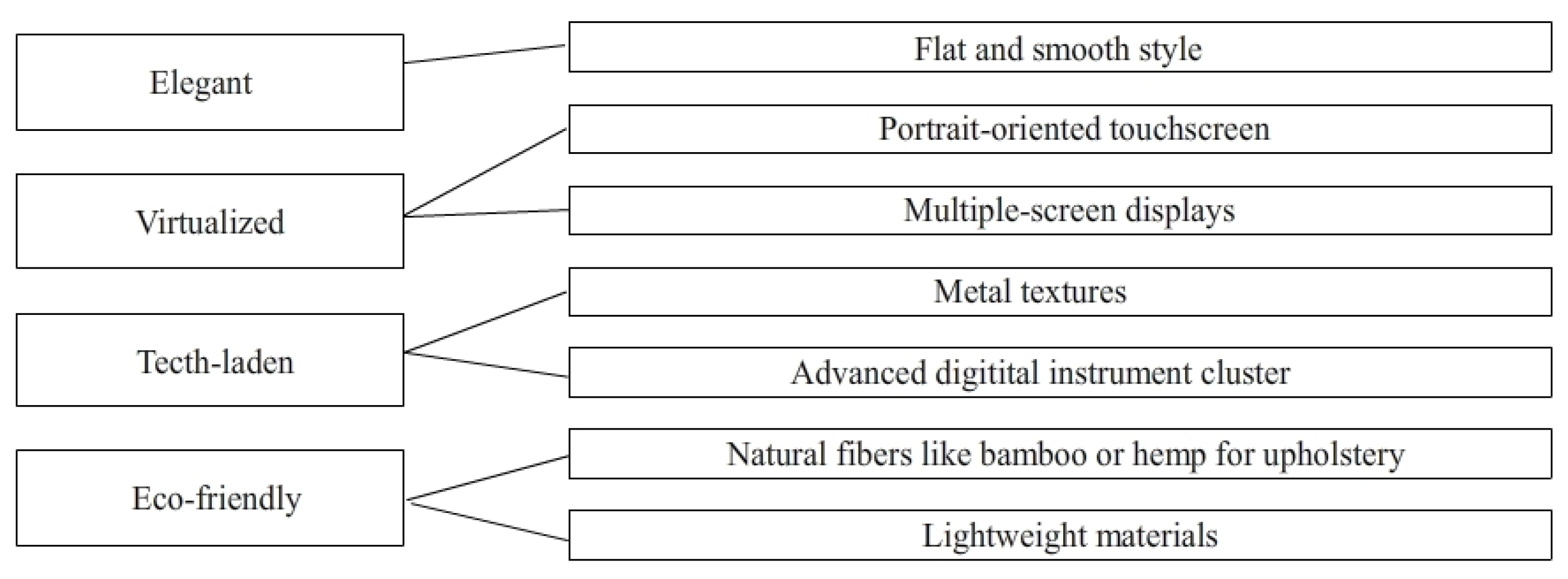
Figure 2.
General Hierarchical Diagram of Preferences for EV Interiors (Based on EGM).
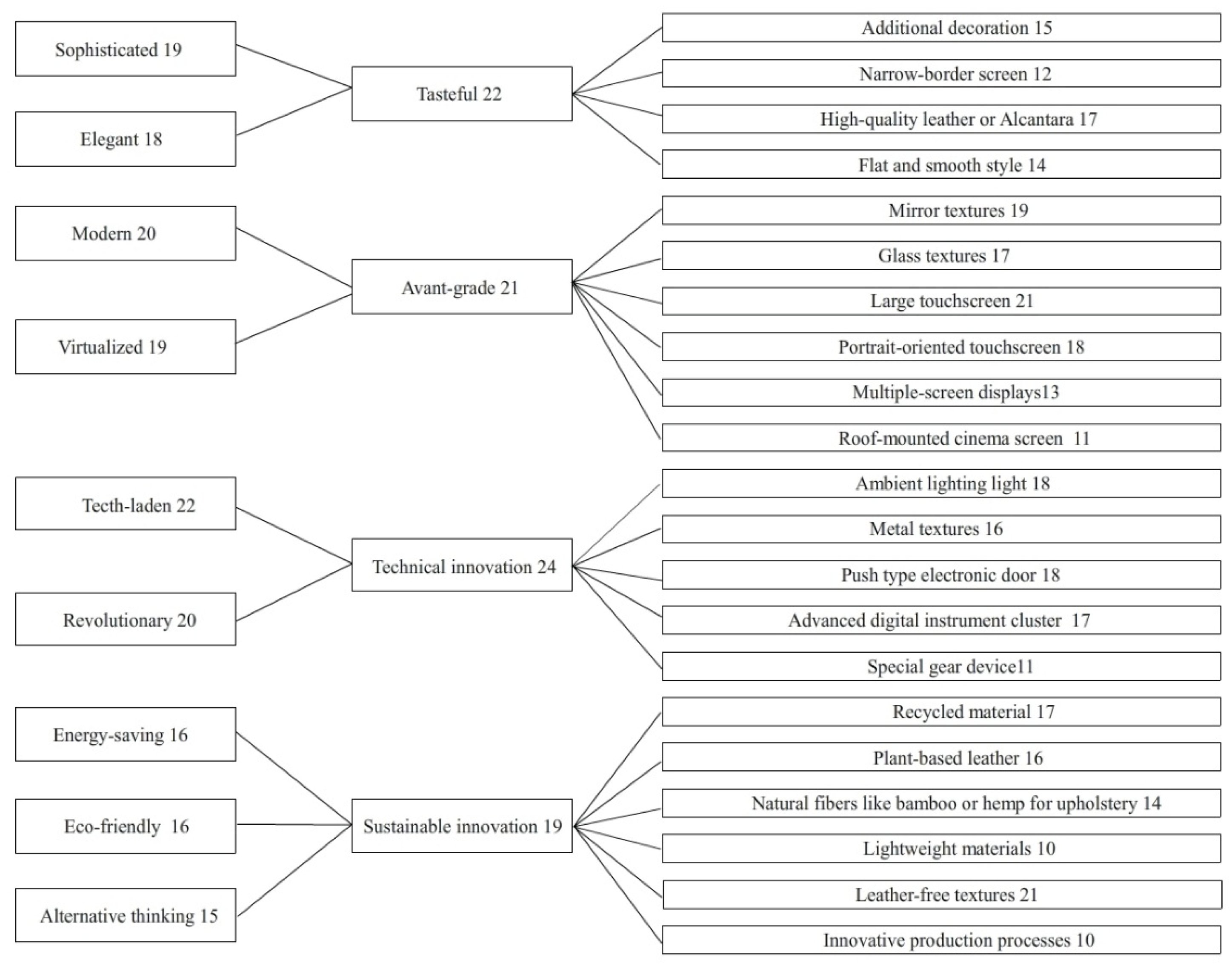

Table 1.
Ranking of Evaluation Items by Frequency in the Hierarchical Diagram.
| Original images | Upper level (reasons) | Lower level (specific attributes) |
| Technical innovation 24 | Tech-laden 22 | Ambient lighting 18 |
| Tasteful 22 | Sophisticated 19 | Additional decoration 15 |
| Avant-grade 21 | Modern 20 | Mirror texture 19 |
| Sustainable innovation 19 | Energy-saving 16 Eco-friendly 16 |
Recycled material 17 Natural fibers 14 |
Table 2.
Top Four Original Evaluation Items and Their Associated Reasons, Ranked by Frequency in the Hierarchical Diagram.
Table 2.
Top Four Original Evaluation Items and Their Associated Reasons, Ranked by Frequency in the Hierarchical Diagram.
| Classified | Original images | Reasons (upper level) |
| First | Technical innovation 24 | Tech-laden 22 Revolutionary 20 |
| Second | Tasteful 22 | Sophisticated 19 Elegant 18 |
| Third | Avant-grade 21 | Modern 20 Virtualized 19 |
| Forth | Sustainable innovation 19 | Energy-saving 16 Eco-friendly 16 Alternative thinking 15 |
Table 3.
Level-Based Structure of the Questionnaire Derived from EGM.
| Level of questionnaire | The first level | The second level | The third level |
| The type of question | Original evaluation item | Upper level | Lower level |
| The example of question | Avant-grade | Modern | Mirror texture |
Table 4.
Partial Correlation Coefficients, Category Scores, and Coefficient of Determination for the Factor “Tasteful”.
Table 4.
Partial Correlation Coefficients, Category Scores, and Coefficient of Determination for the Factor “Tasteful”.
| Categories | Category scores | Partial correlation coefficients |
|
| Sophisticated | Additional decoration | -0.043 | 0.389 |
| Narrow-border screen | 0.086 | ||
| Elegant | High-quality leather or Alcantara | -0.137 | 0.666 |
| Flat and smooth style | 0.121 | ||
| C | 0.750 | ||
| R= | 0.666 | ||
| R2= | 0.443 | ||
Table 5.
Partial Correlation Coefficients, Category Scores, and Coefficient of Determination for the Factor “Avant-Garde”.
Table 5.
Partial Correlation Coefficients, Category Scores, and Coefficient of Determination for the Factor “Avant-Garde”.
| Items | Categories | Category scores | Partial correlation coefficients |
| Modern | Mirror texture | -0.053 | 0.430 |
| Glass texture | 0.092 | ||
| Virtualized | Large touchscreen | -0.135 | 0.648 |
| Portrait-oriented touchscreen | 0.115 | ||
| Multiple-screen displays | *0.167 | ||
| Roof-mounted cinema screen | 0.042 | ||
| C | 0.76 | ||
| R= | 0.649 | ||
| R2= | 0.421 | ||
* This asterisk indicates the category with the highest score.
Table 6.
Partial Correlation Coefficients, Category Scores, and Coefficient of Determination for the Factor “Technical Innovation”.
Table 6.
Partial Correlation Coefficients, Category Scores, and Coefficient of Determination for the Factor “Technical Innovation”.
| Items | Categories | Category scores | Partial correlation coefficients |
| Tech-laden | Ambient lighting | -0.040 | 0.392 |
| Metal textures | 0.089 | ||
| Revolutionary | Push type electronic door | -0.141 | 0.666 |
| Advanced digital instrument cluster | 0.118 | ||
| Special gear device | 0.040 | ||
| C | 0.750 | ||
| R= | 0.666 | ||
| R2= | 0.443 | ||
Table 7.
Partial Correlation Coefficients, Category Scores, and Coefficient of Determination for the Factor “Sustainable Innovation”.
Table 7.
Partial Correlation Coefficients, Category Scores, and Coefficient of Determination for the Factor “Sustainable Innovation”.
| Items | Categories | Category scores | Partial correlation coefficients |
| Energy-saving | Recycled material | -0.042 | 0.372 |
| Plant-based leather | 0.083 | ||
| Eco-friendly | Natural fibers like bamboo or hemp for upholstery | -0.133 | 0.626 |
| Lightweight materials | 0.117 | ||
| Alternative thinking | Leather-free textures | 0.008 | 0.074 |
| Innovative production processes | -0.013 | ||
| C | 0.750 | ||
| R= | 0.668 | ||
| R2= | 0.446 | ||
Disclaimer/Publisher’s Note: The statements, opinions and data contained in all publications are solely those of the individual author(s) and contributor(s) and not of MDPI and/or the editor(s). MDPI and/or the editor(s) disclaim responsibility for any injury to people or property resulting from any ideas, methods, instructions or products referred to in the content. |
© 2025 by the authors. Licensee MDPI, Basel, Switzerland. This article is an open access article distributed under the terms and conditions of the Creative Commons Attribution (CC BY) license (http://creativecommons.org/licenses/by/4.0/).
Copyright: This open access article is published under a Creative Commons CC BY 4.0 license, which permit the free download, distribution, and reuse, provided that the author and preprint are cited in any reuse.


