

Submitted:
18 August 2025
Posted:
20 August 2025
You are already at the latest version
Abstract
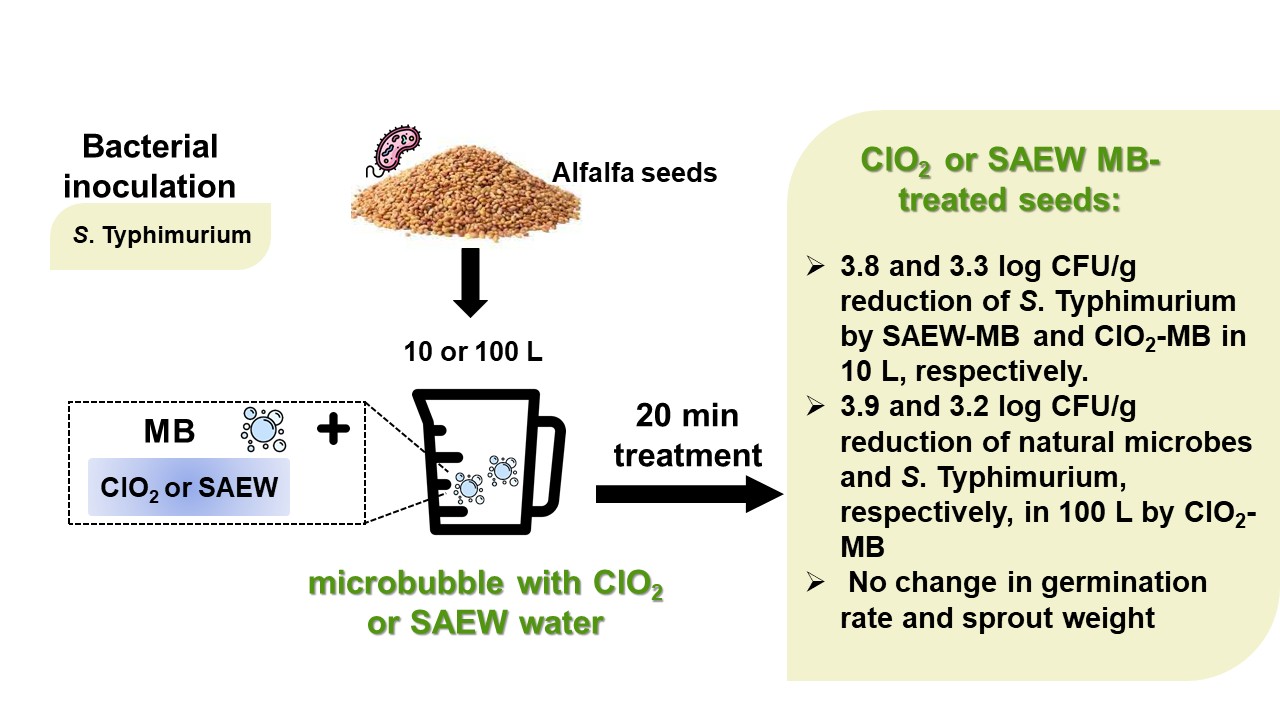
Microbial contamination is the main safety concern of sprouts and seeds are the major source. High concentrations of sanitizers (>10,000 mg/kg) are recommended for effective sanitation. Microbubble (MB) was reported to elevate the sanitizer efficacy. Hence, MB combined with disinfectants, chlorine dioxide (ClO2, 500 ppm) and slightly acidic electrolyzed water (SAEW, 250 ppm), was used to inactivate Salmonella Typhimurium on alfalfa seeds. After fulfilling MB for 10 min, alfalfa seeds were washed in 10 L of water for 10, 20, or 30 min. Compared with untreated seeds, S. Typhimurium reductions obtained by SAEW-MB (SMB) and ClO2-MB (CMB) for 20 min were 3.8 and 3.3 log CFU/g, respectively. Conversely, the 20-min treatments of SAEW and ClO2 only obtained reductions of 0.9 and 1.1 log CFU/g, respectively. More surface ruptures on the seeds treated with CMB were observed under a scanning electron microscope compared with the ones treated by water and ClO2 only. No adverse effects on the seed germination rate and the weight yield of sprouts were observed when treated with CMB for 20 min. A MB device with capacity of 100 L was assembled and achieved reductions of 3.9 and 3.2 log CFU/g of natural microbes and S. Typhimurium, respectively, after 20-min CMB washing. Additionally, a MB device at 250 L was assembled and achieved 3.0 log CFU/g reduction of natural microbes. This study demonstrated that MB enhanced the efficacy of disinfectants and could be applied for industrial-scale operation.
Keywords:
alfalfa
; microbubbles
; chlorine dioxide
; electrolyzed water
; Salmonella
1. Introduction
Microbial contamination is the main risk of sprouts [1]. The most commonly consumed sprout is alfalfa sprouts that consequently involve in the outbreaks associated with sprouts [2]. Salmonella serotypes are the most commonly occurring pathogens in those outbreaks. For example, S. Newport, S. Reading, S. Abony, S. Muenchen, and S. Kentucky in the USA [3,4]; S. Stanley in the US and Finland [5]; S. Typhimurium and Havana in New Zealand [6] and Australia [7], respectively.
Contaminated seeds were the major source of pathogens in sprouts [6,8–11,44]. Furthermore, sprouting is operated in the conditions at 22–24°C and relative humidity 95%, which is suitable for microbial growth [12–14]. Thus, disinfecting alfalfa seeds is the critical step for sprout safety. However, alfalfa seeds are difficult to disinfect due to their naturally rough surface [15]. Consequently, US Food and Drug Administration (FDA) recommends 20,000 mg/L calcium hypochlorite (Ca(ClO)2) to disinfect alfalfa seeds [15]. Due to this unusually high concentration, several alternative methods have been explored, including heating and other disinfectants, such as ozone (O3) [17] and slightly acidic electrolyzed water (SAEW) [17,18]. Jaquette et al. [19] used 54℃-water for 5 min on seeds and obtained 2 log CFU/g reduction of S. Stanley but decreased the germination rate of seeds to 88%. In the same study, 1010 mg/L of NaClO was required to obtain a 2-log reduction. Yao et al. [20] treated seeds at 71.0°C and 0.1 aw for 100 and 140-h to achieve 4.2 and 6.0 log reductions of Salmonella, respectively. Meanwhile, corresponding sprout yield ratios were 100.7% and 96.1%. In the same study, alfalfa seeds were treated with 20,000 mg/L NaClO for 15 min and 20 min and obtained 1.8 and 2.0 log reductions of Salmonella and sprout yield ratios of 70.9% and 65.1%, respectively. Another study applied SAEW (ACC 84 mg/L) for 3 h and obtained 2.8 log CFU/g reduction of Salmonella [17]. Zhang et al. [19] used SAEW (25, 35, 45 mg/L) for 6 h on alfalfa seeds to obtain a >1 log CFU/g reduction of Enterobacteriaceae bacteria.
Since the aforementioned single-step process required a long treatment time, combining methods for disinfecting seeds was also applied. More than 1 log CFU/g reductions of Salmonella and E. coli O157:H7 by combining O3 water (5 mg/L, 20 min) and SAEW (ACC 10 mg/L, 15 min) for alfalfa disinfection when compared to O3 water or SAEW only [22]. When alfalfa seeds were washed with 2% H2O2 for 10 min, vacuum-packed, then dry-heated at 73℃ for 4 h, a 7.1 log CFU/g reduction of S. Typhimurium was obtained. However, only around 1 log reduction was achieved when the seeds were treated with dry heat only [22].
Microbubbles (MB) are defined by the International Organization for Standardization [23] as bubbles with a diameter smaller than 50 μm. MB has been proven to have strong cleaning ability and can be produced in large volumes [24]. The diameter and density of MB are tightly related to the input air pressure, motor power, water quantity, and temperature [25]. Several studies have reported that the antibacterial abilities of disinfectants on food items were enhanced after being coupled with MB [26–32]. Because MB significantly increased the surface/volume ratio, retention time, and gas solubility in water, O3 was the most commonly used disinfectant with MB in the previous studies [26,28,30,31,33,34]. Alfalfa seeds without artificial inoculation were treated by water, MB only, O3 water (3.5 mg/L), OMB (5.3 mg/L), and NaClO (5,000 mg/L) for 5 min [30]. The highest reductions of natural microbes, 2.76 and 2.79 log CFU/g, were obtained from OMB and NaClO, respectively. Additionally, germination rate and sprout weight were not affected by OMB but were decreased by NaClO treatment. Though chlorine-based disinfectants are commonly used for fresh produce, combining MB with chlorine-based disinfectants is seldom studied. MB was combined with NaClO, ClO2, or SAEW to treat S. Typhimurium and E. coli on sweet basil and Thai mint in 8 L of water [29]. After 5-min treatment of NaClO-MB (NMB, 40 mg/L) and SAEW-MB (SMB, 20 mg/L), 1.21-1.90 and 0.67-2.25 log CFU/g reduction of S. Typhimurium was obtained, respectively. During the following study, sweet basil and Thai mint were washed with surfactant (Tween 80, 1 g/L), then with SMB (40 mg/L). More than 2 and 1 log reductions of S. Typhimurium and E. coli, respectively, were obtained when compared to MB or SAEW only [34].
Therefore, the objective of this study was to combine MB with SAEW and ClO2 to inactivate S. Typhimurium on alfalfa seeds for shorter treatment times and lower concentrations of disinfectants than previous studies. Physicochemical characteristics of the treated water, germination rate of seeds, and the weight yields of sprouts were determined. Additionally, the surface morphology of the treated alfalfa seeds with the inoculated S. Typhimurium was observed under a scanning electron microscope. Totally, quantities of 10 L, 100 L, and 250 L of MB water were tested to achieve a basis for industrial-scale application.
2. Materials and Methods
2.1. Microbubble Device
The injecting atmospheric air and water was mixed in a Nikuni motor (KTM20ND07Z, Tokyo, Japan) with 750 watts (W) of power to generate MB water (Figure 1a). The air was injected at a flow rate of 2.5 L/min and the outflowing and inflowing water pressure was 4.5 and 2.719 kg/cm2, respectively. The MB water flowed through a dissolution tank to separate large bubbles from microbubbles, then delivered into a beaker and circulated back to the motor. The water amount was maintained at 10 L. MB fulfilling time in the beaker was 10 min based on preliminary studies. For 100-L tests, a Calpeda motor (NGXM 6/18-60, Vicenza, Italy) with 1500 W power was used (Figure 1b) as the previous study [35]. This system contained no dissolution tank and the filling time of bubbles was extended to 20 min. Air injection flow rate, outflowing, and inflowing water pressure were set at 1.0 L/min, 5.0, and 3.2/cm2, respectively. The average diameters of the microbubbles of the Nikuni system and the Calpeda system were 29.05±6.72 μm and 36.50±5.91 μm, respectively [35]. Additionally, an industrial scale of MB device was assembled with a Calpeda motor (NGXM 6/18-60) and a 250-L stainless tank (Figure 2), in which two water inflow pipes were used. On inflow pipe produced a straight current to stir the seeds and the other produced tilted MB water inflow to generate a swirl current.
2.2. The Bacterial Culture and Inoculation of Alfalfa Seeds
S. Typhimurium (ATCC 13076, Bioresource Collection and Research Center, Hsinchu, Taiwan), was tested. Before testing, this bacterium was incubated at in tryptic soy broth (TSB) at 37°C for 18-20 h, then streaked onto a xylose lysine deoxycholate (XLD) plate to observe the colony morphology and uniformity. A well-isolated colony was inoculated into 10 mL TSB, then incubated for two consecutive 18-20 h incubations. After centrifuging at 5000 ×g at 4°C for 5 min, the precipitate was re-suspended in 0.1% peptone water to 0.5-0.6 optical density at 600 nm (OD600), which was at 108 CFU/mL level according to the earlier study.
Alfalfa seeds were from Yiya Farm (Tainan, Taiwan) and were examined based on the protocols of the Ministry of Health and Welfare (2013) to confirm no Salmonella contamination. Seventy g of alfalfa seeds were soaked in a flask that contained 100 mL of bacterial suspension. After shaking for 2 min, the bacterial suspension was pour through a sterile stainless sieve and the seeds were placed evenly onto an aluminum foil in a laminar hood with the fan on for 14-16 h. Before testing, seeds were soaked in water for 1 h to imitate the common practice of sprouting industry for facilitating germination. Preliminary tests confirmed Salmonella populations were around 5-6 log CFU/g after these procedures. All media were BD Difco™ (Franklin Lakes, NJ, USA).
2.3. Preparation of Disinfectants
ClO2 (Emperor Chemical, Taipei, Taiwan) was prepared fresh before testing based on the manufacturer’s instructions. SAEW was produced by electrolyzing sodium chloride solution (5 g/L) in a SAEW generator (Aquaox, Co. New Taipei, Taiwan). Several concentrations were tested during the preliminary study. After excluding the concentrations that were ineffective or damaged seeds, 500 and 250 mg/L of ClO2 and SAEW were used, respectively, and pH was set at 6.0 for both disinfectants. The available chlorine concentrations (ACC) were measured according to the protocol of the Environmental Protection Administration, Taiwan (2020), in which available chlorine concentrations are determined by the titration of sodium thiosulfate (Na2S2O3).
2.4. The Tests of Microbubble Combining With Disinfectants on Alfalfa Seeds
The treatments of ClO2-MB (CMB) were conducted by using ClO2 solution in a MB device. After 10-min MB fulfilling, 10 g of the inoculated alfalfa seeds were placed into the CMB water for 10, 20, or 30 min. The same procedures were applied for SAEW-MB (SMB) treatments, but only 20 min washing was used since 30-min treatment damaged seeds and lowered germination rate, and 10-min treatment was not adequate to inactivate bacteria based on the CMB results. Control groups included unwashed, water washing, MB only, ClO2 only, and SAEW only. The operational parameters were the same with the combining tests. After washing, seeds were collected by pouring the water through a sterilized stainless sieve. The treated seeds were placed into a stomach bag with 90 mL of phosphate buffer saline (PBS, pH 7.2), then stomached at 230 rpm for 3 min. After decimally serially diluting, 0.1 mL of the dilutant was spread onto plate count agar (PCA) and XLD agar plates, which were incubated at 37°C for 18–24 h. To understand the remaining bacteria in the test water, 100 mL of treated water was collected after testing and filtered through a membrane (0.45 μm, cellulose nitrate, Sartorius, Göttingen, Germany). Two sets were tested, one membrane was placed onto a PCA, and the other was placed onto an XLD plate. Bacterial count was determined after incubation at 37°C for 18-24 hr. The same procedures were used for the 100-L volume test, except 100 g of alfalfa seeds were used. No MB fulfilling time was used for the 250-L device, and non-inoculated seeds were used since they were tested in a commercial sprouting farm. After placing 1 Kg of seeds into the tank, the device was operated for 30 min. After washing, water was released from a pipe on the bottom, and the seeds were collected by a stainless-steel wire mesh strainer.
2.5. Measurement of Oxidation-Reduction Potential (ORP), pH, and Electrical Conductivity (EC) of Treated Water
ORP, pH, and EC values of the treated waters were measured to understand the variance in physicochemical properties between different treatments. Water temperature was measured by an infrared thermometer at the end of treatment. Approximately 1 L of the treated water was sampled to determine ORP, pH, and EC values. The ORP values were measured by an ORP probe (ORP-148G, TECPEL, Taipei, Taiwan) connected with a pH/ORP meter (SP-2300, SUNTEX CO. LTD, Taiwan). The pH and EC values were measured by a pH/conductivity probe (serial 100 probe, Cole-Parmer, Vernon Hills, IL, USA) connected with a pH/conductivity meter (PC-200, Cole-Parmer, Vernon Hills, IL, USA).
2.6. Germinating Rate of Alfalfa Seeds and Weight Yield of Sprouts
After treated with 10-L CMB for 20 min as previously described, 100 seeds were randomly selected and sprayed equally onto a germinating disc (Supplementary figure). Controls were the untreated and ClO2 seeds. The discs were placed in an enclosed chamber set at 22-25°C and humidity without illumination. The seeds were watered 4 times per day and 1 L of tap water was used for each time. On day 4, the ratio of sprouting seeds/total seeds was determined as germination rate. The weight yield of sprouts was determined on day 7 based on the weight ratio of sprouts/seeds. Meanwhile, characteristics of sprout, such as appearance, texture, and aroma, were observed daily.
2.7. Scanning Electron Microscope (SEM) Observation
Twenty MB or CMB-treated alfalfa seeds with intact appearances were used for SEM observation. Control was the untreated seeds. Based on the methods [36], the seeds were soaked in a phosphate buffer containing 2.5% glutaraldehyde at 4-6°C for 2 h. The seeds were dehydrated in serially increasing concentrations of ethanol solutions (50%, 70%, 80%, 90%, 99.5%), then frozen at -80°C for 24 h. After lyophilization (Panchum Free Dryer FD-series, FD-8510T, Kaohsiung, Taiwan) for 24 h, the seeds were stored in a desiccator until fixed on a stainless stub and coated with gold-palladium (E1010, Hitachi, Tokyo, Japan). Morphology of the seeds were examined under a SEM (S3000N, Hitachi, Tokyo, Japan).
2.8. Statistical Analyses
Triplicate samples were tested for each test, which was conducted at least twice. Results were analyzed by the SPSS program (version 12.0, St. Armonk, NY, USA) and presented as average ± standard deviation. Significant differences (p=0.05) between tests were determined by one-way ANOVA and Duncan’s test.
3. Results
3.1. Bactericidal Effects of MB Combining with Disinfectants
Less than 1 log reductions were obtained from the groups of water, MB, and SAEW. Around 1-2 log reduction was achieved from the ClO2 washing. Evidently, using SAEW and ClO2 alone was not effective. In contrast, significantly higher reductions (p<0.05) were achieved with CMB and SMB treatments (Table 1). For instance, only 0.6, <0.1, 1.1, and 0.9 log reduction were obtained after 20-min washing by water, MB, ClO2, and SAEW, respectively. Whereas, the treatments of CMB and SMB for 20 min achieved 3.2 and 3.8 log reduction, respectively. For the CMB treatment group, greater reductions were obtained from longer washing times, specifically, a significant increase (p<0.05) was obtained when washing time was increased from 10 min to 20 min. Although higher reductions were obtained from 30-min washing, no significant difference (p≥0.05) was observed. Additionally, obvious damages and lower germination rates were observed on the seeds after 30-min treatments of MB, ClO2 and CMB. Therefore, 20-min was considered as the optimal washing time and used for the following treatments of SAEW and SMB. A higher but not significant reduction was obtained from the SMB group when compared with the CMB group. However, the results of SMB were not as consistent as CMB and presented a larger standard deviation (Table 1). Thus, the treatment of CMB for 20-min was used for the tests of large volume and sprouting. In the 100-L test, the natural microbes were reduced from 5.0 to 4.2, 3.3, and 1.1 log CFU/g (0.8, 1.7, and 3.9 log reduction) with water, ClO2, and CMB treatments, respectively. The populations of S. Typhimurium were 5.2, 4.4, 3.7 and 1.9 log CFU/g for untreated, water washing, ClO2, and CMB, respectively. Corresponding reductions were 0.9, 1.5, 3.2 log for water washing, ClO2, and CMB, respectively. CMB treatment showed significant greater reduction (p<0.05) than water and ClO2 washing. Similar results were obtained from the 250-L tank, reductions of natural microbes were 0.8, 1.3, 3.0 log for water washing, ClO2, and CMB, respectively.
Bacteria population was consistently undetected (detection limit=1 CFU/100 mL) in the CMB-treated water, whereas 10-50 CFU/100 mL appeared in the ClO2-treated water for both the 10 L and 100 L tests. In contrast, approximately 2-3 log CFU/100 mL was obtained in the MB treated water for the 10 L and 100 L tests. The results indicated that MB alone did not possess a strong antibacterial ability, but physically removed bacteria from the seed surface into the water. The main cause of the elevated antibacterial efficacy of combining MB and disinfectants could be that MB removed the adherent bacteria from the seed surface, then disinfectants inactivated the free-suspended bacteria in the treated water.
Values represent means and standard deviations of six replicates (n=6). MB: microbubble; CMB: chlorine dioxide microbubble; SAEW: slightly acidic electrolyzed water, SMB: slightly acidic electrolyzed water microbubble. Means with the different capital letters in the same row are significantly different (p < 0.05). SAEW and SMB were compared with ClO2 and CMB of 20 min, respectively. Means with the different small case letters in the same column are significantly different (p < 0.05).
3.2. The Values of ORP, pH, and EC of the Treated Water
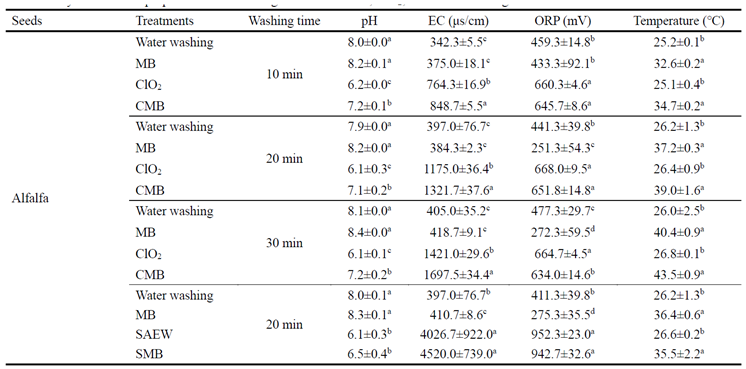
Since disinfectants were strong oxidants and adjusted to pH 6.0 before use, high EC and ORP values and slight acidity were observed. When combined with MB, all EC, ORP, and pH values increased (Table 2). When water quantities increased to 100 L and 250 L, the trend of physicochemical characteristics was the same. Furthermore, the range of pH, EC, ORP, and temperature was very similar between different quantities.
The concentration of chlorine dioxide and SAEW was 500 and 250 ppm, respectively. MB: microbubble; CMB: chlorine dioxide microbubble; SAEW: slightly acidic electrolyzed water; SMB: slightly acidic electrolyzed water microbubble. Values represent means and standard deviations of six replications (n=6). Same seeds and time in the same columns, means with the different letter are significantly different (p < 0.05).
3.3. Germinating Rate of Seeds and Weight Yield of Sprouts
On the first day, the germination rates were from 93-97% and the highest one (97%) was the group of CMB (Figure 3). Germination rates kept increasing and reached 99% on day 4 and no significant difference between treatments was shown throughout the 4-day observation. The weight yields of sprouts were 1209%, 1261%, and 1218% (p>0.05) for water washing, ClO2, and CMB treatments, respectively. Throughout the study, alfalfa sprouts grew well on the discs, and no differences in quality characteristics were observed between various treatments (supplementary figure).
3.4. Observation of SEM
The surface of alfalfa seeds is very uneven and provides many dents to harbor bacteria, which makes sanitation difficult. High numbers of bacteria covered large portions of the untreated seeds, but only few bacteria were observed on the MB and CMB treated seeds, particularly the CMB ones. These results demonstrated that MB was effective in removing bacteria from seed surfaces. Under SEM observation, the surface of the MB and CMB-treated seeds was obviously damaged, and evidently, the seed coat was broken. Furthermore, many debris were visible on the surface, particularly on the CMB-treated seeds. On the contrary, the surface of untreated seeds was intact, and almost no debris was seen (Figure 4). Since the first step of sprouting is the breaking of the seed coat, the cracks resulting from treatments did not interfere with seed sprouting, as shown in the seed germination results detailed in the previous section.
4. Discussion
Disinfecting microorganisms on alfalfa seeds is a long-lasting and ongoing issue. Not only seeds could be contaminated with pathogenic bacteria but bacteria multiply quickly during sprouting [9–11,36,37,44]. Our study also found that the total bacterial population increased from 1.7 log CFU/g on day 1 to 7.4 log CFU/g on day 3 during sprouting. Hence, this study investigated the antibacterial efficacy of various techniques, including the combination of disinfectants with MB, disinfectants alone, MB alone, and water, listed from most effective to least effective. These results clearly showed that coupling disinfectants with MB was more effective to inactivate bacteria on seed surface and in the treated water. These outcomes were consistent with previous studies [27,33,35] and further supported the concept that microbubbles and disinfectants possess a synergistic effect, in which the microbubbles diminish the bacterial adhesion on sample surface while the disinfectants inactivate bacteria in water. It also has been reported that bacteria adhering on surfaces or clustered together are more difficult to inactivate than those freely suspended in the disinfectant solution [38]. Thus, removing attached bacteria from sample surfaces was a critical step during the bacterial inactivation process of disinfectants. Furthermore, MBs generate free radicals, including OH– and OH•, during collapsing, also possess oxidizing capabilities, and that could enhance antibacterial ability [28,39]. Furthermore, no bacteria in the CMB-treated water were detected. Thus, the probability of cross-contamination of seeds in the treated water was eliminated.
Another disinfectant, ozone (O3), was also tested on alfalfa seeds by this research team since combining O3 with microbubble (OMB) has been reported to inactivate S. Typhimurium and E. coli on sweet basil leaves [32], leafy vegetables [42], tomatoes [27], eggs [35], and cabbage leaves [33]. While O3 concentrations in water greatly increased via OMB (from 2.45 to >10 mg/L at 30 min), O3 and OMB were deemed not to be very effective. With water washing as the baseline, only 0.39 log and 1.32 log reductions were obtained from 30-min washing using O3 alone and OMB, respectively. On the contrary, OMB showed 4 and 5 log reductions on tomatoes [27] and eggs [35], respectively, using water washing as the baseline. This could be due to the rough surface of alfalfa seeds, contrasting with the smooth surface of tomatoes and eggs. For example, around 2 log reduction of S. Typhimurium and E. coli was obtained on cabbage leaves after OMB treatment [33], since the surface of cabbage leaves are less smooth than eggs and tomatoes but smoother than alfalfa seeds. Previous studies also showed that applying ozone water to disinfect alfalfa seeds was ineffective. Singh et al. [16] applied O3 water at 4.60, 9.27, and 14.3 mg/L for 3, 5, and 10 min against E. coli O157:H7 on alfalfa seeds. The maximum reduction was 0.54 log CFU/g. Mohammad et al. [21] extended washing time to 15 min with 5 mg/L O3 but only obtained 0.5 and 0.6 log reduction of Salmonella serovars and hemorrhagic E. coli, respectively.
These results were similar to our previous studies [27,33,35]. The increase of EC and ORP values could be caused by the bursting of MB, which generates free radicals. Additionally, the organic matter on food items washed and dissolved into the treated water could neutralize the acidity of disinfectants and increase pH values. However, all values of the treated waters were not significantly higher with longer washing time except for the water’s temperatures. Higher water temperatures were shown during longer MB washing time, but not with ClO2 and SAEW washing. This could be caused by MB bursting, which has been reported to vibrate water molecules and increase water temperature [25].
SEM observations of this and previous studies [41,43] all showed the very tough surface of alfalfa seeds harboring bacteria. Thus, removing bacteria from the rough surface of alfalfa seeds is a critical procedure of disinfection. Another technique, ultrasound, which possesses strong cleaning ability, was also combined with ClO2 to disinfect alfalfa seeds [1]. Higher but not significant reductions of E. coli and Salmonella Abony were achieved by the combined treatment when compared with ultrasound only. It indicated microbubbles possessed a higher removal ability than ultrasonication.
One of the main advantages of using microbubbles is quantity. The water volume of other techniques, such as ultrasound [1] and plasma-activated water [42,45], was less than 10 L. Additionally, previous MB studies tested in 3, 4, 8 or 40 L [18,25,28,29]. In this study, we started at 10 L, then enlarged to 100 L, and eventually to 250 L.
5. Conclusions
In this study, significantly higher reductions of bacterial populations were achieved with CMB and SMB treatments than ClO2 and SAEW alone on alfalfa seeds. In addition, the treatment of CMB for 20 min showed no negative effect on seed germination rate and sprout yield. SEM revealed that the rough surface of alfalfa seeds could harbor bacteria and microbubbles successfully detached those bacteria. Furthermore, microbubble devices with large quantities were presented to be effective and suitable for industrial use. However, the efficacy of this technique against other pathogenic bacteria and crops requires more studies to explore the antibacterial range.
Supplementary Materials
The following supporting information can be downloaded at the website of this paper posted on Preprints.org.
Author Contributions
Chih-Yao Hou: Writing—Review and editing; Shih-Kao Chou: Writing—Review and editing, Data curation; Jong-Shinn Wu: Funding acquisition; Hsiu-Ling Chen: Methodology, Investigation; Pei-Wen Zhang: Methodology, Investigation; Chih-Tung Liu: Conceptualization, Resources; Chun-Ping Hsiao: Investigation; Chia-Min Lin: Writing—Original draft, Writing—Review and editing, Supervision, Funding acquisition. All authors have read and agreed to the published version of the manuscript.
Funding
This research was supported by National Science and Technology Council of Taiwan (grant number MOST-110-2637-E-992-013, MOST 111-2637-E-992-005, and 110-2813-C-992-009-B). SEM observation was supported by the grant number MOST-111-2731-M-EM023700.
References
- Millan-Sango, D.; Sammut, E.; Van Impe, J.F.; Valdramidis, V.P. Decontamination of alfalfa and mung bean sprouts by ultrasound and aqueous chlorine dioxide. LWT 2017, 78, 90–96. [Google Scholar] [CrossRef]
- Matos, A.; Garland, J.L.; Fett, W.F. Composition and Physiological Profiling of Sprout-Associated Microbial Communities. J. Food Prot. 2002, 65, 1903–1908. [Google Scholar] [CrossRef]
- CDC, 2016b. Multistate outbreak of Salmonella infections linked to alfalfa sprouts from one contaminated seed lot (final update). https://www.cdc.gov/salmonella/muenchen-02-16/index.html#print.
- Van Beneden, C.A.; Keene, W.E.; Strang, R.A.; Werker, D.H.; King, A.S.; Mahon, B.; Hedberg, K.; Bell, A.; Kelly, M.T.; Balan, V.K.; et al. Multinational Outbreak of Salmonella enterica Serotype Newport Infections Due to Contaminated Alfalfa Sprouts. JAMA 1999, 281, 158–162. [Google Scholar] [CrossRef]
- Mahon, B.E.; Pöunkä, A.; Hall, W.N.; Komatsu, K.; Dietrich, S.E.; Siitonen, A.; Cage, G.; Hayes, P.S.; Lambert-Fair, M.A.; Bean, N.H.; et al. An International Outbreak ofSalmonellaInfections Caused by Alfalfa Sprouts Grown from Contaminated Seeds. J. Infect. Dis. 1997, 175, 876–882. [Google Scholar] [CrossRef]
- Whitworth, J. Alfalfa sprouts linked to Salmonella outbreak in New Zealand. 2019. https://www.foodsafetynews.com/2019/05/alfalfa-sprouts-linked-to-salmonella-outbreak-in-new-zealand/.
- Harfield, S.; Beazley, R.; Denehy, E.; Centofanti, A.; Dowsett, P.; Housen, T.; Flood, L. An outbreak and case-control study of Salmonella Havana linked to alfalfa sprouts in South Australia, 2018. Commun. Dis. Intell. 2019, 43. [Google Scholar] [CrossRef]
- CDC, 2016a. Multistate outbreak of Shiga toxin-producing Escherichia coli O157 infections linked to alfalfa sprouts produced by Jack & The Green Sprouts (Final Update). https://www.cdc.gov/ecoli/2016/o157-02-16/index.html#print.
- Ferguson, D.D.; Scheftel, J.; Cronquist, A.; Smith, K.; Woo-Ming, A.; Anderson, E.; Knutsen, J.; DE, A.K.; Gershman, K. Temporally distinct Escherichia coli O157 outbreaks associated with alfalfa sprouts linked to a common seed source—Colorado and Minnesota, 2003. Epidemiology Infect. 2005, 133, 439–447. [Google Scholar] [CrossRef]
- Harris, L.; Farber, J.; Beuchat, L.; Parish, M.; Suslow, T.; Garrett, E.; Busta, F. Outbreaks Associated with Fresh Produce: Incidence, Growth, and Survival of Pathogens in Fresh and Fresh-Cut Produce. Compr. Rev. Food Sci. Food Saf. 2003, 2, 78–141. [Google Scholar] [CrossRef]
- Machado-Moreira, B.; Tiwari, B.K.; Richards, K.G.; Abram, F.; Burgess, C.M. Application of plasma activated water for decontamination of alfalfa and mung bean seeds. Food Microbiol. 2021, 96, 103708. [Google Scholar] [CrossRef]
- Feng, G.; Churey, J.J.; Worobo, R.W. Thermal Inactivation of Salmonella and Escherichia coli O157:H7 on Alfalfa Seeds. J. Food Prot. 2007, 70, 1698–1703. [Google Scholar] [CrossRef]
- Stewart, D.S.; Reineke, K.F.; Ulaszek, J.M.; Tortorello, M.L. Growth of Salmonella during Sprouting of Alfalfa Seeds Associated with Salmonellosis Outbreaks. J. Food Prot. 2001, 64, 618–622. [Google Scholar] [CrossRef]
- Taormina, P.J.; Beuchat, L.R.; Slutsker, L. Infections Associated with Eating Seed Sprouts: An International Concern. Emerg. Infect. Dis. 1999, 5, 626–634. [Google Scholar] [CrossRef]
- FDA, 2022. Reducing microbial food safety hazards in the production of seed for sprouting: Guidance for industry. https://www.fda.gov/media/127972/download (accessed on 20 May 2023).
- Singh, N.; Singh, R.; Bhunia, A. Sequential disinfection of Escherichia coli O157:H7 inoculated alfalfa seeds before and during sprouting using aqueous chlorine dioxide, ozonated water, and thyme essential oil. LWT 2003, 36, 235–243. [Google Scholar] [CrossRef]
- Kim, C.; Hung, Y.-C.; Brackett, R.E.; Lin, C.-S. Efficacy of Electrolyzed Oxidizing Water in Inactivating Salmonella on Alfalfa Seeds and Sprouts. J. Food Prot. 2003, 66, 208–214. [Google Scholar] [CrossRef]
- Zhang, H.; Tikekar, R.V. Air microbubble assisted washing of fresh produce: Effect on microbial detachment and inactivation. Postharvest Biol. Technol. 2021, 181. [Google Scholar] [CrossRef]
- Jaquette, C.B.; Beuchat, L.R.; E Mahon, B. Efficacy of chlorine and heat treatment in killing Salmonella stanley inoculated onto alfalfa seeds and growth and survival of the pathogen during sprouting and storage. Appl. Environ. Microbiol. 1996, 62, 2212–5. [Google Scholar] [CrossRef]
- Yao, S.; LiBrizzi, B.R.; Chen, H. Heating temperature and water activity of alfalfa seeds affect thermal inactivation of Salmonella and maintaining seed viability. Int. J. Food Microbiol. 2022, 384, 109975. [Google Scholar] [CrossRef]
- Mohammad, Z.; Kalbasi-Ashtari, A.; Riskowski, G.; Juneja, V.; Castillo, A. Inactivation of Salmonella and Shiga toxin-producing Escherichia coli (STEC) from the surface of alfalfa seeds and sprouts by combined antimicrobial treatments using ozone and electrolyzed water. Food Res. Int. 2020, 136, 109488. [Google Scholar] [CrossRef]
- Hong, E.-J.; Park, S.-H.; Kang, D.-H. Sequential treatment of hydrogen peroxide, vacuum packaging, and dry heat for inactivating Salmonella Typhimurium on alfalfa seeds without detrimental effect on seeds viability. Food Microbiol. 2019, 77, 130–136. [Google Scholar] [CrossRef]
- ISO 20480-1; Fine bubble technology — General principles for usage and measurement of fine bubbles. 2017. https://www.iso.org/standard/68187.html.
- Sharma, P.K.; Gibcus, M.J.; van der Mei, H.C.; Busscher, H.J. Influence of Fluid Shear and Microbubbles on Bacterial Detachment from a Surface. Appl. Environ. Microbiol. 2005, 71, 3668–3673. [Google Scholar] [CrossRef] [PubMed]
- Parmar, R.; Majumder, S.K. Microbubble generation and microbubble-aided transport process intensification—A state-of-the-art report. Chem. Eng. Process.–Process. Intensif. 2013, 64, 79–97. [Google Scholar] [CrossRef]
- Chuajedton, A.; Aoyagi, H.; Uthaibutra, J.; Pengphol, S.; Whangchai, K. Inactivation of Escherichia coli O157: H7 by treatment with different temperatures of micro-bubbles ozone containing water. Intl. Food Res. J. 2017, 24, 1006–1010. http://www.ifrj.upm.edu.my/24%20(03)%202017/(15).pdf.
- Hou, C.-Y.; Chen, Y.-R.; Wu, J.-S.; Chen, H.-L.; Hsiao, C.-P.; Liu, C.-T.; Lin, C.-M. Antibacterial Efficacy and Physiochemical Effects of Ozone Microbubble Water on Tomato. Sustainability 2022, 14, 6549. [Google Scholar] [CrossRef]
- Ikeura, H.; Hamasaki, S.; Tamaki, M. Effects of ozone microbubble treatment on removal of residual pesticides and quality of persimmon leaves. Food Chem. 2013, 138, 366–371. [Google Scholar] [CrossRef]
- Klintham, P.; Tongchitpakdee, S.; Chinsirikul, W.; Mahakarnchanakul, W. Combination of microbubbles with oxidizing sanitizers to eliminate Escherichia coli and Salmonella Typhimurium on Thai leafy vegetables. Food Control. 2017, 77, 260–269. [Google Scholar] [CrossRef]
- Kwack, Y.; Kim, K.K.; Hwang, H.; Chun, C. An Ozone Micro-bubble Technique for Seed Sterilization in Alfalfa Sprouts. Korean J. Hortic. Sci. Technol. 2014, 32, 901–905. [Google Scholar] [CrossRef]
- Pandiselvam, R.; Kaavya, R.; Jayanath, Y.; Veenuttranon, K.; Lueprasitsakul, P.; Divya, V.; Kothakota, A.; Ramesh, S. Ozone as a novel emerging technology for the dissipation of pesticide residues in foods–a review. Trends Food Sci. Technol. 2020, 97, 38–54. [Google Scholar] [CrossRef]
- Phaephiphat, A.; Mahakarnchanakul, W.; Yildiz, F. Surface decontamination of Salmonella Typhimurium and Escherichia coli on sweet basil by ozone microbubbles. Cogent Food Agric. 2018, 4. [Google Scholar] [CrossRef]
- Chen, H.-L.; Arcega, R.D.; Liao, P.-Y.; Hou, C.-Y.; Liu, W.-C.; Chen, Y.-R.; Wu, J.-S.; Wang, W.-R.; Lin, C.-M. Reduction of pesticides and bacteria on Napa cabbage by ozone microbubble water. Postharvest Biol. Technol. 2023, 204. [Google Scholar] [CrossRef]
- Klintham, P.; Tongchitpakdee, S.; Chinsirikul, W.; Mahakarnchanakul, W. Two-step washing with commercial vegetable washing solutions, and electrolyzed oxidizing microbubbles water to decontaminate sweet basil and Thai mint: A case study. Food Control. 2018, 94, 324–330. [Google Scholar] [CrossRef]
- Lin, C.-M.; Chen, S.-Y.; Lin, Y.-T.; Hsiao, C.-P.; Liu, C.-T.; Hazeena, S.H.; Wu, J.-S.; Hou, C.-Y. Inactivating Salmonella Enteritidis on shell eggs by using ozone microbubble water. Int. J. Food Microbiol. 2023, 398, 110213. [Google Scholar] [CrossRef]
- Fu, Y.; Bhunia, A.K.; Yao, Y. Alginate-based antimicrobial coating reduces pathogens on alfalfa seeds and sprouts. Food Microbiol. 2022, 103, 103954. [Google Scholar] [CrossRef]
- Microbiological safety evaluations and recommendations on sprouted seeds. Int. J. Food Microbiol. 1999, 52, 123–153. [CrossRef]
- Winthrop, K.L.; Palumbo, M.S.; Farrar, J.A.; Mohle-Boetani, J.C.; Abbott, S.; Beatty, M.E.; Inami, G.; Werner, S.B. Alfalfa Sprouts and Salmonella Kottbus Infection: A Multistate Outbreak following Inadequate Seed Disinfection with Heat and Chlorine. J. Food Prot. 2003, 66, 13–17. [Google Scholar] [CrossRef]
- Rozman, U.; Pušnik, M.; Kmetec, S.; Duh, D.; Turk, S.Š. Reduced Susceptibility and Increased Resistance of Bacteria against Disinfectants: A Systematic Review. Microorganisms 2021, 9, 2550. [Google Scholar] [CrossRef]
- Xiong, X.; Wang, B.; Zhu, W.; Tian, K.; Zhang, H. A Review on Ultrasonic Catalytic Microbubbles Ozonation Processes: Properties, Hydroxyl Radicals Generation Pathway and Potential in Application. Catalysts 2018, 9, 10. [Google Scholar] [CrossRef]
- Charkowski, A.O.; Sarreal, C.Z.; Mandrell, R.E. Wrinkled Alfalfa Seeds Harbor More Aerobic Bacteria and Are More Difficult To Sanitize than Smooth Seeds. J. Food Prot. 2001, 64, 1292–1298. [Google Scholar] [CrossRef]
- Inatsu, Y.; Kitagawa, T.; Nakamura, N.; Kawasaki, S.; Nei, D.; Bari, L.; Kawamoto, S. Effectiveness of Stable Ozone Microbubble Water on Reducing Bacteria on the Surface of Selected Leafy Vegetables. Food Sci. Technol. Res. 2011, 17, 479–485. [Google Scholar] [CrossRef]
- Fransisca, L.; Feng, H. Effect of Surface Roughness on Inactivation of Escherichia coli O157:H7 87-23 by New Organic Acid–Surfactant Combinations on Alfalfa, Broccoli, and Radish Seeds. J. Food Prot. 2012, 75, 261–269. [Google Scholar] [CrossRef]
- Machado-Moreira, B.; Richards, K.; Brennan, F.; Abram, F.; Burgess, C.M. Microbial Contamination of Fresh Produce: What, Where, and How? Compr. Rev. Food Sci. Food Saf. 2019, 18, 1727–1750. [Google Scholar] [CrossRef]
- Neetoo, H.; Chen, H. Individual and combined application of dry heat with high hydrostatic pressure to inactivate Salmonella and Escherichia coli O157:H7 on alfalfa seeds. Food Microbiol. 2011, 28, 119–127. [Google Scholar] [CrossRef]
Figure 1.
(a) the small scale system: (A) 10 L beaker, (B) Water inlet pipe, (C) Motor, (D) Gas intake, (E) Dissolution tank, (F) Water outlet pipe; (b) the large scale system: (A) 100 L water tank, (B)Water inlet pipe, (C) Motors, (D) Gas intake and (E) Water outlet pipe.
Figure 1.
(a) the small scale system: (A) 10 L beaker, (B) Water inlet pipe, (C) Motor, (D) Gas intake, (E) Dissolution tank, (F) Water outlet pipe; (b) the large scale system: (A) 100 L water tank, (B)Water inlet pipe, (C) Motors, (D) Gas intake and (E) Water outlet pipe.
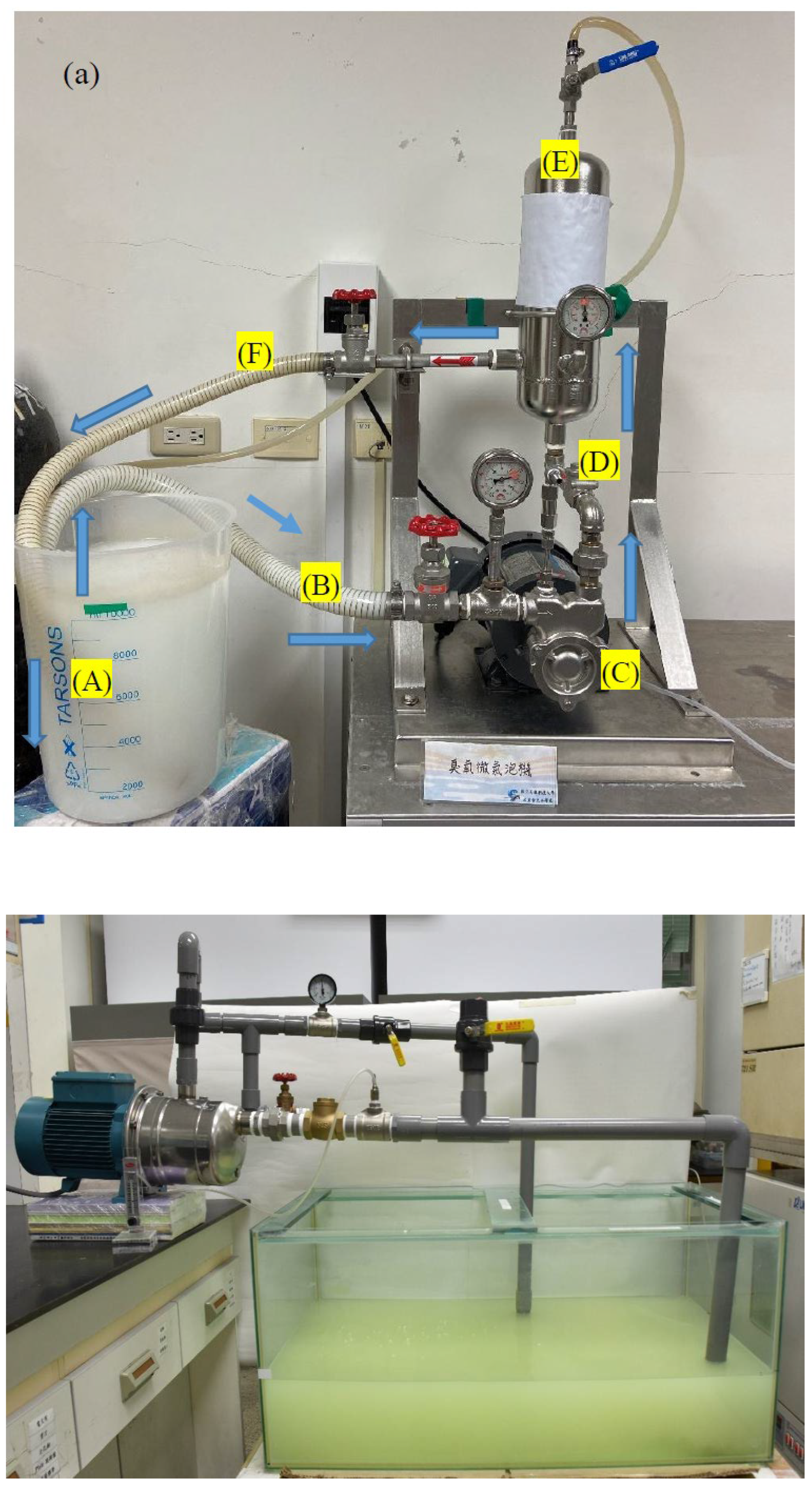
Figure 2.
The 250-L device: (A) 250-L stainless tank, (B) water outflow pipe, (C) gas intake, (D) motors, (E1 and E2) water inflow pipes, (F) the drain to release water and collect seeds. The blue arrows indicate the direction of water.
Figure 2.
The 250-L device: (A) 250-L stainless tank, (B) water outflow pipe, (C) gas intake, (D) motors, (E1 and E2) water inflow pipes, (F) the drain to release water and collect seeds. The blue arrows indicate the direction of water.
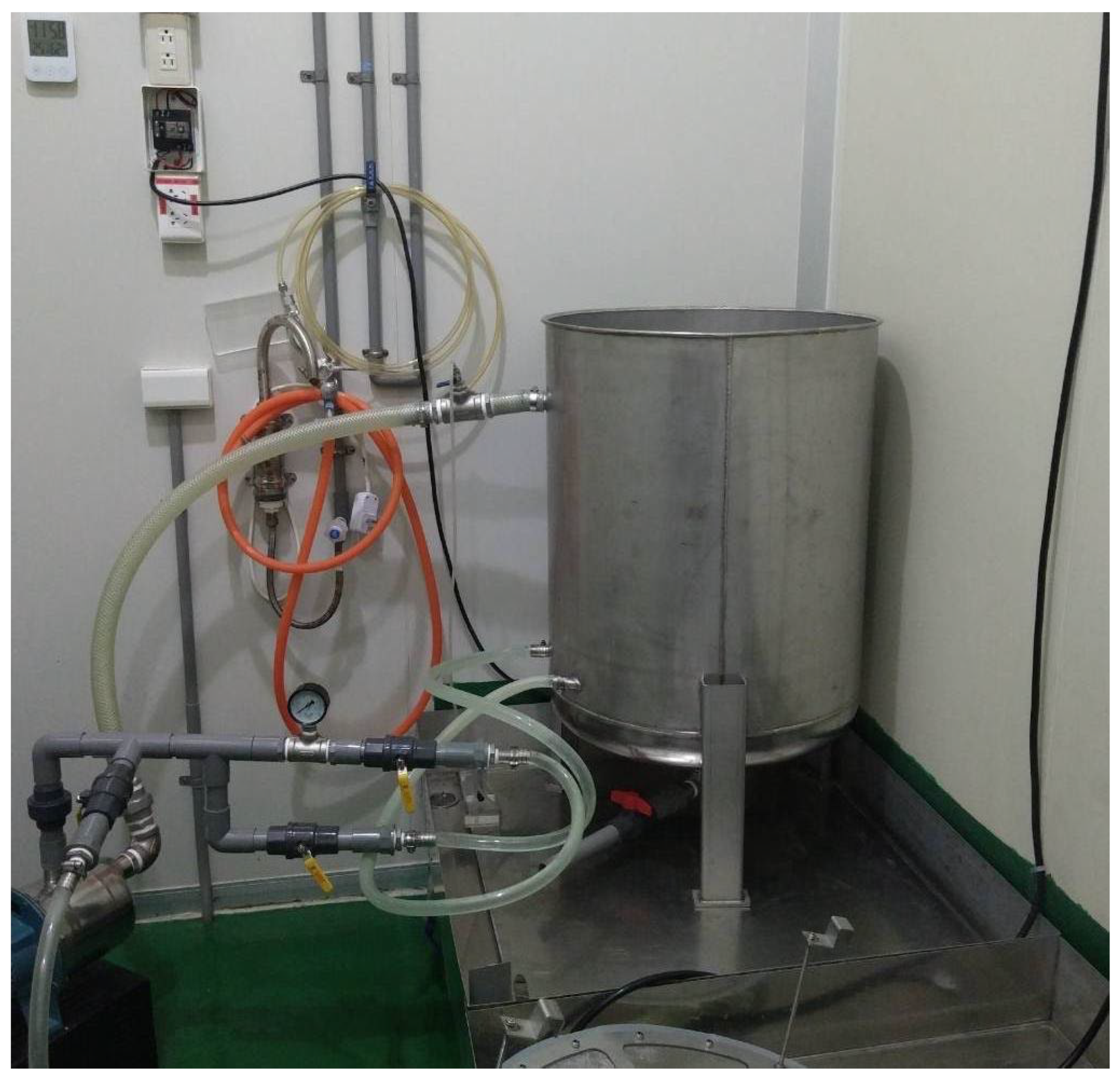
Figure 3.
The germination rate on different days (A) and weight gain ratio of sprouts (B) of alfalfa seeds after various treatments for 20 min. The same letters indicate no significant difference (p > 0.05) between different treatments.
Figure 3.
The germination rate on different days (A) and weight gain ratio of sprouts (B) of alfalfa seeds after various treatments for 20 min. The same letters indicate no significant difference (p > 0.05) between different treatments.
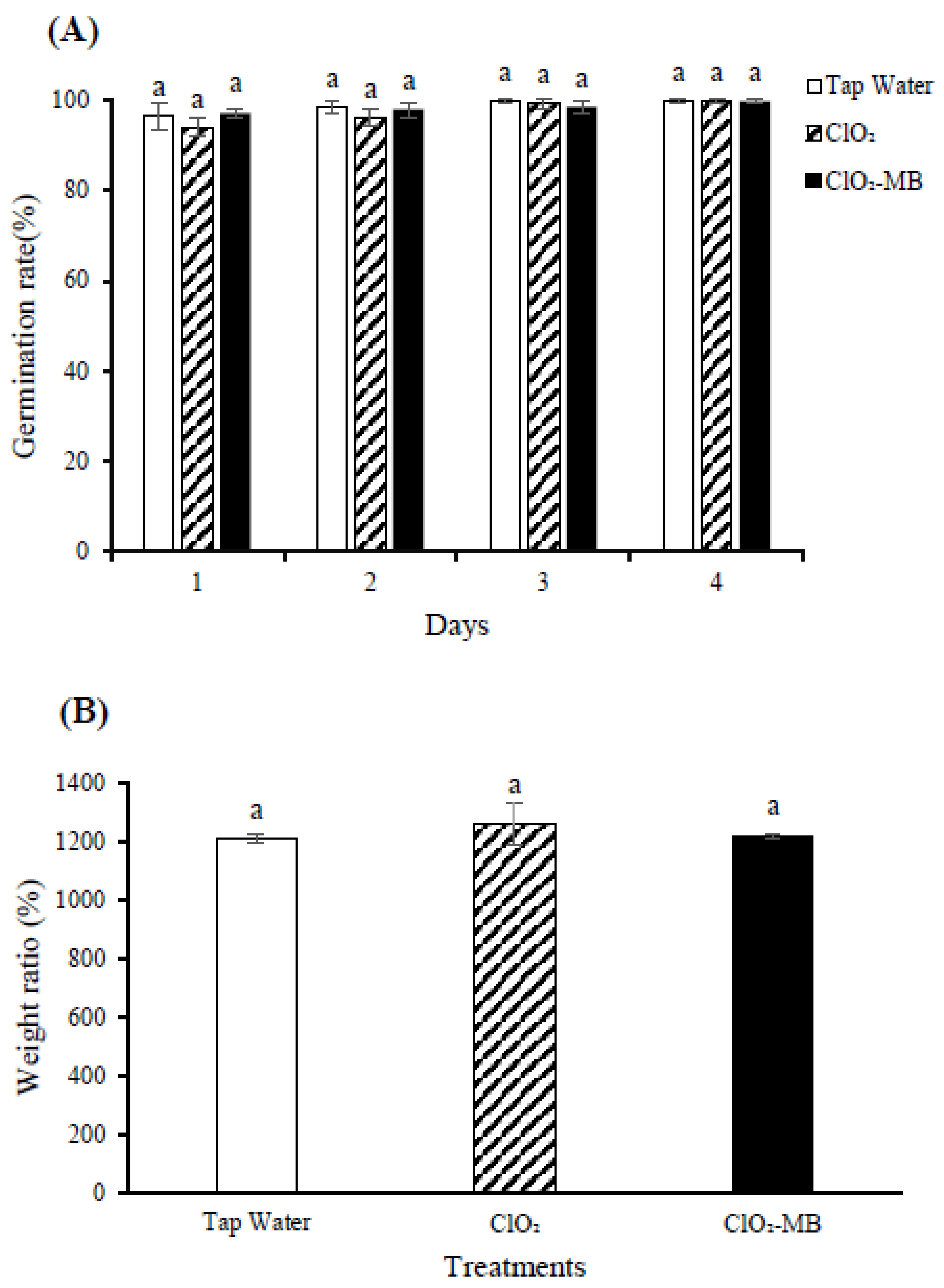
Figure 4.
The surface of alfalfa seeds under scanning electron microscope, (A) the untreated, (B) MB only treated, (C) CMB treated (2000X magnification).
Figure 4.
The surface of alfalfa seeds under scanning electron microscope, (A) the untreated, (B) MB only treated, (C) CMB treated (2000X magnification).
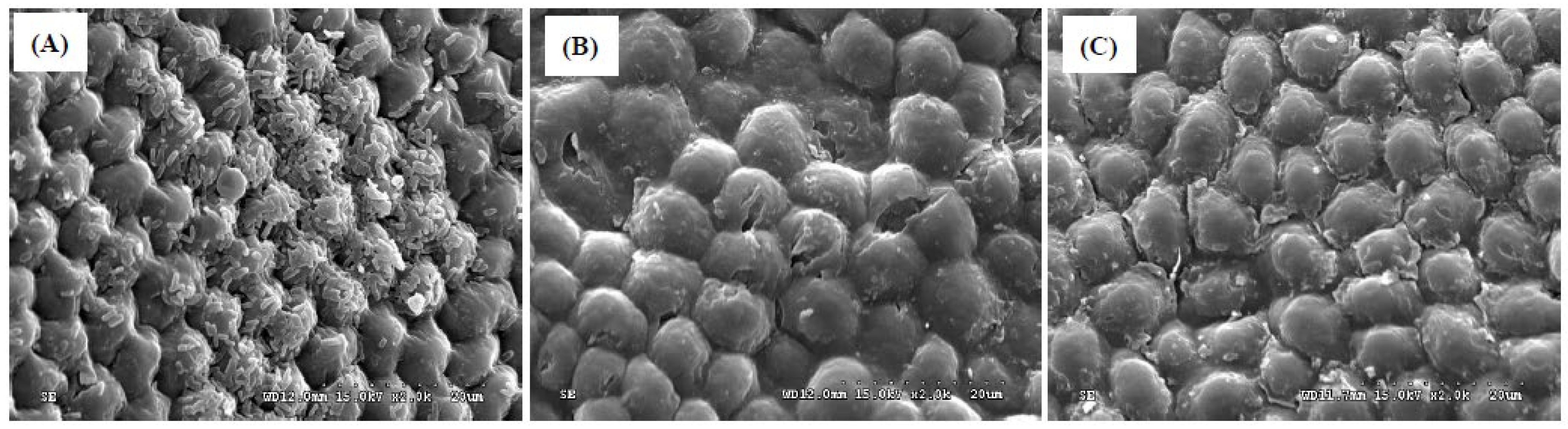

Table 1.
Populations (log CFU/g) and reduction (insides parentheses) of S. Typhimurium on alfalfa seeds after various treatments.
Table 1.
Populations (log CFU/g) and reduction (insides parentheses) of S. Typhimurium on alfalfa seeds after various treatments.
| Treatments | CMB Washing time | SMB | ||
|---|---|---|---|---|
| Washing time | 10 min | 20 min | 30 min | 20 min |
| Untreated | 5.50±0.09a | 5.50±0.09a | 5.50±0.09a | 5.48±0.18a |
| Water soaking | 5.13±0.15b (0.37) | 5.13±0.15b (0.37) | 5.13±0.15a (0.37) | 5.13±0.15ab (0.37) |
| Water washing | 5.08±0.17Ab (0.42) | 4.93±0.36Aab (0.57) | 4.50±0.71Ab (1.05) | 5.01±0.14ab (0.47) |
| MB | 5.21±0.67Aab (0.29) | 5.48±0.27Aa (0.02) | 5.32±0.15Aa (0.18) | 5.46±0.27ab (0.02) |
| ClO2 | 4.70±0.23Abc (0.80) | 4.37±0.45Ab (1.13) | 3.34±0.14Bc (2.16) | - |
| CMB | 4.22±0.21Ac (1.28) | 2.25±0.27Bc (3.25) | 2.05±0.30Bd (3.45) | - |
| SAEW | - | - | - | 4.60±0.04Ab (0.88) |
| SMB | - | - | - | 1.65±0.77Bc (3.83) |
Values represent means and standard deviations of six replicates (n=6). MB: microbubble; CMB: chlorine dioxide microbubble; SAEW: slightly acidic electrolyzed water, SMB: slightly acidic electrolyzed water microbubble. Means with the different capital letters in the same row are significantly different (p < 0.05). SAEW and SMB were compared with ClO2 and CMB of 20 min, respectively. Means with the different small case letters in the same column are significantly different (p < 0.05).
Table 2.
Physicochemical properties of the washing solution of water, ClO2, CMB after treating alfalfa seeds.
Table 2.
Physicochemical properties of the washing solution of water, ClO2, CMB after treating alfalfa seeds.
Disclaimer/Publisher’s Note: The statements, opinions and data contained in all publications are solely those of the individual author(s) and contributor(s) and not of MDPI and/or the editor(s). MDPI and/or the editor(s) disclaim responsibility for any injury to people or property resulting from any ideas, methods, instructions or products referred to in the content. |
© 2025 by the authors. Licensee MDPI, Basel, Switzerland. This article is an open access article distributed under the terms and conditions of the Creative Commons Attribution (CC BY) license (http://creativecommons.org/licenses/by/4.0/).
Copyright: This open access article is published under a Creative Commons CC BY 4.0 license, which permit the free download, distribution, and reuse, provided that the author and preprint are cited in any reuse.