

Submitted:
18 August 2025
Posted:
19 August 2025
You are already at the latest version
Abstract
Borderlands offer a specific context for the development of tourism. On the one hand the borders witness the historical scars of a divide between neighbouring territories. On the other borders function as an interface. In the area along the border of the Spanish region of Castile and Leon and the Portuguese Centre and North regions potential tourism resources are described in terms of attractions and place-related offer. Subsequently, based on the ways tourists use the potential a typology of tourism activities is developed. The destination-based typology uses Butler’s TALC model, institutional involvement in tourism development and the pros and contras of tourism development in a debordering periphery. The typology reflects a wide range of tourist activities including microproducts using endogenous resources as well as destinations exploited by supra-regional or global actors. Most destinations are typical borderland ones.
Keywords:
borderland tourism
; cross-border interaction
; TALC model
; tourism typologies
; Spanish-Portuguese border
1. Introduction
‘Borders and mobilities are not antithetical. A globalizing world is a world of networks, flows and mobility; it is also a world of borders.’
This citation from Rumford (2006, 163) may be applied to the internal state borders of the European Union. On the one hand European integration has made borders more porous and has facilitated cross-border interaction of goods, persons and ideas. On the other state borders continue to divide states because states continue to organise their territorial space and create meaning for it (Paasi, 2009). Regarding debordering processes in Europe Portugal and Spain were latecomers compared to the BENELUX countries and the founding member states of the European Coal and Steel Community which gradually opened their borders from the 1950s onwards. The removal of customs in 1999 enabled free movement of persons and goods between both states and EU market integration reduced price differences of consumer goods across the border.
Although the study of borderlands is a major subject of political geography since the nineteenth century, it is a relative new study area in tourism geography (Gelbman & Timothy 2011, Sofield 2006). This study focusses on the emergence of new tourist activities in the Spanish-Portuguese borderland of Castile and Leon in Spain and the Portuguese North and Centre regions (Figure 1). The area is peripheral in terms of its economy, demography and connectivity. Potential tourist attractions are spread over a large number of sites including natural and cultural heritage as well as special events and amenities created to attract tourists. Apart from contributing to the poorly developed study area of borderland tourism the relevance of our analysis stems from the following three aspects.
First, in our borderland tourism is a recent phenomenon. Up to the 1960s the area was largely unexplored as a tourist destination. Only a few roads and railways connected the area with the large population centres of both countries. Moreover, most Spaniards and Portuguese did not have the resources to engage in tourist activities. Gradually the borderland’s connectivity improved by road construction and paving while an increasing middle class could afford excursions by coach or privately owned cars. Apart from a few towns where border-shopping emerged and some towns with renowned historical centres tourism remained absent in the borderland. From the 1990s up to the present Iberian borderland tourism is increasing and new types of tourism are rising.
Second, tourists go to specific zones, places and sites. In the case of a remote borderland new types of tourism may emerge which substantially differ from organised mass-tourism (Jacobsen, 2004; Fiorello & Bo, 2012; Chylinska, 2022). In this respect, peripheries like our study area, well-endowed with scenic landscapes and cultural heritage have a potential for new sustainable types of tourism.
In the third place our approach aims at a place-specific tourism typology. A glance on the map of potential tourist attractions (Figure 2 and Figure 3) reveals that the borderland is far from a homogeneous space as it includes attraction-less zones, areas with specific attractions and places with a combination of attractions. This is why sweeping generalisations should be avoided as well as the reliance on a few classification criteria (Camară 2022).
The context in which tourism initiatives emerge is one of an old European borderland plagued by socioeconomic decline as is illustrated by the following short regional biography.
In 1297 the border between Spain and Portugal was laid down in the Treaty of Alcañices. With a length of 1,234 kms it is one of the longest European borders. The border delineation remained practically unchanged up to today. The demarcation was based on mountain tops and rivers or arbitrarily defined on other stretches. The study area, locally known as the Raya (S.) or Raia (P) is located in the borderlands of the Autonomous Region of Castile in Spain and the Centre and North Regions of Portugal (Figure 1). Although the border separates the Portuguese freguesias and the Spanish municipalities, the borderland is a zone of transition between in terms of culture and identity.
The abandoning of customs posts has ended the image of the border as an impenetrable barrier (Pintado & Barrenechea, 1972). Spatial separation transmitted the idea of a cul-de-sac and the end of the world in the inland with local people who lived back-to-back (‘de espaldas’; ‘de costas voltadas’).
The peripheral border location is reflected in a poor accessibility over land (Cabero Diez, 2004). Although remoteness and isolation from potential markets and dynamic urban centres have been mitigated by improving the road network, the borderland has not shown signs of economic revitalisation. The area remains badly connected with the outside world, in some parts even worse as a consequence of railway closures. Not surprisingly, the borderland is often qualified as ‘the periphery of the periphery’. Socioeconomic backwardness has not refrained local centres of the counties, namely concelhos (P) and comarcas (Sp) to improve local roads that serve their areas, even roads across the border.
Agriculture and livestock farming have to cope with a hostile natural environment characterised by a high altitude, accidental landscapes and poor soils. Despite these obstacles, the people of the Raya/Raia have adapted farming practice to local circumstances through techniques and community-based habits. Neither the important hydro-electric production, nor mining of agricultural processing have reverted economic decline. With an increasingly marginal agriculture, galloping out-migration and a low population density the predominantly rural borderland needs revitalisation. For de last two decades rural development policies and European cross-border programmes have favoured the primary sector as well as activities such as tourism to diversify the economy.
The ways in which new forms of tourism are introduced into our study area will be theoretically informed by reviewing the literature about peripheral borderland tourism, tourism life cycle theory and the construction of tourism typologies.
2. Literature Review
2.1. Borderlands as a Tourists’ Destinations
In most states borderlands are peripheries located far from the economic, political and cultural centres. Our study area shares features of other non-border peripheries in the interior of the Iberian Peninsula. Apart from being a periphery in the sense of remoteness (Kühn 2015), the Iberian inland is characterised by peripheralization which is a dynamic process of becoming more peripheral and socially more marginal. Features of peripheralization are the relation to centralization in a socio-spatial system, process-centredness, multidimensionality (economic, social, political), multi-scale applicability and temporality (possibility of de-peripheralization) (Kühn 2015, 374). Kühn (p. 368) traces the concept of peripheralization around the turn of this century. However, in his study about Spanish Galicia, Ettema (1980) uses a similar process-centred perspective named ‘peripheral integration’.
Rural peripheries do not suffer from the hectic bustle of the city, which make them attractive for visitors in search of unspoilt nature and untouched cultural heritage. Moreover, local people not bothered by the pressures of urban life or the negative impacts of mass tourism are often more tourist-friendly. In contrast, low population densities and the absence of urban centres reduce the potential for place-bounded multiple activities. However, as out-migration and a lack of innovation are negative dimensions of peripheralization, the resulting absence of young dynamic and qualified people may hamper local initiatives to attract tourists.
Borderlands are a special kind of periphery for the following reasons. First, interstate hostility in the past has militarised borderlands leaving a heritage of castles, walled towns and bastions, often used or reused as tourist attractions (Timothy 1995). Secondly, state control over the economy created price differences for consumer goods and services resulting in cross-border shopping and smuggling. Economic integration in the EU has made this cross-border interaction for economic purposes obsolete though the remnants such as closed shops and smuggling trails can still be in situ. Thirdly, for more than a century nationalisation of borderland cultures has culturally and linguistically divided borderlanders. In this respect a total disappearance of national identities in a borderless world is illusory (Prokkola & Lois 2016; Paasi 2022).
Borderlands well-endowed with natural and cultural heritage may attract significant numbers of tourists if heritage is combined with one or more factors listed by Buhalis (2000, 98), namely his five ‘A’s’:
- -
- Accessibility: the entire transportation system to reach and move around the destination (to which high-speed internet connections and mobile telephony may be added),
- -
- Amenities: all services facilitating a convenient stay,
- -
- Available packages: availability of service bundles by intermediaries to direct tourists’ attention to the unique features of a destination,
- -
- Activities: all available activities at the destination and what consumers can do during their visit, and
- -
- Ancillary Services: daily used services, such as banks, telecommunication, postal service, and hospital, which are not primarily aimed for tourists (Buhalis, 2000, p. 98).
Table 1 combines Buhalis’ A’s with the features of peripheralizing borderlands.
2.2. Butler’s Tourism Area Life Cycle
As we will show further below the studied borderland has become more attractive for various types of tourists. Apart from the classical organised trips new types of tourists are now visiting formerly unexplored places. As a consequence, we expect destinations to vary according to the stage tourism has reached and modified their attractivity. In this respect Butler’s much used tourism area life cycle or TALC model is a helpful concept (Butler 1980). We will first briefly outline the model, followed by a discussion its applicability in our case. The model is based on the evolution of a destination area according to the following stages (Figure 4):
- Exploration: Small numbers of tourists use local facilities having contact with local people without changing the local social and natural environment.
- Involvement: Some local residents begin to provide facilities. Some pressure on public institutions to improve tourism facilities can be expected. Interaction with local people is high. Examples of this stage van be observed in less accessible areas of western Europe (Butler 1980, 8).
- Development: The number of tourists increases rapidly. The area is substantially marketed in tourist-generating areas. Facilities and attractions are adapted. External control of facilities and attractions and business increases to the detriment of local control.
- Consolidation: The rate of increase in the number of tourists declines. The area now depends on tourism dominated by external actors. Some discontent among local people can emerge.
- Stagnation: Tourist numbers stop increasing because the local environment loses attractivity. Organised mass tourism dominates the area.
- Decline or Rejuvenation: Decline implies a decreasing number of tourists, loosing attractivity due to competition with new attractive destinations. Rejuvenation may occur when new attractions are added and/or existing but unexploited heritage is now (re)utilised for tourism.
Butler’s theory has been widely used as a model in empirical and theoretical studies, modified, or criticised, but it would take too far to exhaustively treat them here. For criticism, modifications and reviews of case studies see Haywood (1986), Breakey (2005), Lagiewski (2006), Ho & McKercher (2015), Williams & Lew (2024, 34) and Singh (2021). Yet regarding the research design and the interpretation of the data some comments on the theory are needed with respect to the units of analysis, the dependent variable and the process.
The units of analysis are areas. Their scale is not defined which causes an enormous range of scales opted for in empirical studies. Although our study is carried out on a micro scale, the units still may cause interpretation problems. As results display a general image of the area, they do not reflect internal heterogeneity. For instance, if the unit has various attractions, some may be developing while others are stagnating. In addition, an area may be classified as being in an exploratory stage while it includes some tourism facilities that have gone through several stages of the life cycle.
The dependent variable is the number of tourists. Apart from the problem that different types of tourists are not distinguished nor seasonal variations, many studies use a proxy, such as visitor expenditure or accommodation capacity or define the number of tourists by arrivals or nights spent (Breakey 2005, 73-77).
The process of change is not always a unilinear development trajectory similar to the model’s S-shaped curve (Haywood 1986, Johnston 2001). The neo-Darwinist assumption of evolution can be falsified by cases of de-evolution (Singh 2021). Moreover, some stages may be absent because they are passed over. Finally, some suggestions of the theory such as locals beginning to provide facilities in the involvement stage not always fit the cases as will be shown later on. This is because mechanisms of change before development takes place may come from external institutional or private-sector actors (Aledo & Mazón 2004; Lane & Kastenholz 2015; Müller 2016). Whereas in 1980 Butler emphasised the role of advertising in the recruitment areas of tourists in from the development phase onwards, today advertising on the internet as well as social media may more powerful tools to attract tourists.
Butler has repeatedly been empathetic with criticism as witnesses the following quote:
‘It is not surprising that the TALC does not always fit reality. Any generalized simplistic model is unlikely to match the pattern of development at every destination’ (Butler 2004, 167).
2.3. Considerations of Typology Building
Typification of regions and places is probably as old as geography. Typologies of spatial entities in geography should obey to the same rules as classifications in the social sciences (Grigg 1967). Obviously, any typology should fit well-known rules of classification. Therefore, classes should be mutually exclusive, exhaustive (covering all possibilities) and reliable in the sense that the research results can be replicated while following the operationalisation steps that start from theoretically informed data collection and end with the construction of classes (McKinney 1969).
Here, it is of particular importance to construct a theoretically grounded and meaningful typology of tourism areas. Tourism scholars have developed various typologies, most of them multi-dimensional. We distinguish between typologies focussed on the tourists, e.g., their activity patterns, values, motivations, etc. (Buhalis 2000; Mehmetoglu 2007), tourism governance (Tosun1999, 2006; Hall 2011) and those including a classification of destination areas (for a review of early studies see Lagiewski 2006; recent examples including the TALC model are Coccossis & Constantoglou 2006; Sarantakou 2023). The construction of the typology is not an L’art-pour l’art exercise as it should be embedded in key concepts and contribute to comparative studies and theoretical change (Hall 2011, 438-439). In our case the typology unifies dimensions of border peripherality, attractivity, the role of institutional involvement in tourism development and the stage of tourism growth.
3. Materials and Methods
Tourist destinations consist of many dimensions such as space, place, culture, landscape and social features which are not isolated attributes but instead interact with the outside world (Ouyang et al. 2023). Therefore, they cannot be characterised by one or a few quantitative indicators nor by merely qualitative ones. Local tourist destinations are resulting from path dependency, human agency and contextuality (Sanz-Ibañez & Clave 2014, 570-573). A multi-methods approach is used because identifying the evolution of local tourist destinations requires combined quantitative and qualitative methods. We use qualitative historical information and recent statistical data in order to construct historical place-based biographies embedded in qualitative information about changing contexts and qualitative information about human agency. Knowledge about the historical trajectory of tourist destinations helps to understand why they
‘…are today as they are and, why not, as well as giving some clues about their futures as living communities’ (Sanz-Ibáñez & Clave 2014, 572).
In order to grasp human agency at the local level semi-structured interviews have been taken from stakeholders (e.g., residents, tourism entrepreneurs, politicians and civil servants). Path dependency is reconstructed by historical studies in combination with recent statistical data at a meso- and micro-scale, respectively counties (comarcas in Spain and concelhos in Portugal) and local units (municipios in España and freguesias in Portugal). These scales coincide with the units used by the EUROSTAT European statistical office. The local units are all located along the border and total 359 units in our data base.
In addition, information about agency and contextuality has been collected from primary sources such as documents and websites of public institutions and tourism companies at all scale levels. As secondary sources information is gathered from the communication media, in particular local newspapers. Observation of the state of tourist destinations and tourism equipment in situ has added relevant information the state of maintenance and operating conditions. The basic and thematic maps are made with the license-free tools of the Geographical Information System QGIS.
The chosen methodology aims at replicability, not only for future research along the Spanish-Portuguese border, but in borderlands all over the world.
4. Results: Typology Tourist Destinations
Tourism Destination Typology
In our typology with the most stable tourist destinations which have received a continuous flow of tourists for many decades are Bragança and Almeida (Portugal) and the Spanish towns of Ciudad Rodrigo and Puebla de Sanabria. These places are mature destinations (Table 2). A common characteristic of these destinations is their early formal recognition of heritage as well as a long-lasting public-sector involvement to preserve heritage and reuse it for tourism development. Involvement started long before the emergence of EU policies to promote borderland tourism. All sites stand out for their military heritage consisting of walls, castles and garrisons. Tourism in Ciudad Rodrigo and Bragança is predominantly oriented towards tangible cultural heritage encompassing also non-defensive monuments in their respective historical centres. Due to their size of respectively 12 and 22 thousand inhabitants both towns have a relatively high Buhalisean 5 A’s content, though the A of accessibility should be qualified because despite the location along motorways important population centres like Madrid, Lisbon and Porto remains far away. Almeida and Puebla de Sanabria with no more than 1,500 inhabitants each, have a lower A’s profile. Puebla de Sanabria is attractive for the scenic townscape and its location near to the Lake of Sanabria. Cultural, nature and ‘beach’ tourism make the site a multi-faceted destination.
The stronghold of Almeida is a special case of a mature destination, but it started to be so some twenty years ago. From 1995 to 2004 the Portuguese government created the network of the aldeias históricas (historical villages) with the aim to develop tourism and cope with rural decline. Form the twelve villages selected four are located in our study area, namely Almeida, Castelo Mendo, Castelo Rodrigo and Sortelha. In Almeida almost 5.7 million Euros were invested, particularly in urban renovation and tourism infrastructure (Boura 2004, 121). In contrast to Butler’s expectation that exploring tourists gradually stimulate the rise of local tourism business, the growth to maturity was initiated by an ambitious government-driven development programme. In Almeida public resources continue to be allocated in tourist attractions. In 2009 the historical military museum financed by the Portuguese and Brazilian ministries of defence was opened in the casemates (CEAMA 2021). In addition, European funds were used for cooperation with Ciudad Rodrigo in order to stimulate tourism to walled towns (Hortelano Mínguez & Mansvelt Beck 2017). After initial fluctuations in the volume of tourism, the registered inflow is now stabilised at 70,000 tourists per year, of which about half are foreigners.
A developing destination is the Camino de Hierro located in the Spanish municipality of La Fregeneda. There, the abandoned railway track is transformed into a hiking trail in 2021. The project to adapt the railway to hikers with a total cost of 1.2 million Euros has been financed by the Province of Salamanca. In this case Butler’s exploration phase is absent because the track was closed before the route opened. The itinerary of 17 km crosses a rugged landscape from the Portuguese border to the station of La Fregeneda and includes twenty tunnels and ten bridges. The number of visitors decreased from 19,835 in 2021 to 11,767 in 2024. Given the short operational period it is not possible whether a further TALC stage will be reached or the negative trend will continue. However, according to interviews with hotel owners in neighbouring municipalities, they benefit from the new attraction. The reason is quite simple: the Camino’s gate opens and closes early in the morning. As a consequence, that night before hikers from elsewhere have to book accommodation in the vicinity.
Butler’s development stage can be observed in the ‘historical villages’ of Castelo Rodrigo and Sortelho, both with an important historical defence function. Presumably, both villages passed through the exploration phase. However, the destinations jumped directed from exploration to development because the intervening phase of involvement of local people in preservation, renovation and promotion of tourist activities hardly occurred. Both villages are experiencing such a rapid development of tourism that booming instead of developing may be a more correct qualification. Castelo Rodrigo’s hyper-development is a by-product of river-cruise tourism along the river Douro. During the 1990s the river was made navigable and equipped for cruises and water sports. From Porto to the Spanish border big cruise boats started to organise cruises to the Spanish border. Multi-national cruise companies as well as Portuguese ones based in Porto initiated boat trips and rapidly expanded their business (Ruiz Romero de la Cruz et al. 2020). Several multinational companies offer packages in which a visit to Castelo Rodrigo is included. Out of the 76,000 visitors, more than 60 percent are foreigners, most of them wealthy North-Americans and British. After spending a few hours in Castelo Rodrigo coaches take them to the city of Salamanca where they get a guided tour and spend the night.
While tourism to Castelo Rodrigo is an example of globalisation in terms of external actors and tourists’ origins, Sortelha’s touristic hyper-development is mainly Iberian. Apart from car tourism Portuguese and Spanish tour operators from Madrid, Lisbon, Porto and Salamanca offer bus trips to the historical villages which often have stops and overnight stays in Sortelha. Although both villages have expanded their tourism offer regarding accommodation, catering and particularly in Sortelha artisanry, the Buhalis’ As are not firmly represented, though in Figueira de Castelo Rodrigo at a short distance of Castelo Rodrigo amenities and ancillary services are available. However, like Almeida, both villages have an activity spectrum confined to restored tangible cultural heritage. The ageing of their population is worsened by housing problems. In Sortelha the people live outside the historical site, but local planning permissions inhibit young people to build houses and see themselves obliged to move to the concelho’s capital of Sabugal. In Castelo Rodrigo the inhabitants live in the historical site. They cannot modernise their homes because of preservation regulations making the site unattractive as a residence. During a field visit in Spring 2024 Castelo Rodrigo was swarming with British tourists while the only local person we saw, was a young man working in a souvenir shop. Anthropological fieldwork shows that in both sites, opinions about the new status of historical village vary according to social status and heritage perception (Silva 2009, 2010, Silva & Leal 2015: Gregório & Sarmentos 2022). The historical sites, one in Sortelha without inhabitants and another in Castelo Rodrigo with a few and decreasing population within the site serve as restored decors for site-seeing excursionists or cases of MacCannel’s ‘staged authenticity’ . The question is whether the exponential growth of tourism will suffocate the attraction and Butler’s stagnation and decline stages will be entered.
State subsidies for the preservation have dried out while budgets for maintenance are low or not available. In an interview with in a regional newspaper Paola Reis, the author of a 715 pages PhD thesis about the historical villages, collapsed roofs and broken windows witness the lack of maintenance (Noticias de Coimbra, 16-05-2018).
Miranda do Douro in Portugal is a rejuvenating destination. The town prospered as a border-shopping centre up to the opening of the border and the price levelling of consumer goods as a consequence of European integration. However, the freguesia is reinventing itself by the promotion of nature and gastronomy-based tourism. Miranda’s location on the artificial lake in the river Douro has become an asset attracting an increasing number of tourists. Boat cruises on the lake through a scenic landscape formed by the canyon are organised by the Estação Biológica Internacional do Douro. The catamaran with a 120-passenger capacity offers cruises that last one and a half hours (Campesino Fernández 2016, 58). Moreover, kayaking facilities now attract water sports enthusiasts. New attractions are the ethnographic and archaeological Museum of the Terra renovated in 2014, the Ecocentro Micológico (2019) with exhibitions, courses and show-cooking and the Donkey Centre (2019) with sixty donkeys of the local breed.
The recovery of tourism is reflected in the data following data. From 2008 to 2013 the tourism office received a median of 9,391 visitors (Alves Moreira 2016, 45), while with the exception of the COVID dip the office registered more than 14,000 visitors in 2024. The major part of tourists who visit the tourism office are foreigners. The Spaniards continue to visit Miranda do Douro as reveal the 56% of the total visits to the office in 2024. However, Portuguese tourists have more overnight stays than Spanish who presumably opt for daytrips. Miranda do Douro shows a mix of activity options. According to the data of the tourism office in 2024 one third are nature tourists another third gastronomic and wine tourist and one fifth are registered as cultural tourists. Obviously, tourists may combine nature, gastronomy and culture. The data demonstrates that Miranda’s monoculture of cross-border shopping has been replaced by an appealing mixture of activity options. These options are endorsed with amenities and ancillary services and an increasing offer of accommodation and catering.
Another example of a renewed use of a local resource is in Vimioso (Portugal) where an old spa has been replaced by a brand-new complex that revives the hot springs and attracts tourists. The new installations of the Termas da Terronha co-financed by the EU FEDER funds are operational from 2013 to the present. It as part of the route of the terras frias financed with European and Portuguese funds. The spa is located outside the nuclear county seat of Vimioso. The enclave attracts tourists during the six months it opens per year, but it remains a destination without much involvement in the nucleus of Vimioso. For instance, the hotel and rural accommodations do not mention the spa of Termas da Terronha as an attraction to be visited. However, given the recent creation it is too early to identify the rejuvenation effort as leading to one of the final TALC stages.
Like Miranda do Douro, Vilar Formoso in Portugal has lost its comparative advantage as a border-shopping site. The town is located along the motorway with the highest traffic intensity that connects Spain with Portugal. Although Vilar Formoso has still a catering function for lorry and car drivers, rejuvenation as a tourist destination has failed despite the establishment of the museum Fronteira da Paz. The museum established in 2017 is a memorial to the welcoming of NAZI refugees during World War II. It is located close to the nearby railway station covered with panels of typical azulejo tiles. Neither the museum, built with state funds, nor the station has been able to cope with the loss of cross-border shoppers.
Many small-scale destinations have specialised in one specific niche. Hortelano Mínguez (2015, 259) distinguishes nature, cultural and active tourism, subdivided into 18 types. Here it goes too far to deal with all types and discuss in which stage of the TALC they are situated. The vast and varied cultural and natural heritage encompasses all types while the usually small-size destinations may each have their own development path. More than hundred sites recognised as heritage cultural sites or containing recognised monuments and vast areas where nature is protected give room to specialise in specific types of tourism.
The allocation of public resources has often not followed tourism investments as Butler predicts, but often the reverse has occurred. The expectation that tourism development would follow heritage preservation, reuse and promotion has been an illusion in two Spanish villages. San Felices de los Gallegos is an example of a failed policy-driven destination. Despite considerable investments from the EU INTERREG programme the reuse of the castle with an interpretation centre has not met the expectation. Soon after opening the centre the municipality could not pay the person in charge because the monument was loss-making. From 2012 the castle is only accessible to groups of more than ten persons after previous application to the municipal administration. After costly investments by supra-local entities the municipality with its low budget could not afford the running costs of the castle. Hotel owners in the vicinity soon stopped to recommend guests to visit San Felices de los Gallegos. As a consequence, the village remained stuck in the exploration stage.
The other example of a failed policy-driven destination is the enclave of the Real Fuerte de la Concepción located outside the village of Aldea del Obispo. The star-shaped 18th century fort has become part of the Ruta de Fortificaciones de Frontera established in 1999 and officially promoted. Private investors converted the fort into a luxury 4 stars hotel including a restaurant in 2012. However, the reuse of the defensive heritage finally became loss-making and was closed in 2023. The nearby village of Aldea del Obispo did not experience any spread effect of the hotel during its existence.
Finally, the critical reader may have observed that in our typology characteristics of peripheralization are missing. The reason is that practically all settlements suffer from the same evils of peripheralization such as continuous outmigration, ageing population with population loss as a consequence. The few exceptions are the town of Bragança and the freguesía of Vimioso in Portugal, which have reverted demographic decline into a modest population growth. However, this growth is caused by the expansion of administrative functions, educational and health services. Migrants who leave their villages are usually higher qualified and more dynamic young people resulting of a lowly qualified workforce that lags behind. Potential local tourism entrepreneurs, so much desired by politicians who try to stimulate tourism in order to retain the population are therefore scarce. However, during our fieldwork we have observed a small ray of hope consisting of young urban migrants establishing accommodation, restaurants and attractions in villages like Hinojoso del Duero, San Felices de los Gallegos and Sortelha.
Finally, peripheralization may both destroy and create attractions. In areas with much abandoned cropland and pastures wildlife has returned giving room to wolves around Tábara in Spain, birds (Arribes del Duero) and mushrooms (Miranda do Douro). Wolf and bird watching and mushroom collection have generated new tourist destinations. On the other hand, abandoning of agriculture causes degradation of cultural landscapes and concomitant activities. For instance, terraced landscapes, particularly in the Spanish Raya are ruined by erosion. The village of Fermoselle, which is attracting tourists because of its wine-producing history and its ‘thousand bodegas’, does not tell that over eighty percent of the subterranean bodegas is closed (Potente Castro et al. 2023). The most dynamic entrepreneur is a British oenologist who sells her wine to external market parties and whose business is located in a hypermodern winery. However, tourism is increasing significantly. Apart from visiting the wine cellars and tasting the branded Arribes wine, hiking trails, la Casa del Parque, an interpretation centre of the natural reserve of the Arribes del Duero attract visitors. Local accommodation has increased significantly ranging from many recently established rural houses to a four-stars hotel. Public-sector investments and local initiatives have rejuvenated tourism without passing through the TALC stages of development through external companies, consolidation or decline.
So far, we paid no attention to the role of tourism growth as a means to curb peripheralization. Out of the 360 administrative units only six show some population growth (Hortelano Mínguez & Martín Pescador, 2025). ‘Mature’ Bragança and ‘rejuvenating’ Vimioso are among these units. However, their population increase is due to the establishment of administrative function and institutions of higher education in Bragança while the concentration of public services in the county seat of Vimioso has attracted inhabitants from nearby villages. It does not make a difference whether destinations are mature, booming or rejuvenating, they all continue losing population due to outmigration and ageing.
5. Discussion and Conclusions
Limitations of our study are of a different kind. First, there are limitations inherent to most typologies based on empirical studies. The Weberian Idealtypen are usually simplifications of reality giving little room to combinations of TALC in one destination. For example, Sortelha classified as a booming destination is not only the playground of external tour operators but combines entrepreneurial initiatives of local people, typical for earlier stages.
Secondly, our typology lacks completeness. Destinations we mentioned in the typology are a selection from many sites. Because of financial and time limitations it was impossible to collect data on all the destinations. However, our typology may stimulate future research on tourism in peripheral borderlands. In the future similar or different types may be identified.
Thirdly, our typology includes both paths predicted by the TALC model and different trajectories of TALC. However, hypothetically, more paths may be detected. In this respect more cases of de-evolution different from the failed policy-driven destination before the final stage of TALC has been reached may be detected.
Fourth, more place-specific in-depth information could have been collected. Particularly, information about the involvement of local people in tourism and perception of tourists can enrich our classification.
Finally, in some cases the evolution is badly documented, particularly the availability of data about the historical evolution of local tourism has been a problem. In addition, about the present stat of tourism information is not always updated while available statistics are lagging behind timeliness. Websites of some tourism offices are not or no more certified and thus not accessible.
Despite these limitations the following conclusions can be drawn. Debordering has facilitated cross-border interaction, ranging from institutional collaboration to movements of goods and persons. However, the border continues separating cultures, landscapes and feelings of belonging. Therefore, the borderland is attractive and repellent. Omnipresent military heritage nowadays has converted sites into international and in some occasions, into global destinations. Public-sector investments have created new attractions and rejuvenated old ones by using and reusing heritage, renovating attractions in decline and diversifying declining destinations. In addition, the increasing prosperity in Portugal and Spain has made tourism available to many citizens.
Together with reused heritage, new attractions have resulted in a diverse touristic landscape in which most stages of Butler`s TALC model can be identified as reveals the destination typology. However, mechanisms of growth postulated by Butler often follow a different path, particularly as a consequence of public interventions previous to the development phase. This is because many sites have jumped straightly from the initial exploration to the third development stage.
Like in most of the peripheral interior of the Iberian Peninsula tourism cannot stop peripheralization. As a consequence, local entrepreneurship is scarce. The little dynamism brought by the immigration of tourism entrepreneurs cannot cope with the loss of attractiveness of villages and local centres for their own inhabitants who continue migrating. Paradoxically, the improvement of road infrastructure which seems to have a de-peripheralization effect on the borderland has moved the local elite of civil servants and notables to the cities from where they commute to their workplace aggravating socioeconomic decline.
Informed Consent Statement Not applicable.
Author Contributions
L.A.H.M., J.M.B. and G.W.L. conceptualized the study and conclusions; J.M.B. investigation, literature review and supervising the research methodology. L.A.H.M. materials and methods. G.W.L. contributing to data interpretation and analysis. All authors have read and agreed to the published version of the manuscript.
Funding
This research received no external funding.
Institutional Review Board Statement
Not applicable.
Data Availability Statement
The original contributions presented in this study are included in the article. Further inquiries can be directed to the corresponding author(s).
Conflicts of Interest
The authors declare no conflict of interest.
References
- Aledo, A. & Mazón, T. (2004). Impact of residential tourism and the destination life cycle theory, In; Pineda, Brebbia, C.A, & Mugica, M. (eds.) Sustainable Tourism, 25-36, WIT Press.
- Alves Moreira, M. C. (2016).
- Boura, I. (2004). Património e mobilização das comunidades locais: das Aldeias Históricas aos contratos de aldeia, Cadernos de Geografia, 21.23.
- Breakey, N.M. (2005).
- Buhalis, D. Marketing the competitive destination of the future. Tour. Manag. 2000, 21, 97–116. [Google Scholar] [CrossRef]
- Butler, R.W. The Concept of a Tourist Area Cycle of Evolution: Implications for Management of Resources. In The Tourism Area Life Cycle; Channel View Publications: Bristol, UK, 2006; Volume 1, pp. 3–12. [Google Scholar] [CrossRef]
- Butler, R (2004). The tourism area life cycle, in the twenty-first century, in: Lew, A, Hall, M. & Williams, A. M, (eds,) A companion to tourism, 159-169, Blackwell Publishing.
- Cabero, V. (2004). (2004). Bordes y márgenes del territorio en Castilla y León: integración y cooperación. In E. Clemente, Mª. I. Martín & L. A. Hortelano (Eds), Territorio y planificación, una aproximación a Castilla y León, (pp.79-95). Salamanca: Caja Duero.
- Camară, G. Comment on “A new European regional tourism typology”. Ann. Tour. Res. Empir. Insights 2022, 3. [Google Scholar] [CrossRef]
- Campesino Fernández A., J. (2016). Paisajes del agua y turismo fluvial en la raya ibérica, In: Vera, J. F., Olcina, J., Hernández, M. (eds.), Paisaje, cultura territorial y vivencia de la Geografía. 47-72, Libro homenaje al profesor Alfredo Morales Gil. P: San Vicente del Raspeig.
- CEAMA (2021). Actas do XV Seminário Internacional do Centro de Estudos de Arquitectura Militar de Almeida, Google Académico.
- Chylińska, D. Escape? But where? About ‘escape tourism’. Tour. Stud. 2022, 22, 262–289. [Google Scholar] [CrossRef]
- Coccossis, H.; Constantoglou, M.E. (2006). The Use of Typologies in Tourism Planning: Problems and Conflicts, in Regional analysis and policy: The Greek experience, In: Coccossis, H. & Psycharis, Y. (eds.
- Ettema, W. A. (1980). 18.
- Fiorello, A.; Bo, D. Community-Based Ecotourism to Meet the New Tourist's Expectations: An Exploratory Study. J. Hosp. Mark. Manag. 2012, 21, 758–778. [Google Scholar] [CrossRef]
- Gelbman, A.; Timothy, D.J. Border complexity, tourism and international exclaves. Ann. Tour. Res. 2011, 38, 110–131. [Google Scholar] [CrossRef]
- Gregório, M. J. & Sarmento, J. (2022). A ruína como actante: a teoria ator-rede das aldeias históricas em Castelo Rodrigo, Portugal, In Reis, P. (ed.) Turismo e Desenvolvimento dos Territórios do Interior. -55.
- Chorley, R.; Haggett, P. Integrated Models in Geography (Routledge Revivals); Taylor & Francis: London, United Kingdom, 2013. [Google Scholar]
- Hall, C.M. A typology of governance and its implications for tourism policy analysis. J. Sustain. Tour. 2011, 19, 437–457. [Google Scholar] [CrossRef]
- Haywood, K. Can the tourist-area life cycle be made operational? Tour. Manag. 1986, 7, 154–167. [Google Scholar] [CrossRef]
- Ho, G. K. S. & McKercher, B. (2015). A review of life cycle models by Plog and Butler from a marketing perspective, in Kozak, M, & Kozak, N.
- Hortelano Mínguez, L. A. (2015). 36. [CrossRef]
- Hortelano Mínguez, L. A. & Mansvelt Beck, J. (2017). 29.
- Hortelano Mínguez, L. A. & Martín Pescador, C. A. (2025). Atlas de la Raya hispano-lusa/ Atlas da Raia hispano-lusa, Junta de Castilla y León, Valladolid.
- Jacobsen, J.K.S. Roaming Romantics: Solitude-seeking and Self-centredness in Scenic Sightseeing. Scand. J. Hosp. Tour. 2004, 4, 5–23. [Google Scholar] [CrossRef]
- Johnston, C.S. Shoring the foundations of the destination life cycle model, part 1: Ontological and epistemological considerations. Tour. Geogr. 2001, 3, 2–28. [Google Scholar] [CrossRef]
- Kühn, M. Peripheralization: Theoretical Concepts Explaining Socio-Spatial Inequalities. Eur. Plan. Stud. 2014, 23, 367–378. [Google Scholar] [CrossRef]
- Lagiewski, R. (2006).The Application of the Talc model: a literature survey. Aspects of Tourism, in: Butler, R. (ed.). The Tourism Area Life Cycle Vol.1 Applications and Modifications. Cromwell Press, 27-50.
- Lane, B.; Kastenholz, E. Rural tourism: the evolution of practice and research approaches – towards a new generation concept? J. Sustain. Tour. 2015, 23, 1133–1156. [Google Scholar] [CrossRef]
- MacCannell, D. Staged Authenticity: Arrangements of Social Space in Tourist Settings. Am. J. Sociol. 1973, 79, 589–603. [Google Scholar] [CrossRef]
- McKinney, J. C. (1969). 48.
- Mehmetoglu, M. Typologising nature-based tourists by activity—Theoretical and practical implications. Tour. Manag. 2007, 28, 651–660. [Google Scholar] [CrossRef]
- Müller, D. (2016), On the location of tourism: an outlook from Europe’s northern periphery, In: Mayer, M. & Job, H. (eds.) Naturtourismus- Chancen und Herausforderungen, 113-124, MetaGis-Systems, Mannheim.
- Ouyang, R. , Li, X. & Xing, J. (2023). A: Tourism geography; 2. [CrossRef]
- Paasi, A. Bounded spaces in a ‘borderless world’: border studies, power and the anatomy of territory. J. Power 2009, 2, 213–234. [Google Scholar] [CrossRef]
- Paasi, A. Examining the persistence of bounded spaces: remarks on regions, territories, and the practices of bordering. Geogr. Ann. Ser. B, Hum. Geogr. 2022, 104, 9–26. [Google Scholar] [CrossRef]
- Pintado, A. & Barrenechea, E. (1972). La raya de Portugal. La frontera del subdesarrollo. Madrid: Edicusa, Cuadernos para el Diálogo.
- Castro, M.P.; Prieto, F.C.; Aparicio, D.G.; Zamora, A.N.; Tárraga, A.B.L. Turismo y patrimonio como motores de desarrollo rural: el caso de las bodegas históricas de Fermoselle (Zamora). Cuad. Geogr. 2023, 62, 118–135. [Google Scholar] [CrossRef]
- Prokkola, E.-K.; Lois, M. Scalar politics of border heritage: an examination of the EU’s northern and southern border areas. Scand. J. Hosp. Tour. 2016, 16, 14–35. [Google Scholar] [CrossRef]
- Reis, P. S. (2017). P. 417 Turismo planeamento e desenvolvimento regional. Estratégias de intervenção para a rede das Aldeias Históricas de Portugal, Tese de Doutoramento, Universidade de Coimbra, Google Académico.
- de la Cruz, E.R.R.; Ruiz, E.C.; Aramendia, G.Z. Una década de turismo sin fronteras. El caso de la Región Duero/Douro, el turismo fluvial y la diversidad turística. Cuad. de Turismo. [CrossRef]
- Rumford, C. Theorizing Borders. Eur. J. Soc. Theory 2006, 9, 155–169. [Google Scholar] [CrossRef]
- Sanz-Ibáñez, C.; Clavé, S.A. The evolution of destinations: towards an evolutionary and relational economic geography approach. Tour. Geogr. 2014, 16, 563–579. [Google Scholar] [CrossRef]
- Sarantakou, E. Contemporary Challenges in Destination Planning: A Geographical Typology Approach. Geographies 2023, 3, 687–708. [Google Scholar] [CrossRef]
- Silva, L. (2009). S: Heritage building in the ’historical villages of Portugal’; 2.
- Silva, L. Built heritage-making and socioeconomic renewal in declining rural areas: evidence from Portugal. Etnografica 2012, 487–510. [Google Scholar] [CrossRef]
- Mackie, S.L.; Koduri, G.; Hill, C.L.; Wakefield, R.J.; Hutchings, R.; Loy, C.; Dasgupta, B.; Wyatt, J.C. Accuracy of musculoskeletal imaging for the diagnosis of polymyalgia rheumatica: Systematic review. RMD Open 2015, 1, e000100. [Google Scholar] [CrossRef] [PubMed]
- Singh, S. Time, tourism area ‘life-cycle,’ evolution and heritage. J. Heritage Tour. 2020, 16, 218–229. [Google Scholar] [CrossRef]
- Sofield, T.H. Border Tourism and Border Communities: An Overview. Tour. Geogr. 2006, 8, 102–121. [Google Scholar] [CrossRef]
- Timothy, D.J. Political boundaries and tourism: borders as tourist attractions. Tour. Manag. 1995, 16, 525–532. [Google Scholar] [CrossRef]
- Tosun, C. Towards a Typology of Community Participation in the Tourism Development Process. Anatolia 1999, 10, 113–134. [Google Scholar] [CrossRef]
- Tosun, C. Expected nature of community participation in tourism development. Tour. Manag. 2006, 27, 493–504. [Google Scholar] [CrossRef]
- Williams, S. & Lew, A. A. (2014).
Figure 1.
The Study Area According to Administrative Units.
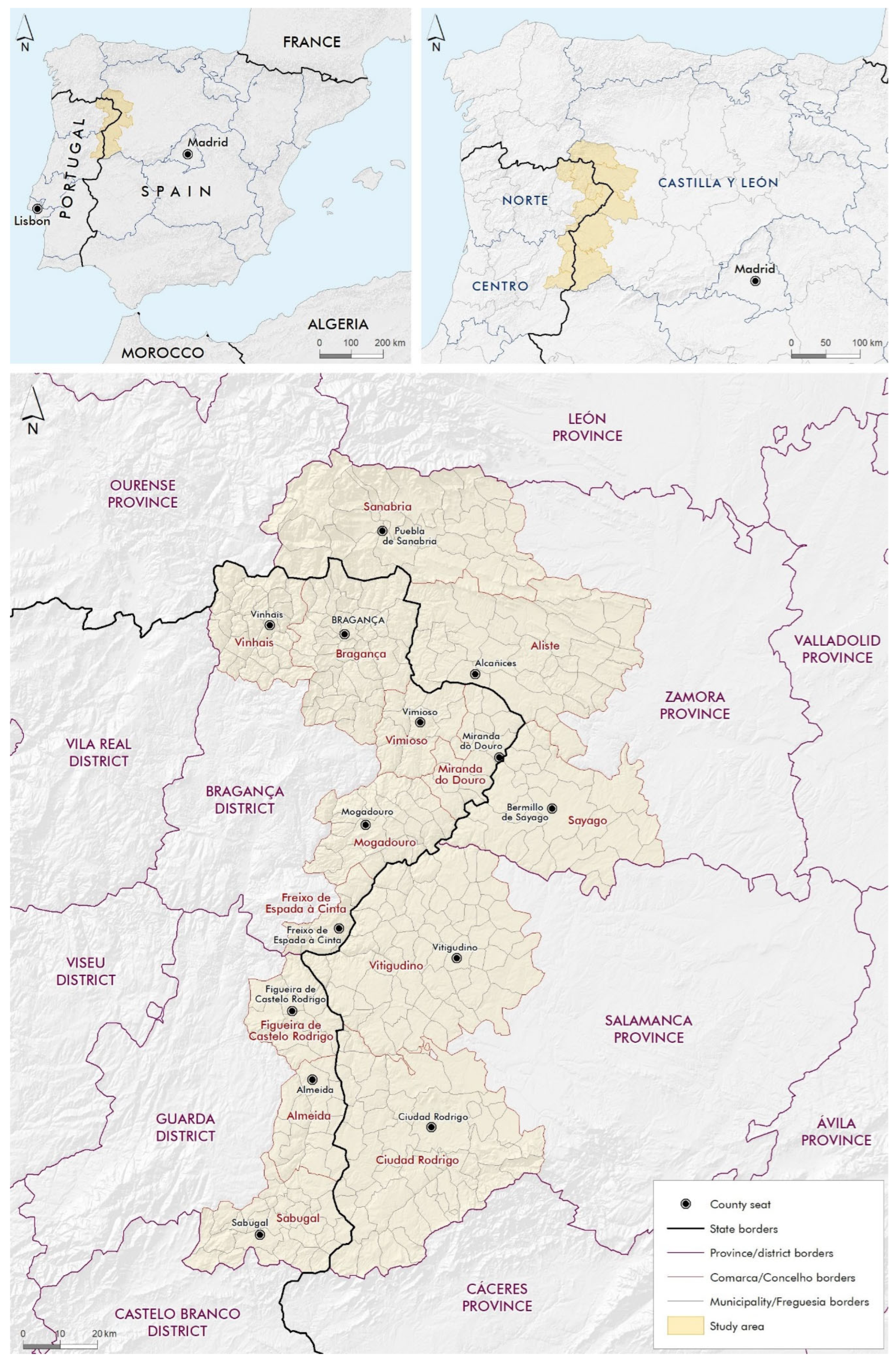
Figure 2.
Defensive Heritage.
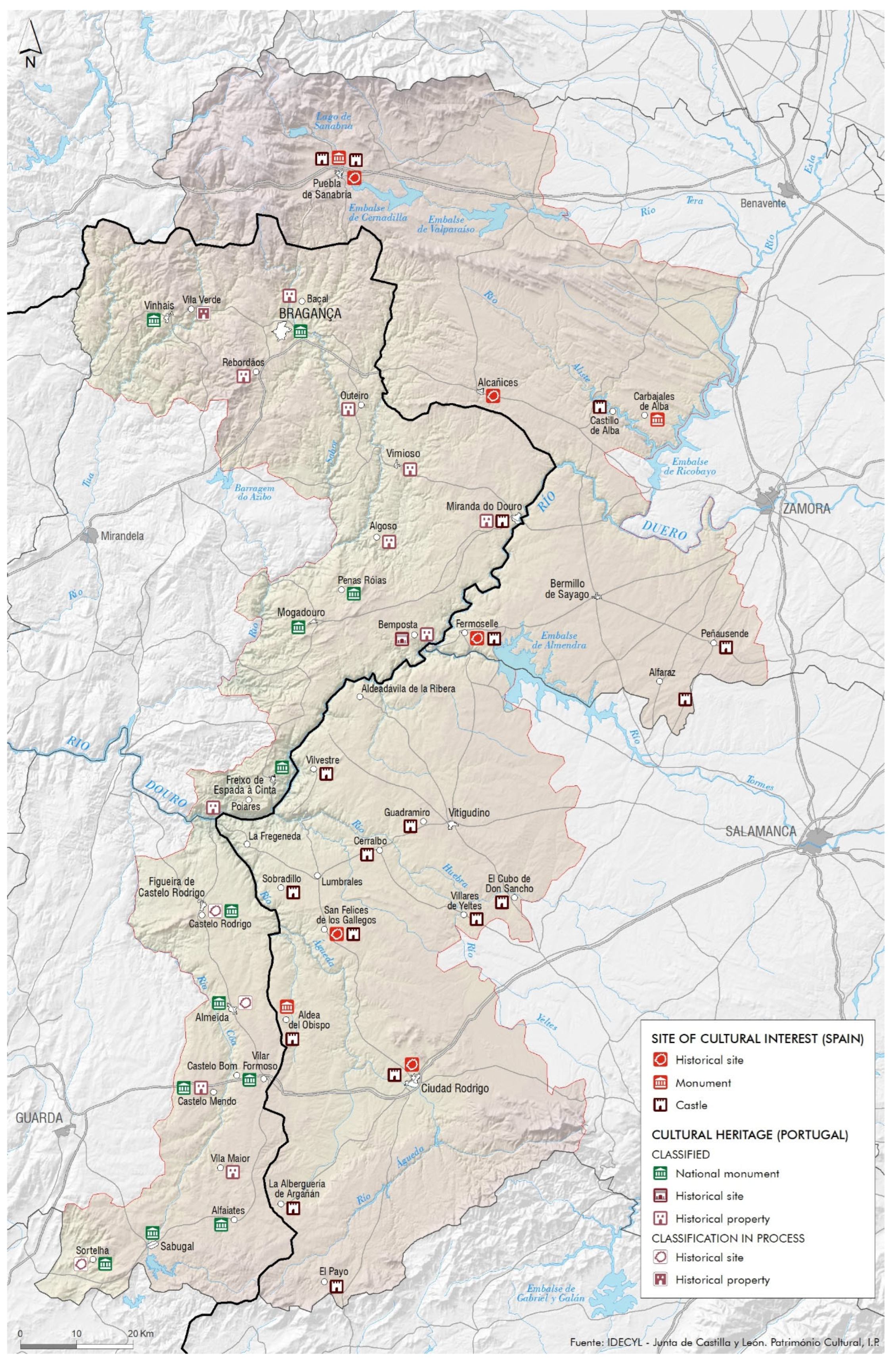
Figure 3.
Natural Heritage.
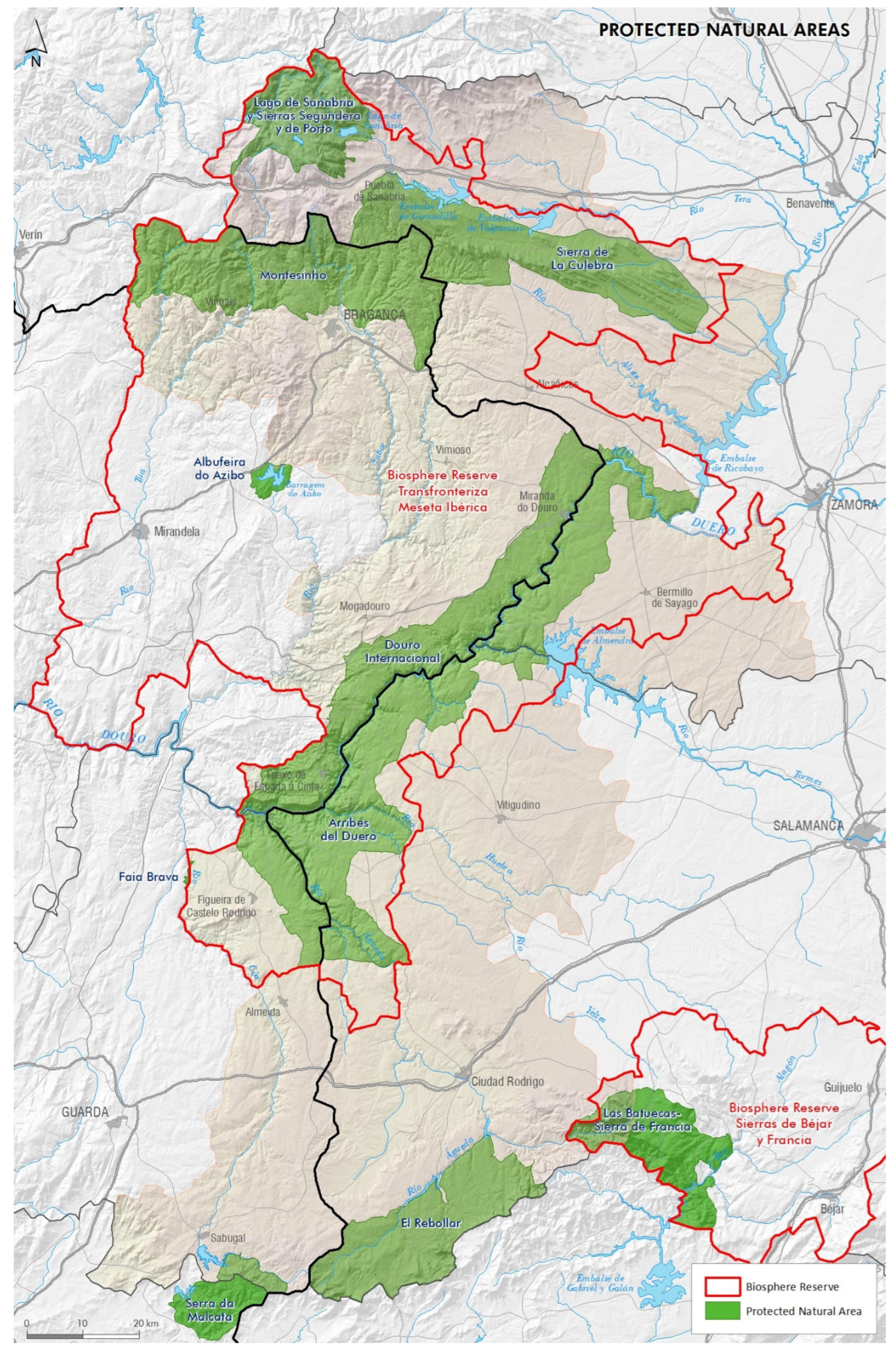
Figure 4.
Tourism Area Life Cycle (TALC) model. Source: Butler (1988).
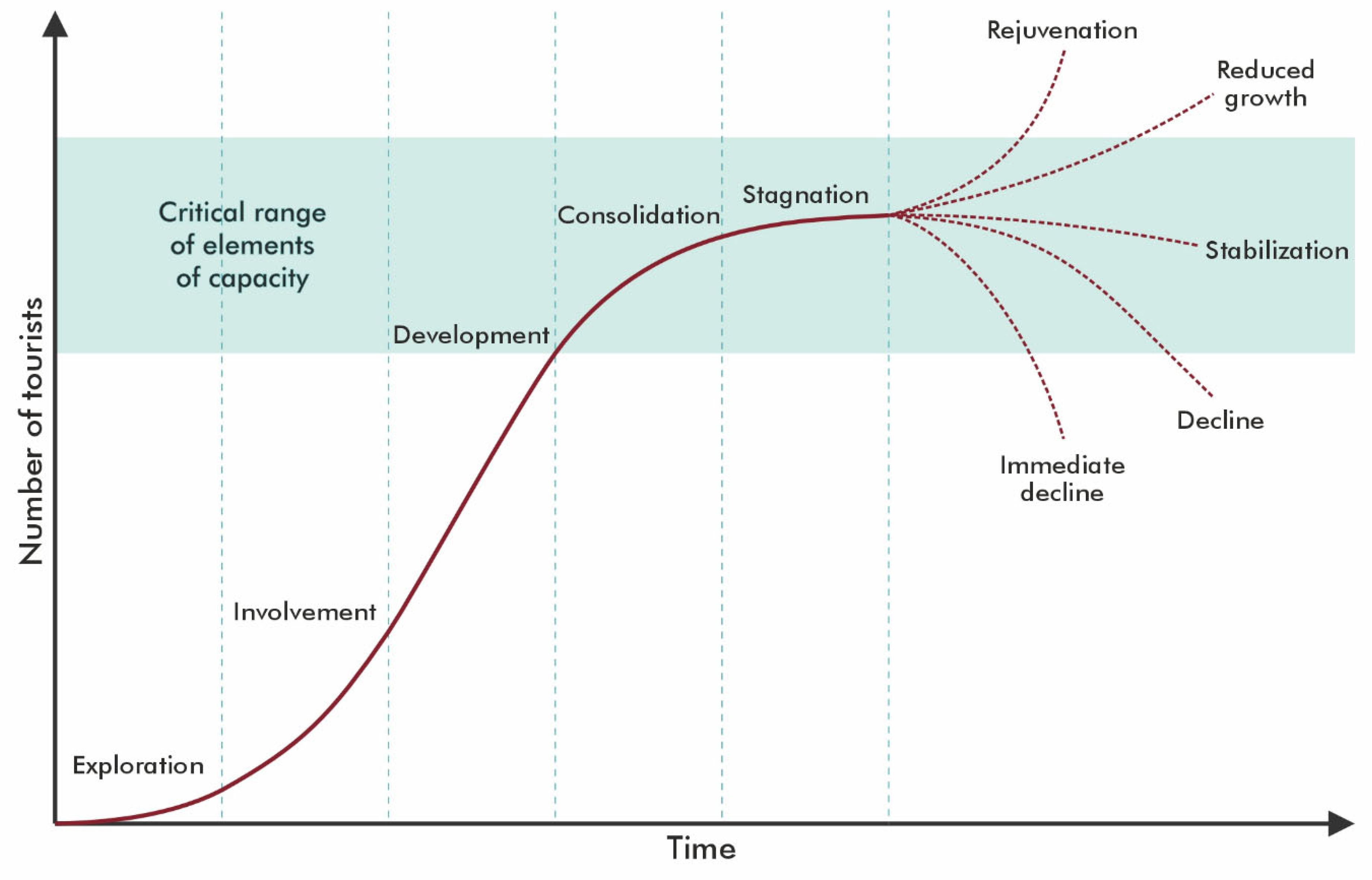

Table 1.
Peripheral Borderlands as Potential Tourists’ Destinations.
| P Periphery PPP Peripheralization |
Inhibiting attraction | Favouring attraction |
|---|---|---|
| P Remoteness | Far from population centres/Limited accessibility | None |
| P Rurality | Reduced activity options | Rest/Authentic nature and culture/Tourist-friendly environment |
| P Border | Low cross-border connectivity/Cultural differences hamper personal communication | Tangible heritage of militarisation/Availability consumer goods and services across the border/Smuggling trails |
| P Structural deficits | Lack of amenities and ancillary services | None |
| PPP Lack of innovation | Lowly qualified workforce | Authentic nature and culture |
| PPP Out-migration | Disappearance of potential of tourism entrepreneurs Degradation cultural landscapes due to abandoned agriculture |
Reappearance wildlife (wolf/bird watching) |
Source: Own elaboration based on Timothy (1995), Kühn (2015) and Buhalis (2000).
Table 2.
Types of Tourist Destinations.
| Type | Volume | Institutional Involvement |
AAAAA | Heritage Recognition | Defensive Heritage | Location in Natural Reserve | Examples |
|---|---|---|---|---|---|---|---|
| Mature | High/Stable | Start: before EU policies, Multilayered | High/Moderate in Puebla and Almeida | Yes | Yes | Puebla de Sanabria | Bragança Ciudad Rodrigo, Puebla de Sanabria, Almeida |
| Developing | Significant growth | Province | Low | Yes | No | Arribes del Duero | La Fregeneda |
| Hyper-development |
Booming | Since mid-1990s, State; now market-driven | Low | Yes | Yes | No | Sortelha, Castelo Rodrigo |
| Rejuvenating | Cross-border shopping replaced by other attractions | Since century XXI, Multilayered | Moderate | Yes | Yes | Douro Internacional, Arribes del Duero |
Miranda do Douro, Fermoselle, Vimioso |
| Stagnation/ Decline |
Decrease cross-border shopping | Since century XXI, Multilayered | Moderate | No | No | No | Vilar Formoso |
| Specialised niche tourism | Moderate or Low/Stable or Growing | Diverse | Low | Diverse | Diverse | Diverse | Small-scale localities |
| Failed policy-driven | Low | Since mid-1990s, Multi-Layered | Low | Yes | Yes | Yes | San Felices de los Gallegos, Aldea del Obispo |
| Sleeping or Exploration | Low | Low | Low | Diverse | Diverse | Diverse | Most sites |
Disclaimer/Publisher’s Note: The statements, opinions and data contained in all publications are solely those of the individual author(s) and contributor(s) and not of MDPI and/or the editor(s). MDPI and/or the editor(s) disclaim responsibility for any injury to people or property resulting from any ideas, methods, instructions or products referred to in the content. |
© 2025 by the authors. Licensee MDPI, Basel, Switzerland. This article is an open access article distributed under the terms and conditions of the Creative Commons Attribution (CC BY) license (http://creativecommons.org/licenses/by/4.0/).
Copyright: This open access article is published under a Creative Commons CC BY 4.0 license, which permit the free download, distribution, and reuse, provided that the author and preprint are cited in any reuse.


