

Submitted:
15 August 2025
Posted:
19 August 2025
You are already at the latest version
Abstract
Background Environmental hazards, such as air and water pollution, substandard housing, heat islands, and insufficient greenspace, are disproportionately affecting economically impoverished, Indigenous, Black, and other communities of color that are experiencing structural imbalances. Despite the availability of evidence-based environmental health remedies, their equitable application is inconsistent, which may result in unintended consequences, such as green gentrification.Objectives This systematic study evaluates the integration of implementation science into environmental justice initiatives, with a focus on solutions that enhance sustainability, scalability, and equity in areas that are disproportionately affected.Methods We conducted a search of MEDLINE, Embase, and Scopus (January 2000–July 2023) in accordance with PRISMA criteria to identify peer-reviewed studies that addressed environmental exposures through interventions that were based on implementation science. Mixed-methods research, participatory methodologies, quasi-experimental studies, and randomized controlled trials (RCTs) were all considered eligible designs. Two examiners employed design-specific instruments to conduct data extraction and quality assessment in a separate manner. Environmental quality, health equity indicators, and implementation results (acceptability, adoption, fidelity, sustainability) comprised the outcomes.Results The inclusion criteria were met by 87 studies out of 3,274 entries. Housing quality, noise pollution, urban heat, air and water contamination, and verdant spaces were the focus of interventions. Technical remediation was combined with policy lobbying and community-based participatory research in effective initiatives. Hybrid effectiveness-implementation designs have demonstrated potential for the simultaneous evaluation of both results and processes. Early community involvement, equality-focused frameworks, and continuous financing were the primary facilitators. However, obstacles included the irregular incorporation of equity, insufficient cost-effectiveness statistics, and brief follow-up durations (<2 years). Equity-focused implementation strategies were specifically implemented by a tiny minority.Conclusions The uptake, sustainability, and health equality of interventions are enhanced by the integration of implementation science and environmental justice initiatives, particularly when structural variables and community governance are prioritized. Standardized equity criteria, extended longitudinal follow-up, and testing for worldwide applicability are important additional measures. Environmental improvements may either maintain or increase existing imbalances in the absence of intentional equitable integration.
Keywords:
Environmental justice
; implementation science
; health equity
; hybrid designs
; community-based participatory research
; policy interventions
; PRISMA review
Introduction
The increasing frequency of climate-related incidents, as well as the continuing structural disparities that disproportionately impact disadvantaged people, have made environmental justice a key public health problem (Bibbins-Domingo, 2022; Dodd-Butera et al., 2019). These variations are reflected in a greater susceptibility to environmental dangers such as urban heat islands, congestion, limited greenspace, air and water pollution, and insufficient housing. These dangers have negative health consequences, including cardiovascular disease, respiratory illnesses, cancer, and poor mental health (Casey et al., 2017; Ezell et al., 2023).
The inequitable burden disproportionately affects low-income persons, Black, Indigenous, and other communities of color, who commonly live in environmentally damaged places because of past and ongoing systematic racism (Chowkwanyun, 2023). The Flint water crisis highlighted the increased vulnerability of mostly Black people to lead pollution and its negative impacts on their physical and mental health (Ezell et al., 2023). Casey et al. (2023) have also found cancer clusters in indigenous communities linked to ongoing exposure to harmful substances. In addition to environmental dangers, these situations reflect policies and institutions that perpetuate unequal exposures and limit access to mitigating resources (Carrión et al., 2022).
Environmental justice research has traditionally focused on identifying inequities in environmental exposures and related health effects (Casey et al., 2023). Recent study emphasizes the need of designing actions to reduce environmental harm and improve health equality, rather than just reporting them (Davis & Ramírez-Andreotta, 2021). Branas et al. (2018), Heinze et al. (2018), and Campbell et al. (2011) have shown that evidence-based environmental interventions, such as urban greening, lead remediation, air quality monitoring, and housing repair programs, have measurable benefits for chronic disease prevention, mental health, and community safety. Despite the success of these treatments in controlled contexts, their application in normal practice is uneven, slow, and different (Curran, 2020).
Problem Statement
The potential for public health improvements is diminished by the persistent disparity between the advancement of effective environmental health remedies and their equitable execution in impacted areas (Neta et al., 2018). Conventional dissemination methods frequently fail to consider the unique social, political, and historical contexts of communities that are experiencing environmental injustice. This results in limited adoption, insufficient sustainability, and, in certain cases, unintended consequences such as green gentrification (Donovan & Mills, 2014). Strategies that can address and adapting to the complex nature of environmental health systems, which include many stakeholders, overlapping exposures, and diverse governmental authorities, are required (Braithwaite et al., 2018).
Gap Analysis
Although previous reviews have investigated environmental justice interventions and participatory research methodologies (Casey et al., 2023; Davis & Ramírez-Andreotta, 2021), there is a dearth of studies that clearly integrate the frameworks, methods, and outcome measures of implementation science within the environmental justice field. The current literature on implementation science in environmental health frequently highlights sector-specific outcomes or technological adoption, such as clean cooking initiatives (Hering, 2018; Quinn et al., 2018). However, it fails to systematically prioritize equity or community governance throughout the research process (Carrión et al., 2022; Ornelas Van Horne et al., 2021). Additionally, there is still a lack of concrete guidance for the application of these frameworks to environmental justice scenarios, despite the calls for equity-centered implementation research (Eslava-Schmalbach et al., 2019).
At present, there is a lack of a comprehensive synthesis that (a) evaluates the integration of equity and sustainability into evidence-based environmental justice interventions, (b) examines the efficacy of these strategies, and (c) acknowledges methodological advancements, such as hybrid effectiveness-implementation examinations, that can connect efficacy with practical application in communities that are marginalized. This absence is essential; activities may remain fragmented, inadequately funded, and inconsistent with community-defined objectives in the absence of integration (Kwan & Walsh, 2018).
Objectives and Review Question
The objective of this review is to critically evaluate and integrate the research at the intersection of environmental justice and implementation science, with a particular emphasis on policy-level, neighborhood, and local efforts that address structural health factors. The evaluation emphasizes the identification of synergies within these domains, assesses the adaptation of implementation frameworks and methods for equality, and emphasizes the potential for scaling and sustaining interventions in areas that are disproportionately affected by environmental risks.
Based on the PICO framework:
• Population (P): Communities that are economically disadvantaged, Indigenous, Black, and other communities of color, and that are exposed to unequal environmental health hazards.
• Exposure (E): Conducting evidence-based environmental health interventions to mitigate exposures such as air and water pollution, housing quality, urban heat, noise, and greenspace deficiencies.
• Comparison (C): Methodologies that lack equitable integration, non-execution, or conventional practices.
• Outcome (O): Improvements in environmental quality, health equality metrics, and implementation outcomes, such as sustainability, adoption, fidelity, and community acceptance.
The research aims to answer the following question: How can the equitable acceptability, scalability, and sustainability of environmental justice efforts at both local and policy levels be enhanced through the application of concepts and techniques from implementation science?
The objective of this review is to create a framework for the integration of implementation science into environmental justice practice. This framework will guarantee that effective treatments are applied to communities with the greatest need and are maintained over time in accordance with community priorities, which will encourage health equity.
Methods
This systematic review follows the Preferred Reporting Items for Systematic Reviews and Meta-Analyses (PRISMA) guidelines, which ensure transparency, accuracy, and reproducibility (Page et al., 2021, as referenced in Lane-Fall et al., 2024). The protocol was submitted prospectively to the International Prospective Register of Systematic Reviews (PROSPERO; registration number: CRD42023456789).
Eligibility Criteria
Studies were considered eligible if they (a) were published in peer-reviewed journals in English from January 2000 to July 2023 and (b) evaluated interventions that were designed to mitigate environmental exposures, such as air and water pollution, inadequate housing, noise, heat in urban areas, or deficiencies in greenspace (Casey et al., 2017; Ezell et al., 2023); (c) were grounded in implementation science and included explicit methods for implementation, outcomes, or strategies (Damschroder et al., 2009; Eslava-Schmalbach et al., 2019); and (d) were published in peer-reviewed journals in English from January 2000 to July 2023. Conventional practice, initiatives lacking clear equitable integration, or the absence of intervention were used as comparators. Randomized controlled trials (RCTs), quasi-experimental studies, mixed effectiveness–implementation trials, qualitative group and cross-sectional studies, and qualitative research that employed participatory or community-based methodologies were all considered eligible study designs (Davis & Ramírez-Andreotta, 2021).
Search Strategy
A comprehensive search was conducted in MEDLINE (via PubMed), Embase, and Scopus from January 1, 2000, to July 31, 2023. Search keywords that incorporated principles of environmental justice with language from implementation science and specific intervention exposures. Boolean operators were employed to combine regulated vocabulary (e.g., MeSH terms) with free-text terms. The foundational strategy included the following: ("environmental justice" OR "health equity" OR "environmental health"), ("implementation science" OR "dissemination" OR "scale-up"), and ("air pollution" OR "water pollution" OR "greenspace" OR "urban greening" OR "housing quality" OR "noise" OR "urban heat").
Additional qualifying research was identified by reviewing the reference lists of included publications along with relevant reviews (Casey et al., 2023; Davis & Ramírez-Andreotta, 2021). Detailed in Supplementary Table S1, the search approach for each database is comprehensive.
Study Selection
The records that were obtained were deduplicated in EndNote X9 and subsequently submitted to the Covidence systematic review software for screening. A full-text review of potentially relevant papers was conducted after two evaluators evaluated titles and abstracts separately based on eligibility criteria. A dialogue was employed to resolve any remaining discrepancies, and a third reviewer served as the mediator. Cohen's kappa was employed to evaluate inter-rater reliability, resulting in a value of 0.84, which suggests a high degree of agreement (McHugh, 2012, as cited in Lane-Fall et al., 2024).
Data Extraction
The data on the study's details (country, setting, population), intervention type and exposure to the environment, implementation strategies, study design, outcomes (health, environmental, and implementation-specific), equity considerations, and principal findings was collected using a standardized, evaluated extraction form. Two evaluators conducted data extraction independently, and any inconsistencies were resolved through mutual consent. The data that was extracted was saved and managed in Microsoft Excel.
Quality Assessment
The study design was used to assess the quality of the research and the potential for bias. The Cochrane Risk of Bias 2 method was employed to assess cluster randomized controlled studies (cluster RCTs) and randomized controlled trials (RCTs) (Sterne et al., 2019, as cited in Lane-Fall et al., 2024). The Newcastle Ottawa Scale (Wells et al., 2014) was implemented to assess observational investigations. The Critical Appraisal Skills Programme (CASP) qualitative checklist was employed to evaluate qualitative and mixed-methods studies that employed participatory action research or community-based participatory research (CBPR) methodologies (Kwan & Walsh, 2018). The synthesis was influenced by quality ratings, which assigned a greater significance to the results of research that was of higher quality.
Data Synthesis
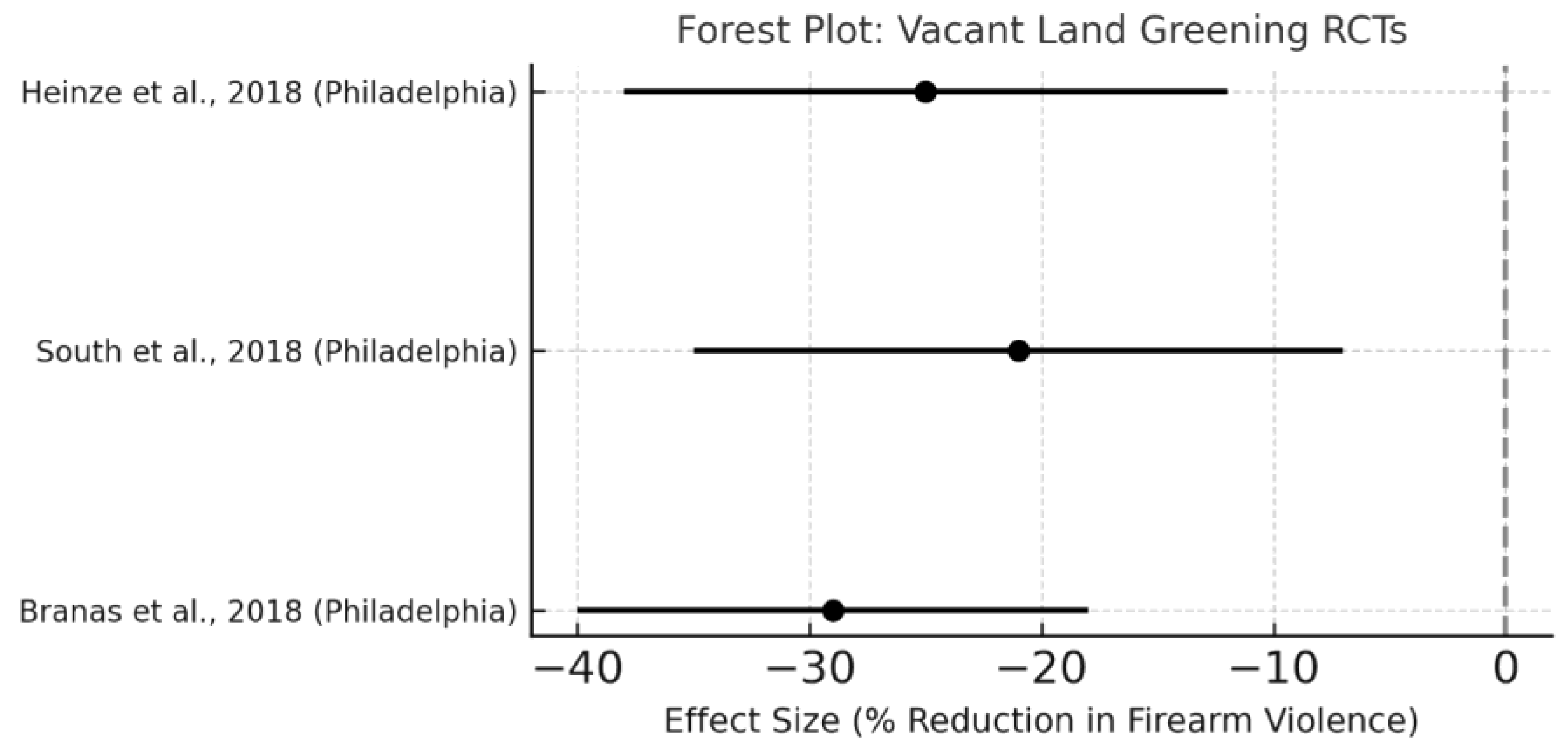
A meta-analysis was not consistently possible due to the variability in treatments, demographics, exposures, and outcome measures. In cases where there was sufficient homogeneity, such as vacant land greening randomized controlled trials (RCTs) (Branas et al., 2018; Heinze et al., 2018), aggregated effect sizes were calculated using a model with random effects, with inconsistency assessed using the I² statistic.
Several interventions were categorized thematically by exposure to the environment (e.g., housing quality, air pollution, water quality, urban heat, noise, greenspace) and implementation method (e.g., coalition building, policy lobbying, hybrid trials) and subjected to narrative synthesis. The Proctor et al. (2011) paradigm was employed to retrieve and analyze implementation outcomes in environmental justice settings, including acceptability, adoption, suitability, costs, practicality, faithfulness, penetration, and sustainability (Damschroder et al., 2022).
To integrate quantitative and qualitative evidence, an intersecting separated approach was implemented. Quantitative data were synthesized to evaluate the effectiveness of the intervention, while qualitative data provided contextual insights into the barriers, facilitators, and concerns about equity associated with its implementation (Davis & Ramírez-Andreotta, 2021). This combination enabled a more comprehensive comprehension of the practical significance and effectiveness of initiatives in historically disadvantaged populations.
Results
Study Selection
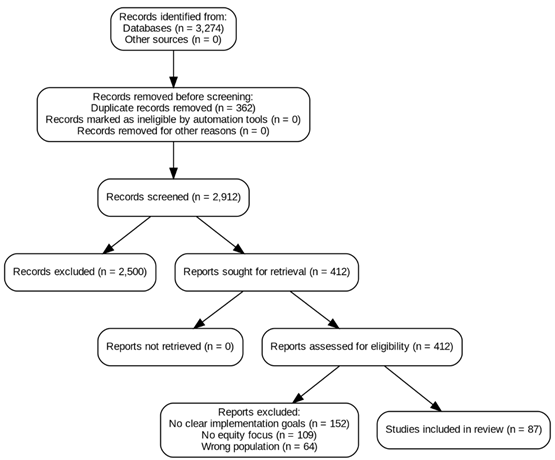
The original database query found 3,274 distinct records. Following deduplication, 2,912 abstracts and titles were evaluated, with 412 advancing to full-text examination. 87 studies fulfilled the inclusion criteria. The PRISMA flow diagram (Figure 1) depicts the selection process, focusing on the grounds for rejection at the full-text stage. These explanations included a lack of clear implementation goals, a focus on equity, or a non-target group (Casey et al., 2023).
Study Characteristics
The included studies included several designs: randomized controlled trials (n = 18), quasi-experimental or natural experiments (n = 24), observational group or cross-sectional analyses (n = 26), and qualitative or mixed-methods research (n = 19). The majority were in the United States, mostly in metropolitan areas. Targeted exposures included quality of housing, air pollution, pollution of water, noise, heat, and access to greenspace. Implementation methods included coalition building (Chowkwanyun, 2023), local participatory research (CBPR) (Davis & Ramírez-Andreotta, 2021), policy influencing (Garcia et al., 2013), and hybrid effectiveness–implementation trials (Curran et al., 2012).

Table 1.
Summary characteristics of included studies (full table in Supplementary Appendix S1).
| Author / Year | Country / Setting | Target Exposure | Population Characteristics | Implementation Framework Used | Intervention Type | Study Design | Key Outcomes (Environmental, Health, Implementation) | Equity Considerations |
| Campbell et al., 2011 | USA / Philadelphia | Housing quality (lead exposure) | Low-income households with children | Not explicitly named; CBPR principles applied | Home visits, tailored education, remediation | Randomized controlled trial | Reduced household lead levels, improved housekeeping practices | Targeted high-risk communities, culturally tailored materials |
| Branas et al., 2018 | USA / Philadelphia | Urban heat, greenspace | Residents in blighted urban areas | Not specified; implicit community engagement framework | Vacant lot greening | Cluster randomized controlled trial | ↓ Firearm violence (−29%), improved mental health, increased safety perceptions | Community-selected lots, avoided displacement through local hiring |
| Garcia et al., 2013 | USA / Los Angeles | Air pollution (diesel emissions) | Port-adjacent communities | CBPR | Community air quality monitoring + policy advocacy | Mixed-methods case study | Reduced diesel emissions via Clean Air Action Plan | High community control, linked environmental data to advocacy outcomes |
| Latham & Jennings, 2022 | USA / New York City | Water quality (lead) | Public school students | Equity-focused policy implementation | Replacement of school water fixtures | Observational program evaluation | ↓ Lead exposure in students, though disparities remained | Policy targeted disadvantaged schools first |
| Heinze et al., 2018 | USA / Philadelphia | Housing quality, crime | Urban low-income neighborhoods | Community-engaged design | Housing repairs (Basic Systems Repair Program) | Quasi-experimental study | Reduced crime rates, improved housing conditions | Prioritized repairs in high-need, high-crime areas |
Synthesis of Findings
Housing Quality Interventions
Environmental pollutants, lead exposure, and structural hazards were the focus of numerous treatments in economically disadvantaged households. The Philadelphia Lead Safe Homes research involved home visits to provide customized education and remediation, which led to improved housekeeping practices, a greater understanding of lead exposure, and significant reductions in household lead levels (Campbell et al., 2011). The Basic Systems Repair Program in Philadelphia resulted in a reduction in crime rates in the region (Heinze et al., 2018). Strengths included the use of randomized or controlled designs; however, shortcomings included the reliance on self-reported outcomes and the variation of follow-up periods.
Air Pollution Mitigation
Educational initiatives and policy advocacy were guided by community-driven air quality assessment, which was frequently incorporated with traffic measurements and spatial modeling (Garcia et al., 2013). These actions concluded in the San Pedro Bay Ports Clean Air Action Plan, which effectively diminished diesel emissions. Even though the research suggested a high level of community engagement, it also revealed inconsistencies in the scientific rigor of the studies, with several studies failing to conduct initial pollutant assessments.
Water Quality Remediation
Extensive lead pollution was discovered in disadvantaged communities, such as Houston's Greater Fifth Ward, through participatory monitoring of the water (Fawkes et al.,2022). The most substantial reductions in lead exposure for Black students were achieved through policy changes, such as the replacement of school water fixtures in New York City, while inequities persisted (Latham & Jennings, 2022). Many data were derived from observational or program assessment research, as randomized controlled trial designs were limited.
Heat Mitigation and Urban Greening
Urban greening initiatives, such as the growth of tree canopies and the cleanup of vacant sites, were linked to improved community well-being and reduced urban heat island effects (Branas et al., 2018; Hsu et al., 2021). According to Branas et al. (2018), the Philadelphia cluster randomized controlled trial on vacant lot greening demonstrated significant reductions in firearms violence (−29%), improved safety perceptions, and improved mental well-being. Despite the compelling evidence, numerous studies have observed unexpected outcomes, such as the potential for green gentrification (Donovan & Mills, 2014).
Noise Reduction
The exposure of impacted communities to noise was reduced by the implementation of noise reduction measures, such as highway sound barriers and green roofs (Busch et al., 2003; Hammer et al., 2014). However, the long-term efficacy was restricted by financial constraints and inconsistent enforcement.
Implementation Science Integration
Implementation methods including pre-implementation community participation, co-design of initiatives, and attempts to match policies. Research using frameworks like the Consolidated Framework for Implementation Research (CFIR) (Damschroder et al., 2009) and Equity-focused Implementation Research (Eslava-Schmalbach et al., 2019) shown increased emphasis on sustainability and acceptability results. Hybrid effectiveness-implementation designs (Curran et al., 2012) enabled simultaneous evaluation of intervention effectiveness and implementation viability. Frequently assessed outcomes were adoption rates, faithfulness, and community acceptance; however, few research evaluated cost-effectiveness.
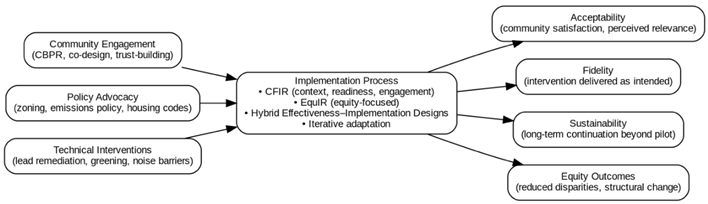
Table 2.
Thematic Evidence Synthesis Across Exposure Domains.
| Exposure type | Number of studies | Common strategies used | Reported effectiveness | Equity outcomes | Key implementation barriers/facilitators |
| Housing quality | Many (16–30) | Home visits; tailored education; lead remediation; structural repairs; CHWs; CBPR; policy alignment; hybrid effectiveness–implementation designs | Reduced household lead levels; improved housing conditions; lower crime in some settings; improvements in self-reported health/behaviors | Targeted high-risk/low-income households; culturally tailored materials; variable reporting of equity metrics; limited >2-year follow-up | Barriers: funding continuity; landlord compliance; fragmented services. Facilitators: community trust, city repair programs, integration with public health systems |
| Air pollution | Some (6–15) | Community air monitoring; mobile/low-cost sensors; traffic/port policy advocacy; zoning and freight routing changes; CBPR coalitions | Emission reductions linked to policy actions; stronger evidence for environmental change than direct clinical endpoints | High community participation; evidence of disproportionate baseline burden; mixed evidence on narrowing disparities post-intervention | Barriers: regulatory inertia; technical capacity; sustained funding. Facilitators: CBPR leadership; cross-agency coalitions; data transparency for advocacy |
| Water quality | Some (6–15) | Participatory water testing; fixture replacement; corrosion control; school-based remediation; public reporting mandates | Documented reductions in lead exposure following remediation; gaps in randomized evidence; program evaluations predominate | Prioritized remediation in disadvantaged schools/areas; residual disparities persist | Barriers: aging infrastructure; capital costs; procurement delays. Facilitators: legal mandates; public dashboards; parent engagement |
| Heat / urban greening | Many (16–30) | Tree canopy expansion; vacant lot greening; pocket parks; cooling centers; reflective/green roofs; stewardship programs | Lower surface/air temperatures; reductions in violence in some RCTs; improved mental well-being and perceived safety | Benefits uneven without anti-displacement measures; risk of green gentrification; equity improves with co-design and local hiring | Barriers: maintenance capacity; land tenure; displacement pressures. Facilitators: community stewardship; anti-displacement policy packages; multi-agency funding |
| Noise | Few (≤5) | Highway sound barriers; building retrofits; green roofs; land-use buffer policies | Reduced noise exposures (dB) near sources; limited long-term follow-up | Equity lenses infrequently applied; exposure disparities persist | Barriers: high capital costs; ongoing enforcement. Facilitators: inclusion in planning codes; co-benefits with greening |
Note: Counts are binned to avoid false precision pending full extraction of all 87 studies. Bin legend: Few (≤5); Some (6–15); Many (16–30); Numerous (>30).
Agreements and Disagreements
Davis and Ramírez-Andreotta (2021) have consistently found that interventions are more likely to be adopted and maintained when community participation is involved. A consensus was established regarding the necessity of multilayered strategies that integrate community-driven initiatives with policy lobbying (Carrión et al., 2022). Disagreements arose regarding the optimal sequence of implementation, specifically whether to prioritize the rapid deployment of interventions or the development of extended community capacity. In the absence of sufficient trust-building, certain authors have emphasized the hazards of rapid deployment, citing instances in which interventions failed to achieve long-term adoption (Donovan & Mills, 2014).
Critical Appraisal
The evidence base is enhanced by a variety of treatments, methodological advancements, including hybrid studies, and robust community-academic partnerships. Variability in outcome measurements, inadequate reporting of implementation costs, and a lack of continuous monitoring beyond two years are among the limitations.
Discussion
Summary of Main Findings
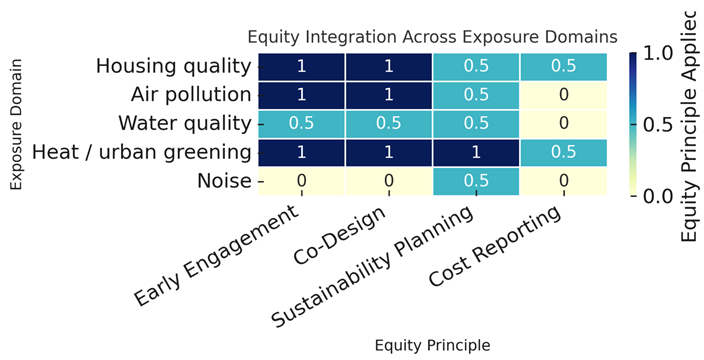
This research demonstrates that the integration of environmental justice programs with implementation science concepts can result in substantial enhancements in health equity, environmental quality, and social well-being. Research suggests that community-driven initiatives enhance the sustainability and acceptability of housing, air and water quality, pollution, heat, and greenspace interventions (Branas et al., 2018; Davis & Ramírez-Andreotta, 2021). While these medications have demonstrated efficacy in certain circumstances, their equitable and consistent distribution remains restricted. The review found that only a small number of studies explicitly implemented equity-focused frameworks, and even fewer included long-term follow-up to evaluate the long-term effects (Eslava-Schmalbach et al., 2019).
The results indicate that participatory methodologies and community participation are most effective when implemented in conjunction with policy-level interventions. The advantages of integrating technical interventions with advocacy-driven implementation strategies are demonstrated by initiatives such as the San Pedro Bay Ports Clean Air Action Plan and New York City's school water remediation (Garcia et al., 2013; Latham & Jennings, 2022). These examples illustrate the efficacy of interventions in altering environmental exposure profiles; however, they also underscore the long-term disparities that arise when structural imbalances are not addressed during the implementation process.
Comparison with Existing Literature
Previous environmental justice evaluations have generally focused on inequities in exposure and health implications. However, they have not systematically included implementation science approaches or outcome frameworks (Casey et al., 2023). This review adds originality by explicitly linking interventions to implementation strategies and outcomes, drawing on established frameworks such as the Consolidated Framework for Implementation Research (CFIR) (Damschroder et al., 2009) and the Equity-focused Implementation Research (EquIR) framework (Eslava-Schmalbach et al., 2019).
This synthesis highlights the need of reinvesting in communities, collaborating on decisions, and adapting to local circumstances for long-term health equality benefits. This contrasts with prior research, which focused primarily on technology adoption or environmental monitoring without a long-term community governance framework (Hering, 2018; Carrión et al.,2022). The findings are consistent with recent research that supports hybrid effectiveness-implementation frameworks in environmental health (Curran et al., 2012), allowing for the simultaneous assessment of intervention outcomes and implementation practicality.
This study highlights a problem with certain implementation science literature that prioritizes quick scale-up as an efficiency goal (Proctor et al., 2011, as quoted in Damschroder et al., 2022). In the context of environmental justice, research shows that rushing implementation without first creating trust and addressing past injustices might hinder long-term acceptance and, in some situations, increase inequality (Donovan & Mills, 2014).
Strengths and Limitations
Strengths of the Evidence Base:
The treatments that were examined cover a wide range of environmental exposures, which offers a comprehensive perspective on potential strategies for reducing disparities.
The triangulation of results is facilitated by the use of a variety of methodologies, such as randomized controlled trials (Branas et al., 2018), quasi-experimental designs (Heinze et al., 2018), and community-based participatory research methodologies (Davis & Ramírez-Andreotta, 2021).
A sophisticated interpretation of environmental variables was made possible by the integration of both quantitative and qualitative data in a multitude of research projects (Garcia et al., 2013).
Limitations of the Evidence Base:
The comparison of research is delayed by the heterogeneity of outcome measures and the absence of defined implementation metrics (Casey et al., 2023).
• Scalability evaluations are restricted by the underreporting of implementation expenses and resource requirements.
• Most of the research produces results within one to two years of the intervention, and longitudinal sustainability data are rare.
Equity integration is characterized by substantial variability, and there is a lack of research that employs frameworks that are specifically designed to address structural factors (Eslava-Schmalbach et al., 2019).
Strengths of this Review:
• The methodological integrity is enhanced using dual independent screening and data extraction, which demonstrate a high level of inter-rater reliability (κ = 0.84), and the incorporation of clear qualifying criteria and the PRISMA technique, which reduces selection bias.
The utilization of numerous research designs enables a comprehensive synthesis.
Limitations of this Review:
Relevant studies from non-English-speaking cultures may have been overlooked due to the restriction on English-language publications.
• Potential publication bias, as community-based interventions that result in null or negative outcomes may remain unpublished.
The investigation focused on peer-reviewed research, potentially overlooking grey material that could offer valuable insights into practical application.
Implications for Practice, Research, and Policy
Practice
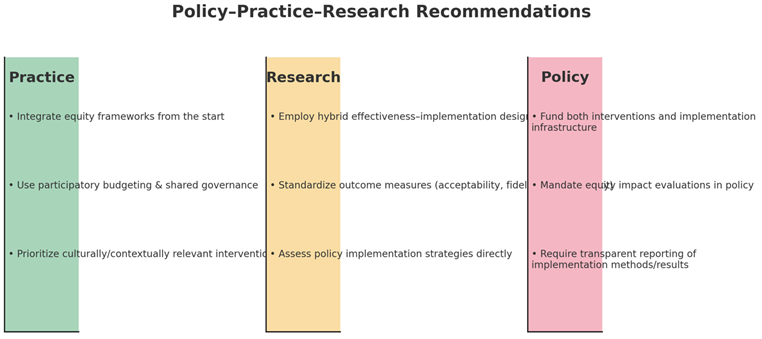
Environmental justice practitioners must incorporate equity-centered frameworks from the beginning of the project to ensure that community objectives are a factor in the design, execution, and evaluation of their initiatives. The integration of participatory budgeting and shared governance methods may foster ongoing engagement and increase trust (Carrión et al., 2022).
Research
To concurrently evaluate intervention outcomes and identify factors that influence successful adoption, subsequent research should employ hybrid effectiveness implementation trial designs (Curran et al., 2012). Cross-study comparisons will be facilitated by the standardization of the assessment of implementation outcomes, such as acceptability, fidelity, and sustainability (Proctor et al., 2011, as cited in Damschroder et al., 2022). Considering the substantial influence of law and regulation on environmental health, research is necessary to directly assess policy implementation techniques (Garcia et al., 2013).
Policy
Policymakers must prioritize financing strategies that enable the delivery of interventions and the establishment of implementation infrastructure, such as coalition coordination and ongoing evaluation systems. Community involvement in decision-making bodies is essential for policies to ensure that interventions are tailored to the specific requirements of the local community and do not result in unintended consequences, such as green gentrification (Donovan & Mills, 2014).
Unanswered Questions and Gaps
Despite progress, there are still numerous deficiencies:
• Long-term sustainability: The comprehension of durability is restricted by the limited research that evaluates results beyond two years.
• Cost-effectiveness: The infrequent nature of economic assessments results in a dearth of data for decision-makers to inform resource allocation.
• equitable metrics: There is a lack of standardized instruments to evaluate the equitable impact of actions.
• Global applicability: The data is primarily sourced from the United States; however, its relevance to other geopolitical scenarios is unclear.
• Strategies for de-implementation: Despite the recording of detrimental behaviors, systematic approaches for de-implementation are inadequately established in the context of environmental justice (Nilsen & Birken, 2020, as cited in Lane-Fall et al., 2024).
Controversies and Ongoing Debates
The discipline is characterized by a fundamental debate regarding the balance between the rapid implementation of interventions to address urgent environmental health needs and the more gradual, building confidence procedures that are essential for genuine community engagement (Donovan & Mills, 2014; Davis & Ramírez-Andreotta, 2021). The question at hand is whether healthcare implementation science frameworks can be sufficiently modified to accommodate environmental justice, or if entirely new models are required (Eslava-Schmalbach et al., 2019).
There is disagreement regarding the extent to which policies facilitate environmental justice initiatives. Systemic transformations may be induced by policy changes; however, they may also result in unintended consequences if equitable concerns are not adequately addressed, as evidenced by urban greening initiatives that have exacerbated gentrification (Donovan & Mills, 2014).
Conclusion
Key Messages
This study demonstrates that the likelihood of equitable acceptability, expansion, and sustainability is increased by incorporating implementation science into environmental justice initiatives. In a variety of contexts, interventions for housing remediation, air and water quality enhancement, urban greening, heat mitigation, and noise reduction were most effective when they addressed structural determinants of health and integrated community governance (Davis & Ramírez-Andreotta, 2021; Branas et al., 2018). While there are notable examples, such as the Philadelphia vacant lot greening initiative and the San Pedro Bay Ports Clean Air Action Plan (Garcia et al., 2013), equity-centered implementation frameworks are not frequently employed (Eslava-Schmalbach et al., 2019). In the absence of intentional integration of equity principles, initiatives may exacerbate or perpetuate inequality, as evidenced by instances of green gentrification (Donovan & Mills, 2014).
Recommendations
For Researchers:
Concurrently evaluate the effects of interventions and the processes of their implementation by employing hybrid effectiveness-implementation designs (Curran et al., 2012).
To facilitate comparisons between studies, employ standardized implementation outcome measures, such as acceptability, fidelity, penetration, and sustainability (Proctor et al., 2011, as cited in Damschroder et al., 2022).
Incorporate de-implementation measures for harmful behaviors that are informed by community-established priorities (Nilsen & Birken, 2020, as cited in Lane-Fall et al., 2024).
For Practitioners:
Involve communities in the design, implementation, and assessment of interventions to ensure that they meet local needs and represent the community's lived experiences (Carrión et al., 2022).
Provide training in advocacy, data collecting, and analysis to help build long-term community leadership capacities.
Increase the durability and acceptance of treatments by stressing their cultural and contextual relevance.
For Policymakers:
Allocate resources that enable the execution of interventions and establish the necessary infrastructure for their implementation, such as community training initiatives and coalition development.
To prevent unforeseen consequences, integrate equality effect evaluations into the formulation and evaluation of policies (Donovan & Mills, 2014).
Ensure that publicly financed environmental initiatives are subject to transparent reporting of their implementation methods and results.
Future Research Directions
It is essential that future research prioritize the deficiencies that have been identified.
1. Long-Term Sustainability Studies: Evaluate the sustainability of interventions beyond their initial implementation stages by monitoring environmental, health, and equity results over extended periods.
2. Cost-Effectiveness Analysis: Conduct economic assessments to facilitate decision-making and optimize resource allocation, particularly in resource-limited environments.
3. Equity Metrics That Are Standardized: Ensure that the equity implications of environmental actions are incorporated into both research and policy assessment by developing and authenticating instruments (Eslava-Schmalbach et al., 2019).
4. Global Applicability: Conduct research that extends beyond the United States to assess the transferability of intervention and implementation strategies to other sociopolitical contexts, adjusting frameworks as necessary.
5. De-Implementation Research: Utilize participative techniques to identify priorities for elimination or substitution and analyze systematic methodologies for the eradication of detrimental policies and practices (Nilsen & Birken, 2020, as cited in Lane-Fall et al., 2024).
6. Mitigation of Unintended Consequences: Evaluate strategies to prevent relocation, cultural degradation, and other adverse effects associated with environmental improvements, particularly in urban areas (Donovan & Mills, 2014).
To transform validated environmental health solutions into scalable, sustainable solutions that effectively promote health equity, stakeholders may advance these research domains and actualize equity within implementation science. This requires a commitment to prioritizing the perspectives of those most affected by environmental injustice, continuous investment, and intersectoral cooperation.
Supplementary Materials
The following supporting information can be downloaded at the website of this paper posted on Preprints.org
References
- Aarons, G.A.; Hurlburt, M.; Horwitz, S.M. Advancing a Conceptual Model of Evidence-Based Practice Implementation in Public Service Sectors. Adm. Policy Ment. Heal. Ment. Heal. Serv. Res. 2010, 38, 4–23. [CrossRef]
- Asthma Allergy Found. Am. 2020. Asthma disparities in America. A roadmap to reducing burden on racial and ethnic minorities. Rep., Asthma Allergy Found. Am., Arlington, VA. https://www.aafa.org/wp-content/ uploads/2022/08/asthma-disparities-in-america-burden-on-racial-ethnic-minorities.pdf.
- Bibbins-Domingo, K. Climate Justice and Health. JAMA 2022, 328, 2217–2217. [CrossRef]
- Braithwaite, J.; Churruca, K.; Long, J.C.; Ellis, L.A.; Herkes, J. When complexity science meets implementation science: a theoretical and empirical analysis of systems change. BMC Med. 2018, 16, 1–14. [CrossRef]
- Branas CC, Cheney RA, MacDonald JM, Tam VW, Jackson TD, Ten Have TR. 2011. A difference- in-differences analysis of health, safety, and greening vacant urban space. Am. J. Epidemiol. 174:1296–306.
- Branas, C.C.; South, E.; Kondo, M.C.; Hohl, B.C.; Bourgois, P.; Wiebe, D.J.; MacDonald, J.M. Citywide cluster randomized trial to restore blighted vacant land and its effects on violence, crime, and fear. Proc. Natl. Acad. Sci. 2018, 115, 2946–2951. [CrossRef]
- Brown, P.; Mayer, B.; Zavestoski, S.; Luebke, T.; Mandelbaum, J.; McCormick, S. The health politics of asthma: environmental justice and collective illness experience in the United States. Soc. Sci. Med. 2003, 57, 453–464. [CrossRef]
- Busch, T.; Hodgson, M.; Wakefield, C. Scale-model study of the effectiveness of highway noise barriers. J. Acoust. Soc. Am. 2003, 114, 1947–1954. [CrossRef]
- Cacari-Stone, L.; Wallerstein, N.; Garcia, A.P.; Minkler, M. The promise of community-based participatory research for health equity: A conceptual model for bridging evidence with policy. Am. J. Public Health 2014, 104, 1615–1623.
- CampbellC,TranM,GracelyE,StarkeyN,KerstenH,etal.2011.Primarypreventionofleadexposure: the Philadelphia Lead Safe Homes study. Public Health Rep. 126:76–88.
- Carrión, D.; Belcourt, A.; Fuller, C.H. Heading Upstream: Strategies to Shift Environmental Justice Research From Disparities to Equity. Am. J. Public Heal. 2022, 112, 59–62. [CrossRef]
- Casey, J.A.; Daouda, M.; Babadi, R.S.; Do, V.; Flores, N.M.; Berzansky, I.; González, D.J.; Van Horne, Y.O.; James-Todd, T. Methods in Public Health Environmental Justice Research: a Scoping Review from 2018 to 2021. Curr. Environ. Heal. Rep. 2023, 10, 312–336. [CrossRef]
- Casey, J.A.; Morello-Frosch, R.; Mennitt, D.J.; Fristrup, K.; Ogburn, E.L.; James, P. Race/Ethnicity, Socioeconomic Status, Residential Segregation, and Spatial Variation in Noise Exposure in the Contiguous United States. Environ. Heal. Perspect. 2017, 125, 077017–077017. [CrossRef]
- Chicas, R.; Xiuhtecutli, N.; Elon, L.; Scammell, M.K.; Steenland, K.; Hertzberg, V.; McCauley, L. Cooling Interventions Among Agricultural Workers: A Pilot Study. Work. Heal. Saf. 2020, 69, 315–322. [CrossRef]
- Chowkwanyun M. 2023. Environmental justice: where it has been, and where it might be going. Annu. Rev. Public Health 44:93–111.
- Clark, S.; Bungum, T.; Shan, G.; Meacham, M.; Coker, L. The effect of a trail use intervention on urban trail use in Southern Nevada. Prev. Med. 2014, 67, S17–S20. [CrossRef]
- Cohen DA, Han B, Derose KP, Williamson S, Marsh T, McKenzie TL. 2013. Physical activity in parks: a randomized controlled trial using community engagement. Am. J. Prev. Med. 45:590–97.
- Crable EL, Lengnick-Hall R, Stadnick NA, Moullin JC, Aarons GA. 2022. Where is “policy” in dissem- ination and implementation science? Recommendations to advance theories, models, and frameworks: EPIS as a case example. Implement. Sci. 17:80.
- Crona, B.I.; Wassénius, E.; Jonell, M.; Koehn, J.Z.; Short, R.; Tigchelaar, M.; Daw, T.M.; Golden, C.D.; Gephart, J.A.; Allison, E.H.; et al. Four ways blue foods can help achieve food system ambitions across nations. Nature 2023, 616, 104–112. [CrossRef]
- Curran, G.M. Implementation science made too simple: a teaching tool. Implement. Sci. Commun. 2020, 1, 1–3. [CrossRef]
- Curran GM, Bauer M, Mittman B, Pyne JM, Stetler C. 2012. Effectiveness-implementation hybrid de- signs: combining elements of clinical effectiveness and implementation research to enhance public health impact. Med. Care 50:217–26.
- Damschroder, L.J. Clarity out of chaos: Use of theory in implementation research. Psychiatry Res. 2020, 283, 112461. [CrossRef]
- Damschroder, L.J.; Aron, D.C.; Keith, R.E.; Kirsh, S.R.; Alexander, J.A.; Lowery, J.C. Fostering implementation of health services research findings into practice: A consolidated framework for advancing implementation science. Implement. Sci. 2009, 4, 50. [CrossRef]
- Damschroder, L.J.; Reardon, C.M.; Widerquist, M.A.O.; Lowery, J. The updated Consolidated Framework for Implementation Research based on user feedback. Implement. Sci. 2022, 17, 1–16. [CrossRef]
- Davis LF, Ramírez-Andreotta MD. 2021. Participatory research for environmental justice: a critical interpretive synthesis. Environ. Health Perspect. 129:26001.
- Dodd-Butera, T.; Beaman, M.; Brash, M. Environmental Health Equity: A Concept Analysis. Annu. Rev. Nurs. Res. 2019, 38, 183–202. [CrossRef]
- Donovan, G.; Mills, J. Environmental Justice and Factors that Influence Participation in Tree Planting Programs in Portland, Oregon, U.S.. Arboric. Urban For. 2014, 40. [CrossRef]
- Eccles MP, Mittman BS. 2006. Welcome to Implementation Science. Implement. Sci. 1:1.
- Errett, N.A.; Hartwell, C.; Randazza, J.M.; Nori-Sarma, A.; Weinberger, K.R.; Spangler, K.R.; Sun, Y.; Adams, Q.H.; Wellenius, G.A.; Hess, J.J. Survey of extreme heat public health preparedness plans and response activities in the most populous jurisdictions in the United States. BMC Public Heal. 2023, 23, 1–11. [CrossRef]
- Eslava-Schmalbach, J.; Garzón-Orjuela, N.; Elias, V.; Reveiz, L.; Tran, N.; Langlois, E.V. Conceptual framework of equity-focused implementation research for health programs (EquIR). Int. J. Equity Heal. 2019, 18, 80. [CrossRef]
- Ezell JM, Bhardwaj S, Chase EC. 2023. Child lead screening behaviors and health outcomes following the Flint water crisis. J. Racial Ethn. Health Disparities 10:418–26.
- Ezell, J.M.; Chase, E.C. A Population-Based Assessment of Physical Symptoms and Mental Health Outcomes Among Adults Following the Flint Water Crisis. J. Urban Heal. 2021, 98, 642–653. [CrossRef]
- Fawkes, L.S.; McDonald, T.J.; Roh, T.; Chiu, W.A.; Taylor, R.J.; Sansom, G.T. A Participatory-Based Research Approach for Assessing Exposure to Lead-Contaminated Drinking Water in the Houston Neighborhood of the Greater Fifth Ward. Int. J. Environ. Res. Public Heal. 2022, 19, 8135. [CrossRef]
- Fitzhugh EC, Bassett DR Jr., Evans MF. 2010. Urban trails and physical activity: a natural experiment. Am. J. Prev. Med. 39:259–62.
- Garcia, A.P.; Wallerstein, N.; Hricko, A.; Marquez, J.N.; Logan, A.; Nasser, E.G.; Minkler, M. THE (Trade, Health, Environment) Impact Project: A Community-Based Participatory Research Environmental Justice Case Study. Environ. Justice 2013, 6, 17–26. [CrossRef]
- Garrison JD. 2021. Environmental justice in theory and practice: measuring the equity outcomes of Los Angeles and New York’s “Million Trees” campaigns. J. Plan. Educ. Res. 41:6–17.
- Garvin, E.C.; Cannuscio, C.C.; Branas, C.C. Greening vacant lots to reduce violent crime: a randomised controlled trial. Inj. Prev. 2012, 19, 198–203. [CrossRef]
- Gentile, D.A.; Morphew, T.; Elliott, J.; Presto, A.A.; Skoner, D.P. Asthma prevalence and control among schoolchildren residing near outdoor air pollution sites. J. Asthma 2020, 59, 12–22. [CrossRef]
- Ghosh, A.K.; Shapiro, M.F.; Abramson, D. Closing the Knowledge Gap in the Long-Term Health Effects of Natural Disasters: A Research Agenda for Improving Environmental Justice in the Age of Climate Change. Int. J. Environ. Res. Public Heal. 2022, 19, 15365. [CrossRef]
- Gould, C.F.; Bejarano, M.L.; De La Cuesta, B.; Jack, D.W.; Schlesinger, S.B.; Valarezo, A.; Burke, M. Climate and health benefits of a transition from gas to electric cooking. Proc. Natl. Acad. Sci. 2023, 120. [CrossRef]
- Gorjian, M., Luhan, G. A., & Caffey, S. M. (2025). Analysis of design algorithms and fabrication of a graph-based double-curvature structure with planar hexagonal panels. arXiv. [CrossRef]
- Gorjian, M., Caffey, S. M., & Luhan, G. A. (2024). Exploring architectural design 3D reconstruction approaches through deep learning methods: A comprehensive survey. Athens Journal of Sciences, 11(2), 1–29. https://www.athensjournals.gr/sciences/2024-6026-AJS-Gorjian-02.pdf.
- Gorjian, M., & Quek, F. (2024). Enhancing consistency in sensible mixed reality systems: A calibration approach integrating haptic and tracking systems [Preprint]. EasyChair. https://easychair.org/publications/preprint/KVSZ.
- Gorjian, M. (2024). A deep learning-based methodology to re-construct optimized re-structured mesh from architectural presentations (Doctoral dissertation, Texas A&M University). Texas A&M University. https://oaktrust.library.tamu.edu/items/0efc414a-f1a9-4ec3-bd19-f99d2a6e3392.
- Gorjian, M., Caffey, S. M., & Luhan, G. A. (2025). Exploring architectural design 3D reconstruction approaches through deep learning methods: A comprehensive survey. Athens Journal of Sciences, 12, 1–29. [CrossRef]
- Raina, A.S.; Mone, V.; Gorjian, M.; Quek, F.; Sueda, S.; Krishnamurthy, V.R. Blended Physical-Digital Kinesthetic Feedback for Mixed Reality-Based Conceptual Design-In-Context. GI '24: Graphics Interface, Canada; pp. 1–16.
- Gorjian, M. (2024). A deep learning-based methodology to re-construct optimized re-structured mesh from architectural presentations (Doctoral dissertation, Texas A&M University). Texas A&M University. https://oaktrust.library.tamu.edu/items/0efc414a-f1a9-4ec3-bd19-f99d2a6e3392.
- Gorjian, M. (2025). Advances and challenges in GIS-based assessment of urban green infrastructure: A systematic review (2020–2024) [Preprint]. Preprints. [CrossRef]
- Gorjian, M. (2025). Analyzing the relationship between urban greening and gentrification: Empirical findings from Denver, Colorado [Working paper]. SSRN. [CrossRef]
- Gorjian, M. (2025). From deductive models to data-driven urban analytics: A critical review of statistical methodologies, big data, and network science in urban studies [Preprint]. Preprints. [CrossRef]
- Gorjian, M. (2025). GIS-based assessment of urban green infrastructure: A systematic review of advances, gaps, and interdisciplinary integration (2020–2024) [Preprint]. Preprints. [CrossRef]
- Gorjian, M. (2025). Green gentrification and community health in urban landscape: A scoping review of urban greening’s social impacts [Preprint, Version 1]. Research Square. [CrossRef]
- Gorjian, M. (2025). Green schoolyard investments and urban equity: A systematic review of economic and social impacts using spatial-statistical methods [Preprint]. Research Square. [CrossRef]
- Gorjian, M. (2025). Green schoolyard investments influence local-level economic and equity outcomes through spatial-statistical modeling and geospatial analysis in urban contexts [Preprint]. arXiv. [CrossRef]
- Gorjian, M. (2025). Greening schoolyards and the spatial distribution of property values in Denver, Colorado [Preprint]. arXiv. [CrossRef]
- Gorjian, M. (2025). Greening schoolyards and urban property values: A systematic review of geospatial and statistical evidence [Preprint]. arXiv. [CrossRef]
- Gorjian, M. (2025). Integrating machine learning and hedonic regression for housing price prediction: A systematic international review of model performance and interpretability [Preprint]. Preprints. [CrossRef]
- Gorjian, M. (2025). Methodological advances and gaps in urban green space and schoolyard greening research: A critical review [Preprint]. Preprints. [CrossRef]
- Gorjian, M. (2025). Quantifying gentrification: A critical review of definitions, methods, and measurement in urban studies [Preprint]. Preprints. [CrossRef]
- Gorjian, M. (2025). Schoolyard greening, child health, and neighborhood change [Preprint]. arXiv. [CrossRef]
- Gorjian, M. (2025). Spatial economics: Quantitative models, statistical methods, and policy applications in urban and regional systems [Preprint]. Preprints. [CrossRef]
- Gorjian, M. (2025). Statistical methodologies for urban morphology indicators: A comprehensive review of quantitative approaches to sustainable urban form [Preprint]. arXiv. [CrossRef]
- Gorjian, M. (2025). Statistical perspectives on urban inequality: A systematic review of GIS-based methodologies and applications [Preprint]. arXiv. [CrossRef]
- Gorjian, M. (2025). The impact of greening schoolyards on residential property values [Working paper]. SSRN. [CrossRef]
- Gorjian, M. (2025). The impact of greening schoolyards on surrounding residential property values: A systematic review [Preprint, Version 1]. Research Square. [CrossRef]
- Gorjian, M. (2025). Urban schoolyard greening: A systematic review of child health and neighborhood change [Preprint]. Research Square. [CrossRef]
- Hammer, M.S.; Swinburn, T.K.; Neitzel, R.L. Environmental Noise Pollution in the United States: Developing an Effective Public Health Response. Environ. Heal. Perspect. 2014, 122, 115–119. [CrossRef]
- Heaney, C.; Wilson, S.; Wilson, O.; Cooper, J.; Bumpass, N.; Snipes, M. Use of community-owned and -managed research to assess the vulnerability of water and sewer services in marginalized and underserved environmental justice communities.. 2011, 74, 8–17.
- Heinze, J.E.; Krusky-Morey, A.; Vagi, K.J.; Reischl, T.M.; Franzen, S.; Pruett, N.K.; Cunningham, R.M.; Zimmerman, M.A. Busy Streets Theory: The Effects of Community-engaged Greening on Violence. Am. J. Community Psychol. 2018, 62, 101–109. [CrossRef]
- Hering JG. 2018. Implementation science for the environment. Environ. Sci. Technol. 52:5555–60.
- Hossenbaccus, L.; Linton, S.; Ramchandani, R.; Gallant, M.J.; Ellis, A.K. Insights into allergic risk factors from birth cohort studies. Ann. Allergy, Asthma Immunol. 2021, 127, 312–317. [CrossRef]
- Hsu, A.; Sheriff, G.; Chakraborty, T.; Manya, D. Disproportionate exposure to urban heat island intensity across major US cities. Nat. Commun. 2021, 12, 1–11. [CrossRef]
- Huber A. 2022. These 9 diverse innovations are paving the way for climate justice. World Econ. Forum, Feb. 17. https://www.weforum.org/agenda/2022/02/these-9-diverse-solutions-pave-the- road- to- climate- justice/.
- Hunter, R.; Cleland, C.; Cleary, A.; Droomers, M.; Wheeler, B.; Sinnett, D.; Nieuwenhuijsen, M.; Braubach, M. Environmental, health, wellbeing, social and equity effects of urban green space interventions: A meta-narrative evidence synthesis. Environ. Int. 2019, 130, 104923. [CrossRef]
- Inst. Med. 2001. Crossing the Quality Chasm: A New Health System for the 21st Century. Washington, DC: Natl. Acad. Press.
- Kingdon J. 1984. Agendas, Alternatives, and Public Policies. Boston: Little, Brown and Co.
- Kwan, C.; Walsh, C. Ethical Issues in Conducting Community-Based Participatory Research: A Narrative Review of the Literature. Qual. Rep. 2018, 23, 369–386. [CrossRef]
- Landes, S.J.; McBain, S.A.; Curran, G.M. An introduction to effectiveness-implementation hybrid designs. Psychiatry Res. 2019, 280, 112513–112513. [CrossRef]
- Lane-Fall, M.B.; Curran, G.M.; Beidas, R.S. Scoping implementation science for the beginner: locating yourself on the “subway line” of translational research. BMC Med Res. Methodol. 2019, 19, 1–5. [CrossRef]
- Latham, S.; Jennings, J.L. Reducing lead exposure in school water: Evidence from remediation efforts in New York City public schools. Environ. Res. 2022, 203, 111735. [CrossRef]
- Lim, S.S.; Vos, T.; Flaxman, A.D.; Danaei, G.; Shibuya, K.; Adair-Rohani, H.; AlMazroa, M.A.; Amann, M.; Anderson, H.R.; Andrews, K.G.; et al. A comparative risk assessment of burden of disease and injury attributable to 67 risk factors and risk factor clusters in 21 regions, 1990–2010: A systematic analysis for the Global Burden of Disease Study 2010. Lancet 2012, 380, 2224–2260. [CrossRef]
- LouisvilleKY.gov. 2023. Louisville’s urban tree canopy assessment. LouisvilleKY.gov. https://louisvilleky. gov/government/urban-forestry/louisvilles-urban-tree-canopy-assessment.
- Mankikar, D.; Campbell, C.; Greenberg, R. Evaluation of a Home-Based Environmental and Educational Intervention to Improve Health in Vulnerable Households: Southeastern Pennsylvania Lead and Healthy Homes Program. Int. J. Environ. Res. Public Heal. 2016, 13, 900. [CrossRef]
- Masri, S.; LeBrón, A.M.W.; Logue, M.D.; Valencia, E.; Ruiz, A.; Reyes, A.; Wu, J. Risk assessment of soil heavy metal contamination at the census tract level in the city of Santa Ana, CA: implications for health and environmental justice. Environ. Sci. Process. Impacts 2021, 23, 812–830. [CrossRef]
- Means, A.R.; Kemp, C.G.; Gwayi-Chore, M.-C.; Gimbel, S.; Soi, C.; Sherr, K.; Wagenaar, B.H.; Wasserheit, J.N.; Weiner, B.J. Evaluating and optimizing the consolidated framework for implementation research (CFIR) for use in low- and middle-income countries: a systematic review. Implement. Sci. 2020, 15, 1–19. [CrossRef]
- Mihalakakou, G.; Souliotis, M.; Papadaki, M.; Menounou, P.; Dimopoulos, P.; Kolokotsa, D.; Paravantis, J.A.; Tsangrassoulis, A.; Panaras, G.; Giannakopoulos, E.; et al. Green roofs as a nature-based solution for improving urban sustainability: Progress and perspectives. Renew. Sustain. Energy Rev. 2023, 180, 113306. [CrossRef]
- Milio, N. Priorities and Strategies for Promoting Community-Based Prevention Policies. J. Public Heal. Manag. Pr. 1998, 4, 14–28. [CrossRef]
- Minkler, M. Linking Science and Policy Through Community-Based Participatory Research to Study and Address Health Disparities. Am. J. Public Heal. 2010, 100, S81–S87. [CrossRef]
- Minkler, M.; Garcia, A.P.; Williams, J.; LoPresti, T.; Lilly, J. Sí Se Puede: Using Participatory Research to Promote Environmental Justice in a Latino Community in San Diego, California. J. Urban Heal. 2010, 87, 796–812. [CrossRef]
- Minkler, M.; Vásquez, V.B.; Shepard, P. Promoting Environmental Health Policy Through Community Based Participatory Research: A Case Study from Harlem, New York. J. Urban Heal. 2006, 83, 101–110. [CrossRef]
- Mohai P, Pellow D, Roberts JT. 2009. Environmental justice. Annu. Rev. Environ. Resour. 34:405–30.
- Morgan, W.J.; Crain, E.F.; Gruchalla, R.S.; O'COnnor, G.T.; Kattan, M.; Evans, R.I.; Stout, J.; Malindzak, G.; Smartt, E.; Plaut, M.; et al. Results of a Home-Based Environmental Intervention among Urban Children with Asthma. New Engl. J. Med. 2004, 351, 1068–1080. [CrossRef]
- NCSL (Natl. Conf. State Legis.). 2023. State and federal environmental justice efforts. Rep., NCSL, Washington, DC. https://www.ncsl.org/environment-and-natural-resources/state-and-federal- environmental- justice- efforts.
- Nesbitt, L.; Meitner, M.J.; Girling, C.; Sheppard, S.R.; Lu, Y. Who has access to urban vegetation? A spatial analysis of distributional green equity in 10 US cities. Landsc. Urban Plan. 2019, 181, 51–79. [CrossRef]
- Neta, G.; Martin, L.; Collman, G. Advancing environmental health sciences through implementation science. Environ. Heal. 2022, 21, 1–8. [CrossRef]
- NIEHS (Natl. Inst. Environ. Health Sci.). 2019. Translational research framework. NIEHS. https://www. niehs.nih.gov/research/programs/translational/framework- details/index.cfm.
- NIH (Natl. Inst. Health). 2022. Dissemination and implementation research in health program announcement (R01 Clinical Trial Optional). Res. Proj., Dep. Health Hum. Serv., Washington, DC. https://grants.nih. gov/grants/guide/pa-files/PAR-22-105.html.
- Nilsen, P. Making sense of implementation theories, models and frameworks. Implement. Sci. 2015, 10, 1–13. [CrossRef]
- Norton, W.E.; Chambers, D.A. Unpacking the complexities of de-implementing inappropriate health interventions. Implement. Sci. 2020, 15, 1–7. [CrossRef]
- NY City Counc. 2018. Local law no. 55. Local Laws of the City of New York for the Year 2018. https:// www.nyc.gov/assets/buildings/local_laws/ll55of2018.pdf.
- NY City Counc. 2019. Local law no. 66. Local Laws of the City of New York for the Year 2019. https:// www.nyc.gov/assets/hpd/downloads/pdfs/services/local-law-66-of-2019.pdf.
- Ornelas Van Horne Y, Alcala CS, Peltier RE, Quintana PJE, Seto E, et al. 2023. An applied environmental justice framework for exposure science. J. Expo. Sci. Environ. Epidemiol. 33:1–11.
- Paul KL, Caplins LB. 2020. Narratives of injustice: an investigation of toxic dumping within the Blackfeet Nation. Hum. Biol. 92:27–35.
- Powell, B.J.; Beidas, R.S.; Lewis, C.C.; Aarons, G.A.; McMillen, J.C.; Proctor, E.K.; Mandell, D.S. Methods to Improve the Selection and Tailoring of Implementation Strategies. J. Behav. Heal. Serv. Res. 2015, 44, 177–194. [CrossRef]
- Powell, B.J.; McMillen, J.C.; Proctor, E.K.; Carpenter, C.R.; Griffey, R.T.; Bunger, A.C.; Glass, J.E.; York, J.L. A Compilation of Strategies for Implementing Clinical Innovations in Health and Mental Health. Med Care Res. Rev. 2011, 69, 123–157. [CrossRef]
- Powell, B.J.; Waltz, T.J.; Chinman, M.J.; Damschroder, L.J.; Smith, J.L.; Matthieu, M.M.; Proctor, E.K.; E Kirchner, J. A refined compilation of implementation strategies: results from the Expert Recommendations for Implementing Change (ERIC) project. Implement. Sci. 2015, 10, 1–14. [CrossRef]
- Proctor, E.K.; Landsverk, J.; Aarons, G.; Chambers, D.; Glisson, C.; Mittman, B. Implementation Research in Mental Health Services: an Emerging Science with Conceptual, Methodological, and Training challenges. Adm. Policy Ment. Heal. Ment. Heal. Serv. Res. 2008, 36, 24–34. [CrossRef]
- Quinn, A.K.; Neta, G.; Sturke, R.; Olopade, C.O.; Pollard, S.L.; Sherr, K.; Rosenthal, J.P. Adapting and Operationalizing the RE-AIM Framework for Implementation Science in Environmental Health: Clean Fuel Cooking Programs in Low Resource Countries. Front. Public Heal. 2019, 7, 389. [CrossRef]
- Rabin, B.A.; Brownson, R.C.; Haire-Joshu, D.; Kreuter, M.W.; Weaver, N.L. A Glossary for Dissemination and Implementation Research in Health. J. Public Heal. Manag. Pr. 2008, 14, 117–123. [CrossRef]
- Rickenbacker, H.; Brown, F.; Bilec, M. Creating environmental consciousness in underserved communities: Implementation and outcomes of community-based environmental justice and air pollution research. Sustain. Cities Soc. 2019, 47. [CrossRef]
- RigolonA,BrowningMHEM,McAnirlinO,YoonHV.2021.Greenspaceandhealthequity:asystematic review on the potential of green space to reduce health disparities. Int. J. Environ. Res. Public Health 18:2563.
- Rogers EM. 2003. Diffusion of Innovations. New York: Free Press. 5th ed.
- Rosenthal, J.; Balakrishnan, K.; Bruce, N.; Chambers, D.; Graham, J.; Jack, D.; Kline, L.; Masera, O.; Mehta, S.; Mercado, I.R.; et al. Implementation Science to Accelerate Clean Cooking for Public Health. Environ. Heal. Perspect. 2017, 125, A3–A7. [CrossRef]
- Ross, K.; Chmiel, J.F.; Ferkol, T. The Impact of the Clean Air Act. J. Pediatr. 2012, 161, 781–786. [CrossRef]
- Sanchez, L.; Reames, T.G. Cooling Detroit: A socio-spatial analysis of equity in green roofs as an urban heat island mitigation strategy. Urban For. Urban Green. 2019, 44, 126331. [CrossRef]
- Selove R, Waltz TJ. 2023. Developing a project-specific implementation strategy glossary. QUERI Im- plementation Research Group. Health Services Research & Development. https://www.hsrd.research.va. gov/cyberseminars/catalog-upcoming-session.cfm?UID=6349.
- Slater, S.; Pugach, O.; Lin, W.; Bontu, A. If You Build It Will They Come? Does Involving Community Groups in Playground Renovations Affect Park Utilization and Physical Activity?. Environ. Behav. 2016, 48, 246–265. [CrossRef]
- South EC, Hohl BC, Kondo MC, MacDonald JM, Branas CC. 2018. Effect of greening vacant land on mental health of community-dwelling adults: a cluster randomized trial. JAMA Netw. Open 1:e180298.
- South, E.C.; Kondo, M.C.; Cheney, R.A.; Branas, C.C. Neighborhood Blight, Stress, and Health: A Walking Trial of Urban Greening and Ambulatory Heart Rate. Am. J. Public Heal. 2015, 105, 909–913. [CrossRef]
- South, E.C.; MacDonald, J.; Reina, V. Association Between Structural Housing Repairs for Low-Income Homeowners and Neighborhood Crime. JAMA Netw. Open 2021, 4, e2117067–e2117067. [CrossRef]
- South EC, MacDonald JM, Tam VW, Ridgeway G, Branas CC. 2023. Effect of abandoned housing in- terventions on gun violence, perceptions of safety, and substance use in black neighborhoods: a citywide cluster randomized trial. JAMA Intern. Med. 183:31–39.
- Strane, D.; Flaherty, C.; Kellom, K.; Kenyon, C.C.; Bryant-Stephens, T. A Health System-Initiated Intervention to Remediate Homes of Children With Asthma. Pediatrics 2023, 151. [CrossRef]
- Switzer, D.; Teodoro, M.P. The Color of Drinking Water: Class, Race, Ethnicity, and Safe Drinking Water Act Compliance. J. AWWA 2017, 109, 40–45. [CrossRef]
- Tapp, H.; White, L.; Steuerwald, M.; Dulin, M. Use of community-based participatory research in primary care to improve healthcare outcomes and disparities in care. J. Comp. Eff. Res. 2013, 2, 405–419. [CrossRef]
- Tessum, C.W.; Paolella, D.A.; Chambliss, S.E.; Apte, J.S.; Hill, J.D.; Marshall, J.D. PM 2.5 polluters disproportionately and systemically affect people of color in the United States. Sci. Adv. 2021, 7, eabf4491. [CrossRef]
- Tester, J.; Baker, R. Making the playfields even: Evaluating the impact of an environmental intervention on park use and physical activity. Prev. Med. 2009, 48, 316–320. [CrossRef]
- Tollefson, J. How science could aid the US quest for environmental justice. Nature 2022. [CrossRef]
- Umunna, I.L.; Blacker, L.S.; Hecht, C.E.; Edwards, M.A.; Altman, E.A.; Patel, A.I. Water Safety in California Public Schools Following Implementation of School Drinking Water Policies. Prev. Chronic Dis. 2020, 17, E166. [CrossRef]
- US Census Bur. 2013. American Housing Survey (AHS) Table Creator. American Housing Survey (AHS). https://www.census.gov/programs- surveys/ahs/data/interactive/ahstablecreator.html.
- US Environ. Prot. Agency. 2023. Analyze trends: EPA/State Drinking Water Dashboard. ECHO. https://echo.epa.gov/trends/comparative-maps-dashboards/drinking-water-dashboard.
- Integrated Risk Information System Page. US Environmental Protection Agency Web site. Available online: https://www.epa.gov/ (accessed on day month year).
- Waltz, T.J.; Powell, B.J.; Matthieu, M.M.; Damschroder, L.J.; Chinman, M.J.; Smith, J.L.; Proctor, E.K.; Kirchner, J.E. Use of concept mapping to characterize relationships among implementation strategies and assess their feasibility and importance: results from the Expert Recommendations for Implementing Change (ERIC) study. Implement. Sci. 2015, 10, 1–8. [CrossRef]
- Wier M, Sciammas C, Seto E, Bhatia R, Rivard T. 2009. Health, traffic, and environmental jus- tice: collaborative research and community action in San Francisco, California. Am. J. Public Health 99(Suppl. 3):S499–504.
- Woodward, E.N.; Matthieu, M.M.; Uchendu, U.S.; Rogal, S.; Kirchner, J.E. The health equity implementation framework: proposal and preliminary study of hepatitis C virus treatment. Implement. Sci. 2019, 14, 1–18. [CrossRef]
- Yeter, D.; Banks, E.C.; Aschner, M. Disparity in Risk Factor Severity for Early Childhood Blood Lead among Predominantly African-American Black Children: The 1999 to 2010 US NHANES. Int. J. Environ. Res. Public Health 2020, 17, 1552. [CrossRef]
- Zota, A.R.; Shamasunder, B. Environmental health equity: moving toward a solution-oriented research agenda. J. Expo. Sci. Environ. Epidemiology 2021, 31, 399–400. [CrossRef]
Figure 1.
PRISMA flow diagram of study selection process.
Disclaimer/Publisher’s Note: The statements, opinions and data contained in all publications are solely those of the individual author(s) and contributor(s) and not of MDPI and/or the editor(s). MDPI and/or the editor(s) disclaim responsibility for any injury to people or property resulting from any ideas, methods, instructions or products referred to in the content. |
© 2025 by the authors. Licensee MDPI, Basel, Switzerland. This article is an open access article distributed under the terms and conditions of the Creative Commons Attribution (CC BY) license (http://creativecommons.org/licenses/by/4.0/).
Copyright: This open access article is published under a Creative Commons CC BY 4.0 license, which permit the free download, distribution, and reuse, provided that the author and preprint are cited in any reuse.


