

Submitted:
18 August 2025
Posted:
19 August 2025
You are already at the latest version
Abstract
This research examines the severe public health challenge posed by Road Traffic Accidents (RTAs) in Bangladesh. Analyzing data from 2015 to 2023, the study reveals a staggering toll: 50,432 accidents resulting in 69,514 fatalities and 123,125 injuries. The calculated case fatality rate (ranging from 18% to 36%) starkly contrasts with rates for other major health crises like COVID-19 (1.44%) and Dengue (0.45%), underscoring the disproportionate severity of RTAs. Modal share analysis identifies "Truck-Pickup-Cavard Van-Lori" (TPCL) as the predominant vehicle type involved in accidents for most years, though a recent surge in motorcycle licenses has shifted this trend. Key contributing factors include driver negligence, speeding, defective vehicles and roads, mobile phone use while driving, inadequate traffic management, and low public adherence to traffic laws. While new legislation has been introduced, the paper emphasizes the critical need for its effective enforcement, the development of a sophisticated national accident database, and the urgent implementation of comprehensive interventions—including awareness campaigns, engineering improvements, and stricter penalties—to mitigate this escalating crisis and enhance road safety in Bangladesh.
Keywords:
Road Traffic Accidents (RTAs)
; Bangladesh
; public health concern
; accident prevention
; road safety measures
Road traffic accidents (RTAs) in Bangladesh have become a significant public health concern that requires a comprehensive and interdisciplinary approach to address. However, RTAs may not be considered highly significant in the context of Bangladesh, but the annual toll is substantial, resulting in numerous fatalities and injuries. Contrasting this with the impact of other crises, such as the COVID-19 pandemic, statistics reveal that from February 13, 2020, to February 2, 2024, Bangladesh reported 2,047,199 COVID-19 infections and 29,482 deaths, with a case fatality rate of 1.44% [1,2]. Similarly, in the case of Dengue, Bangladesh recorded 565,313 cases and 2,570 deaths from January 1, 2000, to December 31, 2023, yielding a case fatality rate of 0.45% [3,4]. Turning attention to road accidents in Bangladesh from January 1, 2015, to December 31, 2023, the statistics paint a stark picture: 50,432 accidents, 69,514 fatalities, and 123,125 injuries [5]. If we hypothesize that the number of accident victims is the sum of those injured and those who died, denoted as V, the case fatality rate would be 36%. However, considering an alternative scenario where the number of victims is 2V, the case fatality rate would be 18%. These figures underscore the severity of road accidents in the country.
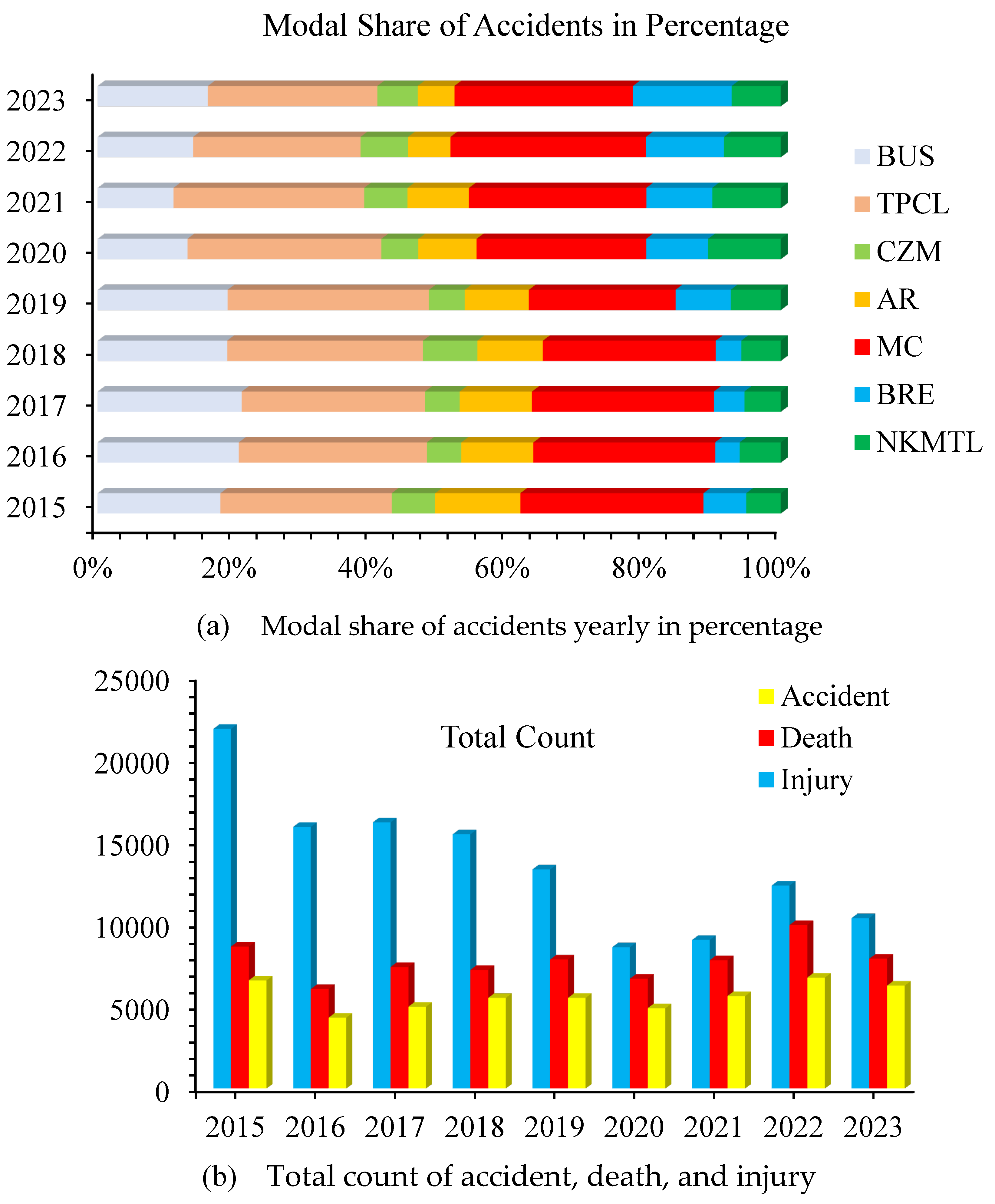
Figure 1a presents the modal share of road accidents in Bangladesh expressed as a percentage from 2015 to 2023. Notably, “Truck-Pickup-Cavard Van-Lori” (TPCL) emerged as the predominant mode leading to accidents in most years, except for 2022 and 2023. This shift can be attributed to a surge in newly issued Motorcycle (MC) licenses by the Bangladesh government in recent years. Conversely, “Battery Rickshaw-Egibike” (BBE) held the lowest percentage of accidents until 2019, with Car-Zip-Microbus (CZM) taking its place thereafter. The modal share of bus and “Nosimon-Korimon-Mahindra-Tractor-Leguna” (NKMTL) accidents exhibited fluctuations, ranging from approximately 18% in 2015 to around 16% in 2023, and 5% in 2015 to approximately 7% in 2023, respectively. The Auto Rickshaw (AR) mode consistently maintained a lower percentage of accidents throughout the specified period. Furthermore, Figure 1b provides a comprehensive overview of the annual count of accidents, deaths, and injuries from 2015 to 2023. The bar graph reveals a peak in accidents in 2015 (6581), followed by fluctuations until reaching a low of 4312 in 2016, followed by an overall increase to 6261 accidents in 2023. Similarly, the bars representing deaths and injuries showcase variations over the years, with peaks in 2015 (8642 deaths, 21855 injuries) followed by a general decrease, reaching 7902 deaths and 10372 injuries in 2023, emphasizing the dynamic trends in road safety during the specified period.
These figures highlighted the critical issue, as road accidents in the country are attributed to various factors, including the negligent behavior of drivers, speeding, defective vehicles, and roads, frequent road crossings, the widespread use of mobile phones while driving, and the sheer volume of vehicles. Additionally, other factors such as low driver pay, irregular working hours, reckless motorcycle riding, public disregard for traffic laws, inadequate traffic management, and less use or lack of public overbridges contribute to the problem [6]. Several measures need to be highlighted to prevent road accidents. These include enforcing mandatory seat belt usage, emphasizing the importance of concentration while driving, ensuring sufficient rest for drivers, replacing unskilled drivers with competent ones, promoting awareness of road-related information, regulating vehicle speed limits, discouraging talking while driving, emphasizing the use of side mirrors, prohibiting driving under the influence of alcohol, eliminating the mentality of reckless overtaking, ensuring transparency and accountability in obtaining a driving license, increasing public awareness of traffic laws, promoting the use of overpasses, restricting car parking in certain areas, addressing defects in the road system, and maintaining an active presence of police and mobile courts on roads [7].
New legislation has been implemented with the aim of mitigating traffic accidents on the road. However, in order to successfully tackle the deteriorating road safety situation, it is imperative to establish precise guidelines for its enforcement [8]. The increasing prevalence of traffic accidents and subsequent fatalities in Bangladesh continues to be a significant issue of concern. Nevertheless, the lack of thorough government data collecting hinders the precise determination of information regarding road accidents and casualties. This creates confusion regarding the true magnitude of the problem, which is crucial for implementing essential measures and adapting new policies. A modernized and sophisticated accident and casualty database system needs to be developed to accurately reflect the true extent of accidents. Several intervention programs, including awareness and education initiatives, engineering improvements, and punitive measures, must be introduced urgently to address the magnitude of the problem. Furthermore, it is imperative to regularly monitor all evolving systems aimed at mitigating accidents to enhance their effectiveness.
References
- Worldometers. Available online: https://www.worldometers.info/coronavirus/country/bangladesh/.
- Ahmed, J.; Jaman, M.H.; Saha, G.; Ghosh, P. Effect of environmental and socio-economic factors on the spreading of COVID-19 at 70 cities/provinces. Heliyon 2021, 7, e06979. [Google Scholar] [CrossRef] [PubMed]
- Management Information System (MIS), Directorate General of Health Services (DGHS). Available online: https://old.dghs.gov.bd/index.php/bd/home/5200-daily-dengue-status-report. 5200.
- Saha, G.; Saha, M.; Saha, M. Dengue: The Enduring Endemic Challenge in Bangladesh. Journal of Medicine 2024, 25, 78–82. [Google Scholar] [CrossRef]
- Road Transport and Highway Division, Bangladesh. Available online: http://www.rthd.gov.bd/.
- UNB, Dhaka: 16 major reasons for road accidents, Bangladesh Post. Published: 23 July 2023. Available online: https://bangladeshpost.net/posts/16-major-reasons-for-road-accidents-116892.
- Rita, S. 2023. How can we keep road accidents in check? Dhaka Tribune. Published: 23 March 2023. Available online: https://www.dhakatribune.com/bangladesh/307396/how-can-we-keep-road-accidents-in-check.
- Islam, M.; Ali Khan, M.; Hossain, M.; Mani, K. C. , & Min, R. Road traffic accidents in Bangladesh: Why people have poor knowledge and awareness about traffic rules? International Journal of Critical Illness and Injury Science 2020, 10, 70–75. [Google Scholar] [CrossRef] [PubMed]
Figure 1.
Yearly Accident overview during the period 2015 to 2023.
Disclaimer/Publisher’s Note: The statements, opinions and data contained in all publications are solely those of the individual author(s) and contributor(s) and not of MDPI and/or the editor(s). MDPI and/or the editor(s) disclaim responsibility for any injury to people or property resulting from any ideas, methods, instructions or products referred to in the content. |
© 2025 by the authors. Licensee MDPI, Basel, Switzerland. This article is an open access article distributed under the terms and conditions of the Creative Commons Attribution (CC BY) license (http://creativecommons.org/licenses/by/4.0/).
Copyright: This open access article is published under a Creative Commons CC BY 4.0 license, which permit the free download, distribution, and reuse, provided that the author and preprint are cited in any reuse.


