

Submitted:
15 August 2025
Posted:
18 August 2025
You are already at the latest version
Abstract
Prepartum vaccination of dairy cows against newborn calf diarrhea protects calves during the first weeks of life via the colostrum. Vaccination may also induce non-specific effects (NSE) beyond antibody production, altering disease susceptibility and productivity of the vaccinated mother. This retrospective study analyzed herd records and on-site survey data from 73,378 dairy cows on 20 German farms using linear mixed-effects models and random forest algorithms. Management practices and milk yield showed stronger associations with outcomes than vaccination. However, cows vaccinated with non-live vaccines had increased odds of retained placenta and metritis (OR: 1.5–1.7), and endometritis (OR: 3–6), and were 20–24% less likely to be successfully inseminated than non-vaccinated cows. Among non-live vaccinated cows, those vaccinated 2.5–4 weeks before calving had an 8% higher non-return rate compared to those vaccinated 6–8 weeks prior. Multiparous cows receiving live vaccine components were 1.9 times more likely to be successfully inseminated, compared to non-live vaccinated multiparous cows. These findings suggest poten-tial NSE of prepartum vaccination on uterine health and fertility. However, the study’s retro-spective design limits causal interpretation, and the benefits in calves may outweigh possible adverse effects. Further research should clarify mechanisms and optimize vaccine timing and composition.
Keywords:
transition cow
; vaccination
; trained immunity
; cattle
; bovine metritis
; epidemiology
1. Introduction
Non-specific effects (NSE) of vaccination beyond an antigen-specific induction of antibodies and effector T cells can be related to both adaptive and innate immune mechanisms, such as heterologous T cell immunity and trained immunity [1]. The extent and nature of NSE are intensely debated, and both beneficial and adverse effects are reported [2]. Epidemiological studies of human vaccines have been well elaborated [1], and evidence of NSE have been shown especially for live-attenuated vaccines, such as Bacille Calmette-Guerin (BCG), measles, oral polio, and vaccinia [1]. In veterinary medicine, research is still lacking, especially for non-live vaccines [2]. Recently, the hypothesis, that live vaccines have beneficial and non-live vaccines have detrimental NSE [3], has been confirmed in a systematic review [4]. In cattle, NSE have been demonstrated in calves where circulating myeloid cells displayed a trained functional phenotype after experimental BCG vaccination [5]. For non-live vaccines, an altered gene expression of circulating immune cells has been demonstrated in cows [6,7]. In a recent study, prepartum vaccination against NCD had no significant effects on mammary health and milk yield. However, the study did not address the influence of live and non-live components [8].
Prepartum vaccinations of cows are used to protect calves from infectious diseases during the first weeks of life. They are considered safe for the dam [9,10]. Although vaccination of pregnant women during the COVID-19 pandemic demonstrated no overall adverse effects, the most opportune timing of vaccination to elicit an optimal immune response in the mother to benefit the neonate remains unclear [11]. The effect of timing of vaccination during pregnancy remains largely unexplored. However, findings from epidemiological studies involving children who have been vaccinated against measles and with a BCG-vaccine indicate that the timing of vaccinations can have a substantial impact on NSE [12,13]. In dairy cows, the timing of prepartum vaccination with two non-live vaccines against neonatal calf diarrhea (NCD) and mastitis and relative to pen change and acidogenic diet has been shown to affect lying time, metabolic profile and immunoglobulins [14,15]. Prepartum vaccination of cows takes place before or directly in the transition period, defined as three weeks before parturition to three weeks after parturition [16]. Thus, timing of prepartum vaccination may be an issue since the transition from a lactating cow to a dry cow is associated with altered immune cell functions [17,18].
Depending on the time when pregnant cow immune cells change their functionality before parturition, initial innate immune responses to vaccinations may differ and hence the induced NSE after vaccination. Fine-tuned innate immune mechanisms are important already in the prepartum period [19] and dysregulated response extend into the postpartum period co-determining whether uterine contamination proceeds to recovery or to an infectious disease. The modulated immune system during the transition period is often seen as the key for postpartum uterine infectious diseases and subsequent fertility [20,21,22,23]. Retained placenta is defined as the failure to pass the fetal membranes within 24 hours, the remaining membranes are usually noticed in the first days postpartum [19]. While most metritis cases occur within the first ten days postpartum, a cut-off date between metritis and endometritis can be made on day 21 postpartum [24]. In the further discourse of the cows’ production cycle, immune system and previous uterine disease co-determine if the cow was successfully inseminated [25].
We hypothesize that prepartum vaccination modulates immune mechanisms in a way that affects uterine disease susceptibility. The objective of this retrospective study was to analyze the associations between the prepartum vaccination against NCD as well as vaccination timing and uterine health and fertility of the periparturient cow.
2. Materials and Methods
2.1. Data Collection
A total of 20 dairy farms enrolled in the RinderAllianz test-herd program were selected for this study, taking into account ten farms that carried out prepartum vaccination against NCD in June 2021, and ten farms that did not perform prepartum vaccination on their farm. Milk yield was balanced in order to attain five high yielding and five low yielding farms in each vaccination group with a cut-off value at 11,000kg mean energy corrected milk yield in 305 days of lactation (ECM 305).
Data was extracted from the herd management programs, comprising reproduction data of 148,268 lactations, milk recordings from 1,561,273 recordings, health documentation with 1,298,703 diagnoses and holding registers of 73,378 dairy cows of 22 herds on 20 farms between January 2007 and September 2020. The large size of this dataset revealed sufficient statistical power and the unnecessity of an a priori power analysis. Additionally, an on-farm survey was conducted between October 2021 and August 2022 to record the local conditions and management practices. Herefore, a questionnaire on vaccination history, dry-off management, housing system, health management, monitoring during birth, milking and colostrum management, hygiene and feeding management was designed. An English translation is provided in File S2. To ensure consistency in data collection, the same surveyor administered all questionnaires. One farm was surveyed remotely due to pandemic-related precautionary measures; all remaining farms were visited on-site, enabling a more comprehensive understanding of the farm environment. Farmers demonstrated a high degree of cooperation and, without exception, provided surveyors with full access to all pertinent areas of the facility, including housing for animals at all production stages, as well as milking systems and calving areas, which were subject to particularly close inspection. In addition to data collection, these visits allowed surveyors to verify the absence of any overt deficiencies in management or hygiene. Furthermore, the attending veterinarians of the farms were consulted to enhance the evaluation of herd management. When scheduling allowed, these veterinarians participated directly in the on-site visits; in other instances, they were consulted separately.
2.2. Data Pre-Processing and Variable Definition
On-site survey data were manually transferred from paper forms to ExcelTM-spreadsheets. R version 4.3.1 software was used to match the questionnaire with data from the herd management programs. Information from the questionnaires revealed that five herds were continuously vaccinated, eight herds were continuously unvaccinated, and eight herds were alternately vaccinated with the prepartum vaccine against NCD during the entire study period between 2007 and 2020. The decision to vaccinate was made at the herd level, with timing ranging from eight to 2.5 weeks before calving. Within each herd, the vaccination protocol was consistent for all cows, although in some cases heifers were vaccinated at a later time. While vaccination protocols differed between herds, all farms followed the manufacturer’s guidelines. Due to the timely fragmentation of the vaccination protocols, it was decided to perform the statistical analysis at the cow level rather than the herd level. This methodological framework enabled the consideration of individual cow factors and ensured statistical power through high sample sizes.
The transition period of each cow served as the basis for the observations. Therefore, a chronological adjustment was implemented for each lactation period in the data set. This adjustment ensured that events occurring during the dry period were aligned with data from the subsequent lactation. Completeness of observations was sought by excluding observations without available health records, reproductive information or survey data. Furthermore, in cases where vaccination protocols were temporarily changed, a buffer period of one month (spanning 15 days before and 15 days after the date of change) was implemented to minimize the risk of misclassification. Particular attention was paid to the herd-specific timing of vaccination to ensure accurate matching of vaccination periods with corresponding calving dates. Initially, data were made available for 73,378 dairy cows from 22 herds on 20 farms. After data consolidation, 53,370 dairy cows from 21 herds on 19 farms were included in the analysis, representing a total of 120,394 transition periods.
Prepartum vaccinations were administered using three different vaccines. RC (Bovilis® Rotavec® Corona, Intervet, Unterschleißheim, Germany, containing inactivated bovine rotavirus (serotype G6 P5), inactivated bovine coronavirus (strain Mebus), E. coli (K99 Antigen), adjuvanted with mineral oil and aluminium hydroxide; n = 27,769). SG (Scourguard® 3, Zoetis, Berlin, Germany, containing live attenuated bovine rotavirus (strain Lincoln), live attenuated bovine coronavirus (strain Hansen), E.coli (K99 Antigen), adjuvanted with Alhydrogel; n = 8,352). BS (Bovigen® Scour, Forte Healthcare, Dublin, Ireland, containing inactivated bovine rotavirus (serotype G6 P1), inactivated bovine coronavirus (strain C-197), E. coli (K99 Antigen), adjuvanted with Montanide ISA 206 VG; ); n=8,004). RC and BS are applicated once and SG is applicated twice, whereby the date of the first application was considered as time of vaccination. In 18,453 cases the vaccine product could not be associated. All observations with other vaccinations than prepartum vaccination against neonatal calf diarrhea were excluded. Table S1 provides an overview of response and predictive variables, definitions, composition, and values.
Due to the inconsistent description of diagnoses in the documentation of the different herds, all acute uterine diseases were summarized under the category Retentio-metritis-complex (RMC). Included are all diagnoses related to inflammatory events in the uterus (retained placenta, metritis, puerperal intoxication, puerperal septicemia), if they were documented until 21 days postpartum. As endometritis the diagnostic categories endometritis catarrhalis, endometritis mucopurulenta, endometritis purulenta and pyometra were considered, if they occurred between day 21 and 56 postpartum.
The non-return rate after first insemination was designated as the response variable to assess fertility and insemination success. It indicates the proportion of successful fertilisation at day 56 (NRR56) post-insemination (p.i.). It is considered less biased than other fertility parameters such as the calving interval, because it includes primiparous and non-pregnant cows. It maintains comparability between herds, although the proportion of pregnant cows is usually overestimated [26].
Available cow and farm management related variables were selected and examined for influence on the response variables. Especially those, considered as well studied risk factors of uterine diseases [19,27], were included in the analysis. Farm size, access to pasture, flooring, hygiene score, first lactation ages were tested as farm-related variables. Stillbirth, parity, time dry, risk of ketosis, multiples, pen change, calf sex, calving season, ECM FTD, ECM 305 of the previous lactation, SCC, time to first service and calving interval as parameters related to the status of the cow and calving. Moreover, RMC and endometritis were incorporated as potential explanatory variables for the respective outcome variables, in accordance with their established role as significant risk factors for uterine disease and subsequent fertility [28,29]. The complete set of variables and their definitions can be found in Table S1. Further details on the study design, data collection procedures, and variable definitions have been described previously in [8], which reports on the same study framework with partially overlapping variables.
2.3. Statistical Analyses
Statistical analyses were performed with R version 4.3.1 [30]. An initial descriptive analysis was performed to provide an overview of the data structure, disease prevalence and fertility. The Random Forest algorithm [31] was conducted in order to obtain a ranking of the importance of the influencing variables. All eligible variables were examined for their influence on the response variables RMC, Endometritis and NRR56 in the univariable generalized linear mixed effects models. Parity was one of the most significant variables, and those influencing variables originating in the previous lactation (ECM305 and calving interval) were only available in multiparous cows, therefore multivariable models were divided into primiparous and multiparous. Herd and calving year were applied as random effects in mixed-effects models and examined as predictor in Random Forest models. A nested structure of these random effects was the most appropriate formulation based on the evaluations with the Akaike’s information criterion. By applying the function [32] to each model, with x= number of observations without missing values, an adapted significance threshold was created, to reduce the risk of false discoveries (type I error) due to high numbers of observations in the models. All variables, that were significant according to the adapted threshold in the univariable analysis were further included in the subsequent multivariable analysis. Manual backward selection was performed on variables below the adapted p-value threshold after multivariable analysis, while constantly comparing model performance. If Akaike’s information criterion was two or more points lower, the variable was excluded. Multicollinearity was assessed by calculating the variance inflation factor.
3. Results
3.1. Vaccine Type and Time of Vaccination
Out of the total 120,394 transition period in the dataset, 57,166 transition periods were without vaccination during the dry period (NON VACC). In 63,228 transition periods, the cows were vaccinated (VACC), hereof 35,773 with a non-live vaccine (NON LIVE), 8,352 with a vaccine containing live and non-live components (MIXED), and 19,103 with unknown type of vaccine (UNKNOWN). In 30,633 transition period, the vaccination was applied between 6 and 8 weeks before expected calving date (EARLY), in 14,169 transition period between 2.5 and 4 weeks before expected calving date (LATE) and in 18,426 transition period a vaccination was applied, but with unknown date within the dry period (EARLY or LATE) (Table 1).
3.2. Production Metrics in Vaccinated and Non-Vaccinated Cows
Among primiparous cows, the proportion of vaccinated individuals was lower (41.3%) compared to multiparous cows (59.5%) (Table 2). Primiparous cows showed a lower ECM 305 yield and a shorter time to first service compared to multiparous cows. Within the primiparous group, ECM 305 yield was the same for both non-vaccinated and vaccinated cows (8,683 liters), with a slight difference in time to first service (73 days for non-vaccinated and 72 days for vaccinated cows). In the multiparous group, non-vaccinated cows had a higher ECM 305 yield (10,968 liters) compared to vaccinated cows (10,371 liters), while the time to first service was consistent at 75 days for both vaccinated and non-vaccinated groups.
3.3. Milk Yield, Performance and Herd Management Are Most Relevant for Uterine Health and Fertility
Random Forest analysis was performed with all significant predictor variables from the univariable general linear mixed effects regression, including herd and calving year, which were previously applied as random effects. The ranking of variable importance showed that ECM 305 of the previous lactation, ECM FTD, herd, and calving interval were among the most influencing variables (Figure 1). Prepartum vaccination is among the least influential predictors. However, time and type of vaccine appeared in all three rankings above prepartum vaccination.
3.4. Prepartum Non-Live Vaccination Affects Uterine Health and Fertility
Results of multivariable models in primiparous cows (Table 3) showed that vaccination with a non-live vaccine significantly increased the odds of RMC and endometritis, while significantly decreased the NRR56, when comparing the NON-LIVE group with the NON-VACC group. The odds ratio of 1.73 suggests that individuals who received the non-live vaccine were 1.73 times more likely to develop RMC, relative to the non-vaccinated group, after controlling for other variables. However, despite a significant p-value, which in this study might be mostly due to the huge sample size, according to Chen et al. (2010), the effect size from OR = 1.73 is classified as small [33]. Primiparous cows who received the non-live vaccine were 3.04 times more likely to develop endometritis. In turn, primiparous cows vaccinated with a non-live vaccine were 24% less likely (OR = 0.76) to be successfully inseminated on day 56 p.i. compared to non-vaccinated primiparous cows. Comparing the groups MIXED and NON-VACC, as well as MIXED and NON-LIVE however showed no significant associations.
The results of the predictors indicate that cows that experienced stillbirth were 1.88 times more likely to develop RMC. Furthermore, primiparous cows with dystocia had a 61% higher likelihood of developing RMC (OR = 1.61) and a 54% higher likelihood of developing endometritis (OR = 1.54). Cows carrying multiples were 3.90 times more likely to develop RMC. Milk yield (ECM FTD) was associated with a 4% reduction in the odds of developing RMC (OR = 0.96). The risk of ketosis increased the likelihood of developing RMC by 33%. Finally, the results for calf sex show that cows giving birth to male calves were 24% more likely to develop RMC.
Generalized linear mixed effects models were conducted, applying the variables herd and calving year as random effects. Empty fields arise because the variable was either not significant in the corresponding univariable analysis or was eliminated by manual backward selection. The vertical wiggly line separates NRR56 from the other response variables due to an inverse association as compared to RMC and Endometritis: while higher RMC and Endometritis rates are undesirable, higher NNR56 rates represent better fertility. All variables and definitions are listed in Table S1.
Results of multivariable models with multiparous cows (Table 4) showed that prepartum vaccination with a non-live vaccine significantly increased the likelihood for endometritis and decreased NRR56 when comparing the NON-LIVE group with the NON VACC group. Multiparous cows vaccinated with a non-live vaccine were 5.61 times more likely to develop endometritis compared to non-vaccinated cows, indicating an association between the non-live vaccine and the development of endometritis with medium effect size. Multiparous cows vaccinated with a non-live vaccine were 20% less likely to be successfully inseminated compared to non-vaccinated cows. In contrast, cows vaccinated with a mixed vaccine were 87% more likely to be successfully inseminated compared to those vaccinated with the non-live vaccine, suggesting that the mixed vaccine might be associated with improved insemination success.
The results of the predictors show that those cows that had a stillbirth were 2.37 more likely to develop RMC. Moreover, the presence of dystocia increased the odds of RMC and Endometritis by 37% and 39% respectively, while also significantly decreased the NRR56 by 9%. Cow with multiples had a markedly higher risk of RMC, being 6.40 times more likely to develop the condition. These cows were also 1.31 times more likely to develop endometritis. Cows with ketosis were 16% more likely to develop RMC. When it comes to calf sex, cows that gave birth to male calves were 18% more likely to develop RMC. Risk of ketosis was associated with an increased likelihood of RMC by 16%. Milk yield of the current lactation (ECM FTD) was significantly negatively associated with the development of RMC, but was not significantly associated with either endometritis or NRR56. However, milk yield of the previous lactation (ECM 305) was positively associated with RMC and endometritis and negatively associated with NRR56. Furthermore, longer time to first service increased NRR56, while longer calving intervals were associated with lower NRR56. Finally, cows that developed RMC were 4.28 times more likely to subsequently develop endometritis. Additionally, the occurrence of RMC was associated with a 10% reduction in the odds of successful insemination.
3.4. Time of Vaccination Affects Fertility in Non-Live Vaccinated Cows
In multivariable generalized linear mixed effects models with only those transition periods (17,574 transition periods of 8,268 cows) where cows were vaccinated with a non-live vaccine, significant associations between time of vaccination and NRR56 could be found (Figure 2). Here, predicted outcomes for the EARLY group were 37.6% NRR56 and for LATE group 46% NRR56, with a difference in predicted probabilities of 8.4% (Figure 2) while the odds for successful insemination of late vaccinated cows was 42% higher. No significant association with time of vaccination was found for RMC and endometritis.
4. Discussion
Innate immune mechanisms play a major role in the peripartum period. Vaccine-induced NSE, which are mainly based on innate immune mechanisms, are rarely studied in the field of uterine health and reproduction. Here, we investigated whether prepartum vaccination against NCD in pregnant cows is associated with the prevalence of postpartum uterine disease and fertility. This was based on the hypothesis that vaccination-induced mechanisms alter the interaction within the immune system or between cells and thus lead to enhanced resistance towards metritis pathogens and improved fertility. Special emphasis was placed on the time of vaccination, whether early or late during the dry period, as well as the type of vaccine, whether live or non-live. As timely discourse plays a role in the interface of innate immune mechanisms and uterine diseases and fertility, the time of vaccination, the timepoint of the parameter and the choice of a non-live or live vaccine could be decisive.
In multivariable models, vaccinated cows, particularly those immunized with a non-live vaccine, exhibited significantly higher odds of developing uterine disease and lower odds of successful insemination on day 56 after the first insemination (Table 3 and Table 4). Those cows vaccinated with a live vaccine component, differed significantly from non-vaccinated cows only in NRR56 and in multiparity, all other results in this regard were not significant (Table 4). These findings point toward a possible trend of poorer postpartum uterine outcomes following non-live prepartum vaccination. Usually, beneficial NSE are found in live and adverse in non-live vaccines [3,4]. Accordingly, our results support this pattern, though favorable outcomes associated with live vaccine components in our study were limited to NRR56 in multiparous cows. Besides, the effect size of all these predictors were small or very small (except for endometritis in multiparous cows) when interpreted according to the recommendations of Chen, Cohen and Chen [33]. This suggests a small impact of the observed association. The results of the variable importance ranking must also be taken into account: herd management and the cows’ milk yield have the greatest influence on uterine health and fertility in the postpartum cow. In addition to the small effect sizes regarding uterine health and fertility, the influence of milk yield may overshadow the findings of this study. Moreover, the variable importance ranking showed a higher relevance of the time of vaccination than the simple comparison between vaccinated and non-vaccinated cows (as well as the type of vaccine). Currently, vaccine manufacturers recommend to vaccinate cows against NCD between three and twelve weeks prior to the expected calving date, to allow sufficient time for antibody production against the target pathogens and to ensure their passage into the colostrum immediately after calving [34,35,36]. The relation between time of vaccination and time of pen change on an acidogenic diet has recently been shown to affect lying time, metabolic profile and immunoglobulins wit prepartum vaccination with two non-live vaccines against neonatal calf diarrhea (NCD) and mastitis [14,15]. Here, a beneficial effect of vaccination 4 weeks prepartum, followed by pen change and acidogenic diet 3 weeks prepartum, compared to all of these procedures 3 weeks prepartum was attributed to additive stressors. In this study, the use and timing of acidogenic diet and pen change could not be fully determined retrospectively, and therefore not considered in the models; however, the time of vaccination was documented. They vaccinated their cows between 2.5 and 8 weeks prior to the expected calving date, multiparous cows usually at dry-off and heifers at regrouping. Therefore, a large time continuum of vaccination could be examined in the respective multivariable analysis. To achieve this, the number of observations in the dataset was reduced to those cows that had been vaccinated with a non-live prepartum vaccine, with only those cases where the date of vaccination was clear. The results showed a significant association between time of vaccination and fertility with a very small effect size (Figure 2 and File S3). For the outcome variables RMC and endometritis, no significant results were found.
Our hypothesis that vaccination-induced mechanisms lead to enhanced resistance to metritis pathogens and improved fertility was not supported by the results of this data set. Nevertheless, associations of small effect sizes could be substantiated. Whether these associations are vaccination-induced cannot be fully approached due to the retrospective, observational and non-randomized design of this study [37]. The reproducibility of the results across the different multivariable models (e.g., primi- vs. multiparity; VACC/NON VACC vs. NON LIVE/MIXED/NON VACC), the high statistical power and the adaptation of the significance thresholds to the large data set [32] argue in favor of a causal relationship. Finally, the findings align with related research that supports beneficial NSE after live vaccination and adverse NSE after non-live vaccination [3,4]. However, in order to confirm a causal relationship, controlled prospective trials are necessary.
The associations observed are unlikely related to the specific effects of the antibody response of the vaccine. The NCD vaccine targets pathogens including E. coli, bovine corona virus and rotavirus. Although coronaviruses and rotaviruses are rarely implicated in the pathogenesis of uterine disorders, it cannot be excluded that antibody generation against E. coli may interfere with intrauterine E. coli. The genotypic specificity of intrauterine E. coli is a current area of research [38] and the presence or absence of bacteria plays a part in uterine diseases, but the role of the immune system is estimated as decisive [24]. Dysregulated immune function around calving is associated with impaired and reduced polymorphonuclear leucocytes (PMN) [20,39]. Conversely, early influx of inflammatory PMN into the uterus reduces uterine disease in the further course of uterine involution [20]. Innate immune mechanisms are important not only in the postpartum period, but already in the prepartum period [19]. Postpartum, time again makes a difference: while puerperal metritis usually occurs within ten days postpartum, endometritis is defined as occurring from day 21 postpartum [24]. Carry-over effects of uterine disease on subsequent fertility have been found, although details of the underlying mechanisms are still unclear [25,40]. While PMN are known to upregulate inflammation, little is known about their role in the resolution of the inflammation. Pascottini et al. hypothesized that this resolution of inflammation is a key feature of PMN in the regulation of uterine disease [20]. In dairy reproduction, Ribeiro et al. found that inflammation prior to breeding reduced fertility and suggested additive negative effects of inflammation from different sources (metabolic, NEB, uterine and non-uterine diseases) [40]. The interplay of systemic and uterine inflammation is not entirely understood, but there is a type or extent of inflammation that leads to maladaptation of the transition cow [41]. Thus, inflammation and specifically its up- and downregulation seems to play a key role in uterine health and fertility. We hypothesize that NSE interfere with these innate regulatory immune mechanisms, especially by increasing the number and competence of PMN [6] and thus affect the dysregulated immune system of the periparturient dairy cow.
Large herd records are a time-tested tool to monitor health parameters in dairy herds [42]. They allow the detection of even small phenomena because of the high statistical power and the thorough examination of subgroups and variables to control confounders. At the same time, large datasets – and especially herd records - entail several challenges. The herd data used in this study were assumed to contain inaccuracies and inconsistencies in diagnoses. This assumption is based on a previous study using data from the same source [43]. Inconsistent definitions of clinical diseases and documentation bias are well-known issues in dairy cattle [44,45]. The consolidation of uterine diagnoses is a common method employed to improve diagnostic accuracy [46]. Given the established significance of retained placenta as the foremost risk factor for metritis, and the assumption that retained placenta invariably results in inflammation, leading to acute metritis [19,47], the summary of acute uterine diseases in a single variable (RMC) was undertaken. In order to further minimize the documentation bias, a combination of diagnoses and reproduction data was utilized to define the outcome variables. The diagnostic parameters retained placenta, metritis, and endometritis were supplemented with the more robust and measurable parameter, NRR56. Furthermore, the study’s findings were validated through on-site farm visits, thorough data cleaning and exploratory data analysis, as well as a confounder check using contingency tables and bivariable analyses. In order to circumvent the occurrence of type 1 errors, characterized by the production of false positive significant results, the likelihood of which is known to be amplified in the context of substantial datasets, a reduction in the significance thresholds was implemented [32].
The risk factors for uterine diseases have been well studied, and the results of this study align closely with the existing literature on the subject [19,27]. It should be noted that certain parameters were not or only partially available for the model of this study, including vulval angle, back fat thickness, and bacterial infection [28,48]. Those variables referring to the previous lactation of the cow, could only be considered in multiparous cows; thus, models were separated into primiparous and multiparous. Additional factors may also have an impact, particularly those related to the composition of the vaccine product. While there was a difference between non-live and live vaccine components, the authors suggest to examine the role of adjuvants in analytical models. In the models of this study, the highest influential factors for all response variables in this study were ECM FTD, ECM 305 of the previous lactation and herd management, as demonstrated by the variable importance ranking of the Random Forest analysis. Literature reports contradicting results regarding the influence of milk yield on reproduction [26,49,50,51]. An increase in milk production due to breeding advances and a concurrent decline in reproduction measures has been observed in dairy herds worldwide. Some researchers have proposed that rising milk yields are a cause of rising infertility. However, others have criticized this conclusion or even found a positive correlation. To address this research question, Rearte, et al. [52] conducted a multilevel logistic regression analysis. These findings indicated a significant negative association between milk yield and reproductive performance, with a small effect size. Also, the findings of this study indicate that while the significance of ECM 305 on NRR56 is high, the effect size is very small. A correlation between early milk yield and other variables was observed in both positive and negative directions [52,53,54]. In this study, both previous lactation and current early lactation milk yield were negatively associated with uterine health and fertility. It is noteworthy that a notable discrepancy was observed in the correlation between milk yield in the previous lactation and that of the current early lactation, while the former seemed to increase the risk of uterine diseases, and high milk yields in the current early lactation seemed to be an indicator for a good uterine health status. The authors hypothesize that regarding uterine disease, the association may be inverse: if the cow’s uterine health is impaired, it affects the overall performance of the animal, resulting in reduced milk yields. Another limitation of the study is the differing days in milk (DIM) of milk recordings, which occurred at monthly intervals in the respective herds. To identify potential biases, the relationship between the average DIM on the day of the milk test and the average milk performance was investigated. The results demonstrated that there was no significant impact on the outcomes.
5. Conclusions
This large-scale study confirmed that management practices and milk yield are the most important factors for the dairy cows’ uterine health and fertility. With small effect size, the prepartum vaccination increased the probability of retained placenta, metritis and endometritis, and reduced fertility. This finding suggests that non-specific effects of prepartum vaccination on uterine health and fertility may be present in dairy cows. However, the retrospective design of this study precludes the determination of causality. It is hypothesized that the associations demonstrated in this study may not outweigh the positive effects of vaccination against NCD on health and survival of neonatal calves. Instead, these findings shed light upon the current immunological discourse on NSE of vaccinations. Further research is required on the mechanisms of NSE in the critical periparturient phase of the dairy cow, with particular emphasis on the optimal timing of vaccination and the most suitable vaccine components (live, non-live, adjuvants).
Supplementary Materials
The following supporting information can be downloaded at the website of this paper posted on Preprints.org, Table S1: List of variables and definitions used in the study; File S2. English translated version of the on-farm survey; File S3. Results of multivariable analysis of the association between time of prepartum vaccination and uterine health and fertility in non-live vaccinated cows.
Author Contributions
Conceptualization, C.K., H.Z., H-J.S., and Y.Z.; methodology, C.K., Y.Z., and A.R.; software, C.K. and Y.Z.; validation, H.Z., H-J.S., Y.Z., and A.R.; formal analysis, C.K. and Y.Z.; investigation, C.K.; resources, D.K. and C.W.; data curation, C.K.; writing—original draft preparation, C.K.; writing—review and editing, H.Z., H-J.S., Y.Z., A.R., D.K., C.W., M.R. and A.S.; visualization, C.K.; supervision, Y.Z., H.Z., and H-J.S.; project administration, C.K., H.Z., M.R. and A.S.; funding acquisition, H.Z., M.R. and A.S. All authors have read and agreed to the published version of the manuscript.
Funding
This research was funded by Intervet Deutschland GmbH (Funding number: E-00065098).
Institutional Review Board Statement
Not applicable.
Informed Consent Statement
Participation in the study was entirely voluntary, and all farms were anonymized. Prior to the initiation of the study, all farms provided written consent on farm-specific data to be used within the framework of this study.
Data Availability Statement
The data generated and analyzed during the study are not publicly available due to reasons of confidentiality. Anonymized data are available upon reasonable request.
Acknowledgments
The authors would like to thank all participating farmers for their time and for providing valuable insights into their herds.
Conflicts of Interest
Authors Debby Kraatz-van Egmond and Claudia Wesenauer were employed by the company RinderAllianz GmbH. Authors Martina Resch and Alexander Stoll were employed by the company Intervet Deutschland GmbH. The remaining authors declare that the research was conducted in the absence of any commercial or financial relationships that could be construed as a potential conflict of interest. The funders had no role in the design of the study; in the collection, analyses, or interpretation of data; in the writing of the manuscript; or in the decision to publish the results.
References
- de Bree, L.C.J.; Koeken, V.; Joosten, L.A.B.; Aaby, P.; Benn, C.S.; van Crevel, R.; Netea, M.G. Non-specific effects of vaccines: Current evidence and potential implications. Semin. Immunol. 2018, 39, 35–43. [Google Scholar] [CrossRef] [PubMed]
- Arega, S.M.; Knobel, D.L.; Toka, F.N.; Conan, A. Non-specific effects of veterinary vaccines: a systematic review. Vaccine 2022, 40, 1655–1664. [Google Scholar] [CrossRef]
- Benn, C.S.; Fisker, A.B.; Rieckmann, A.; Sørup, S.; Aaby, P. Vaccinology: time to change the paradigm? The Lancet Infectious Diseases 2020, 20, e274–e283. [Google Scholar] [CrossRef]
- Rubio-Casillas, A.; Rodriguez-Quintero, C.M.; Redwan, E.M.; Gupta, M.N.; Uversky, V.N.; Raszek, M. Do vaccines increase or decrease susceptibility to diseases other than those they protect against? Vaccine 2024, 42, 426–440. [Google Scholar] [CrossRef]
- Guerra-Maupome, M.; Vang, D.X.; McGill, J.L. Aerosol vaccination with Bacille Calmette-Guerin induces a trained innate immune phenotype in calves. PloS one 2019, 14, e0212751. [Google Scholar] [CrossRef]
- Weikard, R.; Demasius, W.; Hadlich, F.; Kühn, C. Different Blood Cell-Derived Transcriptome Signatures in Cows Exposed to Vaccination Pre- or Postpartum. PloS one 2015, 10, e0136927. [Google Scholar] [CrossRef]
- Demasius, W.; Weikard, R.; Hadlich, F.; Müller, K.E.; Kühn, C. Monitoring the immune response to vaccination with an inactivated vaccine associated to bovine neonatal pancytopenia by deep sequencing transcriptome analysis in cattle. Veterinary research 2013, 44, 93. [Google Scholar] [CrossRef] [PubMed]
- Kuhn, C.; Zerbe, H.; Schuberth, H.-J.; Römer, A.; Kraatz-Van Egmond, D.; Wesenauer, C.; Resch, M.; Stoll, A.; Zablotski, Y. Prepartum Vaccination Against Neonatal Calf Diarrhea and Its Effect on Mammary Health and Milk Yield of Dairy Cows: A Retrospective Study Addressing Non-Specific Effects of Vaccination. Animals 2025, 15, 203. [Google Scholar] [CrossRef]
- Smith, B.I.; Rieger, R.H.; Dickens, C.M.; Schultz, R.D.; Aceto, H. Anti-bovine herpesvirus and anti-bovine viral diarrhea virus antibody responses in pregnant Holstein dairy cattle following administration of a multivalent killed virus vaccine. American Journal of Veterinary Research 2015, 76, 913–920. [Google Scholar] [CrossRef] [PubMed]
- Vidlund, J.; Gelalcha, B.D.; Gillespie, B.E.; Agga, G.E.; Schneider, L.; Swanson, S.M.; Frady, K.D.; Kerro Dego, O. Efficacy of novel staphylococcal surface associated protein vaccines against Staphylococcus aureus and non-aureus staphylococcal mastitis in dairy cows. Vaccine 2024, 42, 1247–1258. [Google Scholar] [CrossRef]
- Juliá-Burchés, C.; Martínez-Varea, A. An Update on COVID-19 Vaccination and Pregnancy. Journal of Personalized Medicine 2023, 13, 797. [Google Scholar] [CrossRef]
- Aaby, P.; Martins, C.L.; Ravn, H.; Rodrigues, A.; Whittle, H.C.; Benn, C.S. Is early measles vaccination better than later measles vaccination? Trans R Soc Trop Med Hyg 2015, 109, 16–28. [Google Scholar] [CrossRef]
- Berendsen, M.L.T.; Smits, J.; Netea, M.G.; Van Der Ven, A. Non-specific Effects of Vaccines and Stunting: Timing May Be Essential. EBioMedicine 2016, 8, 341–348. [Google Scholar] [CrossRef] [PubMed]
- Menichetti, B.T.; Garcia-Guerra, A.; Lakritz, J.; Weiss, W.P.; Velez, J.S.; Bothe, H.; Merchan, D.; Schuenemann, G.M. Effects of prepartum vaccination timing relative to pen change with an acidogenic diet on serum and colostrum immunoglobulins in Holstein dairy cows. Journal of Dairy Science 2021, 104, 11072–11081. [Google Scholar] [CrossRef] [PubMed]
- Menichetti, B.T.; Garcia-Guerra, A.; Lakritz, J.; Weiss, W.P.; Velez, J.S.; Bothe, H.; Merchan, D.; Schuenemann, G.M. Effect of timing of prepartum vaccination relative to pen change with an acidogenic diet on lying time and metabolic profile in Holstein dairy cows. Journal of Dairy Science 2021, 104, 11059–11071. [Google Scholar] [CrossRef]
- Drackley, J.K. Biology of dairy cows during the transition period: the final frontier? Journal of Dairy Science 1999, 82, 2259–2273. [Google Scholar] [CrossRef]
- Lopreiato, V.; Mezzetti, M.; Cattaneo, L.; Ferronato, G.; Minuti, A.; Trevisi, E. Role of nutraceuticals during the transition period of dairy cows: a review. Journal of Animal Science and Biotechnology 2020, 11, 96. [Google Scholar] [CrossRef]
- Horst, E.A.; Kvidera, S.K.; Baumgard, L.H. Invited review: The influence of immune activation on transition cow health and performance-A critical evaluation of traditional dogmas. J Dairy Sci 2021, 104, 8380–8410. [Google Scholar] [CrossRef]
- LeBlanc, S.J. Postpartum uterine disease and dairy herd reproductive performance: a review. The Veterinary Journal 2008, 176, 102–114. [Google Scholar] [CrossRef]
- Pascottini, O.B.; LeBlanc, S.J. Modulation of immune function in the bovine uterus peripartum. Theriogenology 2020, 150, 193–200. [Google Scholar] [CrossRef] [PubMed]
- Sheldon, I.M.; Molinari, P.C.C.; Ormsby, T.J.R.; Bromfield, J.J. Preventing postpartum uterine disease in dairy cattle depends on avoiding, tolerating and resisting pathogenic bacteria. Theriogenology 2020, 150, 158–165. [Google Scholar] [CrossRef]
- Williams, E. Drivers of Post-partum Uterine Disease in Dairy Cattle. Reproduction in Domestic Animals 2013, 48, 53–58. [Google Scholar] [CrossRef]
- Machado, V.S.; Silva, T.H. Adaptive immunity in the postpartum uterus: Potential use of vaccines to control metritis. Theriogenology 2020, 150, 201–209. [Google Scholar] [CrossRef] [PubMed]
- Sheldon, I.M.; Lewis, G.S.; LeBlanc, S.; Gilbert, R.O. Defining postpartum uterine disease in cattle. Theriogenology 2006, 65, 1516–1530. [Google Scholar] [CrossRef] [PubMed]
- LeBlanc, S.J. Review: Postpartum reproductive disease and fertility in dairy cows. Animal 2023, 17 Suppl 1, 100781. [Google Scholar] [CrossRef] [PubMed]
- LeBlanc, S. Assessing the association of the level of milk production with reproductive performance in dairy cattle. The Journal of reproduction and development 2010, 56 Suppl, 1–7. [Google Scholar] [CrossRef]
- Ghavi Hossein-Zadeh, N.; Ardalan, M. Cow-specific risk factors for retained placenta, metritis and clinical mastitis in Holstein cows. Vet Res Commun 2011, 35, 345–354. [Google Scholar] [CrossRef]
- Potter, T.J.; Guitian, J.; Fishwick, J.; Gordon, P.J.; Sheldon, I.M. Risk factors for clinical endometritis in postpartum dairy cattle. Theriogenology 2010, 74, 127–134. [Google Scholar] [CrossRef]
- Fourichon, C.; Seegers, H.; Malher, X. Effect of disease on reproduction in the dairy cow: a meta-analysis. Theriogenology 2000, 53, 1729–1759. [Google Scholar] [CrossRef]
- Team, R.C. R: A Language and Environment for Statistical Computing; R Foundation for Statistical Computing: Vienna, Austria, 2021. [Google Scholar]
- Breiman, L. Random Forests. Machine Learning 2001, 45, 5–32. [Google Scholar] [CrossRef]
- Good, I.J. The Interface Between Statistics and Philosophy of Science. Statistical Science 1988, 3, 386–397. [Google Scholar] [CrossRef]
- Chen, H.; Cohen, P.; Chen, S. How Big is a Big Odds Ratio? Interpreting the Magnitudes of Odds Ratios in Epidemiological Studies. Communications in Statistics - Simulation and Computation 2010, 39, 860–864. [Google Scholar] [CrossRef]
- BfArM. Bovigen Scour. Available online: https://portal.dimdi.de/amguifree/am/docoutput/jpadocdisplay.xhtml?globalDocId=D177C92C25144319A39E604576AF1AF1&directdisplay=true&docid=1 (accessed on 19 May 2025).
- BfArM. Zusammenfassung der Merkmale des Tierarzneimittels. Available online: https://portal.dimdi.de/amispb/doc/pei/Web/2603670-spcde-20131101.pdf (accessed on 19 May 2025).
- BfArM. Gebrauchsinformation: Rotavec Corona. Available online: https://portal.dimdi.de/amispb/doc/pei/Web/2603419-palde-20100501.pdf (accessed on 19 May 2025).
- Kreienbrock, L.; Pigeot, I.; Ahrens, W. Epidemiologische Methoden, 5 ed.; Springer-Verlag: Berlin, Heidelberg, 2012. [Google Scholar]
- Garzon, A.; Basbas, C.; Schlesener, C.; Silva-Del-Rio, N.; Karle, B.M.; Lima, F.S.; Weimer, B.C.; Pereira, R.V. WGS of intrauterine E. coli from cows with early postpartum uterine infection reveals a non-uterine specific genotype and virulence factors. mBio 2024, e0102724. [Google Scholar] [CrossRef] [PubMed]
- Hammon, D.S.; Evjen, I.M.; Dhiman, T.R.; Goff, J.P.; Walters, J.L. Neutrophil function and energy status in Holstein cows with uterine health disorders. Vet. Immunol. Immunopathol. 2006, 113, 21–29. [Google Scholar] [CrossRef]
- Ribeiro, E.S.; Gomes, G.; Greco, L.F.; Cerri, R.L.A.; Vieira-Neto, A.; Monteiro, P.L.J.; Lima, F.S.; Bisinotto, R.S.; Thatcher, W.W.; Santos, J.E.P. Carryover effect of postpartum inflammatory diseases on developmental biology and fertility in lactating dairy cows. Journal of Dairy Science 2016, 99, 2201–2220. [Google Scholar] [CrossRef]
- Pascottini, O.B.; Leroy, J.; Opsomer, G. Maladaptation to the transition period and consequences on fertility of dairy cows. Reprod Domest Anim 2022, 57, 21–32. [Google Scholar] [CrossRef]
- Emanuelson, U.; Oltenacu, P.A.; Gröhn, Y.T. Nonlinear mixed model analyses of five production disorders of dairy cattle. J Dairy Sci 1993, 76, 2765–2772. [Google Scholar] [CrossRef]
- Praeger, W. Untersuchungen zur Auswirkungen von prophylaktischen Maßnahmen zum Mutterschutz bei Milchkühen auf die Gesundheit der Kälber und der Mütter in der Folgelaktation. 2020.
- Kelton, D.F.; Lissemore, K.D.; Martin, R.E. Recommendations for recording and calculating the incidence of selected clinical diseases of dairy cattle. J Dairy Sci 1998, 81, 2502–2509. [Google Scholar] [CrossRef]
- Wenz, J.R.; Giebel, S.K. Retrospective evaluation of health event data recording on 50 dairies using Dairy Comp 305. Journal of Dairy Science 2012, 95, 4699–4706. [Google Scholar] [CrossRef]
- Sanchez, L.; Campos-Chillon, F.; Sargolzaei, M.; Peterson, D.G.; Sprayberry, K.A.; McArthur, G.; Anderson, P.; Golden, B.; Pokharel, S.; Abo-Ismail, M.K. Molecular Mechanisms Associated with the Development of the Metritis Complex in Dairy Cattle. Genes (Basel) 2024, 15, 439. [Google Scholar] [CrossRef]
- Grunert, E. Buiatrik: Euterkrankheiten, Geburtshilfe und Gynäkologie, Andrologie und Besamung; Schaper: Hannover, Germany, 1996; p. 320. [Google Scholar]
- Prunner, I.; Wagener, K.; Pothmann, H.; Ehling-Schulz, M.; Drillich, M. Risk factors for uterine diseases on small- and medium-sized dairy farms determined by clinical, bacteriological, and cytological examinations. Theriogenology 2014, 82, 857–865. [Google Scholar] [CrossRef]
- Niozas, G.; Tsousis, G.; Malesios, C.; Steinhöfel, I.; Boscos, C.; Bollwein, H.; Kaske, M. Extended lactation in high-yielding dairy cows. II. Effects on milk production, udder health, and body measurements. Journal of dairy science 2019, 102, 811–823. [Google Scholar] [CrossRef] [PubMed]
- Niozas, G.; Tsousis, G.; Steinhöfel, I.; Brozos, C.; Römer, A.; Wiedemann, S.; Bollwein, H.; Kaske, M. Extended lactation in high-yielding dairy cows. I. Effects on reproductive measurements. Journal of dairy science 2019, 102, 799–810. [Google Scholar] [CrossRef] [PubMed]
- Lawson, L.G.; Bruun, J.; Coelli, T.; Agger, J.F.; Lund, M. Relationships of efficiency to reproductive disorders in Danish milk production: a stochastic frontier analysis. J Dairy Sci 2004, 87, 212–224. [Google Scholar] [CrossRef]
- Rearte, R.; LeBlanc, S.J.; Corva, S.G.; de la Sota, R.L.; Lacau-Mengido, I.M.; Giuliodori, M.J. Effect of milk production on reproductive performance in dairy herds. Journal of Dairy Science 2018, 101, 7575–7584. [Google Scholar] [CrossRef]
- Cook, J.G.; Green, M.J. Use of early lactation milk recording data to predict the calving to conception interval in dairy herds. J Dairy Sci 2016, 99, 4699–4706. [Google Scholar] [CrossRef]
- Madouasse, A.; Huxley, J.N.; Browne, W.J.; Bradley, A.J.; Dryden, I.L.; Green, M.J. Use of individual cow milk recording data at the start of lactation to predict the calving to conception interval. Journal of Dairy Science 2010, 93, 4677–4690. [Google Scholar] [CrossRef] [PubMed]
Figure 1.
Ranking of importance of influencing variables on prevalence of RMC (A), endometritis (B) and NRR56 (C) by a Random Forest model. Predicted variable importance is represented by the mean decrease of impurity, constituted by the reduction of uncertainty in the model. Importance is associated with the ability of risk factors to correctly predict the response variable (the higher the importance, the better the predictive power).
Figure 1.
Ranking of importance of influencing variables on prevalence of RMC (A), endometritis (B) and NRR56 (C) by a Random Forest model. Predicted variable importance is represented by the mean decrease of impurity, constituted by the reduction of uncertainty in the model. Importance is associated with the ability of risk factors to correctly predict the response variable (the higher the importance, the better the predictive power).
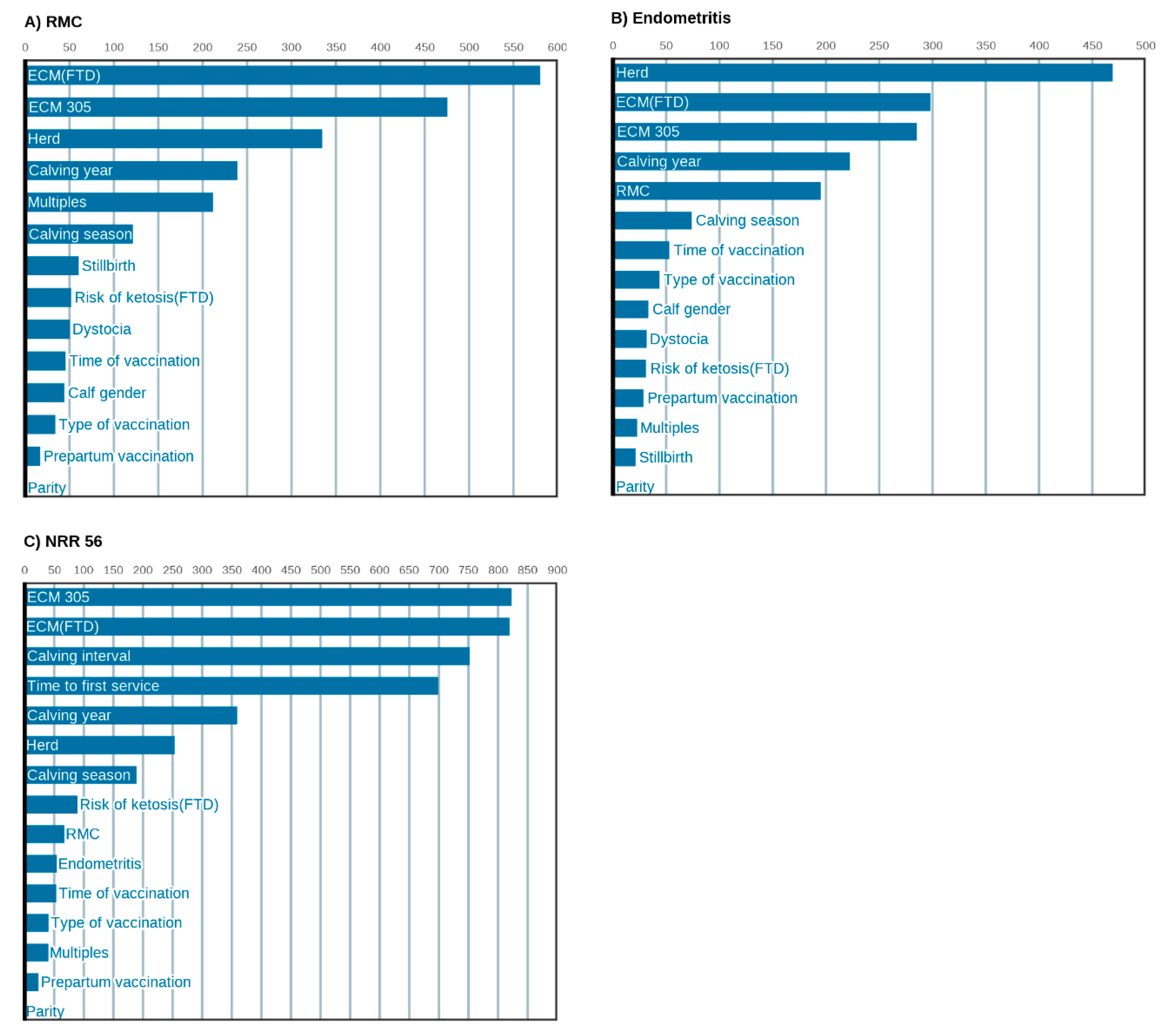
Figure 2.
Association between time of prepartum vaccination and uterine health and fertility parameters in non-live vaccinated cows. Predicted probabilities and 95% confidence intervals are derived from multivariable models. See File S3 for p-values, odds ratios and confidence intervals for all predictors. P-values are marked with *if below the adapted significance threshold, depending on the number of observations between 0.0051 and 0.0054. The vertical dotted line separates NRR56 from the other response variables due to an inverse association as compared to RMC and Endometritis: while higher RMC and Endometritis rates are undesirable, higher NNR56 rates represent better fertility.
Figure 2.
Association between time of prepartum vaccination and uterine health and fertility parameters in non-live vaccinated cows. Predicted probabilities and 95% confidence intervals are derived from multivariable models. See File S3 for p-values, odds ratios and confidence intervals for all predictors. P-values are marked with *if below the adapted significance threshold, depending on the number of observations between 0.0051 and 0.0054. The vertical dotted line separates NRR56 from the other response variables due to an inverse association as compared to RMC and Endometritis: while higher RMC and Endometritis rates are undesirable, higher NNR56 rates represent better fertility.
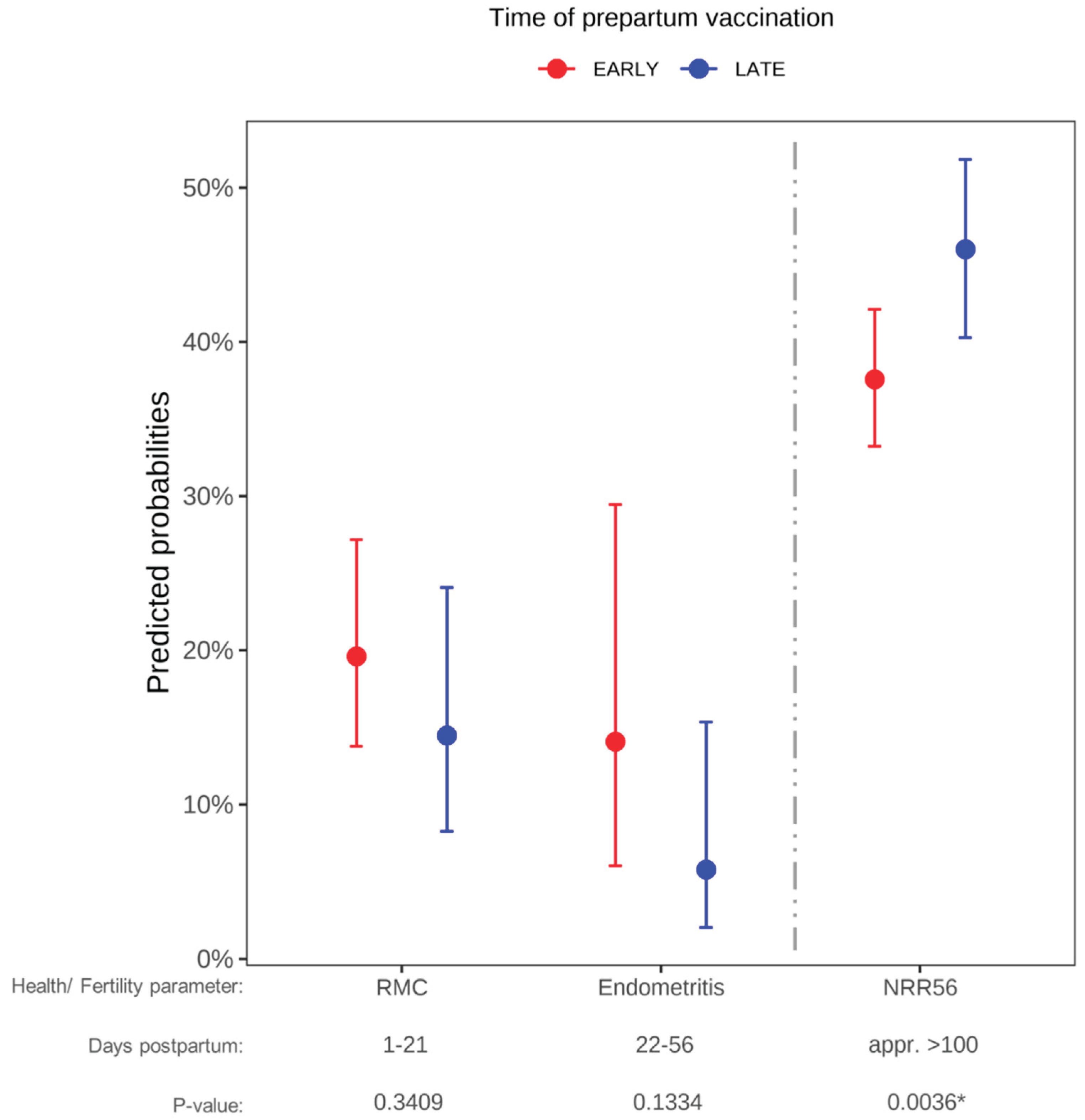

Table 1.
Numbers of transition periods by time of vaccination and type of vaccine.
| Time of prepartum vaccination | ||||||
|---|---|---|---|---|---|---|
| NON VACCa | EARLYb | LATEc | EARLY or LATEd | Total | ||
| Type of vaccine | NON VACCa | 57,166 | 0 | 0 | 0 | 57,166 |
| VACCh (N=63,228) | ||||||
| NON LIVEe | 0 | 11,238 | 6,336 | 18,199 | 35,773 | |
| MIXEDf | 0 | 519 | 7,833 | 0 | 8,352 | |
| UNKNOWNg | 0 | 18,876 | 0 | 227 | 19,103 | |
| Total | 57,166 | 30,633 | 14,169 | 18,426 | 120,394 | |
ano vaccination during the dry period; bvaccination between 6 and 8 weeks before expected calving date; cvaccination between 2.5 and 4 weeks before expected calving date; dvaccination between 2.5 and 8 weeks before expected calving date; evaccination with vaccines containing only non-live components; fvaccination with a vaccine containing live and non-live components; gvaccination with unknown components; hvaccination with any type of vaccine during dry period.
Table 2.
Means of milk yield and time to first service of prepartum vaccinated or non-vaccinated primiparous and multiparous cows.
Table 2.
Means of milk yield and time to first service of prepartum vaccinated or non-vaccinated primiparous and multiparous cows.
| Primiparous cows | Multiparous cows | |||
|---|---|---|---|---|
|
n: |
NON VACCa 27,081 |
VACCb 19,028 |
NON VACCa 30,085 |
VACCb 44,200 |
| ECM 305c | 8,683 | 8,683 | 10,968 | 10,371 |
| Time to first serviced | 73 | 72 | 75 | 75 |
ano vaccination during the dry period; bvaccination during dry period; cenergy corrected milk yield in 305 days of lactation (kg); din days.
Table 3.
Multivariable models: Associations between prepartum vaccine type and uterine health and fertility in primiparous cow.
Table 3.
Multivariable models: Associations between prepartum vaccine type and uterine health and fertility in primiparous cow.
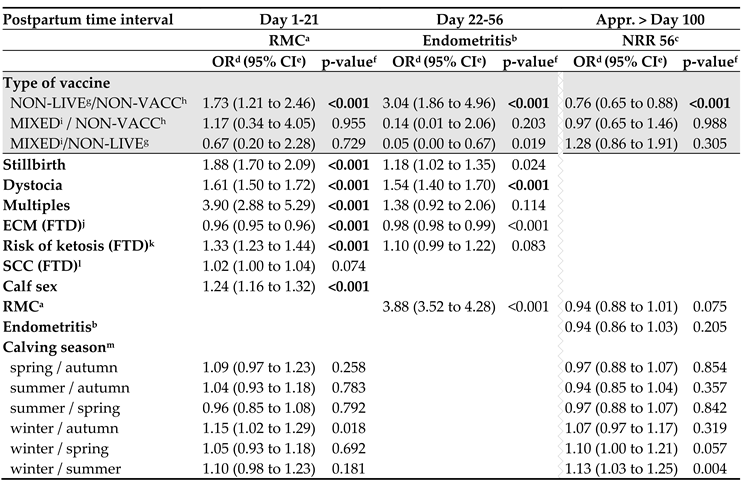 |
aAggregation of Retained placenta and Metritis within day 1-21 postpartum; bEndometritis within day 22-56 postpartum; cNon-Return-Rate refers to day 56 after first service; dOdds Ratio for pairwise contrasts; eConfidence Interval; fp-values are marked bold, if below the adapted significance threshold, of 0.003; gvaccination during the dry period with a vaccine, consisting of only non-live components; hno vaccination during the dry period; ivaccination during the dry period with a vaccine, consisting of live and non-live components; jEnergy corrected milk yield on the first day of milk testing; kKetotic risk was assumed, if the fat-protein-ratio exceeds 1.4 and lower limits of protein content (Emin) are undercut or upper limits of fat content (Fmax) are passed on the first day of milk testing. Emin = (4,11 -0,023 kg milk/day) (1 - 0,35/3,51). Fmax = (5,06 -0,033 kg milk/day) (1 + 0,68/4,20); lSomatic cell count of the first test day, logarithmically transformed; mspring (March-May), summer (June-August), autumn (September-November), winter (December-February).
Table 4.
Multivariable models: Association between vaccine type and uterine health and fertility in multiparous cow.
Table 4.
Multivariable models: Association between vaccine type and uterine health and fertility in multiparous cow.
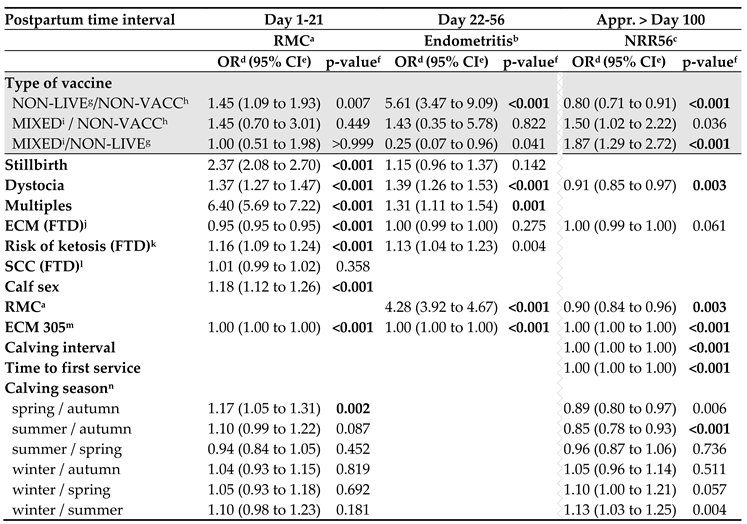 |
aAggregation of Retained placenta and Metritis within day 1-21 postpartum; bEndometritis within day 22-56 postpartum; cNon-Return-Rate refers to day 56 after first service; dOdds Ratio for pairwise contrasts; eConfidence Interval; fp-values are marked bold, if below the adapted significance threshold, of 0.003; gvaccination during the dry period with a vaccine, consisting of only non-live components; hno vaccination during the dry period; ivaccination during the dry period with a vaccine, consisting of live and non-live components; jEnergy corrected milk yield on the first day of milk testing; kKetotic risk was assumed, if the fat-protein-ratio exceeds 1.4 and lower limits of protein content (Emin) are undercut or upper limits of fat content (Fmax) are passed on the first day of milk testing. Emin = (4,11 -0,023 kg milk/day) (1 - 0,35/3,51). Fmax = (5,06 -0,033 kg milk/day) (1 + 0,68/4,20); lSomatic cell count of the first test day, logarithmically transformed; mEnergy corrected milk yield in 305 days of the previous lactation; nspring (March-May), summer (June-August), autumn (September-November), winter (December-February). Generalized linear mixed effects models were conducted, applying the variables herd and calving year as random effects. Empty fields arise because the variable was either not significant in the corresponding univariable analysis or was eliminated by manual backward selection. The vertical wiggly line separates NRR56 from the other response variables due to an inverse association as compared to RMC and Endometritis: while higher RMC and Endometritis rates are undesirable, higher NNR56 rates represent better fertility. All variables and definitions are listed in Table S1.
Disclaimer/Publisher’s Note: The statements, opinions and data contained in all publications are solely those of the individual author(s) and contributor(s) and not of MDPI and/or the editor(s). MDPI and/or the editor(s) disclaim responsibility for any injury to people or property resulting from any ideas, methods, instructions or products referred to in the content. |
© 2025 by the authors. Licensee MDPI, Basel, Switzerland. This article is an open access article distributed under the terms and conditions of the Creative Commons Attribution (CC BY) license (https://creativecommons.org/licenses/by/4.0/).
Copyright: This open access article is published under a Creative Commons CC BY 4.0 license, which permit the free download, distribution, and reuse, provided that the author and preprint are cited in any reuse.


