

Submitted:
14 August 2025
Posted:
14 August 2025
You are already at the latest version
Abstract
This review article systematically examines state-of-the-art applications and emerging trends in integrating modern digital technologies within industrial companies, while also addressing the key challenges hindering their effective adoption and implementation. We analyse how and automated production lines and robots, the Internet of Things (IoT), cloud computing, big data and artificial intelligence (AI) are transforming valueadded processes in smart factories—driving innovation, operational efficiency, and competitive advantage. We also explore future developments such as humanrobot collaboration, explainable AI and sustainability driven smart manufacturing. As a summary, we propose and validate a conceptual framework for digitalization of industrial companies. In the final section, our review also offers recommendations for stakeholders seeking to harness these cutting edge technologies for growth and long term competitiveness.
Keywords:
digitalization
; digital transformation
; industrial companies
; manufacturing automation
; industrial robotics
; internet of things (IoT)
; cloud computing
; big data
; artificial intelligence (AI)
1. Introduction
In recent years, manufacturing industries worldwide have accelerated their digital transformation, embracing advanced technologies from the Industry 4.0 paradigm [1]. The Fourth Industrial Revolution integrates cyber–physical systems (CPS), pervasive connectivity, and embedded intelligence into product design, production, and usage, yielding fully networked smart manufacturing systems [2]. Since 2020, adoption has been further propelled by pandemic disruptions, which underscored the need for remote operations and resilience [3], as well as by intensifying competitive pressures. Manufacturers are leveraging digital tools not only to build more agile and sustainable operations, but also to enhance efficiency and productivity.
Many countries have launched strategic initiatives—such as Germany’s ‘Industrie 4.0’ and China’s ‘Made in China 2025’ programs—aimed at leveraging digital technologies to boost productivity and foster innovation [4,5]. At their core, these initiatives are enabled by a suite of interrelated technologies, notably automation, the internet of things (IoT), cloud computing, big data, and artificial intelligence (AI), which together form the foundation of the cyber-physical systems powering modern industrial transformation. These technologies enable physical devices and processes to be monitored, optimized, and even self-organized through digital means.
However, the digital transformation of industry also raises new challenges alongside its opportunities [6]. For instance, the push for automation and connectivity can conflict with sustainability goals and security [7]. There is a pressing need to understand not only the capabilities of each key technology but also how they converge to shape industrial systems – and what obstacles must be overcome to fully realize their potential.
Implementing innovative information technologies (IT) in industrial environments is challenging for several reasons. First, many factories still operate with outdated legacy systems, making the integration of new technologies technically complex and costly. Second, companies often struggle to select appropriate technologies due to the rapid expansion and fragmentation of digital tools and platforms. Third, as IT and operational technology (OT) systems become more interconnected, the risk of cyberattacks increases significantly, requiring robust security measures. Additional barriers include the lack of standardization for cross-platform integration, the rapid pace of technological evolution affecting long-term interoperability, and persistent data quality and bias issues in AI-driven decision support. Finally, workforce adaptation remains a major challenge – many employees lack the necessary digital skills, and some are resistant to change, slowing the transition to smart manufacturing (SM).
To address these challenges, our study provides a literature review of innovative IT applications in industrial companies, with a focus on the following areas:
- Identification and classification of new technological solutions and their roles in enabling Industry 4.0 and SM ecosystems.
- Evaluation of existing industrial IT frameworks based on flexibility, scalability, interoperability, and sustainability.
- Development of a new framework for industrial digitalization through the transformation of a variety of business processes such as design creation, manufacturing processes, warehouse operations, and maintenance management.
- Analysis and assessment of major challenges and future perspectives in digital transformation, with particular emphasis on enhancing adaptability, growth potential, seamless integration, and long-term viability in the context of Industry 4.0 and Industry 5.0 technologies.
This article makes several contributions to the understanding of manufacturing digitalization. It offers a consolidated review of recent (2020–2025) advances in industrial digitalisation, identifying major new developments and analysing persistent obstacles to implementation. It also examines practical challenges and future opportunities, with special attention to the convergence of Industry 4.0 and Industry 5.0 paradigms, highlighting the growing importance of human-centred technologies and sustainability. Furthermore, the study proposes a cross-technological digital transformation architecture that illustrates how automation, IoT, cloud platforms, and AI interact within industrial ecosystems to streamline processes, improve decision-making, and strengthen resilience. The framework is verified through detailed analysis using current research and industrial practice.
The remainder of this review is structured as follows. Section 2 presents the methodology used for our review study. Section 3 examines previous review articles on innovative digitalisation technologies. Section 4 introduces a holistic digitalisation model for industry, which is later validated through a case study. Section 5 discusses the main challenges and future opportunities in the digitalisation process. Finally, Section 6 presents the conclusions, practical implications, and recommendations for future research.
2. Methodology
The methodological process was designed to capture the most recent and impactful research on digital transformation in industrial companies with a focus on its key technological enablers. This study follows the PRISMA (Preferred Reporting Items for Systematic Reviews and Meta-Analyses) guidelines [8], a widely recognized protocol for conducting structured literature reviews in technical domains. PRISMA provides a systematic process for identifying, screening, and including relevant studies based on predefined criteria, ensuring both clarity and reproducibility. In accordance with these protocols, a structured literature search was conducted on 31 July 2025 to identify peer-reviewed journal publications addressing digital transformation in industrial enterprises.
The focus was placed on the core technologies of SM. The search was limited to journal articles and review papers published in English between 2020 and 2025 to ensure coverage of the most recent developments. An Open Access filter was applied to guarantee full-text availability for analysis. Searches were conducted in two main academic databases – Scopus and Web of Science (WoS) (Figure 1), using the following queries and filters:
-
Scopus:((digitalization OR digitization OR "digital transformation") AND "industry" AND "smart manufacturing") AND (("Internet of Things" OR IoT) OR ("artificial intelligence" OR AI) OR (robotics OR automation) OR ("big data" OR "cloud computing")) AND PUBYEAR > 2019 AND PUBYEAR < 2026 AND (LIMIT-TO (OA, "all")) AND (LIMIT-TO (LANGUAGE, "English")) AND (LIMIT-TO (DOCTYPE, "ar") OR LIMIT-TO (DOCTYPE, "re"))This search returned n = 4,029 articles.
-
WoS:TS = (("digital transformation" OR digitalization OR digitization) AND "smart manufacturing" AND "industry" AND ("Internet of Things" OR IoT OR "Artificial Intelligence" OR AI OR robotics OR automation OR "big data" OR "cloud computing")) AND PY = (2020-2025) AND LA = (English) AND DT = (Article OR Review)An additional manual Open Access filter was applied, yielding n = 87 articles.
To ensure quality and relevance, only articles indexed in both Scopus and WoS were retained, resulting in 75 publications. Manual screening then excluded:
- 7 articles that did not meet full Open Access criteria (e.g., paid access or restricted institutional access);
- 7 articles with a primarily economic, managerial, or educational focus and insufficient discussion of technological aspects.
The final dataset comprised 61 articles, categorized as follows:
- 17 review articles providing consolidated insights and thematic syntheses;
- 44 original research articles presenting empirical findings or technological developments.
This methodology ensures the final selection is thematically aligned with the review’s objective to map the digital transformation landscape in industrial enterprises while maintaining transparency and reproducibility.
3. Related Work
This section starts with a review of review articles to establish the study’s foundation. As described in the methodology, our review includes 17 prior survey articles and 44 original research studies. Section 3.1 examines the review articles and Section 3.2 the research articles. The review articles provide a consolidated perspective on industrial digital transformation, summarizing research trends, identifying knowledge gaps, and outlining practical applications. The original research articles complement this by presenting empirical evidence and demonstrating technological advancements in SM. Together, these two reference groups frame our study, clarify interconnections among digital technologies, and inform implementation strategies and future research. To enhance clarity and highlight thematic links, the discussion is organized by major technological focus areas rather than chronologically.
3.1. State-of-the-Art in Industrial Transformation According to Review Articles
The selected review articles collectively map the technological, methodological, and strategic dimensions of industrial digitalisation under the Industry 4.0 paradigm. Their scope ranges from technology-specific analyses to sector-focused studies and conceptual frameworks, but most focus narrowly on one or two technologies, offering limited cross-technology guidance.
Several reviews are technology-centred, with AI and machine learning (ML) dominating the focus. Çınar et al. [9] review ML for predictive maintenance, identifying supervised methods such as random forest, support vector machines, and neural networks as prevalent, but noting low industrial uptake and advocating hybrid models and cloud-based solutions. Burzyńska [10] examines AI/ML in defect diagnosis within a Quality 4.0 context, highlighting high model accuracy but significant data quality and deployment barriers. Gargalo et al. [11] analyse hybrid modelling in (bio)chemical engineering, showing its potential for optimisation and sustainability but also its integration and interpretability challenges. Ghosh et al. [12] evaluate AI-driven surface roughness evaluation, noting deep learning (DL) effectiveness but also a lack of benchmark datasets and transparency.
A distinct cluster of reviews deals with digital twin (DT) technology and its integration. Onaji et al. [13] present a layered DT framework for manufacturing, emphasizing predictive maintenance and optimization benefits alongside infrastructure challenges. Wang et al. [14] highlight DT’s role in efficiency and sustainability in the energy sector.
Other reviews focus on integrating digitalisation with established operational philosophies. Escobar et al. [15] address the transition to Quality 4.0, recommending AI-enhanced predictive analytics with governance for explainability. Benslimane et al. [16] investigate the convergence of Lean Manufacturing and Industry 4.0, noting mutual benefits but also cultural, technical, and skills-related barriers.
Strategic and ecosystem perspectives are addressed by Suuronen et al. [17], who examine Digital Business Ecosystems and their enabling conditions, benefits, and obstacles, and Serey et al. [17], who propose a framework for aligning Industry 4.0 adoption with organisational strategy. Voinea et al. [19] map industrial augmented reality (AR) trends, noting integration with AI and IoT but also cost and usability issues. Salierno et al. [20] compare Europe’s “digital factory” and China’s “cloud manufacturing”, identifying interoperability as a shared challenge.
Sector- and connectivity-specific studies include Isoko et al. [21], who investigate Industry 4.0 enablers in biopharmaceutical manufacturing and call for standardized integration models, and Qiu et al. [22], who review industrial IoT (IIoT) adoption and advocate fully integrated architectures combining 5G, cloud, edge AI, and DT. Kamble et al. [23] propose a performance measurement framework for automotive Small and Medium-sized Enterprises (SMEs).
Bibliometric and cross-technology perspectives are offered by Reyes Domínguez et al. [24], who explore global Industry 4.0 research trends and urge stronger integration of sustainability with emerging technologies, and by Wang and Jiao [25], who focus on human–automation collaboration with adaptive AI and cognitive modelling.
To summarize these review articles, Table 1 presents a comparative overview based on key aspects: study objectives, utilized digital technologies, and key results and suggestions.
Based on the collected data (Table 1), the review articles on the integration of digital technologies in manufacturing reveal diverse research focuses, which can be grouped into business process enhancement, quality improvement, lean practice, technological integration, and targeted industries. In the business process enhancement group, AI is the most commonly used technology, supporting tasks like predictive maintenance, surface diagnostics, and decision-making [9,11,25]. AR/VR improves training and collaboration [17,23], though high costs and usability issues remain [19]. IoT and IIoT technologies are essential for real-time monitoring and connectivity, with full integration offering higher productivity and efficiency [20,22].
Predictive diagnostics and modelling are prominent in industrial AI applications. Çınar et al. [9] and Ghosh et al. [12] highlight supervised learning and DL in PdM and surface roughness prediction. Burzynska [10] focuses on defect diagnosis using CNNs. Gargalo et al. [11] presents hybrid modelling that merges ML and mechanistic models for robust industrial optimization.
The studies from the second group emphasize the evolution of quality management through AI-enhanced control systems. Escobar et al. [15] recommend combining classical methods with predictive analytics. Wang and Jiao [25] focus on real-time inspection, while Ghosh et al. [12] highlight DL-based surface monitoring. These approaches support adaptive, data-driven quality control.
In the next group, Benslimane et al. [16] is the only review that addresses lean manufacturing (LM) and Industry 4.0 integration, identifying mutual reinforcement and barriers like cultural shifts and system compatibility.
In the technological integration group, Onaji et al. [13] and Gargalo et al. [11] showcase the integration of DT and ML for real-time optimization, while Wang and Jiao [25] explore combining smart inspections with human–automation interaction. These integrations offer adaptability and efficiency but face challenges like coordination, accuracy, and infrastructure needs.
Finally, in the targeted industries group, sector-specific studies include automotive SMEs [23], biochemical engineering [11], bioprocessing [21], and metal casting [10], while most other works offer general manufacturing insights applicable to multiple industrial contexts.
Several of the 17 reviewed studies propose strategic or conceptual frameworks to guide SM under the Industry 4.0 paradigm, each focusing on different aspects – technology integration, performance measurement, strategic alignment, or operational intelligence:
- Strategic alignment frameworks are seen in Serey et al. [18], who emphasize that digital transformation in industrial firms must align technological investments with business models, workforce reskilling, and integrated digital ecosystems, and Isoko et al. [21], who propose an operational roadmap for bioprocessing 4.0.
- Technical and architectural frameworks appear in Onaji et al. [13] and Wang & Jiao [25]. Onaji et al. present a layered DT architecture combining physical systems, data infrastructure, and decision-making analytics, while Wang & Jiao introduce a framework for merging smart in-process inspection with human–automation symbiosis, supporting real-time defect identification and adaptive task allocation. Performance evaluation framework is outlined by Kamble et al. [23], who validate a multi-dimensional SM Performance Measurement System (SMPMS) for SMEs, linking Industry 4.0 investments to outcomes such as flexibility, real-time analytics, and sustainability.
Despite valuable findings, the reviewed studies often treat technologies and strategic actions in isolation. In practice, industrial digital transformation is dynamic, multi-layered, and interdependent – where IoT feeds AI models, which drive CPS, which in turn inform DT simulations and optimization. The challenge remains to design cross-technology frameworks that capture these feedback loops and address integration at both technical and organizational levels.
3.2. State-of-the-Art in Widely Used Technologies in Smart Manufacturing According to Research Articles
This subsection examines 44 original research articles that present empirical findings and detail technological developments in SM. These studies demonstrate how advanced information technologies are integrated to enhance flexibility, efficiency, and responsiveness across manufacturing value chains. In particular, they showcase applications of industrial automation, IoT, cloud computing and AI to digitize business processes, enable real-time decision-making, and build interconnected production ecosystems. For each of these core technologies, we outline the current state of the art, discuss key challenges encountered in implementation, and consider future perspectives crucial to advancing industrial digitalization.
Industrial Automation and Robotics
A thematic analysis of the 44 selected research articles identified 22 that address or intersect with topics in robotics and/or automation. These studies collectively illustrate recent advancements in industrial automation and robotics under the Industry 4.0 paradigm, revealing a shift toward interconnected, smart, and adaptive manufacturing environments.
At the systems architecture level, Kahveci et al. [27] developed a five-layer IoT-based big data analytics platform enabling structured data flow and interoperability, successfully deployed in an electric vehicle battery assembly setting. Sverko et al. [28] and Martinez-Gutiérrez et al. [29] both contribute to automation frameworks: the former enhances Supervisory Control and Data Acquisition (SCADA)-based industrial control systems for steel manufacturing, while the latter demonstrates hyperconnectivity between CPS, cloud, and human actors with low latency.
Smart factory implementation is further explored by Ryalat et al. [30], who propose a CPS-based hierarchical model supporting modular, real-time automation. Ahn et al. [31] address digital transformation through their Production System Maturity Model (PSMM), evaluating automation levels in Manufacturing Execution System (MES) for unmanned operations. Complementing this, Ryalat et al. [32] emphasize mechatronic integration – robotics, AI, IoT, and big data, as a cornerstone for adaptive and sustainable manufacturing.
Several studies apply AI-driven techniques to specific industrial automation problems. Nagy et al. [33] highlight the role of autonomous robots, deep learning, and virtual simulation for SME competitiveness. Khalil et al. [34] utilize fuzzy logic to predict fabric seam strength, enhancing smart textile automation. Kim et al. [35] implement deep learning with a line-scan camera for high-speed PCB defect detection in SMEs, achieving 99.5% accuracy. Similarly, Mu et al. [36] integrate sensor fusion and ML in a digital shadow approach to monitor defects in additive manufacturing in real time.
Singh et al. [37] introduce a DT framework for robotic arms using Unity and Robot Operating System (ROS). The system offers low latency and near-perfect motion accuracy, validating its utility for scalable and interoperable automation in Industry 4.0 environments.
Together, these studies reflect a growing trend toward real-time, AI-enabled, and interoperable automation solutions, with applications spanning SCADA enhancement, CPS deployment, and robotic systems.
IoT and IIoT
Within the context of Industry 4.0 and 5.0, IoT technologies have a pivotal role of industrial digitalization. They facilitate real-time data collection, communication, and automation across CPS, supporting smarter and more connected production environments. The analysis of the selected articles will highlight key contributions that illustrate how IoT is being integrated into manufacturing systems to enhance efficiency, interoperability, and sustainability.
Of the 44 research articles initially selected, 18 address IoT in some capacity, underscoring its relevance within the broader context of industrial digitalization. Although not all these studies exclusively focus on IoT, they collectively highlight its role in enabling real-time data collection, connectivity, and system integration in modern manufacturing. The following analysis will focus on the most prominent studies from this group, examining the diverse ways IoT is influencing manufacturing processes and driving innovation in industrial environments.
Several studies explore how IoT-based architectures are advancing SM by enhancing data acquisition, processing, and decision-making. In this direction are the studies of Lee et al. [38] and Shahbazi et al. [39] which propose systems integrating IoT with edge computing, blockchain, and ML, emphasizing improved latency, secure transactions, and optimized task allocation. Martinez-Gutiérrez et al. [29] and Ryalat et al. (2023) [30] present frameworks for hyperconnected, cyber-physical smart factories. These demonstrate less than 10 ms real-time responsiveness and support modular, intelligent production. Kahveci et al. [27] showcases a layered IoT-based big data analytics platform deployed in an electric vehicle battery assembly process, enhancing interoperability and decision support.
Another key focus is the evolution of industrial control systems, particularly SCADA, through the adoption of IIoT. Dakhnovich et al. [40] addresses security vulnerabilities in IIoT-enabled SCADA networks, proposing garlic-routing-based multipath routing to ensure secure data exchange in peer-to-peer industrial environments. Sverko et al. [28] analyses the transformation of SCADA architectures in the steel industry, highlighting cross-layer integration and IoT as key to interoperability.
IoT plays a vital role in enabling digital transformation for SMEs. In this regard, Alexopoulos et al. [41] demonstrates how integrating IoT and open-source digital tools into a mold shop improved planning and monitoring. Saha et al. [42] introduces a low-cost IoT-based productivity monitoring system for Computer Numerical Control (CNC) machines using current sensors, offering high accuracy and scalability for SMEs. Tanane et al. [43] proposes a Total Manufacturing Quality 4.0 (TMQ 4.0) system using IoT and historical data, demonstrating its feasibility in small-scale high-precision manufacturing.
Sustainability emerges as an essential dimension in the application of IoT. The environmental impact of IoT and its role in sustainable development is examined. Fraga-Lamas et al. [44] explores green IoT (G-IoT) and edge AI integration, presenting a smart workshop use case that balances energy efficiency, process safety, and environmental impact under Industry 5.0. Ali et al. [45] investigates IoT, reverse engineering, and additive manufacturing, showcasing improved energy efficiency, customization, and waste reduction aligned with sustainability goals.
These studies demonstrate the transformative role of IoT in today’s manufacturing. They span architectural innovation, secure communication, productivity monitoring, SME support, and sustainable development. Although varying in focus, they collectively underscore IoT’s centrality in achieving flexible, data-driven, and environmentally conscious industrial systems under the evolving Industry 4.0 and 5.0 paradigms.
Cloud Computing and Big Data
The rapid digital transformation of industry, catalysed by Industry 4.0, has placed cloud computing and big data at the forefront of SM. These technologies enable real-time data processing, scalable storage, and advanced analytics, forming the foundation for intelligent decision-making and agile production systems. Among the 44 selected research articles, 12 were identified as being related to cloud computing and/or big data. The following analysis examines the standout articles to show how these technologies are applied in an industrial environment, revealing their role in optimizing operations, improving system interoperability, and driving innovation in manufacturing companies.
Recent advancements in cloud computing and big data have significantly contributed to the digital transformation of industrial systems under Industry 4.0 and 5.0. A recurring theme across several studies is the integration of cloud-based architectures with data analytics platforms to enable real-time decision-making, scalability, and operational optimization.
Martínez-Gutiérrez et al. [46] present a DT framework for automating Automated Guided Vehicle (AGV) transportation that relies on cloud computing and Industrial Ethernet for offsite access and real-time simulation. The system demonstrates high accuracy and hyperconnectivity, offering a robust foundation for scalable SM environments.
Kahveci et al. [27] also focus on cloud-integrated big data platforms tailored for IoT-enabled factories. Their architecture, deployed in an electric vehicle battery module assembly line, emphasizes modularity and interoperability, supporting real-time analytics and visualization for process improvement. Similarly, Sverko et al. [28] underscore the transformation of SCADA systems through cloud technologies and big data, enabling enhanced interoperability and flexible control in continuous manufacturing.
In the context of SMEs, Bianchini et al. [47] highlight how MES, powered by smart data approaches and key performance indicators, facilitate the adoption of digital technologies despite resource limitations. This structured use of big data enables continuous improvement in SME operations.
From a broader perspective, Akundi et al. [48] emphasize the centrality of cloud computing and big data in Industry 5.0 through a comprehensive text mining study. These technologies are consistently linked to enterprise digitization, human-machine integration, and supply chain optimization, marking them as pillars of future industrial systems.
The integration of AI into edge and cloud infrastructures is also gaining momentum. Asghar et al. [49] introduce the concept of “edge intelligence”, suggesting that AI deployed at the network edge can significantly enhance data processing and mobility services, preparing the ground for next-generation 6G applications. Ryalat et al. [32] further illustrate AI’s role in optimizing logistics through dynamic scheduling and predictive maintenance based on IoT-collected data.
Zhang et al. [50] propose the DT Systems Engineering (DTSE) concept, integrating cloud-based digital twins with systems engineering to support industrial metaverse applications. Their work highlights AI’s role in expanding DTSE’s capabilities, particularly in complex domains like aviation.
These studies reveal a multifaceted application of cloud computing and big data, driving innovation in automation, simulation, logistics, and intelligent decision support across industrial domains.
AI
AI has rapidly emerged as a pivotal factor of industrial digitalization, reshaping how manufacturing systems perceive, decide, and adapt. Advances in MP, DL computer vision, and natural language processing (NLP) have expanded AI’s role from isolated automation tasks to fully integrated decision-making engines within cyber–physical production environments. These technologies enable predictive, prescriptive, and adaptive capabilities, supporting goals such as defect prevention, energy optimization, supply chain agility, and human–machine collaboration.
An examination of the selected 44 original research articles identified in this review shows that 17 of them address AI directly or incorporate AI-powered components into broader digital transformation initiatives. This significant share underlines AI’s cross-cutting influence across diverse Industry 4.0 domains – from predictive maintenance and quality inspection to production scheduling and DT development. The following overview presents representative contributions from these studies, outlining how AI is operationalized in manufacturing, the prevailing technical approaches, and the main challenges to scaling these solutions in industrial contexts.
The reviewed articles present a diverse yet complementary range of AI applications advancing the transformation of industrial enterprises. Several studies, including those by Lee et al. [38] and Fraga-Lamas et al. [44], focus on embedding AI into distributed and sustainable edge computing environments. Lee et al. leverage swarm intelligence for low-latency edge–cloud task scheduling, while Fraga-Lamas et al. emphasize “green AI” for energy-efficient IoT operations.
Others, such as Stojadinovic et al. [51], apply a hybrid of ontologies and bio-inspired algorithms (genetic algorithms and ant colony optimization) to optimize metrology in Industry 4.0. Asghar et al. [49] and Gellert et al. [52] explore AI’s role in next generation wireless communication (6G) and real-time operator assistance via hybrid Markov-A* tree search models. Chen et al. [53] propose a “Four-Know”/“Four-Level” ML taxonomy and pipeline for AI implementation, while Chinnathai and Alkan [54] embed Long Short-Term Memory (LSTM)-based forecasting into a digital life-cycle framework to enhance energy efficiency in EIIs.
Cognitive AI’s transformative role is further developed by Hozdić and Makovec [55], who argue for AI-augmented human–machine symbiosis in cognitive CPSs. Chiang et al. [56] highlight AI’s integrative role in supply chain decision-making, and Kim et al. [35] demonstrate superior defect detection via DL in Printed Circuit Board (PCB) inspection. Tanane et al. [43] propose a semi-supervised AI-driven TMQ 4.0 framework for SMEs, addressing data scarcity and contextualization issues.
Zhang et al. [50] present an AI-augmented DT Systems Engineering model to drive the industrial metaverse, combining NLP, generative AI, computer vision, and predictive analytics. Collectively, these works demonstrate AI’s central role in automation, sustainability, human–machine collaboration, and smart system optimization across evolving Industry 4.0 and 5.0 paradigms.
The analysed articles offer valuable but fragmented insights. The predominance of single-technology perspectives limits their utility for guiding holistic digital transformation. Only a minority provide implementation-oriented frameworks, and cross-technology relationships, especially in dynamic, real-world industrial settings, are seldom explored. This fragmentation reinforces the need for a systematic, integrative framework that not only synthesises existing knowledge but also maps the interdependencies between multiple Industry 4.0 technologies, operational strategies, and sector-specific requirements. To address these gaps, the next section proposes a unified and adaptive framework designed to guide the integration of modern IT in a holistic and dynamic way.
4. Conceptual Framework for Industrial Digitalization
This section presents a new conceptual framework for the digitalization of industrial companies within the Industry 4.0 context (Figure 2). The framework provides a structured approach that supports core functional areas and business processes. It acts both as a strategic compass, aligning digital initiatives with long-term business objectives, and as an operational roadmap, coordinating implementation across technical, human, and organizational domains. Its purpose is to help companies move from fragmented, technology-driven projects toward value-centred smart manufacturing ecosystems, where interconnected IT solutions work synergistically to enhance productivity and competitiveness.
4.1. Framework Design and Structure
The proposed framework is built as a multi-layered, intelligent architecture that integrates machines, data, software, and people into a unified industrial ecosystem. Its foundation, Layer 1 – the physical layer, encompasses all production assets, from semi-automated workstations involving human operators to fully automated systems such as robotic arms, CNC machines, and AGVs operating independently. Equipped with sensors and actuators, these assets continuously capture key operational data, including temperature, pressure, movement, and quality indicators, serving as the primary bridge between the physical and digital worlds.
Data generated in Layer 1 is immediately transferred to Layer 2 – the device or edge layer, where real-time acquisition and initial processing take place. At this stage, IoT gateways, programmable logic controllers (PLCs), and edge computing devices handle machine-level data close to its source. In some cases, edge AI algorithms enable instant actions such as defect detection, equipment failure prediction, or alarm triggering. This layer is critical for rapid responsiveness, particularly in time-sensitive or safety-critical operations. In semi-automated systems, it also serves as the point of human–machine interaction, often enhanced by smart interfaces or augmented reality tools.
Layer 3 – the fog computing environment—serves as an intermediate coordination stage between the edge and cloud systems. At this level, data from multiple machines and edge devices across the plant is aggregated, synchronized, and analysed. Fog nodes, typically hosted on local servers or industrial PCs, enable high-resolution analytics and the coordination of production activities without sending all data to the cloud. This layer often incorporates MES and DTs, providing real-time workflow visibility, scenario simulation, and dynamic process adjustments. In facilities with both human-operated and robotic stations, Layer 3 functions as the central hub that integrates diverse processes into a unified and optimized production flow.
A special case within this layer is the warehouse system, which often requires dedicated software due to its complexity and logistics-specific needs. Modern Warehouse Management Systems (WMS) handle inventory tracking, automated storage and retrieval systems (ASRS), picking strategies, order consolidation, and logistics coordination. In highly digitalized environments, WMS may integrate with mobile robots, barcode scanners, and RFID systems, collecting data in real time and making autonomous adjustments to inventory flows. These systems are often tightly coupled with MES and ERP platforms, enabling synchronized production and delivery schedules. In some settings, warehouses also use edge computing for local optimization and buffering, while leveraging cloud analytics for broader supply chain visibility.
Layer 4 – the cloud layer, operates above the plant level, aggregating data from multiple facilities or departments to provide enterprise-wide intelligence. It encompasses platforms for data storage, ML, business analytics, and enterprise systems such as ERP, CRM, and SCM. Within this layer, DL algorithms can be trained on extensive historical datasets, enabling long-term trend analysis, predictive modelling, and global optimization across product lines or geographic regions. For instance, cloud-based AI can forecast market demand, recommend supply chain adjustments, or detect efficiency gaps across facilities. In doing so, cloud intelligence extends digitalization from individual machines or factories to the entire organizational ecosystem.
The Decision Support Layer acts as a bridge between the operational layers (edge and fog) and the enterprise-wide intelligence in the cloud. Its primary role is to ensure that automated data processing and AI-generated insights are translated into clear, actionable information for human decision-makers. This layer aggregates and contextualizes data from multiple sources, including MES, WMS, ERP/MRP, and AI analytics, presenting it in a form that supports transparency, interpretability, and trust. Key functions include providing explainable AI (XAI) outputs, enabling human-in-the-loop control for handling exceptions or non-standard situations, and supporting scenario simulation and what-if analysis using digital twin technologies. The layer also facilitates cross-department coordination, ensuring that operational realities are aligned with strategic objectives. The layer is closely linked to strategic management, as it allows top management to base long-term planning on real-time operational data while enabling operational teams to align their activities with overarching business goals. This integration strengthens responsiveness, adaptability, and strategic coherence across the organization.
In the flowchart, strategic management block is placed above cloud-based ERP and other operational systems because it defines the overriding vision, long-term objectives, and resource allocation strategies that guide how these digital tools are selected, integrated, and leveraged—ensuring technology adoption aligns with business goals rather than driving them in isolation.
The key advantages of this digitalization framework lie in its scalability, responsiveness, and intelligence. By distributing data processing across edge, fog, and cloud layers, the system achieves both low-latency control and long-term strategic insight. This architecture supports real-time decision-making on the factory floor, while enabling enterprise-wide optimization from the cloud. Moreover, the integration of semi-automated workstations ensures that human skill remains embedded in the digital workflow—making the system more resilient to uncertainties, such as changes in product types, customer demands, or supply chain disruptions.
Another important benefit is modularity. Companies, especially SMEs, can adopt the framework gradually—starting with sensorization and edge-level analytics, then integrating fog coordination, cloud-based intelligence, and AI tools as their capabilities mature. This flexible, layered approach enables cost-effective digital transformation, tailored to the organization’s size, maturity, and sector-specific needs.
In summary, this multi-layered architecture provides a robust, intelligent, and human-aware structure for achieving industrial digitalization. It supports hybrid workflows with both operator-driven stations and autonomous systems, enabling enhanced productivity, quality, and strategic agility in a connected manufacturing environment.
However, several limitations should be noted. Relying on virtual channels between modules can introduce cybersecurity vulnerabilities, which may be more difficult for SMEs with limited IT capacity to address. The central dependence on the local information system could also lead to bottlenecks if not properly optimized. Finally, even with a modular implementation approach, successful adoption will require staff training and adaptation, both of which can be challenging for smaller teams.
The proposed framework enables low-latency, intelligent control while ensuring strategic coordination across all manufacturing business processes. It aligns with the objectives of Industry 4.0 and Industry 5.0 by embedding intelligence at multiple system levels, fostering scalability, sustainability, and autonomy. The design ensures seamless integration and coordination among functions while preserving the flexibility required to adapt to dynamic manufacturing environments, where resource performance, operational conditions, and production demands may change over time.
4.2. Framework Verification
To verify the applicability and effectiveness of the proposed digitalization framework, we conducted a case study on a manufacturing company specializing in smart home systems. The company implemented the framework three years ago, integrating collaborative robots, a MES, an ERP platform, and advanced planning tools within an edge and fog computing environment, as outlined in Figure 2. The verification process involved mapping the company’s current technological status against each framework layer and identifying corresponding implementation priorities (Table 2).
At Layer 1, the company operates a mix of semi-automated and automated workstations, with only partial sensorization. The framework recommends expanding sensorization to all equipment to ensure complete data capture from the production floor.
Layer 2 shows some progress, with PLCs and IoT gateways enabling partial real-time data collection. However, the lack of systematic edge analytics limits responsiveness. Introducing edge-level analytics, particularly for predictive maintenance, would strengthen operational resilience and reduce downtime.
At Layer 3, the company has a partially deployed MES but no full fog computing integration. The framework suggests the deployment of digital twins and improved fog-level coordination to optimize workflows across different production stations.
The Warehouse System currently relies on basic inventory management with barcode scanning. Integration of a WMS with the MES, alongside the introduction of ASRS or mobile robotics, is recommended to enhance logistics efficiency and synchronization with production schedules.
Layer 4 is supported by an ERP system, but cloud analytics capabilities remain limited. Adoption of cloud-based AI for demand forecasting, global optimization, and long-term predictive modelling would significantly expand strategic decision-making capabilities.
Finally, layer Human-Centric Decision Support is limited to basic dashboards without advanced decision support or XAI modules. The framework recommends enhancing decision-making interfaces with XAI tools to strengthen trust, transparency, and adaptability in human–machine collaboration.
This verification demonstrates that while the company has already implemented several foundational components of the proposed framework, there is substantial potential for further digital transformation, particularly through sensorization, edge and fog integration, cloud analytics, and human-centred AI systems. The structured, layered approach of the framework enables a phased, resource-conscious implementation path aligned with the company’s operational priorities.
Table 2 shows how each part of the framework is reflected in real-world company operations.
The adoption process followed the framework’s core principles: alignment of business processes with centralized ERP/MRP modules; integration of MES for real-time production monitoring and control; and use of edge/fog layers to reduce latency, improve data processing efficiency, and enable distributed decision-making.
Performance evaluation was based on publicly available financial reports covering the three-year period before and after framework adoption. The post-implementation data showed a consistent upward trend in all key financial indicators, with the most notable improvement in net profit. In addition to higher profitability, the company reported enhanced production flexibility, reduced lead times, and more efficient resource utilization. These improvements align with the framework’s objectives of creating adaptive, interconnected, and data-driven manufacturing environments. Notably, these positive results were achieved under conditions of partial implementation, suggesting that even greater benefits may be realized once the framework is fully deployed.
The case study demonstrates that the proposed multi-layer digitalization framework is both conceptually robust and practically applicable to companies operating in industrial environment. By mapping the company’s current capabilities against the framework’s components, we identified areas of strong alignment, particularly in basic automation and ERP-supported operations, as well as critical gaps in advanced analytics, edge AI integration, and cross-layer coordination. This analysis confirms the framework’s adaptability to different digital maturity levels, enabling phased implementation according to available resources and strategic priorities. The results highlight its potential to guide manufacturing companies towards enhanced flexibility, responsiveness, and resilience, while providing a structured roadmap for scaling digital transformation in a cost-effective and sustainable manner.
5. Discussion
This section synthesizes the key challenges and future perspectives in industrial digitalization as identified in the reviewed literature. Drawing on insights from both review and original research articles, we examine recurring barriers—such as interoperability issues, high implementation costs, workforce upskilling needs, data security concerns, and the complexity of integrating heterogeneous digital technologies. At the same time, the analysis highlights emerging opportunities, including the expansion of AI-driven decision-making, broader adoption of IoT and CPS, and the shift towards sustainable, human-centric manufacturing models. By consolidating these findings, we aim to provide a balanced view of the current landscape (Section 3), offering both a critical assessment of obstacles and a forward-looking perspective on the transformative potential of Industry 4.0.
Industrial Automation and Robotics
Based on the analysis of recent research and review articles, the field of automation and robotics is undergoing significant transformation, driven by the requirements of Industry 4.0 and the evolving capabilities of digital technologies. However, this progress is accompanied by a range of complex challenges.
One of the most frequently mentioned challenges is system integration—especially in heterogeneous environments where new technologies must coexist with legacy IT. This leads to technical issues such as data heterogeneity, interoperability, and lack of standardization, which hinder smooth implementation [10,35]. Many studies also emphasize cybersecurity concerns, particularly in systems that rely on IoT, edge computing, or cloud connectivity [27,45]. Real-time data processing, communication latency, and scalability limitations are further technical barriers that limit the responsiveness and flexibility of industrial systems [14,37]. From an organizational perspective, resistance to change, limited digital maturity, and lack of skilled workforce represent equally critical non-technical obstacles [57,58]. In advanced systems involving AI, explainability and trustworthiness emerge as additional concerns, especially where autonomous decision-making is involved [32,33].
On the other hand, the perspectives in automation and robotics are highly promising. A key opportunity lies in the integration of AI, digital twins, edge computing, and multi-agent systems. These technologies can work together to enable decentralized, adaptive, and predictive manufacturing environments [13,36]. Studies highlight the importance of collaborative robots (cobots) and human-centred AI, which bring new possibilities for combining automation with human expertise rather than replacing it [28,34]. The adoption of semantic models, knowledge graphs, and XAI is expected to make automated systems more transparent and user-friendly [32,33]. Furthermore, blockchain and secure communication architectures are viewed as essential enablers of trusted automation, especially in data-driven and distributed manufacturing systems [27,45].
In conclusion, while the path toward fully integrated, intelligent automation systems is fraught with technical, organizational, and ethical challenges, the convergence of advanced digital tools presents a compelling vision of future industrial environments—more autonomous, secure, flexible, and aligned with human and sustainability goals.
IoT and IIoT
The adoption of IoT and IIoT in industrial digitalization under the Industry 4.0 and emerging Industry 5.0 paradigms presents both substantial challenges and transformative opportunities. A recurrent theme across the reviewed studies is the complexity of integrating IoT/IIoT into legacy systems, which often lack the infrastructure and interoperability standards required for seamless digital connectivity [29,41,56]. Cybersecurity and data privacy concerns are equally critical, as highlighted by Kahveci et al. [27], Ali et al. [45], and Qiu et al. [22], especially given the large volumes of real-time data exchanged across distributed industrial networks.
Another common barrier is the lack of standardization and fragmented data environments, which hinder system scalability and cross-platform integration [14,48]. High implementation costs and digital skill shortages further limit IoT/IIoT uptake, particularly among small and medium-sized enterprises [10,19]. Additionally, energy efficiency, network latency, and data overload are frequently cited technical bottlenecks, especially in wireless and edge environments [16,22].
Despite these obstacles, the perspectives are strongly optimistic. Numerous authors point to the transformative potential of IoT/IIoT to enable real-time monitoring, predictive maintenance, and intelligent process optimization. Fraga-Lamas et al. [44] and Wang et al. [14] emphasize the convergence of IoT with blockchain and edge computing to create secure, low-latency, and autonomous industrial systems. Similarly, Shahbazi et al. [39] and Tanane et al. [43] underscore the role of digital twins in enabling dynamic, data-driven control across production environments.
Furthermore, Benslimane et al. [16] and Saha et al. [42] highlight the integration of AI and machine learning into IIoT ecosystems as key to unlocking advanced analytics and process automation. As industries shift toward Industry 5.0, the emphasis is increasingly placed not only on efficiency but also on resilience, sustainability, and human-centred innovation, with IoT/IIoT as foundational enablers.
Cloud Computing and Big Data
The rapid expansion of big data and cloud computing has introduced both transformative opportunities and considerable challenges across industrial, urban, and research domains. A central challenge lies in managing data heterogeneity and integration complexity, particularly when attempting to align cloud platforms with diverse aging equipment. Authors such as Gargalo et al. [11] and Bianchini et al. [47] emphasize the difficulty of data standardization and system interoperability, especially in contexts like SM and the circular economy.
Cybersecurity and data privacy also remain critical concerns. Asghar et al. [49] and Zhang et al. [50] underscore the vulnerabilities that emerge when large volumes of industrial or urban data are processed through cloud infrastructures, often without robust governance mechanisms in place. The risk is compounded by the real-time processing demands inherent to Industry 4.0, as discussed by Wang et al. [14] and Martínez-Gutiérrez et al. [29], where latency and reliability issues challenge efficient system operation.
Infrastructure limitations and costs pose further barriers, particularly in less-developed regions or small-to-medium enterprises. Serey et al. [18] and Chinnathai et al. [54] point to the lack of foundational infrastructure and new skills needed to deploy and maintain scalable cloud solutions effectively. Suuronen et al. [17] add that the shortage of a skilled workforce and complexity of system design exacerbate these difficulties.
Despite these hurdles, the perspectives for big data and cloud computing are highly promising. Authors such as Escobar et al. [15], Kahveci et al. [27], and Sofic et al. [58] stress that cloud-enabled big data analytics can significantly improve operational efficiency, predictive maintenance, and data-driven decision-making in smart factories. Cloud-edge collaborative frameworks, as proposed by Zhang et al. [50], offer a pathway to reduce latency and enhance real-time responsiveness.
Moreover, the integration of AI and advanced analytics into cloud platforms promises to unlock greater insight and sustainability. Gargalo et al. [11] and Bianchini et al. [47] highlight the role of such integration in enabling innovation and adaptive strategies across sectors. In the public domain, Serey et al. [18] and Ryalat et al. [32] emphasize the role of cloud-based big data systems in advancing smart governance and urban sustainability.
In summary, while big data and cloud computing face substantial technical, organizational, and security challenges, the ongoing evolution of these technologies—especially through convergence with AI and edge computing—holds transformative potential for industry, government, and research alike.
AI
AI plays a pivotal role in transforming industrial systems under Industry 4.0 and beyond. However, its implementation is met with a range of challenges that span technical, organizational, and infrastructural domains. One of the most frequently cited obstacles is the difficulty in integrating AI into existing industrial ecosystems, which often rely on legacy systems. Authors such as Çınar et al. [9], Kamble et al. [23], and Akundi et al. [48] highlight that integration complexity, coupled with interoperability barriers, slows adoption in both large enterprises and SMEs. Limited availability of high-quality, labelled data is another recurring challenge, as noted by Ghosh et al. [12], Chen et al. [53], , and Popan et al. [60], particularly when deploying AI models for real-time process control or defect detection.
Model generalization and adaptability across dynamic manufacturing environments also present significant hurdles [35,50,56]. In many cases, AI models struggle to maintain performance when exposed to unpredictable or unstructured industrial data. Moreover, high computational requirements, particularly for deep learning-based systems, constrain scalability—especially at the edge [43,44].
From an organizational perspective, a shortage of skilled professionals [10,19] and financial constraints [21,55] further limit AI deployment, especially in developing regions or resource-constrained industries. Ethical and transparency concerns regarding AI algorithms also remain unresolved, particularly in public sector applications [18,30].
Despite these challenges, the reviewed literature consistently points to AI’s transformative potential in industrial digitalization. Numerous authors—such as Qiu et al. [22], Asghar et al. [49] and Gellert et al. [52], emphasize the value of AI in enabling predictive maintenance, intelligent automation, and real-time decision-making. When combined with enabling technologies like IoT, cloud/edge computing, and digital twins, AI can significantly enhance process efficiency, product quality, and operational resilience [11,61].
Looking forward, AI is expected to be a cornerstone of SM, smart cities, and sustainable industrial systems—provided that its integration is supported by infrastructure investment, policy frameworks, and workforce development.
In sum, industrial digitalization is advancing toward increasingly autonomous, interconnected, and adaptive systems, despite persistent technical, organizational, and ethical challenges. The convergence of IT, guided by human-centric design and sustainability principles, offers a clear pathway to resilient and intelligent manufacturing. Achieving this vision will depend on fostering interoperability, strengthening digital skills, and ensuring trust in intelligent systems, paving the way for the transition from Industry 4.0 to Industry 5.0.
6. Conclusions
The digital transformation of industry through innovative IT has become a central research focus in the era of Industry 4.0 and its emerging successor, Industry 5.0. Industrial sectors are increasingly investing in interconnected systems that enable intelligent manufacturing, real-time monitoring, and data-driven decision-making. While these advancements offer significant operational benefits, such as improved efficiency, reduced downtime, enhanced supply chain transparency, and optimized resource utilization—their practical deployment is often hindered by technological and organizational barriers. Challenges include legacy infrastructure, integration complexity, cybersecurity risks, and the need for new skills. Given that technological development is a continuous process, ongoing diagnostics of current capabilities and needs remain essential for both scientific research and industrial practice.
In this study, we: (1) conduct a comprehensive review of innovative IT applications in industrial companies, focusing on a suite of advanced information technologies (e.g., automated systems, IoT, cloud platforms, big-data analytics, and AI); (2) analyse existing frameworks for industrial digitalization and propose a new holistic mechanism for adaptive and flexible implementation of innovative IT in smart manufacturing.
Our proposed systematic and holistic framework addresses key gaps by:
- Revealing interdependencies among technologies, resources, and organizational capabilities across time and layers (shop-floor, MES/ERP, enterprise level).
- Enabling dynamic orchestration of IT, showing when and how to integrate automated systems, cloud computing and AI to reinforce one another rather than operate in isolation.
- Avoiding fragmented digitalisation, where isolated projects and siloed technology stacks cause inefficiencies and duplicate costs.
By embedding intelligence across multiple layers, physical, edge, fog, cloud, and decision support, the framework supports low-latency control, coordination, and resilience in dynamic manufacturing environments. Looking ahead, industrial digitalization will require not only technical integration but also continuous monitoring, iterative refinement, and alignment with evolving market, technological, and sustainability demands. The proposed framework offers a structured pathway to achieve these goals, bridging the gap between conceptual models and real-world industrial implementation.
The verification results indicate that even partial deployment yields measurable improvements in operational flexibility, lead time reduction, and financial performance, with potential for greater benefits upon full deployment.
For industrial managers, policymakers, and researchers, the proposed framework serves as a practical guide for integrating automation, IoT/IIoT, cloud, big data and AI as interconnected elements rather than isolated initiatives. Managers should assess current technological and organizational capacities, plan phased adoption for scalability, and embed decision-support mechanisms to retain human expertise in critical processes. Policymakers can use the framework to align digitalization initiatives with sustainable practices and resilience goals, while researchers can apply it to test its adaptability in diverse industrial settings, explore integration with emerging technologies, and assess cross-technology synergies.
Despite the systematic approach employed in this review, several limitations should be acknowledged. First, the search was restricted to two major databases – Scopus and WoS, potentially omitting relevant studies indexed elsewhere, including IEEE Xplore, ACM Digital Library, or Google Scholar. Second, only English-language and peer-reviewed articles were included, introducing potential language bias and excluding grey literature that could offer valuable industry or policy perspectives. Third, the review covered only the last five years, which may have overlooked foundational or earlier influential work. Fourth, the thematic scope was limited to four technological domains—industrial automation and robotics, IoT, cloud computing and big data, and AI, excluding other important perspectives such as cybersecurity, human-centred design, and sustainability.
Future studies could address these limitations by: (1) expanding database coverage to include IEEE Xplore, ACM Digital Library, Google Scholar, and other specialized repositories; (2) incorporating grey literature and non-English sources to broaden the range of perspectives and reduce bias; (3) including earlier, foundational studies to provide historical and technological context; and (4) broadening the thematic scope to encompass adjacent domains, enabling a more holistic understanding of industrial digitalization under Industry 4.0 and Industry 5.0.
Author Contributions
Conceptualization, G.I. and T.Y.; framework, G.I.; validation, G.I.; formal analysis, G.I., T.Y., P.S. and G.R.; resources, G.I. and T.Y.; writing—original draft preparation, G.I., T.Y., P.S. and G.R.; writing—review and editing, G.I and T.Y; visualization, T.Y.; supervision, G.I.; project administration, T.Y.; funding acquisition, G.I., T.Y., P.S. and G.R. All authors have read and agreed to the published version of the manuscript.
Funding
This research was partially supported by the projects “Digitization of the Economy in a Big Data Environment” (Project No. BG16RFPR002-1.014-0013-С01) and “Support for the Development of Project-Based Doctoral Studies at the University of Plovdiv Paisii Hilendarski” (Project No. BG05SFPR001-3.004-0016-С01).
Institutional Review Board Statement
Not applicable.
Informed Consent Statement
Not applicable.
Data Availability Statement
The data supporting the findings of this study are publicly available at https://data.mendeley.com/preview/vj2wvzm4y2 (accessed on 13 August 2025).
Acknowledgments
The authors thank the academic editor and anonymous reviewers for their insightful comments and suggestions.
Conflicts of Interest
The authors declare no conflict of interest.
References
- The Rise of Industry 4.0 in 5 Stats. Available online: https://iot-analytics.com/industry-4-0-in-5-stats/ (accessed on 31 July 2025).
- Culot, G.; Nassimbeni, G.; Orzes, G.; Sartor, M. Behind the definition of Industry 4.0: Analysis and open questions. Int. J. Prod. Econ. 2020, 226, 107617. [Google Scholar] [CrossRef]
- Madrid-Guijarro, A.; Maldonado-Guzmán, G.; Rodríguez-González, R. Unlocking resilience: The impact of Industry 4.0 technologies on manufacturing firms' response to the COVID-19 pandemic. Manag. Decis. 2025, 63, 126–154. [Google Scholar] [CrossRef]
- Federal Ministry for Economic Affairs and Energy. Industrie 4.0. Available online: https://www.bundeswirtschaftsministerium.de/Redaktion/EN/Dossier/industrie-40.html (accessed on 31 July 2025).
- People's Republic of China State Council. Made in China 2025 (English translation). Available online: http://english.www.gov.cn/policies/latest_releases/2015/05/19/content_281475110703534.htm (accessed on 31 July 2025).
- Zhou, K.; Liu, T.; Zhou, L. Industry 4. In 0: Towards future industrial opportunities and challenges. In Proceedings of the 2015 12th International Conference on Fuzzy Systems and Knowledge Discovery (FSKD), Zhangjiajie, China, 15–17 August 2015; pp. 2147–2152. [Google Scholar] [CrossRef]
- Canavese, D.; Mannella, L.; Regano, L.; Basile, C. Security at the edge for resource-limited IoT devices. Sensors 2024, 24, 590. [Google Scholar] [CrossRef]
- Liberati, A.; Altman, D.G.; Tetzla, J.; Mulrow, C.; Gøtzsche, P.C.; Ioannidis, J.P.A.; Clarke, M.; Devereaux, P.J.; Kleijnen, J.; Moher, D. The PRISMA statement for reporting systematic reviews and meta-analyses of studies that evaluate health care interventions: Explanation and elaboration. PLoS Med. 2009, 6, 1–28. [Google Scholar] [CrossRef] [PubMed]
- Çınar, Z.M.; Nuhu, A.A.; Zeeshan, Q.; Korhan, O.; Asmael, M.; Safaei, B. Machine learning in predictive maintenance towards sustainable smart manufacturing in industry 4.0. Sustainability 2020, 12, 8211. [Google Scholar] [CrossRef]
- Burzyńska, A.; Review of data-driven decision support systems and methodologies for the diagnosis of casting defects. Arch. Foundry Eng. 2024. Available online: https://journals.pan.pl/Content/133780/AFE%204_2024_17.pdf (accessed on 31 July 2025).
- Gargalo, C.L.; Malanca, A.A.; Aouichaoui, A.R.N.; Huusom, J.K.; Gernaey, K.V. Navigating industry 4.0 and 5.0: The role of hybrid modelling in (bio)chemical engineering’s digital transition. Front. Chem. Eng. 2024, 6, 1494244. [Google Scholar] [CrossRef]
- Ghosh, S.; Knoblauch, R.; El Mansori, M.; Corleto, C. Towards AI driven surface roughness evaluation in manufacturing: A prospective study. J. Intell. Manuf. 2024. [Google Scholar] [CrossRef]
- Onaji, I.; Tiwari, D.; Soulatiantork, P.; Song, B.; Tiwari, A. Digital twin in manufacturing: Conceptual framework and case studies. Int. J. Comput. Integr. Manuf. 2022, 35, 831–858. [Google Scholar] [CrossRef]
- Wang, Y.; Kang, X.; Chen, Z. A survey of digital twin techniques in smart manufacturing and management of energy applications. Green Energy Intell. Transp. 2022, 1, 100014. [Google Scholar] [CrossRef]
- Escobar, C.A.; McGovern, M.E.; Morales-Menendez, R. Quality 4.0: A review of big data challenges in manufacturing. J. Intell. Manuf. 2021, 32, 2319–2334. [Google Scholar] [CrossRef]
- Benslimane, T.; Benabbou, R.; Mouatassim, S.; Benhra, J. Understanding the relationship, trends, and integration challenges between lean manufacturing and industry 4.0: A literature review. Int. J. Prod. Manag. Eng. 2024, 12, 195–209. [Google Scholar] [CrossRef]
- Suuronen, S.; Ukko, J.; Eskola, R.; Semken, R.S.; Rantanen, H. A systematic literature review for digital business ecosystems in the manufacturing industry: Prerequisites, challenges, and benefits. CIRP J. Manuf. Sci. Technol. 2022, 37, 414–426. [Google Scholar] [CrossRef]
- Serey, J.; Alfaro, M.; Fuertes, G.; Vargas, M.; Ternero, R.; Duran, C.; Sabattin, J.; Gutierrez, S. Framework for the strategic adoption of industry 4.0: A focus on intelligent systems. Processes 2023, 11, 2973. [Google Scholar] [CrossRef]
- Voinea, G.D.; Girbacia, F.; Duguleană, M.; Boboc, R.G.; Gheorghe, C. Mapping the emergent trends in industrial augmented reality. Electronics 2023, 12, 1719. [Google Scholar] [CrossRef]
- Salierno, G.; Leonardi, L.; Cabri, G. The future of factories: Different trends. Appl. Sci. 2021, 11, 9980. [Google Scholar] [CrossRef]
- Isoko, K.; Cordiner, J.L.; Kis, Z.; Moghadam, P.Z. Bioprocessing 4.0: A pragmatic review and future perspectives. Digit. Discov. 2024, 3, 1662–1681. [Google Scholar] [CrossRef]
- Qiu, F.; Kumar, A.; Hu, J.; Sharma, P.; Tang, Y.B.; Xu Xiang, Y.; Hong, J. A review on integrating IoT, IIoT, and Industry 4.0: A pathway to smart manufacturing and digital transformation. IET Inf. Secur. 2025, 1, 9275962. [Google Scholar] [CrossRef]
- Kamble, S.S.; Gunasekaran, A.; Ghadge, A.; Raut, R. A performance measurement system for industry 4. 0 enabled smart manufacturing system in SMMEs—A review and empirical investigation. Int. J. Prod. Econ. 2020, 229, 107853. [Google Scholar] [CrossRef]
- Reyes Domínguez, D.; Infante Abreu, M.B.; Parv, A.L. Main trend topics on industry 4.0 in the manufacturing sector: A bibliometric review. Appl. Sci. 2024, 14, 6450. [Google Scholar] [CrossRef]
- Wang, S.; Jiao, R.J. Smart in-process inspection in human–cyber–physical manufacturing systems: A research proposal on human–automation symbiosis and its prospects. Machines 2024, 12, 873. [Google Scholar] [CrossRef]
- Ilieva, G.; Yankova, T.; Staribratov, P.; Ruseva, G. Industrial digitalization technologies and their applications (2020–2025). Mendeley Data 2025, V1. [Google Scholar] [CrossRef]
- Kahveci, S.; Alkan, B.; Mus’ab H, A.; Ahmad, B.; Harrison, R. An end-to-end big data analytics platform for IoT-enabled smart factories: A case study of battery module assembly system for electric vehicles. J. Manuf. Syst. 2022, 63, 214–223. [Google Scholar] [CrossRef]
- Sverko, M.; Grbac, T.G.; Mikuc, M. SCADA systems with focus on continuous manufacturing and steel industry: A survey on architectures, standards, challenges and industry 5.0. IEEE Access 2022, 10, 109395–109430. [Google Scholar] [CrossRef]
- Martínez-Gutiérrez, A.; Díez-González, J.; Verde, P.; Ferrero-Guillen, R.; Perez, H. Hyperconnectivity proposal for smart manufacturing. IEEE Access 2023, 11, 70947–70959. [Google Scholar] [CrossRef]
- Ryalat, M.; ElMoaqet, H.; AlFaouri, M. Design of a smart factory based on cyber-physical systems and Internet of Things towards Industry 4.0. Appl. Sci. 2023, 13, 2156. [Google Scholar] [CrossRef]
- Ahn, D.-J.; Jun, C.; Song, S.; Baek, J.-G. Production system maturity model (PSMM) for assessing manufacturing execution system. IEEE Access 2024, 12, 123459–123475. [Google Scholar] [CrossRef]
- Ryalat, M.; Franco, E.; Elmoaqet, H.; Almtireen, N.; Al-Refai, G. The integration of advanced mechatronic systems into industry 4.0 for smart manufacturing. Sustainability 2024, 16, 8504. [Google Scholar] [CrossRef]
- Nagy, M.; Lăzăroiu, G.; Valaskova, K. Machine intelligence and autonomous robotic technologies in the corporate context of SMEs: Deep learning and virtual simulation algorithms, cyber-physical production networks, and Industry 4.0-based manufacturing systems. Appl. Sci. 2023, 13, 1681. [Google Scholar] [CrossRef]
- Khalil, E.; Akter, M. Prediction of seam strength of cotton canvas fabric using fuzzy logic. Results Control Optim. 2024, 17, 100502. [Google Scholar] [CrossRef]
- Kim, B.; Shin, M.; Hwang, S. Design and development of a precision defect detection system based on a line scan camera using deep learning. Appl. Sci. 2024, 14, 12054. [Google Scholar] [CrossRef]
- Mu, H.; He, F.; Yuan, L.; Commins, P.; Ding, D.; Pan, Z. A digital shadow approach for enhancing process monitoring in wire arc additive manufacturing using sensor fusion. J. Ind. Inf. Integr. 2024, 40, 100609. [Google Scholar] [CrossRef]
- Singh, M.; Kapukotuwa, J.; Gouveia, E.L.S.; Fuenmayor, E.; Qiao, Y.; Murry, N.; Devine, D. Unity and ROS as a digital and communication layer for digital twin application: Case study of robotic arm in a smart manufacturing cell. Sensors 2024, 24, 5680. [Google Scholar] [CrossRef]
- Lee, C.K.; Huo, Y.Z.; Zhang, S.Z.; Ng, K.K. Design of a smart manufacturing system with the application of multi-access edge computing and blockchain technology. IEEE Access 2020, 8, 28659–28667. [Google Scholar] [CrossRef]
- Shahbazi, Z.; Byun, Y.C. Improving transactional data system based on an edge computing–blockchain–machine learning integrated framework. Processes 2021, 9, 92. [Google Scholar] [CrossRef]
- Dakhnovich, A.D.; Moskvin, D.A.; Zegzhda, D.P. Approach for securing network communications modelling based on smart multipath routing. Nonlinear Phenom. Complex Syst. 2020, 23, 386–396. [Google Scholar] [CrossRef]
- Alexopoulos, K.; Nikolakis, N.; Xanthakis, E. Digital transformation of production planning and control in manufacturing SMEs—The mold shop case. Appl. Sci. 2022, 12, 10788. [Google Scholar] [CrossRef]
- Saha, A.; Airehenbuwa, B.; Jahangir, J.B.; Ndoye, M.; Akasheh, F.; Kim, E.; Fiock, T.; Van Meter, Z.; Alam, M.A.; Shakouri, A. Part fingerprinting-based productivity monitoring of CNC machines with low-cost current sensors. Int. J. Adv. Manuf. Technol. 2025, 137, 5913–5926. [Google Scholar] [CrossRef]
- Tanane, B.; Bentaha, M.-L.; Dafflon, B.; Moalla, N. Bridging the gap between Industry 4.0 and manufacturing SMEs: A framework for an end-to-end Total Manufacturing Quality 4.0’s implementation and adoption. J. Ind. Inf. Integr. 2025, 45, 100833. [Google Scholar] [CrossRef]
- Fraga-Lamas, P.; Lopes, S.I.; Fernández-Caramés, T.M. Green IoT and edge AI as key technological enablers for a sustainable digital transition towards a smart circular economy: An industry 5.0 use case. Sensors 2021, 21, 5745. [Google Scholar] [CrossRef] [PubMed]
- Ali, M.; Salah, B.; Habib, T. Utilizing industry 4.0-related technologies and modern techniques for manufacturing customized products—Smart yogurt filling system. J. Eng. Res. 2024, 12, 468–475. [Google Scholar] [CrossRef]
- Martínez-Gutiérrez, A.; Díez-González, J.; Ferrero-Guillén, R.; Verde, P.; Álvarez, R.; Perez, H. Digital twin for automatic transportation in Industry 4.0. Sensors 2021, 21, 3344. [Google Scholar] [CrossRef]
- Bianchini, A.; Savini, I.; Andreoni, A.; Morolli, M.; Solfrini, V. Manufacturing execution system application within manufacturing small–medium enterprises towards key performance indicators development and their implementation in the production line. Sustainability 2024, 16, 2974. [Google Scholar] [CrossRef]
- Akundi, A.; Euresti, D.; Luna, S.; Ankobiah, W.; Lopes, A.; Edinbarough, I. State of Industry 5.0—Analysis and identification of current research trends. Appl. Syst. Innov. 2022, 5, 27. [Google Scholar] [CrossRef]
- Asghar, M.Z.; Memon, S.A.; Hämäläinen, J. Evolution of wireless communication to 6G: Potential applications and research directions. Sustainability 2022, 14, 6356. [Google Scholar] [CrossRef]
- Zhang, H.; Li, Y.; Zhang, S.; Song, L.; Tao, F. Artificial intelligence-enhanced digital twin systems engineering towards the industrial metaverse in the era of Industry 5.0. Chin. J. Mech. Eng. 2025, 38, 40. [Google Scholar] [CrossRef]
- Stojadinovic, S.M.; Majstorovic, V.D.; Gąska, A.; Sładek, J.; Durakbasa, N.M. Development of a coordinate measuring machine—Based inspection planning system for Industry 4.0. Appl. Sci. 2021, 11, 8411. [Google Scholar] [CrossRef]
- Gellert, A.; Sorostinean, R.; Pirvu, B.-C. Robust assembly assistance using informed tree search with Markov chains. Sensors 2022, 22, 495. [Google Scholar] [CrossRef]
- Chen, T.; Sampath, V.; May, M.C.; Shan, S.; Jorg, O.J.; Aguilar Martín, J.J.; Stamer, F.; Fantoni, G.; Tosello, G.; Calaon, M. Machine Learning in Manufacturing towards Industry 4.0: From ‘For Now’ to ‘Four-Know’. Appl. Sci. 2023, 13, 1903. [Google Scholar] [CrossRef]
- Chinnathai, M.K.; Alkan, B. A digital life-cycle management framework for sustainable smart manufacturing in energy intensive industries. J. Clean. Prod. 2023, 419, 138259. [Google Scholar] [CrossRef]
- Hozdić, E.; Makovec, I. Evolution of the human role in manufacturing systems: On the route from digitalization and cybernation to cognitization. Appl. Syst. Innov. 2023, 6, 49. [Google Scholar] [CrossRef]
- Chiang, A.H.; Trimi, S.; Kou, T.C. Critical factors for implementing smart manufacturing: A supply chain perspective. Sustainability 2024, 16, 9975. [Google Scholar] [CrossRef]
- Bezerra, N.R. de A.; Marchisotti, G.G.; Bezerra, M.J.S.; Farias Filho, J.R. de. Digital transformation in naval industry. Braz. J. Oper. Prod. Manag. 2024, 21, 2210. [Google Scholar] [CrossRef]
- Demeter, K.; Szász, L.; Rácz, B.-G.; Györfy, L.-Z. Fourth industrial (r)evolution? Investigating the use of technology bundles and performance implications. J. Manuf. Technol. Manag. 2024, 35, 1–23. [Google Scholar] [CrossRef]
- Sofic, A.; Rakic, S.; Pezzotta, G.; Markoski, B.; Arioli, V.; Marjanovic, U. Smart and Resilient Transformation of Manufacturing Firms. Processes 2022, 10, 2674. [Google Scholar] [CrossRef]
- Popan, I.A.; Cosma, C.; Popan, A.I.; Bocăneț, V.I.; Bâlc, N. Monitoring Equipment Malfunctions in Composite Material Machining: Acoustic Emission-Based Approach for Abrasive Waterjet Cutting. Appl. Sci. 2024, 14, 4901. [Google Scholar] [CrossRef]
- Walas, F.; Redchuk, A. IIoT/IoT and Artificial Intelligence/Machine Learning as a Process Optimization driver under industry 4.0 model. J. Comput. Sci. Technol. 2021, 21, e15. [Google Scholar] [CrossRef]
Figure 1.
Overall literature review process following PRISMA guidelines. Remarks: All identified documents were screened and assessed for eligibility, then classified into four groups. Numbers in parentheses indicate the total number of articles, followed by the number of review articles in each classification group (separated by a slash).
Figure 1.
Overall literature review process following PRISMA guidelines. Remarks: All identified documents were screened and assessed for eligibility, then classified into four groups. Numbers in parentheses indicate the total number of articles, followed by the number of review articles in each classification group (separated by a slash).
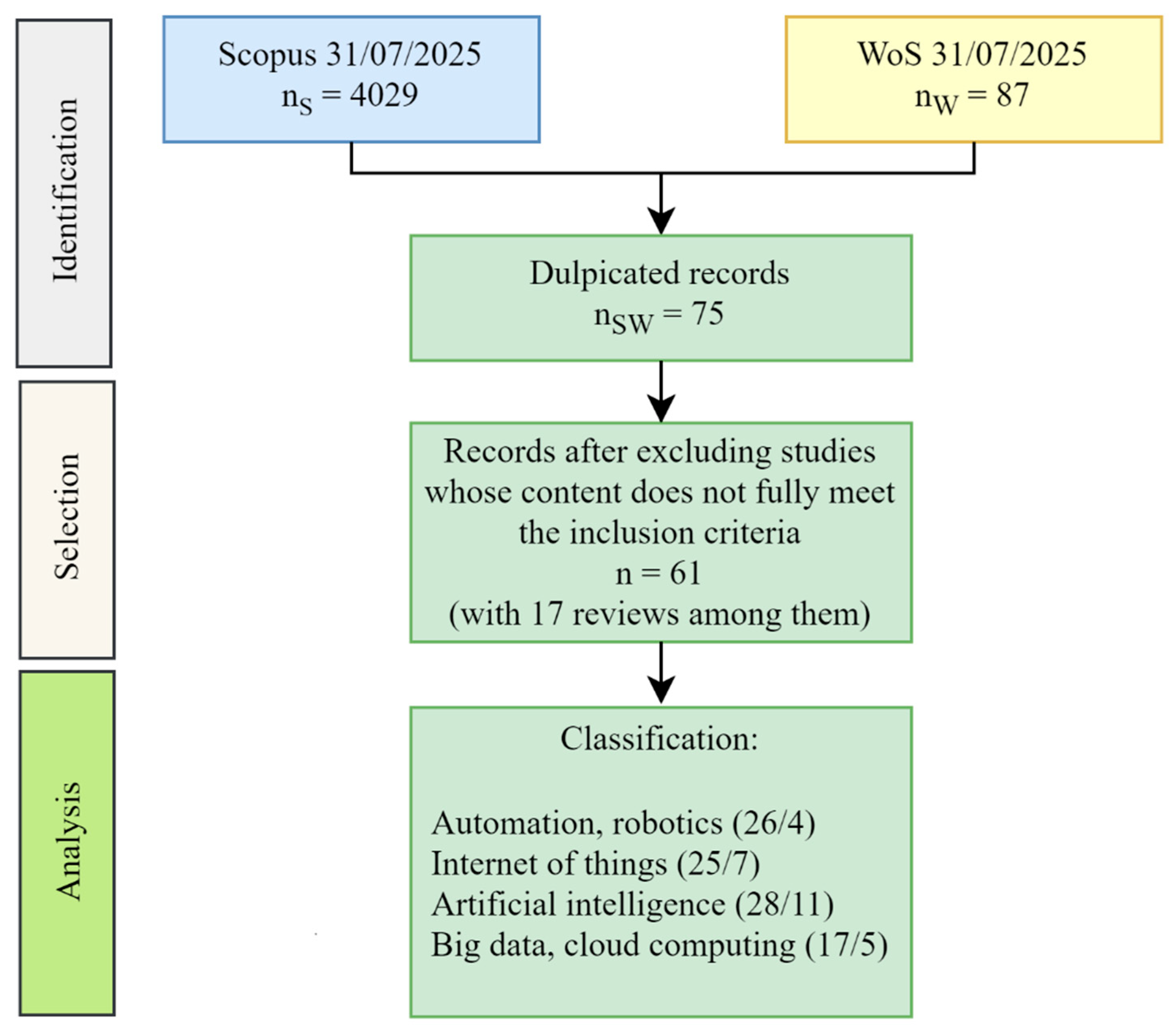
Figure 2.
The flowchart of proposed framework for industrial digitalization.
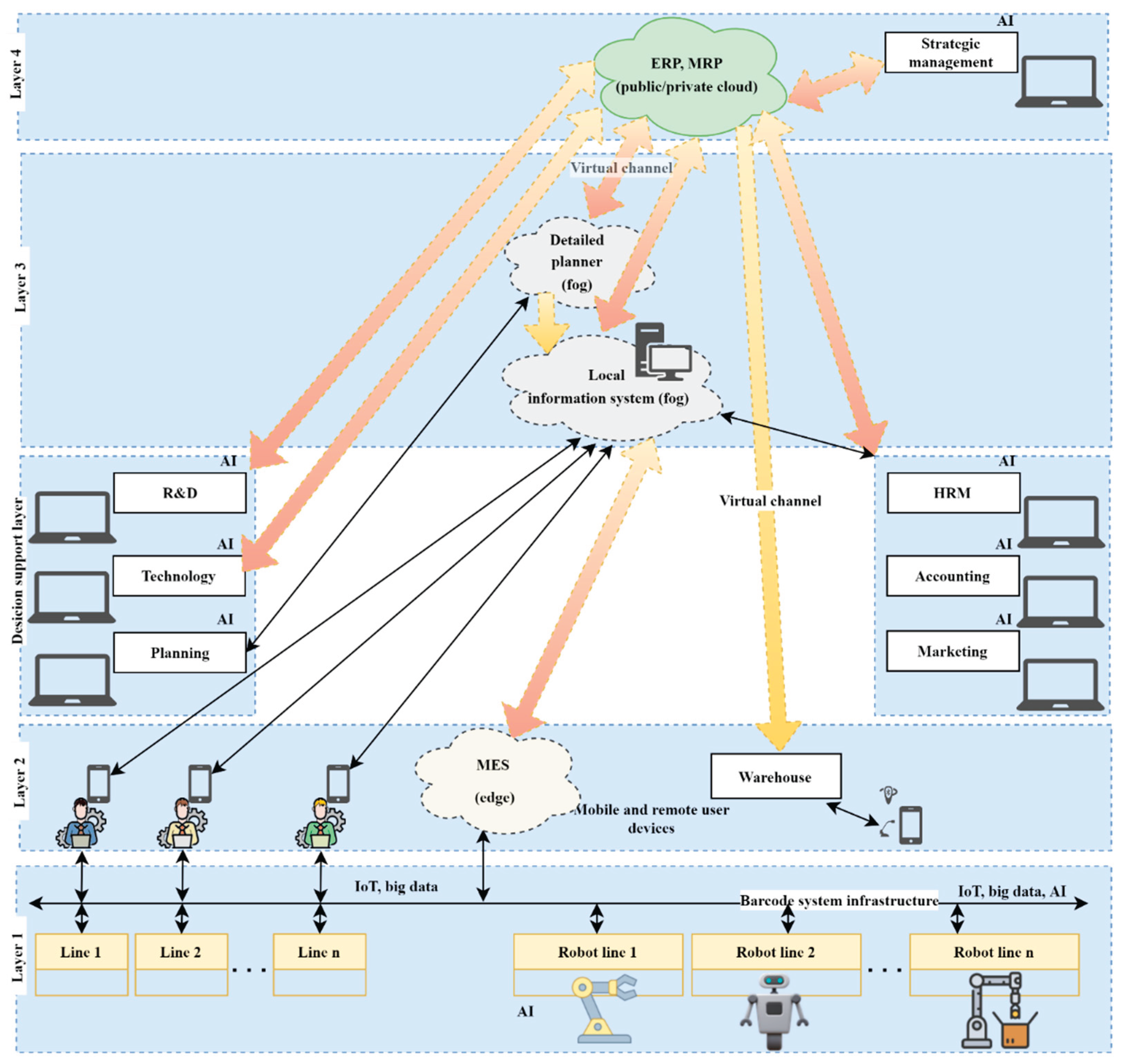

Table 1.
Comparison of recent manufacturing digitization reviews and their key findings.
| Reference | Research Objective |
IT Technologies |
Key Findings and Suggestions |
|---|---|---|---|
| Çınar et al. (2020) [9] |
To review of ML in PdM by classifying existing studies according | ML for PdM in smart factories, highlights popular supervised ML | Finds that RF is the most widely applied ML technique in PdM, used across many industrial assets. Suggests ensemble approaches to improve prediction accuracy and robustness. |
| Kamble et al. (2020) [23] |
To develop and validate a performance-measurement system for SMEs auto-component manufacturing | Robotics and semi-autonomous systems, CPS, IoT, cloud computing, big data analytics, AI, AM, AR/VR, blockchain | Empirically selected 59 measures into ten validated dimensions (cost, quality, flexibility, time, integration, optimized productivity, real-time diagnosis & prognosis, computing, social & ecological sustainability) |
| Escobar et al. (2021) [15] |
To chart the shift to Quality 4.0 by integrating real-time data and AI into shop-floor quality control | IoT sensor networks, cloud/edge analytics platforms, ML/DL | Classical SPC and Six Sigma must be enhanced by AI-driven predictive analytics and corresponding explainability |
| Salierno et al. (2021) [20] |
To compare major approaches for factory digitalization under the I4.0 and ‘MIC2025’ initiatives | CPS to integrate physical and digital factory components (enabling DT), IoT, 3D simulation | European “digital factory” and Chinese “cloud manufacturing” paradigms share the goal of smarter, digitalized production but focus on different levels (intra-factory processes vs. inter-factory collaboration). Interoperability is a critical challenge. |
| Onaji et al. (2022) [13] |
To propose a conceptual framework for assessment of DT applications and validate it via manufacturing case studies | CPS, IoT, cloud computing, big data analytics, AI, simulation tools | DT enables PdM, real-time optimization, and enhanced decision-making; integration complexity and infrastructure needs are key barriers to broader adoption. |
| Suuronen et al. (2022) [17] |
To review DBEs in manufacturing and outline challenges, benefits, and future research trends | IoT/IIoT, cloud computing and platform technologies, AI and data analytics | DBEs offer innovation and market agility but face challenges like interoperability and cybersecurity. The study identifies key enablers, barriers, and benefits, and outlines future research directions and managerial implications. |
| Wang et al. (2022) [14] |
To develop an agent-based framework that enhances SM through AI, DT, and real-time decision-making | AI, intelligent agents, DT, real-time analytics | The framework improves manufacturing flexibility, responsiveness, and autonomy; includes recommendations for implementing decentralized systems in dynamic production environments. |
| Serey at al. (2023) [18] |
To create a strategic framework integrating I4.0 and AI to guide industrial organizations through DX | I4.0 technologies, digital ecosystems, intelligent systems. | Strategic alignment with I4.0 requires mindset shifts, workforce reskilling, business model innovation, and integrated data-driven ecosystems for sustainable competitiveness. |
| Voinea et al. (2023) [19] |
To map emergent trends in industrial AR (IAR) through a scientometric review of literature from 2018–2022 | SM, AR, IoT, AI, DT, Human–Robot Interaction, visualization | Identifies key growth areas in IAR, with AI as fastest-growing and I4.0 as most published; notes industrial benefits and challenges like high cost, usability, and integration. |
| Benslimane et al. (2024) [16] |
To analyse the relationship, trends, and challenges in integrating Lean Manufacturing with I4.0 through a systematic literature review | Robotics, CPS, IoT, RFID, AM, cloud, big data, AI, DTs, analytics tools | Reveals mutual reinforcement between LM and I4.0, identifies key trends (productivity, sustainability, I5.0), and challenges (culture, technology, skills). |
| Burzynska (2024) [10] |
To systematically review of data-driven DSS for diagnosing casting defects | AI/ML/DL methods; DTs; case-/rule-based reasoning; and analytical tools |
AI-based models often achieve high accuracy; challenges include imbalanced defect data and limited deployment in real factories; calls for further research to enable reliable, real-time predictive |
| Gargalo et al. (2024) [11] |
To investigate hybrid modelling integrating mechanistic and AI/ML methods to accelerate digitalization in chemical and biochemical industries, enabling credible DTs and I4.0/I5.0 transition | Cloud, ML/AI, hybrid models, DTs, data integration, advanced analytics, real-time monitoring systems feeding process optimization and decision support | Hybrid models improve optimization, cost efficiency, and sustainability but face data, integration, and skill challenges; proposed pathway positions them as foundation for DX. |
| Ghosh et al. (2024) [12] |
To survey and synthesize AI/ML methods for predicting surface quality (surface roughness) in manufacturing | Pd ML/DL models, edge/IoT computing | Most studies use sensor/experimental data to train AI models. DL models often achieved the highest accuracy, while tree-based/SVM methods were used on tabular data. |
| Isoko et al. (2024) [21] |
To assess the integration of I4.0 technologies into complex manufacturing environments and propose a roadmap for DX | CPS and DT frameworks, connectivity, ML, data-driven modelling, predictive analytics, immersive technologies for operations | Identifies key integration challenges, especially lack of standards; proposes operating models and guiding principles for scalable, interoperable smart factory systems. |
| Reyes Domínguez et al. (2024) [24] |
To analyse IoT and AI/ML integration under I4.0 for industrial process optimization through bibliometric analysis | SM, IoT/IIoT, AI/ ML, process optimization | AI and ML significantly optimize industrial processes, though complexity remains a barrier; greater focus on integrated frameworks is recommended. |
| Wang and Jiao (2024) [25] |
To propose a conceptual framework for integrating smart in-process inspection with human–automation symbiosis in CPS in manufacturing | Smart in-process inspection, cognitive task allocation, human–automation interfaces, and adaptive decision support in CPPS | Integration enhances quality, resilience, and adaptability; key barriers are inspection accuracy, adaptive task allocation, and nudging design. |
| Qiu et al. (2025) [22] |
To review IIoT integration within I4.0 for SM, highlighting differences from traditional IoT | CPS, 5G, IIoT, AI/ML, big data, blockchain, cybersecurity | Effective IIoT deployment improves operational efficiency; addressing interoperability and cybersecurity via encryption/blockchain is critical. |
Note: The acronym list is available online [26].
Table 2.
Framework verification summary.
| Framework layer | Current company capabilities | Implementation status | Potential improvements |
|---|---|---|---|
| Layer 1 | Modern machinery, partial automation |
Partial | Expand robotics, add more sensors |
| Layer 2 | Some PLCs and IoT devices |
Partial | Implement edge AI for predictive maintenance |
| Layer 3 | Limited local data aggregation |
Low | Deploy MES and integrate DTs |
| Layer 4 | ERP in place, limited analytics |
Partial | Add cloud-based AI for demand forecasting |
| Decision support | Skilled workforce, manual dashboards |
Partial | Implement XAI interfaces |
Disclaimer/Publisher’s Note: The statements, opinions and data contained in all publications are solely those of the individual author(s) and contributor(s) and not of MDPI and/or the editor(s). MDPI and/or the editor(s) disclaim responsibility for any injury to people or property resulting from any ideas, methods, instructions or products referred to in the content. |
© 2025 by the authors. Licensee MDPI, Basel, Switzerland. This article is an open access article distributed under the terms and conditions of the Creative Commons Attribution (CC BY) license (http://creativecommons.org/licenses/by/4.0/).
Copyright: This open access article is published under a Creative Commons CC BY 4.0 license, which permit the free download, distribution, and reuse, provided that the author and preprint are cited in any reuse.


