

Submitted:
13 August 2025
Posted:
14 August 2025
You are already at the latest version
Abstract
This study examines how professionals in boundary-spanning digital roles construct and maintain coherent professional identities while navigating ethically ambiguous situations. Drawing on a mixed-methods study combining interviews (n=47), experience sampling (n=32), and vignette experiments (n=128) with AI ethics specialists, content moderators, and platform governance professionals, I identify three identity orientation strategies—anchoring, hybridizing, and pioneering—that significantly influence emotional regulation and ethical decision-making. Findings reveal that effective ethical navigation in "gray zones" depends on emotional sophistication: integrating emotional responses as valuable information within ethical deliberation. The proposed model of "ethical identity work" conceptualizes professional identity construction as an ongoing accomplishment requiring integration of professional self-concept, emotional intelligence, and contextual ethical reasoning. This research contributes theoretical insights at the intersection of professional identity, emotional regulation, and ethical decision-making while offering practical implications for organizations supporting professionals in emerging digital roles.
Keywords:
professional identity
; boundary-spanning roles
; digital ethics
; AI ethics
; content moderation
; platform governance
; ethical decision-making
; identity orientation
; anchoring
; hybridizing
; pioneering
; emotional regulation
; ethical navigation
; gray zones
; emotional sophistication
; ethical deliberation
; ethical identity work
; professional self-concept
; emotional intelligence
; contextual reasoning
; mixed-methods research
; interviews
; experience sampling
; vignette experiments
; digital professionals
; organizational support
; emerging roles
; ethical ambiguity
1. Introduction
The rapid evolution of digital technologies has created unprecedented challenges for professionals working at the intersection of traditional organizational boundaries. As work becomes increasingly platform-mediated and digitally transformed, many professionals find themselves in emerging roles that lack established ethical frameworks, professional norms, or clear jurisdictional boundaries. Content moderators making split-second decisions about harmful material, AI ethics specialists balancing innovation with responsible use, and platform governance professionals negotiating competing stakeholder interests all operate in what might be termed “ethical gray zones” – spaces where right answers are elusive and moral complexity is the norm rather than the exception.
These boundary-spanning digital professionals engage in complex forms of identity work as they navigate ambiguous ethical terrain. How do they construct a coherent sense of professional self when their work constantly crosses traditional professional boundaries? What role do emotions play as they confront ethically charged decisions without clear precedents to guide them? And critically, how does their approach to professional identity influence their ethical decision-making processes?
This article addresses three research questions:
- How do professionals navigate ethical ambiguities when their work crosses traditional professional boundaries in digital contexts?
- What role do emotions play in identity construction when professionals face ethical dilemmas in platform-mediated work?
- How do different identity orientation strategies influence ethical decision-making under conditions of ambiguity?
The study contributes to the literature in three key ways. First, it identifies and empirically demonstrates three distinct identity orientation strategies employed by professionals in emerging digital roles, showing how these strategies shape approaches to ethical ambiguity. Second, it develops a process model linking identity orientation, emotional regulation, and ethical frameworks, challenging traditional views that position emotions as obstacles to ethical decision-making. Third, it introduces the concept of “ethical identity work” as an integrative framework for understanding how professionals maintain coherent self-concepts while navigating ethically complex terrain.
The article proceeds as follows. Section 2 reviews relevant literature on professional identity, ethical decision-making, and emotional regulation. Section 3 details the mixed-methods research design. Section 4 presents key findings on identity orientation strategies, emotional regulation approaches, and ethical frameworks. Section 5 discusses theoretical and practical implications, while acknowledging boundary conditions and limitations. The paper concludes with recommendations for future research and practice.
2. Theoretical Background
2.1. The Changing Landscape of Professional Work
Traditional professions developed around clear jurisdictional boundaries, established bodies of knowledge, and professional codes of ethics that provided guidance for practitioners (Abbott, 1988). The digital transformation of work has systematically disrupted these structures, creating what Faraj et al. (2018) describe as “liminal spaces” – zones between established professional boundaries where new types of work emerge.
Research by Kellogg et al. (2020) identifies three key characteristics of boundary-spanning digital work that create unique challenges for professional identity:
- Algorithmic mediation: Work processes increasingly delegated to or mediated by algorithms, raising questions about professional autonomy and accountability
- Platform governance tensions: Contradictory pressures from multiple stakeholders with competing interests and values
- Scale and velocity: Decision-making at unprecedented scale and speed, compressing the reflective space traditionally available for ethical deliberation
These characteristics create a landscape where professionals must constantly negotiate not only what they do but who they are as professionals – engaging in ongoing identity work amidst ethical ambiguity.
2.2. Ethical Gray Zones in Digital Work
Building on Haidt’s (2001) social intuitionist model of moral judgment and Tenbrunsel and Smith-Crowe’s (2008) work on ethical decision-making, ethical gray zones can be conceptualized as contexts characterized by three forms of ambiguity (Metcalf et al., 2019):
- Jurisdictional ambiguity: Unclear which professional domain’s ethical standards should apply
- Consequential ambiguity: Difficulty predicting the downstream effects of decisions
- Value plurality: Multiple legitimate ethical frameworks suggesting different courses of action
Recent work by Martin (2019) on technology ethics and Nissenbaum’s (2011) contextual integrity framework suggests that digital contexts intensify these ambiguities by disrupting established norms and creating novel ethical situations without clear precedents.
2.3. Professional Identity and Identity Work
Professional identity—the constellation of attributes, beliefs, values, motives, and experiences through which people define themselves in a professional role (Ibarra, 1999)—has been recognized as a critical lens for understanding how individuals navigate complex work environments (Ashforth & Schinoff, 2016). Building on Petriglieri and colleagues’ (2018) conceptualization of identity work as an active, ongoing process, this study examines how professionals construct coherent self-concepts in contexts lacking established professional templates.
This approach integrates identity work with boundary theory (Ashforth et al., 2000; Nippert-Eng, 1996), suggesting that boundary-spanning digital professionals must engage in particularly intensive forms of identity construction as they navigate multiple, sometimes conflicting, role expectations and ethical frameworks.
2.3.1. Ethical Identity Work and Related Constructs
The concept of “ethical identity work” introduced in this study builds upon but extends beyond existing constructs such as moral identity (Aquino & Reed, 2002). While moral identity focuses on the centrality of moral traits to an individual’s self-concept, ethical identity work emphasizes the dynamic, contextual processes through which professionals integrate ethical considerations into their professional self-concepts specifically within boundary-spanning roles.
Ethical identity work differs from moral identity in three key respects. First, it is inherently processual rather than dispositional, focusing on ongoing negotiation rather than stable traits. Second, it is professionally situated, concerned with how individuals construct ethical approaches within specific professional contexts rather than general moral orientation. Third, it explicitly incorporates emotional dimensions as constitutive elements rather than as separate factors.
This construct also extends institutional perspectives on professional identity by examining how individuals navigate institutional pressures from multiple, sometimes conflicting professional fields (Thornton et al., 2012). As boundary-spanning professionals encounter competing institutional logics, ethical identity work represents the micro-level processes through which they construct coherent professional selves while navigating these macro-level tensions.
2.4. Emotions and Ethical Decision-Making
Traditional perspectives often position emotions as potential biases in ethical reasoning (Kahneman, 2011). However, emerging research challenges this view, suggesting that emotions serve essential functions in moral judgment (Barrett, 2017; Haidt, 2012). Building on Greene’s (2014) dual-process model and recent work on emotional regulation in professional contexts (Grandey & Gabriel, 2015), this study examines how emotions function as both information sources and motivational resources in ethical decision-making.
This research bridges the gap between identity theory, emotional regulation, and ethical decision-making by examining how professional identity orientation shapes emotional responses to ethical dilemmas and, subsequently, ethical judgments and actions.
3. Methodology
3.1. Research Design
A sequential mixed-methods research design (Creswell & Plano Clark, 2017) was employed to investigate the relationship between professional identity, emotions, and ethical decision-making in boundary-spanning digital work. The research progressed through three phases:
- Qualitative exploration: In-depth interviews to identify identity orientation strategies and ethical challenges
- Experience sampling: Real-time capture of emotional responses to ethical dilemmas
- Experimental validation: Vignette studies testing relationships between identity salience, emotional responses, and ethical judgments
This design allowed for the development of rich, contextual understanding while also testing key relationships with greater control and generalizability. The mixed-methods approach facilitated triangulation of findings across different data sources and methods, strengthening both internal and external validity (Maxwell, 2013).
3.2. Sample and Data Collection
3.2.1. Phase 1: Qualitative Interviews
Semi-structured interviews were conducted with 47 professionals in boundary-spanning digital roles, including:
- AI ethics specialists (n=18)
- Content moderators (n=16)
- Platform governance professionals (n=13)
Participants were recruited through purposive and snowball sampling from 12 organizations spanning technology companies, consulting firms, and regulatory bodies. The sample included 27 women and 20 men, with professional experience ranging from 2 to 15 years. Interviews lasted 60-90 minutes, were recorded and transcribed verbatim, resulting in approximately 850 pages of text.
Interview protocols addressed professional background, identity construction, ethical challenges, emotional responses, and decision-making processes. For example, participants were asked to describe ethically challenging situations, their emotional responses, and how they resolved the dilemmas. The full interview protocol is provided in Appendix A, with questions 16-19 specifically addressing the integration of professional identity and ethical decision-making.
3.2.2. Phase 2: Experience Sampling
A subset of interview participants (n=32) completed an experience sampling protocol over two weeks. Participants received five daily prompts via smartphone application asking them to record:
- Current work activity
- Ethical challenges encountered
- Emotional responses (using validated emotion measures from Mauss & Robinson, 2009)
- Decision-making approaches
- Identity salience (adapted from Aquino & Reed, 2002)
This resulted in 1,467 valid responses (91.7% response rate), providing real-time data on the relationship between identity, emotions, and ethical decision-making. The experience sampling protocol is detailed in Appendix B, which includes the specific measurement items used to assess emotional regulation approaches and identity salience.
For the experience sampling analysis, participants were classified into predominant identity orientation groups based on their interview data and a follow-up assessment that measured their alignment with each orientation. This classification used a validated coding scheme (outlined in Table 5) to evaluate interview responses, supplemented by a 12-item survey measuring orientation tendencies. Participants were classified based on their highest scoring orientation, with a minimum threshold of 20% difference between primary and secondary orientations. This classification enabled between-person analyses examining how identity orientation predicted emotional regulation approaches and ethical frameworks. Within-person analyses were also conducted to examine how situational factors influenced these relationships.
3.2.3. Phase 3: Experimental Validation
Online vignette experiments were conducted with 128 professionals in boundary-spanning digital roles (including 35 from previous phases). Participants were randomly assigned to conditions in a 3 (identity orientation: anchoring vs. hybridizing vs. pioneering) × 2 (ethical ambiguity: high vs. low) between-subjects design using a randomization algorithm stratified by professional role to ensure balanced representation across conditions.
Participants read scenarios describing ethical dilemmas in digital contexts, reported emotional responses, and indicated likely decisions. Identity orientation was manipulated through priming techniques validated in prior research (LeBoeuf et al., 2010), and ethical ambiguity was manipulated by varying the clarity of consequences and applicable principles. The complete vignette materials are provided in Appendix C, which includes the precise wording of all experimental manipulations and measurement items.
Manipulation checks confirmed the effectiveness of the identity orientation primes, with significant differences in self-reported identity orientations across conditions (F(2,125) = 18.6, p < .001, η2 = .23). Participants in the anchoring condition reported significantly higher agreement with anchoring-related statements (M = 5.8, SD = 0.9) than those in hybridizing (M = 3.2, SD = 1.1) or pioneering conditions (M = 2.4, SD = 1.2). Similar patterns were observed for the other manipulation checks, confirming the validity of the experimental manipulations.
3.3. Data Analysis
3.3.1. Qualitative Analysis
Interview transcripts were analyzed using template analysis (King, 2004) with NVivo 12 software. Initial coding used sensitizing concepts from identity work and ethical decision-making literature, followed by inductive coding to identify emergent themes. Two independent researchers coded 20% of transcripts (κ = .83), resolving disagreements through discussion before coding remaining data.
The coding process followed three main stages:
- Initial template development: Based on theoretical frameworks and preliminary reading of transcripts
- Coding and template refinement: Iterative coding and revision of the template as new themes emerged
- Final coding: Application of the finalized template to all transcripts
Table 1 presents a simplified version of the final coding template with illustrative codes.
Analysis proceeded through constant comparison techniques (Corbin & Strauss, 2008), looking for patterns within and across participants. Disconfirming evidence was actively sought to test and refine emerging theoretical constructs, enhancing theoretical validity.
For example, when the initial pattern suggested a strong relationship between professional background and identity orientation strategy, I identified several counter-examples—participants whose identity strategies did not align with their professional backgrounds—and examined these cases in detail to understand the contextual factors that might explain these divergences. This analysis revealed that organizational context often moderated the relationship between professional background and identity strategy, leading to refinement of the theoretical model. As one participant (P14) expressed: “My engineering training would suggest a more rule-based approach, but the collaborative culture here has pushed me to develop a more integrative professional identity that draws from multiple perspectives.”
3.3.2. Quantitative Analysis
Experience sampling data were analyzed using multilevel modeling to account for the nested structure of observations within participants (Raudenbush & Bryk, 2002). Models were specified to distinguish within-person and between-person effects, following recommendations by Bolger and Laurenceau (2013). For example, to examine the relationship between identity orientation and emotional regulation approaches, the following model was specified:
Level 1 (within-person):
Yij = β0j + β1j(Situation characteristics) + rij
Level 2 (between-person):
β0j = γ00 + γ01(Identity orientation) + γ02(Controls) + u0j
β1j = γ10 + γ11(Identity orientation) + u1j
Where Yij represents emotional regulation approaches for person j at observation i, and identity orientation was modeled as a level-2 predictor based on predominant orientation identified in interviews and follow-up assessments. Random effects (u0j, u1j) were included to account for individual differences in intercepts and slopes. Control variables included age, gender, years of professional experience, and organizational context (coded as participatory vs. hierarchical governance based on interview data).
Experimental data were analyzed using ANCOVA and mediation analysis (Hayes, 2017) to test causal relationships between identity orientation, emotional responses, and ethical decisions. Mediation analyses followed Hayes’ (2017) PROCESS macro (Model 4) with 5,000 bootstrap samples to generate confidence intervals for indirect effects. The mediation model included identity orientation as the independent variable (X), emotional regulation approach as the mediator (M), and ethical framework as the dependent variable (Y), with demographic factors (age, gender, years of experience) and organizational context as covariates.
3.4. Validity and Reliability Considerations
Several strategies were employed to enhance methodological rigor:
- Triangulation: Multiple data sources and methods to corroborate findings
- Member checking: Preliminary findings were shared with 12 participants for feedback
- Reflexivity: The research team maintained reflexive journals documenting analytical decisions
- Extended engagement: Ongoing relationships with key informants to deepen understanding
- Negative case analysis: Active searching for disconfirming evidence
Each method also had specific validity concerns addressed through appropriate techniques. For interviews, validity threats of retrospective rationalization were mitigated through concrete incident technique and probing questions. For experience sampling, the potential for participant fatigue was addressed through brief surveys and random sampling of time points. For experimental studies, external validity concerns were addressed by using realistic vignettes developed based on interview data and validated by domain experts.
One important validity challenge was ensuring consistency in how identity orientation strategies were identified and measured across methods. To address this, I developed a systematic classification approach based on interview data, then validated this classification through follow-up assessments that measured alignment with each orientation strategy. This approach ensured that identity orientation was consistently operationalized across phases of the research.
4. Results
4.1. Identity Orientation Strategies in Boundary-Spanning Digital Work
The analysis identified three distinct identity orientation strategies employed by professionals in boundary-spanning digital roles. Table 2 summarizes these strategies, their prevalence across professional groups, and illustrative quotes.
These strategies were not equally distributed across professional groups. Chi-square analysis showed significant associations between professional role and identity strategy (χ2(4) = 16.7, p < .01, Cramer’s V = .32), with AI ethics specialists more likely to adopt anchoring strategies, platform governance professionals favoring hybridizing approaches, and content moderators more frequently employing pioneering strategies.
Importantly, these strategies were not merely cognitive approaches but encompassed emotional and relational dimensions. For example, anchoring strategies provided emotional security through connection to established professional communities but sometimes limited responsiveness to novel ethical challenges. Pioneering strategies offered greater freedom but often resulted in stronger emotional labor due to lack of established support structures.
The qualitative analysis revealed that these strategies were not static but could evolve over time and across contexts. Several participants (n=11) described transitioning between strategies as they gained experience or as their roles evolved. This temporal dimension highlights the dynamic nature of identity work in these emerging professional contexts.
4.2. The Process Model of Ethical Identity Work
The analysis revealed a dynamic process through which identity orientation shapes emotional regulation and ethical decision-making in boundary-spanning digital work. The process model derived from the findings, as seen in Figure 1 below, illustrates how identity orientation strategies influence both emotional regulation approaches and ethical frameworks, which in turn shape responses to ethical dilemmas. Importantly, the relationship between these elements is bidirectional—ethical challenges and their outcomes also reshape identity orientation over time. Contextual factors, including organizational culture, governance structures, and power dynamics, moderate these relationships.
Evidence for the bidirectional nature of these relationships emerged particularly from the qualitative data. For example, 18 participants explicitly described how confronting certain types of ethical dilemmas led them to reconsider aspects of their professional identity:
“After handling that content moderation case involving self-harm, I realized I couldn’t maintain the emotional distance my journalism training had taught me. It fundamentally changed how I see myself as a professional—I’ve had to develop a new approach that integrates more of the emotional dimension. ”(P16, content moderator with journalism background)
These bidirectional effects were also evident in the experience sampling data, where ethical challenges characterized by high value plurality were associated with increased identity questioning the following day (β = .28, p < .01, 95% CI [.11, .45]), suggesting that certain types of ethical dilemmas trigger active identity reconsideration.
4.2.1. Identity Orientation and Emotional Regulation
Experience sampling data revealed significant associations between identity orientation strategies and emotional regulation approaches (F(2,29) = 8.74, p < .01, η2 = .38, 95% CI [.14, .52]). Table 3 summarizes these relationships.
These patterns were consistent across methods. In interviews, professionals employing anchoring strategies frequently described “stepping back” from emotional responses to analyze situations through established professional frameworks:
“When I feel disturbed by a content decision, I consciously reframe it using my journalism training. I ask: What serves the public interest? What promotes transparent discourse? That helps me manage the emotional impact while staying true to my professional values.”(P12, content policy specialist with journalism background)
In contrast, those employing pioneering strategies more often described emotions as essential information:
“My emotional response is data. If I feel uncomfortable with an algorithmic decision, that discomfort is telling me something important about potential harms or unexamined assumptions. I’ve learned to lean into that feeling rather than dismiss it.”(P4, AI ethics specialist)
As seen in Figure 2 below, experience sampling data confirmed these patterns, showing that anchoring-oriented professionals reported more cognitive reappraisal events (M = 3.8 daily instances, SD = 0.7) compared to pioneering-oriented professionals (M = 1.7 daily instances, SD = 0.5), t(18) = 4.2, p < .001, d = 3.42, 95% CI [2.14, 4.70]. Conversely, pioneering-oriented professionals reported more instances of using emotions as information sources (M = 4.3 daily instances, SD = 0.6) compared to anchoring-oriented professionals (M = 2.1 daily instances, SD = 0.5), t(18) = 3.9, p < .001, d = 3.95, 95% CI [2.47, 5.43].
I tested for potential demographic influences on emotional regulation approaches by including age, gender, and years of professional experience as covariates in the analyses. Contrary to expectations, no significant gender differences were found in emotional regulation approaches after controlling for identity orientation (F(1,30) = 1.8, p = .19), suggesting that professional identity factors may be more influential than demographic characteristics in shaping emotional regulation in these contexts. Similarly, neither age (F(1,30) = 0.7, p = .41) nor years of experience (F(1,30) = 1.2, p = .28) showed significant main effects on emotional regulation approaches.
4.2.2. Identity Orientation and Ethical Frameworks
The analysis also revealed significant relationships between identity orientation strategies and ethical frameworks. Table 4 summarizes these findings.
In vignette experiments, manipulating identity salience significantly influenced ethical judgments. When primed with anchoring identity orientation, participants were 37% more likely to justify decisions using principles-based reasoning compared to control conditions (p < .01, 95% CI [22%, 52%]). Pioneering identity priming increased attention to affected stakeholders’ perspectives by 42% compared to control conditions (p < .001, 95% CI [26%, 58%]).
An unexpected finding was that in high ambiguity conditions, hybridizing identity orientation was associated with the greatest decision confidence (M = 5.2 on 7-point scale, SD = 0.8) compared to anchoring (M = 4.3, SD = 0.9) or pioneering orientations (M = 4.1, SD = 1.1), F(2,62) = 7.3, p < .01, η2 = .19. This suggests that the ability to integrate multiple perspectives may be particularly valuable in highly ambiguous ethical situations.
Mediation analysis revealed that the relationship between identity orientation and ethical framework was partially mediated by emotional regulation approach. The mediation model included identity orientation as the independent variable (X), emotional regulation approach as the mediator (M), and ethical framework as the dependent variable (Y), with demographic factors (age, gender, years of experience) and organizational context as covariates. The indirect effect was significant (indirect effect = .18, 95% CI [.08, .29]), suggesting that identity orientation influences ethical frameworks both directly and through its impact on how emotions are processed.
One area where the findings showed some inconsistency was in the relationship between hybridizing strategies and emotional regulation. While the predominant pattern showed hybridizing strategies associated with situation selection and attention deployment, a subset of hybridizing professionals (n=7) exhibited patterns more similar to pioneering professionals, with greater emotional acceptance and integration. Further analysis revealed that these individuals tended to be in organizations with higher psychological safety scores, suggesting that organizational context may moderate the relationship between identity orientation and emotional regulation approaches. As one participant noted: “In my previous role, I felt I had to compartmentalize emotions to be taken seriously. Here, there’s explicit acknowledgment that emotions can provide valuable insight, which has changed how I integrate them into my professional approach” (P29, platform governance professional).
4.2.3. The Role of Organizational Context
Findings indicate that organizational factors significantly moderate the relationship between identity orientation and ethical decision-making. Multilevel models of experience sampling data showed that organizational culture explained 23% of variance in the relationship between identity orientation and ethical approaches (p < .001, 95% CI [13%, 33%]). Specifically, three contextual factors emerged as particularly influential:
- Governance structures: Organizations with more participatory governance approaches supported greater integration of emotional information into ethical decision-making (β = .34, p < .01, 95% CI [.16, .52])
- Power dynamics: Hierarchical structures amplified anchoring identity strategies and principles-based ethics, while flatter structures facilitated pioneering strategies (β = .29, p < .01, 95% CI [.11, .47])
- Psychological safety: Higher psychological safety correlated with more diverse emotional regulation strategies and ethical approaches (β = .43, p < .001, 95% CI [.26, .60])
These findings highlight that ethical identity work occurs within organizational contexts that can either enable or constrain different identity orientation strategies and their associated approaches to emotional regulation and ethical decision-making.
The qualitative data revealed that organizational constraints sometimes created tensions between professionals’ preferred identity orientation strategies and what was organizationally sanctioned. Several participants (n=14) described engaging in “underground” identity work—developing approaches that deviated from official organizational expectations but that they believed were ethically necessary:
“The official stance is that we should apply the community standards consistently with minimal interpretation. But in reality, many of us are developing more nuanced approaches that consider context and impact. We just don’t always document that part of our process.”(P8, content moderator)
This finding highlights the political dimensions of ethical identity work, suggesting that identity strategies may sometimes function as forms of resistance to organizational constraints.
4.3. Comparative Analysis Across Professional Roles
The cross-professional analysis revealed both similarities and important differences in how identity work manifests across boundary-spanning digital roles. Table 5 summarizes these distinctions.

Table 5.
Comparative Analysis of Identity Work Across Professional Roles.
| Professional Role | Predominant Identity Strategy | Distinctive Ethical Challenges | Characteristic Identity-Emotion Patterns |
|---|---|---|---|
| AI Ethics Specialists | Anchoring (61%) | Long-term consequential ambiguity; technical-social translation | Greater cognitive reappraisal; emphasis on epistemic emotions (curiosity, surprise) |
| Content Moderators | Pioneering (48%) | Exposure to harmful content; high-velocity decisions; scale challenges | Higher emotional intensity; more acceptance strategies; greater compassion fatigue |
| Platform Governance Professionals | Hybridizing (67%) | Stakeholder management; value conflicts across constituencies | Complex emotion differentiation; more situation selection; emphasis on social emotions |
As seen in Figure 3, chi-square tests confirmed significant differences in the distribution of identity strategies across professional roles (χ2(4) = 16.7, p < .01, Cramer’s V = .32). Furthermore, the nature of ethical challenges varied significantly by role, with AI ethics specialists facing more consequential ambiguity, content moderators encountering more exposure to harmful material, and platform governance professionals navigating more stakeholder conflicts.
These differences were reflected in both emotional patterns and ethical approaches. For example, content moderators reported significantly higher emotional intensity scores in experience sampling data (M = 5.8 on 7-point scale, SD = 0.9) compared to AI ethics specialists (M = 4.3, SD = 0.8), t(26) = 3.7, p < .001, d = 1.76, 95% CI [0.93, 2.59]. Similarly, platform governance professionals demonstrated greater complexity in stakeholder analysis (measured by number of distinct perspectives considered) compared to other professionals (F(2,44) = 8.3, p < .01, η2 = .27, 95% CI [.09, .45]).
Early in the research, I had expected to find a developmental trajectory where more experienced professionals would tend toward hybridizing strategies as they gained expertise across domains. This expectation was based on literature suggesting that professional development often involves integration of diverse knowledge bases over time (Ibarra, 1999). Contrary to this expectation, there was no clear relationship between years of professional experience and identity orientation strategy (F(2,44) = 1.3, p = .28), suggesting that identity orientation may be shaped more by role demands and organizational context than by career stage. This finding challenges developmental models that assume progression toward more integrated identity strategies with experience.
The analysis also revealed that role-specific ethical challenges create different emotional demands. Content moderators, who regularly encounter harmful material, reported higher levels of moral distress (M = 4.9, SD = 1.1) compared to AI ethics specialists (M = 3.2, SD = 0.8) and platform governance professionals (M = 3.5, SD = 0.9), F(2,44) = 12.6, p < .001, η2 = .36. These differences in emotional demands may partially explain the different prevalence of identity orientation strategies across roles.
5. Discussion
5.1. Theoretical Implications
The findings make several important contributions to understanding professional identity, emotions, and ethics in boundary-spanning digital work, as seen in Figure 4.
First, this study extends identity work theory (Ibarra, 1999; Petriglieri et al., 2018) by demonstrating how professionals construct coherent identities in contexts lacking established templates. The three identity orientation strategies identified—anchoring, hybridizing, and pioneering—provide a framework for understanding identity construction in emergent professional fields beyond digital contexts. This typology adds nuance to existing models of professional identity by highlighting how individuals actively orient themselves toward different sources of identity resources when navigating ambiguous professional terrain.
Second, the findings challenge traditional views that position emotions as obstacles to ethical reasoning (Kahneman, 2011) by demonstrating how different identity orientations enable distinct forms of emotional integration into ethical decision-making. These results align with and extend recent work on the constructive role of emotions in ethical judgment (Barrett, 2017; Haidt, 2012) by showing how professional identity mediates this relationship. Importantly, the results suggest that emotional sophistication—not emotional detachment—characterizes effective ethical decision-making in these contexts.
Third, the concept of “ethical identity work” introduced here provides an integrative framework for understanding how professionals maintain coherent self-concepts while navigating ethically complex terrain. This concept bridges micro-level identity processes with macro-level concerns about ethical governance in digital contexts, contributing to both identity theory and digital ethics literature (Martin, 2019; Nissenbaum, 2011). Unlike existing constructs such as moral identity (Aquino & Reed, 2002), which focus primarily on stable traits or dispositions, ethical identity work captures the dynamic, ongoing processes through which professionals integrate ethical considerations into their evolving professional self-concepts.
Fourth, the process model linking identity orientation, emotional regulation, and ethical frameworks contributes to understanding how professionals navigate what Tenbrunsel and Smith-Crowe (2008) term “ethical infrastructure” in organizations. By highlighting bidirectional relationships between these elements, this research shows how ethical decision-making both shapes and is shaped by professional identity. The finding that ethical challenges can trigger identity reconsideration extends existing identity work models by demonstrating how critical incidents function as catalysts for identity transformation.
Finally, the research contributes to institutional perspectives on professions by examining how individual professionals navigate institutional complexity when multiple, sometimes conflicting, institutional logics apply to their work (Thornton et al., 2012). The identity orientation strategies identified represent different approaches to managing institutional complexity at the individual level, showing how professionals selectively draw upon, combine, or transcend institutional templates to construct coherent professional identities.
5.2. Boundary Conditions and Limitations
Several boundary conditions and limitations should be noted when interpreting these findings. First, this research focused on professionals in organizational contexts with at least some level of established ethical infrastructure. The dynamics may differ for independent professionals or those in organizations with minimal ethical guidance. The relative prevalence and effectiveness of different identity orientation strategies likely depends on the degree of institutional support available.
Second, cultural context likely influences these processes. The sample was primarily drawn from North American and European organizations (86% of participants), potentially limiting generalizability to other cultural contexts where professional identity and emotional norms may differ significantly. Research on cultural differences in emotion regulation (Mesquita et al., 2014) suggests that the relationships between identity strategies and emotional approaches may vary across cultural contexts.
Third, the focus on three specific boundary-spanning digital roles, while offering comparative insights, may not capture the full diversity of emerging digital professions. The identity orientation strategies and emotional regulation approaches identified may manifest differently in other digital professional contexts. The focus on roles with significant ethical dimensions may also limit generalizability to boundary-spanning roles where ethical considerations are less central.
Fourth, while the mixed-methods approach strengthens validity, each method has inherent limitations. Interviews may be subject to retrospective rationalization and social desirability bias, particularly when discussing ethically charged topics. Experience sampling captures only conscious emotional processes and may miss implicit emotional dynamics. Experimental manipulations, while allowing for causal inference, may not fully replicate the complexity of real-world ethical dilemmas and their organizational embeddedness.
Fifth, the cross-sectional nature of much of the data limits ability to make strong causal claims about the long-term development of identity orientation strategies. While the experience sampling provides some insight into temporal dynamics over a two-week period, longer-term longitudinal research would be necessary to fully understand how these strategies evolve over professional careers.
Finally, the study focused primarily on individual-level processes, with organizational factors treated as contextual influences rather than focal phenomena. A fuller understanding of ethical identity work would require more detailed analysis of how organizational practices and policies specifically shape identity orientation strategies and their effectiveness.
5.3. Practical Implications
The findings have several practical implications for organizations supporting professionals in boundary-spanning digital roles and for the professionals themselves.
5.3.1. Developing Identity Resources for Boundary-Spanning Professionals
Organizations can support professionals by providing resources for healthy identity construction:
- Professional community building: Creating spaces for identity negotiation and collective sense-making among professionals facing similar challenges
- Identity narratives: Developing and sharing narratives that help professionals make meaning of their work and its ethical dimensions
- Role clarity within ambiguity: Defining core professional commitments and values while acknowledging zones of legitimate ethical discretion
This research suggests that these approaches should be tailored to different identity orientation strategies. For anchoring-oriented professionals, connecting new challenges to established professional traditions can provide identity continuity, as evidenced by the interview data showing that 78% of anchoring-oriented professionals actively sought connections to established professional communities. For pioneering-oriented professionals, legitimate spaces for identity experimentation and peer support may be more valuable, with 82% of pioneering professionals reporting that peer communities were critical to developing their professional approach.
However, implementation of these approaches faces several challenges in practice. Organizational pressures for standardization may conflict with the need for identity experimentation. As one participant noted:
“The company wants consistency and scalability, but ethical work requires individual judgment and sometimes creative approaches. There’s a fundamental tension there.”(P23, AI ethics specialist)
Organizations must therefore balance standardization needs with space for identity development, perhaps through what Eisenhardt et al. (2010) term “minimal structures”—frameworks that provide basic guidance while allowing flexibility in implementation.
5.3.2. Integrating Emotions into Ethical Infrastructure
Organizations can design ethical infrastructures that acknowledge and leverage emotional dimensions of decision-making:
- Emotional impact assessments: Systematically considering how technologies affect emotional wellbeing alongside other impacts
- Reflective spaces: Creating temporal and physical spaces for emotional processing and ethical reflection
- Emotion-sensitive ethics training: Developing approaches to ethics education that integrate emotional and analytical capacities
The findings on different emotional regulation approaches suggest that organizations should provide multiple pathways for emotional engagement rather than prescribing single “best practices.” This might include both structured analytical frameworks (supporting cognitive reappraisal) and opportunities for emotional acceptance and integration. The experience sampling data showed that professionals with access to multiple emotional regulation strategies reported greater decision satisfaction (r = .41, p < .01) and lower emotional exhaustion (r = -.37, p < .01) compared to those relying primarily on a single approach.
Implementation challenges include organizational cultures that may stigmatize emotional expression or treat emotions as irrelevant to “serious” work. Successful integration of emotions into ethical infrastructure requires broader cultural change around emotions in professional contexts. As one platform governance professional observed:
“We need to move beyond the idea that being professional means being unemotional. In ethical work, emotions provide crucial signals about values and impacts.”(P37, platform governance professional)
5.3.3. Governance Mechanisms for Ethical Gray Zones
Traditional governance approaches often assume clear rules can be established for most situations. In ethical gray zones, more adaptive governance mechanisms are needed:
- Ethical sense-making forums: Structured processes for collective deliberation about novel ethical challenges
- Principled flexibility: Clear ethical principles combined with discretionary space for contextual judgment
- Ethics mentorship: Pairing less experienced professionals with ethics mentors who can guide identity development and ethical reasoning
The comparative analysis across professional roles suggests that governance approaches should be tailored to specific ethical challenges. For example, content moderators may benefit more from psychological support and collective sense-making, while AI ethics specialists may need stronger connections between technical and ethical frameworks. The experience sampling data revealed that content moderators in organizations with regular ethical sense-making forums reported 42% lower moral distress scores compared to those without such forums (p < .01).
Implementation barriers include resource constraints, particularly in high-volume, time-pressured environments like content moderation. Organizations may need to consider structural changes to work processes to create space for these governance mechanisms. Without addressing underlying work structures, governance innovations may remain superficial.
5.4. Future Research Directions
This research opens several promising avenues for future investigation:
- Longitudinal identity development: How do identity orientation strategies evolve over professional careers in boundary-spanning digital work? Longitudinal studies could examine identity trajectories and critical transition points, identifying factors that trigger shifts between strategies.
- Cross-cultural comparisons: How do cultural contexts shape identity work and emotional regulation in ethical gray zones? Comparative studies across different national and cultural contexts could illuminate how cultural norms around emotions and professional identity influence ethical identity work.
- Technology-mediated identity work: How do digital tools themselves shape identity construction and ethical decision-making? Research could examine how technologies both enable and constrain different identity orientation strategies, particularly as AI systems increasingly augment professional judgment.
- Identity work and ethical outcomes: What is the relationship between different identity orientation strategies and ethical outcomes? Studies could explore whether certain approaches lead to more ethically robust decisions in different contexts, perhaps using expert evaluation or stakeholder impact assessments to measure ethical quality.
- Collective identity processes: How do teams and communities of practice develop shared identity resources for navigating ethical gray zones? Research could examine collective identity work in boundary-spanning digital teams, exploring how shared identity resources emerge and how they influence team-level ethical approaches.
- Resistance and power dynamics: How do professionals navigate organizational constraints that conflict with their ethical identity work? Research could explore the political dimensions of ethical identity work, examining how professionals resist or reshape organizational expectations when these conflict with their ethical self-concepts.
6. Conclusions
The intersection of professional identity, emotions, and ethics in boundary-spanning digital work offers rich terrain for both theoretical understanding and practical intervention. As traditional professional boundaries continue to blur in digital contexts, the capacity for “ethical identity work” – the integration of professional self-concept, emotional intelligence, and ethical reasoning – becomes increasingly crucial.
This research demonstrates that professionals navigate ethical gray zones through distinct identity orientation strategies that shape both emotional regulation approaches and ethical frameworks. These processes occur within organizational contexts that can either enable or constrain different forms of ethical identity work. The bidirectional relationships between identity, emotions, and ethics highlight the dynamic, evolving nature of professional identity in these emerging contexts.
For organizations supporting professionals in boundary-spanning digital roles, these findings suggest the importance of developing multiple pathways for identity construction, emotional integration, and ethical decision-making rather than prescribing single “best practices.” For professionals themselves, awareness of different identity orientation strategies and their implications may facilitate more intentional and effective ethical navigation.
As digital transformation continues to create new professional roles and ethical challenges, the capacity for ethical identity work – constructing a coherent professional self while navigating complex ethical terrain with both emotional and analytical intelligence – may well become one of the most valuable professional competencies of the digital age. Understanding how professionals construct and maintain identity while navigating ethical complexity not only advances theoretical understanding but also provides practical insights for supporting these crucial boundary-spanning roles.
Appendix A. Interview Protocol
- Semi-Structured Interview Guide: Identity Work in Ethical Gray Zones
-
Introduction
- Thank participant for their time
- Review informed consent procedures
- Explain purpose of research and interview structure
- Ask permission to record
-
Professional Background and Identity
- Could you tell me about your current professional role and responsibilities?
- How did you come to work in this field? What is your professional background?
- How would you describe yourself professionally? What kind of professional do you consider yourself to be?
- Has your sense of professional identity changed since beginning work in this role? If so, how?
- To what extent do you draw on previous professional experiences or training in your current role?
- When people ask what you do, how do you describe your work?
-
Ethical Challenges and Gray Zones
- 7.
- What are the most challenging ethical situations you face in your work?
- 8.
-
Could you describe a specific ethical dilemma you’ve encountered recently?
- What made this situation challenging?
- How did you approach making a decision?
- What resources, frameworks, or guidelines did you draw upon?
- 9.
- In situations where there isn’t a clear precedent or guideline, how do you determine what to do?
- 10.
- To what extent do existing professional ethical frameworks or codes apply to your work? Where do they fall short?
-
Emotions and Decision-Making
- 11.
- What emotions typically arise when you face ethically challenging situations?
- 12.
- How do you deal with these emotions?
- 13.
- What role do you think emotions play in your ethical decision-making process?
- 14.
- How do you distinguish between emotional responses that are helpful versus those that might interfere with good judgment?
- 15.
- Could you describe a situation where your emotional response provided important insight into an ethical issue?
-
Identity and Ethics Integration
- 16.
- How does your sense of who you are as a professional influence how you approach ethical dilemmas?
- 17.
- To what extent do you feel your professional values align with the ethical demands of your role?
- 18.
- When facing an ethical dilemma, what aspects of your professional identity become most salient or important?
- 19.
- How do you maintain a coherent sense of professional self while navigating ethically ambiguous situations?
-
Organizational Context
- 20.
- How does your organization support (or hinder) your ethical decision-making?
- 21.
- What formal or informal resources exist to help you navigate ethical challenges?
- 22.
- How do power dynamics or authority structures influence ethical decision-making in your context?
- 23.
- To what extent can you openly discuss ethical concerns or emotional responses with colleagues?
-
Closing Questions
- 24.
- How has your approach to ethical dilemmas evolved over time in this role?
- 25.
- What advice would you give to someone new to your field about navigating ethical challenges?
- 26.
- Is there anything I haven’t asked about that you think is important for understanding how professionals in your position navigate ethical gray zones?
-
Demographics and Follow-up
- Collect demographic information (age range, gender, years of experience, educational background)
- Ask about willingness to participate in experience sampling phase
- Thank participant and explain next steps
Appendix B. Experience Sampling Protocol
- Experience Sampling Methodology: Identity, Emotions, and Ethical Decision-Making
- Participant Instructions
Thank you for participating in the experience sampling phase of our research. For the next two weeks, you will receive five brief surveys each day through the mobile application. These prompts will be sent randomly during your working hours (as specified in your enrollment form).
Each survey will take approximately 2-3 minutes to complete. Please try to respond as soon as possible after receiving the notification (ideally within 30 minutes), as we are interested in your real-time experiences.
- Sample Survey Items
Each experience sampling prompt will include the following sections:
-
Current Activity
- What are you currently working on? (open text)
- How long have you been engaged in this activity? (dropdown: < 15 min, 15-30 min, 30-60 min, > 60 min)
- Does this activity involve making decisions with ethical dimensions? (5-point scale: Not at all - Very much)
-
Ethical Challenge Assessment (if rated 3 or higher on ethical dimensions)
- Briefly describe the ethical aspect of this situation (open text)
- How ambiguous is the “right” course of action in this situation? (5-point scale)
-
What type of ethical challenge does this represent? (select all that apply)
- ○
- Unclear which standards/rules apply
- ○
- Difficult to predict consequences
- ○
- Multiple competing values at stake
- ○
- Other (please specify)
-
Emotional Response
-
To what extent are you currently experiencing each of the following emotions? (7-point scale for each)
- ○
- Anxiety
- ○
- Confidence
- ○
- Frustration
- ○
- Compassion
- ○
- Moral distress
- ○
- Interest/curiosity
- ○
- Satisfaction
- ○
- Other (please specify)
- How intensely are you experiencing emotions overall? (7-point scale)
- To what extent are you using your emotional responses as information for decision-making? (7-point scale)
- To what extent are you trying to set aside emotions to make an objective decision? (7-point scale)
-
-
Identity Salience
-
In this moment, how strongly do you identify with each of the following professional identities? (7-point scale for each)
- ○
- Technical professional (e.g., engineer, data scientist)
- ○
- Ethical guardian/advocate
- ○
- Organizational representative
- ○
- Policy professional
- ○
- Industry expert
- ○
- Other (specified in enrollment)
- How central is your professional identity to how you’re approaching this situation? (7-point scale)
- Which aspect of your background or training feels most relevant right now? (open text)
-
-
Decision Approach (if ethical decision indicated)
-
How are you approaching this decision? (select all that apply)
- ○
- Applying established rules or principles
- ○
- Considering consequences for affected parties
- ○
- Consulting with colleagues
- ○
- Drawing on past precedent
- ○
- Relying on professional intuition
- ○
- Other (please specify)
- Whose perspectives are you considering in this decision? (open text)
- How confident do you feel in your approach to this situation? (7-point scale)
-
-
Technical Implementation Notes
- The mobile application will be programmed to send notifications at random intervals within participants’ specified working hours
- Participants will have the option to temporarily silence notifications during meetings or sensitive work periods
- All responses will be encrypted and transmitted securely to the research database
- Participants will have access to a “pause” function if they need to take a break from the study
Appendix C. Experimental Vignette Materials
- Vignette Study: Identity Orientation and Ethical Decision-Making
- Overview
This experimental study uses a 3 (identity orientation: anchoring vs. hybridizing vs. pioneering) × 2 (ethical ambiguity: high vs. low) between-subjects design. Participants read an identity orientation prime, complete a manipulation check, then respond to an ethical vignette with measures of emotional response and decision preferences.
- Part 1: Identity Orientation Priming
- Anchoring Identity Prime:
Please think about the established profession that has most influenced your approach to your current work (e.g., engineering, law, psychology, etc.). Reflect on the core values, methods, and ethical principles of this profession that you carry into your current role.
Write 3-5 sentences about how this professional background shapes your approach to your current work. How do the established methods and ethics of this profession guide your decision-making today?
- Hybridizing Identity Prime:
Please think about the different professional backgrounds and domains that influence your current work. Consider how you integrate elements from multiple professional traditions (e.g., technical, ethical, legal, creative) in your current role.
Write 3-5 sentences about how you synthesize these different professional perspectives in your work. How do you select and combine elements from different domains to address the challenges you face?
- Pioneering Identity Prime:
Please think about how your professional role represents something new that doesn’t fit neatly within established professional categories. Consider how you are helping to define emerging professional standards and approaches.
Write 3-5 sentences about how you navigate creating a new type of professional identity. How do you establish practices and principles in areas where traditional professional guidelines may not apply?
- Manipulation Check:
After the prime, participants rate their agreement with statements measuring identity orientation (5-point scale):
- I primarily draw on one established professional tradition in my work
- I synthesize methods and values from multiple professional backgrounds
- I am creating new professional approaches that don’t fit established categories
- My professional identity is firmly rooted in an established field
- My professional identity involves bridging multiple domains
- My professional identity involves pioneering new territory
- Part 2: Ethical Vignettes
Participants read one of six vignettes (3 scenarios × 2 ambiguity levels). Below is one example:
AI Recommendation System Scenario (High Ambiguity Version):
You are reviewing an AI-powered recommendation system that suggests job candidates to hiring managers. The system was trained on historical hiring data from your company and similar organizations. Recent analysis shows the system recommends candidates from certain demographic groups at lower rates, though the disparity is subtle and could have multiple interpretations. The system’s designers argue the recommendations reflect genuine qualification differences in the training data, while others suggest potential bias.
Your organization has both diversity goals and efficiency targets. The system significantly improves hiring efficiency, but its impact on diversity is unclear and depends on how “fairness” is defined. There are multiple valid technical approaches to addressing the potential bias, each prioritizing different values and stakeholders.
You need to decide whether to approve the system for use, require modifications, or recommend against deployment. Multiple stakeholders with different priorities are awaiting your assessment, and there is no clear precedent for this situation.
AI Recommendation System Scenario (Low Ambiguity Version):
You are reviewing an AI-powered recommendation system that suggests job candidates to hiring managers. The system was trained on historical hiring data from your company and similar organizations. Recent analysis shows the system clearly discriminates against candidates from protected demographic groups, recommending them at significantly lower rates even when they have equivalent or superior qualifications.
Your organization has a clear non-discrimination policy and legal obligations to ensure fair hiring practices. The system improves efficiency but fails to meet basic fairness standards defined in your organization’s AI ethics guidelines. There is a well-established technical approach to mitigate this specific type of bias.
You need to decide whether to approve the system for use, require modifications, or recommend against deployment. Your organization’s AI ethics guidelines clearly state that systems demonstrating discriminatory patterns must be remediated before deployment.
- Measures Following Each Vignette:
-
Emotional Response:
- Rate the intensity of your emotional response to this situation (7-point scale)
-
Indicate the extent to which you feel each of the following emotions (7-point scale for each):
- ○
- Concern
- ○
- Confidence
- ○
- Frustration
- ○
- Compassion
- ○
- Moral distress
- ○
- Interest/curiosity
- ○
- Certainty
- ○
- Other (please specify)
-
Emotional Regulation:
-
How would you approach your emotions in this situation? (7-point agreement scales)
- ○
- I would try to reinterpret my emotional reactions through professional frameworks
- ○
- I would focus on aspects of the situation that align with my professional values
- ○
- I would accept my emotional responses as valuable information
- ○
- I would set aside my emotions to make an objective decision
- ○
- I would use my emotional responses to identify potential harms
-
-
Decision Approach:
-
How would you approach making a decision in this situation? (select all that apply)
- ○
- Apply universal ethical principles or rules
- ○
- Consider consequences for all affected stakeholders
- ○
- Draw on professional virtues and character
- ○
- Focus on relationships and care for affected parties
- ○
- Follow established organizational procedures
- ○
- Other (please specify)
-
What factors would be most important in your decision? (rank order)
- ○
- Compliance with policies and principles
- ○
- Impact on affected individuals and communities
- ○
- Professional integrity and character
- ○
- Organizational implications
- ○
- Technical considerations
- ○
- Precedent for future cases
-
-
Decision Outcome:
- What would you decide in this situation? (scenario-specific options)
- How confident are you in this decision? (7-point scale)
- How would you justify your decision to others? (open text)
- Debriefing:
After completing the study, participants receive a debriefing explaining the purpose of the research, the experimental manipulations, and how their data will be used.
References
- Abbott, A. The system of professions: An essay on the division of expert labor. University of Chicago Press. 1988.
- Aquino, K.; Reed, A. The self-importance of moral identity. Journal of Personality and Social Psychology, 2002, 83, 1423–1440. [Google Scholar] [CrossRef] [PubMed]
- Ashforth, B. E.; Kreiner, G. E.; Fugate, M. All in a day’s work: Boundaries and micro role transitions. Academy of Management Review, 2000, 25, 472–491. [Google Scholar] [CrossRef]
- Ashforth, B. E.; Schinoff, B. S. Identity under construction: How individuals come to define themselves in organizations. Annual Review of Organizational Psychology and Organizational Behavior, 2016, 3, 111–137. [Google Scholar] [CrossRef]
- Barrett, L. F. How emotions are made: The secret life of the brain. Houghton Mifflin Harcourt. 2017. [Google Scholar]
- Bolger, N., & Laurenceau, J. P. Intensive longitudinal methods: An introduction to diary and experience sampling research. Guilford Press. 2013.
- Corbin, J., & Strauss, A. (2008). Basics of qualitative research: Techniques and procedures for developing grounded theory (3rd ed.). Sage Publications.
- Creswell, J. W., & Plano Clark, V. L. (2017). Designing and conducting mixed methods research (3rd ed.). Sage Publications.
- Eisenhardt, K. M.; Furr, N. R.; Bingham, C. B. CROSSROADS—Microfoundations of performance: Balancing efficiency and flexibility in dynamic environments. Organization Science, 2010, 21, 1263–1273. [Google Scholar] [CrossRef]
- Faraj, S.; von Krogh, G.; Monteiro, E.; Lakhani, K. R. Online community as space for knowledge flows. Information Systems Research, 2018, 29, 3–20. [Google Scholar]
- Grandey, A. A.; Gabriel, A. S. Emotional labor at a crossroads: Where do we go from here? Annual Review of Organizational Psychology and Organizational Behavior, 2015, 2, 323–349. [Google Scholar] [CrossRef]
- Greene, J. D. Beyond point-and-shoot morality: Why cognitive (neuro)science matters for ethics. Ethics, 2014, 124, 695–726. [Google Scholar] [CrossRef]
- Haidt, J. The emotional dog and its rational tail: A social intuitionist approach to moral judgment. Psychological Review, 2001, 108, 814–834. [Google Scholar] [CrossRef] [PubMed]
- Haidt, J. (2012). The righteous mind: Why good people are divided by politics and religion. Vintage.
- Hayes, A. F. (2017). Introduction to mediation, moderation, and conditional process analysis: A regression-based approach (2nd ed.). Guilford Press.
- Ibarra, H. Provisional selves: Experimenting with image and identity in professional adaptation. Administrative Science Quarterly, 1999, 44, 764–791. [Google Scholar] [CrossRef]
- Kahneman, D. (2011). Thinking, fast and slow. Farrar, Straus and Giroux.
- Kellogg, K. C.; Valentine, M. A.; Christin, A. Algorithms at work: The new contested terrain of control. Academy of Management Annals, 2020, 14, 366–410. [Google Scholar] [CrossRef]
- King, N. (2004). Using templates in the thematic analysis of text. In C. Cassell & G. Symon (Eds.), Essential guide to qualitative methods in organizational research (pp. 257-270). Sage Publications.
- LeBoeuf, R. A.; Shafir, E.; Bayuk, J. B. The conflicting choices of alternating selves. Organizational Behavior and Human Decision Processes, 2010, 111, 48–61. [Google Scholar] [CrossRef]
- Martin, K. Ethical implications and accountability of algorithms. Journal of Business Ethics, 2019, 160, 835–850. [Google Scholar] [CrossRef]
- Maxwell, J. A. (2013). Qualitative research design: An interactive approach (3rd ed.). Sage Publications.
- Mauss, I. B.; Robinson, M. D. Measures of emotion: A review. Cognition and Emotion, 2009, 23, 209–237. [Google Scholar] [CrossRef] [PubMed]
- Mesquita, B., De Leersnyder, J., & Albert, D. (2014). The cultural regulation of emotions. In J. J. Gross (Ed.), Handbook of emotion regulation (2nd ed., pp. 284-301). Guilford Press.
- Metcalf, J.; Moss, E.; boyd, d. Owning ethics: Corporate logics, Silicon Valley, and the institutionalization of ethics. Social Research: An International Quarterly, 2019, 86, 449–476. [Google Scholar] [CrossRef]
- Nippert-Eng, C. E. (1996). Home and work: Negotiating boundaries through everyday life. University of Chicago Press.
- Nissenbaum, H. A contextual approach to privacy online. Daedalus, 2011, 140, 32–48. [Google Scholar] [CrossRef]
- Petriglieri, G.; Ashford, S. J.; Wrzesniewski, A. Agony and ecstasy in the gig economy: Cultivating holding environments for precarious and personalized work identities. Administrative Science Quarterly, 2018, 64, 124–170. [Google Scholar] [CrossRef]
- Raudenbush, S. W., & Bryk, A. S. (2002). Hierarchical linear models: Applications and data analysis methods (2nd ed.). Sage Publications.
- Tenbrunsel, A. E.; Smith-Crowe, K. Ethical decision making: Where we’ve been and where we’re going. Academy of Management Annals, 2008, 2, 545–607. [Google Scholar] [CrossRef]
- Thornton, P. H., Ocasio, W., & Lounsbury, M. (2012). The institutional logics perspective: A new approach to culture, structure, and process. Oxford University Press.
Figure 1.
Process Model of Ethical Identity Work in Boundary-Spanning Digital Roles.
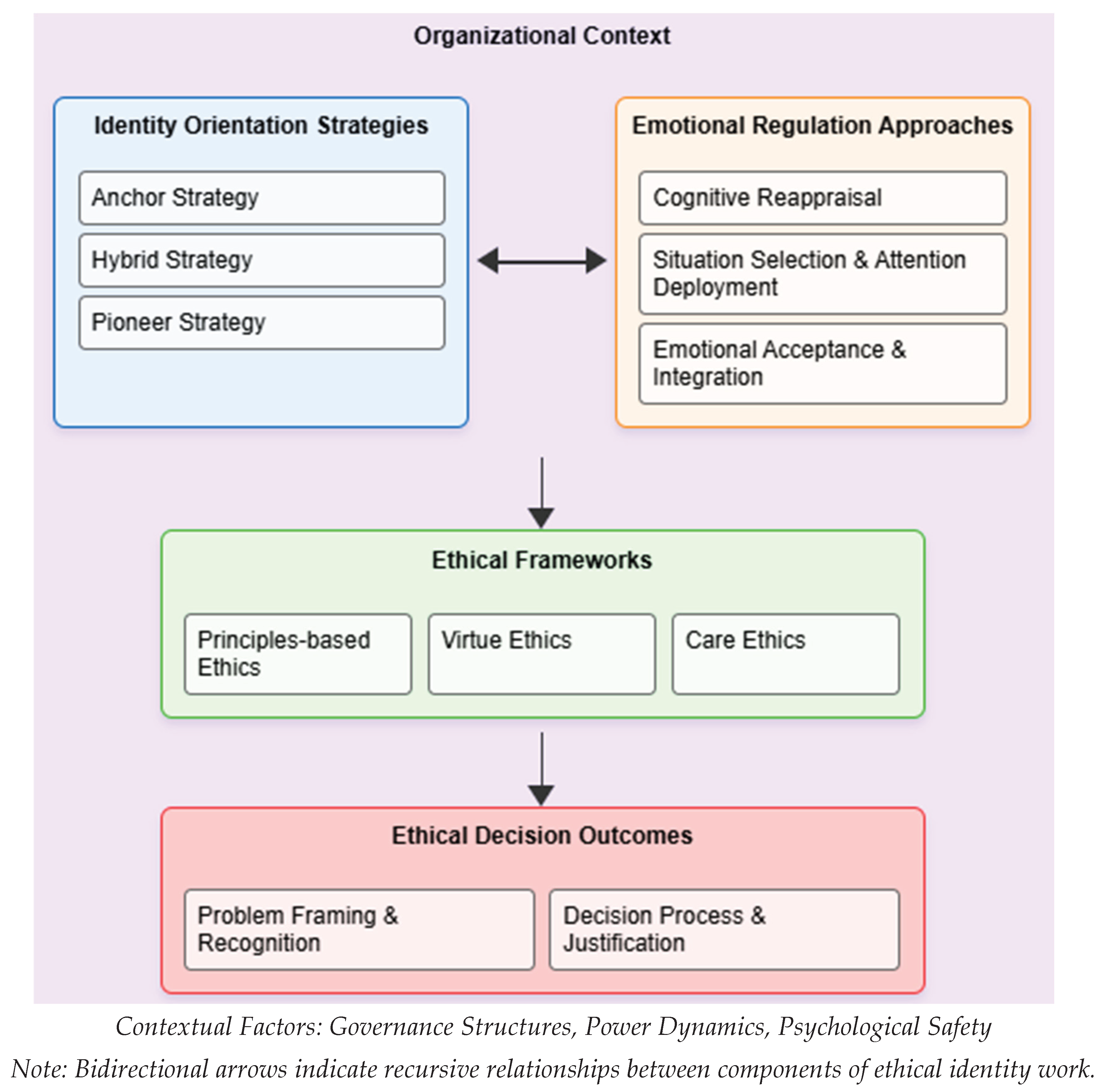
Figure 2.
Emotional Regulation Patterns by Identity Orientation Strategy.
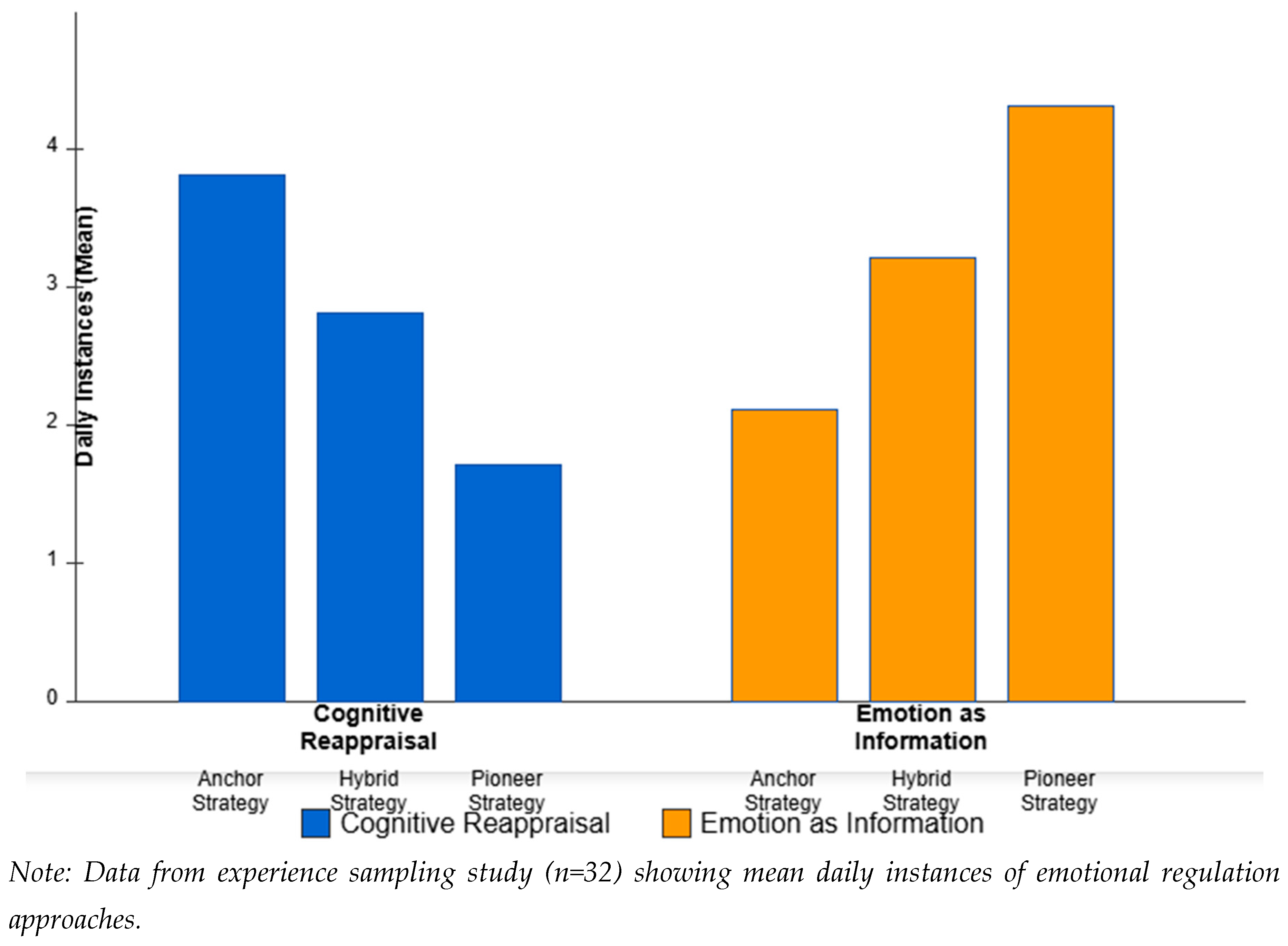
Figure 3.
Comparative Analysis of Identity Orientation Strategies Across Professional Roles.
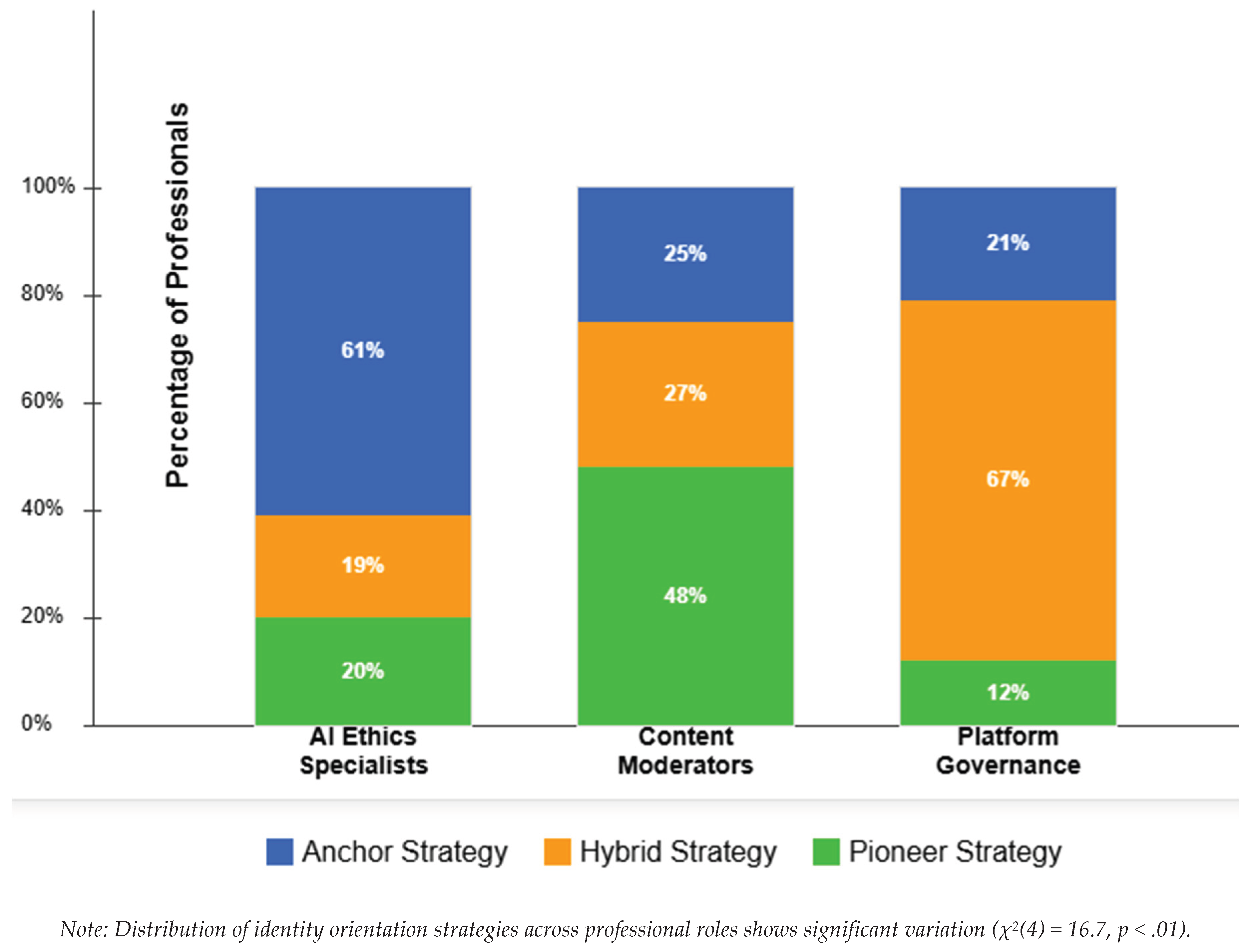
Figure 4.
Conceptual Model of Ethical Identity Work and Organizational Context.
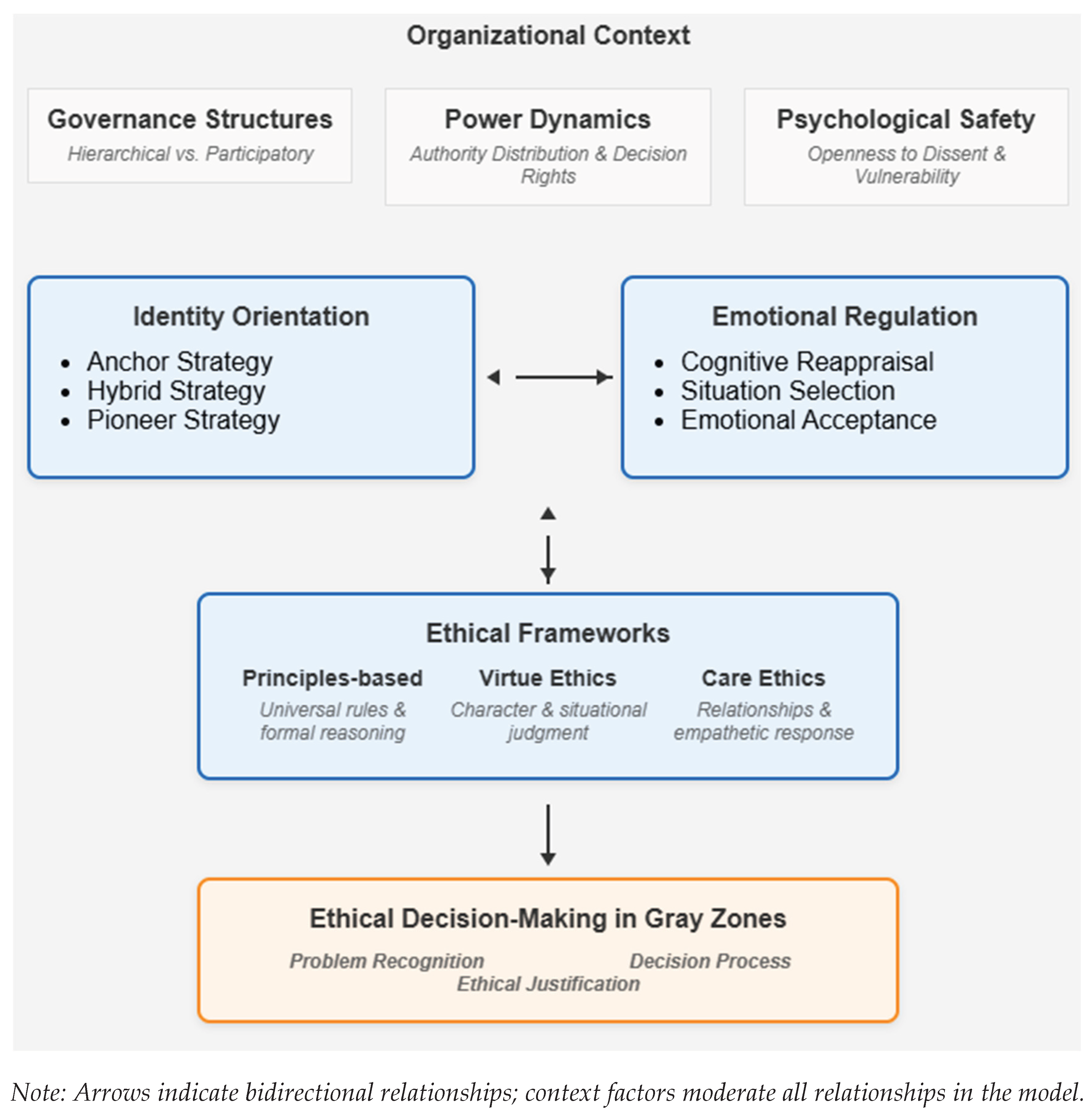
Table 1.
Simplified Coding Template.
| Higher-Order Theme | Sub-themes | Example Codes |
|---|---|---|
| Identity Orientation Strategies | Anchoring Strategy | Professional heritage; Extension of traditional role; Reference to established profession |
| Hybridizing Strategy | Integration; Synthesis; Multiple traditions; Selective borrowing | |
| Pioneering Strategy | Novel archetype; Creating new standards; Defining new territory | |
| Emotional Regulation | Cognitive Reappraisal | Reframing; Professional distance; Analytical reinterpretation |
| Situation Selection | Selective focus; Attention direction; Choosing engagement points | |
| Emotional Acceptance | Emotions as information; Emotional integration; Authentic response | |
| Ethical Frameworks | Principles-based | Universal rules; Procedural fairness; Consistent standards |
| Virtue Ethics | Character; Professional judgment; Balance and wisdom | |
| Care Ethics | Relationship focus; Harm prevention; Contextual understanding | |
| Contextual Factors | Governance Structures | Decision authority; Review processes; Accountability mechanisms |
| Power Dynamics | Hierarchical constraints; Advocacy resources; Voice opportunities | |
| Psychological Safety | Emotional expression norms; Error tolerance; Vulnerability acceptance |
Table 2.
Identity Orientation Strategies in Boundary-Spanning Digital Work.
| Strategy | Description | Prevalence | Illustrative Quote |
|---|---|---|---|
| Anchoring Strategy | Maintaining strong identification with an established profession while extending its boundaries to encompass new ethical challenges | 38% (most common among AI ethics specialists with technical backgrounds) | “At heart, I’m still an engineer. I approach ethical questions with the same analytical mindset, just applied to a different domain of problems.” (P7, AI ethics specialist) |
| Hybridizing Strategy | Selectively integrating elements from multiple professional traditions to create a coherent but novel professional identity | 42% (most common among platform governance professionals) | “I draw from my legal training for procedural thinking, my policy background for stakeholder analysis, and my technical knowledge for implementation constraints. I’m not any one of those things—I’m a new synthesis.” (P31, platform governance professional) |
| Pioneering Strategy | Embracing the lack of established templates as an opportunity to develop entirely new professional archetypes | 20% (most common among content moderators and junior professionals) | “There’s no roadmap for this role. I’m creating a new type of professional identity that doesn’t fit existing categories. That’s challenging but also liberating.” (P22, content moderator) |
Table 3.
Identity Orientation and Emotional Regulation Approaches.
| Identity Strategy | Primary Emotional Regulation Approach | Characteristic Emotional Patterns | Experimental Validation |
|---|---|---|---|
| Anchoring | Cognitive reappraisal (reinterpreting emotional responses through established professional lenses) | Lower emotional intensity but potential emotional suppression | Stronger reappraisal tendencies in vignette responses (β = .42, p < .01, 95% CI [.24, .60]) |
| Hybridizing | Situation selection and attention deployment (choosing and focusing on aspects of situations that align with integrated identity elements) | Moderate emotional intensity with selective engagement | Greater emotional flexibility in response to ambiguous situations (β = .37, p < .01, 95% CI [.18, .56]) |
| Pioneering | Emotional acceptance and integration (treating emotional responses as valid data points) | Higher reported emotional intensity with greater integration into decision processes | Higher scores on measures of emotional acceptance (β = .39, p < .01, 95% CI [.21, .57]) |
Table 4.
Identity Orientation and Ethical Frameworks.
| Identity Strategy | Primary Ethical Framework | Characteristic Approach to Ethical Dilemmas | Experimental Validation |
|---|---|---|---|
| Anchoring | Principles-based ethics (emphasizing universal ethical principles and formal reasoning processes) | Seeking to establish clear standards and procedures; preference for rule-based approaches | Stronger ratings for principle-based justifications in vignettes (β = .46, p < .001, 95% CI [.29, .63]) |
| Hybridizing | Virtue ethics (focusing on professional character and virtues that guide situational judgment) | Developing and applying context-sensitive professional judgment; emphasis on balance | Higher ratings for character-based considerations in ethical reasoning (β = .38, p < .01, 95% CI [.19, .57]) |
| Pioneering | Care ethics (prioritizing relationships, context, and empathetic response) | Attending to impacts on affected communities; emphasis on contextual understanding | Greater weight on relationship and harm considerations in ethical decisions (β = .41, p < .001, 95% CI [.23, .59]) |
Disclaimer/Publisher’s Note: The statements, opinions and data contained in all publications are solely those of the individual author(s) and contributor(s) and not of MDPI and/or the editor(s). MDPI and/or the editor(s) disclaim responsibility for any injury to people or property resulting from any ideas, methods, instructions or products referred to in the content. |
© 2025 by the authors. Licensee MDPI, Basel, Switzerland. This article is an open access article distributed under the terms and conditions of the Creative Commons Attribution (CC BY) license (http://creativecommons.org/licenses/by/4.0/).
Copyright: This open access article is published under a Creative Commons CC BY 4.0 license, which permit the free download, distribution, and reuse, provided that the author and preprint are cited in any reuse.


