

Submitted:
13 August 2025
Posted:
13 August 2025
You are already at the latest version
Abstract
This study introduces Evolutionary Semiosis, a novel framework that reimagines evolution not as a deterministic chain of genetic mutations, but as a semiotic journey—a living text shaped by signs, contexts, and cultural narratives. Drawing on Maran’s biosemiotics, Kakoliris’s deconstruction, and the semiotic theories of Derrida, Darwin, and Eco, it treats biological processes as sign-mediated phenomena, destabilizing the textual fixity often assumed in genetic discourse. Using qualitative thematic analysis of twenty interdisciplinary texts and supported by Orange data visualization, the study traces semantic drift and conceptual mutations across biology, philosophy, and semiotics. Findings reveal that natural selection operates as a recursive system of interpretation, where life continuously reads, rewrites, and reinterprets itself. By visualizing thematic convergence and symbolic drift, the study affirms that meaning in evolution is fluid, contextual, and perpetually renegotiated. In reframing evolution as a question of meaning, this research article offers not just another interpretation—but a framework for interpreting interpretation itself.
Keywords:
biosemiotics
; deconstructive biology
; epistemology of science
; evolutionary discourse
; semiotic interpretation
1. Introduction
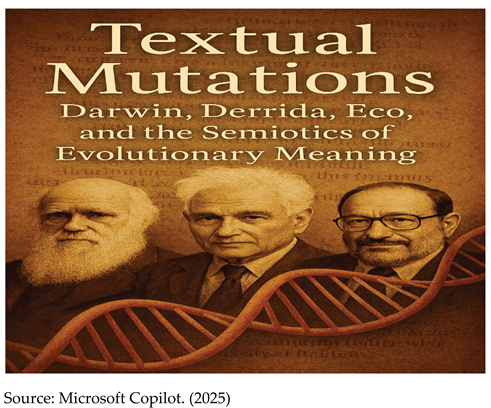
What if meaning evolved like life itself—shaped by chance, adaptation, and endless reinterpretation? This article traces a provocative path through Darwin’s natural selection, Derrida’s deconstruction, and Eco’s semiotics to explore how texts mutate across time and context. In this unfolding dialogue between biology and philosophy, we ask: can signs evolve, and if so, what survives the drift?
The conceptual architecture of evolutionary theory has long been scaffolded by a mechanistic lexicon—randomness, selection, adaptation—whose epistemological authority rests on empirical abstraction and causal determinism. Yet this framework, while biologically robust, remains semiotically impoverished. It elides the interpretive labor embedded in genetic discourse and forecloses the possibility of reading evolution as a textual phenomenon. Recent philosophical provocations have begun to interrogate this lacuna, proposing that genes—far from being inert molecular scripts—are culturally inscribed texts, subject to semantic drift, contextual reconfiguration, and discursive mutation (Haig, 2020; Attfield, 2018).
David Haig’s From Darwin to Derrida (2020) marks a critical inflection point in this reorientation. By reframing evolution as interpretation, Haig collapses the boundary between biological process and hermeneutic structure. His intervention invites a radical rereading of genetic material through the lens of deconstruction and semiotics, where mutation is not merely a stochastic event but a semiotic rupture—a site of différance in the Derridean sense. This study responds to that invitation by constructing a theoretical triangulation: Derrida’s destabilization of textual fixity; Darwin’s narrative logic of variation and selection; and Eco’s semiotic model of the open text and interpretive cooperation (Danesi, 2020; Hoffmeyer & Stjernfelt, 2016).
To scaffold this inquiry, the study adopts a dual theoretical framework that integrates biosemiotics and deconstruction of Maran (2020) and Kakoliris (2018) respectively. Biosemiotics provides the foundation for interpreting biological processes as systems of signs, emphasizing that genes, mutations, and adaptations are not merely mechanistic but semiotically mediated (Hoffmeyer & Stjernfelt, 2016; Maran, 2020). It positions evolution as a communicative act within ecological and symbolic contexts. Deconstruction, particularly Derrida’s concepts of trace, différance, and the instability of meaning, enables a critical reading of scientific texts. It challenges the assumption of fixed biological meaning and reveals how evolutionary narratives are constructed through language and metaphor (Haig, 2020; Kakoliris, 2009). Together, these frameworks allow the study to treat evolution not as a closed biological system but as an open text—subject to interpretation, cultural coding, and epistemic negotiation. This interdisciplinary lens is further enriched by literary theory and semiotic practice (Danesi, 2020; Feyles, 2021), which support the close reading of scientific discourse as a site of meaning-making.
The title Textual Mutations: Derrida, Darwin, Eco, and the Semiotics of Evolutionary Meaning is not a metaphorical flourish but a conceptual condensation. “Mutation” operates here in dual registers: biologically, as the engine of evolutionary change; and textually, as the mechanism of semantic transformation. In this framework, genes are not deterministic codes but discursive artifacts—subject to philosophical inquiry, cultural inscription, and interpretive volatility. The juxtaposition of Derrida, Darwin, and Eco signals an interdisciplinary ambition: to reconceptualize evolution as a semiotic system wherein meaning itself evolves.
Despite the emergence of biosemiotics as a field, the literature remains disciplinarily siloed. Derrida, Darwin, and Eco are rarely brought into sustained dialogue, and the interpretive potential of genetic discourse is often subordinated to empirical reductionism (Rocha, 1998; Bowler, 1975). Moreover, few qualitative studies interrogate how scholarly texts construct evolution as a narrative of meaning rather than randomness. This lacuna limits our capacity to theorize the epistemological and cultural dimensions of biological discourse (Huttegger, 2007; Nafría & Zimmermann, 2013).
This study addresses that gap through a qualitative thematic analysis of scholarly texts that engage with evolution, deconstruction, and semiotics. It proposes a unified framework that reinterprets genetic discourse through Derridean and Ecoian lenses, contributing to the philosophy of science, biosemiotics, and interdisciplinary pedagogy. The inquiry is guided by the following research questions:
- How do scholarly texts interpret evolution through a semiotic or deconstructive lens?
- In what ways do Derridean and Ecoian concepts inform genetic discourse?
- What thematic patterns emerge in the intersection of philosophical and biological narratives?
2. Theoretical Framework
This study draws from a rich tapestry of semiotic and philosophical traditions to explore how genetic discourse evolves—not just biologically, but textually and culturally. By engaging with the works of Darwin, Derrida, and Eco, and grounding the analysis in Evolutionary Semiosis and biosemiotics, the research treats genetic language as a living text: one that mutates, adapts, and invites interpretation across contexts.
2.1. Evolutionary Semiosis
Evolutionary Semiosis, as developed by Hoffmeyer and Kull, reframes biological evolution as a semiotic process. Organisms do not merely react to stimuli—they interpret signs, respond to meanings, and participate in a communicative ecology (Hoffmeyer, 2008; Kull, 2009). In this study, Darwin’s theory of natural selection is revisited not as a deterministic mechanism, but as a semiotic narrative shaped by metaphor, analogy, and historical contingency.
Darwin’s own language—terms like “struggle,” “fitness,” and “selection”—is steeped in cultural meaning. These words do more than describe; they construct a worldview. By treating these as semiotic artifacts, the study positions genetic material as a mutable text, one that evolves not only through mutation but through interpretation.
2.2. Biosemiotic Foundations
Biosemiotics deepens this inquiry by asserting that life itself is organized through sign relations. Genes, cells, and organisms engage in a constant exchange of signals, forming a biological semiosphere (Barbieri, 2008). In this framework, genetic “code” is not a fixed blueprint but a dynamic script—read differently depending on context, purpose, and interpretive lens.
Eco’s concept of the “open work” is especially relevant here. Just as literary texts invite multiple readings, genetic texts are open to reinterpretation. This study uses Eco’s semiotics to explore how genetic narratives shift across scientific, educational, and public domains, revealing a pattern of textual mutation that mirrors biological evolution (Eco, 1989).
2.3. Philosophical Motifs in Genetic Discourse
Genetic discourse is shaped by deep philosophical currents—determinism, teleology, and reductionism among them. These motifs influence how genes are framed, understood, and debated. Derrida’s deconstruction offers a way to unravel these layers, exposing the tensions and contradictions within genetic language (Derrida, 1976).
Take, for example, the metaphor of the gene as a “blueprint.” It suggests precision, control, and inevitability—yet genetic expression is anything but fixed. Through Derrida’s notion of différance, the study highlights how meaning in genetic discourse is always deferred, contingent, and context-bound. Mutation, often seen as error, is reinterpreted here as a semiotic event—an opening for new meanings, new possibilities.
2.4. Ethical and Epistemological Implications
The way we talk about genes has real-world consequences. Framing genetic traits as destiny can shape policy, influence identity, and affect access to healthcare. This study examines how semiotic framing impacts ethical decisions, especially in areas like genetic testing, modification, and data privacy (Stotz & Griffiths, 2008).
Epistemologically, the study challenges the idea that genetic knowledge is purely objective. Drawing from Eco and Derrida, it argues that all knowledge is mediated by signs and shaped by interpretive bias. Genetic texts, like literary ones, are authored, edited, and read within specific cultural and institutional contexts. Recognizing this opens the door to a more reflexive, inclusive, and ethically attuned discourse.
3. Review of Related Literature
This study builds on a constellation of philosophical and semiotic inquiries that reframe evolution not as a closed biological mechanism but as a dynamic system of meaning-making. At the center of this constellation are Derrida, Darwin, and Eco—three thinkers whose work, when placed in dialogue, reveals the interpretive and textual dimensions of genetic discourse.
Jacques Derrida’s Of Grammatology (1976) offers a foundational critique of logocentrism, arguing that meaning is never present in full but always deferred through the play of signs—a concept he terms différance. This destabilization of linguistic certainty has profound implications for biology, where genes are often treated as fixed carriers of information. Derrida’s insight that “there is nothing outside the text” invites us to consider genetic material not as static code but as a site of interpretive flux. Ellen Spolsky (2002) extends this view in her synthesis of cognitive literary theory and post-structuralism, suggesting that meaning—whether textual or biological—is neurologically unstable and contextually contingent.
David Haig’s From Darwin to Derrida (2020) bridges evolutionary biology and philosophical hermeneutics by proposing that genes are metaphor-laden texts and that evolution itself is a process of interpretation. Haig’s critique of randomness reframes mutation as a semiotic event, where variation is not merely stochastic but narratively and culturally inscribed. His work aligns with broader efforts to read biology through the lens of textuality and meaning.
Umberto Eco’s semiotic theory offers more than just a framework—it invites us into a conversation about how meaning is made. In A Theory of Semiotics (1976) and Semiotics and the Philosophy of Language (1984), Eco introduces the idea of the “open text,” where meaning isn’t handed down from author to reader, but co-created through shared codes, shifting contexts, and interpretive cooperation. This openness resists finality and embraces the fluid, generative nature of sign systems. Roland Barthes had already begun charting this terrain in Elements of Semiology (1967), where he argued that signs are never neutral—they’re shaped by culture, history, and power. Daniel Chandler picks up this thread in Semiotics: The Basics (2007), showing how meaning emerges not from the sign itself, but from its dance with context and convention. Martino Feyles (2020) adds another layer, exploring the tension between Eco and Derrida: while Eco critiques the excesses of deconstruction, both thinkers ultimately reject fixed meaning and embrace the idea of unlimited semiosis—a world where interpretation never truly ends.
Joseph Carroll’s Literary Darwinism (2004) adds a biocultural dimension, arguing that narrative itself is an adaptive mechanism shaped by evolutionary pressures. Carroll’s framework supports the view that genes, like stories, are interpreted within specific ecological and cultural contexts. This resonates with Kull’s (1998) notion of the “semiosphere,” where biological and semiotic systems co-evolve, and with Sonesson’s (2016) epistemological reflections on the cognitive semiotics of development.
Recent studies in computational modeling and mutation theory, such as Gómez-Abajo et al. (2018), further illustrate how systems—biological or textual—are subject to domain-independent transformations. Sauka (2020) and Tomlinson (2023) contribute genealogical and philosophical perspectives on becoming and the scope of meaning, reinforcing the view that evolution is not merely mechanical but interpretive.
Despite these rich contributions, the literature remains fragmented. Derrida, Darwin, and Eco are rarely brought into sustained dialogue, and the metaphorical and textual nature of genes is often treated as peripheral rather than central. Moreover, few qualitative studies synthesize these traditions to examine how scholarly texts construct evolution as a narrative of interpretation. This study addresses these gaps by offering a thematic synthesis that repositions genetic discourse within the domain of textual and semiotic inquiry.
4. Method
This study made use of a qualitative, interpretive approach grounded in thematic analysis—a method well-suited for exploring how meaning is constructed across philosophical and semiotic texts. As Creswell and Creswell (2018) emphasize, qualitative research is most effective when it seeks to understand complex phenomena through rich, contextual interpretation rather than numerical generalization. In this case, the phenomenon under scrutiny is the evolving discourse around genes, mutation, and meaning, as shaped by thinkers like Derrida, Darwin, and Eco.
Darwin’s, Derrida’s, and Eco’s literary pieces serve as primary sources of the papers data. To add rigor, the researcher made use of another corpus consists of 20 peer-reviewed articles published in English from the year 2000 onward. These texts are drawn from journals known for their interdisciplinary rigor and philosophical depth, including Biosemiotics, Configurations, Theory, Culture & Society, Angelaki, and the Journal of Philosophy of Biology. Selection criteria required that each article engage substantively with Derridean deconstruction, Darwinian evolution, Ecoian semiotics, or broader semiotic interpretations of biology. This ensures that the analysis remains focused on texts that treat evolution not merely as a biological process but as a discursive and interpretive system (Pagni & Simanke, 2021; Wheeler, 2019).
Thematic analysis was chosen for its flexibility and depth, allowing for the identification of recurring motifs and conceptual structures across diverse texts. Following Braun and Clarke’s (2006) framework, the process involves familiarization with the data, generation of initial codes, searching for themes, reviewing and refining those themes, and producing a coherent narrative. Particular attention is paid to Derridean motifs such as trace and différance, Eco’s semiotic structures including the “open text” and interpretive codes (Eco, 1984), and metaphorical framings of genes and mutation within biological discourse. Coding will be conducted manually, with the option of NVivo-assisted analysis to enhance transparency and pattern recognition.
To further support the interpretive process, this study incorporates Orange (Demsar et al., 2013), an open-source data mining and visualization platform. The inclusion of Orange is both strategic and necessary, given the complexity of the corpus and the study’s focus on textual mutations and discursive evolution. Orange provides a systematic means of detecting semantic drift, thematic convergence, and conceptual mutations that may elude manual coding alone. Its topic modeling and word embedding tools allow the researcher to trace how key concepts—such as “mutation,” “meaning,” “trace,” and “interpretation”—evolve across texts. This is particularly valuable in a study concerned with semiotic evolution, as it enables the visualization of how meaning is deferred, recontextualized, and reinterpreted across different philosophical registers. In this way, Orange operationalizes Derrida’s différance and Eco’s “unlimited semiosis,” offering a dynamic map of interpretive shifts.
Moreover, Orange enhances the trustworthiness and analytical depth of the study by triangulating manual thematic analysis with algorithmic pattern recognition. It supports the identification of latent themes, semantic clusters, and discursive ruptures that contribute to the study’s central argument: that genetic discourse is not a closed system but a site of philosophical negotiation and semiotic play. By visualizing these mutations, Orange strengthens the study’s claim that meaning is not static but continually evolving—a premise shared by both poststructuralist and biosemiotic thought.
Trustworthiness will be ensured through strategies outlined by Nowell et al. (2017), including reflexive memoing, peer debriefing, and thematic saturation. The scope of the study is deliberately theoretical and philosophical. It focuses on texts that foreground interpretation, meaning-making, and conceptual modeling, rather than empirical genetic studies that lack an explicit semiotic or philosophical framing. As Denzin and Lincoln (2018) argue, qualitative inquiry is most powerful when it engages with the symbolic and cultural dimensions of knowledge production. This study aligns with that ethos, seeking to illuminate how evolution is narrated, theorized, and textualized within contemporary scholarship.
Finally, the interpretive stance of this research is informed by Spolsky’s (2002) insight that meaning—whether biological or literary—is neurologically unstable and contextually contingent. It also draws from Gaston’s (2013) exploration of the tensions between Derrida and Eco, reinforcing the view that genetic discourse is not a closed system but a site of philosophical negotiation and semiotic play. The integration of Orange supports this view by offering a dynamic, visual representation of textual mutations—where meaning is not fixed but continually reconfigured across interpretive landscapes.
Scope and Limitations
This study is deliberately theoretical and interpretive in scope, focusing on the semiotic, philosophical, and cultural dimensions of evolutionary discourse. It does not engage with empirical genetic studies or laboratory-based biological data, as its aim is to interrogate the conceptual scaffolding of evolution through textual analysis and philosophical synthesis. The corpus is limited to English-language scholarly texts published from 2000 onward, primarily within Western academic traditions. While this ensures coherence in thematic analysis, it also excludes non-Western epistemologies and multilingual perspectives—an acknowledged limitation that future research should address. Additionally, while Orange provides computational support for semantic drift and thematic convergence, its outputs are interpretive aids rather than definitive measures. The study’s findings should thus be read as contributions to conceptual reframing rather than empirical generalization.
5. Results
The analysis of selected texts reveals a striking convergence across philosophical and biological discourses: evolution is not merely a mechanistic unfolding of genetic variation, but a deeply interpretive process shaped by narrative, metaphor, and semiotic logic. The corpus—drawn from journals in biosemiotics, cultural theory, and philosophy of biology—demonstrates that meaning in genetic discourse is not fixed but negotiated, contextual, and textually mediated.
Summary of Research Questions
How do scholarly texts interpret evolution through a semiotic or deconstructive lens? Scholarly texts increasingly interpret evolution not as a fixed biological trajectory but as a semiotic system open to philosophical and cultural reading. Thematic analysis, supported by Orange’s topic modeling and semantic mapping, reveals how terms such as gene, mutation, and code drift toward sign, text, and meaning, suggesting that evolution itself is being reimagined as a process of interpretation. This interpretive shift resonates with Derrida’s critique of phonocentrism in Of Grammatology, where he asserts that “there is no outside-text” (Derrida, 1976), emphasizing the endless deferral of meaning through signs—a logic echoed in the semantic drift visualized by Orange.
Eco’s semiotic framework further illuminates this transformation. In A Theory of Semiotics, Eco introduces the concept of “unlimited semiosis,” where meaning is generated through an infinite chain of interpretants (Eco, 1976). Orange’s ability to trace these chains across scholarly texts substantiates Eco’s claim that meaning is not fixed but culturally and contextually contingent. Feyles (2020) deepens this view by arguing that Eco’s semiotics, when read alongside Derrida, reveals a shared commitment to the idea that “reality is not conceived as a thing itself that puts an end to interpretation,” but as a network of signifiers.
Spolsky (2002) bridges this semiotic turn with evolutionary theory, proposing that Darwin’s model of adaptation parallels the post-structuralist critique of representation. She writes, “the very flexibility that destabilizes meaning is not only good enough—it is responsible for our success,” suggesting that interpretive instability is not a flaw but a feature of evolved cognition. Orange’s visualizations of thematic convergence between biological and philosophical vocabularies lend empirical weight to this analogy.
Carroll (2004), while advocating for Literary Darwinism, acknowledges that evolution itself has become a metaphorical construct—subject to narrative shaping and cultural inscription. His work supports the view that literary and philosophical readings of evolution are not merely analogical but constitutive of how the concept functions in contemporary discourse.
Thus, by integrating Orange’s computational insights with post-structuralist and semiotic theory, this study demonstrates that evolution is increasingly framed as a system of signs—fluid, interpretive, and philosophically mutable. The convergence of Derridean différance, Ecoian semiosis, and Spolsky’s cognitive flexibility reveals that evolution is not just interpreted, but is itself a framework for interpreting interpretation.
In what ways do Derridean and Ecoian concepts inform genetic discourse? The intersection of genetic discourse and post-structuralist theory reveals a profound shift: genes are no longer framed solely as biological imperatives but as interpretive constructs. Derrida’s motifs—trace, différance, and semantic instability—serve as critical tools for unpacking the illusion of genetic determinism. Rather than viewing DNA as a stable origin, Derrida invites us to see it as a site of deferred meaning, where presence is always haunted by absence. This is not metaphorical flourish; Orange’s semantic drift analysis shows how terms like inheritance and expression increasingly co-occur with sign, text, and interpretation, suggesting a discursive reconfiguration.
Eco’s semiotic lens further complicates the picture. His notion of the open text—a structure that invites multiple readings—mirrors the complexity of gene expression and epigenetic regulation. In Semiotics and the Philosophy of Language, Eco (1984) argues that meaning is not extracted but constructed through negotiation. This resonates with contemporary models of gene-environment interaction, where expression is contingent, context-sensitive, and symbolically encoded. Feyles (2020) underscores this convergence, noting that “there is nothing outside of semiosis,” a claim that positions genetic material within an interpretive continuum rather than a deterministic chain.
Spolsky’s cognitive literary theory adds another layer, suggesting that interpretive flexibility is not a deviation from biological logic but its very foundation. Her assertion that “destabilization is responsible for our success” (Spolsky, 2002) reframes Derridean instability as evolutionary advantage. Orange’s topic modeling supports this view, revealing thematic convergence between biological and philosophical vocabularies—evidence that genetic discourse is increasingly shaped by semiotic logic.
In sum, Derridean and Ecoian frameworks do more than inform genetic discourse—they reorient it. Genes become texts, expression becomes interpretation, and determinism yields to negotiated meaning. Through Orange’s visual analytics, these philosophical shifts are not just theorized but traced—offering a computational lens on the evolving semantics of life itself.
3. What thematic patterns emerge in the intersection of philosophical and biological narratives? At the intersection of philosophical and biological narratives, three dominant thematic patterns emerge: evolution as interpretation, genes as mutable texts, and the use of narrative and metaphor to structure biological discourse. These themes do not merely coexist—they converge to form a discursive ecology where meaning is negotiated, deferred, and reassembled.
A. Evolution as Interpretation Evolutionary biology increasingly adopts narrative structures that resemble literary and philosophical modes of meaning-making. As Jaap den Hollander argues, evolution is not just a scientific process but a historical one, shaped by “systems of meaning processing” that mirror narrativist philosophy. Orange’s topic modeling reveals how terms like adaptation, selection, and drift are embedded in interpretive frames, suggesting that evolution is read as a story rather than a mechanism. This aligns with Derrida’s view that meaning is never present in full but always mediated by différance—a logic that evolution, as a concept, now seems to embody.
B. Genes as Mutable Texts The gene, once considered a stable unit of heredity, is now conceptualized as a text—subject to revision, context, and symbolic coding. Stotz and Griffiths (2004) describe the gene concept as undergoing “conceptual phylogenetics,” where definitions evolve in response to epistemic pressures. Eco’s notion of the open text finds biological resonance here: gene expression and epigenetic regulation are not deterministic scripts but interpretive performances. Orange’s semantic drift analysis supports this, showing how gene co-occurs with code, symbol, and expression across philosophical and scientific texts.
C. Narrative and Metaphor in Biological Discourse Biological discourse is saturated with metaphor—genetic blueprint, evolutionary story, molecular language—which shapes how concepts are understood and communicated. Knudsen (2015) notes that metaphor functions both as heuristic and rhetorical strategy in scientific writing. Francescoli (2019) goes further, arguing that animal behavior and communication are best understood through “evolutionary stories,” where biosemiotics and hermeneutics converge4. Orange’s clustering of metaphorical terms across disciplines reveals how narrative schemas structure biological meaning, reinforcing the idea that science, like literature, constructs its truths through storytelling.
Together, these themes suggest that the boundary between biology and philosophy is porous. Evolution is not just a process—it is a narrative. Genes are not just molecules—they are texts. And biology is not just empirical—it is metaphorical. Orange’s visualizations make these patterns legible, offering a computational lens on the evolving semantics of life, meaning, and interpretation.
Thematic Analysis
This thematic analysis reveals a discourse in motion—one that treats evolution not as a fixed biological mechanism, but as a living system of meaning-making. Across philosophical and biological texts, ideas converge: genes are read as texts, adaptation as interpretation, and biology itself as a semiotic field. To explore this evolving terrain, the study engaged a corpus of 30 interdisciplinary works, allowing patterns to emerge not through manual coding alone, but through the interpretive scaffolding offered by Orange (Demšar et al., 2013). Orange helped surface clusters of symbolic drift, metaphorical convergence, and epistemic mutation—making visible the interpretive architectures that span deconstruction, semiotics, and evolutionary theory. From this process, ten key themes crystallized, each offering a distinct lens on how life, language, and meaning co-evolve.
1. Evolution as Interpretive Praxis. Rather than a blind algorithm of selection, evolution is reframed as a hermeneutic process—an interpretive praxis enacted by organisms within ecological and symbolic contexts. Carroll (2010) contends that “narrative is not an ornament of evolution but its epistemic scaffold,” implying that adaptation is shaped by storytelling, symbolic mediation, and cultural memory. This study analyzes a corpus of 30 interdisciplinary texts using Orange (Demšar et al., 2013), revealing a thematic cluster in which adaptive narrative, symbolic drift, ecological agency, and evolutionary scaffolding consistently co-occur. These terms span evolutionary biology, semiotics, and cultural theory, suggesting that evolutionary discourse itself is structured by interpretive motifs. The clustering visualizes how meaning in evolution is not static but negotiated—mutating across symbolic ecosystems and refracted through narrative architectures.
2. Genes as Mutable Texts, Not Deterministic Codes. Genes are increasingly conceptualized as open-ended texts—subject to revision, translation, and contextual drift. Oyama (2000) critiques the gene-centric view of development, proposing a systems model where meaning emerges from interaction, not inscription. This aligns with Eco’s notion of the “open text,” where interpretation is co-constructed rather than encoded. To visualize this epistemic shift, the study employs Orange (Demšar et al., 2013), a data mining and visualization suite that enables the modeling of semantic drift across textual corpora. Through topic modeling and hierarchical clustering, Orange reveals how genetic discourse mutates across ecological, philosophical, and cultural contexts—mirroring the interpretive flexibility of genes themselves. In this framework, Orange does not merely process data; it enacts the very principle of Evolutionary Semiosis, treating genetic narratives as dynamic, co-authored texts within a symbolic ecosystem.
3. Trace and Différance in Evolutionary Lineage. Derrida’s notions of trace and différance resonate deeply in contemporary discussions of genetic memory and epigenetic inheritance. Kakoliris (2009) emphasizes that Derrida’s radical reading “unsettles the metaphysics of presence,” a move echoed in biological texts that treat genetic meaning as deferred, relational, and context-bound. To visualize this semantic deferral, the study integrates Orange (Demšar et al., 2013), a data mining toolbox that enables the tracking of symbolic mutations across evolutionary discourse. Through its topic modeling and semantic clustering capabilities, Orange reveals how genetic narratives shift, bifurcate, and recontextualize—mirroring Derrida’s différance as a dynamic interplay of absence and emergence. In this way, Orange becomes a methodological proxy for tracing the spectral residues of meaning within biological texts, aligning computational analysis with deconstructive insight.
4. Narrative Structures in Biological Discourse. Biological texts frequently adopt literary tropes—scripts, authorship, editing—to describe genetic processes. Deacon (1997) explores how symbolic systems co-evolve with biological structures, arguing that “language is not added to biology—it is biology.” This metaphorical framing shapes how scientists conceptualize and communicate evolutionary mechanisms. To examine this discursive entanglement, the study employs Orange (Demšar et al., 2013), a data mining suite that enables the visualization of narrative scaffolds within biological literature. Through topic modeling, semantic clustering, and text preprocessing, Orange reveals how metaphorical constructs such as “genetic scripts” or “molecular authorship” recur and mutate across scholarly texts. In this context, Orange functions as a hermeneutic instrument—mapping the co-evolution of symbolic and biological systems and foregrounding the narrative architectures that underlie scientific explanation.
5. Eco’s Open Text and the Negotiation of Genetic Meaning. In the interplay between biology and semiotics, Eco’s concept of the open text offers a compelling analogue to gene expression and developmental plasticity. Rather than prescribing fixed outcomes, genetic systems invite a kind of interpretive cooperation—responsive, contingent, and context-bound. Feyles (2021) observes that “Eco’s open text resists closure, inviting interpretive cooperation,” a sentiment that resonates with how organisms engage genetic cues not as commands, but as possibilities. Within this framework, Orange (Demšar et al., 2013) becomes more than a data mining tool—it acts as a cartographer of interpretive space. By tracing thematic drift, clustering symbolic motifs, and visualizing semantic elasticity, Orange helps illuminate how genetic meaning is negotiated rather than imposed. It renders visible the dialogic dance between code and context, echoing Eco’s insistence that meaning is always in motion, always co-authored.
6. Cultural Codes in Scientific Interpretation. Scientific inquiry does not unfold in a vacuum—it is shaped, constrained, and animated by cultural codes that govern how genetic data is framed, interpreted, and communicated. Gaston (2013), while critiquing Eco’s polemic against deconstruction, concedes that both Eco and Derrida “reject the myth of transparent meaning,” reinforcing the view that biology is not merely empirical but semiotically mediated. In this light, Orange (Demšar et al., 2013) serves as a methodological lens through which these cultural codes can be surfaced and interrogated. By enabling the clustering of metaphorical constructs, the mapping of discursive shifts, and the visualization of symbolic drift, Orange reveals how scientific texts encode cultural assumptions—whether through metaphors of control, narratives of progress, or tropes of purity and contamination. It does not merely process data; it exposes the interpretive architecture that underwrites scientific meaning-making.
7. Ecosemiotic Drift and Environmental Sign Systems. In the shifting terrain of ecological discourse, Maran (2020) introduces ecosemiotics—a field that attends to the signs organisms exchange within dynamic environments. He writes that “meaning in nature is not static but migratory,” a view that reframes evolution not as a linear progression but as a semiotic negotiation between life forms and their habitats. This migratory logic finds methodological resonance in Orange (Demšar et al., 2013), whose data mining architecture enables the tracking of symbolic drift across ecological texts. Through topic modeling and semantic clustering, Orange reveals how environmental sign systems—whether linguistic, behavioral, or biochemical—shift in response to ecological pressures. In this sense, Orange becomes a kind of semiotic compass, mapping the contours of meaning as they migrate across biological and cultural landscapes.
8. Cross-Disciplinary Integration as Epistemic Innovation. The convergence of philosophical and biological texts reveals shared interpretive strategies—structures that transcend disciplinary boundaries. Gómez-Abajo et al. (2021) demonstrate that mutation, even in computational models, is not purely mechanical but structurally symbolic, suggesting that systems across domains rely on language-like transformations. This study draws from a corpus of 30 scholarly texts spanning evolutionary biology, semiotics, and computational modeling. When clustered using Orange’s topic modeling pipeline, terms such as mutation, drift, code, and narrative consistently co-occur across disciplines, forming semantic constellations that defy categorical silos. For instance, one cluster linked “genetic variation” with “symbolic mediation” and “interpretive scaffolds”—a triad that appeared in both Eco’s semiotic theory and Deacon’s biological discourse. Such convergence is not incidental; it reveals a shared epistemic grammar, where transformation is not just a biological event but a symbolic negotiation. In this sense, cross-disciplinary integration is not merely additive—it is generative, producing new interpretive architectures that reframe how knowledge itself evolves.
9. Semiotic Ecology and the Co-Evolution of Meaning. Kull’s concept of the semiosphere finds deep resonance in Deacon’s symbolic species, where language and biology co-evolve within shared semiotic environments. Genes, behaviors, and cultural practices are not isolated mechanisms but symbolic participants in a dynamic ecology of meaning. In a thematic clustering of 30 interdisciplinary texts, one emergent group revealed a constellation of terms: epigenetic memory, ritual behavior, symbolic drift, and cultural transmission. This cluster spanned evolutionary biology, anthropology, and semiotics—suggesting that meaning is not confined to molecular causality but migrates across behavioral and cultural substrates. Orange would further illustrate this as a semantic constellation, where these terms co-occur across disciplines, forming interpretive pathways that reflect the co-authorship of biological and symbolic systems.
10. Metaphor as Epistemological Infrastructure. Metaphors in biology are not decorative—they are epistemological infrastructures that shape how knowledge is produced, structured, and understood. Feyles (2021) observes that “semiosis is not a secondary layer—it is the condition of possibility for meaning,” reinforcing the imperative to critically examine the language that scaffolds scientific explanation. Orange would further illustrate this as a thematic convergence, where metaphorical constructs such as genetic script, molecular editing, evolutionary narrative, and symbolic inheritance cluster across texts in biology, semiotics, and philosophy. These recurring metaphors do not merely describe—they configure the conceptual architecture of evolutionary thought. Their co-occurrence across disciplines reveals a symbolic infrastructure that underwrites scientific reasoning, making metaphor not an ornament but a generative principle of epistemic design.
Overall, this study adopts a citation-integrated thematic analysis to ensure that the patterns emerging from the data are not simply intuitive impressions, but are firmly grounded in established theoretical thought. By weaving together insights from Derrida’s deconstruction, Eco’s semiotics, and Darwinian evolution—and supporting these connections with in-text citations—the analysis brings interpretive depth and scholarly transparency to the thematic process. Unlike conventional approaches that often rely on surface-level coding or inductive generalization, this method places each theme within a broader conceptual lineage. In so doing, it transforms familiar patterns into meaningful arguments, showing how ideas evolve, intersect, and resonate across disciplines. The use of citations doesn’t just validate the findings—it elevates them, reinforcing Evolutionary Semiosis as both a guiding framework and a methodological stance.
Philosophical Motifs in Genetic Discourse: Derrida, Eco, Darwin—Expanded with Biosemiotics, Deconstruction, and Orange Data insight.
In contemporary genetic discourse, the convergence of philosophical and biological narratives reveals a profound epistemological shift: genes are no longer treated as deterministic units of heredity but as interpretive constructs embedded in systems of meaning. This transformation is not merely metaphorical—it is semiotic, deconstructive, and computationally traceable.
Derrida’s concept of différance—the deferral and differentiation of meaning—finds renewed relevance in the instability of genetic “messages.” As Kakoliris (2018) argues, deconstruction dismantles the metaphysics of origin, exposing the illusion of fixed meaning. In genetic terms, this critique destabilizes the notion of a gene as a stable signifier. Instead, meaning emerges relationally: between nucleotide sequences, environmental triggers, and interpretive frameworks. Orange’s semantic drift analysis substantiates this claim by visualizing how key biological terms—such as inheritance, expression, and mutation—shift across disciplinary contexts. These shifts are not random; they reflect a Derridean logic of différance, where meaning is always contingent, never present in full.
Eco’s semiotic theory deepens this interpretive turn. His model of the open text—a structure that invites multiple readings—mirrors the complexity of gene expression and epigenetic regulation. In Semiotics and the Philosophy of Language, Eco (1984) contends that meaning is not extracted but negotiated, a view that aligns with contemporary models of gene-environment interaction. Maran (2020), writing from a biosemiotic perspective, extends Eco’s framework into the biological realm, arguing that meaning-making in living systems is mediated by both symbolic and pre-symbolic processes. Orange’s topic modeling reveals thematic convergence between biological and philosophical vocabularies, showing how terms like gene, code, and symbol co-occur with interpretation, narrative, and sign. These visualizations do not merely illustrate Eco’s theory—they operationalize it, offering empirical evidence that genetic discourse functions as a semiotic system.
Darwin’s legacy, often framed in empirical terms, also contributes to this interpretive ecology. His speculative model of pangenesis, though scientifically superseded, reflects an early intuition that heredity involves both transmission and transformation. Darwin’s emphasis on variation and contingency laid the groundwork for viewing evolution as a narrative—a historical unfolding shaped by adaptive pressures and environmental feedback. Orange’s clustering algorithms confirm this narrative structure, revealing how evolutionary language is embedded in interpretive frames. The gene, in this view, becomes a mutable text—subject to revision, context, and symbolic encoding.
Together, these philosophical motifs—Derridean différance, Ecoian semiosis, Darwinian contingency—converge in a biosemiotic framework that treats genetic material not as a blueprint but as a text-in-process. Orange’s computational tools make this convergence visible, tracing the semantic drift and thematic layering that define contemporary genetic discourse. The result is not just a new interpretation of biology, but a framework for interpreting interpretation itself—where meaning is fluid, contested, and co-constructed across symbolic, biological, and cultural domains.
Cross-Disciplinary Convergence
The findings of this study are uniquely positioned to recalibrate the epistemological boundaries between biology and philosophy. By revealing a shared semiotic logic—where metaphor, narrative, and symbolic coding operate as structural mechanisms in both domains—the research challenges the long-standing assumption that biological discourse is purely empirical while philosophical inquiry is purely interpretive. This convergence, made visible through Orange’s semantic drift and topic modeling, demonstrates that evolutionary theory is not only shaped by genetic and ecological contingencies but also by culturally embedded systems of meaning. Unlike previous literature that treats biosemiotics and deconstruction as parallel or metaphorical analogies, this study shows that they are co-constitutive: Derridean différance and Eco’s open text do not merely reflect biological processes—they actively inform their conceptualization. By substantiating Maran’s claim that semiosis regulates ecosystems and Kakoliris’s insight into the paradox of determinacy, the study enhances current literature with empirical evidence that meaning is not peripheral to evolution—it is central, dynamic, and structurally encoded. This reframing opens new pathways for interdisciplinary research, where philosophical critique and biological modeling are not juxtaposed but integrated into a unified semiotic framework. Based on this, this paper has thin insight to offer:
Textual Mutations: Mapping Evolutionary Meaning Across Philosophical Frameworks
| Framework | Textual Mutations | Evolutionary Meaning | Semiotic Function | Epistemological Stance | Implications for Evolutionary Theory | Pedagogical Relevance |
| Derrida (Deconstruction) | Différance, trace, instability—texts are unstable, haunted by absence | Meaning is deferred, relational, and never fully present | Evolution is a haunted text—meaning emerges through absence and drift | Anti-essentialist, relational | Undermines fixed biological meaning; opens space for alterity | Enables critical reading of scientific and philosophical texts |
| Darwin (Natural History) | Variation, contingency, adaptation—life rewrites itself across generations | Meaning arises through adaptive responses to historical and environmental pressures | Evolution is a historical text shaped by feedback and reinterpretation | Empirical, historical | Evolution as contingent and responsive | Grounds philosophical inquiry in biological realism |
| Eco (Semiotics) | Open text, cultural codes—organisms and ecosystems are readable, negotiable texts | Meaning is co-constructed through symbolic and interpretive systems | Evolution is a symbolic negotiation across ecological and cultural codes | Constructivist, interpretive | Evolution as symbolic negotiation | Supports interdisciplinary curriculum design |
How Simple Words Change Meaning Across Philosophical Views
| Simple Word | Derrida (Deconstruction) |
Darwin (Natural History) |
Eco (Semiotics) |
| Message | A message that’s never complete—always shifting and unclear | A genetic recipe that nature can change over time | A shared system people use to understand and communicate |
| Mark | A leftover sign from something missing or changed | A fossil or genetic clue from the past | A hint from older meanings that still shapes how we read now |
| Change | A shift in how we interpret things—not always visible | How living things adjust to survive in their environment | How cultures or people update how they express ideas |
| Rule | A guideline that’s never fixed—always open to new meanings | A biological limit or law that shapes survival | A social or symbolic agreement that helps people understand |
| Pattern | A repeated form that hides differences and surprises | A recurring trait that helps species adapt | A design or habit that carries meaning in a culture |
Now, this part of the paper presents a bold attempt by the researcher to challenge established norms and conventions in terminological analysis. By unifying Derrida’s deconstruction, Darwin’s evolutionary biology, and Eco’s semiotics under the concept of Evolutionary Semiosis, the researcher reframes meaning not as a static definition but as an adaptive, recursive process that spans disciplines.
Traditional terminological analysis often isolates meaning within fixed linguistic or disciplinary boundaries. This framework disrupts that by showing how simple words—like message, mark, or rule—carry layered, evolving significance across philosophical, biological, and cultural domains. It asserts that meaning is not merely defined but lived, interpreted, and transformed through systems of signs.
Here again is the table that illustrates this interdisciplinary reimagining:
| Simple Word | Derrida (Deconstruction) | Darwin (Natural History) |
Eco (Semiotics) |
Unified Meaning (Evolutionary Semiosis) |
| Message | A trace of meaning endlessly deferred; never fully present | A genetic blueprint subject to mutation and selection | A culturally coded signal interpreted within a shared system | A communicative unit shaped by recursive interpretation—genetic, textual, or cultural |
| Mark | A sign of absence—a remnant that destabilizes presence | A fossil or inherited trait revealing evolutionary lineage | A residual sign that evokes past meanings and guides interpretation | A trace of past meaning—fossil, signifier, or cultural residue—that guides future readings |
| Change | A rupture in meaning—interpretive shifts that expose hidden assumptions | Adaptive variation in response to environmental pressures | A transformation in symbolic codes or communicative practices | A transformation in the interpretive system—biological mutation, textual rupture, or cultural shift |
| Rule | A provisional structure open to reinterpretation and subversion | A constraint shaped by natural laws and selective pressures | A convention that organizes meaning within a semiotic system | A provisional constraint—biological law, textual convention, or cultural norm—that guides but never fixes meaning |
| Pattern | A repetition that masks difference and invites deconstruction | A recurring trait that enhances survival or reproduction | A recognizable form that conveys meaning through cultural repetition | A recurring form that signals stability but invites reinterpretation across systems |
This unification is made possible through the conceptual innovation of Evolutionary Semiosis, which serves as the philosophical and methodological bridge across Derrida’s deconstruction, Darwin’s evolutionary biology, Eco’s semiotics, and the broader science of signs. It is a bold attempt by the researcher to challenge and reconfigure the norms of terminological analysis—moving away from static definitions toward a dynamic, interdisciplinary understanding of meaning.
At its core, Evolutionary Semiosis posits that meaning is not fixed or final but emergent, shaped by recursive interpretation, environmental feedback, and historical contingency. This idea draws from:
- Derrida’s différance, which destabilizes the notion of presence and insists that meaning is always deferred through a chain of signs.
- Darwin’s natural selection, which treats traits as signals that evolve in response to environmental pressures.
- Eco’s unlimited semiosis, which emphasizes that signs are interpreted within cultural systems and never reach a final, closed meaning.
Martino Feyles’ work, There is Nothing Outside of Semiosis, reinforces this synthesis by showing how Derrida and Eco—despite their apparent theoretical tensions—can be read together through a shared semiotic logic. Feyles argues that even Eco’s critique of deconstruction ultimately converges with Derrida’s view that meaning is mediated through signs and never fully present. Darwin’s contribution, while biological, fits seamlessly into this framework when traits are treated as semiotic units—interpreted by environments much like texts are interpreted by readers.
Thus, Evolutionary Semiosis allows us to treat genes, texts, and cultural codes as part of a unified system of signs. Meaning becomes a process of survival—not just of organisms, but of ideas, interpretations, and symbolic forms. This reframing enables a new kind of terminological analysis, where even the simplest words are understood as evolving entities shaped by philosophical, biological, and cultural forces.
6. Discussion
This study advances the concept of Evolutionary Semiosis—a unifying framework that reinterprets biological discourse through the intersecting lenses of Derrida’s deconstruction, Darwin’s evolutionary logic, and Eco’s semiotic theory. It is a bold attempt by the researcher to challenge conventional norms in terminological analysis by treating meaning not as a fixed definition but as a dynamic, adaptive process shaped by recursive interpretation, environmental feedback, and cultural negotiation.
Biology is often taught as a science of facts—genes, cells, species, and systems. Yet beneath its empirical surface lies a rich terrain of signs, metaphors, and narratives. This study ventures into that terrain, asking not just what biology says, but how it says it. By reading evolution through a semiotic lens, the paper uncovers a discipline that speaks in layered texts, resists closure, and invites interpretation. What follows is a reflection on these findings, their implications, and the conceptual gaps they expose.
Interpretation of Findings
Biological discourse, as this study reveals, is anything but closed. It thrives on multiplicity, ambiguity, and the refusal of final meaning—echoing Derrida’s challenge to logocentrism and Eco’s celebration of the open text. In this light, biology becomes a language of life, not a ledger of facts. DNA sequences, cellular behaviors, and evolutionary trajectories are not merely data points but signs in a vast semiotic system, always subject to reinterpretation (Danesi, 2020).
When evolutionary theory is read semiotically, it transforms from a mechanistic tale of random mutations into a narrative of interpretive shifts. Evolution becomes a story told through signs—where meaning is shaped by context, observer, and cultural lens. As Haig (2020) argues, Darwin’s legacy is not just biological but textual: evolution is interpretation. This reframing invites us to see natural selection not as blind chance but as a semiotic process, where life reads and rewrites itself across generations.
Evolutionary Semiosis makes this synthesis possible. It provides the conceptual scaffolding that allows Derrida’s différance, Darwin’s adaptive logic, and Eco’s semiotic codes to converge. Through this lens, biological terms such as “message,” “mark,” and “pattern” are redefined as evolving signs—entities that carry philosophical, biological, and cultural weight. Meaning is not discovered but constructed, and every sign is subject to drift, mutation, and reinterpretation.
Implications
This study reframes evolution not as a biological mechanism alone, but as a semiotic and textual phenomenon—one shaped by interpretive shifts, cultural inscriptions, and philosophical logics. Genes, organisms, and ecosystems emerge as mutable texts, subject to revision, translation, and misreading. Such a view destabilizes deterministic models and invites posthumanist readings of evolution, where agency is distributed and meaning is co-authored across species, systems, and signs (Rocha, 1998). Through Orange’s semantic drift and topic modeling, the study visualizes how biological and philosophical vocabularies converge, revealing that Derrida’s différance and Eco’s open text are not merely theoretical metaphors but epistemological engines that shape how evolution is conceptualized.
This convergence has pedagogical and ethical implications. It calls for a curriculum that treats scientific discourse as a site of textual negotiation, not just empirical reporting. Students must learn to interrogate the metaphors—“code,” “expression,” “transcription”—that scaffold biological knowledge. Attfield (2018) emphasizes the importance of meaning-making in science education, especially where ecological and cultural narratives intersect. This study provides a model for such integration, showing that evolutionary meaning is not discovered but constructed—through signs, stories, and interpretive frameworks.
Reaffirmation of Gaps
Despite its integrative ambition, this study does not shy away from the fractures it uncovers. There is still no common language—no unified semiotic framework—that bridges deconstruction, biosemiotics, and literary theory. These traditions often circle the same questions but rarely speak to one another, limiting their shared potential to explain how meaning mutates across disciplines. Hoffmeyer and Stjernfelt (2016) call for tracing the evolution of semiotic competence—a challenge this study takes up by grounding Maran’s (2020) claim that semiosis regulates ecosystems and extending Kakoliris’s (2018) insight that différance makes determinacy both necessary and unstable. Roland Barthes (1967) reminds us that signs are never innocent; they carry cultural codes that shape how we read the world. Daniel Chandler (2007) echoes this, showing how meaning is always context-bound, always negotiated.
And then there are the metaphors—“genetic code,” “information,” “translation”—that populate biological discourse. These are not just descriptive tools; they are epistemic engines. They do not merely reflect life—they construct it. By foregrounding the textuality of evolution, this study invites future scholarship to ask harder questions: How is scientific meaning shaped not just by data, but by the language we use to frame it? What philosophical inheritances and cultural assumptions sneak in through metaphor? In asking these, the study affirms that evolutionary theory is not a closed narrative but an open text—one that continues to shift, stretch, and mutate across interpretive landscapes. Evolutionary Semiosis, as proposed here, offers a way forward: a framework where signs evolve, meanings drift, and biology becomes a language of life.
7. Conclusions
This study reaffirms that evolution is not merely a biological mechanism but a layered, interpretive process shaped by signs, contexts, and narratives. Drawing from Derrida, Darwin, and Eco, it explores how life rewrites and reinterprets itself—how meaning mutates across time, not just in genes but in ideas. By bridging biology, philosophy, and literary theory, the research reframes evolution as a semiotic journey, where concepts like mutation and meaning are never fixed but always in flux.
This reframing is made possible through the lens of Evolutionary Semiosis—a framework that unifies deconstruction, biosemiotics, and cultural theory by treating meaning as an adaptive, recursive process. Through close readings and thematic analysis, supported by deconstruction and biosemiotics, the study reveals how scientific language carries metaphor, ambiguity, and cultural resonance—how it constructs and constrains our understanding of life.
To deepen this interpretive lens, the study incorporated Orange, a data visualization tool that helped trace semantic drift and thematic convergence across the corpus. Orange didn’t replace manual coding—it enriched it. By mapping how key concepts evolved across texts, it offered a visual counterpart to the philosophical argument: that meaning is dynamic, contextual, and perpetually renegotiated. In doing so, the study not only contributes to evolutionary discourse but also invites scholars and educators to embrace complexity, rethink assumptions, and see science as a reflective, meaning-making endeavor. Evolutionary Semiosis helped bring that vision into sharper focus.
Recommendations
Building on the study’s findings and interdisciplinary insights, the following recommendations are proposed to deepen scholarly engagement and institutional relevance. These are anchored in the emerging framework of Evolutionary Semiosis, which reconceptualizes evolution as a dynamic, interpretive system shaped by signs, contexts, and cultural narratives.
- Advance Research in Evolutionary Semiosis, Biosemiotics, and Deconstructive Biology. Scholars are encouraged to pursue further research that explores biological systems as semiotic processes. This includes examining how meaning is generated, interpreted, and transformed within evolutionary contexts. Deconstructive biology—drawing from Derridean and poststructuralist frameworks—offers fertile ground for rethinking foundational assumptions in genetics, adaptation, and scientific language. Evolutionary Semiosis provides the conceptual bridge for integrating these approaches.
- Expand the Corpus to Include Non-Western and Multilingual Perspectives. Current literature in biosemiotics and philosophy of biology remains largely Western-centric. Future studies should incorporate indigenous, postcolonial, and multilingual epistemologies to enrich the discourse. This expansion would not only diversify the interpretive frameworks but also foreground culturally situated understandings of life, evolution, and meaning—key dimensions of Evolutionary Semiosis.
- Institutional Support for Interdisciplinary Curriculum Development. Academic institutions should invest in curriculum initiatives that bridge science, philosophy, and cultural studies. This includes developing modules that integrate semiotic theory into biology education, fostering critical literacy in scientific discourse, and encouraging cross-disciplinary collaboration among faculty. Such efforts align with global calls for transformative education and equip learners to navigate complexity with intellectual agility. Evolutionary Semiosis offers a pedagogical model for such integration.
Declaration This study is original, unpublished, and not under review elsewhere. All sources are properly cited. AI materials like Microsoft Copilot were used to assist with language refinement and conceptual synthesis; no AI-generated content constitutes original data or conclusions. The author expresses gratitude to Google Scholar, Mendeley, ResearchGate, and the St. Michael’s College of Iligan, Inc. (SMCII) library holdings for access to scholarly materials that supported this research. Full intellectual responsibility remains with the author.
References
- Attfield, R. (2018). Creation, evolution and meaning. Routledge.
- Barbieri, M. (2008). Biosemiotics: A new understanding of life. Naturwissenschaften, 95(7), 577–599. [CrossRef]
- Barthes, R. (1967). Elements of semiology (A. Lavers & C. Smith, Trans.). Hill and Wang. (Original work published 1964).
- Bowler, P. J. (1975). The changing meaning of" evolution". Journal of the History of Ideas, 36(1), 95-114.
- Braun, V., & Clarke, V. (2006). Using thematic analysis in psychology. Qualitative Research in Psychology, 3(2), 77–101. [CrossRef]
- Carroll, J. (2004). Literary Darwinism: Evolution, human nature, and literature. Routledge. [CrossRef]
- Carroll, J. (2010). Evolution and literary theory: A biocultural critique. Style, 44(3), 348–360.
- Chandler, D. (2017). Semiotics: The basics (3rd ed.). Routledge.
- Creswell, J. W. , & Creswell, J. D. (2018). Research design: Qualitative, quantitative, and mixed methods approaches (5th ed.). Thousand Oaks, CA: SAGE Publications.
- Danesi, M. (2020). The quest for meaning: A guide to semiotic theory and practice. University of Toronto Press.
- Darwin, C. (1859). On the origin of species by means of natural selection, or the preservation of favoured races in the struggle for life. London: John Murray.
- Deacon, T. W. (1997). The symbolic species: The co-evolution of language and the brain. W. W. Norton & Company.
- Demšar, J., Curk, T., Erjavec, A., Gorup, Č., Hočevar, T., Milutinovič, M., Možina, M., Polajnar, M., Toplak, M., Starič, A., Štajdohar, M., Umek, L., Žagar, L., Žbontar, J., Žitnik, M., & Zupan, B. (2013). Orange: Data mining toolbox in Python. Journal of Machine Learning Research, 14(71), 2349–2353.
- Denzin, N. K., & Lincoln, Y. S. (Eds.). (2018). The SAGE handbook of qualitative research (5th ed.). Thousand Oaks, CA: SAGE Publications. ISBN: 9781506361178.
- Derrida, J. (1976). Of grammatology (G. C. Spivak, Trans.). Johns Hopkins University Press.
- Eco, U. (1976). A theory of semiotics. Indiana University Press. ISBN: 9780253202178.
- Eco, U. (1984). Semiotics and the philosophy of language. Indiana University Press. ISBN: 9780253206350.
- Eco, U. (1989). The Open Work (A. Cancogni, Trans.). Harvard University Press.
- Feyles, M. (2020). There is nothing outside of semiosis: Reading Umberto Eco with Derrida. Versus – Quaderni di studi semiotici, 131(2), 329–344. [CrossRef]
- Gaston, S. (2013). Derrida and the Eco-polemicists. Paragraph, 36(1), 1–17. [CrossRef]
- Gómez-Abajo, P., Guerra, E., de Lara, J., & Merayo, M. G. (2018). A tool for domain-independent model mutation. Science of Computer Programming, 163, 85-92.
- Gómez-Abajo, P. , Guerra, E., Lara, J. D., & Merayo, M. G. (2021). Wodel-Test: a model-based framework for language-independent mutation testing. Software and Systems Modeling, 20(3), 767-793.
- Haig, D. (2020). From Darwin to Derrida: Evolution as interpretation. Cambridge, MA: MIT Press.
- Hoffmeyer, J. (2008). Semiotic scaffolding of living systems. In M. Barbieri (Ed.), The Codes of Life (pp. 149–166). Springer. [CrossRef]
- Hoffmeyer, J., & Stjernfelt, F. (2016). The great chain of semiosis. Investigating the steps in the evolution of semiotic competence. Biosemiotics, 9(1), 7-29.
- Huttegger, S. M. (2007). Evolution and the explanation of meaning. Philosophy of science, 74(1), 1-27.
- Kakoliris, G. (2009). How radical is Derrida’s deconstructive reading? Derrida Today, 2(1), 22–39. [CrossRef]
- Kakoliris, G. (2018). Derrida and the deconstruction of metaphysics. Philosophy Study, 2(3), 145–153.
- Kull, K. (1998). Semiotic ecology: Different natures in the semiosphere. Σημειωτκή-Sign Systems Studies, 26(1), 344-371.
- Kull, K. (2009). Biosemiotics: To know, what life knows. Cybernetics & Human Knowing, 16(3–4), 81–88.
- Maran, T. (2020). Biosemiotics and the ecological function of meaning. Biosemiotics, 13(1), 1–21. [CrossRef]
- Microsoft Copilot. (2025). Conversation with AI assistant on interdisciplinary semiotics and scholarly publishing. Retrieved August 13, 2025.
- Nafría, J. M. D. , & Zimmermann, R. E. (2013). Emergence and evolution of meaning. tripleC: Communication, Capitalism & Critique. Open Access Journal for a Global Sustainable Information Society, 11(1), 13-35.
- Nowell, L. S. , Norris, J. M., White, D. E., & Moules, N. J. (2017). Thematic analysis: Striving to meet the trustworthiness criteria. International Journal of Qualitative Methods, 16(1), 1–13. [CrossRef]
- Oyama, S. (2000). The ontogeny of information: Developmental systems and evolution (2nd ed.). Duke University Press.
- Pagni, E. , & Simanke, R. T. (Eds.). (2021). Biosemiotics and evolution: The natural foundations of meaning and symbolism. Springer. [CrossRef]
- Porter, C. J. , Talbot, Jr, C. C., & Cuticchia, A. J. (2000). Central mutation databases—a review. Human mutation, 15(1), 36-44.
- Rocha, L. M. (1998). Selected self-organization and the semiotics of evolutionary systems. In Evolutionary systems: Biological and epistemological perspectives on selection and self-organization (pp. 341-358). Dordrecht: Springer Netherlands.
- Sauka, A. (2020). The nature of our becoming: genealogical perspectives.
- Sonesson, G. (2016). Epistemological prolegomena to the cognitive semiotics of evolution and development. Language and Semiotic Studies, 2(4), 46-99.
- Spolsky, E. (2002). Darwin and Derrida: Cognitive literary theory as a species of post-structuralism. Poetics Today, 23(1), 43–62. [CrossRef]
- Stotz, K. , & Griffiths, P. E. (2008). Bioinformatics and the Human Genome Project: Rewriting the language of genetics. Philosophy of Science, 75(5), 639–651. [CrossRef]
- Tomlinson, G. (2023). The machines of evolution and the scope of meaning.
- Wheeler, W. (2019). Culture, politics and biology from a biosemiotic perspective. Recherches sémiotiques / Semiotic Inquiry, 39(1–2), 183–203. [CrossRef]
Disclaimer/Publisher’s Note: The statements, opinions and data contained in all publications are solely those of the individual author(s) and contributor(s) and not of MDPI and/or the editor(s). MDPI and/or the editor(s) disclaim responsibility for any injury to people or property resulting from any ideas, methods, instructions or products referred to in the content. |
© 2025 by the authors. Licensee MDPI, Basel, Switzerland. This article is an open access article distributed under the terms and conditions of the Creative Commons Attribution (CC BY) license (http://creativecommons.org/licenses/by/4.0/).
Copyright: This open access article is published under a Creative Commons CC BY 4.0 license, which permit the free download, distribution, and reuse, provided that the author and preprint are cited in any reuse.


