

Submitted:
13 August 2025
Posted:
14 August 2025
You are already at the latest version
Abstract
Increasing global water scarcity has driven the adoption of water reuse as a sustainable strategy, especially in regions subject to drought and pressure on natural resources. This paper presents a review of the application of Life Cycle Assessment (LCA) in water reuse projects by analyzing trends, methodological approaches, and opportunities for improvement. Twelve studies were selected out of 57 published since 2020, focusing on reuse systems assessed through LCA. The results indicate a predominance of research in Europe, reflecting regulatory advances and academic interests. The most frequent keywords were “water reuse”, “LCA”, and “wastewater treatment”, highlighting the centrality of these themes. The most analyzed environmental impact categories were global warming, human toxicity, eutrophication, and ecotoxicity, present in all studies. Energy transportation and consumption stand out as the most impactful stages of the life cycle, especially in scenarios with large distances or the use of fossil fuels. Despite these challenges, most studies point to the environmental viability of water reuse, especially when renewable sources and logistics optimization strategies are integrated. The critical analysis revealed the need for greater integration of economic and social aspects in the assessments, as well as for adapting the methodologies to the local context. These findings reinforce the role of LCA as an essential tool for making more sustainable water reuse management decisions.
Keywords:
water reuse
; life cycle assessment (LCA)
; review
; reclaimed water
; sustainable water management
; circular economy
1. Introduction
Water scarcity is one of the greatest challenges in the 21st century, affecting billions of people worldwide. According to the UN, approximately two billion people do not have access to safe drinking water, and half of the global population faces water shortages of at least one month per year [1]. Population growth, urban and industrial expansion, intensive agriculture, and climate change further intensify the pressure on water resources, leading to an imminent crisis that is already a critical reality in some regions [2].
In response to this challenge, water reuse has emerged as a promising alternative to reduce pressure on natural resources. Israel and Singapore are examples of nations that have already implemented advanced water reuse systems, utilizing treated wastewater (TWW) for various urban, industrial, and agricultural uses, which contribute to water security and environmental sustainability. Israel, one of the main examples, is widely recognized as a global leader, reusing approximately 90% of its TWW, primarily for agriculture [3]. The country has invested heavily in innovative treatment technologies, such as chlorination and ultraviolet processes, and has developed a reuse culture that integrates different sectors of the economy [3]. Singapore is also a reference for the NEWater program, which transforms highly treated wastewater into potable and industrial water, ensuring water security even with limited natural resources [4].
In Portugal, water scarcity is a growing concern, especially in inland regions and during more severe drought periods, which have become more frequent owing to climate change [5]. The extreme drought that occurred in the Iberian Peninsula in 2017 is a clear example that severely affects reservoir levels and necessitates the search for alternative water supply sources for the population [6]. This poses significant challenges for sustainable water management.
Portugal has gradually implemented water reuse as a strategy to improve the utilization of water resources. In Algarve, in the southern region of the country, reuse projects have already been developed for irrigation of crops, golf courses, and ecosystem support [7]. A notable example is the Águas do Tejo Atlantico group, which operates in 23 municipalities in the Lisbon region and leads initiatives based on the circular economy, through the innovative concept of "Water Factory." This approach promotes the valorization of treated water for various purposes, such as industrial use, irrigation of green spaces, and urban cleaning, in addition to educational initiatives, such as the production of "VIRA" beer with recycled water, with the aim of raising public awareness about the quality and potential of reused water [8].
These examples demonstrate that Portugal has the potential to advance in this scenario, adopt technologies and policies that encourage water reuse, reduce potable-water consumption, and help mitigate the effects of water scarcity. These actions can bring economic and environmental benefits, in addition to enhancing a country's resilience in the face of climate change. However, to ensure that this practice is environmentally viable, it is crucial to understand its impact throughout the entire life cycle.
Life Cycle Assessment (LCA) is a robust methodological tool that, according to ISO 14040 (2006) and 14044 (2006) standards [9,10], allows for the quantification and comparison of environmental impacts associated with products, processes, or services from resource extraction to end-of-life. Applied to water reuse, LCA offers a holistic view of environmental benefits and trade-offs, facilitating the identification of bottlenecks and opportunities for improvement in reuse systems.
This study conducted a review of the literature on the application of LCA as an innovative strategy to support the sustainable management of water reuse, identifying recent trends, main methodological approaches, and opportunities for improvement to foster more conscious and integrated decision making in the sector.
2. Materials and Methods
To achieve the objective of this study, a critical review of recent literature on the application of Life Cycle Assessment (LCA) in water reuse projects was conducted following the Preferred Reporting Items for Systematic Reviews and Meta-Analyses (PRISMA) 2020 guidelines.
The search was performed using the Web of Science, ScienceDirect, and Google Scholar databases, with keyword combinations such as “Life Cycle Assessment”, “LCA”, “water reuse”, “water recycling”, “wastewater recycling”. The selection was limited to publications from 2020 onwards to ensure the inclusion of up-to-date studies.
After removing duplicates and screening titles and abstracts, the remaining articles were assessed for eligibility based on thematic relevance, methodological consistency, and the availability of complete data. At the end of the process, 12 studies were included in the review.
Qualitative Analysis and Critical Synthesis
The selected studies were analyzed based on aspects such as the study objective, definition of functional units, system boundaries, inventory method, impact categories considered, use of primary or secondary data, allocation or system expansion approach, main results, and recommendations. Based on this analysis, a critical synthesis was developed, highlighting methodological advances, existing knowledge gaps, and future opportunities to support more sustainable water reuse practices grounded in a lifecycle approach.
The full selection process is illustrated in Figure 1, which presents an adapted PRISMA 2020 flow diagram.
3. Results and Discussion
3.1. Profile of Articles Selected for Analysis
According to the methodology previously described 12 scientific articles that focused on the application of LCA in water reuse projects were selected and analyzed. The selection was based on strict criteria, including thematic alignment, methodological rigor, and relevance to the current discussion on sustainability in water reuse.
To facilitate the presentation and discussion of the findings, a summary table was created that included key information for each selected article. Table 1 details the article number, title, authors, publication year, and scientific journal in which it was published.
The analysis reveals a predominance of studies conducted in European countries, particularly within the European Union, with notable contributions from Italy, France, and Portugal. This region has excelled in LCA research applied to water reuse, reflecting advancements in environmental policies and academic interests. This prominence is further reinforced by regulatory frameworks, such as Regulation (EU) 2020/741, which sets minimum requirements for water reuse, especially in agriculture. This regulation aims to standardize practices, ensure sanitary safety, and stimulate efficient and sustainable water resource use [23].
Journals such as the Journal of Cleaner Production and Sustainability are among the primary sources of publications, suggesting their central role in disseminating scientific knowledge on sustainability and water resource management. While most studies concentrate on Europe, the sample includes relevant contributions from countries in Asia, South America, and Africa, such as India, Iran, Vietnam, Chile, and Algeria, demonstrating the gradual expansion of interest in this topic across diverse global contexts.
Analyzing the keywords used in these articles is crucial for understanding the conceptual structure and emerging trends in the field. According to Du et al. [24], keywords help to identify central themes and subfields within a research area. Additionally, analyzing these words can reveal emerging trends and future research directions.
A thorough examination of these terms allowed the identification of dominant themes, as well as the most recurrent methodologies, technologies, and contexts, making it easier to visualize the main research foci.
Figure 2 presents a graphic map of the keywords, where "water reuse" stands out as the central node, highlighting its position as the dominant theme in the thematic network. Secondary nodes represent associated methodologies, technologies, applications, and contexts, and form a complex network of interrelationships. The size of the circles is proportional to the frequency of keyword occurrences in the articles, whereas the colors indicate the connections between the terms.
Analyzing the keywords allowed the identification of four interconnected thematic colors. The most recurrent theme was "water reuse," present in 92% of the studies, with terms like "reclaimed water" and "greywater reuse." Next, "life cycle assessment (LCA)" stood out, mentioned in 75% of the works, using terms like "LCA" and "environmental assessment." "Wastewater treatment" appeared in 50% of the studies, with an emphasis on technologies such as "tertiary treatment" and "AnMBR." Finally, the themes of "irrigation" (33%) and "sustainability" (25%) complete the thematic structure, focusing on "circular economy" and "water circularity."
The analyzed themes were strongly linked, forming a well-defined connection pattern. The relationship between water reuse and LCA, present in eight studies, shows that LCA can be used to prove the environmental benefits of reuse, such as reducing water consumption. The link between LCA and treatment, as seen in five studies, highlights the use of LCA to choose the most suitable and safe technologies. LCA is widely used in the water treatment sector because it offers a complete view of environmental impacts throughout the life cycle. This allows a comparison of technologies and scenarios, helping to choose the most sustainable options for the design and operation of treatment plants [25].
The connection between reuse and irrigation observed in four studies indicates that agriculture is the main destination for reused water. Sustainability appears indirectly and is mainly related to LCA.
The present study revealed several significant differences. Only 8% of the studies integrate economic assessment, such as Life Cycle Costing (LCC), and social aspects (S-LCA), such as farmers' practices. According to Larsen et al. and Dong et al. [26], [27] the application of LCC and S-LCA is hindered by a lack of reliable data, especially social data, and the need for contextual adaptations. Integrating these approaches into LCA requires methodological advancements and collaboration, which can discourage its adoption. Additionally, most studies (67%) focused on microsystems, with little attention paid to broader urban infrastructure.
The connection map revealed a strong link between technical and environmental themes, especially between water reuse, LCA, and treatment. However, the limited attention given to social, economic, and scale factors restricts a more complete view of the topic, highlighting the need for more comprehensive studies in the future.
3.2. LCA Methodological Approach
Studies were analyzed based on the methodological approach adopted for LCA, considering the main elements that structure this type of evaluation. The functional units used, defined system boundaries, LCA type (attributional or consequential), and environmental impact assessment methods were examined.
In addition, the software and databases used in each study were identified. This analysis allowed us to understand the methodological decisions made and evaluate the consistency between the studies in light of the guidelines established by the ISO 14040 and ISO 14044 standards. The main aspects of the type of LCA, system boundaries, and functional units are summarized in Table 2.
Analysis of the studies presented in Table 2 revealed that 100% used the attributional LCA approach. This reflects a preference for an approach that represents the average environmental impact of existing systems, without considering marginal changes. The attributional approach is the most widely used approach in LCA studies primarily because of its simplicity and accessibility. As Schaubroeck et al. [28] observed, using average data reduces the need for extensive information collection and complex modelling, making the process more practical for professionals and decreasing the risk of errors.
Regarding system boundaries, four studies adopted the "cradle-to-field" scope (Studies 2, 3, 4, and 8) related to cucumber production, effluent treatment, vineyard irrigation, and water use in agriculture, respectively. Three studies (5, 10, and 11) used the "expanded cradle-to-gate" boundary, while studies 7 and 6 adopted "cradle-to-gate" and "cradle-to-grave" limits, respectively. Study 1 considered the "expanded gate-to-gate" system, study 9 applied the "gate-to-use" limit, and study 12 used the "cradle-to-cradle" approach.
As for functional units, seven studies (3, 5, 6, 7, 8, 11, and 12) used the volume of treated water or effluent as a reference, in formats such as 1 m³ or 1 m³/day. Other units included irrigation of 1 m² of green area per day (study 1), 1 ha of irrigated vineyard (study 4), 211 m ³/day of water (study 9), and the total weight of chickens slaughtered in one year (study 10). Study 2 used two functional units (1 ha and 1 kg of cucumber) to compare the effects of cultivated area and irrigation system productivity. The diversity of the functional units identified reflects each study's methodological adaptation to its specific goals and the context of reused water application.
The analyzed studies used different software and methods for conducting the LCA (Table 3), with a notable emphasis on SimaPro in various versions (Studies 1, 4, 7, 11, and 12), OpenLCA (Studies 5, 6, 8, and 9), Umberto LCA+ (Study 3), and GaBi (Study 10). SimaPro is a widely used LCA software because it allows the comparison of scenarios and the identification of environmental improvements in products and processes. An extensive and detailed database supports more sustainable decisions and contributes to achieving Sustainable Development Goals [29].
The ReCiPe method was the most frequently applied impact assessment method, used in eight out of 12 studies (including its 2008, 2016, and various versions). Other methods employed included CML-IA, ILCD 2011, TRACI 2.1, and Impact 2002+. The ReCiPe method is widely used because of its comprehensive coverage that allows for the evaluation of environmental impacts across multiple dimensions [30]. Its versatility makes it a robust tool for environmental impact assessments across different sectors [31].
Regarding databases, most studies utilized the Ecoinvent database in various versions ( 3.1 to 3.9.1), recognized for its breadth and detail. Some studies supplemented or used additional databases such as ELCD 3.2, OzLCI2019, and GaBi’s database. This diversity in tools and databases reflects the adaptation of studies to the specificities of the analyzed systems and available methodological updates.
The environmental impact categories used in the 12 evaluated studies revealed clear patterns of prioritization and frequency of use, as illustrated in the graph (Figure 3). To facilitate comparison, impact categories were grouped according to a consolidated classification, unifying distinct nomenclatures and subdivisions adopted by different methods. For example, categories such as "Climate change," "Global warming," and "Global warming potential" were consolidated into a single global warming category, while others like human toxicity, ecotoxicity, eutrophication, acidification, resource depletion, and land occupation were also harmonized into equivalent groups. This methodological grouping reduced fragmentation and enhanced comparability between the studies, reflecting the recommended LCA practices.
Four categories stand out as being present in 100% of the studies: global warming/climate change, human toxicity, eutrophication, and ecotoxicity. These categories reflect the main impacts of water treatment and reuse.
Global warming is consistently present owing to the intensive energy consumption of treatment processes, especially in advanced systems, such as membrane bioreactors and tertiary treatments. Additionally, Wastewater Treatment Plants (WWTPs) emit primary greenhouse gases (GHGs) including methane (CH4), carbon dioxide (CO2), and nitrous oxide (N2O) [32], [33]. N2O, in particular, has a high global warming potential and is primarily produced during nitrification and denitrification [34].
Human toxicity is fundamental, as it involves direct or indirect exposure of the population to contaminants in treated water, which is a central concern for reuse safety [35].
According to Li et al. [36] and Pranta et al. [37], water for reuse often contains high levels of nutrients, such as nitrogen and phosphorus, which are the main contributors to eutrophication. Therefore, the eutrophication category is important and has been widely analyzed in LCA studies of water reuse.
Ecotoxicity is crucial for evaluating the toxic effects of substances present in TWW on aquatic and terrestrial organisms such as bacteria, algae, crustaceans, and fish. These effects vary according to the type of effluent and treatment and can cause biochemical changes to acute and chronic toxicity, reflecting the incomplete removal of harmful contaminants [38].
Other categories were also frequently assessed, such as ozone layer depletion, which was present in 75% of the studies. This is often linked to nitrous oxide emissions during biological treatment processes. Acidification, photochemical oxidant formation, and abiotic resource depletion occur in approximately 67% of the studies, resulting from atmospheric emissions and the consumption of energy and chemicals in treatment processes. Categories with lower frequencies, such as ionizing radiation, particulate matter formation, metals/mineral depletion, water depletion, and land occupation/transformation, reflect more specific and contextual aspects related to the regional or methodological particularities of the studies.
Two distinct groups were identified regarding the level of impact assessment in the life cycle: those that exclusively applied midpoint categories and those that used both midpoint and endpoint categories (Table 4). Five studies (3, 4, 5, 6, and 9) evaluated only midpoint categories. In these cases, the results are presented solely in intermediate categories, such as those mentioned above. The midpoint approach is versatile and applicable to various sectors, offering a flexible framework for environmental impact assessment, which is why it is commonly used [39].
Conversely, seven studies (1, 2, 7, 8, 10, 11, and 12) integrated both the midpoint and endpoint categories. All these studies considered three major areas of protection at the endpoint level: human health, ecosystems, and resources/resource availability. Study 11 also included a fourth endpoint category specifically related to ecosystem quality.
These endpoint categories aggregate the results from multiple midpoint categories, synthesizing environmental impacts into potential damage to human health, ecosystem integrity, and future availability of natural resources. The endpoint approach assesses broad damage categories, translating midpoint results in more understandable final impacts for decision makers [30,40]. Its advantages include providing a holistic view of the impacts and facilitating communication of results [40, p. 2].
Notably, none of the analyzed studies exclusively used endpoint categories. This reinforces the importance of both approaches for a robust and comparable assessment of the environmental impact of water reuse.
3.3. Analysis of the Main Results of the Studies
The reviewed studies highlight the diversity of contexts and technological pathways assessed in the field of water reuse, emphasizing both the environmental benefits and the main trade-offs associated with each scenario (Table 5). Results from four environmental impact categories — global warming potential/climate change, ecotoxicity, eutrophication, and human toxicity — were considered, as these were the only ones consistently reported across the 12 studies analyzed. The recurrence of these categories reinforces their relevance in LCA studies applied to water reuse, making it essential to understand them for meaningful comparative interpretation across scenarios.
The objectives of the studies were also analyzed, as understanding the focus of each work is essential for correctly interpreting the results and identifying the main intentions behind the adopted approaches. As Dudkowski [41] pointed out, this also facilitates clear communication with stakeholders, increasing the impact and applicability of the conclusions.
The purpose of water reuse studies has shown that most of them primarily focus on comparing treatment technologies and strategies, aiming to identify the most environmentally advantageous alternatives (Studies 3, 5, 10, 11, and 12). These works mainly apply LCA to compare different reuse scenarios and to highlight the processes that contribute the most to environmental impacts throughout the life cycle.
A second group of studies focuses on specific applications, such as agricultural or green space irrigation, evaluating the associated environmental impacts, and in some cases, incorporating economic analyses (Studies 1, 2, 6, and 8).
- Additionally, some studies have concentrated on developing decision-support tools and methodological approaches to guide the selection of water sources or reuse strategies tailored to different geographical and climatic contexts (Studies 4 and 7).
- Finally, one study stands out for its broader approach, conducting an integrated analysis of water reuse across multiple municipal services, including energy production, green area irrigation, and urban cleaning (Study 9).
The integrated analysis of LCA studies applied to treated wastewater reuse revealed consistent patterns regarding the main critical factors affecting the environmental sustainability of these systems: transportation, energy consumption, and use of chemical inputs. The categories most sensitive to different arrangements were Global Warming Potential (GWP), eutrophication, ecotoxicity, and human toxicity.
Study 1, which assessed the irrigation of green spaces with treated wastewater (TWW) in Viseu, observed a negative impact of +15% in GWP, primarily associated with transportation and the electrical energy used in the system. However, the other categories showed significant environmental benefits, with reductions of –7% in eutrophication, –10% in ecotoxicity, and –7% in human toxicity. These results demonstrate that even with an increase in GWP, reuse can represent a net environmental gain, especially in urban contexts where the field is close to the treatment plant (Study 4, Study 6). This aligns with Filho et al. [42] and Rezaei et al. [43], who highlight the logistical relevance of transportation and its influence on the feasibility of reuse projects. In the case presented in Study 8, conducted in Italy, there was an increase in impact across almost all categories with TWW reuse. The additional impact was primarily attributed to the use of ultrafiltration and hypochlorite disinfection, which were also cited as the main contributors in Study 12. Even so, the study's final balance demonstrated that in arid regions, reuse is environmentally preferable, as it avoids the discharge of nutrients into the marine environment and reduces pressure on groundwater resources. Considering the data presented by Szalkowska and Zubrowska-Sudol [19], presented in Study 9, a case study in Warsaw, it was shown that for the transportation and use of TWW, in the short term, trucks have a lower environmental impact than a constructed dedicated network for reused water distribution. However, after 11–107 days of operation (depending on the truck category), the network becomes environmentally more advantageous, with accumulated reductions in GWP, toxicity, and eutrophication. This finding is consistent with the recommendation to prioritize permanent solutions in continuous projects.
In Study 2, conducted in agricultural greenhouses in Algeria, the data reinforce that the use of reused water can be advantageous provided that there is a rational adjustment in fertilization. The uncontrolled scenario showed the highest GWP (1.81 kg CO₂-eq/ha) and high human toxicity (1.58 kg 1,4-DCB-eq/ha). In the optimized scenario with adjusted fertilization, there was a reduction of up to 58% in GWP and over 60% in human toxicity, indicating that the main impact vector is not water but the excessive use of fertilizers.
Foglia et al. [13] compared different disinfection technologies and highlighted that the UASB + AnMBR combination, while promoting significant reductions in GWP (− 28%) and ecotoxicity (− 35%), also resulted in an increase in eutrophication (+68%) and human toxicity (+55%). This shows a tradeoff between the environmental benefits of advanced treatments and their high energy consumption. Technologies such as UASB + AnMBR significantly reduce impacts such as GWP and ecotoxicity; however, they require more energy and can increase the presence of residual nutrients, elevating eutrophication and human toxicity. Thus, it is essential to integrate adjusted fertilization practices, as demonstrated in Study 2 and reinforced by Rezaei et al. [43], to offset the negative effects and leverage the nutrients present in the effluent.
The LCA applied to water reuse in agriculture irrigation analysis (Study 4) demonstrated that the reuse of UV-treated water presents the best environmental performance, with lower impacts than conventional sources in all analyzed categories, provided the treatment plant is close to the irrigated area. In contrast, ultrafiltration and chlorination showed similar or higher impacts than irrigation with surface or groundwater owing to the intensive use of inputs and energy. This pattern was also observed in other studies (Studies 10 and 11), which showed that less energy-intensive technologies are preferable when available.
The data presented in Study 5, achieved in an urban context in India, indicate that the centralized non-potable reuse (NPR) scenario is the most environmentally advantageous, with reductions of up to 100% in eutrophication, 50% in ecotoxicity, and 24% in human toxicity. On the other hand, potable reuse (DPR) and hybrid scenarios showed significant increases in impacts, especially GWP (+34%) and human toxicity (+98% to +128%), owing to intensive energy and chemical use. This result clearly illustrates the trade-off between water security and environmental penalties. In contrast, the data presented in Study 6, which was conducted in Chile, showed that the most sensitive variable was water transport. The use of tanker trucks increased the GWP by up to 10 times compared with that of the public network. However, when solar energy and backwash systems were used, a significant reduction in GWP and toxicity was observed. These data confirm the advantages of decentralized systems with renewable sources, as pointed out in Studies 6 and 12.
The effects of different geographical conditions were the focus of Study 7, and the authors demonstrated that light tertiary treatment (RT1S) is environmentally advantageous, especially in arid and coastal regions, with reductions of more than 67% in the main categories. However, the use of intensive treatment (RT2) was only justified when compared to desalination or in contexts of extreme scarcity, where the benefits outweigh the high-energy cost. This result corroborates the analysis of Study 3 and highlights the importance of aligning the treatment level with the local water criticality.
Considering the impacts of different tertiary treatment technologies to treat secondary municipal wastewater for reuse presented in Study 11, which evaluated 20 combinations of technologies for agricultural, industrial, and aquifer recharge reuse, it was shown that the lowest impacts were associated with simple arrangements, such as depth filter + activated carbon + chlorination, especially for irrigation. In contrast, technologies such as reverse osmosis and MBR have shown high impacts due to high energy consumption. Electricity was the main contributor in all categories, accounting for up to 66% of the total impact. Energy is one of the main sources of environmental impact in reuse systems because of the high energy demand of tertiary and advanced treatments [44]. This effect is even more pronounced in regions where the energy matrix is based on fossil fuels, exacerbating greenhouse gas emissions. Additionally, both wastewater and potable-water treatment consume substantial volumes of energy, with sewage treatment generally being more energy-intensive than potable-water treatment [45].
Considering the industrial applications of water reuse, Study 10 reports the results of LCA in the poultry sector. It was observed that all reuse scenarios showed marginal improvements in GWP (up to –1.22%) compared to the baseline. Irrigation was slightly more beneficial than discharge into a water body; however, gains only became relevant in the "Reduce" scenario, which implemented a 50% reduction in water consumption. This shows that reducing resource use is more effective than isolating technological changes, as also pointed out in Studies 11 and 12. Study 12 quantifies the impact of different strategies applied to the paper sector. The use of biogas for energy generation within the system itself reduced the impacts by up to 30% in the midpoint categories and 15% in the aggregate indicator (single score). The water reuse strategy also showed reductions of up to 21%, confirming that the integration of renewable energy and simultaneous reuse is highly effective, particularly in industrial processes.
Overall, the 12 studies reinforce that the environmental impacts associated with water reuse are not intrinsic to the practice itself, but are strongly dependent on the system design, technological choice, and local context. The efficiency of these systems can be substantially enhanced by integrating renewable energy sources (solar and biogas), optimizing fertilizer doses, and minimizing transport distance, as synthesized in the analyzed studies. Therefore, technical decisions and public policies should adopt a systemic approach that considers the operational conditions and complete environmental balance.
4. Conclusions
By leveraging LCA as a comprehensive tool, this review underscores its potential to drive innovation and sustainability in water reuse systems, while identifying recurring patterns and gaps in the existing literature. Most research has been conducted in Europe, particularly Italy, France, and Portugal, with contributions from Asia, Africa, and South America. This geographic focus underscores the growing interest in water reuse and significant environmental awareness, as LCA helps identify the potential environmental impacts of these projects.
The most common keywords were "water reuse," "LCA," and "wastewater treatment," highlighting a strong methodological focus on LCA and a thematic interest in managing and reusing wastewater. However, the analysis also showed limited integration of complementary approaches like Life Cycle Costing (LCC) and Social Life Cycle Assessment (S-LCA). These are rarely or entirely absent in most studies, indicating a significant gap for future research.
SimaPro and the ReCiPe method were the most used because of their broad coverage of impact categories, flexibility, and integration with databases, such as Ecoinvent. The most frequently addressed categories were global warming, human toxicity, eutrophication, and ecotoxicity, reflecting concerns regarding energy consumption and contaminants in treated water. Most studies performed analyses at midpoint and endpoint levels, allowing for more complete environmental assessments.
Regarding the study results, the most impactful stages of the life cycle were water transportation (especially by tanker trucks over long distances) and energy consumption in advanced treatments such osmosis and UV. Despite these impacts, studies have indicated the environmental viability of wastewater reuse, particularly when combined with renewable energy sources, nutrient recovery, and logistical optimization.
Applying LCA to water reuse is strategic for promoting more sustainable practices and revealing significant opportunities for improvement and innovation, especially through the integration of the environmental, economic, and social dimensions. Adopting reuse strategies tailored to the local context is also crucial, and approaches such as LCC and S-LCA remain largely under-explored.
Author Contributions
Conceptualization, J.F. and L.S.; methodology, JF and L.S.; software, M.F.; validation, J.F.; formal analysis, L.S., J.F., A. F., and I.B.; investigation, L.S.; resources, J.F. and A.F.; data curation, J.F.; writing—original draft preparation, L.S.; writing—review and editing, L.S., J.F., M.F., A.F., and I.B.; supervision, J.F.; and project administration, J.F.. Funding acquisition: J.F. and A.F. All authors have read and agreed to the published version of the manuscript.
Funding
This work was financed by national funds through Fundação para a Ciência e Tecnologia (FCT), through the CERNAS Research Centre—project UIDB/00681/2020 (I.D.).
Acknowledgments
The authors thank the Technology and Management School, Polytechnic University of Viseu.
Conflicts of Interest
The authors declare no conflict of interest.
References
- FAO. Livestock and environment statistics: manure and GHG emissions. Global, regional and country trends 1990–2018 2020. Available online: https://openknowledge.fao.org/server/api/core/bitstreams/f0cebfdd-725e-4d7a-8e14-3ba8fb1486a7/content (accessed on 30 July 2025).
- Pokhrel, Y.; et al. Global terrestrial water storage and drought severity under climate change. Nature Climate Change 2021, 11, 226–233. [CrossRef]
- Christou, A.; et al. Sustainable wastewater reuse for agriculture. Nature Reviews Earth & Environment 2024, 5, 504–521. [CrossRef]
- de Sá, P.L.S.; Lousada, S.A.N.; Teixeira, H.L.S. Tratamento de Águas Residuais: Uma Visão Geral da Pesquisa Através da Análise Bibliométrica. Journal of Lifestyle and SDGs Review 2025, 5, e03641–e03641.
- Rebelo, A.; Amaro, A.B.; Quadrado, F. Water Reuse: A Risk Assessment Model for Water Resources. KnE Materials Science 2022, 193–203. [CrossRef]
- Brandao, J.M.; Simoes, L.M.; Callapez, P.; Magalhaes, V. Água em Viseu: desafios de um percurso centenário. In La gestion del agua en la península Ibérica (siglos XIX y XX); Sílex Ediciones: Madrid, Spain, 2022; pp. 451–470. Available online: https://hdl.handle.net/10174/36040 (accessed on 22 June 2025).
- United Nations. The United Nations World Water Development Report 2017: Wastewater — The Untapped Resource. UNESCO – United Nations Educational, Scientific and Cultural Organization 2017. Available online: https://unesdoc.unesco.org/ark:/48223/pf0000247552_por (accessed on 5 June 2025).
- Águas do Tejo Atlântico. Fábrica de Água. Águas do Tejo Atlântico 2019. Available online: https://www.aguasdotejoatlantico.adp.pt/content/fabrica-de-agua (accessed on 24 June 2024).
- ISO 14040. Environmental management – Life cycle assessment – Principles and framework. 2006.
- ISO 14044. Environmental management – Life cycle assessment – Requirements and guidelines. 2006.
- Santos, L.; Brás, I.; Ferreira, M.; Domingos, I.; Ferreira, J. Life Cycle Assessment of Green Space Irrigation Using Treated Wastewater: A Case Study. Sustainability 2024, 16, 5696. [CrossRef]
- Azeb, L.; Hartani, T.; Aitmouheb, N.; Pradeleix, L.; Hajjaji, N.; Aribi, S. Life cycle assessment of cucumber irrigation: Unplanned water reuse versus groundwater resources in Tipaza (Algeria). Journal of Water Reuse and Desalination 2020, 10, 227–238. [CrossRef]
- Foglia, A.; et al. Comparative life cycle environmental and economic assessment of anaerobic membrane bioreactor and disinfection for reclaimed water reuse in agricultural irrigation: A case study in Italy. Journal of Cleaner Production 2021, 293, 126201. [CrossRef]
- Kalboussi, N.; Biard, Y.; Pradeleix, L.; Rapaport, A.; Sinfort, C.; Ait-Mouheb, N. Life cycle assessment as decision support tool for water reuse in agriculture irrigation. Science of the Total Environment 2022, 836, 155486. [CrossRef]
- Negi, R.; Chandel, M.K. Life cycle assessment of wastewater reuse alternatives in urban water system. Resources, Conservation and Recycling 2024, 204, 107469. [CrossRef]
- Rodríguez, C.; Sánchez, R.; Rebolledo, N.; Schneider, N.; Serrano, J.; Leiva, E. Life cycle assessment of greywater treatment systems for water-reuse management in rural areas. Science of the Total Environment 2021, 795, 148687. [CrossRef]
- Maeseele, C.; Roux, P. An LCA framework to assess environmental efficiency of water reuse: Application to contrasted locations for wastewater reuse in agriculture. Journal of Cleaner Production 2021, 316, 128151. [CrossRef]
- Canaj, K.; Mehmeti, A.; Morrone, D.; Toma, P.; Todorović, M. Life cycle-based evaluation of environmental impacts and external costs of treated wastewater reuse for irrigation: A case study in southern Italy. Journal of Cleaner Production 2021, 293, 126142. [CrossRef]
- Szalkowska, K.; Zubrowska-Sudol, M. Opportunities for water reuse implementation in metropolitan areas in a complex approach with an LCA analysis, taking Warsaw, Poland as an example. Sustainability 2023, 15, 1190. [CrossRef]
- Hargitai, R.H.; Sebestyén, V.; Somogyi, V. Potential water reuse pathways from a life cycle analysis perspective in the poultry industry. Journal of Water Process Engineering 2024, 64, 105577. [CrossRef]
- Akhoundi, A.; Nazif, S. Life-Cycle Assessment of Tertiary Treatment Technologies to Treat Secondary Municipal Wastewater for Reuse in Agricultural Irrigation, Artificial Recharge of Groundwater, and Industrial Usages. J. Environ. Eng. 2020, 146, 04020031. [CrossRef]
- Vu, T.T.; Huang, C.-F.; Phan, H.A.; Bach, T.T.N.; Zhang, P.; Bui, H.M. Biogas Utilization and Water Reuse in Paper Mill Wastewater Treatment: A Life Cycle Analysis. Water, Air, & Soil Pollution 2025, 236, 265. [CrossRef]
- Mclennan, C.; Rudi, G.; Altchenko, Y.; Ait-Mouheb, N. Will the European Regulation for water reuse for agricultural irrigation foster this practice in the European Union? Water Reuse 2024, 14, 115–135. [CrossRef]
- Du, Z.; Wang, Z.; Guo, F.; Wang, T. Dynamic structures and emerging trends in the management of major trauma: a bibliometric analysis of publications between 2012 and 2021. Frontiers in Public Health 2022, 10, 1017817. [CrossRef]
- Tsangas, M.; Papamichael, I.; Banti, D.; Samaras, P.; Zorpas, A.A. LCA of municipal wastewater treatment. Chemosphere 2023, 341, 139952.
- Larsen, V.G.; Tollin, N.; Sattrup, P.A.; Birkved, M.; Holmboe, T. What are the challenges in assessing circular economy for the built environment? A literature review on integrating LCA, LCC and S-LCA in life cycle sustainability assessment, LCSA. Journal of Building Engineering 2022, 50, 104203. [CrossRef]
- Dong, B.; Song, C.; Li, H.; Lin, A.; Wang, J.; Li, W. Life cycle assessment on the environmental impacts of different pig manure management techniques. International Journal of Agricultural and Biological Engineering 2022, 15, 78–84. [CrossRef]
- Schaubroeck, T.; Schaubroeck, S.; Heijungs, R.; Zamagni, A.; Brandão, M.; Benetto, E. Attributional & consequential life cycle assessment: definitions, conceptual characteristics and modelling restrictions. Sustainability 2021, 13, 7386.
- Luo, C.; Yao, X.; Zhang, Y.; Zhou, H. An empirical study on the impact of different structural systems on carbon emissions of prefabricated buildings based on SimaPro. World Journal of Engineering and Technology 2023, 11, 434–453. [CrossRef]
- Huijbregts, M.A.J.; et al. ReCiPe2016: a harmonised life cycle impact assessment method at midpoint and endpoint level. International Journal of Life Cycle Assessment 2017, 22, 138–147. [CrossRef]
- Devi, S.A.; Mirwan, M. Analisis Life Cycle Assessment (LCA) pada Proses Produksi Pupuk ZA II Menggunakan Metode Recipe 2016. INSOLOGI: Jurnal Sains dan Teknologi 2023, 2, 620–632. [CrossRef]
- Anazonwu, I.A.; Fahmi, M.Z. Wastewater treatment, greenhouse gas emissions, and our environment. Recent Advances in Natural Sciences 2024, 121–121.
- Chen, X.; Zhao, B.; Shuai, C.; Qu, S.; Xu, M. Global spread of water scarcity risk through trade. Resources, Conservation and Recycling 2022, 187, 106643. [CrossRef]
- Mannina, G.; Cosenza, A.; Ekama, G.A. A comprehensive integrated membrane bioreactor model for greenhouse gas emissions. Chemical Engineering Journal 2018, 334, 1563–1572. [CrossRef]
- Kesari, K.K.; et al. Wastewater Treatment and Reuse: a Review of its Applications and Health Implications. Water Air Soil Pollution 2021, 232, 208. [CrossRef]
- Li, G.; Hao, C.H.; Jing, Y.M.; Liu, D.X.; Li, Y. Eutrophication problems of recycled water for landscape water and ecological restoration. Applied Mechanics and Materials 2013, 361, 938–941. [CrossRef]
- Pranta, A.D.; Rahaman, M.T.; Ahmed, M.S.; Arefin Rafi, M.S. Navigating eutrophication in aquatic environments: understanding impacts and unveiling solutions for effective wastewater management. Res Ecol 2023, 5, 11–18.
- Liwarska-Bizukojc, E. Evaluation of Ecotoxicity of wastewater from the full-scale treatment plants. Water 2022, 14, 3345. [CrossRef]
- Olagunju, B.D.; Olanrewaju, O.A. Life cycle assessment of ordinary portland cement (OPC) using both problem oriented (Midpoint) approach and damage oriented approach (Endpoint). In Product Life Cycle-Opportunities for Digital and Sustainable Transformation; IntechOpen: 2021. Available online: https://www.intechopen.com/chapters/77062 (accessed on 23 June 2025).
- Gu, L.; Lin, B.; Gu, D.; Zhu, Y. An endpoint damage oriented model for life cycle environmental impact assessment of buildings in China. Chinese Science Bulletin 2008, 53, 3762–3769. [CrossRef]
- Dudkowski, R. Objectives of the Study. In Managing Value Co-creation in University-Industry Partnerships, Springer International Publishing: Cham, Switzerland, 2021, 61–63.
- Pereira Filho, J.M.; Vieira, E.L.; Silva, A.M.A.; Cezar, M.F.; Amorim, F.U. Efeito do tratamento com hidróxido de sódio sobre a fração fibrosa, digestibilidade e tanino do feno de jurema-preta (Mimosa tenuiflora Wild). R. Bras. Zootec. 2003, 32, 70–76.
- Rezaei, N.; Diaz-Elsayed, N.; Mohebbi, S.; Xie, X.; Zhang, Q. A multi-criteria sustainability assessment of water reuse applications: a case study in Lakeland, Florida. Environmental Science: Water Research & Technology 2019, 5, 102–118. [CrossRef]
- deMonsabert, S.; Bakhshi, A.; Maas, C.; Liner, B. Incorporating energy impacts into water supply and wastewater management. American Council for an Energy Efficient Economy 2009. Available online: https://www.aceee.org/files/proceedings/2009/data/papers/6_86.pdf (accessed on 24 June 2025).
- Plappally, A.K. Energy requirements for water production, treatment, end use, reclamation, and disposal. Renewable and Sustainable Energy Reviews 2012, 16, 4818–4848.
Figure 1.
PRISMA flow diagram illustrating the study selection process for the systematic review, including the phases of identification, screening, eligibility, and inclusion, in accordance with PRISMA 2020 guidelines.
Figure 1.
PRISMA flow diagram illustrating the study selection process for the systematic review, including the phases of identification, screening, eligibility, and inclusion, in accordance with PRISMA 2020 guidelines.
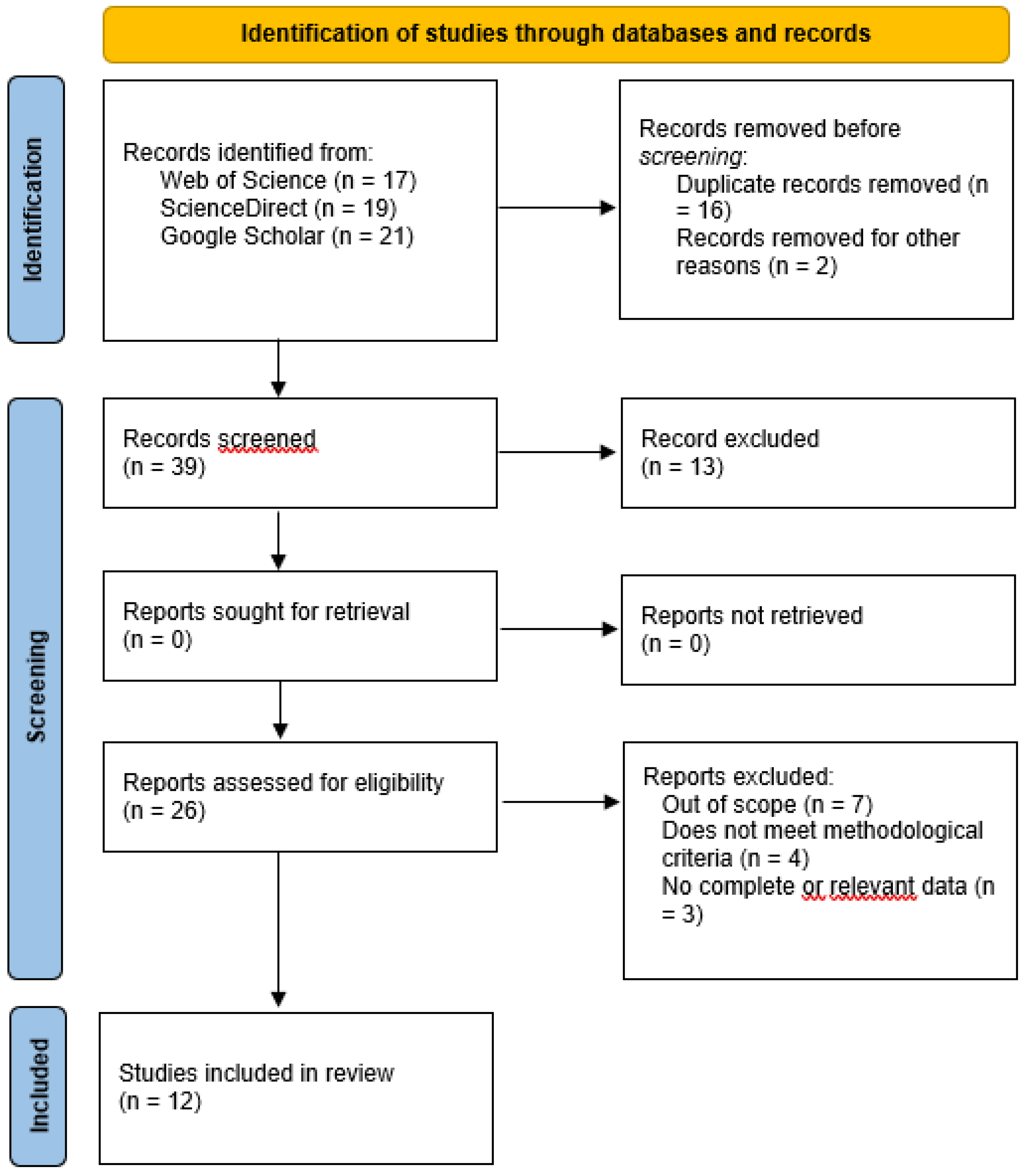
Figure 2.
Map of connections of keywords from the studies under analysis.
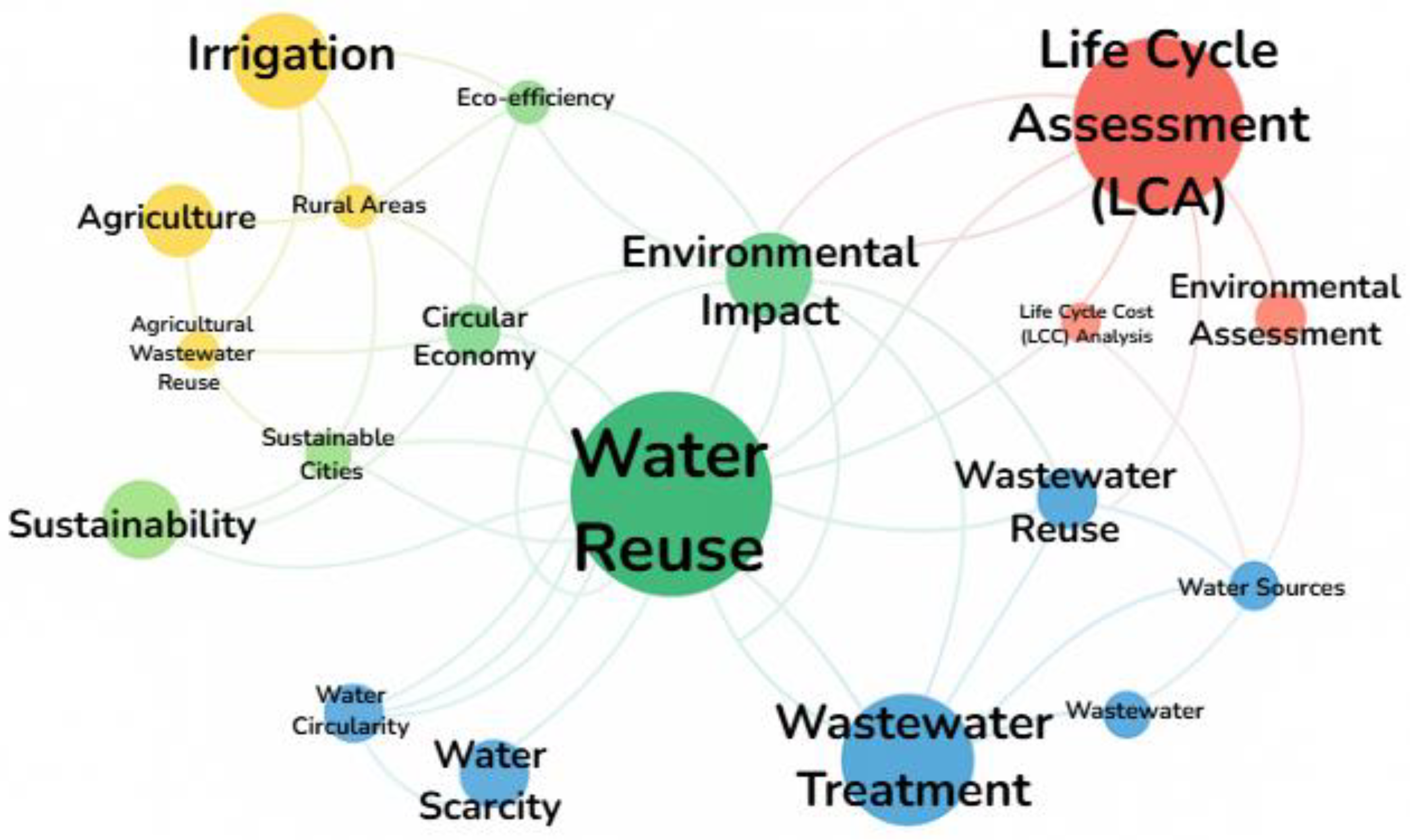
Figure 3.
Graph showing the distribution of the number of studies by midpoint impact categories in the LCA.
Figure 3.
Graph showing the distribution of the number of studies by midpoint impact categories in the LCA.
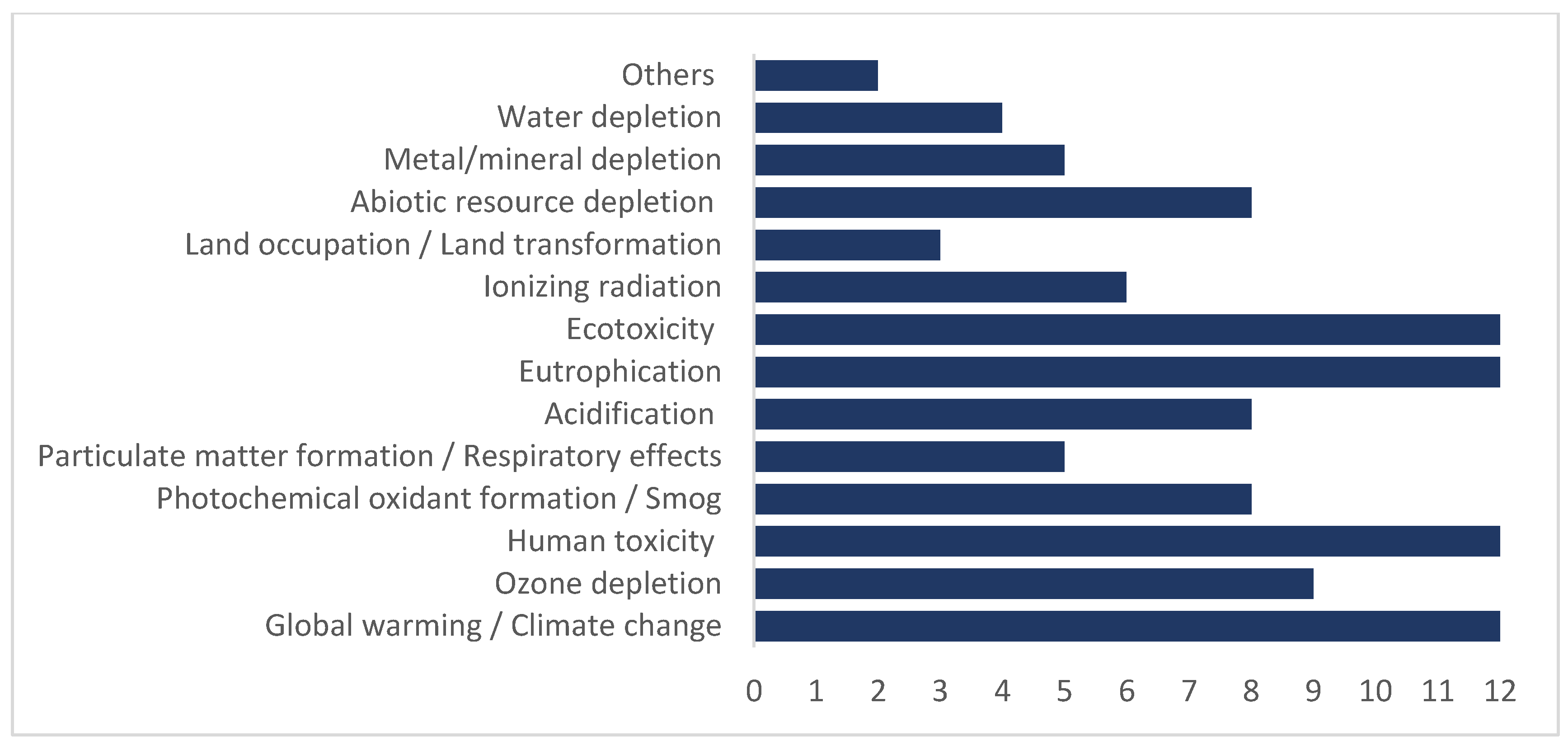

Table 1.
Bibliographic data of the studies.
| Study No | Ref | Title | Authors | Years | Country | Journal |
| 1 | [11] | Life Cycle Assessment of Green Space Irrigation Using Treated Wastewater: A Case Study | Lenise Santos, Isabel Brás, Miguel Ferreira, Idalina Domingos, José Ferreira | 2024 | Portugal | Sustainability |
| 2 | [12] | Life cycle assessment of cucumber irrigation: unplanned water reuse versus groundwater resources in Tipaza (Algeria) | Latifa Azeb, Tarik Hartani, Nassim Aitmouheb, Ludivine Pradeleix, Nouredddin Hajjaji, Soumaya Aribi | 2020 | Algeria | Journal of Water Reuse and Desalination |
| 3 | [13] | Comparative life cycle environmental and economic assessment of anaerobic membrane bioreactor and disinfection for reclaimed water reuse in agricultural irrigation: A case study in Italy | Alessia Foglia, Corinne Andreola, Giulia Cipolletta, Serena Radini, Çağrı Akyol, Anna Laura Eusebi, Peyo Stanchev, Evina Katsou, Francesco Fatone | 2021 | Italy | Journal of Cleaner Production |
| 4 | [14] | Life cycle assessment as decision support tool for water reuse in agriculture irrigation | Nesrine Kalboussi, Yannick Biard, Ludivine Pradeleix, Alain Rapaport, Carole Sinfort, Nassim Ait-mouheb | 2022 | France | Science of the Total Environment |
| 5 | [15] | Life cycle assessment of wastewater reuse alternatives in urban water system | Rajhans Negi, Munish K. Chandel | 2024 | India | Resources, Conservation & Recycling |
| 6 | [16] | Life cycle assessment of greywater treatment systems for water-reuse management in rural areas | Carolina Rodríguez, Rafael Sánchez, Natalia Rebolledo, Nicolás Schneider, Jennyfer Serrano, Eduardo Leiva | 2021 | Chile | Science of the Total Environment |
| 7 | [17] | An LCA framework to assess environmental efficiency of water reuse: Application to contrasted locations for wastewater reuse in agriculture | Camille Maeseele, Philippe Roux | 2021 | France | Journal of Cleaner Production |
| 8 | [18] | Life cycle-based evaluation of environmental impacts and external costs of treated wastewater reuse for irrigation: A case study in southern Italy | Kledja Canaj, Andi Mehmeti, Domenico Morrone, Pierluigi Toma, Mladen Todorović | 2021 | Italy | Journal of Cleaner Production |
| 9 | [19] | Opportunities for Water Reuse Implementation in Metropolitan Areas in a Complex Approach with an LCA Analysis, Taking Warsaw, Poland as an Example | Karolina Szalkowska, Monika Zubrowska-Sudol | 2023 | Poland | Sustainability |
| 10 | [20] | Potential water reuse pathways from a life cycle analysis perspective in the poultry industry | Réka Harasztiné Hargitai, Viktor Sebestyén, Viola Somogyi | 2024 | Hungary | Journal of Water Process Engineering |
| 11 | [21] | Life-Cycle Assessment of Tertiary Treatment Technologies to Treat Secondary Municipal Wastewater for Reuse in Agricultural Irrigation, Artificial Recharge of Groundwater, and Industrial Usages | Ali Akhoundi, Sara Nazif | 2020 | Iran | Journal of Environmental Engineering (ASCE) |
| 12 | [22] | Biogas Utilization and Water Reuse in Paper Mill Wastewater Treatment: A Life Cycle Analysis | Thuy Thi Vu, Chih Feng Huang, Hao Anh Phan, Thuy Thi Ngoc Bach, Panyue Zhang, Ha Manh Bui | 2025 | Vietnam | Water Air Soil Pollution |
Table 2.
Main aspects of LCA studies: type, system boundaries, and functional units.
| Study No | LCA type | System boundaries | Functional unit |
| 1 | Attributional | Gate-to-gate expanded |
1 m² of irrigated green area/day |
| 2 | Attributional | Cradle-to-field | 1 ha /1 kg of cucumber |
| 3 | Attributional | Cradle-to-field | 1 m³ of treated effluent |
| 4 | Attributional | Cradle-to-field | 1 ha of irrigated vineyard |
| 5 | Attributional | Cradle-to-gate expanded |
1 m³ of water delivered |
| 6 | Attributional | Cradle-to-grave | 1 m³ of treated gray water |
| 7 | Attributional | Cradle-to-gate | 1 m³ of water |
| 8 | Attributional | Cradle-to-field | 1 m³ of water |
| 9 | Attributional | Gate-to-use | 211 m³/day |
| 10 | Attributional | Cradle-to-gate expanded |
Total weight of chickens slaughtered in one year |
| 11 | Attributional | Cradle-to-gate expanded |
1 m³/day of treated effluent |
| 12 | Attributional | Cradle-to-cradle | 1 m³ of treated effluent |
Table 3.
Software, Methods and Databases Used in LCA Studies.
| Study No | Software/ Method | Database |
| 1 | SimaPro 9.6.01/ReCiPe 2016 | Ecoinvent |
| 2 | ReCiPe 2016 1.03 | Ecoinvent v3 |
| 3 | Umberto LCA+ 10/ReCiPe 2008 | Ecoinvent 3.6 |
| 4 | SimaPro 9.1.1.1/ILCD 2011 | Ecoinvent 3.6 |
| 5 | OpenLCA 1.10.3/CML-IA | Ecoinvent versão 3.8 |
| 6 | OpenLCA 1.10/TRACI 2.1 | Ecoinvent 3.7 |
| 7 | SimaPro 9.0/ReCiPe 2016 | Ecoinvent 3.5 |
| 8 | OpenLCA 1.10.2./ReCiPe 2016 | Ecoinvent 3.1 |
| 9 | OpenLCA 1.11.0/ CML-IA | ELCD 3.2. and OzLCI2019 |
| 10 | GaBi - Software 10.6.1.35/ReCiPe 2016 | GaBi - databases/ Ecoinvent 3.0 |
| 11 | SimaPro 8./Impact 2002+ | Ecoinvent V3 |
| 12 | SimaPro 9.5./ReCiPe (H) v1.13 | Ecoinvent v3.9.1 |
Table 4.
Assessment level (midpoint and endpoint) adopted in the analyzed studies.
| Evaluation level/ Study No | 1 | 2 | 3 | 4 | 5 | 6 | 7 | 8 | 9 | 10 | 11 | 12 | |
| Midpoint | x | x | x | x | x | x | x | x | x | x | x | x | |
| Endpoint | x | x | x | x | x | x | x |
Table 5.
Quantitative synthesis of the environmental impacts of water reuse: results of LCA studies.
Table 5.
Quantitative synthesis of the environmental impacts of water reuse: results of LCA studies.
|
Study No |
Study Objective |
Scenarios Evaluated |
Global Warming Potential | Eutrophication | Ecotoxicity | Human Toxicity |
| 1 | Assess the environmental impacts of irrigating green spaces with treated water (Viseu, Portugal) | Single Scenario | +15% | –7% | –10% | Carc: –3.5% Non-carc: –3.5% |
| 2 | LCA of irrigation for cucumber: comparing unplanned reuse, groundwater, and planned reuse (Algeria) | Groundwater | 1.30 kg CO₂-eq/ha | 0.022 kg P-eq/ha | 0.053 kg 1,4-DB-eq/ha | Carc: 0.031 kg Non-carc: 1.33 kg (1,4-DCB-eq) |
| Reclaimed water | 1.81 kg CO₂-eq/ha | 0.020 kg P-eq/ha | 0.104 kg 1,4-DB-eq/ha | Carc: 0.036 kg Non-carc: 1.58 kg (1,4-DCB-eq) |
||
| Reuse + optimal fertilization | 0.77 kg CO₂-eq/ha | 0.018 kg P-eq/ha | 0.075 kg 1,4-DB-eq/ha | Carc: 0.014 kg Non-carc: 0.58 kg (1,4-DCB-eq) |
||
| 3 | Compare tertiary disinfection alternatives in agricultural reuse LCA | UV | –7% | –32% | –35% | +19% |
| PAA | –9% | –32% | –35% | +12% | ||
| UASB + AnMBR | –28% | +68% | –35% | +55% | ||
| 4 | LCA of vineyard irrigation: compare water sources/technologies (France) | Reuse vs. River (UV) | Lower in reuse | Lower | Lower | Lower |
| Reuse vs. Surface (UF) | Higher in reuse | Equal | Higher | Higher | ||
| Chlorination | No difference | No difference | No difference | No difference | ||
| 5 | Urban reuse strategies LCA (Europe): centralized, indirect, direct potable, etc. | NPR | –12% | –100% | –50% | –24% |
| IPR | +30% | +20% | +15% | +31% | ||
| DPR | +34% | –87% | +70% | +98% | ||
| dNPR_C | +22% | –56% | +55% | +96% | ||
| dNPR_B | +33% | –40% | +60% | +115% | ||
| Hybrid scenarios | +36 to +45% | –87 to –90% | +80% | +128% | ||
| 6 | Urban irrigation reuse LCA: energy types, distribution & sources | Case 1 (Public, no add. energy) | 14.4 kg CO₂-eq | 0.0694 kg N-eq | 300 CTUe | 8.66×10⁻⁶ CTUh |
| Case 2 (truck delivery) | 140 kg CO₂-eq | 0.177 kg N-eq | 1,260 CTUe | 1.52×10⁻⁵ CTUh | ||
| Cases 3–10 (varied configs) | 23.7–136 kg CO₂-eq | 0.137–0.247 kg N-eq | 5,930–9,540 CTUe | 1.86×10⁻⁵ – 2.87×10⁻⁵ CTUh | ||
| 7 | Compare reuse vs. conventional/desalination supply | Coastal (desalination) | Impact reduction ≥67% with reuse | Reduction ≥67% | Reduction ≥67% | Reduction ≥67% |
| Arid coastal (RT1) | Reduction in all categories | Reduction | Reduction | Reduction | ||
| RT2/fossil energy | Higher impacts than conventional | Higher | Higher | Higher | ||
| 8 | LCA: reuse vs. baseline for irrigation | TWW reuse | 0.706 kg CO₂-eq/m³ | 0.367 ×10⁻⁴ kg P-eq/m³ | 0.104 ×10⁻² kg 1,4-DCB-eq/m³ | Carc: 2.26 ×10⁻⁴ Non-carc: 6.90 ×10⁻⁵ kg 1,4-DCB-eq/m³ |
| Baseline | 0.626 kg CO₂-eq/m³ | 0.230 ×10⁻⁴ kg P-eq/m³ | 0.066 ×10⁻² kg 1,4-DCB-eq/m³ | Carc: 1.89 ×10⁻⁴ Non-carc: 6.27 ×10⁻⁵ kg 1,4-DCB-eq/m³ |
||
| 9 | Reuse for municipal washing: truck vs. dedicated network | Truck | 3.37×10³ kg CO₂-eq | 3.59 kg PO₄³⁻-eq | 1.71 kg 1,4-DB-eq | 102 kg 1,4-DB-eq |
| Dedicated network (construction total) | 3.60×10⁵ kg CO₂-eq | 261 kg PO₄³⁻-eq | 19.6 kg 1,4-DB-eq | 3,270 kg 1,4-DB-eq | ||
| 10 | Industrial reuse/reduction/tertiary LCA | SBR | –0.84% vs baseline | ≈0% | ≈0% | ≈0% |
| SBR-wwtp | –1.09% | +3.47% | +10.45% | +41.98% | ||
| River | –0.85% | ≈0% | –0.07% | –0.06% | ||
| Reduce (50% less water) | –1.22% (best) | ≈0% | +0.04% | +0.09% | ||
| Irrigation | –0.89% | ≈0% | –0.05% | –0.06% | ||
| 11 | Tertiary reuse for irrigation, recharge, industry | Irrigation: DF+GAC+Chl | 0.32 mPt (climate) | 0.82 mPt (ecosystems) | 13.6 mPt (human) | 249.2 mPt (total) |
| UF+Chl | 15.0 mPt (climate) | 3.25 mPt (ecosystems) | 92.7 mPt (human) | 273.9 mPt (total) | ||
| CW+Chl | 0.32 mPt (climate) | 84.4 mPt (ecosystems) | 13.6 mPt (human) | 261.5 mPt (total) | ||
| Artificial Recharge: MBR+Chl | 9.2 mPt (climate) | 16.4 mPt (ecosystems) | 259 mPt (human) | 1,194 mPt (total) | ||
| Industrial: UF+RO+Chl | 26.4 mPt (climate) | 23.4 mPt (ecosystems) | 576 mPt (human) | 2,026 mPt (total) | ||
| 12 | LCA of paper mill reuse: biogas burn vs. energy & water reuse | UASB + flare (baseline) | 2.05 kg CO₂-eq/m³ | 9.34×10⁻⁴ kg P-eq/m³ | 4.46×10⁻³ kg 1,4-DCB-eq/m³ | 6.08×10⁻² kg 1,4-DCB-eq/m³ |
| Biogas to energy | –30% (~1.4 kg CO₂-eq/m³) | –30% (~7×10⁻⁴ kg P-eq/m³) | –30% (~3×10⁻³ kg 1,4-DCB-eq/m³) | –30% (~4×10⁻² kg 1,4-DCB-eq/m³) | ||
| Water reuse | –10 to –30% (1.4–1.85 kg CO₂-eq/m³) | –10 to –30% (6.5–8.4×10⁻⁴ kg P-eq/m³) | –10 to –30% (3.1–4×10⁻³ kg 1,4-DCB-eq/m³) | –10 to –30% (4.3–5.4×10⁻² kg 1,4-DCB-eq/m³) | ||
| IC reactor (advanced tech) | 0.10 kg CO₂-eq/m³ | nd | Nd | nd |
Legend: Objectives summarize the main goal of each LCA study. Scenarios: GW = groundwater; TWW = treated wastewater; NPR/IPR/DPR = non-/indirect-/direct-potable reuse; SBR = sequencing batch reactor; UASB = upflow anaerobic sludge blanket; AnMBR = anaerobic MBR; PAA = peracetic acid; UF = ultrafiltration; GAC = granular activated carbon; Chl = chlorination. Impact categories: GWP (kg CO₂-eq or %), Eutrophication (kg P-eq, N-eq or PO₄³⁻-eq), Ecotoxicity (kg 1,4-DCB-eq, CTUe or mPt), Human toxicity (kg 1,4-DCB-eq, CTUh or mPt; split into carc. and non-carc. if available). “+” = increase, “–” = reduction vs. baseline. mPt: lower is better. “nd” = not disclosed.
Disclaimer/Publisher’s Note: The statements, opinions and data contained in all publications are solely those of the individual author(s) and contributor(s) and not of MDPI and/or the editor(s). MDPI and/or the editor(s) disclaim responsibility for any injury to people or property resulting from any ideas, methods, instructions or products referred to in the content. |
© 2025 by the authors. Licensee MDPI, Basel, Switzerland. This article is an open access article distributed under the terms and conditions of the Creative Commons Attribution (CC BY) license (http://creativecommons.org/licenses/by/4.0/).
Copyright: This open access article is published under a Creative Commons CC BY 4.0 license, which permit the free download, distribution, and reuse, provided that the author and preprint are cited in any reuse.


