
Submitted:
12 August 2025
Posted:
13 August 2025
You are already at the latest version
Abstract
Bohr-type inequalities have been extensively studied for integral operators defined on 2
bounded analytic functions in the unit disk. In this paper, we extend this line of inves- 3
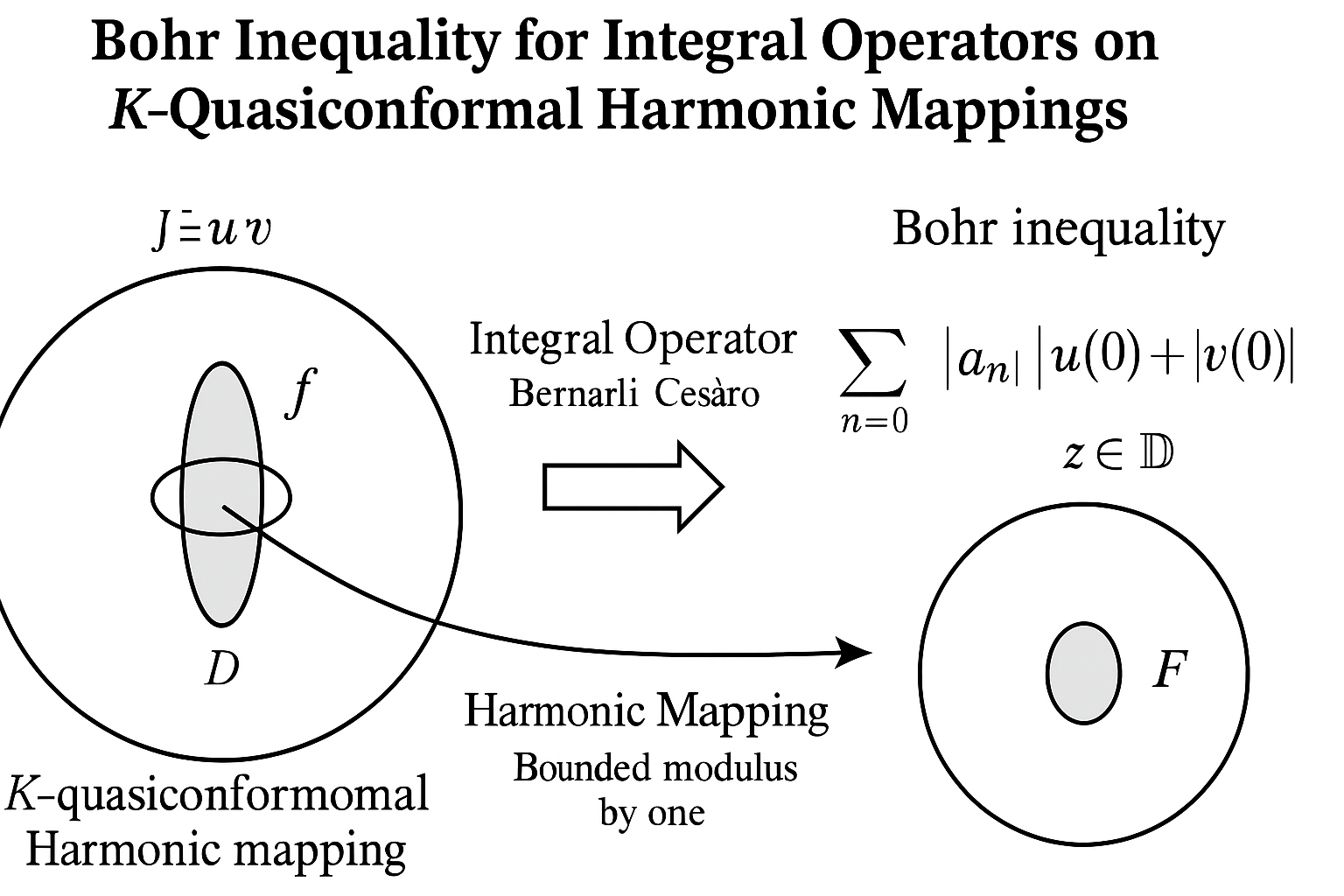
tigation to the class of K-quasiconformal harmonic mappings and consider the action of 4
integral operators (including the Bernardi and Cesàro operators) on the harmonic mappings 5
whose analytic parts are bounded in modulus by one. Our results provide estimates that 6
generalize existing results in the analytic case.
Keywords:
30A10
; 30C62
; 30C45
1. Introduction and Preliminaries
Let denote the unit disk and be class of analytic functions in such that for all . The majorant series on is expressed as . In 1914, Harald Bohr [6] established the following theorem:
Theorem 1
where the constant cannot be improved.
Inequality (1) is known as the Bohr inequality for bounded analytic function in . Bohr [6] initially proved this inequality for , M. Riesz, I. Schur and N. Wiener independently refined this bound and proved the validity for (see [1,7]). The constant is regarded as the classical Bohr radius for in the literature.
Over the past two decades, Bohr’s inequality has been extensively studied in the literature leading to improvements, extensions and generalizations in different mathematical settings (for instance, see [1,2,3,5,7,8,9,14]). For investigations and studies on Bohr inequality, we refer interested readers to the articles in [1,7,11,14] and the references therein.
Recently, attention has turned to harmonic mappings, especially those that are sense-preserving and k-quasiconformal. These mappings generalize many properties of analytic functions while introducing new geometric behavior.
A complex-valued function f is said to be harmonic in if it satisfies Laplace’s equation . Any such harmonic mapping can be written as (see [11])
where h is called the analytic part and g is called the co-analytic part in . The mapping f is said to be sense-preserving if the Jacobian
in which case f is locally univalent and orientation-preserving (see [11]). A sense-preserving harmonic mapping is called K-quasiconformal if there exists and such that
Kayumov et al. [11] generalized Theorem 1 to K-quasiconformal harmonic mappings with analytic part , leading to the following:
Theorem 2.
Suppose that is a sense-preserving K-quasiconformal harmonic mapping of the disk , where . Then
where the number is sharp. Moreover,
The constant is sharp.
Remark 1.
If in (3), we obtain the Bohr radius in Theorem 1.
A particular area of interest is the study of Bohr-type inequalities for integral operators acting on bounded analytic functions. Integral operators such as those introduced by Bernardi and Cesàro play a central role in function theory due to their connections with convolution, univalence, and geometric function properties (see [13]).
Definition 2
where is an integer.
From the Bernardi’s intgeral operator, the case where and leads to the Libera operator on analytic function defined as follows:
Similarly, for a special case where and , the Alexander’s operator for analytic function is defined as
Kayumova et al.[12] established the Bohr inequality for Cesàro operator defined on and obtained the following:
Theorem 3.
Suppose is analytic in and in . Then
where is the positive root of the equation and the number R is best possible.
Shankey and Sahoo [13] also provided sharp Bohr radius for Bernardi integral operator as follows:
Theorem 4.
Let , if is analytic in and in . Then
where is the positive root of that cannot be improved.
Remark 2.
Observe that Theorems 3 and 4 address the Bohr radius for Cesàro and Bernardi operators acting on functions . Motivated by the works in [11,12], and [13], we establish new sharp Bohr radii for Cesàro and Bernardi operators acting on K-quasiconformal harmonic mappings of the form , where . Our results not only extend earlier findings from the analytic to the harmonic setting but also highlight the influence of quasiconformality on the Bohr phenomenon.
Lemma 1
Lemma 2
2. Main Results
Firstly, we discuss the Cesàro and Bernardi operators on the class of harmonic mappings of the form (2). Applying (5), the Cesàro operator on yields
where
In view of (12) and (13), we define the Bohr sums corresponding to the Cesàro and Bernardi operators by
and
where , and .
Theorem 5.
Let be a sense-preserving K-quasiconformal harmonic mapping in the disk , where . Then
where the constant is the positive root of in . The constant is best possible.
Proof.
Setting , where , and applying Lemma 1, we obtain for . Consequently, from (14) and using Lemma 2, we have
Differentiation of the function twice with respect to a yields
and
It is easy to see that for every and . Therefore, is a decreasing function and hence we obtain
But f is K-quasiconformal, so . Hence, (17) gives
which holds for , where is the positive root of the equation
Then is an increasing function of a, for . It implies that , that is
Clearly, inequality (16) is obtained. To conclude the proof, we show that the constant is best possible Bohr radius. To demonstrate the sharpness of the constant , we consider , where
and , where , and . For this function, we find that and for . Using (14), the Bohr sum is simplified as follows:
We can rewrite in the last expression as
where
Putting in summation form, we have
From (18), we obtain for all , where . It can also be seen that for
The last lines show that the constant cannot be improved. This complete the proof of Theorem 5. □
Remark 3.
Setting in Theorem 5, we recover the main result of Kayumova et al. [12].
Corollary 1.
Suppose is a sense-preserving harmonic mapping of the disk , where . Then
where the constant is best possible.
Proof.
By allowing in Theorem 5, the result follows immediately. □
We now discuss the Bohr inequality for Bernardi operator acting on K-quasiconformal harmonic mapping.
Theorem 6.
Let . Suppose that is a sense-preserving K-quasiconformal harmonic mapping of the disk , where . Then
where the constant is the positive root of in . The constant is best possible.
Proof.
Let and using Lemma 1, for . Applying Lemma 2, (15) yields the following:
Differentiating twice with respect to a to get
and
It is easy to see that . Since , it follows that . Hence
which holds in if , where is the root of
Replacing k by , the last expression yields
After some calculations, we find that , which implies that is an increasing function of a for , and . Thus, for
which proves (22). In order prove the sharpness of , we consider , where
and , where , and . With the help of (15), we obtain
which is equivalent to
where
Furthermore, it is easy to check that for the following inequality holds
These facts in (23) show that the number cannot be improved. This completes the proof of Theorem 6. □
Remark 4.
If we put in Theorem 6, we obtain theorem 2.2 of the work in [13].
Corollary 2.
Let . If is a sense-preserving harmonic mapping of the disk , where . Then
where the constant is the positive root of in . The constant is best possible.
Proof.
The proof follows from Theorem 6 by making . □
As discussed earlier in Definition 2, the Libera and Alexander operators are special cases of the Bernardi operator. The following theorems, which are direct consequences of Theorem 6, establish Bohr-type inequalities for the Libera and Alexander operators acting on K-quasiconformal harmonic mappings.
Corollary 3.
Suppose that is a sense-preserving K-quasiconformal harmonic mapping of the disk , where . Then
where the constant is the positive root of in cannot be improved.
Remark 5.
This corollary establishes the Bohr-type inequality for the Libera operator acting on K-quasiconformal harmonic mappings. It is derived as a special case of Theorem 6 by setting and . In particular, when , we recover the sharp Bohr radius , which coincides with corollary 2.3 in [13].
Corollary 4.
Let Suppose that be a sense-preserving K-quasiconformal harmonic mapping of the disk , where . Then
where the constant is the positive root of in cannot be improved.
Remark 6.
This corollary presents the Bohr-type inequality for the Alexander operator applied to K-quasiconformal harmonic mappings. It follows directly from Theorem 6 by choosing and . When the quasiconformality constant is set to , we get the classical case with sharp Bohr radius , in agreement with corollary 2.4 of [13].
3. Conclusion
In this paper, we extended Bohr-type inequalities to the class of K-quasiconformal harmonic mappings. By analyzing the action of Cesàro and Bernardi integral operators, we established sharp Bohr radii that generalize existing results in the analytic case. These findings highlight the interplay between quasiconformality and the Bohr phenomenon, and they open avenues for further research on integral operators in the harmonic setting.
References
- Y. Abu-Muhanna, R. M. Ali, and S. Ponnusamy, On the Bohr inequality, in: N. K. Govil, R. Mohapatra, M. A. Qazi, and G. Schmeisser (eds.), Progress in Approximation Theory and Applicable Complex Analysis, Springer Optimization and Its Applications, 117 (2017), 269–300. Zbl 1370.30003.
- Aizenberg, L. , Multidimensional analogues of Bohr’s theorem on power series, Proc. Amer. Math. Soc., 128 (2000), 1147-1155. MR1636918. Zbl 0948.32001.
- S. A. Alkhaleefah, I. R. Kayumov, and S. Ponnusamy, On the Bohr Inequality with a Fixed Zero Coefficient, Proc. Amer. Math. Soc., 147(12) (2019), 5263-5274.
- I. S. Amusa and A. A. Mogbademu, Bohr Inequalities for Some Generalized Integral Operators on Simply Connected Domain, J. Nig. Math. Soc., 43(4) (2024), 377–388.
- Amusa, I. S. , Mogbademu, A. A., Some Bohr type inequalities for sense-preserving harmonic mappings, Prob. Anal. Issues Anal., 14(32) (2025), 1, 3-21.
- H. Bohr, A theorem concerning power series, Proc. Lond. Math. Soc., 2 (1914),1, 1-5. MR1577494. JFM 44.0289.01.
- P. B. Djakov and M. S. Ramanujan, A remark on Bohr’s theorem and its generalizations, J. Anal., 8 (2000), 65-77. MR1806396. Zbl 0969.30001.
- I. R. Kayumov and S. Ponnusamy, Bohr’s inequalities for the analytic functions with lacunary series and harmonic functions, J. Math. Anal. Appl., 465 (2018), 2, 857-871. MR3809334. Zbl 1394.31001.
- I. R. Kayumov and S. Ponnusamy, Improved version of Bohr’s inequality, C. R. Acad. Sci. Paris, Ser. I, 356 (2018), 272-277. MR3767595. Zbl 1432.30002.
- I. R. Kayumov, D. M. Khammatova and S. Ponnusamy, Bohr–Rogosinski phenomenon for analytic functions and Cesaro operators, J. Math. Anal. and Appl., 496 (2021), 2, 1-12. Zbl 1461.30008.
- I. R. Kayumov, S. Ponnusamy, and N. Shakirov, Bohr radius for locally univalent harmonic mappings, Math. Nachr., 291 (2018), 11, 1757-1768. MR3844804. Zbl 1398.30003.
- I, R. Kayumova, D. M. Khammatova and S. Ponnusamy, On the Bohr inequality for the Cesáro operator, Comptes Rendus Mathématique, 358 (2020), 5, 615-620. MR4149861. Zbl 1451.30100.
- S. Kumar and S. K. Sahoo, Bohr Inequalities for certain integral operators, Mediterranean J. Math., 18 (2021), 268, 1–10. [CrossRef]
- L. Ming-Sheng, Y. Shang and J. Xu, Bohr-type inequalities of analytic functions, Journal of Ineq. and App., 345 (2018), 1-13. MR3891846. Zbl 1498.30001.
Disclaimer/Publisher’s Note: The statements, opinions and data contained in all publications are solely those of the individual author(s) and contributor(s) and not of MDPI and/or the editor(s). MDPI and/or the editor(s) disclaim responsibility for any injury to people or property resulting from any ideas, methods, instructions or products referred to in the content. |
© 2025 by the authors. Licensee MDPI, Basel, Switzerland. This article is an open access article distributed under the terms and conditions of the Creative Commons Attribution (CC BY) license (http://creativecommons.org/licenses/by/4.0/).
Copyright: This open access article is published under a Creative Commons CC BY 4.0 license, which permit the free download, distribution, and reuse, provided that the author and preprint are cited in any reuse.


