

Submitted:
11 August 2025
Posted:
12 August 2025
You are already at the latest version
Abstract
The knowledge economy has become ever more important for cities and regions, and different types of urban spaces have been created to accommodate its activities. One of the main assets of these spaces is vitality, a quality that is directly related to innovation and is oftentimes considered the result of spontaneous space arrangements. Recent literature, however, shows that urban vitality is not an intangible quality; it can be correlated to different place quality aspects, such as urban morphology, and measured through ex-isting analytical methods. The aim of this paper is to systematize such indicators and use them to develop algorithms that can be subsequently incorporated into a computational tool for the assessment of knowledge territories during the early design stages, to support their spatial planning and development. The Paris-Saclay Urban Campus is used as a case study to understand and assess these place quality indicators in an existing bench-mark. The results can contribute to the serendipity and the success of new or redeveloped knowledge and innovation areas.
Keywords:
urban vitality
; knowledge territories
; urban morphology
1. Introduction
The second half of the 20th century was marked by a shift from a manufacturing-based economy towards a knowledge and creativity-based one (Drucker, 1993; Florida, 2010; Unger, 2022). As cities undergo a transformation from an industrial to a knowledge-intensive production, their urban fabrics reflect these changes. Formal knowledge has typically been produced on University campuses and different spatial arrangements have been created over time to take advantage of the physical and conceptual proximity to them, such as the Science and Technology Parks and, more recently, Innovation Districts [1,2].
These places represent new spatial urban configurations that have, in agreement with shifting theories on innovation development, gradually blurred the boundaries between work, learning, daily life, and community. They have been called by different names that are often used interchangeably, e.g., innovation clusters, innovation hubs, knowledge precincts, knowledge cities [1,2]. As pointed out by Annerstedt [1](p. 288) they have become "truly incorporated into the urban fabric as catalysts for innovation." Thus, to encompass this variety, herein, we refer to these spatial arrangements, that aim at fostering innovation and creativity, and producing knowledge, as Knowledge Territories (KT).
For Dong and Zhang [3] vitality is an urban “soft power” that directly influences the number of patents, inventions, and education, science and technology investments. Pan, Zhu and Zhang [4] consider technological innovation competitiveness as an indicator to measure urban vitality in existing cities. Zhang et al.[5] echo this idea by stating that cultural vitality directly influences innovation and regional competitiveness as cultural facilities foster creative activities and stimulating environments for new ideas. According to Florida[6] ( p. 6), in the knowledge economy, creativity “has become the decisive source of competitive advantage”. As the Creative Class, also referred to as knowledge workers, are highly mobile and choose their location based on material and subjective characteristics, “place” has become “the central organizing unit of our time,”[6] p. 8) as cities and regions compete to attract and retain creative people, businesses, companies and industries. Consequently, the concept of “quality of place” has gained attention in areas aiming at knowledge-based social and economic development [6,7].
Florida[6](p. 281) defines Quality of Place as a combination of built and natural environment characteristics, social diversity, street life vibrancy and social activities. Esmaeilpoorarabi et al.[8] further develop this concept, which they call simply “quality of place”, subdividing it into tangible and intangible attributes across four characteristics: function, form, ambience, and image. Both these definitions are strongly related to built and environmental quality and to the urban vitality that can be fostered through it.
Thus, urban vitality can be understood as a fundamental component for the development of KT, as these areas must attract and retain knowledge workers and inhabitants in order to generate an environment that fosters creativity and innovation. This is particularly important for KTs that are located far from consolidated urban centers, or that have been built in recently urbanized areas, as they must plan or redesign their artificially produced territories to achieve attractive and vibrant urban environments that foster creativity and innovation. This specific type of KT is very common across different parts of the world, as many Science and Technology Parks were located close to University campuses and on the outskirts of cities, aiming at acquiring larger and cheaper areas for their construction. Thus, in the coming years, these outdated existing KT will have to adapt to this changing paradigm by improving their place quality and becoming more environmentally sustainable, in order to regain their social and economic relevance[9,10].
While previous studies have correlated specific urban vitality indicators to existing built environment characteristics, and demonstrated the potential of using quantitative models for territorial planning to support sustainability assessments, there is still a lack of research that discusses what indicators can be applied to the process of planning and designing new urban developments or adapting outdated ones to increase their vitality, particularly in the context of KT [11,12].
A typical example of this type of KT is the Paris-Saclay Urban Campus, a Science and Technology Park which has undergone this transformation in the past couple of decades, is an example of how urban planning and design can be strategically applied to adapt these older parks to the Quintuple Helix Innovation model, in which society and the natural environment became central actors in the innovation process, along with the traditional Triple Helix ones: Academy, Industry and Government. Furthermore, it empirically demonstrates that urban vitality can be promoted through the improvement of place quality even in artificially developed territories[10,13].
This research explores how place quality attributes, which are often associated with the emergence of urban vitality in KT, can be quantified based on existing urban morphology analysis methods and tools, and used to develop algorithms that can be subsequently incorporated into a computational tool for the geometric modeling of KT, to support their urban planning and development. The Paris-Saclay Urban Campus is used as a case study to understand and assess these place quality indicators in an existing benchmark KT [6,7,8,14,15,16]. Our final aim is to automate the assessment of urban vitality in KTs, developing a tool that can be used in the design of future scenarios and renovation projects for underperforming sites.
In the next section we discuss the relation between urban vitality and Place Quality, with attention to KT specificities. The third section presents a review on analytical approaches to urban morphology. The fourth presents the methods used in this research, followed by a description of our case study and the results and discussion section. Finally, we present our conclusions and propose future developments.
1.1. Urban Vitality and Place Quality
Low urban vitality has been linked to several contemporary urban challenges, e.g., automobile dependence in cities, urban sprawl, environmental degradation, population and socioeconomic decline, low social dynamism and deterioration of public safety and public and open spaces[17,18,19,20,21]. While it has been extensively studied in the urban planning field, the challenge of objectively defining and measuring urban vitality indicators remains an important gap, and more recent studies have focused on developing quantitative methods to improve its assessment [22].
As urban vitality is a multidimensional variable, quantitative studies in the field have focused on developing potentially explanatory frameworks based on two main approaches. The first attempts to decompose urban vitality into interconnected subsystems, such as demographic attractiveness, economic prosperity, economic performance, functional diversity, social inclusiveness, social interaction, entertainment and recreational opportunities, green space availability, environmental quality and sustainability[3,4,23,24,25]. The second approach studies how different built environment dimensions can influence urban vitality[5,21].While the frameworks developed in these studies are relevant to the assessment of consolidated urban environments, because they relate vitality to the human activities in place, they give little guidance for the planning of new urban developments or the revitalization of existing ones, particularly in the case of KT. Furthermore, it was found that studies that measured the flow of people fail to identify the cause of this activity, focusing on quantifying presence rather than experience or place quality[18,19,21,26].
The methods used to measure urban vitality are either statistical, applying spatial regression models to correlate built environment indicators to measured vitality, or spatial, using Geographic Information Systems (GIS) in their analysis. Big data from mobile phones and shared vehicles are the main approach to data acquisition, with questionnaires and field observations following close behind [19,20,21,27]. Points of Interest (POIs) from online platforms and night light images obtained with remote sensing are also used, but to a smaller degree, to analyze social and economic activity[5,28,29]. Machine Learning techniques, such as Random Forest and Neural Networks, have gained recent traction in the field with the aim of capturing complex non-linear relationships between variables[17,29].
Several studies establish consistent correlations between urban morphology dimensions and the presence of urban vitality. Cervero e Kockelman’s[30] 3D’s framework - Density, Diversity and Design, which was originally developed to study the relationship between built environment and travel behavior, is recurrently used to explain urban vitality[5,29,31,32]. These factors are closely related to Jane Jacobs’ [33] discussion of four main conditions through which planning can induce urban vitality: concentration, close-grained diversity of uses, small urban blocks, and aged buildings. Destination Accessibility and Distance to Transit, later added to the 3D’s to form the 5D’s framework, are also used extensively in the study of urban vitality [34]. This highlights the importance of human movement and accessibility to promote vitality as, through density, diversity (functional mix), and design (small blocks), the built environment encourages active mobility and the use of public transportation, while also increasing the presence and flow of people on the streets[29,31].
Despite this growing analytical sophistication on the subject of urban vitality, City Information Modeling (CIM), as well as other three-dimensional modeling and simulation tools, are seldom used to analyze or generate urban vitality-promoting scenarios. Most research operates in two-dimensions, using land use metrics and network analysis. One study, by Lin et al.[17], chose to extract three-dimensional metrics to feed two-dimensional statistical models, rather than integrating the analysis directly into a three-dimensional environment.
The concept of urban vitality has been applied to various urban challenges, but few studies discuss it specifically in relation to the knowledge economy, and none propose how to apply it in the design or requalification of urban developments. Furthermore, the concept of urban vitality performance benchmarks, that could be used to support the design process, remains unexplored.
To bridge these gaps, this research approaches the problem of how to design KTs to achieve urban vitality from the perspective of place quality, which has been widely identified as a central factor in the success of these areas and as a strategic asset for cities seeking to compete for knowledge workers, companies and investments[6,8].
This premise is reinforced by the work of Burke and Gras (2019), who identify urban infrastructure as one of the three fundamental pillars of KTs, alongside talent networks (workers) and organizational structures (companies and institutions). In their Atlas of Innovation Districts, the authors demonstrate that urban design, i.e., aesthetics, morphology, amenities, and connectivity, acts as an active agent to facilitate collaboration and enhance innovation. This means place quality is not simply an additional benefit in KTs, but a precondition for the flourishing of innovation ecosystems. This idea is seconded by Esmaeilpoorarabi et al. 's (2018) four-pillar place quality framework for KTs: function, form, ambience, and image. These pillars identified in these two studies are closely related with Jacob's (1961) discussion on urban vitality, Alexander’s [35] discussion of a “quality without a name” and Cozzolino’s[36] idea of “spontaneous beauty” that are central concepts in the study of urban morphology. Thus, for this conceptual-to-operational transition proposed herein, we investigated works that relate place quality to urban morphology metrics in relation to these KT pillars[8,37,38,39].
1.2. Analytical Approaches to Urban Morphology
Urban morphology is an interdisciplinary field that studies how cities evolve through time by analyzing the urban form and relating it to cultural, social and economic changes[16]. It approaches cities from the perspective of complexity, meaning that they are more than the sum of their parts, and emerge as a result of multiple components, actors, and subsequent decisions and interactions[15]. Urban morphologists analyze the tangible and objective aspects that result from these multiple interactions and their intentional or unintentional outcomes focusing on the city's physical form elements [15,16]
Historically, this field of study has focused mainly on the relationship between the city’s public and private spaces. But as the boundary between them became more blurred, with the addition of private spaces with public use and privatized public spaces, other urban components were subsequently integrated into these analytical frameworks to improve their explanatory capacity, namely buildings, open spaces, plots, streets and blocks[16,40,41].
In addition to form, a morphological analysis is based on other two components. The first is the resolution, from the fine-grained buildings/block, and streets/blocks, to the coarser neighborhoods/districts/cities and regions. The second is time, as urban form is studied within a historical context [40,42].
By decomposing urban form into these multiple components, it is possible to understand their influence on several different urban aspects, such as social and economic development; urban vitality; urban mobility; urban regeneration; energy consumption; resource management; heat islands phenomena, etc. [40,43].
Kropf[15] identified four main approaches to the analysis of urban morphology: historico-geographical; process typological; configurational, and spatial analytical. The first approach is rooted in the work of German geographer Michael R. G. Conzen, and decomposes urban form into their “constituent elements and development through time” (p. 113). The second approach, also called the Italian school of urban morphology, is based on the work of Saverio Muratori and his pupil Gianfranco Caniggia, and divides cities hierarchically into elements, i.e., buildings; structures of elements, i.e., urban tissue formed by the buildings; systems of structures, i.e., association of urban tissues or districts; and organisms of systems, i.e., the association of the former forming the city. Each of these hierarchical components can then be associated with typologies that represent their social, cultural and historical contexts[15,42]. The third is based on the work by Bill Hillier on Space Synthax, which uses graph theory to understand the urban spatial structure based on movement through the voids left from buildings, i.e., streets and open spaces. The last is based on the work of Michael Batty and collaborators using different computational modeling and simulation methods to study the complex and emergent behaviors in city systems, such as agent-based models, cellular automata, geographic information systems, and fractals[44].
Another spatial-analytical approach to urban morphology analysis is Spacematrix, which relates urban form to density using the relationships between four different indices and the corresponding urban form: Floor Space Index (FSI) - floor space to ground area ratio; Ground Space Index (GSI) - ratio of building footprints; Layer (L) - average number of floors, and Open Space Ratio (OSR) - proportion between open space and total area[41]
2. Methods
The As previously stated, the final aim of this research is to automate the assessment of urban vitality in KTs, such as innovation districts and urban campuses, developing a tool that can be used in the design of future scenarios, both for greenfield or renovation/requalification projects. As seen in Section 2 and Section 3, vitality and place quality are intrinsically related and crucial for successful KTs, and urban morphology plays an important role for achieving it. Specialized literature shows correlations and provides a number of indicators for those typically subjective urban environment aspects. However, using these indicators to make a fully automated assessment procedure requires their translation into quantifiable and objective built environment measures.
This research is based on the Constructive Research Approach, aimed at solving practical problems through the development of new constructs by drawing on existing knowledge from a given field of research[45]. This methodological approach integrates different methods into the research process to: 1) conceptualize the problem; 2) ground the development on relevant references, and 3) identify and analyze the construct’s theoretical contribution. Figure 1 illustrates the methodological steps used to develop the proposed construct, which is further explained below.
Figure 1.
Steps in the methodology of this study. Source: Authors, 2025.
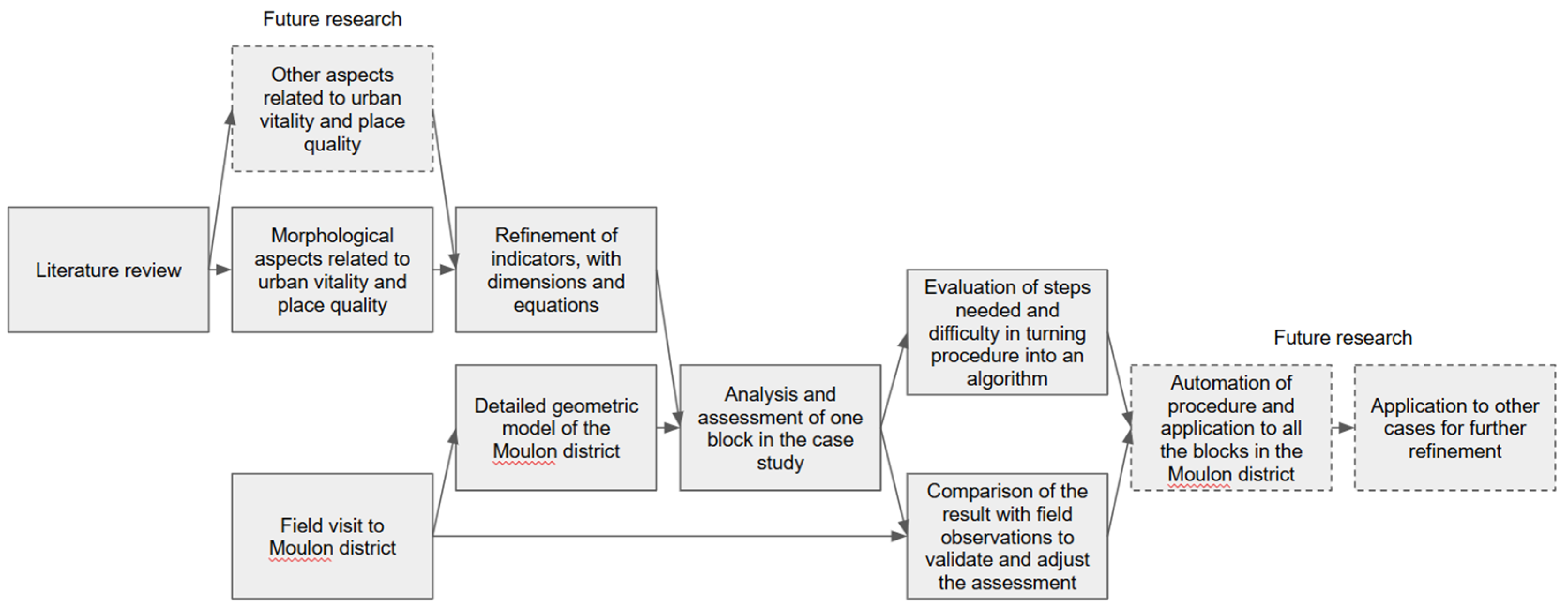
In order to set the ground for automating this assessment procedure, we isolated one group of aspects related to urban vitality and quality of place - morphology - and developed a step-by-step procedure, meticulously defining measurement methods and trying to predict all possible exceptions and difficulties. Other aspects found in the literature, such as mobility, use and function, and green spaces, will be added in future research.
The first step consisted of listing all the indicators found in the literature and the information and equations required to calculate each of them, even if they were not perfectly clear in the source texts. For example, the “construction density” indicator, mentioned by [8,37], requires two dimensions (total built area and total block area) and one equation (total built area/total block area). However, it is not clear if the total built area refers just to the ground floor or to the entire construction. In the first case, it is also not clear if one should count covered public passages as built areas or not, and so forth. Moreover, an optimal value for the ratio is not provided by the authors. Clearly defining the procedures to calculate each indicator involved interpretation, discussion and additional literature support.
The second part of the study consisted of using the list of indicators to assess our case study, the Paris-Saclay Moulon district, based on geometry and qualitative information attached to it. A detailed geometric model of the district was created, based on a field visit and on other data provided by the district management or available on the Internet. The site was visited between September 30th and October 13th 2024, in order to coincide with the beginning of the school semester, when most students are on campus, but the weather is still pleasant enough for people to stay outside. The site observations, done at different times of the day and on different days of the week, were recorded using Fulcrum software (www.fulcrumapp.com) that supports on-site data collection and georeferences photographs, videos and routes. An interview with the urban development director of Paris-Saclay’s Établissement Publique d’Amenagement (EPAPS) allowed us to gather further information about specific urban morphology strategies used in the district’s planning.
A digital geometric model of the blocks was created on Rhino 3Dceros CAD software, based on the site map. The buildings’ height and the position of their openings and recesses were defined based on on-site photographs manually compared with Google Earth data and inserted in the GIS files. The resulting model included all morphological aspects of the buildings, such as porticos, overhangs, covered and uncovered passages through the blocks, windows, doors, and so forth. Each district block was numbered and each edge labeled (North, South, etc.). The dimensions and equations needed for calculating each indicator were carefully evaluated, allowing to compare the results between different district blocks. The procedures for calculating each indicator were analyzed in terms of steps required and difficulty for algorithmic implementation, such as the need to introduce third party plugins or add-ons and the computational cost of the procedure. Following Moudon’s[42] definition of resolution for morphological analyses, the indicators focus on two resolutions: 1) Building/Block; 2) Block/Street. In the first resolution we list the indicators that are related to the building layout in relation to its block. In the second we list the indicators that discuss the interface between blocks and streets (or block edges). Having separate evaluations for every edge of each block will allow us to grade also the streets and not just the blocks. The following section presents the case study and its value as a base case for the development of these indicators.
The specific metrics for each of the indicators were developed based on three main works by[8,37,38] that specifically discussed place quality indicators related to urban vitality in KT contexts. However, these papers did not discuss how to measure or operationalize the assessment of place quality. Thus, for some of the indicators we developed our own algorithms based on theoretical concepts and, whenever needed, on benchmarks found in the literature. These indicators were categorized according to four of Ewing and Cervero’s (2010) 5D’s: Diversity, Density, Design and Destination Accessibility.
These algorithms were applied to the Moulon district’s Joliot Curie area as a base study. They were proof-implemented using the Grasshopper visual programming interface for Rhino 3D, in order to test their applicability and capacity to automate the process of assessing KT urban vitality through morphology indicators. Table 1 through 4 present the indicators and algorithms that were implemented in this application study, as well as the literature sources. The complete table with all the algorithmic procedures is provided as supplementary data (authors, 2025-excluded for blind review).
Finally, based on the indicators, the assessment was compared to the level of vitality and place quality observed during the field visit. The complete automated procedure and comparison with other benchmarks will be addressed in future publications.

Table 1.
Indicators and respective algorithms, part 1 of 4. Source: Authors, 2025.
| Resolution | Category | Indicator | Specific Metric | Source |
|---|---|---|---|---|
| Building/ Block | Destination Accessibility | Block permeability | (1) Connection Points Index (CPI) = Σ(CP) / n; Where: Σ(CP) = sum of all valid connection points on the block perimeter n = number of block faces (n = 4) (2) Distribution Factor (DF) = nf / n; (3) Connections Index (CI) = CPI × DF; |
*[38,39] |
| Block connections index | Viable segments / Intersection nodes | [19,38,39] | ||
| Morphological Connectivity Index (MCI) | MCI = Existing Paths / Potential Paths (Voronoi) | *[37] | ||
| Block Dimensional Adequacy (BDA) | Block size - side length: Length of Individual block sides evaluated against dimensional adequacy limits for pedestrian accessibility (1) BDA = Boolean_Check[Length_Adequacy, Width_Adequacy] |
[19,38,39] | ||
| Block Area Performance (BAP) sqm | Total block area evaluated combining size classification with pedestrian accessibility adequacy (1) BAP = Size_Adequacy_Classification[Current_Area] |
[19,38,39] | ||
| Block Perimeter Access Interval | Assessment of access point distribution for blocks requiring internal connectivity strategies Conditional requirement: BPP ≥ 0.60 < 0.75: MEETS THE REQUIREMENTS (requires internal connections) (1) IF 0.60 ≤ BPP < 0.75 THEN (2) BPAI = 150 / Longest_Perimeter_Segment (3) ELSE BPAI = Not Applicable (block naturally walkable) |
*[39] |
* Developed by authors based on these references.
Table 2.
Indicators and respective algorithms, part 2 of 4. Source: Authors, 2025.
| Resolution | Category | Indicator | Specific Metric | Source |
|---|---|---|---|---|
| Building/ Block | Design | Interface between built and open space | Face Alignment Ratio (FAR) = Sum of the length of urban-defining elements (solid facades + functional openings) that are aligned to the sidewalk or setback to a maximum of 2m / total perimeter of block face; Block Edge Continuity Score (BEC) = √[(FAR₁² + FAR₂² + FAR₃² + ... + FARₙ²) ÷ n] Where n = number of block faces |
*[37,46] |
| Building positioning definition | Block Morphological Coherence (BMC): Composite index combining edge continuity (BECS) and internal building distribution (IBR) to assess overall morphological coherence (1) BMC = BECS + (0.1 × Boolean[0.15 ≤ IBR ≤ 0.40]) where: (2) IBR = Area of internal buildings / Total building area in block |
*[37] | ||
| Block Perimeter Score (BPS) | Direct score assignment for reference perimeter cases based on established pedestrian accessibility parameters (1) IF BDA = 1 THEN (2) BPS = Conditional_reference_checks[Length, Width] |
[19,38,39] | ||
| Block Perimeter Performance (BPP) m | Interpolated evaluation for non-reference cases using proximity-weighted analysis against established pedestrian accessibility benchmarks (1) IF BPS = 0.0 THEN (2) BPP = Score_Interpolated = Σ(Score_i × Weight_i) / Σ(Weight_i) |
[19,38,39] |
* Developed by authors based on these references.
Table 3.
Indicators and respective algorithms, part 3 of 4. Source: Authors, 2025.
| Resolution | Category | Indicator | Specific Metric | Source |
|---|---|---|---|---|
| Building/ Block | Diversity | Block open space (BOS) | Block Open Space (BOS) = Open space area / Total block area | *[37] |
| Building size diversity (BSD) | Percentage distribution of buildings across size categories based on footprint area, measuring urban morphological heterogeneity. (1)Score = 1 - ((|%Small - 55| + |%Medium - 23| + |%Large - 22|) ÷ 100) |
[37] | ||
| Building Evenness Index (BEI) | (1) BEI = √[Σ(Vi - V)²/S]; Score (BEI) (2) e^(-((BVD-186.6)²)/(2×94.5²)) |
[26,38,39] | ||
| Building height diversity | Indica a dispersão e variabilidade da altura dos edifícios relativa à sua média SDBH = sqrt[Sum(Hi - BAH)^2/M] |
*[17,38,39] | ||
| Building Shape Factor sqm | BSF = Surface area / Total volume | [17] | ||
| Density | Spatial congestion degree (SCD) | Indicador de compacidade que mede quanto do potencial volumétrico máximo está sendo utilizado na área urbana. (1) SCD = Sum(Vi) / (max(Hi) x A) (2) Score (SCD) = exp(-((0,357 - 0,55)²) / (2 × 0,28²)) |
*[17,47,48] | |
| Building Average Height | Avalia a média das alturas do edifício na quadra BAH = Sum Hi / N |
[17,26,38,39] | ||
| Building density (Floor Area Ratio) | FAR = Total built area / Block land area | *[8,27,47,49] | ||
| Spatial Compactness Rate (Richardson Index) | RI = 2 x sqrt(pi x Area) / Perimeter | * [8,32,38] | ||
| Gross Population density inh./ha | Total population / Area in hectares | *[37,47,49,50] | ||
| Net population density (NPD) inh./ha | NPD = Population / (Total block area - Open space) | *[37,47,49,50] |
* Developed by authors based on these references.
Table 4.
Indicators and respective algorithms, part 4 of 4. Source: Authors, 2025.
| Resolution | Category | Indicator | Specific Metric | Source |
|---|---|---|---|---|
| Street/ Block | Destination Accessibility | Access density | AD = Number of accesses / 100 m of facade Score_AD = (Number of accesses / Facade length) × 10 Score_Block_AD = √[(Score_AD₁² + Score_AD₂² + Score_AD₃² + ... + Score_ADₙ²) / n] |
[46,51,52] |
| Ground floor permeability (GFP)% | Opening area / Total facade area | [51] | ||
| Design | Window density win./m | Number of windows / Facade length | [46] | |
| Window area % | Window area / Total facade area | [52] | ||
| Diversity | Active facades (AF) % | Active extension / Total block perimeter | [39] | |
| Density | Human scale and proportions (num. of floors) | Maximum building height per block | [46,51] |
* Developed by authors based on these references.
3. Case Study: Paris Saclay
The Paris-Saclay Urban Campus was selected as a base case study in this research, because it is a successful example in terms of quality of place and urban vitality, where urban morphology played an important role. Moreover, while most innovation districts result from the renovation of declining industrial areas and are, thus, limited in terms of site planning, the Paris-Saclay Urban Campus was implemented in what was practically greenfield, with just a few, sparsely located existing buildings and science facilities. Therefore, planners had the freedom to - and the challenge of - proposing a particular urban design to achieve very specific goals.
Although the area is located approximately 25 km southwest of Paris, until recently, most researchers and students would rather spend 50 minutes by train or even more in cars to reach science facilities in the Saclay plateau, rather than living there. As a result, the area was compared to an archipelago of science institutions by Pierre Veltz[53]. EPAPS was a national-interest operation started in 2010, aiming at creating an urban environment that would foster collaboration between institutions (both academic and industry-based R&D) that had been present in the Saclay plateau for decades, but lacked the urban “glue” that can promote vitality, serendipity and interaction, qualities that can attract and retain talents. With this project, the government expected to create a local community, increase academic performance and stop brain drain. The overall idea was to “go beyond the isolated monofunctional campus in favor of the emergence of a real university city integrated into the Metropolis” [54].
The project started with a comprehensive landscape design by Michel Desvigne’s office, in 2009. According to Michel Desvigne Paysage (MDP), the challenge consisted in “moving past the current stage of an area made up of industrial-university activities dotted with large closed off access points, to an authentic neighborhood containing residents, shared facilities, and businesses” [55]. Due to the large extension of the site and the existence of large wooded and agricultural areas on the plateau, the master plan proposed creating a few compact neighborhoods around the existing built-up areas. Connected to each other by public transit and soon to be connected to Paris by the new Grand Paris Express line, each neighborhood was planned to be “of significant dimension”, i.e., dense enough, and built “within the radius of a public transport stop, each of a scale traversable by foot or bicycle”[55]. MDP worked through different scales, from the cluster and the urban campus to the public spaces and gardens, keeping the same logic. Other offices were also hired to further develop neighborhoods, blocks and buildings.
The EPAPS is composed of three areas - Moulon, École Polytechnique and Corbeville, with approximately 200 ha each, the latter still under development, as shown in Figure 3. In this study we focused on the Moulon district, because it has the greatest functional diversity of the three. Part of the Moulon district, the Joliot-Curie area, was commissioned to OMA France1, after the Office for Metropolitan Architecture (OMA) had won the competition for the Centrale-Supélec engineering school facilities in the same area, in collaboration with Bollinger and Grohman and others[56,57].
The design for the Centrale-Supélec was referred by OMA [56] as “the LabCity”, “a stable framework for constantly changing requirements (...) with creative disorder framed under a structural skeleton”, a “city within a city”, based on the concept of block permeability for pedestrians:
…a seamless experience between the building and its surroundings, providing a convenient public route between the future heart of the neighbourhood and the future subway station. Around this urban spine, the program is spread in different buildings of various typologies and sizes, organized on an urban grid served by secondary streets. [56]
Similarly, in the Joliot-Curie area, blocks, buildings and public spaces were specifically designed to achieve the main goals of the operation, combining urban density and program interaction. According to Germe&JAM [54], two of the offices responsible since 2017 for extending this area’s masterplan, “the age-old grid model thus [became] the fertile support for a re-territorialization of the campus (...) and the formation of a mixed urban fabric guaranteeing the integration of the diversity of programs, uses and scales”.
The conceptual image published on OMA’s website [58]was a collage with the existing buildings’ black footprints pasted against a birds’ eye photograph of the Saclay plateau’s wheat fields. It clearly stated the problem: how to integrate existing buildings spread out on an agricultural area? The answer is visually explained in the following image, where new buildings are used to define a grid and its urban blocks. A diagonal dotted line links the neighborhood center to the Subway Station, crossing the Centrale-Supélec building, which has a covered privately-owned public passage. Different functions are mixed in the area. The urban design is described as
...a new form of a rigorous and flexible urbanism, capable of combining varied programs and integrating existing buildings into an efficient, unified scheme. Public spaces integrated with existing natural components act to both articulate the diverse functions and provide space for interactions between different users. Density and intensity of use is sought for student housing, while the diversity and plurality of lifestyles guide the design of plots for family housing.[58]
The project is therefore divided in three phases, shown in Figure 2 [54].The first phase is composed of the pre-existing buildings, figures against the ground. The second one is made of large, single program perimeter blocks, with buildings that define inner courtyards open to the public, as privately-owned public spaces (POPS). The third and last phase of development is based on a “mixed and diversified urban fabric”:
In contrast with the large size and monumentality of the previous architectural objects or voids, the new urban fabric aims for a return to an "urban ordinary", of the small scale, tight spacing, the division of blocks, diversity and urban complexity (...), articulating a wide variety of private collective spaces, open or closed to the public domain, [allowing] for “ordinary” operating units, the long-term evolution of which (reversibility) is much simpler to implement than for monolithic blocks[54].
Figure 2.
The three development phases of the Moulon district: figure-ground (in black and green), perimeter blocks (in black and blue), and diversified blocks (in red and yellow). Source: Germe&JAM[54].
Figure 2.
The three development phases of the Moulon district: figure-ground (in black and green), perimeter blocks (in black and blue), and diversified blocks (in red and yellow). Source: Germe&JAM[54].
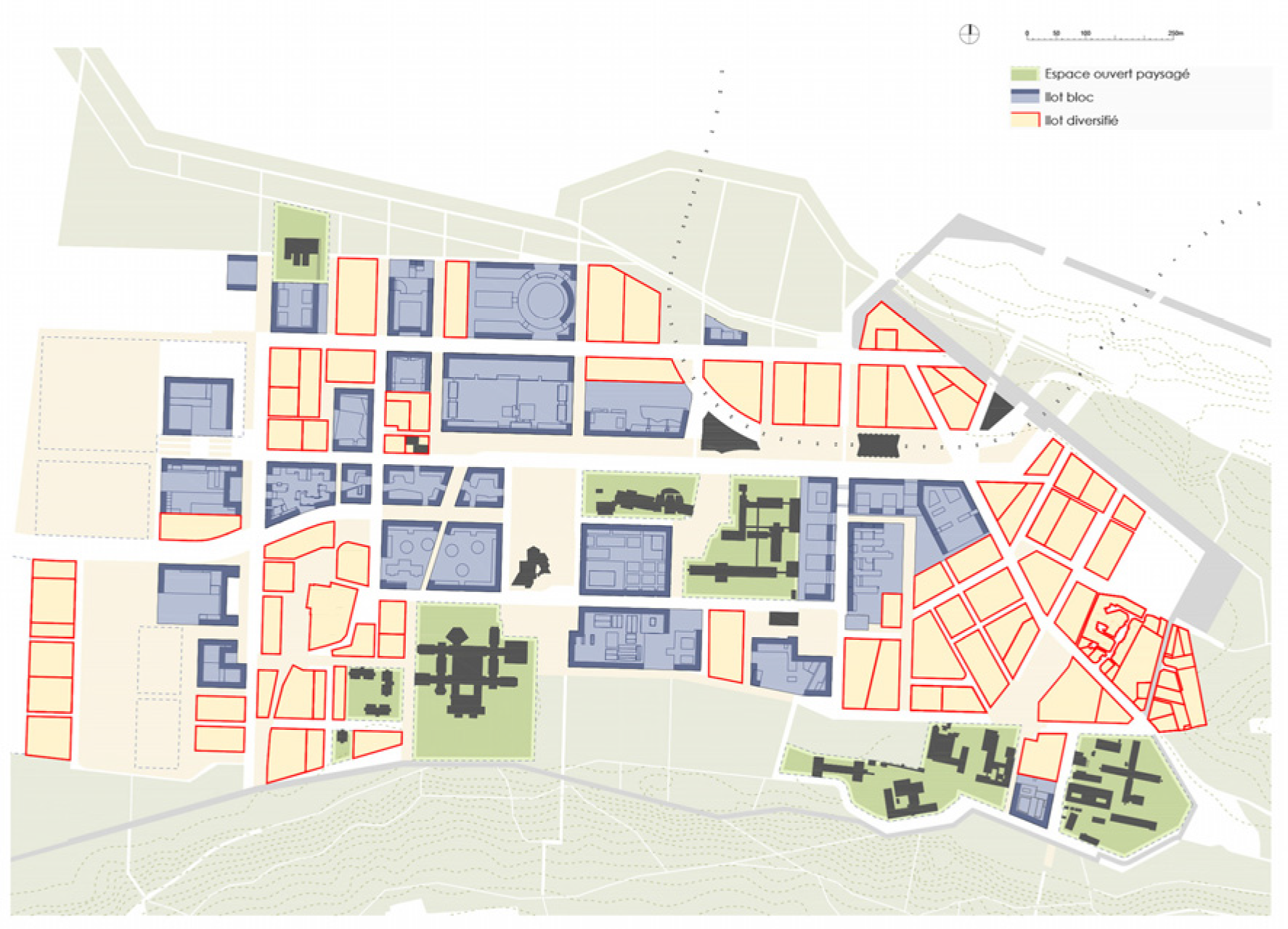
This third method of filling up the empty space allows the evolution of the district over time, with new programs that may appear. There are also some variability rules. For example, on North-South streets buildings are lined-up, but with different heights, while on Eat-West streets there is more discontinuity between buildings, assuring visual permeability and views to the valley. Nevertheless, typological rules assure an underlying logic to the entire district, avoiding a random look (Figure 3).
Figure 3.
Typological rules for the third phase blocks. Source: Germe&JAM[54].
Figure 3.
Typological rules for the third phase blocks. Source: Germe&JAM[54].
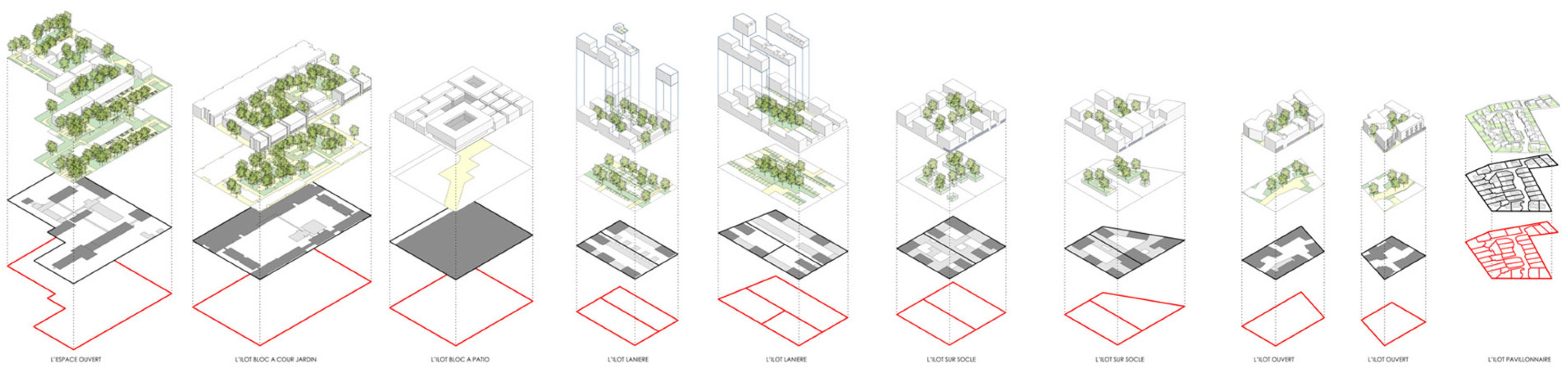
As a result, despite being an artificially-created district, Moulon has enough complexity and diversity of scales, typologies and functions, with a variety of open spaces that foster the aimed vitality and quality of place, which was confirmed during the authors’ visits to the site.
4. Results
A total of 27 indicators were developed with the aim of assessing urban vitality using place quality aspects and their urban morphology metrics. These indicators were divided into two resolution scales (building/block and street/block) and four main categories, based on Ewing and Cervero’s [34] 5D’s: Diversity, Density, Design and Destination Accessibility. Table 1 presents the indicators for each resolution scale. While the method for calculating some of those indicators were readily available from the references, others had to be further specified by us. Those are marked with an asterisk on the Table. The reasoning for calculating them is presented below, under each category.
Because this research focuses on morphology and on Building and Block resolutions, the Distance to Transport category was included at this point. Nonetheless, the latter is an important aspect of vitality and place quality assessments on district, city and regional resolutions and should be incorporated in future developments. As stated above, use and function and green areas were also not included and will also be subject of future studies.
4.1. Destination Accessibility
Although our study focused on morphology and did not include specific transportation aspects, such as cycling infrastructure or distance to transit, some of the indicators used have a direct impact on mobility. In the field of transportation, Destination Accessibility, which measures how easy it is to access destinations or attraction points, i.e., jobs, services, commercial activities, within an urban grid, is usually measured on a city or regional scale. In this case, based on the specific literature on vitality and place quality, this category is approached from a finer grain to reflect the human scale on a building/block resolution. Thus, the selected indicators include: Block permeability, Block connections Index, Morphological Connectivity Index (MCI), Block Dimensional Adequacy (BDA), Block Area Performance (BAP) and Block Perimeter Access Interval under the Building/Block resolution; and Access Density and Ground floor permeability under the Block/Street resolution. Among them, the following were further developed by us, based on concepts found in the literature.
The Block permeability metric was developed based on its importance for promoting walkability and route diversity in the urban environment. According to Victoria Walks[39], block perimeters exceeding 600 meters tend to discourage walking, and it is recommended to create transversal connections that allow crossing through the interior of the block. Adu-McVie et al.[38] reinforce this approach by pointing out that successful innovation districts exhibit high permeability, offering greater freedom of movement and multiple opportunities for enjoying the urban space. Based on these foundations, we developed the Connection Index (CI), composed of two complementary factors: 1) Connection Points Index (CPI), which measures the average density of functional access points per block face, 2) the Distribution Factor (DF), which represents the proportion of block faces that contain at least one functional access. This structure penalizes both the low density of access points and their concentration on a limited number of faces, enabling a fairer and morphology-sensitive block-wide evaluation.
We also developed an extended, based on our methodological interpretation, the Morphological Connectivity Index (MCI), building upon Kim's[37] figure-ground analysis, which was used as "the primary method to undertake and communicate morphological elements of urban form" and demonstrated how "buildings defined streets and squares and promoted a small-scale and finely-meshed street grid." Kim's figure-ground mapping "visually showed urban blocks that were small in length and width, which allowed for greater freedom of movement, creating more significant opportunities for street frontages, paths, and openings." While Kim analyzed these "opportunities for paths" qualitatively through visual figure-ground mapping, we extended this analysis quantitatively: if buildings define urban spaces through their spatial arrangement, they also mathematically define the optimal potential paths between these spaces. This metric automates and quantifies Kim's visual interpretation using Voronoi diagrams generated from building centroids to mathematically identify all optimal potential paths based on spatial distribution, comparing them with actually implemented paths to measure the degree of utilization of connectivity opportunities that the building configuration enables.
The Block Perimeter Access Interval (BPAI), depentent of calculated indicator Block Dimensional Adequacy (BDA) and Block Area Perfomance (BAP), metric was complemented with the one for counting perimeter entries of the block that connect its interior to external faces and measuring distances between each entry along the block perimeter, creating an integrated morphological evaluation system that simultaneously considers block scale and its perimeter connectivity capacity. This systemic approach ensures that larger blocks maintain adequate permeability levels through adequately distributed accesses along the perimeter, empirically validating pedestrian accessibility principles even in large-scale development contexts.
4.2. Design
The Design category indicators include: Interface between built and open space; Building positioning definition; Block Perimeter Score (BPS) and Block Perimeter Performance (BPP) under the Building/Block resolution; and Window density and Window area under the Block/Street resolution. The last two ones need to be analyzed taking into account two other indicators under the Destination Accessibility category (Access density and Ground floor permeability), because a low window density or area may be the result of a high access density, and vice-versa.
Kim[37] identifies through qualitative figure-ground mapping two distinct morphological typologies: buildings that "define space" (characteristic of traditional urban fabrics where buildings are constructed adjacent to one another, providing the "walls" of open space) versus buildings "loose in space" (isolated objects characteristic of modernist design). The Building positioning metric is used to automate this qualitative analysis by establishing a quantitative threshold of 15m from the block edge to objectively classify building positioning and calculate percentages of each typology within the block. The 15m threshold was chosen as it approximately corresponds to the width of a typical building, though this parameter can be modified according to specific urban contexts and research objectives.
The same author further identifies that successful Innovation Districts create "more significant opportunities for street frontages" and that adjacent buildings "provide the walls of open space," defining streets and squares[37]. Building upon this foundation, our metrics for the Design category quantitatively measure the percentage of block perimeter where urban-defining elements, i.e., solid facades and functional openings such as passages, porticos, and galleries, are aligned or setback to a maximum of 2m. This approach objectively quantifies the "cohesiveness of space" that Kim[37] observed through figure-ground mapping, distinguishing between mere setbacks and functional openings that maintain spatial continuity. The 2m threshold was selected for this analysis as an appropriate tolerance for facade alignment, though this parameter remains adjustable according to specific urban contexts. Additionally, we applied Root Mean Square calculation to individual face scores to emphasize spatial quality over simple arithmetic averaging, recognizing that urban spatial excellence benefits from exceptional performance in key relationships rather than uniform mediocrity. Block Perimeter Performance (BPP) depends on Block Perimeter Score (BPS).
4.3. Density
The indicators for the Density category were developed to capture built form characteristics beyond Building density (Floor to Area Ratio - FAR) and Gross and Net Population Density[41]. In order to capture positive and negative aspects of density perception by users, we included metrics for Spatial congestion degree (SCD); Building Average Height and Spatial Compactness Rate (Richardson Index) in the Building/Block resolution. The Human scale and proportions indicator was added under the Block/Street resolution.
According to Lin et al.[17] higher values of Spatial Congestion are strongly associated with the concentration of socioeconomic activities that could accommodate a large number of people. However, the authors did not offer interpretive benchmarks, limiting its practical application. To transform it into a prescriptive planning tool, a calibration system was developed based on the Compact Midrise model by Stewart & Oke[48],recognized for combining urban efficiency, vitality, and sustainability.
The Spatial Compactness Rate (Richardson Index) is based on Lv et al.[32] and assesses the relationship between urban vitality and spatial compactness considering it as an attribute of the "block pattern" dimension, which directly influences urban performance. The use of the Richardson Index is based on the premise that the most efficient spatial form for urban development is a circle. According to the formula, the index ranges from 0 to 1, with 1 assigned to the most compact shape, i.e., a perfect circle. However, the authors do not propose benchmarks or thresholds to classify the resulting values, limiting its application in comparative studies. To overcome these limitations, we developed a weighted methodology that integrates three fundamental components: shape efficiency (Richardson Index), area adequacy, and perimeter efficiency, based on Victoria Walks'[39] standards. The 95%-02%-3%weighting scheme prioritizes shape efficiency (as the main component of urban vitality) while also accounting for dimensional adequacy, preventing extremely small or elongated blocks from receiving high scores based solely on geometric compactness. This approach recognizes that blocks with similar compactness values may exhibit different urban performances when their absolute dimensions are taken into account. Our analysis is based on Victoria Walks'[39] reference parameters for ideal block size, which establish optimal perimeter and area dimensions for walkable urban environments. A review of all their benchmarks revealed the following cases, where extremely small or elongated blocks could otherwise receive inflated scores due only to compactness.
4.4. Diversity
While Diversity is usually assessed using entropy equations to measure the variety of land uses, to capture this dimension on a block by block scale, we go beyond this concept and include measures to capture building and occupation diversity as well[34]. This is based on the idea that building size and type diversity promotes diversified mixed use, allows for greater urban permeability, attracts people of different income levels, creates vibrant street life, and supports the co-location of diverse types and sizes of innovative industries[37]. Measures related to active facades are also included in the Diversity category, as their use is related to the variety of uses. This category was assessed with the following indicators: Block Open Space (BOS); Building size diversity (BSD); Building Evenness Index (BEI); Building height diversity and Building Shape Factor under the Building/Block resolution; and Active facades under the Block/Street resolution.
Kim[37] systematically uses the distinction between "built and unbuilt spaces" as the fundamental basis of morphological analysis through figure-ground mapping, even developing a specific formula that considers "Gross area – Open land" for net density calculation. This metric directly automates this central concept by calculating the percentage of block area dedicated to open spaces. While Kim[37] focused on the built/unbuilt relationship for population density analysis, we extended this approach to quantify specifically the balance between built and open spaces within individual blocks, providing an objective measure of the "flexibility of built form and open space" that the author identified as an important morphological characteristic.
Through the morphological analysis of five Urban Innovation Districts, Kim [37] concluded that those characterized by the predominance of small and medium buildings were more successful than those that preferred larger buildings reaching the following thresholds for the Building size diversity (BSD): 1) Small under 500m², Medium between 501 and 1000m², and Large over 1000m².
The Building Evenness Index (BEI) proposed by Xu et al. [26]provides a basis for quantifying the volumetric diversity of buildings (BVD). This metric evaluates urban morphological quality, as the diversity of built volumes is directly related to urban vitality, social and functional permeability of spaces, and the capacity to attract diverse activities and users[37]. However, these authors did not establish quantitative benchmarks for interpreting BVD values, limiting themselves to comparative analyses between different urban areas. To bridge this gap, we developed a methodology to calibrate this benchmark based on the literature on urban morphology and urban vitality. For the definition of building footprint categories, we adopted Kim’s[37] building size classification, presented in above and establish an ideal scenario to be a composition of 40% small, 40% medium, and 20% large buildings, combined with building heights distributed in the range of 15–24 meters (5–6 floors), a standard identified by the Healthy Urban Design Index (HUDI) as ideal for urban vitality[47].This height range is adopted by HUDI for three main reasons: 1) it increases user comfort and well-being, 2) it maintains clear sky visibility, preserving visual connection with the natural environment, and 3) it prevents vertical sprawl, avoiding over-densification harmful to urban quality[47] . This benchmark is further supported by the Local Climate Zone (LCZ) system, which empirically demonstrates that mid-rise buildings, between 10 and 25m tall, offer the best balance between adequate urban density and thermal-environmental comfort[48] .
4.5. Morphological Analysis of Paris Saclay
Due space limitations, the assessment result for only one of the blocks is presented here, as a base case in Table 5 and Table 6. The block chosen for the application study is between Joliot Curie Street, Sebastienne Guyot Street, Jules Horowitz Street and Andre Blanc-Lapierre Street. It includes three different types of buildings: (1) a pre-existing isolated building dating from 2005-2006, with a wide setback from the sidewalk, (2) perimetral buildings lined up with the sidewalk (2016-19), and (3) new isolated buildings placed in the middle of the block (2016-19). The perimetral buildings display a few facade variations, such as narrow setbacks with overhangs, covered and non-covered openings, and a variety of uses and facade types. There are also a variety of streets and sidewalk widths and components around the block, ranging from a main road with bus stops to a pedestrian commercial street, with an outside restaurant sitting area.
The application of the morphology indicators to our base case block showed that the urban design strategy adopted ranked high in our analysis. Almost all the morphology indicators (24 out of 27) either met the minimum requirements or exceeded expectations.
Table 5.
Morphological analysis results for Paris Saclay, part 1 of 2. Source: Authors, 2025.
| Indicator | Reference parameter (Benchmarks) | Block 1 Result (score) | Classification |
|---|---|---|---|
| Block permeability | INADEQUATE: CI = 0; ADEQUATE: 0 < CI < 1; EXCEEDS EXPECTATIONS: CI ≥ 1 |
CI = 2.5 | EXCEEDS EXPECTATIONS |
| Block connections index | ADEQUATE: | 8.2 | EXCEEDS EXPECTATIONS |
| Morphological Connectivity Index (MCI) | INADEQUATE: ≤ 0.5; ADEQUATE: 0.5 < MCI < 0.8; EXCEEDS EXPECTATIONS: ≥ 0.8 |
MCI = 1 | EXCEEDS EXPECTATIONS |
| Block Dimensional Adequacy (BDA) | MEETS THE REQUIREMENTS = 1; INADEQUATE = 0 |
BDA = 1 | MEETS THE REQUIREMENTS |
| Block Area Performance (BAP) sqm | Small: 7.200-10.000m²; Medium: 10.000-20.000m²; Large: 20.000-28.800m² |
24069 m² (Large: requires internal connectivity) | MEETS THE REQUIREMENTS |
| Block Perimeter Access Interval | EXCEEDS EXPECTATIONS: BPAI > 1.0; MEETS THE REQUIREMENTS: BPAI = 1.0; INADEQUATE: BPAI < 1.0 |
BPAI = 1.47 | EXCEEDS EXPECTATIONS |
| Interface between built and open space | INADEQUATE: BECS ≤ 0.7; ADEQUATE: 0.7 < BECS < 0.8; EXCEEDS EXPECTATIONS: BECS ≥ 0.8 |
BECS = 0.84 | EXCEEDS EXPECTATIONS |
| Building positioning definition | INADEQUATE: BMC ≤ 0.70; ADEQUATE: 0.70 < BMC < 0.80; EXCEEDS EXPECTATIONS: BMC ≥ 0.80 |
BMC = 0.94 | EXCEEDS EXPECTATIONS |
| Block Perimeter Score (BPS) | NON-REFERENCE CASE: BPS = 0.0; REFERENCE CASE: BPS > 0.0 |
BPS = 0.0 | MEETS THE REQUIREMENTS |
| Block Perimeter Performance (BPP) m | EXCEEDS EXPECTATIONS: BPP ≥ 0.75; MEETS THE REQUIREMENTS: 0.60 ≤ BPP < 0.75 |
BPP = 0.713 | MEETS THE REQUIREMENTS |
| Block open space (BOS) | INADEQUATE: < 0.50; MEETS REQUIREMENTS: ≥0.7; EXCEEDS EXPECTATIONS: 1 |
BOS = 1 | EXCEEDS EXPECTATIONS |
| Building size diversity (BSD) | INADEQUATE: < 0.50; MEETS REQUIREMENTS: 0.50-0.79; EXCEEDS EXPECTATIONS: ≥ 0.80 |
BSD = 0.823 | EXCEEDS EXPECTATIONS |
| Building Evenness Index (BEI) | INADEQUATE: < 0.70; MEETS THE REQUIREMENTS: 0.70-0.79; EXCEEDS EXPECTATIONS: QI ≥ 0.80 |
QI = 0.83 | EXCEEDS EXPECTATIONS |
Table 6.
Morphological analysis results for Paris Saclay, part 2 of 2. Source: Authors, 2025.
| Indicator | Reference parameter (Benchmarks) | Block 1 Result (score) | Classification |
|---|---|---|---|
| Building height diversity | INADEQUATE: < 0.79; MEETS REQUIREMENTS: 0.79-0.95; EXCEEDS EXPECTATIONS: 0.95-1.00 |
Score_SDBH = 0.75 | MEETS THE REQUIREMENTS |
| Building Shape Factor sqm | INADEQUATE: Compact: 0.1 a 0.4; Very complex: >2 MEETS REQUIREMENTS: Moderate: 0.4 a 0.8; EXCEEDS EXPECTATIONS: Articulated: 0.8 a 1.5; |
Moderate: 29.5% | MEETS REQUIREMENTS |
| Spatial congestion degree (SCD) | INADEQUATE: < 0.56; MEETS REQUIREMENTS: 0.56-0.89; EXCEEDS EXPECTATIONS: ≥ 0.90 |
Score_SCD = 0.79 | MEETS REQUIREMENTS |
| Building Average Height | INADEQUATE: < 0.8; MEETS REQUIREMENTS: 0.8-1.0; EXCEEDS EXPECTATIONS: = 1.0 |
BAH = 17.7m, Score_BAH = 0.98 | MEETS THE REQUIREMENTS |
| Building density (Floor Area Ratio) | INADEQUATE: < 0.70; MEETS REQUIREMENTS: 0.70-0.89; EXCEEDS EXPECTATIONS: 0.90-1.00 |
FAR = 2.3, Score_FAR = 0.7 | MEETS REQUIREMENTS |
| Spatial Compactness Rate (Richardson Index) | INADEQUATE: < 0.65; MEETS REQUIREMENTS: 0.65-0.95; EXCEEDS EXPECTATIONS: ≥ 0.96 |
RI = 0.853, Score_RI = 0.927 | MEETS REQUIREMENTS |
| Gross Population density inh./ha | INADEQUATE: < 0.70; MEETS REQUIREMENTS: 0.70-0.99; EXCEEDS EXPECTATIONS: = 1.0 |
PD = 637.9, Score_PD = 0.9 | MEETS THE REQUIREMENTS |
| Net population density (NPD) inh./ha | INADEQUATE: <150; MEETS THE REQUIREMENTS: 150-250 inhab/ha |
NPD = 154 inhab/ha | MEETS THE REQUIREMENTS |
| Access density | INADEQUATE: < 0.43; MEETS REQUIREMENTS: 0.43-0.79; EXCEEDS EXPECTATIONS: ≥ 0.8 |
Score_Block_AD = 0.449 | MEETS THE REQUIREMENTS |
| Ground floor permeability (GFP)% | INADEQUATE: < 0.5; MEETS REQUIREMENTS: 0.5-0.69; EXCEEDS EXPECTATIONS: ≥ 0.7 |
Score_Block_GFP = 0.638 | MEETS THE REQUIREMENTS |
| Window density win./m | ADEQUATE: ≥ 0.2 windows/m | Average 0.125 win/m | MEETS THE REQUIREMENTS |
| Window area % | INADEQUATE: < 0.5; MEETS REQUIREMENTS:≥ 0.5 |
Average 8.9% | INADEQUATE |
| Active facades (AF) % | INADEQUATE: < 0.25; MEETS REQUIREMENTS: 0.25-0.49; EXCEEDS EXPECTATIONS: ≥ 0.5 |
0,26 | MEETS THE REQUIREMENTS |
| Human scale and proportions (num. of floors) | ADEQUATE: 5-6 floors | 6 floors | MEETS THE REQUIREMENTS |
The exceptional performance is particularly evident in the Destination Accessibility category, where the block achieved extraordinary results that directly embody OMA's [56] concept of creating "a seamless experience between the building and its surroundings." Furthermore, this performance is crucial for its function as a pedestrian and commercial axis. Despite its large area of 24,069 m² (BAP), which classifies it as a block that "requires internal connectivity," the design effectively overcomes this challenge. The block permeability indicator reached a Connection Index of 2.5, which indicates that the connection points are numerous and well-distributed. This is reinforced by the Block Perimeter Access Interval (BPAI = 1.47), showing that the distance between entrances is 47% better than the minimum recommended threshold. The Morphological Connectivity Index achieved a perfect score of 1.0, meaning the existing paths align with the optimal routes suggested by the building layout itself. This confirms a highly intentional design that maximizes pedestrian flow and route choice. These results quantitatively validate the pedestrian block permeability strategy that underpins the entire urban design approach.
The hybrid typological strategy implemented in the district is validated by the indicators in the Design category, which show that the block successfully creates a cohesive yet diverse urban environment. High scores for Interface between built and open space (BECS = 0.84) and Building positioning definition (BMC = 0.94) both exceed expectations. The design achieves this by using perimeter buildings to form a strong, continuous "urban wall," which ensures spatial clarity, while the strategic placement of buildings within the core adds functional complexity. This interior is not empty, as the Block Open Space (BOS = 0.56) is actively used for circulation and housing. The overall diversity is further enhanced by excellent scores in Building size diversity (BSD = 0.823) and the Building Evenness Index (BEI = 0.83), which confirm a rich mix of building footprints and volumes that avoids both monotony and chaos. This phased approach to development, evolving from the initial "figure-ground" of pre-existing buildings to monumental perimeter blocks with internal courtyards, and finally to a diversified urban fabric signifying a "return to the urban ordinary," is precisely what forges the "creative disorder framed under a structural skeleton" envisioned by OMA[56] for its LabCity concept.
The Density indicators reveal an adequate performance, reflecting an intentional balance struck between the urban compactness required for innovation ecosystems and the maintenance of a human scale. Specifically, the block meets the requirements for Spatial Congestion (SCD Score = 0.79), Floor Area Ratio (FAR Score = 0.7), and Population Density (PD Score = 0.9). These results point to a density level sufficient to sustain urban vitality and public transportation while avoiding excessive congestion. Furthermore, the Average Building Height (Score = 0.98) and a maximum height of 6 floors firmly establish the block within the "compact mid-rise" category—a typology widely recognized for fostering human scale and urban quality.
Notably, the only indicator that failed to meet the requirements was Window Density, with an average of 0.125 windows/m. This result, however, must be viewed in context. The block does meet the requirements for Access Density (Score = 0.449) and Ground Floor Permeability (Score = 0.638), which suggests that the lower count of traditional windows is offset by a high number of doors, transparent commercial storefronts, and passages. These elements equally fulfill the "eyes on the street" principle, contributing to a vibrant and engaging pedestrian experience.
These findings offer corroborate that the morphological strategy in Paris-Saclay effectively integrates typological diversity while maintaining spatial coherence, fosters permeability without sacrificing urban definition, and strikes a balance between density and place quality. With 24 out of 27 indicators (89%) meeting or exceeding requirements, the results demonstrate how specific morphological choices can quantitatively enhance urban vitality, translating traditionally subjective concepts into objective metrics for planning knowledge territories. The integration of three distinct building typologies—the pre-existing isolated building, the perimeter blocks, and new isolated buildings in the core—is key to this success, creating multiple opportunities for access, morphological diversity, programmatic flexibility, and spatial vitality across different scales. Even for a large-scale block that would typically pose permeability challenges, the design overcomes these limitations through specific morphological strategies and the shaping of intermediate spaces that act as public space extensions. Ultimately, these strategies yield exceptional connectivity and permeability performance, proving that block size can be effectively offset by intentional morphological design.
5. Discussion
From a methodological perspective, the assessment of the Joliot Curie block confirms the practical viability of implementing these morphological indicators in computational design environments. The analysis revealed a clear division in automation complexity: 17 of the 27 indicators (63%) were classified as "Easy" to automate in Grasshopper for Rhino 3D, relying solely on geometric input data that is directly extractable from digital geometric model. This group includes fundamental metrics like Block Dimensional Adequacy, Morphological Connectivity Index, Average Building Height, and Population Density, which form the backbone of the morphological evaluation. One indicator was rated as "Medium" difficulty, while nine (33%) were categorized as "Difficult." This latter group's complexity stems from its dependence on qualitative facade information—such as Active Facades, Window Density, and Ground Floor Permeability. These indicators, which relate to functional transparency and facade characteristics, required specific data collection procedures including: detailed modeling of ground floor plans to identify functional accesses; manual measurement of window dimensions from field photographs; verification of spatial configurations using Google Earth imagery; and a detailed survey of nuanced facade features, like setbacks and typological variations, that are not easily detectable in basic digital geometric models.
The application of the 27 developed morphological indicators to the Joliot Curie block reveals a strong convergence between the quantitative results and the empirically observed urban vitality. The field analysis, conducted during the campus's peak activity period, confirmed that this specific block functions as the main pedestrian and commercial axis of the area, validating the success of the urban design strategy in creating a dynamic social hub.
The commercial and pedestrian street to the south of the block fosters a sense of neighborhood life, where convenience and routine nurture vitality. Operating at a smaller scale, with full priority given to pedestrians and a focus on active facades, it concentrates essential daily commerce and services, such as bakeries, pharmacies, bars, and restaurants, alongside family and student housing. As a result, the district is not merely a place of work and study with daytime activity peaks, but a living neighborhood with its own life at night and on weekends.
Furthermore, its strategic location also contributes to its success, as it connects different territories and flows within Moulon. As observed in the field, it intercepts the natural path of students between the universities and the Parc de Moulon. At the same time, it serves as an attractor between the flow of workers from the economic axis to the north and the residential, student, and family areas to the south. Thus, during peak hours, such as lunch or the end of the workday, the street comes to life. The flow of people mixes with daily activities—going to the market, having lunch, grabbing a coffee—transforming routine tasks into opportunities for social interaction.
Similarly, it is observed that the planned diversity is not limited to the neighborhood scale but also extends to the micro-scale of the block. The axis is situated precisely between two porous blocks, one for family housing and the other for student housing. This design choice encourages interaction between two distinct lifestyles: on one side, children arriving from school and playing in the internal courtyards; on the other, students socializing in the open courtyards of their residences. Both groups, with their own rhythms and needs, converge on the same commercial axis, creating a rich and heterogeneous social dynamic that sustains the area's vitality. This demonstrates the district's ability to combine the daily activities of residents, workers, and students, promoting an integrated urban ecosystem.
Moreover, the composition of the blocks also allows for the overlap of different housing typologies within the same block. The offerings include both private and social student housing, as well as family housing, with a portion allocated to the social segment. This planning demonstrates a commitment to social inclusion, resulting in a diversity that encompasses not only different lifestyles and age groups but also various socioeconomic profiles, which further enriches the urban vitality of the axis. Finally, the dialogue between spaces is reinforced by the design of the facades, as the entire perimeter of the blocks was designed with visual and physical permeability. Where there is no commerce or services, the design employs transparent or porous facades. This allows for mutual visibility between the internal courtyards and the street, connecting the private life of the buildings to the urban movement and reinforcing the sense of security and community.
These rich field observations highlight the challenge of transforming urban vitality—a fundamentally subjective and experiential quality—into objective and quantifiable metrics, which represents one of the most significant methodological contributions of this research. Traditional approaches to assessing urban vitality rely heavily on qualitative observations, surveys, or activity mapping, which, though valuable, are difficult to standardize, replicate, or integrate into design processes. The correlation between the quantitative indicators and the observed vitality in the Joliot Curie block demonstrates that specific morphological characteristics can indeed serve as reliable proxies for urban quality, effectively bridging the gap between place quality and measurable design parameters.
However, this transformation from the subjective to the objective inevitably involves certain reductions and simplifications. The block permeability indicator, while representing a significant advance in objective quantification, exemplifies both the potential and the limitations of automated urban analysis. As currently formulated, the indicator does not fully account for the spatial distribution of access points along the block faces. A block face with two poorly positioned connections near its edges might be less effective for pedestrian movement than one with a single, centrally located access point, particularly on large-scale blocks where the length of internal segments becomes critical. Following the Victoria Walks recommendation that optimal walking segments should range between 60 and 120 meters, future refinements could incorporate a Segmentation Factor that assesses not only the number and distribution of access points but also their effectiveness in creating appropriately scaled pedestrian segments.
This need for contextual interpretation is further illustrated by another indicator. While the Window Density scored inadequately (0.125 windows/m), field observations revealed that this metric failed to capture the qualitative richness of the ground-floor interface, where large commercial openings, covered passages, and varied facade treatments created engaging urban environments despite the lower count of traditional windows. This underscores the importance of developing suites of indicators rather than relying on single metrics, as compensatory performance across multiple measures provides a more comprehensive assessment.
The classification of indicators into three levels of automation—Easy (17 indicators), Medium (1 indicator), and Difficult (9 indicators)—reveals both the potential and the current limitations of automated urban analysis. While 68% of the indicators can be fully or semi-automated, the remaining 32% that require manual input represent crucial aspects of urban vitality related to programmatic diversity, transparency, and human-scale details. This manual bottleneck, however, points to a promising future where emerging technologies can be integrated. Tools like Fulcrum, for example, allow for the collection of structured, georeferenced field data, while the use of Artificial Intelligence to analyze Google Street View imagery could automate the large-scale extraction of data on facades, uses, and openings, overcoming current limitations. This suggests that a hybrid approach, combining automated geometric analysis with targeted manual data collection, is the most practical path forward at present, with clear potential for greater automation in the future.
Finally, while the Joliot Curie block serves as a powerful proof-of-concept, the generalizability of these benchmarks requires further validation. The application of this methodology to additional blocks within the Moulon district and to other knowledge territories will be essential for calibrating the benchmarks and testing the robustness of the indicators across different contexts. Each new case study will likely reveal specific adaptations needed for varied urban conditions, building typologies, and cultural contexts. This iterative process of application and refinement is crucial for developing truly universal indicators that simultaneously maintain sensitivity to local conditions.
6. Conclusions
Positive aspects of cities related to urban morphology can be seen as the result of spontaneous emergence, or of a fortunate transformation process taking shape along decades - or even centuries - of history. Sometimes, these qualities are even considered hard to name. Alexander[35], for example, coined the term “Quality Without a Name” to refer to some of those indescribable qualities. Urban vitality is one of them. Similarly, Cozzolino[36] (p. 43) states that “a clear bridge connecting the theory of spontaneous order and the issue of beauty in and for cities has not yet been developed”.
In this paper, we have introduced the idea of territories where knowledge is present ubiquitously, and not just contained in an enclosed area, such as a university campus, a Science & Technology Park or an innovation district. Next, we have discussed how important urban vitality and place quality - typically seen as subjective aspects of the urban environment - are for attracting and retaining talents in these territories, as well as promoting serendipity and innovation. We then looked at the Moulon district in Paris-Saclay as a case study in which the urban morphology was specifically designed to fill in territorial gaps in a spread-out KT, aiming to synthetically create the optimal conditions for knowledge exchange. Based on indicators found in the literature, we extracted objective values from the existing built environment, describing each procedure to geometrically calculate it, as a base for future automation. The results were compared to and considered consistent with field observations.
With this work, we expect to contribute to a more comprehensive and automated procedure for evaluating urban vitality, which can be a useful tool for assessing possible scenarios in the development or urban KT projects. Other aspects of a successful KT will also need to be taken into account, measured, assessed and systematized, such as mobility infrastructure, green areas and other amenities.
Abbreviations
The following abbreviations are used in this manuscript:
| KT | Knowledge Territories |
| GIS | Geographic Information Systems |
| CAD | Computer Aided Design |
| EPAPS | Paris-Saclay’s Établissement Publique d’Amenagement |
| OMA | Office for Metropolitan Architecture |
| POPS | Privately-owned Public Spaces |
References
- Annerstedt, J. Science Parks and High-Tech Clustering. In International Handbook on Industrial Policy; Bianchi, P., Labory, S., Eds.; Edward Elgar Publishing, 2006; pp. 279–297.
- Gyurkovics, J.; Lukovics, M. Generations of Science Parks in the Light of Responsible Innovation. In Responsible Innovation; Gyurkovics, J., Lukovics, M., Eds.; University of Szeged, Faculty of Economics and Business Administration: Szeged, 2014; pp. 193–208. [Google Scholar]
- Dong, L.; Zhang, L. Spatial Coupling Coordination Evaluation of Mixed Land Use and Urban Vitality in Major Cities in China. Int J Environ Res Public Health 2022, 19, 15586. [Google Scholar] [CrossRef]
- Pan, J.; Zhu, X.; Zhang, X. Urban Vitality Measurement and Influence Mechanism Detection in China. Int J Environ Res Public Health 2022, 20, 46. [Google Scholar] [CrossRef] [PubMed]
- Zhang, P.; Zhang, T.; Fukuda, H.; Ma, M. Evidence of Multi-Source Data Fusion on the Relationship between the Specific Urban Built Environment and Urban Vitality in Shenzhen. Sustainability 2023, 15, 6869. [Google Scholar] [CrossRef]
- Florida, R. The Rise of the Creative Class: Revisited; Basic Books: New York, 2012. [Google Scholar]
- Yigitcanlar, T.; Pancholi, S.; Esmaeilpoorarabi, N.; Adu-McVie, R. Innovation District Planning: Concept, Framework, Practice; CRC Press, 2024. [CrossRef]
- Esmaeilpoorarabi, N.; Yigitcanlar, T.; Guaralda, M. Place Quality in Innovation Clusters: An Empirical Analysis of Global Best Practices from Singapore, Helsinki, New York, and Sydney. Cities 2018, 74, 156–168. [Google Scholar] [CrossRef]
- Pancholi, S.; Yigitcanlar, T.; Guaralda, M. Place Making Facilitators of Knowledge and Innovation Spaces: Insights from European Best Practices. International Journal of Knowledge-Based Development 2015, 6, 215. [Google Scholar] [CrossRef]
- Noronha, M.; Canuto da Silva, R.; Celani, G. Placemaking in the Design of Knowledge-Based Urban Developments. Joelho Revista de Cultura Arquitectonica 2023, 91–112. [Google Scholar] [CrossRef]
- Koe, D.M. de. Urban Vitality through a Mix of Land-Uses and Functions: An Addition to Citymaker. Thesis (M.Sc.), Wageningen University, 2013. https://library.wur.nl/WebQuery/titel/2036780.
- Jácome, R. de C. G. Vitalidade Urbana: Diretrizes Para Induzir Padrões de Vida Urbana No Hub Internacional Para o Desenvolvimento Sustentável (HIDS). Thesis (specialization), Universidade Estadual de Campinas, 2021. https://hdl.handle.net/20.500.12733/5721.
- Carayannis, E.G.; Barth, T.D.; Campbell, D.F.J. The Quintuple Helix Innovation Model: Global Warming as a Challenge and Driver for Innovation. J Innov Entrep 2012, 1, 2. [Google Scholar] [CrossRef]
- Eloah, A.; Cruz, S.R.S.; Sousa, M.N.P. de O. e; Celani, M.G.C. Analysis of Knowledge Territories Based on the Triple Bottom Line. PARC: Pesquisa em Arquitetura e Construção 2025, 16, e025017. [Google Scholar] [CrossRef]
- Kropf, K. Aspects of Urban Form. Urban Morphology 2009, 13, 105–120. [Google Scholar] [CrossRef]
- Moudon, A.V. Urban Morphology as an Emerging Interdisciplinary Field; 1997; Vol. 1. http://urbanmorphology.org/pdf/moudon1997.pdf (accessed 2019-02-13).
- Lin, J.; Zhuang, Y.; Zhao, Y.; Li, H.; He, X.; Lu, S. Measuring the Non-Linear Relationship between Three-Dimensional Built Environment and Urban Vitality Based on a Random Forest Model. Int J Environ Res Public Health 2022, 20, 734. [Google Scholar] [CrossRef]
- Lee, S.; Kang, J.E. Impact of Particulate Matter and Urban Spatial Characteristics on Urban Vitality Using Spatiotemporal Big Data. Cities 2022, 131, 104030. [Google Scholar] [CrossRef]
- Zhao, K.; Guo, J.; Ma, Z.; Wu, W. Exploring the Spatiotemporal Heterogeneity and Stationarity in the Relationship between Street Vitality and Built Environment. Sage Open 2023, 13. [Google Scholar] [CrossRef]
- Zhang, R. Evaluation of Emotional Attachment Characteristics of Small-Scale Urban Vitality Space Based on Technique for Order Preference by Similarity to Ideal Solution, Integrating Entropy Weight Method and Grey Relation Analysis. Land (Basel) 2023, 12, 613. [Google Scholar] [CrossRef]
- Li, X.; Li, Y.; Jia, T.; Zhou, L.; Hijazi, I.H. The Six Dimensions of Built Environment on Urban Vitality: Fusion Evidence from Multi-Source Data. Cities 2022, 121, 103482. [Google Scholar] [CrossRef]
- Jiang, Y.; Zhang, Y.; Liu, Y.; Huang, Z. A Review of Urban Vitality Research in the Chinese World. Transactions in Urban Data, Science, and Technology 2023, 2, 81–99. [Google Scholar] [CrossRef]
- Shi, J.; Miao, W.; Si, H.; Liu, T. Urban Vitality Evaluation and Spatial Correlation Research: A Case Study from Shanghai, China. Land (Basel) 2021, 10, 1195. [Google Scholar] [CrossRef]
- Yang, Y.; Wang, H.; Qin, S.; Li, X.; Zhu, Y.; Wang, Y. Analysis of Urban Vitality in Nanjing Based on a Plot Boundary-Based Neural Network Weighted Regression Model. ISPRS Int J Geoinf 2022, 11, 624. [Google Scholar] [CrossRef]
- Shi, Y.; Zheng, J.; Pei, X. Measurement Method and Influencing Mechanism of Urban Subdistrict Vitality in Shanghai Based on Multisource Data. Remote Sens (Basel) 2023, 15, 932. [Google Scholar] [CrossRef]
- Xu, G.; Su, J.; Xia, C.; Li, X.; Xiao, R. Spatial Mismatches between Nighttime Light Intensity and Building Morphology in Shanghai, China. Sustain Cities Soc 2022, 81, 103851. [Google Scholar] [CrossRef]
- Kashef, M. The Building Blocks of Walkability: Pedestrian Activity in Abu Dhabi City Center. Frontiers of Architectural Research 2022, 11, 203–223. [Google Scholar] [CrossRef]
- Liu, B.; Yang, Z.; Xue, B.; Zhao, D.; Sun, X.; Wang, W. Formalizing an Integrated Metric System Measuring Performance of Urban Sustainability: Evidence from China. Sustain Cities Soc 2022, 79, 103702. [Google Scholar] [CrossRef]
- Chen, Z.; Dong, B.; Pei, Q.; Zhang, Z. The Impacts of Urban Vitality and Urban Density on Innovation: Evidence from China’s Greater Bay Area. Habitat Int 2022, 119, 102490. [Google Scholar] [CrossRef]
- Cervero, R.; Kockelman, K. Travel Demand and the 3Ds: Density, Diversity, and Design. Transp Res D Transp Environ 1997, 2, 199–219. [Google Scholar] [CrossRef]
- Wu, W.; Ma, Z.; Guo, J.; Niu, X.; Zhao, K. Evaluating the Effects of Built Environment on Street Vitality at the City Level: An Empirical Research Based on Spatial Panel Durbin Model. Int J Environ Res Public Health 2022, 19, 1664. [Google Scholar] [CrossRef] [PubMed]
- Lv, G.; Zheng, S.; Hu, W. Exploring the Relationship between the Built Environment and Block Vitality Based on Multi-Source Big Data: An Analysis in Shenzhen, China. Geomatics, Natural Hazards and Risk 2022, 13, 1593–1613. [Google Scholar] [CrossRef]
- Jacobs, J. The Death and Life of Great American Cities, 1st ed.; Vintage Books: New York, New York, USA, 1961. [Google Scholar]
- Ewing, R.; Cervero, R. Travel and the Built Environment. Journal of the American Planning Association 2010, 76, 265–294. [Google Scholar] [CrossRef]
- Alexander, C. A Pattern Language: Towns, Buildings, Construction; Oxford University Press: New York, 1977. [Google Scholar]
- Cozzolino, S. On the Spontaneous Beauty of Cities: Neither Design nor Chaos. URBAN DESIGN International 2022, 27, 43–52. [Google Scholar] [CrossRef]
- Kim, I. An Urban Morphology Analysis of Urban Innovation Districts in Canada. Master, University of Waterloo, Waterloo, 2020.
- Adu-McVie, R.; Yigitcanlar, T.; Xia, B.; Erol, I. Innovation District Typology Classification via Performance Framework: Insights from Sydney, Melbourne, and Brisbane. Buildings 2022, 12, 1398. [Google Scholar] [CrossRef]
- Victoria Walks. Urban design for walking. https://www.victoriawalks.org.au/urban_design/.
- Chen, F. Urban Morphology and Citizens’ Life. In Encyclopedia of Quality of Life and Well-Being Research; Springer Netherlands: Dordrecht, 2014; pp. 6850–6855. [Google Scholar] [CrossRef]
- Berghauser-Pont, M.; Haupt, P. The Spacemate: Density and the Typomorphology of the Urban Fabric. In Ph.D. research: Urbanism Laboratory for Cities and Regions: Progress of Research Issues in Urbanism 2007; IOS Press: Netherlands, 2007. [Google Scholar]
- Moudon, A.V. Urban Morphology as an Emerging Interdisciplinary Field. Urban Morphology 1997, 1, 3–10. [Google Scholar] [CrossRef]
- Jiang, Y.; Huang, Z.; Zhou, X.; Chen, X. Evaluating the Impact of Urban Morphology on Urban Vitality: An Exploratory Study Using Big Geo-Data. Int J Digit Earth 2024, 17. [Google Scholar] [CrossRef]
- Batty, M. Cities and Complexity: Understanding Cities with Cellular Automata, Agent-Based Models, and Fractals; The MIT press, 2007.
- Lukka, K. The Constructive Research Approach. In Case study research in logistics; Ojala, L., Hilmola, O.P., Eds.; Publications of the Turku School of Economics and Business Administration, 2003; pp. 83–101.
- M. NETTO, V.; VARGAS, J.C.; SABOYA, R.T. de. (Buscando) Os Efeitos Sociais Da Morfologia Arquitetônica. URBE - Revista Brasileira de Gestão Urbana 2012, 4, 261. [Google Scholar] [CrossRef]
- Montana, F.; Mueller, N.; Barboza, E.P.; Khomenko, S.; Iungman, T.; Cirach, M.; Daher, C.; Chakraborty, T.; de Hoogh, K.; Battiston, A.; Schifanella, R.; Nieuwenhuijsen, M. Building a Healthy Urban Design Index (HUDI): How to Promote Health and Sustainability in European Cities. Lancet Planet Health 2025, 9, e511–e526. [Google Scholar] [CrossRef] [PubMed]
- Stewart, I.D.; Oke, T.R. Local Climate Zones for Urban Temperature Studies. Bull Am Meteorol Soc 2012, 93, 1879–1900. [Google Scholar] [CrossRef]
- Demuzere, M.; Bechtel, B.; Middel, A.; Mills, G. Mapping Europe into Local Climate Zones. PLoS One 2019, 14, e0214474. [Google Scholar] [CrossRef]
- Lima, F.; Brown, N.; Duarte, J. Urban Design Optimization: Generative Approaches towards Urban Fabrics with Improved Transit Accessibility and Walkability - Generative Approaches towards Urban Fabrics with Improved Transit Accessibility and Walkability; 2021; pp. 719–728. [CrossRef]
- Teixeira, B.K.; Silva, A.D.S. FACHADAS ATIVAS E SUA INFLUÊNCIA NA QUALIDADE DE VIDA URBANA. Cadernos de Arquitetura e Urbanismo 2018, 25, 206. [Google Scholar] [CrossRef]
- Hamidi, S.; Bonakdar, A.; Keshavarzi, G.; Ewing, R. Do Urban Design Qualities Add to Property Values? An Empirical Analysis of the Relationship between Urban Design Qualities and Property Values. Cities 2020, 98, 102564. [Google Scholar] [CrossRef]
- Veltz, P.; Roclarion, P.-L. Saclay, Genèse et Défis d’un Grand Projet; Parenthèses Editions: Marseille, France, 2020. [Google Scholar]
- Germe&JAM. Orsay / Gif-sur-Yvette / Saint-Aubin – Quartier universitaire du Moulon, Plateau de Saclay. https://www.germeetjam.com/saclay-moulon-4185.
- Michel Desvigne Paysagiste. Paris-Saclay, Campus Urbain. https://micheldesvignepaysagiste.com/en/paris-saclay-campus-urbain.
- OMA. OMA Wins Competition for Ecole Centrale Engineering School in Saclay, France. https://www.oma.com/news/oma-wins-competition-for-ecole-centrale-engineering-school-in-saclay-france.
- Bollinger+Grohmann. Centrale-Supélec. https://www.bollinger-grohmann.com/en.projects.centrale-supelec.html.
- OMA. Quartier Joliot Curie Masterplan. https://www.oma.com/projects/quartier-joliot-curie-masterplan.
- Clément Blanchet Architecture. Joliot-Curie District. https://www.clementblanchet.com/joliot-curie-district.
| 1 |
Disclaimer/Publisher’s Note: The statements, opinions and data contained in all publications are solely those of the individual author(s) and contributor(s) and not of MDPI and/or the editor(s). MDPI and/or the editor(s) disclaim responsibility for any injury to people or property resulting from any ideas, methods, instructions or products referred to in the content. |
© 2025 by the authors. Licensee MDPI, Basel, Switzerland. This article is an open access article distributed under the terms and conditions of the Creative Commons Attribution (CC BY) license (https://creativecommons.org/licenses/by/4.0/).
Copyright: This open access article is published under a Creative Commons CC BY 4.0 license, which permit the free download, distribution, and reuse, provided that the author and preprint are cited in any reuse.


