1. Introduction
Thoracic endovascular aortic repair (TEVAR) has emerged as a pivotal intervention for the treatment of various thoracic aortic pathologies, including thoracic aortic aneurysms, type B aortic dissections, and traumatic aortic injuries. This minimally invasive procedure has been offering significant advantages over traditional open surgical approaches, including reduced recovery times, and lower perioperative morbidity and mortality for over the past two decades. With the evolution of endovascular techniques and consistently high procedural success rates, TEVAR has become the preferred first-line treatment for thoracic aortic pathologies in anatomically eligible patients [1,2,3].
However, despite its numerous benefits, TEVAR is not without complications. Serious issues such as spinal cord ischemia (SCI) and the need for early or late reintervention remain significant concerns. Additionally, vascular injuries, including access site complications, guidewire-related injuries, retrograde dissection, and surrounding tissue complications such as aortoesophageal and aortobronchial fistulae, as well as malperfusion and renal failure, require careful consideration. Adverse events like endoleaks and endograft collapse can also lead to stroke, arm ischemia, or SCI, further emphasizing the potential impact of these complications on patient survival and quality of life [3,4].
SCI, a potentially devastating complication of TEVAR, arises due to compromised blood flow to the spinal cord. The incidence rates of SCI range from 2% to 10%,and are influenced by factors such as the extent of aortic coverage, the patient’s pre-existing vascular anatomy, and the presence of collateral circulation. Timely recognition and intervention can significantly alter patient outcomes. Meanwhile, reintervention rates following TEVAR also warrant attention, as they reflect the durability and effectiveness of the repair. These rates can be mainly influenced by the type of aortic pathology and the complexity of the procedure. Early reintervention whether due to endoleak, graft migration, or device-related complications continues to pose significant challenges despite procedural success [5,6,7,8,9,10]
While multicenter registries provide valuable insight into long-term outcomes, single-center studies offer a more controlled environment to evaluate specific risk factors, institutional protocols, and patient-specific outcomes. Understanding the specific risk factors for SCI and reintervention is crucial for optimizing patient selection, procedural planning, and postoperative management strategies.
The primary objective of this study was to analyze the incidence and risk factors for SCI and early reintervention following TEVAR in a consecutive cohort of patients treated at a single high-volume tertiary care center. Secondary objectives included evaluation of stroke, upper extremity ischemia, 30-day mortality rates, and comparison of outcomes between elective and urgent procedures.
2. Methods
2.1. Study Design and Population
This retrospective, single-center, observational cohort study was conducted at Ankara University Department of Cardiovascular Surgery, a high-volume tertiary care center. The study protocol was approved by the Institutional Review Board (Protocol number: 2024/720, Date: 14 March 2025) and conducted in accordance with the Declaration of Helsinki.
All consecutive patients who underwent TEVAR between February 2012 and August 2023 were identified from our institutional database. Inclusion criteria were: (1) age ≥18 years,(2) TEVAR procedure for any thoracic aortic pathology, (3) complete medical records available, and (4) minimum 30-day follow-up data. Exclusion criteria included: (1) previous spinal cord injury or neurological deficit, (2) concomitant abdominal aortic repair, (3) hybrid procedures combining open and endovascular techniques, and (4) incomplete procedural or follow-up data.
2.2. Patient and Pathology Classification, Anatomic Definitions
Data collection involved a thorough review of electronic medical records, focusing on demographic information, preoperative characteristics, procedural details, and postoperative outcomes. Patients were classified based on their primary aortic pathology and procedural urgency:
Thoracic Aortic Aneurysms (TAA): Fusiform or saccular dilatation >5.5 cm in diameter or >1.5 times the normal aortic diameter.
Type B Aortic Dissections: Stanford Type B dissections (complicated or uncomplicated), including chronic dissections with aneurysmal degeneration.
Traumatic Aortic Injuries: Blunt aortic injuries presenting with intimal tear, pseudoaneurysm, or transection.
Penetrating Aortic Ulcers (PAU): Ulcerative lesions penetrating the internal elastic lamina, often associated with intramural hematoma.
Other Pathologies: Aortic coarctation, mycotic aneurysms, and aortoesophageal fistulas.
Procedures were categorized as elective, which were scheduled for stable or chronic conditions, and urgent/emergent, which were performed within 24 hours or immediately for symptomatic, complicated, or life-threatening conditions, including cases with rupture or hemodynamic instability.
Aortic zones were defined according to the Ishimaru classification, with the proximal zone encompassing Zone 0-2 (ascending aorta to the left subclavian artery origin) and the distal zone covering Zone 3-4 (mid-descending aorta to the diaphragmatic aorta). Lesion lengths were measured using 3D reconstruction software RadiAnt DICOM Viewer Version 2025.2 (Medixant, Poznań, Poland) with centerline analysis. For aneurysms, the maximum diameter was measured from the proximal to distal extent of dilatation, while for dissections, the length was determined from the primary entry tear to the most distal extent of the false lumen. In traumatic injuries, the measurement included the injured segment plus 2 cm of proximal and distal landing zones.
2.3. Procedural Protocols and Outcome Definitions
2.3.1. Adjunctive Protective Measures
Prophylactic Cerebrospinal Fluid Drainage (CSFD) catheters were placed in high-risk patients meeting specific criteria: anticipated aortic coverage >200 mm, coverage of T8-L2 region (Adamkiewicz artery territory), previous abdominal aortic surgery, and absence of contraindications. CSFD pressure was maintained at 10-12 mmHg for 48-72 hours postoperatively.
Prophylactic carotid-to-subclavian bypass was performed in patients with dominant left vertebral artery, patent left internal mammary artery graft, inadequate collateral circulation, or anticipated coverage >15 cm, based on preoperative imaging assessment and multidisciplinary team discussion.
2.3.2. Data Collection and Outcome Definitions
Demographic and clinical variables collected included:
- Demographics: Age, sex, body mass index
- Comorbidities: Hypertension (systolic BP >140 mmHg or antihypertensive medication), diabetes mellitus (HbA1c >6.5% or antidiabetic medication), chronic kidney disease (eGFR ,glomerular filtration rate <60 mL/min/1.73 m²), chronic obstructive pulmonary disease (FEV1 <80% predicted or bronchodilator therapy),coronary artery disease (previous MI, PCI, or CABG), cerebrovascular disease (previous stroke or TIA)
- Medications: Antiplatelet therapy, statins
- Procedural variables: Lesion location, length, number of stent grafts, procedure time, contrast volume, fluoroscopy time
The primary outcomes of this study were spinal cord ischemia, defined as new-onset paraplegia or paraparesis within 30 days confirmed by neurological examination, and early reintervention, defined as any secondary endovascular or surgical procedure related to the index TEVAR within 1 year. Secondary outcomes included stroke (new focal neurological deficit lasting >24 hours with imaging confirmation), upper extremity ischemia following left subclavian artery coverage, 30-day all-cause mortality, and major adverse events, which comprised a composite endpoint of death, stroke, spinal cord ischemia, or urgent reintervention occurring within 30 days of the procedure. We hypothesized that reinterventions might be less frequent in elective cases and short segment lesions, while the risk of SCI might be increased in patients with long segments closed in the distal region.
2.4. Statistical Analysis.
Continuous variables presented as mean ±SD or median (IQR) based on distribution normality (Shapiro-Wilk test). Categorical variables presented as frequencies and percentages. Chi-square or Fisher’s exact test for categorical variables, Student’s t-test or Mann-Whitney U test for continuous variables. Logistic regression models for binary outcomes (SCI, reintervention, mortality) including variables with p<0.20 in univariate analysis. Model fit assessed using Hosmer-Lemeshow test. Kaplan-Meier curves for time-to-event outcomes with log-rank test for group comparisons. Cox proportional hazards regression for adjusted survival analysis. Multiple imputation was performed for variables with <10% missing data. Patients with >20% missing key variables were excluded from multivariate analyses. Stratified analysis by procedure urgency (elective vs urgent), pathology type,and anatomical zone. Statistical significance was set at p<0.05. All analyses were performed using IBM SPSS Statistics version 29.0.2.0 (IBM Corp., Armonk, NY).
3. Results
The data for 146 patients who underwent TEVAR between February 2012 and August 2023 were retrospectively analyzed. Among the 146 patients analyzed, 116 (79.45%) were male, with an average age of 63.23 ± 12.50(
Table 1).
Baseline characteristics are presented in
Table 1. Hypertension was the most common comorbidity (124 patients, 84.9%), followed by coronary artery disease (71 patients, 48.6%) and smoking history (61 patients, 41.8%). Chronic kidney disease was present in 33 patients (22.6%), diabetes mellitus in 23 patients (15.8%), and COPD in 41 patients (28.1%).
Procedural characteristics are detailed in
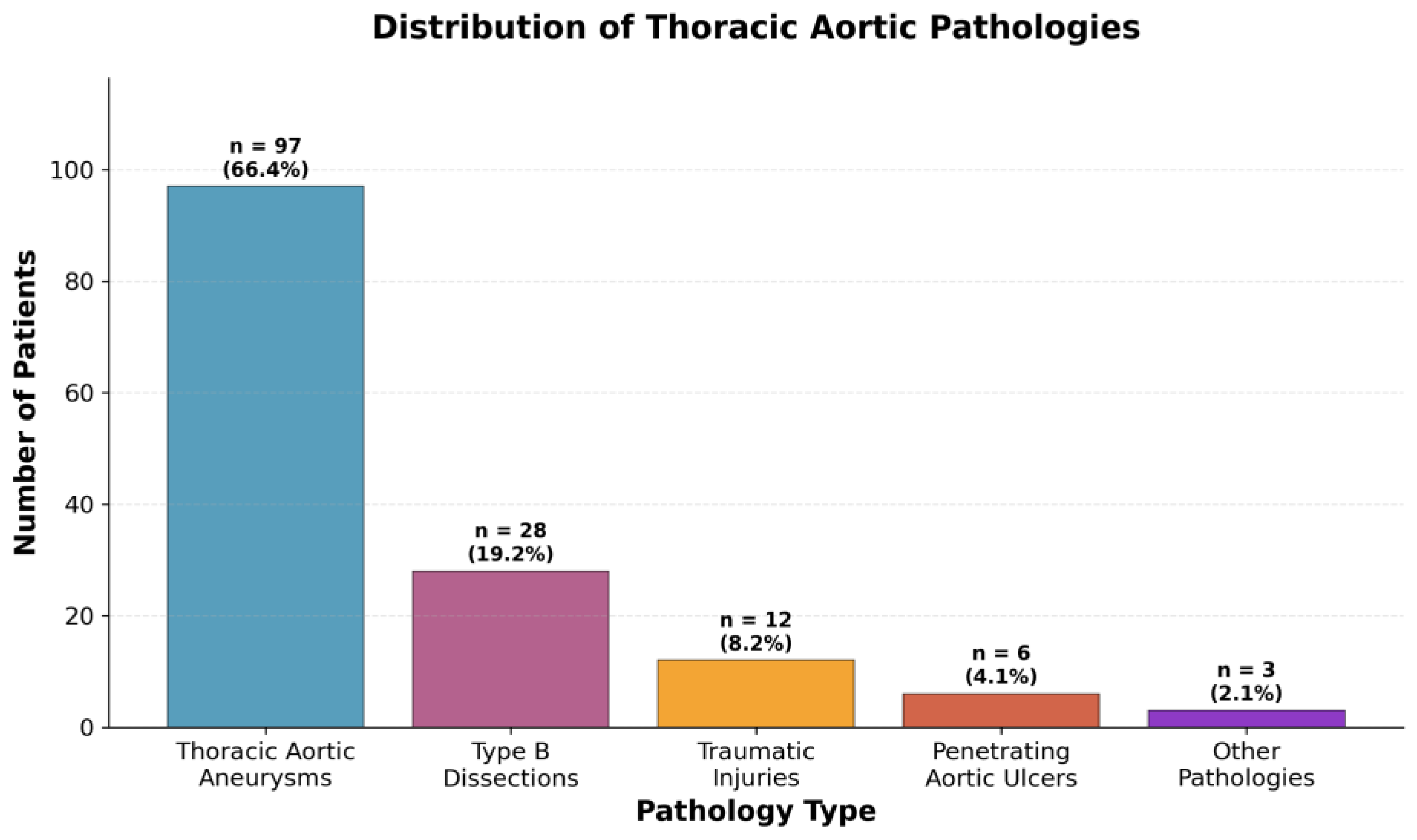
Table 2. The majority of procedures were elective(121 patients, 82.9%) versus urgent (25 patients, 17.2%). Mean lesion length was 24.7±9.8 cm, with longer coverage in dissection cases compared to aneurysms (28.4±11.2 cm vs 23.1±8.9 cm, p=0.02). Proximal zone landing was more common (108 patients,74.0%) than distal zone (38 patients, 26.0%).When examining the pathologies requiring TEVAR, thoracic aortic aneurysms were the most common indication, accounting for 97 patients (66.4%). The remaining pathologies were distributed as follows: type B aortic dissections in 28 patients (19.2%), traumatic aortic injuries in 12 patients (8.2%), penetrating aortic ulcers in 6 patients (4.1%), and other pathologies including mycotic aneurysms and aortic coarctation in 3 patients (2.1%). This distribution reflects the diverse spectrum of thoracic aortic pathologies encountered in contemporary endovascular practice. (
Table 2/
Figure 1).
3.1. Primary Outcomes
SCI occurred in 11 patients (7.5%), with onset within 24 hours in 8 patients (72.7%) and delayed onset (24-72 hours) in 3 patients (27.3%). Complete paraplegia occurred in 4 patients (36.4%), while 7 patients (63.6%) experienced paraparesis. Recovery was observed in 6 patients (54.5%) at 30-day follow-up. Univariate analysis revealed no significant associations between SCI and patient demographics, comorbidities, or procedural variables (
Table 3). Multivariate logistic regression confirmed no independent predictors of SCI in our cohort (all p>0.05).
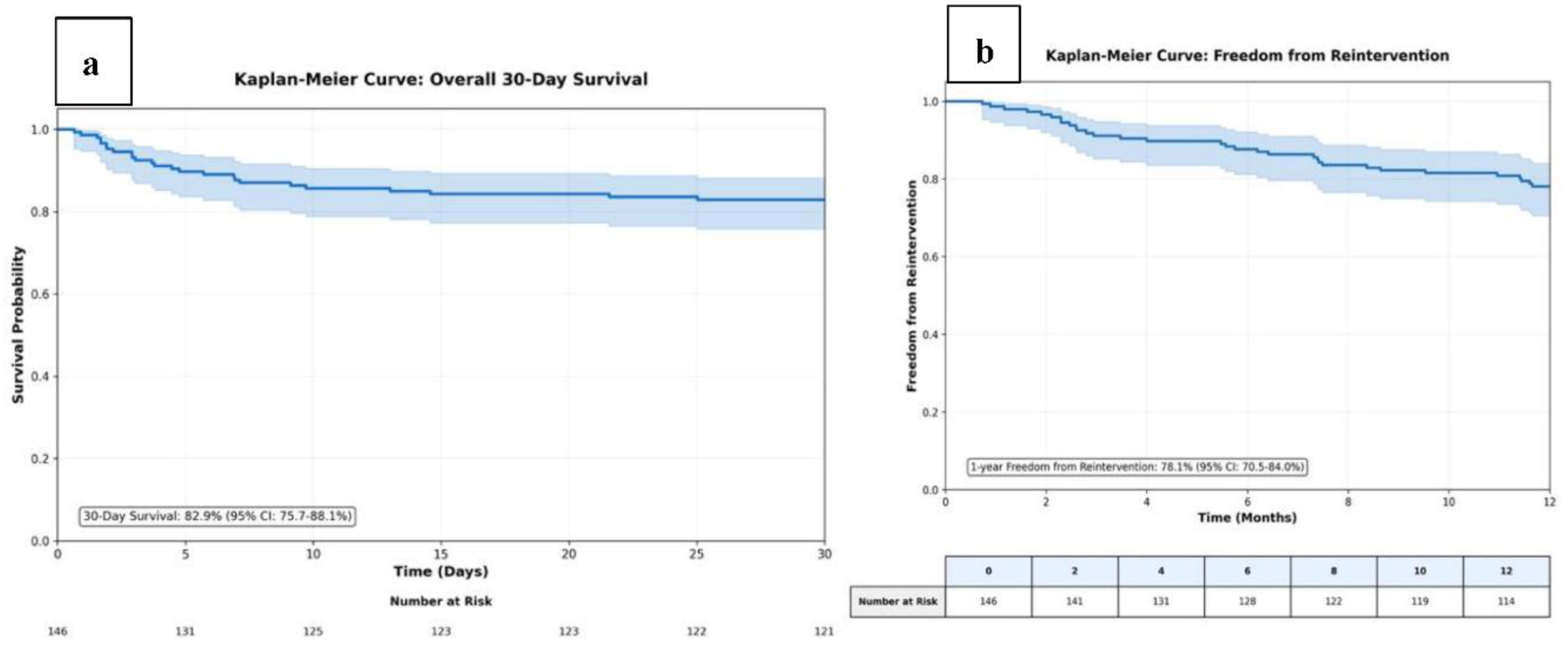
Reintervention within 1 year was required in 38 patients (26.0%). The majority of reinterventions involved additional stent graft placement in 29 patients (76.3%) to address issues such as endoleaks, inadequate seal, or disease progression. Endoleak repair was specifically performed in 8 patients (21.1%) using various endovascular techniques including stent graft optimization and balloon angioplasty. Kaplan-Meier survival analysis was conducted on 146 patients undergoing thoracic endovascular aortic repair (TEVAR). The overall 30-day survival was 82.9% (95% confidence interval [CI]: 75.7-88.1%). At 12-month follow-up, freedom from reintervention was observed in 78.1% of patients (95% CI: 70.5-84.0%), indicating that approximately three-quarters of the cohort did not require secondary interventions during the study period.(
Figure 2)
Multivariate logistic regression analysis identified three independent predictors of reintervention, as detailed in
Table 3. Diabetes mellitus emerged as the strongest predictor with an odds ratio of 3.2 (95% CI: 1.3-7.8, p=0.01), followed by distal zone lesions (OR 2.4, 95% CI: 1.1-5.2, p=0.03) and smoking history (OR 2.1, 95% CI: 1.0-4.4, p=0.05). These findings suggest that patients with diabetes, smoking history, or lesions located in the distal thoracic aorta require enhanced surveillance and potentially modified treatment strategies to minimize reintervention risk.
3.2. Secondary Outcomes
Overall 30-day mortality was 25 patients (17.1%). The leading cause of death was multi-organ failure in 12 patients (48.0%), followed by cardiac complications including myocardial infarction and heart failure in 6 patients (24.0%). Stroke-related mortality occurred in 4 patients (16.0%), while aortic-related complications including rupture and bleeding accounted for 3 deaths (12.0%). The mortality rate was significantly higher in urgent procedures compared to elective cases, reflecting the increased physiological stress and limited optimization time in emergency interventions.
4. Discussion
The management of thoracic vascular diseases has undergone significant advancements over the past few decades. While traditional approaches relied on extensive and invasive surgical procedures, technological progress and an improved understanding of vascular pathologies have shifted the paradigm. Since it was first reported by Dake et al. in 1994, the indications and applications of TEVAR (Thoracic Endovascular Aneurysm Repair) have steadily increased with advancing technology and published experiences. Endovascular repair is widely used in complicated cases such as rupture and dissection, based on several studies comparing it with open surgical repair, highlighting its lower perioperative mortality and morbidity rates [9,10]. This single-center retrospective study of 146 consecutive TEVAR patients provides important insights into early outcomes and risk factors for complications. Our key findings demonstrate that while SCI rates (7.5%) are consistent with published literature, reintervention rates (26.0%) are influenced by specific patient and procedural factors. Notably, diabetes mellitus, smoking history, and distal zone lesions emerged as independent predictors of early reintervention, while urgent procedures carried significantly higher morbidity and mortality risks.
According to the data from non-comparative, single-center, retrospective studies in the literature, there is no definitive information on preventing SCI. However, looking at the incidence rates, we see that SCI occurs in less than 10% of cases after TEVAR and has been reported to occur in 2-15% of cases after open repair [5,13,14]. Reflecting the results of a prospective, single-center 5-year study, the W.L. Gore TAG (W.L. Gore & Associates, Flagstaff, AZ,USA) pivotal trial reported a 2.9% incidence of SCI among 139 patients who had a repair of a descending thoracic aneurysm [14,15]. The Gore TAG trial exclusively enrolled patients with degenerative thoracic aneurysms, whereas our cohort included 19.2% dissection cases and 8.2% traumatic injuries, which may explain the higher SCI rate.
We know that the risk factors for SCI after TEVAR are multifactorial, with previous publications identifying factors such as the length of aortic coverage, prior abdominal aortic surgery, hypotension, iliac artery injury, and coverage of the left subclavian artery [6]. However, in our study, we did not find a significant relationship (p>0.05) between SCI and these variables in our multivariate logistic regression analysis, as seen in
Table 3. This finding may reflect our institutional protocol of prophylactic CSFD in high-risk patients (23.3% of cases), which has been shown to reduce SCI rates by up to 50% in randomized trials [7,16]. The European Society of Vascular Surgery (ESVS) guidelines recommend CSFD for extensive aortic coverage (>200 mm) or high-risk anatomical configurations, which aligns with our institutional practice [23]. Keeping in mind that cerebrospinal fluid drainage can also have procedure-related complications (0-7%), such as headache, subdural hematoma, or suspected meningitis, we believe that inserting CSFD in patients at high risk for spinal cord ischemia could further improve the outcomes of TEVAR.
Another outcome, early reinterventions in the TEVAR group, such as the need for follow-up CTA and additional grafts, can be considered a disadvantage of endovascular treatments due to the associated costs. Some authorities argue that TEVAR does not alter the natural history of the disease, suggesting that it is not superior to open surgery. It is also important to note that longer follow-up periods are needed to clear these concerns [17]. Our 1-year reintervention rate of 26.0% is higher than the 15-17% reported for isolated thoracic aneurysms but consistent with series including complex pathologies. Parsa et al. reported 23% reintervention rates in dissection cases, while Böckler et al. found 32% rates in complicated acute and chronic dissections [18,19]. Given that 19.2% of our cohort had dissection pathology, our overall reintervention rate appears reasonable.
Multivariate analysis identified three independent predictors of reintervention (
Table 3). The identification of diabetes mellitus as the strongest predictor (OR 3.2, p=0.01) is particularly intriguing and somewhat paradoxical. While diabetes has been associated with impaired wound healing and increased cardiovascular complications, recent meta-analyses suggest a protective effect against aortic dissection and aneurysm formation [20,21,22]. However, in the context of endovascular repair, diabetes may predispose to endothelial dysfunction, accelerated atherosclerosis, and impaired endograft integration, potentially explaining the increased reintervention risk. Smoking history emerged as another significant predictor (OR 2.1, p=0.05), which aligns with established knowledge of smoking's detrimental effects on vascular healing, endothelial function, and long-term graft patency. The association between distal zone lesions and reintervention (OR 2.4, p=0.03) may reflect the technical challenges of achieving adequate seal in the more tortuous and smaller-caliber distal thoracic aorta, as well as the higher prevalence of type II endoleaks in this region. This finding requires validation in larger multicenter studies with long follow-up periods to clarify this complex situation related to diabetes.
Isaac et al. reported a 30-day mortality rate of 4.2% in a study of 2141 patients who underwent endovascular repair for thoracic aortic aneurysm in 2022. In addition to this study involving stable aneurysms, Philip et al. reported a perioperative mortality rate of 6.1% for intact aneurysms, compared to a rate of 28% for ruptured cases [11,12]. Considering that our study included not only patients with intact aneurysms but also complicated cases such as ruptured aneurysms and dissection patients, it would not be incorrect to state that our 30-day mortality rate of 17.1% (25 patients) is consistent with the literature data. Our subgroup analysis revealed significantly higher morbidity and mortality in urgent cases, with 30-day mortality of 32.0% versus 13.2% in elective procedures (p=0.02). The higher reintervention rate in urgent cases (40.0% vs 23.1%, p=0.08) likely reflects the compromised anatomy, limited preoperative planning time, and suboptimal landing zones often encountered in emergency situations.
Our stroke rate of 13.7% was higher than the 3–7% typically reported after TEVAR [24]. This likely reflects our institutional practice of left subclavian artery coverage in 36.3% of cases with prophylactic revascularization performed in only 26.0%. Upper-extremity ischemia occurred in 6.8% of patients, exclusively after LSA coverage without revascularization, which is consistent with published series and reinforces guideline recommendations to revascularize patients with dominant left vertebral arteries, patent left internal mammary grafts, or inadequate collateral circulation. In subgroup analyses, urgent procedures exhibited substantially higher early mortality than elective cases (32.0% vs 13.2%), in line with registry experience in acute aortic syndromes [25,26]. Our SCI rate of 7.5% is also comparable to contemporary reports from national datasets evaluating TEVAR-associated spinal cord ischemia [13]. Together, these findings situate our outcomes within real-world expectations while highlighting opportunities to mitigate neurologic events through selective LSA revascularization and standardized perioperative protocols. These findings validate our institutional outcomes within the contemporary TEVAR literature while underscoring the need for larger multicenter studies to establish evidence-based protocols for neurologic complication prevention.
Limitations
One of the major limitations of our study is its retrospective nature and reliance on follow-up results available within the hospital system. Another point is that it presents single-center results from a small patient population of 146 patients. The patient population consisted of a heterogeneous group, including dissection, aneurysm, rupture, coarctation, etc. It should be noted that subgroup analyses are necessary to present the results more objectively. Our results are based on an average of one-year follow-ups, and the inability to present long-term survival analyses is one of the significant limitations. Despite these limitations, our findings offer valuable insights into early TEVAR outcomes in real-world clinical settings.
5. Conclusion
Endovascular techniques, particularly thoracic endovascular aortic repair (TEVAR), have emerged as a preferred approach for aortic repair due to their lower complication rates and reduced perioperative mortality compared to conventional open surgical methods. Despite its advantages, the potential need for conversion to open surgery remains a critical concern, often stemming from the procedural complexities involved. Early intervention with TEVAR offers significant benefits for certain patient groups, and improved clinical outcomes are expected as operator expertise continues to advance. Future multicenter trials are warranted to validate these findings. Additionally, randomized clinical trials involving larger patient cohorts are needed to derive more conclusive evidence and advance clinical practice. Ultimately, healthcare institutions must critically evaluate their procedural expertise and align their practices with achievable standards to maximize the benefits of TEVAR and minimize associated risks.
Author Contributions
Conceptualization: MCS, FA. Formal analysis: FA, MCS. Data curation: FA, AFK, SAB, OB. Writing—original draft: MCS, FA. Writing—review and editing: EÖ, AİH, CB, LY, SE. Project administration: SE, EÖ. Software: FA, MCS. Obtained funding: None. All authors have read and agreed to the published version of the manuscript.
Funding
This research did not receive any specific grant from funding agencies in the public, commercial, or not-for-profit sectors.
Institutional Review Board Statement
This retrospective single-center study was approved by the Institutional Review Board and conducted in accordance with the Declaration of Helsinki. The human research ethics committee details include the date of approval (14 March 2025) and protocol number (2024/720).
Informed Consent Statement
Informed consent was obtained from all subjects involved in this study.
Data Availability Statement
The original contributions presented in this study are included in this article; further inquiries can be directed to the corresponding authors.
Conflicts of Interest
The authors declare no conflicts of interest.
References
- Chen SW, Lee KB, et al. Complications and management of the thoracic endovascular aortic repair. Aorta (Stamford). 2020;8(3):49–58. [CrossRef]
- Badran A, Elghazouli Y, Shirke MM, et al. Elective thoracic aortic aneurysm surgery: A tertiary center experience. Cureus. 2023;15(5):e39102. [CrossRef]
- Sattah AP, Secrist MH, Sarin S. Complications and perioperative management of patients undergoing thoracic endovascular aortic repair. J Intensive Care Med. 2018;33(7):394–406. [CrossRef]
- Grabenwöger M, Alfonso F, Bachet J. Thoracic endovascular aortic repair (TEVAR) for the treatment of aortic diseases: A position statement from the European Association for Cardio-Thoracic Surgery (EACTS) and the European Society of Cardiology (ESC), in collaboration with the European Association of Percutaneous Cardiovascular Interventions (EAPCI). Eur Heart J. 2012;33(13):1558–1563. [CrossRef]
- Sugiura J, Oshima H, et al. The efficacy and risk of cerebrospinal fluid drainage for thoracoabdominal aortic aneurysm repair: A retrospective observational comparison between drainage and non-drainage. Interact Cardiovasc Thorac Surg. 2017;24:609–614. [CrossRef]
- Feezor RJ, Martin T, et al. Extent of aortic coverage and incidence of spinal cord ischemia after thoracic endovascular aneurysm repair. Ann Thorac Surg. 2008;86(5):1535–1540. [CrossRef]
- Riambau V, Capoccia L, et al. Spinal cord protection and related complications in endovascular management of B dissection: LSA revascularization and CSF drainage. Ann Cardiothorac Surg. 2014;3(3):336–338. [CrossRef]
- Geisbüsch P, Hoffmann S, et al. Reinterventions during midterm follow-up after endovascular treatment of thoracic aortic disease. J Vasc Surg. 2011;53(6):1528–1535. [CrossRef]
- Cheng L. Reintervention after thoracic endovascular aortic repair of uncomplicated type B aortic dissection. J Clin Med. 2023;12(4):1418. [CrossRef]
- Faure EM, Canaud L, Agostini C, et al. Reintervention after thoracic endovascular aortic repair of complicated aortic dissection. J Vasc Surg. 2014;59:327–333. [CrossRef]
- Goodney PP, et al. Survival after open versus endovascular thoracic aortic aneurysm repair in an observational study of the Medicare population. Circulation. 2011;124(24):2761–2769. [CrossRef]
- Naazie IN, et al. Risk calculator predicts 30-day mortality after thoracic endovascular aortic repair for intact descending thoracic aortic aneurysms in the Vascular Quality Initiative. Clin Res Thorac Aneurysm. 2022;75(3):833–841.e1. [CrossRef]
- Scali ST, et al. National incidence, mortality outcomes, and predictors of spinal cord ischemia after thoracic endovascular aortic repair. J Vasc Surg. 2020;72(1):152–160. [CrossRef]
- Bavaria JE, Appoo JJ, Makaroun MS, et al. Endovascular stent grafting versus open surgical repair of descending thoracic aortic aneurysms in low-risk patients: A multicenter comparative trial. J Thorac Cardiovasc Surg. 2007;133:369–377. [CrossRef]
- Farber MA, et al. Five-year outcomes with conformable GORE TAG endoprosthesis used in traumatic aortic transections. Ann Thorac Surg. 2022;113(5):1536–1542. [CrossRef]
- Coselli JS, LeMaire SA, et al. Cerebrospinal fluid drainage reduces paraplegia after thoracoabdominal aortic aneurysm repair: Results of a randomized clinical trial. J Vasc Surg. 2002;35(4):631–639. [CrossRef]
- Son SA, Jung H, et al. Long-term outcomes of intervention between open repair and endovascular aortic repair for descending aortic pathologies: A propensity-matched analysis. BMC Surg. 2020;20:266. [CrossRef]
- Parsa CJ, Schroder JN, Daneshmand MA, et al. Midterm results for endovascular repair of complicated acute and chronic type B aortic dissection. Ann Thorac Surg. 2010;89:97–102. [CrossRef]
- Böckler D, Schumacher H, Ganten M. Complications after endovascular repair of acute symptomatic and chronic expanding Stanford type B aortic dissections. J Thorac Cardiovasc Surg. 2006;132:361–368. [CrossRef]
- Zhang L, Zhao Z, et al. Reintervention after endovascular repair for aortic dissection: A systematic review and meta-analysis. J Thorac Cardiovasc Surg. 2016;152(5):1279–1288.e3. [CrossRef]
- Takagi H, Umemoto T, ALICE (All-Literature Investigation of Cardiovascular Evidence) Group. Negative association of diabetes with thoracic aortic dissection and aneurysm. Angiology. 2016;67(3):229–236. [CrossRef]
- Theivacumar NS, Stephenson MA, Mistry H, et al. Diabetics are less likely to develop thoracic aortic dissection: A 10-year single-center analysis. Ann Vasc Surg. 2014;28:427–432. [CrossRef]
- Riambau V, Böckler D, Brunkwall J, et al. Editor's Choice - Management of Descending Thoracic Aorta Diseases: Clinical Practice Guidelines of the European Society for Vascular Surgery (ESVS). Eur J Vasc Endovasc Surg. 2017;53(1):4–52. [CrossRef]
- Rizvi AZ, Murad MH, Fairman RM, et al. The effect of left subclavian artery coverage on morbidity and mortality in patients undergoing endovascular thoracic aortic interventions: A systematic review and meta-analysis. J Vasc Surg. 2009;50(5):1159–1169. [CrossRef]
- Matsumura JS, Lee WA, Mitchell RS, et al. The Society for Vascular Surgery Practice Guidelines: Management of the left subclavian artery with thoracic endovascular aortic repair. J Vasc Surg. 2009;50(5):1155–1158. [CrossRef]
- Evangelista A, Isselbacher EM, Bossone E, et al. Insights from the International Registry of Acute Aortic Dissection: A 20-year experience of collaborative clinical research. Circulation. 2018;137(17):1846–1860. [CrossRef]
|
Disclaimer/Publisher’s Note: The statements, opinions and data contained in all publications are solely those of the individual author(s) and contributor(s) and not of MDPI and/or the editor(s). MDPI and/or the editor(s) disclaim responsibility for any injury to people or property resulting from any ideas, methods, instructions or products referred to in the content. |
© 2025 by the authors. Licensee MDPI, Basel, Switzerland. This article is an open access article distributed under the terms and conditions of the Creative Commons Attribution (CC BY) license (http://creativecommons.org/licenses/by/4.0/).