

Submitted:
11 August 2025
Posted:
12 August 2025
You are already at the latest version
Abstract
The paper investigates the design and operation of microgrid arrangements, with a focus on renewable power systems, system architectures, and storage solutions. The research evaluates stochastic and multi-objective optimization methods to show how demand response systems improve operational flexibility. The study evaluates 200 journal articles to select those that address microgrid design in conjunction with optimization models and demand response approaches. The articles are classified into three essential categories, which include microgrid design optimization methods and demand response integration. The review establishes that microgrid performance depends on three fundamental design parameters, which include energy generation systems, storage capabilities, and load demand control mechanisms. The review demonstrates that advanced optimization approaches, such as stochastic and multi-objective optimization methods, offer effective solutions for managing renewable energy variability. The paper demonstrates that demand response strategies are crucial for reducing costs and enhancing system flexibility. However, current published research falls short of establishing an integrated system that combines real-time demand response with stochastic optimization. This integration, while not yet fully realized, is suggested as a critical advancement for ensuring both system performance optimization and long-term sustainability. Therefore, this paper calls for further research to develop resilient hybrid renewable microgrids that integrate flexibility with sustainability through advanced optimization models and demand response strategies.
Keywords:
demand response
; energy storage systems
; hybrid renewable microgrids
; load demand management
; multi-ojective optimization
; real-time optimization
; renewable energy integration
; stochastic optimization
; system flexibility
1. Introduction
1.1. Overview of Hybrid Renewable Microgrids
Hybrid renewable microgrids (HRMGs) are widely adopted sustainable energy solutions that benefit both urban and remote areas [1]. Combining solar and wind renewable energy sources with battery storage systems may create dependable, flexible power networks. Implementing HRMGs reduces national dependence on fossil fuels and lowers greenhouse gas emissions. The energy security benefits of HRMGs become most apparent in communities that centralized power grids have traditionally neglected. The integration of renewable energy resources enables HRMGs to develop a cleaner, decentralized power grid system. The power systems function autonomously but can also connect to the primary grid, adjusting their energy consumption patterns accordingly. These systems provide customized energy solutions tailored to meet the specific needs of individual communities. A small village would rely on solar panels and wind turbines, using storage capacity. Industrial areas achieve maximum energy optimization by integrating solar and wind power with battery storage systems, thereby reducing operational expenses. The ability to adapt to fluctuations in energy demand and supply makes HRMGs extremely useful. Optimizing hybrid systems presents a significant technical challenge. The system requires optimal optimization to maintain its cost-effectiveness alongside reliability and environmental sustainability. Hybrid systems comprise multiple energy sources, along with storage and backup components, creating complex operational systems. The seamless integration of all components requires optimization of cost, together with emissions and reliability [2,3,4].
1.2. Importance of Optimizing Hybrid Systems for Cost, Emissions, and Reliability
The optimization of HRMGs requires. The expense represents a significant point of consideration. The initial costs of implementing renewable energy technologies and deploying energy storage systems remain high. Still, they may lead to substantial long-term financial benefits depending on maintenance costs and lifetime. Operators must manage operations and maintenance costs to maintain operational efficiency. The design of HRMGs has the objective of heavy emission reduction as a fundamental element. The systems reduce carbon emissions by minimizing the use of backup generator operations that rely on fossil fuels. The importance of this factor increases as the global community works to fulfill climate objectives by transitioning away from fossil fuels. Reliability stands as the most vital element among all factors. The power delivery from HRMGs must remain continuous without interruptions, even as renewable energy production levels decline. The general architecture of a hybrid renewable microgrid is described in Figure 1.
The reliability of solar and wind energy remains a significant concern due to their variable power output, which fluctuates based on changing weather conditions. The power supply from these sources does not provide a reliable, continuous electricity stream. The implementation of hybrid systems represents a potential solution to this problem. The storage of excess energy in batteries during periods of high production enables its later use during periods of increased demand or reduced production [3,5]. The energy storage system functions similarly to saving money for future needs but operates within an energy framework. Diesel generators function as backup systems to ensure grid reliability during periods when renewable energy production decreases [6]. Optimization methods help mitigate the uncertainties associated with renewable energy systems. Stochastic optimization techniques help manage this uncertainty by incorporating probabilistic models that account for fluctuations in renewable energy generation, such as changes in wind speed or solar radiation. We refer to situations where weather patterns are erratic, and customer demand fluctuates. Planning such challenges is not easy, but stochastic optimization makes it more manageable. Moreover, multi-objective optimization is also essential, as it aims to reduce costs, minimize emissions, and enhance system reliability. With these approaches, hybrid systems are better equipped to handle the unpredictability of renewable energy and the evolving needs of energy consumers [7].
1.3. Introduction to Demand Response and Its Role in Enhancing System Flexibility
The implementation of demand response (DR) technology serves as a fundamental element to improve both flexibility and operational efficiency of HRMGs [8]. The system enables users to modify their power consumption according to supply availability, which becomes vital during periods of high demand. The main difficulty for hybrid microgrids stems from renewable energy source variability because weather conditions determine whether solar and wind power generation exceeds or falls short of requirements [9]. DR strategies function to synchronize microgrid energy requirements with the availability of renewable energy. The implementation of this strategy reduces the need for backup power systems, representing a significant benefit. Two DR strategies exist for consideration, which include time-of-use tariffs that raise prices during peak demand periods and real-time pricing that adjusts according to supply and demand fluctuations. [10]. The concept appears straightforward, yet additional adjustments remain necessary. The DR and its role in enhancing grid flexibility are described in Figure 2.
The implemented strategies provide economic benefits to consumers, motivating them to adjust their power consumption patterns to align with periods of abundant renewable energy production. According Avordeh, Gyamfi [11,12], the system reliability improves while fossil fuel dependence decreases. DR controls energy consumption patterns by shifting appliance operations to daytime usage during periods of high solar production, thereby preventing overload of storage and backup systems. DR implements demand reduction or time-shifting of consumer usage during low solar or wind power output to maintain energy stability while avoiding backup generation costs [13].
1.4. Structure of the Paper
The paper is organized as follows:
Section 2: Methodology
The section describes the systematic literature review approach that guided this research. The authors describe their database search methods and article selection process, which yielded 200 journal articles for synthesis. The research faced difficulties when trying to limit sources to match the study parameters, but the methodology provided a thorough understanding of the topic through relevant and diverse literature.
Section 3: Hybrid Renewable Microgrid Architectures
This section reviews different hybrid microgrid configurations, their components, integration challenges, and benefits. It focuses on the main architectural designs, which describe the typical energy sources and storage systems found in HRMGs. The different configurations demonstrate varying levels of operational success, but each design requires analysis to understand its real-world implementation challenges.
Section 4: Key Design Parameters in Hybrid Microgrids
The section focuses on vital parameters that enhance hybrid microgrid systems through improved energy generation and storage, load demand management, and enhanced reliability methods for forecasting energy requirements and addressing the unpredictable nature of renewable energy resources.
Section 5: Optimization Techniques in Hybrid Microgrids
The section examines sophisticated optimization methods, which include multi-objective, stochastic, and evolutionary algorithms. The analysis examines current model restrictions while demonstrating how integrating them with demand response systems would enhance operational efficiency and flexibility. The real-world implementation of these methods presents a distinct challenge compared to their theoretical potential.
Section 6: Demand Response Integration in Hybrid Microgrids
This section covers DR systems and their influence in enhancing the flexibility and efficiency of HRMGs.
Section 7: Research Gaps and Future Directions
The section presents various research gaps and future directions that concentrate on integrating stochastic optimization with real-time demand response systems. While some progress has been made, these areas still require further exploration and present opportunities for advancing hybrid microgrids. Bridging these gaps could significantly enhance system performance.
Section 8: Conclusion
The final section summarizes our findings and offers recommendations for future research. We suggest areas where further optimization, emissions reduction, and improvements in reliability and flexibility are necessary for the continued development of HRMGs. As the demand for sustainable energy solutions grows, these research areas will play a crucial role in shaping the future of the hybrid microgrid. We also emphasize the importance of performance indexes for HRMGs. These indices: system efficiency, reliability, economic costs, and environmental impact, are critical for assessing and enhancing the overall performance of HRMGs.
2. Methodology
2.1. Literature Search Process
The literature search involved multiple academic databases, including Google Scholar, IEEE Xplore, ScienceDirect, and SpringerLink. We selected these databases for their extensive collections of peer-reviewed articles on energy systems, microgrids, optimization, and demand response. We aimed to collect the most recent and relevant studies on HRMGs, with a specific focus on system architectures, optimization techniques, and demand response mechanisms. We used a combination of targeted search terms and Boolean operators to ensure comprehensive coverage. Keywords such as “hybrid renewable microgrids,” “demand response,” “optimization techniques,” “multi-objective optimization,” and “stochastic optimization” helped refine the search results. We connected different aspects of HRMGs using operators like "AND," such as “hybrid renewable microgrids AND optimization” or “demand response AND renewable energy integration.” Our search focused on articles from 2013 to 2025 to include the most recent developments in hybrid microgrid technology and optimization methods, as well as to address new trends in demand response integration. We searched and then reviewed the titles and abstracts of more than 200 articles. We only included those that focused explicitly on hybrid renewable microgrids, optimization strategies, and demand response. We excluded articles that were primarily focused on traditional energy systems or standalone renewable technologies unless they contributed significantly to understanding HRMGs or optimization strategies.
2.2. Article Selection Criteria
The main inclusion criteria were as follows:
Publication Quality
Our analysis included only articles from reputable, peer-reviewed journals and conference proceedings. We selected Applied Energy, Renewable & Sustainable Energy Reviews, IEEE Transactions on Smart Grid, and Energy as our primary journals because they have the highest impact on energy systems and microgrids.
Relevance to Hybrid Renewable Microgrids
Our selection of articles focused on hybrid renewable microgrid systems. Our research focused on investigating various combinations of renewable energy sources, including solar power, wind power, storage systems, and backup power systems. The selection included studies on microgrid operations in isolated or off-grid settings, which focused on integrating renewable resources [4,14,15].
Focus on Optimization Techniques
The review focuses on optimization as its central theme, so we selected articles that analyzed optimization models for hybrid microgrids. The studies by Dawoud, Lin [16] examined multi-objective optimization, stochastic optimization, and genetic algorithms to manage trade-offs between cost emissions, and reliability.
Demand Response Integration
The research examined articles on demand response systems in HRMGs, focusing on time-of-use tariffs, real-time pricing, and load shifting. These strategies are essential for enhancing flexibility and matching energy consumption with renewable energy availability.
Methodology Transparency
We concentrated on articles that provided detailed descriptions of their research methods. The studies that employed well-defined models, along with algorithms and simulation tools, for microgrid design were most notable. To the best of the authors' knowledge, the methodologies concerned are believed to be effective, combining optimization techniques with demand response integration.
2.3. Data Synthesis and Categorization
The articles are divided into three main themes: Hybrid microgrid design, Optimization techniques, and Demand response integration (see Figure 3).
Hybrid Microgrid Design and Architecture
The theme explores fundamental aspects of hybrid renewable microgrids by examining how renewable energy systems interact with storage and backup power systems. The articles in this category examine how these components interact to form efficient and reliable systems.
Optimization Techniques in Hybrid Microgrids
The theme explores optimization techniques for HRMGs through multi-objective and stochastic optimization methods. The articles present methods to reduce costs and emissions while maintaining system reliability, particularly in the face of unpredictable renewable energy sources and changing demand patterns. The field has advanced, but researchers encounter significant obstacles when dealing with unpredictable weather patterns and unexpected demand surges.
Demand Response Integration
The theme investigates how demand response integration improves the flexibility of HRMG systems. The articles demonstrate that time-of-use tariffs, real-time pricing, and direct load control strategies effectively boost both efficiency and reliability. Different systems have varying approaches to demand response integration, which remains a topic of expert discussion. The following section presents the primary findings from each theme, together with their assessment for hybrid renewable microgrid design and optimization. The areas show significant advancement, yet researchers need to continue their work to develop these fields fully.
By leveraging both AC and DC, hybrid microgrid configurations reduce conversion losses and enhance power flow management, thereby increasing the overall system's efficiency [17,18]. Effective control strategies are crucial for maintaining operational stability in HRMGs. Distributed, decentralized, and hierarchical control structures have emerged to regulate voltage, stabilize frequency, and ensure optimal power sharing among various distributed energy resources (DERs) [19,20,21,22]. It is interesting how these systems are evolving, and while some solutions seem to work well, there is always room for improvement, especially in real-world, large-scale implementations. Recent works propose approaches that reduce dependence on centralized communication systems, enhancing resilience against faults and cyberattacks [23].
The design and operation of hybrid microgrids also necessitate advanced energy management systems (EMS) to coordinate energy flows dynamically between generation, storage, and load demands [24]. Optimal EMS design considers technical, economic, and environmental objectives while balancing local autonomy with grid-support functions [25].
Although HRMG technologies demonstrate significant potential, several technical and non-technical challenges remain. Large-scale deployment demands scalable architectures, fault-tolerant communication protocols, efficient integration of variable renewable sources, and compliance with diverse regulatory frameworks [26]. Economic feasibility also influences adoption rates, particularly in developing regions where upfront investment costs remain prohibitive.
This section reviews the operational components, configurations, and control strategies of hybrid renewable microgrids, based on a critical analysis of recent literature. The paper focuses on design aspects for combining solar, wind, energy storage, and backup systems, emphasizing technological developments and current limitations.
2.4. Configurations and Operational Components
The HRMG architectures combine various energy sources to boost reliability, efficiency, and flexibility. The selection and combination of these components depend on resource availability, load profiles, and operational goals. The typical HRMGs include photovoltaic (PV) systems, wind energy conversion systems (WECS), energy storage systems (ESS), and backup generation units. The system's performance depends on the characteristics, advantages, and challenges of each subsystem.
2.4.1. Solar Energy Systems
Solar PV systems are a primary energy source in most HRMG configurations. Their modular design, decreasing costs, and low environmental impact make them appealing for distributed generation [27]. PV panels convert sunlight directly into electricity, which sounds simple, but it is not without challenges. These systems rely on maximum power point tracking (MPPT) algorithms to optimize energy capture, especially as irradiance and temperature fluctuate. It is a process that works well in theory, but it requires constant adjustment to adapt to changing conditions.
Integrating PV systems into microgrids necessitates careful consideration of voltage regulation and synchronization with other energy sources. In DC-based microgrids, we can connect PV modules directly to the distribution bus with the appropriate DC/DC converters, which minimizes energy losses [28]. However, PV inverters must synchronize with the microgrid’s voltage and frequency in AC-based or hybrid systems. This synchronization demands robust grid-forming or grid-following controls to ensure smooth operation [29]. The PV output becomes unpredictable due to cloud shading and daily variations in the sun cycle. The system maintains power equilibrium through three alternative methods, which include dynamic dispatch control, load management, and energy storage. Although imperfect, forecasting techniques enable smooth microgrid operations [30].
2.4.2. Wind Energy Systems
The power generation of Wind energy conversion systems (WECS) depends on wind resources, which experience different patterns. The systems achieve their highest output levels during nighttime and specific seasonal periods when solar power generation reaches its minimum. Wind turbines operate in two modes, which include fixed-speed and variable-speed operation, to maximize energy capture and improve power grid support [31]. The integration of WECS into HRMGs needs detailed evaluations of power electronics interfaces. The system utilizes either doubly fed induction generators (DFIGs) or permanent magnet synchronous generators (PMSGs), which are connected through AC or DC buses, depending on the system's specific requirements. [32].
The DC-link coupling in hybrid AC/DC systems enables adaptable power transfer and smoother control operations, particularly when wind conditions fluctuate. The variable nature of wind generation presents similar operational challenges to solar power systems due to its unpredictable nature. The operational challenges are typically solved by predictive control systems and storage solutions, which maintain voltage and frequency stability. Zhang, Shotorbani [33] created hierarchical control systems that effectively stabilize voltage and control dynamic loads when wind speed variations occur.
2.4.3. Energy Storage Systems
The operation of HRMGs depends on ESS because these systems maintain surplus power generated during peak production hours for use during periods of limited resources. Lithium-ion battery technology is the best choice for microgrid storage applications due to its high energy density and rapid response times, with prices continuing to decrease [34,35]. The energy storage systems in HRMGs serve four essential roles, including frequency regulation, voltage support, peak shaving, and grid-forming services for islanded operation. The integration methods differ based on whether the ESS connects to AC or DC buses. The DC-coupled storage system provides more effortless energy transfer from PV or WECS sources by minimizing conversion steps. However, the AC-coupled storage offers better compatibility with traditional power grids [36].
The EMS operates these operations by analyzing state-of-charge (SOC) levels and degradation models together with real-time load predictions [37]. The research community works to create hybrid storage systems that combine batteries with supercapacitors and flywheels to enhance system flexibility and extend lifespan [38]. Combining different storage systems enables solutions for immediate transient power needs and extended energy supply requirements.
2.4.4. Backup Systems
The reliability of HRMG depends on backup systems because renewable and storage technologies have not yet rendered them obsolete. To support critical loads during prolonged renewable generation shortfalls, dispatchable backup sources like diesel generators, microturbines, and fuel cells are commonly used [39].
The implementation of backup generation systems in HRMGs faces obstacles related to synchronization, fuel consumption optimization, and emission control. The implementation of Bidirectional interlinking converters (BICs) resolves these problems because they enable seamless integration of backup AC units with hybrid systems. The system allows for fast mode transitions, which prevent power interruptions according to [40]. The primary objective of optimal dispatch algorithms is to reduce backup generator usage while maintaining sufficient fuel reserves and minimizing operational expenses. Through predictive scheduling and dynamic programming, it becomes possible to schedule backup activation according to renewable energy forecasts and load criticality assessments [41,42]. The implementation of advanced HRMG designs includes combined heat and power (CHP) units, which enhance efficiency by utilizing the waste heat from backup generators. [43]. The ongoing conflict between environmental protection and energy security remains a significant challenge for microgrids that primarily rely on diesel.
2.5. Design Considerations for Hybrid Renewable Microgrids
The design of HRMGs should consider scalability, control strategies, system topology, and economic feasibility. These factors play a crucial role in ensuring the system remains stable, integrates various resources, and delivers reliable, cost-effective energy across diverse situations.
2.5.1. Scalability and Modularity
The design of HRMGs requires scalability as one of its fundamental requirements. The system architecture needs to accommodate the growth of generation units, storage devices, and loads without needing major reengineering, according to Thang, Ahmed [44]. Microgrids achieve scalability through modular designs that use standardized unit capacities and decentralized management systems, which enable growth according to demand and technological advancements. The implementation of plug-and-play interfaces between distributed energy resources (DERs) is a crucial element, as it enhances modularity and simplifies upgrade processes [45,46]. The expansion of microgrids leads to more intricate network systems. The rising system complexity demands sophisticated communication systems and fault management capabilities to manage the increasing complexity of systems. System integrity throughout all growth phases depends on an adaptable communication infrastructure together with protective measures as these systems expand [47,48].
2.5.2. Control Strategies
The control frameworks of HRMGs maintain voltage stability and frequency stability by distributing power across DERs. The control systems consist of three hierarchical layers, which include primary control, secondary control, and tertiary control [49,50,51,52]. The primary control layer provides immediate stability through virtual inertia emulation, which operates independently of communication systems. The secondary control system operates to restore voltage and frequency by adjusting setpoints, working in coordination with other control systems. Distributed secondary controls that utilize consensus algorithms enhance system resilience by minimizing dependence on central communication links, which are sometimes vulnerable to vulnerabilities [37]. The tertiary control system operates at a broader level to optimize economic dispatch and primary grid interactions. The control layers require proper time-scale separation because fast-acting dynamics must stabilize before economic optimizations with slower speeds are activated [53]. The protection of these communication-based systems from attacks requires strong cybersecurity measures.
2.5.3. Interconnection Topologies
The selection of interconnection topology in HRMGs remains crucial because it significantly impacts system performance outcomes. The authors Shen, Tan [54] explain that hybrid AC/DC systems unite AC and DC networks through dual buses, which use bidirectional interlinking converters. The AC buses serve as excellent connections for traditional loads and rotating machines, while DC buses offer an efficient power supply to PV arrays, batteries, and DC loads.
Researchers have studied three different architectural configurations, including radial, ring, and mesh designs, which present unique trade-offs between reliability, cost, and system complexity, according to [55]. The ring and mesh topologies enhance fault tolerance by providing backup power routes. The implementation of multiple power flow paths in these systems demands sophisticated protection systems, which increases system complexity. The addition of multiple voltage levels to DC buses appears beneficial for system optimization, yet introduces additional converters and complex system requirements [56]. The process of topology design requires a balance between system performance, simplicity, and cost management.
2.5.4. Economic Feasibility
Despite technological progress, the economic feasibility of HRMGs is still the key factor for widespread adoption. The initial capital costs for renewable generation, energy storage, and advanced controls are typically substantial. Total cost analysis should include equipment replacement periods, maintenance needs, and backup system fuel expenses. Energy management systems (EMS) enhance economic viability through optimized dispatch decisions, which reduce operational costs while extending asset lifetimes [57]. The implementation of demand-side management strategies enables peak load reduction, resulting in improved asset utilization rates. The attractiveness of HRMG deployments increases with the implementation of regulatory incentives, carbon pricing mechanisms, and community ownership models, especially in underserved or off-grid regions [58,59]. However, the uncertainty surrounding policy frameworks and market structures remains a significant obstacle to substantial investment in hybrid microgrids.
2.6. Critical Review of Hybrid Renewable Microgrid Literature
The advancement of HRMGs has led to multiple control architectures, operational strategies, and design frameworks. Research studies demonstrate significant progress alongside ongoing difficulties in creating scalable, resilient, and economically viable systems. Distributed control strategies have become more popular than traditional centralized management systems. Araujo, Callegari [29,60,61] developed a distributed grid-forming control system that removed the requirement for central converter management while providing seamless transitions between grid-connected and islanded operations. The hardware validation showed better scalability and reliability, but the economic feasibility study and DER constraints needed further development. Qin, Li [62] created distributed cooperative control for DC microgrid clusters through multiport converter implementation. The research experiments demonstrated better energy sharing performance, but the method needs further evaluation to assess its potential for large-scale implementation. The economic and energy management aspects of interconnected microgrids have been extensively studied by researchers. Micallef, Guerrero [63] proposed a comprehensive optimal energy control framework that integrated multiport energy routers and demand response programs. Although their simulations demonstrated reduced peak demands and enhanced reliability, the authors acknowledged that broader market integration and regulatory challenges remained insufficiently addressed.
Control strategies focusing on adaptive load management have been another research focus. Yuan, Fu [64] introduced a hierarchical control structure with adaptive droop methods for DC microgrids, thereby improving dynamic load sharing and bus voltage regulation. However, practical challenges related to communication delays and fault tolerance require further investigation for real-world applications.
Several studies have offered guidelines for the practical implementation of microgrids. Cagnano, De Tuglie [65] presented an extensive overview of microgrid operational features based on real-world projects. Although the paper outlined key design considerations, it lacked detailed discussions of economic and regulatory barriers, which remain crucial to the proliferation of microgrids.
Regarding stability and dynamic control, Moheb, El-Hay [66] conducted a comprehensive review emphasizing hierarchical control systems and fault ride-through capabilities. Their findings highlighted the complexity associated with hybrid AC/DC architectures, particularly during mode transitions, but called for more empirical validation through large-scale case studies.
Efforts to optimize hybrid interconnections have focused extensively on bidirectional interlinking converters (BICs). Azeem, Ali [67,68,69] reviewed control strategies for BICs within hybrid AC/DC microgrids, discussing power-sharing challenges, operational flexibility, and system coordination. Although BIC control methods offer numerous advantages, they introduce control complexity at scale, a concern yet to be fully resolved in practice.
Decentralized approaches emphasizing modularity and plug-and-play capabilities have also advanced. Muralidhar and Rajasekar [70] proposed a decentralized DC microgrid with a fully modular architecture tailored for rural electrification applications. Their design-enhanced system scalability and eliminated reliance on centralized controllers. However, long-term fault tolerance and system robustness, especially under harsh environmental conditions, remain open research topics.
Analysis of different microgrid topologies has revealed trade-offs between simplicity and performance. Dos Santos Neto, Barros [71] compared multiple DC microgrid configurations, providing guidelines for voltage level selection and power flow management. Nevertheless, practical case studies evaluating multi-voltage DC microgrids under field conditions are still scarce.
Kim, So [72] developed a common microgrid platform supporting interoperability across diverse communication standards. Although their platform demonstrated improved communication integration, its scalability in heterogeneous regulatory environments needs broader validation.
Other studies have focused on renewable-based microgrids for rural or isolated settings. Tank and Mali [27] proposed a renewable DC microgrid incorporating basic energy management strategies. While their system achieved stability in simulations, it failed to account for lifecycle costs and integration challenges with grid-based networks. Additional distributed control solutions have reinforced the need for scalable architectures. Shaban, Mosa [73] highlighted energy storage sharing across DC microgrid clusters, enhancing fault tolerance and retrofitting options. However, the authors identified that practical deployment at a large scale requires additional communication and operational optimization.
Advances in consensus-based control strategies aim to improve plug-and-play features. Espina, Llanos [37] proposed a distributed secondary control that avoided circulating currents while supporting scalable energy sharing. Their experimental validations were promising, though real-world applications must address communication latency and cybersecurity threats. Hybrid energy storage strategies have also emerged as critical components of HRMGs. Biglarahmadi, Ketabi [57] introduced nonlinear hierarchical control methods, outperforming conventional systems in simulations. Nonetheless, their applicability to large and diverse hybrid systems remains to be demonstrated through pilot projects. The development of HRMGs has advanced through various architectures, control methods, and operational strategies. A critical review of recent literature highlights technical progress and identifies persisting challenges related to scalability, economic viability, and system resilience.
Distributed control strategies have been widely explored to improve HRMG flexibility and robustness. Araujo, Callegari [29] presented a distributed grid-forming control that removed the need for centralized converters, offering improved scalability and smooth transitions. However, the study lacked evaluation of large-scale deployment and economic impacts. Similarly, Meng, Shafiee [74,75] introduced distributed cooperative control for DC microgrid clusters using multiport converters, validated through hardware-in-the-loop experiments, though large-scale scalability issues remained unaddressed. Optimal energy control frameworks have focused on enhancing efficiency and grid support. Micallef, Guerrero [63] proposed a comprehensive approach incorporating demand response and multiport energy routers. While effective in simulations, the economic feasibility and integration into real-world market structures require further investigation. Hierarchical control structures have addressed dynamic load sharing and voltage regulation challenges. Mohammadi and Ajaei [76] developed an adaptive droop control mechanism to stabilize DC microgrids. Although simulations yielded positive results, the authors acknowledged potential issues related to communication delays and fault tolerance in practical deployments.
Systematic overviews have provided practical guidelines for microgrid implementation. Cagnano, De Tuglie [65] analyzed operational experiences from real-world projects, emphasizing control strategies and design practices. Nevertheless, the absence of detailed discussions on economic and regulatory frameworks limited their practical applicability across diverse contexts. Research on stability and fault management has highlighted the complexities of hybrid systems. Ahmed, Sarwar, Kirli [69] identified critical challenges in AC/DC hybrid microgrids, particularly during transition events. Theoretical models demonstrated promising results, but validation through empirical field tests remains necessary. Efforts to enhance interconnection flexibility have emphasized bidirectional interlinking converters. Kumar [77] reviewed control strategies for BICs, focusing on operational flexibility and power-sharing accuracy. While BICs improved hybrid system performance, managing control complexity at scale remains an unresolved challenge.
Decentralized and modular approaches have gained traction to support system scalability. Richard, Boudinet [78] proposed a decentralized plug-and-play DC microgrid model for rural electrification, improving flexibility and resilience. However, issues related to long-term system reliability and fault isolation in harsh environments need further exploration. Topology studies have compared different network designs. Modu, Abdullah [79] reviewed DC microgrid topologies and recommended configurations based on system voltage and load characteristics. Despite their theoretical advantages, practical field evaluations of multi-voltage DC networks remain limited. Microgrid interoperability platforms have also been developed. Kim, So [72], designed a common platform for seamless operation across different communication standards. While facilitating interoperability, questions remain regarding practical implementation across varied regulatory frameworks. Rural and isolated microgrids have garnered attention for their potential in integrating renewable energy sources. Tank and Mali [27] proposed a renewable-based DC microgrid, validated through simulations, though lacking in economic lifecycle assessments and scalability considerations. Energy storage strategies have expanded to address transient and long-term demands. Biglarahmadi, Ketabi [57] introduced nonlinear hierarchical controls that improved stability compared to conventional approaches. Pilot projects are needed to confirm applicability to larger and more diverse systems. Research into consensus-based secondary controls has improved plug-and-play capabilities. Ahmad, Hassan [80] demonstrated distributed control schemes that supported accurate power-sharing without introducing circulating currents. Nonetheless, cybersecurity risks and communication delays still pose implementation challenges. New coordinated control strategies have emphasized seamless power exchanges. Alhasnawi, Jasim [81] developed a distributed control method for hybrid microgrids that integrate wind and solar resources. Although simulations confirmed flexibility under different operational modes, practical scaling issues and concerns regarding communication reliability remain.
Studies analyzing economic operations have focused on optimizing energy dispatch and cost efficiency. Shaukat, Islam [82] proposed a decentralized economic control for hybrid microgrids, reducing dependence on centralized management. Real-world deployments, however, are needed to validate economic gains under complex load and generation profiles. Hybrid energy architectures continue to evolve. Yuan, Gou [83] proposed novel hybrid microgrid designs combining modular multilevel converters and energy storage systems, achieving lower conversion losses. Although promising, comprehensive long-term operational data are necessary to assess reliability and cost-effectiveness. Optimized energy management systems have also been explored. Wang, Sun [84] proposed an integrator current-sharing-based DC droop control strategy, improving uniform power-sharing in microgrids. Although simulations showed reduced circulating currents, larger field trials are required to establish robustness under fault conditions. Seamless operational mode transitions have remained a challenge. Karami, Baharizadeh [85] presented a master-slave control structure for managing transitions in hybrid AC/DC microgrids. While effective in controlled environments, adaptability to real-world disturbances and dynamic loads needs further study. Renewable resource forecasting and dispatch coordination have been identified as key factors for HRMG success. Sarwar, Kirli [69] provided a comprehensive review of interconnection strategies, identifying gaps in dynamic energy management, particularly for hybrid multi-terminal systems. Recent works have proposed model-free adaptive control strategies for HRMGs. Zhang, Zhou [86] combined dual-droop control with model-free adaptive mechanisms to improve proportional power-sharing. Practical implementations must address disturbance rejection capabilities and scalability.
Advanced control methodologies have focused on hierarchical and nonlinear optimization. Baharizadeh and Karshenas [87] proposed a unidirectional hierarchical control strategy that eliminated power-sharing errors across AC and DC domains. Validation across larger and more diverse microgrid configurations remains necessary. Lastly, scalable clustering architectures have emerged to organize large HRMG networks. Xu, Xiao [88] introduced decentralized clustering for hybrid AC/DC microgrids, enhancing operational flexibility. Practical integration with national grid codes and standards remains an open area of research. Despite significant progress, the literature consistently identifies remaining gaps, including the need for large-scale pilot implementations, enhanced cybersecurity measures, dynamic energy management under high renewable penetration, and economic viability modeling for diverse deployment contexts. Future research should concentrate on practical validations, cross-sector interoperability, and resilience strategies to fully realize the potential of hybrid renewable microgrid architectures.
2.7. Summary and Future Outlook of HRMGs
HRMGs offer an effective solution for integrating renewable energy systems with conventional power infrastructure. System architectures, along with control strategies and energy management approaches, have undergone significant developments, as noted in the literature. Distributed and hierarchical control mechanisms have enhanced both scalability and reliability in power systems, according to Cárdenas, Martínez [89]. The optimization strategies for energy dispatch developed by Tang and Wang [90] address technical and economic barriers through flexible operational modes. The innovative solutions demonstrate their potential to resolve fundamental energy system problems.
The implementation of these systems faces multiple substantial challenges that need resolution. System complexity, combined with communication delays and economic challenges associated with hybrid configurations, presents obstacles to deploying these systems on a large scale. The implementation of hybrid AC/DC systems for loss reduction requires additional research on fault management and scalability issues that arise during changing load and generation conditions [91].
Moreover, let us not forget the economic side: lifecycle costs, grid integration, and policy frameworks all require more attention to make large-scale, cost-effective adoption possible. It's a lot to work through, but it's doable. Looking ahead, future research will need to address several key areas. First, scalability and real-world applications need more attention. While HRMGs appear promising in controlled environments, further testing is required on a larger scale, particularly in diverse geographic and regulatory settings. That is where things could get tricky. Different regions face unique challenges, and what works in one place may not be effective in another.
Advanced control algorithms also need to evolve. New algorithms must efficiently manage dynamic power flows as these hybrid systems grow more complex. The focus should be on optimizing hierarchical and decentralized approaches for large-scale systems, so we do not rely too much on centralized infrastructure [37]. Energy storage, of course, plays a massive role in this equation. We must integrate advanced energy storage technologies, especially hybrid storage systems, to improve reliability and reduce reliance on fossil fuel-based backup systems. The challenge here is optimizing storage for both short-term frequency regulation and long-term energy storage [92]. It is one of those areas that could make or break the efficiency of these systems.
The final aspect involves policies and economic considerations. To promote HRMG adoption, we need to study economic models that analyze market incentives together with regulations and financing systems. The development of supportive deployment conditions for microgrids necessitates collaboration between policymakers and industry stakeholders, particularly in remote and underserved regions. The path to sustainable and resilient energy systems becomes clear through HRMGs. The path forward requires additional work to achieve scalability, together with control strategies, energy management systems, and economic models. The global transition to a decarbonized, decentralized, reliable energy future depends on solving these challenges for HRMGs to become essential. The path will be challenging, yet the potential remains strong.
3. Key Design Parameters in Hybrid Microgrids
The rising worldwide energy demands require the development of sustainable and resilient energy systems. HMRGs, which combine renewable power sources with storage systems and conventional power generation technologies, have the potential to provide a reliable and environmentally friendly power supply to both grid-connected and off-grid communities. Figure 4 shows the key design parameters in a hybrid microgrid.
3.1. Forecasting Energy Generation and Renewable Integration
The primary renewable energy sources used in hybrid microgrids consist of solar PV systems, wind power, and hydropower generation. The integration of renewable power systems within microgrids creates dual benefits for security and environmental protection. The study by Uddin, Mo [4] investigates how microgrid technology enables renewable energy-based solutions to enhance grid resilience while decreasing dependence on fossil fuels. The research provides important theoretical insights into hybrid systems, although it does not address the operational challenges that arise when renewable energy sources become unstable. The lack of understanding about microgrid deployment in these regions presents a crucial challenge for their implementation. The literature indicates that managing renewable energy variability remains a complex issue that warrants further research. Azeem, Adeel [93] concentrate on hybrid AC/DC microgrids, which unite AC and DC networks to enhance system reliability and efficiency. Hybrid systems offer substantial benefits, particularly when multiple renewable power sources must operate in tandem.
The authors provide a correct analysis of the practical problems that occur when implementing AC/DC systems across large operational areas. The theoretical analysis remains relatively easy to understand, but implementing the practical system proves to be more challenging. System deployment faces practical challenges because conversion expenses, system imbalances, and fluctuating renewable outputs require further research. Case studies would enhance the understanding of hybrid system behavior under high energy demands, along with real-world conversion cost implications [93]. These systems require further research to fully understand their operational effectiveness in practical applications.
Hybrid renewable systems continue to implement backup power solutions, such as diesel generators and natural gas turbines, when renewable power generation decreases. Almutairi, Hosseini Dehshiri [94] examines a hybrid renewable power system integrating solar PV systems, wind turbines, and diesel generators along with storage batteries for residential use. This system demonstrates economic feasibility while decreasing greenhouse gas emissions when compared to conventional fossil fuel-based systems. The utilization of diesel generators presents environmental concerns alongside long-term sustainability issues. The need for diesel backup in regions with weak renewable resources creates an immediate conflict with building a carbon-neutral energy network. The actual challenge lies in determining the phase-out timeline of fossil fuel-based solutions when renewable capacity expands. Future research should concentrate on creating completely renewable systems that operate independently of fossil fuel backup [95]. A move toward sustainability would be achieved by conducting additional research in this area, and we support this direction.
3.2. Storage Sizing and Optimization
The stability of energy supply in hybrid microgrids depends heavily on storage systems because renewable generation has intermittent output, and when generation cannot meet demand. The design of microgrids requires substantial effort to size and optimize these storage systems properly. Energy storage systems (ESS) require important decisions that determine which type to use between conventional options like lithium-ion and flow batteries, and newer options such as supercapacitors or hydrogen storage. It is not an easy choice, and each option brings its own set of trade-offs.
The research by Mquqwana and Krishnamurthy [96] focuses on maximizing hybrid microgrid design capabilities by using renewable energy sources for remote locations. The authors employ Particle Swarm Optimization (PSO) to establish the optimal component sizes, including storage system capacities. Their study shows hybrid systems provide both economic savings and reliability benefits, specifically for locations that lack access to main power networks. Their research concentrates mainly on rural energy systems where electricity consumption patterns remain relatively consistent. This method fails to examine how the system functions under changing weather conditions, as well as unpredictable renewable energy sources in urban and industrial regions with their fluctuating load demands.
PSO delivers important findings, but does not evaluate the system's performance during severe weather conditions and irregular patterns of renewable power generation. System performance requires advanced algorithms that can adapt to both renewable output and demand changes in real-time. Large-scale storage systems face a significant cost hurdle because implementing costly battery storage technology proves unaffordable for hybrid systems deployed in resource-constrained areas. Additional economic analysis of storage technology alternatives, combined with operational performance analysis, would create more effective frameworks for decision-making processes.
Anvari-Moghaddam, Rahimi-Kian [97] investigate the combination of different energy storage solutions for microgrids serving large buildings while highlighting the importance of integrating multiple power sources through coordinated energy management. Various storage systems integrated into hybrid configurations improve overall system performance by covering individual system weaknesses. The research establishes a strong foundation, yet it does not analyze the actual implementation challenges that large buildings face when implementing such systems. The concept of utilizing electric vehicles as mobile storage units shows considerable promise. The practicality and economic viability of this concept require additional study to evaluate its potential in real-world situations [98].
Cabrane, Kim [99] investigates the stability of islanded DC microgrids through HESS performance evaluation of batteries and supercapacitors during major disturbances. The research provides essential stability requirements, but remains theoretical. The lack of real-world validation is essential because microgrids operate in different environments with different load profiles. The control strategies need real-world testing to confirm their operational robustness in practical operational conditions. Future research on large microgrids should conduct experimental testing to validate HESS system scalability because their actual performance in real-world deployments remains unknown [100]. Hybrid storage systems require additional real-world testing and development to achieve readiness for implementation.
3.3. Load Demand Forecasting
Accurate load demand prediction serves as a critical operational requirement for achieving maximum efficiency in hybrid microgrid systems. The prediction of future energy needs enables better energy distribution systems, which in turn minimize unnecessary power usage. Thirunavukkarasu, Seyedmahmoudian [101] provide a detailed evaluation of microgrid energy management systems and control methods, assessing optimization approaches and real-time control mechanisms. The authors emphasize the necessity for an end-to-end energy management solution in microgrid systems, as well as collaborative energy sharing functionality. The unpredictable nature of renewable energy generation makes load forecasting tasks even more complicated. Shayeghi, Shahryari [102] demonstrate that microgrid performance enhances when flexible energy sources, including demand-side management (DSM) and ESS, are implemented. The evaluation of these systems depends on three essential microgrid performance indices, which include system reliability, as well as economic costs and emissions reduction. The indices enable assessment of DSM strategy efficiency, which plays a crucial role in maintaining supply-demand equilibrium. The supply-demand equilibrium becomes possible through DSM because it rewards consumers for modifying their usage according to the available energy amounts. The implementation of flexible energy sources into existing power grids creates separate operational difficulties. The need for advanced forecasting methods arises because renewable generation rates, load demands, and storage systems with DSM systems experience real-time changes.
3.4. Reliability and Scalability of Hybrid Systems
The ability of microgrids to scale up or connect with bigger power networks remains a significant challenge despite their enhanced resilience from local energy solutions. Kenneth, Peter [103] explain that decentralized microgrids present numerous benefits; however, their scalability faces obstacles due to inconsistent local power generation and usage patterns. Hybrid systems must handle fluctuations in renewable power generation and changes in demand to maintain system stability. Research in the literature lacks methods for expanding hybrid systems across networks that contain different energy sources. Additional empirical investigations need to establish methods for system growth that will not compromise reliability. Bakar, Guerrero [104] describe microgrid designs for seaports that combine renewable energy systems with storage elements and cold ironing capabilities. The research demonstrates that hybrid systems provide cost-effective solutions, according to their findings. The study does not explain how these systems would function under real conditions with changing energy requirements. The unpredictable nature of seaport energy consumption necessitates hybrid systems that can demonstrate reliable operation during periods of fluctuating power demands. The development of adaptable hybrid systems that fulfill diverse and evolving requirements of large industrial sites, including seaports and manufacturing facilities, should be the focus of future research, according to [104].
3.5. Operational Constraints: Cost, Emissions, and Efficiency
Operational constraints, including cost, emissions, and efficiency, play a major role in deciding the deployment of hybrid microgrids. Even though hybrid microgrids offer many environmental benefits by reducing the use of fossil fuels, the system's cost and efficiency must be carefully considered. Although integrating renewable energy sources, storage systems, and control technologies can be a significant challenge due to high initial investment costs, especially for developing countries or remote areas. Amupolo, Nambundunga [105] assess the techno-economic viability of off-grid renewable energy systems in informal settlements in Namibia. The research fails to demonstrate the sustainable operation of these systems within urban environments for an extended period. The authors also emphasize that the study requires detailed assessments of system costs and benefits, which include future costs and environmental impacts, as well as system maintenance and fuel costs. Kharrich, Mohammed [106] developed a new hybrid optimization algorithm that unites Invasive Weed Optimization (IWO) and the Backtracking Search Algorithm (BSA) for hybrid renewable energy systems. The authors' optimization research does not address real-world system deployment requirements. Optimization models need to incorporate real-world factors, which include fuel price fluctuations, system maintenance expenses, and power grid integration, to accurately assess the operational characteristics and expenses of hybrid systems. Emissions reduction serves as an essential component when designing hybrid microgrids. The use of renewable energy components in hybrid systems, such as solar and wind power, reduces carbon emissions, but the backup systems using diesel or natural gas continue to produce greenhouse gas emissions. The development of future research must focus on building entirely renewable power systems that do not use fossil fuels to meet global climate targets. The complete life cycle assessment of hybrid systems for environmental impact evaluation requires evaluating carbon emissions and resource usage. The development of hybrid microgrids faces three fundamental barriers that require simultaneous solutions for cost reduction, emission reduction, and efficiency improvement. According to Nayak, Pattanaik [107], the utilization of diesel generators produces a trade-off between minimizing costs and environmental sustainability. According to Yakubu, Tedla [108], diesel generators provide reliable power, but they compromise sustainability, so the system needs to strike a balance between financial and ecological considerations. Hybrid microgrids demonstrate better performance than renewable or diesel-based systems in terms of techno-economic evaluations of these systems [109]. The real-time optimization methods discussed by Núñez-Rodríguez, Unsihuay-Vila [110] enable better cost and efficiency results through dynamic dispatch strategies that adapt to predicted generation and demand forecasts. Technical constraints related to scalability and real-time responsiveness become major issues when working with extensive hybrid AC/DC networks. Figure 5 illustrates various hybrid microgrid configurations. The different hybrid microgrid configurations are shown in Figure 5.
3.6. Operational Constraints: Cost, Emissions, and Efficiency
The worldwide energy sustainability problems can be addressed through hybrid microgrids, as these systems provide reliable power at affordable prices and deliver environmental benefits. The successful operation and deployment of these systems requires a complete assessment of vital design parameters, including energy generation and storage sizing, load demand forecasting, scalability, and operational constraints. The research field of hybrid microgrid technology has made substantial progress, but significant gaps remain, particularly regarding real-world testing, practical applications, and cost-effectiveness assessments. Future research needs to address these gaps through additional empirical studies, the exploration of advanced optimization algorithms, and the development of scalable, flexible solutions for integration with existing power grids.
Multiple obstacles continue to affect the development and management of hybrid microgrids even after extensive research:
- Battery technologies have reached maturity, yet researchers require further investigation to link hydrogen-based systems with second-life EV batteries [111].
- A strong data infrastructure, together with secure cybersecurity systems, must be established to implement AI and machine learning models for real-time optimization [112].
- The successful implementation requires attention to address regulatory barriers while obtaining community backing for new technologies, including nuclear-renewable hybrids [113].
- Future microgrid designs must include provisions to handle climate-induced variability, which provides for temperature extremes and natural disasters [114].
4. Optimization Techniques in Hybrid Microgrids
Hybrid microgrids need optimization methods to operate and manage them effectively. The systems that combine renewable energy sources (RES), including wind and solar power, with energy storage systems and conventional generators require efficient optimization to manage energy generation and storage, as well as meet demand requirements. The following section examines three essential optimization methods, which include multi-objective optimization, stochastic optimization, and evolutionary algorithms (see Figure 6).
4.1. Multi-Objective Optimization
In microgrid operation, multi-objective optimization targets multiple conflicting objectives, such as cost reduction, emission control, and renewable energy optimization. The optimization objective aims to establish equilibrium between multiple objectives because improvements in one area may create adverse effects on other targets. Optimizing operational costs results in greater emissions, together with reduced system dependability. Multi-objective optimization can rely on evolutionary algorithms (EAs) and metaheuristics for its implementation. Optimization problems that have complicated, conflicting objectives benefit from these methods because they demonstrate good adaptability. Thirunavukkarasu, Seyedmahmoudian [101] analyze the combination of mixed-integer programming along with metaheuristics and multi-agent systems. The optimization approaches demonstrate excellent performance in solving scheduling and dispatching problems, according to research, while advanced forecasting techniques have received limited development. The authors of this paper acknowledge a research gap in demand management and forecasting methodologies that they believe require further examination. The paper conducts a detailed optimization analysis of microgrid problems through classification, emphasizing the necessity for sophisticated scheduling algorithms.
The research paper by Uddin, Mo [4] investigates potential future directions for microgrid optimization. The authors note that multi-objective methods show promise but need better execution in genuine microgrid environments. The review conducted by Uddin provides detailed insights into control methods that integrate theoretical principles with real-world implementations across various microgrid systems. The study suffers from a weakness because it lacks concrete examples from real-world deployments that would show how these approaches work. The research introduces control strategies across multiple applications but demands extra experimental data to validate these methods for real-world implementation in various microgrid types and geographical areas.
Hemeida, Hemeida [115] Study the potential integration of several microgrid models to establish control systems. The study implements multi-objective multi-verse optimization (MOMVO) through a detailed example of renewable energy-based hybrid microgrid systems in Egypt. The research successfully resolves operational issues through cost and renewable energy optimization. The research fails to provide a thorough analysis of MOMVO scalability for managing extensive systems, which makes its complete capacity uncertain. The research results show MOMVO as an effective method for optimizing renewable energy resources. The research fails to demonstrate the method's ability to expand across various system dimensions and configurations. Shezan, Ishraque [116] analyze optimization solutions for solar-wind hybrid microgrid systems. The study demonstrates multi-objective optimization capabilities through HOMER and fuzzy logic optimization of net present cost and levelized cost of energy (LCOE), which leads to reduced energy management costs. The reviewed studies fail to provide an adequate analysis of long-term performance alongside scalability assessments of hybrid systems beyond specific size limitations. Future studies should investigate both the scalability of optimization systems and their long-term reliability in cases where cost-saving advantages do not apply.
4.2. Stochastic Optimization
Optimization models based on stochastic methods exist to address uncertainties in renewable energy production and customer demand patterns. Stochastic models are necessary to ensure microgrid reliability, given the unpredictable nature of wind and solar power generation, as well as volatile demand patterns. Several studies on stochastic energy management models for hybrid microgrids have been published in the research literature. Firouzmakan, Hooshmand [117] created a probabilistic energy management system that unites micro-CHP units with renewable energy sources and storage systems operating in microgrids. The study demonstrates that probabilistic methods enhance energy management by handling unpredictable market prices and uncertain demand forecasts. System performance receives a significant improvement because of this method, despite the natural variability found in renewable resources.
The implementation of these stochastic models in real-time systems faces multiple challenges during deployment. The primary challenge of these models arises from their complex nature, which hinders their practical application in large microgrids that require rapid decision-making capabilities. The study from Hosseini, Carli [118] introduced an optimal energy management model that demonstrated high computational requirements to show its limitations. The models remain essential for handling unpredictable renewable energy generation alongside variable user demand. The implementation of computational solutions to address weather changes and load variations has the potential to transform how energy management works in microgrids .Budiman, Ramli [119] developed stochastic mixed-integer linear programming (MILP) scheduling optimization for grid-connected systems. The integration of multiple uncertainty factors with energy storage systems produced enhanced scheduling while reducing costs. The fundamental challenge lies in applying these models to real-world systems, as validation is the essential step to prove their effectiveness in various environmental settings.
4.3. Evolutionary Algorithms
EAs function as strong optimization solutions for complex problems in hybrid microgrids. Through iterative processes, the algorithms replicate natural selection to explore multiple potential solutions until they discover the optimal solution. The Particle Swarm Optimization (PSO) algorithm represents one of the most used evolutionary algorithms for microgrid optimization. The algorithm demonstrates successful performance in multiple microgrid applications, especially when designing power systems for distant locations. Jayachandran and Ravi [120] implemented PSO to optimize rural electrification through hybrid microgrid systems. The authors demonstrate a functional solution; however, they do not examine the environmental effects of diesel generator operation within their system. The authors propose that future research should integrate diesel generators with renewable energy systems by evaluating environmental costs against financial benefits.
While real-time data improves optimization outcomes, researchers must conduct additional studies to scale these methods for larger systems. Ma, Mu [121] applied multi-objective optimization through their improved Bird Swarm Algorithm (LF-BSA) for microgrid dispatching. Their optimization approach achieved better convergence accuracy than competing algorithms. While the study produced positive outcomes, real-world validation remains unverified. These models require real-world validation to demonstrate their effectiveness in operating large, complex microgrid systems. The authors acknowledge the need for implementing real-world case studies to support the development of theoretical research. Pecenak, Stadler [122] developed a hybrid optimization method that enhances microgrid resilience, particularly during macrogrid disruptions. The research presents a dual minimum investment optimization strategy that decreases computational times and improves system reliability. The results show promise for real-world microgrid design; however, a more detailed examination of regional regulatory challenges is required to fully evaluate environmental flexibility.
4.4. Challenges in Practical Applications
The practical application of these models faces difficulties because of scalability issues, the requirement for real-time decision-making, and the complexity of large-scale optimization problems.
Shezan et al. (2023) assessed the optimization of solar-wind islanded hybrid microgrids by implementing heuristic algorithms together with fuzzy logic control systems. The research shows that these algorithms achieve the lowest possible net present value and levelized energy costs. The research findings have restricted applicability to smaller systems because the study does not include operational data from extended periods. The results require strengthening through the collection of real-world system data. The authors emphasize that optimization techniques need operational testing at the system level to achieve complete long-term performance metrics. The optimization models encounter ongoing obstacles when validating their performance in real-world applications. Pecenak, Stadler [122] established a hybrid optimization system to keep microgrid operations running during macrogrid outages. The research falls short in providing a comprehensive evaluation of the method's effectiveness in adapting to diverse regional regulations and varying resource availability. The study results are not applicable for broad implementation because the research fails to account for these essential factors. The successful deployment of microgrids requires testing them throughout different geographic regions with their unique regulatory frameworks and resource availability. Hybrid microgrids require optimization techniques, including multi-objective optimization, stochastic models, and evolutionary algorithms to achieve reliable and efficient operation. These methods enable the integration of renewable energy systems and control uncertainties while minimizing expenses. The wide-scale deployment of these methods requires additional research to resolve existing implementation obstacles.
5. Demand Response Integration in Hybrid Microgrids
DR strategies play a vital role in enhancing hybrid microgrid systems by controlling renewable energy fluctuations, stabilizing the grid, and reducing operational expenses. The research investigates multiple DR methods through optimization methods to solve system integration problems while accounting for consumer behavior and real-time adaptability. The analysis focuses on Time-of-Use and Real-Time Pricing and Direct Load Control to determine their effects on system flexibility, load balancing, and overall cost reduction. These strategies hold essential value for improving both microgrid performance and sustainability.
5.1. Demand Response Strategies
Research on hybrid microgrids has extensively analyzed Time-of-Use (TOU) pricing strategies, which modify energy prices according to the current time. The strategies offer substantial cost-saving potential by matching energy rates with customer usage patterns. Tran, Muttaqi [123] and Zhao, Yang [124] investigate the cost reduction potential of implementing TOU pricing with renewable energy systems. The main obstacle emerges when attempting to implement pricing strategies that must adapt to the unpredictable output of renewable power generation systems. Real-Time Pricing (RTP) presents an immediate answer for hybrid microgrids to operate effectively. The real-time market conditions trigger direct price adjustments through RTP, which proves beneficial for managing unpredictable renewable energy supplies. The study by Nwulu and Xia [125] examines how RTP facilitates a balance between wind and solar power generation and consumer power demands. The researchers warn that RTP loses its effectiveness when renewable generation becomes unpredictable unless control systems are correctly implemented. The implementation of Direct Load Control (DLC) strategies presents a promising solution for managing load balance. The system motivates users to decrease their power consumption during peak times, which helps both control demand levels and integrate renewable power sources. The research conducted by Chatuanramtharnghaka, Deb [126] and Ahmed [127] demonstrates that DLC maintains grid stability; so far, its success depends heavily on how well consumers follow the program. The system faces problems when it expands in size.
5.2. System Flexibility and Load Balancing
The main advantage of integrating DR into hybrid microgrids is its ability to enhance system flexibility [67]. DR systems help balance loads more effectively, especially when renewable resources fluctuate. This improves the overall flexibility of the hybrid system. Mock, Bush [128] highlight that DR systems can perform peak shaving by shifting and curtailing demand in real-time, thereby reducing reliance on fossil-fuel backup generation. This is particularly effective in industrial settings. While DR works well for small or isolated microgrids, large-scale hybrid systems require more advanced optimization models to manage multiple energy sources and complex load patterns [129,130].
5.3. Cost Savings and Economic Efficiency
The deployment of DR strategies in hybrid microgrids demonstrates promising potential to decrease energy expenses. The research by Avordeh, Gyamfi [11] demonstrates that load shifting combined with price-responsive behaviors produces substantial savings through reduced peak energy procurement expenses. The cost-benefit analysis performed by Boateng, Liscio [131] demonstrates that DR savings need to account for expenses related to smart meters, communication infrastructure, and consumer incentives. The study suggests that a comprehensive economic assessment is necessary to comprehend the financial implications of DR, particularly in hybrid microgrids equipped with advanced control and monitoring systems.
5.4. Challenges and Future Directions for Demand Response Strategies
The integration of DR into these complex systems requires advanced optimization models capable of adapting to changing grid conditions, varying renewable energy availability, and fluctuating load demands [132]. One of the most significant hurdles these models face is scalability, especially when applied to large-scale systems. DR models studied by Almihat and Munda [133] work well for small to medium-sized microgrids but struggle as the system grows. This is mainly due to the increased data processing and computational complexity. Mohamed, Shaaban [134] argue that new, more efficient algorithms must be developed to handle the growing complexity of larger hybrid microgrids. Looking ahead, future studies should focus on enhancing the real-time application of DR strategies while boosting consumer involvement. Developing advanced algorithms to manage the integration of diverse energy sources better is also critical [135]. These approaches should be further explored to create adaptable solutions that can scale with large hybrid microgrids. Ultimately, hybrid microgrids stand to gain a lot from DR strategies, particularly in terms of enhanced system flexibility, load balancing, and cost reduction [67]. Time-of-Use (TOU), Real-Time Pricing (RTP), and Direct Load Control (DLC) strategies, as shown in the studies reviewed, enhance the efficiency and reliability of hybrid systems, particularly in regions with substantial renewable energy integration [136]. However, addressing the challenges of system complexity, consumer participation, and model scalability will be key to fully realizing the potential of DR. Future research should focus on developing more complex optimization algorithms, real-time control mechanisms, and improving consumer behavior models, particularly through the integration of machine learning and predictive analytics to enhance grid stability and efficiency.
5.5. Case Studies of DR Implementation in Microgrids
5.5.1. Demand Response and Microgrid Integration
Alirezaei, Dashti [137] demonstrate the economic benefits of DR through time-of-use (TOU) pricing and energy storage systems (ESS). Their model shows a reduction in energy costs, highlighting DR's potential to optimize hybrid renewable microgrids. While this approach works well for small-scale systems, scalability could be an issue in larger, more complex setups, especially where price signals might not be as effective. It’s a great solution, but it has its limitations.
5.5.2. Economic and Environmental Benefits of DR
The use of DR enhances grid flexibility and reduces environmental impact, particularly in remote areas without access to the grid [138]. However, substantial investments in communication technologies and consumer participation are necessary, which is a challenge in areas with limited infrastructure.
5.5.3. Advanced Demand Side Management (DSM) in Microgrids
Zunnurain, Maruf [139] propose a Demand Side Management (DSM) framework that integrates DR with a Home Energy Management System (HEMS) to optimize energy use. The study shows that daily energy costs can be reduced by 3% by shifting consumption to off-peak periods. Although the survey successfully applies its findings to residential applications, its limitations become apparent when considering the challenges of using this model to larger-scale microgrids.
5.5.4. Agent-Based DR for Distributed Microgrids
Nunna and Doolla [140] use an agent-based model to control DR in distributed microgrids. The system features an incentive mechanism designed to motivate customers to participate, thereby reducing peak demand and operational costs. The method demonstrates potential to improve both grid stability and economic efficiency. However, when dynamic pricing signals are added, the system faces challenges in expanding its capabilities to handle complex systems.
5.5.5. Optimal Dispatch with DR in Microgrids
Nwulu and Xia [125] investigate the best dispatch approach for microgrids that integrate DR and renewable energy systems. The research demonstrates that Demand Response programs successfully decrease grid pressure during peak usage periods. DR programs that combine renewable energy sources decrease electricity expenses while enhancing power grid stability. The effectiveness of this method for extensive microgrids with different energy resources needs further investigation.
5.5.6. Demand Response and Renewable Energy Integration
The research by Robert, Sisodia [141] examines how DR can stabilize renewable energy microgrids through storage integration. The research identifies two significant issues with current models: their oversimplified representation of storage behavior and their failure to account for customer participation in DR programs despite DR's ability to stabilize renewable generation. The paper advocates for better models to improve DR and storage integration.
5.5.7. Automated DR for Smart Microgrids
The research by Vanthournout, Dupont [142] examines automated DR systems that adjust consumption patterns through real-time pricing during peak demand periods. The research demonstrates that automated systems reduce operational expenses while enhancing system reliability. Optimizing these systems for different customer types remains challenging because customization is necessary to meet the specific needs of each consumer.
5.5.8. DR in Smart Distribution Systems with Multiple Microgrids
Nunna and Doolla [143] describe a multi-agent system that controls DR across microgrids by optimizing power trading to decrease peak demand. The system achieves substantial improvements in grid efficiency but faces challenges when scaling up to larger systems. The system functions effectively for smaller interconnected systems, yet requires additional development to manage the complexities of large-scale operations effectively.
5.5.9. Optimal Dispatch for Microgrids Incorporating Renewables and DR
Nwulu and Xia [125] propose a method for microgrid energy distribution that integrates DR with renewable energy systems. Their research shows that it helps optimize renewable energy use and manage costs by reducing peak demand. The case studies yield promising results, but I believe further research is necessary to evaluate how these strategies perform when renewable energy availability fluctuates in real-time.
5.5.10. Utilization of Storage and Demand Response for Renewable Energy Microgrids
The research by Robert, Sisodia [141] investigates the reliability of renewable energy microgrids through the combination of distributed resources and storage systems. The authors contend that distributed resources help mitigate fluctuations in renewable energy; however, existing models fail to represent storage system behavior accurately and heavily depend on financial incentives to engage customers. The research suggests that advanced models need to be developed to comprehend the dynamic characteristics of these systems while promoting real-time DR program participation.
5.5.11. Microgrid System Energy Management with DR Program for Clean and Economical Operation
The research by Dey, Misra [144] evaluates a microgrid energy management system that includes DR programs. The research demonstrates that DR and TOU pricing systems effectively decrease operational expenses. The promising findings of the study have a limitation because TOU pricing may not function effectively in volatile energy markets, which affects regions with unstable pricing structures.
5.5.12. Implementation of Advanced Demand Side Management for Microgrid Incorporating DR and HEMS
Zunnurain, Maruf [139] extends their DSM framework by integrating DR with HEMS to optimize household energy use and reduce peak demand. The method demonstrates effectiveness for residential systems, yet faces challenges when applied to extensive microgrids with multiple energy sources. The model requires additional modifications to achieve wider implementation.
5.5.13. Impact of DR Programs on the Optimal Operation of Multi-Microgrid Systems
Nguyen, Bui [145] analyze how DR programs such as RTP and emergency demand response (EDRP) affect multi-microgrid systems. The research demonstrates that DR programs decrease operational expenses and enhance the trading efficiency of energy systems. The study fails to examine how DR programs interact with real-time system variations and renewable energy production, which could impact their performance under changing conditions. Future research should investigate this topic.
5.5.14. Computational Intelligence-Based DR Management in Microgrids
Herath, Fusco [146] apply computational intelligence methods, including PSO and Artificial Immune Systems (AIS), to control distributed resources in microgrids. The research demonstrates that these methods optimize load scheduling while decreasing costs and preserving customer comfort. The study would gain more practical value if it analyzed customer behavior patterns and their influence on DR participation in detail.
5.5.15. Impact of Customer Participation and Incentive Values in EDRP for Microgrid Operation
Al-Kharsan, Zahid [147] investigates the effects of customer participation levels and incentive value on Emergency Demand Response Programs (EDRP). The study demonstrates that proper incentive systems enhance system performance while decreasing costs and improving reliability. The study has a limitation because it uses only one microgrid test system, which reduces the generalizability of its findings to bigger systems.
The case studies demonstrate how DR functions in microgrids optimizes energy consumption while reducing costs and enhancing system reliability. The implementation of DR faces ongoing challenges due to scalability issues, real-time adaptability, and consumer engagement. Future research needs to concentrate on enhancing DR integration between various microgrid configurations, including large systems, while creating advanced incentive plans and real-time optimization techniques. The systems require extensive development to achieve scalability and effectiveness.
6. Research Gaps and Future Directions
Research on DR integration in HRMGs has gained momentum in recent years, aiming to optimize performance, reduce costs, and enhance system flexibility. However, the current body of work remains insufficient. The full potential of DR strategies is limited by scalability, real-time adaptability, and stochastic optimization techniques, particularly in enhancing operational efficiency. These gaps need to be addressed to develop more responsive, resilient, and sustainable systems, especially as grids become larger and more complex.
6.1. Gaps in DR Integration in Hybrid Microgrids
Research gaps in demand response integration are described in Figure 7 and also explicated in the following paragraphs.
Scalability and System Complexity
Research studies demonstrate a significant lack of investigation regarding the expansion of DR models for larger microgrid systems. The research conducted by Anand and Ramasubbu [148] proves that TOU and RTP approaches work effectively in small isolated systems, yet these models fail when implemented in complex large-scale grids. The models demonstrate limited effectiveness because small microgrids maintain basic structures with a manageable few variables. The complexity of these models grows substantially when researchers try to expand them for use in larger systems that incorporate multiple energy sources together with diverse demand patterns.
The main difficulty arises from merging DR with various renewable energy systems and storage and backup infrastructure. The current systems that operate through TOU pricing maintain daily consumption equilibrium but lack the ability to handle rapid changes in renewable power output and market price fluctuations. The research conducted by Nwulu and Xia [125] and Robert, Sisodia [141] shows that real-time pricing improves grid flexibility, but the system faces challenges in fast enough response times, especially when dealing with unpredictable renewable resources. Future research must focus on creating DR models that can adjust dynamically to real-time changes across large hybrid microgrids.
Real-Time Adaptability
The current research lacks real-time adaptation capabilities, which DR systems require to function effectively. Most existing models rely on established pricing rules, along with predetermined load-shifting approaches. The systems function effectively under steady demand conditions, yet fail to perform well when renewable energy output changes or customers modify their usage patterns suddenly. The research by Xiong, Ye [149] has explored adaptive pricing, yet real-time adaptive microgrid operation remains an active area of development. Real-time adaptability extends beyond adjusting pricing strategies, as it represents a broader concept. The research conducted by Shezan, Ishraque [116] demonstrates that real-time demand management proves challenging, particularly during power shortages and sudden power surges. DR systems require immediate responses to both grid instability and real-time system alerts. Future research should investigate how predictive analytics and machine learning technologies can enhance the dynamic response capabilities of DR systems.
Consumer Behavior and Engagement
The process of understanding consumer participation in DR programs requires more than enrollment because it involves developing methods to modify their behavior. The research conducted by [150] demonstrates that incentives serve as essential factors for consumer enrollment but actual participation remains uncertain. The success of direct load control strategies in DR programs depends on guaranteed engagement from consumers because these programs operate through voluntary participation, especially in large urban areas [151]. The primary challenge arises from the differing energy consumption behaviors between residential and commercial consumer groups. Mohanty, Panda [152] emphasize that DR programs need customized incentive systems to engage different user segments effectively. Future research should investigate methods to incorporate behavioral economics principles into DR models to improve prediction and encourage consumer behavior. Research needs to determine which factors most impact DR program participation by studying how income levels, energy usage patterns, and socio-economic conditions affect consumer engagement.
Data and Computational Requirements
The implementation complexity of DR strategies grows more sophisticated when analyzing microgrids, which leads to increased data and computational needs. The optimization models used by [116,125], Mohanty, Panda [152] along with other studies, need substantial computational power. Real-time large microgrid decision-making becomes impractical because these models have such high computational complexity that they cannot handle extensive applications. A sophisticated data infrastructure must be established to combine weather forecast information with energy production statistics and user behavior patterns. The analysis of hybrid microgrid data requires efficient algorithms to handle the massive amount of information on time. Current systems do not optimize their ability to handle extensive computational needs, especially when renewable energy integration reaches substantial levels. Future research needs to develop real-time optimization techniques that require minimal computational resources to connect to the power grid.
6.2. Future Research Directions
Stochastic Optimization Integration into Real-Time DR Systems.
Stochastic optimization techniques show great promise for future development in DR systems. The management of uncertainties in renewable generation and demand patterns has been extensively studied through stochastic optimization. The research conducted by Firouzmakan, Hooshmand [117] demonstrates how stochastic models can enhance energy management systems. Real-time DR systems have not yet adopted these models as standard practice.
The optimization of DR systems requires real-time data integration with sophisticated optimization algorithms. The systems would predict and respond to changes in energy demand and renewable generation, thereby enhancing grid stability and reducing backup generator usage. Future research should investigate methods to expand these algorithms for bigger interconnected systems, particularly those with multiple microgrids, as proposed by [146].
AI and Machine Learning for Consumer Behavior and Real-Time Optimization
The implementation of AI and machine learning technology has the potential to transform DR systems [153]. The technology enables better demand forecasting and facilitates real-time decision-making, while enhancing consumer participation. The evaluation of machine learning models should focus on their ability to improve load shifting operations and enhance the accuracy of consumer behavior prediction. The implementation of AI in hybrid microgrid systems enables DR programs to respond more effectively to changes in renewable generation and consumer demand [154]. The development of predictive models that adapt to changing grid conditions should be the primary focus of future research. AI technology enables better consumer participation through personalized incentive programs that adapt to individual usage patterns.
DR Models that are Scalable for Large-Scale Microgrids
DR models face their primary challenge in achieving effective scalability when operating within larger systems. The solution requires optimization algorithms that can process multiple interconnected microgrids with different energy sources. The achievement of scalability depends on both improved system design and enhanced computational capabilities for running large-scale optimization. Future research should investigate the combination of decentralized control methods with scalable DR models, as Cioara, Antal [155] suggested to enhance the flexibility and efficiency of large hybrid microgrids.
Sustainability Assessments and Life-Cycle Analysis
The increasing adoption of hybrid renewable microgrids requires evaluation of their environmental sustainability together with their economic performance [1]. Future studies need to develop LCA optimization models for hybrid microgrids that include DR strategies [156]. The sustainability of these systems depends on reducing environmental impacts, including carbon emissions and resource consumption, throughout their entire lifecycle.
Sustainability assessments should evaluate DR system performance over extended periods while analyzing both initial costs and ongoing maintenance expenses, as well as system upgrade requirements. Effective decision-making in the design and optimization of energy systems requires a holistic assessment of all contributing attributes. Although these attributes may present conflicting objectives, their integrated analysis supports the formulation of robust and sustainable energy solutions [157]. Advanced predictive models should be examined to identify areas for sustainability improvement that will keep hybrid microgrids both environmentally friendly and economically viable in the long term. Hybrid microgrids can optimize their energy systems through demand response (DR) to achieve sustainability targets. The literature review revealed three significant gaps in scalability, real-time adaptability, and consumer engagement that need resolution. Future research should develop improved optimization models that incorporate AI and ML for real-time decision-making and conduct life cycle sustainability assessments[158,159]. Hybrid microgrids will become essential to the future energy system, as they address current gaps to create sustainable, resilient, and effective energy infrastructure.

Table 1.
Identified research gaps in HRMG optimization.
| Research Gap | Description | Example Studies | Proposed Future Research Directions |
|---|---|---|---|
| Scalability of DR Models | Current DR strategies are effective in small systems but face challenges in larger, more complex HRMGs. | Huang, Kidanemariam [98,138] | Develop scalable DR models that handle multiple energy sources and complex load profiles in large HRMGs. |
| Real-Time Adaptability | DR models lack real-time adaptability to handle fluctuations in renewable generation and demand. | Nwulu and Xia [125,141] | Explore real-time DR models that dynamically adjust based on renewable generation and market price fluctuations |
| Consumer Behavior and Engagement | DR effectiveness is hampered by inconsistent consumer participation and varying demand behaviors. | Alvina, Bai [151] Mohanty, Panda [152] |
Integrate behavioral economics to better predict and motivate consumer participation in DR programs. |
| Data and Computational Demands | Optimization techniques require substantial computational power, limiting real-time applicability in large systems. | [116], Nwulu and Xia [125] | Develop efficient optimization algorithms that can process large amounts of data in real-time with minimal computational resources. |
| Integration of Stochastic Optimization | Stochastic models for managing uncertainties are not well integrated with DR systems for real-time operation. | Firouzmakan, Hooshmand [117] Nwulu and Xia [125,141] |
Integrate stochastic optimization models with real-time DR systems for more accurate predictions and adjustments. |
| Large-Scale System Implementation | Current models have not been fully validated in large, interconnected microgrid systems | Nwulu and Xia [125,141] | Focus on large-scale, real-world applications to validate optimization models in diverse and complex systems. |
| Lack of Life-Cycle Sustainability Assessments | Environmental impacts and long-term costs of HRMGs are often overlooked in optimization models | [16], Amupolo, Nambundunga [105] | Integrate life-cycle assessments (LCA) in optimization models to evaluate environmental and economic sustainability. |
| Advanced Optimization for Hybrid Architectures | Optimization strategies for hybrid AC/DC microgrids are still in early stages, especially with multiple energy sources. | [54], Azeem, Ali [67] | Develop advanced optimization algorithms that address the complexities of hybrid AC/DC microgrid architectures. |
| Real-Time Consumer Demand Forecasting | Inaccurate or delayed demand forecasts undermine DR and grid stability. | Ahmad, Hassan [80,102] | Improve forecasting models that can account for real-time changes in consumer behavior and renewable generation. |
| Coordination Among Distributed Microgrids | Coordination of multiple distributed microgrids in a larger network remains an unsolved challenge. | [125], Cioara, Antal [155] | Explore decentralized and multi-agent systems for better coordination among distributed microgrids and improved overall system reliability. |
7. Conclusions
The research reviews indicate that integrating advanced optimization frameworks to address the energy challenges associated with growing renewable energy adoption is critical for HRMGs. The results show that stochastic optimization and DR are significant for the management of hybrid microgrid systems, especially under uncertainty and variability.
The results showed that HRMGs can significantly improve energy resilience, especially for remote or off-grid communities. Several renewable energy resources, such as solar, wind, and energy storage, can be integrated to form a hybrid system that addresses the intermittency issues associated with individual renewable energy sources. However, to realize the potential of HRMGs, it is necessary to address the problems of system flexibility, optimization, and real-time control.
Thus, the review concludes that hybrid optimization techniques, combined with stochastic modeling and demand response, are necessary. Such optimization models can improve system flexibility, balance the load, and save costs. Time-of-use tariffs, real-time pricing, and load shifting can significantly increase system efficiency, especially when the output from renewable energy generation is not constant. Additionally, the review emphasizes the importance of energy storage systems in integrating intermittent renewable energy sources to provide a stable and reliable power supply.
However, the literature review also reveals gaps in the existing research, particularly in the areas of real-time demand response and stochastic optimization of HRMGs. While some promising theoretical models have been proposed, their implementation and scalability remain poorly addressed. Real-time DR strategies require further development to operate in sync with large microgrid systems that incorporate diverse energy resources and load patterns. However, the computational complexity of stochastic optimization models remains a challenge, especially for large systems where fast decision-making is necessary.
Future studies should therefore focus on developing more dependable models that can utilize real-time data, such as weather forecasts and energy consumption profiles, during the optimization process. The dependable models serve as essential tools for HRMGs to enhance their performance by allowing them to handle unexpected changes in renewable power generation and demand effectively. This will improve the performance of HRMG in responding to sudden changes in renewable power generation and demand. Furthermore, it is essential to evaluate the applicability of these models in diverse operational contexts, such as urban microgrids and industrial applications, to ensure their practical relevance. The necessity for advanced optimization techniques that manage multiple uncertainties in renewable power generation and customer demand is evident. The algorithms must operate in real-time while providing accurate predictions to enhance system performance. Real-time demand response integration with optimization frameworks reduces operational costs, decreases reliance on fossil fuel-based backup generation, and improves hybrid microgrid efficiency. Hybrid microgrids that utilize demand response and stochastic optimization methods will foster more efficient and resilient energy systems. The review results indicate that further research is needed to advance this field. The full potential of hybrid renewable microgrids requires a greater emphasis on real-time optimization, alongside advanced energy management systems and improved demand response strategies. Future research must focus on addressing existing gaps, particularly in large systems, to establish HRMGs as a viable option for future energy systems.
Author Contributions
Conceptualization, A.D; methodology, A.D.; writing—original draft preparation, A.D.; supervision, O.A.O. and F.M. All authors have read and agreed to the published version of the manuscript.
Funding
The research received no external funding.
Conflicts of Interest
The authors declare no conflict of interest.
References
- Kumar, N.M., et al., Hybrid renewable energy microgrid for a residential community: A techno-economic and environmental perspective in the context of the SDG7. Sustainability, 2020. 12(10): p. 3944. [CrossRef]
- Dahmani, S., Energy optimization and smart grids: IoT-based smart grid solution and smart grids applications, in Harnessing High-Performance Computing and AI for Environmental Sustainability. 2024, IGI Global. p. 278-304. [CrossRef]
- Hassan, Q., et al., A review of hybrid renewable energy systems: Solar and wind-powered solutions: Challenges, opportunities, and policy implications. Results in engineering, 2023. 20: p. 101621. [CrossRef]
- Uddin, M., et al., Microgrids: A review, outstanding issues and future trends. Energy Strategy Reviews, 2023. 49: p. 101127. [CrossRef]
- Bamisile, O., et al., Towards renewables development: Review of optimization techniques for energy storage and hybrid renewable energy systems. Heliyon, 2024. [CrossRef]
- Thirugnanam, K., et al., Energy management for renewable microgrid in reducing diesel generators usage with multiple types of battery. IEEE Transactions on Industrial Electronics, 2018. 65(8): p. 6772-6786. [CrossRef]
- Olatomiwa, L., et al., Energy management strategies in hybrid renewable energy systems: A review. Renewable and Sustainable Energy Reviews, 2016. 62: p. 821-835. [CrossRef]
- Ponnaganti, P., J.R. Pillai, and B. Bak-Jensen, Opportunities and challenges of demand response in active distribution networks. Wiley Interdisciplinary Reviews: Energy and Environment, 2018. 7(1): p. e271. [CrossRef]
- Jafarizadeh, H., et al., Navigating challenges in large-scale renewable energy storage: Barriers, solutions, and innovations. Energy Reports, 2024. 12: p. 2179-2192. [CrossRef]
- Eid, C., et al., Time-based pricing and electricity demand response: Existing barriers and next steps. Utilities Policy, 2016. 40: p. 15-25. [CrossRef]
- Avordeh, T.K., S. Gyamfi, and A.A. Opoku, The role of demand response in residential electricity load reduction using appliance shifting techniques. International Journal of Energy Sector Management, 2022. 16(4): p. 605-635. [CrossRef]
- Shareef, H., et al., Review on home energy management system considering demand responses, smart technologies, and intelligent controllers. Ieee Access, 2018. 6: p. 24498-24509. [CrossRef]
- Das, N., et al., Energy Strategy Reviews. 2020.
- Agupugo, C.P., H.M. Kehinde, and H.N.N. Manuel, Optimization of microgrid operations using renewable energy sources. Engineering Science & Technology Journal, 2024. 5(7): p. 2379-2401. [CrossRef]
- Zaidi, S.S., et al., Optimal designing of grid-connected microgrid systems for residential and commercial applications in Pakistan. Heliyon, 2023. 9(7). [CrossRef]
- Dawoud, S.M., X. Lin, and M.I. Okba, Hybrid renewable microgrid optimization techniques: A review. Renewable and Sustainable Energy Reviews, 2018. 82: p. 2039-2052. [CrossRef]
- Xia, Y., et al., Decentralized multi-time scale power control for a hybrid AC/DC microgrid with multiple subgrids. IEEE Transactions on Power Electronics, 2017. 33(5): p. 4061-4072. [CrossRef]
- Yan, B., et al., Operation and design optimization of microgrids with renewables. IEEE Transactions on automation science and engineering, 2017. 14(2): p. 573-585. [CrossRef]
- Fusco, G. and M. Russo, A decentralized approach for voltage control by multiple distributed energy resources. IEEE Transactions on Smart Grid, 2021. 12(4): p. 3115-3127. [CrossRef]
- Han, Y., et al., Review of power sharing, voltage restoration and stabilization techniques in hierarchical controlled DC microgrids. IEEE Access, 2019. 7: p. 149202-149223. [CrossRef]
- Xu, S., Y. Xue, and L. Chang, Review of power system support functions for inverter-based distributed energy resources-standards, control algorithms, and trends. IEEE open journal of Power electronics, 2021. 2: p. 88-105. [CrossRef]
- Zuo, K. and L. Wu, A review of decentralized and distributed control approaches for islanded microgrids: Novel designs, current trends, and emerging challenges. The Electricity Journal, 2022. 35(5): p. 107138. [CrossRef]
- Abdelkader, S., et al., Securing modern power systems: Implementing comprehensive strategies to enhance resilience and reliability against cyber-attacks. Results in engineering, 2024: p. 102647. [CrossRef]
- Vuddanti, S. and S.R. Salkuti, Review of energy management system approaches in microgrids. Energies, 2021. 14(17): p. 5459. [CrossRef]
- Shaier, A.A., et al., Multi-objective optimization and algorithmic evaluation for EMS in a HRES integrating PV, wind, and backup storage. Scientific Reports, 2025. 15(1): p. 1147. [CrossRef]
- Medina, C., C.R.M. Ana, and G. González, Transmission grids to foster high penetration of large-scale variable renewable energy sources–A review of challenges, problems, and solutions. International Journal of Renewable Energy Research (IJRER), 2022. 12(1): p. 146-169. [CrossRef]
- Tank, I. and S. Mali. Renewable based DC microgrid with energy management system. in 2015 IEEE international conference on signal processing, informatics, communication and energy systems (SPICES). 2015. IEEE.
- Shuai, Z., et al., Dynamic stability analysis of synchronverter-dominated microgrid based on bifurcation theory. IEEE Transactions on Industrial Electronics, 2017. 64(9): p. 7467-7477. [CrossRef]
- Araujo, L.S., et al., Heterogeneous microgrids: Centralized control strategy with distributed grid-forming converters. International Journal of Electrical Power & Energy Systems, 2024. 158: p. 109950. [CrossRef]
- Chen, Y., et al., Impacts of stochastic forecast errors of renewable energy generation and load demands on microgrid operation. Renewable Energy, 2019. 133: p. 442-461. [CrossRef]
- Ahmed, S.D., et al., Grid integration challenges of wind energy: A review. Ieee Access, 2020. 8: p. 10857-10878. [CrossRef]
- Puchalapalli, S., B. Singh, and S. Das, Synchronizing control of wind turbine driven doubly fed induction generator system with DG in remote area involving solar PV-battery energy storage. IEEE Transactions on Industry Applications, 2023. 59(5): p. 5774-5783. [CrossRef]
- Zhang, Y., et al., A combined hierarchical and autonomous DC grid control for proportional power sharing with minimized voltage variation and transmission loss. IEEE Transactions on Power Delivery, 2021. 37(4): p. 3213-3224. [CrossRef]
- Berrueta, A., et al., Lithium-ion batteries as distributed energy storage systems for microgrids, in Distributed Energy Resources in Microgrids. 2019, Elsevier. p. 143-183.
- Santos-Pereira, K., et al., The requirements and constraints of storage technology in isolated microgrids: A comparative analysis of lithium-ion vs. lead-acid batteries. Energy Systems, 2021: p. 1-24. [CrossRef]
- Sandelic, M., A. Sangwongwanich, and F. Blaabjerg, Reliability evaluation of PV systems with integrated battery energy storage systems: DC-coupled and AC-coupled configurations. Electronics, 2019. 8(9): p. 1059. [CrossRef]
- Espina, E., et al., Distributed control strategies for microgrids: An overview. IEEE Access, 2020. 8: p. 193412-193448. [CrossRef]
- Dong, Z., et al., A survey of battery–supercapacitor hybrid energy storage systems: Concept, topology, control and application. Symmetry, 2022. 14(6): p. 1085. [CrossRef]
- Aryani, D.R. and H. Song, Coordination control strategy for AC/DC hybrid microgrids in stand-alone mode. Energies, 2016. 9(6): p. 469. [CrossRef]
- Shen, F., Q. Wu, and Y. Xue, Review of service restoration for distribution networks. Journal of Modern Power Systems and Clean Energy, 2019. 8(1): p. 1-14. [CrossRef]
- Boaro, M., et al., Adaptive dynamic programming algorithm for renewable energy scheduling and battery management. Cognitive Computation, 2013. 5: p. 264-277. [CrossRef]
- Oskouei, M.Z. and H. Mehrjerdi, Multi-stage proactive scheduling of strategic DISCOs in mutual interaction with cloud energy storage and deferrable loads. IEEE Transactions on Sustainable Energy, 2023. 14(3): p. 1411-1424. [CrossRef]
- Arslan, M. and C. Yılmaz, Design and optimization of multigeneration biogas power plant using waste heat recovery System: A case study with Energy, Exergy, and thermoeconomic approach of Power, cooling and heating. Fuel, 2022. 324: p. 124779. [CrossRef]
- Thang, T., et al., Flexible system architecture of stand-alone PV power generation with energy storage device. IEEE Transactions on Energy Conversion, 2015. 30(4): p. 1386-1396. [CrossRef]
- Faria, J., et al., Plug-and-Play Framework for Assessment of Renewable Energy Community Strategies. IEEE Access, 2025. [CrossRef]
- Widergren, S., et al., The plug-and-play electricity era: Interoperability to integrate anything, anywhere, anytime. IEEE Power and Energy Magazine, 2019. 17(5): p. 47-58. [CrossRef]
- Ghorbanian, M., et al., Communication in smart grids: A comprehensive review on the existing and future communication and information infrastructures. IEEE Systems Journal, 2019. 13(4): p. 4001-4014. [CrossRef]
- Mohanty, A., et al., Power system resilience and strategies for a sustainable infrastructure: A review. Alexandria Engineering Journal, 2024. 105: p. 261-279. [CrossRef]
- Khayat, Y., et al., On the secondary control architectures of AC microgrids: An overview. IEEE Transactions on Power Electronics, 2019. 35(6): p. 6482-6500. [CrossRef]
- Nawaz, F., et al., A comprehensive review of the state-of-the-art of secondary control strategies for microgrids. IEEE Access, 2023. 11: p. 102444-102459. [CrossRef]
- Wang, Y., et al., Enhanced hierarchical control framework of microgrids with efficiency improvement and thermal management. IEEE Transactions on Energy Conversion, 2020. 36(1): p. 11-22. [CrossRef]
- Yin, Y., et al. Overview of hierarchical control of AC and DC microgrid. in 2021 IEEE International Conference on Recent Advances in Systems Science and Engineering (RASSE). 2021. IEEE.
- Baharizadeh, M., M.S. Golsorkhi, and M. Savaghebi, Secondary control with reduced communication requirements for accurate reactive power sharing in AC microgrids. IET Smart Grid, 2023. 6(6): p. 638-652. [CrossRef]
- Shen, X., et al., Control Techniques for Bidirectional Interlinking Converters in Hybrid Microgrids: Leveraging the advantages of both ac and dc. IEEE Power Electronics Magazine, 2019. 6(3): p. 39-47. [CrossRef]
- Chang, K., et al., Performance evaluation and design trade-offs for wireless network-on-chip architectures. ACM Journal on Emerging Technologies in Computing Systems (JETC), 2012. 8(3): p. 1-25. [CrossRef]
- Forouzesh, M., et al., Step-up DC–DC converters: a comprehensive review of voltage-boosting techniques, topologies, and applications. IEEE transactions on power electronics, 2017. 32(12): p. 9143-9178. [CrossRef]
- Biglarahmadi, M., et al., Integrated nonlinear hierarchical control and management of hybrid AC/DC microgrids. IEEE Systems Journal, 2021. 16(1): p. 902-913. [CrossRef]
- Aunemo, H., Implementing Off-Grid Solar Solutions in Southeast Asia-A CSR-based Approach to Rural Development. 2015, NTNU.
- Heynen, A.P., et al., The role of private sector off-grid actors in addressing India's energy poverty: An analysis of selected exemplar firms delivering household energy. Energy and Buildings, 2019. 191: p. 95-103. [CrossRef]
- Callegari, J.M., et al., Integrating Multiple Control Actions in Advanced Microgrids: an Analogy to Well-Established Inverter Control. Eletrônica de Potência, 2025. 30: p. e202516-e202516. [CrossRef]
- Callegari, J.M.S., et al., Centralized strategies for grid-connected microgrids integrating multi-control actions to enhance dynamic response. IEEE Open Journal of the Industrial Electronics Society, 2025. [CrossRef]
- Qin, J., et al. Distributed Cooperative Control for DC Microgrid Clusters Interconnected by Multi-port Converter. in International Symposium on New Energy and Electrical Technology. 2022. Springer.
- Micallef, A., J.M. Guerrero, and J.C. Vasquez, New horizons for microgrids: From rural electrification to space applications. Energies, 2023. 16(4): p. 1966. [CrossRef]
- Yuan, M., et al., Hierarchical control of DC microgrid with dynamical load power sharing. Applied energy, 2019. 239: p. 1-11. [CrossRef]
- Cagnano, A., E. De Tuglie, and P. Mancarella, Microgrids: Overview and guidelines for practical implementations and operation. Applied Energy, 2020. 258: p. 114039. [CrossRef]
- Moheb, A.M., E.A. El-Hay, and A.A. El-Fergany, Comprehensive review on fault ride-through requirements of renewable hybrid microgrids. Energies, 2022. 15(18): p. 6785. [CrossRef]
- Azeem, O., et al., A comprehensive review on integration challenges, optimization techniques and control strategies of hybrid AC/DC Microgrid. Applied Sciences, 2021. 11(14): p. 6242. [CrossRef]
- Khan, M.Y.A., et al., Hybrid AC/DC microgrid: Systematic evaluation of interlinking converters, control strategies, and protection schemes: A review. IEEE Access, 2024. [CrossRef]
- Sarwar, S., et al., Major challenges towards energy management and power sharing in a hybrid AC/DC microgrid: a review. Energies, 2022. 15(23): p. 8851. [CrossRef]
- Muralidhar, K. and N. Rajasekar, A new design and feasible architecture of DC microgrid for rural electrification. International Transactions on Electrical Energy Systems, 2021. 31(8): p. e12973. [CrossRef]
- dos Santos Neto, P.J., et al., Power management techniques for grid-connected DC microgrids: A comparative evaluation. Applied Energy, 2020. 269: p. 115057. [CrossRef]
- Kim, J.-S., et al., Microgrids platform: A design and implementation of common platform for seamless microgrids operation. Electric Power Systems Research, 2019. 167: p. 21-38. [CrossRef]
- Shaban, M., et al., Effect of power sharing control techniques of hybrid energy storage system during fault conditions in DC microgrid. Journal of Energy Storage, 2023. 72: p. 108249. [CrossRef]
- Meng, L., et al., Review on control of DC microgrids and multiple microgrid clusters. IEEE journal of emerging and selected topics in power electronics, 2017. 5(3): p. 928-948.
- Smith, E.J., Cooperative Strategies for Management of Power Quality Problems in Voltage-Source Converter-based Microgrids. 2023, University of Wollongong.
- Mohammadi, J. and F.B. Ajaei, Improved mode-adaptive droop control strategy for the DC microgrid. IEEE Access, 2019. 7: p. 86421-86435. [CrossRef]
- Kumar, M., BIC based on Modified Droop Control of Hybrid AC/DC Microgrid with PV/Wind/ESS under Variable Generation and Load Conditions. Iranian Journal of Electrical & Electronic Engineering, 2022. 18(4).
- Richard, L., et al., Development of a DC microgrid with decentralized production and storage: From the lab to field deployment in rural Africa. energies, 2022. 15(18): p. 6727. [CrossRef]
- Modu, B., et al., DC-based microgrid: Topologies, control schemes, and implementations. Alexandria Engineering Journal, 2023. 70: p. 61-92. [CrossRef]
- Ahmad, G., et al., Distributed Control Strategies for Microgrids: A Critical Review of Technologies and Challenges. IEEE Access, 2025. [CrossRef]
- Alhasnawi, B.N., et al., Energy Strategy Reviews.
- Shaukat, N., et al., Decentralized, democratized, and decarbonized future electric power distribution grids: a survey on the paradigm shift from the conventional power system to micro grid structures. IEEE Access, 2023. 11: p. 60957-60987. [CrossRef]
- Yuan, C., et al., Modular Multilevel Converter-Based Hybrid Energy Storage System Integrating Supercapacitors and Batteries with Hybrid Synchronous Control Strategy. Processes, 2025. 13(5): p. 1580. [CrossRef]
- Wang, R., et al., Proportional Current Sharing Based on Periodic Dynamic Event-driven $ H_ {\infty} $ Consensus in DC Microgrids with Power Coupling. CSEE Journal of Power and Energy Systems, 2022. 8(6): p. 1558-1568.
- Karami, P., et al., A coordinated control of hybrid AC/DC microgrids based on master–slave method. Electrical Engineering, 2022. 104(5): p. 3619-3629. [CrossRef]
- Zhang, H., et al., Data-driven control for interlinked AC/DC microgrids via model-free adaptive control and dual-droop control. IEEE Transactions on Smart Grid, 2015. 8(2): p. 557-571. [CrossRef]
- Baharizadeh, M. and H.R. Karshenas, A decentralized control for accurate power sharing and precise voltage regulation in hybrid single-phase ac/dc microgrids. IEEE Transactions on Smart Grid, 2023. 15(3): p. 2493-2506. [CrossRef]
- Xu, Q., et al., A decentralized control strategy for economic operation of autonomous AC, DC, and hybrid AC/DC microgrids. IEEE Transactions on Energy Conversion, 2017. 32(4): p. 1345-1355. [CrossRef]
- Cárdenas, P.A., et al., Development of control techniques for ac microgrids: A critical assessment. Sustainability, 2023. 15(21): p. 15195. [CrossRef]
- Tang, H. and S. Wang, A model-based predictive dispatch strategy for unlocking and optimizing the building energy flexibilities of multiple resources in electricity markets of multiple services. Applied Energy, 2022. 305: p. 117889. [CrossRef]
- Sarangi, S., B.K. Sahu, and P.K. Rout, Distributed generation hybrid AC/DC microgrid protection: A critical review on issues, strategies, and future directions. International Journal of Energy Research, 2020. 44(5): p. 3347-3364. [CrossRef]
- Kazemi, M. and H. Zareipour, Long-term scheduling of battery storage systems in energy and regulation markets considering battery’s lifespan. IEEE Transactions on Smart Grid, 2017. 9(6): p. 6840-6849. [CrossRef]
- Azeem, I., et al., Uptake and accumulation of nano/microplastics in plants: a critical review. Nanomaterials, 2021. 11(11): p. 2935. [CrossRef]
- Almutairi, K., et al., Use of a hybrid wind–solar–diesel–battery energy system to power buildings in remote areas: a case study. Sustainability, 2021. 13(16): p. 8764. [CrossRef]
- Mazur, Ł., S. Cieślik, and S. Czapp, Trends in locally balanced energy systems without the use of fossil fuels: a review. Energies, 2023. 16(12): p. 4551. [CrossRef]
- Mquqwana, M.A. and S. Krishnamurthy, Particle swarm optimization for an optimal hybrid renewable energy microgrid system under uncertainty. Energies, 2024. 17(2): p. 422. [CrossRef]
- Anvari-Moghaddam, A., et al., A multi-agent based energy management solution for integrated buildings and microgrid system. Applied energy, 2017. 203: p. 41-56. [CrossRef]
- Huang, P., A. Kidanemariam, and L.-H. Bjornsson, Transforming electric vehicles into mobile power sources: technical performance evaluation of the electric vehicle based virtual electricity network (EVEN) solution for improving the power supply resilience. Sustainable Cities and Society, 2025: p. 106477. [CrossRef]
- Cabrane, Z., et al., HESS-based photovoltaic/batteries/supercapacitors: Energy management strategy and DC bus voltage stabilization. Solar Energy, 2021. 216: p. 551-563. [CrossRef]
- Shyni, R. and M. Kowsalya, HESS-based microgrid control techniques empowered by artificial intelligence: A systematic review of grid-connected and standalone systems. Journal of Energy Storage, 2024. 84: p. 111012. [CrossRef]
- Thirunavukkarasu, G.S., et al., Role of optimization techniques in microgrid energy management systems—A review. Energy Strategy Reviews, 2022. 43: p. 100899. [CrossRef]
- Shayeghi, H., et al., A survey on microgrid energy management considering flexible energy sources. Energies, 2019. 12(11): p. 2156. [CrossRef]
- Kenneth, I.I., et al., Microgrid systems in US energy infrastructure: A comprehensive review: Exploring decentralized energy solutions, their benefits, and challenges in regional implementation. 2024.
- Bakar, N.N.A., et al., Optimal configuration and sizing of seaport microgrids including renewable energy and cold ironing—The Port of Aalborg case study. Energies, 2022. 15(2): p. 431. [CrossRef]
- Amupolo, A., et al., Techno-economic feasibility of off-grid renewable energy electrification schemes: a case study of an informal settlement in Namibia. Energies, 2022. 15(12): p. 4235. [CrossRef]
- Kharrich, M., et al., Multi-objective optimization and the effect of the economic factors on the design of the microgrid hybrid system. Sustainable Cities and Society, 2021. 65: p. 102646. [CrossRef]
- Nayak, C., B.P. Pattanaik, and J.K. Panda, Trade-off study on economy and environmental aspects of a dual-fuel diesel engine using diesel additive and producer gas. Journal of Energy Resources Technology, 2022. 144(3): p. 032306. [CrossRef]
- Yakubu, S., et al., Hybrid Energy System as Driver of Sustainable Rural Development: An Optimization and Impact Analysis of Tulefa Energy Village, Ethiopia. Energy Nexus, 2025: p. 100434. [CrossRef]
- Pesantes, L.A., et al., Optimal design of hybrid microgrid in isolated communities of ecuador. Journal of Modern Power Systems and Clean Energy, 2024. 12(2): p. 488-499. [CrossRef]
- Núñez-Rodríguez, R.A., et al., Real-Time Testing Optimal Power Flow in Smart-Transformer-Based Meshed Hybrid Microgrids: Design and Validation. Energies, 2024. 17(8): p. 1950. [CrossRef]
- Runefors, M., Perceived research needs for Battery and Hydrogen Safety: A Nordic Perspective. Report, 2024(7057).
- Balasubramanian, A. and N. Gurushankar, Building secure cybersecurity infrastructure integrating AI and hardware for real-time threat analysis. International Journal of Core Engineering & Management, 2020. 6(7): p. 263-270.
- El-Emam, R.S., et al., Nuclear and renewables in multipurpose integrated energy systems: A critical review. Renewable and Sustainable Energy Reviews, 2024. 192: p. 114157. [CrossRef]
- Lyster, R., D.A. Farber, and R.R. Verchick, Climate-induced disasters and electricity infrastructure, in Research Handbook on Climate Change Adaptation Law. 2022, Edward Elgar Publishing. p. 358-391.
- Hemeida, M.G., et al., Renewable energy resources technologies and life cycle assessment. Energies, 2022. 15(24): p. 9417. [CrossRef]
- Shezan, S.A., et al., Optimization and control of solar-wind islanded hybrid microgrid by using heuristic and deterministic optimization algorithms and fuzzy logic controller. Energy reports, 2023. 10: p. 3272-3288. [CrossRef]
- Firouzmakan, P., et al., A comprehensive stochastic energy management system of micro-CHP units, renewable energy sources and storage systems in microgrids considering demand response programs. Renewable and sustainable energy reviews, 2019. 108: p. 355-368. [CrossRef]
- Hosseini, S.M., R. Carli, and M. Dotoli, Robust optimal energy management of a residential microgrid under uncertainties on demand and renewable power generation. IEEE Transactions on Automation Science and Engineering, 2020. 18(2): p. 618-637. [CrossRef]
- Budiman, F.N., et al., Stochastic optimization for the scheduling of a grid-connected microgrid with a hybrid energy storage system considering multiple uncertainties. Energy Reports, 2022. 8: p. 7444-7456. [CrossRef]
- Jayachandran, M. and G. Ravi, Design and optimization of hybrid micro-grid system. Energy Procedia, 2017. 117: p. 95-103. [CrossRef]
- Ma, X., et al., Multi-objective microgrid optimal dispatching based on improved bird swarm algorithm. Global Energy Interconnection, 2022. 5(2): p. 154-167. [CrossRef]
- Pecenak, Z.K., et al., Robust design of microgrids using a hybrid minimum investment optimization. Applied Energy, 2020. 276: p. 115400. [CrossRef]
- Tran, V.T., K.M. Muttaqi, and D. Sutanto, A robust power management strategy with multi-mode control features for an integrated PV and energy storage system to take the advantage of ToU electricity pricing. IEEE Transactions on Industry Applications, 2018. 55(2): p. 2110-2120. [CrossRef]
- Zhao, L., Z. Yang, and W.-J. Lee, The impact of time-of-use (TOU) rate structure on consumption patterns of the residential customers. IEEE Transactions on Industry Applications, 2017. 53(6): p. 5130-5138. [CrossRef]
- Nwulu, N.I. and X. Xia, Optimal dispatch for a microgrid incorporating renewables and demand response. Renewable energy, 2017. 101: p. 16-28. [CrossRef]
- Chatuanramtharnghaka, B., et al., Reviewing demand response for energy management with consideration of renewable energy sources and electric vehicles. World Electric Vehicle Journal, 2024. 15(9): p. 412. [CrossRef]
- Ahmed, F., Demand Side Management using DLC in Smart Grid. 2017.
- Mock, D., J. Bush, and S.V. Arbogast, DERs Role in a More Reliable, Sustainable, and Resilient Power System. 2024.
- Wang, X., A. Palazoglu, and N.H. El-Farra, Operational optimization and demand response of hybrid renewable energy systems. Applied Energy, 2015. 143: p. 324-335. [CrossRef]
- Wang, Y., et al., Energy management of smart micro-grid with response loads and distributed generation considering demand response. Journal of cleaner production, 2018. 197: p. 1069-1083. [CrossRef]
- Boateng, N.S., et al., Economic Cost–Benefit Analysis on Smart Grid Implementation in China. Sustainability, 2025. 17(7): p. 2946. [CrossRef]
- Cavus, M., Advancing Power Systems with Renewable Energy and Intelligent Technologies: A Comprehensive Review on Grid Transformation and Integration. Electronics, 2025. 14(6): p. 1159. [CrossRef]
- Almihat, M.G.M. and J.L. Munda, Review on recent control system strategies in Microgrid. Edelweiss Applied Science and Technology, 2024. 8(6): p. 5089-5111. [CrossRef]
- Mohamed, S., et al., An efficient planning algorithm for hybrid remote microgrids. IEEE transactions on sustainable energy, 2018. 10(1): p. 257-267. [CrossRef]
- Ali, M.S., et al., A Comprehensive Review of Integrated Energy Management for Future Smart Energy System. Control Systems and Optimization Letters, 2024. 2(1): p. 43-51. [CrossRef]
- Ozkop, E., A Survey on Direct Load Control Technologies in the Smart Grid. IEEE Access, 2024. 12: p. 4997-5053. [CrossRef]
- Alirezaei, R., R. Dashti, and M. Mirhosseini, Analysis of Energy Supply Scenarios Using Grid-Connected Hybrid Systems: Investigating Time-of-Use Demand Response Strategy for Improving Operational Performance. Energy, 2025: p. 134596. [CrossRef]
- Mina-Casaran, J.D., D.F. Echeverry, and C.A. Lozano, Demand response integration in microgrid planning as a strategy for energy transition in power systems. IET renewable power generation, 2021. 15(4): p. 889-902. [CrossRef]
- Zunnurain, I., et al., Implementation of advanced demand side management for microgrid incorporating demand response and home energy management system. Infrastructures, 2018. 3(4): p. 50. [CrossRef]
- Nunna, H.K. and S. Doolla, Energy management in microgrids using demand response and distributed storage—A multiagent approach. IEEE Transactions on Power Delivery, 2013. 28(2): p. 939-947. [CrossRef]
- Robert, F.C., G.S. Sisodia, and S. Gopalan, A critical review on the utilization of storage and demand response for the implementation of renewable energy microgrids. Sustainable cities and society, 2018. 40: p. 735-745. [CrossRef]
- Vanthournout, K., et al., An automated residential demand response pilot experiment, based on day-ahead dynamic pricing. Applied Energy, 2015. 155: p. 195-203. [CrossRef]
- Nunna, H.K. and S. Doolla, Multiagent-based distributed-energy-resource management for intelligent microgrids. IEEE Transactions on Industrial Electronics, 2012. 60(4): p. 1678-1687. [CrossRef]
- Dey, B., S. Misra, and F.P.G. Marquez, Microgrid system energy management with demand response program for clean and economical operation. Applied Energy, 2023. 334: p. 120717. [CrossRef]
- Nguyen, A.-D., et al., Impact of demand response programs on optimal operation of multi-microgrid system. Energies, 2018. 11(6): p. 1452. [CrossRef]
- Herath, P.U., et al., Computational intelligence-based demand response management in a microgrid. IEEE Transactions on Industry Applications, 2018. 55(1): p. 732-740. [CrossRef]
- Al-Kharsan, I.H., et al., Demand response programs in smart grids–survey. International Journal of Engineering and Technologies, 2018. 7: p. 5090-5099. [CrossRef]
- Anand, H. and R. Ramasubbu, A real time pricing strategy for remote micro-grid with economic emission dispatch and stochastic renewable energy sources. Renewable Energy, 2018. 127: p. 779-789. [CrossRef]
- Xiong, J., et al., A comprehensive review on distributed energy cooperative control and optimization method for energy interconnection system. Electric Power Systems Research, 2024. 237: p. 111007. [CrossRef]
- Skoczkowski, T., et al., Participation in demand side response. Are individual energy users interested in this? Renewable Energy, 2024. 232: p. 121104. [CrossRef]
- Alvina, P., et al., Smart community based solution for energy management: an experimental setup for encouraging residential and commercial consumers participation in demand response program. Energy Procedia, 2017. 143: p. 635-640. [CrossRef]
- Mohanty, S., et al., Demand side management of electric vehicles in smart grids: A survey on strategies, challenges, modeling, and optimization. Energy Reports, 2022. 8: p. 12466-12490. [CrossRef]
- Ali, A.N.F., et al., Artificial intelligence application in demand response: advantages, issues, status, and challenges. IEEE access, 2023. 11: p. 16907-16922. [CrossRef]
- Talaat, M., et al., Artificial intelligence applications for microgrids integration and management of hybrid renewable energy sources. Artificial Intelligence Review, 2023. 56(9): p. 10557-10611. [CrossRef]
- Cioara, T., et al., Data centers optimized integration with multi-energy grids: Test cases and results in operational environment. Sustainability, 2020. 12(23): p. 9893. [CrossRef]
- Jiménez-Vargas, I., J.M. Rey, and G. Osma-Pinto, Sizing of hybrid microgrids considering life cycle assessment. Renewable Energy, 2023. 202: p. 554-565. [CrossRef]
- Babatunde, Olubayo, Oluwaseye Adedoja, Oluwaseun Oyebode, Uthman Abiola Kareem, Damilola Babatunde, Toyosi Adedoja, Busola Akintayo et al., Techno-Economic Optimization and Assessment of Solar Photovoltaic–Battery–Hydrogen Energy Systems with Solar Tracking for Powering ICT Facility. Resources 14, no. 5 (2025): 74. [CrossRef]
- Ogunniran, Olufemi, Olubayo Babatunde, Busola Akintayo, Kolawole Adisa, Desmond Ighravwe, John Ogbemhe, and Oludolapo Akanni Olanrewaju, Risk-Based Optimization of Renewable Energy Investment Portfolios: A Multi-Stage Stochastic Approach to Address Uncertainty. Applied Sciences (2076-3417) 15, no. 5 (2025). [CrossRef]
- Ataguba, Hillary Enemaku, Charles Kokofi, Oluwaseun Olarenwaju Alade, and Emmanuel Damilare Babatunde. Integrating cybersecurity and ICT into climate-smart agriculture: a framework for resilient food systems. Information Technologist 21, no. 2 (2024).
Figure 1.
General architecture of a hybrid renewable microgrid.
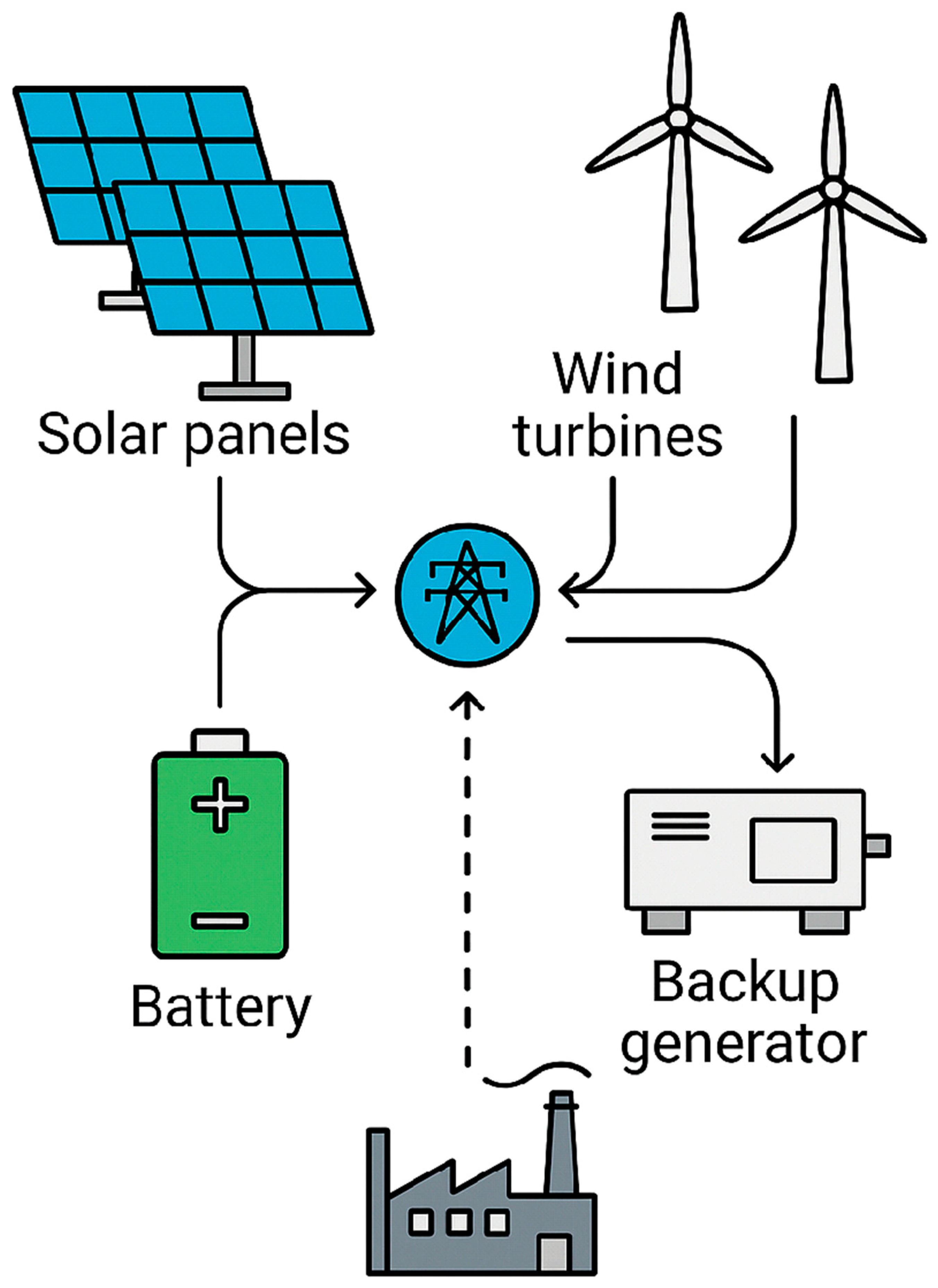
Figure 2.
DR and Its roles in enhancing systems grid flexibility.
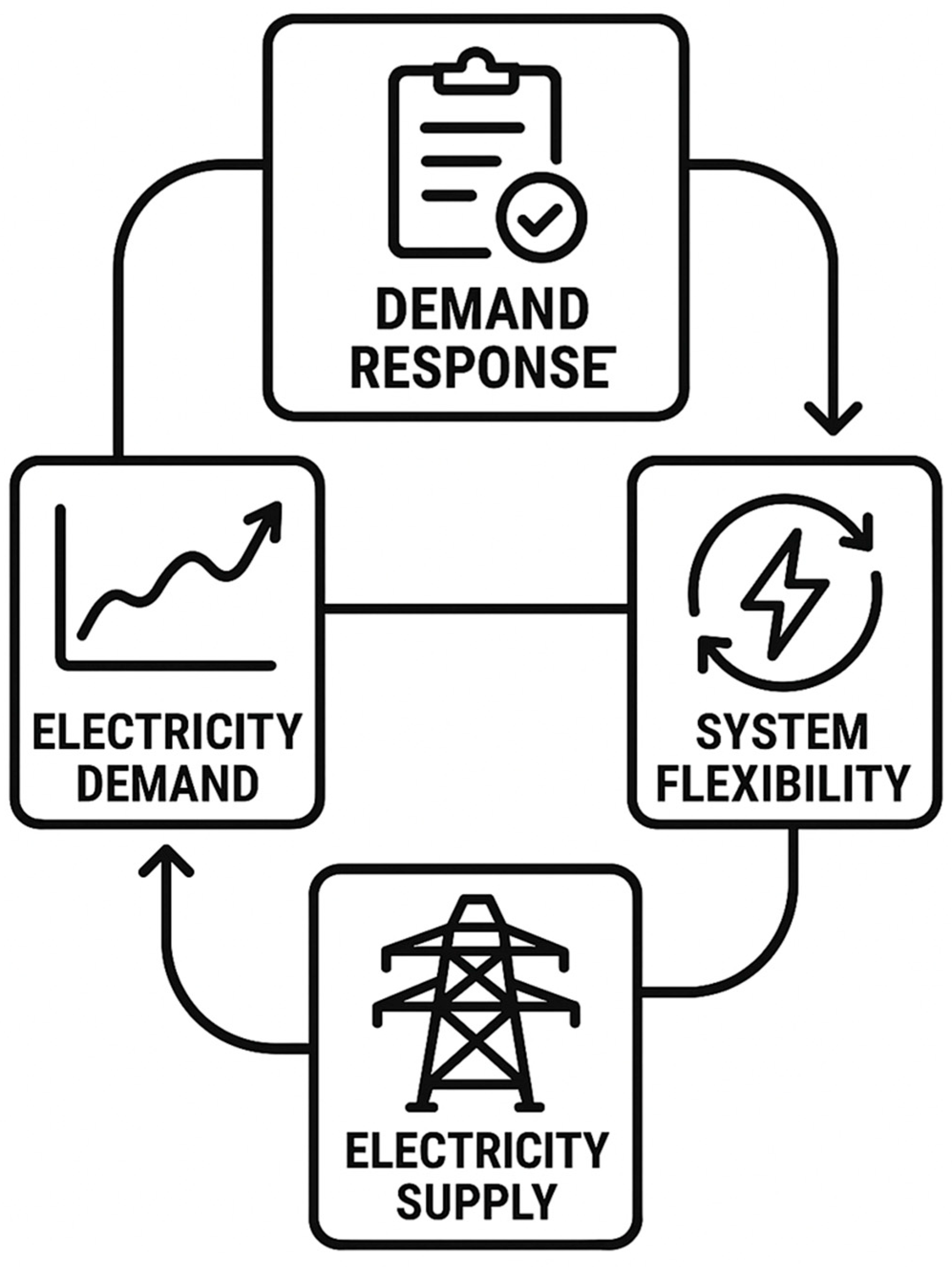
Figure 3.
Flowchart of the review methodology.
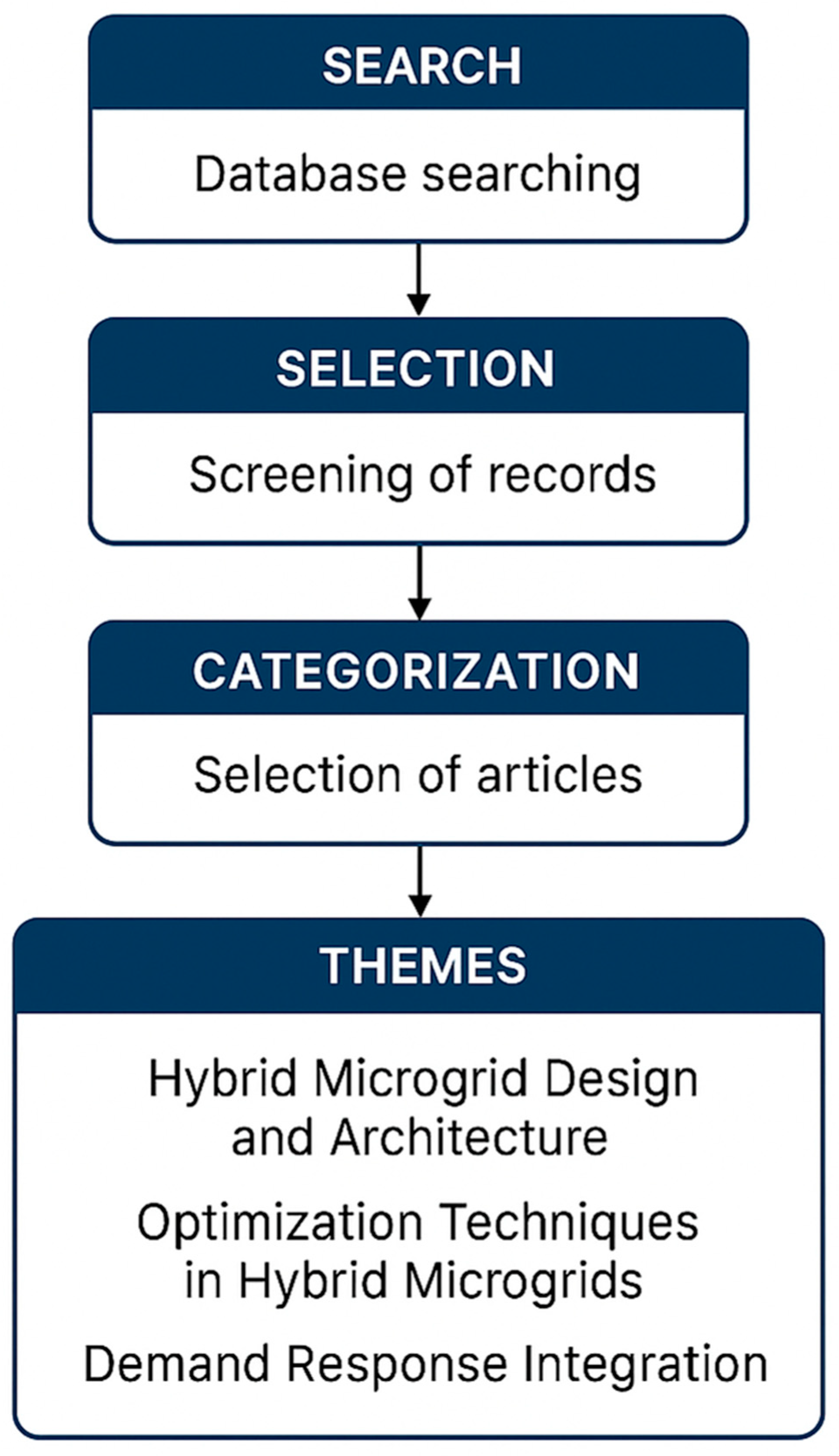
Figure 4.
Key design parameters in a hybrid microgrid.
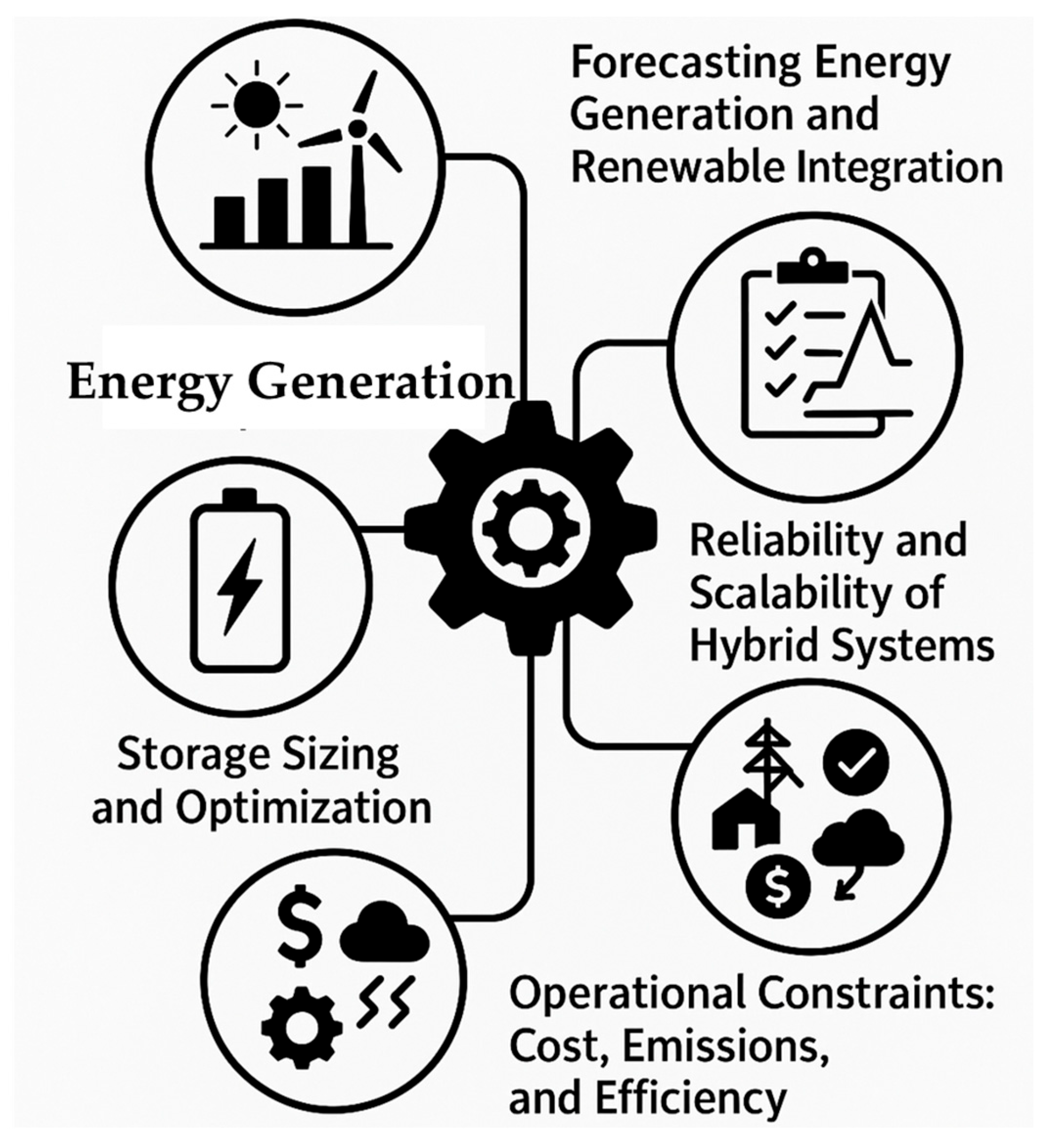
Figure 5.
Illustration of different hybrid microgrid configurations.
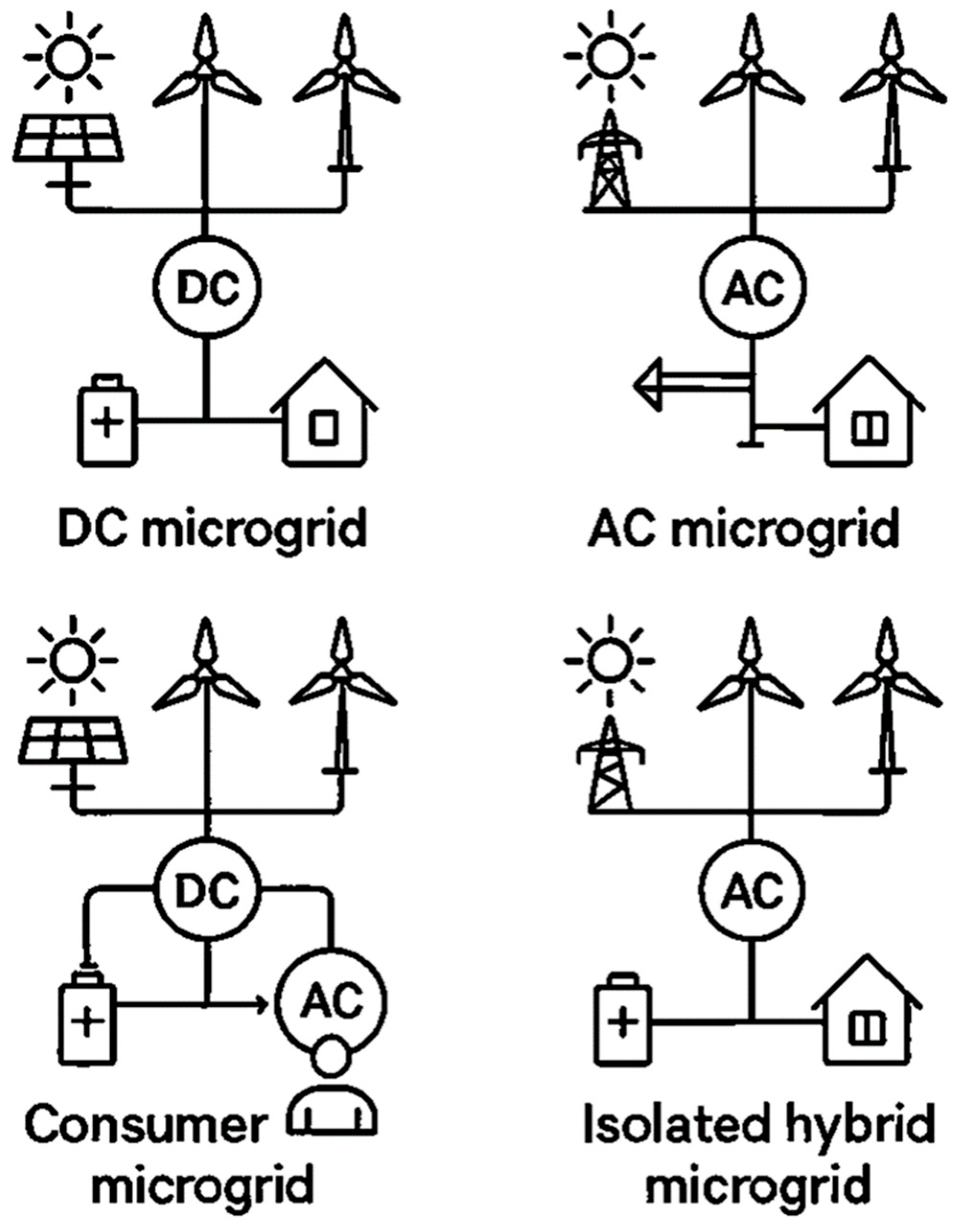
Figure 6.
Optimization techniques in hybrid microgrids.
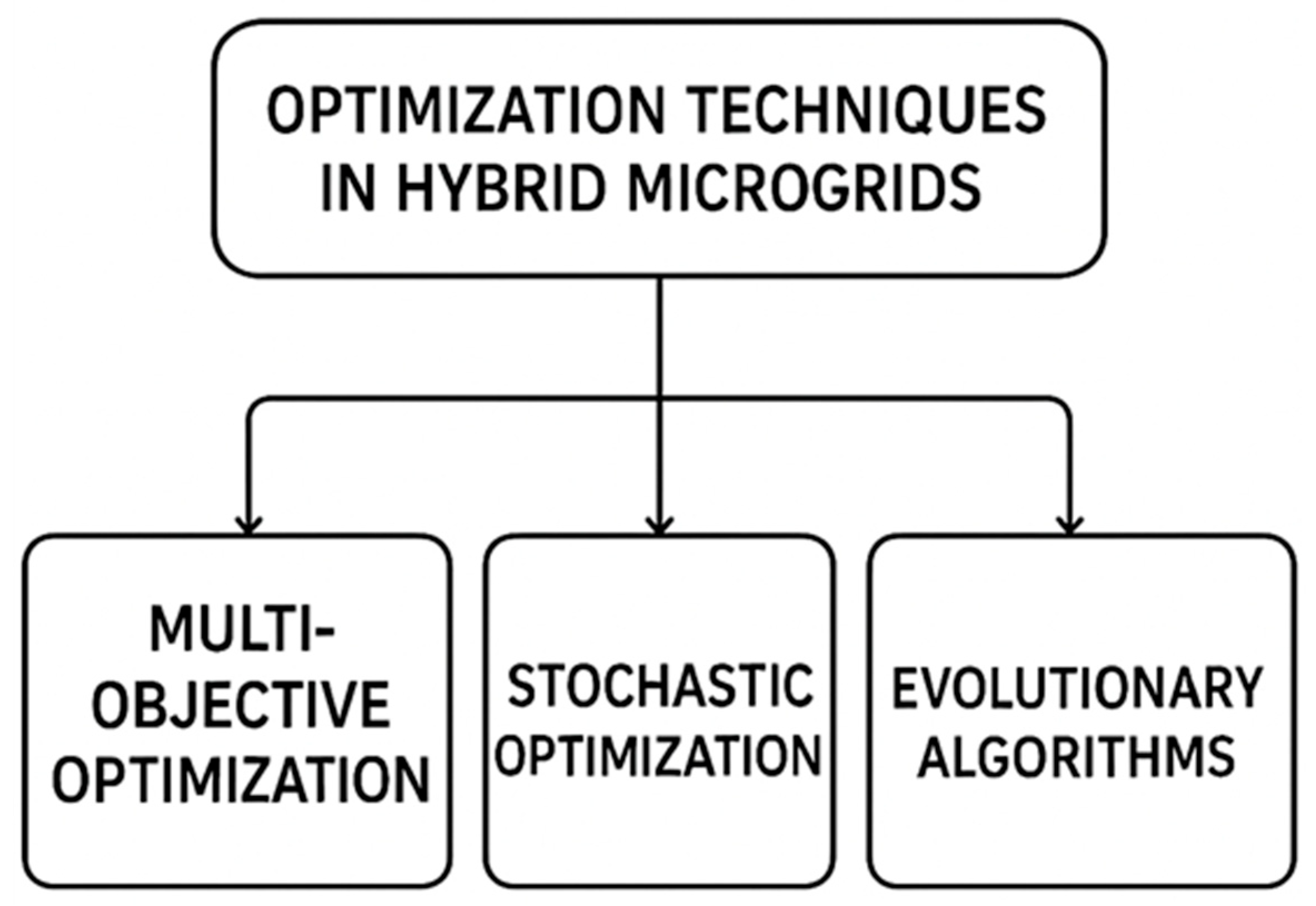
Figure 7.
Gaps in DR Integration in the hybrid microgrids source.
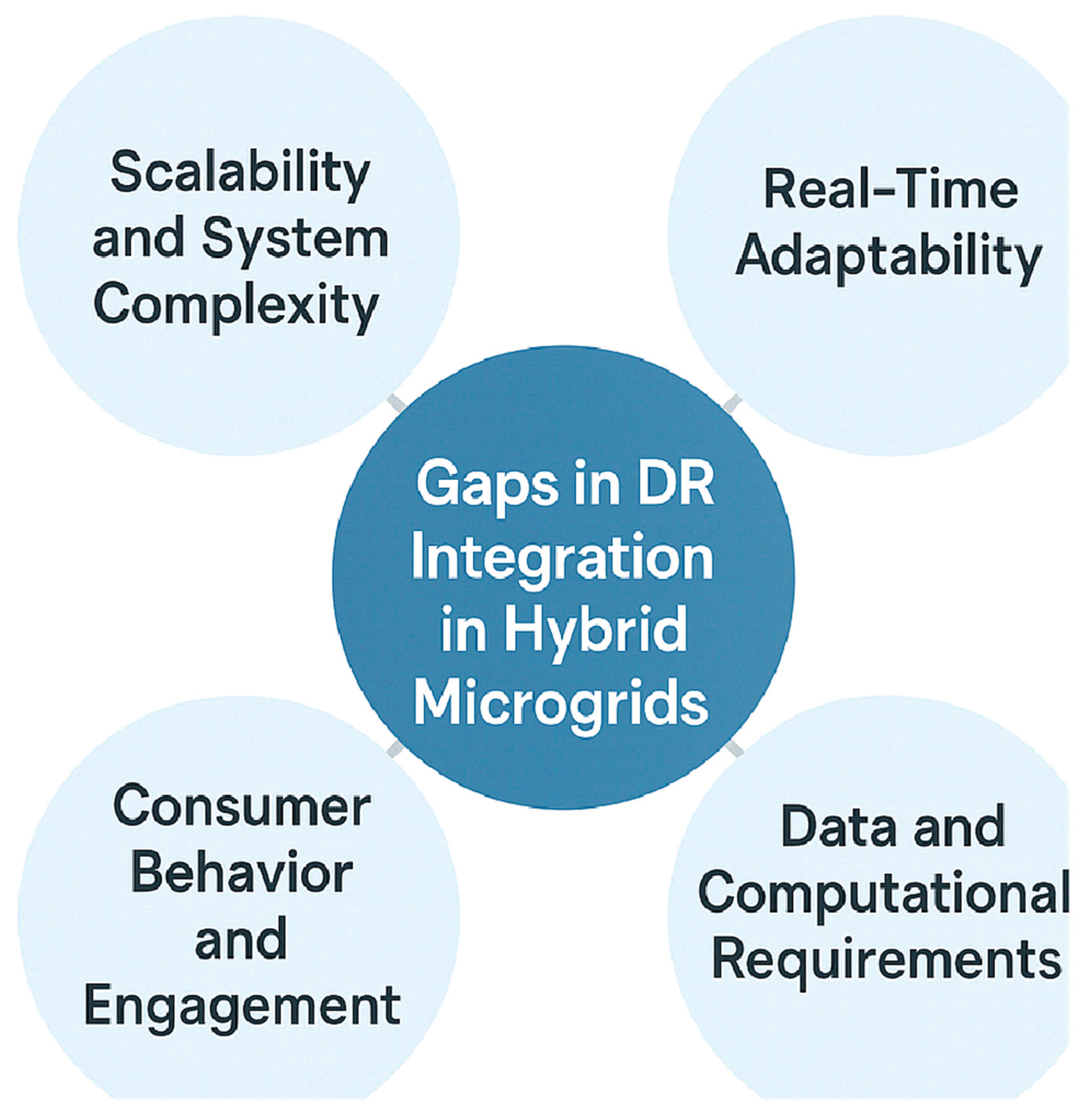
Disclaimer/Publisher’s Note: The statements, opinions and data contained in all publications are solely those of the individual author(s) and contributor(s) and not of MDPI and/or the editor(s). MDPI and/or the editor(s) disclaim responsibility for any injury to people or property resulting from any ideas, methods, instructions or products referred to in the content. |
© 2025 by the authors. Licensee MDPI, Basel, Switzerland. This article is an open access article distributed under the terms and conditions of the Creative Commons Attribution (CC BY) license (http://creativecommons.org/licenses/by/4.0/).
Copyright: This open access article is published under a Creative Commons CC BY 4.0 license, which permit the free download, distribution, and reuse, provided that the author and preprint are cited in any reuse.