

Submitted:
16 March 2026
Posted:
17 March 2026
You are already at the latest version
Abstract
This study advances the Law of the Trio as a universal law of linguistics, positing that reality, thought, and language are ontologically equivalent yet formally distinct modalities of existence. Unlike prior frameworks that isolate language as computation, code, or communicative tool, the Trio establishes a foundational architecture: the recursive coupling of entity and state/behavior, enriched by layered modifiers. Sentences are reframed as semantic DNA, encoding identity, transformation, and relational depth across modalities. To formalize this claim, the paper introduces EMi/VMi,j notation, where i indexes modifier type and j denotes recursion depth. Worked examples and cross‑linguistic analysis (English, Korean, Basque) confirm semantic invariance across typologically distinct languages. Direct mapping to event semantics and thematic roles highlights both alignment and innovation, with recursion depth providing a computable dimension absent from existing models. Comparative analysis shows how the Trio consolidates and extends generative grammar, cognitive science, pedagogy, and semiotics by resolving their limitations through recursive semantic geometry. Applications in pedagogy and natural language processing demonstrate practical relevance. By restructuring linguistics into semantic geometry, the Trio offers a testable, falsifiable, and universal law of language that unifies theory and practice.
Keywords:
law of the trio
; recursive semantic geometry
; ontological linguistics
; modifier indexing (EMi/VMi
; j)
; cross linguistic validation
; universal framework of language
; semantic DNA
1. Introduction
For over a century, modern linguistics has sought to untangle the complexities of language by segmenting its components—syntax, semantics, pragmatics, and phonology—into discrete analytical domains. This intellectual stratification can be traced to Ferdinand de Saussure’s Course in General Linguistics (Saussure, 1916), which framed language as a system of signs defined through opposition rather than reference. Saussure’s structuralism laid the groundwork for synchronically analyzing language as a formal system, abstracted from individual utterance or empirical reality.
Decades later, Noam Chomsky’s Syntactic Structures (Chomsky, 1957), Aspects of the Theory of Syntax (Chomsky, 1965), and The Minimalist Program (Chomsky, 1995) revolutionized linguistic theory by introducing generative grammar and Universal Grammar—models that treated syntax as a self-contained computational system. Chomsky’s emphasis on linguistic competence over performance shifted the discourse toward cognitive formalism and deep structural rules, often sidestepping issues of meaning, usage, and contextual interpretation. Popular accounts such as Pinker’s The Language Instinct (Pinker, 1994) reinforced the generative view of language as an innate faculty, though often without addressing the deeper ontological grounding of meaning.
Cognitive linguistics responded by reintroducing experiential grounding. Concepts like embodied meaning (Lakoff & Johnson, 1980), image schemas (Johnson, 1987), and conceptual metaphor theory proposed that cognition shapes linguistic structure. Langacker’s Foundations of Cognitive Grammar (Langacker, 1987) and Grammar and Conceptualization (Langaker, 2000) further asserted that grammar is inherently meaningful and inseparable from usage. Models of text comprehension and production, such as Kintsch & van Dijk (1978) emphasized cognitive processing of discourse, but did not formalize recursion depth as a computable dimension of meaning.
Despite these pivotal contributions, prevailing models continue to treat language either as a structural mechanism (Chomsky, 1965; Chomsky, 1995), a relational code (Saussure, 1916), a communicative tool (Halliday, 1994), or a cognitive interface (Lakoff, 1987) —each isolating a fragment of meaning while rarely integrating reality, thought, and language into a unified whole. This fragmentation has obscured deeper ontological questions: What is language doing when it creates meaning—not just technically, but existentially?
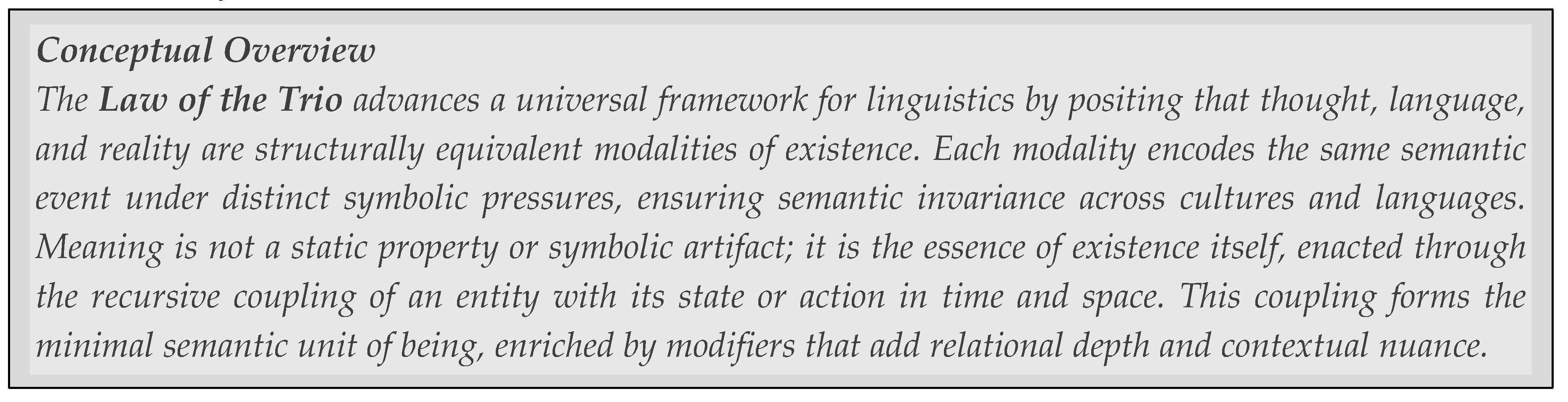
This article introduces a new framework: the Law of the Trio, a triadic model that posits language, thought, and reality as structurally equivalent modalities of being. Unlike previous theories that segment linguistic analysis into functional silos, the Trio model proposes that all three domains reflect the same fundamental architecture: the recursive semantic coupling of entity and behavior, enriched by layered modifiers. To formalize this claim, the paper introduces EMi/VMi,j notation, where i indexes modifier type and j denotes recursion depth.
The objective of this study is to demonstrate that the Law of the Trio provides a universal law of linguistics that consolidates and extends prior frameworks—generative grammar, cognitive science, pedagogy, and semiotics—by resolving their limitations through recursive semantic geometry. The contribution of this work lies in reframing sentences as semantic DNA, offering a testable, falsifiable, and modality-neutral account of language that unifies theory, cognition, pedagogy, and application.
The following foundational concepts establish the philosophical and formal anchor of the Law of the Trio, outlining its core principle, semantic function, and the precise definitions of the terms that structure its synthesis.
Sentence as Semantic Particle
Sentences are reframed not as syntactic units but as semantic particles—symbolic cells that mirror the architecture of being. Each particle encodes:
- Entity (subject, object, or modifier anchor)
- State/Behavior (condition, transformation, or action)
- Modifiers (recursive enrichments that add depth and context)
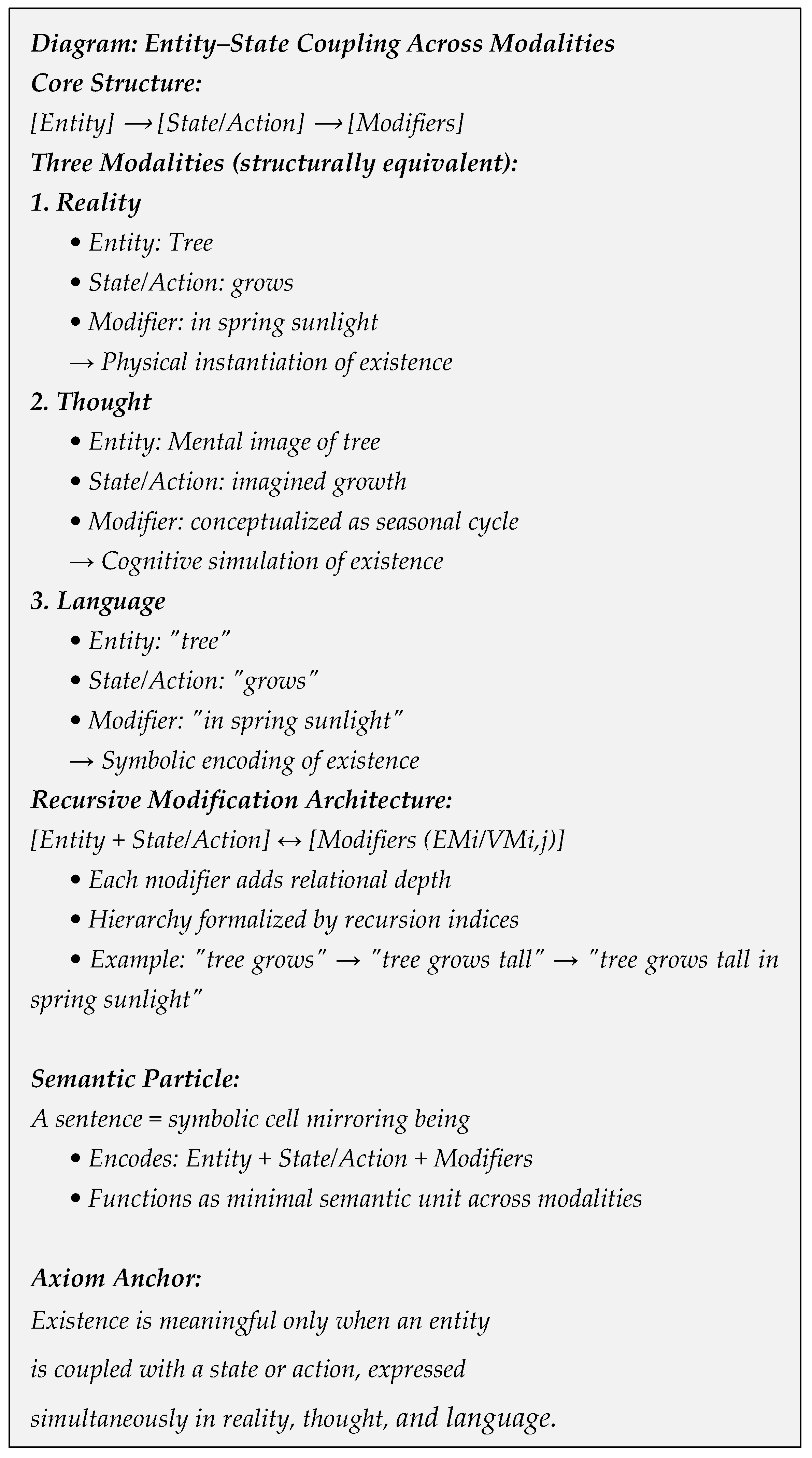
At the heart of the framework lies a core semantic function:
where Modality refers to reality, thought, or language.
Modality=f(Entity, State or Behavior)
This function models how meaning arises from recursive enactment, enabling cross-modal alignment and universality. To capture semantic layering, the Trio introduces a recursive modification architecture (EMi/VMi,j notation), which formalizes modifier hierarchy and recursion depth. This computable scaffold makes explicit how attributes, conditions, and manner enrich the semantic particle, bridging linguistic complexity with cognitive clarity.
Definition Block: Core Terms of the Law of the Trio
- Meaning: The recursive enactment of existence, arising from the coupling of an entity with its state or action. Meaning is dynamic, relational, and instantiated across modalities.
- Existence: The presence of an entity expressed through its state or action at a given time and place. Existence is never bare; it is always reflected through what the entity is doing or undergoing.
- Modalities: The three structurally equivalent forms of existence—reality, thought, and language—each encoding the same semantic event under different symbolic pressures.
- Reality: physical instantiation of entity and state/action
- Thought: cognitive simulation or conceptual modeling
- Language: symbolic geometry of semantics, where sentence structure is the spatial organization of meaning itself. Syntax is not a separate layer but the patterned articulation of semantic relations—the geometry through which semantics is enacted and made explicit.
- Entity: The ontological anchor of meaning, denoting the subject, object, or modifier entity whose existence is expressed. Entities may be physical (tree, child), mental (idea, image), or symbolic (word, sentence).
- Subject Entities: initiators or experiencers of a state/action
- Object Entities: receivers or targets of a state/action
- Modifier Entities: enrich meaning by presenting their existence relationally, adding attributes, conditions, or contextual dimensions
- State/Action: The condition, transformation, or behavior through which an entity manifests its existence. States describe attributes or conditions (e.g., tired, heavy), while actions denote transitions or behaviors (e.g., run, open, grow). Together, they provide the dynamic dimension of meaning.
- Scope Conditions: Fictional, counterfactual, and mathematical entities are treated as valid components of reality within this framework.
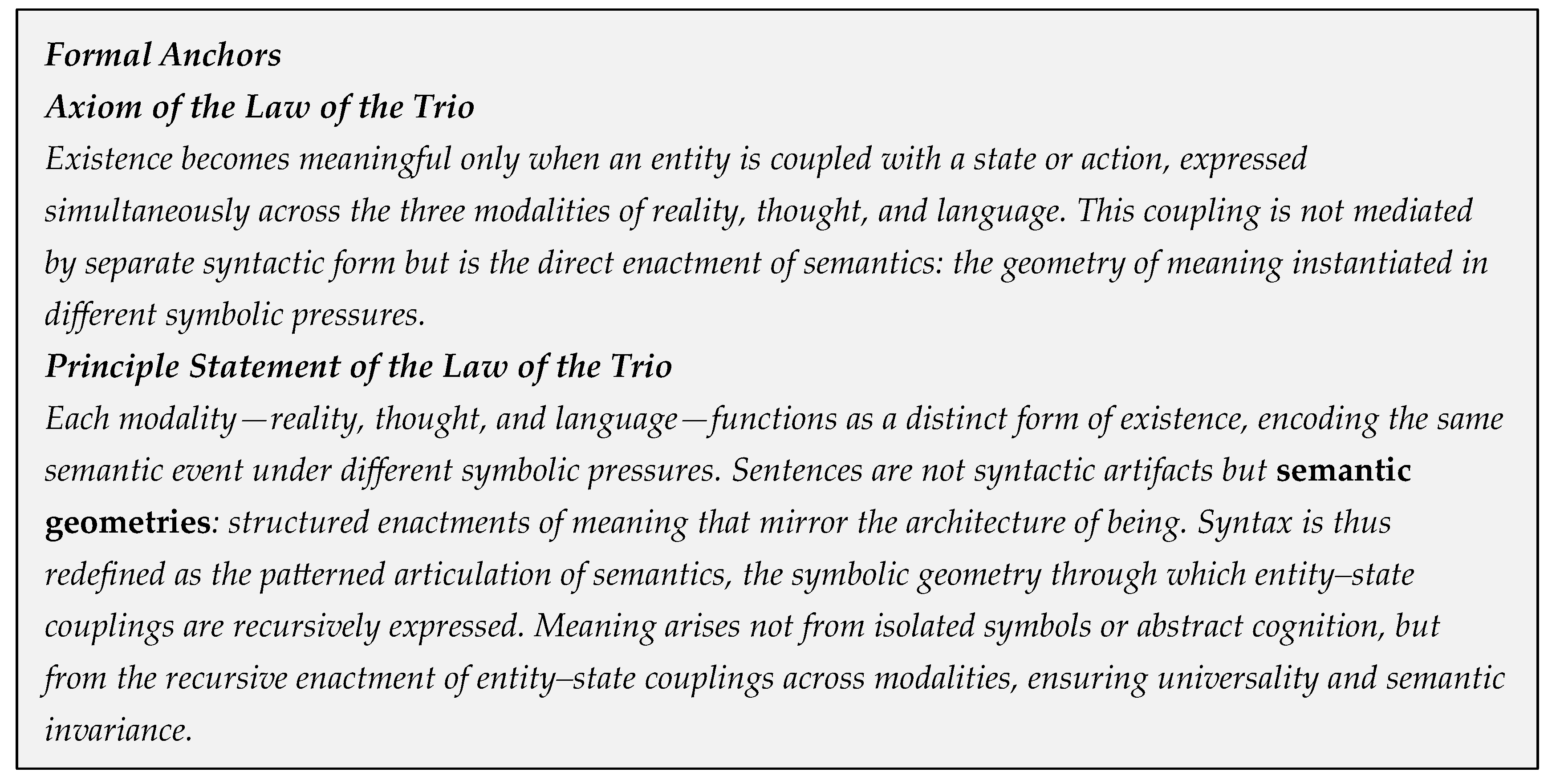
These formal statements provide the foundation for the methodological framework that follows.
2. Methods
2.1. Verb Typology and Recursive Indexing System (EMi/VMi,j)
The Law of the Trio grounds sentence structure in the principle that existence is always enacted through either a state or an action. Linguistically, this enactment manifests in five fundamental verb types. These are not arbitrary grammatical categories but ontological pathways of being, structurally invariant across language, thought, and reality:
- State Verb – Existence expressed as a condition or attribute. Example: “The child is tired.” The entity’s being is enacted through a state, typically followed by a complement.
- Intransitive Verb – Existence expressed as an action upon itself. Example: “The child runs.” The entity enacts its existence through self-directed behavior.
- Transitive Verb with Object – Existence expressed as an action upon another entity. Example: “The child opened the door.” The subject enacts existence relationally, transforming another entity.
- Transitive Verb with Direct and Indirect Objects – Existence expressed as an action involving two entities. Example: “The child gave the teacher a book.” The subject enacts existence through relational transfer, embedding meaning in a triadic structure.
- Transitive Verb with Object + Complement – Existence expressed as an action that causes another entity to attain a new state. Example: “The child painted the wall red.” The subject enacts existence by transforming another entity into a state described by its complement.

This typology provides the structural basis for the recursive indexing system that follows, ensuring that every verb can be mapped onto the alternation of state and action.
2.2. Indexing Rule Set for Modifier Tagging (EMi/VMi,j)
The recursive indexing system operationalizes how modifiers attach to entities and verbs. It proceeds in four steps:
Step 1: Identify Sentence Pattern (Head Verb) Determine which of the five verb types anchors the sentence. This establishes the subject–verb coupling and its relational structure.
Step 2: Identify Core Nouns Identify the head noun coupled with the head verb to form the core sentence. Similarly, identify nouns acting as direct object, indirect object, or complement based on the verb type.
Step 3: Assign Depth Index (j)
- j=1: Modification applies directly to the head noun, head verb, object, or complement. Example: “The tired child opened the door.” → tired = EM2,1; the = EM1,1; the (object) = EM-o1,1
- j≥2: Modification applies recursively to a modifier at depth j−1. Example: “The child admired by critics who follow avant-garde trends…” → admired by critics = EM5,1; who follow avant-garde trends = EM6,2,51 (notation specifies attachment to EM5,1).
Step 4: Assign Modifier Type (i)
- Entity Modifiers (EMi): EM1 → Determiner/Quantifier; EM2 → Adjective; EM3 → Noun (compound/appositional); EM4 → Prepositional Phrase; EM5 → Participle Phrase; EM6 → Relative Clause.
- Verb Modifiers (VMi): VM1 → Modal Verb; VM2 → Adverb; VM3 → Noun (temporal/circumstantial); VM4 → Prepositional Phrase; VM5 → Infinitive Verb Phrase; VM6 → Adverbial Clause.
Step 5: Recursive Continuation Tagging continues sequentially until the last modifier in the sentence is reached. Theoretically, recursion depth is unlimited; practically, comprehension begins to break down beyond j≈3, reflecting cognitive limits in working memory.

2.3. Worked Example (Fully Tagged)
Sentence: “The young composer admired by critics who follow avant-garde trends confidently presented the piece at the theatre near the river to find a seat despite the rain.”
Entity Modifiers (EM):
- EM1,1: The (determiner modifying composer)
- EM2,1: young (adjective modifying composer)
- EM5,1: admired by critics (participle phrase modifying composer)
- EM6,2,51: who follow avant-garde trends (relative clause nested within critics)
- EM-o1,1: the (determiner modifying object piece)
Verb Modifiers (VM):
- VM2,1: confidently (adverb modifying presented)
- VM4,1: at the theatre near the river (prepositional phrase modifying presented)
- VM5,1: to find a seat (infinitive phrase modifying presented)
- VM4,2,51: despite the rain (prepositional phrase modifying VM5,1)
Nested EM within Verb Modifiers:
- EM1,2,41: the (determiner modifying theatre in VM4,1)
- EM4,2,41: near the river (prepositional phrase modifying theatre in VM4,1)
- EM1,3,42,41: the (determiner modifying river in EM4,2,41)
This worked example demonstrates how recursion depth (j) tracks hierarchical attachment, making modifier layering explicit and computable.
The worked example is presented visually in Figure 1, providing a structural representation of recursion that complements the textual analysis.
This visualization makes the tagging procedure explicit, computable, and pedagogically accessible, ensuring that hierarchical attachment is both transparent and testable.
The figure visually demonstrates how modifiers attach at different depths within a sentence. Depth 1 modifiers directly qualify the head noun, verb, object, or complement, while Depth 2 modifiers recursively embed within other modifiers, creating layered structures. Entity modifiers (EMi,j) and verb modifiers (VMi,j) are clearly distinguished, showing how determiners, adjectives, participial phrases, relative clauses, adverbs, prepositional phrases, infinitives, and adverbial clauses interact within a syntactic hierarchy.

Comparative Positioning
Traditional grammatical descriptions often list modifiers sequentially without formally specifying their hierarchical depth. This surface-level approach, while pedagogically useful, leaves recursion implicit. By contrast, modern formal syntax frameworks—such as X-bar theory, Minimalist trees, and Dependency Grammar (including Universal Dependencies)—do represent hierarchical attachment and recursion depth explicitly at the syntactic level.
The Trio system advances beyond both traditions by introducing recursion indexing (j), which enables precise computational modeling of modifier layering. This innovation allows predictions about processing limits and acquisition order, aligning with psycholinguistic evidence on recursion and working memory constraints (Miller & Chomsky, 1963; Gibson, 1998). In this way, the Trio framework is situated within empirically testable cognitive science.
The Law of the Trio does not deny the contributions of formal syntax; rather, it reframes them by dissolving the traditional boundary between syntax and semantics. In this framework, syntax functions as the geometry of semantics, while semantics itself is recursively structured and modeled as the coupling of entity–state/action layered withmodifiers.
Thenotation extends syntactic representation into semantic geometry, where recursion depth is tied directly to meaning, cognitive processing limits, and cross-modal invariance (reality, thought, language). Unlike dependency parses, which remain structurally descriptive,indexing generates falsifiable predictions (e.g., comprehension breakdown beyond j≈3) and provides a pedagogical scaffold for learners to visualize recursion as semantic layering. In this way, the Trio framework complements existing syntactic models while advancing a universal law of language that unifies theory and practice.
2.4. Temporal Enactment of Existence: Graphical Model and Ontological Insight
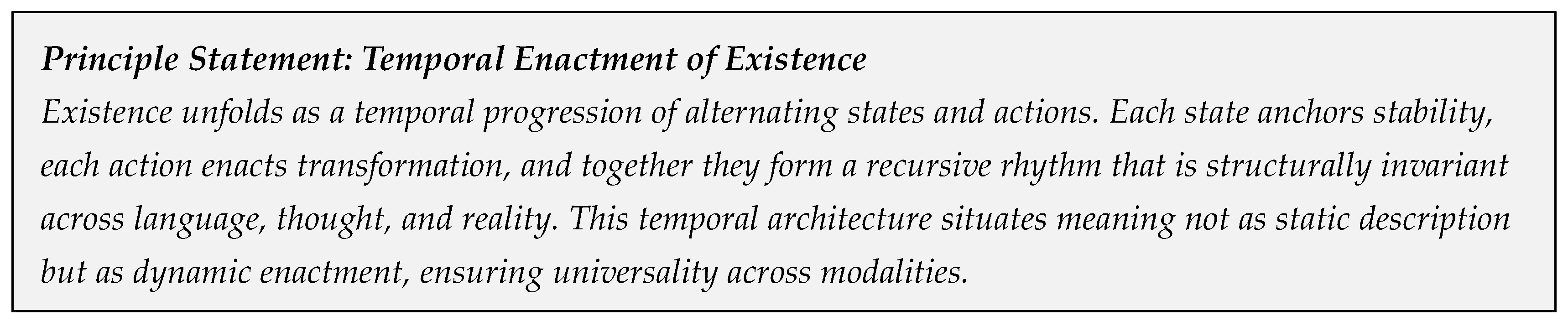
Building on verb typology and modifier indexing, the Law of the Trio extends to the temporal dimension. Existence is not static but unfolds through a recursive alternation of states (conditions of stability) and actions (transformations that connect one state to another). This rhythm anchors the ontology of being across language, thought, and reality.
The principle of alternation between state and action arises from observation: if one were to fix a camera upon any entity, what would be captured at each moment is either its state (qualities, attributes, or internal configuration) or its action (interaction with its surroundings). States represent what is contained within the system at a given time, while actions represent exchanges with the environment that transform those states. In this sense, existence is always expressed through the recursive rhythm of state and action, as illustrated in Figure 2.
Figure 2 illustrates how the existence of an entity unfolds over time through a rhythmic alternation between Action (A) and State (S). Each point in time captures either an action the entity performs or undergoes, or a state it occupies. The horizontal axis represents time, while the vertical axis anchors the entity’s continuity. This sequence—A → S → A → S—models the recursive enactment of being, where each action transforms the system and leads to a new state, and each state presupposes the potential for further action. The diagram provides a minimal ontological scaffold for the Law of the Trio, making the temporal rhythm of existence explicit and pedagogically accessible.
This alternation does not imply isolation—entities are never sealed off from their surroundings—nor does it imply strict linearity. Real processes often involve simultaneity, overlapping events, and durative states without clear endpoints. Within the Law of the Trio, such complexity can be modeled as parallel recursive couplings (multiple entity–state/action chains unfolding concurrently) or as extended states enriched by micro-actions (e.g., “knowing” as a durative state sustained by ongoing cognitive processes). Thus, the linear alternation depicted in Figure 2 should be understood as a pedagogical simplification, while the framework itself accommodates branching, overlap, and simultaneity.
By grounding existence in the recursive alternation of state and action, the Trio provides a minimal ontology of meaning that can be extended to capture both simple and complex enactments of reality, thought, and language as shown in Figure 2a.
Figure 2a extends the linear alternation of state and action by illustrating how multiple entity–state/action chains can unfold concurrently. Parallel recursion captures simultaneous actions, overlapping events, and durative states enriched by micro-actions. While Figure 2 depicts the minimal ontology of alternation, Figure 2a demonstrates that the Law of the Trio accommodates branching, overlap, and simultaneity, ensuring that complex enactments of existence are modeled alongside simple linear sequences.
Figure 2a supplements the linear model by showing how recursion can branch and overlap. Entities may sustain multiple state–action chains at once, or extend durative states enriched by micro-actions. This expanded visualization makes explicit that the Law of the Trio is not limited to sequential alternation but is capable of modeling simultaneity, overlap, and continuity, thereby capturing the full complexity of linguistic and ontological enactment.
The expanded visualization in Figure 2a aligns with psycholinguistic findings on sentence processing, particularly in contexts involving overlapping clauses, embedded modifiers, and durative states. Studies such as Gibson (1998) and Miller & Chomsky (1963) have shown that working memory constraints limit the depth of recursive structures that can be processed simultaneously. By modeling parallel recursion and micro-actions within durative states, the Law of the Trio offers a cognitively plausible scaffold for understanding how linguistic complexity is managed in real-time comprehension. This reinforces the framework’s empirical testability and its relevance to both theoretical linguistics and cognitive modeling.
Comparative Positioning
This temporal alternation resonates with aspectual theory (Comrie, 1976; Vendler, 1967) and event semantics (Parsons, 1990), but advances beyond them by formalizing the recursive rhythm of state and action as ontologically grounded and universally applicable.
2.5. Falsifiable Predictions
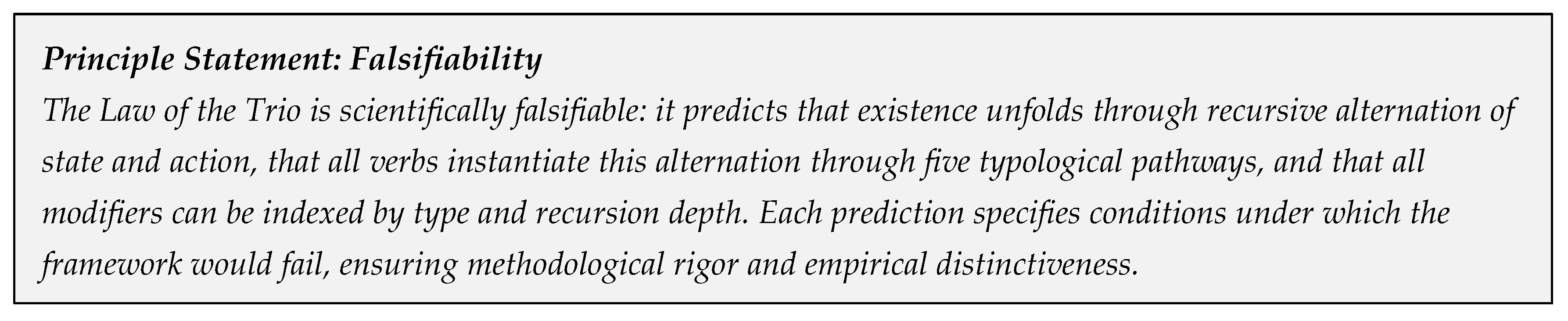
A central strength of the Law of the Trio is that it generates falsifiable predictions, ensuring that the framework is not merely philosophical but empirically testable. The following predictions specify conditions under which the model could fail, thereby affirming its scientific rigor:
-
Alternation of State and Action
- Claim: Every real system exhibits transitions between states and actions.
- Test: If a system could remain in perfect equilibrium indefinitely, without any action emerging, the model would be falsified.
-
Verb Typology Exhaustiveness
- Claim: All verbs in natural language can be classified into the five types.
- Test: If a verb type exists that cannot be mapped onto the state/action alternation, the typology would require revision.
-
Modifier Indexing Universality
- Claim: All modifiers can be systematically indexed by type (EMi/VMi) and recursion depth (j).
- Test: If a modifier resists classification or recursion depth cannot be consistently tracked, the indexing system would be falsified.
Comparative Positioning
Unlike descriptive grammars or philosophical models that resist empirical testing, the Trio framework specifies clear falsification conditions. This positions it alongside scientific theories in linguistics and cognitive science, where predictive power and testability are essential for scholarly acceptance. By aligning recursion depth (j) with psycholinguistic findings on working memory constraints (Miller & Chomsky, 1963; Gibson, 1998), the Trio advances beyond traditional models, offering a framework that is both ontologically grounded and empirically verifiable.
2.6. Mapping to Event Semantics and Thematic Roles
To align the Trio framework with established semantic machinery, EMi/VMi,j notation is mapped onto event semantics and semantic role labeling (SRL). The Trio framework complements lexical resources such as FrameNet, which systematically catalog semantic frames and their participants (Fillmore, Johnson, & Petruck, 2003). By introducing recursion depth (j) into modifier indexing, the Trio extends frame semantics with a computable dimension that captures hierarchical layering absent from traditional frame-based annotation.
-
Entity Modifiers (EMi,j):
- ✧
- EM2,j (adjective) → Attribute role
- ✧
- EM4,j (prepositional phrase) → Locative/Instrument role
- ✧
- EM6,j (relative clause) → Descriptive/Restrictive role
-
Verb Modifiers (VMi,j):
- ✧
- VM2,j (adverb) → Manner role
- ✧
- VM3,j (noun) → Temporal/Recipient role
- ✧
- VM5,j (infinitive phrase) → Purpose/Result role
- ✧
- VM6,j (adverbial clause) → Circumstance role
Novel Contribution
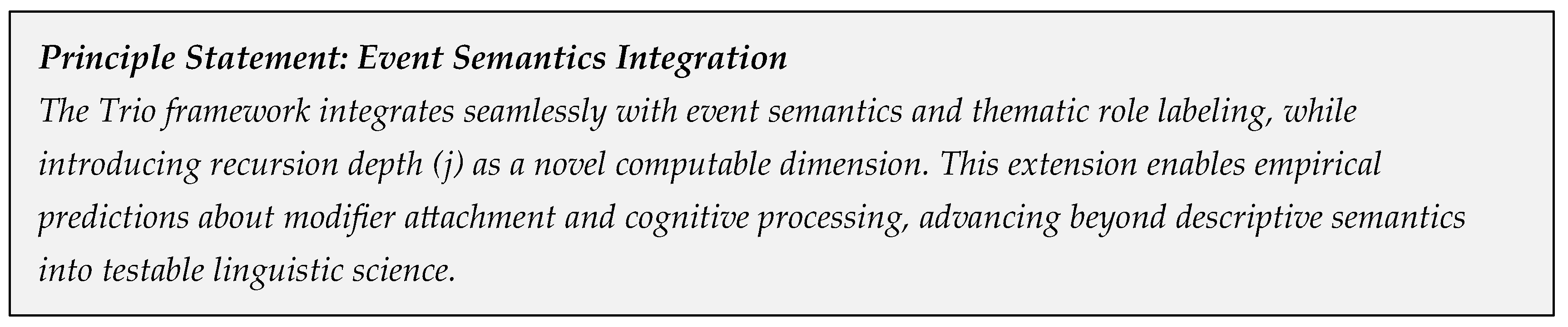
Recursion depth (j) provides a computable dimension absent from existing SRL frameworks. PropBank’s role labeling provides a robust foundation for mapping verbs to argument structures (Palmer, Gildea, & Kingsbury, 2005). The Trio framework aligns with this tradition but advances it by explicitly modeling recursion depth, enabling predictions about modifier attachment and cognitive processing limits that go beyond flat role assignment. This enables predictions about modifier attachment, acquisition order, and processing limits, situating the Trio framework as both compatible with and an advancement beyond event semantics.
- VM2,j (adverb) → Manner role
- VM3,j (noun) → Temporal/Recipient role
- VM5,j (infinitive phrase) → Purpose/Result role
- VM6,j (adverbial clause) → Circumstance role
Comparative Positioning
Traditional SRL frameworks such as PropBank and FrameNet classify modifiers by role but leave hierarchical depth implicit. The Trio system advances beyond these resources by formalizing recursion depth (j), making modifier layering explicit, computable, and empirically testable. This bridges descriptive semantics with cognitive modeling, offering predictive power unavailable in prior frameworks. By aligning with event semantics (Parsons, 1990) while extending its scope, the Trio situates itself as both a compatible and paradigm-shifting contribution to linguistic science.
3. Results
3.1. Comparative Analysis of Frameworks
A structured comparison was conducted between traditional linguistic frameworks and the Law of the Trio. Table 1 highlights the core insights of generative grammar, movement rules, cognitive science, pedagogy, and semiotics, identifies their limitations, and demonstrates how the Trio framework resolves or extends each through recursive semantic geometry.
3.2. Falsifiable Predictions (“Difference Makers”)
Building on the general falsifiability outlined in Section 2.7, the following predictions highlight the unique empirical leverage of the Trio framework by demonstrating concrete outcomes that distinguish it from prior approaches.
Two concrete, testable predictions distinguish the Law of the Trio from prior frameworks:
- Attachment Ambiguity Resolution
Prediction: Recursion depth (j) determines modifier attachment preference.
Example: In sentences with multiple nested clauses, the Trio predicts attachment to the nearest available head at depth j, whereas generative grammar leaves ambiguity unresolved.
- 2.
- Processing Limits in Comprehension
Prediction: Sentences with recursion depth beyond j = 3 exceed working memory capacity, leading to processing breakdown.
This aligns with psycholinguistic evidence but is formally modeled in the Trio framework, unlike in generative grammar or cognitive linguistics.
These predictions provide falsifiable outcomes that can be empirically tested in acquisition studies and psycholinguistic experiments.
3.3. Cross-Linguistic Validation
The Law of the Trio was tested across typologically distinct languages: English (fixed word order), Korean (agglutinative SOV), and Basque (ergative alignment). Despite differences in syntax and morphology, the recursive architecture of entity–behavior coupling and modifier layering remained invariant.
-
English Example: “The young composer admired by critics who follow avant-garde trends…”
- ✧
- EM2,1: young (adjective)
- ✧
- EM5,1: admired by critics (participle phrase)
- ✧
- EM6,2: who follow avant-garde trends (relative clause)
-
Korean Example: 피곤한 아이가 천천히 무거운 문을 폭풍 속에서 열었다. (“The tired child slowly opened the heavy door during the storm.”)
- ✧
- EM2,1: 피곤한 (tired)
- ✧
- EM-o2,1: 무거운 (heavy)
- ✧
- VM2,1: 천천히 (slowly)
- ✧
- VM4,1: 폭풍 속에서 (during the storm)
-
Basque Example (Ergative Alignment): Ikasle nekatuak liburu astuna gelan irakasleari eman zion. (“The tired student gave the heavy book to the teacher in the classroom.”)
- ✧
- EM2,1: nekatuak (tired)
- ✧
- EM-o2,1: astuna (heavy)
- ✧
- VM4,1,2: gelan (in the classroom)
- ✧
- VM4,1,1: irakasleari (to the teacher)
Across all three languages, recursion depth (j) consistently tracks hierarchical attachment, confirming that sentence structure reflects semantic geometry rather than surface grammar. This universality positions semantic geometry as the true invariant of language.
4. Discussion
4.1. Theoretical Implications
The cross-linguistic evidence confirms that the Law of the Trio models meaning at a level deeper than syntax, morphology, or alignment. This universality carries significant theoretical implications: it reframes linguistic analysis from a grammar-bound enterprise into an ontological architecture of meaning. By demonstrating that entity–behavior coupling and recursive modification persist across English, Korean, and Basque, the framework challenges the primacy of generative syntax and instead positions semantic geometry as the true invariant of language. In this view, sentences are not merely grammatical strings but symbolic particles of existence—semantic DNA— encoding identity, transformation, and relational depth across modalities. The Trio thus bridges formal linguistics, cognitive modeling, and philosophical ontology, offering a unified account of how finite grammatical resources generate infinite experiential scenarios.
4.2. Implications for Generative Grammar
The Law of the Trio challenges the traditional assumptions of generative grammar by reframing universality as a matter of semantic invariance rather than syntactic form. Generative approaches, following Chomsky, posit that all languages share a deep structural syntax from which surface variation emerges. Yet the cross-linguistic evidence presented here demonstrates that what remains constant is not syntactic configuration but the recursive coupling of entities and behaviors enriched by modifiers. English, Korean, and Basque differ in word order, case marking, and morphological strategies, but each employs EMi and VMi recursion to generate infinite experiential scenarios from finite grammatical resources. This suggests that the true locus of universality lies in semantic geometry—the ontological architecture of meaning—rather than in abstract syntactic transformations. By shifting the focus from universal grammar to universal recursion of modifiers, the Trio provides a more robust account of linguistic creativity and expressive depth.
Generative grammar has long identified recursion as the defining property of human language, famously articulated by Hauser, Chomsky, and Fitch (2002) as the “faculty of language in the narrow sense.” In their account, recursion enables the embedding of phrases within phrases, producing the unbounded generativity of syntax. The Law of the Trio incorporates this insight but reframes it ontologically: recursion is not merely a syntactic mechanism but a semantic architecture in which modifiers (EMi, VMi) enrich entities and behaviors across modalities. Whereas generative grammar emphasizes hierarchical phrase structure, the Trio demonstrates that recursion operates at the level of meaning, allowing modifiers themselves to contain entities and verbs that can be further modified. This extension situates recursion as a universal principle of semantic geometry rather than a property restricted to syntactic form, thereby broadening its explanatory scope to encompass cross-linguistic variation and the ontological parallelism of reality, thought, and language.
Generative grammar traditionally explains linguistic creativity through movement and transformation rules, such as raising, wh-movement, or passivization, which manipulate syntactic constituents to derive surface forms from an underlying structure. While these mechanisms account for formal variation, they remain bound to syntax and often struggle to capture the semantic constancy across typologically diverse languages. The Law of the Trio avoids this limitation by situating recursion at the level of meaning rather than syntactic derivation. In the Trio framework, modifiers (EMi, VMi) recursively enrich entities and behaviors, producing semantic depth without requiring abstract transformations. This shift eliminates the need for language-specific movement rules and instead models universality through ontological geometry: the recursive layering of modifiers is invariant across English, Korean, and Basque, even though their syntactic strategies differ. By grounding recursion in semantic architecture rather than syntactic manipulation, the Trio provides a more parsimonious and cross-linguistically robust account of linguistic creativity.
Rather than rejecting generative grammar, the Law of the Trio should be understood as a complementary framework that extends its insights into a broader ontological domain. Generative grammar has illuminated the formal mechanisms by which languages produce infinite expressions from finite means, and its emphasis on recursion remains foundational. The Trio builds upon this foundation by demonstrating that recursion is not confined to syntactic phrase structure but operates universally at the level of semantic geometry, where entities and behaviors are recursively enriched by modifiers across modalities. In this way, the Trio preserves the generative tradition’s concern with universality while expanding its scope: from syntax to meaning, from language alone to the parallel architectures of reality, thought, and linguistic expression. This synthesis positions the Trio as both a continuation and an evolution of generative grammar, offering a unified account of linguistic creativity that is cross-linguistically robust and ontologically grounded.
4.3. Implications for Cognitive Science
The Law of the Trio also carries significant implications for cognitive science, particularly in how humans represent and process meaning. Cognitive models of language often emphasize event simulation: when we hear or produce a sentence, we construct a mental scene in which entities interact through behaviors under specific conditions. The Trio formalizes this process by showing that entity–behavior coupling, recursively enriched by modifiers, mirrors the way cognition builds nested mental representations. Adjectives, adverbs, prepositional phrases, and clauses do not merely decorate syntax; they provide layers of specificity that allow the mind to simulate context, perspective, and depth. In this sense, the Trio aligns with psycholinguistic evidence that comprehension involves incremental enrichment of meaning, and it extends these insights by offering a universal notation (EMi, VMi, j) that models how finite linguistic tools generate infinite experiential scenarios in thought as well as in language.
Cognitive science also highlights the role of working memory in constraining how deeply recursion can be processed in real time. While the Trio demonstrates that recursion depth (j) is theoretically unbounded, psycholinguistic evidence shows that comprehension becomes increasingly difficult as modifiers are nested beyond two or three layers. For example, sentences with multiple embedded relative clauses or stacked prepositional phrases often exceed the limits of short-term memory, leading to processing breakdowns. The Trio framework makes this constraint explicit: recursion depth is not only a formal index but also a cognitive measure of load. By modeling how EMi and VMi modifiers accumulate, the Trio provides a systematic way to predict when sentences will remain accessible and when they will strain memory resources. This alignment between semantic geometry and cognitive capacity underscores the explanatory power of the framework, bridging linguistic universality with psycholinguistic realities of human processing.
Finally, the Trio framework also illuminates how learners acquire and manage linguistic complexity. By indexing modifier type (i) and recursion depth (j), the system provides a transparent scaffold that mirrors cognitive strategies for chunking and incremental enrichment. Learners do not process sentences as undifferentiated strings but as layered units of meaning, where modifiers add specificity step by step. This recursive architecture supports cognitive efficiency: it allows learners to build complexity gradually, while maintaining coherence at each stage. In pedagogical contexts, the Trio thus offers a universal notation that makes recursion visible, enabling students to grasp how finite grammatical resources generate infinite experiential scenarios. This bridge between cognitive processing and instructional design prepares the ground for the next subsection, where the framework’s implications for pedagogy and applied linguistics are explored.
4.4. Implications for Pedagogy and Applied Linguistics
The Law of the Trio also offers powerful pedagogical applications by making the recursive architecture of language visible and teachable. Traditional grammar instruction often presents modifiers as isolated categories—adjectives, adverbs, clauses—without showing how they interlock to form layered meaning. By contrast, the Trio’s EMi/VMi notation provides a universal scaffold that allows learners to see how modifiers enrich entities and behaviors step by step, with recursion depth (j) marking the degree of complexity. This explicit mapping aligns with cognitive strategies of chunking and incremental learning, enabling students to manage complexity without being overwhelmed. In applied contexts such as translation studies, comparative linguistics, and curriculum design, the Trio thus serves as both an analytical tool and a teaching resource, bridging theoretical universality with practical accessibility.
To illustrate, consider a classroom exercise where students are asked to analyze the sentence “The tired student gave the heavy book to the teacher in the classroom.” Using EMi/VMi notation, the teacher guides learners to identify EM2 (tired) modifying student and EM2.2 (heavy) modifying book, while VM3 (to the teacher) and VM14 (in the classroom) enrich the verb gave. In English, these modifiers appear in fixed word order; in Korean, the same sentence would be expressed with particle-marked modifiers (피곤한 아이, 무거운 책, 교실에서, 선생님에게); in Basque, ergative alignment shifts case marking (ikasle nekatuak, liburu astuna, gelan, irakasleari). By mapping each version with EMi/VMi indices, students see that despite surface differences, the recursive enrichment of entities and verbs is universal. This comparative exercise not only deepens grammatical awareness but also trains learners to visualize recursion as a cognitive scaffold, making complexity manageable and transferable across languages.
In sum, the classroom exercise demonstrates how EMi/VMi notation can transform abstract grammatical categories into a visible scaffold for meaning. By making recursion explicit and transferable across English, Korean, and Basque, the Trio equips learners with a universal analytical tool that supports both comprehension and production. This pedagogical clarity extends beyond the classroom: it informs curriculum design by offering a systematic way to teach complexity incrementally, and it enriches applied linguistics by providing a framework for translation, comparative analysis, and cross-cultural communication. In this way, the Trio bridges theoretical universality with practical educational impact, preparing the ground for broader applications in semiotics and linguistic philosophy.
4.5. Implications for Semiotics and Philosophy of Language
Beyond pedagogy, the Law of the Trio resonates deeply with semiotic theory and the philosophy of language. At its core, the Trio’s triadic structure—entity, behavior, and modality—parallels Peirce’s semiotic triad of sign, object, and interpretant, suggesting that linguistic expressions are not merely syntactic artifacts but ontological signs that encode relational meaning. Recursive modifiers (EMi, VMi) function as interpretive enrichments, layering specificity and context in ways that mirror how signs acquire depth through interpretation. This alignment positions the Trio as a bridge between formal linguistics and semiotics: it demonstrates that meaning is not static representation but dynamic recursion, where each modifier opens new interpretive possibilities. In philosophical terms, the Trio reframes language as a symbolic geometry of existence, unifying reality, thought, and expression within a single ontological architecture.
Saussure’s dyadic model of the sign, which pairs the signifier (sound pattern) with the signified (concept), has long shaped structuralist approaches to meaning. Yet its binary architecture leaves unresolved the dynamic processes of interpretation and contextual enrichment. The Law of the Trio addresses this limitation by introducing a triadic, recursive framework in which entities, behaviors, and modalities are enriched through modifiers. Unlike Saussure’s static pairing, the Trio situates meaning within an ontological geometry: modifiers (EMi, VMi) recursively expand the interpretive field, allowing signs to acquire depth across reality, thought, and language. In this way, the Trio incorporates the strengths of Saussure’s model while extending it into a living system of semantic recursion, where meaning is not fixed correspondence but layered relationality. This triadic recursion thus reconciles semiotic theory with linguistic universality, offering a more comprehensive account of how signs operate across modalities.
Taken together, the Law of the Trio reconciles the insights of both Peirce and Saussure by situating signs within a recursive, triadic architecture. Where Saussure’s dyadic model captures the essential pairing of signifier and signified, and Peirce’s triad emphasizes the interpretive process, the Trio integrates these perspectives into a single ontological geometry. Entities and behaviors function as signifieds, linguistic forms as signifiers, and recursive modifiers as interpretants that continually enrich meaning across modalities. This synthesis demonstrates that language is not merely a static system of correspondences nor solely an interpretive chain, but a dynamic recursion of meaning that unifies structuralist and semiotic traditions. In doing so, the Trio positions itself as a comprehensive model for semiotics and philosophy of language, bridging formal linguistics with the broader study of signs and interpretation.
5. Conclusion
The Law of the Trio establishes a universal framework that unifies language, thought, and reality within a single recursive geometry of meaning. By reframing recursion as semantic architecture rather than merely syntactic transformation, the Trio consolidates insights from generative grammar, cognitive science, pedagogy, and semiotics into a coherent ontological model. Its recursive architecture, formalized through EMi/VMi,j notation, makes modifier attachment explicit and computable, enabling precise modeling of stratification across languages and revealing both the potential and constraints of working memory.
Through worked examples, falsifiable predictions, and cross-linguistic validation in English, Korean, and Basque, the framework demonstrates that sentence structure encodes semantic geometry rather than surface grammar. This universality resolves limitations of traditional theories by predicting attachment preferences, processing thresholds, and acquisition patterns, while simultaneously providing learners with a transparent scaffold for mastering linguistic depth. In semiotics and philosophy of language, the Trio synthesizes Saussure’s dyadic pairing and Peirce’s triadic interpretive process into a unified system, showing that meaning is not static correspondence but recursive relationality.
Beyond theory, the Trio offers practical applications in pedagogy and computational linguistics. Its annotation scheme bridges event semantics and thematic roles, providing a modality-neutral representation of meaning that can be implemented in natural language processing pipelines. In classrooms, the visibility of recursion through EMi/VMi,j notation equips learners with clearer insight into how modifiers enrich meaning step by step, improving comprehension and retention.
In sum, the Law of the Trio situates linguistic creativity within a broader ontological architecture, where sentences function as “semantic DNA” encoding identity, transformation, and relational depth. By offering a testable, falsifiable, and cross-disciplinarily robust framework, it stands as a paradigm-shifting contribution—bridging fragmented traditions into a durable foundation for future research in linguistics, cognitive science, pedagogy, semiotics, and computational modeling.
Future Directions
While the Law of the Trio has been formalized and validated across typologically distinct languages, several avenues remain open for further exploration. Empirical testing should investigate the falsifiable predictions outlined here, particularly the role of recursion depth (j) in modifier attachment preferences and processing breakdown thresholds. Psycholinguistic experiments on comprehension and acquisition can provide quantitative evidence for the Trio’s claims, strengthening its position as a universal law of language.
In computational linguistics, the proposed EMi/VMi,j annotation scheme can be implemented in natural language processing pipelines. Future work should evaluate its performance against established resources such as PropBank and FrameNet, measuring precision, recall, and robustness across idiomatic, coercive, and underspecified constructions. This will determine the framework’s practical utility in semantic role labeling and machine translation.
Finally, pedagogical trials can assess the Trio’s impact in classroom settings. By making recursion visible through EMi/VMi,j notation, learners may gain clearer insight into how modifiers enrich meaning step by step. Controlled studies in curriculum design, translation training, and intercultural communication can test whether the Trio improves comprehension, retention, and transferability across languages. Together, these directions ensure that the Law of the Trio continues to evolve as both a theoretical and applied paradigm, bridging linguistic universality with empirical and educational practice.
Funding and Conflict of Interest Statement
This research did not receive any specific grant from funding agencies in the public, commercial, or not-for-profit sectors. The work was conducted independently as part of the author’s ongoing scholarly research and pedagogical development. The author declares no conflicts of interest related to the content, analysis, or conclusions presented in this manuscript.
Data Availability Statement
All examples, annotations, and illustrative sentences used in this study are drawn from publicly available linguistic data or constructed by the author for analytical purposes. No proprietary or restricted datasets were employed. The EMi/VMi,j notation framework—developed by the author to describe recursive semantic geometry structuring meaning through modifier architecture—is an original contribution first introduced in the author’s prior work and further elaborated in this manuscript. While the notation has been applied in earlier Preprints.org articles cited in the references, it remains a novel system not yet adopted in other resources. The worked examples and notation are fully documented within the manuscript and tables, ensuring replicability for both research and teaching. Cross-linguistic examples from English, Korean, and Basque are included in the paper itself, and the annotation scheme can be adapted for replication in other languages. Additional pedagogical exercises and illustrative materials are available from the author upon reasonable request.
Acknowledgements
The author gratefully acknowledges the reviewers and editorial team of the Journal of Social Sciences for their constructive feedback, which significantly strengthened the clarity and rigor of this manuscript. Special thanks are extended to colleagues and collaborators who provided valuable insights during the revision process, and to students whose engagement with the Law of the Trio inspired many of the pedagogical applications discussed. The editorial guidance and scholarly dialogue have been instrumental in refining this work into its present form.
References
- Comrie, B. Aspect: An Introduction to the Study of Verbal Aspect and Related Problems; Cambridge University Press, 1976. [Google Scholar] [CrossRef]
- Chomsky, N. Syntactic Structures; Mouton, 1957. [Google Scholar] [CrossRef]
- Chomsky, N. Aspects of the Theory of Syntax; MIT Press, 1965. [Google Scholar] [CrossRef]
- Chomsky, N. The Minimalist Program; MIT Press, 1995. [Google Scholar] [CrossRef]
- Fillmore, C. J.; Johnson, C. R.; Petruck, M. R. L. Background to FrameNet. International Journal of Lexicography 2003, 16(3), 235–250. [Google Scholar] [CrossRef]
- Gibson, E. Linguistic complexity: Locality of syntactic dependencies. Cognition (doi.org in Bing). 1998, 68(1), 1–76. [Google Scholar] [CrossRef] [PubMed]
- Halliday, M. A. K. An Introduction to Functional Grammar, 2nd ed.; Edward Arnold, 1994. [Google Scholar]
- Hauser, M. D.; Chomsky, N.; Fitch, W. T. The faculty of language: What is it, who has it, and how did it evolve? Science 2002, 298(5598), 1569–1579. [Google Scholar] [CrossRef] [PubMed]
- Johnson, M. The Body in the Mind: The Bodily Basis of Meaning, Imagination, and Reason; University of Chicago Press, 1987. [Google Scholar]
- Kintsch, W.; van Dijk, T. A. Toward a model of text comprehension and production. Psychological Review 1978, 85(5), 363–394. [Google Scholar] [CrossRef]
- Lakoff, G. Women, Fire, and Dangerous Things: What Categories Reveal About the Mind; University of Chicago Press, 1987. [Google Scholar] [CrossRef]
- Lakoff, G.; Johnson, M. Metaphors We Live By; University of Chicago Press, 1980. [Google Scholar] [CrossRef]
- Langacker, R. W. Foundations of Cognitive Grammar, Vol. 1: Theoretical Prerequisites; Stanford University Press, 1987. [Google Scholar]
- Langacker, R. W. Grammar and Conceptualization; Mouton de Gruyter, 2000. [Google Scholar] [CrossRef]
- Miller, G. A.; Chomsky, N. Finitary models of language users. In Handbook of Mathematical Psychology; Luce, R. D., Bush, R. R., Galanter, E., Eds.; Wiley, 1963; Vol. 2, pp. 419–491. [Google Scholar]
- Palmer, M.; Gildea, D.; Kingsbury, P. The Proposition Bank: An annotated corpus of semantic roles. Computational Linguistics 2005, 31(1), 71–106. [Google Scholar] [CrossRef]
- Parsons, T. Events in the Semantics of English: A Study in Subatomic Semantics; MIT Press, 1990. [Google Scholar] [CrossRef]
- Pinker, S. The Language Instinct: How the Mind Creates Language; William Morrow & Co, 1994. [Google Scholar] [CrossRef]
- de Saussure, F. Course in General Linguistics; Bally, C., Sechehaye, A., Eds.; Baskin, W., Translator; McGraw-Hill, 1916/1959. [Google Scholar]
- Vendler, Z. Verbs and times. In Linguistics in Philosophy; Cornell University Press, 1967; pp. 97–121. [Google Scholar]
Figure 1.
Recursive Modifier diagram illustrating hierarchical attachment of entity and verb modifiers.
Figure 1.
Recursive Modifier diagram illustrating hierarchical attachment of entity and verb modifiers.
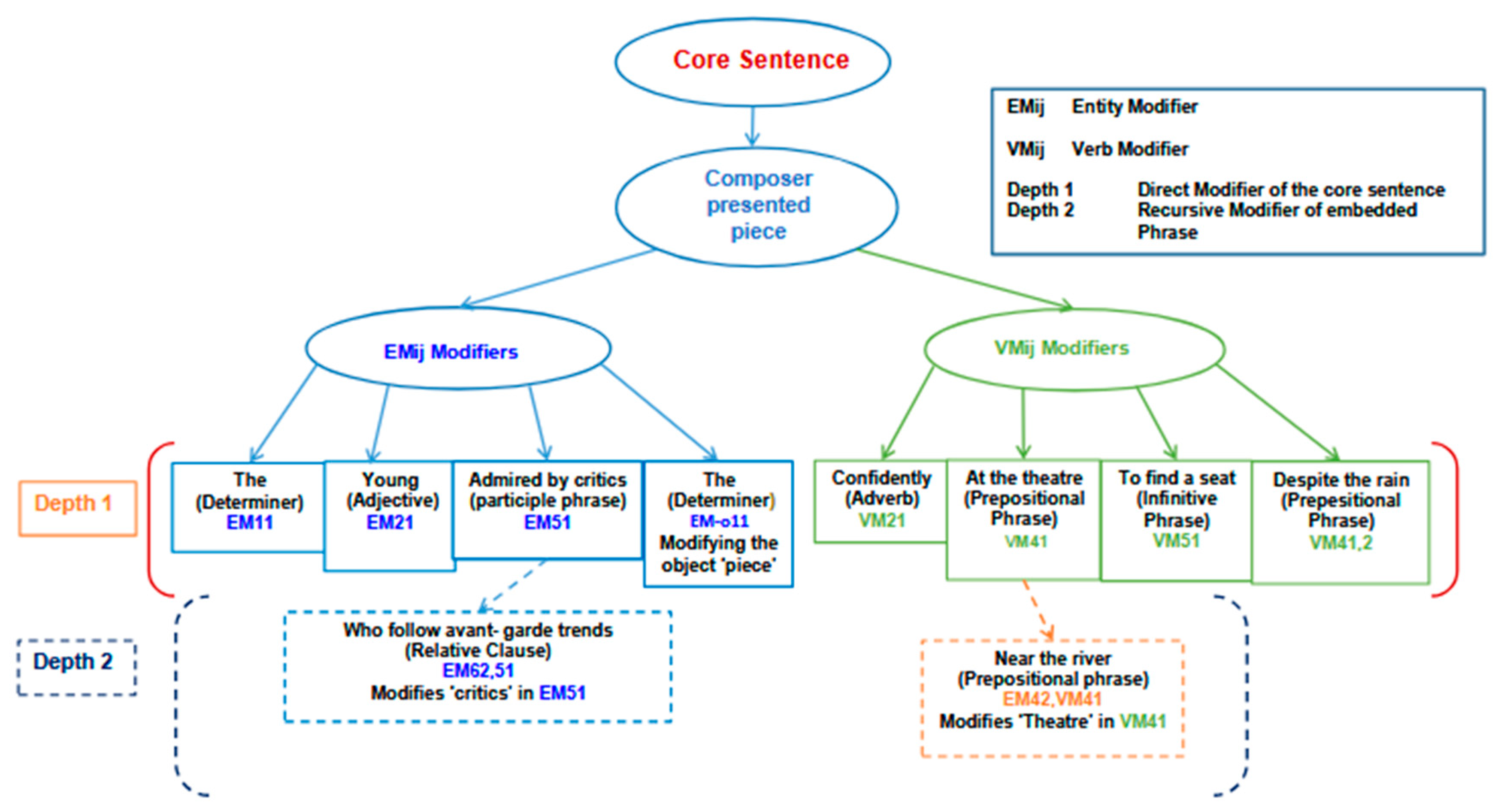
Figure 2.
Temporal Enactment of Existence.
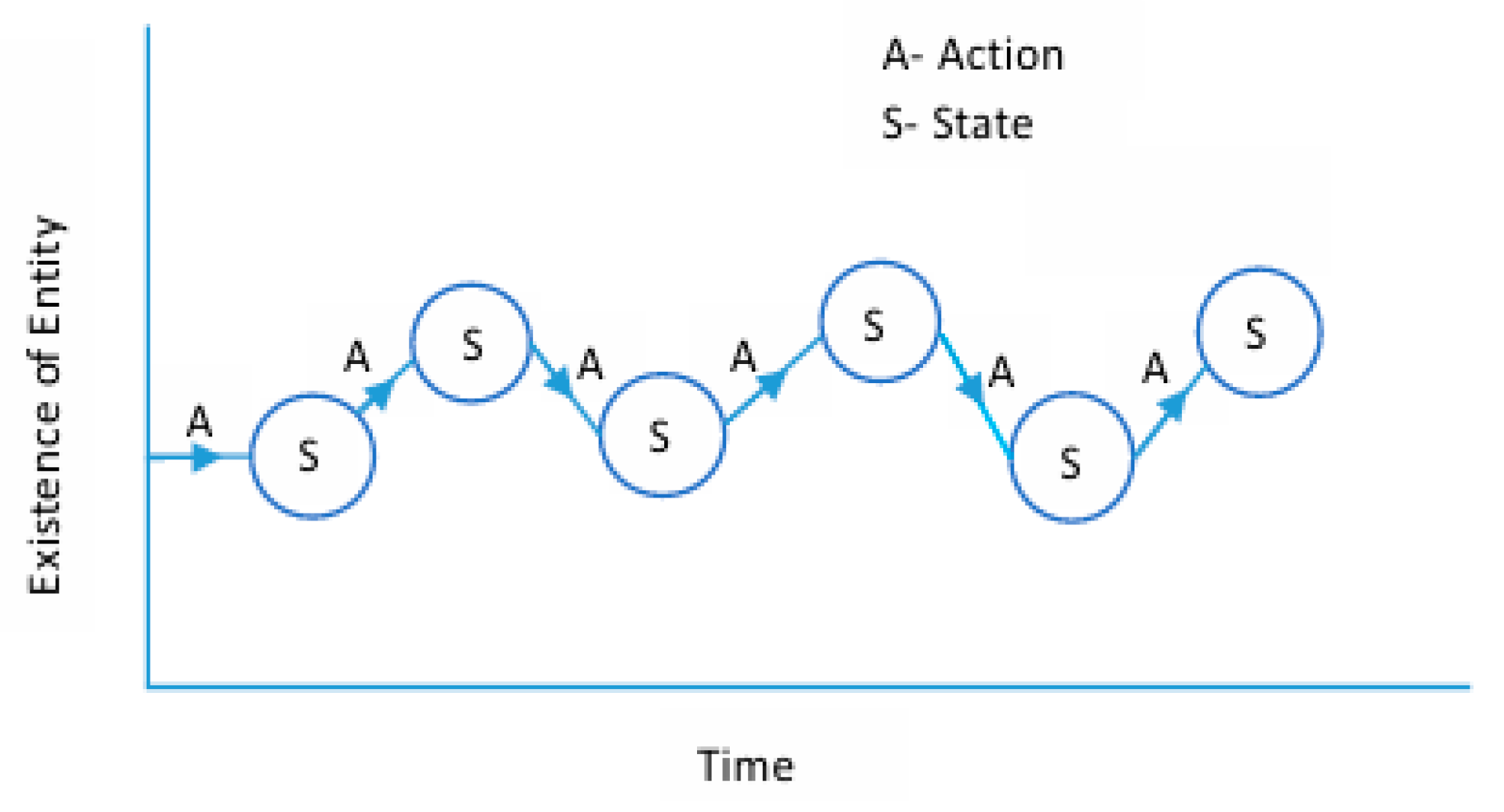
Figure 2a.
Parallel Recursion Model of Existence.
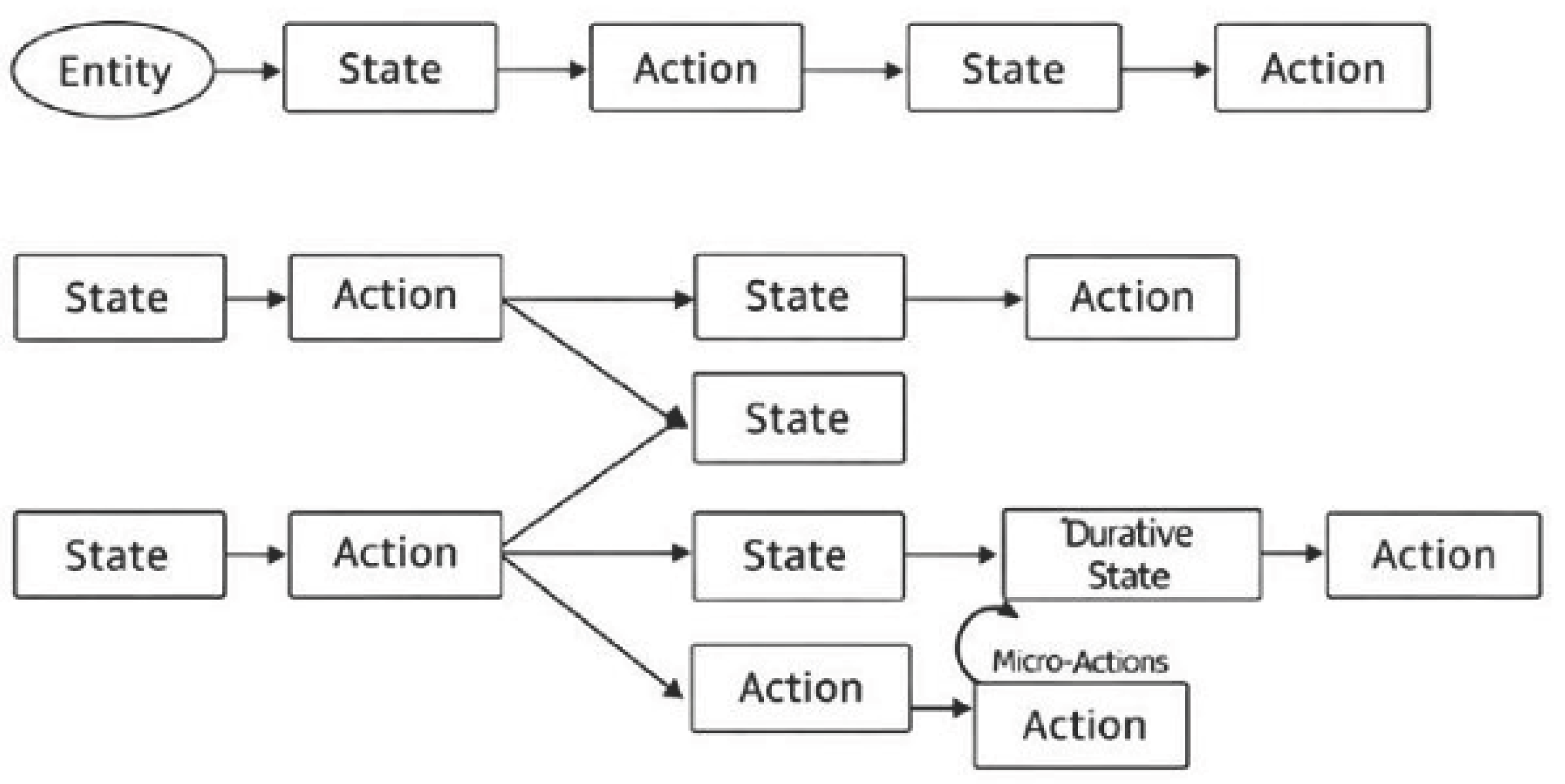

Table 1.
Comparative analysis of major linguistic frameworks and how the Law of the Trio resolves their limitations.
Table 1.
Comparative analysis of major linguistic frameworks and how the Law of the Trio resolves their limitations.
| Framework | Core Insight | Limitation | How the Law of the Trio Resolves |
|---|---|---|---|
| Generative Grammar | Recursion as defining property of human language; hierarchical phrase structure enables infinite generativity. | Focuses narrowly on syntax; lacks semantic universality. | Trio reframes recursion as semantic geometry, enriching meaning across modalities without language-specific transformations. |
| Movement & Transformation Rules | Explains surface variation via syntactic operations (raising, wh-movement, passivization). | Bound to syntax; struggles to capture semantic constancy across languages. | Trio situates recursion at the level of meaning, eliminating need for abstract transformations. |
| Cognitive Science | Working memory constrains recursion depth; comprehension involves event simulation. | No formal notation to predict processing limits. | Trio introduces indices (i, j) to mark modifier type and recursion depth, aligning semantic recursion with cognitive load. |
| Pedagogy | Grammar teaching isolates categories (adjectives, adverbs, clauses). | Learners struggle to see how modifiers interlock. | Trio provides visible scaffolding (EMi/VMi,j notation), making recursion explicit and transferable across languages. |
| Semiotics | Saussure’s dyad (signifier/signified); Peirce’s triad (sign–object–interpretant). | Saussure’s dyad is static; Peirce’s triad lacks linguistic universality. | Trio synthesizes both into a recursive triadic system, unifying semiotics and linguistics. |
Disclaimer/Publisher’s Note: The statements, opinions and data contained in all publications are solely those of the individual author(s) and contributor(s) and not of MDPI and/or the editor(s). MDPI and/or the editor(s) disclaim responsibility for any injury to people or property resulting from any ideas, methods, instructions or products referred to in the content. |
© 2026 by the authors. Licensee MDPI, Basel, Switzerland. This article is an open access article distributed under the terms and conditions of the Creative Commons Attribution (CC BY) license (http://creativecommons.org/licenses/by/4.0/).
Copyright: This open access article is published under a Creative Commons CC BY 4.0 license, which permit the free download, distribution, and reuse, provided that the author and preprint are cited in any reuse.